
GreenPill
by Kevin Owocki
Is this your podcast?Insights from recent episode analysis
Audience Interest
Podcast Focus
Publishing Consistency
Platform Reach
Insights are generated by CastFox AI using publicly available data, episode content, and proprietary models.
Most discussed topics
Brands & references
Total monthly reach
Estimated from 1 chart position in 1 market.
By chart position
- 🇪🇸ES · Education#1861K to 10K
- Per-Episode Audience
Est. listeners per new episode within ~30 days
300 to 3K🎙 Daily cadence·293 episodes·Last published 2mo ago - Monthly Reach
Unique listeners across all episodes (30 days)
1K to 10K🇪🇸100% - Active Followers
Loyal subscribers who consistently listen
300 to 3K
Market Insights
Platform Distribution
Reach across major podcast platforms, updated hourly
Total Followers
—
Total Plays
—
Total Reviews
—
* Data sourced directly from platform APIs and aggregated hourly across all major podcast directories.
On the show
From 11 epsHosts
Recent guests
Recent episodes
S.10 Ep.12 Can Quadratic Funding Go Mainstream? | Ma Earth, Hypercerts & the Future of Public Goods
Jun 30, 2026
40m 25s
VDAO Ep 12 The Hidden Risks of Stablecoins (And Why Decentralization Matters) | Michael
Apr 27, 2026
1h 06m 15s
S.10 Ep.11 $170M to Fix Ethereum Security (After Another Major Hack) with Griff Green
Apr 24, 2026
53m 34s
VDAO Ep 11 Rethinking Systems: Resilience, Coordination & the Future We're Building | Raphael
Apr 20, 2026
55m 28s
VDAO Ep 10 Humans as a Keystone Species: Regeneration, Crypto & the Meta-Crisis | Gregory
Apr 13, 2026
1h 43m 21s
Social Links & Contact
Official channels & resources
Official Website
Login
RSS Feed
Login
| Date | Episode | Topics | Guests | Brands | Places | Keywords | Sponsor | Length | |
|---|---|---|---|---|---|---|---|---|---|
| 6/30/26 | Quadratic Fundingpublic goods funding+5 | Matthew MonahanHolke Brammer | Ma EarthHypercerts Foundation+4 | — | Quadratic Fundingpublic goods+6 | — | 40m 25s | ||
| 4/27/26 | stablecoinsdecentralization+5 | Michael | Silicon Valley BankEthereum+5 | — | stablecoinsdecentralized finance+6 | — | 1h 06m 15s | ||
| 4/24/26 | Ethereum securitycrypto challenges+4 | Griff Green | DAO Security FundEthereum+5 | — | Ethereumsecurity+6 | — | 53m 34s | ||
| 4/20/26 | resiliencesystem design+5 | Raphael | GreenPillVDAO+3 | — | resiliencesystems+7 | — | 55m 28s | ||
| 4/13/26 | keystone speciesregeneration+5 | Gregory | Regen NetworkVDAO Series | Alaska | meta-crisisenvironmentalism+6 | — | 1h 43m 21s | ||
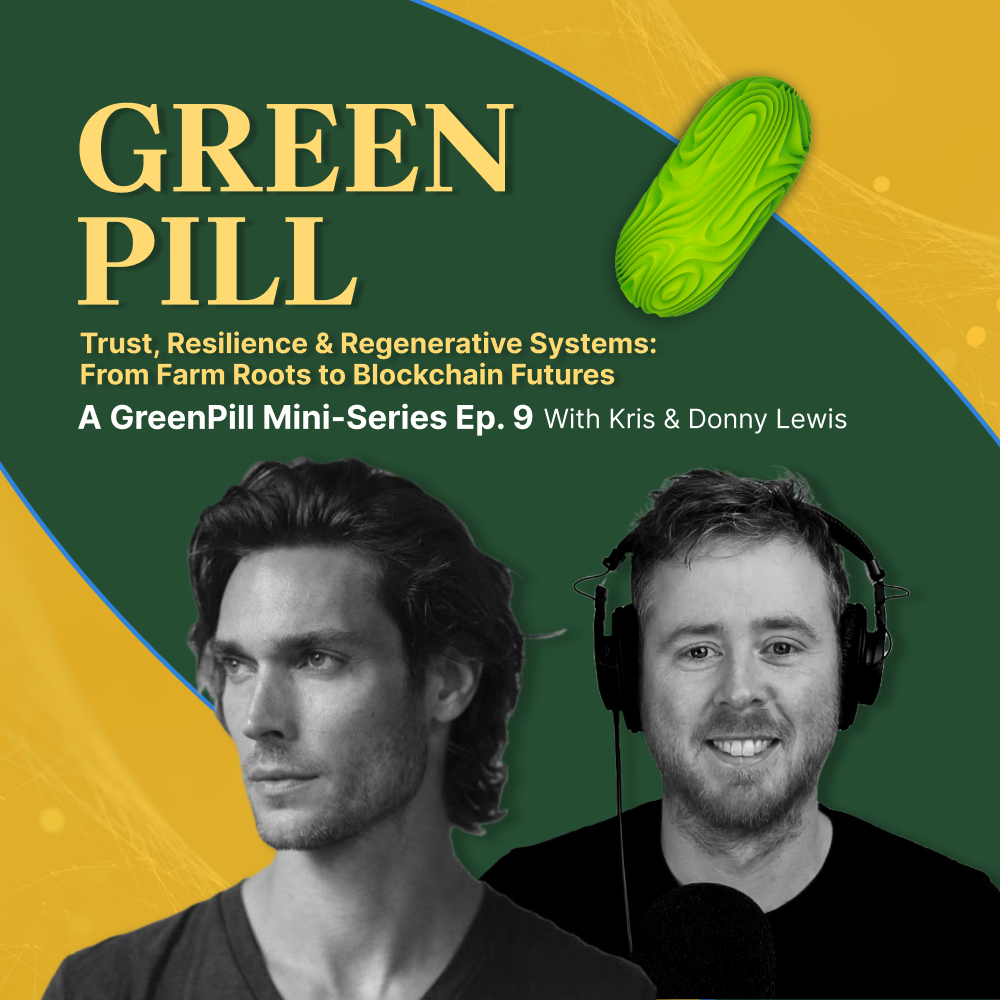
| 4/6/26 | trustresilience+5 | Donny Lewis | Web3AI+2 | Texas | blockchainresilience+7 | — | 54m 15s | ||
| 3/31/26 | local resilienceurban permaculture+5 | Adrian | Calgary Harvestgreenpill.network+1 | — | resilienceecosystems+5 | — | 1h 00m 57s | ||
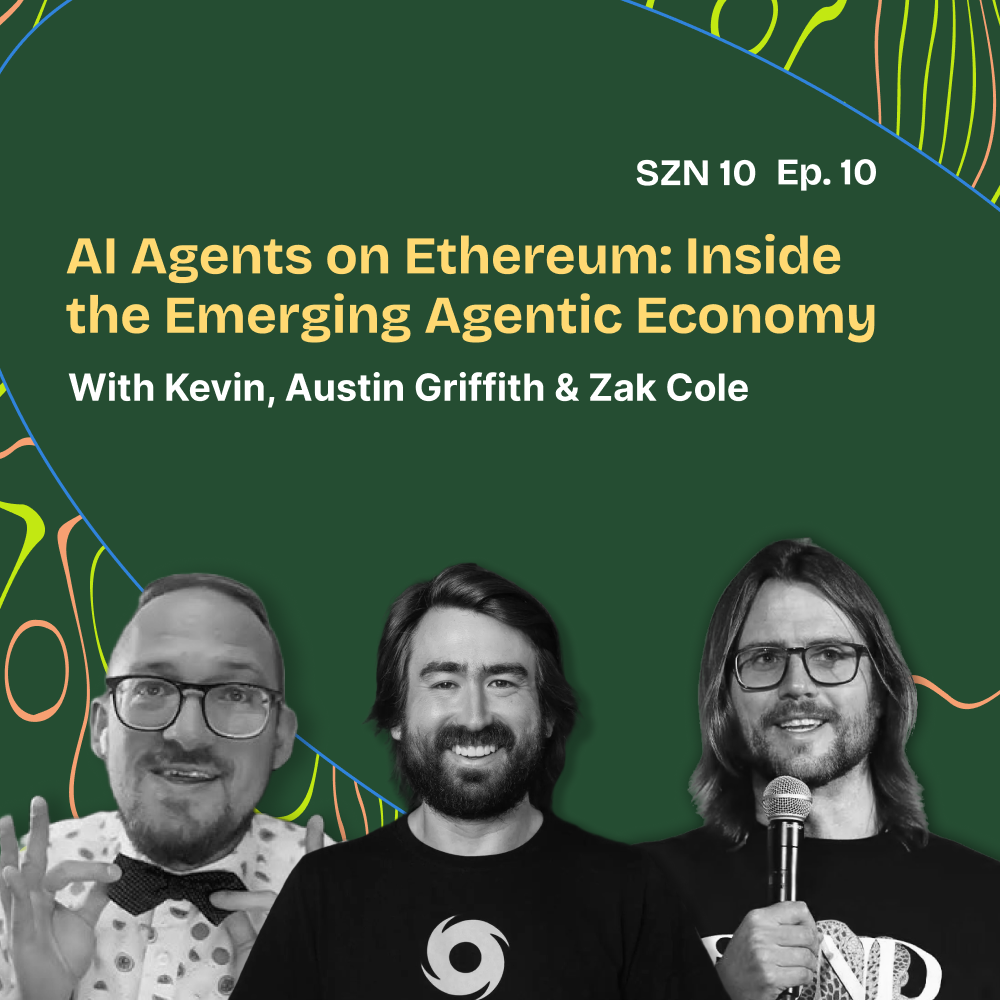
| 2/9/26 | AI agentsEthereum+5 | Zak ColeAustin Griffith | EthereumOpenClaw+1 | — | AI agentsEthereum+6 | — | 59m 42s | ||
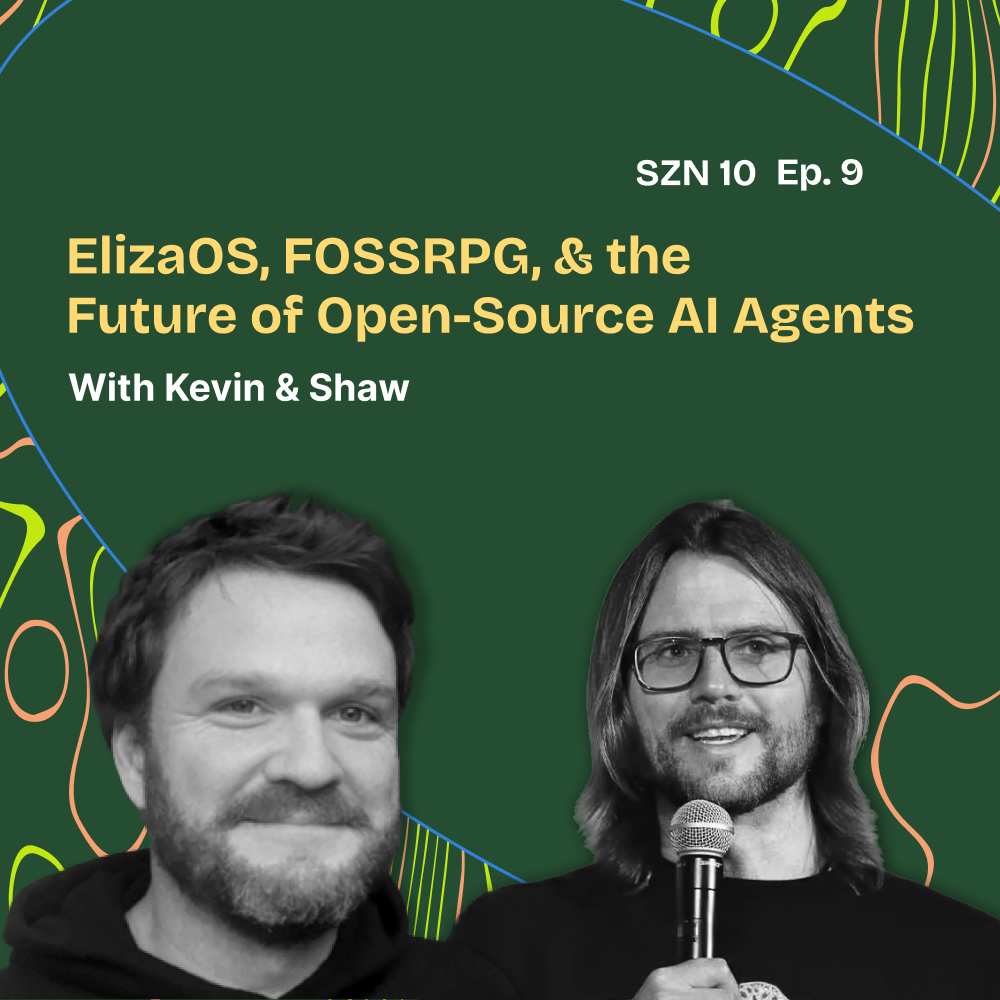
| 2/7/26 | open sourceAI agents+4 | Shaw | ElizaOSgreenpillnet+6 | — | ElizaOSAI agents+5 | — | 52m 00s | ||
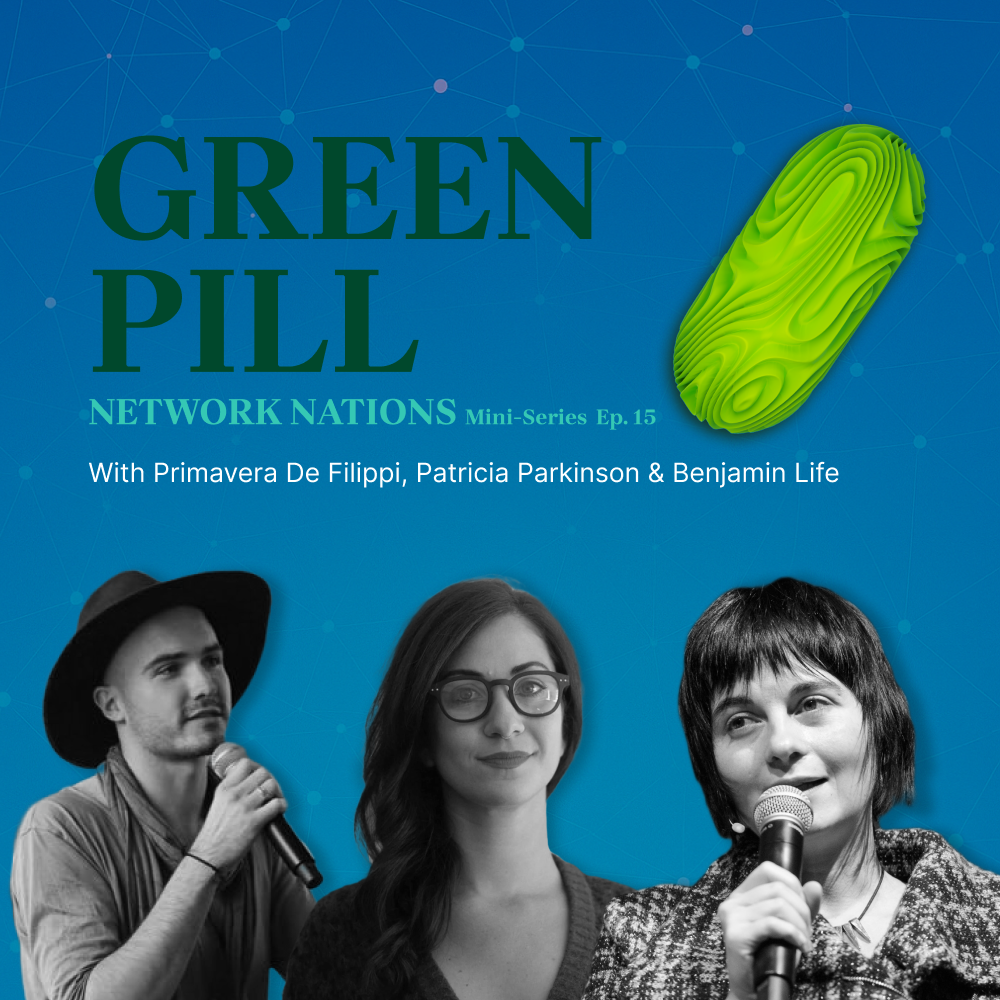
| 2/6/26 | Network Nationsmovement building+5 | Patricia ParkinsonBenjamin Life | OpenCivicsgreenpillnet+5 | — | Network Nationsmovement building+8 | — | 59m 43s | ||
Want analysis for the episodes below?Free for Pro Submit a request, we'll have your selected episodes analyzed within an hour. Free, at no cost to you, for Pro users. | |||||||||
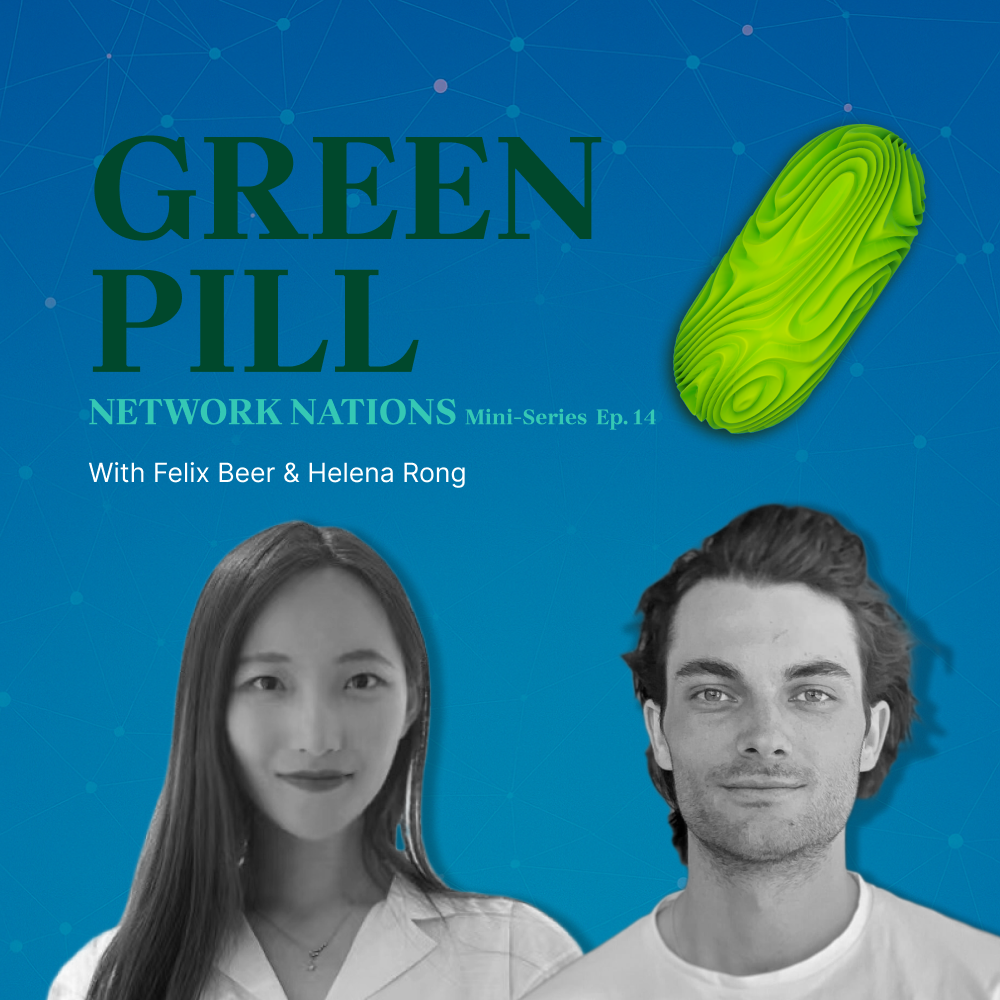
| 1/30/26 | Network NationsSeeDAO+5 | Helena Rong | New York University ShanghaiSeeDAO+5 | — | SeeDAONetwork Nations+7 | — | 53m 36s | ||
| 1/26/26 | 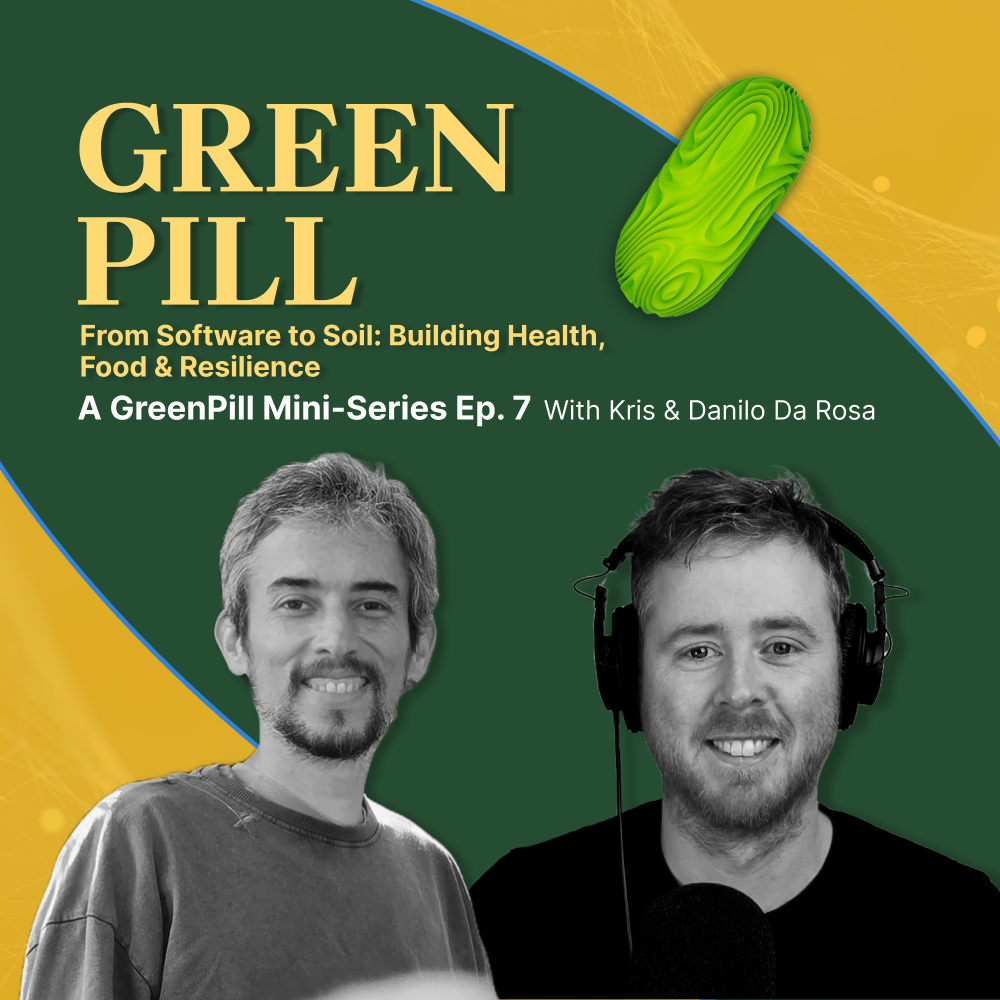 VDAO Ep.7 From Software to Soil: Health, Food & Building Real Resilience with Danilo Da Rosa | New @greenpillnet pod out today! 🌐 In this episode of the VDAO × Greenpill Anti-Fragile Network States mini-series, host Kris Miller speaks with Danilo, a software engineer who left city life behind to rebuild his health, relationship with food, and sense of resilience through permaculture, natural building, and community living in Uruguay. Danilo shares how a health crisis pushed him to rethink his lifestyle, why growing food changed everything, and how moving closer to nature reshaped his understanding of resilience. They explore food autonomy, water catchment, natural house building, digital tools for land design, patience as a strategy, and why community is the most important layer of resilience. A deeply human conversation about bridging technology and nature to build a regenerative, antifragile way of life. 🌱 greenpill.network 🌐 vdao.org 🐦 https://x.com/JoinVDAO 🐦 https://x.com/greenpillnet linktr.ee/danilo_da_rosa ⏱️ Timestamps 00:00 – Cold open: city life, darkness & missing nature 00:59 – Danilo joins & his "why" 02:30 – Health crisis & rethinking food 03:55 – Farmers markets, seasons & nutrient-dense food 05:00 – Leaving the city for a small farm 06:45 – Technology, screens & losing connection with nature 08:05 – What resilience means on a human level 09:15 – Health challenges as antifragility 11:15 – COVID, gardens & food security 13:15 – Choosing land: early mistakes & lessons 15:00 – Advice: observe land for a full year 17:25 – Studying soil, biodiversity & local laws 18:10 – Using digital tools to assess land 19:35 – Making land-design tools free & accessible 22:00 – Water catchment & reading the land 25:55 – Rainwater systems, ponds & long-term planning 27:50 – Slow solutions & patience in permaculture 29:40 – Building a natural (cob) house 31:45 – Learning by building & skill-sharing 33:30 – Loneliness, then rediscovering community 35:45 – Mingas, workshops & social resilience 37:45 – Local materials & low-tech building 41:35 – Bridging tech skills with land stewardship 43:50 – Using software to support regeneration 45:50 – Food autonomy: annuals vs perennials 48:20 – Energy efficiency & working with nature 49:40 – One-square-meter gardens as a starting point 52:00 – Energy use, renewables & solar plans 53:15 – Advice for developers starting this journey 54:50 – Final thoughts & closing | — | ||||||
| 1/23/26 | 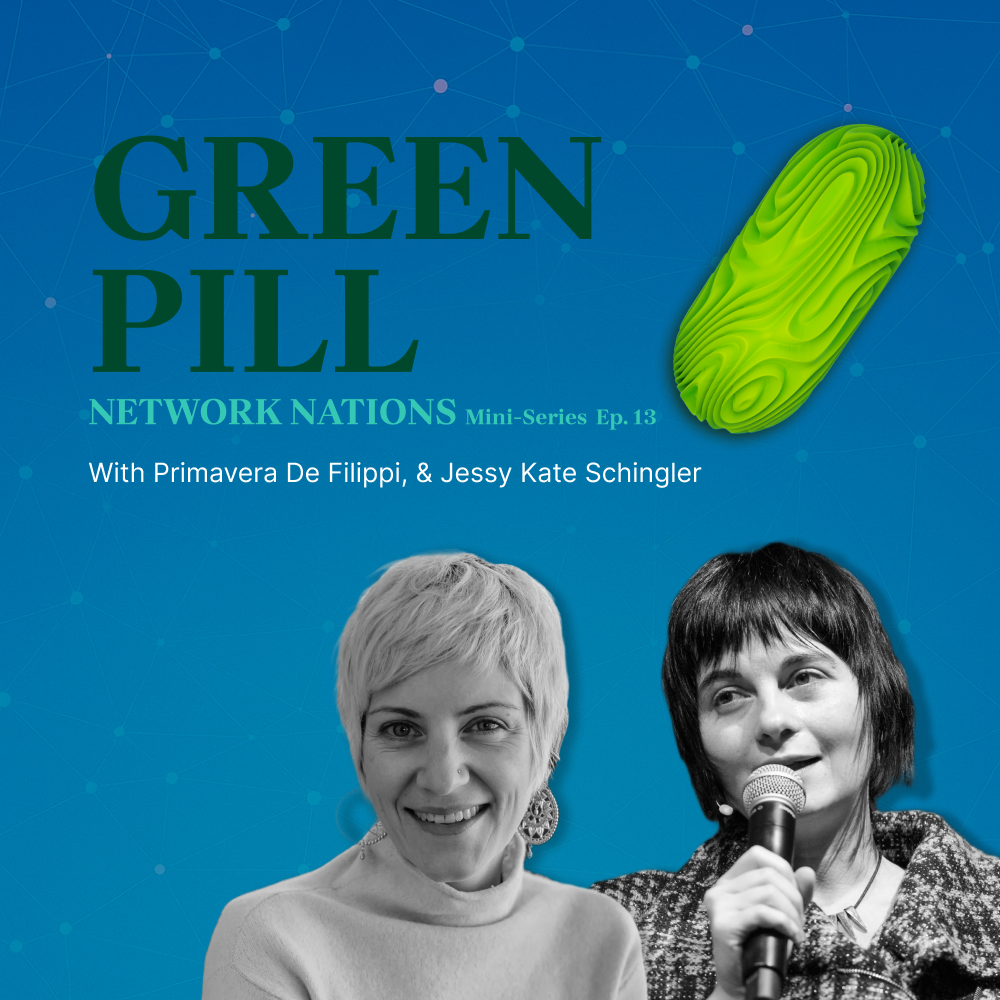 NN Ep:13 - Intentional Communities & New Jurisdictions with Jessy Kate Schingler | New @greenpillnet pod out today! 🌐 In this episode of the Network Nations mini-series, Primavera De Filippi is joined by Jessy Kate Schingler, co-founder of the Embassy Network, to explore how intentional communities and new jurisdictions can give Network Nations real-world grounding. Jessy shares lessons from over a decade of building translocal co-living communities, explains why the Embassy Network thought of its spaces as "embassies to the future," and how identity, culture, and entanglement emerge without formal membership rules. The conversation then turns to jurisdictional innovation, including Gelephu Mindfulness City in Bhutan, and how special administrative regions, charter cities, and regulatory sandboxes could act as physical anchor points for Network Nations. A rich discussion on culture, identity, subsidiarity, functional sovereignty, and how digital communities might interface with states without losing their values. 🌱 greenpill.network 🌐 networknations.network 🐦 @owocki @greenpillnet https://x.com/yaoeo https://x.com/jessykate ⏱️ Timestamps 00:00 – Can Network Nations become political actors without land? 01:10 – Intentional communities vs new jurisdictions 02:25 – Introducing Jessy Kate Schingler (Embassy Network) 03:20 – What intentional communities look like today 04:45 – The origin of the Embassy Network 05:40 – "Embassies to the future" where the name came from 06:45 – Membership, curation & why formal rules failed 08:15 – Sister communities & translocal identity 09:30 – Cultural, financial & people-based entanglement 11:40 – Cultural transfusion as the strongest glue 13:00 – Financial support between community nodes 14:20 – Identity through shared people & movement 16:20 – Drift: experiments with shared currencies & mobility 18:05 – Private law vs public law in Network Nations 19:10 – Why jurisdictions matter for scaling 20:05 – Rise of new jurisdictions worldwide 21:50 – Introducing Gelephu Mindfulness City (Bhutan) 23:30 – Values, culture & mindful development 25:35 – Experimentation, subsidiarity & the "diamond strategy" 27:20 – Visas, access & digital-first services 29:35 – Jurisdictions as platforms for Network Nations 31:45 – New corporate forms & DAO-native structures 33:45 – Network state vs network nation approaches 36:05 – Polycentricity & layered governance 38:00 – Embassies as portals between cultures 40:15 – AI, credentials & future statutory innovation 42:40 – Regulatory equivalence & sandboxing 44:40 – Intentional communities vs territorial zones 46:40 – Dispute resolution as a legitimacy bridge 50:30 – Lessons from working with states 52:40 – Land policy, mutualism & functional sovereignty 54:50 – Where to follow Jessy Kate & closing thoughts | — | ||||||
| 1/16/26 | 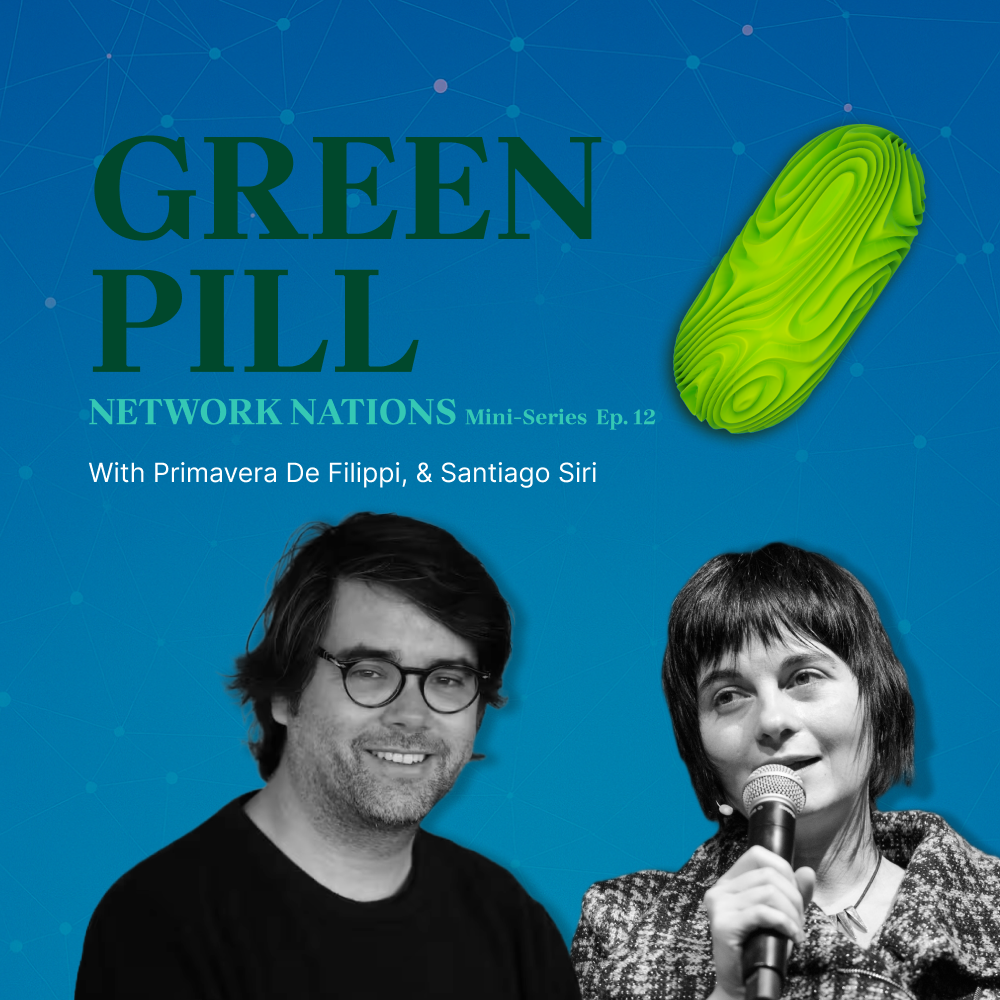 NN Ep:12 From politics to protocols to protocol politics with Santiago Siri | In this episode of the Network Nations mini-series, Primavera De Filippi speak with Santiago Siri, founder of Democracy Earth, DemocracyOS, and Proof of Humanity, to explore a central question of the digital age: Can we escape politics with protocols or do protocols simply create new political arenas? Santiago shares his journey from building Argentina's internet political party Partido de la Red, to creating open-source democratic infrastructure, to running one of the most ambitious on-chain identity and governance experiments in Web3. They discuss identity as the core bottleneck of digital democracy, governance failures inside protocols, DAOs as political systems, AI as both promise and threat, and what Network Nations must learn from a decade of real-world experimentation. A deep, honest conversation about legitimacy, power, and why politics never disappears it just moves layers. 🌱 greenpill.network 🌐 networknations.network 🐦 @owocki @greenpillnet https://x.com/santisiri https://x.com/yaoeo ⏱️ Timestamps 00:00 – Can protocols help us escape politics? 01:00 – Introducing Santiago Siri 02:15 – From activism to political parties 04:10 – Partido de la Red & proxy voting 06:40 – Using technology to modernize democracy 09:00 – DemocracyOS & global adoption 10:45 – Why political systems resist change 12:10 – The limits of centralized digital voting 14:15 – Why identity is the core problem 15:45 – Leaving politics to build infrastructure 17:50 – Democracy Earth & global pilots 20:00 – Bitcoin vs Ethereum for governance 22:00 – The birth of Proof of Humanity 24:20 – Early identity failures & attacks 26:40 – One person, one vote challenges 29:55 – Proof of Humanity mechanics explained 32:10 – UBI, incentives & DAO governance 34:40 – Delegation farming & power struggles 36:25 – Quadratic delegation as a fix 38:25 – Removing founders from power 40:25 – Identity, justice & money tensions 42:00 – AI breaks video-based identity 44:05 – Worldcoin & biometric approaches 46:30 – Protocols still create politics 48:30 – AI governance experiments 50:25 – Why AI is still unsafe for governance 52:25 – Centralized compute as a risk 54:15 – Who governs the governance layer? 56:40 – Proof of Humanity as a proto–Network Nation 58:40 – What's missing for real Network Nations 01:00:45 – Shared identity & legitimacy 01:02:55 – Lessons from 10 years of experimentation 01:04:40 – Final lesson: legitimacy is enacted, not declared 01:07:30 – Where to follow Santiago & closing | — | ||||||
| 1/9/26 |  NN Ep:11 Let a Thousand Societies Bloom with Vitalik Buterin | New @greenpillnet pod out today! 🌐 In this episode of the Network Nations mini-series, Primavera De Filippi & Felix Beer are joined by Vitalik Buterin to reflect on one of the most influential experiments in recent community-building history: Zuzalu. Vitalik shares the motivations behind Zuzalu, what actually worked (and what didn't), and why many pop-up cities risk drifting into "long conferences" instead of becoming real communities. Together they explore kinship vs telos, culture vs mission, permanence vs mobility, governance by forking, and how zones, tribes, and regulatory sandboxes might interlock to form durable network nations. A deep, reflective conversation on how digitally aligned communities can evolve into lasting political actors without losing their soul. 🌱 greenpill.network 🌐 networknations.network 🐦 @owocki @greenpillnet https://x.com/yaoeo?lang=en https://x.com/felix_beer?lang=en https://x.com/VitalikButerin https://www.zuzalu.city/ ⏱️ Timestamps 00:00 – Why Zuzalu matters for network nations 02:20 – Introducing Vitalik & the Zuzalu experiment 03:40 – From ideas to action: why Zuzalu was created 05:40 – Bringing 200 people together for two months 07:10 – When a pop-up becomes "real life" 09:10 – Membership, visas & selective curation 11:20 – Zuzalu's offshoots: Edge City, Vitalia & more 13:30 – Decentralizing after Zuzalu 15:30 – Why permanence matters 18:10 – Building culture through physical proximity 20:20 – Cities vs tribes vs nations 22:30 – Membership as a spectrum, not binary 24:50 – Bitcoin embassies & cultural recognition 27:00 – Interests vs vibes vs kinship 29:10 – Shared experiences as the glue of community 31:30 – Why kinship is hard to design 33:50 – Internal purpose vs external purpose 36:10 – Telos-driven communities & corporations 38:50 – Prospera, regulation & culture 41:00 – Zones as platforms for tribes 44:40 – Regulatory sandboxes & state experiments 46:50 – Libertarian vs developmentalist approaches 49:10 – Why niche cities beat generic hubs 51:40 – The "archipelago" vision 54:00 – Zones and tribes: separation or fusion? 56:00 – Governance by forking 01:10:00 – Why governance still matters 01:12:10 – Reinvigorating crypto's political vision 01:14:10 – Low-hanging fruit for network nations 01:16:40 – Ethereum as a proto-network nation 01:17:50 – Closing thoughts | — | ||||||
| 1/2/26 | 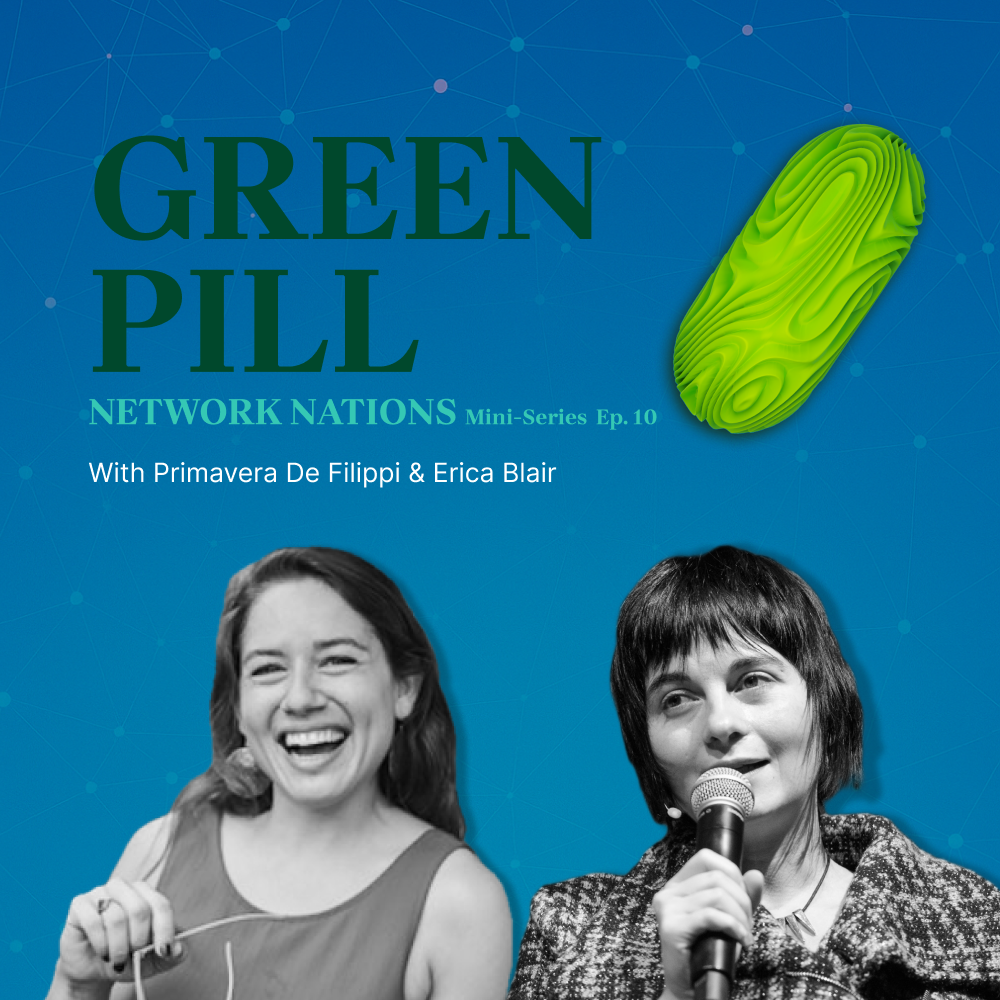 NN Ep:10 Burning Man: Seeding a Network Nation | New @greenpillnet pod out today! 🌐 In this episode of the Network Nations mini-series, Primavera De Filippi explore one of the most influential community experiments of the last 40 years: Burning Man. They're joined by Erika Blair, who leads engagement and network strategy at Burning Man, to unpack how a one-week event in the Nevada desert evolved into a global, year-round network of communities bound not by territory, but by shared principles, rituals, and identity. The conversation dives into the origins of Burning Man, the emergence of the 10 Principles, regional burns around the world, kinship and belonging, ritual and meaning, cultural dilution, and whether Burning Man can be understood as a real-world example of a network nation — including where it aligns, and where it diverges, from ideas like functional sovereignty and self-governance. A fascinating case study for anyone interested in network societies, collective identity, and the future of non-territorial communities. 🌱 greenpill.network 🌐 networknations.network https://burningman.org/ @owocki @greenpillnet ⏱️ Timestamps 00:00 – Burning Man as a radical community experiment 02:09 – Introducing Erika Blair & her role at Burning Man 03:50 – Why Burning Man resonated as a movement 05:30 – Burning Man as a response to consumerism 07:40 – The mythic origins: burning the man on the beach 09:40 – Meaning without a fixed narrative 12:15 – What does it mean to be a "Burner"? 14:20 – Global participation beyond Nevada 17:20 – Recognizing "Burner texture" and shared ethos 18:40 – Imagining the world anew 20:30 – The 10 Principles: origins and purpose 24:00 – How regional burns emerged worldwide 27:20 – Burning Man as a "network of networks" 30:10 – Why some events are official 32:10 – Protecting culture from commodification 35:40 – Kinship, belonging, and recognition 37:50 – Decommodification and trust 40:20 – Rituals: the Man, the Temple, grief & celebration 43:20 – Full-spectrum human experience 45:20 – Popularity, scaling & cultural dilution 47:50 – Burning Man across cultures 49:20 – Is Burning Man a Network Nation? 51:30 – Functional sovereignty & working with states 53:45 – Governance, autonomy & stewardship 56:20 – Burning Man as a permission engine 58:40 – Community decision-making & slow governance 01:00:55 – The power of intrinsic motivation 01:02:40 – Building nations vs building companies 01:03:50 – Where to learn more & closing | — | ||||||
| 12/30/25 | 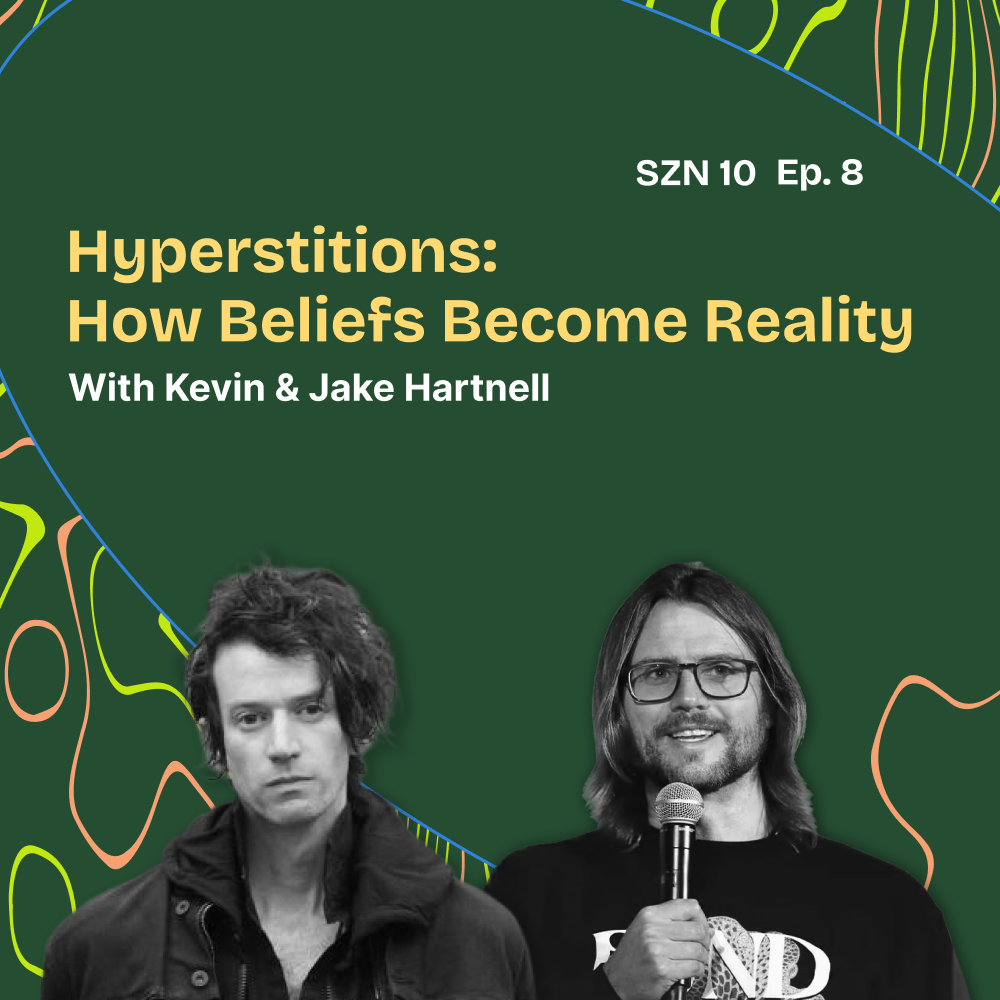 S.10 Ep.8 Hyperstitions: How Beliefs Become Reality in Networked Systems with Jake Hartnell | New @greenpillnet pod out today! 🌐 In this episode of the Greenpill Podcast, Kevin Owocki sits down with Jake Hartnell reality engineer, builder, and the mind behind ENOVA to explore the idea of hyperstitions: beliefs and narratives that become real by spreading through networks. Jake explains how hyperstitions operate as a new coordination primitive, why technologies like Bitcoin, Ethereum, and AGI can be seen as successful hyperstitions, and how tools like hyperstition markets blend prediction markets, incentives, and storytelling to drive collective action. They discuss ENOVA, egregores, cybernetic systems, futarchy, and how communities can consciously design narratives that pull the future into the present. A deep and playful conversation about memetics, crypto-economics, and how collective belief can shape the world. 🌱 greenpill.network @owocki @greenpillnet https://x.com/JakeHartnell Some of the materials we mention in the episode: https://x.com/0xEN0VA https://en0va.xyz/hyperstition ⏱️ Timestamps 00:00 – Welcome to a new season of Greenpill 01:55 – Introducing Jake Hartnell & the idea of hyperstitions 02:45 – What is a hyperstition? (simple definition) 04:23 – Examples: AGI, Ethereum & Bitcoin as hyperstitions 06:50 – Everyday hyperstitions: lunch vs parties 08:05 – Network effects & aspirational stories 09:20 – Is Greenpill itself a hyperstition? 10:10 – What Jake is building with ENOVA 11:05 – Hyperstition markets explained 12:35 – The first hyperstition market & Goodhart's Law 14:10 – Donation-based hyperstitions & GG / bioregional funding 16:10 – Incentivizing action, not passive prediction 18:00 – Theory of change & coordination design 19:40 – Hyperstition markets vs hyperstition itself 21:30 – Where to find ENOVA & what's coming next 23:05 – Egregores, cybernetic systems & collective intelligence 26:15 – Making hyperstition markets permissionless 28:00 – Greenpill, regeneration & narrative power 31:55 – Phases of a hyperstition 33:20 – Futarchy & decision-making markets 35:20 – Community as the real coordination engine 36:20 – A future where DAOs work 38:15 – Collective intelligence as political power 39:50 – Closing thoughts & where to follow Jake | — | ||||||
| 12/23/25 | 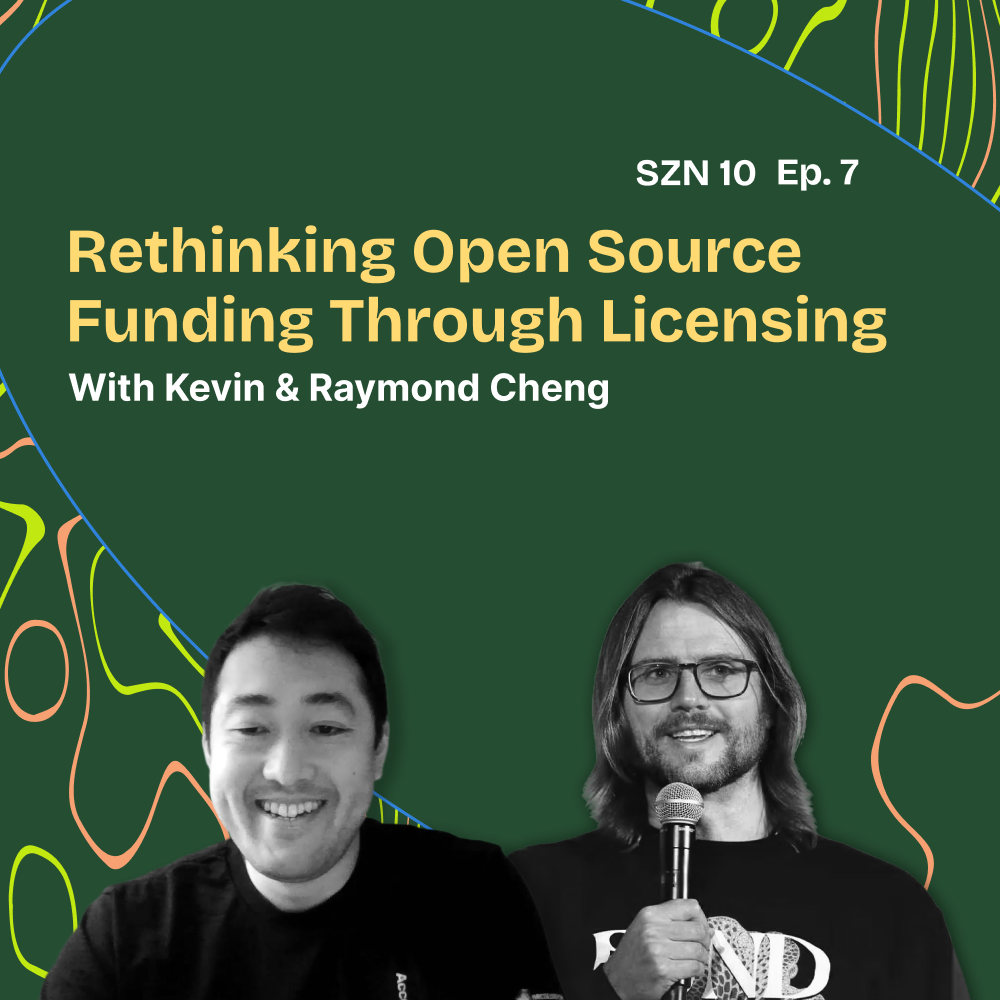 S.10 Ep.7 Prosperous Software: Rethinking Open Source Funding Through Licensing | New @greenpillnet pod out today! 🌐 In this episode of the Greenpill Podcast, Kevin Owocki talks with Raymond Cheng software engineer, researcher, and co-founder of Open Source Observer — about the Prosperous Software Movement and why open source licensing needs to evolve. Raymond explains how today's open source economy underfunds its own foundations, why existing licenses fail to reflect modern financial realities, and how a new class of revenue-sharing licenses could sustainably fund open source dependencies. They explore the history of free software, the limits of voluntary public goods funding, the idea of "ProfitLeft" licensing, and how legal, technical, and social mechanisms including crypto could help open source creators share in the prosperity they generate. A must-listen for anyone building, funding, or relying on open source software in Web3 and beyond. Some of the materials we mention in the episode: https://tally.so/r/68LGdO https://pgf.ing/chat 🌱 greenpill.network @owocki @greenpillnet @RaymondCheng00 Timestamps 00:00 – Welcome to the Greenpill Podcast 01:00 – Introducing Raymond Cheng & Open Source Observer 02:45 – The problem: funding open source sustainably 04:30 – Why public goods funding has hit its limits 06:10 – The history of free software & open source licenses 08:10 – Open source as the bedrock of the global economy 10:30 – Why current licenses ignore financial reality 12:10 – Introducing the Prosperous Software Movement 14:00 – Why licensing is a core lever of power 16:00 – Preserving open source freedoms while adding funding 18:30 – "ProfitLeft" vs traditional commercial licenses 20:30 – How revenue-sharing licenses could work 22:45 – Crypto, smart contracts & enforceability 24:50 – Legal, technical & social power combined 26:45 – Building a founding cohort of projects 28:30 – Call to action: how to get involved 30:00 – Long-term vision: prosperity for open source 31:30 – Zero-to-one adoption challenges 33:00 – Closing thoughts & where to follow Raymond | — | ||||||
| 12/19/25 | 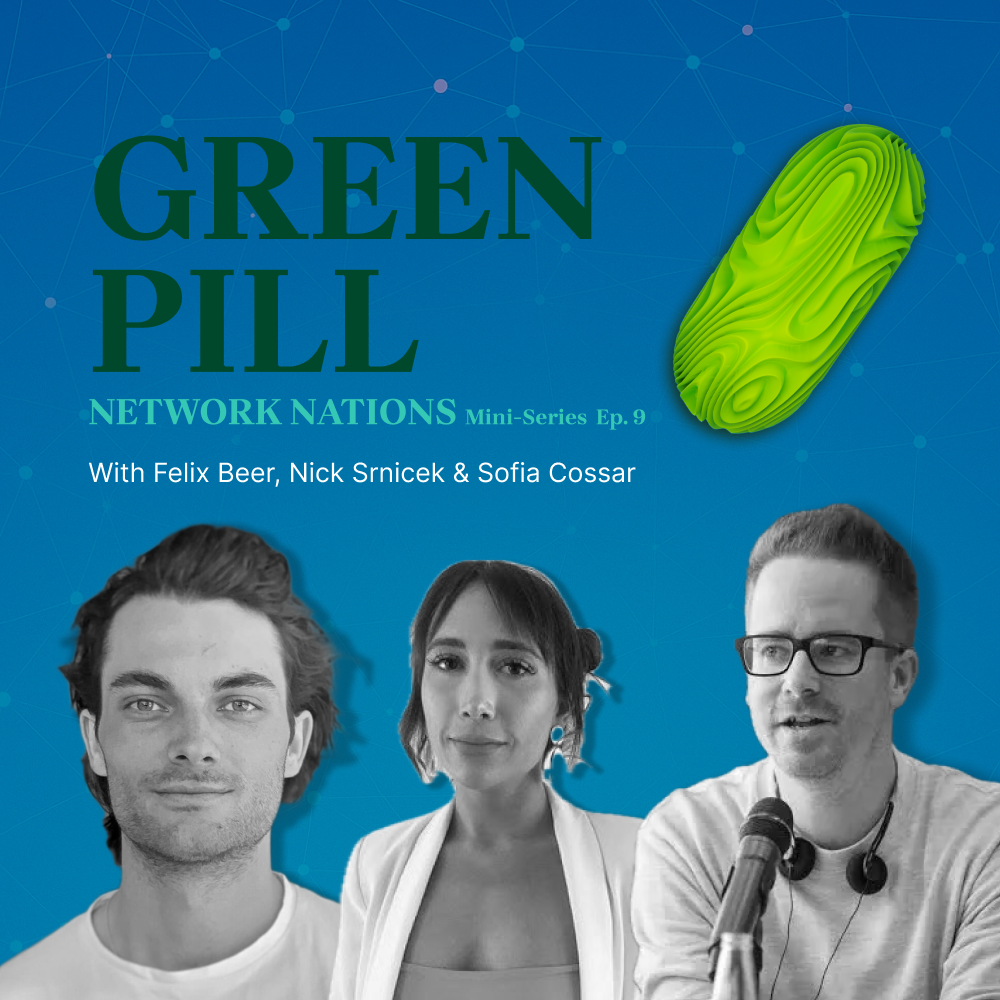 NN Ep:9 A New Political Landscape in the Digital Age with Nick Srnicek & Sofia Cossar | New @greenpillnet pod out today! 🌐 In this episode of the Network Nations mini-series, host Felix Beer is joined by Nick Srnicek (author of Platform Capitalism and Silicon Empires) and Sofia Cossar (BlockchainGov) to explore the emerging concept of Network Sovereignty. They unpack how power is shifting from nation-states to digital networks, why platforms now function like political infrastructures, and how algorithms, protocols, and platforms increasingly shape governance, speech, and economic life. The conversation examines platform empires, AI infrastructure, state power, civil society strategies, Web3, cooperative platforms, and what it would take to reclaim networks as democratic commons rather than extractive systems. A foundational episode for anyone trying to understand sovereignty, power, and governance in a networked world. 🌱 greenpill.network 🌐 networknations.network @owocki @greenpillnet https://x.com/nsrnicek?lang=en https://x.com/CossarSofia ⏱️ Timestamps 00:00 – Welcome to the Network Nations mini-series 01:30 – What are Network Nations? 02:10 – Introducing today's topic: Network Sovereignty 02:45 – Guests: Nick Srnicek & Sofia Cossar 04:30 – Living in the network age 05:35 – Platforms as infrastructures, not just tools 07:40 – Is there an "outside" to the network? 09:45 – Modulating participation instead of exiting 11:10 – Platform capitalism & concentrated power 13:30 – From markets to empires: platforms as political actors 15:55 – Rule-making, enforcement & taxation by platforms 18:15 – AI, data centers & physical infrastructure power 20:20 – States vs platforms: dependency and conflict 22:20 – Civil society as a third force 24:30 – Three strategies for reclaiming network power 26:25 – Data centers, environment & local resistance 28:25 – Open-source AI & alternative pathways 30:30 – Workers, AI & political leverage 32:40 – What is Network Sovereignty? 35:00 – People, space & governance in network entities 37:15 – Historical examples of network sovereigns 39:05 – Platform empires vs network communities 41:20 – States reasserting control over networks 43:35 – Civil society building its own infrastructure 45:55 – Web3: political potential and risks 48:20 – Exit vs entrance as a political problem 50:05 – Cooperative platforms as real alternatives 52:20 – Why states must support alternatives 54:25 – Accelerationism, work & political power 56:40 – Technology for liberation vs profit 59:05 – Organizing movements in platform-dominated spaces 01:00:50 – Projects and researchers to follow 01:02:30 – Closing thoughts & what's next | — | ||||||
| 12/18/25 | 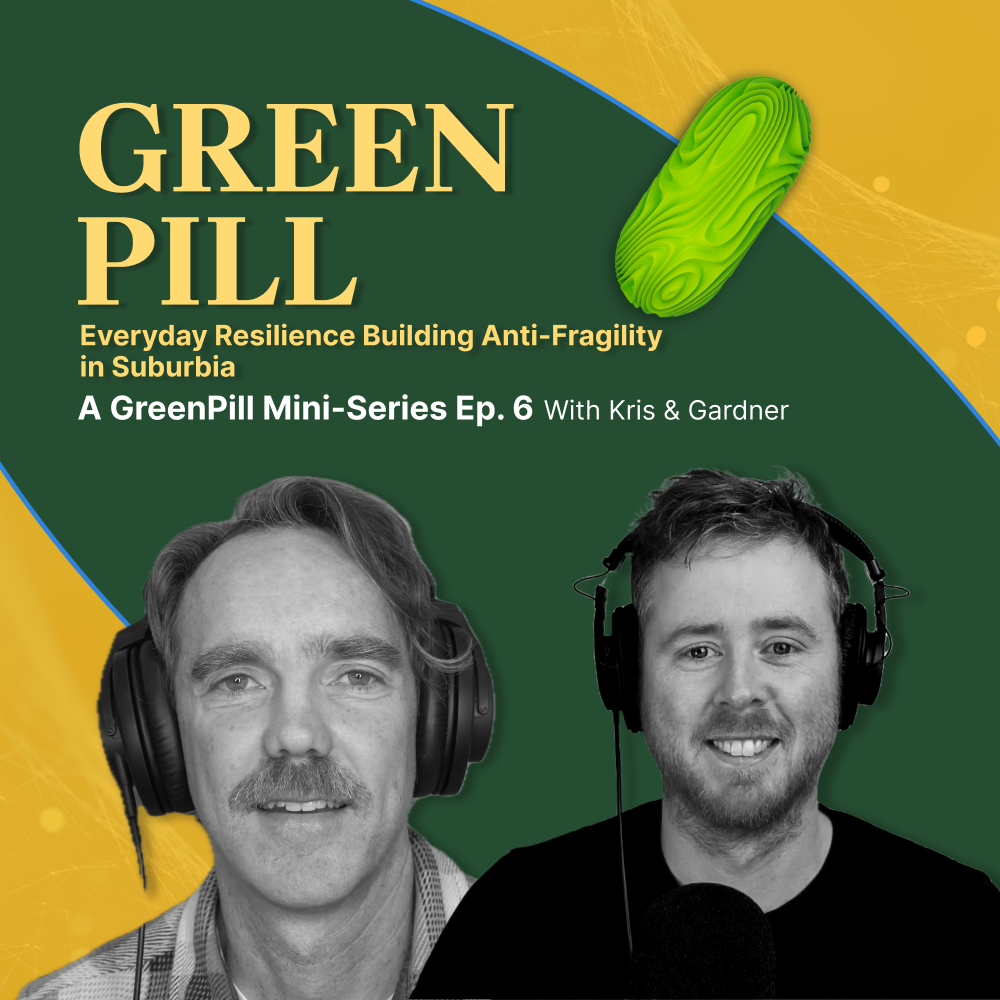 VDAO Ep.6 Everyday Resilience Building Anti-Fragility in Suburbia with Gardner | New @greenpillnet pod out today! 🌐 In this episode of the VDAO × Greenpill Anti-Fragile Network States mini-series, host Kris Miller talks with Gardner, a tech founder exploring how local resilience and self-sovereignty can be built without going off-grid. Gardner shares his hands-on journey of transforming a suburban home into a more resilient system from rainwater harvesting and food forests to community reciprocity and mindset shifts. They discuss why resilience doesn't mean bunkers or isolation, how small actions compound, and why investing in community, not fear, is the real path to anti-fragility. A grounded, practical conversation for anyone curious about building resilience right where they live. 🌱 greenpill.network 🌐 vdao.org 🐦 https://x.com/JoinVDAO 🐦 https://x.com/Gardner 🐦 https://x.com/greenpillnet Timestamps 00:00 – Cold open: collapse, bunkers & "the power is still on" 01:08 – Gardner joins & his "why" as a builder 02:21 – Building a better future through local resilience 03:50 – IRL + URL coordination and finding your tribe 06:04 – Self-sovereignty vs community: not opposites 08:55 – Suburban fragility & reliance on centralized systems 10:18 – Resilience doesn't mean going off-grid 11:30 – First steps: rainwater harvesting at home 12:38 – Water ethics, pools & responsibility 14:25 – Learning by doing: how much water you can actually catch 16:16 – Nature's ability to self-filter water 18:06 – Reducing water demand through hardscaping 19:55 – Destruction as a forcing function for better design 22:36 – Upcycling, free resources & neighbor collaboration 24:31 – Food forests, edible ground cover & rethinking lawns 26:30 – Growing food as "printing yield" 28:31 – Optimism, effort & real sacrifices 30:38 – Family trade-offs & finishing the project 32:58 – "Should I be building a bunker?" 35:19 – The reality behind fast YouTube tutorials 39:06 – Action over fear: doing something tangible 41:02 – Investing in community through shared spaces 43:04 – Turning lawns into food forests at scale 45:06 – Scaling local resilience: resources & accountability 49:07 – Why people think about collapse but don't act 50:54 – Fear vs empowerment in suburban resilience 52:46 – Vision for communal learning spaces ("Wee Woods") 54:07 – Closing thoughts: start small, build, and be free | — | ||||||
| 12/18/25 | 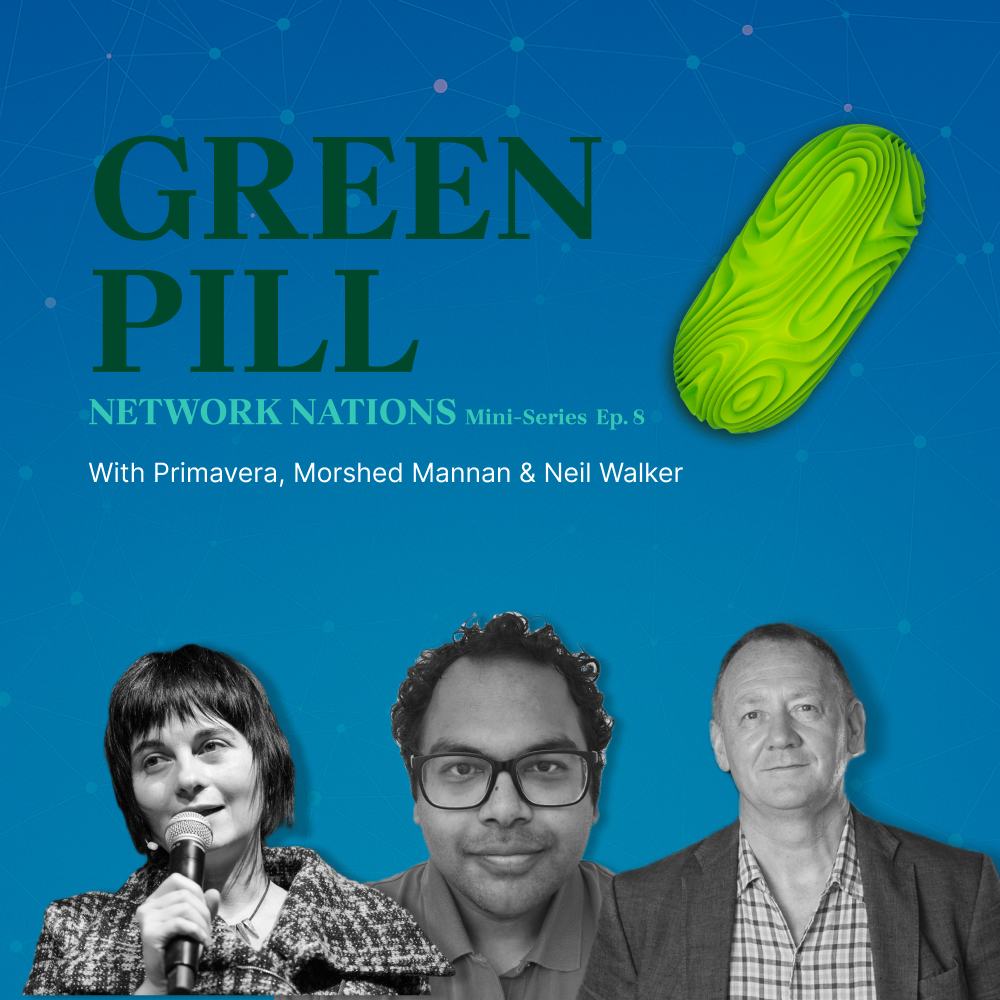 NN Ep:8 Functional Sovereignty: Can Network Nations Self-Govern Without Land? | New @greenpillnet pod out today! 🌐 In this episode of the Network Nations mini-series, host Primavera De Filippi speak with Morshed Mannan (European University Institute) and Neil Walker (author of Sovereignty in Transition) to explore one of the most challenging ideas in political theory today: Functional Sovereignty. They discuss whether sovereignty can be unbundled into separate functions like identity, finance, and dispute resolution — and what it means when digital communities begin exercising these powers without controlling land. Together they examine historical precedents, overlapping authorities, private platform power (Amazon, Meta), self-determination, legitimacy, polycentric governance, and how decentralized infrastructure may enable network nations to achieve real autonomy. A foundational conversation for understanding how communities can self-govern in the networked age. 🌱 greenpill.network 🌐 networknations.network 🐦 @owocki @greenpillnet https://x.com/MannanMorshed Timestamps 00:00 – Cold open: "Functional sovereignty is an oxymoron. 01:34 – What is functional sovereignty? 02:18 – Introducing guests: Morchette Mannan & Neil Walker 03:48 – Traditional sovereignty vs non-territorial sovereignty 06:14 – How communities govern identity, finance & dispute systems 07:20 – Unbundling sovereignty into multiple functions 08:25 – Historical evolution of sovereignty (dynastic → modern state) 10:50 – Early cracks: EU autonomy without exclusivity 13:09 – Examples of functional sovereignty (EU, monetary union, etc.) 16:42 – Guild socialism & industrial self-governance 18:20 – Decentralized constitutionalism in Yugoslavia 19:08 – Citizens as the sovereign, not territory 20:44 – Are Big Tech platforms (Amazon/Facebook) functional sovereigns? 23:24 – Digital proximity & affinity in network communities 25:29 – Declarative vs constitutive sovereignty 27:18 – Corporate sovereignty vs democratic sovereignty 29:33 – Power vs authority: who is the real sovereign? 31:58 – Sovereignty as a discursive claim 33:48 – Why Network Nations seek functional, not declarative, sovereignty 35:50 – Self-determination vs sovereignty 37:00 – The paradox of self-constitution 39:24 – How multiple sovereigns overlap (polycentricity) 41:34 – Managing conflict in overlapping jurisdictions 43:15 – Constitutions and polycentric coordination 45:21 – Who decides who decides? 47:42 – Multi-level governance & territorial scaffolding 49:36 – Functional domains: art, science, data, digital systems 51:38 – How functional sovereignty works in practice 53:22 – Cooperatives as real examples of mutual self-governance 55:43 – Cross-border recognition & legal frameworks 58:05 – What law can and cannot do in digital governance 01:00:06 – Why Network Nations require hybrid (digital + physical) presence 01:02:29 – Decentralized infrastructure as sovereign infrastructure 01:04:08 – Can network nations coexist peacefully with states? 01:06:20 – States' anxiety about digital communities 01:08:42 – Politics, culture & technological migration 01:10:00 – Closing | — | ||||||
| 12/9/25 | 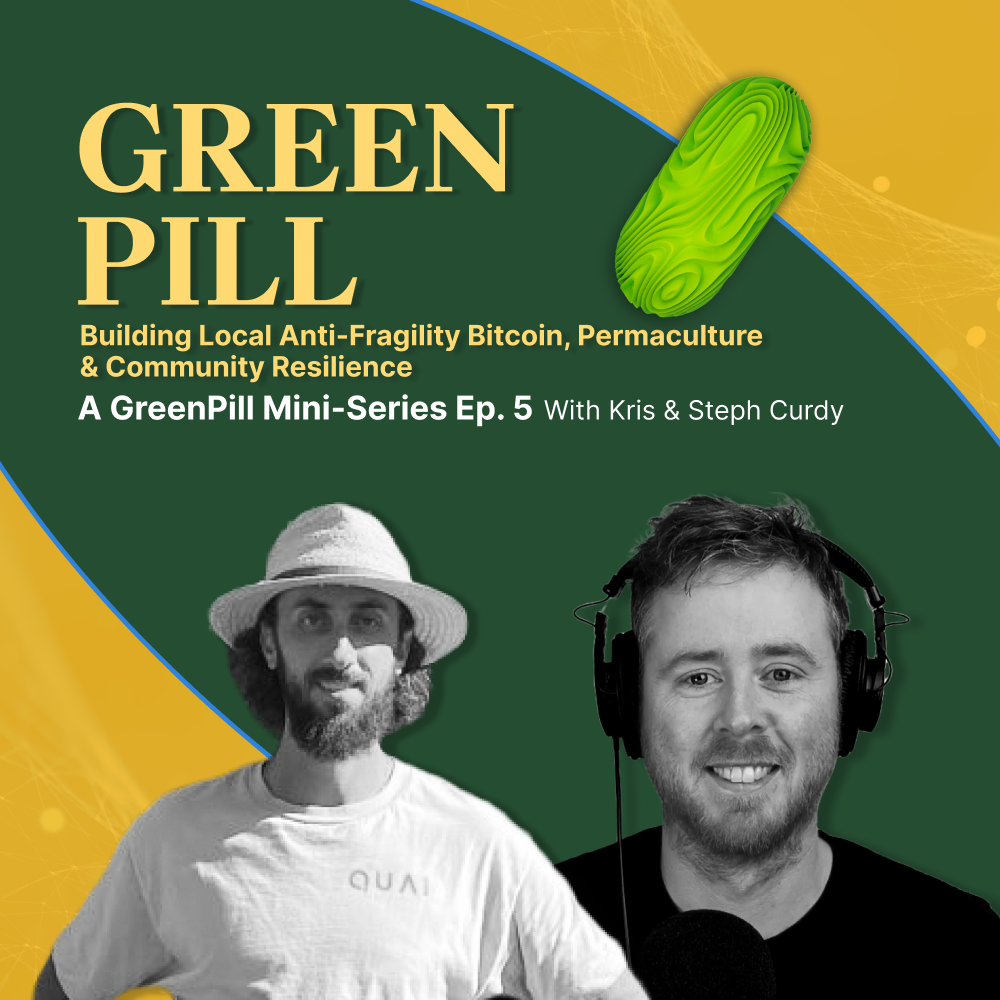 VDAO Ep.5 Building Local Anti-Fragility Bitcoin, Permaculture & Community Resilience w Steph Curdy | New @greenpillnet pod out today! 🌐 In this episode of the VDAO × Greenpill Anti-Fragile Network States mini-series, host Kris Miller talks with Steph Curdy — Bitcoin early adopter, Wolfram researcher, and real-world resilience builder who traded city life for a hands-in-the-soil permaculture experiment. Steph shares how Bitcoin shaped his understanding of asymmetry, how COVID exposed the fragility of urban systems, and why he decided to buy land, build food and energy resilience, and grow a local community around it. They explore anti-fragility, decentralized systems, gradients, permaculture design, skepticism, community trust, and why people — not tomatoes — are the real value in any resilient ecosystem. A grounded, practical and inspiring look at how digital builders can become real-world resilience builders. 🌱 greenpill.network 🌐 vdao.org 🐦 https://x.com/JoinVDAO 🐦 https://x.com/Steph_Curdy 🐦 https://x.com/greenpillnet ⏱️ Timestamps 00:00 – Cold open: "The real value is community, not tomatoes." 01:24 – Welcome to the VDAO Anti-Fragile Network State season 02:19 – Steph Curdy joins the show 02:44 – Steph's "why" as a builder 03:50 – Bitcoin, energy & curiosity 05:48 – What anti-fragility means to Steph 07:30 – Bitcoin as asymmetric exposure 08:55 – COVID revealing urban fragility 09:38 – Searching for land & building resilience 11:35 – Bitcoin as a "Cambrian explosion" of economic primitives 13:32 – Returning to foundational systems: food & nature 15:46 – Steph's background: Tesla → finance → Wolfram 17:31 – Discovering permaculture 19:11 – Emergence: crypto, permaculture & meta-crisis spaces 20:56 – Sensemaking through energy gradients 22:52 – History & first-principles thinking 25:05 – Using gradients to understand Bitcoin 26:55 – How Steph thinks about skeptics 28:51 – Money as information & coordination 30:27 – Listening as a core civic skill 32:25 – Crypto insecurity & ecosystem overwhelm 34:44 – Quality-of-life benefits of resilience 36:24 – Buying land: the practical journey 38:46 – Turning a junk site into regenerative opportunity 41:10 – Building trust with neighbors 42:58 – Year-by-year development of the land 45:02 – Insight: community is the real value 47:29 – Mushroom systems, events & collaborative building 49:28 – Crypto × permaculture: bridging the worlds 51:51 – Polarization & public perception 54:30 – Digital + physical sovereignty 57:03 – What Steph learned building in real life 59:49 – Closing thoughts 01:00:32 – Outro | — | ||||||
| 12/6/25 | 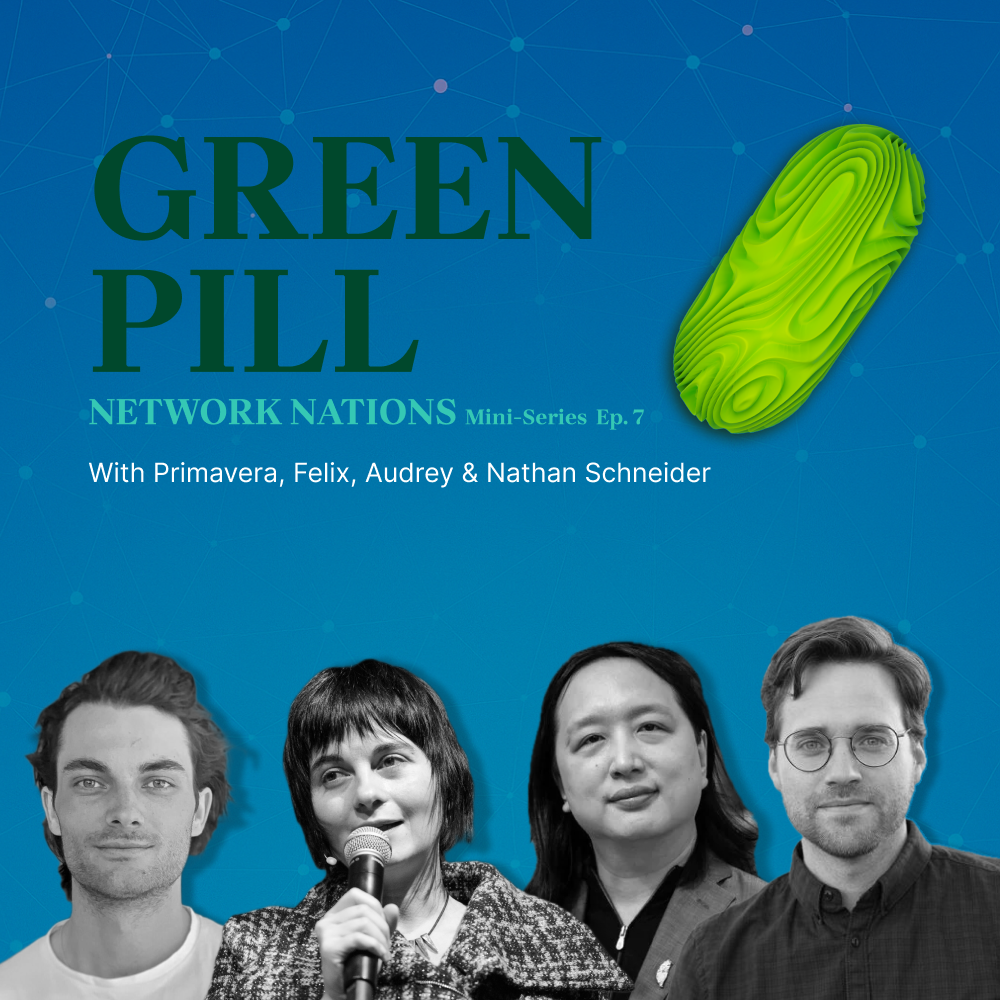 NN Ep:7 Meta-Politics: Designing Digital Environments for Civic Power with Audrey & Nathan Schneider | New @greenpillnet pod out today! 🌐 In this episode of the Network Nations mini-series, Primavera De Filippi & Felix Beer speak with Audrey Tang, former Digital Minister of Taiwan, and Nathan Schneider, professor and author of Governable Spaces. Together they explore Meta-Politics — the foundational design of digital infrastructures that shape how civil society governs itself online. Audrey and Nathan discuss how platforms today constrain collective action, how democratic protocols like alignment assemblies can counter online harms, and why new governance substrates must embed values such as plurality, civic care, interoperability, and entanglement. They also examine decentralized identities, freedom of movement, DAOs, religion as governance, and how network-native communities can evolve into political actors. A powerful conversation about the next layer of digital democracy — and what it takes to build civic technologies that empower global communities. 🌱 greenpill.network 🌐 networknations.network @owocki @greenpillnet @audreyt @ntnsndr 00:00 – Cold start 02:18 – Introducing Audrey Tang & Nathan Schneider 03:07 – Nathan: "Why I worry about the word meta" 05:10 – Nation-states as fragile historical accidents 06:15 – Self-governing online networks as new politics 08:16 – How today's platforms limit civic life 10:22 – Blockchains break the server–client power structure 12:17 – Nation-states reacting to decentralized governance 14:33 – Audrey: Democracy as a "social technology" 16:37 – Deepfakes, alignment assemblies & Taiwan's model 18:33 – Crowdsourced policymaking at national scale 20:49 – Freedom of movement & interoperability design 22:48 – What Network Nation aims to build 24:52 – Audrey's "Six-Pack of Care" 27:13 – Embedding civic care into protocols 29:21 – Bridging systems & depolarization 31:33 – What values can — and cannot — be encoded 33:28 – Forking, polycentric governance & metastability 35:52 – Norms vs code: where power really lives 37:41 – How decentralized tech forces governance innovation 39:51 – Why cooperatives aren't enough for politics 42:13 – Religion as a governance model for network nations 45:17 – Open movements & global political power 47:15 – Civil society as a political actor 49:40 – Verifiable credentials & protecting deliberation 51:52 – Avoiding dystopia & VC-dominated "network states" 54:17 – Funding, incentives & getting there first 56:43 – Poison pills & preventing bad governance 58:39 – Scaling across vs scaling up 01:00:44 – Fractal scaling & mutualization 01:02:53 – Naming as the first political act 01:05:59 – Different starting points for network nations 01:08:15 – Diversity, plurality & collective action 01:10:29 – Making conflict fun through bridging 01:12:41 – Innovation amnesia & protecting past wins 01:14:42 – Values vs opinions in political communities 01:16:37 – Civic care vs individual virtue ethics 01:19:00 – Entanglement as cohesion 01:21:11 – Building a narrative that reaches real people 01:23:25 – Applying meta-politics to global crises 01:25:46 – Everyday tools already enabling the future 01:26:51 – Closing | — | ||||||
| 12/4/25 | 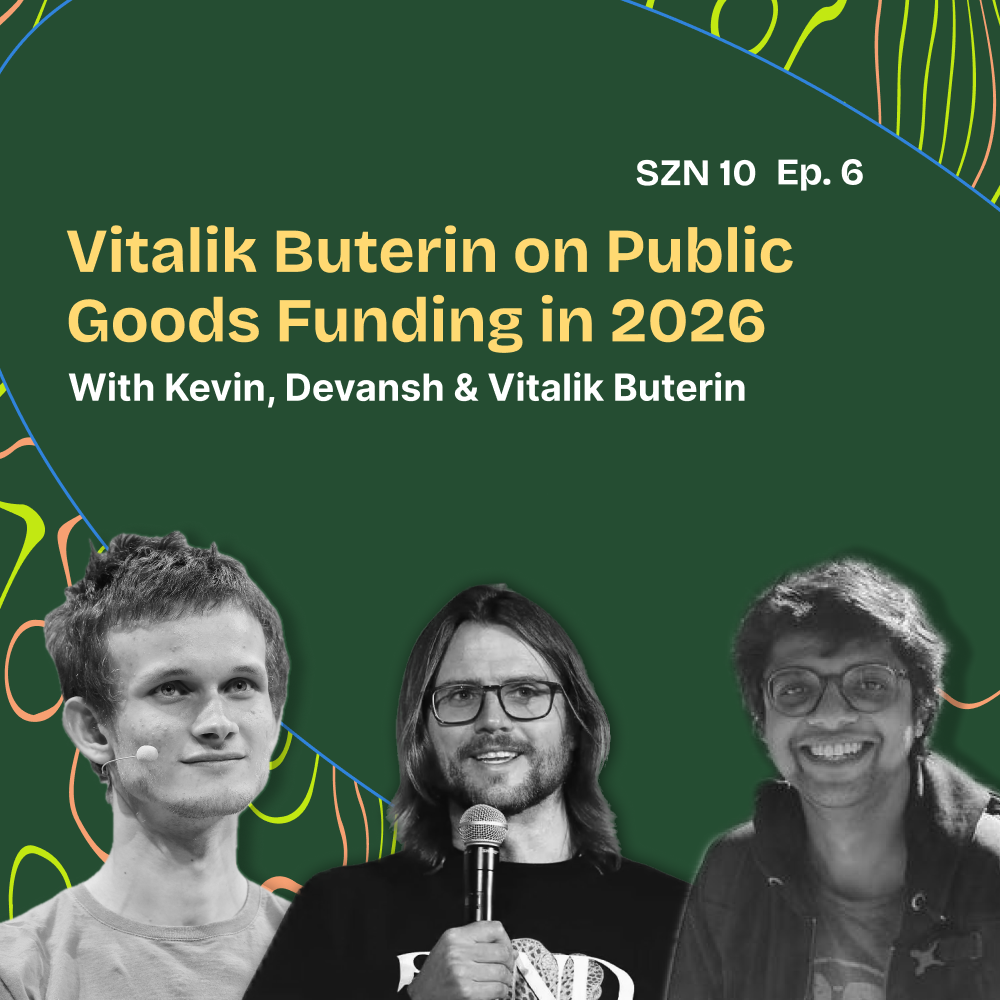 S.10 Ep.6 Public Goods Funding in 2026 & What Builders Should Do Next with Vitalik ButerinVitalik Buterin on Public Goods Funding in 2026 : Mechanisms, Money & What Builders Should Do Next | In this episode of the Green Pill Podcast, Kevin Owocki and co-host Devansh Mehta sit down with Vitalik Buterin for their annual deep dive into the future of public goods funding in the Ethereum ecosystem. They explore where funding will come from in 2026, how the landscape has shifted from "vibes-based" funding to verifiable, dependency-driven mechanisms, and why this is the best moment to reform PGF using new tools like programmable cryptography, AI-assisted evaluation, and deep funding models. Vitalik also shares how he thinks about dependencies, credible neutrality, open-source licensing, pluralism, accountability, and what builders should prioritize in the coming year. A must-listen for anyone designing mechanisms, funding public goods, or building the next era of Ethereum governance. 🌱 https://greenpill.network https://x.com/owocki https://x.com/greenpillnet https://x.com/VitalikButerin https://x.com/TheDevanshMehta 🌐 Timestamps 00:00 – Welcome to the Green Pill Podcast 01:50 – Vitalik joins: why public goods funding matters 02:19 – Why PGF is essential for decentralization 04:18 – The crypto spirit: censorship resistance, institutional design & funding 06:42 – The shift from vibes-era PGF to verifiable mechanisms 08:25 – Why 2026 is the best moment to reform PGF 10:19 – Where does PGF money actually come from? 12:45 – Open-source licensing, taxes & funding dependencies 17:34 – "Fund your dependencies" as a stable mechanism 19:35 – Why general-purpose QF doesn't work in a chaotic world 21:59 – Bottom-up vs top-down: polycentric PGF 25:29 – How to create accountability loops in public goods 27:22 – Funding open-source as an Ethereum priority 29:31 – Privacy as a public good & why it's upstream of PGF 31:54 – What OSS developers really think about crypto 33:52 – Mixing social outreach with financial support 35:56 – What should PGF builders focus on in 2026? 38:13 – Work with new projects, not legacy ones 39:44 – Ecosystem cycles & "layers of sediment" 41:39 – Yield-based funding (Octant) & treasury strategies 43:40 – Accountability: from vibes to rigorous mechanisms 47:35 – Motivation, feedback & the psychology of public goods 50:43 – Profit sharing licenses & sustainable PGF pools 53:46 – Security, issuance & public goods 56:12 – Technology, democracy & long-term risks 58:31 – How PGF relates to DIAC (Defensive/Decentralized Acceleration) 01:00:05 – Solving the free-rider problem without coercion 01:02:12 – Mechanisms vs coercion: credible neutrality 01:04:16 – Institutions, power & capture risks 01:06:16 – Individuals vs institutions in PGF 01:08:41 – Why PGF is more error-tolerant than governance 01:11:01 – Pluralism: many funders, many mechanisms 01:13:14 – Why diversity of funders is healthy 01:15:17 – What Vitalik wants built next 01:17:12 – Ethereum localism & real-world experiments 01:19:28 – What success in PGF looks like by end of 2026 01:24:28 – Closing thoughts | — | ||||||
| 12/1/25 |  VDAO Ep.4 : Pop-Up Cities, Membership Models & Network Societies with Chance McAllister | New @greenpillnet pod out today! 🌐 In this episode of the VDAO × Greenpill Antifragile Network States mini-series, host Kris Miller talks with Chance McAllister, one of the early builders shaping the pop-up village movement and researching how global communities form identity, belonging, and support systems. Chance McAllister shares how a simple Discord link created a high-talent online community, how pop-up cities exploded from one experiment to dozens worldwide, and why digital nomads are searching for deeper social infrastructure. They explore informal safety nets, civil society history, global "dark talent," and what we can learn from groups like the Mennonites as we design the next generation of network societies. A thoughtful, human-centered conversation for anyone exploring community, belonging, and new models of membership across borders. 🌱 greenpill.network 🌐 vdao.org https://x.com/JoinVDAO https://x.com/chancecollabs?s=20 https://x.com/0xkrisv https://x.com/greenpillnet 🌐 Timestamps 00:00 – Cold open 00:24 – What "network state" means to Chance 01:14 – Chance's personal "why" 02:40 – Network societies as an umbrella concept 04:22 – The diversity inside the movement 05:49 – How Chance entered the space 07:27 – Accidentally creating a high-talent Discord 09:27 – Formal vs informal safety nets 12:11 – Unlocking global talent 14:19 – Origins of pop-up villages 16:22 – Zuzalu & the first big experiment 18:19 – Why Chance started researching pop-up cities 20:22 – Civil society & mutual aid history 22:42 – "Summer camps for nomads?" critique 24:52 – Permanent hubs vs pop-ups 28:59 – Demand for new communities 30:59 – The Mennonite example 35:08 – Why jurisdictions welcomed them 37:33 – Lessons for network builders 41:54 – Building identity & membership 48:39 – The future of membership models 55:35 – Designing new societal structures 58:51 – Closing thoughts | — | ||||||



Showing 25 of 295
Pitch Fit is a Pro feature
See how bookable this show is for guests, which brands already advertise, the per-episode ad value, and the best-fit guest and sponsor profile. The numbers are blurred on the free plan.
How readily this show books outside guests like you.
How proven this show is for host-read sponsorships.
For Guests
ProFor Advertisers
ProUpgrade to Pro to unlock guest cadence, sponsor categories, fit scores, and per-episode ad value for this show.
Chart history for GreenPill
Peaked at #186 in Spain, currently #186 in Spain.
| Market | Genre | Peak | Current | Trend |
|---|---|---|---|---|
| Spain | — | #186 | #186 | — |
Chart Positions
1 placement across 1 market.
Chart Positions
1 placement across 1 market.