
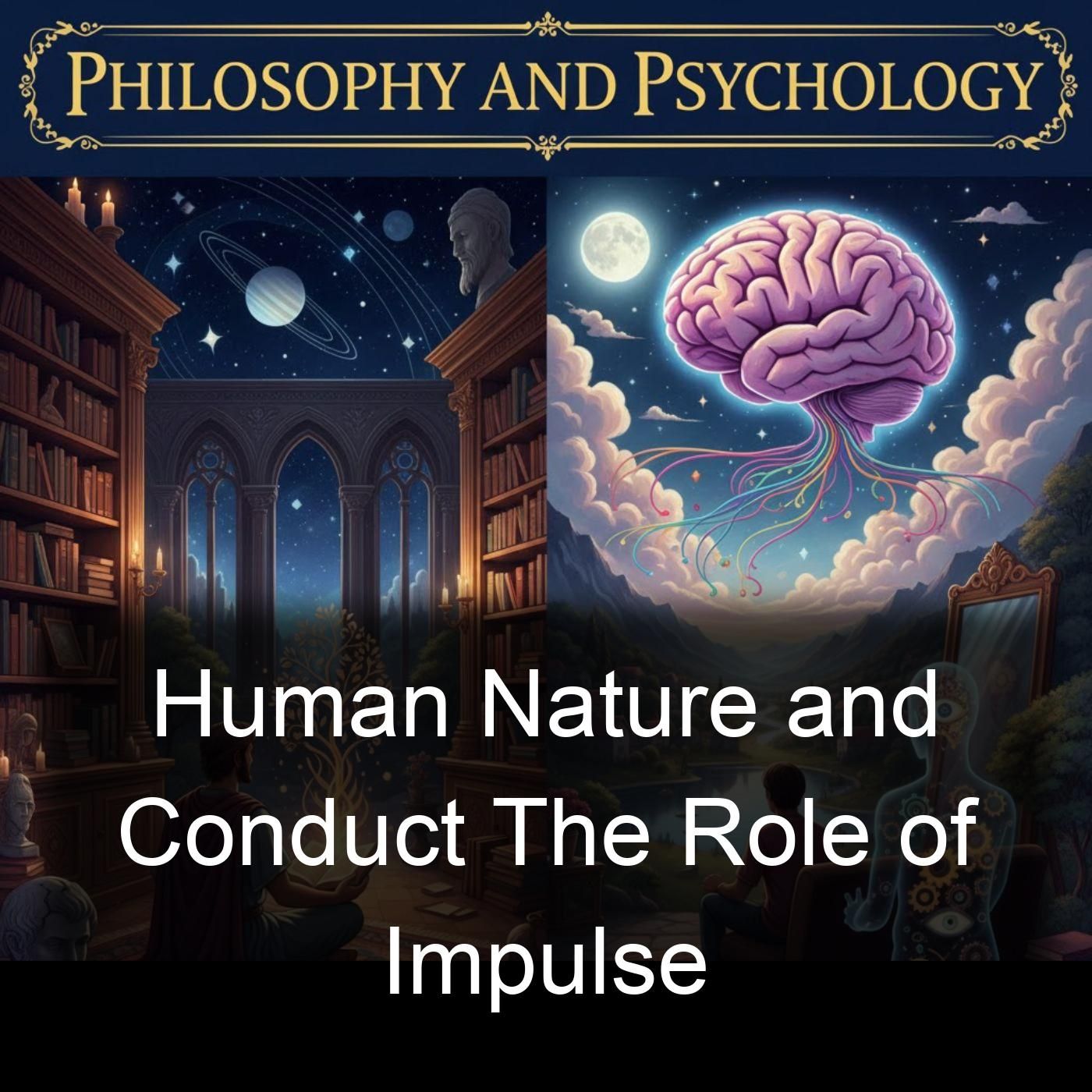
Insights from recent episode analysis
Audience Interest
Podcast Focus
Publishing Consistency
Platform Reach
Insights are generated by CastFox AI using publicly available data, episode content, and proprietary models.
Total monthly reach
Estimated from 1 chart position in 1 market.
By chart position
- 🇦🇺AU · Social Sciences#37100K to 300K
- Per-Episode Audience
Est. listeners per new episode within ~30 days
50K to 150K🎙 Weekly cadence·7 episodes·Last published 4mo ago - Monthly Reach
Unique listeners across all episodes (30 days)
100K to 300K🇦🇺100% - Active Followers
Loyal subscribers who consistently listen
30K to 90K
Market Insights
Platform Distribution
Reach across major podcast platforms, updated hourly
Total Followers
—
Total Plays
—
Total Reviews
—
* Data sourced directly from platform APIs and aggregated hourly across all major podcast directories.
On the show
Recent episodes
007 - Impulse And Thought
Feb 9, 2026
6m 06s
006 - NO SEPARATE INSTINCTS Uniqueness of acts possibilities of operation necessity of play and art rebell
Feb 9, 2026
38m 33s
005 - CLASSIFICATION OF INSTINCTS False simplifications self-love will to power acquisitive and creative
Feb 9, 2026
36m 00s
004 - IMPULSE AND CONFLICT OF HABITS Possibility of social betterment conservatism
Feb 9, 2026
12m 48s
003 - CHANGING HUMAN NATURE Habits the inert factor modification of impulses war a social function economi
Feb 9, 2026
41m 39s
Social Links & Contact
Official channels & resources
Official Website
Login
RSS Feed
Login
| Date | Episode | Description | Length | |
|---|---|---|---|---|
| 2/9/26 | 007 - Impulse And Thought | In Part 2, we delve into Deweys intriguing concept of IMPULSES, exploring how they represent the dynamic interplay between individuals and their environment. When environmental challenges clash with ingrained HABITS, it is these innate impulses that drive us to rethink and adjust both our behaviors and our surroundings. The age-old debate of Nature vs Nurture can be misleading, as it often oversimplifies the complexities of human personality. Our inherent behaviors are essentially a blend of habits shaped by cultural customs. Notably, much of education is less about learning in the traditional sense and more about training our habits to align with societal norms. Human nature is adaptable, yet customs tend to be rigid. As our environments evolve, these customs and habits are consistently put to the test, and societies risk disintegration when they become too inflexible. A MORAL ACT serves to refine and reorganize these habits. Thought emerges when our habits face obstacles, leaving only our impulses to direct us. According to Dewey, habit—not reason or instinct—is the fundamental driver of human conduct. He argues that education should guide youth away from the detrimental habits of society, highlighting that our economic philosophies often focus too heavily on OWNERSHIP rather than on the meaningful ways we USE our resources. - Summary by William Jones, Soloist | 6m 06s | |
| 2/9/26 | 006 - NO SEPARATE INSTINCTS Uniqueness of acts possibilities of operation necessity of play and art rebell | In Part 2, we delve into Deweys intriguing concept of IMPULSES, exploring how they represent the dynamic interplay between individuals and their environment. When environmental challenges clash with ingrained HABITS, it is these innate impulses that drive us to rethink and adjust both our behaviors and our surroundings. The age-old debate of Nature vs Nurture can be misleading, as it often oversimplifies the complexities of human personality. Our inherent behaviors are essentially a blend of habits shaped by cultural customs. Notably, much of education is less about learning in the traditional sense and more about training our habits to align with societal norms. Human nature is adaptable, yet customs tend to be rigid. As our environments evolve, these customs and habits are consistently put to the test, and societies risk disintegration when they become too inflexible. A MORAL ACT serves to refine and reorganize these habits. Thought emerges when our habits face obstacles, leaving only our impulses to direct us. According to Dewey, habit—not reason or instinct—is the fundamental driver of human conduct. He argues that education should guide youth away from the detrimental habits of society, highlighting that our economic philosophies often focus too heavily on OWNERSHIP rather than on the meaningful ways we USE our resources. - Summary by William Jones, Soloist | 38m 33s | |
| 2/9/26 | 005 - CLASSIFICATION OF INSTINCTS False simplifications self-love will to power acquisitive and creative | In Part 2, we delve into Deweys intriguing concept of IMPULSES, exploring how they represent the dynamic interplay between individuals and their environment. When environmental challenges clash with ingrained HABITS, it is these innate impulses that drive us to rethink and adjust both our behaviors and our surroundings. The age-old debate of Nature vs Nurture can be misleading, as it often oversimplifies the complexities of human personality. Our inherent behaviors are essentially a blend of habits shaped by cultural customs. Notably, much of education is less about learning in the traditional sense and more about training our habits to align with societal norms. Human nature is adaptable, yet customs tend to be rigid. As our environments evolve, these customs and habits are consistently put to the test, and societies risk disintegration when they become too inflexible. A MORAL ACT serves to refine and reorganize these habits. Thought emerges when our habits face obstacles, leaving only our impulses to direct us. According to Dewey, habit—not reason or instinct—is the fundamental driver of human conduct. He argues that education should guide youth away from the detrimental habits of society, highlighting that our economic philosophies often focus too heavily on OWNERSHIP rather than on the meaningful ways we USE our resources. - Summary by William Jones, Soloist | 36m 00s | |
| 2/9/26 | 004 - IMPULSE AND CONFLICT OF HABITS Possibility of social betterment conservatism | In Part 2, we delve into Deweys intriguing concept of IMPULSES, exploring how they represent the dynamic interplay between individuals and their environment. When environmental challenges clash with ingrained HABITS, it is these innate impulses that drive us to rethink and adjust both our behaviors and our surroundings. The age-old debate of Nature vs Nurture can be misleading, as it often oversimplifies the complexities of human personality. Our inherent behaviors are essentially a blend of habits shaped by cultural customs. Notably, much of education is less about learning in the traditional sense and more about training our habits to align with societal norms. Human nature is adaptable, yet customs tend to be rigid. As our environments evolve, these customs and habits are consistently put to the test, and societies risk disintegration when they become too inflexible. A MORAL ACT serves to refine and reorganize these habits. Thought emerges when our habits face obstacles, leaving only our impulses to direct us. According to Dewey, habit—not reason or instinct—is the fundamental driver of human conduct. He argues that education should guide youth away from the detrimental habits of society, highlighting that our economic philosophies often focus too heavily on OWNERSHIP rather than on the meaningful ways we USE our resources. - Summary by William Jones, Soloist | 12m 48s | |
| 2/9/26 | 003 - CHANGING HUMAN NATURE Habits the inert factor modification of impulses war a social function economi | In Part 2, we delve into Deweys intriguing concept of IMPULSES, exploring how they represent the dynamic interplay between individuals and their environment. When environmental challenges clash with ingrained HABITS, it is these innate impulses that drive us to rethink and adjust both our behaviors and our surroundings. The age-old debate of Nature vs Nurture can be misleading, as it often oversimplifies the complexities of human personality. Our inherent behaviors are essentially a blend of habits shaped by cultural customs. Notably, much of education is less about learning in the traditional sense and more about training our habits to align with societal norms. Human nature is adaptable, yet customs tend to be rigid. As our environments evolve, these customs and habits are consistently put to the test, and societies risk disintegration when they become too inflexible. A MORAL ACT serves to refine and reorganize these habits. Thought emerges when our habits face obstacles, leaving only our impulses to direct us. According to Dewey, habit—not reason or instinct—is the fundamental driver of human conduct. He argues that education should guide youth away from the detrimental habits of society, highlighting that our economic philosophies often focus too heavily on OWNERSHIP rather than on the meaningful ways we USE our resources. - Summary by William Jones, Soloist | 41m 39s | |
| 2/9/26 | 002 - PLASTICITY OF IMPULSE Impulse and education uprush of impulse fixed codes | In Part 2, we delve into Deweys intriguing concept of IMPULSES, exploring how they represent the dynamic interplay between individuals and their environment. When environmental challenges clash with ingrained HABITS, it is these innate impulses that drive us to rethink and adjust both our behaviors and our surroundings. The age-old debate of Nature vs Nurture can be misleading, as it often oversimplifies the complexities of human personality. Our inherent behaviors are essentially a blend of habits shaped by cultural customs. Notably, much of education is less about learning in the traditional sense and more about training our habits to align with societal norms. Human nature is adaptable, yet customs tend to be rigid. As our environments evolve, these customs and habits are consistently put to the test, and societies risk disintegration when they become too inflexible. A MORAL ACT serves to refine and reorganize these habits. Thought emerges when our habits face obstacles, leaving only our impulses to direct us. According to Dewey, habit—not reason or instinct—is the fundamental driver of human conduct. He argues that education should guide youth away from the detrimental habits of society, highlighting that our economic philosophies often focus too heavily on OWNERSHIP rather than on the meaningful ways we USE our resources. - Summary by William Jones, Soloist | 25m 31s | |
| 2/9/26 | 001 - IMPULSES AND CHANGES OF HABITS Present interest in instincts impulses as re-organizing | In Part 2, we delve into Deweys intriguing concept of IMPULSES, exploring how they represent the dynamic interplay between individuals and their environment. When environmental challenges clash with ingrained HABITS, it is these innate impulses that drive us to rethink and adjust both our behaviors and our surroundings. The age-old debate of Nature vs Nurture can be misleading, as it often oversimplifies the complexities of human personality. Our inherent behaviors are essentially a blend of habits shaped by cultural customs. Notably, much of education is less about learning in the traditional sense and more about training our habits to align with societal norms. Human nature is adaptable, yet customs tend to be rigid. As our environments evolve, these customs and habits are consistently put to the test, and societies risk disintegration when they become too inflexible. A MORAL ACT serves to refine and reorganize these habits. Thought emerges when our habits face obstacles, leaving only our impulses to direct us. According to Dewey, habit—not reason or instinct—is the fundamental driver of human conduct. He argues that education should guide youth away from the detrimental habits of society, highlighting that our economic philosophies often focus too heavily on OWNERSHIP rather than on the meaningful ways we USE our resources. - Summary by William Jones, Soloist | 13m 12s |
Showing 7 of 7
Sponsor Intelligence
Sign in to see which brands sponsor this podcast, their ad offers, and promo codes.
Chart Positions
1 placement across 1 market.
Chart Positions
1 placement across 1 market.