
Insights from recent episode analysis
Audience Interest
Podcast Focus
Publishing Consistency
Platform Reach
Insights are generated by CastFox AI using publicly available data, episode content, and proprietary models.
Total monthly reach
Estimated from 3 chart positions in 3 markets.
By chart position
- 🇦🇺AU · Leisure#1805K to 30K
- 🇧🇷BR · Leisure#1611K to 10K
- 🇷🇴RO · Leisure#200500 to 3K
- Per-Episode Audience
Est. listeners per new episode within ~30 days
1.9K to 13K🎙 Daily cadence·53 episodes·Last published today - Monthly Reach
Unique listeners across all episodes (30 days)
6.5K to 43K🇦🇺70%🇧🇷23%🇷🇴7% - Active Followers
Loyal subscribers who consistently listen
2.6K to 17K
Market Insights
Platform Distribution
Reach across major podcast platforms, updated hourly
Total Followers
—
Total Plays
—
Total Reviews
—
* Data sourced directly from platform APIs and aggregated hourly across all major podcast directories.
On the show
Recent episodes
Sicily & Palermo Travel Guide (Part 2 of 2). Day Trips to Cefalu, Agrigento, Mondello, San Vito lo Capo. Festivals and Experiences
Jun 12, 2026
Unknown duration
Sicily & Palermo Travel Guide (Part 1 of 2). History of Sicily, Palermo Travel Guide
Jun 5, 2026
Unknown duration
Sardinia & Cagliari Travel Guide: Best Beaches, Slow Food, Experiences. Episode 19 of 20 in the Regional Capitals of Italy Series
May 29, 2026
Unknown duration
Calabria & Catanzaro Travel Guide | Episode 18 of 20: Regional Capitals of Italy Series
May 22, 2026
Unknown duration
Basilicata and its Capital of Potenza with Visits to Matera, Metaponto, Melfi, Venosa, Southern Dolomites. Episode 17 of 20 in the Regional Capitals of Italy Series
May 15, 2026
Unknown duration
Social Links & Contact
Official channels & resources
Official Website
Login
RSS Feed
Login
| Date | Episode | Description | Length | ||||||
|---|---|---|---|---|---|---|---|---|---|
| 6/12/26 | 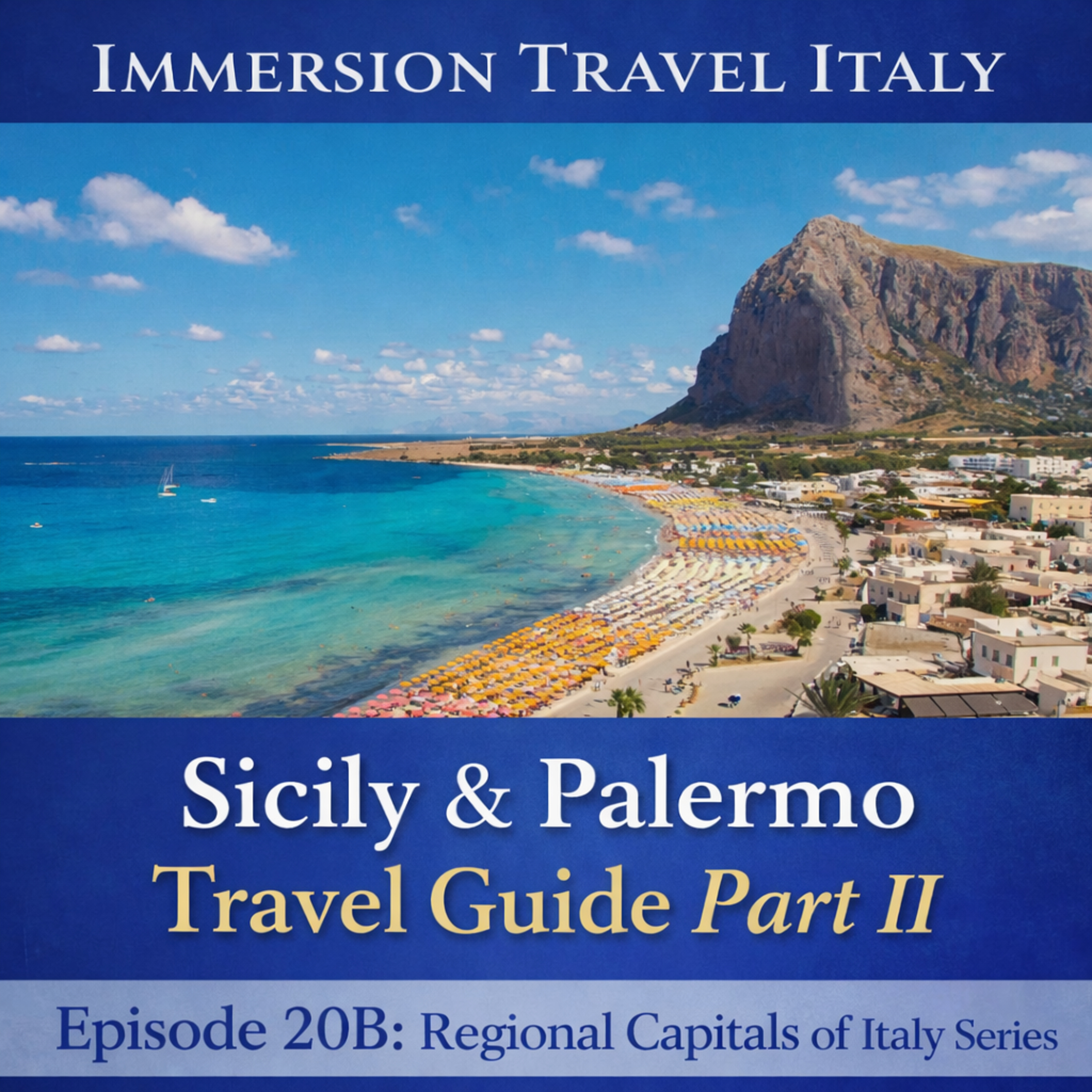 Sicily & Palermo Travel Guide (Part 2 of 2). Day Trips to Cefalu, Agrigento, Mondello, San Vito lo Capo. Festivals and Experiences | In this episode, we continue our journey through Palermo and Sicily, diving deeper into the experiences, festivals, day trips, beaches, and living culture that make this island unforgettable.For the full 550-page guide with detailed walking tours, logistics, restaurants, accommodations, and complete festival calendars across the entire island, explore my Ultimate Festival and Travel Guide Sicily here: https://amzn.to/4l71PbiThis episode moves beyond monuments and into the rhythm of Sicilian life.We begin with Palermo’s great festivals: the Festino di Santa Rosalia, where the Carro Trionfale rolls from Palermo Cathedral through Quattro Canti to the sea; the Sicilia Jazz Festival, echoing through Teatro di Verdura and Santa Maria dello Spasimo; Le Vie dei Tesori, unlocking hidden palaces and Arab qanat tunnels; and the sweet celebration of Sherbeth Festival, Palermo’s international gelato event in Piazza Verdi before Teatro Massimo.Then we step into Palermo’s markets — Ballarò and La Vucciria — where Arab agricultural legacy meets modern street life. Panelle, sfincione, stigghiola, espresso at metal counters. This is Sicily breathing.We share a personal cooking experience in a Palermo home, shaping arancini and stretching focaccia, discovering how Sicilian food connects family, faith, and history. We rise above the city to Monte Pellegrino and the Sanctuary of Santa Rosalia, then climb to golden Monreale Cathedral, where 12th century Byzantine mosaics shimmer in over 6,000 square meters of gold.From there, we explore the best day trips from Palermo:• Cefalù – Norman cathedral, La Rocca hike, medieval laundry, beach and the Festa del Santissimo Salvatore• Agrigento and the Valley of the Temples – Temple of Concordia, Temple of Juno, Greek ruins older than Rome, Almond Blossom Festival, Italy Capital of Culture 2025• San Vito Lo Capo – turquoise beaches, Zingaro Nature Reserve, Cous Cous Fest, Mediterranean culinary exchange• Mondello Beach – Palermo’s Art Nouveau seaside escapeThroughout this episode, we trace Sicily’s layered history: Greek foundations, Roman rule, Arab irrigation systems, Norman mosaics, Spanish Baroque devotion, Bourbon administration, and modern Italian life. Sicily is not erased by conquest. It absorbs. It layers. It remembers.If you are searching for:Palermo travel guideSicily travel podcastThings to do in PalermoSicilian festivalsSanta Rosalia FestivalCefalù day tripAgrigento Valley of the TemplesSan Vito Lo Capo beachMonreale Cathedral mosaicsMonte Pellegrino sanctuarySicilian food experiencesBallarò marketMondello beachYou are in the right place.This episode concludes our two-part Palermo and Sicily mini series and marks the final capital in our 20-episode Regional Capitals of Italy journey — from Turin in the north to Palermo in the south.Each episode includes an associated blog with photos, maps, and additional planning resources at:https://katerinaferrara.com/blogsJoin the Immersion Travel Italy newsletter for festival calendars, travel inspiration, and insider updates:https://katerinaferrara.comFor deeper planning across Italy, explore the full Ultimate Festival and Travel Guide series:Sicily: https://amzn.to/4l71PbiPuglia: https://amzn.to/3HFAe2wRome & Beyond: https://amzn.to/440Dq0lRome 2025 Jubilee Guide: https://amzn.to/4n7sBSYSicily in Celebration: https://amzn.to/4jPVEHKTravel slowly.Travel deeply.And let the cities tell their stories. | — | ||||||
| 6/5/26 | 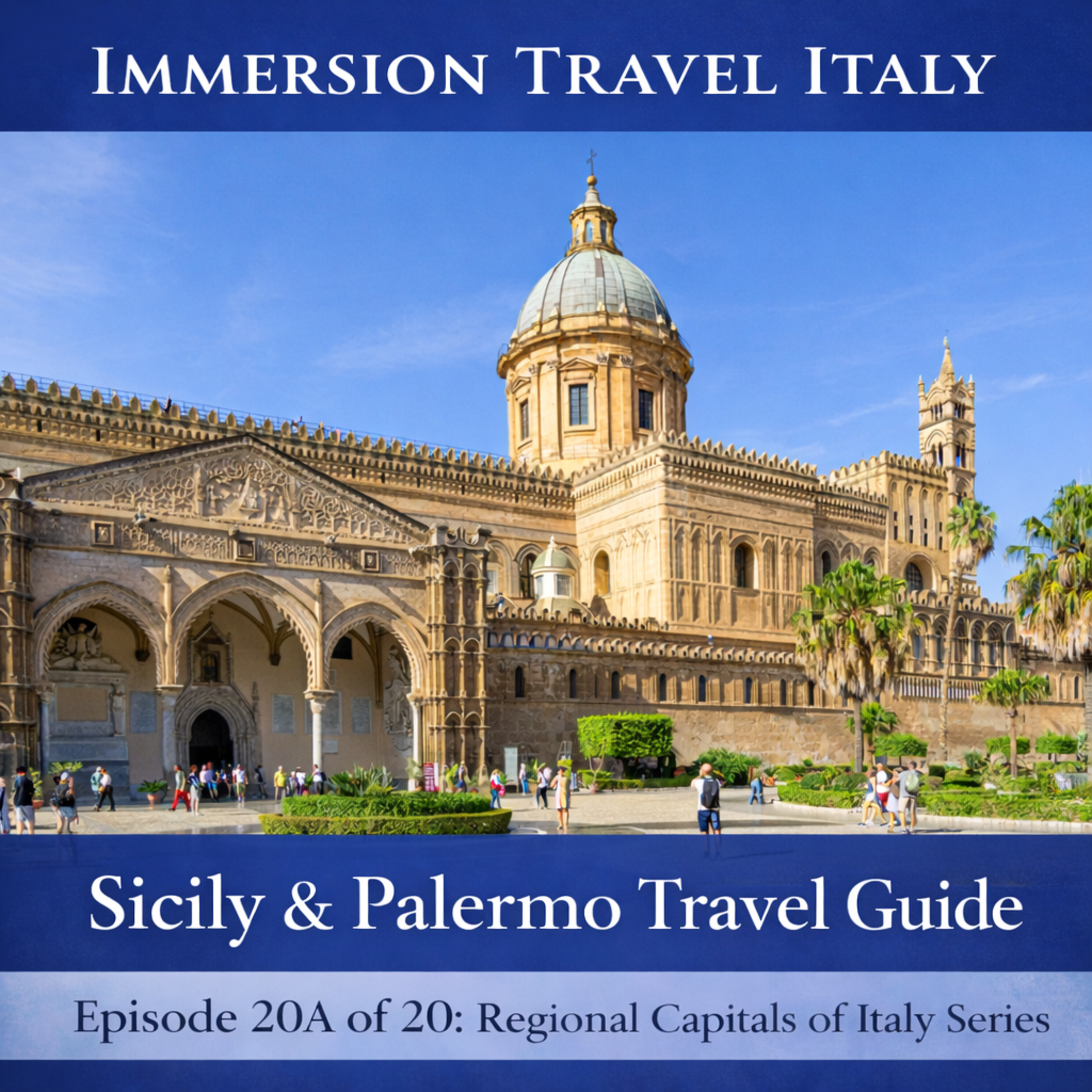 Sicily & Palermo Travel Guide (Part 1 of 2). History of Sicily, Palermo Travel Guide | Regional Capitals of Italy SeriesWelcome to Episode 20A in the Regional Capitals of Italy Series, where we arrive at the largest island in the Mediterranean — Sicily — and begin our deep exploration of Palermo, the island’s capital and historical heart.Before we dive in, if you are planning a trip, my book Ultimate Festival and Travel Guide Sicily is designed to be your complete framework once you land. It includes structured walking tours of Palermo and beyond, restaurant recommendations, accommodations, train logistics, day trip strategy, and hundreds of festivals organized by calendar so you can time your visit intentionally.Grab your copy here: https://amzn.to/4l71PbiThis episode is about understanding Sicily before you explore it.We trace the island’s sweeping history from the Sicani, Sicels, and Elymians to Magna Graecia, from the Valley of the Temples in Agrigento to Roman rule after the Punic Wars, from Byzantine governance to Arab innovation that reshaped agriculture, language, irrigation, and cuisine. We explore the Norman conquest under Roger II, the tension of William I, the stability of William II, the intellectual brilliance of Frederick II, the Sicilian Vespers, Spanish Baroque influence, Bourbon rule, Italian unification, World War I, the Allied invasion of Sicily in World War II, and the island’s modern autonomous status.Sicily is not peripheral Italy. It is foundational Mediterranean history.Then we narrow our focus to Palermo, set in the Conca d’Oro between Monte Pellegrino and the Tyrrhenian Sea. We explore the city’s geography, port, climate, and layered identity shaped by Phoenicians, Arabs, Normans, Spanish viceroys, and modern Italy.In this episode, we walk through Palermo’s monuments of power:• Palermo Cathedral — a timeline in stone blending Byzantine, Arab, Gothic, and Neoclassical elements• The cathedral rooftops — panoramic views over the historic center• The crypt — archbishop tombs and Norman foundations• The royal tombs of Roger II and Frederick II• The Archbishop’s Palace and Diocesan Museum• The Palazzo dei Normanni, seat of Sicilian governance for nearly 1,000 years• The Cappella Palatina, where Byzantine mosaics, Arab muqarnas ceilings, and Norman architecture merge into one of the most extraordinary sacred spaces in EuropeWe also discuss how to arrive in Sicily via Palermo Airport, Catania Fontanarossa, regional rail routes along the coast, ferries across the Strait of Messina, and practical transportation strategy across the island.This episode includes searchable travel planning terms for:Sicily travel guide, Palermo walking tour, Arab Norman architecture, Cappella Palatina mosaics, Christ Pantocrator, Sicilian history timeline, Valley of the Temples Agrigento, Sicilian Vespers 1282, Santa Rosalia, Monte Pellegrino, Monreale Cathedral, Sicily train travel, Palermo Cathedral crypt, Sicilian festivals, Mediterranean travel Italy, Sicily itinerary planning.Episode 20A sets the historical and architectural foundation.In Episode 20B, we continue our Palermo walking tour, explore markets like Ballarò and La Vucciria, discuss Sicilian food traditions including arancine and pasta con le sarde, experience Monte Pellegrino and Monreale, and take day trips to Cefalù, Agrigento, San Vito Lo Capo, and Mondello — plus major festivals like Santa Rosalia and Cous Cous Fest.Associated blog for this episode:https://katerinaferrara.com/blogsJoin the Immersion Travelers Newsletter for monthly festival calendars, Italy travel strategy, and insider planning tools:https://katerinaferrara.comExplore the full Ultimate Festival & Travel Guide series:Sicily: https://amzn.to/4l71PbiPuglia: https://amzn.to/3HFAe2wRome & Beyond: https://amzn.to/440Dq0lVenice & the VenetoMilan & LombardyRome 2025 Jubilee Guide: https://amzn.to/4n7sBSYSicily in Celebration bilingual edition: https://amzn.to/4jPVEHKTravel slowly.Travel deeply.And let Sicily tell its story. | — | ||||||
| 5/29/26 | 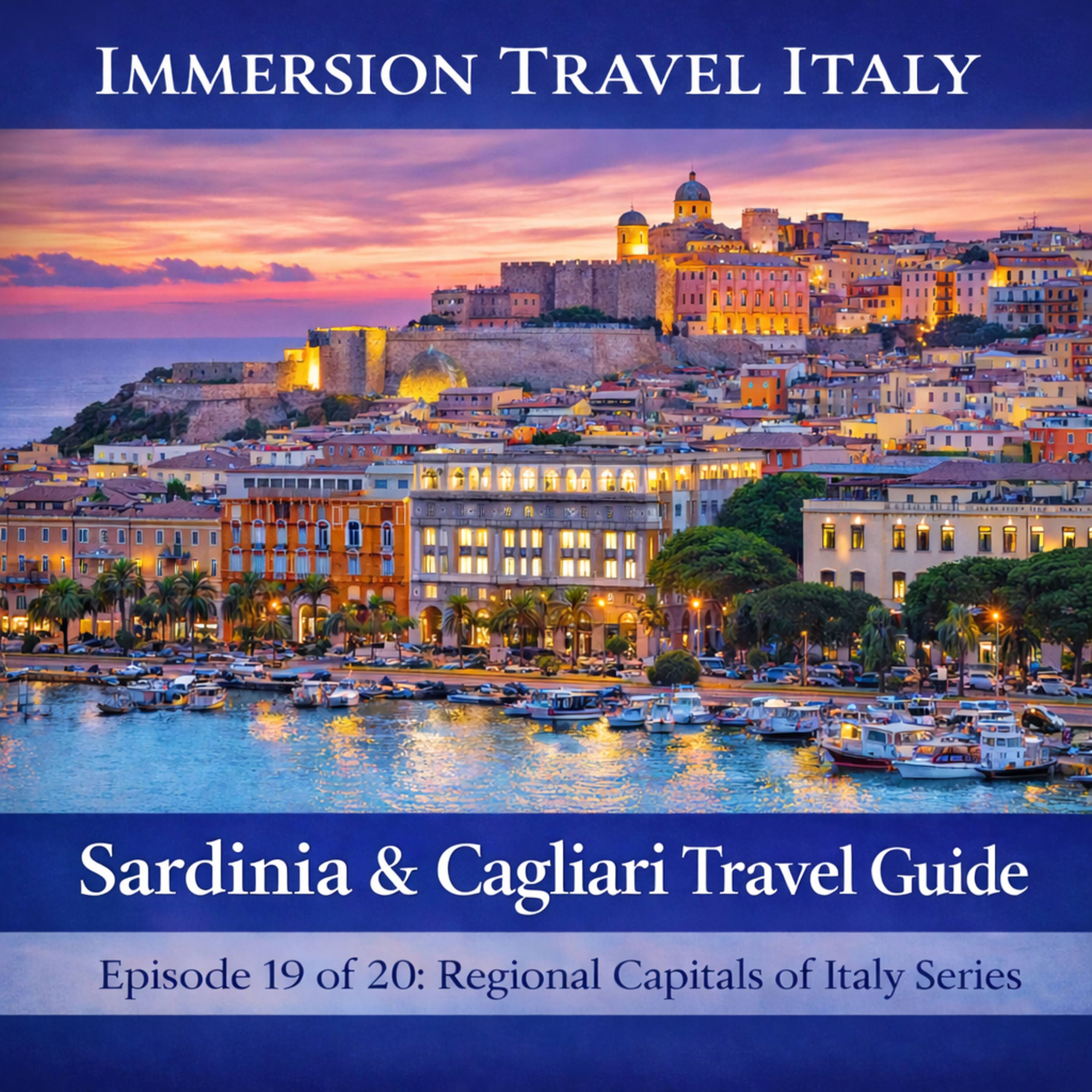 Sardinia & Cagliari Travel Guide: Best Beaches, Slow Food, Experiences. Episode 19 of 20 in the Regional Capitals of Italy Series | Sardinia & Cagliari Travel Guide | Episode 19 of 20 – Regional Capitals of Italy SeriesIn Episode 19 of 20 of the Immersion Travel Italy Podcast, we journey west into the Mediterranean to explore Sardinia and its regional capital, Cagliari — an island older than Rome, older than Carthage, and older than the very idea of Italy.This Sardinia travel guide blends deep history, archaeology, food culture, festivals, and practical travel insight into one immersive experience. If you are planning travel to Italy, researching Sardinia beaches, building a Cagliari itinerary, or looking for unique Mediterranean destinations beyond the usual tourist circuit, this episode gives you both context and inspiration.We begin with Sardinia’s ancient Nuragic civilization and the mysterious Bronze Age stone towers known as nuraghi, including the UNESCO site of Su Nuraxi di Barumini. We trace Phoenician trade routes in Nora, Roman rule beginning in 238 BC, Byzantine influence, the medieval Judicates, Spanish and Aragonese power, Savoy rule, and the island’s modern autonomous identity.Then we walk Cagliari step by step:• Castello district and medieval fortifications• Cathedral of Santa Maria• Bastione di Saint Remy overlooking the Gulf of Angels• Roman Amphitheater carved directly into limestone• Marina district and Via Roma at sunset• Flamingos in Molentargius lagoon• Hiking Sella del Diavolo• Poetto Beach and southern Sardinia coastlineWe explore Sardinian cuisine in depth:• Bottarga, the “caviar of the Mediterranean”• Fregola con arselle• Malloreddus with sausage and saffron• Pane carasau• Cannonau wine and VermentinoWe experience the island’s most powerful festivals:• Festa di Sant’Efisio, celebrated continuously since 1657• Festa della Madonna di Bonaria• International Jazz Festival in SardiniaBeyond Cagliari, we travel to:• Nora and its seaside Roman ruins• The Giants of Mont’e Prama, monumental Nuragic sculptures• Golfo di Orosei and Cala Mariolu’s dramatic limestone coastline• Alghero, Sardinia’s Catalan city with Iberian Holy Week traditionsThis episode covers Sardinia history, Cagliari travel planning, Italian island vacations, Mediterranean archaeology, UNESCO sites in Italy, Sardinian food culture, beaches near Cagliari, and how to reach Sardinia by air and ferry.Sardinia is not mainland Italy with beaches attached.It is older.Stronger.More independent.This is slow travel.This is cultural immersion.This is Italy beyond the checklist.🎧 Listen now and walk Sardinia with me.—📖 Read the full associated blog with photos, maps, and detailed planning information:https://katerinaferrara.com/blog/📬 Sign up for my FREE Immersion Travel Italy monthly newsletter for festival dates, insider tips, and region by region travel inspiration:https://katerinaferrara.com/—📚 Explore my Ultimate Festival & Travel Guide book series:Ultimate Festival and Travel Guide Sicilyhttps://amzn.to/3KARdo8Ultimate Festival and Travel Guide Pugliahttps://amzn.to/42WEnH1Ultimate Festival and Travel Guide Rome and Beyondhttps://amzn.to/4gRlvz0Ultimate Festival and Travel Guide Venice and the Venetohttps://amzn.to/48OhHfTUltimate Festival and Travel Guide Milan and Lombardyhttps://amzn.to/46VzmQsSicily in Celebration / Sicilia in Festahttps://amzn.to/4jPVEHK—Thank you for joining Episode 19 of 20 in the Regional Capitals of Italy series.Next Friday, we cross the Strait of Messina and begin the final chapter of this journey — Sicily.Travel slowly.Travel deeply.And let the cities tell their stories. | — | ||||||
| 5/22/26 | 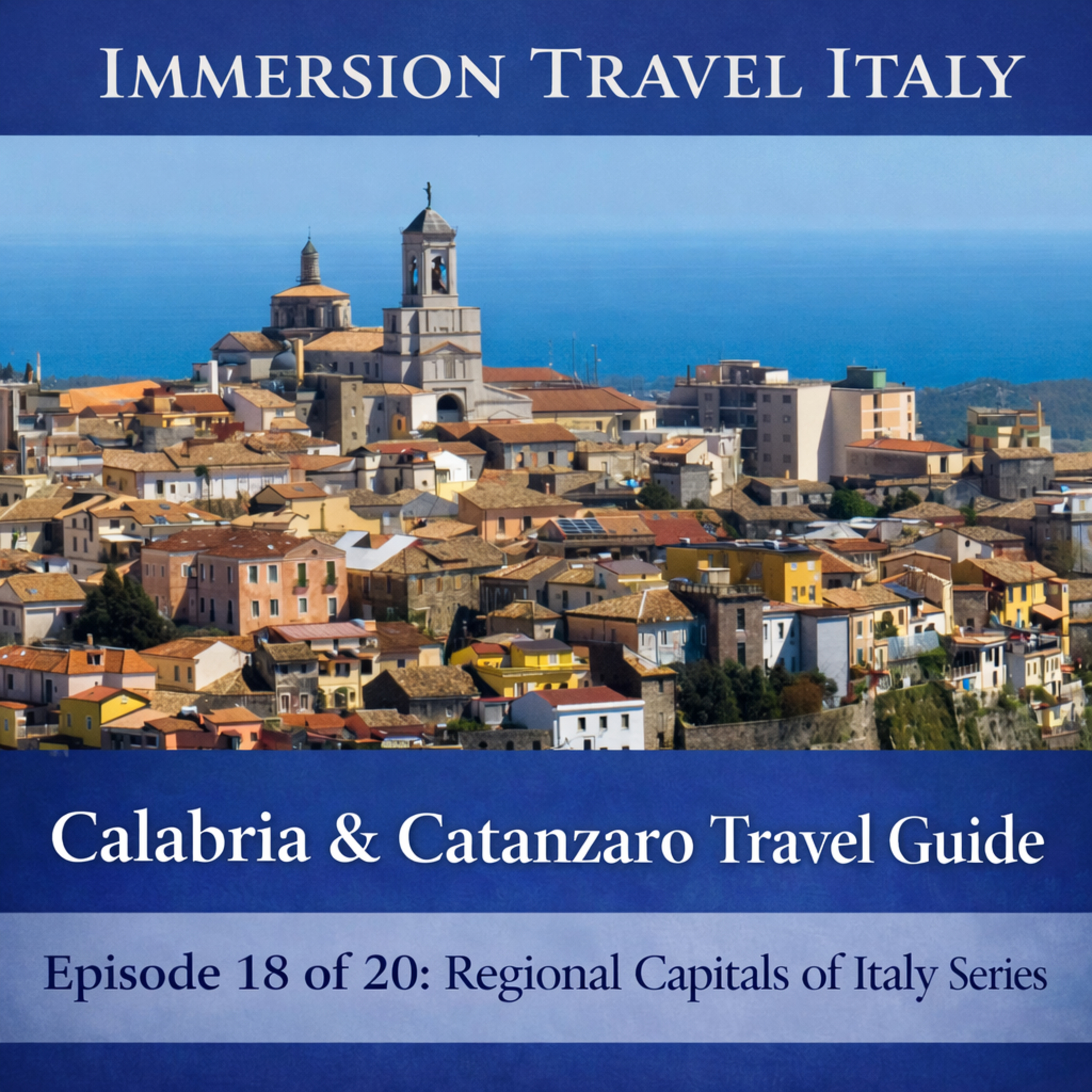 Calabria & Catanzaro Travel Guide | Episode 18 of 20: Regional Capitals of Italy Series | In this episode of the Immersion Travel Italy Podcast, we journey into Calabria, one of Italy’s most ancient, layered, and misunderstood regions. From the Greek foundations of Magna Graecia to Roman expansion, Byzantine monasteries, Norman fortresses, Spanish rule, Bourbon governance, devastating earthquakes, and waves of migration, Calabria tells a story of endurance rather than reinvention.We then focus on Catanzaro, the regional capital of Calabria since 1970, perched on a ridge between the Ionian Sea and the Tyrrhenian coast. Often called the “City Between Two Seas,” Catanzaro offers medieval streets, Norman foundations, Bourbon era churches, and a surprising silk heritage that once made it one of Europe’s most important textile centers.You will walk with me through the historic center along Corso Mazzini, visit the Duomo di Santa Maria Assunta, explore the Complesso Monumentale di San Giovanni, and discover why Catanzaro feels elevated, layered, and authentic. We descend to Catanzaro Lido along the Gulf of Squillace, where long sandy beaches and calm Ionian waters offer a completely different rhythm of southern Italian life.We dive into Calabrian cuisine, including ’nduja, fileja pasta, Pecorino Crotonese, Cipolla Rossa di Tropea, swordfish, and the region’s famous peperoncino. If you love bold, spicy Italian food, Calabria delivers.We also explore the most important festivals in Catanzaro, including the Festa di San Vitaliano in July, Holy Week processions, and the historic Fiera di San Lorenzo.Beyond the capital, we highlight essential Calabria day trips: Tropea’s dramatic cliffside old town and turquoise Tyrrhenian beaches, ancient Greek ruins at Capo Colonna in Crotone, the Riace Bronzes in Reggio Calabria, and the mythological fishing village of Scilla. We also discuss train options versus renting a car to explore the Ionian coast, Tyrrhenian coast, and mountain regions like Sila National Park.If you are planning travel to southern Italy, Calabria offers authentic villages, archaeological treasures, coastal beauty, medieval hill towns, Catholic festivals, and some of the most powerful historical layers in Italy.For deeper exploration of Italy through festivals and immersive travel, explore my books:Ultimate Festival and Travel Guide Sicilyhttps://amzn.to/3KARdo8 Ultimate Festival and Travel Guide Pugliahttps://amzn.to/42WEnH1 Ultimate Festival and Travel Guide Rome and Beyondhttps://amzn.to/4gRlvz0 Ultimate Festival and Travel Guide Venice and the Venetohttps://amzn.to/48OhHfT Ultimate Festival and Travel Guide Milan and Lombardyhttps://amzn.to/46VzmQs Sicilia in Festa: English Italian Dual Language Editionhttps://amzn.to/4jPVEHK For monthly festival calendars, Italy travel tips, and exclusive updates on new podcast episodes and books, sign up for my free Immersion Travel Italy newsletter at:https://katerinaferrara.comTravel slowly. Travel deeply. And let Calabria tell its story. | — | ||||||
| 5/15/26 | 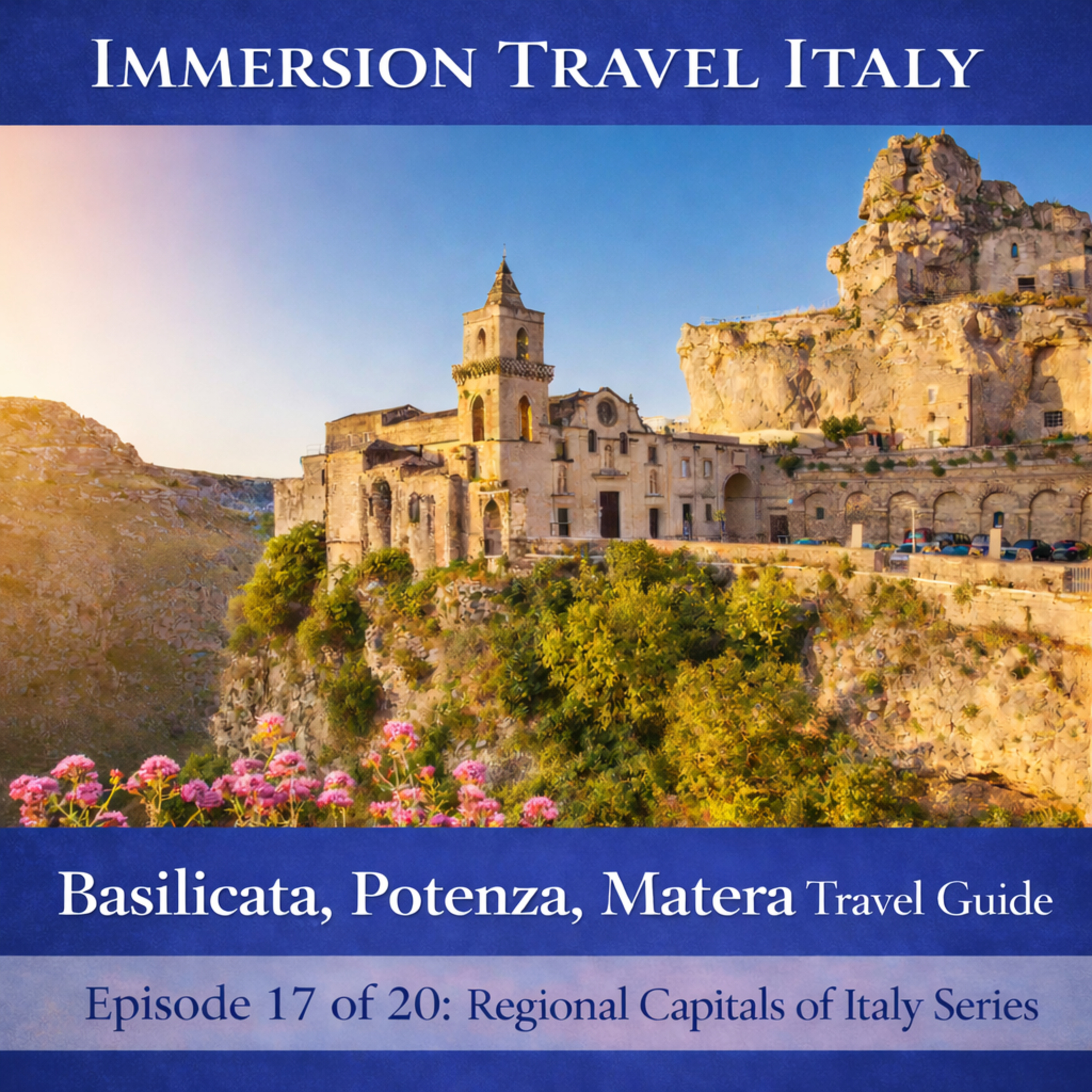 Basilicata and its Capital of Potenza with Visits to Matera, Metaponto, Melfi, Venosa, Southern Dolomites. Episode 17 of 20 in the Regional Capitals of Italy Series | Episode 17: Basilicata & Potenza — Matera, Sassi, Greek Temples, Norman Castles, Festivals & Southern Italy’s Hidden Mountain RegionIn this episode of the Immersion Travel Italy Podcast, we travel into Basilicata, one of southern Italy’s most overlooked yet deeply compelling regions. Anchored by its mountain capital Potenza, Basilicata sits between Puglia, Campania, and Calabria, touching the Ionian Sea and the Tyrrhenian coast near Maratea while remaining shaped by the Lucanian Apennines. This is inland southern Italy — rugged, introspective, authentic.This immersive Basilicata travel guide episode explores:• Potenza — Italy’s highest regional capital• Matera and the Sassi — UNESCO World Heritage Site• The transformation from “Shame of Italy” in the 1950s to European Capital of Culture• Cave churches and Byzantine frescoes• The Cathedral of Matera and the newer post-war town• Madonna della Bruna festival and the dramatic “lo strazzo”• Presepe Vivente in the Sassi at Christmas• Metaponto and Magna Graecia Greek temples• Melfi’s Norman castle and Frederick II’s Constitutions• Venosa, birthplace of Horace and home to the Abbey of the Santissima Trinità• Dolomiti Lucane and the Volo dell’Angelo zipline• Monte Vulture and Aglianico del Vulture wine• Lucanian cuisine, peperone crusco, lamb, and pastoral traditionsWe trace Basilicata’s history from Greek colonization in Metaponto, through Roman Venusia, Norman power in Melfi, medieval monasticism, Bourbon rule, emigration to America, and post–World War II hardship. We discuss how Matera was once called “the shame of Italy,” how families were relocated from the Sassi, and how restoration transformed the city into one of Italy’s most extraordinary destinations.You will experience Matera on screen — from Mel Gibson’s The Passion of the Christ filmed among the Sassi, to No Time to Die featuring dramatic chase scenes through its vertical streets, and the Italian television series Imma Tataranni set against Matera’s staircases and piazzas. We walk cave churches carved into stone, explore Potenza’s Cathedral of San Gerardo, and drive through the Apennine spine of southern Italy.This episode is part of the Regional Capitals of Italy Series, moving region by region through all 20 Italian capitals. If you love Italian history, UNESCO sites, Italian festivals, Catholic traditions, medieval castles, Greek ruins, hidden Italy destinations, wine travel, slow travel, and immersive cultural experiences, this episode is for you.Associated blog for this episode:👉 https://katerinaferrara.com/blog/📩 Join my FREE Immersion Travel Italy newsletter for monthly Italy travel inspiration, festival calendars, insider tips, and curated itineraries:👉 https://katerinaferrara.com📚 Explore the Ultimate Festival & Travel Guide Series:Ultimate Festival and Travel Guide Pugliahttps://amzn.to/42WEnH1Ultimate Festival and Travel Guide Sicilyhttps://amzn.to/3KARdo8Ultimate Festival and Travel Guide Rome and Beyondhttps://amzn.to/4gRlvz0Ultimate Festival and Travel Guide Venice and the Venetohttps://amzn.to/48OhHfTUltimate Festival and Travel Guide Milan and Lombardyhttps://amzn.to/46VzmQsSicilia in Festa: Experience the Magic of Sicily’s History, Art and Timeless Cultural Celebrationshttps://amzn.to/4jPVEHKNew episodes release every Friday as we continue south into Calabria and its capital Catanzaro.Travel slowly. Travel deeply. Discover Italy beyond the checklist.— Katerina Ferrara Author of the Travel Italy Book seriesImmersion Travel Italy Podcast | — | ||||||
| 5/8/26 | 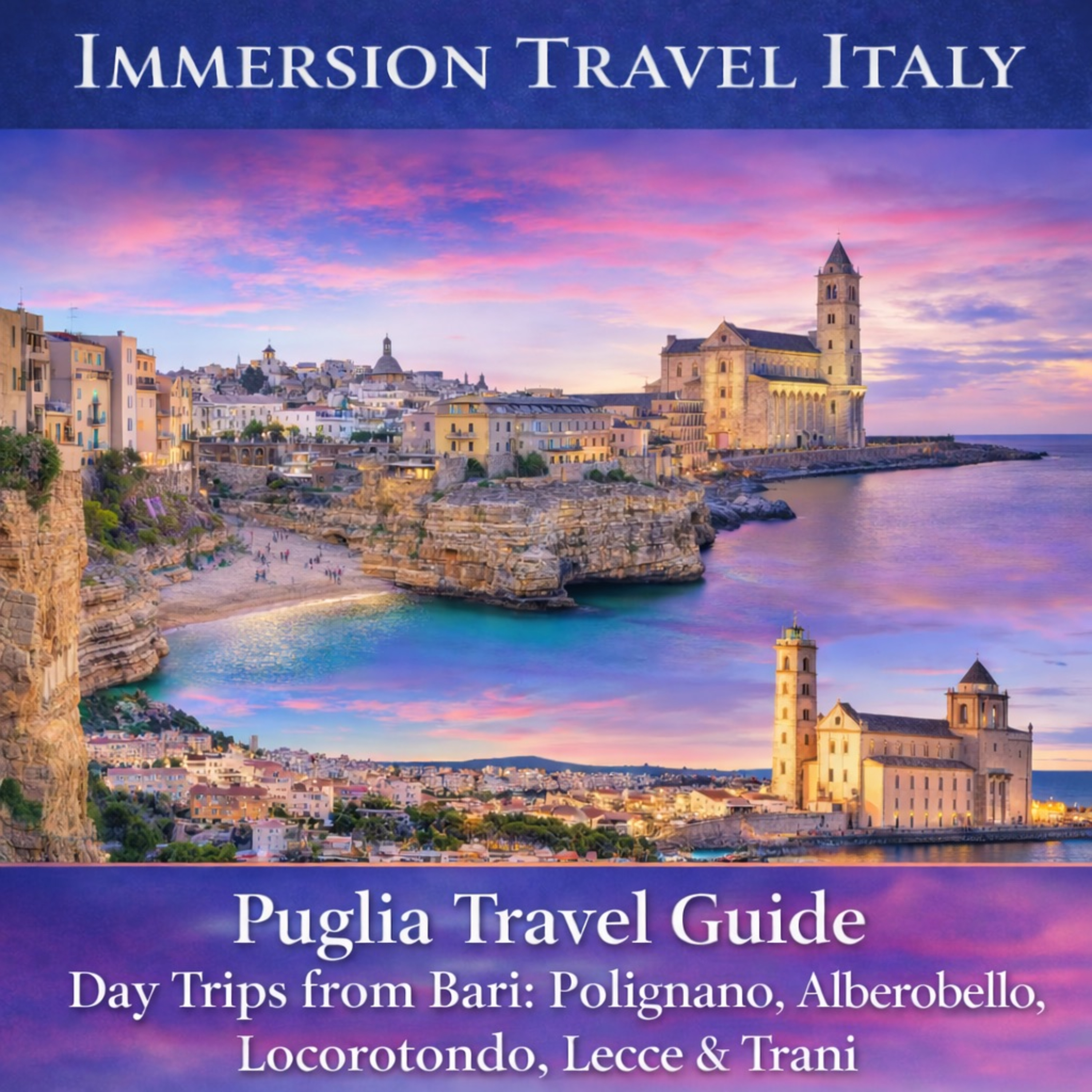 Puglia Travel Guide Part II: Day Trips from Bari: Polignano, Alberobello, Locorotondo, Lecce & Trani. Unique Experiences. Slow Travel. Episode 16B of 20 in the Regional Capitals of Italy Series. | Welcome back to Immersion Travel Italy and Episode 16B of 20 in our Regional Capitals of Italy series.In Part Two of our Puglia journey, we move beyond the capital of Bari and begin radiating outward into some of the most breathtaking landscapes in southern Italy. Bari is the perfect base, but what makes this region extraordinary is what surrounds it.From limestone sea cliffs and glowing Adriatic water to fairytale stone villages and baroque masterpieces carved in honey colored stone, Puglia unfolds slowly and beautifully.In this episode we explore the most rewarding day trips from Bari, all easily accessible by train or short drive.We begin along the dramatic Adriatic coast in Polignano a Mare, where white houses cling impossibly to vertical limestone cliffs. We walk through the historic center beneath the Arco Marchesale, stand above Lama Monachile beach, and then head out by boat to explore the famous sea caves. Turquoise water. Echoing grottos. A prosecco toast inside a cave. This is one of the most unforgettable experiences in Puglia.Next we travel inland into the Valle d’Itria to Alberobello, a UNESCO World Heritage town known for its trulli. These whitewashed stone houses with conical roofs rise like something from a storybook. We explore both Rione Monti and the quieter Rione Aia Piccola and explain the fascinating tax history behind this unique architecture.From there we continue to Locorotondo, often overlooked but stunning in its simplicity. Circular layout. Flower filled balconies. Sweeping vineyard views across the Valle d’Itria. Dinner in a quiet piazza. Southern Italy at its most graceful.Then we head south to Lecce, often called the Florence of the South. Here we explore Piazza del Duomo, take the elevator to the top of the cathedral bell tower, descend into the medieval crypt, and stand before the baroque explosion of Santa Croce. We visit the Roman amphitheater in Piazza Sant’Oronzo and end with hot panzarotti and gelato in front of ancient ruins.Finally, we travel north to Trani, where the Romanesque cathedral rises directly from the Adriatic Sea. We stay overnight in a former convent overlooking the harbor, walk the Jewish quarter, and explore Frederick II’s Castello Svevo alone at sunrise. Trani feels luminous, refined, and deeply peaceful.This episode is filled with practical travel guidance, immersive experiences, walking routes, food recommendations, train logistics, and personal travel stories that help you plan your own Puglia itinerary.If you are building a southern Italy itinerary, this episode will help you understand:• Where to base yourself in Puglia• Which towns work best as day trips• How to move efficiently by train• What experiences are worth booking in advance• And how to slow down and experience this region the right wayFor a full written guide with photos, maps, and additional travel tips, visit the associated blog for this episode:👉 https://katerinaferrara.com/blog/If you love immersive Italy travel and want seasonal festival guides, cultural insights, and new episode alerts, join my free Immersion Travel newsletter here:👉 https://katerinaferrara.com/newsletter/And if you are planning a trip to Italy, my books are designed to help you travel by season and by cultural depth:Ultimate Festival and Travel Guide Pugliahttps://amzn.to/42WEnH1Ultimate Festival and Travel Guide Sicilyhttps://amzn.to/3KARdo8Ultimate Festival and Travel Guide Rome and Beyondhttps://amzn.to/4gRlvz0Ultimate Festival and Travel Guide Venice and the Venetohttps://amzn.to/48OhHfTUltimate Festival and Travel Guide Milan and Lombardyhttps://amzn.to/46VzmQsSicilia in Festa: Experience the Magic of Sicily’s History, Art and Timeless Cultural Celebrationshttps://amzn.to/4jPVEHKThank you for continuing this journey through the Regional Capitals of Italy series.We do not just visit Italy.We experience it. 🇮🇹✨ | — | ||||||
| 5/1/26 | 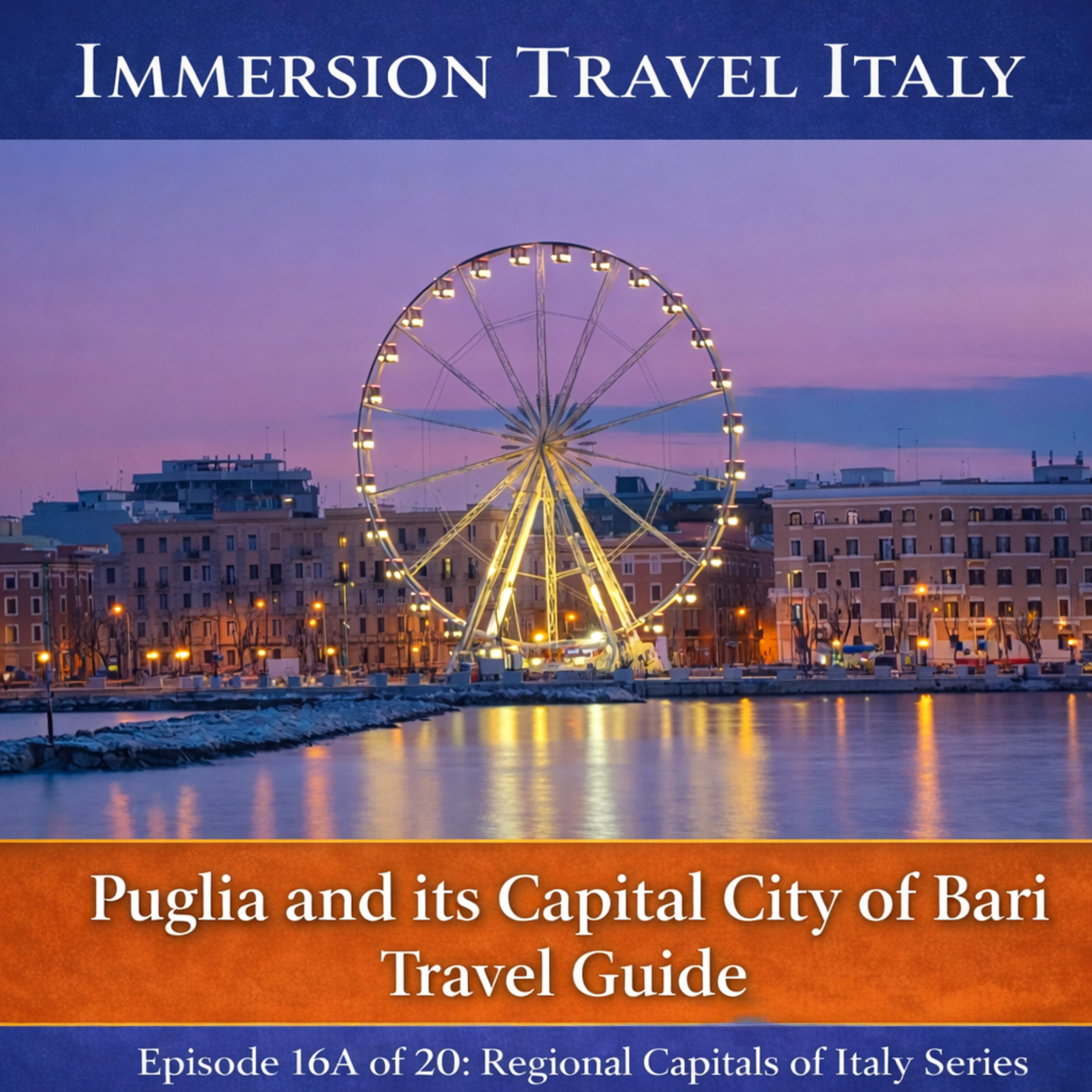 Puglia Travel Guide Part 1 | Bari, History, Masserie & Immersive Experiences. Episode 16A Regional Capitals of Italy Series | Welcome to Episode 16A in our 20 part Regional Capitals of Italy journey. In this episode, we begin exploring Puglia, the sun drenched heel of Italy’s boot, a region shaped by sea winds, conquest, pilgrimage, agriculture, and centuries of cultural exchange between East and West.This episode focuses on Bari and the deeper regional history of Puglia, along with immersive experiences you can plan into your own travels. In Episode 16B, we will move outward for day trips to Polignano a Mare, Alberobello, Locorotondo, Lecce, Trani, and more.Puglia is unlike anywhere else in Italy.Stretching between the Adriatic and Ionian Seas, it has always faced outward. Greek settlers arrived in the 8th century BC. Roman roads like the Via Appia connected Brindisi to the eastern Mediterranean. Byzantines left mosaics. Normans built fortresses. Frederick II constructed Castel del Monte. Spanish and Bourbon rulers governed from afar. During World War II, Brindisi briefly served as Italy’s capital.This is a region shaped by exposure rather than isolation.In this episode, we explore:• The five subregions of Puglia: Gargano, Tavoliere, Le Murge, Valle d’Itria, and Salento• Greek, Roman, Byzantine, Norman, and Spanish influence• Bari as a maritime crossroads and pilgrimage center• The Basilica di San Nicola and the relics of Saint Nicholas• Bari Cathedral and its Byzantine layers• Castello Svevo and Norman defensive power• Strada delle Orecchiette and traditional handmade pasta• Local Pugliese cuisine including burrata, orecchiette, fave e cicoria, focaccia Barese, Primitivo and Negroamaro wines• Coastal walks along Bari’s lungomare• Immersive travel experiences you can book and planBari is more than a port city. It is a living bridge between Catholic and Orthodox Christianity. In 1087, sailors brought the relics of Saint Nicholas from Myra to Bari, transforming the city into one of the most important pilgrimage destinations in Europe. The Basilica di San Nicola remains a powerful spiritual site where Orthodox and Catholic faithful still pray side by side.Beyond its sacred history, Bari reveals everyday southern Italy. Women shaping orecchiette by hand in the old city. Espresso bars humming in dialect. Limestone streets warmed by Adriatic light.We also explore immersive travel experiences in and around Bari:• Cooking classes focused on orecchiette and focaccia Barese• Street food tours through Bari Vecchia• Olive oil tastings at historic masserie• Farm stays in fortified countryside estates• Coastal bike rides along one of Europe’s longest seafront promenades• Small group boat tours along the Bari coastlineThis episode lays the foundation for understanding Puglia’s layered identity before we head into its most iconic towns in Episode 16B.If you are planning a Puglia itinerary, a Bari city guide, a southern Italy trip, or looking for immersive Italian travel experiences beyond Rome, Florence, and Venice, this episode is your starting point.Associated blog with maps, photos, and travel resources:https://katerinaferrara.com/blog/Sign up for my free Immersion Travel Italy newsletter for travel insights, festival dates, and insider planning tips:https://katerinaferrara.com/Continue the journey with Episode 16B where we explore Polignano a Mare sea caves, Alberobello’s trulli, Locorotondo’s white hilltop streets, baroque Lecce, and cathedral light in Trani.Books by Katerina Ferrara:Ultimate Festival and Travel Guide Pugliahttps://amzn.to/42WEnH1Ultimate Festival and Travel Guide Sicilyhttps://amzn.to/3KARdo8Ultimate Festival and Travel Guide Rome and Beyondhttps://amzn.to/4gRlvz0Ultimate Festival and Travel Guide Venice andthe Venetohttps://amzn.to/48OhHfTUltimate Festival and Travel Guide Milan and Lombardyhttps://amzn.to/46VzmQsSicilia in Festa: Experience the Magic of Sicily’s History, Art and Timeless Cultural Celebrationshttps://amzn.to/4pUxBuP | — | ||||||
| 4/24/26 | 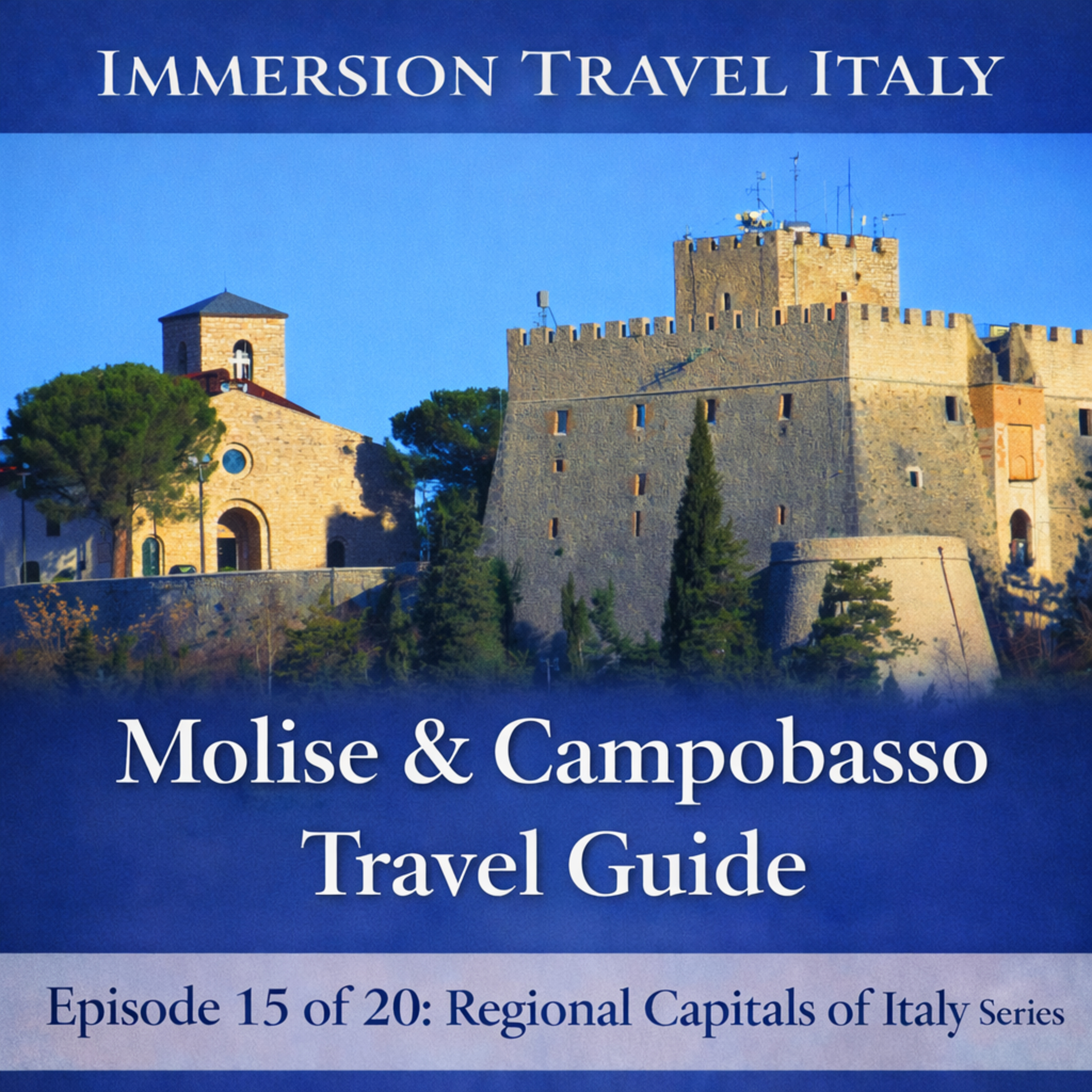 Molise & Campobasso Travel Guide including Termoli, Agnone, Procession of the Mysteries. Episode 15 of 20: Regional Capitals of Italy | In this episode of the Immersion Travel Italy Podcast, we travel to Molise, one of Italy’s least visited and most misunderstood regions, and its capital Campobasso, a hilltop city often passed through but rarely explored.Molise became Italy’s 20th region only in 1963, separating quietly from Abruzzo after centuries of shared administration. That late and almost unnoticed split explains why many Italians still joke that Molise “does not exist.” And yet, this episode reveals exactly why Molise does exist, and why it may be one of Italy’s most authentic destinations.We begin in Campobasso, the regional capital, perched at 700 meters in the Apennines. We explore its layered history from the Samnites and Romans through medieval fortifications, earthquakes, and quiet rebuilding. You’ll walk the centro storico, stop for coffee at historic Pasticceria Ciccone, visit the Cathedral of the Holy Trinity, and climb to Castello Monforte, a fortress rebuilt in the 15th century to watch over a city that has always lived between regions and powers.Campobasso’s identity comes alive through its most extraordinary tradition, the Mysteries of Campobasso (I Misteri). Held each year on Corpus Domini, this 18th-century procession features towering structures carrying real people suspended as angels and saints. It is one of the most moving and unique religious festivals in Italy, carried by the community rather than performed for it.Beyond the capital, we explore immersive day trips across Molise. We travel to Agnone, home to the legendary Marinelli Bell Foundry, one of the oldest family-run businesses in the world, where bells have been cast for churches across Italy and the Vatican for centuries. We visit Sepino (Altilia), one of southern Italy’s most intact Roman cities, where ancient streets, gates, and forums lie open in the countryside alongside grazing sheep. And we head to the Adriatic coast to Termoli, where sandy beaches meet a medieval old town perched above the sea, offering one of the most relaxed and underrated seaside experiences in Italy.This episode also touches on Molise’s experience during World War I and World War II, a region largely spared from destruction but deeply affected by loss, hardship, and postwar emigration. Throughout, Molise reveals itself not through spectacle, but through continuity, craft, faith, and landscape.If you’re looking for Italy beyond the crowds, beyond the checklist, and beyond the obvious, Molise offers something rare.🎧 Read the companion blog:https://katerinaferrara.com/blog/📬 Join my FREE monthly Immersion Travel Italy newsletter for festival dates, regional insights, and slow-travel inspiration:https://katerinaferrara.com/📚 Explore my books on Amazon:Ultimate Festival and Travel Guide SicilyUltimate Festival and Travel Guide PugliaUltimate Festival and Travel Guide Rome & BeyondUltimate Festival and Travel Guide Venice and the VenetoUltimate Festival and Travel Guide Milan & LombardySicilia in Festa (English–Italian bilingual edition)Travel slowly. Travel deeply. And let Italy tell its quieter stories. | — | ||||||
| 4/17/26 | 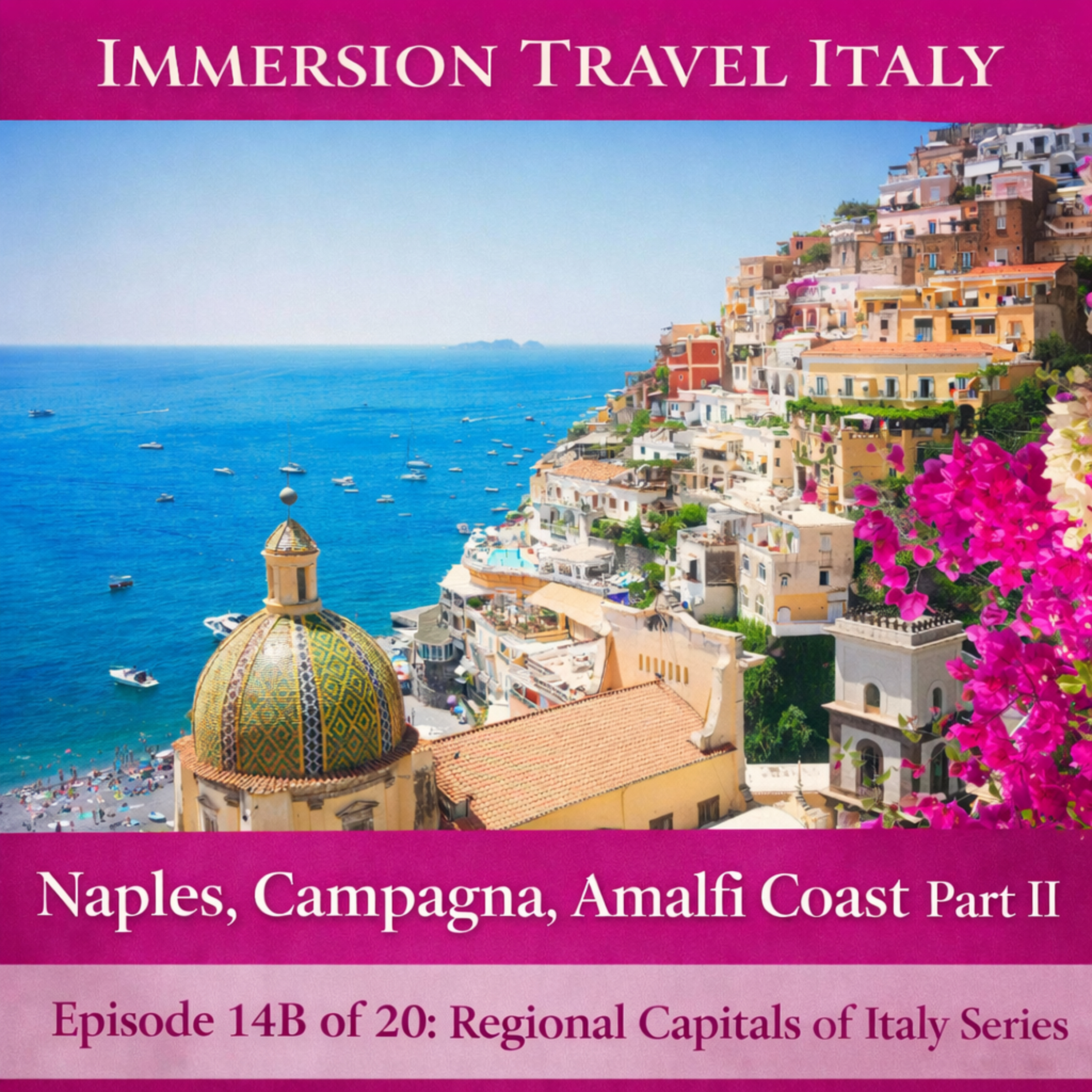 Naples, Amalfi Coast & Campania Travel Guide Part II: Experiences, Activities, Pompeii, Reggia di Caserta, Amalfi and Beyond. Episode 14B of 20 in the Regional Capitals of Italy Series | In Episode 14 Part 2 of the Immersion Travel Italy Podcast, we return to Naples and Campania for one of the most unforgettable travel days of our lives: the Amalfi Coast from the sea.Day Two begins in Naples, then glides south by boat toward Amalfi. Approaching the coast by water changes everything. Towns rise vertically from the sea. Houses cling to cliffs. Roads vanish from view. You instantly understand why this coastline belonged to sailors and maritime republics long before it belonged to drivers.We step into Amalfi’s living history at the Duomo di Amalfi, the Cattedrale di Sant’Andrea. Its Byzantine influenced façade, monumental staircase, shimmering mosaics, and layers of Arab Norman detail tell the story of Amalfi as a powerful Maritime Republic. Inside, the mood turns hushed and timeless as we enter a space tied to relics, devotion, and centuries of trade and ambition. Then we slow down the way Amalfi asks you to: wandering lanes, browsing ceramics and linens, refilling water at the piazza fountain, and letting the energy of the harbor town wash over us.This episode also highlights Amalfi’s most important festival, the Festa di Sant’Andrea Apostolo, when the saint’s relics move through the streets and down the cathedral staircase as fireworks burst above the piazza.Back in Naples, we dive into authentic hands on culture through San Gregorio Armeno, the famous presepe street where artisans build entire miniature worlds. A true Neapolitan nativity scene is not just Christmas. It is daily life layered with faith, humor, and storytelling, with tiny bakers, musicians, merchants, and modern figures crafted with stunning detail.We also explore Naples through craftsmanship: historic glove traditions, quiet leather workshops near Via dei Tribunali and Spaccanapoli, and the spirit of functional artisan culture, including legendary umbrella makers like Mario Talarico. Naples is not polished tourism. It is real artisans working in real time.Food is part of the immersion. In Naples, the best experiences come through participation: a food tour, a cooking class, slow dinners built around ragù napoletano or Genovese, espresso taken standing at the bar, and crema di caffè that tastes like a daily ritual.Then we expand outward with craft experiences in the dintorni: handmade Amalfi paper at the Museo della Carta and the legacy of Amatruda, plus Vietri sul Mare ceramics, a living tradition of color, pigment, and freehand painting that feels like the Amalfi Coast translated into art.Finally, we close with the deeper Campania day trips that belong on every Naples itinerary: Pompeii and Herculaneum, the Reggia di Caserta and San Leucio silk, Paestum’s Greek temples, Benevento’s Lombard legacy, and Gaeta’s dramatic coastline and beach.Listeners will also hear about immersive travel experiences that go beyond sightseeing, including boat travel, island rhythms, coastal towns, and understanding how Campania functions as a region rather than a collection of highlights.________________________________________Related Resources📖 Associated Bloghttps://katerinaferrara.com/blog/📬 Free Immersion Travel Italy NewsletterSign up on the website for travel insights, festivals, regional guides, and immersive Italy experiences.📚 Books by Katerina FerraraUltimate Festival and Travel Guide Sicilyhttps://amzn.to/3KARdo8Ultimate Festival and Travel Guide Pugliahttps://amzn.to/42WEnH1Ultimate Festival and Travel Guide Rome and Beyondhttps://amzn.to/4gRlvz0Ultimate Festival and Travel Guide Venice and the Venetohttps://amzn.to/48OhHfTUltimate Festival and Travel Guide Milan and Lombardyhttps://amzn.to/46VzmQsSicilia in Festa: Experience the Magic of Sicily’s History, Art and Timeless Cultural Celebrations(English-Italian Dual Language Edition)https://amzn.to/4pUxBuP________________________________________Travel slowly.Travel deeply.And let Campania tell its story. | — | ||||||
| 4/10/26 | 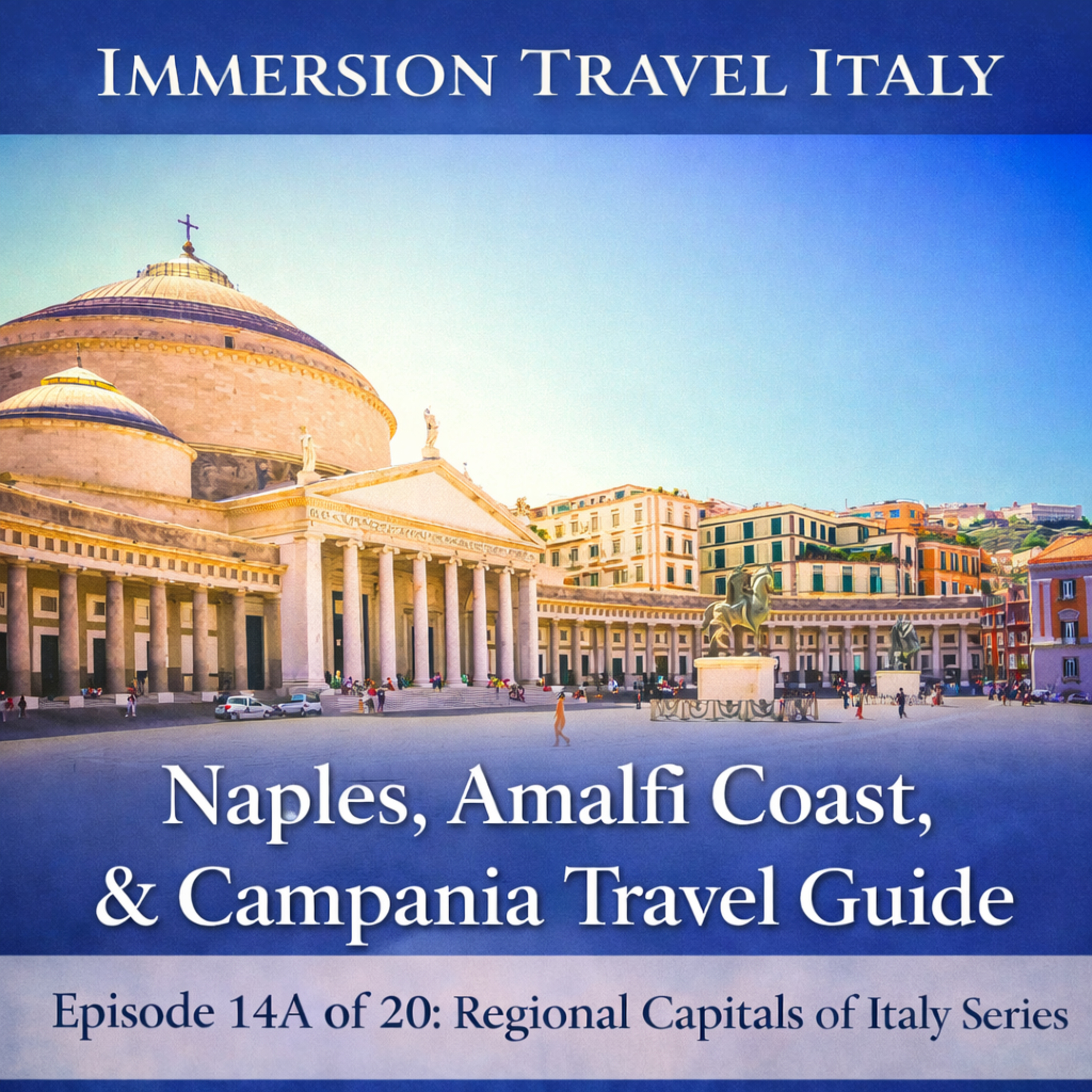 Naples, Amalfi Coast, & Campania Travel Guide: Activities, Sites, and Slow Food. Episode 14A of 20 Regional Capitals of Italy Series | Naples is not a city you visit quickly. It is a city you absorb over time.In Episode 14 of the Regional Capitals of Italy series, we travel south to Naples and the region of Campania, beginning a two-part journey through one of the most historically important, emotionally complex, and misunderstood cities in Italy.This is Part One, dedicated to Naples itself, its ancient origins, its layered history, and the lived experience of the city before expanding outward into the wider region.Founded by the Greeks more than 2,500 years ago, refined by the Romans, shaped by Byzantines, Normans, Angevins, Aragonese, Spanish rulers, Bourbons, revolutionaries, and everyday people, Naples has never been quiet and never been passive. Long before Italy existed as a nation, Naples was already a cultural and political powerhouse, living between sea and fire, with Mount Vesuvius looming constantly in the background.In this episode, host Katerina Ferrara, travel author and founder of Immersion Travel Italy, guides you through Naples as a city with a long memory. We explore how its Greek street grid still defines the historic center, how Roman underground aqueducts and tunnels continue to shape daily life, and how centuries of faith, survival, and resilience are embedded in the city’s churches, neighborhoods, and rituals.This episode goes beyond surface sightseeing. You will hear about Naples as a lived city. A place of deep devotion and daily negotiation. A city shaped by extremes, beauty and danger, elegance and grit, where history is not behind glass but underfoot.Part One includes immersive storytelling around:• Naples’ ancient Greek foundations and Roman transformation• The survival of the city after the fall of Rome• Byzantine influence and the Duchy of Naples• The Norman arrival and the foundations of southern power• Why Naples feels culturally distinct from the rest of Italy• How underground Naples explains centuries of resilience• Faith, saints, and the deeply personal spirituality of the city• Walking Naples through its historic streets and neighborhoodsThe episode then shifts outward to the sea, where Naples begins to open itself geographically and emotionally. As a port city, Naples makes sense from the water, and Day One concludes with an unforgettable boat journey across the Bay of Naples.You will hear about traveling by sea to Procida, Capri, and Ischia, including why seeing these islands from the water changes how you understand Campania. From Procida’s quiet authenticity and maritime traditions, to Capri’s dramatic light and sea caves, to Ischia’s volcanic waters and grounding presence, this first day by boat sets the tone for the wider regional journey that continues in Part Two.This episode is ideal for travelers planning a trip to Naples, listeners interested in Italian history, and anyone who wants to experience Italy beyond the checklist.📖 Associated Blog:https://katerinaferrara.com/blog/Immersion Travel Italy Books by Katerina FerraraAvailable now on Amazon:📘 Ultimate Festival & Travel Guide Sicilyhttps://amzn.to/4l71Pbi📘 Ultimate Festival & Travel Guide Pugliahttps://amzn.to/3HFAe2w📘 Ultimate Festival & Travel Guide Rome & Beyondhttps://amzn.to/440Dq0l📘 Ultimate Festival & Travel Guide Venice & the Venetohttps://amzn.to/48OhHfT📘 Ultimate Festival & Travel Guide Milan & Lombardyhttps://amzn.to/4krTH63 📘 Sicily in Celebration / Sicilia in Festahttps://amzn.to/4jPVEHKA bilingual English-Italian edition designed for travelers and language learners.📬 Free Immersion Travel Italy NewsletterSign up on the website for travel insights, Italy planning tips, festivals, and immersive experiences across all 20 regions of Italy.🎧 More Episodes in the Regional Capitals of Italy Serieshttps://katerinaferrara.com/video-podcast/. | — | ||||||
Want analysis for the episodes below?Free for Pro Submit a request, we'll have your selected episodes analyzed within an hour. Free, at no cost to you, for Pro users. | |||||||||
| 4/5/26 |  Bonus Episode: Slow Travel Italy with Carlo | Verona, Lake Garda, Umbria, Sicily, Tuscany, Piedmont, Food Experiences & Festivals Across Italy | In this special bonus episode of the Immersion Travel Italy Podcast, Katerina Ferrara sits down with Carlo from Slow Travel Italia to explore how to truly experience Italy beyond the checklist.This conversation dives into the heart of slow travel in Italy, focusing on meaningful experiences, local culture, food traditions, and immersive travel across some of Italy’s most iconic and underrated regions.If you are looking to experience Italy beyond the typical checklist of sights, I highly recommend exploring Slow Travel Italia at www.slowtravelitalia.it. Their approach focuses on slowing down and truly connecting with Italy through local culture, food, and meaningful experiences. Whether it is joining a hands-on cooking class, visiting a family-run farm, tasting wine with a local producer, or discovering hidden towns off the beaten path, their curated experiences are designed to help you see Italy through the eyes of those who live there. It is a perfect way to transform your trip into something more personal, immersive, and unforgettable.From the lakes of northern Italy to the countryside of Umbria and the traditions of Sicily, this episode is filled with inspiration and practical travel insight.The true meaning of slow travel in ItalyHow to experience Italy like a local, not a touristWhy festivals, sagras, and religious celebrations are the best way to experience Italian cultureCarnival traditions across Italy including Verona and ViareggioUnique cultural experiencesTravel tips on where to stay and how to choose a home base in ItalyWhy traveling slower leads to deeper, more memorable experiencesIf you’ve ever felt rushed through Italy trying to see Rome, Florence, and Venice all in one trip, this episode will completely change how you plan your travels.This is your guide to:✔️ Connecting with locals✔️ Experiencing Italy through food, festivals, and traditionUltimate Festival and Travel Guide Sicily: https://amzn.to/4l71PbiUltimate Festival and Travel Guide Puglia: https://amzn.to/3HFAe2wUltimate Festival and Travel Guide Rome & Beyond: https://amzn.to/440Dq0lUltimate Festival and Travel Guide Milan & Lombardy: https://amzn.to/3O3yR1bUltimate Festival and Travel Guide Umbria: https://amzn.to/4bRpcTjSicily in Celebration: https://amzn.to/4jPVEHKUltimate Festival and Travel Guide Venice & the Veneto: https://amzn.to/4sDBS7uBlog: https://katerinaferrara.com/blog/Podcast: https://katerinaferrara.com/video-podcast/Join my free newsletter and get festival calendars, travel tips, and hidden gems across Italy delivered to your inbox.Instagram: @katerinaferraraauthorCities & Regions Featured in This EpisodeVerona, Lake Garda, Lake Como, Umbria, Assisi, Spoleto, Orvieto, Tuscany, Siena, Turin, Perugia, Modena, Parma, Sicily, Ragusa, Modica, Syracuse, Mount Etna, Puglia, Bari, BolognaExperiencesItaly itinerary tips, Italian festivals, sagras in Italy, Carnival in Italy, religious festivals in Italy, Italian food experiences, Lake Garda travel guide, Lake Como travel, Umbria travel guide, Tuscany travel tips, Palio di Siena, Turin chocolate experiences, Perugia chocolate festival, Modena balsamic vinegar tasting, Parma cheese (Parmigiano Reggiano) experiences, Sicily travel experiences, Modica chocolate, Mount Etna wine tasting, Puglia travel experiencesLike, subscribe, and share with fellow Italy loversNew episodes every Friday at 7am.🇮🇹 What You’ll Discover in This Episode✨ Why This Episode Matters🇮🇹 SEO Keywords📚 Plan Your Trip with My Books🌍 More Italy Travel Inspiration💌 Join My Free Monthly Newsletter📱 Follow Along👍 Enjoyed this episode? | — | ||||||
| 4/3/26 | 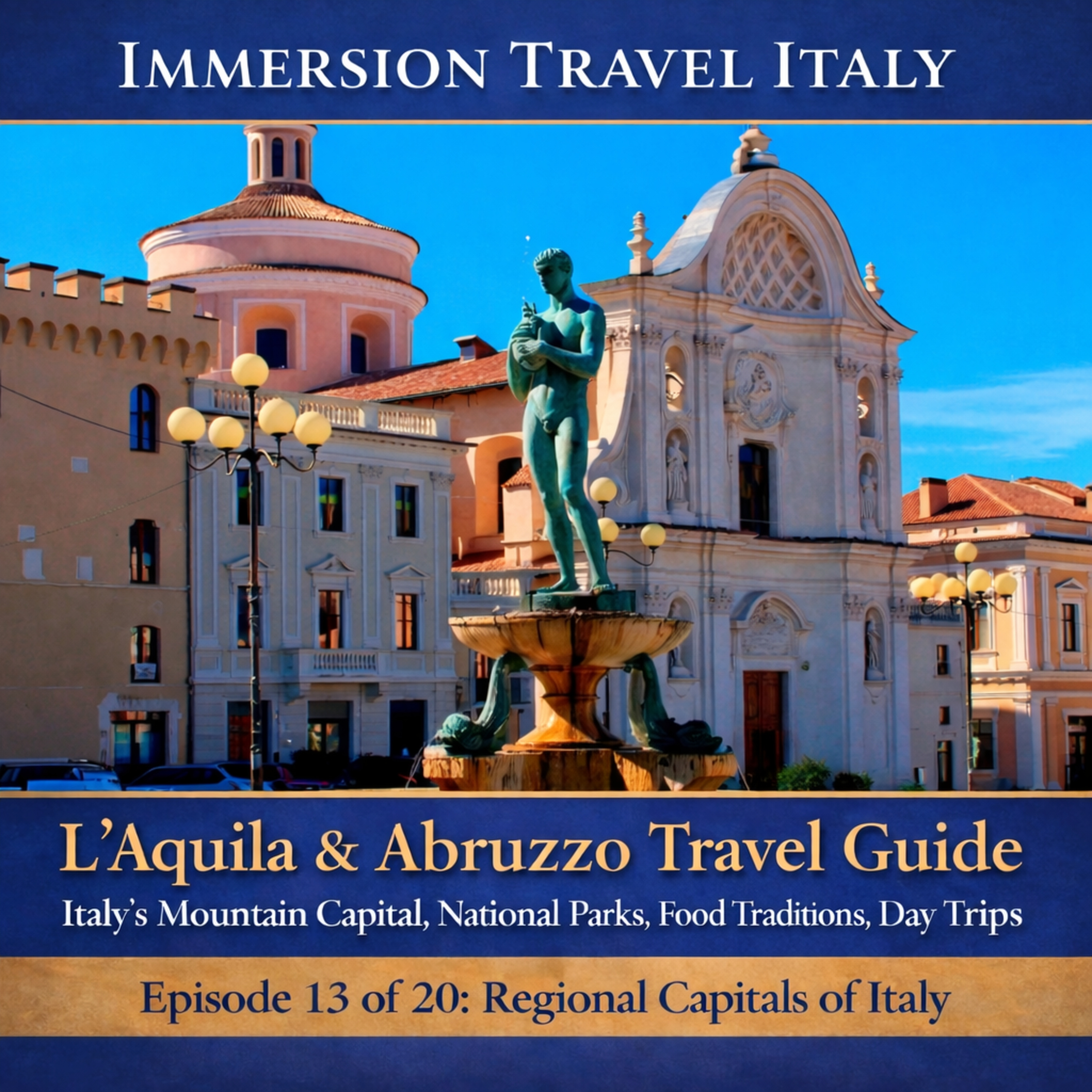 L'Aquila & Abruzzo Travel Guide: Italy's Mountain Capital, National Park, Food Traditions, Day Trips to Sulmona, Pescara and Beyond. Episode 13 of 20 Regional Capitals of Italy Series | L'Aquila: Italy’s Mountain Capital, Earthquake History, National Parks, Food & Day TripsRegional Capitals of Italy Series, Episode 13 of 20In this episode of the Immersion Travel Italy Podcast, we travel into one of Italy’s most underestimated and least crowded regions: Abruzzo.Often called the green heart of Europe, Abruzzo sits in central Italy, east of Rome, where the Apennine Mountains rise sharply and traditions remain deeply rooted in the land. Nearly one third of the region is protected national parkland, shaped by ancient shepherd routes, dramatic landscapes, and a strong sense of identity that has never been softened for tourism.At the center of the episode is L’Aquila, a mountain capital shaped by earthquakes, faith, endurance, and quiet strength. Founded deliberately in 1254 by dozens of villages choosing cooperation over conquest, L’Aquila has one of the most unusual origin stories of any regional capital in Italy.We explore Abruzzo’s deep history, from ancient Italic tribes and Roman expansion to medieval independence, World War I and World War II, and the devastating April 6, 2009 earthquake that killed more than 300 people and displaced tens of thousands. This episode looks honestly at the national tragedy that followed, including questions of accountability and rebuilding, and how L’Aquila chose restoration over erasure.You’ll walk the historic center of L’Aquila step by step, including:• Basilica of Santa Maria di Collemaggio, home to Pope Celestine V and the Perdonanza Celestiniana• Corso Vittorio Emanuele, where recovery unfolds in real time• Piazza Duomo and L’Aquila Cathedral, layered with centuries of rebuilding• Fontana delle 99 Cannelle, the city’s origin story told through water• Coffee at historic Pasticceria Nurzia and lunch at Ristorante La FeniceWe also dive into Abruzzo’s food culture, including maccheroni alla chitarra, pecorino and shepherd cheeses shaped by transhumance, and celebratory dishes like timballo abruzzese.This episode includes immersive day trips from L’Aquila, perfect for slow travelers:• Sulmona, birthplace of Ovid and home of traditional confetti (sugar almonds)• Pescara, Abruzzo’s Adriatic gateway with beaches, modern history, and WWII reconstruction• Castel di Sangro, where transhumance landscapes still define daily life• A visit into Abruzzo’s national parks, including wildlife, mountain villages, and ancient shepherd pathsYou’ll also learn about Abruzzo’s most important festivals, including:• Perdonanza Celestiniana (UNESCO Intangible Cultural Heritage)• Festa di San Massimo, a deeply local celebration rooted in communityThis episode is for travelers who want to go beyond the checklist and understand why Abruzzo feels different, a region shaped by survival, rebuilding, and identity held tightly even when everything else is shaken.________________________________________📩 Stay ConnectedSign up for the Immersion Travel Italy Newsletter for monthly festival calendars, travel inspiration, and immersive Italy planning tips:👉 katerinaferrara.com📝 Read the Companion BlogExplore the associated blog post with maps, walking routes, food highlights, and day trip details from this episode on the Immersion Travel Italy website.🎧 Subscribefor more episodes in the Regional Capitals of Italy series as we travel north to south, uncovering the cities that shape Italy far beyond the headlines.Travel slowly.Travel deeply.And let Italy tell its stories. | — | ||||||
| 3/27/26 | 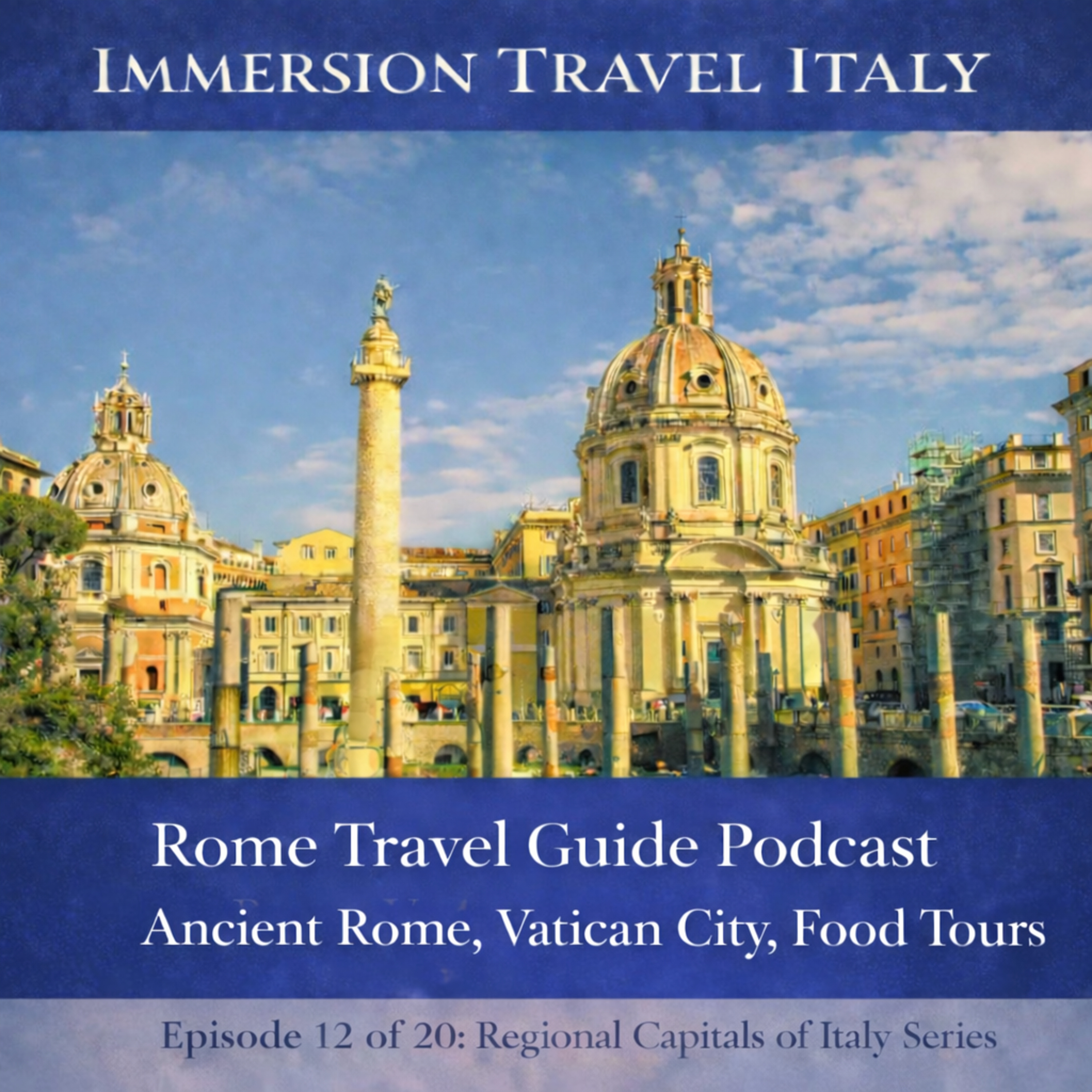 Rome, Italy Travel Guide | Ancient Rome, Vatican City, Food Tours, Festivals & Day Trips to Tivoli, Castelli Romani, Florence, Orvieto Part 12 of 20: Regional Capitals of Italy Series | Welcome to Immersion Travel Italy, where we do not just visit Italy, we experience it.I’m Katerina Ferrara, Italy travel author and host, and this is Episode 12 of 20 in the Regional Capitals of Italy podcast series.In this episode, we explore Rome, the capital of Italy and the heart of the Lazio region. Rome is one of the most layered cities in the world, with over 2,700 years of continuous history. Ancient Rome, the Roman Republic, the Roman Empire, the Catholic Church, the Renaissance, modern Italy, and daily Roman life all exist together in one living city.This episode is designed for travelers who want to understand Rome beyond the checklist.We begin with Rome’s legendary founding by Romulus and Remus and walk through the city’s evolution from a small settlement on the Palatine Hill to the center of a global empire. You will hear how Rome absorbed Etruscan and Greek influences, how the Roman Republic governed power, how emperors reshaped the city, and how Christianity transformed Rome after the Edict of Milan in AD 313.We explore how Rome survived the fall of the Western Roman Empire, how the papacy became Rome’s anchor, and how Renaissance popes rebuilt the city through art, architecture, and influence. We also cover Rome’s role in Italian unification, the Lateran Pacts, World War II, and Rome’s place as the capital of the Italian Republic today.From history, we move into how to experience Rome today.You will hear a focused one day walking route connecting Ancient Rome to Vatican City, including the Colosseum, Roman Forum, Palatine Hill, St Peter’s Basilica, the Vatican Museums, and the Sistine Chapel. We also share tips on skip the line tickets, dome climbs, and after hours Vatican visits.Food is central to understanding Rome, and this episode highlights immersive food experiences including the Roscioli walking food tour, a three hour journey through traditional Roman cuisine, and a Rome cooking class with Cesarine, where you cook inside a local Roman home.We also explore Rome’s hidden layers with experiences like Nero’s Domus Aurea, the underground Colosseum at night, and Palazzo Colonna, one of Rome’s most extraordinary privately owned palaces.Festivals are a key part of immersion travel, and this episode highlights three of Rome’s most important celebrations:• Natale di Roma on April 21• The Feast of Saints Peter and Paul on June 29 with fireworks over Castel Sant’Angelo• Festa dei Noantri in Trastevere in JulyDay trips from Rome are also covered, including Tivoli with Hadrian’s Villa and Villa d’Este, the Castelli Romani hill towns like Castel Gandolfo, Frascati, and Ariccia, plus easy train trips to Florence and Orvieto.This episode is perfect for travelers planning:• A first trip to Rome• A return visit focused on deeper experiences• A Jubilee year visit• A longer Italy itinerary• Food focused travel in Rome• Festival based travel in ItalyFor a deeper dive, this episode pairs with my book Ultimate Festival and Travel Guide Rome and Beyond, which includes over 100 festivals across Lazio, detailed walking tours, food recommendations, and practical travel planning.Rome is not a city you finish.It is a city you return to.Follow the podcast for more immersive Italy travel and join me as we continue the Regional Capitals of Italy series.Travel slowly.Travel deeply.And let Italy tell its story. | — | ||||||
| 3/20/26 | 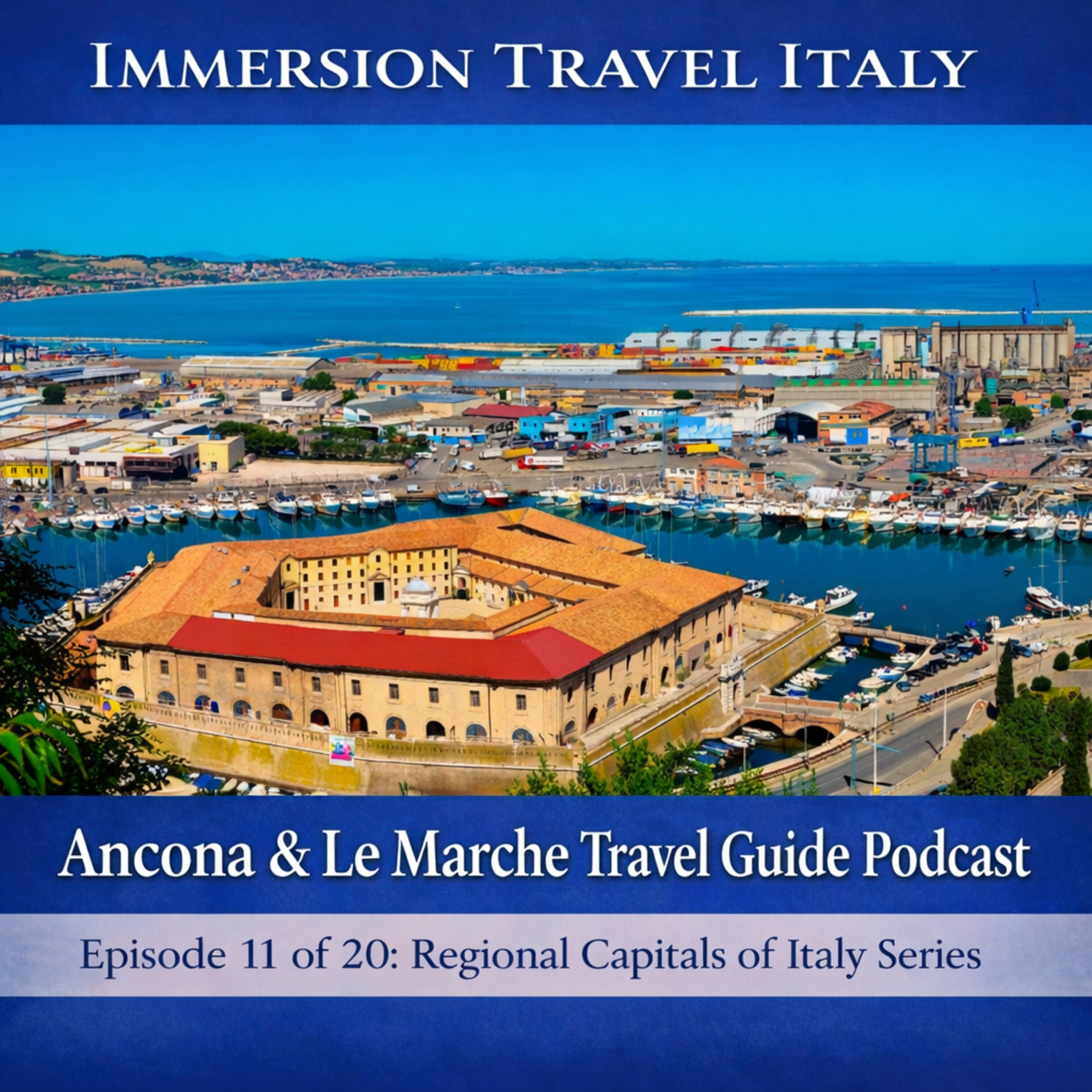 Ancona & Le Marche Travel Guide Podcast | Italy’s Adriatic Capital, History, Walking Tour, Day Trips & Slow Travel. Episode 11 of 20 : Regional Capitals of Italy Series | In this episode of Immersion Travel Italy, we travel to Ancona, the capital of Le Marche, one of Italy’s most quietly compelling regions. Framed by the Adriatic Sea on one side and the Apennine Mountains on the other, Le Marche is a place of ports and pilgrimage, craftsmanship and continuity, where Italy reveals itself slowly and honestly.This is Episode 11 of the Regional Capitals of Italy Podcast Series, where we explore Italy city by city, not just for what we see, but for why it matters. Today’s journey takes us beyond the usual tourist routes to a working port city shaped by trade, faith, resilience, and centuries of movement across the Mediterranean.We begin with the layered history of Ancona, founded by the Greeks in the 4th century BC and later developed into a vital Roman port under Emperor Trajan. You’ll hear how Ancona survived the fall of the Roman Empire, functioned as a medieval maritime republic, endured papal rule, suffered heavy bombing during World War II, and rebuilt itself without ever turning into a museum city.From there, we move into a walkable, immersive tour of Ancona, starting near the port and climbing upward through the historic center. Highlights include the Arch of Trajan, the Roman Amphitheater, the pentagonal Mole Vanvitelliana (Lazzaretto), Piazza del Plebiscito (Piazza del Papa), the National Archaeological Museum of the Marche, Santa Maria della Piazza, the former Jewish quarter, Teatro delle Muse, and the dramatic Cathedral of San Ciriaco, perched high above the Adriatic.Along the way, we pause for coffee with locals, talk about daily life in a working Italian port, and end by the sea at Passetto, where Ancona opens back out to the water that has always defined it.This episode also explores Le Marche’s artisan traditions, including:• Shoemaking in Ascoli Piceno• Hat making in Montappone, where a majority of Italy’s hats are still produced• Accordion and organetto craftsmanship in Castelfidardo• Handmade paper production in Fabriano, one of Europe’s most important historic paper centersWe then expand outward with meaningful day trips from Ancona, including:• Loreto, one of Italy’s most important pilgrimage towns and home to the Basilica of the Holy House• Recanati, birthplace of poet Giacomo Leopardi and a town shaped by reflection and thought• Urbino, a UNESCO World Heritage city and one of the purest expressions of Renaissance humanismYou’ll also hear about experiences that bring Le Marche to life, from boat tours along the Riviera del Conero, to Verdicchio wine tastings, olive oil farms, agriturismi, and hands on cultural encounters that define slow travel in central Italy.If you’re looking for an Italy travel podcast that goes beyond checklists and highlights, this episode offers history, walking routes, cultural insight, and practical inspiration for travelers who want depth, not crowds.📖 Read the companion blog with additional details and travel notes:👉 https://katerinaferrara.com/blogs📬 Join the free Immersion Travel Italy Newsletter for festival calendars, regional travel ideas, and behind the scenes planning for upcoming episodes:👉 https://katerinaferrara.comIf you enjoyed this episode, follow the podcast, share it with a fellow Italy lover, and join me as we continue traveling through Italy’s regional capitals one city at a time.Travel slowly.Travel deeply.And let Italy tell its stories. | — | ||||||
| 3/13/26 | 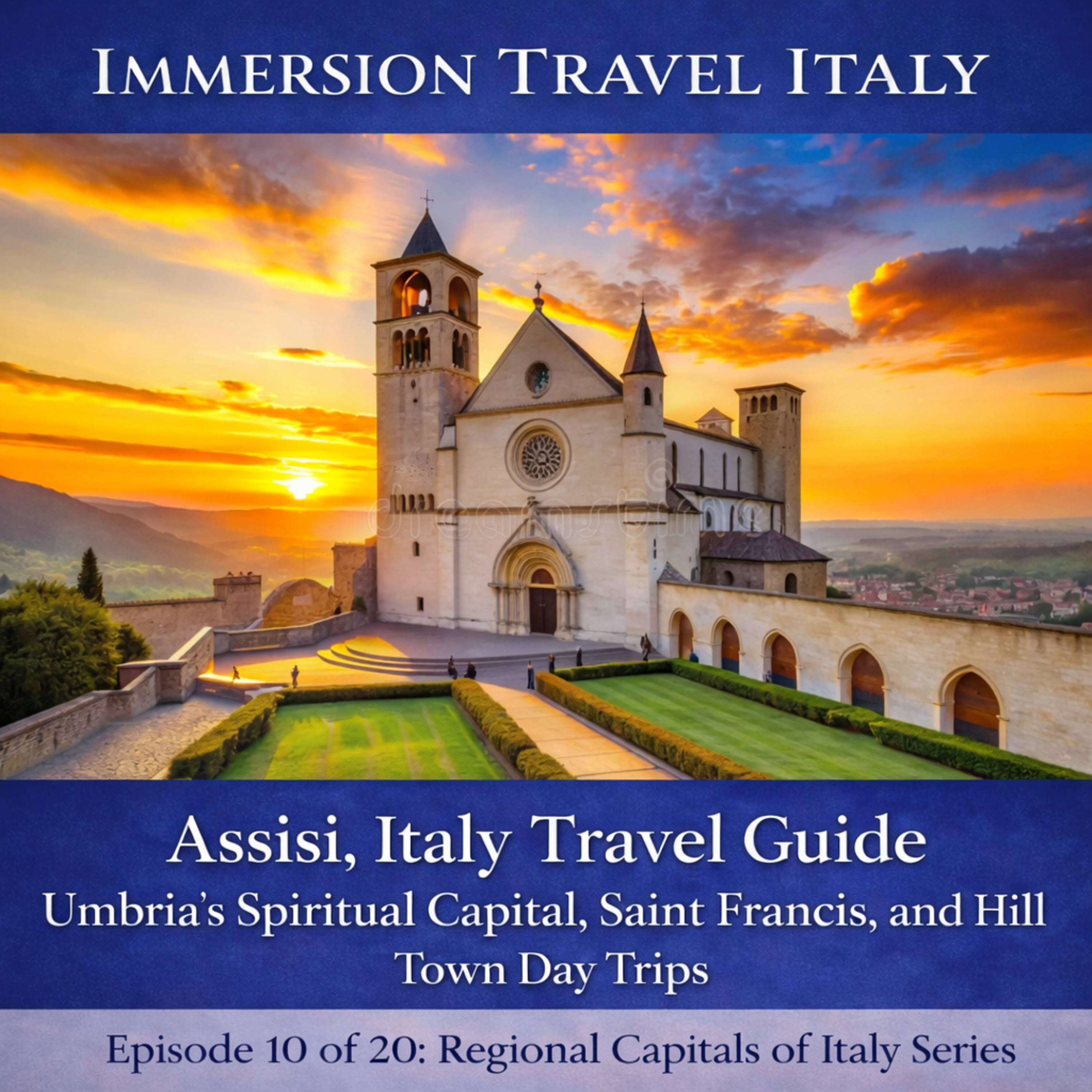 Assisi and Umbria Travel Guide | Festivals, Saint Francis, Saint Clair and Hill Town Day Trips to Spoleto, Orvieto, and Spello. Episode 10 of 20: Regional Capitals of Italy Series | Welcome to Assisi, one of Italy’s most powerful spiritual destinations and the heart of Umbria. In this episode of the Immersion Travel Italy Podcast, we slow the pace and step into a city shaped by faith, silence, and centuries of continuity. We visited Assisi in early December last year, when the crowds had faded and the medieval streets felt almost suspended in time. Winter hats and jackets, crisp air, quiet stone alleys, and the rare gift of having space to truly experience the city. This episode captures Assisi in its most honest form, calm, reflective, and deeply moving. We begin with Assisi’s long history, from its Umbrian and Roman origins as Asisium, through its turbulent medieval period, and into the extraordinary transformation sparked by Saint Francis of Assisi and Saint Clare.We explore how a city once defined by rivalry and warfare became one of the world’s most important pilgrimage destinations and a global symbol of peace. You’ll walk through Assisi step by step, starting at the historic gates and making your way to the Basilica of Santa Chiara, including its quiet crypt and luminous interior. From there, we move through the civic heart of the city at Piazza del Comune, anchored by the remarkably preserved Roman Temple ofMinerva, and continue on to the Cathedral of San Rufino, where both Francis and Clare were baptized. The episode culminates at the Basilica of San Francesco, one of the most important churches in the Christian world. We descend into the Lower Church with its intimate atmosphere and early frescoes by Cimabue and Pietro Lorenzetti, pause at the simple tomb of Saint Francis, then rise into the light-filled Upper Church. Here, the revolutionary fresco cycle traditionally attributed to Giotto marks a turning point in Western art and the beginning of a new visual language that would lead directly to the Renaissance. This episode also includes practical travel insight. We discuss how to reach Assisi by train, what to know about the station’s location in the valley, and why having a car offers flexibility for exploring Umbria’s hill towns. From Assisi, we take immersive day trips to:• Orvieto, with its dramatic volcanic setting, funicular, andunforgettable cathedral façade and Renaissance frescoes• Spoleto, home to Roman foundations, Filippo Lippi’s final masterpiece, and the breathtaking Ponte delle Torri• Spello, a refined and intimate town known for Roman gates and Pinturicchio’s joyful Baglioni Chapel frescoes We also share local food experiences, including lunch with a view overlooking the Basilica of San Francesco, Umbrian cuisine highlights, artisan shopping, ceramics in Deruta, and reflective experiences like walking a portion of the Via di Francesco pilgrimage route.This is not an episode about rushing through sights. It’s about rhythm, stillness, and letting a place reveal itself slowly. For more details, walking routes, and travel planning tips, visit the companion blog at katerinaferrara.com/blogs.Be sure to subscribe to the Immersion Travel Italy Newsletter for free seasonal travel ideas, festival updates, and behind-the-scenes stories. New episodes of the Regional Capitals of Italy Series releaseevery Friday. | — | ||||||
| 3/6/26 | 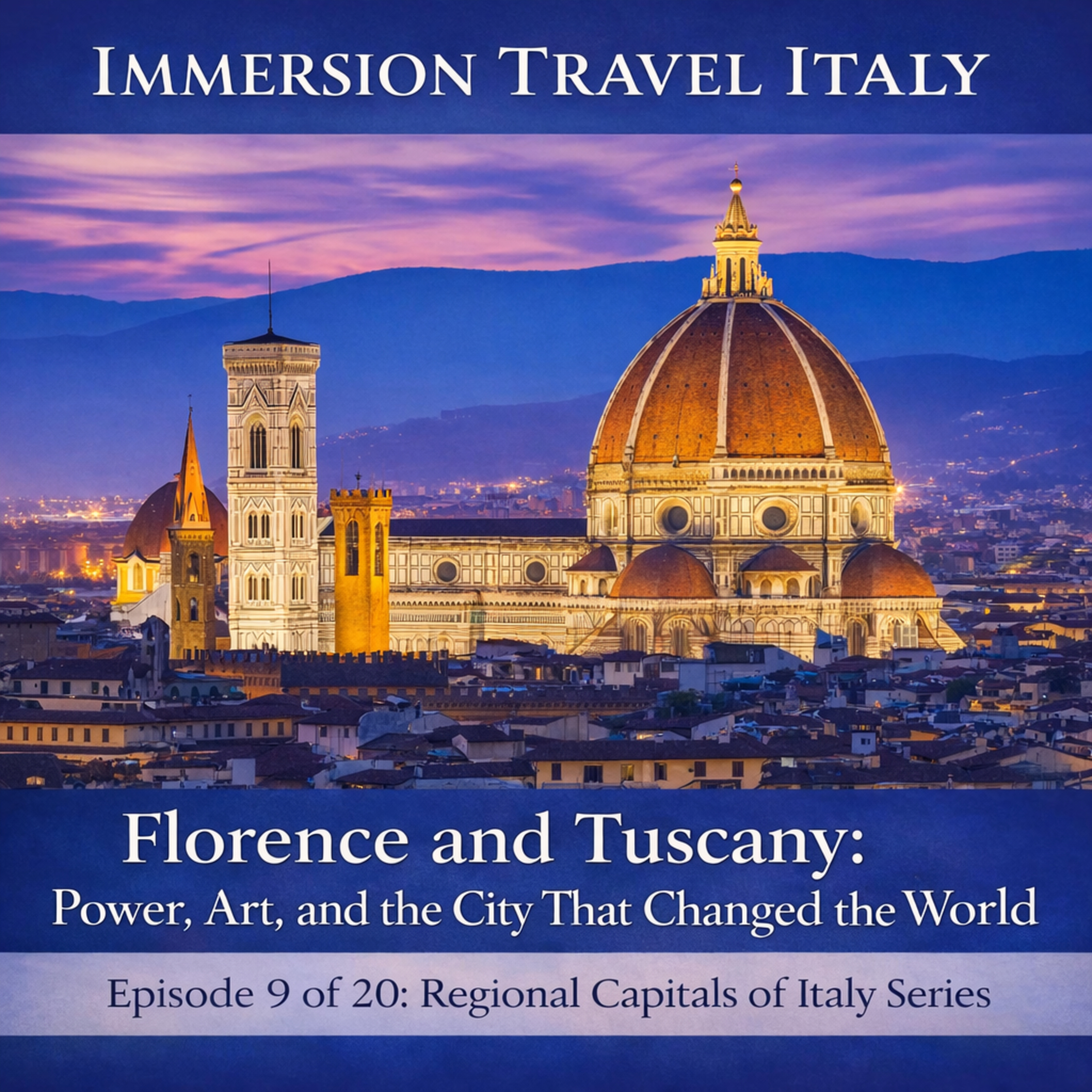 Florence Italy Travel Guide: Climb the Cupola, Decode the Medici & Experience Tuscany Like a Local. Episode 9 (of 20) of the Regional Capitals of Italy Series. | Florence and Tuscany are at the heart of Italy’s cultural identity, and in this episode of the Immersion Travel Italy Podcast, we explore why Florence continues to draw travelers back again and again. After Rome and Venice, Florence is the third most visited city in Italy, and for good reason. This is where the Renaissance took shape, where art and power merged, and where families like the Medici reshaped Europe through banking, politics, architecture, and patronage. In this episode, I take you deep into Florence’s history, beginning with its Etruscan and Roman foundations, through the Middle Ages, the Renaissance, Medici rule, foreign domination, and Florence’s often overlooked role as thecapital of the Kingdom of Italy in the nineteenth century. We walk step by step through Florence’s most important sites, starting at Piazza del Duomo and the Cathedral of Santa Maria del Fiore, with its iconic colored marble façade and Brunelleschi’s revolutionary dome. I explain why thedome remains one of the greatest engineering achievements in history and what it feels like to stand beneath Vasari’s Last Judgment fresco. You will hear what it is like to climb the Duomo’s cupola, why Irecommend it over Giotto’s Bell Tower if you only choose one, and how standing eye level with the frescoes changes the experience completely. We also explore Giotto’s Campanile, the Baptistery of San Giovanni, the famous bronze doorsknown as the Gates of Paradise, and the Museo dell’Opera del Duomo where the original doors are preserved. From there, we move into Piazza della Signoria, Palazzo Vecchio, and the dramatic political history of Florence, including the rise and fall of the Medici family, their move to Pitti Palace, and how republican Florence became aducal capital. We also explore Santa Maria Novella, its important cloisters, and why this church is often the first historic site visitors see when arriving by train. This episode includes personal experiences, from starting the day at historic Pasticceria Gilli, to climbing Florence’s towers, to eating lunch at Trattoria Zà Zà near the Duomo and Accademia. I also share what it is like to see Michelangelo’s David at the Galleria dell’Accademia and why Florence neverfeels finished after one visit. We go beyond sightseeing to talk about immersive experiences in Florence, including Tuscan cooking classes with market visits, fresco and gilding workshops, leather crafting in the Oltrarno, art restoration traditions, historic perfume and apothecary culture, and after hours access tochurches and museums. Finally, we step outside the city to explore Tuscany beyond Florence, including day trips to Siena, Lucca, Pisa, San Gimignano, Fiesole, and Piazzale Michelangelo. I also mention other Tuscan cities like Arezzo, Prato, Pistoia, Livorno, Grosseto, Carrara, Volterra, Viareggio, and Cortona, which will be featured in future episodes. This episode is for travelers who want more than highlights, for those who want to understand Florence, not just see it.Thank you for traveling with me.This is Immersion Travel Italy.Let the cities tell their stories.Explore More with My BooksUltimate Festival and Travel Guide Sicilyhttps://amzn.to/3KARdo8Ultimate Festival and Travel Guide Pugliahttps://amzn.to/42WEnH1Ultimate Festival and Travel Guide Rome and Beyondhttps://amzn.to/4gRlvz0Ultimate Festival and Travel Guide Venice and the Venetohttps://amzn.to/48OhHfTUltimate Festival and Travel Guide Milan and Lombardy https://amzn.to/46VzmQsSicilia in Festa Experience the Magic of Sicily’s History Art andTimeless Cultural Celebrations English Italian Dual Language Editionhttps://amzn.to/4pUxBuP | — | ||||||
| 2/27/26 | 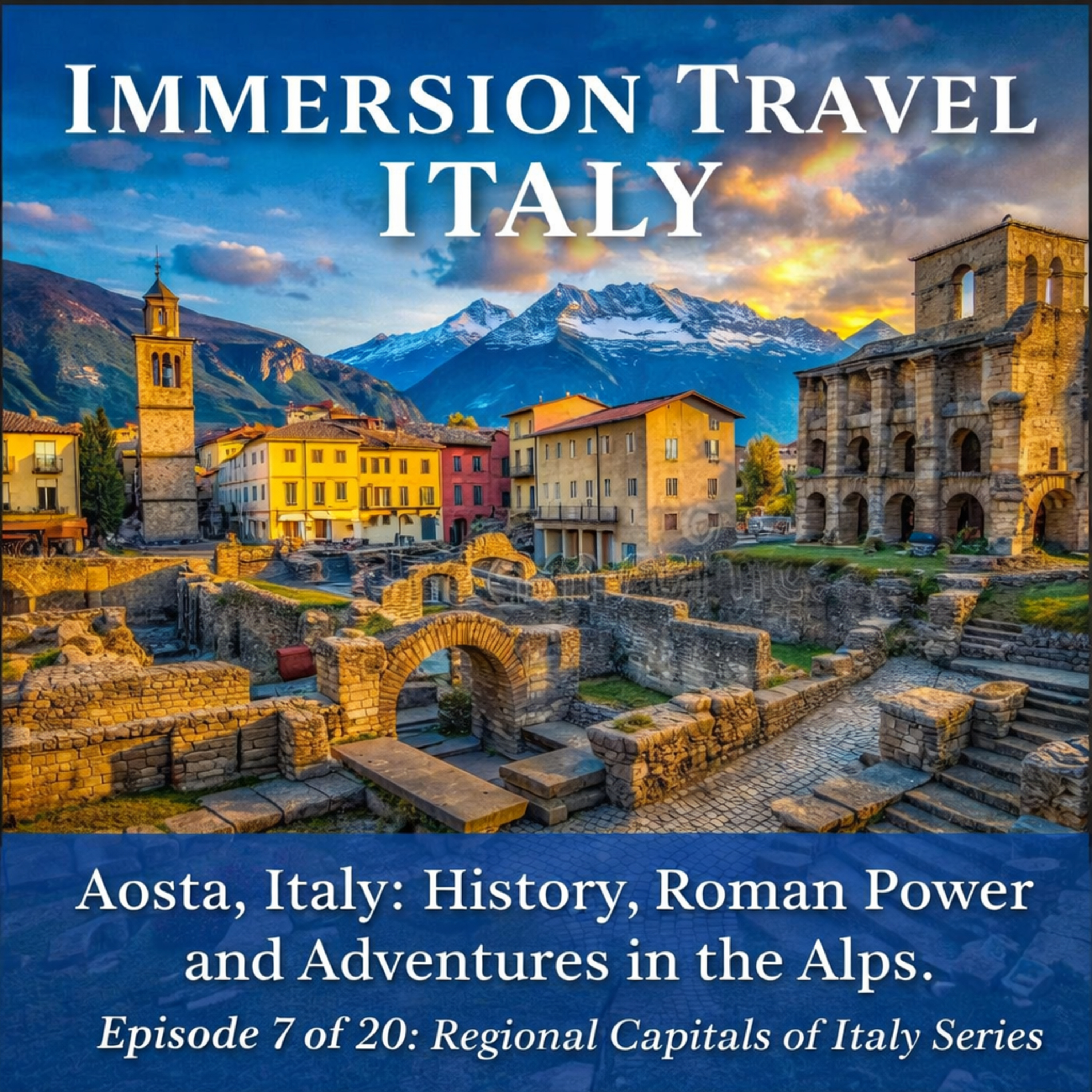 Aosta, Italy: History, Roman Power, Skiing, Hiking, Trekking, and Cycling in the Alps. Episode 7, Regional Capitals of Italy Series | In this episode of Immersion Travel Italy, travel author and host Katerina Ferrara takes you to Aosta, the capital of the Val d’Aosta, Italy’s smallest and least populated region, nestled deep in the Italian Alps at the crossroads of Italy, France, and Switzerland. Episode 7 of 20 in the Regional Capitals of Italy Series.With just over 30,000 residents in the city and roughly 125,000 in the entire region, the Val d’Aosta feels intimate, grounded, and deeply shaped by its landscape. Yet despite its size, this valley has played an outsized role in European history for more than two thousand years.Founded by the Romans in 25 BC as Augusta Praetoria, Aosta remains one of the most legible Roman cities in Italy. You can still walk the original Roman grid, pass through monumental gates like the Porta Praetoria, stand beneath the Arch of Augustus, and see a Roman theatre rising dramatically against snow-capped peaks. Unlike cities layered over centuries of demolition and rebuilding, Aosta evolved inside its Roman shell. The past was never erased. It was absorbed.Surrounded by some of the highest mountains in Europe, including Mont Blanc, Monte Rosa, Gran Paradiso, and the Matterhorn, the Val d’Aosta has always been defined by movement. Traders, pilgrims, armies, emperors, and modern travelers all passed through this valley because they had to. Control the passes, and you control the route between northern Europe and Italy.That geography shaped everything, from medieval towers and Savoy castles to one of Napoleon’s most humbling moments at the Fort of Bard, where stone and terrain forced his army to adapt.Today, the Val d’Aosta is often associated with winter skiing, and rightly so. Resorts like Courmayeur, Cervinia, La Thuile, and Pila make this one of Italy’s premier alpine winter destinations. But this episode explores why the region is far more than a ski playground. Summer brings hiking, cycling, climbing, and nature travel, especially in Gran Paradiso National Park, Italy’s oldest national park. Spring and fall reveal a quieter, deeply local side of the valley focused on food, festivals, and daily life.Aosta itself anchors the region year-round. It is not a resort town. It is a living city where Roman ruins, medieval churches, cafés, markets, and alpine culture exist side by side.This episode covers:Aosta’s Roman foundations and surviving monumentsMedieval towers, Savoy rule, and French influenceNapoleon and the strategic Alpine passesAutonomy, bilingual identity, and modern lifeWalking Aosta on footTraditional Valdostan food and mountain cuisineDay trips including Bard, Courmayeur, Pré-Saint-Didier, and CerviniaYear-round activities from skiing to hikingWhether you are planning a trip to northern Italy, curious about Roman cities in the Alps, or looking for a destination that blends history, mountains, and culture without crowds, Aosta offers a powerful and often overlooked story.🎧 This episode has a companion blog with additional travel planning tips at katerinaferrara.comFor more immersive travel guides and festival-focused journeys through Italy, explore Katerina’s books, including:Ultimate Festival and Travel Guide SicilyUltimate Festival and Travel Guide PugliaUltimate Festival and Travel Guide Rome & BeyondVenice and the VenetoSicilia in Festa (Dual Language Edition)Immersion Travel Italy is about traveling slowly, intentionally, and with context.Because places like Aosta do not just want to be seen.They want to be understood. | — | ||||||
| 2/20/26 | 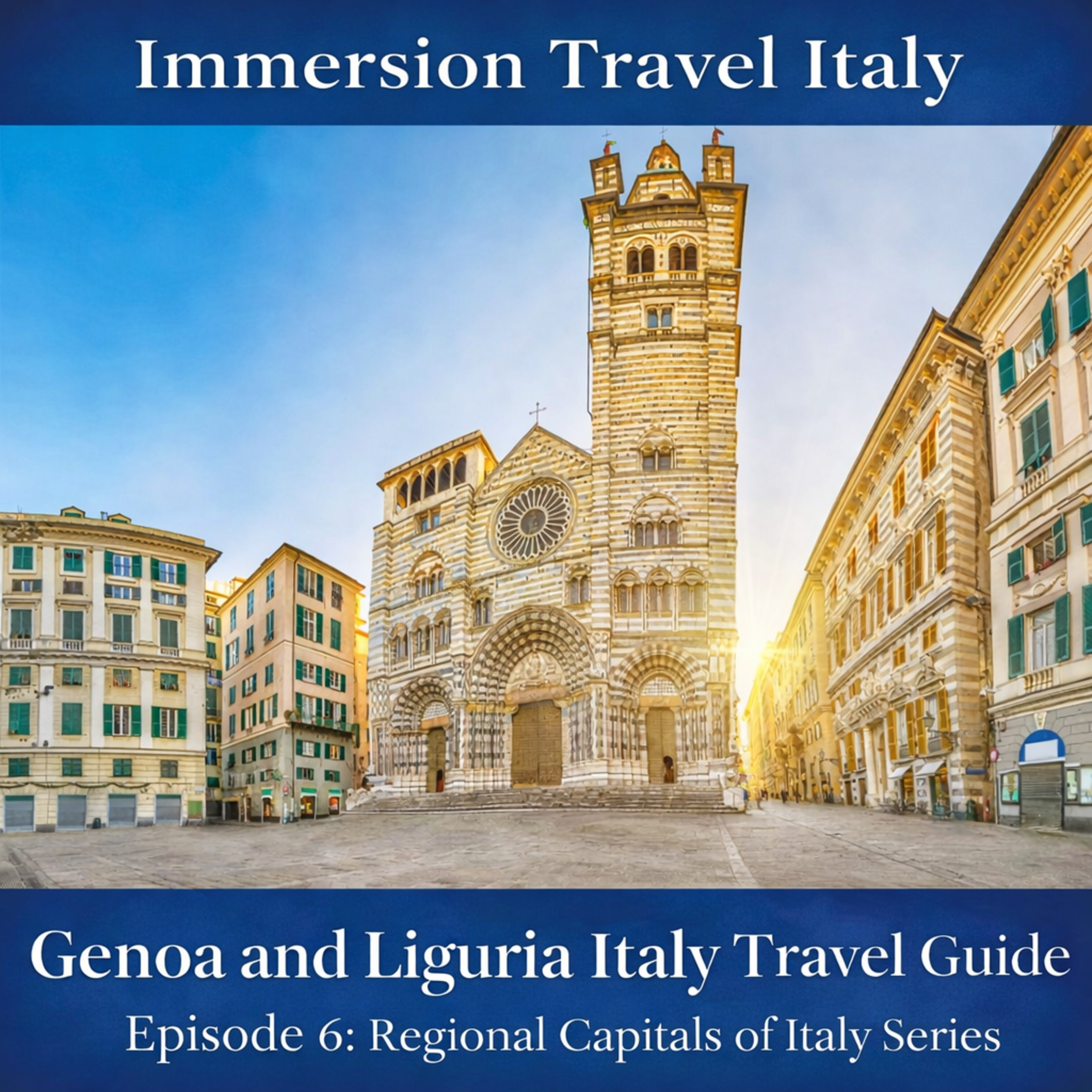 Genoa and Liguria Italy Travel Guide | Maritime Power, Hidden Streets, and a Capital Built on Trade. Regional Capitals of Italy Series Episode 6 | In this episode of the Immersion Travel Italy Podcast, we travel to Genoa, the capital of Liguria, and one of Italy’s most complex and underestimated cities.Genoa is not a city that explains itself easily. Wedged between the Ligurian Sea and steep hills, it developed inward, guarding its wealth, knowledge, and power behind narrow medieval streets known as the caruggi. For more than seven centuries, Genoa functioned as an independent maritime republic, funding empires, controlling trade routes, and shaping European finance in ways that are still felt today.This episode is the sixth in our Regional Capitals of Italy series, following Turin in Piedmont, Bologna in Emilia Romagna, Milan in Lombardy, Trento in Trentino Alto Adige, and Trieste in Friuli Venezia Giulia. Each capital reveals a different way power shaped Italy. Genoa’s story is one of commerce, strategy, and endurance.We begin with Genoa’s origins as a medieval maritime republic and explore how geography shaped its identity. Unlike Venice, Genoa exercised influence quietly, through contracts, banking, and control of movement rather than ceremony. Powerful families built palaces not as royal seats, but as private instruments of authority.The episode covers Genoa’s key historical transitions, including the end of the Republic under Napoleon Bonaparte, the city’s forced integration into the Kingdom of Sardinia, and its later role in Italian unification. Genoa never regained independence, but it became essential to the new Italian state as a port, industrial center, and gateway to the wider world.We also explore Genoa’s connection to Christopher Columbus, born here in the 15th century. Columbus was shaped by Genoa’s maritime culture and financial mindset long before sailing for Spain. Even after his voyages, Genoese bankers helped manage the flow of wealth from the Americas into Europe, reinforcing Genoa’s influence beyond visible borders.From history, we move into experience.You’ll walk through Genoa’s historic center, beginning at the magnificent Duomo di San Lorenzo, moving through the caruggi, opening into Piazza De Ferrari, and continuing along Via Garibaldi and the UNESCO listed Rolli Palaces. We talk about what to notice, how to read the city, and why Genoa feels lived in rather than curated.Food is an essential part of understanding Genoa, and we cover classic Ligurian dishes including focaccia genovese, farinata, and trofie al pesto, along with suggestions for cafés, bakeries, and traditional lunch spots.The episode also highlights Genoa’s three most important festivals:Festa di San Giovanni Battista, honoring the city’s patron saintLe Vele d’Epoca, celebrating maritime heritageRolli Days, when historic palaces open their doors to the publicFrom Genoa, we explore easy day trips by train and boat, including Rapallo and Portofino in one day, the fishing town of Camogli, and ferry connections to Sardinia, Sicily, and Corsica. Genoa has always been a city of departure, and it remains one today.We close with activities that help you experience Genoa beyond sightseeing, including walking the Porto Antico, riding the city’s public elevators and funiculars, visiting the Galata Museo del Mare, and seeing Genoa from the water.This episode is about learning how to read a city that never performed for visitors, but rewarded those willing to look deeper.🎧 Associated blog with full details, walking routes, and planning tips:https://katerinaferrara.com/blog/For more immersive travel guides, podcast episodes, and Italy focused itineraries, visit katerinaferrara.com and follow the Immersion Travel Italy series. | — | ||||||
| 2/13/26 | 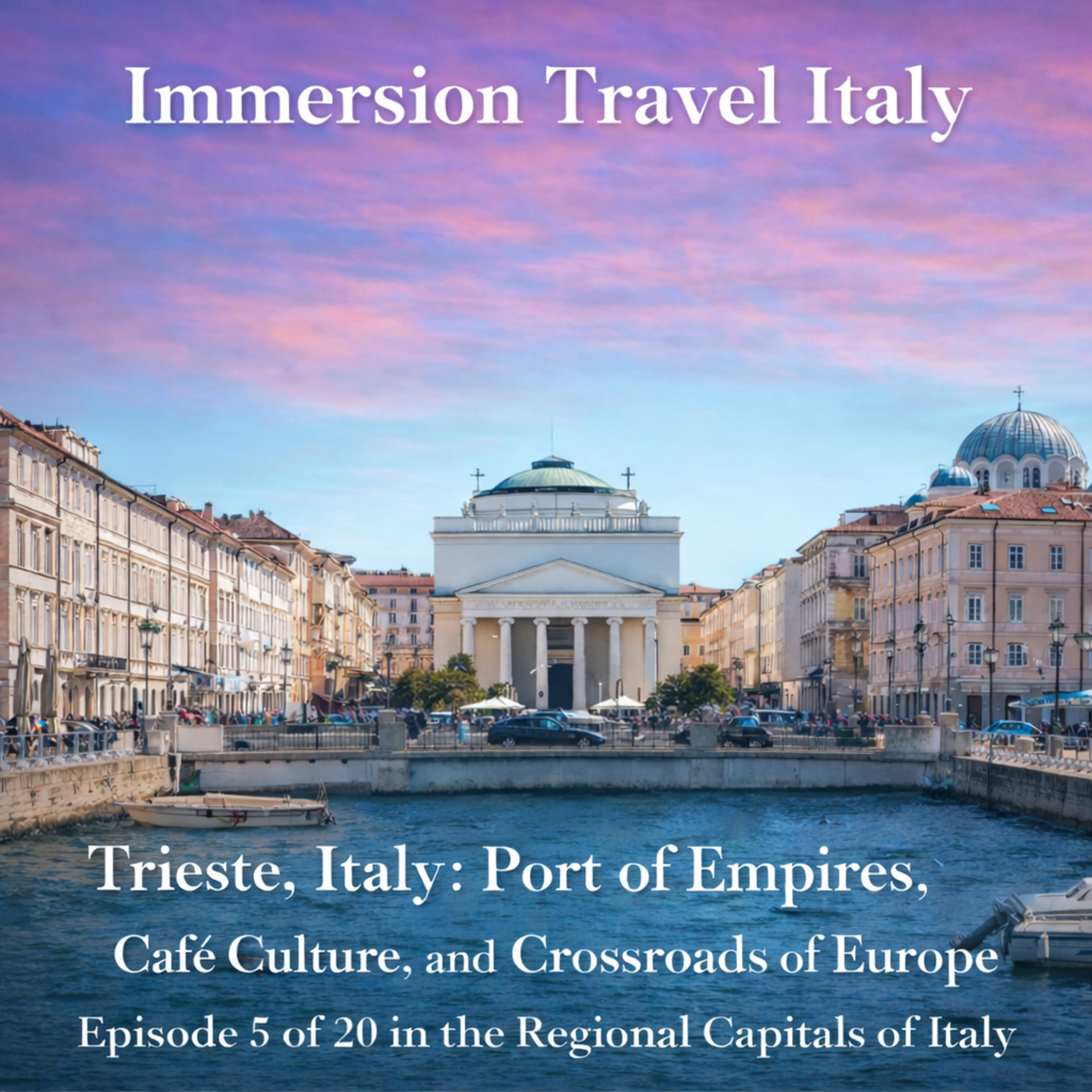 Trieste, Italy: Port of Empires, Café Culture, and Crossroads of Europe. Episode 5 of the Capitals of Italy Series. | Welcome to Immersion Travel Italy—I’m Katerina Ferrara, travel author, podcaster, and your guide through Italy’s most fascinating regions. This is episode 5 of 20 in the Regional Capitals of Italy Series. In this episode, we journey to Trieste, a city unlike any other in Italy. Once the prized port of the Austro-Hungarian Empire and today a hidden jewel at the crossroads of Italian, Slavic, and Germanic worlds, Trieste is a place of layers, complexity, and unexpected beauty.This isn’t your typical Italy. With its neoclassical architecture, literary cafés, Austro-Hungarian cafés, grand boulevards, and Central European elegance, Trieste evokes Vienna as much as Venice. You’ll hear about the city’s role as the empire’s vital seaport, its complex identity within Friuli Venezia Giulia, and how it became a center of science, resistance, and reinvention.We take you on a full walking tour of Trieste, including stops at Piazza Unità d’Italia—Italy’s largest seaside square—San Giusto Cathedral with its layered Roman, medieval, and Baroque history, the ruins of the Roman forum, and literary landmarks connected to James Joyce and Italo Svevo. Along the way, I share stories of our favorite café rituals, a lunch we loved at an authentic osteria, and a dinner at one of Trieste’s top-rated restaurants serving local specialties like jota and gnocchi di susine.I also guide you beyond the city—on scenic day trips to Piran and Koper in Slovenia, and Udine and Grado in Italy, with train and car travel tips. Plus, we spotlight festivals that reveal the city’s soul, including the internationally famous Barcolana Regatta in October, the Festa di San Giusto in early November, the vibrant Trieste Pride, and winter traditions tied to San Nicolò, Krampus, and Carnevale.Looking for experiences beyond sightseeing? This episode recommends immersive activities—take a literary walking tour, enjoy a science-based experience at Trieste’s cutting-edge museums, or simply sit by the Adriatic with a glass of local wine and let the city reveal itself.As you may know, I’m writing a travel guide for every one of Italy’s 20 regions. So far, I’ve completed Sicily, Puglia, Lombardy, Lazio (Rome and Beyond), and Venice and the Veneto. I don’t know when the Friuli Venezia Giulia guide will arrive—maybe 2033!—but in the meantime, I hope this podcast helps you experience Trieste with depth, joy, and curiosity.And if you want to explore further, check out my festival and travel guides. Each book is packed with walking tours, regional history, travel logistics, hidden gems, and detailed festival chapters that take you into the heart of Italy’s traditions.📚 Explore my books on Amazon:🔸 Ultimate Festival and Travel Guide Sicilyhttps://amzn.to/3KARdo8🔸 Ultimate Festival and Travel Guide Pugliahttps://amzn.to/42WEnH1🔸 Ultimate Festival and Travel Guide Rome and Beyondhttps://amzn.to/4gRlvz0🔸 Ultimate Festival and Travel Guide Venice and the Venetohttps://amzn.to/48OhHfT🔸 Ultimate Festival and Travel Guide Milan and Lombardyhttps://amzn.to/46VzmQs🔸 Sicilia in Festa – Bilingual Italian-English editionhttps://amzn.to/4pUxBuP You can also visit my website KaterinaFerrara.com for the companion blog, links to each book, and more Italy inspiration. If you’d like to share your travel stories or request a future podcast destination, email me at katerina@katerinaferrara.com or use the contact form on my website.Thanks for joining me on Immersion Travel Italy.Until next time: travel slowly, travel intentionally, and let the places you visit tell their stories. | — | ||||||
| 2/6/26 | 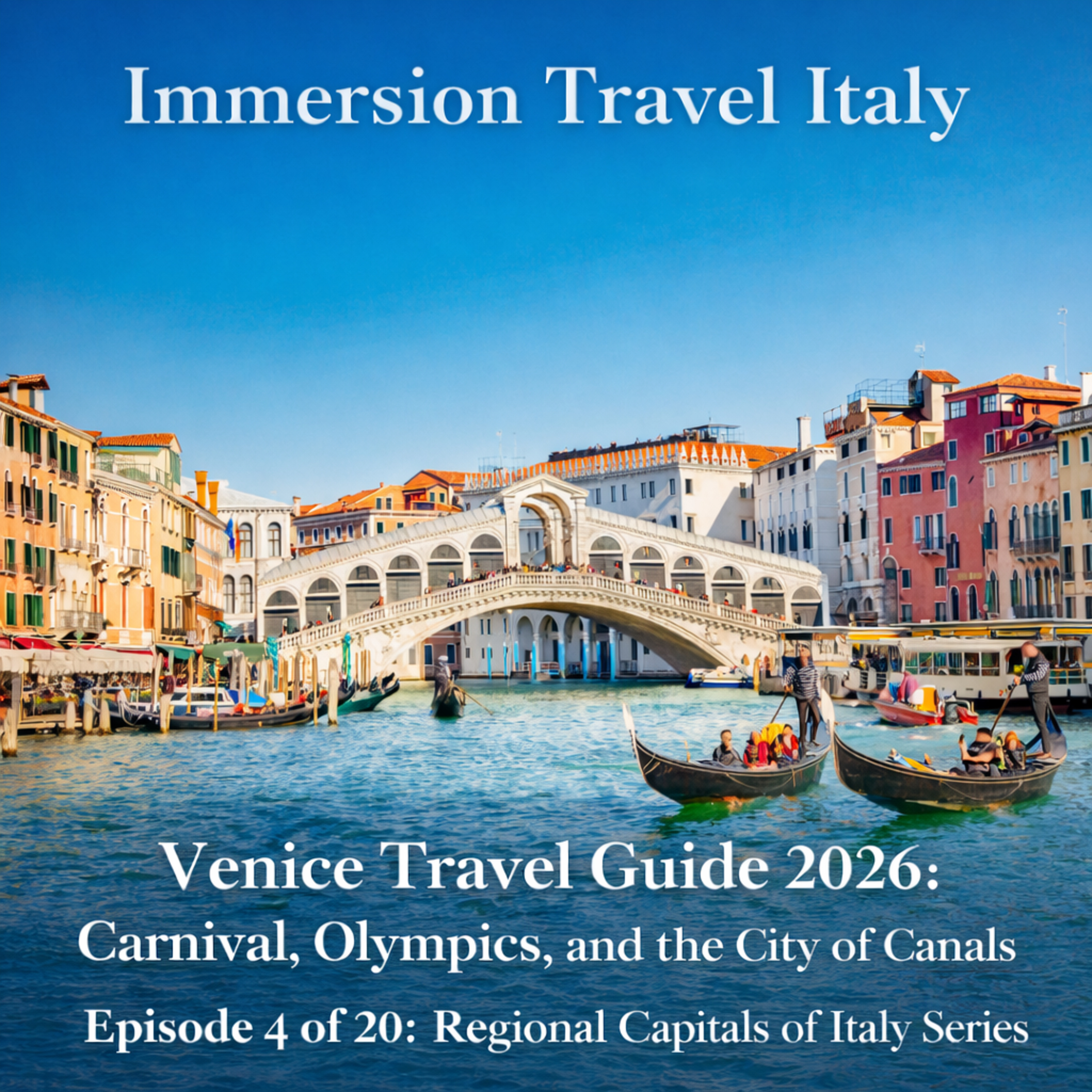 Venice Travel Guide 2026: Carnival, Olympics, and the City of Canals | Venice: Carnival, Power, and the Olympic Curtain CallEpisode 5 of 20 in the Regional Capitals of Italy SeriesCiao and welcome to Immersion Travel Italy, the podcast where we don’t just visit Italy, we experience it.In this episode, we travel to one of the world’s most unforgettable cities: Venice. Timed with the 2026 Winter Olympics and the start of the Carnival season, we explore Venice through history, tradition, architecture, festivals, and personal stories that bring the city to life.We begin in Piazza San Marco, experiencing the Basilica di San Marco at sunrise and during an unforgettable after-hours tour. Listeners will hear about the shimmering gold mosaics, the view from the terrace, the Pala d’Oro, and the sacred crypt where Saint Mark’s relics rest.Next, we visit the Campanile of San Marco, the city’s towering bell tower with elevator access and panoramic views. From there, we walk through the Doge’s Palace, cross the Bridge of Sighs, and imagine Venice in the days when it was a maritime empire that shaped the eastern Mediterranean.We also explore Venice’s neighborhoods. I share a personal story from our recent stay in Cannaregio, a quieter and more local part of the city that still hugs the Grand Canal. You will hear about Pasticceria Pitteri, a local favorite for fresh pastries, and our morning routines away from the crowds.We continue by ferry across the lagoon to Murano and Burano. On Murano, we visit Gino Mazzuccato’s glass studio, where my teenage son and his friend were selected to help in a live glassblowing demonstration. It was a moment we will never forget. On Burano, we share the story of the island’s vivid houses, lace-making tradition, and a peaceful lunch at Trattoria alla Maddalena on nearby Mazzorbo, where we watched students arrive by boat after school.Additional highlights include:• Our favorite church for art in situ, Santa Maria Gloriosa dei Frari• The Accademia Galleries, home to masterpieces by Bellini, Tintoretto, and Carpaccio• A special stop at Gelateria Nico on the Zattere, where a local friend always goes for a gianduiotto affogato• The Festa della Sensa, Venice’s symbolic marriage to the sea• Reflections on Venetian architecture in places like Split, Dubrovnik, and Slovenia• A preview of upcoming Olympic events in Cortina d’Ampezzo and the Closing Ceremony in VeronaWe also touch on the importance of visiting Venice with care and intention. From sacred spaces to hidden gems, this is a city that rewards those who walk slowly, look up, and linger longer.To help plan your own visit, be sure to check the blog post associated with this episode at katerinaferrara.com. You will find:• Self-guided walking tour routes• Ticket links for sites like the basilica, bell tower, and Doge’s Palace• After-hours tour options• Ferry routes to Murano and Burano• Travel tips and festival calendars• A link to my Venice bonus podcast episode, where I share even more stories and experiences: Watch it here https://youtu.be/TqkGAWYRtac To dive deeper, explore my full series of guidebooks covering immersive travel and festivals across Italy.Shop my books on Amazon:• Ultimate Festival and Travel Guide: Sicilyhttps://amzn.to/3KARdo8 • Ultimate Festival and Travel Guide: Pugliahttps://amzn.to/42WEnH1 • Ultimate Festival and Travel Guide: Rome and Beyondhttps://amzn.to/4gRlvz0 • Ultimate Festival and Travel Guide: Venice and the Venetohttps://amzn.to/48OhHfT • Ultimate Festival and Travel Guide: Milan and Lombardy https://amzn.to/46VzmQs • Sicilia in Festa: Dual Language Editionhttps://amzn.to/4pUxBuP Thank you for listening. Subscribe and follow for more immersive journeys across Italy. | — | ||||||
| 2/3/26 | 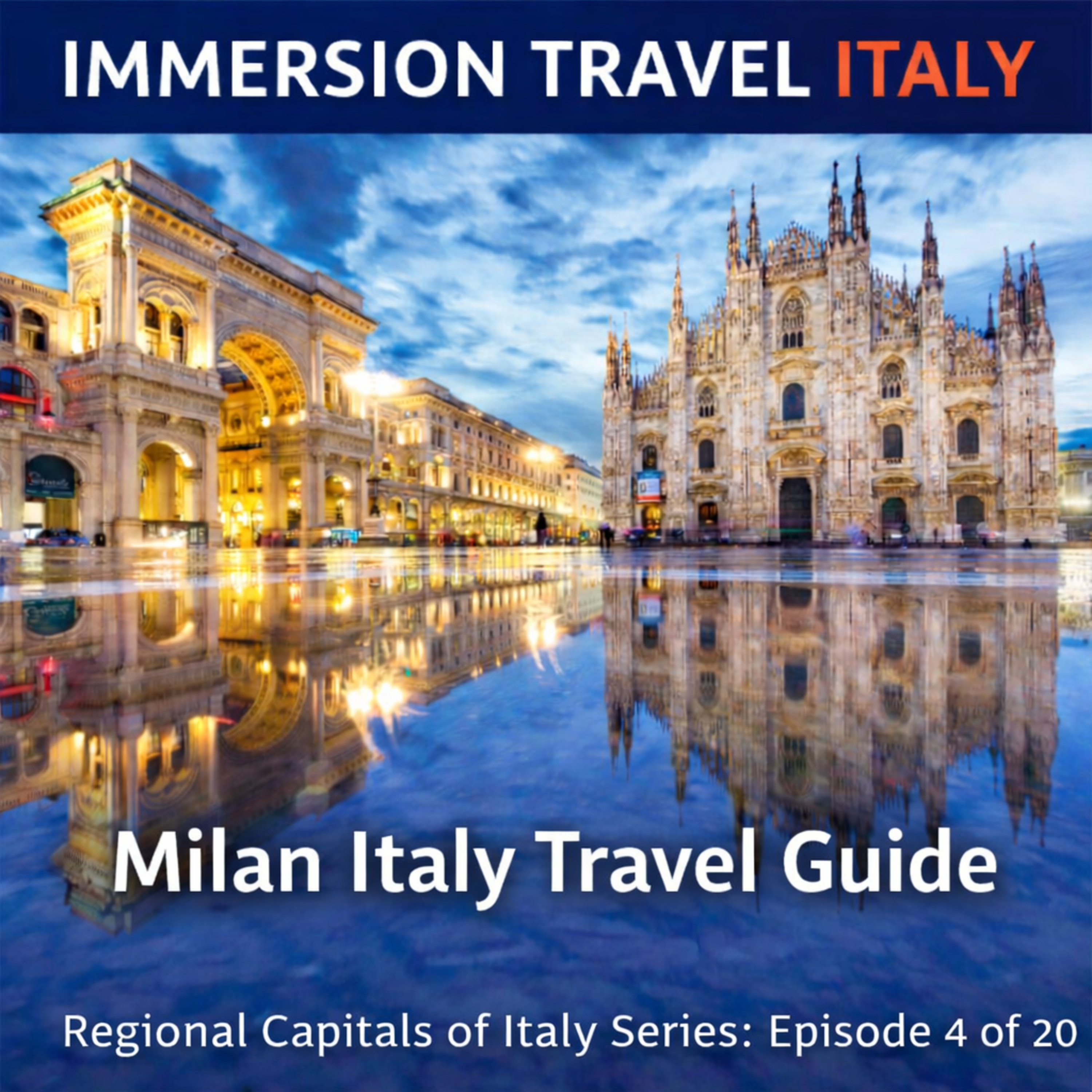 Milan, Italy Travel Guide | History, Duomo, Castles, Saints, Day Trips & the 2026 Winter Olympics Regional Capitals of Italy – Episode 4 of 20 | Welcome to Immersion Travel Italy, the podcast that goes beyond the checklist to explore Italy through history, culture, faith, and lived experience. I’m Katerina Ferrara, travel author, blogger, and your host.In this episode, we travel to Milan, the capital of Lombardy and one of the most powerful and influential cities in Europe, both past and present. This is Episode 4 of 20 in our Regional Capitals of Italy series, and it is an essential stop for understanding northern Italy.Milan is not just another Italian city. It is Italy’s economic engine, its most international hub, and a city that has shaped politics, religion, art, and innovation for centuries. In this episode, we explore how Milan rose from Roman capital to Renaissance powerhouse, and how it continues to reinvent itself today as it prepares to host the Milano Cortina 2026.You’ll hear about:• Milan as the capital of the Western Roman Empire• Saint Ambrose, Saint Augustine, and Milan’s central role in early Christianity• Piazza Duomo and the extraordinary history of the Duomo di Milano• The Galleria Vittorio Emanuele II and Teatro alla Scala• Castello Sforzesco, the Visconti and Sforza rulers, and Renaissance power• Leonardo da Vinci in Milan, engineering, and intellect• The Pinacoteca Ambrosiana and Milan’s scholarly identity• Santa Maria delle Grazie and the historical setting of The Last Supper• Brera as Milan’s intellectual and artistic quarterI also share personal stories from my many visits to Milan, including why the Duomo and the Pinacoteca Ambrosiana remain my favorite places in the city, and how we’ve often used Milan as a gateway to Lake Como and northern Italy. From Milan, day trips are effortless and deeply rewarding. I talk about traveling by train to Como, where the lake first opens up in dramatic fashion, and continuing on to Bellagio, the iconic town where water, mountains, and elegance meet. I also share experiences in Bergamo, with its unforgettable Città Alta rising above the plains, as well as Crema, a quieter and charming town known for its graceful piazza and slower rhythm of life. Finally, I include Pavia, home to one of Italy’s oldest universities and a powerful sense of medieval and scholarly history. These easy train journeys show how Milan isn’t just a destination in itself, but a perfectly positioned base for discovering lakeside beauty, fortified hill towns, and historic cities across northern Italy.A special focus of this episode is Milan’s role in the 2026 Winter Olympics, taking place February 6–22, 2026. We explore how Milan serves as the organizational and transportation hub for the Games, connecting iconic Alpine and Dolomite host towns including Cortina d’Ampezzo, Bormio, Livigno, Val di Fiemme, and Anterselva. I also share a personal moment from December 2025, when we witnessed the Olympic flag begin its journey through Rome, marking the start of Italy’s Olympic story.This episode is ideal for travelers planning a trip to Milan, visitors interested in the 2026 Olympics, and anyone who wants to understand Milan beyond fashion and finance.For deeper exploration, my Ultimate Festival and Travel Guide Milan covers far more, including festivals, sacred traditions, neighborhoods, and day trips connected to Milan and the Alpine north. The book is available on Amazon. Search Katerina Ferrara, or find direct book links at katerinaferrara.com.You’ll also find a free companion blog for this episode on my website with additional context and travel planning tips.Thank you for listening to Immersion Travel Italy.Travel slowly. Travel intentionally. And let Italy tell you its story. | — | ||||||
| 1/30/26 | 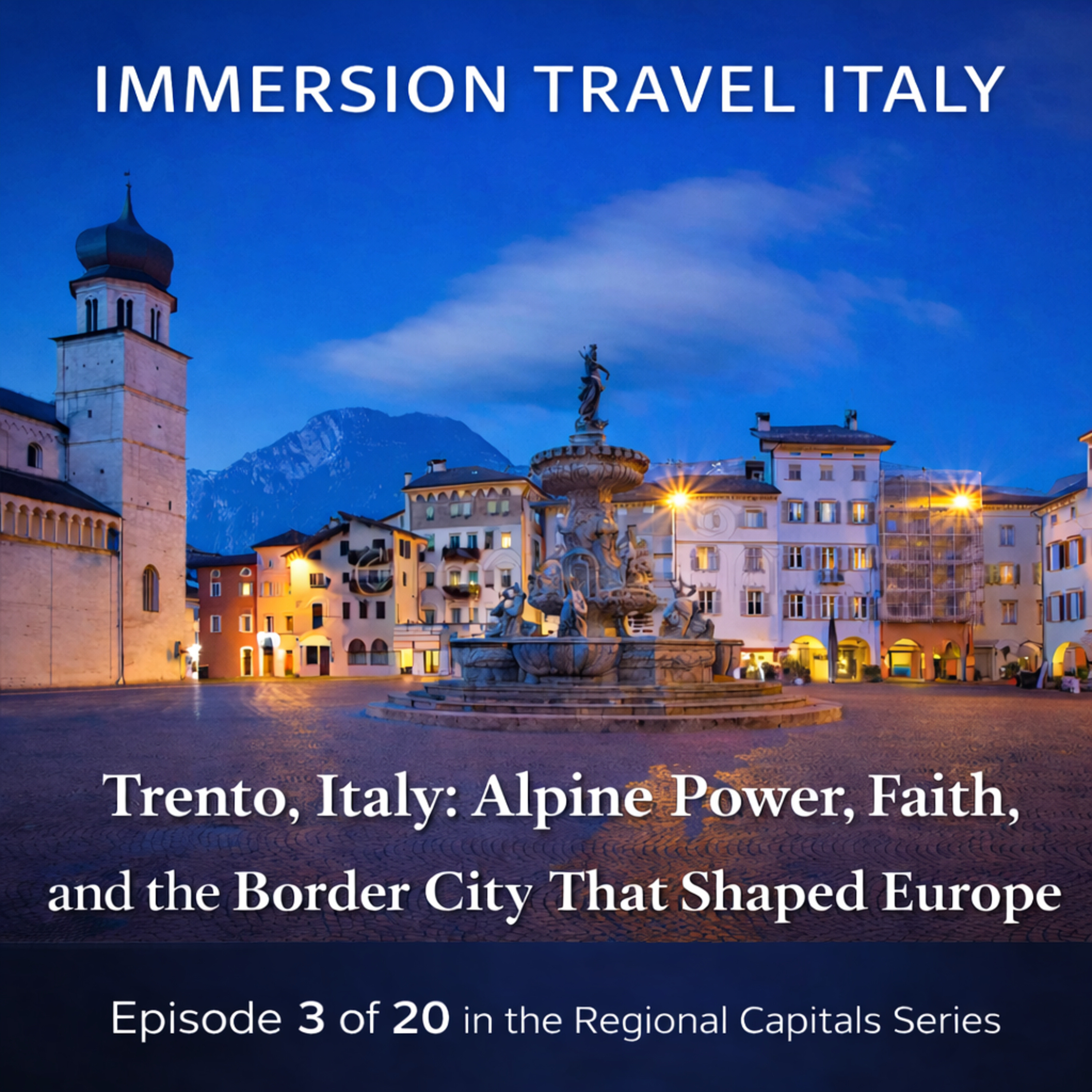 Trento, Italy: Alpine Power, Faith, and the Border City That Shaped Europe | Immersion Travel Italy Podcast – Regional Capitals SeriesIn this episode of the Immersion Travel Italy Podcast, travelauthor and host Katerina Ferrara takes you deep into Trento, the capital of Trentino Alto Adige, one of Italy’s most overlooked yet historically powerful cities.Nestled in the Adige Valley and framed by the Alps, Trento is a city shaped by geography, diplomacy, faith, and balance. Once a Roman stronghold known as Tridentum, Trento later became the seat of powerful prince bishops andthe host city of the Council of Trent (1545–1563), one of the most important religious events in European history.In this immersive episode, you will explore:• Trento’s Roman origins and Alpine geography• The prince bishop system and centuries of dual religious and political power• The Council of Trent and how it reshaped Catholic Europe• Walking Trento’s historic center, including Piazza Duomo, Via Belenzani, Via Suffragio, medieval towers, and frescoed palaces• Castello del Buonconsiglio and the art of quiet authority• Santa Maria Maggiore and the working sessions of the Council• Trento’s food culture, including canederli, speck, mountain cheeses, and Trentodoc sparkling wineThis episode also covers Trento’s most important festivals,including:• Le Feste Vigiliane and the Palio dell’Oca• The Trento Film Festival, the world’s oldest mountain film festival• The Mercatino di Natale di Trento Christmas MarketBeyond the city, you will discover outdoor activities and Alpine experiences, including:• Monte Bondone hiking, skiing, and panoramic views• Cycling the Adige Valley bike path• Via ferrata climbing routes• Paragliding over the valley• Kayaking and rafting on the Adige RiverTrento also serves as a perfect base for day trips by train, alldiscussed in this episode:• Bolzano and South Tyrol’s bilingual culture• Bressanone (Brixen) and Alpine cathedral towns• Rovereto and modern art at MART• Verona and Roman power in northern ItalyThis episode is part of the Regional Capitals Series, followingTurin and Bologna, and focuses on cities that shaped Italy through power,ideas, and geography rather than spectacle.📝 Associatedblog available free at:https://katerinaferrara.com📚 ExploreKaterina Ferrara’s travel books and guides:Ultimate Festival and Travel Guide Sicily: https://amzn.to/4l71Pbi Ultimate Festival and Travel Guide Puglia: https://amzn.to/3HFAe2w Ultimate Festival and Travel Guide Rome & Beyond: https://amzn.to/440Dq0lUltimate Festival and Travel Guide Venice & the Veneto: https://amzn.to/48OhHfTMilan & Lombardy https://amzn.to/46VzmQsSicily in Celebration / Sicilia in Festa (DualLanguage Edition)https://amzn.to/4jPVEHKItalian Language: Guida Completa a Feste e ViaggiSiciliahttps://amzn.to/44AIYQ1🎧 If you loveimmersive travel, history rich destinations, festivals, and slow travel experiences beyond the tourist checklist, this episode is for you.📩 Podcast ideas ortravel questions? Email: katerina@katerinaferrara.comImmersion Travel Italy – where history, culture, and place come together. | — | ||||||
| 1/28/26 | 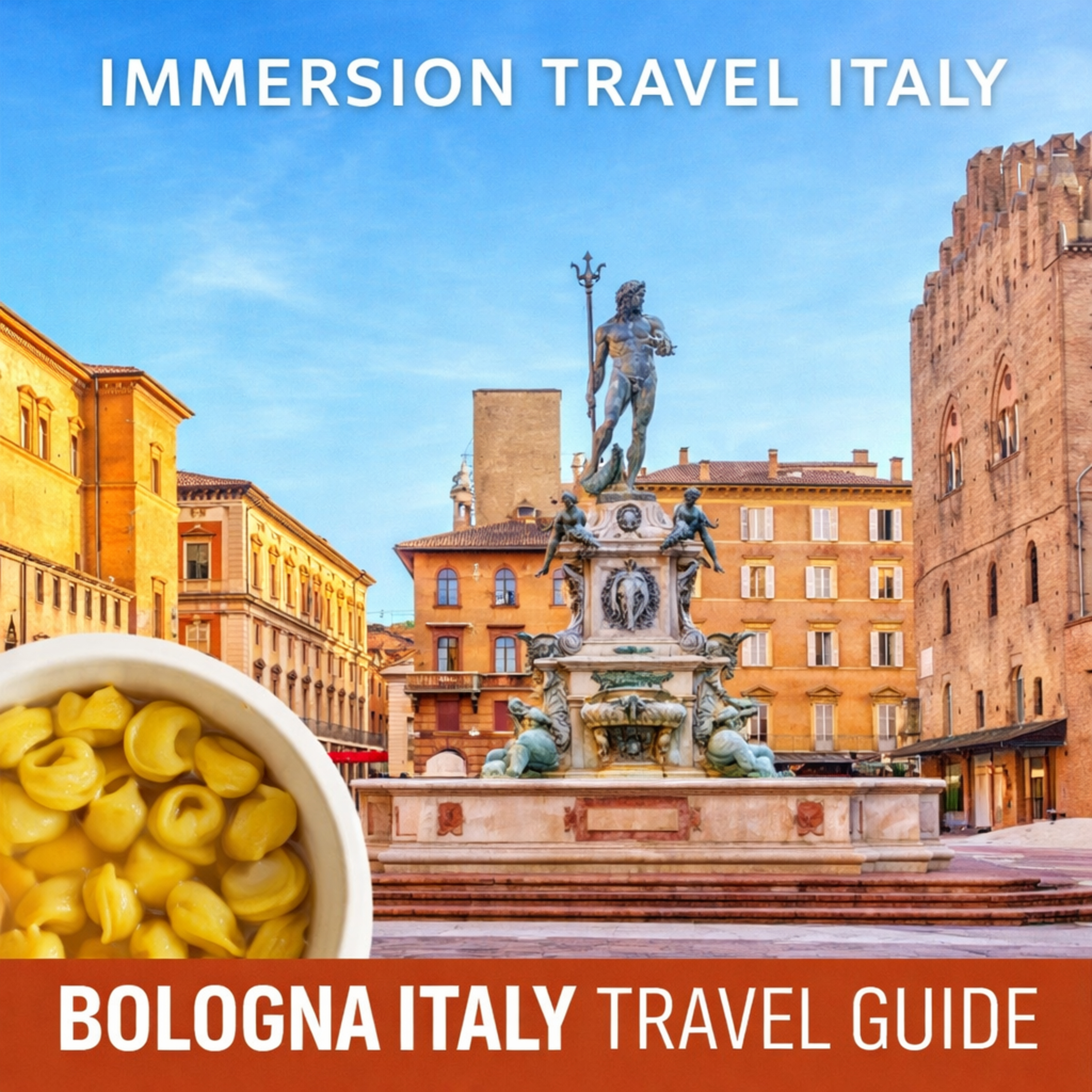 Bologna Italy Travel Guide: History, Food, Porticoes, Towers & Day Trips in Emilia-Romagna | Bologna is one of Italy’s most important cities and one of its least understood.In this immersive episode of Immersion Travel Italy, travel author and Italy expert Katerina Ferrara takes you deep into Bologna, a city known as La Dotta (the Learned), La Grassa (the Fat), and La Rossa (the Red). This is not a checklist travel episode. It is a thoughtful journey through a city that shaped European education, law, architecture, and food culture.You will discover why Bologna is home to the oldest university in the Western world, how its medieval porticoes became a UNESCO World Heritage Site, and why its cuisine is considered the gold standard of Italian cooking. This episode blends history, walking routes, cultural insight, and practical travel planning, making it ideal for first time visitors and returning travelers who want depth rather than highlights.You will explore Bologna’s Roman origins and medieval rise as an intellectual powerhouse. We walk through Piazza Maggiore and the Basilica of San Petronio, including the remarkable meridian line where science and faith intersect. You will learn the story of the Two Towers and why medieval families built them, what you see from the top of the Asinelli Tower, and how Bologna once looked with over one hundred towers on its skyline.We explore Bologna’s 62 kilometers of porticoes and the legendary covered walk to the Sanctuary of San Luca. You will also discover the city’s hidden canals, the Archiginnasio and its Anatomical Theatre, and Santo Stefano, Bologna’s medieval recreation of the Holy Sepulchre in Jerusalem.Bologna is widely considered the food capital of Italy, and this episode explains why. You will learn what makes true tagliatelle al ragù different from what the rest of the world calls Bolognese, why tortellini in brodo is treated with reverence, and how food guilds protected recipes centuries before modern certifications existed.We explore the Quadrilatero market district, aperitivo culture, and the role food plays in Bologna’s identity, daily life, and civic pride.Bologna is one of Italy’s best transportation hubs and an ideal base for Emilia Romagna. This episode includes easy day trips by train to:Modena for balsamic vinegar traditions, Ferrari history, and ducal architectureParma for opera, refined architecture, and Parmigiano ReggianoImola for medieval fortresses and motorsport historyRavenna for Roman and Byzantine mosaics and the tomb of DanteThis episode is designed for travelers who want cultural understanding, historical context, and meaningful experiences. You will not just learn what to see in Bologna, but why it matters and how to experience it slowly and intentionally.Explore Italy more deeply with the Ultimate Festival and Travel Guide Series, available on Amazon:Ultimate Festival and Travel Guide Sicilyhttps://amzn.to/3KARdo8Ultimate Festival and Travel Guide Pugliahttps://amzn.to/42WEnH1Ultimate Festival and Travel Guide Rome and Beyondhttps://amzn.to/4gRlvz0Ultimate Festival and Travel Guide Venice and the Venetohttps://amzn.to/48OhHfTUltimate Festival and Travel Guide Milan and LombardyComing soonhttps://amzn.to/46VzmQsSicilia in FestaDual Language English Italian Editionhttps://amzn.to/4pUxBuPGuida Completa a Feste e Viaggi SiciliaItalian Language Editionhttps://amzn.to/44AIYQ1Rome 2025 Jubilee Travel Guidehttps://amzn.to/4pA40qaA companion blog post with photos, site details, and travel tips is available free at katerinaferrara.com.Questions or episode ideas? Email katerina@katerinaferrara.comSlow down. Pay attention. And experience Italy beyond the checklist. | — | ||||||
| 1/23/26 |  Turin with visits to Asti, Alba, Bra in Piedmont : Royal Capitals, Slow Food, Chocolate, and the Most Underrated City in Northern Italy | Turin and Piedmont are among Italy’s most elegant and overlooked destinations, and in this episode of the Immersion Travel Podcast, I’m taking you deep into a region that surprised us in the very best way.My husband and I spent two weeks in Piedmont in May 2022, using Turin as our base. From the moment we arrived, Turin felt different. Calm, refined, and quietly confident. With its grand piazzas, long arcaded streets, and regal architecture, the city often feels more French than Italian, and that is no accident. Turin was once the first capital of unified Italy, designed to project power, order, and sophistication.In this episode, I share our personal experience exploring Turin on foot and explain why it remains one of the most beautiful yet least tourist-crowded cities in northern Italy. We talk about why Turin is so easy to visit, including flying in and out of Turin’s airport, and how it works perfectly as both a destination and a gateway to northern Italy.You’ll hear the fascinating history of Turin, from its Roman foundations as Augusta Taurinorum, to its rise under the House of Savoy, its brief but symbolic role as Italy’s first capital, and its transformation into an industrial powerhouse through FIAT and the Lingotto factory.This episode also explores Piedmont’s legendary food and wine culture, from Barolo and Barbaresco wines to white truffles, chocolate, and the philosophy behind the Slow Food movement. We connect Turin’s most important festivals directly to its landmarks, including the Festa di San Giovanni in Piazza Castello, the Torino Film Festival at the Mole Antonelliana, and the Turin International Book Fair at the former Lingotto factory.Turin was also our gateway to Lago Maggiore, and it worked beautifully. We flew into Turin, spent time in the city, then continued on to the lake by train and car. The transition from royal capital to lakefront promenades, ferry rides, and mountain views is seamless. I also reference my five-part Lago Maggiore video series on YouTube and related podcast episodes, where I break the lake down town by town to help you plan a slower, more immersive trip.From Turin, we explored some of Piedmont’s most rewarding towns, each offering a distinct perspective on the region’s identity.We begin with Asti, a former Roman and medieval powerhouse best known today for Asti Spumante and one of Italy’s oldest horse races, the Palio di Asti. Just under an hour from Turin by train, Asti blends Roman roots, Gothic architecture, and deep wine traditions.Next is Alba, the heart of the Langhe hills and the capital of white truffles. Alba’s medieval towers, refined historic center, and world-famous truffle fair make it one of Piedmont’s most important food destinations, surrounded by the Barolo and Barbaresco wine regions.Just beyond Alba lies Bra, birthplace of the Slow Food movement. Bra’s calm rhythm, Baroque architecture, agricultural markets, and the international Cheese festival reflect a philosophy rooted in tradition, sustainability, and thoughtful eating.Finally, we explore Alessandria, a strategic crossroads city founded in the Middle Ages. Known for its massive star-shaped citadel and civic identity, Alessandria reveals Piedmont’s military and commercial history and connects naturally toward Liguria and southern France.Together, these towns show why Piedmont is one of Italy’s most balanced regions, where agriculture, industry, culture, and tradition coexist without excess.✨ A companion blog post is available for this episode with additional historical detail, travel logistics, and planning tips.🌍 Visit my website for the blog, podcast episodes, travel guides, and festival-focused itineraries:👉 https://katerinaferrara.com/If you love Italy beyond the usual tourist trail and want destinations with depth, elegance, and authenticity, this episode will show you why Turin and Piedmont quietly belong among Italy’s great travel experiences. | — | ||||||
| 1/9/26 |  Immersion Travel Italy: Slow Travel, Festivals, and Mindful Experiences Beyond the Tourist Checklist | What if traveling in Italy was less about checking off sights and more about how a place makes you feel?In this episode of Immersion Travel Italy, host Katerina Ferrara is joined by well-being advocate and speaker Jodie Steele for a thoughtful conversation about slow travel, sensory awareness, and experiencing Italy beyond the traditional tourist itinerary. Together, they explore how different environments affect us emotionally and physically, from the high-energy streets of Rome and Milan to the calmer rhythms of Italy’s smaller towns and countryside.This episode dives into why immersive travel experiences like local festivals, cooking classes, shared meals, and everyday rituals stay with us longer than a packed sightseeing schedule. Katerina shares why Italian festivals are at the heart of her travel philosophy, from centuries-old saint celebrations to food and wine festivals that bring entire communities together once a year. Jodie offers insight into mindfulness, sensory balance, and how travelers, including neurodivergent and highly sensitive travelers, can plan trips that feel grounding rather than overwhelming.You will hear practical tips on traveling during Italy’s shoulder seasons, layering busy cities with quieter destinations like the Castelli Romani, Treviso, Lake Como, and Lake Garda, and why slowing down helps reduce burnout while traveling. The conversation also touches on modern travel habits, the impact of constant photography, and why being fully present often creates the most powerful travel memories.If you are looking to experience Italy through culture, festivals, food, nature, and meaningful connection rather than rushing from site to site, this episode offers inspiration, reflection, and actionable ideas.✨ Topics covered include:• Slow travel in Italy• Italian festivals and local traditions• Mindful and sensory-friendly travel• Cooking classes and immersive experiences• Traveling beyond Rome, Venice, and Milan• Lake Como, Lake Garda, and Italy’s smaller towns• Travel planning without burnout• Experiencing Italy through food, nature, and ritualFor more immersive Italy travel inspiration, festival calendars, and in-depth guides, visit katerinaferrara.com and explore Katerina’s Ultimate Festival & Travel Guides.🎒 Travel slowly. Stay curious. Experience Italy deeply. | — | ||||||
Showing 25 of 55
Sponsor Intelligence
Sign in to see which brands sponsor this podcast, their ad offers, and promo codes.
Chart Positions
3 placements across 3 markets.
Chart Positions
3 placements across 3 markets.