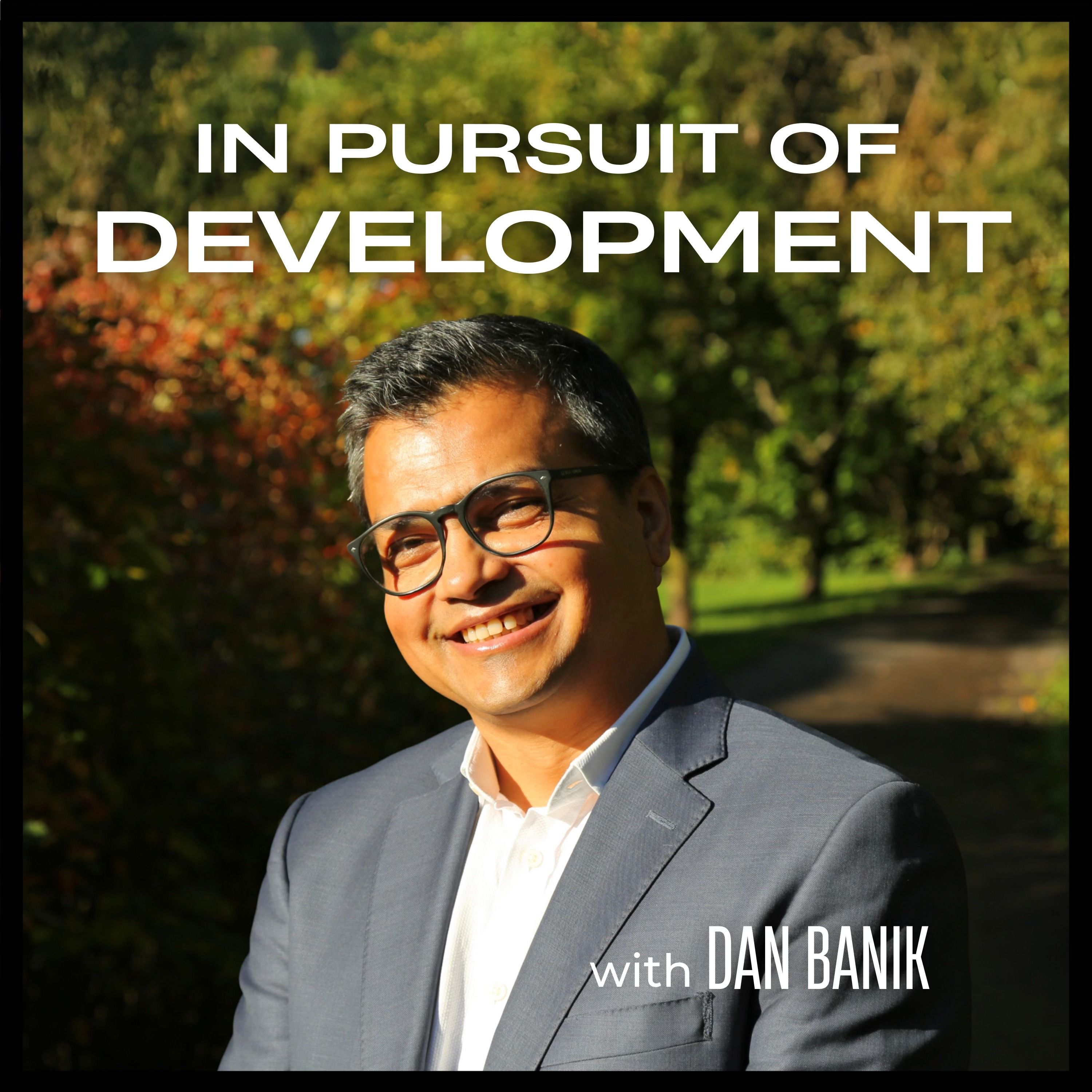
In Pursuit of Development
by Dan Banik
Is this your podcast?Insights from recent episode analysis
Audience Interest
Podcast Focus
Publishing Consistency
Platform Reach
Insights are generated by CastFox AI using publicly available data, episode content, and proprietary models.
Most discussed topics
Brands & references
Total monthly reach
Estimated from 19 chart positions in 19 markets.
By chart position
- 🇺🇸US · Social Sciences#5630K to 100K
- 🇦🇺AU · Social Sciences#1755K to 30K
- 🇮🇹IT · Social Sciences#9210K to 30K
- 🇰🇷KR · Social Sciences#10010K to 30K
- 🇮🇳IN · Social Sciences#1441K to 10K
- Per-Episode Audience
Est. listeners per new episode within ~30 days
87K to 278K🎙 Daily cadence·172 episodes·Last published 2mo ago - Monthly Reach
Unique listeners across all episodes (30 days)
290K to 925K🇳🇴32%🇰🇪32%🇺🇸11%+16 more - Active Followers
Loyal subscribers who consistently listen
87K to 278K
Market Insights
Platform Distribution
Reach across major podcast platforms, updated hourly
Total Followers
—
Total Plays
—
Total Reviews
—
* Data sourced directly from platform APIs and aggregated hourly across all major podcast directories.
On the show
From 11 epsHost
Recent guests
Recent episodes
Why hope is what we need | Dan Banik
Jun 17, 2026
31m 39s
How civil society adapts when aid shrinks | Tikhala Itaye
Jun 3, 2026
48m 19s
Is Rwanda a development success? | Pritish Behuria
May 20, 2026
46m 13s
African agency at the crossroads | Dan Banik
May 13, 2026
24m 35s
How public institutions become captured | Elizabeth Dávid-Barrett
Apr 29, 2026
43m 56s
Social Links & Contact
Official channels & resources
Official Website
Login
RSS Feed
Login
| Date | Episode | Topics | Guests | Brands | Places | Keywords | Sponsor | Length | |
|---|---|---|---|---|---|---|---|---|---|
| 6/17/26 | hopeglobal poverty+3 | — | — | — | hopeglobal poverty+6 | — | 31m 39s | ||
| 6/3/26 | civil societyaid+5 | Tikhala Itaye | — | Malawi | civil societyaid+6 | — | 48m 19s | ||
| 5/20/26 | developmentRwanda+5 | Pritish Behuria | — | Rwanda | Rwandadevelopment+5 | — | 46m 13s | ||
| 5/13/26 | African agencydevelopment+4 | — | — | AfricaPretoria+3 | African agencydevelopment+4 | — | 24m 35s | ||
| 4/29/26 | state capturecorruption+4 | Elizabeth Dávid-Barrett | stateinstitutions+1 | — | state capturecorruption+5 | — | 43m 56s | ||
| 4/22/26 | United NationsGlobal South+5 | Alanna O’Malley | United Nations | AfricaAsia+1 | United NationsGlobal South+6 | — | 47m 28s | ||
| 4/15/26 | tuberculosispoverty+4 | Madhukar Pai | tuberculosis | — | tuberculosispoverty+6 | — | 51m 20s | ||
| 4/8/26 | global developmentforeign aid+3 | Elina Scheja | Sida | — | aid cutsgeopolitical fragmentation+4 | — | 39m 21s | ||
| 4/1/26 | developmentAsia+5 | Philip Schellekens | UNDP | — | Asiadevelopment+5 | — | 43m 19s | ||
| 3/25/26 | urbanizationinequality+5 | Benjamin Bradlow | — | world | urban inequalityinformal settlements+5 | — | 46m 21s | ||
Want analysis for the episodes below?Free for Pro Submit a request, we'll have your selected episodes analyzed within an hour. Free, at no cost to you, for Pro users. | |||||||||
| 3/18/26 | global middle classdevelopment+4 | Homi Kharas | — | — | middle classglobal development+4 | — | 45m 24s | ||
| 3/11/26 | Artificial intelligence and the future of human decision-making | Francesco Marcelloni | Artificial intelligence is transforming healthcare, education, and governance. Dan Banik and Francesco Marcelloni explore the risks and benefits, and why human judgment must remain central in the AI era. | — | ||||||
| 3/4/26 | Why India–China relations could reshape the global order | Manoj Kewalramani | India-China relations have entered a phase of cautious re-engagement, but beneath the diplomatic optics lie deep structural fault lines shaped by power asymmetry, border tensions, economic interdependence, and great power rivalry. Dan Banik speaks with Manoj Kewalramani about whether the relationship is stabilizing into a cold peace or simply entering another cycle of strategic competition with global consequences. | — | ||||||
| 2/25/26 | Can philosophy save a world obsessed with power? | Thomas Pogge | In a world defined by rising great-power rivalry, declining solidarity, and shrinking aid budgets, the Yale philosopher Thomas Pogge joins Dan Banik to discuss whether global justice and human rights still matter or whether power politics has won. From the erosion of soft power to bold proposals like the Ecological Impact Fund, this conversation explores how values, innovation, and institutional reform could reshape a fractured international order. | — | ||||||
| 2/18/26 | Debt, development finance, and global agency | David McNair | Dan Banik speaks with David McNair about the shifting politics of global development in an era of debt distress and declining humanitarian funding. They explore how activism must adapt to a changing global financial landscape, the rise of agency in the Global South, and what it will take to reform development finance for the years ahead. | — | ||||||
| 2/11/26 | Six economists and the making of modern development | David Engerman | David Engerman takes Dan Banik inside the lives and rivalries of six South Asian economists who helped define what “development” would mean in the postcolonial world. From Cambridge seminars to global institutions, the conversation reveals how their debates on trade, planning, inequality, and human welfare still shape the choices governments face today. | — | ||||||
| 2/4/26 | Making evidence actually usable | Lindsey Moore | Dan Banik speaks with Lindsey Moore about how ethical AI and predictive analytics can transform decades of development evaluations into structured and searchable evidence for better decisions. They explore what it takes to build context-aware models grounded in clear taxonomies and local perspectives, enabling AI to strengthen institutional learning and advance equity. | — | ||||||
| 1/28/26 | Vietnam’s remarkable development turnaround | Arve Hansen | Vietnam is a celebrated development success story, but rapid growth is also reshaping everyday life through rising inequality, changing consumption, and mounting environmental pressures. Dan Banik speaks with Arve Hansen about what Vietnam’s next phase of development may look like and the trade-offs it will require. | — | ||||||
| 1/21/26 | Energy for growth on the African continent | Todd Moss | Dan Banik speaks with Todd Moss about why electrification has surged in some countries but continues to lag across much of Africa. Together they unpack why “access” is only the starting point when electricity is expensive, unreliable, and unable to power jobs and growth. | — | ||||||
| 12/23/25 | Looking back, thinking forward | Dan Banik | As the year draws to a close, Dan Banik takes stock of the major ideas and debates that have defined Season 6 of In Pursuit of Development. From shifting global power and democracy to climate, energy, and artificial intelligence, this episode looks back at what we have learned and ahead to what is next. | — | ||||||
| 12/17/25 | Climate, conflict and the development squeeze | Florian Krampe | Climate change is increasingly shaping development and security outcomes, not as a single cause of conflict but as a force that intensifies existing vulnerabilities in fragile contexts. Dan Banik and Florian Krampe discuss why separating climate, development, and security is no longer tenable and how climate action might become a pathway to resilience and peace rather than instability. | — | ||||||
| 12/10/25 | Aid at the breaking point | Nilima Gulrajani | As aid budgets shrink and multilateralism weakens, Dan Banik speaks with Nilima Gulrajani about what’s worth saving, what must change, and how global cooperation can still deliver in an uncertain world. | — | ||||||
| 12/6/25 | How Latin America sees the new Global South | Benedicte Bull | Dan Banik speaks with Benedicte Bull about how Latin America fits into the shifting idea of the “Global South.” Together, they explore what this identity means in practice, how the region balances ties to China and the United States, and what its experience reveals about power, justice, and development in a changing world order. | — | ||||||
| 12/3/25 | Borders, bargains, and the business of smuggling | Max Gallien | Dan Banik and Max Gallien explore how smuggling operates as a deeply embedded part of state–society relations in North Africa, rather than a simple threat to state authority. They discuss what this reveals about governance, livelihoods, and the political bargains that shape life in border regions. | — | ||||||
| 11/29/25 | Solidarity in a divided world | Cecilia Bailliet | Dan Banik speaks with Cecilia Marcela Bailliet about what solidarity truly means in a world increasingly turning inward. Together, they explore how solidarity, human rights, and peace intersect—and why real solidarity requires action, inclusion, and a renewed commitment to our shared humanity. | — | ||||||
Showing 25 of 178
Pitch Fit is a Pro feature
See how bookable this show is for guests, which brands already advertise, the per-episode ad value, and the best-fit guest and sponsor profile. The numbers are blurred on the free plan.
How readily this show books outside guests like you.
How proven this show is for host-read sponsorships.
For Guests
ProFor Advertisers
ProUpgrade to Pro to unlock guest cadence, sponsor categories, fit scores, and per-episode ad value for this show.
Chart history for In Pursuit of Development
Peaked at #3 in Norway, top 10 in 2 of 21 tracked markets, currently #3 in Norway.
| Market | Genre | Peak | Current | Trend |
|---|---|---|---|---|
| Norway | — | #3 | #3 | — |
| KE | — | #3 | #3 | — |
| Norway | — | #15 | #15 | — |
| KE | — | #26 | #26 | — |
| Denmark | — | #33 | #33 | — |
| South Africa | — | #41 | #41 | — |
| United States | — | #56 | #56 | — |
| RO | — | #64 | #64 | — |
| Italy | — | #92 | #92 | — |
| NG | — | #93 | #93 | — |
| HU | — | #96 | #96 | — |
| South Korea | — | #100 | #100 | — |
| MY | — | #102 | #102 | — |
| PH | — | #110 | #110 | — |
| BE | — | #118 | #118 | — |
| PT | — | #128 | #128 | — |
| India | — | #144 | #144 | — |
| CZ | — | #160 | #160 | — |
| Australia | — | #175 | #175 | — |
| Brazil | — | #186 | #186 | — |
Chart Positions
21 placements across 19 markets.
Chart Positions
21 placements across 19 markets.