

Insights from recent episode analysis
Audience Interest
Podcast Focus
Publishing Consistency
Platform Reach
Insights are generated by CastFox AI using publicly available data, episode content, and proprietary models.
Total monthly reach
Estimated from 11 chart positions in 11 markets.
By chart position
- 🇩🇪DE · Non-Profit#1235K to 30K
- 🇺🇸US · Non-Profit#1575K to 30K
- 🇯🇵JP · Non-Profit#8610K to 30K
- 🇧🇷BR · Non-Profit#1171K to 10K
- 🇳🇱NL · Non-Profit#1321K to 10K
- Per-Episode Audience
Est. listeners per new episode within ~30 days
25K to 102K🎙 ~2x weekly·17 episodes·Last published 1mo ago - Monthly Reach
Unique listeners across all episodes (30 days)
50K to 203K🇩🇪15%🇺🇸15%🇯🇵15%+8 more - Active Followers
Loyal subscribers who consistently listen
20K to 81K
Market Insights
Platform Distribution
Reach across major podcast platforms, updated hourly
Total Followers
—
Total Plays
—
Total Reviews
—
* Data sourced directly from platform APIs and aggregated hourly across all major podcast directories.
On the show
Recent episodes
When Cash Can't Wait: Reimagining Payment Distribution in Sudan
Apr 16, 2026
Unknown duration
Loans to Lifelines: Can Lending Innovations Enhance Climate Resilience?
Apr 1, 2026
Unknown duration
How Can Data Help Close Gaps in Women’s Financial Inclusion? Lessons from Rwanda
Mar 18, 2026
Unknown duration
Nano by Necessity: Unlocking Growth for Women Entrepreneurs in Uganda and Beyond
Mar 4, 2026
Unknown duration
What's Next for Financial Inclusion? Unpacking Findex 2025
Feb 18, 2026
Unknown duration
Social Links & Contact
Official channels & resources
Official Website
Login
RSS Feed
Login
| Date | Episode | Description | Length | ||||||
|---|---|---|---|---|---|---|---|---|---|
| 4/16/26 | 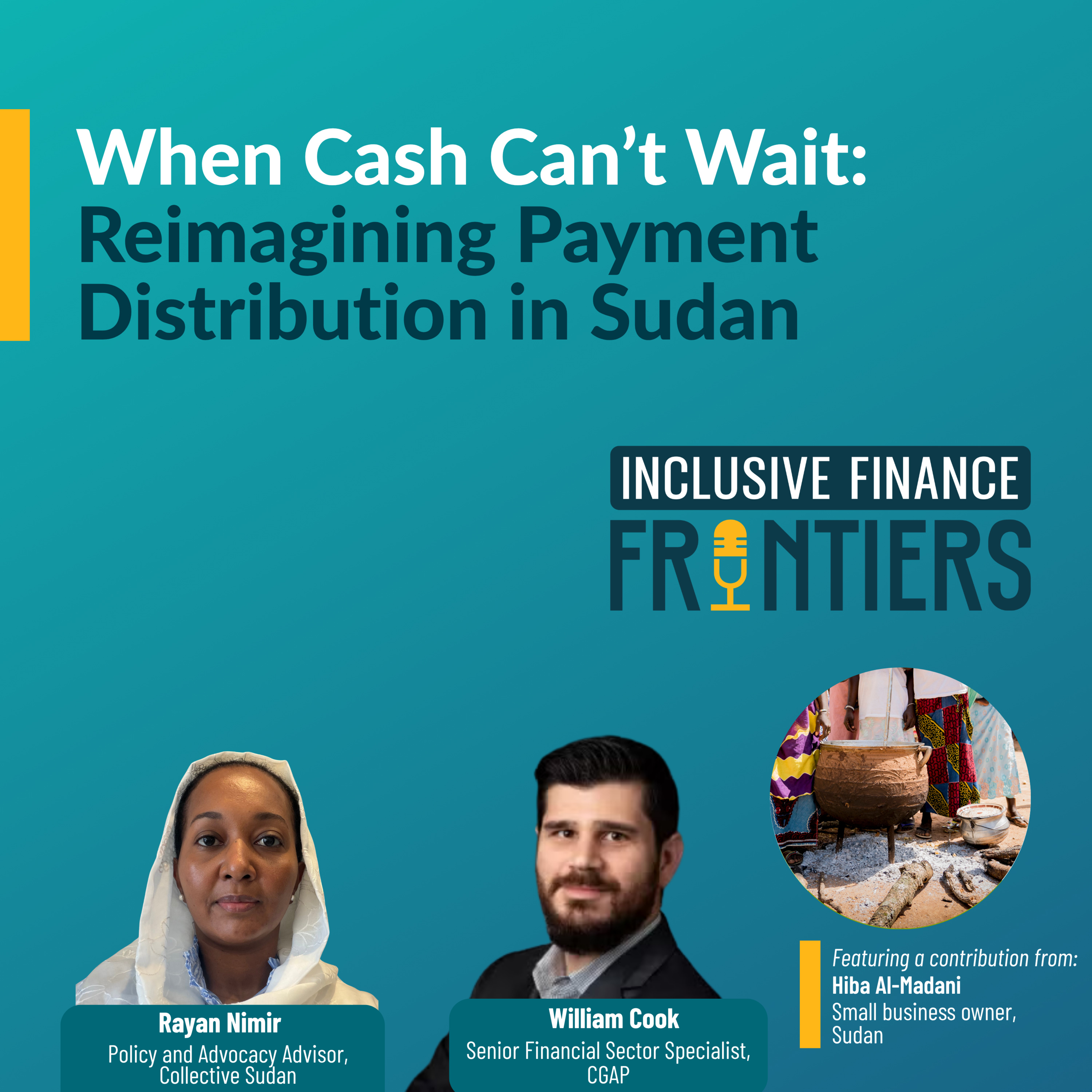 When Cash Can't Wait: Reimagining Payment Distribution in Sudan | Three years ago, conflict erupted in Sudan, and its toll continues to be devastating. The crisis has caused profound human suffering and dismantled the systems households once relied on to absorb shocks. The financial sector has been hit hard: liquidity has dried up, infrastructure destroyed, and social protection mechanisms unraveled. Humanitarian actors have scaled up cash assistance, but face serious obstacles: limited liquidity, fragmented financial service providers, and complex payment processes. This has resulted in accumulated delays of up to 200 days in delivering cash transfers in the midst of a severe humanitarian crisis. In this episode, we explore an emerging solution: the Shared Distribution Network (SEND), designed by CGAP and the Cash Consortium of Sudan to cut delays and improve cost-effectiveness. Featured Voices: Rayan Nimir, Policy and Advocacy Advisor, Collective Sudan (formerly, Cash Consortium of Sudan) William Cook, Senior Financial Sector Specialist, CGAP Hiba Al-Madani, a cash recipient and small business owner in Sudan Producer: Lamis Daoud, CGAP External Affairs Officer Audio Editor and Sound Producer: Samantha Malhotra, World Bank Group Interactive Media Program Executive Producer: Jahda Swanborough, CGAP Communications Lead © CGAP/World Bank, 2026 Special thanks to Sara Murray from CGAP for her expertise and insights that brought this episode to life, the Cash Collective for conducting the interview with Hiba Al-Madani, and Samah Salman for dubbing Hiba’s contribution. Listen and subscribe for free on your favorite platform. To learn more, visit www.cgap.org. If you have any feedback, connect with us at podcast@cgap.org. | — | ||||||
| 4/1/26 | 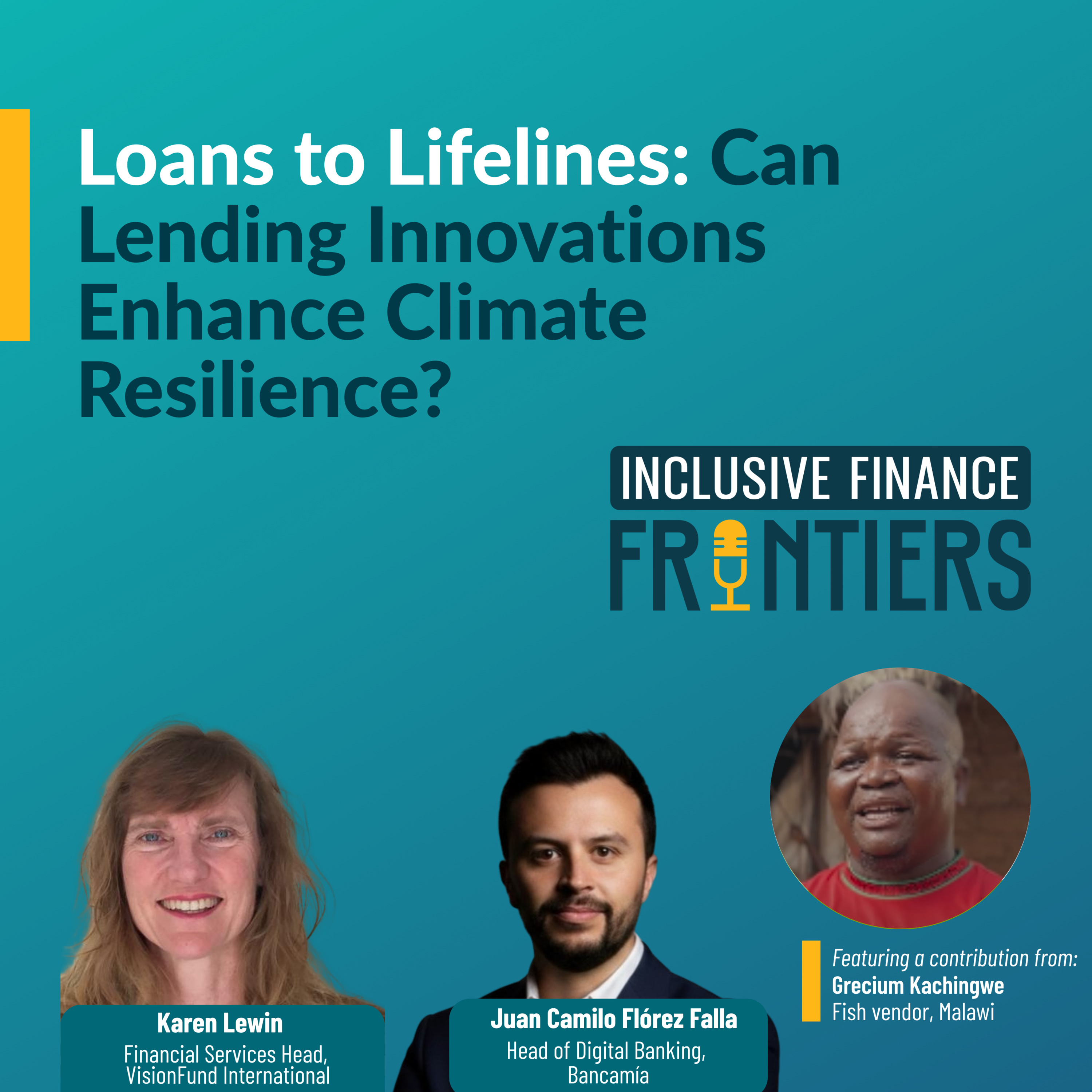 Loans to Lifelines: Can Lending Innovations Enhance Climate Resilience? | As climate instability intensifies, frontline communities need better tools to adapt and recover. Yet, when extreme weather strikes, the institutions best positioned to help—microfinance institutions (MFIs)—have historically pulled back, reducing lending during crises, just when clients need capital the most. Today, a new wave of innovations is changing that equation, in ways that still make financial sense for lenders. This episode explores two approaches that are flipping the script on how inclusive finance institutions respond to climate shocks: Recovery lending: Post-disaster loans that help households and small businesses rebuild quicklyContingent lines of credit: Pre-arranged financing that can be activated when a specific, objective trigger is met We dive into real-world examples from Malawi and Colombia, where these approaches are helping MFIs stay engaged during crises and unlock faster recovery for climate-affected communities. Featured Voices: Karen Lewin, Financial Services Head, VisionFund International Juan Camilo Flórez Falla, Head of Digital Banking, Bancamía Grecium Kachingwe, a fish vendor from Phalombe, Malawi Producer: Lamis Daoud, CGAP External Affairs Officer Audio Editor and Sound Producer: Samantha Malhotra, World Bank Group Interactive Media Program Executive Producer: Jahda Swanborough, CGAP Communications Lead © CGAP/World Bank, 2026 Special thanks to Peter Zetterli and Michel Hanouch from CGAP for helping shape this episode. Listen and subscribe for free on your favorite platform. To learn more, visit www.cgap.org. If you have any feedback, connect with us at podcast@cgap.org. | — | ||||||
| 3/18/26 | 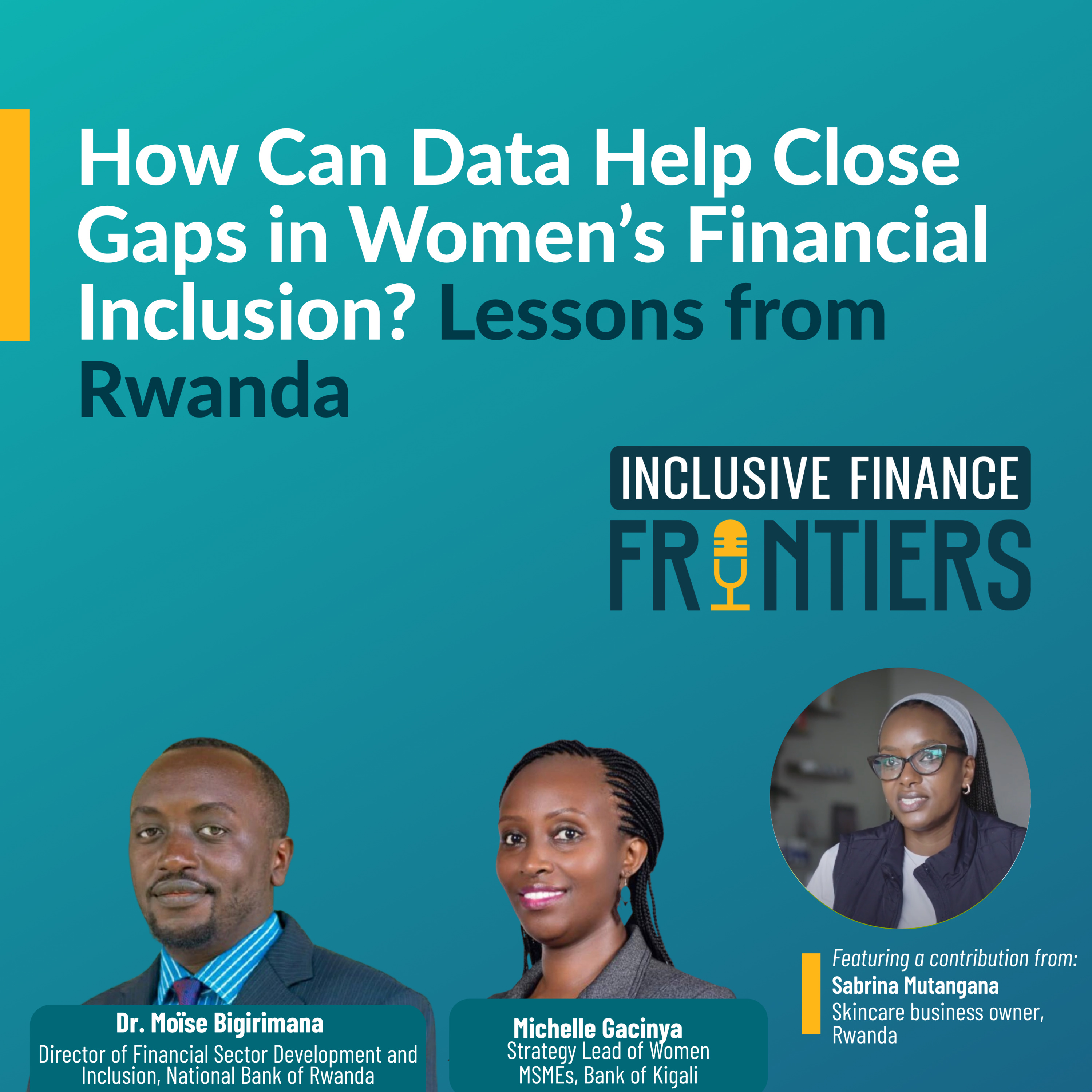 How Can Data Help Close Gaps in Women’s Financial Inclusion? Lessons from Rwanda | Women's financial inclusion is advancing, but gaps remain. The World Bank's Global Findex 2025 reveals that 77% of women globally now hold a financial account, yet in some low- and middle-income countries, women are still up to 30 percentage points less likely to own one than men. So, what's driving this persistent divide, and how do we close it? In our last episode, we looked at some of the barriers nano women entrepreneurs face and potential solutions. Thie time, we turn to the power of data. Gender-disaggregated data gives regulators and financial service providers the insight needed to design products and policies that truly serve women. In this episode, we explore how Rwanda is leading the way using smarter data collection to build a more inclusive and equitable financial system for women. Featured Voices Dr. Moise Bigirimana, Director of Financial Sector Development and Inclusion, National Bank of Rwanda Michelle Gacinya, Strategy Lead W-MSME, Bank of Kigali Sabrina Mutangana, Skincare business owner, Rwanda Producer: Lamis Daoud, CGAP External Affairs Officer Audio Editor and Sound Producer: Samantha Malhotra, World Bank Group Interactive Media Program Executive Producer: Jahda Swanborough, CGAP Communications Lead © CGAP/World Bank, 2026 Special thanks to Valdete Berisha for conducting the interviews with this episode's guests on behalf of the produce. Listen and subscribe for free on your favorite platform. To learn more, visit www.cgap.org. If you have any feedback, connect with us at podcast@cgap.org. | — | ||||||
| 3/4/26 | 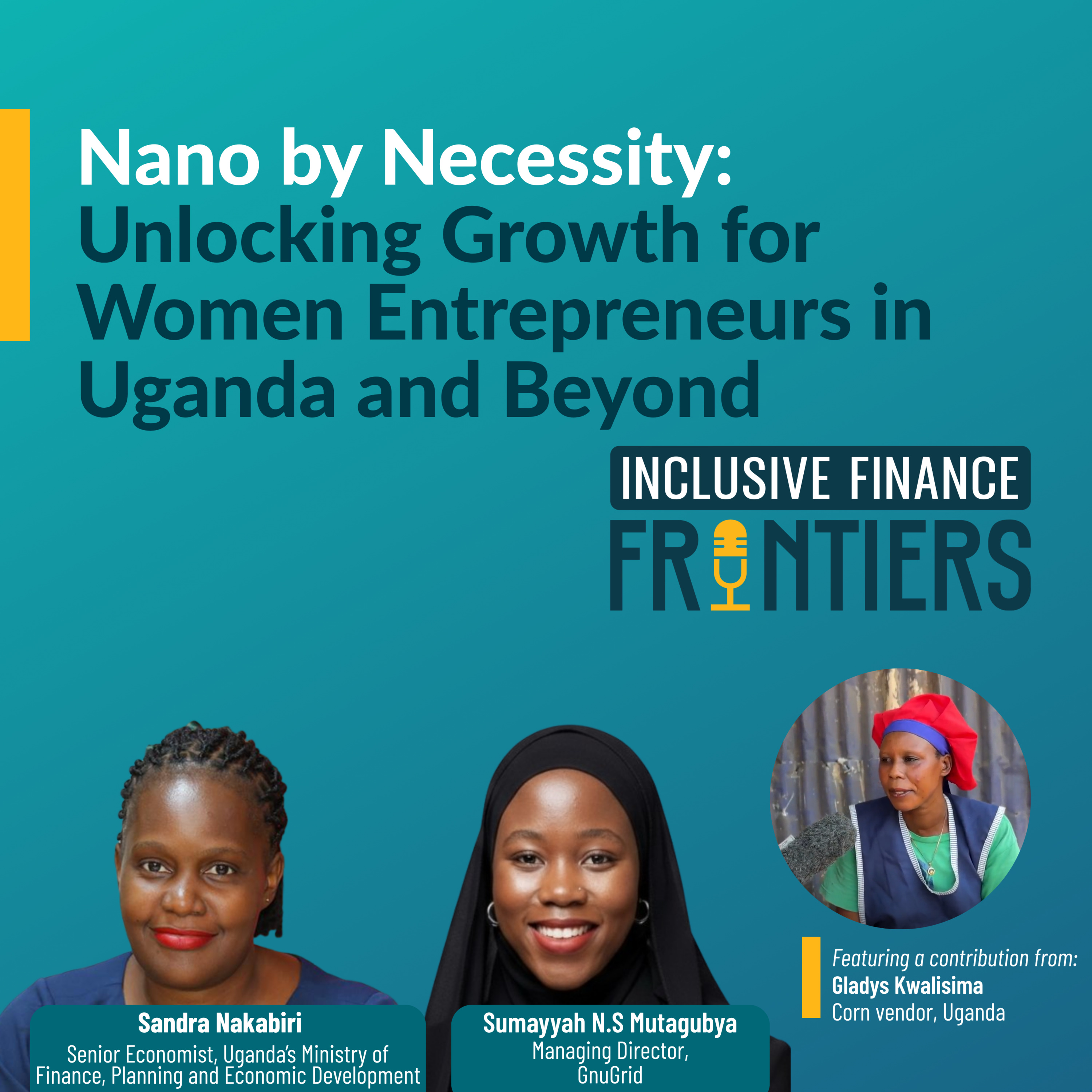 Nano by Necessity: Unlocking Growth for Women Entrepreneurs in Uganda and Beyond | Uganda’s 1.1 million nano and micro enterprises are the economy’s backbone, driving jobs and economic growth. Women lead 55% of them, sustaining households, strengthening communities, and powering local markets. Yet CGAP’s latest research shows too many remain “nano by necessity,” held back by scarce collateral and gaps in digital and financial literacy that limit scale and resilience. What will it take to change that? We speak with GnuGrid—Uganda’s first and only indigenous credit reference bureau—and the Ministry of Finance. How can policymakers, financial service providers, and development partners design tailored interventions that meet women where they are? And how can an ecosystem-wide response unlock the full economic potential of Uganda’s women entrepreneurs?Featured Voices Sandra Nakabiri, Senior Economist at Uganda’s Ministry of Finance, Planning and Economic Development Dr. Sumayyah SengendoN.S Mutagubya, Managing Director of GnuGrid Gladys Kwalisima, corn vendor in Uganda Producer: Lamis Daoud, CGAP External Affairs Officer Audio Editor and Sound Producer: Samantha Malhotra, World Bank Group Interactive Media ProgramExecutive Producer: Jahda Swanborough, CGAP Communications Lead© CGAP/World Bank, 2026Listen and subscribe for free on your favorite platform. To learn more, visit www.cgap.org. If you have any feedback, connect with us at podcast@cgap.org. | — | ||||||
| 2/18/26 | 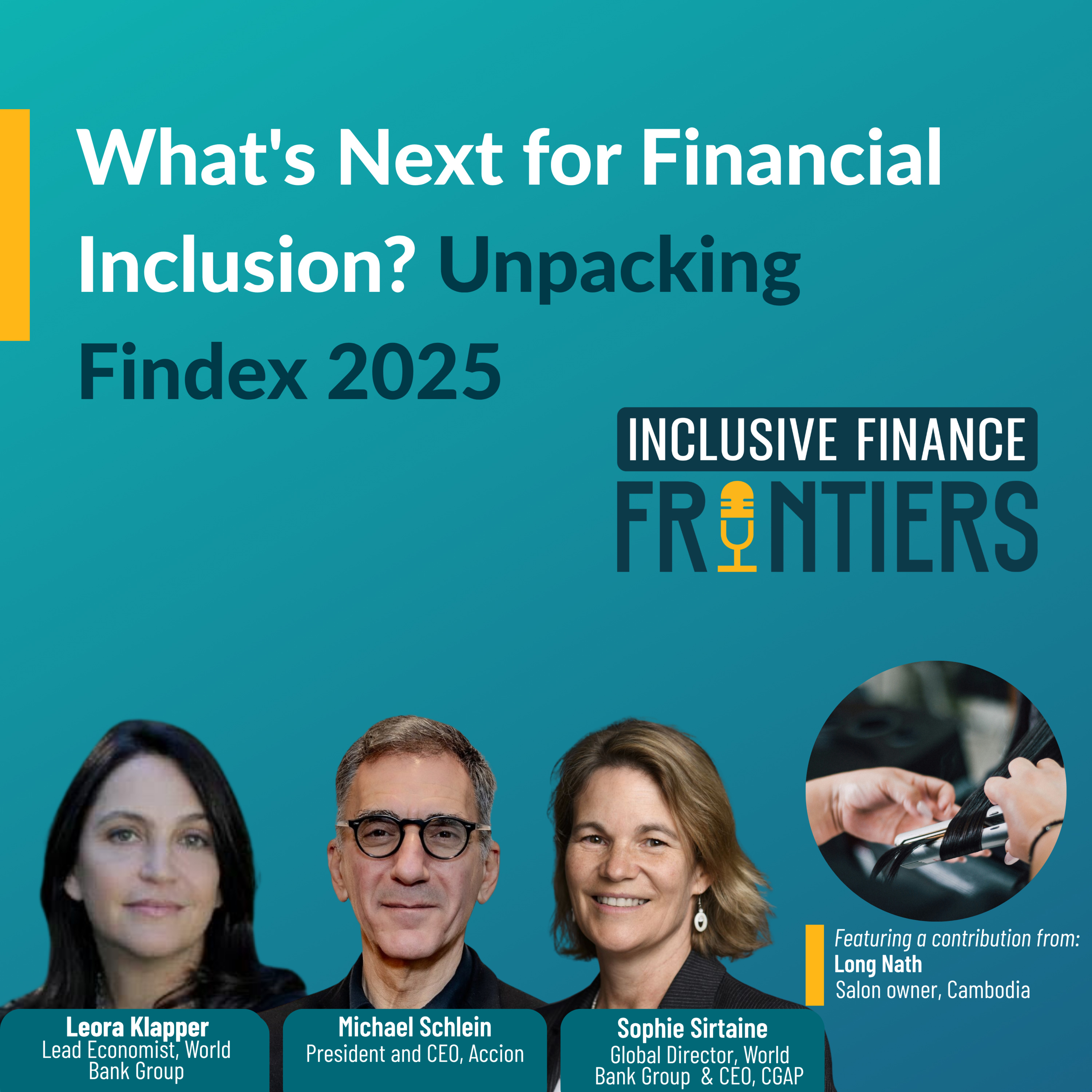 What's Next for Financial Inclusion? Unpacking Findex 2025 | Financial inclusion is rising—but are we converting access into impact? Global Findex 2025 reports 75% of adults in low- and middle-income countries now have an account (79% globally), powered by the wave of digital as mobile phones and the internet transform access and usage. Yet 1.3 billion adults remain unbanked, 300 million accounts sit idle, and large gender gaps persist across regions. Credit, insurance, and pensions lag, and nearly half of adults in emerging markets still struggle to raise emergency funds. Join top voices in the financial inclusion space to unpack the latest Findex findings and map the path forward toward development outcomes. Featured VoicesLeora Klapper, Lead Economist at the World Bank and founder of the Global Findex databaseMichael Schlein, President and CEO of AccionSophie Sirtaine, World Bank Group Director, for the Financial Services Sector and CEO of CGAPLong Nath, salon owner in CambodiaProducer: Lamis Daoud, CGAP External Affairs Officer Audio Editor and Sound Producer: Samantha Malhotra, World Bank Group Interactive Media ProgramExecutive Producer: Jahda Swanborough, CGAP Communications Lead© CGAP/World Bank, 2026Listen and subscribe for free on your favorite platform. To learn more, visit www.cgap.org. If you have any feedback, connect with us at podcast@cgap.org. | — | ||||||
| 9/10/25 |  How Can We Improve Resilience Globally? Leading Experts Weigh In | The world faces a variety of ‘global risks’, ranging fromgeopolitical conflicts and climate change to cyber threats. These are growingever more complex and affect all of us. However, people and small enterprises in low-income countries face disproportionate challenges. If left unaddressed, this can create ripple effects regionally and globally. Government-led strategies remain vital, but the intensifying risks underscore the urgent need for approaches that put solutions directly into the hands of communities most vulnerable to risks and can complement government-led strategies. In June 2025, CGAP convened nearly 200 global decisionmakers in Amsterdam involved in global resilience responses for a Symposium titled, “RethinkingResilience: Why Inclusive Finance Can’t Wait”. Inthis bonus episode of Inclusive Finance Frontiers, hear from participants interviewed on the sidelines of the Symposium on how inclusive finance tools—such as savings, credit, insurance, and digital payments—can strengthenresilience for those most at risk and drive sustainable development. Featured voices: Michel Liès, Chairman of Zurich Insurance Group and Insurance Development ForumStéphane Hallegatte, Chief Climate Economist at the World BankStuart Rutherford, Director of Hrishipara Daily Diaries ProjectSophie Sirtaine, CGAP CEO | — | ||||||
| 1/30/25 |  Coding Through Crisis: Building a Digital Social Protection System in Lebanon | In 2019, Lebanon witnessed the start of one of the most severe socio-economic crises globally since the mid-nineteenth century, plunging many Lebanese into poverty. Amid the hardships, a new hope emerged in 2021. The World Bank set up a $246 million social safety net project and the Government of Lebanon (GoL) designed a registration platform for this program, with the help of Siren Associates, called DAEM (Arabic for "support"). Built in record time, DAEM is more than just a registry; it’s a fully localized social protection system that provides a lifeline to Lebanese families hit by crisis.In this episode, we hear from the GoL, CGAP, the World Bank, and Siren Associates about how collaboration was key to DAEM’s success and how, even in the most challenging conditions, it’s possible to design solutions that go beyond emergency relief and sow the seeds for a more inclusive financial system. This is Season 2, Episode 6 of CGAP's podcast, Inclusive Finance Frontiers. Ahmed Fatih Ortakaya, Senior Social Protection Specialist, World BankCarole Alsharabati, Research Director, SIREN AssociatesMarie Louise Abou Jaoudeh, Presidency of the Council of Ministers (PCM) of the Government of LebanonNadine Chehade, Senior Financial Sector Specialist, World Bank Souraya Sbeih, Consultant, CGAP Listen and subscribe for free on your favorite platform. To learn more, visitwww.cgap.org. To share feedback, connect with us atpodcast@cgap.org. This episode incorporates a news report from PBS NewsHour, Financial crisis leads some in Lebanon to rob banks to access their money. | — | ||||||
| 1/22/25 |  Can Inclusive Carbon Markets Pave the Way for a Just Transition? | The climate crisis demands urgent global action. Green technologies—like solar panels and clean cookstoves—have the potential to transform lives and protect the planet but remain out of reach for many in developing economies. Can carbon markets make them more accessible? Voluntary carbon markets (VCMs), where companies purchase carbon credits to offset greenhouse gas emissions, are rapidly gaining traction. These markets hold immense potential to enable the adoption of green technologies among low-income households on the frontlines of climate change and improve their lives. In this episode, we take a deep dive into VCMs to hear from ATEC about their pay-as-you-go electric cookstoves, which aim to decarbonize cooking through verifiable tech, how Gold Standard issues carbon certifications, and why CGAP sees a promising role for financial services in supporting more inclusive carbon markets. Featured Voices: Ben Jeffreys, CEO, ATEC Vikash Talyan, Senior Director of Standard Development and Innovation, Gold Standard Max Mattern, Senior Financial Sector Specialist, CGAP Listen and subscribe for free on your favorite platform. To learn more, visit www.cgap.org. To share feedback, connect with us at podcast@cgap.org. | — | ||||||
| 12/10/24 |  Can AI Revolutionize Financial Consumer Protection? | Artificial intelligence (AI) is already transforming almost every aspect of the financial services industry. It is driving efficiencies and sparking innovation by reshaping the way financial authorities protect consumers—not just how financial service providers operate. But financial authorities need to walk a tightrope. While they need to harness the power of AI to improve consumer protection, they must also address the novel risks and challenges that AI brings, such as new forms of financial fraud, cyber threats, and data privacy concerns. This episode explores how the Central Bank of the Philippines is embracing AI-powered "SupTech” (supervisory technology) for its chatbot named BOB to enhance financial consumer protection. We'll hear from experts at the Central Bank of the Philippines, the Cambridge SupTech Lab, and CGAP about the potential benefits and risks of this revolutionary technology. Featured Voices: Charina B. De Vera-Yap, Director of the Consumer Protection and Market Conduct Office (CPMCO), Regional Operations and Advocacy Sector, Bangko Sentral ng Pilipinas (BSP) Matt Grasser, Co-Head and Tech Lead, Cambridge SupTech Lab and Principal Technologist at Cambridge Centre for Alternative Finance (CCAF) Juan Carlos Izaguirre, Senior Financial Sector Specialist, CGAP Eric Duflos, Senior Financial Sector Specialist and Consumer Protection Lead, CGAP Listen and subscribe for free on your favorite platform. To learn more, visit www.cgap.org. To share feedback, connect with us at podcast@cgap.org. | — | ||||||
| 12/3/24 |  Banking on Open Finance to Advance Financial Inclusion: Lessons from Brazil | In Brazil, the banking world is changing fast. Open Finance allows people in Brazil to securely share their financial data across financial service providers, sparking competition and innovation among providers. This empowers customers to compare and choose services that best meet their needs. But how does open finance work in practice and what does it mean for the millions of people still excluded or underserved by formal finance? In this episode, we talk to experts at the Central Bank of Brazil, Nubank, and CGAP about Brazil’s experience in rolling out open finance and how data can help unlock credit for informal workers, improve product offerings, and reach wider segments of society. Along the way, we tackle critical questions: Can open finance help reduce inequality? And what lessons can other countries learn from Brazil’s rapid adoption? Featured Voices: Matheus Rauber, Senior Advisor, Financial System Regulation Department, Central Bank of Brazil Rafael Wowk, Head of Regulatory Affairs, NuBank Maria Fernandez Vidal, Senior Financial Sector Specialist, CGAP Listen and subscribe for free on your favorite platform. To learn more, visit www.cgap.org. To share feedback, connect with us at podcast@cgap.org. | — | ||||||
Want analysis for the episodes below?Free for Pro Submit a request, we'll have your selected episodes analyzed within an hour. Free, at no cost to you, for Pro users. | |||||||||
| 1/10/23 |  Digital Finance’s Little Secret... (Agent Networks) | The wide reach of digital financial services, such as digital savings, credit, payments, insurance or investment products, can unlock life-changing opportunities for low-income consumers by helping them save, borrow, and receive remittances. But here’s a little secret about the seemingly endless array of these digital services: their current ability to attract and serve new users largely depends on the expansion of old-fashioned physical interaction through agent networks. These networks enable users to deposit or withdraw cash from digital accounts, which is crucial in cash economies where digital finance has limited use cases. Expanding these networks beyond large cities is notoriously difficult, but significant progress has been made in recent years — and in surprising ways. In this episode, we explore the latest advances in agent networks and what they mean for the future of inclusive finance. Featured Voices: · Emilio Hernandez, Senior Financial Sector Specialist, CGAP · Sasidhar Thumuluri, Managing Director and CEO, Sub-K · Archana Pandey, General Manager, Financial Inclusion at Bank of Baroda · Sandhya Rani, Sub-K rural agent Special thanks to Anand Raman, CGAP consultant based in India, for his help in leading interviews with Sub-K agents and customers. Listen and subscribe for free on your favorite platform. To learn more, visit www.cgap.org. If you have any feedback, connect with us at podcast@cgap.org. | — | ||||||
| 1/10/23 |  Will Central Bank Digital Currencies be a game-changer for financial inclusion? | Central banks have been eying the emergence of privately issued digital currencies with a mix of excitement and anxiety and some began experimenting with their own versions of crypto: central bank digital currencies (CBDCs). Advocates say CBDCs offer an alternative to private digital currencies that will enable central banks to retain their control over national monetary supplies, better combat money laundering and fraud, and even advance financial inclusion. But are CBDCs really the game-changer for financial inclusion that many claim? What are the key enablers and constraints to CBDCs advancing financial inclusion? And how are central banks thinking about designing CBDCs to ensure that they achieve their goals? Featured Voices: · Kwame Oppong, Head of Fintech and Innovation, Bank of Ghana · Mahesh Uttamchandani, Global Practice Manager for the World Bank Group’s Financial Inclusion, Access and Infrastructure between January 2018 and September 2022 and currently the World Bank’s Practice Manager for Digital Development in East Asia and the Pacific · Nana Yaa Boakye-Adjei, Senior Consultant, the World Bank · Tanja Hessdörfer, Head of Sales and Business Development CBDC at Giesecke+Devrient · Mehmet Kerse, Senior Consultant on Digital Finance and Financial Inclusion, CGAP Listen and subscribe for free on your favorite platform. To learn more, visit www.cgap.org. If you have any feedback, connect with us at podcast@cgap.org. | — | ||||||
| 11/28/22 |  What Can Super Typhoon Rai Teach Us About Financial Inclusion? | Typhoon Rai made landfall in the Philippines in December 2021, killing over 400 people, devastating 1.5 million homes, and causing over US$1 billion in damage. Extreme weather events like Rai are becoming more common as a result of climate change. Financial services can make households more resilient and adaptive, but too often the people who are most vulnerable to these shocks—such as women, poor people, forcibly displaced people, and people in rural areas—are also financially excluded. In this episode, we travel to the Philippines to speak with a Typhoon Rai survivor and the insurance provider that helped her rebuild her home, as we explore the changing role of insurance and other financial services in climate change mitigation and adaptation. Featured Voices: Astrid Zwick, Head of InsuResilience Secretariat Emilie Fernandes, former Philippines Country Director, Relief International Lorenzo Chan, President and CEO of Pioneer Inc. Annaliza Hermano, a Pioneer Insurance customer Wendy Chamberlin, CGAP Consultant Listen and subscribe for free on your favorite platform. To learn more, visit www.cgap.org. If you have any feedback, connect with us at podcast@cgap.org. | — | ||||||
| 11/28/22 |  What’s in store for embedded finance? | The spread of digital technology and infrastructure has given rise to fintech, but it’s also driven the popularity of non-financial services like social media apps, gig platforms, and e-commerce sites. The term “embedded finance” refers to the integration of financial tools into this growing array of services. Just as mobile money brought payments closer to low-income customers via their phones, embedded finance has the potential to bring a whole range of financial services even closer. The opportunities this presents to advance financial inclusion are almost endless and may define financial inclusion for years to come. But what forms will embedded finance take? What are the biggest opportunities and risks? And what players are driving it in different regions? In this episode, we take a look at what lies ahead for embedded finance. Featured Voices: Ana Maria Zuluaga Tafur, Head of Innovation Group, Superintendencia Financiera de Colombia Laura Crow, Head of the financial services team, M-Pesa Africa Pui San Chay, Director of Public Affairs and Policy, Grab Peter Zetterli, Senior Financial Sector Specialist, CGAP Patrick Meagher, CGAP Consultant Listen and subscribe for free on your favorite platform. To learn more, visit www.cgap.org. If you have any feedback, connect with us at podcast@cgap.org. | — | ||||||
| 11/28/22 |  The Social Frontier of Financial Inclusion | What are the frontiers of financial inclusion? Of course, there is a geographical frontier: people in rural areas are more often excluded from the financial system. There’s also a technological frontier: while digital technology has greatly expanded the reach of financial services, those on the other side of the digital divide are being left behind. But there’s also a social frontier, often in the form of social norms that dictate who can – and can’t – access and use financial services. In this episode, we hear from Women’s Micro Bank (also known as Mama Bank), a bank in Papua New Guinea that pushed geographical and technological boundaries in its attempts to expand rural women’s access to banking services but ran into its biggest challenges at the social frontier. Featured voices: Jill Pijui, Head Trainer, Center for Excellence in Financial Inclusion (CEFI) in Papua New Guinea Gunanidhi Das, CEO, Women’s Micro Bank (Mama Bank) Gina Gelena, Mama Bank agent Elle Pele, Mama Bank customer Katie Highet, CGAP Consultant Listen and subscribe for free on your favorite platform. To learn more, visit www.cgap.org. If you have any feedback, connect with us at podcast@cgap.org. | — | ||||||
Showing 15 of 15
Sponsor Intelligence
Sign in to see which brands sponsor this podcast, their ad offers, and promo codes.
Chart Positions
11 placements across 11 markets.
Chart Positions
11 placements across 11 markets.