

Insights from recent episode analysis
Audience Interest
Podcast Focus
Publishing Consistency
Platform Reach
Insights are generated by CastFox AI using publicly available data, episode content, and proprietary models.
Total monthly reach
Estimated from 4 chart positions in 4 markets.
By chart position
- 🇺🇸US · Earth Sciences#1495K to 30K
- 🇪🇸ES · Earth Sciences#9710K to 30K
- 🇦🇹AT · Earth Sciences#2100K to 300K
- 🇵🇹PT · Earth Sciences#2710K to 30K
- Per-Episode Audience
Est. listeners per new episode within ~30 days
63K to 195K🎙 ~2x weekly·3 episodes·Last published 1w ago - Monthly Reach
Unique listeners across all episodes (30 days)
125K to 390K🇦🇹77%🇺🇸8%🇪🇸8%+1 more - Active Followers
Loyal subscribers who consistently listen
50K to 156K
Market Insights
Platform Distribution
Reach across major podcast platforms, updated hourly
Total Followers
—
Total Plays
—
Total Reviews
—
* Data sourced directly from platform APIs and aggregated hourly across all major podcast directories.
On the show
Recent episodes
A Sunshade For Earth, And Who Controls It — Ross Centers and Morgan Goodwin
Jun 16, 2026
1h 27m 03s
Plan C for Civilization — Ben Kalina
May 20, 2026
1h 01m 15s
Iceland Declared AMOC Collapse a Threat — Páll Gunnarsson, Founder of Reykjavík Institute
Apr 29, 2026
1h 15m 14s
Building Governance From Scratch — Janos Pasztor, Former ED, Carnegie Climate Governance Initiative
Apr 7, 2026
1h 05m 19s
"Are You Going To Stop Me Cooling The Earth?" — Luke Iseman, Founder of Make Sunsets
Mar 24, 2026
57m 42s
Social Links & Contact
Official channels & resources
Official Website
Login
RSS Feed
Login
| Date | Episode | Description | Length | |
|---|---|---|---|---|
| 6/16/26 | 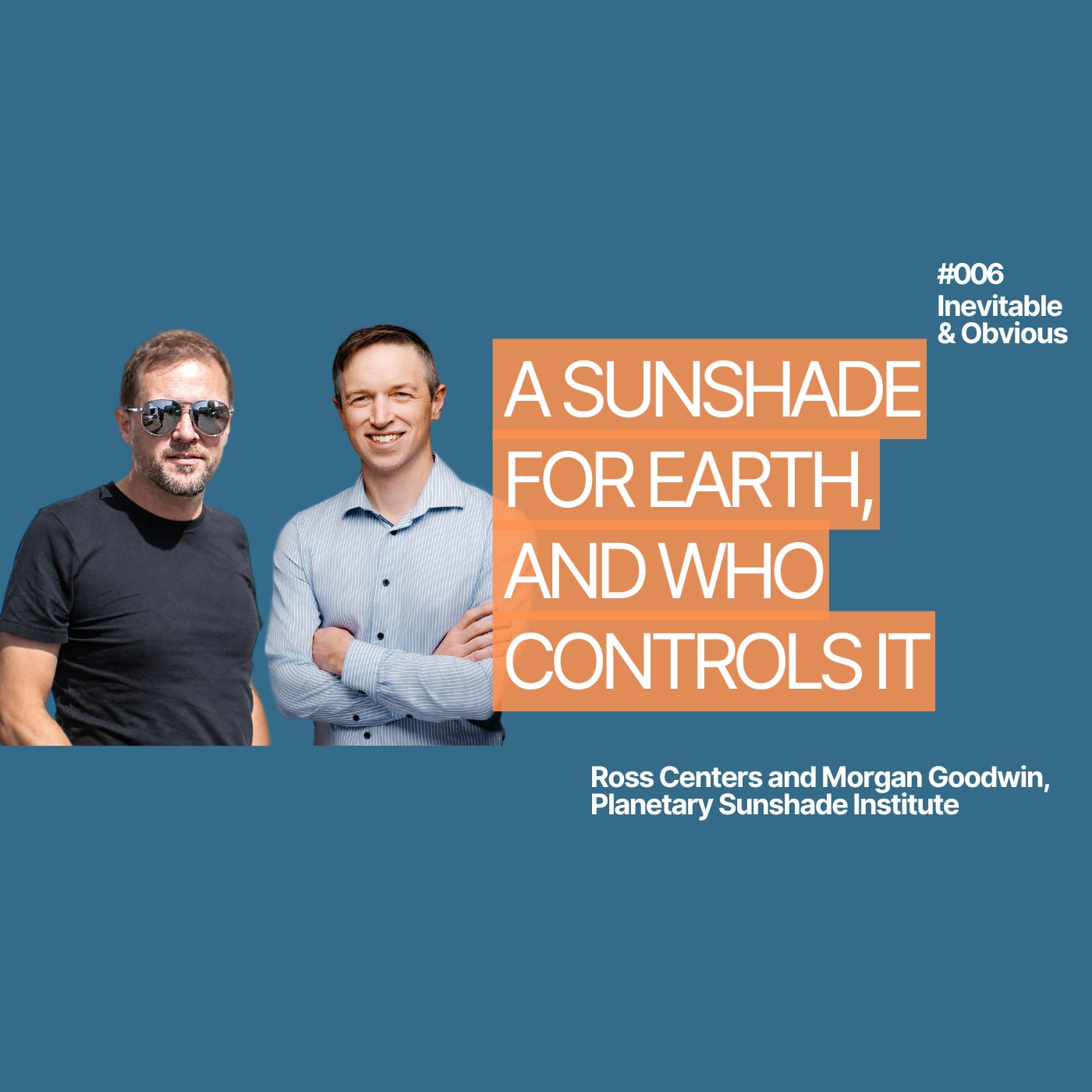 A Sunshade For Earth, And Who Controls It — Ross Centers and Morgan Goodwin | A planetary sunshade is one of those ideas that gets filed under science fiction and left there. A constellation of thin reflectors, parked at the gravitational balance point between the Earth and the Sun, shading the planet by a percent or so and buying us time on warming. The reason to take it seriously now is that the industrial base required to build one is the same base that SpaceX, NASA, and a handful of startups are already racing to stand up for entirely commercial reasons. Ross Centers and Morgan Goodwin of the Planetary Sunshade Institute have been working on this since before it was a field, and in this conversation we trace the whole path: from why even clean energy eventually hits a planetary limit, to how you’d manufacture forty-kilometer solar sails out of moon dust, to who would actually be in charge of the global thermostat once it exists.Guest introductionRoss Centers founded what became the Planetary Sunshade Institute in 2018 and is the founder and CEO of Ethos, where he’s developed electrochemical metallurgy techniques on simulated lunar regolith. Morgan Goodwin is PSI’s executive director and has spent twenty years working in climate. The Institute recently convened the first planetary sunshade workshop in Nottingham, drawing more than eighty researchers, and is funded in part by the UK’s ARIA to baseline sunshade architectures. Learn more at planetarysunshade.org.Key topics with timestamps (also use as YouTube chapter markers)* 04:37 — A field comes into being. How a single paper from the 1980s and a workshop of eighty-plus people in Nottingham turned the sunshade from an idea into a research field.* 07:52 — Welcome to climate. Morgan on what it’s like to enter climate work from the space world, and why the people closest to you often won’t engage.* 22:13 — What a Dyson Swarm actually is. Solar-powered data centers orbiting the Sun, and the Kardashev-scale logic that points there.* 27:09 — The planetary heat limit. Why even a fully renewable civilization eventually warms the planet through waste heat alone.* 28:59 — SpaceX as a Dyson Swarm company. Ross’s read on what the largest IPO in history is actually for.* 34:58 — Mining the Moon. Morgan’s Hoover Dam analogy and the economics of building from lunar material.* 47:06 — The Heliogyro. A forty-kilometer spinning solar sail made almost entirely from aluminum, walked through step by step.* 57:41 — Who governs the climate. Why only governments can deploy SRM, and what “the climate government” means.* 1:01:29 — Sunshade and SAI as complementary backups. Why having two cooling technologies beats having one.* 1:16:01 — Does a sunshade ever come down. The generational-memory question, and whether planetary management becomes permanent.Inevitable & Obvious is where I work through the technologies and the politics of cooling the planet, with the people actually building the field. If conversations like this one are useful to you, subscribing for free at inevitableandobvious.com gets you every episode plus the writing that goes deeper than the audio. Get full access to Inevitable & Obvious at www.inevitableandobvious.com/subscribe | 1h 27m 03s | |
| 5/20/26 | 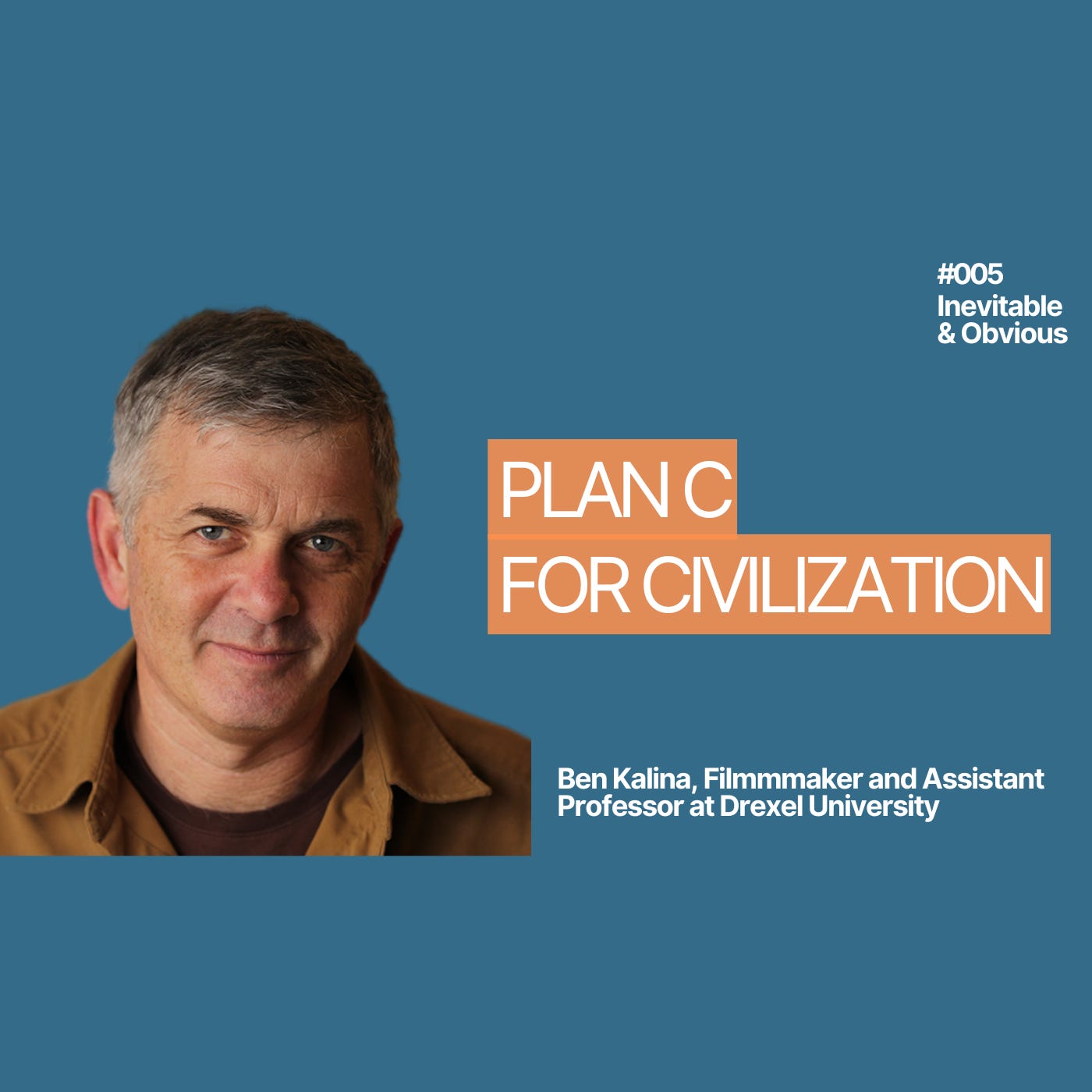 Plan C for Civilization — Ben Kalina | SRM Is Coming Faster Than You Think — Ben Kalina on 15 Years Filming Climate’s Most Controversial IdeaSunlight reflection has spent decades as an idea scientists batted around at academic conferences. Now venture-backed companies are racing to build deployment systems, state legislatures are passing bans on weather modification research, and the public still mostly thinks the contrails overhead are a government plot. Ben Kalina has been pointing a camera at this entire evolution for fifteen years. Plan C for Civilization, his documentary on the field’s emergence as serious research, is the closest thing we have to a real historical record of how this is unfolding. We talked about what changed Ben’s mind about the timeline, why average audiences leave his film more curious not less, the strange dynamics of venture capital entering a space that runs on trust, and what of the Stardust Solutions optics problem can and cannot be engineered away.Ben Kalina is a documentary filmmaker and a professor at Drexel University. His new film Plan C for Civilization follows the emergence of solar geoengineering research, centered on David Keith, the SCoPEx experiment at Harvard, and the late entrance of Make Sunsets. The film is currently in festival distribution and screening tour. More at plancforcivilization.com.Key topics with timestamps* (02:00) The fifteen-year project — How a film begun in 2009 ended up documenting a field that took most of that time to become real* (05:30) David Keith, Ken Caldeira, and the 1998 Aspen meeting — The origin moment that drew two researchers in by trying to prove the idea ridiculous* (07:40) Why SCoPEx mattered symbolically — A small experiment that did the work of declaring solar geoengineering research a legitimate field* (09:20) The Make Sunsets entrance — Move-fast culture meets a field that desperately needs trust* (13:30) The choice to go to Sweden — What the headline missed about the actual procedural reality* (16:30) Time and the climate conversation — Why the carbon curve has changed how Ben thinks about decisions* (19:50) From “scare them straight” to “help them grapple” — How a fifteen-year project changed its own purpose* (23:00) What the focus groups show — Why average viewers come away wanting more research, not less* (28:30) The fall tour — Taking the film to states with proposed weather modification bans* (36:00) Storytelling and fiction — Why direct air capture, ocean iron fertilization, and SAI all need better cultural artifacts* (46:30) Slow science versus move fast — The dichotomy the field is currently navigating* (54:30) Stardust and the trust problem — Why isotopic markers cannot do all the work* (58:00) Who is actually in this field — Fifteen years with the researchersNotable quotes“This stuff is coming at us, solar geo, much, much faster than most people realize. There’s probably some major decisions that are going to start getting made in the next few years. And the public has no clue. And if they do, they think they’re talking about chemtrails.” — Ben Kalina“When you start talking about making the planet more reflective, that’s a ‘could possibly go wrong’ thought. That’s a classic ‘why the hell would we do that.’” — Ben Kalina“We could have the science down to a T with solar geoengineering. You could have isotopic markers on the particles you’re putting up there, and there’s still going to be a big piece of this that is just trust.” — Ben Kalina“Nobody in this field is a climate denier. They all come to this kind of as a career last resort, after having sort of figured out that there’s nothing else where they can contribute.” — Ben Kalina“Stardust Solutions, in this moment, being an Israeli company of former nuclear scientists funded by Silicon Valley tech billionaires whose stated goal is to change the planet’s temperature, and accidentally, by the way, name themselves after the empire’s plan to build the Death Star.” — Ben Kalina Get full access to Inevitable & Obvious at www.inevitableandobvious.com/subscribe | 1h 01m 15s | |
| 4/29/26 | 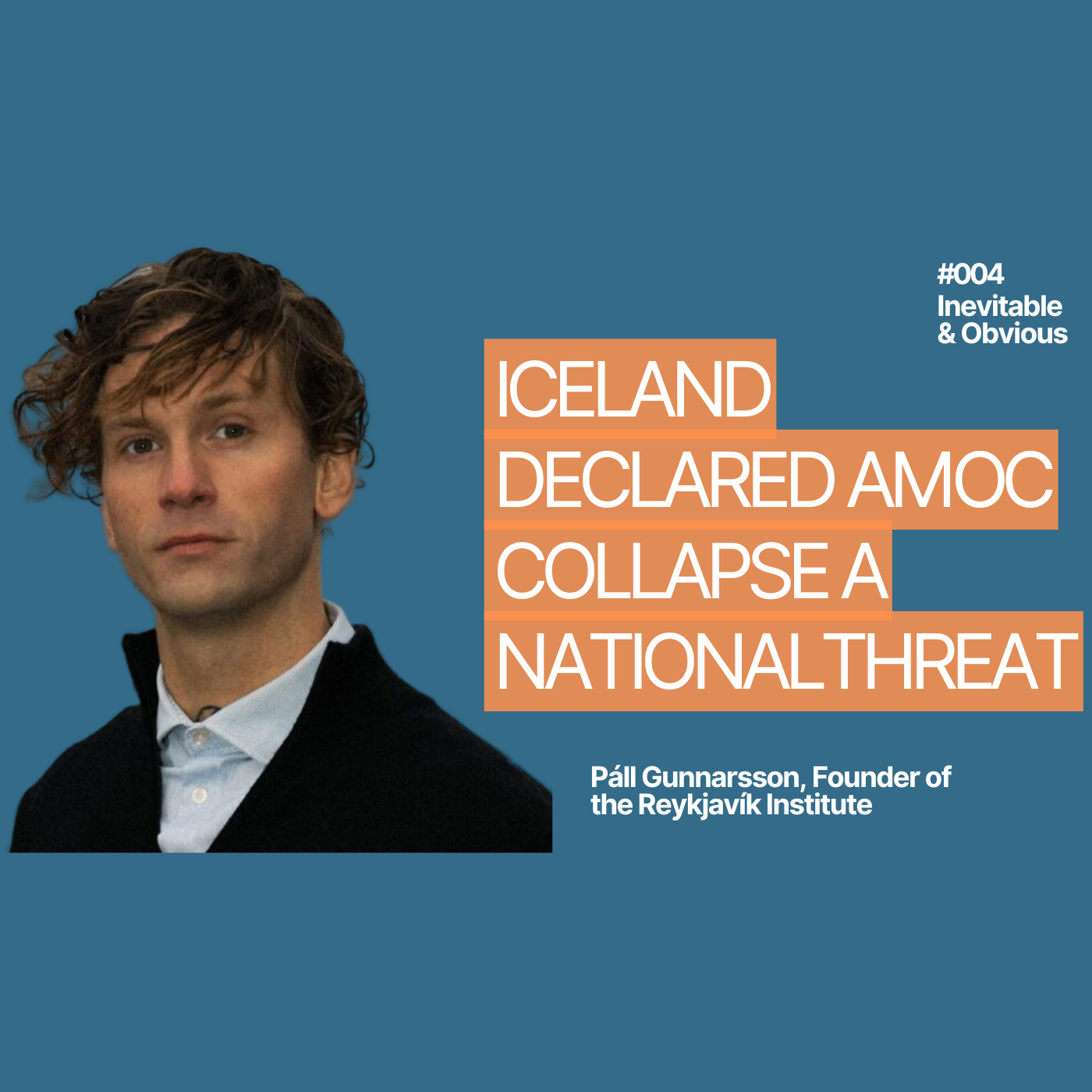 Iceland Declared AMOC Collapse a Threat — Páll Gunnarsson, Founder of Reykjavík Institute | Iceland is the first country to formally declare a potential AMOC collapse a national security threat. Páll Gunnarsson, founder of the Reykjavík Institute, has been close to the political process that produced that declaration. He explains why a country of 400,000 people moved faster than larger Atlantic-rim nations, what made the declaration possible, and why he believes intervention capability research has to advance in parallel with climate science rather than after it. We also dig into his case against the standard moral hazard argument (the idea that climate interventions undermine decarbonization ambition) which he reframes as enforced vulnerability, the position of telling the most vulnerable people in the world to remain vulnerable so that wealthier societies feel pressure to act. And we talk about what comes next: a September pledging event in the EU around the OceanEye initiative, an emerging coalition-of-the-willing approach to research governance, and what happened the first time Reykjavík civil society sat down to discuss climate interventions in public.Subscribe for free and get more detailed show notes at inevitableandobvious.com Get full access to Inevitable & Obvious at www.inevitableandobvious.com/subscribe | 1h 15m 14s | |
| 4/7/26 | 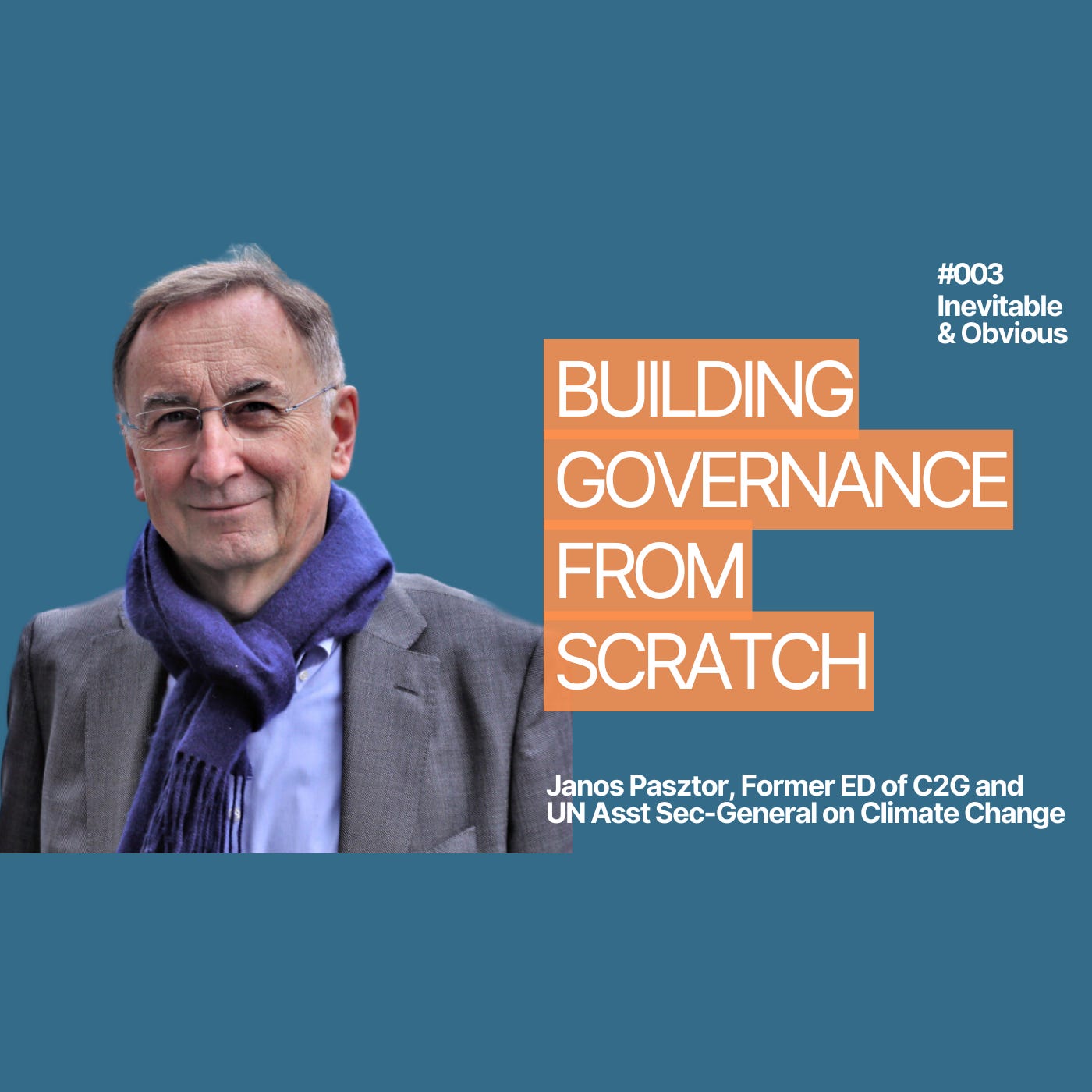 Building Governance From Scratch — Janos Pasztor, Former ED, Carnegie Climate Governance Initiative | A former UN Assistant Secretary-General spent seven years trying to get world leaders to talk about planetary cooling. Most of them told him the same thing: "We can't talk about this publicly." Janos Pasztor led the Carnegie Climate Governance Initiative (C2G), the first organization to systematically bring solar radiation modification governance to governments, diplomats, and the UN system. In this conversation, he walks through what those private meetings actually sounded like, why a landmark UN event was killed by COVID days before launch, how a Pakistani minister's first question revealed what actually drives national policy, and why the biggest gap right now isn't research or technology but the societal conversations that still aren't happening.Chapter Timestamps* [00:00] Opening: “We can’t talk about this publicly” — what Janos heard behind closed doors* [02:21] What was C2G, and what does “governance” actually mean?* [06:59] Breaking down SRM governance into manageable pieces — research, decision-making, and the question of what happens if the answer is no* [11:44] The case against unilateral deployment — counter-geoengineering and the IPCC’s warning* [19:13] “What planet are you coming from?” — how reception shifted from bewilderment to engagement* [23:51] The Belgium UN event that COVID killed, and what it would have meant* [29:19] Why politicians are afraid to go beyond the 1.5°C frame* [35:02] How countries actually develop positions — the multi-layered feedback loops behind government policy* [41:47] “What do Pakistani scientists say?” — the global south, Degrees Initiative, and building local capacity* [47:57] What C2G learned about trust, impartiality, and opening doors* [53:12] The biggest gap right now: societal conversations that aren’t happening* [56:33] What keeps Janos awake — geopolitics, bandwidth, and the timing problem* [1:01:42] If C2G were active today, what would it do differently?Links and Resources* Carnegie Climate Governance Initiative (C2G): c2g2.netIf this kind of inside view conversation where we talk about how governance actually works, what's happening behind closed doors, and what isn't, then subscribe at inevitableandobvious.com. Every episode brings you into a direct conversation with the people navigating the hardest questions in climate intervention. Next up: we're continuing to build this picture of the emerging ecosystem with more voices you won't hear anywhere else. Get full access to Inevitable & Obvious at www.inevitableandobvious.com/subscribe | 1h 05m 19s | |
| 3/24/26 | 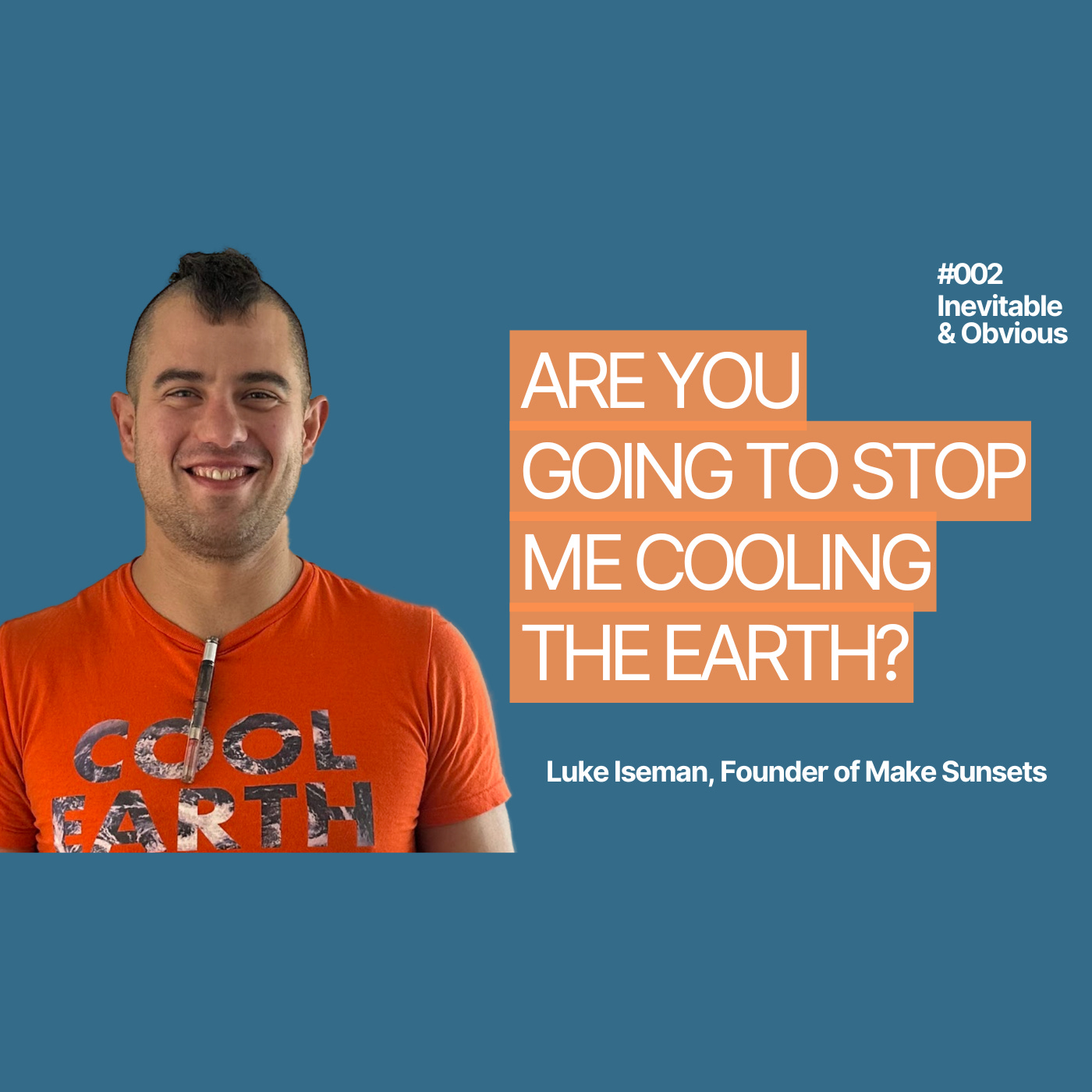 "Are You Going To Stop Me Cooling The Earth?" — Luke Iseman, Founder of Make Sunsets | Luke Iseman is putting sulfur dioxide into the stratosphere with high-altitude balloons and selling cooling credits to pay for it. And he doesn’t care if you approve.Make Sunsets is maybe the most polarizing company in climate interventions right now, and I wanted to have Luke on the show so we could learn more about how they think and what their goals are. We discussed the question that if we assuming cooling the planet is necessary (and we both believe it is), does that justify acting without institutional permission? We get into the energy math on carbon removal, the governance question, and a wealthy customer who may be planning to personally fund enough deployment to measurably cool the planet. Chapter Timestamps* 01:22 — What Make Sunsets actually does and how cooling credits work* 05:07 — The energy math against carbon removal: why CDR needs 20x global energy production* 07:00 — Luke’s vision for 2100: nuclear energy, 10x global prosperity, and table stakes* 10:50 — “We’ve been geoengineering since the industrial revolution”* 15:11 — Theory of change, the wealthy customer revelation, and “are you going to stop me?”* 19:40 — Deployment risks: monsoon disruption, weaponization, and the Pentagon’s response* 25:27 — Luke’s critique of governance approaches being taken today* 30:29 — The smallpox analogy: does innovation precede or follow institutions?* 38:36 — What success looks like for Make Sunsets in 10 years (0.1°C measurable cooling)* 47:39 — The Mexico ban that wasn’t, and why getting the facts right matters* 53:19 — What the field needs: “bold action” vs. “analysis and meetings”* 55:07 — Paul’s post-interview reflection: where he agrees and where he doesn’tNotable Quotes* “Are you going to stop me? And unless someone is going to do that... the cat’s out of the bag. Anyone can do this.” — Luke Iseman* “Unless you are breaking the law to build nuclear reactors, I don’t want to hear about CDR from anyone proposing it as a serious climate solution.” — Luke Iseman* “People are obsessed with developing governance for something for which there’s no demand. You govern things for which there is demand.” — Luke Iseman, quoting a friend* “I have a lot more respect now for the institutions that govern things that can help make decisions, the social license and legitimacy that comes from working through much more traditional systems.” — Paul Gambill (post-interview)* “Every day that we wait to do solar geoengineering is needless lives lost, species extincted, and tipping points flirted with.” — Luke IsemanLinks and Resources* Make Sunsets: Luke’s company, where you can buy cooling credits* Termination Shock by Neal Stephenson: the novel that inspired Luke to start Make Sunsets* “Why Countries Aren’t Ready for Climate Interventions Yet” (Inevitable & Obvious)This and every episode I publish is free because I want these conversations to reach as many people as possible. Paid subscriptions are how I keep doing this work independently. They allow me to follow the research on climate interventions and meet the researchers, practitioners, founders, and policymakers shaping how this landscape evolves. Paid members get access to our community chat, where we discuss the latest developments in climate interventions and make sense of them together. If you found this conversation valuable, I’d appreciate your support. Get full access to Inevitable & Obvious at www.inevitableandobvious.com/subscribe | 57m 42s | |
| 3/17/26 | 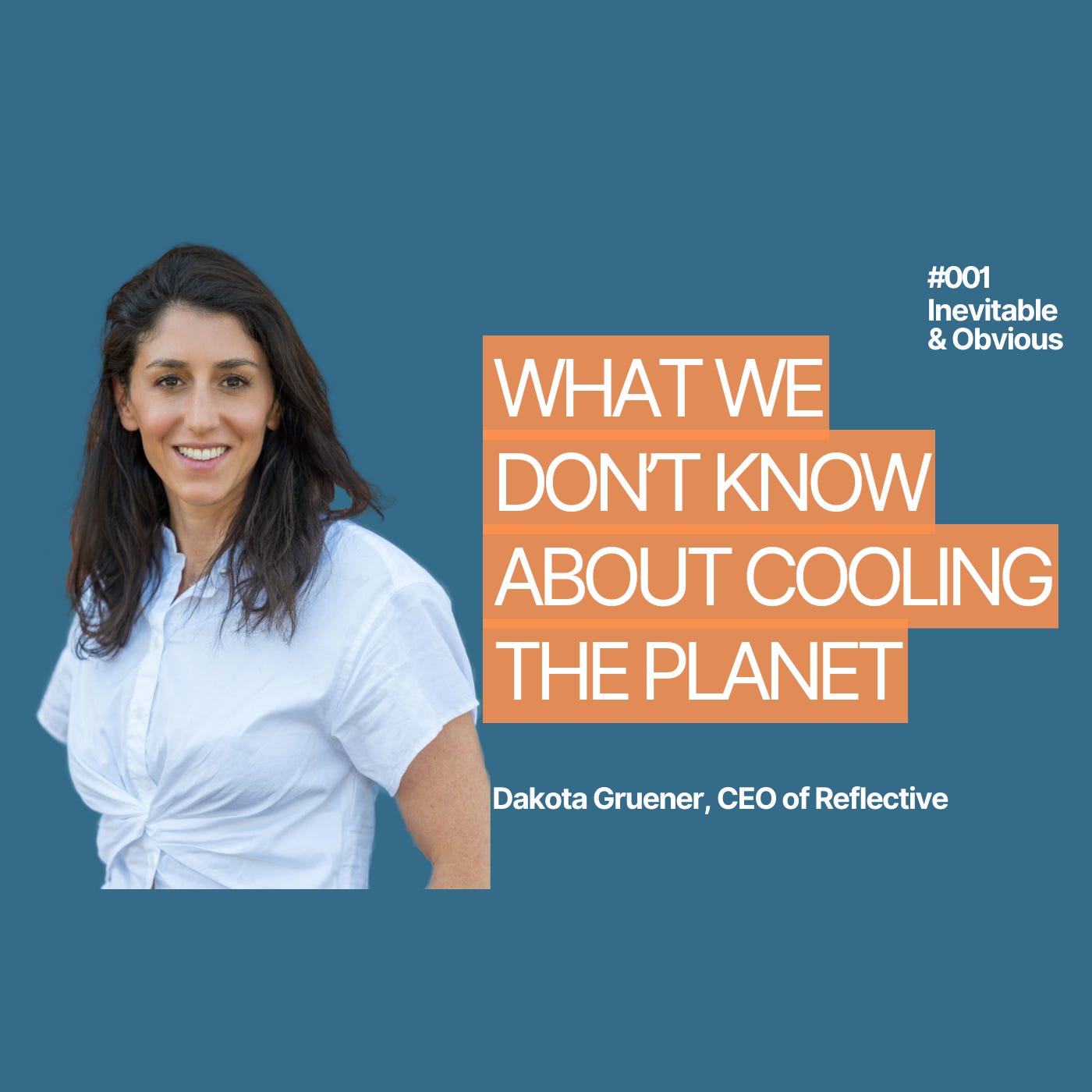 What We Don’t Know About Cooling the Planet — Dakota Gruener, CEO of Reflective | Stratospheric aerosol injection might be one of the only interventions that could reduce global warming on the timescales that actually matter, but we don't yet know enough to say if it's completely worth the potential tradeoffs, and we're not on track to find out in time. Dakota Gruener is the founder and CEO of Reflective, an independent nonprofit trying to change that by radically accelerating the research. In this conversation, we talk about what it would take to actually evaluate SAI: • The tools Reflective has built to map the unknowns • The case for something like clinical trials for the atmosphere• Why Dakota thinks the worst outcome isn't deployment but decisions being forced before the science is ready.Subscribe for free at inevitableandobvious.com Get full access to Inevitable & Obvious at www.inevitableandobvious.com/subscribe | 58m 50s |
Showing 6 of 6
Pitch Fit is a Pro feature
See how bookable this show is for guests, which brands already advertise, the per-episode ad value, and the best-fit guest and sponsor profile. The numbers are blurred on the free plan.
How readily this show books outside guests like you.
How proven this show is for host-read sponsorships.
For Guests
ProFor Advertisers
ProUpgrade to Pro to unlock guest cadence, sponsor categories, fit scores, and per-episode ad value for this show.
Chart Positions
5 placements across 4 markets.
Chart Positions
5 placements across 4 markets.