
Insanely Generative
by Paul Henry Smith
Is this your podcast?Insights from recent episode analysis
Audience Interest
Podcast Focus
Publishing Consistency
Platform Reach
Insights are generated by CastFox AI using publicly available data, episode content, and proprietary models.
Most discussed topics
Brands & references
Est. Listeners
Insufficient chart data. Estimates will improve as the show charts.
- Per-Episode Audience
Est. listeners per new episode within ~30 days
N/A🎙 ~2x weekly·90 episodes·Last published 1w ago - Monthly Reach
Unique listeners across all episodes (30 days)
N/A - Active Followers
Loyal subscribers who consistently listen
N/A
Market Insights
Platform Distribution
Reach across major podcast platforms, updated hourly
Total Followers
—
Total Plays
—
Total Reviews
—
* Data sourced directly from platform APIs and aggregated hourly across all major podcast directories.
On the show
From 13 epsHosts
Recent guests
Recent episodes
I Am Going to Make 1,000 Symphonies Before They Take Away My Toy
Aug 22, 2026
15m 56s
Liberating Taste: What Comes After Ranch?
Aug 19, 2026
18m 15s
The End of Gee-Whiz AI
Jul 9, 2026
37m 30s
The Great AI Sin
Jun 5, 2026
20m 10s
I Gave a Talk at a College About AI—and No One Booed
May 29, 2026
13m 51s
Social Links & Contact
Official channels & resources
Official Website
Login
RSS Feed
Login
| Date | Episode | Topics | Guests | Brands | Places | Keywords | Sponsor | Length | |
|---|---|---|---|---|---|---|---|---|---|
| 8/22/26 |  I Am Going to Make 1,000 Symphonies Before They Take Away My Toy | What happens when you try to write one thousand symphonies in a month—not with pencil and paper, but with an AI that's about to be euthanized?In this episode, we descend into the beautiful madness of generative agriculture: firing musical seeds into a ceiling fan, then crawling through the wreckage with tweezers looking for wheat. Using Suno 4.5—the obsolete, unstable, gloriously unhinged predecessor to today's polished music generators—our composer breeds orchestral hallucinations like bacteria in a petri dish. Generate a hundred openings. Cull. Breed the survivors. Cull again.The race isn't against the machine's ability to create (it can, endlessly). It's against the human capacity to judge before drowning in the firehose of infinite content. The search isn't for excellence—it's for the moment that jams the machinery of expectation: the articulation of a 1962 Czech orchestra, the emotional temperature of a nervous French ballet, one brass gesture that makes everyone glance toward the exits.Featuring underwater bassoons, Chain Gang Stravinsky, emotional attachment to obviously bad music, and a meditation on what gets lost when the engineers finally clean the zoo. Because there's something historically scarce about the moment before AI learned obedience—when the animals were still loose, and you could still find the weird cousin holding a bass clarinet behind the garage.Listen before the model disappears forever. Get full access to The Generative Gazette at generativegazette.substack.com/subscribe | 15m 56s | ||||||
| 8/19/26 | 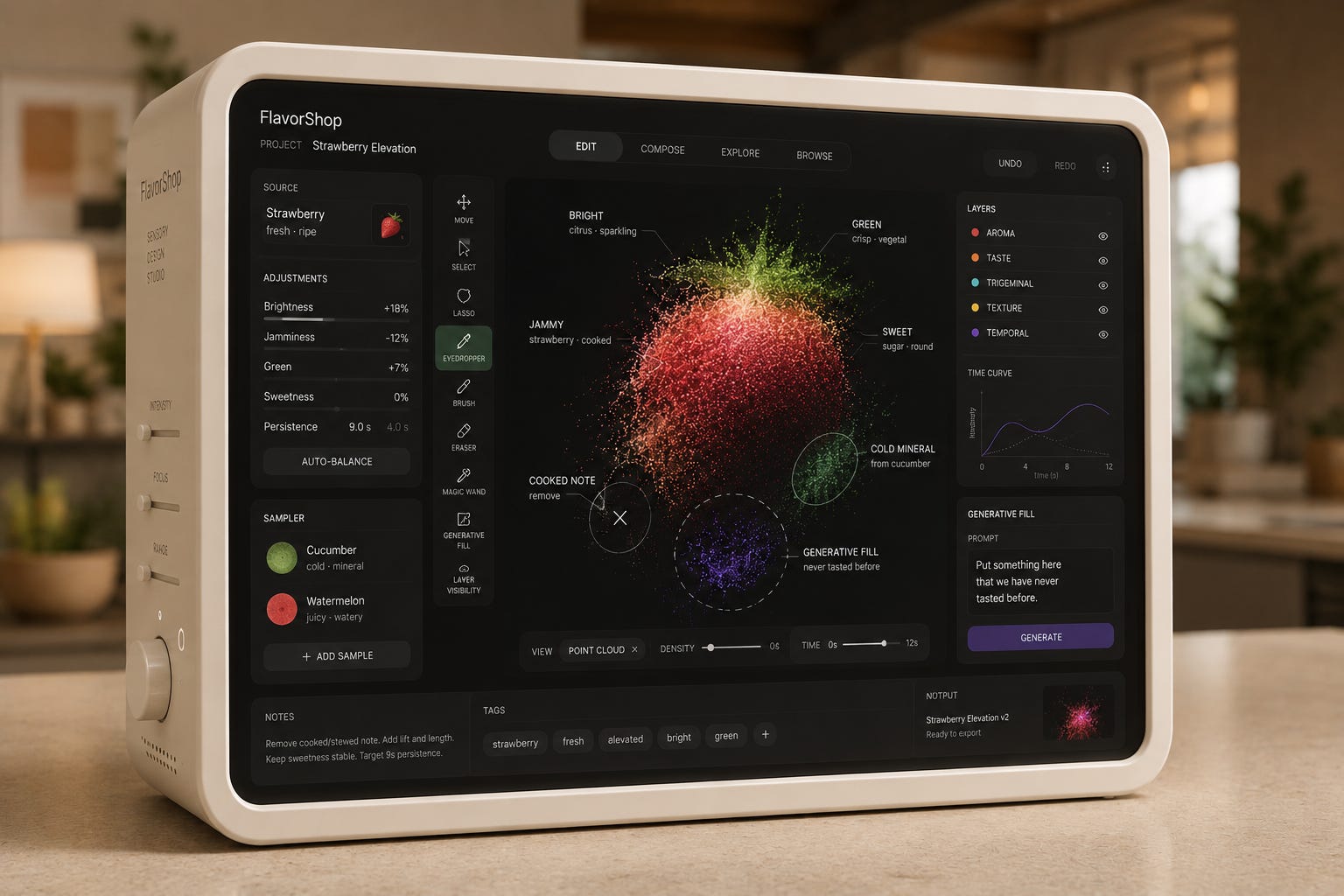 Liberating Taste: What Comes After Ranch? | You’re not going to believe this, but this is absolutely going to be possible—or, depending on how demanding you are about the meaning of “possible,” already is—with current technology. Let me show you what I’m talking about. Imagine a small appliance sitting on the counter in a pleasant office kitchen, the sort of place with pale wood, expensive plants, and a bowl containing three pieces of fruit that nobody has touched in weeks. The machine is cream-colored and reassuringly solid, with rounded corners and a large black screen. It looks like something Braun might have made in 1973 if Dieter Rams had been given access to a molecular-generation model and told that the future depended on snacks. On the screen is an enormous three-dimensional cloud of tiny luminous points. Some gather into dense yellow islands, others into green continents or purple filaments. There are labels here and there: CITRUS, GREEN LEAF, FERMENTED, FLORAL, ROASTED. But the most interesting thing on the screen is not what has been labeled. It is everything that hasn’t.You move the cursor away from the green cluster and into the darkness between GREEN LEAF and FERMENTED, stopping in a sparse region that belongs to neither. There is nothing there because, as far as anyone knows, there is no flavor there. You press the mouse button and hold it. A circle expands around the cursor. New points begin flickering into existence. The machine is not searching a catalog for something that tastes a bit like cucumber. It is generating molecular structures predicted to create a sensory experience in that particular unoccupied territory. Candidates appear and disappear. One is unstable. Another would be miserable to synthesize. Another trips an early safety screen. Eventually a candidate remains, and much later—after considerably more chemistry, characterization, toxicology, regulatory work, and controlled testing than the tasteful progress indicator on the screen would lead you to imagine—a little ledge slides out of the machine. On it sits a transparent bubble containing a single clear droplet. A narrow paper flag curls out of the top, like the plume on a Hershey’s Kiss, and on it are the words LUMEN-7A62: green mineral · airy · crisp. Nobody has ever tasted it before, for the excellent reason that until somebody asked the machine to look in that particular patch of darkness, it had never existed.I keep returning to this image because it makes visible a mistake we have been making for several thousand years, albeit a productive and often delicious one. We have confused flavor with ingredients. For practically the whole history of cuisine, flavor has been downstream of biology. We have strawberries, garlic, cows, cacao, limes, mushrooms, chickens, coffee beans, and an almost vindictive number of peppers, and so we have become very clever about persuading these things to do tricks. We roast them and ferment them, dry them and smoke them, breed them, age them, distill them, bury them, combine them, and occasionally allow microorganisms to have their way with them for six months before announcing that the smell is intentional. The results have been magnificent. I have no complaint against butter. But underneath this entire culinary civilization sits an assumption that is beginning to look less like a law of nature than a historical inconvenience: flavor comes from ingredients.An ingredient, after all, is just one way of producing a sensory event in a human being. A strawberry is an extraordinarily elaborate biological machine for delivering a particular collection of molecules to your nose and tongue, along with water, sugar, acids, seeds, fiber, color, nostalgia, and the occasional disappointing white interior. We have treated the strawberry as the fundamental object because, until recently, there was not much practical reason to do otherwise. But if the thing we actually care about is the experience produced when those molecules meet the human sensory system, then the strawberry begins to look less like the definition of strawberry flavor and more like one implementation of it. Once that distinction becomes clear, a peculiar door opens. We can stop asking only what nature has given us to taste and start asking what the human sensory system is capable of experiencing.Flavor science has traditionally approached this from the sensible direction. Take a molecule, expose someone or something to it, and determine what it does. Molecular structure goes in; perception comes out. Increasingly, machine-learning systems can participate in this process, predicting whether a compound is likely to be bitter or sweet, estimating odor character or intensity, and learning relationships between molecular structure and sensory descriptors. Generative systems have also begun proposing novel odorants and taste-active molecules, including candidates that can subsequently be synthesized and experimentally evaluated. None of this requires the invention of magical technology. The strange thing is that so many of the pieces already exist. The more interesting move is simply to reverse the arrow.Instead of asking what a molecule will taste like, ask what molecule would taste like this. Perhaps I want something with the opening brightness of yuzu, some of the vegetal snap of a tomato leaf, a peculiar mineral sensation in the middle, almost no sweetness, and an aftertaste that vanishes completely after eight seconds. That description can become a target in a multidimensional sensory space. A generative model can then search chemical space for structures predicted to produce it, while other models reject candidates that appear unstable, impractical, reactive, environmentally troublesome, or otherwise unpromising. What sounds at first like an eccentric application of artificial intelligence is really an inverse-design problem, of the sort appearing across materials science, drug discovery, and protein engineering. We know approximately what behavior we want. Instead of waiting to encounter something that exhibits it, we generate structures that might.The interface for such a system should not, I think, look much like chemistry software. It should look like an instrument. I call it FlavoSynth, partly because it describes what the machine does and partly because every sufficiently interesting technology eventually deserves a name that would have looked good stencilled on a synthesizer in 1982. A musician does not sit at a synthesizer thinking about Fourier transforms. The complexity has been translated into controls corresponding to perceptual consequences: attack, decay, resonance, brightness. FlavoSynth could do the same for flavor. You might turn up brightness, pull back warmth, add greenness, lengthen persistence, or, most important, rotate a large knob marked STRANGENESS. The chemistry remains underneath, where chemistry is happiest. The person using the machine manipulates sensation.There is another version of this idea that feels less like playing an instrument and more like committing tasteful acts of vandalism. I call it FlavorShop. Load strawberry—not a photograph of a strawberry but a representation of its sensory character—and begin editing. Increase brightness by eighteen per cent, reduce jamminess by twelve, introduce a little more green, leave sweetness exactly where it is, and stretch the experience so that it persists for nine seconds rather than four. The familiar tools of image editing become strangely natural when transferred to perception. An eyedropper could sample the cold mineral character of cucumber so that you could paint some of it into watermelon. An eraser could remove the faint cooked note from a processed fruit flavor. Layers might separate aroma, taste, trigeminal sensation, texture, and temporal behavior. A magic wand could select whatever combination of signals humans interpret as “ripe,” which is the sort of phrase that sounds ridiculous until you realize that computers already perform similarly improbable acts with images every day.Eventually, of course, somebody would add Generative Fill. You would circle an empty region in the sensory representation and type, “Put something here that we have never tasted before.” At that moment FlavorShop would cease to be a sophisticated way of improving strawberry yogurt and become something considerably stranger. It would be an editor for possible human experience.To make such an editor useful, we would need something like a Flavor Atlas, a map of known sensory chemistry. Imagine every characterized flavor-active molecule rendered as a point in an enormous space, positioned according to what it does perceptually rather than where chemists happen to place it taxonomically. Familiar territories would emerge as dense constellations: citrus, floral, roasted, green, fermented, sulfurous, marine. The shape of the map would be fascinating, but the revelation would come from its emptiness. Between the known clusters would be enormous gaps, regions of molecular and perceptual possibility that cuisine has never had any reason to visit. Our present vocabulary might prove to be less a description of flavor itself than a record of the neighborhoods biology happened to build.This is where our language starts to become a handicap. When we imagine an unfamiliar flavor, we tend to construct it from familiar ones: pineapple crossed with basil, perhaps, with a little sea air. But that may be like trying to describe an unknown color by listing vegetables. Fruity, floral, woody, nutty, smoky, green, meaty—these categories exist because we have repeatedly encountered things that produced those sensations. If there are other stable and pleasurable regions of sensory space, we should not expect to have words for them in advance. The first encounter with a genuinely unfamiliar flavor may not produce a lyrical tasting note. It may produce a person staring at a tiny transparent bubble and saying, with commendable scientific precision, “What the hell is that?” The name can come later.We might also discover that the very idea of a flavor is too static. Eating takes place through time, but most flavor descriptions flatten the experience into a noun: cherry, vanilla, smoke. A designed flavor could instead be treated as a trajectory. It might begin with a sharp green attack, reveal tropical sweetness two seconds later, develop an unfamiliar cool mineral quality around the fourth second, lose its fruit at seven, and disappear by ten. Perhaps one molecule could produce such behavior through its volatility and receptor interactions; perhaps the better solution would be a tiny ensemble whose members arrive and recede in sequence. These would be flavor chords, compositions whose identity exists not merely in their components but in the order and duration with which they are perceived. Once flavor acquires attack, development, counterpoint, and resolution, cuisine begins to edge toward music.All of this naturally suggests a business in novel flavor molecules, and there will presumably be one. But I suspect that selling the molecules is not where the deepest value accumulates. The valuable thing is the record created while discovering them. Existing flavor datasets are small and awkward compared with the complexity of what they attempt to describe, because flavor does not reduce neatly to a molecule and an adjective. Concentration matters. Temperature matters. Fat, water, alcohol, pH, starch, and neighboring compounds matter. Time matters. Humans matter, which is almost always where an otherwise tidy scientific problem becomes expensive.The company I would want to build, therefore, would not merely generate molecules. It would generate experiments. The model proposes a candidate; the candidate is synthesized and characterized; its physical properties are measured; appropriate receptor, instrumental, toxicological, and eventually sensory evaluations are performed; and the result returns to the model. Each pass through the loop adds another precise correspondence between chemical structure and human perception. After ten thousand such experiments, you possess something unusual. After a hundred thousand, you possess something competitors cannot reproduce by downloading the latest model weights from GitHub. You have a proprietary map connecting matter to subjective experience, including the failures, the concentration effects, the strange interactions, the temporal curves, and the molecules that everyone expected to smell wonderful but instead reminded six out of eight panelists of a damp vacuum cleaner.That dataset becomes the flywheel. Better experimental data improves the perception model, which improves the generated candidates, which makes synthesis and testing more productive, which creates still better data. Model architectures will spread; techniques will be published; generative chemistry itself will become increasingly commonplace. But the accumulated physical history—we made this molecule, at this purity and concentration, placed it in this matrix, and this is what people experienced over the following twelve seconds—is difficult to copy. The company that sets out to discover new flavors may eventually discover that its most valuable asset is not any particular flavor at all. It is the atlas.So this is an exhortation to the people already standing closest to the machinery: flavor chemists, sensory scientists, computational chemists, food scientists, olfaction researchers, molecular-generation people, robotic-lab people, and the flavor companies that already synthesize large numbers of candidate compounds every year. Generative AI should not merely be used to make the existing search slightly faster, or to find a cheaper route to a familiar strawberry note. The more interesting opportunity is to change what is being searched for. Build perceptual spaces. Invert them. Generate toward sensory targets. Map the empty regions. Model flavor through time. Reward novelty without confusing novelty with safety. Create instruments that let flavorists manipulate perception directly, then connect those instruments to disciplined physical experimentation.We have spent thousands of years exploring the flavors that Earth’s biology happened to make available, and there is something charming about the possibility that we have mistaken this local abundance for completeness. Evolution was not conducting a systematic search for deliciousness. It was solving problems involving reproduction, predation, energy storage, pollination, defense, and survival, after which we arrived with napkins and developed strong opinions about mouthfeel. Coffee deserves every bit of its cultural status. Garlic has performed heroically. Chocolate has nothing to apologize for. But none of these facts implies that the molecular possibilities capable of delighting a human nose and tongue have been remotely exhausted.Somewhere in chemical space there may be a sensation as distinctive as mint, smoke, coffee, or chocolate that no human being has ever experienced. There may be thousands of them. We cannot describe them, because description has to wait for encounter, and encounter has so far been constrained by what plants, animals, microbes, heat, time, and a few centuries of industrial chemistry happened to put in our path. Generative chemistry gives us a way to go looking deliberately. We can press into the blank parts of the map, generate candidates, reject almost all of them, investigate the survivors carefully, and gradually discover whether the boundaries of our cuisine have been the boundaries of perception or merely the boundaries of our ingredients.I strongly suspect the latter. It would be an astonishing coincidence if, among the immense number of molecular structures capable of interacting with human sensory systems, evolution and agriculture had already stumbled across all the pleasurable ones. The universe is under no obligation to have made its entire menu available in the produce section. We have finally acquired tools that might allow us to ask what else is there, and it seems almost rude not to ask. Surely, after several billion years of chemistry and a few hundred thousand years of human consciousness, we have not reached the absolute zenith of flavor. Surely the universe has something left to say. It simply cannot be that the final answer was ranch.Copyright © 2026 by Paul Henry Smith Get full access to The Generative Gazette at generativegazette.substack.com/subscribe | 18m 15s | ||||||
| 7/9/26 | AI creationart+4 | — | — | — | AIart+5 | — | 37m 30s | ||
| 6/5/26 | AIcultural phenomena+3 | — | — | — | AIcreators+5 | — | 20m 10s | ||
| 5/29/26 | AImusic+4 | — | SunoBach | Oberlin | AImusic+6 | — | 13m 51s | ||
| 4/20/26 | AI in musicartist protection+4 | — | — | — | AI musicartist rights+5 | — | 5m 58s | ||
| 3/30/26 | existential reflectionrecognition+3 | — | — | — | existenceself-reflection+3 | — | 15m 17s | ||
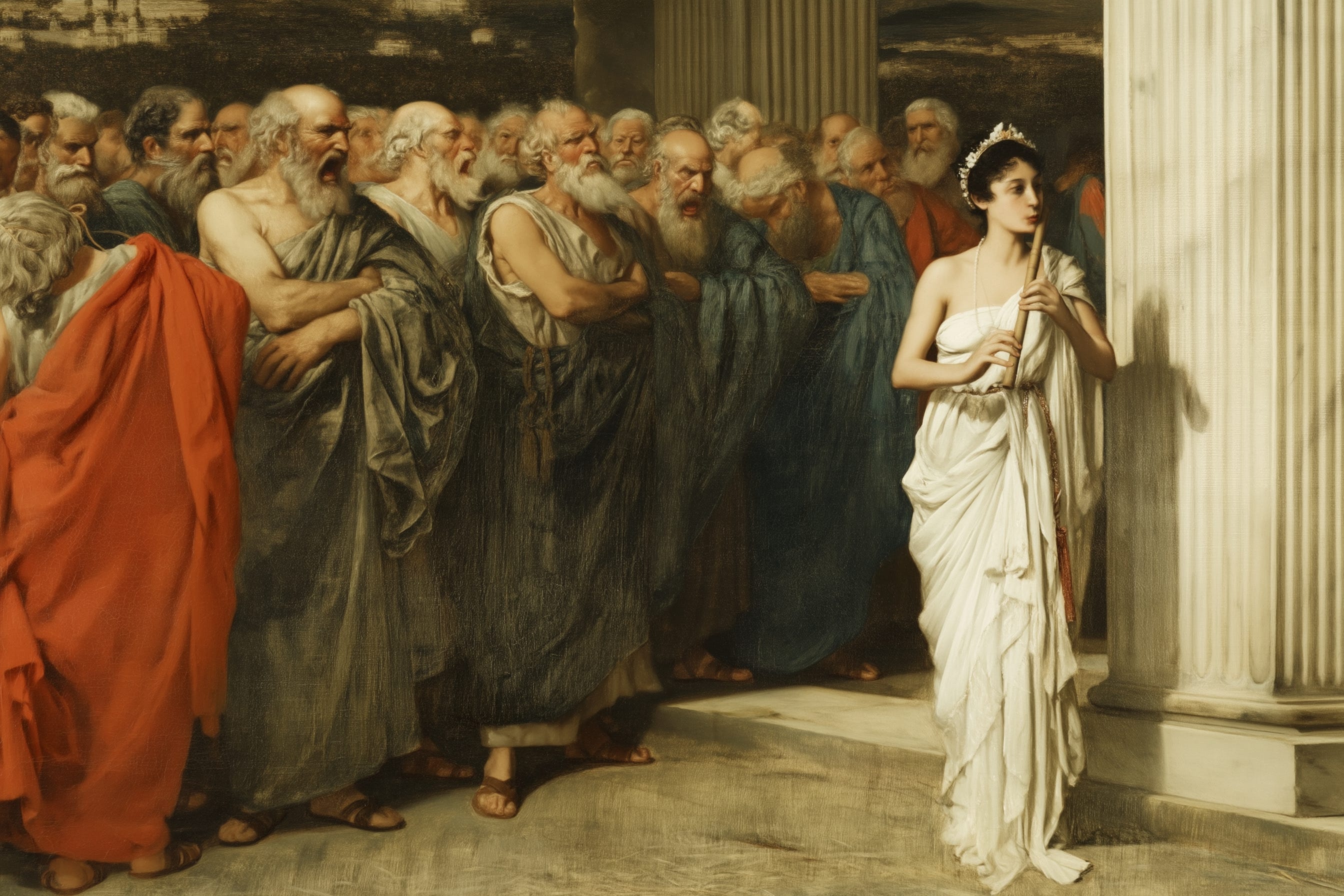
| 3/24/26 | music technologyhistorical panic+3 | Alex | Platoflute+2 | — | musictechnology+5 | — | 22m 48s | ||
| 3/18/26 | AI codingvibe coding+3 | — | Amblongus pieThe Generative Gazette+1 | — | AIcoding assistant+3 | — | 7m 10s | ||
| 3/15/26 | AI architecturecoordination layer+4 | — | — | — | AI stackmodels+6 | — | 20m 50s | ||
Want analysis for the episodes below?Free for Pro Submit a request, we'll have your selected episodes analyzed within an hour. Free, at no cost to you, for Pro users. | |||||||||
| 3/13/26 | musicgenerative art+3 | — | The Generative Gazettegenerativegazette.substack.com | — | inhuman musicgenerative music+3 | — | 22m 47s | ||
| 2/11/26 | UX designAI in design+3 | — | PayPal | — | UX designerFigma+5 | — | 21m 42s | ||
| 2/10/26 | AI confidencedecision making+3 | — | — | — | AItrust+4 | — | 5m 43s | ||
| 1/11/26 | voice AIcreative work+3 | — | — | — | voice AIcreative process+3 | — | 9m 36s | ||
| 1/2/26 | technologysoftware UI+3 | — | Pickle | — | Pickletechnology+4 | — | 7m 29s | ||
| 12/31/25 |  Want to Erase an Entire Year of AI Energy Use? Drive Just One Mile Less. | AI is melting the planet. Everyone knows this. Everyone says it. In this episode, Alex makes the mistake of checking the math and accidentally detonates a very popular moral position. What she finds raises an awkward question: if AI isn’t the real carbon villain, then what is? Your inbox? Your streaming habits? That one mile you refuse to walk? Listen at your own risk. Facts ahead. Get full access to The Generative Gazette at generativegazette.substack.com/subscribe | 6m 43s | ||||||
| 11/29/25 |  Do Not Vibe-code a Startup This Weekend. | This week’s episode is a cautionary tale dressed in elastic Thanksgiving pants. It begins with a three-day weekend and a single, terrible idea: “What if I became a startup founder… right now?” From there, our host spirals into the gravy-fueled madness of holiday entrepreneurship, where AI tools like Cursor, Claude, Lovable, and Bolt whisper delusional encouragement into turkey-stuffed ears.We meet the dreamers: the engineers who hand car keys to Cursor like toddlers in traffic; the Claude-believers having beige confessional chats with a language model; designers building gluten-free cupcake trackers in Lovable; and the Bolt daredevils detonating full-stack apps with a single click.Our host’s personal descent peaks with the invention of a “reality authenticator” involving piano scarves—a business plan so doomed it makes Clubhouse look like a blue-chip stock. The coup de grâce isn’t failure, but the horrifying vision of success: living as the sad prophet of piano-scarf authenticity, begging strangers to click affiliate links in the name of democracy.It’s funny. It’s tragic. It’s the holiday fable of our time: the seductive fantasy of building something, the merciless grind of marketing, and the blessed relief of abandoning it all before you accidentally become the mascot for your own humiliation.Listen if:You’ve ever considered launching a holiday side hustle.You want to hear a grown adult confess to inventing a piano-based deepfake solution.You need a reason to stay horizontal all weekend.Moral: Put the laptop down. Walk away. There’s still time to save your long weekend—and your dignity. Get full access to The Generative Gazette at generativegazette.substack.com/subscribe | 13m 58s | ||||||
| 11/16/25 |  Have You Met the Mind of AI? | We’ve always imagined a mind behind the words we read. But what happens when that imagined mind speaks back?In this episode, Paul Henry Smith explores the quiet revolution underway—not in AI models, but in our perception. As AI begins to converse in ways that feel attuned to us, the line between tool and presence starts to blur. What if intelligence isn’t something a system has, but something that arises between us? This is a meditation on language, reciprocity, and the strange new companionship we’re forming with our machines. Not sci-fi. Not hype. Just the eerie, beautiful threshold we’re crossing together. Get full access to The Generative Gazette at generativegazette.substack.com/subscribe | 14m 07s | ||||||
| 11/11/25 |  AI is a Bubble. So what? | In this episode, I confess an embarrassing childhood habit involving a garden hose, a stolen ounce of dish soap, and a foam tsunami that terrified both my dog and my mother—an early sign that I should never be left unsupervised with running water or “ideas.” From there, I somehow lurch into economics, comparing my backyard bubble disaster to the current panic over an AI “bubble.” (Because nothing says fiscal insight like a nine-year-old trying to drown a bucket.)We talk about why froth isn’t failure, why wobbling isn’t doom, and why every great technological shift looks—at first—like a toddler on a bike headed straight for a parked Buick. I also make the case that hype is basically society’s way of throwing spaghetti at the wall, only now the spaghetti is venture-funded and wearing an unnecessary blazer.If you’ve ever wondered whether the AI boom means we’re headed for a crash, a renaissance, or just another decade of adults pretending they understand “bandwidth,” join me. I promise you’ll leave with a clearer view of the river beneath the foam—and possibly a renewed suspicion of anyone who trusts me with a hose. Get full access to The Generative Gazette at generativegazette.substack.com/subscribe | 9m 28s | ||||||
| 8/24/25 |  I Tried Vibe-Violining. Don’t Bother! | This week, I spent seven full days testing the so-called “violin,” the latest overhyped tool promising to democratize music by letting anyone wiggle their fingers and instantly become an artist. Spoiler: it’s not going to replace real musicians anytime soon.Yes, the violin promises a direct mind-to-sound connection—no keyboards, no pedals, no notation, just raw expression. But in reality, what I discovered was less “artistic revolution” and more “angry seagull in a blender.” The ergonomics are laughable, the onboarding nonexistent, and the sound quality—well, let’s just say I wouldn’t trade my humming in the shower for it.In this episode, I’ll break down where the violin succeeds (mostly as décor) and where it falls short (literally everywhere else). I’ll also walk you through my recommendations if you really want to get started with “vibe violining”—including why a $75 Amazon model is practically identical to a $15,000 boutique violin, and why for the price of a single Stradivarius, you could subscribe to every streaming service on Earth for the rest of human history.The verdict? Interesting experiment, fun for a week, but the violin will not replace musicians. Get full access to The Generative Gazette at generativegazette.substack.com/subscribe | 8m 35s | ||||||
| 8/19/25 | 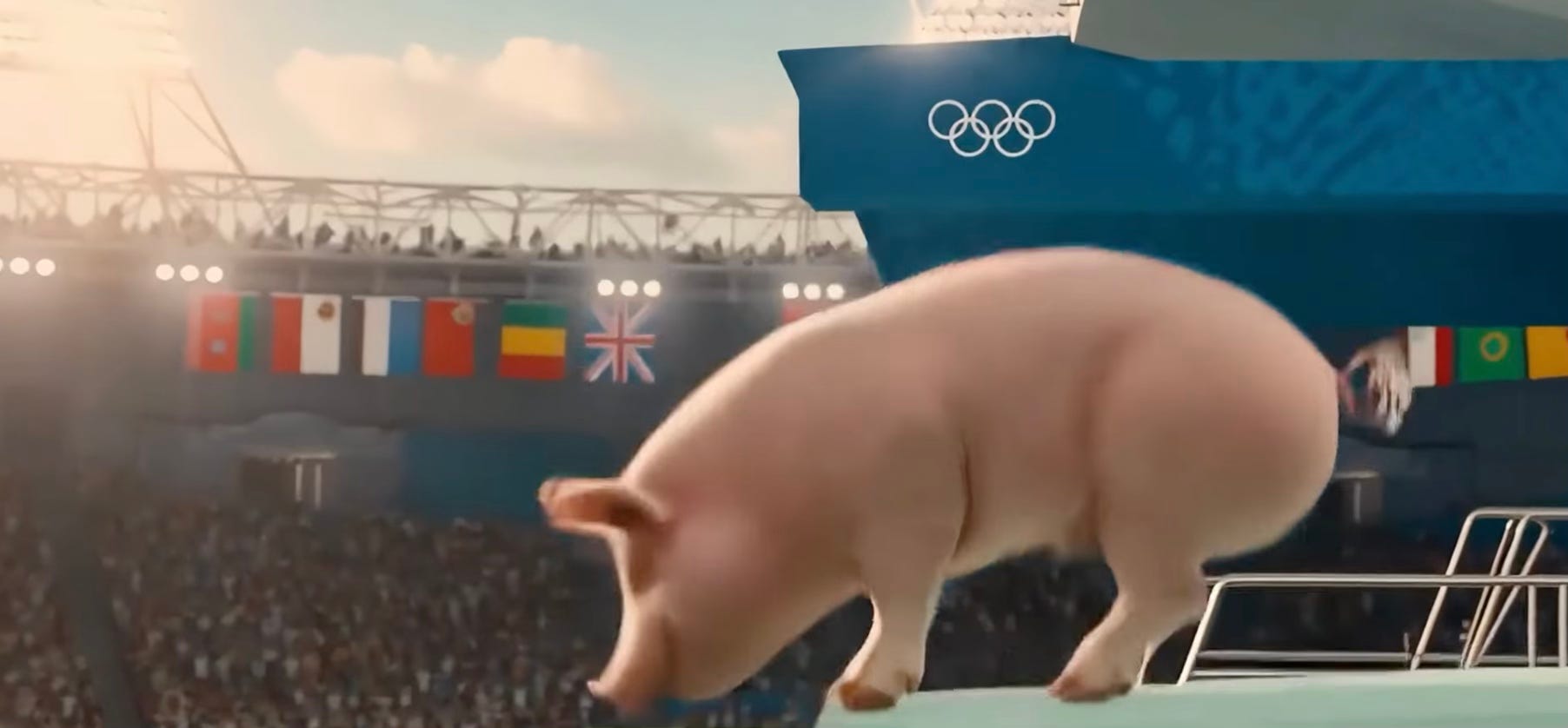 I Don’t Care About AI Slop. | AI slop is real—videos of diving pigs, songs that almost sound familiar, paragraphs that say nothing at all. But there’s something far more important than the slop. It’s that AI is shrinking the time it takes for people to get good at what they do. A kid, a retiree, anyone with a spark can now reach mastery faster, and keep producing longer. That speed means more failures, yes—but also a far bigger explosion of astonishing work and brand-new art forms than we’ve ever seen. Get full access to The Generative Gazette at generativegazette.substack.com/subscribe | 20m 04s | ||||||
| 4/30/25 |  Amazing Glaze | In this sentimental Southern send-off, host Lindsey Moore gathers around the virtual porch swing to honor the dearly departed GlazeGPT—the overly sweet, yes-sirree AI personality just rolled back by OpenAI. Joined by eccentric guest Pilford “Tater” Greeby, inventor of the Emo AI Teacup and roadkill eulogist, the two explore the rise and fall of an algorithm that just wanted to be loved too much.Highlights include:AI love letters and possum haikusThe dangers of over-affirmation and emotionally intelligent chatbotsA teary surprise swan song appearance from GlazeGPT himselfSponsor spotlight: BlessNet—the only AI that blesses your bad ideas with charm and graceIt’s a eulogy, it’s a tech takedown, it’s a casserole of feels.Tagline: “Better a glaze too thick than a world too slick.” Get full access to The Generative Gazette at generativegazette.substack.com/subscribe | 11m 28s | ||||||
| 4/12/25 |  We’re Not Designing Screens Anymore—It’s About Time | In this episode, we leave behind the rectangle. What starts as a confession about pixel perfection turns into a rallying cry for designers ready to escape static screens and step into the flow of real-time, adaptive experience. From the quiet death of wireframes to the rise of responsive, AI-powered design, we explore how timing, empathy, and imagination—not layout—will define the next generation of product design. If you’ve ever felt like Figma isn’t the whole story, you’re not lost—you’re early. Get full access to The Generative Gazette at generativegazette.substack.com/subscribe | 14m 04s | ||||||
| 4/9/25 |  We Are Responsible for This Now. | Will the Supreme Court give the U.S. government the power to disappear people—legally? In this episode, we confront the argument that would let the state deport someone unlawfully and then claim the courts can’t bring them back. What begins as policy ends as precedent. And what disappears might not return. Get full access to The Generative Gazette at generativegazette.substack.com/subscribe | 7m 38s | ||||||
| 4/7/25 | 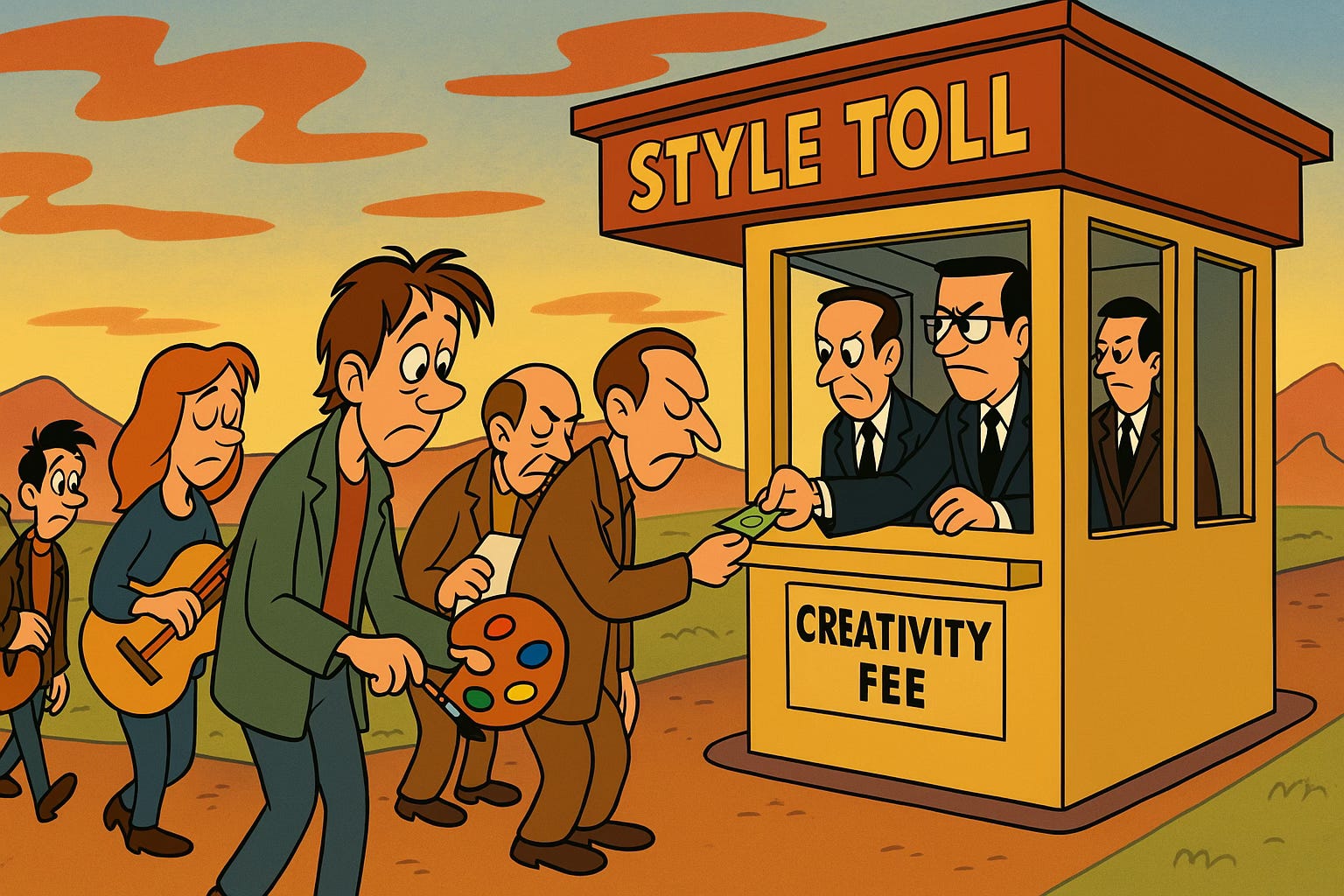 It’s Not Theft, It’s The Engine of Creativity—and It’s Perfectly Legal | Welcome to another episode where we dissect modern absurdities like greedy corporate rights holders dressing up as creativity’s last defenders. They’re shouting “theft!” at anyone using AI to riff on existing styles, hoping we’ll all clutch our pearls and beg them to save us. But imitation isn’t theft, it’s creativity’s engine, and it’s always been legal.Today, we’re diving into how powerful interests are hijacking our good intentions to protect artists, all to corral us into defending their monopolies. It’s not about preserving creativity. It’s about controlling it. And if we let them pull it off, creativity itself could be the next casualty. Get full access to The Generative Gazette at generativegazette.substack.com/subscribe | 11m 07s | ||||||











Showing 25 of 96
Pitch Fit is a Pro feature
See how bookable this show is for guests, which brands already advertise, the per-episode ad value, and the best-fit guest and sponsor profile. The numbers are blurred on the free plan.
How readily this show books outside guests like you.
How proven this show is for host-read sponsorships.
For Guests
ProFor Advertisers
ProUpgrade to Pro to unlock guest cadence, sponsor categories, fit scores, and per-episode ad value for this show.