Insights from recent episode analysis
Audience Interest
Podcast Focus
Publishing Consistency
Platform Reach
Insights are generated by CastFox AI using publicly available data, episode content, and proprietary models.
Total monthly reach
Estimated from 2 chart positions in 2 markets.
By chart position
- 🇺🇸US · Technology#12300K to 1M
- 🇩🇪DE · Technology#26100K to 300K
- Per-Episode Audience
Est. listeners per new episode within ~30 days
200K to 650K🎙 ~2x weekly·44 episodes·Last published 2w ago - Monthly Reach
Unique listeners across all episodes (30 days)
400K to 1.3M🇺🇸77%🇩🇪23% - Active Followers
Loyal subscribers who consistently listen
120K to 390K
Market Insights
Platform Distribution
Reach across major podcast platforms, updated hourly
Total Followers
—
Total Plays
—
Total Reviews
—
* Data sourced directly from platform APIs and aggregated hourly across all major podcast directories.
On the show
Recent episodes
EP 52: Shadow AI: Why $10.3M is Costing Your Organization More Than You Know
Jul 14, 2026
44m 46s
EP 51: AI-Native Software Development: Building Production Systems with Multi-Agent AI
Jun 21, 2026
36m 18s
EP 50: AI & Cybersecurity: Building Agentic AI for Real-World Threat Detection
Jun 10, 2026
44m 30s
EP 49: How to Spot the Next Healthcare AI Fraud Before It Happens
May 25, 2026
51m 30s
EP 48: AI Transforms Soccer: Premier League Analytics Revolution
Apr 30, 2026
14m 39s
Social Links & Contact
Official channels & resources
Official Website
Login
RSS Feed
Login
| Date | Episode | Description | Length | ||||||
|---|---|---|---|---|---|---|---|---|---|
| 7/14/26 | 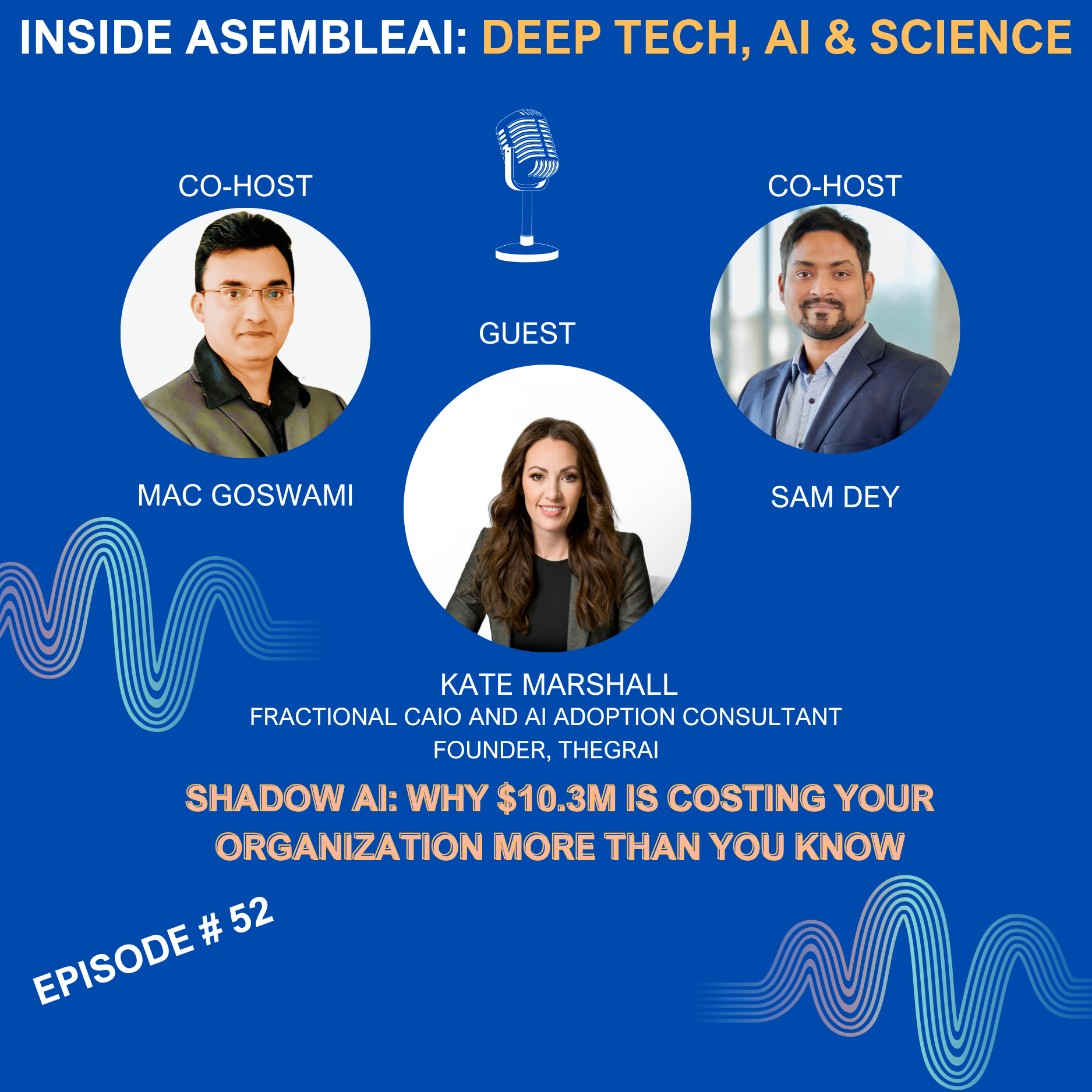 EP 52: Shadow AI: Why $10.3M is Costing Your Organization More Than You Know | Shadow AI is costing organizations $10.3 million a year—more than malicious insider threats combined. Employees are using AI tools nobody approved, on data nobody's tracking, and most leadership teams have no idea it's happening at this scale. Banning AI doesn't work. You can't solve this with another policy PDF nobody reads. You need real behavioral change. In this episode, hosts Sam Dey and Mac Goswami sit down with Kate Marshall-founder of TheGrai and author of AI at Work—to expose why most enterprise AI rollouts fail at the most critical layer: getting people to actually adopt and stick with new tools and processes. What You'll Learn: 🔹 The $10.3M Shadow AI Problem — What that number actually represents and why banning AI just drives it underground 🔹 The Maturity Model Trap — Why organizations get stuck between Level 1 (Awareness) and Level 2 (Shadow AI), with leadership presenting vendor demos while employees silently use unapproved tools 🔹 Why Generic Training Fails — The fatal flaw of all-hands lunch-and-learn sessions and what role-specific, sticky AI training actually looks like in practice 🔹 The Habit Layer™ Framework — Kate's proprietary methodology for turning one-time training into lasting behavior change 🔹 Data Hygiene as the Foundation — Why cleaning up your downloads folder, emails, and redundant files is where AI transformation actually begins 🔹 The Book: AI at Work — Why Kate wrote a 3-chapter workbook for non-technical professionals instead of another theory-heavy guide Kate's Closing Insight: "Adoption is not a training day. It's a habit. You have to give employees not just access to tools, but time, space, and role-specific guidance to actually learn how to use them." Key Takeaway: The gap between knowing about AI and actually using it effectively is the difference between organizations that transform and those that waste millions on failed pilots. Connect with Kate Marshall: Website: katemarshall.ai LinkedIn: https://www.linkedin.com/in/kate-b-marshall/ Book: AI at Work Subscribe: Spotify | Apple Podcasts | Amazon Music | iHeart Radio | YouTube #ShadowAI #AIAdoption #HabitLayer #AIatWork #ChangeManagement #EnterpriseAI #AsembleAI | 44m 46s | ||||||
| 6/21/26 | 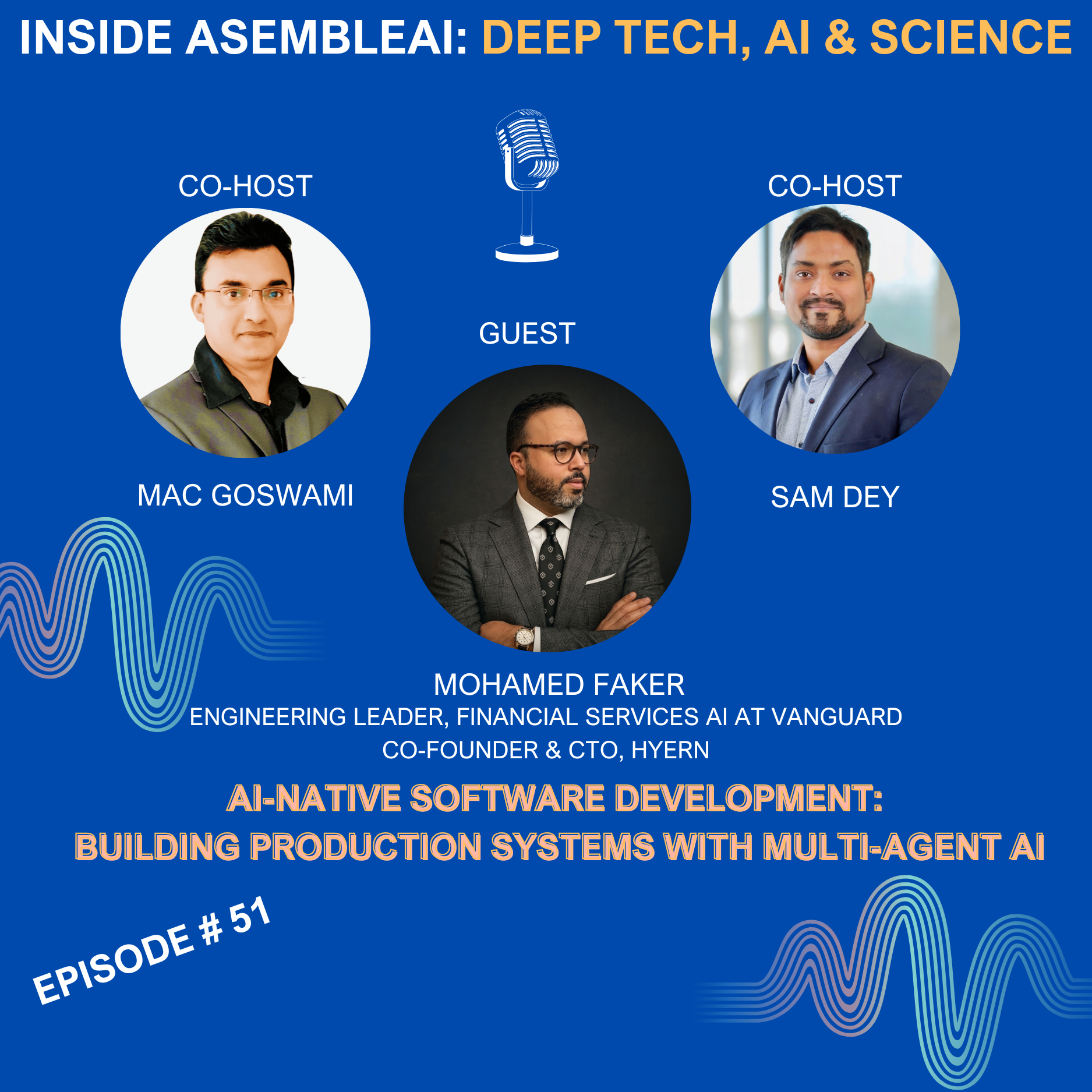 EP 51: AI-Native Software Development: Building Production Systems with Multi-Agent AI | "AI native software development" gets thrown around everywhere right now—and almost nobody can define it clearly. Not a chatbot bolted on. Not Copilot autocomplete. We mean production-grade systems where AI agents write, orchestrate, and ship the work end-to-end. In this episode, hosts Sam Dave and Mac Goswami sit down with Mohamed Faker, Engineering Leader, Financial Services AI at Vanguard Group and co-founder/CTO of Hirin, a fractional leadership hiring platform built almost entirely by orchestrating specialized AI agents. Key Insights: What AI-Native Actually Means — Every line of code in Hirin was AI-produced. Mohamed's role: architect, decision-maker, final say on direction—not the one typing code. From Solo Orchestrator to Manager of Agents — How he evolved from manually prompting individual AI chats (architect, UX expert, engineer) to building agent hierarchies with sub-agents and dedicated "audit" agents reporting directly to him. Where Agents Fail — Spotting when an agent burns tokens without progress, takes conversations sideways, or simply isn't suited to the task—and knowing when to stop. Validation at Scale — Building internal "audit department" agents that verify other agents did exactly what was asked, nothing more, nothing less. Product Management Is the New Core Skill — Knowing how to break down features, prioritize by dependency and complexity, matters more than knowing how to code. Biggest AI Adoption Mistakes — Rushing to adopt AI without defining real ROI, plus strategies that fail because the workforce isn't trained or willing to execute them. Human-AI Collaboration — Why the human must always stay in the loop as critical thinker and decision-maker, even as the agent-to-human ratio shifts dramatically. The Horse-and-Carriage Analogy — Entire industries can disappear in 15 years, but the people who adapted earned more by managing the new technology rather than resisting it. Mohamed's takeaway: "The future is you managing a subset of AI agents. Think about it-you're going to have multiple versions of yourself working together." Connect with Mohamed Faker: https://www.linkedin.com/in/mohamed-faker/ Check out Hyern: https://hyern.com/ Subscribe: Spotify | Apple Podcasts | Amazon Music | iHeart Radio | YouTube #AINative #MultiAgentAI #SoftwareDevelopment #AIAdoption #ProductManagement #AsembleAI | 36m 18s | ||||||
| 6/10/26 | 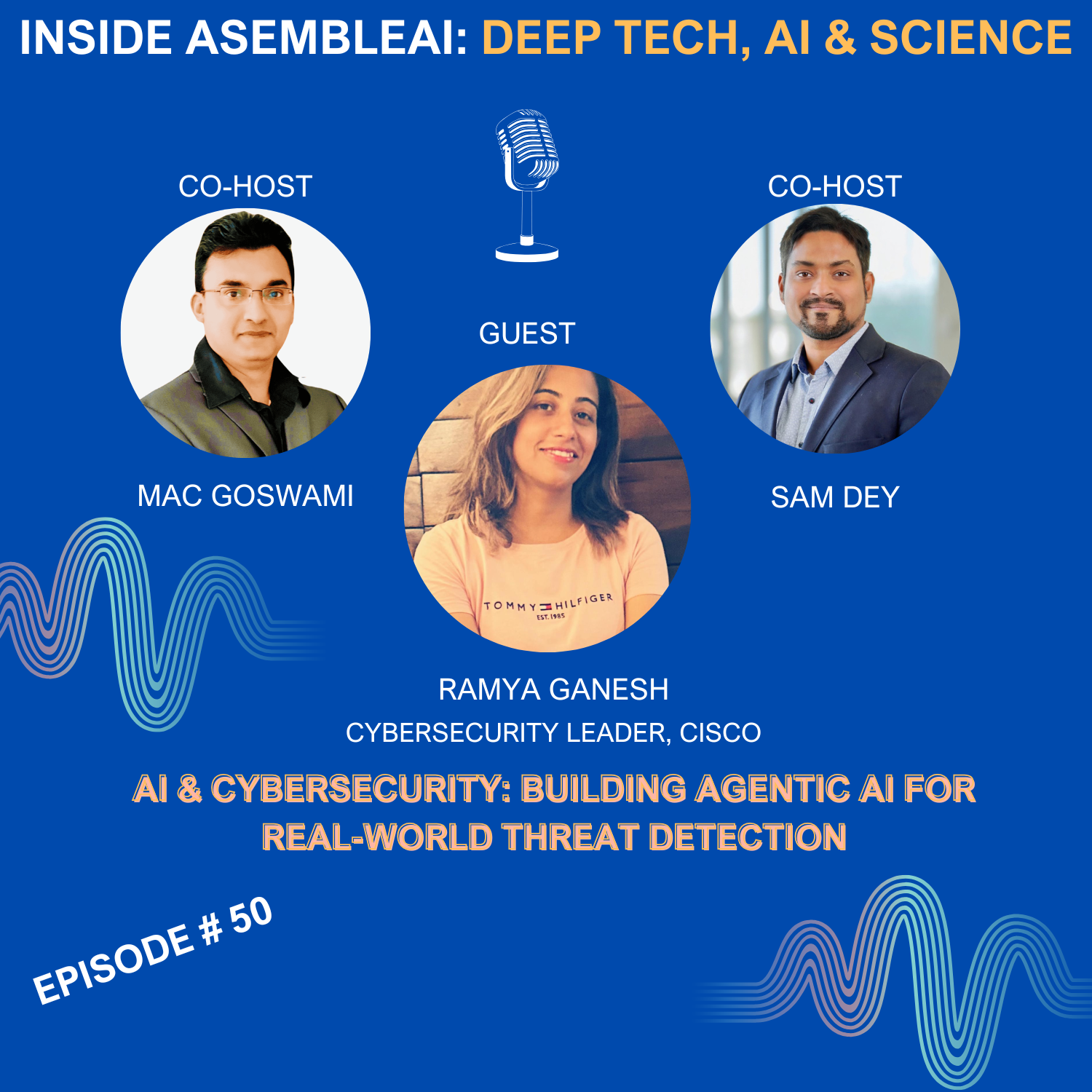 EP 50: AI & Cybersecurity: Building Agentic AI for Real-World Threat Detection | 97% false positives. Millions of alerts daily. Security tools that can't keep up. The threat landscape has outpaced traditional security operations—and Agentic AI is the answer. In this episode, hosts Mac Goswami and Sam Dey sit down with Ramya Ganesh, Top 50 Women Cybersecurity Leads in the US and AI leader at Cisco, to break down how autonomous AI agents are transforming cybersecurity from detection to response. Key Insights: Multi-Agent Systems Beat Single Models — Like a hospital with specialists, multiple focused agents outperform one generalist AI. Modular, scalable, explainable, resilient. The Future SOC — Not humans vs. AI, but humans supervising teams of AI agents handling continuous telemetry while analysts focus on strategic decisions. Agentic AI vs. AI-Assisted Tools — Speed, autonomy, and cross-system correlation distinguish today's agentic platforms from yesterday's alert dashboards. POC to Production — Most AI initiatives fail because they start with technology, not business problems. Success requires measurable metrics and governance discipline before deployment. For Women in Tech — Stay curious, experiment, share what you build publicly. Imposter syndrome is real but community and visibility accelerate growth. Ramya's takeaway: "The companies seeing the greatest AI success aren't those with the most advanced models—they're the ones with the strongest discipline around AI adoption." Connect with Ramya: https://www.linkedin.com/in/ramya-ganesh-082bb231/ Subscribe: Spotify | Apple Podcasts | Amazon Music | iHeart Radio | YouTube | Substack #AgenticAI #Cybersecurity #WomenInTech #SOC #AsembleAI | 44m 30s | ||||||
| 5/25/26 | 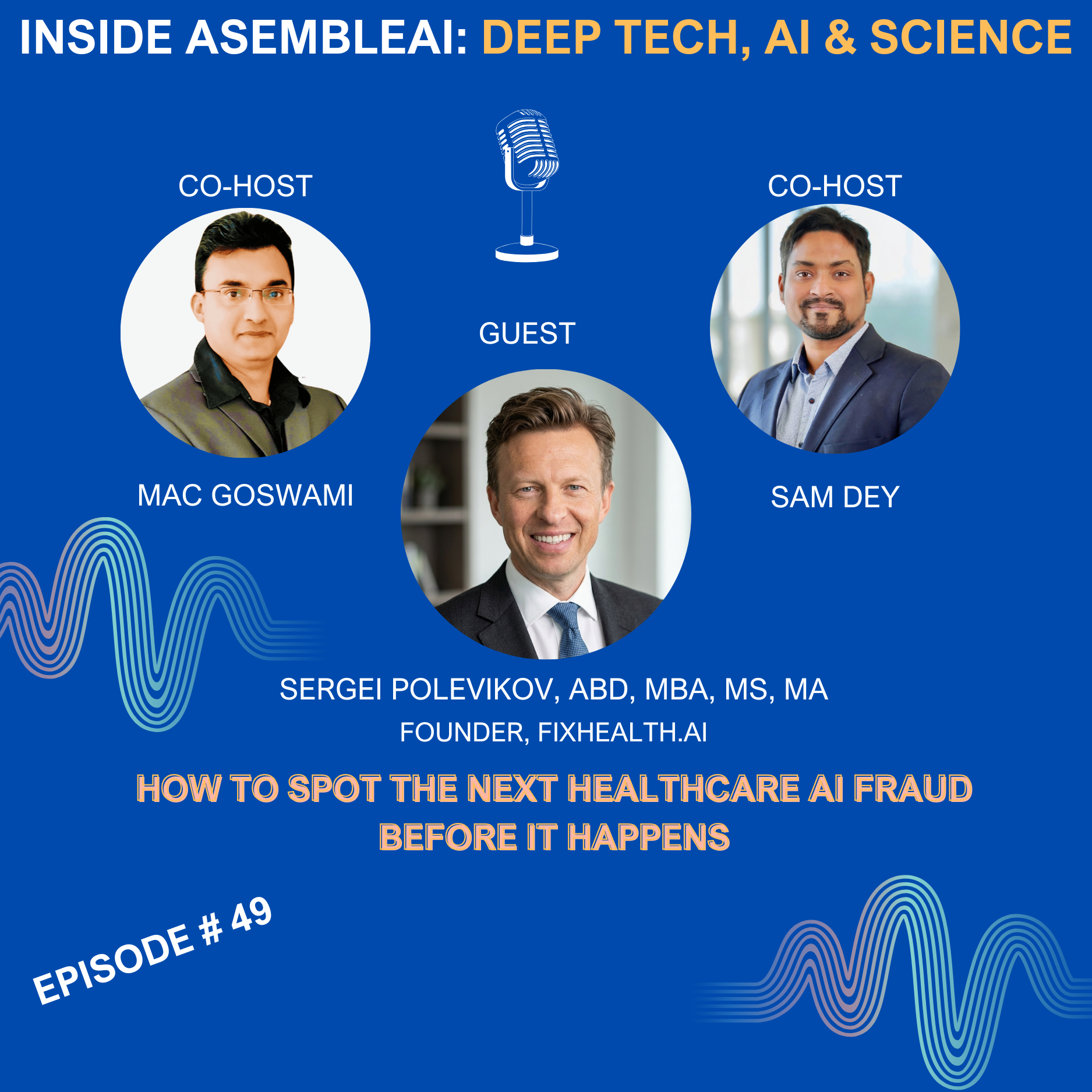 EP 49: How to Spot the Next Healthcare AI Fraud Before It Happens | What does it take to call out billion-dollar healthcare AI companies when the system is rigged against whistleblowers? In this episode of Inside Assemble AI, hosts Sam Day and Mac welcome Sergei Polevikov, PhD-trained data scientist, AI entrepreneur, author of the widely-read Substack newsletter AI Health Uncut, and co-host of Digital Health Inside Out. Sergei has spent years investigating irregularities in healthcare AI, from inflated product claims and misleading adoption reports to the structural VC incentives that allow fraud to fester. This is one of our most candid conversations yet — covering the 10 patterns that predict healthcare AI failure, why the real AI adoption rate in healthcare is nowhere near what industry reports claim, and why human-in-the-loop remains an essential safeguard regardless of how capable foundation models become. TOPICS COVERED: → How Sergei went from healthcare AI founder (WellAI / Chart2Chart) to fraud investigator — and why transparency, not scandal, drives his mission. → His 10 healthcare tech failure patterns, including: the Chinese wall between management and teams, investors-as-customers conflicts of interest, smoke-and-mirrors technology, champagne-and-cocaine financial mismanagement, toxic code of silence, founder extortion, and celebrity protection schemes. → Why surveys from firms like Menlo Ventures and McKinsey dramatically overstate AI adoption — and what US Census Bureau data covering 30,000+ smaller healthcare organisations actually shows. → The structural reason why incumbents like Epic, Optum, and Cigna are disincentivised to build genuinely innovative AI products — and why startups like Abridge are winning despite the odds. → What's genuinely working in healthcare AI right now: AI scribes (done well), drug discovery, genomics, and protein structure modelling. → His advice for founders entering the healthcare or pharma space: protect your mission when VC money arrives, read every clause in your operating agreement, and choose partners who care about patients — not just their LPs. RESOURCES & LINKS: 1. "AI Health Uncut" Substack: FixHealth.ai 2. Advancing AI in Healthcare: A Comprehensive Review of Best Practices: https://www.sciencedirect.com/science/article/abs/pii/S0009898123003212 3. "Digital Health Inside Out" podcast: https://www.youtube.com/@DigitalHealthInsideOut CONNECT WITH ASSEMBLE AI: Subscribe on Apple Podcasts, Spotify, iHeartRadio, and Amazon Music. Follow our YouTube channel and Substack newsletter for more deep dives into AI's real impact across industries. Have a topic you'd like us to explore? Reach out — we welcome new voices and fresh perspectives. Keywords: healthcare AI, AI fraud, digital health, VC pump and dump, Babylon Health, Olive AI, Theranos patterns, AI scribes, Epic health, healthcare startup, AI adoption, human in the loop, AI compliance, healthcare innovation | 51m 30s | ||||||
| 4/30/26 |  EP 48: AI Transforms Soccer: Premier League Analytics Revolution | 68.5 billion euros in EPL betting annually. 1.4 million data points per match. Soccer sits at the absolute center of the AI revolution, and it's transforming the world's most popular sport from officiating to tactical analysis. In Episode 2 of our "AI in Sports Analytics" series, hosts Sam Dave and Mac Goswami explore how AI fundamentally changed soccer from 2020-2025. Revolutionary Technology: Semi-Automated Offside Detection (EPL 2024-25): Calibrated cameras + AI algorithms measure player positions with centimeter-level precision. Pioneered at 2022 Qatar World Cup, now standard across elite leagues. Processes data faster than humans, eliminating decades of controversial calls. Player Tracking: Optical systems track each player 25x/second, detecting invisible tactical patterns. Game-changer: Standard TV footage now generates tracking data previously requiring expensive dedicated cameras. Smaller-budget teams access insights once reserved for Barcelona, Manchester City, Bayern Munich. Match Prediction: 69-78% accuracy with ensemble models. Challenge: Soccer is harder to predict than basketball/baseball due to lower scoring and higher randomness. One lucky deflection can decide a match despite dominating possession. Real-World Impact: Tactical Analysis (March 2025 study): Real-time computer vision tracks all players, ball, formations simultaneously. Coaches see which tactical adjustments opponents made in the 67th minute three weeks ago and how they affected passing networks. Large Events Model (2024): Deep learning framework simulates games from any state. Test tactical approaches against AI-simulated opponents before stepping onto the pitch. Economic Impact: Sports analytics market: $1.03B (2024) → $2.61B (2030). AI-powered betting analytics provide sophisticated predictions. The Reality: AI reveals tactical sophistication fans never saw. That perfect through ball required reading three defenders' positioning, understanding striker's running profile, executing with millimeter precision. AI helps us see genius, not replace it. Subscribe: Spotify | Apple Podcasts | Amazon Music | iHeart Radio | YouTube Next: Baseball AI revolution #SoccerAnalytics #AIFootball #EPL #SportsAnalytics #AsembleAI | 14m 39s | ||||||
| 4/29/26 |  EP 47: AI Revolutionizes Basketball: NBA Analytics 2020-2025 | 1.4 million data points per game. NBA teams now track every player movement, defensive rotation, and shot attempt with AI-powered analytics—and it's transforming professional basketball in real-time. In this first episode of our "AI in Sports Analytics" series, hosts Sam Dey and Mac Goswami explore how the NBA and WNBA embraced AI more aggressively than any other league. Game-Changing Technology: SportVU Tracking System captures 29 data points per player, tracking all 22 players 10x/second and the ball 25x/second. Second Spectrum uses computer vision to extract data directly from broadcast video—no specialized cameras needed. NBA-AWS Partnership (Oct 2025): "Inside the Game" platform turns billions of data points into compelling insights, introducing AI-powered stats measuring performance never quantified before. Game Prediction: 87% accuracy with ensemble machine learning models (up from 65-70% five years ago). Models now weight three-point efficiency and spacing metrics heavily since the game evolved post-2015. Real-World Impact: Boston Celtics (2024-25): AI models refined defensive schemes using spatiotemporal data, contributing directly to playoff success. Golden State Warriors: Physical AI robots assist practice—rebounding, passing drills, simulating defensive plays. Steph Curry: "Robots provide consistent data-driven feedback humans can't match." Philadelphia 76ers: Large language models now participate as "a vote in any decision"—draft picks to game strategies. Broadcast Revolution: AWS Play Finder analyzes thousands of games, retrieving similar plays in milliseconds. Expected Field Goal models account for defender positioning, pressure, fatigue—not just distance. The Reality: AI predicts trends exceptionally well, but human elements—leadership, clutch performance, chemistry—resist quantification. 87% accuracy doesn't eliminate competitive balance when base-level data is universally available. Subscribe: Spotify | Apple Podcasts | Amazon Music | iHeart Radio | YouTube Next: Soccer/Football AI revolution #NBAnalytics #AIBasketball #SportsAnalytics #NBAtech #AsembleAI | 16m 37s | ||||||
| 4/28/26 |  EP 46: New Collar Jobs: Emerging Roles That Only Exist Because of AI | 143% growth for AI Engineers. 136% for Prompt Engineers. 135% for AI Content Creators. These aren't niches—they're fundamental new careers that couldn't exist before AI. In this final "Who Survives the AI Shift" episode, Sam Dey and Mac Goswami reveal 16 brand-new job titles from 2025: Knowledge Architect, Orchestration Engineer, Conversation Designer, Human-AI Collaboration Leader. Top Emerging Roles: Prompt Engineer ($123K avg, top $200K+) - Building systematic AI outputs at scale. 40% fewer hallucinations, 60% better brand alignment. AI Model Trainer - Fine-tune algorithms. Requires technical skills + deep industry knowledge. AI Ethics Officer & Safety Analyst - Critical for governance in regulated industries. Assess biases, develop risk protocols. Data Curator - Most accessible entry point. Domain expertise matters more than degrees. Conversation Designer/NLP Engineer - Build chatbots, virtual assistants, translation systems. AI Product Manager - Bridge technology and business with deep AI understanding. AI Program/Project Manager - Handle AI implementation, operations, budgets. Huge growth projected. Where Jobs Are: Big Tech (Google, Microsoft, Amazon), AI-Native (OpenAI, Anthropic), Traditional Enterprises (JPMorgan, hospitals, retail) The Reality: New collar jobs exist at AI capability + human necessity intersection. Better AI needs MORE human oversight, not less. Consulting and freelancing booming—work that took days now takes hours. The future belongs to those treating AI as collaborative tool, not competitive threat. Subscribe: Spotify | Apple Podcasts | Amazon Music | iHeart Radio | YouTube | Podbean #AIJobs #PromptEngineer #FutureOfWork #AsembleAI | 19m 54s | ||||||
| 4/22/26 |  EP 45: Reskill or Perish? How to Future-Proof Your Career Against AI | Inside AsembleAI | 50% of employees need reskilling by 2026-RIGHT NOW. Are you ready, or already falling behind? In this critical episode of "Who Survives the AI Shift," hosts Sam Dave and Mac Goswami expose the brutal reality: only 49% of employees feel equipped for their roles (down from 59% in 2024). Gen Z confidence crashed 20 points to 39%. The gap between awareness and action is where careers die. Key Takeaways: The Training Disconnect: 37% of employers claim they offer reskilling programs Only 28% of employees confirm these exist Companies check boxes without ensuring actual completion Skills That Matter for 2030: AI & big data, cybersecurity, technological literacy Creative thinking, resilience, curiosity Winning combo: Technical fluency + human capabilities AI can't replicate Subscribe: Spotify | Apple Podcasts | Amazon Music | iHeart Radio | YouTube | Podbean #Reskilling #AICareer #FutureProof #Upskilling #DataLiteracy #LifelongLearning #AsembleAI | 20m 12s | ||||||
| 4/12/26 | 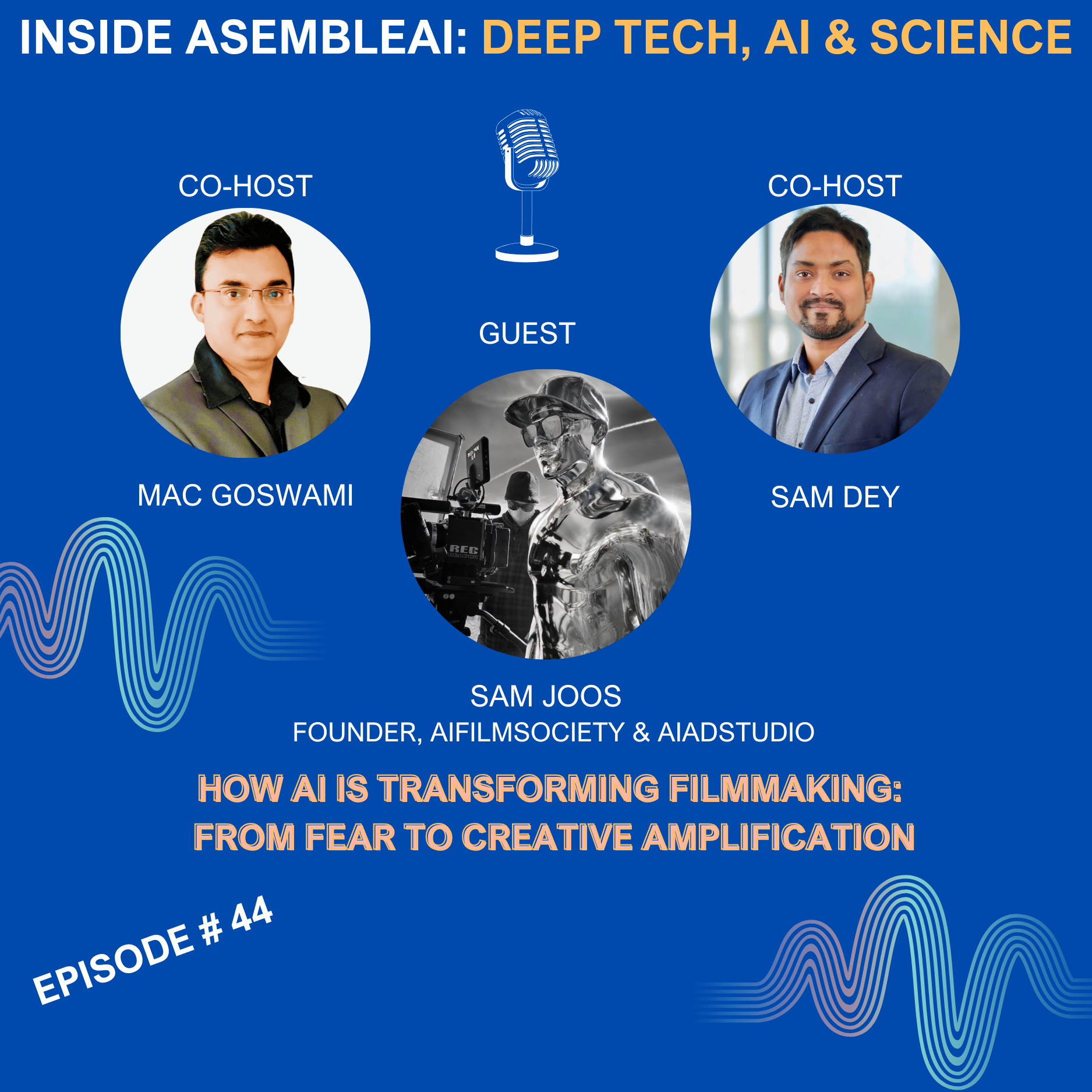 EP 44: How AI Is Transforming Filmmaking - From Fear to Creative Amplification | Can AI amplify filmmaking creativity without killing the craft? Season 4 guest Sam Joos—20-year filmmaker, founder of AI Ad Studio and AI Film Society - shows how generative AI is transforming commercial production from $500K budgets to bedroom studios. Key Insights: The Breakthrough Moment: "Once I started prompting AI like I'd talk to a crew member on set, the cheat code unlocked." Sam went from AI skeptic to teaching 50+ filmmakers how to adapt. The Economics Shift: Traditional commercials: $30K-$500K, 2-6 month turnarounds AI-powered: Shoot "London scenes" from home, deliver in 1-2 weeks Reality check: "It's not an easy button—taste and expertise still determine quality" Quality vs. "AI Slop": What separates great AI work? Traditional filmmaking fundamentals-lighting, framing, camera movement, lens choice. "Hand a cinema camera to someone untrained—it'll look horrible. Same with AI tools." Democratizing Film: Breaking Hollywood's gatekeeping: Midwest creators can now visualize ideas without industry connections, red carpets, or million-dollar budgets. Your First Steps: Study films/commercials you love—analyze what moves you Learn cinematic vocabulary: shallow depth of field, steadicam, dolly shots Research lighting, camera work, color grading techniques Apply filmmaking knowledge to AI tools (MidJourney, Runway, Pika) Build taste before prompts Connect with Sam Joos: 🎬 AI Ad Studio 🎥 AI Film Society - Free resources, job boards, global community 📸 Instagram: @samjoosai The Verdict: AI doesn't replace filmmakers, it creates AI-enhanced creators who blend craft with technology. Subscribe: Spotify | Apple Podcasts | Amazon Music | iHeart Radio | YouTube | 45m 13s | ||||||
| 4/4/26 |  EP 43: On the Chopping Block - Roles Most Vulnerable to AI Automation Right Now | Which jobs are AI eliminating right now—not in five years, but today? In this hard-hitting episode of Inside AsembleAI, hosts Sam Dave and Mac Goswami examine the roles facing immediate AI displacement, backed by 2025 data showing actual job losses happening across industries. This is the episode nobody wants to hear but everyone needs to understand. What You'll Discover: Customer Service: The First Major Casualty 80% automation potential by 2025 (up from 60% recently) 2.8 million US customer service jobs at risk; 2.24 million likely displaced by 2025 Real examples: Dukaan replaced 27 agents with ChatGPT bot, cut costs 99%, maintained 85% satisfaction IBM's AskHR handles 11.5M interactions annually with Why customers now prefer bots: 62% choose chatbots over waiting, 74% prefer bots for simple questions $8 billion in annual business savings driving rapid adoption Data Entry: 7.5 Million Jobs on the Line Companies using AI form processing saw 56% reduction in data entry hiring rates Why it's vulnerable: quintessentially routine work—pattern matching, structured rules, accuracy-measured tasks AI eliminates human data quality issues while working faster and more consistently Entry-Level White Collar Jobs: The Vanishing Career Ladder Anthropic CEO Dario Amodei's prediction: AI could eliminate half of entry-level white collar jobs within 5 years Entry-level marketing assistant roles dropped 31% since 2022 Big Tech new graduate hiring down 25% (2024 vs 2023) Why entry-level specifically? Junior work = grunt work that AI now handles instantly The pipeline problem: eliminating training grounds that created pathways to senior positions The Timeline Is NOW—Not Later: Salesforce cut 4,000 customer support roles (9,000 → 5,000) Sky Telecom eliminated 2,000 customer service jobs Microsoft laid off software engineers while CEO Satya Nadella revealed 30% of company code is now AI-written Displacement accelerating through 2027-2028 Critical Risk Factors for Your Job: ✓ Routine, predictable tasks ✓ Primarily data processing or pattern recognition ✓ Structured environments with consistent rules ✓ Cost savings dramatically outweigh human value-add Who Bears the Biggest Risk: Southeast Asia: 52% increase in logistics/warehousing displacement since 2023 Women: 9.6% at highest automation risk vs 3.2% for men (concentration in admin/customer service) Urban vs rural divide: 38% urban job postings include AI vs 14% rural What You Should Do RIGHT NOW: Mac and Sam's urgent action plan: Upskill toward AI-adjacent positions - learn to supervise, quality-check, and improve AI outputs Transition to roles requiring human judgment - physical work, emotional intelligence, regulatory oversight Pursue structural barriers - healthcare, skilled trades, positions AI can't easily automate Don't wait - executives already rewarding employees who smartly implement AI into workflows The Brutal Truth: If your tasks can be described in a detailed manual that someone could follow without judgment calls, AI can and likely will replace you. This isn't about being good at your job—it's about whether your job's fundamental nature aligns with AI's strengths. Subscribe for the complete AI jobs series: YouTube, Spotify, Apple Podcasts, and Substack for in-depth articles. | 16m 35s | ||||||
Want analysis for the episodes below?Free for Pro Submit a request, we'll have your selected episodes analyzed within an hour. Free, at no cost to you, for Pro users. | |||||||||
| 4/4/26 |  EP 42: Safe Zones - Jobs AI Will Augment, Not Replace (And Why) | Not all jobs are at risk from AI automation. In this episode of Inside AsembleAI, hosts Sam Dey and Mac Goswami reveal the safe zones—careers where AI enhances human work rather than eliminating it-and explain the crucial "why" behind these patterns so you can evaluate your own role's resilience. What You'll Learn: Healthcare: The Clearest Example of AI Augmentation 34 million new healthcare roles emerging by 2030 globally Nurse practitioners projected to grow 52% from 2023-2033 AI healthcare spending rising from $15.1B to $19.8B, but it's augmenting, not replacing clinicians Why patients will always demand human faces for life-altering decisions—the trust factor AI can't overcome AI handles 15% (imaging, scheduling, protocols) while humans retain 85% (emotional support, complex diagnosis, ethical decisions) The Four Traits of Automation-Resistant Careers: Non-routine physical tasks in unstructured environments Real-time sensory perception and 3D motor skills Contextual problem-solving that can't be reduced to data Human judgment under uncertainty and emotional complexity Industries Where Humans Remain Essential: Skilled Trades & Technical Work: Electricians, plumbers, construction workers face minimal AI threat Why troubleshooting a 100-year-old building requires detective work AI can't replicate 95% of skilled trade work demands hands-on human expertise navigating messy real-world constraints Creative Leadership & Strategy: Brand directors, creative directors, strategic planners operating at psychology-culture-business intersection AI can draft content and analyze data (25% augmentation), but humans set vision and cultural direction Risk-taking, ethical accountability, and counter-cultural choices require human judgment Why AI struggles to navigate demographic sensitivities and cultural nuances in creative work Education & Mentorship: Teachers won't be replaced because learning is fundamentally social AI tutors handle 20% (grading, practice, supplemental content) Humans retain 80% (inspiration, mentorship, emotional vs. intellectual struggle recognition) Special needs students, artistic children, and classroom dynamics demand emotional intelligence AI lacks Your Career Action Plan: Sam and Mac provide practical guidance to audit your role: Identify automation risks: routine data processing, predictable patterns, structured environments Identify augmentation opportunities: human judgment, physical work, creative problem-solving, emotional intelligence Position yourself toward augmentation and embrace AI tools for routine tasks The Bottom Line: Safe zones aren't static—they're determined by current AI capabilities and economic feasibility. As technology advances, new tasks requiring uniquely human skills will emerge. The jobs that remain safe provide value that's either technically impossible or economically impractical for AI to replicate. Subscribe for More: Don't miss the next episode covering roles most vulnerable to AI automation. Subscribe on YouTube, Spotify, Apple Podcasts, and join our Substack for in-depth AI analysis. | 14m 40s | ||||||
| 4/4/26 |  EP 41: The AI Job Apocalypse - Myth vs Reality | What the Data Actually Shows | Is AI really coming for your job? Or is the "AI apocalypse" just another tech scare story? In this episode of Inside AsembleAI, hosts Sam Dave and Mac Goswami cut through the fear-mongering headlines to examine what's actually happening in the AI job market right now - backed by hard data from the World Economic Forum, SHRM, Goldman Sachs, and Microsoft research. What You'll Discover: The Real Numbers Behind AI Displacement: 85 million jobs displaced by 2025—but 97 million NEW roles created (net gain of 12 million jobs globally) 23.2 million US jobs already 50%+ automated, yet 63.3% have barriers preventing complete replacement Why Microsoft's 200,000-user study shows AI is augmenting work, not eliminating it wholesale Who's Actually at Risk: 58.87 million women vs. 48.62 million men in high-exposure roles—the demographic disparity nobody's discussing Why workers aged 18-24 are 129% more likely to fear job loss than those over 65 How 49% of Gen Z believes AI has devalued their college education The Historical Context: Why 85% of employment growth since 1940 came from tech-driven job creation, not destruction The pattern repeats: World Wide Web, cloud transition, and now AI—lessons from past transformations Goldman Sachs research: 0.3-point unemployment bumps are temporary, fading within two years The New Jobs AI Is Creating: 350,000 emerging positions: Prompt engineers, AI ethics officers, human-AI collaboration specialists The catch: 77% require master's degrees—creating accessibility challenges for displaced workers Real examples from Microsoft, Cisco, Intel, and Meta layoffs vs. new AI role hiring What This Means for YOU: Sam and Mac break down the transition vs. devastation reality—why this moment mirrors the World Wide Web revolution and cloud computing shift. You'll learn why pretending everything's fine OR catastrophizing about mass unemployment both miss the mark. Subscribe for More AI Insights: Don't miss our next episode covering jobs AI will augment (not replace) and why those safe zones exist. Hit subscribe on YouTube, Spotify, or Apple Podcasts, and sign up for our Inside AsembleAI newsletter for weekly AI industry analysis. Perfect for: Tech professionals, business leaders, career changers, students planning their future, and anyone wondering how AI will reshape work in the next five years. | 12m 35s | ||||||
| 2/25/26 |  EP 40: AI Analytics: From Hindsight to Foresight | AI analytics represents a fundamental shift from analyzing what happened to predicting what will happen. Traditional marketing analytics was retrospective-dashboards showing last month's performance, reports explaining why campaigns succeeded or failed. AI analytics is prospective-predictive models forecasting customer behavior, propensity scores indicating conversion likelihood, churn risk signals identifying at-risk customers before they leave. The shift in marketing team composition is significant. Traditional teams were heavy on creative and campaign managers. AI-driven marketing teams need data scientists, analytics engineers, and marketing technologists who understand both strategy and technical implementation. The skillset evolves from "what message resonates" toward "what patterns in customer data predict behavior we can influence." Critical pitfalls include overfitting models on historical data, optimizing for proxies rather than actual business outcomes, and creating feedback loops where AI recommendations reinforce existing biases rather than discovering new opportunities. Privacy regulations like GDPR and CCPA create constraints on what data you can collect and how you can use it for profiling. The ROI is compelling. McKinsey research shows businesses using advanced analytics growing 10-15% faster than competitors, with 20-40% improvement in marketing efficiency through better targeting and resource allocation. | 15m 48s | ||||||
| 2/25/26 |  EP 39: AI Chatbots: 95% of Interactions by 2025 | Servian Global Solutions projects that 95% of customer interactions will be AI-powered by 2025. We're in 2026 now-that's not a future prediction anymore, it's the present reality. The chatbot market is growing by $11.45 billion through 2026, fueled by major advances in natural language processing and machine learning making chatbots intuitive, context-aware, and capable of handling genuinely complex conversations. Modern AI chatbots differ dramatically from frustrating automated systems of years ago. These systems now understand context, handle follow-up questions, detect sentiment, and maintain conversation flow naturally. They're not doing keyword matching scripts anymore—they're using transformer models similar to ChatGPT, trained specifically for customer service scenarios with reinforcement learning for real-time contextual awareness. However, limitations exist. Chatbots struggle with truly novel situations they haven't been trained on, can't make judgment calls requiring human empathy, and occasionally hallucinate confidently incorrect information—which is why accuracy checking and clear escalation paths matter. Some customers simply prefer human interaction regardless of AI capability, which businesses must respect. Cost savings are substantial but shouldn't be the only driver. NIB Health Insurance saved $22 million through AI-driven digital assistance, reducing customer service costs by 60%. The strategic value extends beyond cost reduction: 24/7 availability supports customers globally, instant response times improve satisfaction, and consistent answer quality eliminates variance in agent knowledge. | 14m 02s | ||||||
| 2/25/26 |  EP 38: AI-Powered Advertising: Programmatic’s Next Evolution | Traditional ad buying involved manual targeting, static audiences, and fixed bids. AI advertising uses machine learning to optimize targeting, bidding, and creative selection in real time across millions of data points. Performance Max and Meta Advantage+ campaigns represent this evolution - algorithms handling what used to require entire teams of media buyers. Smart bidding algorithms adjust bids based on conversion likelihood, time of day, device type, user behavior history, competitor activity, and dozens more variables simultaneously. This dynamic approach consistently outperforms manual bid management, especially for campaigns with large audiences and multiple ad variations. However, human strategy and oversight remain necessary—marketers must set clear goals, supply quality creative assets, and analyze performance to ensure AI automation aligns with business objectives. Critical risks include over-optimization—AI might optimize for metrics that don't actually align with business goals. Optimizing for clicks gets clicks but might not deliver quality traffic. Optimizing for conversions without considering lifetime value might acquire expensive customers who churn quickly. The human role is defining success properly so AI optimizes toward meaningful outcomes. Looking at 2026, programmatic advertising moves toward full automation. For small businesses without media buying expertise, this democratizes access to sophisticated advertising. For agencies and specialists, it forces evolution toward strategic consulting rather than tactical execution. | 12m 45s | ||||||
| 2/25/26 |  EP 37: AI Content Creation: 3x Output, Half the Cost | The numbers are staggering: 96% of companies now use generative AI for content production. Companies report 3-5x more content output, 30-50% cost savings, and 50% reductions in creation time. This isn't incremental improvement—it's transformational change in how marketing teams operate. AI content creation in 2025 encompasses far more than ChatGPT writing blog posts. We're talking about integrated workflows governing ideation, creation, distribution, and analytics. Tools like Jasper, Copy.ai, and ContentBot handle everything from drafting to scheduling and multi-platform distribution. The sophistication has moved far beyond simple text generation. Limitations remain clear: AI struggles with truly original creative thinking—breakthrough ideas that redefine categories. It excels at recombining existing concepts but genuine innovation requires human creativity. AI lacks emotional intelligence and cultural nuance, can mimic empathy but doesn't actually understand context the way humans do, and generates confidently wrong information (hallucinations), which is why human fact-checking remains non-negotiable. Looking ahead, the strategic implication is marketing teams shifting focus from production to strategy. When AI handles volume, humans focus on insight, positioning, and differentiation. Small teams can now compete with large enterprises because production bottlenecks disappear. | 18m 36s | ||||||
| 2/25/26 |  EP 36: AI Personalization: From Segments to Individuals | AI personalization has evolved dramatically from basic segmentation to true individual-level customization. McKinsey's 2025 research shows businesses using advanced personalization techniques are seeing 10-15% revenue increases, with 89% of decision makers saying AI-driven personalization will be critical in the next three years. This isn't optional anymore-it's competitive survival. Consumer expectations have shifted dramatically. 72% of consumers say they only engage with marketing messages tailored to their interests, and 90% are happy to share personal data if the result is a smoother, more personalized experience. However, they want immediate tangible value in exchange—brands can't just collect data and hope customers will be patient. Looking ahead to 2026, generative AI will create not just personalized messages but personalized imagery, video, and even product configurations. Adobe's 2025 Digital Trends Report shows 58% of teams seeing GenAI ROI expect better quality customer interactions in the next 12-24 months. The winners will be brands that see personalization as a system, not just a tactic-building predictive models into planning cycles while maintaining human oversight on privacy and ethics. | 12m 05s | ||||||
| 2/22/26 |  EP 35: AI Algorithmic Trading: The New Market Makers | Welcome to the final episode of the AI in Finance series, exploring algorithmic trading and AI market makers—genuinely the wild west of AI in finance. Here's context most people don't realize: 60-70% of equity market volume already comes from algorithmic trading, with high-frequency trading alone accounting for roughly 50%. When you think about the stock market, you're thinking about a system that's already majority AI and algorithms, not human traders. Sam and Mac explore what fundamentally differentiates AI algorithmic trading from traditional algorithmic trading. Traditional algorithms follow fixed rules: if condition X, then execute action Y—deterministic and predictable. AI algorithms learn and adapt dynamically, recognizing complex patterns across multiple variables, adjusting strategies in real time based on changing market conditions, and optimizing behaviors continuously. The technical models include reinforcement learning (AI learning optimal strategies through trial and error in simulations), LSTMs for time series prediction, and increasingly transformer models adapted for financial data—same basic architecture as ChatGPT but trained on market data instead of language. These models are exceptional at understanding that the same price movement means different things in different contexts: high volatility versus low volatility, bull market versus bear market. Regulatory landscape remains challenging. The SEC requires reasonable oversight, but defining "reasonable" for systems executing thousands of trades per second is genuinely difficult. In practice, this means kill switches, risk limits built into algorithms, monitoring systems that flag unusual patterns, and automatic shutoffs when volatility triggers occur. | 14m 59s | ||||||
| 2/22/26 |  EP 34: AI in Credit and Lending: Democratizing Access or Amplifying Bias? | AI in credit decisions is genuinely controversial because it could either democratize lending and expand access to underserved populations or take historical discrimination and amplify it at scale. The reality is both are happening simultaneously in different institutions—it all depends on how intentionally the AI is designed and monitored for fairness. Sam and Mac examine how AI is disrupting traditional credit scoring. FICO scores have dominated for decades using limited data: payment history, credit utilization, length of credit history, types of credit, and recent inquiries. This approach systematically excludes millions who don't have traditional credit histories, even if they're perfectly responsible with money and would be excellent borrowers. The technical models include XGBoost as the industry standard and neural networks for processing more data with hidden layers. Traditional logistic regression is often a poor fit for real-world credit behavior. Banks need model governance with clear ownership, regular bias testing, robust explainability, and human oversight for complex cases. AI handles straightforward approvals and denials; humans handle the middle—complex situations requiring judgment and contextual understanding. | 15m 19s | ||||||
| 2/22/26 |  EP 33: AI in Compliance: Turning Regulation into Competitive Advantage | Compliance has traditionally been viewed as a pure cost center—regulatory overhead that doesn't generate revenue. But AI is fundamentally changing this equation by turning compliance from a defensive obligation into an actual strategic advantage. New LSTM networks are achieving 94.2% accuracy in compliance monitoring while simultaneously cutting false positives dramatically. Sam and Mac explore why AI in compliance might be the biggest impact area that nobody is talking about. The false positive problem has always made compliance painful and expensive—traditional systems generated massive false positive rates, with analysts drowning in alerts where 95% turned out to be completely legitimate activity. This creates compliance fatigue where analysts become desensitized because so many alerts are false. The episode covers AI's impact across major regulatory areas: AML (Anti-Money Laundering), KYC (Know Your Customer), Sanctions Screening, and Trade Surveillance. For AML, AI narrows down suspicious patterns while letting routine activity pass without alerts. For KYC, banks report 78% faster onboarding times and 85% reduction in manual review—customers approved in an hour instead of days. AI must be transparent and auditable. The future is shifting from reacting to violations to preventing them entirely, flagging patterns on day three instead of catching problems on day 30, saving millions in potential federal lawsuits. | 14m 50s | ||||||
| 2/22/26 |  EP 32: AI Fraud Detection - Fighting Fire with Fire | Over 50% of fraud now involves AI. FIDZY surveyed 562 fraud professionals globally and found AI-powered fraud has become the norm, not the exception. We're talking about deepfakes, synthetic identities, and AI-powered phishing so sophisticated it's basically indistinguishable from legitimate communications. The counter punch? 90% of banks are now using AI to fight back—fighting fire with fire. Sam and Mac paint the threat landscape: deepfake calls that sound exactly like your bank's fraud department, using your bank's actual spoofed phone number, with perfect voice and professional script asking for your PIN. California bank customers received dozens of these calls and many fell for it because the technology is that convincing. This is an arms race. Fraudsters use AI, banks use AI—there's no final victory. As bank AI gets smarter at detection, fraud AI evolves to evade those systems. It's like computer viruses and antivirus software—never-ending evolution and counter-evolution. The economic stakes are enormous: Deloitte estimates US banking losses from fraud could increase from $12.3 billion in 2023 to $40 billion by 2027, more than tripling in four years due to generative AI sophistication. Human oversight remains essential. 88% of banking professionals say human oversight is non-negotiable. AI identifies potential issues and surfaces them to analysts, but humans make final calls on complex cases. The benefit: 43% of institutions report increased efficiency because AI handles high-volume straightforward cases, freeing human experts for complex nuanced cases requiring judgment. | 16m 57s | ||||||
| 2/22/26 |  EP 31: AI in Stock Prediction: The Stanford Study that outperformed 93% of Fund Managers | Stanford just dropped a bombshell study: an AI analyst made 30 years of stock picks and outperformed 93% of human mutual fund managers by an average of 600 basis points—that's 6% annually. This is absolutely massive in the investment world, kicking off Inside AssembleAI's AI in Finance series with the technology that's shaking Wall Street. Here's what's fascinating: the AI mostly used simple variables, not the sophisticated ones everyone expected. Firm size and dollar trading volume were dominant factors, but it used complex AI techniques to squeeze maximum predictive value from simple data everyone can access. The insight isn't about finding hidden data-it's about extracting more signal from obvious data. Any investment firm could have had this data in the pre-AI era, but it was simply too costly to justify economically. Sam and Mac explore three main approaches institutions use today: pattern recognition for known scenarios (AI learns what fraud or manipulation looks like), anomaly detection for unknown threats (establishing what's normal and alerting on deviations), and predictive analytics for future behavior (forecasting what's likely to happen next). All happening in real time, in milliseconds-the game changer compared to legacy systems. The data quality issue compounds everything—garbage in, garbage out. Models require at least five years of high-quality historical data for reliable results, and even then, past performance doesn't guarantee future success. Looking ahead to 2026, expect more hedge funds adopting sophisticated AI systems, models incorporating multi-modal data like satellite imagery and social sentiment, intensifying regulatory scrutiny, and continued democratization as retail investors gain access to tools that were hedge fund exclusive just years ago. | 16m 07s | ||||||
| 2/22/26 |  EP 30: Healthcare Data Security in The AI Era | In 2024, a single cyber attack exposed the medical records of 190 million Americans. As healthcare organizations rush to adopt AI—with 38% now using it regularly—a new crisis is emerging: how do we harness AI's transformative power while protecting the most sensitive data we possess? This episode tackles the critical intersection of AI innovation and healthcare data security, where the stakes couldn't be higher. Sam and Mac reveal alarming statistics that healthcare executives can't afford to ignore: AI privacy incidents surged 56.4% in 2024, with 72% of healthcare organizations citing data privacy as their top AI risk. The average healthcare breach now costs $11.07 million per incident, yet only 17% of organizations have technical controls in place to prevent data leaks. The math is terrifying—and the problem is accelerating. The conversation explores how AI fundamentally changes the threat model in healthcare. Unlike traditional software that processes data according to fixed rules, AI models can unintentionally retain sensitive patient information from training data, creating new vulnerabilities that standard security practices weren't designed to address. Shadow AI—unauthorized AI tools used by employees handling sensitive data—poses massive compliance risks that most organizations haven't even begun to map. But this isn't just a doom-and-gloom episode. Sam and Mac outline emerging solutions that could reshape how healthcare handles AI and data security. Federated learning allows AI models to train across multiple institutions without patient data ever leaving its original location, enabling collaboration without exposure. Synthetic data can mimic real patient populations for AI training without using actual patient information, dramatically reducing privacy risks while maintaining analytical value. Looking forward, the episode emphasizes that stronger regulations and compliance practices aren't obstacles to AI adoption—they're prerequisites for sustainable innovation. Patient trust is healthcare's most valuable asset, and once lost through a major AI-related breach, it may be impossible to recover. The organizations that will thrive in the AI era are those that treat data protection not as a compliance checkbox but as a competitive advantage and moral imperative. Key topics covered: • The 2024 cyber attack exposing 190 million American medical records • Why 72% of healthcare organizations cite data privacy as their top AI risk • The 56.4% surge in AI privacy incidents involving PII (personally identifiable information) • Healthcare breach costs: $11.07 million average per incident • Shadow AI risks: unauthorized tools handling sensitive patient data • Why only 17% of organizations have adequate technical controls • How AI models unintentionally retain sensitive training data • Federated learning: training AI without data leaving institutions • Synthetic data: mimicking real populations without using actual patient information • The regulatory landscape and need for stronger compliance frameworks • Balancing innovation velocity with responsible AI practices • Privacy-preserving techniques: differential privacy and secure multi-party computation • Patient trust as healthcare's most critical asset in the AI era • Practical governance frameworks for healthcare AI implementation This episode is essential listening for healthcare executives navigating AI adoption, data security professionals protecting sensitive information, technology leaders implementing AI systems, and anyone concerned about the privacy implications of AI in medicine. Sam and Mac cut through the hype to deliver actionable insights on one of healthcare's most pressing challenges: how to innovate responsibly in an era where a single breach can expose hundreds of millions of records. | 17m 31s | ||||||
| 2/21/26 |  EP 29: AlphaFold, AlphaGenome, And the Scientific Revolution | In 2024, the Nobel Prize in Chemistry was awarded for an AI breakthrough - an unprecedented recognition that signals a fundamental shift in scientific discovery. This episode explores how Google DeepMind's AlphaFold and AlphaGenome are revolutionizing protein biology and genomics, solving problems previously deemed unreachable. For 50 years, determining protein structures required months of painstaking laboratory work using X-ray crystallography or cryo-electron microscopy. AlphaFold shattered that paradigm by predicting structures for 200 million proteins in months—work that would have taken centuries using traditional methods. The accuracy is remarkable: for well-studied proteins, AlphaFold's predictions match experimental results with near-atomic precision. Sam and Mac explain how AlphaFold works, breaking down the AI's ability to predict 3D protein structures from amino acid sequences alone. This capability transforms drug discovery—pharmaceutical companies can now identify binding sites, predict drug interactions, and design molecules computationally before expensive laboratory synthesis. AlphaFold 3 takes this further by predicting how proteins interact with other molecules, DNA, RNA, and small drug compounds. This enables researchers to model entire biological pathways and understand disease mechanisms at molecular resolution. Google DeepMind is collaborating with major pharmaceutical companies, accelerating drug development timelines and reducing costs dramatically. AlphaGenome extends AI's reach into genomics, analyzing DNA sequences to predict gene expression patterns, regulatory elements, and genetic variations' functional impacts. Together, these tools are solving fundamentally unreachable problems in biology, making the impossible routine. The broader implications extend beyond any single discovery. AI is compressing timelines, reducing costs, and democratizing access to sophisticated biological research. Academic labs without massive infrastructure can now compete with well-funded institutions. Rare diseases become tractable research targets. Scientific discovery accelerates exponentially. TAGS: AlphaFold, Nobel Prize, Google DeepMind, Protein Structure, Drug Discovery, AlphaGenome, Genomics, AI Biology, Biotechnology, Pharmaceutical AI EPISODE LENGTH: ~15 minutes | 15m 54s | ||||||
| 2/20/26 |  EP 28: AI-Powered Patient Care Through Synthetic Data | By 2024, synthetic data will comprise 60% of all healthcare AI training data. This episode explores how this shift is solving the industry's massive data problem while protecting patient privacy. Healthcare faces a critical paradox: AI needs vast patient data for accurate diagnoses and personalized treatments, but HIPAA and GDPR restrict access to real records. Synthetic data offers a breakthrough—artificially generated datasets that mimic real patient populations statistically without containing actual patient information. Sam and Mac explain how generative AI techniques like GANs and auto-encoders create synthetic data preserving statistical properties of real healthcare data while eliminating privacy concerns. These datasets train AI to detect diseases, predict outcomes, and recommend treatments without exposing sensitive information. The AI healthcare market is expected to grow from $26.6 billion in 2024 to $187.7 billion by 2030, driven by synthetic data breakthroughs. AI tools trained on synthetic datasets are automating clinical documentation, reducing clinician burnout by handling administrative tasks consuming hours daily. For rare diseases with limited real data, synthetic data enables previously impossible AI training. However, challenges exist. If original data contains demographic biases or reflects healthcare disparities, synthetic data perpetuates those biases. This can lead to AI performing poorly for underrepresented populations, worsening health inequities. Careful validation and bias detection are essential. Regulatory guidance for synthetic data generation and use is still developing. Healthcare organizations must navigate this evolving framework carefully to ensure compliance while leveraging advantages. Early adoption provides competitive advantages. Organizations developing expertise in high-quality synthetic datasets are positioning themselves to lead the AI-driven healthcare transformation. The future of patient care increasingly depends on AI trained on synthetic data protecting privacy while enabling innovation. TAGS: Synthetic Data, Healthcare AI, Patient Privacy, HIPAA, Generative AI, GANs, Rare Disease AI, Clinical Documentation, AI Bias, Patient Outcomes, Healthcare Analytics | 16m 19s | ||||||
Showing 25 of 52
Pitch Fit is a Pro feature
See how bookable this show is for guests, which brands already advertise, the per-episode ad value, and the best-fit guest and sponsor profile. The numbers are blurred on the free plan.
How readily this show books outside guests like you.
How proven this show is for host-read sponsorships.
For Guests
ProFor Advertisers
ProUpgrade to Pro to unlock guest cadence, sponsor categories, fit scores, and per-episode ad value for this show.
Chart history for Inside AsembleAI: DeepTech, AI & Science
Peaked at #12 in United States, currently #12 in United States.
| Market | Genre | Peak | Current | Trend |
|---|---|---|---|---|
| United States | — | #12 | #12 | — |
| Germany | — | #26 | #26 | — |
Chart Positions
2 placements across 2 markets.
Chart Positions
2 placements across 2 markets.