

Insights from recent episode analysis
Audience Interest
Podcast Focus
Publishing Consistency
Platform Reach
Insights are generated by CastFox AI using publicly available data, episode content, and proprietary models.
Total monthly reach
Estimated from 2 chart positions in 2 markets.
By chart position
- 🇦🇺AU · Philosophy#1955K to 30K
- 🇦🇹AT · Philosophy#593K to 10K
- Per-Episode Audience
Est. listeners per new episode within ~30 days
4K to 20K🎙 Weekly cadence·3 episodes·Last published today - Monthly Reach
Unique listeners across all episodes (30 days)
8K to 40K🇦🇺75%🇦🇹25% - Active Followers
Loyal subscribers who consistently listen
2.4K to 12K
Market Insights
Platform Distribution
Reach across major podcast platforms, updated hourly
Total Followers
—
Total Plays
—
Total Reviews
—
* Data sourced directly from platform APIs and aggregated hourly across all major podcast directories.
On the show
Recent episodes
From Matter to Mind: Inside the Unified Theory of Knowledge | Gregg Henriques, Nick Hedlund, Brendan Graham Dempsey
Jun 24, 2026
1h 25m 24s
Why Integrative Metatheory 2.0 Now? | Robb Smith, Nick Hedlund, Brendan Graham Dempsey
Jun 17, 2026
1h 11m 10s
What Is Meta-Studies? w/ Mark Edwards, Nick Hedlund, & Brendan Graham Dempsey
Jan 28, 2026
1h 02m 38s
Integration for Transformation w/ Robb Smith, Nick Hedlund, & Brendan Graham Dempsey
Jan 21, 2026
1h 30m 55s
The Evolutionary-Developmental Perspective w/ Clément Vidal
Oct 16, 2025
1h 17m 04s
Social Links & Contact
Official channels & resources
Official Website
Login
RSS Feed
Login
| Date | Episode | Description | Length | |
|---|---|---|---|---|
| 6/24/26 |  From Matter to Mind: Inside the Unified Theory of Knowledge | Gregg Henriques, Nick Hedlund, Brendan Graham Dempsey | In this episode of the Integration podcast, Dr. Gregg Henriques joins Brendan Graham Dempsey and Nick Hedlund for a deeper dive into the Unified Theory of Knowledge. His earlier presentation at the IAM Research Forum established the philosophical context; this conversation goes inside the model itself.Key themes include the Tree of Knowledge in depth: the four cones of complexification and how matter, life, mind, and culture emerge as distinct information-processing domains. The conversation also takes up two levels of consciousness and what UTOK has to say about panpsychism, before turning to the RAFTing model (Relating, Acting, Feeling, Thinking) as a practical framework for psychology. Dr. Henriques closes by reflecting on UTOK's limits and what it stands to gain from engagement with other metatheories.Modernity's greatest achievements came without a coherent worldview to guide them. Without an adequate foundation for what is real and what we value, coordinating at the scale we now inhabit remains an open problem. That, Dr. Henriques argues, is precisely what UTOK is working to address.Timestamps:00:00:00 – Introduction: Continuing the UTOK Conversation00:02:52 – Unpacking the Tree of Knowledge Diagram00:15:15 – The Emergence of Mind: From Organism to Culture00:32:12 – UTOK and Consciousness00:46:05 – The Hard Problem and Perspectival Epistemic Portal00:55:10 – The RAFTing Model as Applied Psychology01:09:07 – The Real-World Stakes of Metatheory01:09:33 – UTOK's Limits and What It Still Needs | 1h 25m 24s | |
| 6/17/26 |  Why Integrative Metatheory 2.0 Now? | Robb Smith, Nick Hedlund, Brendan Graham Dempsey | In this episode of the Integration podcast, Robb Smith joins Nicholas Hedlund and Brendan Graham Dempsey to make the case for Integrative Metatheory 2.0. Drawing on a project that began with Sean Esbjörn-Hargens' meta-integral work in 2010-2013, they explore how frameworks like critical realism, Edgar Morin's complex thought, and metamodernism entered the conversation alongside integral theory, and what it now takes to bring them into genuine dialogue. Key themes include a typology of metatheories (philosophical, scientific, and synthetic), the causal force of worldviews in shaping our understanding of and response to planetary-scale systems, and why AI and other accelerating developments make adequate conceptual foundations more urgent than ever. The group also takes up negative transfiguration as a core commitment: the aim is for frameworks to genuinely learn from and alter each other, rather than collapse into a single grand synthesis. The conversation closes on what success looks like for the project: frameworks that change as a result of dialogue, and the emergence of a shared grammar adequate to navigating between disciplines and philosophical traditions. Timestamps: 00:00:15 – Introduction and Project Overview 00:02:48 – The Project's History: From Meta-Integral to IMT 2.0 00:05:40 – The "So What?" Critique 00:13:47 – Modernity Scaled the Planet on a Fragmented Worldview 00:20:41 – Worldview, AI, and the Question of Agency 00:46:08 – A Typology of Metatheories 00:54:22 – What Does Success Look Like? 00:57:07 – Negative Transfiguration | 1h 11m 10s | |
| 1/28/26 |  What Is Meta-Studies? w/ Mark Edwards, Nick Hedlund, & Brendan Graham Dempsey | In this episode of the Integration podcast, Mark Edwards joins Brendan Graham Dempsey and Nick Hedlund for an in-depth conversation on metatheory, meta-studies, and why methodological rigor is essential for navigating the global metacrisis. Edwards, one of the most influential contemporary scholars in integrative meta-studies, clarifies what metatheory is (and is not), why “big pictures” require disciplined methods, and how meta-studies can function as a kind of earth-system social science.Key themes include the distinction between method and methodology, the role of absence and critique in generating new metatheoretical lenses, and the limits of progress-oriented and altitude-based frameworks. Edwards also reflects on epistemic humility, domain specificity, and pluralism — particularly the importance of taking indigenous and non-Western knowledge systems seriously in big-picture theorizing.The discussion culminates in a wide-ranging reflection on the metacrisis, understood not only as a systems failure but as a planetary-scale trauma response, and on the future of meta-studies as a field grounded in what Edwards calls disciplined imagination.0:00 Introduction3:55 What Is Metatheory (and Why It Matters Now)04:17 “Meta-Studies” as a Clearing in the Global Noosphere10:51 Why Methodology Is the Missing Piece in Metatheory13:52 Method vs Methodology15:58 Scientific Methods for Metatheory17:56 George Ritzer’s Four Functions of Metatheorising19:50 From Meta-Methodology to Meta-Validity21:18 Metatheory as a Human Universal24:16 Moving Beyond Canonical “Great Thinkers” to Discover New Lenses24:16 Absence as a Driver of Innovation in Metatheory35:59 Integrating Across Domains Without Losing Rigor42:08 The Problem with Altitude: Critiquing Progress-Oriented Metatheories47:11 Indigenous Worldviews and the Problem with Cultural Stages51:47 The Metacrisis and the Need for Metatheory59:49 The Future of Meta-Studies: Disciplined Imagination | 1h 02m 38s | |
| 1/21/26 |  Integration for Transformation w/ Robb Smith, Nick Hedlund, & Brendan Graham Dempsey | Robb Smith discusses the need for integrative conceptual work in today's world with Integration journal Editor-in-Chief Nicholas Hedlund and Managing Editor Brendan Graham Dempsey. Why do the interconnected challenges of the metacrisis demand integrative solutions? How are emancipatory struggles aided by embracing critical metatheory? What do the very patterns of knowledge integration suggest about a bold new story of wholeness? Finally, the three outline the vision and scope of the new journal and explore the nature and uses of an "integrative metatheory 2.0" beyond postmodernism.Timestamps0:00 IAM in the Context of Radical Social Morphogenesis12:39 A Meta-Systematic Metacrisis in Need of Meta-Systematic Analysis20:21 The Problems We Face and the Stories We Tell31:39 Advancing a Worldview for Long-Term Good38:56 Critical Metatheory and Emancipatory Struggle beyond Postmodernism49:20 Knowledge Integration and a New Story of Wholeness1:02:34 Integration: The Journal of Big Picture Theory and Practice1:08:52 Integrative Metatheory 2.0 in Service of Planetary Flourishing1:21:00 Competing Worldviews in the 21st Century for AI and Value Alignment1:29:01 Conclusion | 1h 30m 55s | |
| 10/16/25 | 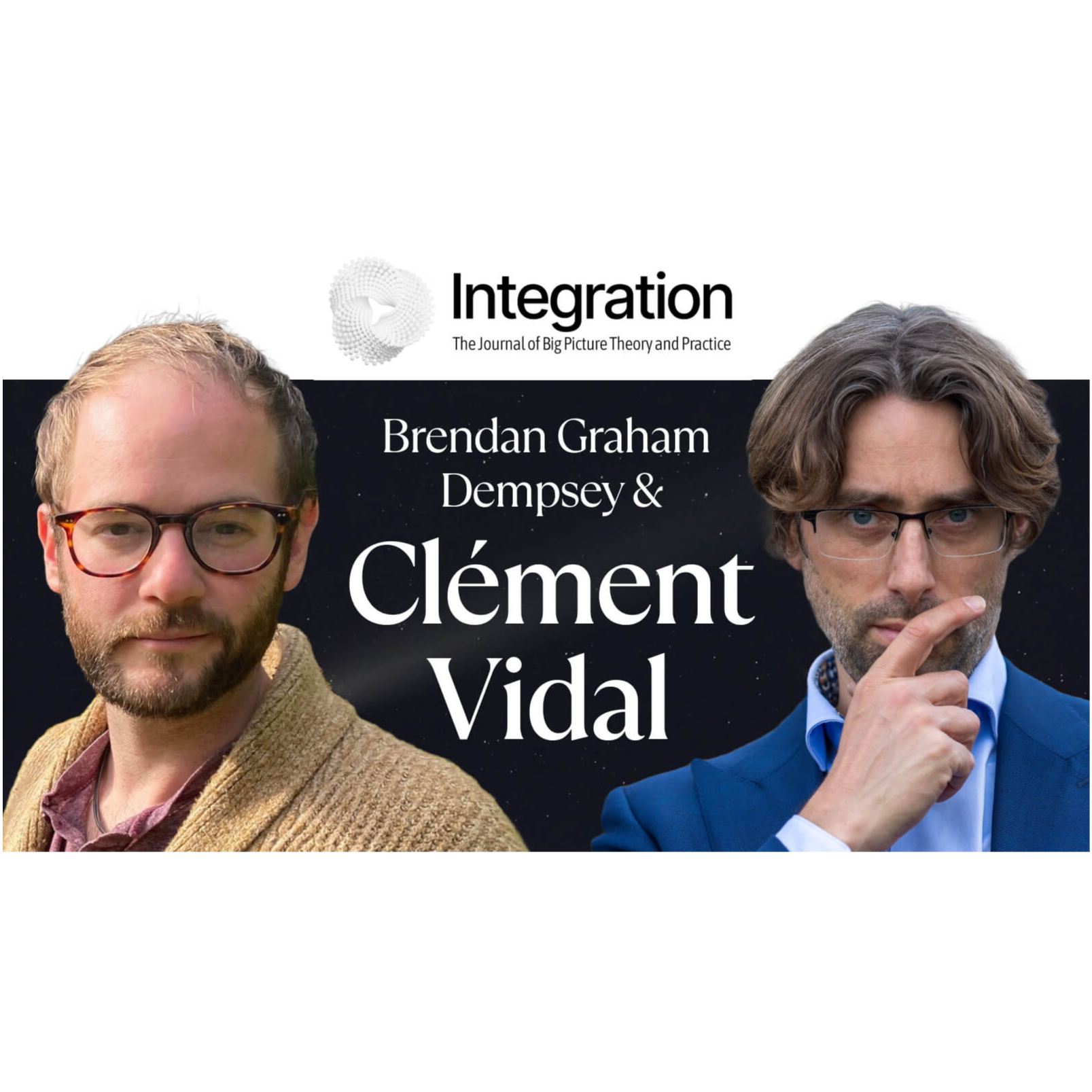 The Evolutionary-Developmental Perspective w/ Clément Vidal | Dr. Clément Vidal discusses the work coming out of the Evo-Devo community and his contributions to theorizing the concept of worldview before unpacking the core aspects of a so-called "cosmic evolutionary" worldview, whose ideas resonate deeply with the integrative worldview being developed by the Institute of Applied Metatheory. We unpack his ideas around cosmological artificial selection and its connection to various forms of metaphysics, as well as how value(s) relate to this cosmic picture. 0:00 Introduction0:58 What is the "Evo-Devo" Research Community?5:05 The Problem with (and Promise of) "Progress" 11:51 Evo-Devo Research Questions 14:53 Evolutionary Philosophy and the Question of Worldview 20:59 Criteria for Comparing Worldviews 26:05 The Nature of an Evolving Universe: The Origins of Fine-Tuning 34:33 Cosmological Artificial Selection 52:04 Cosmological Variation in a Multiverse? 55:25 Evolution, Development, Complexity and Value 1:08:47 Worldview Competition and Cultural Evolution 1:14:10 Conclusion | 1h 17m 04s |
Showing 5 of 5
Sponsor Intelligence
Sign in to see which brands sponsor this podcast, their ad offers, and promo codes.
Chart Positions
2 placements across 2 markets.
Chart Positions
2 placements across 2 markets.