Invested In Climate
by Jason Rissman
Is this your podcast?Insights from recent episode analysis
Audience Interest
Podcast Focus
Publishing Consistency
Platform Reach
Insights are generated by CastFox AI using publicly available data, episode content, and proprietary models.
Most discussed topics
Brands & references
Total monthly reach
Estimated from 2 chart positions in 2 markets.
By chart position
- 🇵🇹PT · Investing#653K to 10K
- 🇮🇱IL · Investing#145500 to 3K
- Per-Episode Audience
Est. listeners per new episode within ~30 days
1.8K to 6.5K🎙 ~2x weekly·133 episodes·Last published 1mo ago - Monthly Reach
Unique listeners across all episodes (30 days)
3.5K to 13K🇵🇹77%🇮🇱23% - Active Followers
Loyal subscribers who consistently listen
1.1K to 3.9K
Market Insights
Platform Distribution
Reach across major podcast platforms, updated hourly
Total Followers
—
Total Plays
—
Total Reviews
—
* Data sourced directly from platform APIs and aggregated hourly across all major podcast directories.
On the show
From 13 epsHost
Recent guests
Recent episodes
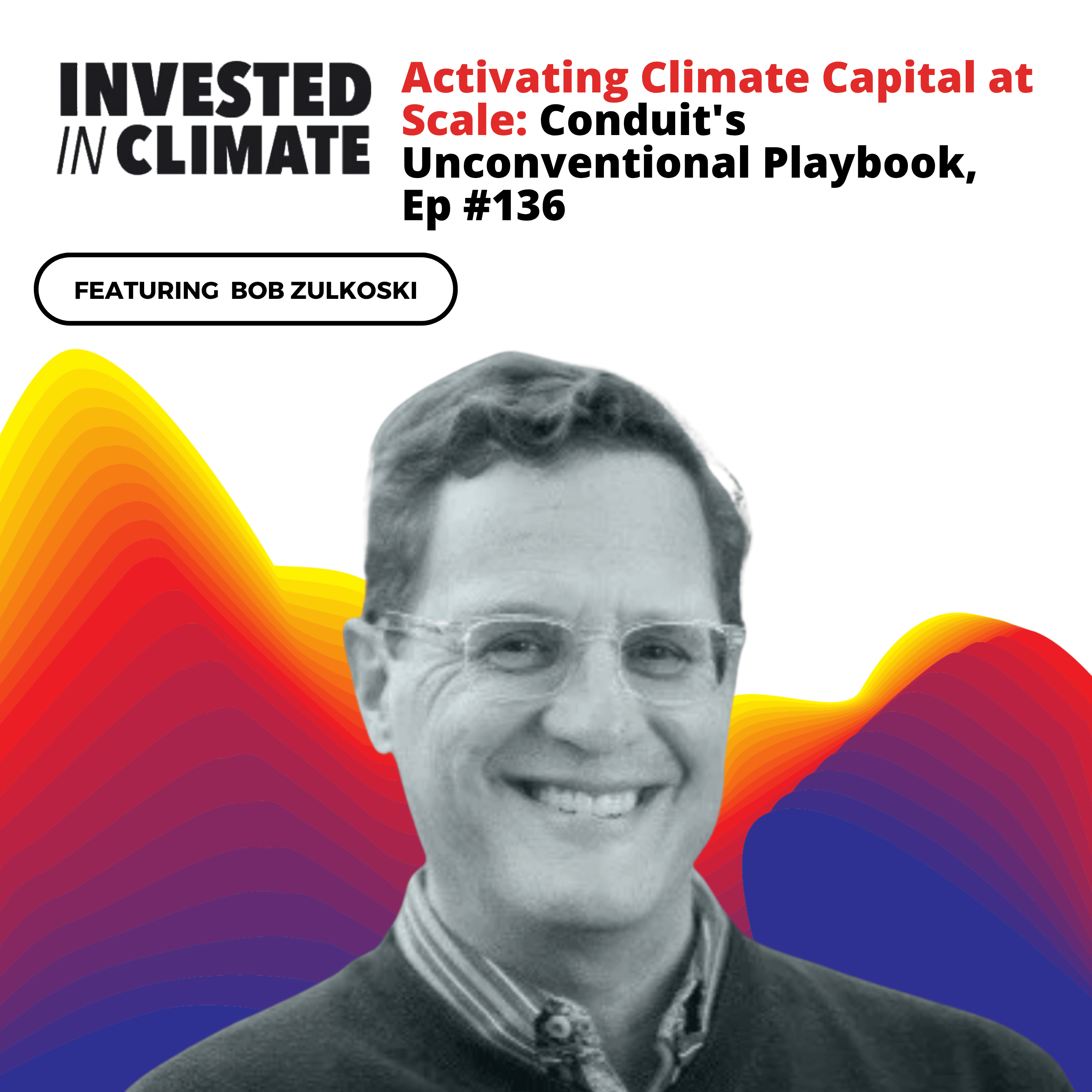
Activating Climate Capital at Scale: Conduit's Unconventional Playbook, Ep #136
Jul 14, 2026
42m 25s
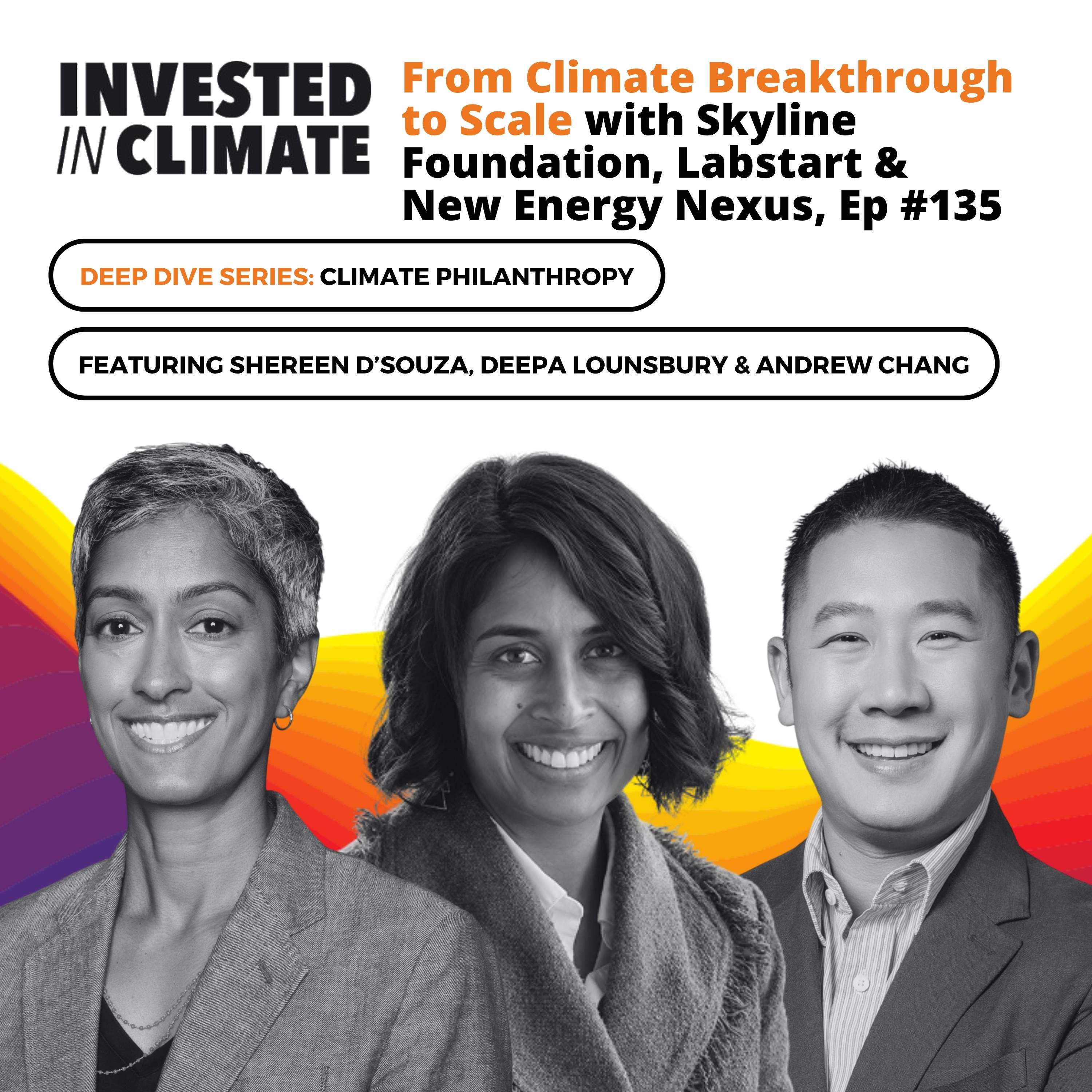
From Climate Breakthrough to Scale with Skyline Foundation, LabStart & New Energy Nexus, Ep #135
Jun 23, 2026
48m 13s
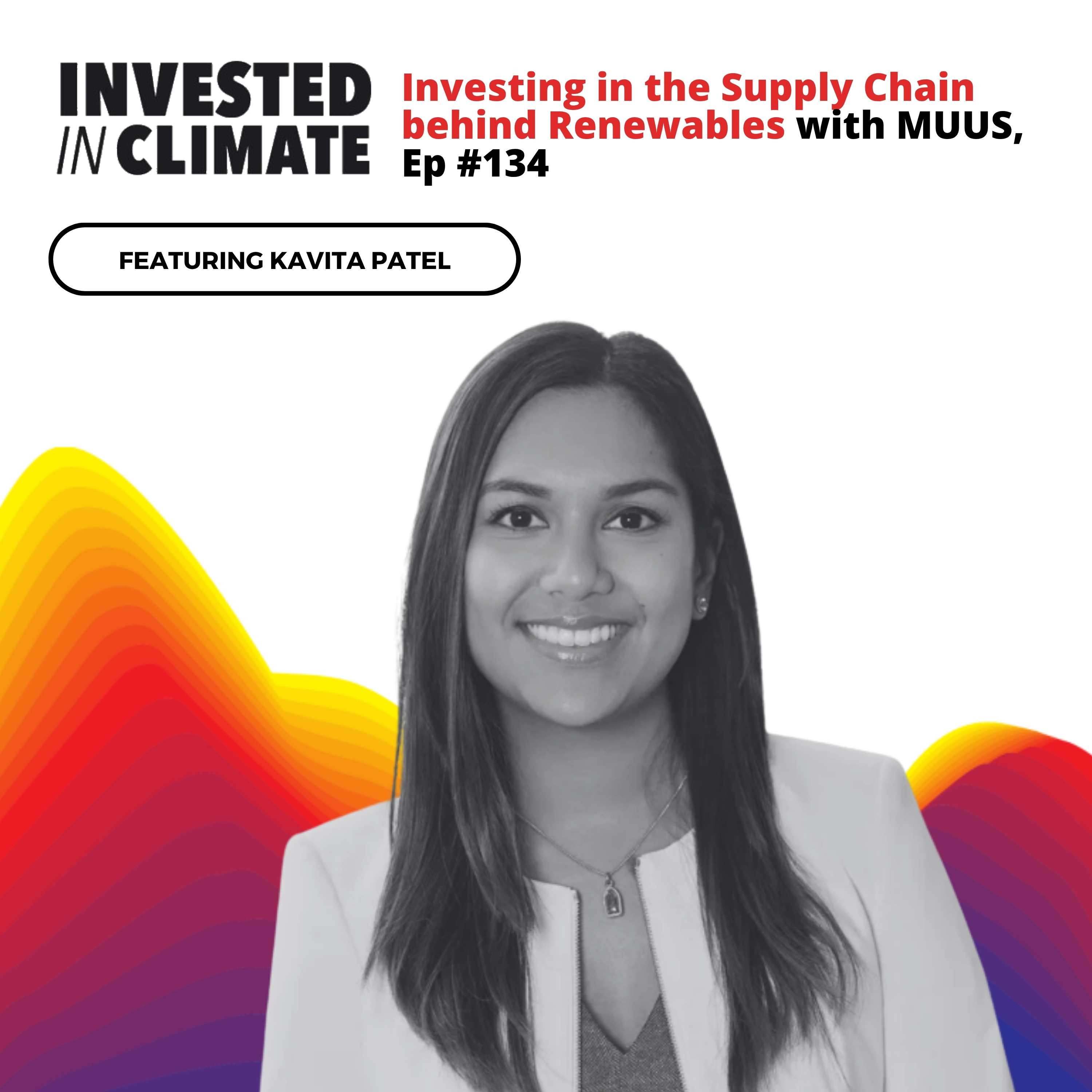
Investing in the Supply Chain behind Renewables with MUUS, Ep #134
Jun 9, 2026
38m 58s
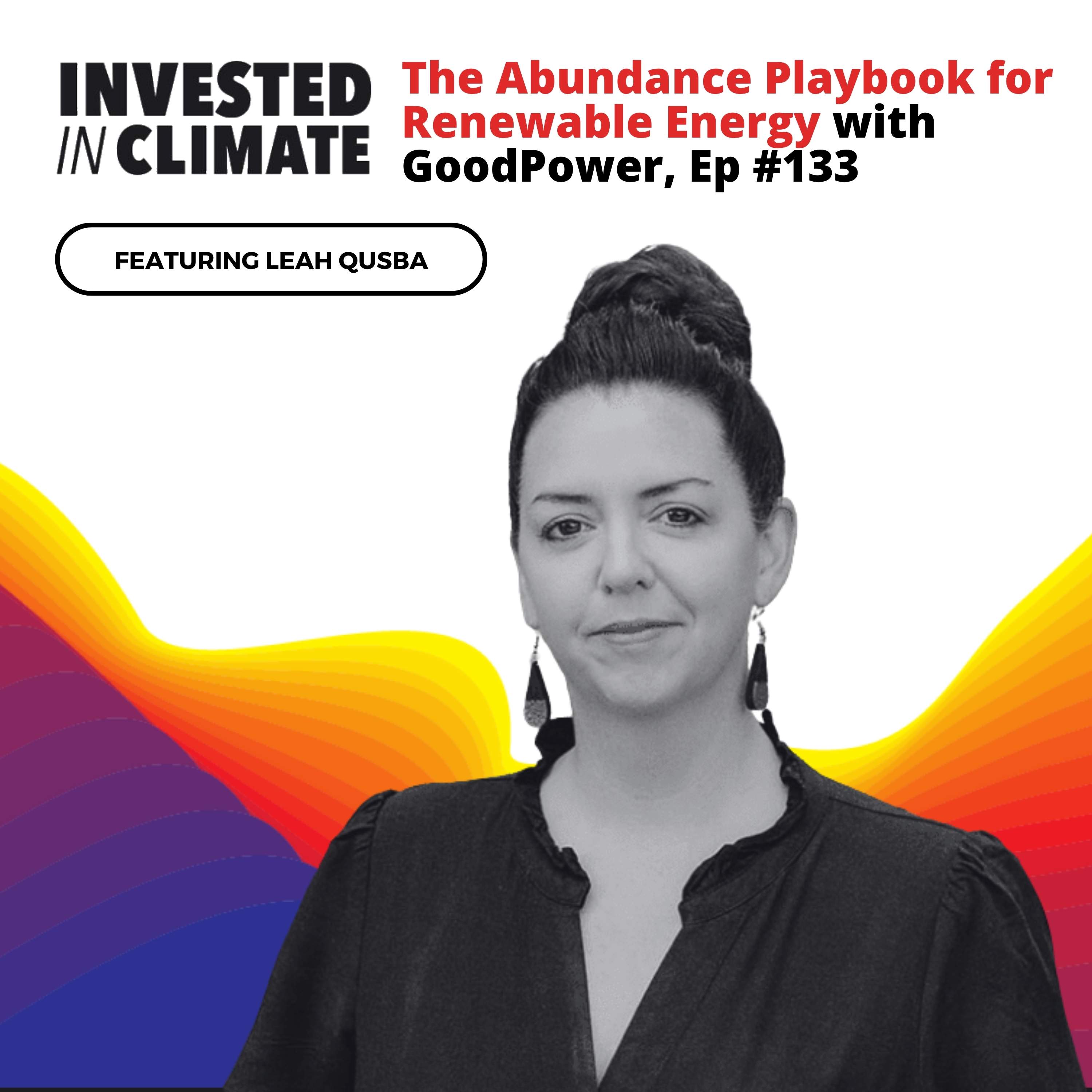
The Abundance Playbook for Renewable Energy with GoodPower, Ep #133
May 5, 2026
35m 44s
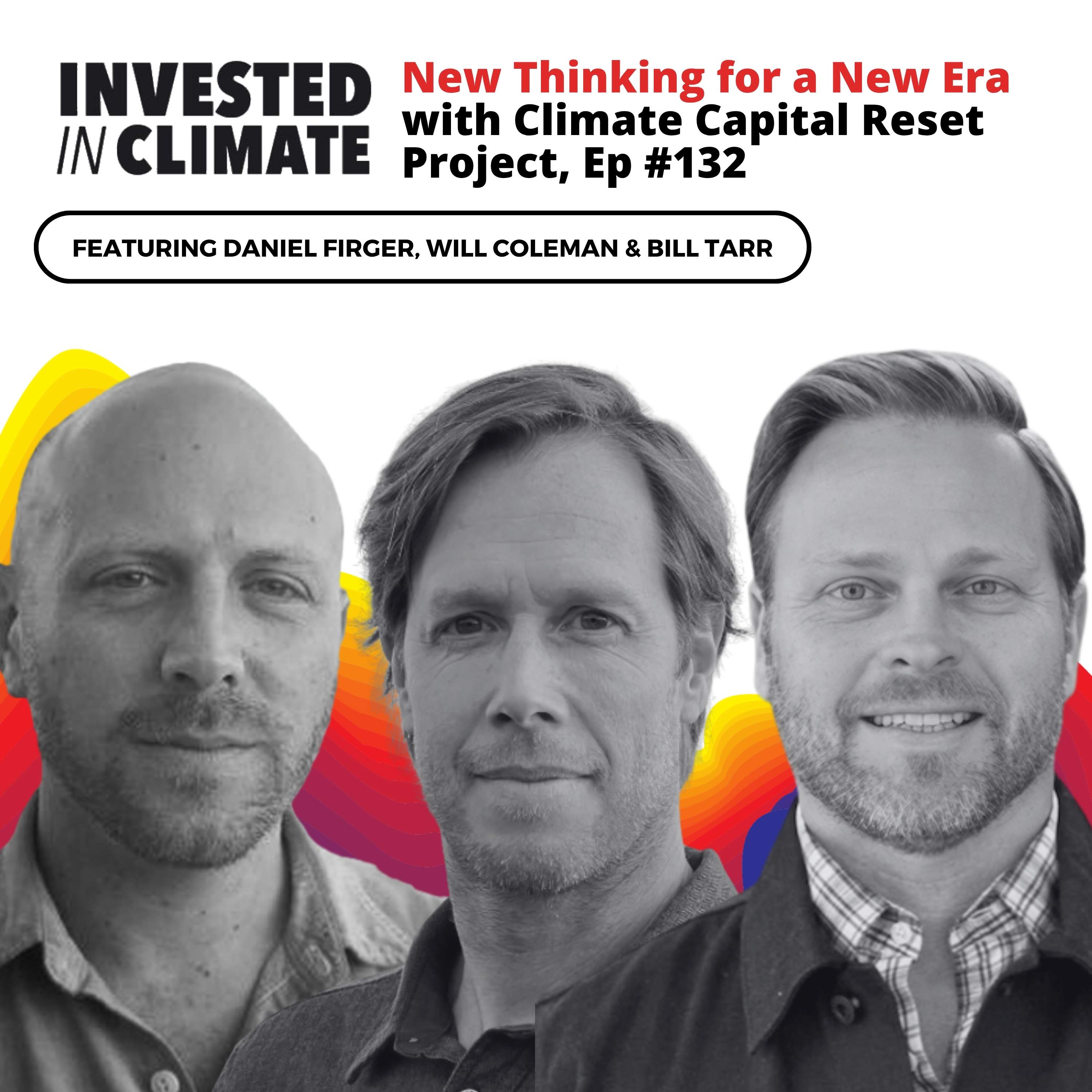
New Thinking for a New Era with Climate Capital Reset Project, Ep #132
Apr 22, 2026
52m 21s
Social Links & Contact
Official channels & resources
Official Website
Login
RSS Feed
Login
| Date | Episode | Topics | Guests | Brands | Places | Keywords | Sponsor | Length | |
|---|---|---|---|---|---|---|---|---|---|
| 7/14/26 | climate financeinvestment models+3 | Bob Zulkoski | Conduit CapitalSustainable Credit Partners | — | climate transitionfinancing barriers+3 | — | 42m 25s | ||
| 6/23/26 | climate philanthropyclimate tech+3 | Shereen D’SouzaDeepa Lounsbury+1 | Skyline FoundationLabStart+1 | — | climate philanthropyclimate tech+3 | — | 48m 13s | ||
| 6/9/26 | climate transitionrenewable energy+3 | Kavita Patel | MUUS & CompanyTIGER 21+1 | — | climate investingrenewables+3 | — | 38m 58s | ||
| 5/5/26 | renewable energyclean energy+3 | Leah Qusba | GoodPowerThe Abundance Playbook | — | renewable energyGoodPower+3 | — | 35m 44s | ||
| 4/22/26 | climate investingfinance trends+3 | Dan FirgerWill Coleman+1 | Climate Capital Reset Project | United States | climate financeinvestment trends+3 | — | 52m 21s | ||
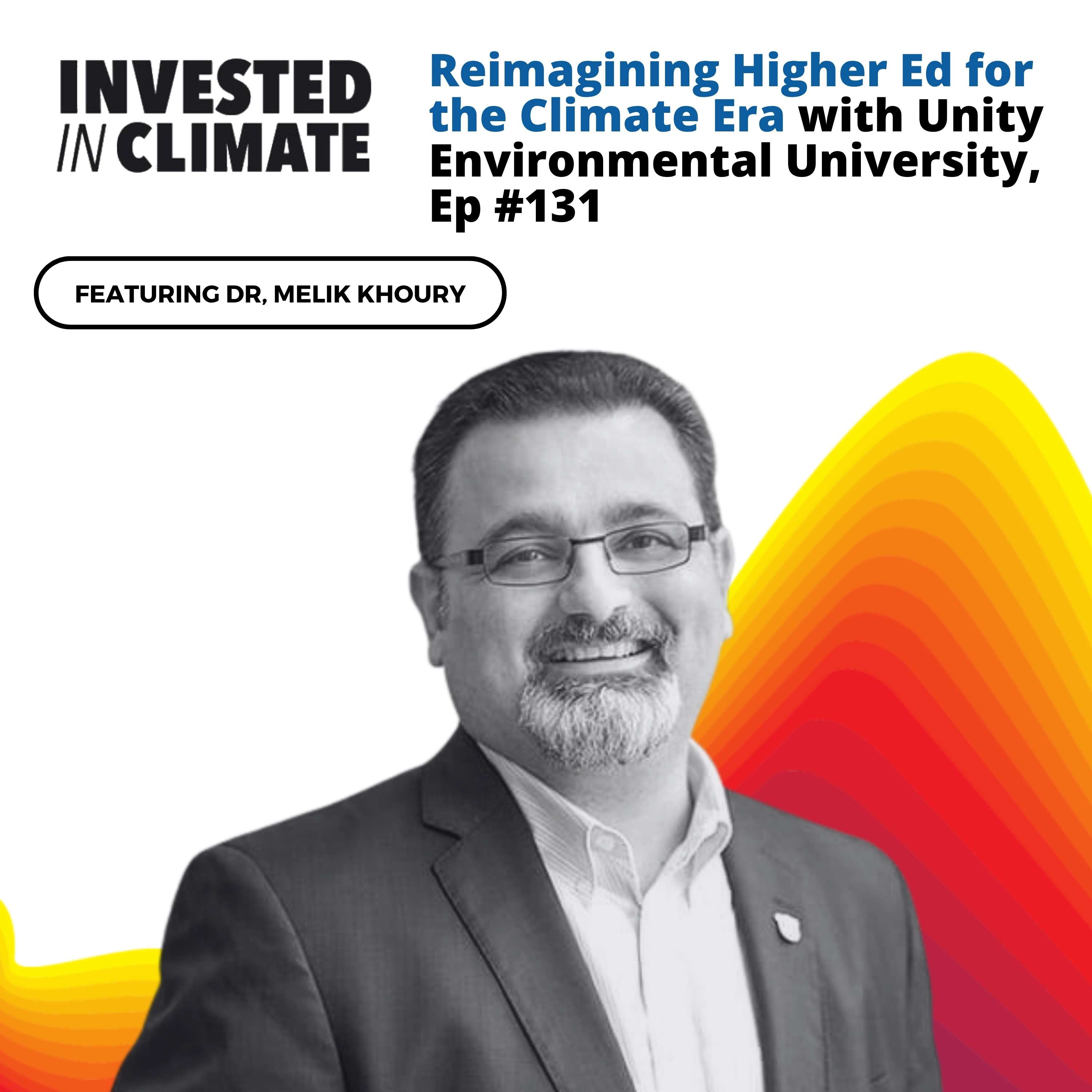
| 3/24/26 | climate educationhigher education transformation+3 | Dr. Melik Khoury | Unity Environmental University | West AfricaUS | climate changeeducation+3 | — | 46m 33s | ||
| 3/10/26 | regenerative economicsclimate change+3 | Eugene Kirpichov | Work on ClimateGoogle | Russia | regenerative economyclimate leadership+3 | — | 58m 13s | ||
| 2/24/26 | climate financesustainable investing+3 | Robert Brown | Resolution InvestorsImpact Evaluation Lab | — | climate investingESG+3 | — | 39m 50s | ||
| 1/27/26 | climate innovationcatalytic capital+4 | Dawn LippertMatt Logan | Elemental ImpactEarthshot Ventures | — | climateinvestment+6 | — | 48m 28s | ||
| 1/13/26 | climate investinginvestor priorities+4 | Rob DayRaj Atluru | Spring Lane CapitalActivate Capital+1 | — | climate techinvestment strategies+4 | — | 53m 52s | ||
Want analysis for the episodes below?Free for Pro Submit a request, we'll have your selected episodes analyzed within an hour. Free, at no cost to you, for Pro users. | |||||||||
| 1/6/26 | climate investingclean energy+5 | Daniel Weiss | Angeleno GroupWorld Resources Institute+4 | — | climate investingAngeleno Group+5 | — | 37m 18s | ||
| 12/11/25 | climate philanthropytrust-based philanthropy+3 | Shereen D’SouzaShaady Salehi | Skyline FoundationTrust-Based Philanthropy Project | — | philanthropyclimate action+5 | — | 41m 04s | ||
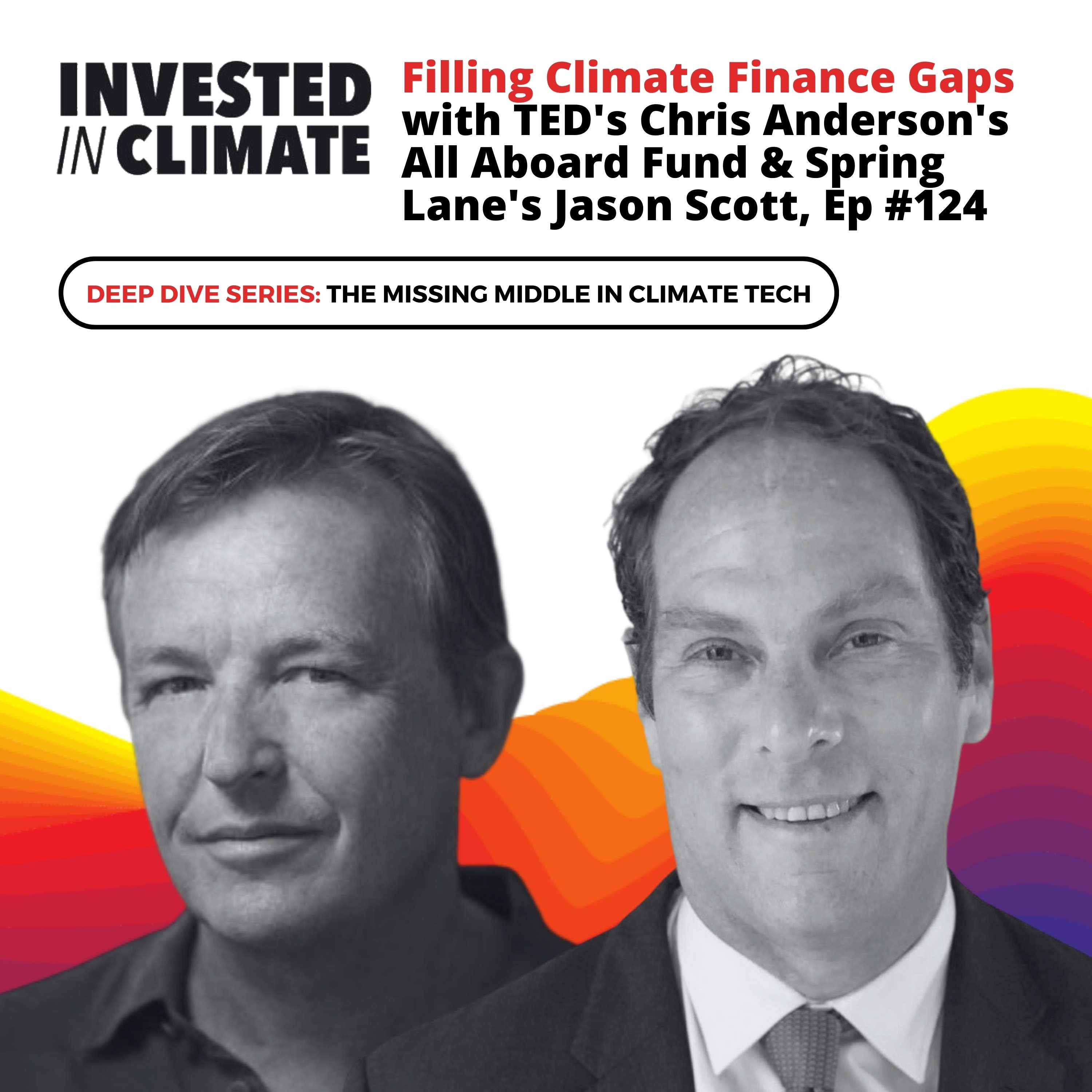
| 11/25/25 | climate financeinvestment+3 | Chris AndersonJason Scott | TEDSpring Lane Capital+2 | — | climate financeinvestment mandates+5 | — | 43m 37s | ||
| 10/30/25 | 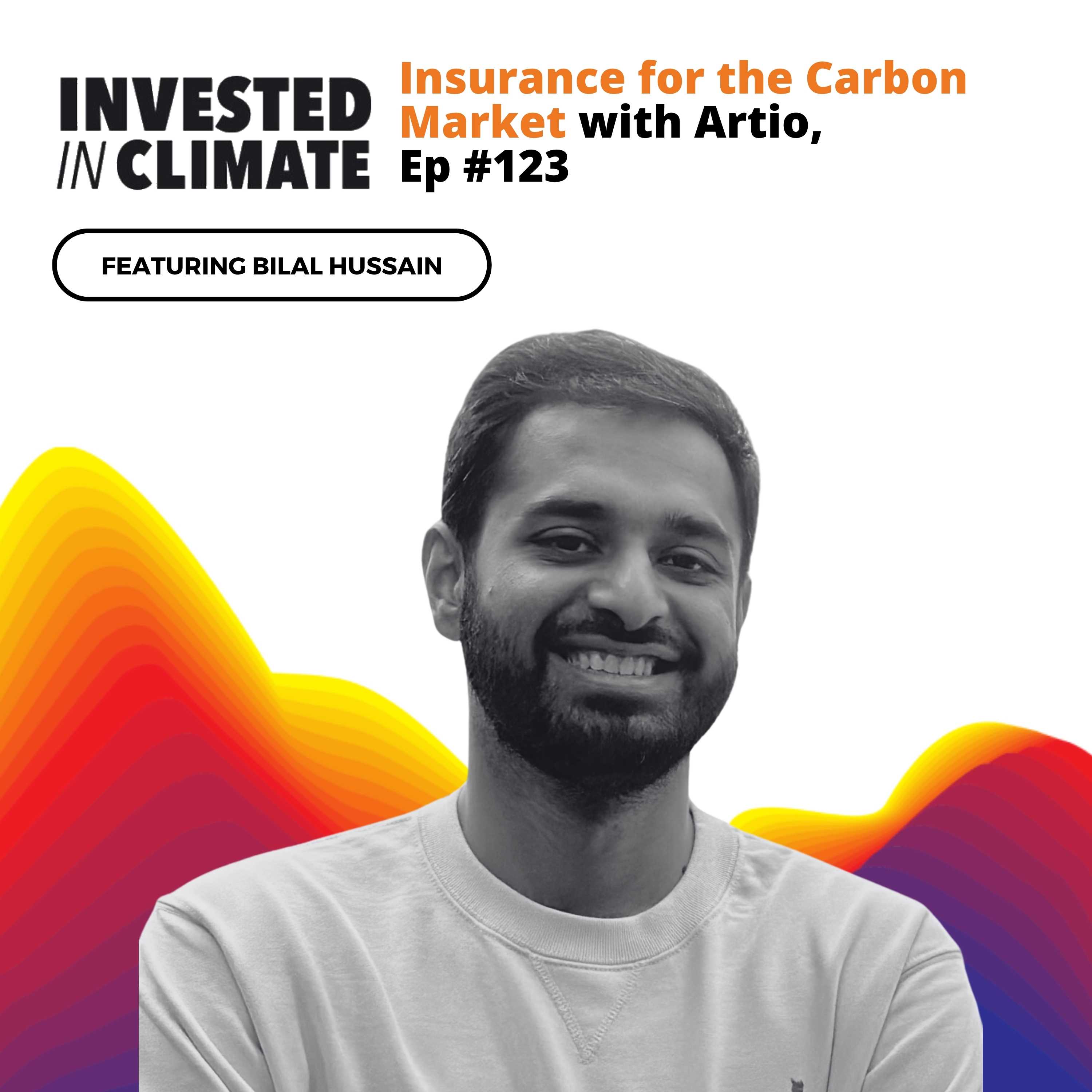 Insurance for the Carbon Market with Artio, Ep #123 | There’s been a lot of news in recent years about the risks within carbon markets. Companies buying carbon credits to offset their emissions have struggled with the uncertainty that a carbon project might not reduce as much carbon as they project. A forest could burn or a technology could fail to work properly and the project will underdeliver. Yet, hundreds of billions of dollars are spent on carbon credits, a figure that could grow well into the trillions. Bilal Hussain is targeting this uncertainty in this market by offering insurance through his company Artio. Fun fact: Bilal actually saw the need for insurance while working at Sylvera – a carbon market sourcing and diligence platform and recent guest on our show – when he realized that investors were asking for collateral that no one had. Artio enters early – before the first tree is planted – to help more carbon reducing projects become viable. If you consider the size of the carbon market and the shortage of ways to insure new projects, the opportunity for Artio is quite significant.Bilal makes this complex space rather simple and easy to understand. We spoke about his background, the need for insurance, the risks different types of projects face, the growth he’s anticipating and much more. If you’ve long wondered about the risks of carbon projects, this conversation will shed some light on the space and one approach to unlocking its potential. On today’s episode, we cover:00:58 — Introduction to carbon market risks and Artio’s approach02:40 — Bilal’s background and transition into carbon insurance04:25 — The creation of Artio and addressing insurance needs in carbon markets07:52 — Artio’s impact on financial and climate markets, and market sizing11:13 — Early-stage risk phases and insurance for carbon projects14:05 — Types of projects Artio insures; afforestation, biochar, rock weathering15:25 — Risk assessment by project type and key differences17:14 — Artio’s market positioning, product traction, and offering insurability assessments to developers20:41 — How Artio’s workshops educate insurers and demonstrate risk modeling22:46 — Case study: How coverage and claims/settlements work in practice27:25 — Market challenges: Standing out in a crowded space, growth ambitions, and automation29:10 — Key surprises about the carbon market and importance of policy31:47 — The role of data transparency and risk assessment in broader climate domains34:59 — Other insurance use cases for managing climate transition risk38:10 — Artio’s roadmap: expanding coverage, supporting developers, and scaling upResources MentionedArtioSylveraMaya ClimateAsia Climate SummitSF Climate WeekCORSIA InsuranceConnect with usBilal HussainJason RissmanKeep up with Invested In ClimateSign up for our NewsletterLinkedInInstagramBlueskyHave feedback or ideas for future episodes, events, or partnerships?Get in touch! | — | ||||||
| 10/17/25 | ![The $9 Trillion Adaption Opportunity with Adapt[us], Ep #122 episode artwork](https://artwork.captivate.fm/a4f96c76-1de4-474e-a6a3-75a2df9b8c7a/121.jpg) The $9 Trillion Adaption Opportunity with Adapt[us], Ep #122 | The vast majority of my interviews have focused on innovations, investing and advocacy related to climate mitigation – that is, what we can do to cut greenhouse gases and minimize the rise in global temperatures. What we do or don’t do now, will have lasting consequences and it is climate mitigation that is driving the transformation of the global economy. So it’s not surprising that mitigation dominates climate investing. Adaptation and resilience, meanwhile, focus not on limiting or reversing climate change but rather on improving quality of life in a warmer world. Adaptation ventures receive only a small fraction of climate investments, but rising temperatures are creating tremendous demand for a new category of products. In a joint report by Boston Consulting Group (BCG) and Temasek, it’s estimated that between $500 million and $1.3 trillion could be spent annually by 2030 on technologies that help people adapt to a changed climate. That’s the opportunity Darren Clifford is targeting with a new fund called Adapt[us]. Darren has worked for two decades on new markets as a founder, consultant at McKinsey & Co, and as an angel investor, and I found his perspective on the climate adaptation market to be packed with nuance and insight. We spoke about his background, three different categories of adaptation tech, the unique challenges they face, how they’ll make the future more livable, and much more. On today’s episode, we cover:[02:45] Darren’s Background & Career Journey[06:39] Why Focus on Climate Adaptation?[08:07] Insights from Angel Investing & Supporting Founders[12:14] Why Adaptation is Underfunded; Adapt[us] Fund Overview[16:19] Challenges in Scaling Adaptation Solutions[17:31] Adapt[us] Fund: Focus & Stage, Why For-Profit[18:53] Measuring Impact & Third-Party Well-being Validation[23:10] Market Segmentation: Resilience, Repair & Recovery, Demand Adaptation[25:38] Market Size and Investment Allocation[27:50] Business Model Challenges for Adaptation Startups[30:23] Concrete Examples of Target Companies [32:59] Adapt[us] Venture Building Approach & Founder Support[36:42] The Venture Builder/Capital Model: Criteria & Structure[38:27] Norwegian Talent & Global Competitive Advantages[41:03] Building a Movement, Not Just a Fund[42:06] Short-Term Goals for Adapt[us] & Team Building[44:41] Closing RemarksResources MentionedAdapt[us]BCG x Temasek Report: The Private Equity Opportunity in Climate Adaptation and ResilienceToronto Climate WeekGIC Report: Sizing the Inevitable Investment Opportunity: Climate AdaptationWRI Study: Strengthening the Investment Case for Climate Adaptation: A Triple Dividend ApproachConnect with usDarren CliffordJason RissmanKeep up with Invested In ClimateSign up for our NewsletterLinkedInInstagramBlueskyHave feedback or ideas for future episodes, events, or partnerships?Get in touch! | — | ||||||
| 9/30/25 | 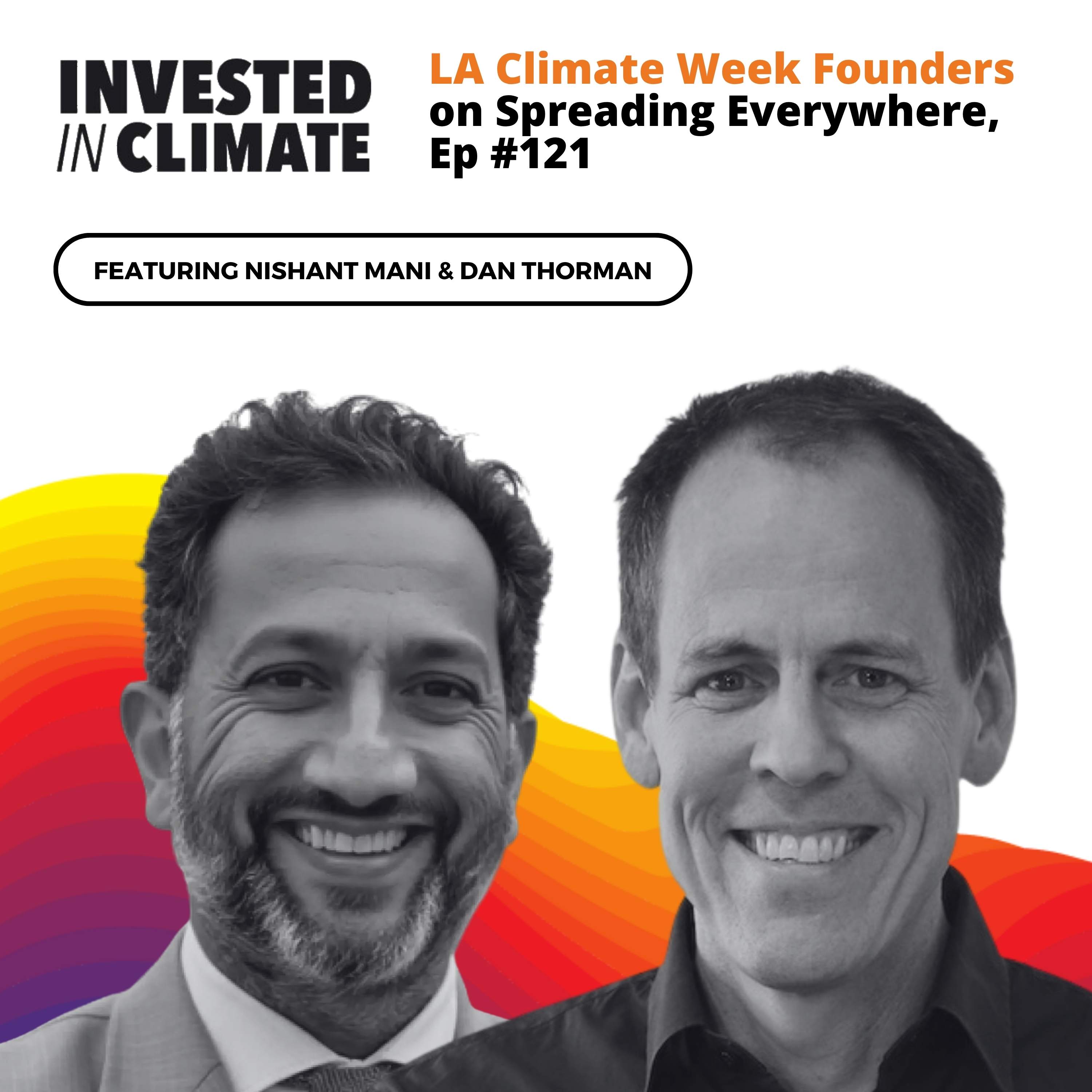 LA Climate Week Founders on Spreading Everywhere, Ep #121 | In case you missed it, last week was NY Climate Week. There were well over 1,000 events — from summits with CEO and heads of state, to film screenings, concerts, parties, boat cruises, pitch sessions, hackathons and much more. I tried to sum up my experience at New York climate week in a special episode two years ago. This year, of course, the context was different with a US administration no longer interested in climate, and a lot of green hushing, hand wringing and new language that aims to be less politicizing.To me, one of the most interesting things about NY Climate Week is that it's not the only one. Climate weeks are spreading. San Francisco, Los Angeles, Washington DC, San Diego, Shanghai, Bangkok, Panama City all have climate weeks. There might be dozens more in the works. No city on the planet is immune from the impact of climate, and most cities have thriving ecosystems of organizations, innovators, investors, policymakers, researchers and more working to advance climate solutions and adapt to a changing planet. In this conversation I’m joined by Nishant Mani and Dan Thorman, co-founders of the LA Climate Week. Nishant and Dan saw a need to bring together their community. They volunteered to lead and have built LA Climate Week into a successful example that people anywhere can follow to create their own week of solidarity, learning and action. We talk about their backgrounds, the founding story of LA Climate Week, the impact of the LA wildfires on last year’s event, lessons they’ve learned and much more. So whether or not you were in New York last week, I hope you’ll enjoy this conversation and consider how you can help your local climate community wherever you are. On today’s episode, we cover:1:22 – Recap of New York Climate Week & Spread of Climate Weeks3:43 – Nishant’s Personal & Professional Background6:19 – Dan’s Personal & Professional Background 10:16 – The Origin Story of LA Climate Week14:40 – The Role of Entertainment & Culture in LA Climate Week17:08 – Entertainment Industry’s Role in Climate Movement18:33 – Impact of Wildfires on LA Climate Week24:47 – The Broader Role of Climate Weeks & Local Collaboration27:51 – Lessons Learned from Organizing LA Climate Week32:20 – Evolving the Structure and Infrastructure Involvement33:02 – Measuring Success and Growth of LA Climate Week36:44 – Community Engagement & Accessibility39:32 – Aspirations for the Future: Magic Wand Scenario42:21 – Future Planning and Event Announcement44:14 – Closing Remarks and Call to ActionResources MentionedLA Climate WeekClimate CapitalTerra.doReunionCollidescope FoundationJane Goodall InstituteConnect with usNishant ManiDan ThormanJason RissmanKeep up with Invested In ClimateSign up for our NewsletterLinkedInInstagramBlueskyHave feedback or ideas for future episodes, events, or partnerships?Get in touch! | — | ||||||
| 9/16/25 | 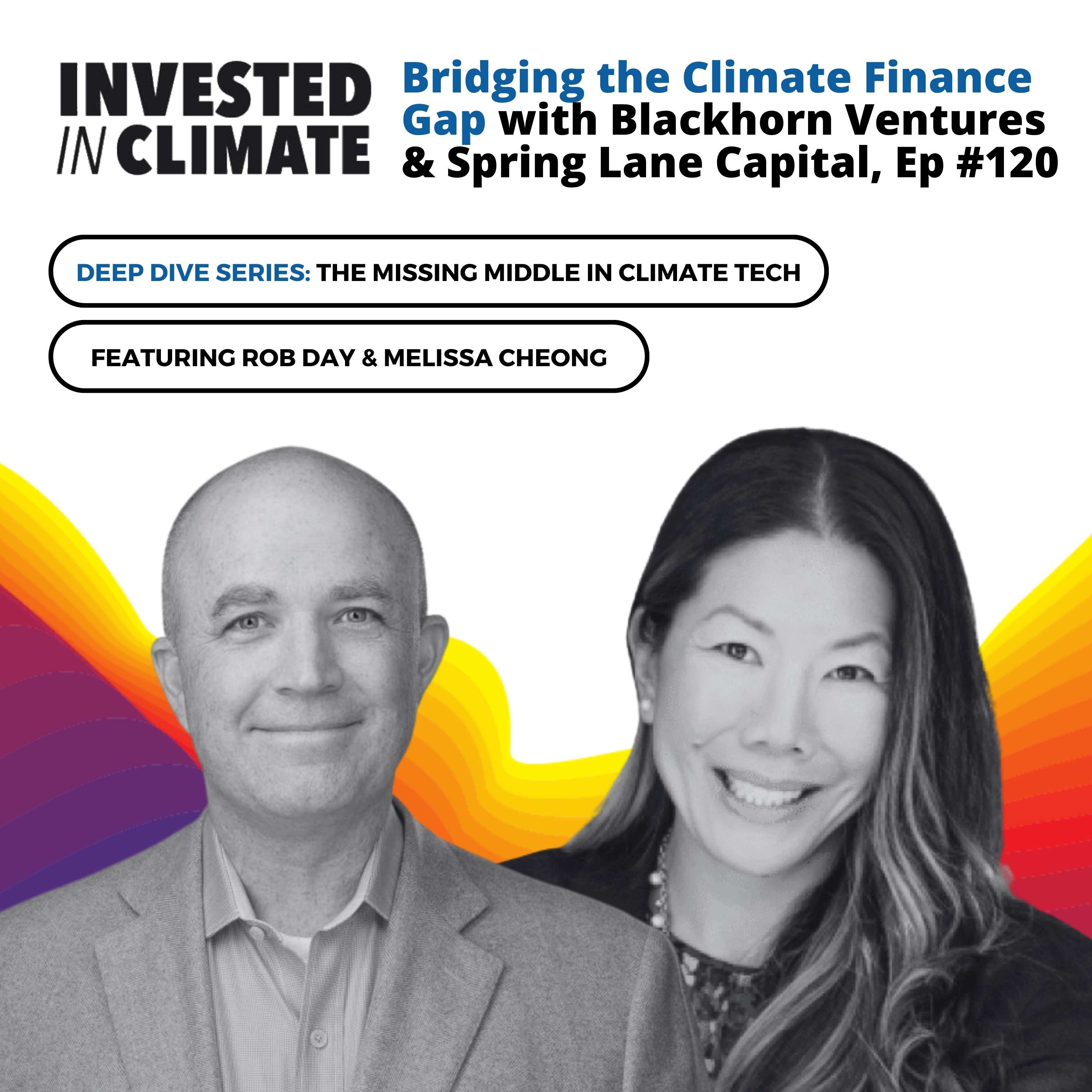 Bridging the Climate Finance Gap with Blackhorn Ventures & Spring Lane Capital, Ep #120 | Climate tech companies face a range of structural challenges to securing the mid stage investment needed to scale their solutions. The lack of capital at this stage prevents many viable, potentially transformative technologies from going mainstream and eliminating gigatons of emissions. That’s why we’ve been running a series of episodes on the Missing Middle in Climate Tech in partnership with Spring Lane Capital. If you haven’t heard our previous three episodes in this series, check them out at investedinclimate.com, and if you have ideas of other topics that warrant a Deep Dive series please reach out through the contact form on our website. For the fourth episode in our series, I’m joined by Spring Lane Capital Co-Founder and Partner Rob Day who guest hosts the conversation with Blackhorn Ventures Managing Partner Melissa Cheong. On today’s episode, we cover:2:23 – Introducing Blackhorn Ventures & Melissa Chong3:31 – Melissa’s Path to Venture Capital & Impact Investing8:44 – Surprises & Learnings in Venture Capital10:13 – Overview of Blackhorn Ventures’ Investment Focus & Strategy13:55 – Addressing the Missing Middle: Digital vs. Hardware Solutions17:18 – Leveraging Accepted Hardware & Digital Solutions19:09 – The Role of Vertical Data Pools in Construction and Energy21:03 – AI, Utilities, and the Urgency for Digital Solutions25:10 – Building Resilience & Anti-Fragile Mindsets in Climate Tech28:14 – Exploring New Financing Instruments & Insurance32:21 – Portfolio Example: Formic – Robotics as a Service36:37 – Portfolio Example: King Energy – Solar for Multi-Tenant Properties38:55 – Lessons from Community Solar & Smart Billing40:00 – Takeaways: The Evolving Role of Venture Capital in Climate Impact43:24 – Closing RemarksResources MentionedSpring Lane CapitalBlackhorn VenturesFormicKing EnergyConnect with usRob DayMelissa CheongJason RissmanKeep up with Invested In ClimateSign up for our NewsletterLinkedInInstagramBlueskyHave feedback or ideas for future episodes, events, or partnerships?Get in touch! | — | ||||||
| 9/2/25 | 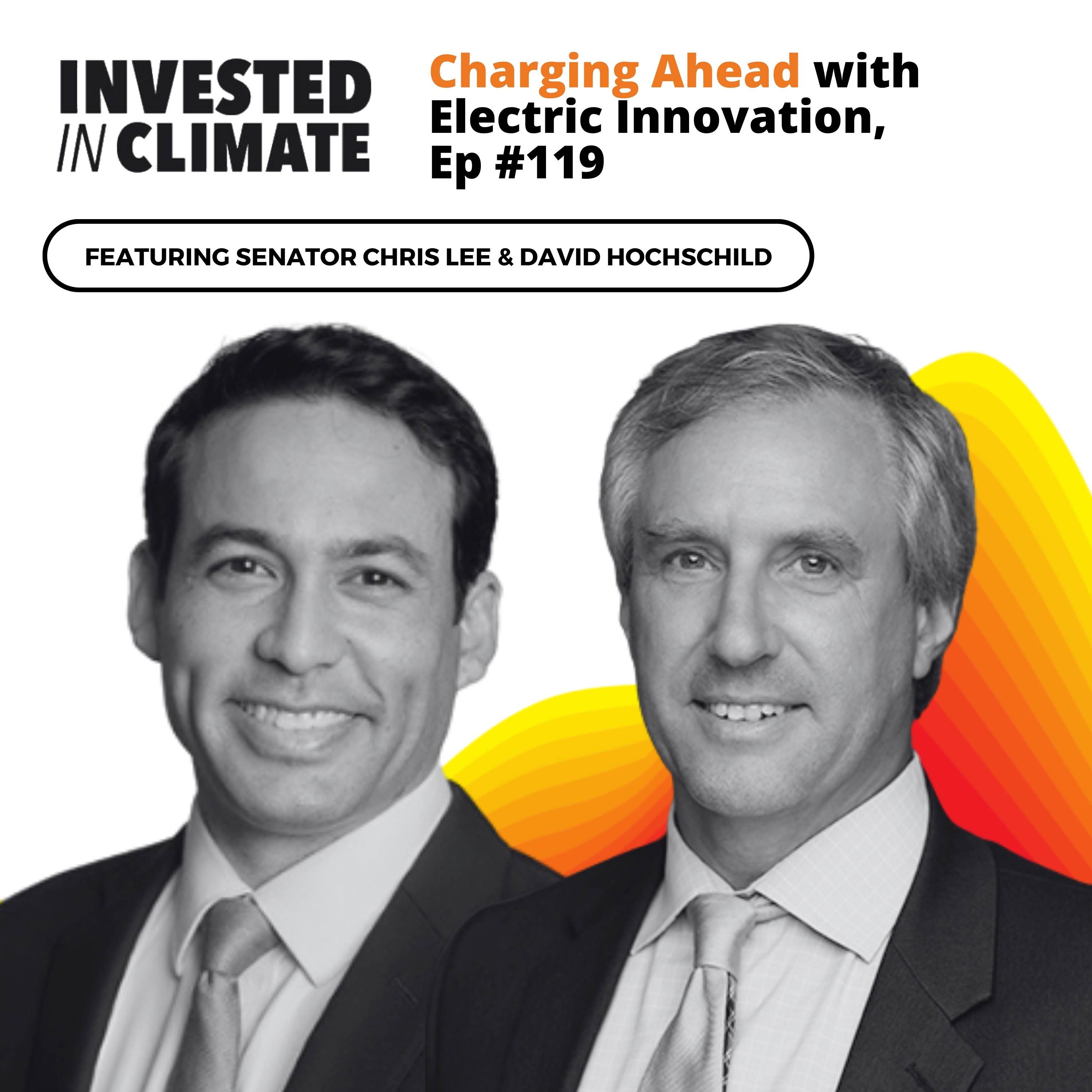 Charging Ahead with Electric Innovation, Ep #119 | I’ll admit it’s not often these days that I’m talking to climate leaders, particularly those working on policy, who say it’s an exciting time. This conversation was like a breath of fresh air. It’s not getting the headlines it deserves, but innovation is literally electrifying our country. Sector by sector, state by state, our economy is being transformed by electric technology replacing outdated fossil fuel applications.To elevate and accelerate this wave of innovation, Hawaii State Senator Chris Lee and California Energy Commission Chair David Hochschild have teamed up to launch the Electric Innovation Initiative. The Initiative is starting with an awards event during NY Climate Week, recognizing breakthrough electrification projects with $10,000 cash awards. But beyond this event, the Initiative is a 10-year campaign to showcase innovation, advance learning and shape policy. In this conversation, we go deep into the context of why the Electric Innovation Initiative is needed, what sort of progress is happening at the state level, how states are learning from one another, the many benefits of electrification and much more. I learned a lot in this episode and was thrilled to hear there’s much to celebrate in a still growing electrification movement. On today’s episode, we cover:[03:27] David Hochschild & His Role at the California Energy Commission04:09] Chris Lee & His Energy work as a Hawaii State Senator[05:05] Details of the Electric Innovation Initiative[07:07] State Legislators Collaboration: Sharing best practices and policy replication[09:09] Why electrification progress needs more attention[10:52] State and local responses to federal rollbacks[13:18] Policy Options for States: Connecting policymakers with electrification leaders[15:44] Fast-Tracking Projects: Permitting and financing challenges[17:01] California’s Permitting Reforms: Fast-track permitting for clean energy[18:49] California’s approach to stable, long-term programs[21:01[ Hawai'i’s 100% Renewable Mandate[23:05] Lessons from Hawaii and California: State leadership and policy replication[25:24] Legislator Network: Supporting new lawmakers and advancing innovation[28:54] State and local opportunities despite federal gridlock[32:57] Equity in Electrification: Directing investments to underserved communities[35:27] Vision for 2035: What a fully electrified future could look like[37:27] How listeners can support electrification[39:45] Optimism for the future and bipartisan collaborationResources MentionedElectric Innovation InitiativeCalifornia Energy CommissionHawai'i State LegislatureClimate Week NYCNational Caucus of Environmental LegislatorsConnect with usHawaii Senator Chris LeeCalifornia Energy Commission Chair David HochschildJason RissmanKeep up with Invested In ClimateSign up for our NewsletterLinkedInInstagramBlueskyHave feedback or ideas for future episodes, events, or partnerships?Get in touch! | — | ||||||
| 8/13/25 | 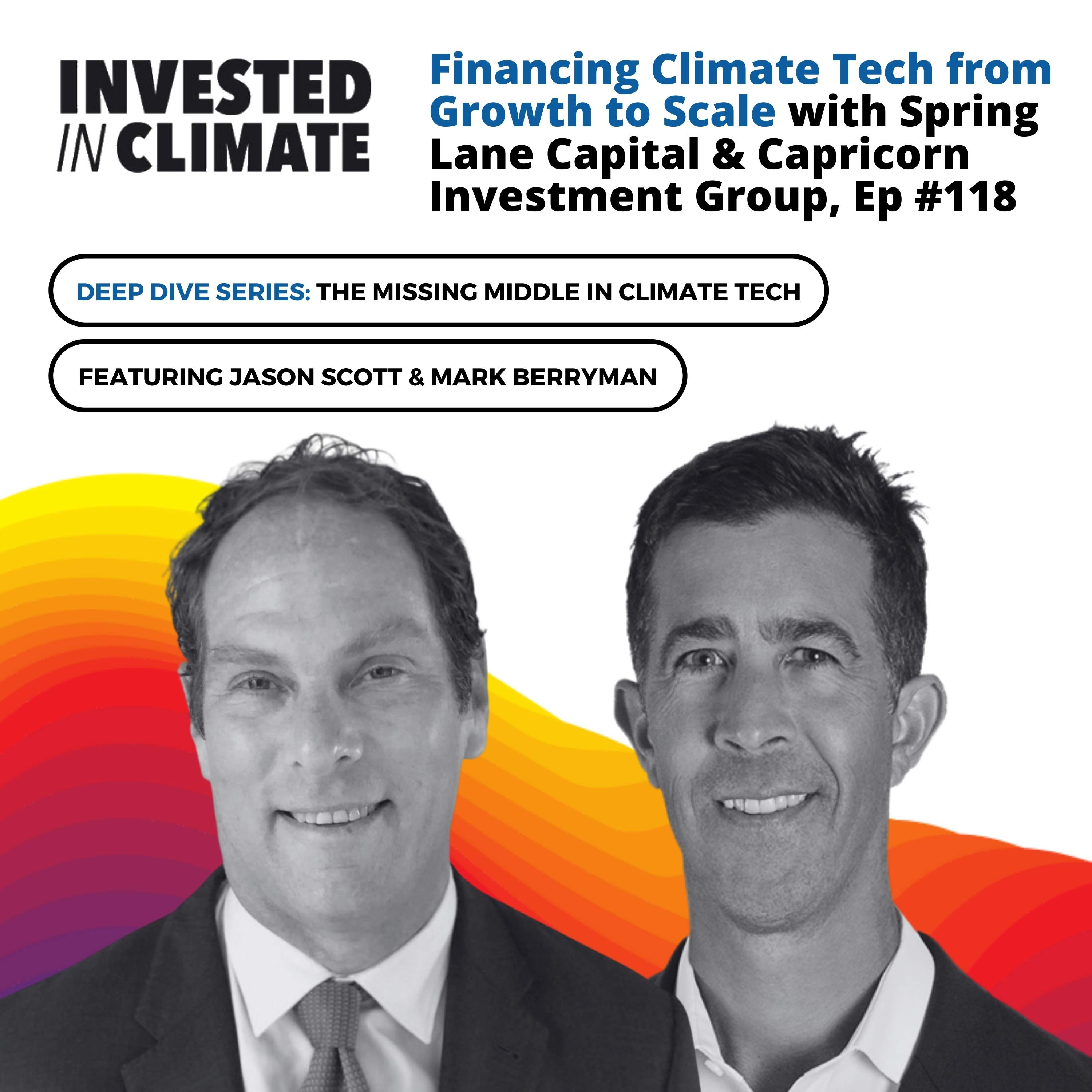 Funding Climate Tech from Growth to Scale with Spring Lane Capital & Capricorn Investment Group, Ep #118 | We’re back with the third installment in our Missing Middle in Climate Tech series, created in partnership with Spring Lane Capital. If you haven’t yet heard the earlier episodes, head to our website for conversations exploring research from CREO and S2G on the financing gap facing climate tech companies caught between early-stage venture and large-scale project finance. And if you have ideas for future series or want to explore a partnership, we’d love to hear from you—reach out via our site (investedinclimate.com/contact).In this episode, we’re joined by Jason Scott, Partner and Entrepreneur in Residence at Spring Lane Capital, and Mark Berryman, Partner at Capricorn Investment Group. Capricorn is one of the OGs of sustainable investing, with over two decades of leadership in the space and more than $12 billion in assets under management. This conversation brought together two distinct perspectives: a large, established asset allocator and a nimble firm specializing in project finance and growth-stage venture capital.Mark, recently named LP of the Year by Impact Capital Managers, offered nuanced insights into the challenges and opportunities of bridging the missing middle. Jason’s decision to bring him into the conversation sparked a rich dialogue on what it will take to close this critical funding gap. Lots to unpack and learn in this one. Enjoy!On today’s episode, we cover:[03:08] Series recap and context on the “Missing Middle" [07:03] Mark’s background & experience in climate investing[11:09] Mark’s perspective on the "missing middle" & its evolution[14:08] Why mid-sized funds are suited to fill the climate financing gap[17:45] Capricorn’s approach to climate portfolios & supporting the ecosystem[21:46] What Mark looks for in emerging fund managers[25:07] Building a fully climate-aligned portfolio & impact reporting[28:45] Where to categorize Spring Lane’s investment approach[32:10] The need for more innovative, category-defying climate funds[33:33] Macro context: tariffs, market volatility & long-term climate investing trends[41:33] Three-to-five year outlook for climate investing & the missing middle[44:15] Industry consolidation & future innovations[46:34] Closing remarksResources MentionedSpring Lane CapitalCapricorn Investment GroupThe Role of Family Offices with Spring Lane Capital & CREO, Ep #114Rethinking Climate Finance with Spring Lane Capital & S2G, Ep #115Impact Capital ManagersInternational Finance CorporationCaprockSkoll FoundationCREO Syndicate: Understanding the Climate Finance Gap reportVision Ridge PartnersConnect with usJason ScottMark BerrymanJason RissmanKeep up with Invested In ClimateSign up for our NewsletterLinkedInInstagramBlueskyHave feedback or ideas for future episodes, events, or partnerships?Get in touch! | — | ||||||
| 7/22/25 | 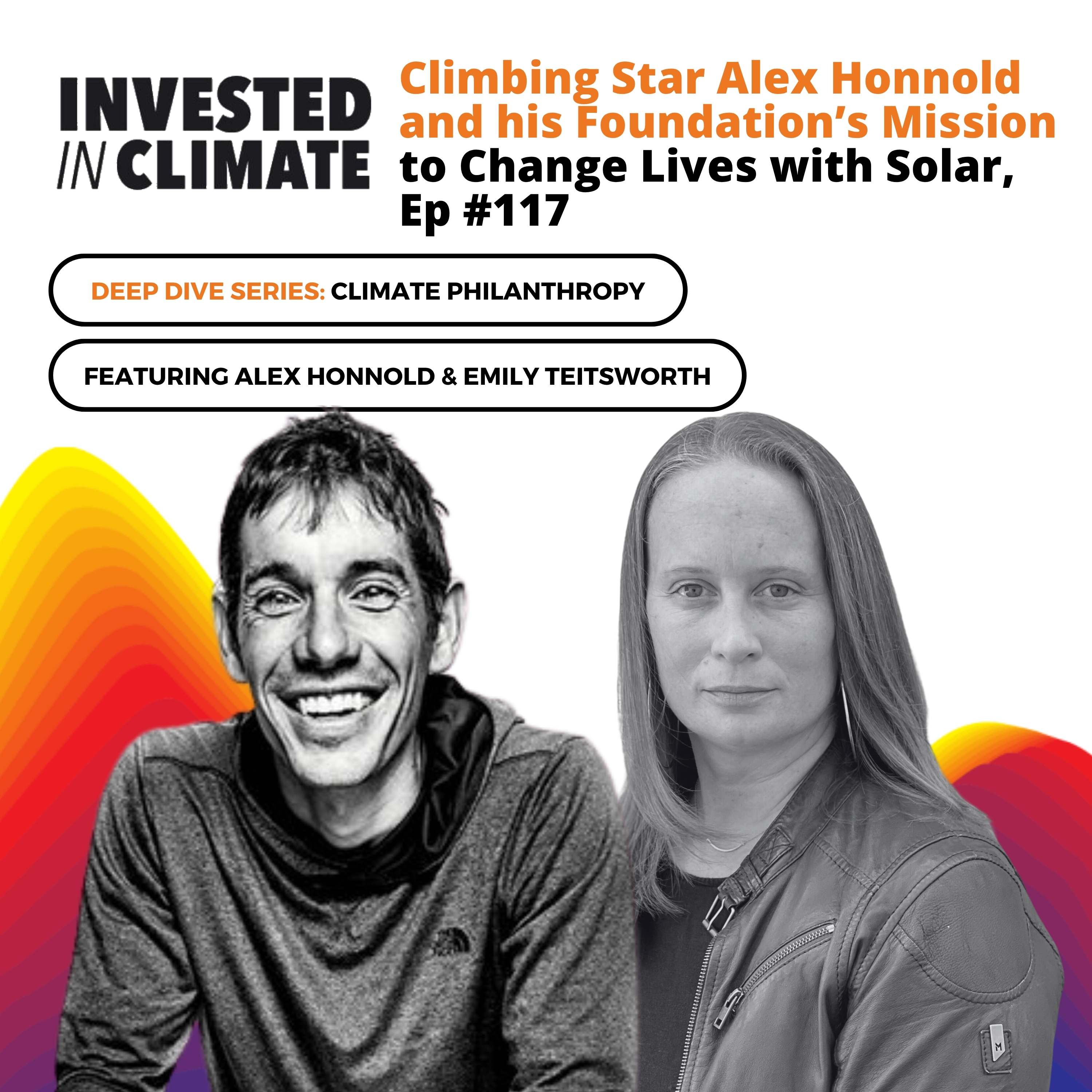 Climbing Star Alex Honnold and his Foundation’s Mission to Change Lives with Solar, Ep #117 | As you know, with government funding cuts slowing climate progress across the board, philanthropy is more important than ever. Private foundations offer just a drop in the bucket compared to government funding, but they can still play an important role and catalyze other forms of capital. That’s why I’m doing a series of episodes on climate philanthropy. If you have ideas of other foundations that should be part of this series, please reach out through InvestedinClimate.comWe spoke recently with Pisces Foundation President David Beckman on the importance of funding movement infrastructure. Today’s episode considers a totally different perspective. Alex Honnold is perhaps the world’s most famous professional rock climber. He’s also a true climate leader. He decided years ago to donate one-third of his income to address climate change, and he uses his platform to raise awareness and money to help people in remote communities develop solar projects. Alex brings a no-nonsense, pragmatic approach but also one that is deeply compassionate, prioritizing projects that change people's lives.In this conversation, I’m joined by Alex, as well as Emily Teitsworth, Executive Director of the Honnold Foundation. We, of course, talk about Alex’s history, his climbing, and how it’s influenced his climate philanthropy. We go deep into the foundation’s theory of change, some tangible examples of projects they’ve supported, and the broader impact they have in elevating a portfolio of worthy projects for other funders to consider. Alex’s resources are not vast. His dedication runs deep, however, and even with modest resources, he’s been able to support over 100 projects that have impacted thousands of people. I find Alex’s example truly inspiring. And, I hope this episode inspires you to move past the feeling that we sometimes all feel – that our resources or influence are too small to have an impact – and just do what you can.On today’s episode, we cover:[03:48] Alex Discusses Founding the Honnold Foundation[04:13] Alex's Environmental Motivation[06:18] Emily's Background and Journey[08:30] Honnold Foundation's Mission and Strategy[10:10] Reasons for Focusing on Community Solar[12:52] Importance of Community-Led Projects[14:38] Examples of Supported Projects[17:11] Foundation's Focus Areas[19:27] Specific Project Highlights[24:26] Philanthropic Opportunities[26:53] Storytelling and Media Exposure[30:42] Cultural Impact Discussion[35:20] Alex's Perspective on Impact[37:00] Persistence and Motivation in Climate Work[38:43] Alex's Recent Climbing Experience[39:32] Future Plans for the Honnold Foundation[40:24] Closing RemarksResources MentionedHonnold FoundationHonnold Foundation: PartnersCeibo AllianceAdjuntasHonnold Foundation: Featured FilmsConnectAlex HonnoldEmily TeitsworthJason RissmanKeep up with Invested In ClimateSign up for our NewsletterLinkedInInstagramBlueskyHave feedback or ideas for future episodes, events, or partnerships?Get in touch! | — | ||||||
| 6/24/25 | 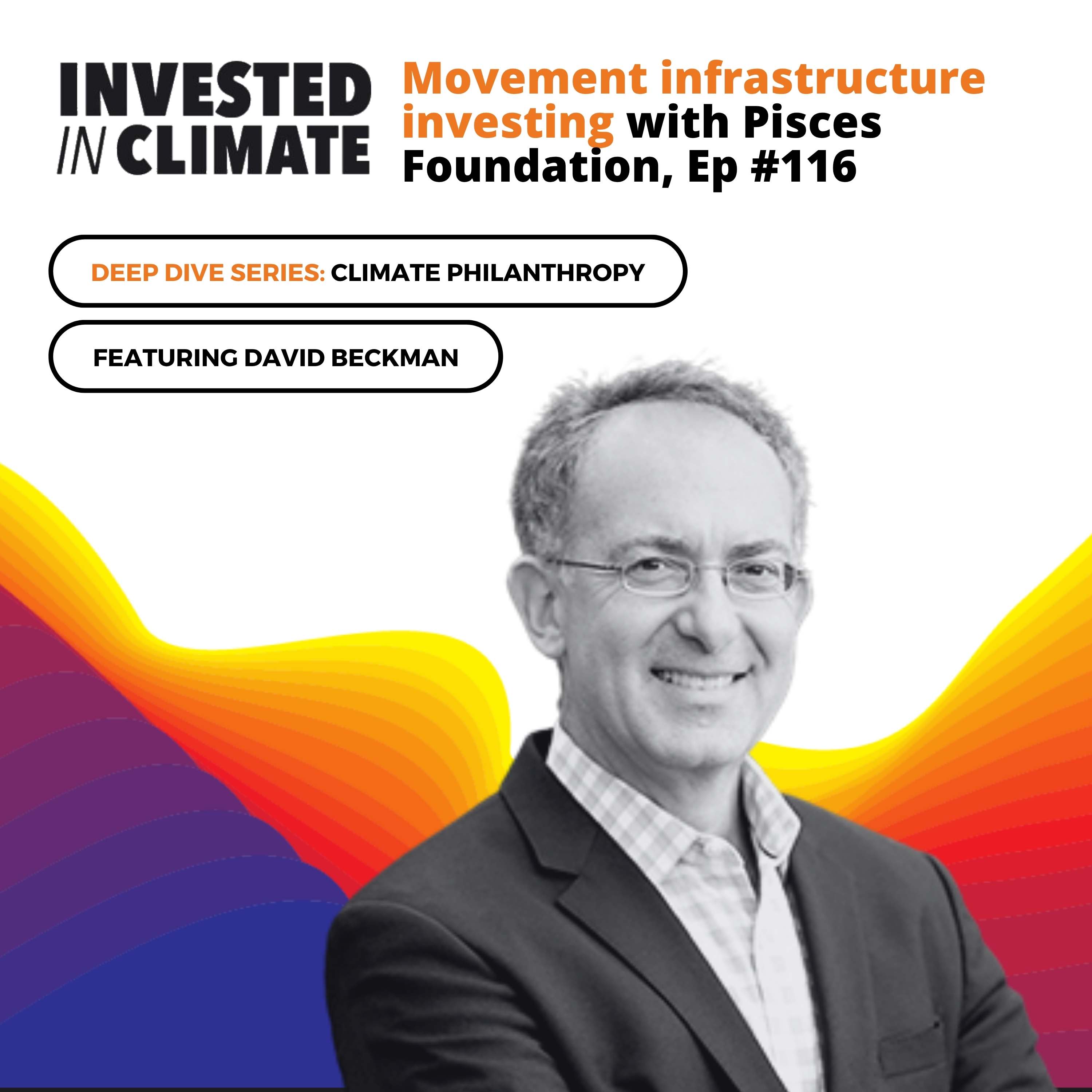 Movement infrastructure investing with Pisces Foundation David Beckman, Ep #116 | In this Deep Dive series on Climate Philanthropy, I’m exploring the wide range of ways that foundations are stepping up to support climate progress, especially amid federal rollbacks and inconsistent commitments from large companies. Philanthropic capital is tiny in comparison to government and corporate budgets, but it can still be a helpful tool – especially if wielded strategically. Let's set some context: In the United States, there are over 30,000 environmental nonprofits. It's a wildly diverse field with organizations of all sizes and countless focus areas. Since the 1970s, they’ve saved millions of lives through environmental protections that have cleaned our air, water, land, buildings, factories, and products. Many are struggling with funding cuts and staff shortages, and too often they compete for attention and resources.Foundations provide funding to these organizations, but they can also play a more fundamental role: building movement infrastructure that bolsters the power and influence of the entire field. That, argues Pisces Foundation President David Beckman, is a priority that deserves more attention and support. David is a friend whom I’ve had the pleasure of working with over the years. When it comes to investing in movement infrastructure, I can’t think of anyone else who brings the nuance and insight David has gained through a career-long focus on advancing the environmental movement. We talk about his background as an National Resources Defense Council attorney, his role in helping start the Pisces Foundation, the entreprenuerial nature of his work, what movement infrastructure is, what he’s learned about investing in it, the importance of late night cookies in building relationships, the need for a meta narrative, the work of the Pisces Foundation, super pollutants, what business people and young people should know about the environmental movement, and much more. On today’s episode, we cover:[03:49] David's Background and Career Path[05:37] Founding of Pisces Foundation[07:56] State of the Environmental Movement[09:41] Strategic Posture and Movement Influence[11:44] Collective Work and Movement Infrastructure[15:08] Social Entrepreneurship in Philanthropy[17:29] Collaborative Field Building Insights[19:49] Late Night Cookies and Building Relationships[22:31] Meta Narrative in Environmental Movement[25:32] Discussion on Environmental Regulations[28:25] Pisces Foundation's Strategic Evolution[31:33] Super Pollutants Overview[33:40] Impact of DC Politics on Philanthropy[35:48] Advice for Business Community[37:13] Advice for Young People[39:04] Current InspirationsResources MentionedPisces FoundationNational Resources Defense CouncilSierra ClubBlue Sky Funders ForumMosaic Funders CollaborativeHewlett Foundation“Abundance” by Ezra Klein and Derek ThompsonU.S. Environmental Protection AgencyEnvironmental Grantmakers Association“‘Hope is an embrace of the unknown’: Rebecca Solnit on living in dark times”Connect on LinkedInDavid BeckmanJason RissmanKeep up with Invested In ClimateSign up for our NewsletterLinkedInInstagramBlueskyHave feedback or ideas for future episodes, events, or partnerships?Get in touch! | — | ||||||
| 6/10/25 |  Rethinking Climate Finance with Spring Lane Capital & S2G, Ep #115 | In the second installment of our Deep Dive: Missing Middle in Climate Tech series, created in partnership with Spring Lane Capital, we dive deeper into why the “missing middle” is not just a gap; it's a structural issue. We're joined by two of the sharpest minds in climate investing: Francis O’Sullivan, Managing Director at S2G Investments, and Rob Day, Co-Founder of Spring Lane Capital. Together, they explore how early-stage innovation and late-stage deployment are well funded, while the crucial middle phase of scaling is dangerously underserved.We discuss why this gap exists, what solutions are emerging, and how investors are shifting their strategies to meet the moment. If you care about accelerating the climate transition, you’re going to want to listen to this.What You’ll LearnWhy the "missing middle" persists despite surging climate capital overallHow venture capital models can distort scale-up potentialWhat new capital strategies (like development expense financing) are emergingWhy climate investing now enters a “third phase” of full-scale deploymentHow Rob and Francis are rethinking returns and risk for the climate transitionIn today’s episode, we cover:[2:50] Francis' background and journey to S2G[4:36] Rob's career path in climate tech investing[6:30] Spring Lane Capital's founding and investment thesis[9:54] Discussion of the missing middle in climate finance[19:04] Structural challenges in climate investment[25:46] Organizational challenges for institutional investors[33:57] Concrete investment examples[41:37] Explanation of structured investment instruments[44:26] Historical context of climate investingResources MentionedS2G InvestmentsSpring Lane CapitalWorld Resources InstituteInvested in Climate - Missing Middle in Climate Tech Series: The Role of Family Offices with Spring Lane Capital & CREO, Ep #114S2G: 2023 Report - The Missing Middle: Capital Imbalances in the Energy TransitionCREO: 2024 Report - Understanding the Climate Finance GapSolunaConnect with UsJason RissmanRob DayFrancis O’SullivanSpring Lane CapitalWebsite: https://springlanecapital.com/Linkedin: https://www.linkedin.com/company/springlanecapital/ S2G Investment Website: https://www.s2ginvestments.com/Linkedin: https://www.linkedin.com/company/s2g-investments/Invested in ClimateSign up for our NewsletterLinkedInInstagramYoutubeBlueskyHave feedback or ideas for future episodes, events, or partnerships? Get in touch! | — | ||||||
| 5/28/25 |  The Role of Family Offices with Spring Lane & CREO, Ep #114 | The climate transition requires not just allocating trillions of dollars to scale new technologies, build new infrastructure, and transform incumbent industries – it requires getting the right mix of capital to develop, grow, and eventually scale innovations. In the world of climate, promising technologies too often don’t find the growth-stage capital that’s needed before large institutional investors can finance reaching scale. Addressing this missing middle is a structural challenge that requires more attention, and today’s episode is the first in a series of discussions on the missing middle in climate, developed in partnership with Spring Lane Capital. In this conversation, I’m joined by Jason Scott, a long-time climate investor who is Partner in Residence at Spring Lane Capital and also Board Chair of CREO Syndicate, and Régine Clément, CEO at CREO Syndicate. Spring Lane has been investing for years in the missing middle and has unique expertise in the challenges and opportunities it holds. If you haven’t heard of CREO, this is a group you should know. CREO works to help family offices invest more in climate. Families hold over $10 trillion in assets and can bring versatility and resilience that can help improve climate finance. CREO is working to mobilize $1 trillion for climate in the coming years. We talk about insights from their recent report on the missing middle, how climate investing has evolved in recent years, the role of catalytic capital, whether investors are backing away from climate amidst changing policy and macro-factors, and much more.This was a great kick-off for our Deep Dive: Missing Middle in Climate Tech series, and I hope it piques your interest in the other episodes as well. And, if it piques your interest about partnering on a topical series of your own, don’t hesitate to reach out. What You'll LearnWhat the "missing middle" is and why it's crucial for climate progressHow climate financing has evolved over the past decade and what gaps remainThe unique role family offices play in addressing climate investment gapsWhy growth-stage capital is especially scarce despite strong returns in climate investingHow policy uncertainty and structural market issues impact climate financeStrategic approaches to mobilize trillions for climate solutions by 2030In today’s episode, we cover:03:12 - Régine’s background and CREO Syndicate's work06:08 - Jason’s background and Spring Lane Capital’s work08:22 - Defining the "missing middle" in climate finance13:19 - Analysis of climate investment trends and current market dynamics17:43 - The 6x financing gap needed to reach climate goals by 203019:57 - Why the missing middle in climate is more complex than in other sectors24:49 - Structural challenges with fund sizes and misaligned investor incentives30:33 - The surprising finding that only 18% of self-proclaimed climate funds invest >50% in climate34:05 - Perspective on progress despite policy uncertainty and market fluctuations37:47 - The economic case for climate investing beyond environmental benefits41:27 - The unique role of family offices in catalyzing climate capitalResources MentionedCREO Syndicate: Understanding the Climate Finance Gap reportForbes: Where To Find The 'Missing Middle' Of Capital For Sustainable Innovations by Rob DayCTVC by Sightline Climate: $30bn and 14% fall as market finds new normal in ‘24Net-Zero Asset Owner AllianceNet Zero Asset Managers InitiativeNet-Zero Banking AllianceCREO Syndicate: Understanding the Climate Finance Gap reportConnect with UsJason RissmanJason ScottRégine ClémentSpring Lane CapitalWebsite: https://springlanecapital.com/Linkedin: https://www.linkedin.com/company/springlanecapital/CREO Syndicate Website: https://www.creosyndicate.org/Linkedin: https://www.linkedin.com/company/meet-creo/Invested in ClimateSign up for our NewsletterLinkedInInstagramYoutubeBlueskyHave feedback or ideas for future episodes, events, or partnerships? Get in touch! | — | ||||||
| 5/13/25 |  Removing Carbon Market Bottlenecks with Sylvera, Ep #113 | The voluntary carbon markets have been a source of curiosity for me. There’s been a lot of hope that the market would mature and offer a reliable way to offset emissions that otherwise could not be eliminated. Reliability has been the problem, however. Not knowing which carbon reduction projects are additive and truly remove or reduce carbon has held this market back, and I’ve been excited to learn about how new technologies will enable the reliability that’s needed. There are many people working on this problem. Dr. Allister Furey, Founder and CEO of Sylvera is one, and I was excited to learn about his company’s approach to removing carbon market bottlenecks and accelerating the investment in carbon projects. As he says it’s a mix of software, data, AI, and analysis that have helped Sylvera work with large clients and unlock enormous investments. Hope you learn as much as I did. Enjoy.On today’s episode, we cover:[03:37] Allister’s background and entrepreneurial journey[05:54] Sylvera's founding and initial business concept[10:42] Exploration of the desert greening concept[11:27] Sylvera's current business offerings[17:10] Sylvera’s progress, reach, and client base[20:24] Corporate climate commitment trends[22:44] Corporate demand for carbon projects[26:12] Policy market expectations[29:07] Climate investor sentiment[30:33] Future outlook for carbon marketsResources Mentioned Sylvera Connect on LinkedInAllister FureyJason RissmanKeep up with Invested In ClimateSign up for our NewsletterLinkedInInstagramBlueskyHave feedback or ideas for future episodes, events, or partnerships?Get in touch! | — | ||||||
| 5/6/25 |  Grant Management & Strategy: How to Win & Deliver on Climate Grants, Ep #112 | Non-dilutive funding isn’t just about landing the grant; it’s about delivering on it with excellence. In the third episode of our Deep Dive Series with Climate Finance Solutions, we go beyond the application and explore what happens after the award. Our guest host Joel Armin-Hoiland, Founder & CEO of Climate Finance Solutions, is joined by two experts who live and breathe this work: Susan Perri, Director of Grants at Climate Finance Solutions, and Jeff Haydock, CEO of ecoCFO.Together, they unpack the essential strategies behind post-award grant management from navigating audits to implementing smart financial systems, crafting efficient technical reports, and making strategic choices long before the application is even submitted. The episode offers real-world insights into federal grant reporting, shifting expectations with the new administration, and how startups can build internal or external capacity to manage complexity without losing focus.If you’re building a climate company and want to stay ahead of the curve on grants, this episode is for you.On today’s episode, we cover:[02:00] Introductions of Jeff and Susan[04:00] Susan’s background[05:29] Jeff's background[09:38] Susan’s role at Climate Finance Solutions[11:18] Post-award management best practices[14:10] Strategic elements of grant applications[16:26] Financial preparation for grant reporting[20:31] Insights on grant audits[24:14] Overview of technical reporting [27:34] Strategies for making post-award reporting easier[34:18] When to hire consultants for grant management[39:11] How to ensure smooth collaboration with consultants[41:13] Changes in federal grants under the new Administration[45:22] Alternative grant funding sources[48:24] Closing thoughts and sources of hopeResources MentionedClimate Finance SolutionsecoCFOConnect on LinkedInJoel Armin-HoilandSusan PerriJeff HaydockJason RissmanKeep up with Invested In ClimateSign up for our NewsletterLinkedInInstagramBlueskyHave feedback or ideas for future episodes, events, or partnerships?Get in touch! | — | ||||||
Showing 25 of 138
Pitch Fit is a Pro feature
See how bookable this show is for guests, which brands already advertise, the per-episode ad value, and the best-fit guest and sponsor profile. The numbers are blurred on the free plan.
How readily this show books outside guests like you.
How proven this show is for host-read sponsorships.
For Guests
ProFor Advertisers
ProUpgrade to Pro to unlock guest cadence, sponsor categories, fit scores, and per-episode ad value for this show.
Chart history for Invested In Climate
Peaked at #65 in PT, currently #65 in PT.
| Market | Genre | Peak | Current | Trend |
|---|---|---|---|---|
| PT | — | #65 | #65 | — |
| IL | — | #145 | #145 | — |
Chart Positions
2 placements across 2 markets.
Chart Positions
2 placements across 2 markets.