

Insights from recent episode analysis
Audience Interest
Podcast Focus
Publishing Consistency
Platform Reach
Insights are generated by CastFox AI using publicly available data, episode content, and proprietary models.
Total monthly reach
Estimated from 1 chart position in 1 market.
By chart position
- 🇦🇺AU · Management#6230K to 100K
- Per-Episode Audience
Est. listeners per new episode within ~30 days
15K to 50K🎙 Weekly cadence·68 episodes·Last published 3d ago - Monthly Reach
Unique listeners across all episodes (30 days)
30K to 100K🇦🇺100% - Active Followers
Loyal subscribers who consistently listen
9K to 30K
Market Insights
Platform Distribution
Reach across major podcast platforms, updated hourly
Total Followers
—
Total Plays
—
Total Reviews
—
* Data sourced directly from platform APIs and aggregated hourly across all major podcast directories.
On the show
Recent episodes
Managing Through Dry Times: What Angus Whyte Learned From 10 Years of Drought
May 13, 2026
Unknown duration
Curiosity, Contradictions & Robust Farm Businesses - with John King
Jan 30, 2026
Unknown duration
Nourishment: How Animals, People & Landscapes Learn — with Dr Fred Provenza
Jan 11, 2026
Unknown duration
Building Resilient Soils: Cover Crops, Biology & Profitable Pastures with Kevin Elmy
Dec 8, 2025
Unknown duration
What's KLR All About? The Principles Behind Profitable Livestock Decisions ~ Mel Kiel and Grahame Rees
Dec 4, 2025
Unknown duration
Social Links & Contact
Official channels & resources
Official Website
Login
RSS Feed
Login
| Date | Episode | Description | Length | ||||||
|---|---|---|---|---|---|---|---|---|---|
| 5/13/26 |  Managing Through Dry Times: What Angus Whyte Learned From 10 Years of Drought | Managing Through Dry Times: What Angus Whyte Learned From 10 Years of Drought In this powerful KLR Marketing podcast, Grahame Rees sits down with western NSW producer Angus Whyte to unpack one of the toughest challenges livestock producers face — managing through prolonged dry times. Operating west of Pooncarie near the Darling River, Angus and his family have endured nearly a decade of dry conditions, beginning in 2016 and only receiving a genuine seasonal break in early 2026. Yet throughout that time, Angus continued to make decisions, trade livestock, manage grass carefully, maintain cashflow and protect both his landscape and his family. The Worst Decision Is No Decision One of the biggest themes throughout the discussion was mindset. Angus explained that during drought, producers often feel powerless against Mother Nature. But he believes making decisions — even imperfect ones — gives you a sense of control. His philosophy was simple: The best decision is the right decision The next best decision is the wrong decision The worst decision is no decision Because when no decision is made, producers often drift into blame, frustration and paralysis. Instead, Angus believes decisions should constantly be reviewed and adjusted as conditions change. Staying Connected to Grass, Livestock, Money and People Throughout the conversation, Angus continually returned to the importance of "connectedness." He challenged producers to ask themselves: Do you truly understand your grass? Do you know the quality, quantity and species composition? Are your livestock healthy and suited to your environment? Are you connected with your finances, bank and cashflow? Are you staying connected with your family and team? For Angus, drought management isn't just about livestock numbers — it's about balancing grass, money, livestock and people together. Protecting Family and Mental Health A standout message from Angus was the danger of "overselling your time." He spoke openly about producers working around the clock feeding stock while sacrificing family relationships, mental health and quality of life. He warned that surviving drought financially means very little if families are burned out or no longer want to remain on the land. Instead, Angus encouraged producers to: involve the whole family in decision-making create opportunities for children to understand the business take breaks away from the property protect mental clarity so better decisions can be made Drought Is About Flexibility Over the past 10 years, Angus and his family have: significantly destocked when required retained only core breeding animals traded livestock opportunistically used crop stubbles strategically adjusted enterprises based on rainfall and opportunity focused on maintaining cashflow rather than chasing scale Rather than "restocking" after rain, Angus described it as simply "trading stock" based on opportunity. After receiving significant rainfall in early 2026, the business quickly pivoted: agistment cattle arrived within days trading lambs and cattle were purchased rotational grazing resumed immediately grazing pressure was carefully managed to stimulate recovery It highlighted the flexibility that comes from remaining mentally prepared and financially positioned to act. Don't Let Outside Noise Run Your Business Another key lesson was learning to disconnect from outside opinions. Angus spoke about how community pressure and pub conversations can easily creep into producers' thinking during drought. Comments about destocking, restocking or "what everyone else is doing" often influence decision-making more than producers realise. Instead, Angus reinforced: "You've got to make good decisions for your business, your family, your livestock and your land — not anyone else's." The Power of Networks Both Angus and Grahame highlighted the importance of strong networks during difficult seasons. Whether through: KLR Marketing Resource Consulting Service (RCS) industry relationships leadership groups online communities agistment partnerships Having people to discuss ideas with helps remove isolation and improves decision-making confidence. A Practical Example of KLR Principles This conversation perfectly demonstrated the KLR Marketing principles in action: balancing Grass, Money and Livestock understanding price relationships knowing cost of carry identifying opportunities making objective decisions remaining flexible understanding yourself and your mindset Rather than trying to predict the future, Angus focused on working with what was in front of him — one decision at a time. Final Thoughts Managing through dry times is never easy. But this discussion with Angus Whyte shows that drought management is about far more than feeding stock or waiting for rain. It's about: mindset communication flexibility leadership connectedness decision-making And perhaps most importantly: continuing to make decisions — even when conditions are uncertain. | — | ||||||
| 1/30/26 |  Curiosity, Contradictions & Robust Farm Businesses - with John King | Curiosity, Contradictions & Robust Farm Businesses A conversation with John King (New Zealand) hosted by Grahame Rees (KLR Marketing) Episode Summary What actually makes a farm business robust — not just productive, but resilient across seasons, markets, and generations? In this wide-ranging webinar conversation, New Zealand educator and author John King joins Grahame Rees to share insights from over 100 real farm case studies featured in his Curiosity books. Drawing on decades of experience across sheep, beef, and dairy systems, John explores why many farming "truths" don't hold up under close observation — and how curiosity, not compliance, is often the real driver of profitability. From debt reduction and grazing simplicity to genetics, marketing, leverage, and low-input systems, this episode challenges conventional thinking and highlights what innovative producers are doing differently to create freedom, flexibility, and long-term viability. 🔑 Key Themes & Takeaways Curiosity beats compliance – the most successful farmers ask better questions rather than follow industry rules blindly Robustness over maximisation – why resilient systems outperform high-input, high-stress models Contradictions & paradoxes in farming – slower growth, less fertiliser, or fewer cows can sometimes mean more profit Debt as a strategic lever – reducing debt increases flexibility and optionality Low-input success stories – farms thriving without fertiliser, chemicals, or complex systems Genetics & behaviour matter – selecting animals for structure, temperament, and longevity, not just numbers Marketing beyond the farm gate – why some producers are capturing more value by selling differently Technology vs fundamentals – when tools help… and when they distract from observation Land use pressure & forestry – the unintended consequences of policy on rural communities A simple truth – many animal health problems disappear when grass inventory and nutrition are managed well 🧠 Notable Quotes "Most problems in farming don't originate at ground level — they're six foot above it." "If you focus too hard on production, reproduction usually goes backwards." "There aren't many investments that beat reducing debt — it creates real robustness." "If you get the fundamentals right, you don't need half the technology people are selling." 📚 Referenced Resources Curiosity: Farmers Discovering What Works – John King Curiosity: Farmers Finding Freedom – John King Holistic Management & observational grazing principles Case studies across NZ sheep, beef, and dairy systems 🎧 Who This Episode Is For Sheep & cattle producers Dairy farmers questioning high-input systems Regenerative and holistic practitioners Farming families thinking about succession Anyone wanting less stress, more clarity, and better decisions 👉 Next Steps If this conversation resonated, explore how KLR Marketing principles help producers apply clarity around grass, money, and livestock — and turn insight into confident action | — | ||||||
| 1/11/26 |  Nourishment: How Animals, People & Landscapes Learn — with Dr Fred Provenza | Nourishment: How Animals, People & Landscapes Learn — with Dr Fred Provenza In this powerful conversation, Dr Fred Provenza — author of Nourishment — explores how animals and humans learn from experience, how environments shape behaviour through epigenetics, and why real change in agriculture begins "between the ears." From in-utero learning to regenerative decision-making, this episode challenges us to rethink how we manage land, livestock, and ourselves. 🌱 What This Episode Covers In this wide-ranging and deeply thoughtful discussion, Fred Provenza joins the KLR team to explore how biology, behaviour, belief systems, and learning are inseparable — in animals and in people. You'll hear about: How animals develop the ability to digest and utilise poor-quality feed through experience and early-life exposure The role of epigenetics — how genes are expressed in response to social and environmental conditions Research showing animals exposed to certain plants in utero later choose those plants and adapt physiologically to them Why animals — and people — resist change, even when current systems are no longer serving them What morning sickness may tell us about evolutionary protection of the developing fetus Why transformation usually comes through trial, discomfort, and disruption How regenerative change must start with mindset, not just management practices The influence of Bud Williams and the power of learning to truly think for yourself 🧠 Key Takeaways for Livestock Producers Animals are not passive — they learn what to eat, where to go, and how to survive through experience. Early nutrition and exposure shape lifetime performance, preference, and resilience. Behaviour and biology are shaped by environment — management matters more than genetics alone. Change is hard because beliefs are hard to shift — both in livestock and in people. Regeneration isn't just about what you do with the land… it's about how you see the land. As one Mexican regenerative farmer famously put it: "If you want to change the land, the change has to happen between your ears first." 📖 About the Guest — Dr Fred Provenza Dr Fred Provenza is Professor Emeritus at Utah State University and author of the book Nourishment: What Animals Can Teach Us About Rediscovering Our Nutritional Wisdom. His work has transformed how scientists, producers, and land managers understand: Animal behaviour and diet selection Learning in livestock Plant–animal relationships Ecological and human health connections Fred's research and philosophy have influenced regenerative agriculture thinkers and stockpeople around the world, including close collaboration and friendship with the late Bud Williams. 💬 Memorable Quotes from the Episode "Genes are incredibly stable — what changes is how they are expressed in response to environment." "Animals become intimately linked to the landscapes they are required to survive in." "It's hard to change core beliefs — in animals and in people." "The trials are what transform consciousness." "I don't want you to think like I think… I just want you to think." — Bud Williams 🔁 Why This Matters for KLR Producers This conversation reinforces a core KLR principle: Management decisions — not markets or genetics — drive outcomes. Understanding how animals learn, adapt, and respond to environments strengthens our ability to: Match livestock to landscapes Build resilient grazing systems Improve animal welfare and performance Make more intentional, less reactive decisions It also reminds us that profitable, regenerative systems start with how we think, not just what we do. | — | ||||||
| 12/8/25 | 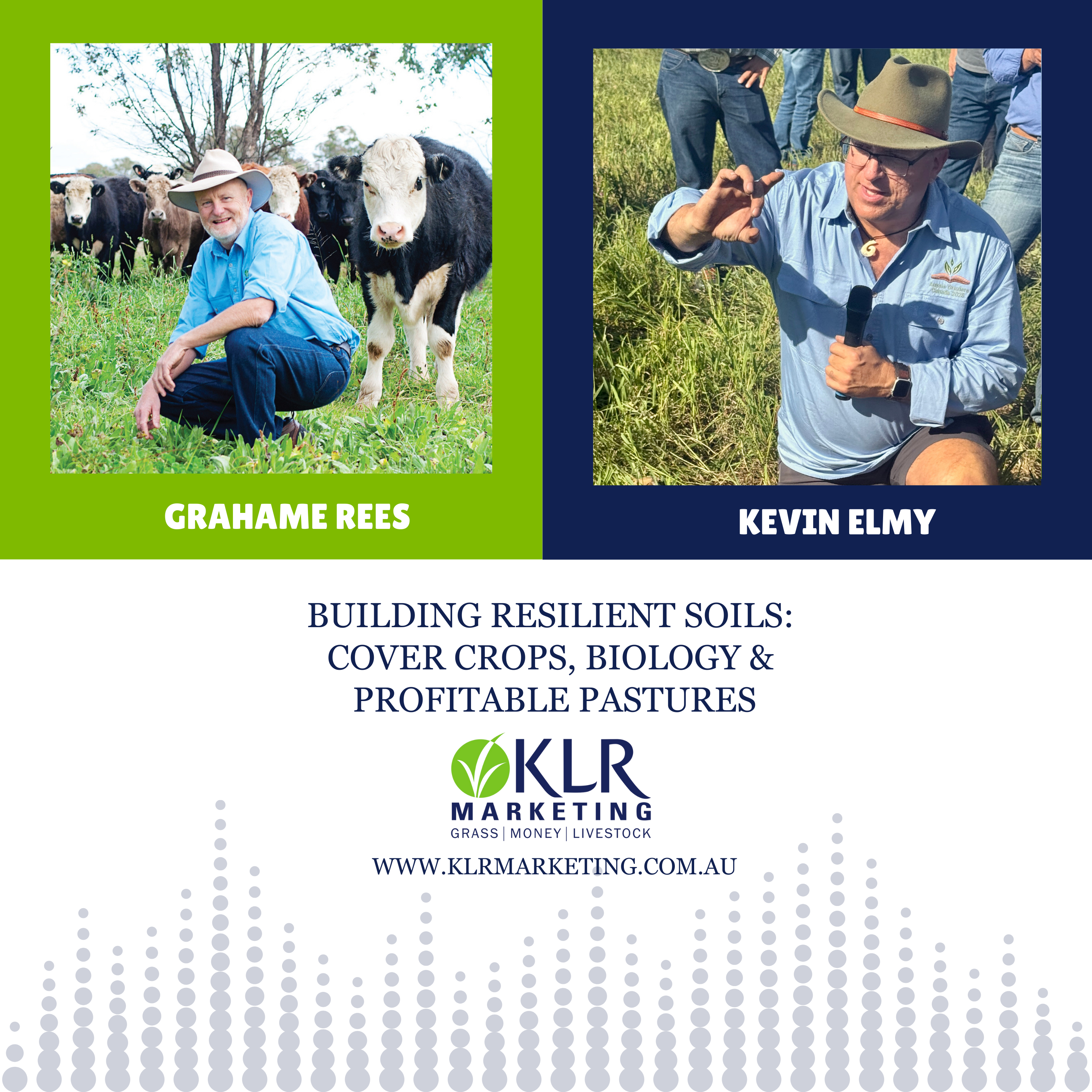 Building Resilient Soils: Cover Crops, Biology & Profitable Pastures with Kevin Elmy | Building Resilient Soils: Cover Crops, Biology & Profitable Pastures with Kevin Elmy Episode Overview In this conversation, Grahame is joined by Canadian cover cropping specialist Kevin Elmy, author of Not Just Dirt and long-time regenerative agronomist. Kevin shares how he turned "dirt back into soil" on his Saskatchewan farm, and how the same principles apply in Western Canada, Western Australia and across Australian grazing country. From multi-species cover crops and relay cropping, to weeds as indicator plants and the power of livestock, Kevin unpacks a practical, biology-first approach to reducing risk, improving water use, and lifting profitability in both cropping and livestock systems. In This Episode, You'll Learn: What cover cropping really is (without overcomplicating the definition) – simply growing plants to protect and improve soil, whether you're a grain grower, grazier, horticulture producer, or gardener. How Kevin realised he'd "bought dirt, not soil" in 1999 – and the steps he took over 22 years to rebuild organic matter, structure and biology. The five soil health principles Kevin lives by and how they link to longer growing seasons, living roots and reduced synthetic inputs. Why water infiltration and "functional water" matter more than rainfall totals – and how diverse cover crops help capture and hold every millimetre. How relay cover cropping works: seeding a low-growing cover into a cash crop, harvesting the cash crop, then letting the understory explode into growth for biology and feed. Why weeds are indicator plants, not enemies – and how high nitrate levels, low calcium and compaction are often the real problem. The importance of the fungal:bacterial ratio in your soil, and what different plant communities (weeds, natives, shrubs) are telling you about it. How combining grasses + legumes + forbs (and even flowers) creates synergy for nutrient cycling, animal performance and nutrient-dense grain and fodder. Practical ideas for using cover crops in the "shoulder seasons" so you can rest perennials, reduce tractor hours, and keep livestock grazing instead of feeding bales. Why broadcasting seed and using animal impact can be a simple, low-steel way to establish diverse covers – especially when timed with rain. Key Concepts & Takeaways Principles before products: Start with biology, living roots and diversity; inputs and machinery are secondary. Diversity trumps density: Five functional plant groups – grasses, legumes, brassicas, non-brassica forbs, and other broadleaves – with mixes of summer/winter active and annual/biennial/perennial species. Weeds as messages: Species like wild oats, Capeweed and thistles are signalling high nitrates, compaction or mineral imbalances – not "bad luck". Livestock as critical partners: Properly integrated livestock elevate soil health to the "next level" through grazing, trampling and nutrient cycling. Think like a plant and a microbe: The aim is to feed soil biology so it can feed plants, animals and ultimately human health. Guest Bio – Kevin Elmy Kevin Elmy is a Canadian agronomist, cover cropping specialist and author based in eastern Saskatchewan. After buying highly degraded "dirt" in 1999, Kevin spent over two decades rebuilding soil function using cover crops, diverse rotations and well-managed livestock. He has consulted widely across Western Canada and Australia, including work with Haggerty's in WA and workshops at Dunedoo (NSW). Kevin's work focuses on practical, profitable regenerative systems that reduce reliance on synthetic inputs while improving resilience, productivity and animal performance. Quotes Worth Remembering "If we're not making money, we're not going to be doing good things for the soil for very long." – Kevin "Weeds are just really successful plants trying to fix the soil." – Kevin "Diversity trumps density – every time." – Kevin "We focus on the livestock above the ground, but if we ignore the livestock under the ground, we're missing half the picture." – Grahame Resources & Mentions Kevin's book: Not Just Dirt Sir Albert Howard – early soil health pioneer Dr Christine Jones – soil ecologist, regenerative ag educator Nicole Masters – agroecologist, author & educator Dr David Montgomery – Dirt: The Erosion of Civilizations Who This Episode Is For Mixed farmers wanting to integrate cropping and livestock more profitably Graziers looking to reduce drought risk and improve pasture resilience Grain growers wanting to lift soil health without going broke on inputs Anyone curious about practical regenerative agriculture that works in low-rainfall, challenging environments | — | ||||||
| 12/4/25 |  What's KLR All About? The Principles Behind Profitable Livestock Decisions ~ Mel Kiel and Grahame Rees | Co-trainer Mel Kiel (Yeoval, NSW) and co-founder Grahame Rees unpack what KLR Marketing is really all about — beyond the myths, beyond "systems," and well beyond simply trading cattle. Mel shares how she went from turning up at a KLR school with a two-year-old on her hip to running a 100% trading operation and now training producers across Australia and the US. Grahame traces the origins of KLR back to working with Bud Williams, the partnership with Rod Knight and Jim Lindsay, and how the KLR principles have evolved over more than 20 years. Together, they walk through the five KLR principles, why grass is the real driver of profit, how to think about cost of carry that incorporates overheads, and how KLR helps you create cash flow and profit in any market — rising, falling, or sideways. If you've ever wondered, "What actually IS KLR?" or "Is it only for traders?" this conversation gives you a clear, practical overview. What We Cover Mel's story: from a small farm and young family to Full-time Trading and KLR trainer Grahame's background at Ivanhoe, stockmanship with Bud Williams, and the birth of KLR How Knight, Lindsay & Rees (KLR) came together — and the legacy of the Late Rod Knight Where KLR is being used: Australia, NZ, US, Canada, South Africa, and beyond Why KLR is not just about trading – and why breeders often have more opportunity The five KLR principles and how they guide day-to-day decisions Grass as the foundation: matching stocking rate to carrying capacity The concept of cost of carry vs "cost of gain" and why overheads matter Using the Business Analyzer, spreadsheets, and the cloud app to make decisions Real examples: When to Sell, When not to Replace, and when the numbers say "walk away" The role of agents, bankers and advisors in your KLR "team" The structure of the KLR Marketing School and the ongoing Mastermind & 6-week sprint Why KLR doesn't try to predict the market — and focuses on margin, not prices. Key Takeaways KLR is a decision-making framework, not a rigid system. It gives you tools and principles to make your own choices around grass, money, and livestock. Breeders AND Traders can use KLR. KLR applies whether you're trading, backgrounding, or running a breeding enterprise — you simply use the tools in different places in the business. Grass comes first. You're a grass producer before you're a livestock producer. Matching stocking rate to carrying capacity is central to both profit and peace of mind. Cash flow is as important as profit. KLR helps you design trades and strategies that keep money moving through the business, not just paper profits. Cost of Carry includes overheads. It's not just freight and animal health — overheads, interest, and time all need to be accounted for in your trades. You can profit in any market direction. Rising, falling, or sideways, there are always price relationships and margins to work with — if you have a way to measure them. Know and understand yourself. Your risk profile, habits, skills with numbers, grass management and people all affect how you use the KLR tools. You're not alone. The KLR Mastermind, agents who understand the approach, and other graduates create a support network to help implement, not just "learn and leave." The Five KLR Principles Balance the trading between the inventories of grass, money and livestock Every day we sell and replace (can be sell and replace with grass or upcoming progeny) Know the price relationship between what you have to sell and what you can replace it with today Sell the overpriced, buy/keep the underpriced (for you, after cost of carry) Know and understand yourself About the Presenters Mel Kiel – Co-Trainer, KLR Marketing School Mel lives at Yeoval, NSW, where she and her husband Dave run a 100% trading operation complemented by a mobile diesel mechanic business. She first attended a KLR school over 20 years ago and has been using the principles ever since. Today, Mel co-trains KLR schools in Australia and the US, supports producers through the KLR Mastermind, and is known for her practical focus on grass, cash flow, and unemotional decision-making. Grahame Rees – Co-Founder & Trainer, KLR Marketing School Grahame spent his early life at Ivanhoe, NSW, managing sheep and wool operation and trading cattle, He has a long background in grazing management and low-stress stock handling. After working closely with Bud Williams and partnering with Jim Lindsay and the late Rod Knight, he helped develop what is now the KLR Marketing School. Grahame continues to teach, manage livestock on a smaller scale, travel to ranches worldwide, and refine the KLR tools and principles. Standout Quotes "We're not teaching a system. We're teaching principles you can apply anywhere." "We're really grass producers. The way we sell that grass through animals determines profit." "The formula is simple: sell – buy – cost of carry = profit or loss. The human mind is what complicates it." "It's not about whether the market is high or low. It's about the relationship between what you're selling and what you're replacing it with today." "Knowing and understanding yourself is often the biggest block when making decisions." | — | ||||||
| 11/29/25 |  Navigating the Cattle Market with KLR Marketing : A Journey of Growth and Success | Trading With Confidence: How Numbers, Grass & Teamwork Drive Better Decisions ~ Rhys and Catherine Daniels In this episode, we dive into a practical and powerful conversation about livestock trading, using tools like AuctionsPlus and the KLR Marketing calculator, and how clear thinking—not emotion—creates consistent profit. Our guests share how they transformed their business by focusing on cashflow, grass budgeting, timing, and teamwork. 🔥 Key Topics Covered Using AuctionsPlus strategically – how real-time updates during a sale with the KLR Calculator App, help remove emotion and guide buying decisions. The power of the KLR calculator – working out profit per head, per trade, and per annum before committing. Setting a clear "sell" first – why knowing your sale price makes buying decisions far simpler. Removing emotion from trading – no more falling in love with "nice-looking" cattle; decisions are purely numbers-based. Cashflow transformation – how their trading success exceeded expectations and delivered stronger-than-anticipated cashflow. Why market risk is overrated – and why feed risk is now the biggest factor to manage. Grass budgeting as the real edge – understanding how feed reserves unlock opportunity and protect profit. Opportunity in low markets – why falling prices often create the best margins. Teamwork in trading – how Catherine's fresh perspective and enthusiasm enhanced decision-making. Using data to challenge assumptions – when the calculator shows cattle are overpriced, even if "they don't look done". Finding margins everywhere – using the calculator to test scenarios: sell now or add weight? Hold or trade? Balancing fieldwork and market awareness – how working together helps identify opportunities they might otherwise miss. 💡 Key Quotes "I just look at the numbers and that's the decision." "The market isn't the risk for us anymore—the biggest risk is feed." "Low prices create the best opportunities because people make silly decisions." "The calculator says they're ready." "Being able to take opportunities has been a huge part of our success." 🎧 Why This Episode Matters This episode is a masterclass in thinking clearly about livestock trading: ✔ How to trade confidently—without stress ✔ How to use numbers instead of emotions ✔ How to turn low prices into opportunity ✔ How teamwork and fresh eyes improve decisions ✔ How to remove market risk and focus on the real risk—feed If you're managing livestock, juggling grass, cashflow, and markets, or looking to improve decision-making on your farm, this episode is full of practical insights about the benefits of attending a KLR Marketing School. Find out more at www.klrmarketing.com.au | — | ||||||
| 11/18/25 |  Ranching in Colorado with Fiona Jackson, Redwing Ranch Manager | Episode: Adaptive Grazing, Sell-Buy Marketing & Ranch Team Culture with Fiona Jackson (Redwing Ranch, Colorado) Guest: Fiona Jackson, Ranch Manager – Redwing Ranch, South-Central Colorado Host: Grahame Rees Location: Eastern slope of the Rocky Mountains, elevation 7,200–8,500 ft Episode Overview In this conversation, Fiona Jackson shares an in-depth look at the evolution of Redwing Ranch — a diverse grazing operation in south-central Colorado — and how adaptive management, flexible marketing, and strong team culture drive remarkable production and financial results. Fiona walks us through the ranch's landscape, their shift away from set-stocked management, and the sell-buy strategies that generated over 42% return in 180 days being attributed to both a 'good' trade and a rising market, on some trades – without flogging the paddocks. Realistically we were aiming for around a 20% ROI and the 42% ROI in 180 days was phenomenal. The initial price relationships were showing 24% ROI which is on target for what we are looking for, and then with a rising market contributing as well, we were positioned with the 42% ROI when we sold 180 days later. Another example on our ROI, our 300 head of stocker heifers this summer had a 21% ROI in 270 day. We were pleased with this. She also discusses how their decision-making is grounded in grass availability, not habit or tradition, and why people management is one of the most critical skills for running a profitable ranch. What We Cover in This Episode 🏔 Ranch Context & Landscape Elevation ranges from 7,200–8,500 feet across mixed country: Shortgrass prairie Sub-irrigated meadows Historic irrigated hay ground Over 35 permanent barbed-wire pastures, a mile of river, and 20+ watering points Temporary electric fencing used to increase stock density and control graze periods Typical moves every 3–5 days, aligned with grass growth rate and season 🐄 Operation Overview Redwing Ranch is only three years into a major transition, and now runs: Custom grazing Short-term cattle ownership / sell-buy trading 3x Airbnb short-term rentals A new events & education arm (workshops, field days, women's chainsaw training, grazing schools) Before 2023, the ranch was leased for 16 years under continuous set-stocking with low ecological response. Today, the focus is profitability + animal performance + ecological regeneration. 💹 Sell-Buy Marketing: A Big Win in 2024 Fiona breaks down their major trade of the season: Initial Plan: Run 500 stockers for the summer. The Problem: By March, prices became too high to "buy right" — stockers were no longer underpriced. The Pivot: They identified an undervalued class: 3rd-trimester aged cows, expecting May–June calves. All while maintaining ecological goals and not over-grazing their country. 🌾 Grass-First Decision Making A key takeaway: "We don't talk enough about grass in marketing." — Grahame Fiona explains how grass conditions — not markets alone — determined their exit: By early fall, they had just 60–75 days of feed left. Instead of pushing the system, they: Sold all heifers and pairs on one big day Did NOT retain calves or keep cows (even though tempting at high prices) Switched to custom grazing with a neighbour to protect ecological and financial outcomes. This avoided: Feeding hay Market-mistimed selling Elevation health risks (PAP / brisket disease) in older cows Smart, fast decisions = avoided risk + preserved profit. 👥 Team & People Management Fiona believes: "Everything is a people problem." Highlights include: Weekly team meetings Working-on-the-business (WOTB) sessions Intentional hiring of apprentices via the Quivira Coalition Hiring for attitude and integrity more than experience Clear training systems for new team members This year's apprentice — zero ag background, previous aircraft mechanic — was a standout due to mindset and willingness to learn. Key Takeaways Flexibility beats tradition: Don't lock into one class of stock. Grass drives profit: Plan marketing around feed, not habit. Sell-buy works when you identify undervalued opportunities. People matter: Culture, communication, and fit are as important as grazing skills. Small changes compound: Moving cattle every few days, using temporary fence, and monitoring grass growth create ecological and financial resilience. Connect with Fiona & Redwing Ranch Website: Redwing Ranch, Colorado Email: Fiona Jackson (contact shared in the webinar) | — | ||||||
| 3/19/25 | Ranching in Wyoming with Sage Askin | No description provided. | — | ||||||
| 8/18/24 | What's KLR All about with Anna Tickle | No description provided. | — | ||||||
| 7/16/24 | KLR Team with James Nason at Beef Week | No description provided. | — | ||||||
Want analysis for the episodes below?Free for Pro Submit a request, we'll have your selected episodes analyzed within an hour. Free, at no cost to you, for Pro users. | |||||||||
| 2/24/20 | Bushfire Recovery ~ Thoughts and Insights with Rod Knight | https://www.klrmarketing.com.au teach the 5 key principles to running a profitable Livestock business.The KLR Marketing School is a 2 /12 day school for breeders and backgrounder's of sheep and cattle. | — | ||||||
| 2/24/20 | Should I Buy Livestock or Sell Grass with Rod Knight | https://www.klrmarketing.com.au teach the 5 key principles to running a profitable Livestock business.The KLR Marketing School is a 2 /12 day school for breeders and backgrounder's of sheep and cattle. | — | ||||||
| 2/24/20 | Buying Livestock in a Rising Market with Rod Knight | Using KLR Principles to make decisions about buying livestock in a rising market. | — | ||||||
| 2/24/20 | Restocking After Drought with Rod Knight | Rod Knight from KLR Marketing shares from a KLR perspective te things we should consider when restocking after a drought. | — | ||||||
| 7/17/19 | Coping with Disaster ~ David Younger | No description provided. | — | ||||||
| 7/17/19 | KLR Flood Disaster 2019 Response Call | No description provided. | — | ||||||
| 7/17/19 | Water with Walter Jehne | No description provided. | — | ||||||
| 7/17/19 | Call of the Reed Warbler Q and A with Charles Massey | No description provided. | — | ||||||
| 7/17/19 | How Not to Go Broke Ranching with Walt Davis | No description provided. | — | ||||||
| 7/17/19 | Dirt to Soil with Gabe Brown | No description provided. | — | ||||||
| 7/11/18 | Health and Wellbeing with Stacey Curcio | Stacey Curcio is from www.cultivatingwellness.com.au | — | ||||||
| 7/11/18 | Rural Adversity and Wellness with Di Gill | Di Gill is with the Rural Adversity and Mental Health unit | — | ||||||
| 5/26/18 | Big Scary Goals with Joy,Paul and Jane | Jane Weir, Paul McClymont, and Joy McClymont share their journey on a quest to take on a big scary goal. | — | ||||||
| 5/19/18 | Call of the Reed Warbler with Charles Massy | Charles took some time to chat about his book Call of the Reed Warbler | — | ||||||
| 5/19/18 | Regarian Planning with Darren Doherty | I chatted with Darren about his work and planning process | — | ||||||
Showing 25 of 53
Sponsor Intelligence
Sign in to see which brands sponsor this podcast, their ad offers, and promo codes.
Chart Positions
1 placement across 1 market.
Chart Positions
1 placement across 1 market.