Insights from recent episode analysis
Audience Interest
Podcast Focus
Publishing Consistency
Platform Reach
Insights are generated by CastFox AI using publicly available data, episode content, and proprietary models.
Most discussed topics
Brands & references
Est. Listeners
Insufficient chart data. Estimates will improve as the show charts.
- Per-Episode Audience
Est. listeners per new episode within ~30 days
N/A🎙 Daily cadence·25 episodes·Last published 6d ago - Monthly Reach
Unique listeners across all episodes (30 days)
N/A - Active Followers
Loyal subscribers who consistently listen
N/A
Market Insights
Platform Distribution
Reach across major podcast platforms, updated hourly
Total Followers
—
Total Plays
—
Total Reviews
—
* Data sourced directly from platform APIs and aggregated hourly across all major podcast directories.
On the show
From 13 epsHosts
Recent guests
Recent episodes
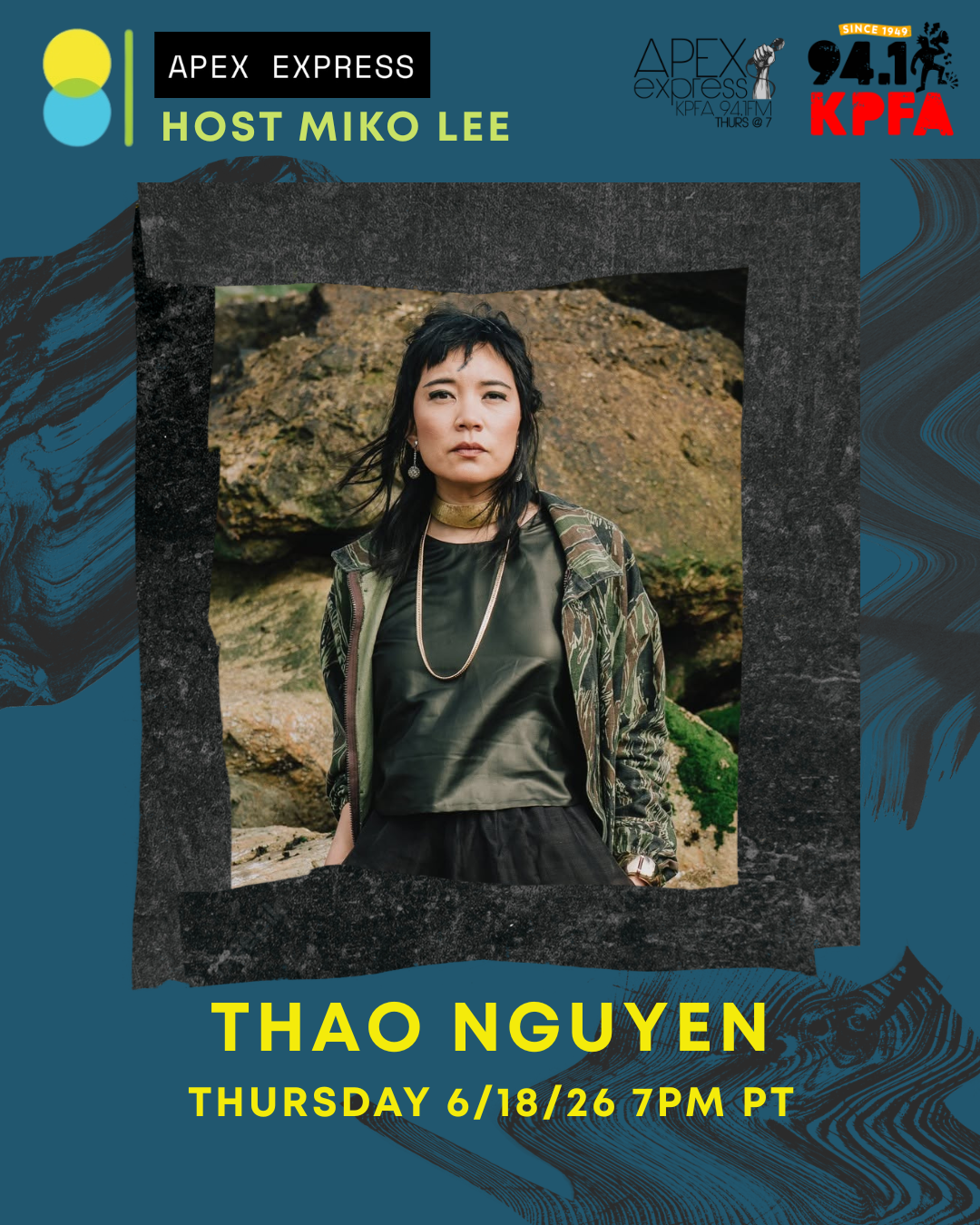
APEX Express – 6.18.26 Talk Story with Thao Nguyen
Jun 18, 2026
Unknown duration
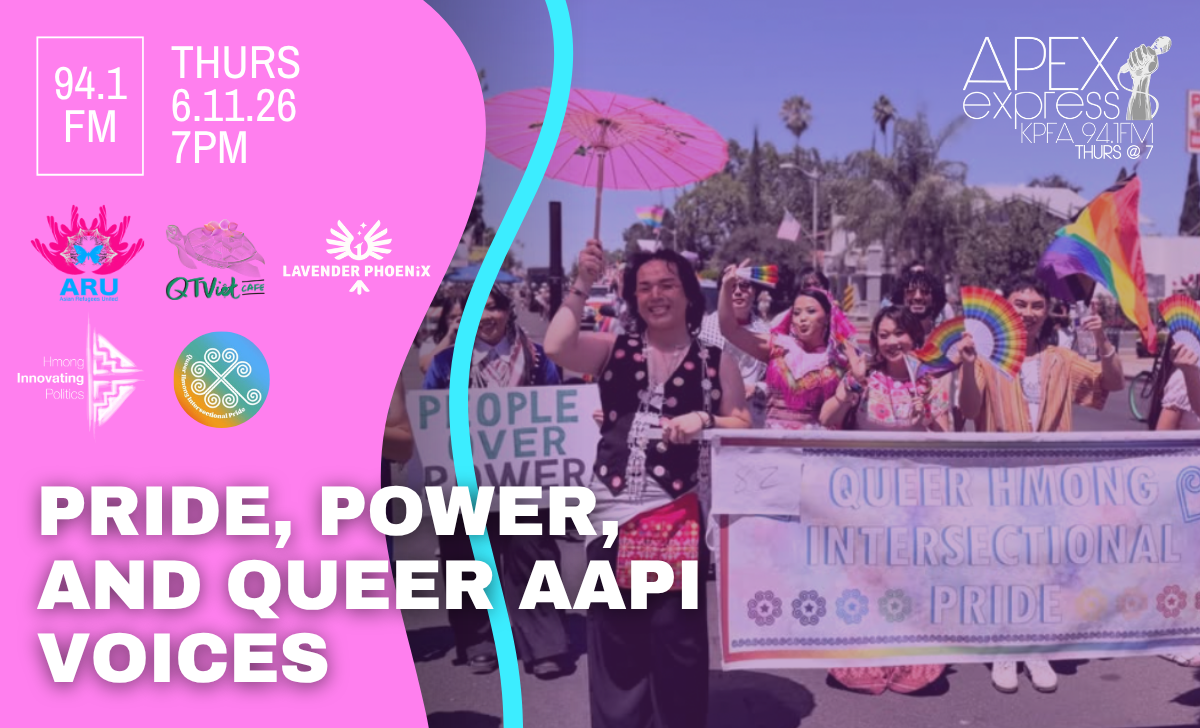
APEX Express – 6.11.26 – Pride, Power, and Queer AAPI Voices
Jun 11, 2026
59m 58s
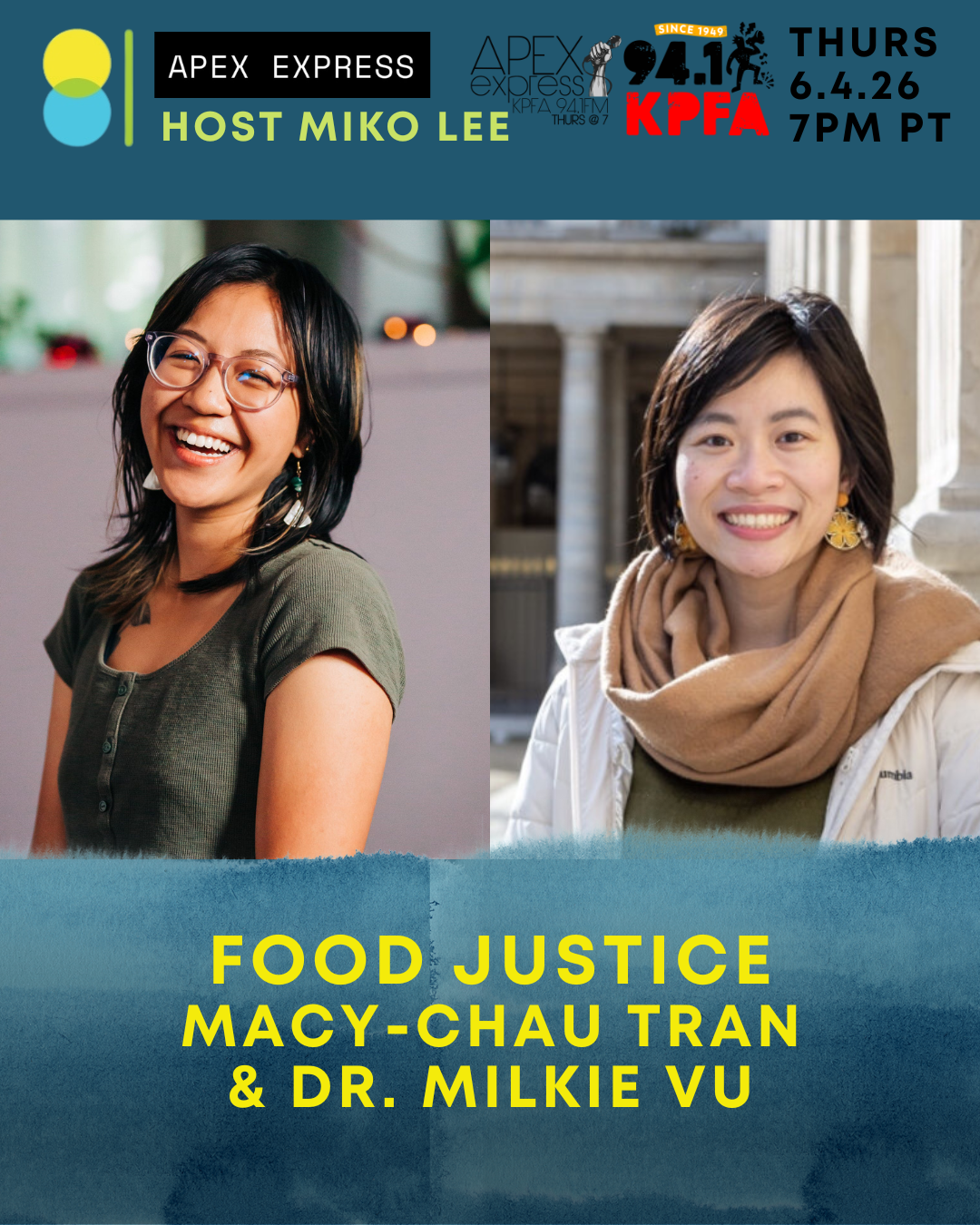
APEX Express – 6.4.26 – Food Justice
Jun 4, 2026
59m 57s
APEX Express – 5.28.26 – Building South Asian Power
May 28, 2026
59m 58s
APEX Express – 4.30.26 – Bruce Lee and the Manosphere
Apr 30, 2026
59m 58s
Social Links & Contact
Official channels & resources
Official Website
Login
RSS Feed
Login
| Date | Episode | Topics | Guests | Brands | Places | Keywords | Sponsor | Length | |
|---|---|---|---|---|---|---|---|---|---|
| 6/18/26 | ![]() APEX Express – 6.18.26 Talk Story with Thao Nguyen | A weekly magazine-style radio show featuring the voices and stories of Asians and Pacific Islanders from all corners of our community. The show is produced by a collective of media makers, deejays, and activists. Tonight on Apex Express, Host Miko Lee talk story with singer-songwriter Thao Nguyen. Hear about her new album Fossil, her short documentary, and about her artistic inspirations. Thao’s tour starts this week in North Carolina, so listen in to hear from the brilliant Thao, and then check out her website to catch a live show. SHOW TRANSCRIPT [00:00:00] Opening: Apex Express Asian Pacific expression. Community and cultural coverage, music and calendar, new visions and voices, coming to you with an Asian Pacific Islander point of view. It’s time to get on board the Apex Express. [00:00:35] Miko Lee: Tonight on Apex Express, we talk story with singer-songwriter Thao Nguyen. Join me, your host, Miko Lee, as I talk with this multi-hyphenated artist. We get to hear about her new album, chat about her short documentary, and hear about her artistic inspirations. Thao’s tour starts this week in North Carolina, so listen in to hear from the brilliant Thao, and then check out her website to catch a live show. [00:01:05] Ayame Keane-Lee: In today’s show, you’ll be listening to some songs from Thao & The Get Down Stay Down’s 2020 album, Temple. First off, let’s listen to “Pure Cinema.” MUSIC [00:05:44] That was “Pure Cinema” by today’s guest, Thao Nguyen. Let’s get to the interview. [00:05:50] Miko Lee: Welcome Thao Nguyen to Apex Express. [00:05:54] Thao Nguyen: Thank you. I’m so happy to be here. [00:05:57] Miko Lee: I love talking with creative people and you’re such an amazingly talented singer and songwriter and imagination creator. I’m wanna start with the first question I ask all of my guests, which is, who are your people and what legacy do you carry with you? [00:06:16] Thao Nguyen: Who are my people? Some of them include the family I was born into. I’m from Virginia. I was born and raised in Virginia. but I’m the daughter of Vietnamese refugees of war. And, I moved out to the Bay in 2006 after my first US tour. And, I’m so fortunate to have such a robust community here in the bay and all of my chosen family here. [00:06:40] Miko Lee: And what legacy do you carry with you? [00:06:43] Thao Nguyen: What legacy? I think the legacy I prioritize. I think, you know, [laughs] we inherit a lot and as time goes on and we get older, we realize everything is finite and you have to choose which legacies you choose to continue, and perpetuate and honor and what you have to leave by the wayside. And so the things I choose to continue and celebrate are that of a real ability to be very present and in the moment and available to joy and I think the people I come from are really good at metabolizing joy because they know the flip side of it so well. [00:07:23] Miko Lee: Ooh, that’s so interesting. Can you speak more about what it means to metabolize joy? [00:07:30] Thao Nguyen: [Laughs] uh, an ongoing practice? I think it is to be truly present and I believe, of course gratitude goes a long way, but I to fully metabolize it is to allow yourself to feel embodied in it. And, you know, there’s more somatic practice I think that to actually feel it course through your body, you are allowing it, you’re honoring it as completely as possible. And, do you have to acknowledge that it’s happening as it’s happening? You know, I think that’s having true presence with it. [00:08:08] Miko Lee: Can you roll back with me in time and talk about your earliest childhood memories of being a singer or songwriting? What came first? [00:08:18] Thao Nguyen: I loved music from a very early age, but I didn’t have a lot of access to it, to making it, it was more as a listener. The soundscape that I grew up with, there was a series called Paris by Night, which probably you’ve heard of within Vietnamese diaspora, uh, community and Culture. And it was this variety show that was, created by, people who had to flee Vietnam. And originally it was in Paris and it showcased A lot of singers and performers, who had fled, either before, during, or right after the fall of Saigon. And, it was this one gathering wherein. entertainers from the different generations, from my grandmother’s generation, from my parents were able to coalesce and exist together. And there was just this sampler platter of a lot of different sonic influences. And then you had the younger generation, which was reinterpreting what American pop music was at the time. So you’d have my grandmother who [sang] cải lương which was this incredibly, it’s like, almost like folk operatic, very dramatic, theatrical singing with a lot of pitch bending and, which I didn’t understand that I was absorbing it in such a way that I would recreate it later on in my playing, but I would go on to credit it to being from Virginia and saying it was more of like an Appalachian influence, which it was as well. But the origins, the true origins were within my soundscape before I understood what that was. You know, so you have that and then you have, an artist named Lynette who’s. basically in reinterpreting, like the latest Madonna song and has a cone bra on, so everyone’s existing act after act in the same, um, sorry for that ramble. Did I answer that question? [00:10:13] Miko Lee: Yeah. Uh, I, so what was, do you remember the age or you just grew up hearing all these different kinds of sounds? [00:10:20] Thao Nguyen: I mean, that was from before I knew what age I was, you know, that was just like, and that was such, um. For the community and within my family it was such an event every time one of these, you know, double VHS things were issued that people would be making copies, someone would drop it off at the house. You know, there, there was always one or two in circulation, but it was this. Event that you’d, [00:10:43] Miko Lee: are these like bootleg copies? [00:10:45] Thao Nguyen: Yeah, there’s like, wow, there’s bootleg. There’s also, there was one book in music store in Eden Shopping Center, which was like the hub of, of the Vietnamese community in, in, uh, Northern Virginia. And so someone would buy the original and then go and bootleg it. You don’t know how you ended up with what, but just like they would drop off some citrus and and Hennessy or whatever, and then the Paris By Night thing. And um, [00:11:11] Miko Lee: I love that the combo citrus, Hennessy and some music. [00:11:16] Thao Nguyen: Everything is a digestif, you know? And, um, so I would have that. But then of course, I, you know, I, I listened to the radio. That was what, that was my main resource and I listened to the oldie station the most, and I loved Motown. And I remember, in this I was like five or six, we had these large speakers that’s sat on the floor either side of, of this cassette deck, radio unit. And I would lay down and, every time Smokey Robinson came on, “You really got a hold of me” that was like my favorite song and I would tape it and then so either I would listen to it live or I would play the cassette and I would just lay down and get as close to the speakers as I could. But at that point, I hadn’t seen who Smokey Robinson was, and I imagined, because I also am a child of eighties and nineties. I imagined it was Crystal who was Roseanne’s best friend from the Roseanne show. You know, I didn’t know anything, but I felt all of it. [00:12:20] Miko Lee: Wow. Yeah. I love that. So, I love that. And I was really wondering, I heard this story about you, that you actually did a rap for on Charlotte’s Web when you were in elementary school. [00:12:33] Thao Nguyen: Okay. Okay. This is a deep cut. You’ve done some research. [00:12:39] Miko Lee: Tell me about how that came to be. So you must have been introduced to rap pretty young to be doing that. [00:12:44] Thao Nguyen: Oh, absolutely. This, so this was another, and this, I’m so glad you brought that up, because all of this is, every genre, every kind of music I, at this point is so vital to me, and it actually goes on to reflect the kind of music I make. And so I have an older brother who’s almost eight years older, and around this same time, he’s a huge hip hop fan, or that’s one of the things he loves, he loves like Duran Duran and like the Fat Boys, you know? And , when I saved money, the first cassette I ever bought was Salt-n-Pepa. And I, yeah, so I was listento the Fat Boys and Queen Latifah. And I loved, I loved every, I loved to hear the flow, the different cadences and in third grade I was voted best rapper. This, and, you know, not coincidentally. This is the year I, I do the book report, the Charlotte’s Web, you know, and they gave me the option. You can either write it or you can write a song or whatever. And so I wrote a rap about Charlotte’s Web, but I was too shy. I had recorded it and just played it in my presentation. I didn’t perform it live. [00:13:51] Miko Lee: And how was it received? [00:13:54] Thao Nguyen: I mean, I can still hear the roar. yeah, everyone, [laughs] I think the teachers [00:14:01] Miko Lee: The crowd roared. The third graders roared. [00:14:03] Thao Nguyen: Yeah. I mean, everyone’s standing on their desks. It’s rickety, you know, teachers are worried about child safety, it doesn’t matter. They’re like, Encore. I’m like, I don’t have anything else. Uh, you know, uh, [00:14:15] Miko Lee: Wait for real? [00:14:17] Thao Nguyen: No, no. [laughs] the teachers thought it was cute. Probably the kids thought it was funny. I actually don’t know because I was so nervous I even pressing play. I was so nervous. I don’t know if I registered what, how it was received. [00:14:34] Miko Lee: That’s so sweet. Given your eclectic music knowledge and the music that was around you at the time as a musician, now you’ve been described with so many different categories, country tinge, indie folk, pop, blues. How would you describe your music? [00:14:54] Thao Nguyen: I would describe it as. What’s embarrassing is I’ve been doing this a long time now and I’ve never figured out a way to describe it. I would, I, I generally just say it’s, you know, it’s under the umbrella of indie rock, but influenced by jazz and hip hop. And because I learned to play guitar by picking out country blues songs. And because I grew up in Virginia, there, there are these, like old time, Country blues picking patterns that I’ve used. I, you know, it’s, yeah. So that, I’ve never figured out a way to say it succinctly and I continue [00:15:29] Miko Lee: and you don’t need to. That’s okay. [00:15:31] Thao Nguyen: Thank you. [00:15:31] Miko Lee: Is there a big Vietnamese population in Virginia? [00:15:35] Thao Nguyen: Yeah, I, I think there is a very healthy population there. And it was one of the first places that people were settling when they were being resettled. And my parents met, in a refugee camp in Guam. And then they were sent to Arkansas. And then from there sponsored out to North Carolina. And then from there of a few friends that they had made, had found work with Metro, which is the public transportation train system in DC and found my dad work there. So that’s why people resettle, that’s why we ended up in Virginia. [00:16:16] Miko Lee: So Thao & The Get Down Stay Down you released five studio albums and now you’re working primarily as a solo artist. Right? [00:16:25] Thao Nguyen: Yes. Yeah. I will say I still work record and perform with a band. And a lot of the people who worked and performed with me in that iteration are still with me. it was more I wanted to, just use my name and move beyond what the get down stay down was, which I was never really sure. With things that you choose when you’re 22. As time goes, you know, it starts to, and you’re lucky if you can kind of shed things and not, not stay beholden too much. [00:16:57] Miko Lee: Ah, what have you learned to shed? [00:17:02] Thao Nguyen: Oh my gosh. Thankfully a great deal and it’s an ongoing exercise, but. I used to be so much heavier with the weight of what I thought a serious artist was what I thought a serious songwriter should be, who I thought, where I thought my, you know, different benchmarks of what success were. What I should be making versus what people wanted to hear versus what I wanted to hear. I actually never I wasn’t always all the way sure about what I wanted. You know, I, I think a lot of people encounter that, but I’ve thankfully been able to shed as much as I can. It’s an ongoing practice, but I, you know, one thing it. Is that I used to think, I can’t believe I’ve been doing this this long. And it’s, not necessarily, I didn’t understand what I was working towards, but only that I had not gotten there yet. And then, you know, I think pandemic and on, I’ve been just so and as I get older, the transition into being so sincerely grateful that I’m still here and I get to do this. this is what my job is, and however I can, and whatever I can do to sustain, being able to, to do this for my livelihood and maintain my integrity within it is the greatest gift. So as when I made that switch a a lot of things, a lot of the darkness left me. [00:18:39] Miko Lee: Oh, that’s beautiful. Thank you for sharing. [00:18:42] Ayame Keane-Lee: Next, let’s listen to Temple, the first track off of Thao’s album of the same name. MUSIC [00:22:56] That was Temple by Thao and the Get Down Stay Down. Back to her interview with Miko. [00:23:01] Miko Lee: I’m wondering if you could talk a little bit about the 2017 documentary Nobody Dies, a film about a musician, her mom in Vietnam. How did that, and that’s a documentary that follows you and your mom as you go to Vietnam. I’m wondering how that project came about. [00:23:17] Thao Nguyen: Yes, I’m happy to tell you about it. in 2015 I was invited by concert promoters in conjunction with the US Embassy based in Hanoi, to come perform for the, I guess at that point it was the 25th anniversary of the normalization of relations between the US and Vietnam, and I was able to bring my band and I was able to bring my mom, and she hadn’t been back in 43 years, and she used to work for the South Vietnamese embassy and was stationed in Lao, when Saigon fell. So she actually left Vietnam in 73, assuming she would go back after her time abroad and then was never able to return. So I was able to bring her, the struggle was would she actually come, you know, and we had, I had, a bear of the time initially convincing her it would be okay. And, it was like, just begging her to come. She’s like freaking out. She hangs up on me. I call back. She hangs up. You know, it was a back and forth that I’m trying to convince her of things that I’m not sure of where she’s like, I’m still on a list. I’m like, no, you’re not. But I don’t know that, you know who, how would I know that? But I told her she wasn’t on the list. Anyway, my, a friend of mine who’s a filmmaker, as this all was happening, he asked if he could come along and document all of it. And he and, his DP traveled with us and it was an incredibly intense trip, and it was beautiful and I am so glad it was documented. And then somewhere along the way I had a performance and, this was all in editing. And then I ran into Don Young at CAAM Center for Asian American Media. Oh, I know what it was. It was something for Sundance and Don Young and I were just in the same shuttle going to the airport and we were talking and I told him a little bit about this and then I sent him some footage and you know, and then CAAM and PBS were gracious enough to co-produce and, Make it so it could be, you know, a a half hour documentary that aired on PBS. Um, [00:25:21] Miko Lee: so that that was on a bus ride. [00:25:23] Thao Nguyen: That was on an airport shuttle. [00:25:25] Miko Lee: Airport shuttle. I love it. [00:25:26] Thao Nguyen: Yeah [laughs]. [00:25:28] Miko Lee: So was it hard to convince your mom, I know it was hard to convince her to go to Vietnam. Was it hard to convince her also then to be on film? What was her response to that? [00:25:37] Thao Nguyen: Well, luckily for all of us, my mom loves to be on film and is, um, a total flirt and ham and. Oh, [00:25:48] Miko Lee: so that was a bonus. That was like a, [00:25:49] Thao Nguyen: that was a bonus. The camera loves her. As did the film director, my friend Todd, she loved it. And she just, she comes alive and she’s a true performer. And, it was really beautiful to see her in this element that I, I didn’t know if I’d ever, I actually. Never thought I’d get to see her this way. You know, I grew up, both my brother and I grew up translating for her, it is sort of at every, at every level. And, we’d go out to restaurants and it’s not that she, you know, it’s like she would get shy and then it would just easier, it always just became easier if we just did it for her. But, so we’d order for restaurants and, and to see her. not to say that she doesn’t I mean, she was a small business owner. She owned a laundromat, dry cleaners in Virginia and totally is the reason why everybody is alive, you know? But, to see her move so seamlessly and easily, I’m sorry, it’s emotional in the world was this, such a gift I didn’t know I’d get. And, You see her haggling with people, you know, and, and she’s directing as she’s pointing out. Yeah. It was just a really, no matter how long someone has been away from the place they were born, you know, to see them back there is, um, it was, yeah, it was just such a beautiful gift and I’m glad we have it on film. [00:27:17] Miko Lee: Did you discuss that with your mom? How different that was for you to see her in a different way? [00:27:22] Thao Nguyen: You know, not, not, um, not directly. I’ve written about it, but I’ve not, we don’t have the kind of, Yeah. That, that’s never come up in those ways. You know, we talk a lot. I basically, I try to call her at least, uh, almost every day, just ’cause she lives across the country. So I wanna just be sure that, you know, I’m just doing these like, casual wellness checks, but we don’t often get into those more philosophical conversations. Um, but she did, you know, the, the song Temple, Which would become the lead single of the album Temple was, inspired by this moment of candor that I had never experienced before and I would never experience again. It happened one night when we were in Vietnam and she just said outta nowhere. You have to understand what freedom is and you have to understand why a million people would risk their lives at sea, and I can’t. I can’t teach you that. I can’t help you with it. You have to know for yourself. And that’s what became, the song Temple where wherein she’s speaking to me about her life before, during, and after war. [00:28:35] Miko Lee: That’s so powerful. Thank you for sharing. I, I appreciate that about your music, the personal, visions and dreams and pain that you experience putting that in. Is there another song of yours that really stands out to you? [00:28:51] Thao Nguyen: Another one. Aside from that? [00:28:53] Miko Lee: Aside from that. [00:28:54] Thao Nguyen: There’s. You know, yes, there’s a, there’s definitely a few from this new album that is, that I just finished and it’s releasing in September. From that same album Temple there’s, the song Marrow. there’s a few. That album is as much, it was, it was this, I just had this, I knew that I had to make it both about, what my Vietnamese identity is and what it is to be queer in Vietnamese and stay in the culture, which is not something that I thought I could do. So yeah, I would say both Temple and Marrow encapsulate, this effort to fully align myself in ways that I hadn’t been able to. [00:29:40] Miko Lee: And what is Marrow about? [00:29:42] Thao Nguyen: Marrow is about what it means to fully accept yourself so that you could offer yourself to the rest of your life. You know, it’s, it’s like. [00:29:54] Miko Lee: That’s all. [00:29:56] Thao Nguyen: That’s all. And it’s, and it was against the backdrop of getting married. but it was more about me coming to terms with not even coming to terms, like even that language is so, disparaging. It’s, it was just about claiming myself and saying to my family, I need to be, you know, I, I need to be my full self and I believe I can be with you still. But you know, the lines are, It’s so funny. I sing it all the time and I can’t do that. The line I’m thinking of in particular is, at that point I’m apologizing to my partner at the time and saying, you know, I am basically, I couldn’t claim us because of this barrier, but I’m sorry to you and I’m sorry to me, and the, you know. I have grief in my marrow. Will you marry me still? So is it, that’s a roundabout way of explaining what that, what that song is. [00:30:54] MUSIC [00:34:24] Ayame Keane-Lee: You just listened to “Marrow” by tonight’s guest, Thao Nguyen. [00:34:28] Miko Lee: You talk about Temple and how that was based on this trip you took in 2015, right? 2016. How long does it generally take you for a song to germinate? [00:34:41] Thao Nguyen: You know, that one, um, that’s, that is an example of a, a longer, uh, gestation period because it was such an intense, because Vietnam was such an intense time. Uh, it was months, maybe it was two years before I could even think about it, honestly. And there are other things that happen. I wish things happened more instantaneously. It’s very rare that a whole song will just present itself. You know, temple, that song in particular, when I started writing it, it took maybe two hours, but it took me two years to get to the point where I could [00:35:20] Miko Lee: And it just came to you in two hours? [00:35:22] Thao Nguyen: Yeah. It just came, just the vision. All those, the imagery, everything that I’d wanted to say. It just, I understood how. To present it. And I think I had tried in other forms over that time, but it just wasn’t ready. Other songs, um, yeah, anywhere from it’s, it’s like the chorus or a hook or a verse will come very quickly, and then the time, the more arduous stuff is building around it to make sure that it, it, you know, it’s properly bolstered. Like I, if I believe in a hook, then I’ll, I’ll try to build the house around it. [00:36:02] Miko Lee: And how, what do you do? Do you just record it straight up right when you get the hook, like on a small device or what’s your process? [00:36:09] Thao Nguyen: It um, typically I’m playing an instrument, either guitar or piano or I’ve written, you know, sometimes I get bored, I write on other instruments, but primarily it’s guitar, piano, and, um. It’ll be the melodic hook only on the instrument, and then I’ll put words. But yeah, it’s, I, I just use voice memos and then as I’m building it, then I’ll move into pro tools and, and, and record a more proper demo. [00:36:40] Miko Lee: And do you have a set working process or you just vibe it whenever you’re feeling it? And I ask because I always ask this of artists. Because I think it’s so interesting, what is the discipline it takes for your art form? And I remember I interviewed Isabel Allende years ago and she said, yes, I make myself go in my studio at 8:00 AM every day. And even if I can’t write, I sit there from this time to this time. So what, what is your process like? Or do you have a set process? [00:37:05] Thao Nguyen: Yes. Absolutely. And it’s taken me so many years to figure out what my set process is and to have the discipline to really, really, um, I do believe it is a daily practice and it is a daily discipline and I’m so afraid of what happens when I slip out of it because I know what happens. I’ve tumbled into this very dark, deep well of despair and I don’t know. You, you start to question what your whole purpose is. It gets bad very quickly, right? So I’m always trying to stay on the side of not completely sliding down. Not to say it isn’t very joyful and I mean this a very lucky position to be in. One of the things that’s been going on for the last few years is I have multiple projects going on at once and I do have to figure out, I had an, um, the album is just finished thankfully, but I am developing a musical and I’m also writing a book. And so I have to figure out, I divvy out the days. I would like to say that I can work on all three in one day, not possible. So I have to choose, um. And it’s always, the morning time is the best for generating something from nothing. And then I try not to edit or revise or question it until that afternoon or later. Actually, you don’t question it within that same day. Like the main, I think the main priority for me is maintaining momentum and optimism. So I need to do whatever it is to thwart whatever part of me is trying to take it down. Um, so I’ll work in the morning for a few hours and then leave it, you know, and as writers say, leave it no matter if it’s songwriting or whatever, like leave it at a place where you, when you start again, you feel good about it and you know what the next step is. [00:39:08] Miko Lee: Do you have a set time? It’s like just the morning from this time to this time. And then do you say musical today? Book today. Album today. How do you do that? [00:39:17] Thao Nguyen: Well, it depends on the deadlines. [00:39:21] Miko Lee: Of course. [00:39:22] Thao Nguyen: I, yeah, I, I work to the deadline. ’cause there’s always, thankfully, there’s always at least one happening and yeah, I. I love this by the way, because I actually, when I’m stuck, I just look up different routines for writers and artists. It’s like my favorite thing to do. So I love to participate in this conversation. Um, but I wake up, I meditate, I try to do a little stretching, and then I do a walk. It depends on where I’m working. Okay? Here’s the thing. If I’m working on music, I have to work at home. If I can write, then I’m gonna go to a coffee shop or the library or my friends just opened up local economy, uh, that, that, so I’ve been going there and because writing is so lonely and miserable that I cannot be in the house, I, I, there’s no way I have to be in public. Um, and just at least feeling the energy of other life [00:40:18] Miko Lee: With songwriting also? [00:40:19] Thao Nguyen: With songwriting, I have to be home ’cause I’m making all this noise. So what? Yeah, with songwriting I’ll be at home, but that’s way less miserable ’cause I can just play guitar or piano or something and then, or I’ll be in studio with my friends that I’m making the album with. Um, now that I’ve finished the album and I’m moving and I’m more squarely in the book writing, um, I try to do two hours. You know, not, not solid. I will try, like, for a while, um, I was doing the timer with the, you know, 25 minutes at a time. And then that wasn’t, I wasn’t getting enough done and then, yeah, and then more than two hours. I, I just can’t, it’s not sustainable. Um, for me, I feel like I get a solid hour to two. Or maybe you hit like a two page, two or three page, um, quota or something, and then just don’t even look at it and then go, and then I go exercise and I need to be outside and, or go on a hike or something. [00:41:34] Miko Lee: Okay. Tell us about this book. What is it about, what’s the timeline? No pressure. [00:41:41] Thao Nguyen: I would love to tell you what it was about, if I knew better. Um, what it was. It’s, it’s a collection of essays and I’m calling it, so it’s, it’s, uh, it’ll be out on Gray Wolf, um, into, in spring of 27. And so it is due relatively soon ’cause they, it’s a longer lead time. I’m calling it a community memoir, um, because it’s a collection of essays from different, it’s all through my lens, but it’s to celebrate these characters that I grew up with in Foster Virginia, within my family, within the community that I, they’re so vivid to me and. Their stories. The quieter sides, the quieter moments of what it means to live in diaspora or what I wanna capture. And also what, you know, part of it is what shaped my musical life. And, and there are all these influences and elements that I, that I just wanted to celebrate and honor and. These people that I remember, but I, I’m, we’re all, you know, I’m, I’m turning 42. I’m like, I, we’re close to lo I’m close to losing the Hi-Fi detail of them, you know, and, and I don’t know who else, is in a position to capture it. You know, and, and also it’s this amazing opportunity to talk to my mom’s, brothers and sisters. You know, there are tales. There’s, of course, you grow up with, I think it’s really different to, I was raised, you know, in Virginia by my, primarily by my mom. My grandmother and my aunt didn’t come till I was five, but the stories that I heard. Mostly were from my mom who fled in, who left in 73, and her experience is so different than my grandmother, my aunt, all of my mom’s siblings who stayed, who had to stay through the fall and, and live in a different regime, you know? And so to get to hear those stories of just like the more quotidian indignities of what is life after you’ve lost your. To them they’ve lost their country, but they’re still in it. You know, like, what is it to, with what were the rice rations like? Yeah. So, 50 years on what stays with people, you know, against the backdrop of the most devastating thing that can happen is that like the rice was so broken and it was so rationed and the quality of it was so infuriating and that they and my uncle talks about just for the 50th anniversary, I went back, I had an event, um, I think at the Smithsonian, and I went and I was staying with my uncle, and so I was able to ask them questions and he remembers buying meat on the black market. But you, you’d go to this market, you’d make eye contact with the person. They, you follow them to a behind the stall. They give you this meat wrapped in newspaper. You don’t even know what it is. You don’t, you can’t unwrap it till you get home, you know? Anyway, those are the things that I, I just am so fascinated by, and I, there’s just this kind of humanity and life in them that I wanna help. Um, record and if nothing else, just so that I know that it gives me an opportunity to ask these questions. Um, there’s stuff about, you know, I’m estranged from my father and I have a lot there, there are things that I, you know, it just, these essays are helping me, better understand and, and process. these open-ended. storylines that, that, have punctuated and haunted me. [00:45:38] Miko Lee: And this is your first book, right? [00:45:40] Thao Nguyen: It is, yes. [00:45:42] Miko Lee: What made you decide to do a book format and also essays, I heard you say? Mm-hmm. Um, as opposed to another album or a series of songs. [00:45:52] Thao Nguyen: Um, I’ve always wanted to be a writer. Bef I wanted to be a writer before I was a songwriter, before I wanted to do anything. And I think it scares me the most in my life. And, and it was time to, you know, the opportunity came up, um, very fortunately to get to write a book for Gray Wolf, which of which I’m a huge fan, you know, and, uh, it’s a true honor to be affiliated with them. And. Uh, I wanted to do it because it’s a lifelong goal and dream, that actually is way scarier to me than making music and performing music. So I, I kind of just needed to see that I, I needed to try. [00:46:38] Miko Lee: And why an essay format? [00:46:40] Thao Nguyen: Um, I think that’s what naturally. For this, for the first go, it, it, it is what naturally I’m drawn to and what happens most easily. Uh, and I think they’re similar to songs in that way. And I, I am very much as a writer, as a songwriter or any or prose writer, I want to try and just capture the, a moment and a feeling and I. Um, that’s my main prerogative and my main compulsion when I write. And so for this first go, I’m hoping that there will be more, but this, yeah. Is, is just the, the easiest way to package it. [00:47:28] Miko Lee: I’m absolutely looking forward to reading it. Now share about a musical. Tell me more [00:47:34] Thao Nguyen: Musical. I don’t know how much I can say besides, uh, it’s not been announced yet, but I do, I have been in, I do spend a lot of time in New York, um, and it’s an adaptation. Um, I. I shouldn’t have. I, I just wanted to mention that it was happening, but I know now that I sh I can’t actually say. [00:47:56] Miko Lee: Okay. That’s okay. It’s secret, So how can our audiences find out more about you and your work? We’ll put a link to your website absolutely. On their webs, on our, program page. But are there other ways that folks can find out more and keep up to date with what you’re doing? [00:48:11] Thao Nguyen: For sure there’s, um, well, all the social media, um, outlets were on there @thaogetstaydown. And um, I have a substack called THAO For The Record, which actually was just me sort of documenting my process of making this next record. Um, but that is my preferred way to be in touch in a more long form, um, less harried way. And the new album is coming out in mid to late September. And so I’m really excited about that. And we’re, we are gearing up for more touring, starting the summertime. [00:48:54] Miko Lee: Excellent. Can’t wait to listen to you more and hear the new, piece. And thank you so much for joining us on Apex Express. [00:49:02] Thao Nguyen: Thank you so much for having me. It was such a joy to speak with you. [00:49:05] Ayame Keane-Lee: The last song we’re playing tonight is also the last on the album Temple. It’s called “I’ve Got Something.” MUSIC [00:53:51] That was “I’ve Got Something” by Thao & The Get Down Stay Down. [00:53:55] Miko Lee: Thank you so much for listening tonight. Remember to reconnect to your ancestral technologies and hold in the power of tenderness. Please check out our website, kpfa.org/program/apexexpress to find out more about our show and our guests tonight. We thank all of you listeners out there. Keep resisting, keep organizing, keep creating, and sharing your visions with the world because your voices are important. Apex Express is produced by Ayame Keane-Lee, Anuj Vaidya, Cheryl Truong, Isabel Li, Jalena Keane-Lee, Miko Lee, Miata Tan, Preti Mangala-Shekar and Swati Rayasam. Tonight’s show was produced by me Miko Lee, and edited by Ayame Keane-Lee. Have a great night. The post APEX Express – 6.18.26 Talk Story with Thao Nguyen appeared first on KPFA. | — | ||||||
| 6/11/26 | ![]() APEX Express – 6.11.26 – Pride, Power, and Queer AAPI Voices✨ | Pride Monthqueer AAPI community+3 | — | QTViệt Cafe CollectiveQueer Hmong Intersectional Pride (QHIP)+2 | — | Pride Monthqueer AAPI+3 | — | 59m 58s | |
| 6/4/26 | ![]() APEX Express – 6.4.26 – Food Justice✨ | food justiceAsian America+3 | Macy TranDr. Milkie Vu | APEX ExpressKPFA | — | food justiceAsian America+3 | — | 59m 57s | |
| 5/28/26 | ![]() APEX Express – 5.28.26 – Building South Asian Power✨ | South Asian political powercross-movement solidarity+3 | South Asian Coalition | South Asian CoalitionManavi+3 | — | South Asianpolitical power+5 | — | 59m 58s | |
| 4/30/26 | ![]() APEX Express – 4.30.26 – Bruce Lee and the Manosphere✨ | Asian American menBruce Lee+3 | Jeff ChangRachel Koelzer | NakasecBruce Lee & the making of Asian America, Water Mirror Echo | — | Asian American menBruce Lee+5 | — | 59m 58s | |
| 4/23/26 | ![]() APEX Express – 4.23.26 – Nurses of The Pitt✨ | Filipino heritagehealthcare professionals+3 | Amielynn AbelleraKristin Villanueva | HBO MaxThe Pitt | — | APEX Expressnurses+7 | — | 59m 58s | |
| 4/16/26 | ![]() APEX Express – 4.16.26 – Rethinking Immigration Detention✨ | immigration detentionasylum-seeking families+3 | Tsuru for Solidarity | Tsuru for SolidarityUS Immigration and Customs Enforcement | United States | immigrationdetention+5 | — | 59m 59s | |
| 4/9/26 | ![]() APEX Express – 4.9.26 – Library Joy✨ | Library JoyNational School Library Month+4 | Lorraine NamUma Krishnaswami+1 | PowerleegirlsNational School Library Month+4 | — | Library Joychildren's books+3 | — | 59m 58s | |
| 4/2/26 | ![]() APEX Express – 4.2.26 – Surviving Through Solidarity.✨ | Birthright CitizenshipSolidarity+4 | Lisa HolderMing Hsu Chen+2 | Chinese for Affirmative ActionAPEX Express+2 | — | Birthright CitizenshipAsian American+5 | — | 59m 59s | |
| 3/26/26 | ![]() APEX Express – 3.26.26 – A Conversation with Lavender Phoenix: The Next Chapter✨ | Asian American voicesPacific Islander stories+3 | Lavender Phoenix | Lavender PhoenixAsian Americans for Civil Rights and Equality | — | APEX ExpressLavender Phoenix+5 | — | 59m 59s | |
Want analysis for the episodes below?Free for Pro Submit a request, we'll have your selected episodes analyzed within an hour. Free, at no cost to you, for Pro users. | |||||||||
| 3/19/26 | ![]() APEX Express – 3.19.26- The Power of Tenderness✨ | Restorative JusticeTenderness+3 | Tatiana Chaterji | APEX Express | — | Restorative JusticeTenderness+3 | — | 59m 58s | |
| 3/12/26 | ![]() APEX Express – 3.12.26- Feed Your Heart✨ | Restorative JusticeAsian American Pacific Islander+3 | Elli Nagai-RotheTatiana Chaterji | Asian American Pacific Islander Restorative Justice NetworkRipple+1 | New Orleans | Restorative JusticeAAPI+6 | — | 59m 59s | |
| 2/12/26 | ![]() APEX Express – 2.12.26 – Anti-Pacific Islander Hate Amid Ongoing Injustice✨ | Anti-Pacific Islander HateCommunity Support+3 | — | Stop AAPI Hate | ChinatownSan Francisco+2 | APEX ExpressPacific Islander+3 | — | 59m 59s | |
| 2/5/26 | ![]() APEX Express – 2.5.26-Envisioning Hopeful Futures✨ | Asian Pacific Islander voicessocial change+3 | Tara DorabjiCece Carpio | Stand With KashmirCall Her Freedom | Bay Area | APEX ExpressAsian Pacific Islander+5 | — | 59m 59s | |
| 1/29/26 | ![]() APEX Express – 1.29.26 – White Switch | A weekly magazine-style radio show featuring the voices and stories of Asians and Pacific Islanders from all corners of our community. The show is produced by a collective of media makers, deejays, and activists. Guest host Jovelyn Richards presents White Switch WHITE SWITCH Show Transcript Opening: [00:00:00] Apex Express Asian Pacific expression. Community and cultural coverage, music and calendar, new visions and voices, coming to you with an Asian Pacific Islander point of view. It’s time to get on board the Apex Express. Jovelyn Richards: [00:01:07] Hi, this is Jovelyn Richards and I’m happy to be here on Apex. Some of you may know me from Cover to Cover, which is every Tuesday at two o’clock, which I, um, spend time with artists, filmmakers, uh, writers, play writers, poets, to bring that to my audience. And on every third Monday you would hear me on Women’s Magazine and my colleagues. We all take one Monday and Tuesday on different topics from a feminist perspective, from a global perspective. And my specific way of approaching that is to look at writings and, um, that’s either from fiction or either it is nonfiction, but at the core of it, because my interest really is getting to the story of what it’s like to be human. Jovelyn Richards: [00:02:05] Those reflect characters topics that really dig inside of that written by women who was in search of, in their research, their lives of highlighting either known people or ordinary people who are. Living in ways in which moves humanity forward. So that’s where you’ll find me. And so why am I here? I’m here because I did a project, uh, over a year ago, and this, this, uh, tape is, uh, this program is a long time coming. I partnered with this particular project with, so when you would be familiar with, and that’s Preeti Shekar last name is spelled S-H-E-K-A-R. And we began this story, uh, of looking at anti-blackness in the South Asian community together. So what I’m going to do is let you listen to a clip, not from Preeti or myself. But from someone else’s doing this anti-blackness work in South Asian communities with Ritu Bhasin, and the last spelling of her name is B-H-A-S-I-N. So we’ll take a listen to that and then I will be right back and have that discussion. CLIP PLAYS Jovelyn Richards: [00:04:46] All right, so here we go. And so one of the things I appreciated seeing and listening to her video when I first was introduced to her, that aligned with the work that myself and Preeti was doing in our project curriculum called The White Switch, and we’ll dig into that. What is the White Switch? What is the curriculum of the White Switch and how it came about? And so what I appreciate, the continuous work, you may wanna Google, if you don’t already know, you probably do with Ritu Bhasin, uh, because she speaks directly about anti-black, uh, racism within South Asian communities, especially among professionals and leaders. And as you’ve heard in the video, she shares what that experience has been. And I was so happy to be able to offer that in the beginning of this. Uh, broadcast so that it, uh, to break the sense of isolation just in myself. Speaking of it as a black woman, I was hoping that Preeti would be here, but she’s, um, back in India and I’ll talk a little bit about what that’s like for me, uh, that my co-create, um, my partner on this here. Jovelyn Richards: [00:05:59] So the white switch and the history of it for years. Uh. Probably like close to 15 years now. We were part of the beginning of white, uh, women’s magazine and we had wanted to do something together. We knew that we wanted to work together without knowing the why, but every time we were in conversation in the building, uh, women’s magazine and the way I approach the topics, uh, as a collective. And where the resistance was, where the fun of it was at. Uh, and then her way she approached it, there was place the, the connected dots. So example would be for any of our lives, when you’re in very difficult conversations, you pay attention to the other, uh, uh, collaborators or whatever the, what the team is made of. And even if it’s to people and you see whether or not they’re coming from a place of inclusiveness, you’re seeing how, how hard they are holding on to their opinion, whether it’s negotiable, whether they’re really deeply listening. And what was really interesting to where we connect the is that we found that both of us and we were relatively new to each other. Jovelyn Richards: [00:07:20] What we both found is that the humor. That in the heat of it all, or the conflict of it all, there was, we relied on this part of humor to not, to deflate and deflect from the situation, not to deflate it, like take off the, the, the fullness of the topic, but to give us all a moment to breathe in humor. Right? And, and that’s, that is part of my go-to as a standup comedian. So that’s real for me. So. Let’s talk about the white switch. So the, oh, so the, how it began, how we came up with that since we wanted to do a project together, how did we come up with the white switch anti-blackness in South Asian community Preeti, uh, was in New York over a year ago, and she was taking a Lyft in Harlem to wherever else she was going, or she was going to Harlem and the Lyft driver. South Asian, uh, driver asked her why was she going there or coming from there. Then she said, what do you mean? And he began to have a conversation around the dangers of that even. He didn’t always like to pick up folks there and he was referring to black folks. And so pretty him not knowing that she’s an independent journalist, she’s also an activist. Jovelyn Richards: [00:08:48] Begin to ask important questions and starting with what has been your experience, your personal experience, and then your experience with others close to you that might have shared that is informing these thoughts. You have these feelings, you have these decisions you’re making, these things you’re telling me not to do, and he had nothing, none to offer. So the next question would be, so then, then. Why, and then from, if I got the story right, there was a, um, uh, moments of silence and so I think he was sort of processing, processing in his own mind. Why am I telling, why am I feeling this way? Why am I hesitant to go to areas where I know there’ll be black folks? Why am I telling a woman who is South Asian, particularly identifying with his own, uh, identity, wanting her not to go? And in that emptiness, one would hope that. Once he did self-reflection, uh, with that question that he was discovering, like he really didn’t have anything substantial to go by. And so when she got back from her trip, we were talking and she said this was very important to her, to talk about that. Jovelyn Richards: [00:10:15] And uh, and I told her at the time, surprisingly enough that I was. Actually had been working on a project in my isolation, uh, called the White Switch, and that this coincidence, we wanted to take advantage of both of our energy of importance towards the matter. So the thesis statement within it is that the whites, which is a healing curriculum. This innovative program designed for activists very specifically anyone can, can be involved in the curriculum of, of essentially looking at the anti-blackness in any community outside of the black community. Specifically for activists and then, but anyone can do that if you, if they’re, you don’t have to be actively considering yourself an activist just by wanting to, to think about and look at the curriculum on some level. Something is activating inside and looking at that, and then to, in the curriculum to recognize as this, this Lyft driver did that there was no logical reason for him. To not only have that stance, but to offer it to strangers, then spreading that untruth or have no validity to it, right? And so the curriculum addresses that and to begin as, as to, to eradicate the deeper feelings despite being activists, despite education around anti-blackness. Jovelyn Richards: [00:12:12] That even among the most astute South Asians, there are the deeper roots, the deeper roots of anti-blackness. And that is the white switch. The white switch. And so the, the pattern. The reoccurring pattern that one has seen politically in black communities. As we also heard in the, um, video, which were two of us seen, uh, has been, that is, is even after years of political education, community organizing, or DEI, where there’s a sudden internal shift that occurs. This shift is not intellectual, it is somatic. Emotional and rooted in the proximity to whiteness. And that switch, the white switch goes on immediately for survival purpose. So when confronted. By anti-blackness in conversation and actions, there’s a switch that goes off. Fight or flight, fight or flight. And when that happens, there are things that happen again in the activist. In, in communities that have, uh, fought for years for political education through community organizing. But the, the, the roots of the proximity to whiteness globally is no joke because literally it is saying, this is for your survival. Jovelyn Richards: [00:14:18] You are invested here in this proximity to whiteness. For your survival, economically, social placement, accessibility, back to safety for all of the above, and this buried there even while you’re doing the, the, the radical work, however you show up, is sitting there with those deep roots, right? And so the workshop curriculum was created. I had started it before Preeti and I began doing it, um, writing about it. And I’ll give you that history. This is a good place to do the history of that. I had been doing political education around anti-blackness and around many issues, but what, this is what we’re speaking about, right? And educating around domestic. Other things were like hunger, domestic violence, um, community organizing, and specifically that, that came out of anti-blackness, holding workshops, creating workshops. And what I discovered is, um. Most of the people, the audience that was there, I’m thinking example of the Stockton Unified School districts district where myself and peer advocates went in, uh, to do the work of anti-blackness over some incidences that had happened in in Stockton in the public school system that was quite serious and quite painful for the black students and black community. Jovelyn Richards: [00:16:07] And when I was there doing a workshop, and this was in my particular, um, um, curriculum that we was, we was doing, uh, but I was implementing it and what I noticed was more pronounced, I had noticed it before. And had even talked about it, had, um, had dialogues about it, uh, with others. What I noticed in those, the, those times that there’s a point. Where in the, that particular workshop, I could see where there was staff that was really wanting to get to the bottom of their own anti-blackness for their students. So the teacher part of them and the diversity of the students. And there was activated and then there was those, uh, that were not engaged with the caring of, they were there to teach and they brought, they. Didn’t have an issue with their behavior that spoke to anti-blackness. Example would be two students are talking and one non-black. Black. And these are just random examples. Very, they’re not mild, but compared to what had happened, what brought us there that was so extreme, it involved death. Um, uh. I shouldn’t just say it like that without giving more backdrop to it, but, and maybe I will. Jovelyn Richards: [00:17:43] But here’s in the daily classroom that then this black student would be called out and removed more times than not from a classroom. And so by the teachers that did not take up responsibility, that in their teaching they had a responsibility to be teaching themselves. By listening to the students that would call, would call them out and, and stay forth and say, why, why? This person started talking to me? Why are you only pointing out at me? So this, this is not new. I’m sure this happened throughout the teaching person teaching career. Why am I have to go to office? And so now we can see what happens when students are constantly in the office, how that impacts them. So. That is part of when I started making more notes on this here. And then I, uh, worked with, and probably you’re very familiar with this organization in the Bay Area, surge showing up for racial justice. And they were, uh, we worked together on a project. That I was doing as a writer. I was writing the Play 911: What’s your emergency? And it was in response to white communities, particularly women calling the police on Brown and black people. And most notable in the Bay Area was barbecue, Becky and Permit Patty. So I met La Peña. I was a resident artist at La Peña Cultural Center. Hopefully you’re all aware of that. Uh, of the center and its beauty that it, uh, and work is done over the decades. And I, so in writing the play and working with community folks, uh, actors, performers, and interested and impacted by these phone calls, and we worked in Workshop to create together, I did. I wanted to. Dig more into the psychology now of the barbecue Becky and permit Patty. Jovelyn Richards: [00:20:10] That means I wanted to look at the racism within white women. And again, I wanted to look at that from, of. White women who have done work and fight for anti-blackness and other, uh, social ills. And so I went to search and, uh, they agreed immediately, which is kudos and kudos, uh, that, uh, they were willing to even think to themselves, yes, I can look, I can get, I, there’s, there’s roots in here. There’s something in here. And so we, um. Created, I created the curriculum for the workshop that lasted over the weekend, and I found out some very interesting things and they found out more importantly, some very interesting things being activists themselves. And as we dug deeper using healing curriculum, for example, uh, there’s, uh, healing, uh, um. Theater is based in theater, similar to, um, not similar to, but another theater thing you could think of that deals, which social ills would be theater of the press, uh, playback theater. And I also use that in some of the work I do. That’s part of the White Switch. But I had created a thing called two Tiers Telling. Jovelyn Richards: [00:21:38] And in the chairs, two chairs telling the facilitator being me and the, the person who is working on, and this, in this case, women from s would sit in the chair and the others are the witness. They hold the space. Right. And again, this is a healing, uh, process. And then we go into some reflection questions, right. The same way. Preeti did with the Lyft Driver. But these particular questions, because I’m working with activists who are very savvy in the work they do, and very knowledgeable and, uh, the political, uh, things that are happening are happening in the world, then I created those questions to dig past the intellect. Pass the work into the personal, right? So we go into to memory, we go into early memory, and that became really a wonderful experience, as I said, for everybody, right? And I took those notes again, collecting that. And over the years, other workshops I’ve done. And so again, by the time it circled to pretty us looking forward. Uh, work to do together. It came up. Now I even in this rec, this, um, programming, it was odd when I ’cause this, this recording, this program was due like almost a year ago. We started this program in this 20, 20, 26. Now we started together in late 2024. We presented this at the DESI Conference in 2024, south Asian uh, DESI Conference. Jovelyn Richards: [00:23:41] We presented at that conference, right? And we were building the curriculum looking for, um, support for it, and Kamala Harris spoke at that conference. There was some political uproar from some of the folks there. They had their own feelings about her and the, the, the, what was, what was happening, what was not happening in the, uh, Biden and her administration with Biden. And there happened to be a moment when I got into, uh, an argument with one of the people who wanted to disrupt the moment she was speaking. I had an issue with that and wanted to, um, ask more questions and in the questioning the person was, was crying and so upset, and then I asked them what work they had been doing in their, in anti-blackness, and their response to me was, I don’t have time for that right now. That was very concerning. Very concerning. And so when I talk about this now, I’m recording this. It’s actually Martin Luther King’s Day where I’m recording it at air, uh, later and, and I’m sitting here reflecting on where we’re at as a whole. Jovelyn Richards: [00:25:14] And I know that a lot of that was, we’re here now, whatever, wherever you’re thinking about where we’re at, because of anti-blackness, because of anti-blackness. So, so much feels kind of odd to be talking about the work we were doing and wanting to do, and then more fiercely leading up to the election. Right? So again, this was, uh, 24. 2024 when we started the story in the, the spring of, and it just turned 2024. The conference was in the spring, I think it was May, late spring, and we came back wanting to do workshops and I left the conference. It was a wonderful. And I love the diversity of the conference in terms of the way diversity and how they was approaching it. Different topics, whatever the topics they were using. It was a different, it was different than most conference where the talking hads and, and then you go to break room, then you come back to another workshop on the program and then you go on the talking hat. You take notes or. And then you come out and then there’s a, another break or lunchtime, you go back in and you meet people. There were hundreds of people and there were, there were people approaching difficult subject matters with comedy. And I’m a comedian, so I know that, and we all know on some level the comedians can tell you the best of the best stuff in terms of, um, political social ills, and they get you with that punch. Jovelyn Richards: [00:26:50] That’s another way to get people to sort of pay attention to where they’re at in the world, where they’re at within the subject matter and what or what not they want to do. Richard Pryor would be a good one, uh, most notable. Uh, and Eddie Murphy to some degree. Yeah, to some degree, but definitely Richard Pryor. Um. And so, and then they also had the dance. They have so much, they had so much of, they brought themselves their culture to the conference and it was one, it was the best conference I had been to. Uh, in a long time. ’cause it brought the, the, the one beautiful thing about many communities is that if, if the conference is put on by them, uh, and for whatever the topics, some, a lot of communities bring their culture into it, right? It’s not a template of traditional conference, which very cut, very linear, et cetera. And that was absolutely fantastic. And I enjoyed it deeply and that was my takeaway from it. My takeaway from what we presented, very active listeners, very painful. As I was listening to some of the panelists, I was on the panel, discussed the work they do and gave, uh. Examples, like, uh, one woman was an his attorney and deals with, uh, prison reform and she was giving case cases that she had shared and the disparity of an justice system and the pain of, and then it was, it was, um, very, uh, emotional for me because I know these things occur, but when you hear, hear them in a case study and the results of them. Jovelyn Richards: [00:28:47] So I was. How very, I was feeling that very deeply. And when it was my, someone asked a question, it was my, and I was speaking again. I’m feeling a certain kind of way. And I’m much, much, uh, I mean at this point my, you can hear and feel my passion when I was answering the question and the frustration that the story of the prison system. Uh, the, the racial, uh, inequality, the punitive measures, and I, and frustrated because this is not new. We know that in the different presidential folks, uh, say the Reagan administration, the Clinton three strikes, we know that’s been going on and on, and yet the same stories being told over and over again. Uh, the sameness is like the, the, that different, different, different zip codes, different people, et cetera. But the same story of the injustice. The injustice, right? Going all the way back for some of you that are familiar with history. Going back to, uh, emancipation when the, um, black folks were, the, this sort of system we’re working on now was created from that, that system doing emancipation with black folks, had nowhere to go with no resource, no money, and that no land. Jovelyn Richards: [00:30:19] And that wandering the roads of trying to, to make up a life. And they created a system, a law that if you were the, what is the fragrant of fragrant frequency law, lot loitering, L-O-I-T-E-R-I, in order to re imprison them. So they had choices either go to prison or go work on Mr. X Farm of Land. And so it’s been a continuation of, of creating systems, of imprisonment, of enslavement, of brown and black folks. And then so that came out and one of the people facilitating the conference when I, I just, my impatience of keep dis of discussion, my impatience of intellectual approach, my impatience and my bottom line question is, is what is taking this so long? If everybody, if we have attorneys and politicians and all these folks working on the same thing, why are we still here? What is that? And the persons, and so whatever I said after that was really about being more radical, more clear, more intolerant of it. And the person said, we are not ready yet. Meaning we are not we, we are not ready. We don’t have all those pieces in place. And then I said, we are. And why? And why are we on the timeframe of others? Jovelyn Richards: [00:31:50] Right. Why is it we’re looking at the clock of others? What is that about other than anti-blackness? The deeper woods where the white switch clicked on? Why are you, why would anyone or any bodies of people talk about the atrocities of the prison system? The injustice? Talk about it, the atrocities. Then when approached to say, meet it, meet it where it’s at, it turns the intensity to say, we are not ready yet. What does that, what did that mean? Jovelyn Richards: And what I learned even in that statement that at the conference, and as men pretty came back and talked about and realized that even after years of political education, the community organizing or DEI, a sudden internal shift occurs. The shift is not intellectual, it’s somatic. Emotional and again rooted in proximity to whiteness and despite activists stated commitments to racial justice, many South Asians activists experience a movement with their nervous system over rise their politics. Fight or flight response activation. Instead of leaning into accountability, they retreat. Jovelyn Richards: [00:33:23] Retreat into defensiveness, fragility or self-protection. And when I say those words, we see that more. We think about in the, what is the book? White fragility. So it’s the same thing, right? The same characteristic. ’cause again. It’s that close proximity to whiteness. So of course you’re taking the, the, the, when you, and this, I think it’s across the board when anyone is confronted on anything and don’t take the word confronted, um, and begin to think of it just as confront, like it seems like a hard word, word and English language doesn’t always offer enough words to express. One thing without making it as heavy, because confront, confront could be simply in a conversation and someone says, do you know what you just said is very offensive to me? And, and say, why? And then suddenly the possibility of the white switch, this reflective, turned toward whiteness. Toward innocence. Jovelyn Richards: [00:34:29] Rural more purity and distance from blackness is the white switch. And so when in my experience, uh, south Asian activist is confronted with their own anti-blackness, does the switch may show up as defensiveness. Words like, I’ve done so much work on this. I, you know, I do the work. It’s like proving, here’s my resume, here’s my, this, I’ve done the work and, and, and that’s not me. I’ve taken anti-racism training. I work every day my and, and bring credentials into it. I teach workshops. I’m dismantling racism, volunteer in prison reform. I’ve marched, donated, organized, centering my, uh, centering, centering. And that I wanna say is what people do in any situations, not just a topic like anti-blackness. It’s in a relationships you can, and we call, what do people call it now? Uh, you’re deflecting, you’re being a narcissist. It’s all these other things that cover it up. So it’s a, it is, it appears to be something that human beings do in constant protection. So I wanna make that clear, but now we’re talking about. Jovelyn Richards: [00:35:50] In a way of the social pains of this world that we are trying as activists, uh, as people trying to get, not just get a handle on, but to eradicate it. Like right where, just take a moment. Where are we at right now? Where are we at in Minnesota? Where are we at in any state? DC Chicago? Where are we at? This is the thing that we’re dealing with. And so it, if the answer is to look at the things that, the look at, the things that the government is saying, it is saying, we clearly, we are racist, and everything we about to do was about to be about that. I’m so happy. Again, you’re going to hear this after, uh, today, which is Martin Luther King’s Day. I’m so happy on social media where everyone is celebrating. Not everyone, but those that I see are, are celebrating and they’re honoring. And they’re ignoring any, any kind of dismissal. Erasure, ain’t nobody. Yeah. You can forget what you wanna forget. You can have what you want to hide, but, but everybody out here knows the truth. Jovelyn Richards: [00:37:18] We just gotta get to their truth of humanity. Other ways of dis defensiveness is the feeling in a sense of, of almost like being dismissed as all that they’ve done. Like, I’ve done all this, I do all this. And then to hear that and in, in, in that moment, I have, uh, witnessed we’re almost as if in the mind, you know, if they say we are not mind Raiders, but if you. You don’t have your mind reader to pay attention to the, the flesh of a person, the eyes of a person to be able to get cold. Where they’re running, where they’re hiding, which, where what, what, what are they doing to survive the moment? Right. To be seen and not seen. Right. And it’s not intentional. It’s not malicious. It again, it is a, it is the umbrella psychology that we exist under and. When a person works so hard to, to show up their best self as an activist in anti-blackness, and then someone, and particularly a black person, joins in their huge effort to say, Hey, this, this ain’t this. This is not working here. Let’s work with this here. It’s almost like they just threw out their. Whole journey of sense of, of what they’re proud of, what they’re, what makes them feel good about themselves inside this human life. And it should, oh, and they should absolutely adore, feel good because we’re out here doing the work. Jovelyn Richards: [00:39:09] And so these are the things that is important for us to know. And we’re going to listen to another, um, video, and you are going to hear, I, I appreciated this video because it asked a question, what would I have been if I had not been doing this? So take a listen and then I will be right back. CLIP PLAYS Jovelyn Richards: [00:41:55] So what would. Right. What would we be doing? I ask myself as a black woman, if a lot of what I do as a writer, as a performance artist, as a community, um, activist, whatever the title is, how much energy it takes, and right now. The energy is taken again in a very different faith. This hurts, this hurts, this really hurts. Right? In a way that almost the thinking about again, the timeframe of when we were doing the work and then where we at now. Being in the conference where we at now, how many people voted against Kamala, where we are now after the conference, um, I got a text message and this was when they were, uh, folks was holding, uh, zoom. Jovelyn Richards: [00:43:20] And it was really exciting. So many people from so many different communities was doing Zoom calls to talk about the, the elections that were coming up. And when she became the primary chosen person to run as a democratic party and people were talking, people raising money. Oh, did you see the excitement, the energy. I got a text message from one of the people from the DESI conference and, and was very, they were in pain. He said, I feel so hurt right now because on the zoom that she was uh, on, there were many people saying that they weren’t gonna vote for her, or no, this is South Asian Zoom. They weren’t going to vote for her. Or they weren’t gonna vote at all. My re I was so my livid, which is really not as important as the liveness of now. But I was just surprised given what everybody understood and knew about her opponent. And so I said to the person in text. I said, go back to the Zoom, and I said this, everyone, there’s a slogan that people are saying as if it’s, uh, the, the, you know, there’s always this new thing to say. Jovelyn Richards: [00:44:58] And the slogan was, listen to black women. Listen to black. So I said to her, which, which I, I think people really don’t get it, don’t understand the history of what that means. They don’t understand history with that. They don’t care. And, and I’m saying, I shouldn’t just say I, it’s not that they don’t care. I don’t think they, they, they take, they don’t look at what that meaning. That means listen to black women means the story of black women in this country, how the, how our arrival, and then the story after that. They’re not gonna even get into you. You know that if you know anything, if you listen to KPFA, you know, and the MA mechanisms of how that happens, the template of how that works is the, the ask black women, the template, right? We, we know that the, the intimate details of how that works, right? And so the thought that people were literally not wanting to. I not wanting to, and that was disturbing. Jovelyn Richards: [00:46:19] And so that happened. And then we did, oh, then I was, um, watching a couple ones that were white women were getting together. On these zooms, and they were so excited, so excited. And in their excitement, they were talking about, they were connecting. They, they were having so much fun talking about this, this, the leading up to the election, the support, the, the, and they felt some sisterhood. They felt energized. They felt all of this stuff and the energy I got from that. The energy I got from that is this is about y’all having fun, connecting, laughing, having a project. This is a project, and I asked, what I didn’t hear them say is how much they had raised. They weren’t talking about any of the practicalities of the next step. Jovelyn Richards: [00:47:28] It was just about. It was a, and I put it in the way I took it. Good, bad or different. You can agree or not agree, but I’m telling you what I experienced. It felt like it was a big party, a really big fun party that they had experienced and being able to see people, they and strangers, and laugh and talk and, and go on and on and on, that it was a party, right? But it really wasn’t about the truth. It had something to do. And then, and I said, and I left that, that when I saw that, I wasn’t in the Zoom, but this was people talking afterwards, like on social media, about how excited they were. And I had asked, what did you raise? What are your next steps? They had nothing. Jovelyn Richards: [00:48:14] Well, we are gonna have another one in a couple weeks. We can figure that out. Really interesting. You got two weeks to figure it out. You got, oh, you got that kind of time. Interesting. Right. And then, uh, we saw how that happened and I see that they’re working right outside my window. So let me just day. I apologize for those. Got a little bit of that noise out, said that, oh, I think that happened a little bit. And so that’s how that went. And now we are here. So again and again, we, I think to find a way, even though there’s a sense of probably hopelessness that some of us are feeling and we are not gonna go into, um, the hopelessness of it all. We are gonna go into, uh, not in this here, um, thing, but I think all of us needs to go into, uh, the, not even about the hope, but the necessity. Hope is wonderful. Necessity. They’re going to the necessity, right? They go into that place like, and find where do you live, where it’s like this is the urgency, the necessity to it. Jovelyn Richards: [00:49:42] Uh, other quotes that I’m gonna give you a few of them. A few quote, anti-blackness is foundational, not peripheral. And that’s Frank B Wilderson. The third on the limits of allyship. So as we go into this, uh, we’re in this thing right now. I think it’s important for, uh, connectiveness, interconnectiveness in groups, intubated, dig. Inside, um, those roots to be the most effective on the nervous system and racial conditioning, the body keeps the score. I think that’s, um, something that’s important. And then when the, when I bring that up, the body keeps the score because what does proximity to whiteness doom where it literally dismantles parts of you no matter how deep you’ve been educated. Jovelyn Richards: [00:50:43] That it can dismantle you. Um, and where does that go? Example, the nervous system and racial conditioning I speak about That is the, you lose the ability to see, hear, and speak that racial conditioning, proximity to whiteness. You give up the ability to hear. To see and to speak. You are muted and your critical thinking skills is dismantled in areas of, of, uh, anym. So I’m gonna broaden it anym, and it dismantles those parts of you energetically. Like here we are on this human experience. And, and all the, the human properties that belong to us. All the gifts of being human and to come into a circumstance, uh, where you are immediately given isms and in this story, anti-blackness. And I think some of you have, you, you may have heard of the book cast and we know it South. Asian communities coming from a caste system and then coming to America. If you came here to America with, or a history of, however, the story is that you, it’s, you have a built in template for anti-blackness. I mean, it’s already set thousands of years of being set. Jovelyn Richards: [00:52:27] And so coming here, it’s not so hard, uh, to even, no matter how hard when you work to be educated. And to work in systems, uh, it gives you, working in systems and anti-blackness gives you sort of the oodles and feel a sense of pride when you sit down at the table. Right. But that white switch is there that you, the, the hearing, the saying, and the knowing is gone speaking, and so it’s at what percent. What percent are you really doing the work if you are embedded with anti-blackness? You, so, like I said, the co. The co, the conference, I asked that questions. I asked a question like, why is it taking so long? Because people operating, operating at 40%. It’s like being in a burning building and people in the burning building, you say, okay, I’m gonna go get, um, uh, enough water for half the building to be, um, uh, fire to be put out. Jovelyn Richards: [00:53:45] So stand on that part of the building. The building’s still on fire. So you’re gonna put that out. So you’re kind of running around in a burn, a, a burning building, and that’s not okay. And so in creating the curriculum to do work, I think is really relevant. Now, I would fe I think February, um, 20, uh. 20 something, there’s gonna pop the white switch, uh, ebook is coming out and it’ll be on Amazon. I know. Um, and that’s not the best thing. Um, it’ll be on, but it’ll be out there and it will be the curriculum, it’ll be the self-reflection, it’ll be stories. And I, one of the things that I’m wanting of folks is to start partnering with. Like, if you’re listening to this as a South Asian activist, what would it be like to get to, to hook up, which probably folks in your circle, um, black activists and there, and, and you may say what you, you may, I’m pretty sure you, you connected, but some folks have said, well, what if they’re, they’re not an activist. Jovelyn Richards: [00:55:15] Um, very difficult to be breathing in black and not be an activist, if that’s even before this time being aware of your activism. ’cause if you gotta move through space every day, you’re fighting for yourself. You endure, uh, worlds. You are code switching, you are being aware of and mindful of and of your activities. You are an activist and always saving yourself. Saving yourself, saving your family, aware of signs of, uh, like, uh, signs that are out movies, you’re always looking after anti-blackness that exists, even if it’s not conscious on that level. Right. And so as I come to an end, I must say that, uh, it would’ve been nice to have done this with pretty, uh, one of the things that I think we both was learning an I that was. Jovelyn Richards: [00:56:11] We were working on the anti-blackness and our work together that was, that couldn’t be helped, uh, in working together. And as she shared with me one time, and she does a lot of fantastic work on herself, she said, you know, I am, I am the white woman in India. And I appreciated that knowledge and how that might work out with us. I work and it did show up and we were able to discuss some things, some things I, my own stuff kept silent. Right. And that’s something I gotta work on. And I’ll leave you with that. It’s been traveling. Again, the ebook called We Switch by Joplin, uh, late February. Uh, curriculum exercises, thoughts, reflections, Self-Reflection, uh, and I’ll see you on Cover, the cover of Women’s Magazine. Until then, be mindful. Be conscious. Goodbye. Miko Lee: [00:57:18] Please check out our website, kpfa.org to find out more about our show tonight. We think all of you listeners out there. Keep resisting, keep organizing, keep creating and sharing your visions with the world because your voices are important. Apex Express is produced by Ayame Keane-Lee, Anuj Vaidya, Cheryl Truong, Isabel Li, Jalena Keane-Lee, Miko Lee, Preeti Mangala Shekar and Swati Rayasam. Thank you so much for joining us. The post APEX Express – 1.29.26 – White Switch appeared first on KPFA. | — | ||||||
| 1/22/26 | ![]() APEX Express – 1.22.26 – What Is Community Safety? | APEX Express is a weekly magazine-style radio show featuring the voices and stories of Asians and Pacific Islanders from all corners of our community. The show is produced by a collective of media makers, deejays, and activists. On this episode, host Miata Tan speaks with three guests from the Coalition for Community Safety and Justice (CCSJ), a leading community-based resource providing direct victim services for Asian Americans in San Francisco. They unpack CCSJ’s approach to policy change, community advocacy, and public education, and reveal how their Collective Knowledge Base Catalog captures lessons from their work. Important Links: Community Safety and Justice (CCSJ) CCSJ Collective Knowledge Base Catalog CCSJ‘s four founding partners are the Chinatown Community Development Center, Chinese for Affirmative Action, Chinese Progressive Association, and Community Youth Center. Transcript: [00:00:00] Miata Tan: Hello and welcome. You are tuning into APEX Express, a weekly radio show, uplifting the voices and stories of Asian Americans. I am your host, Miata Tan, and today we are focusing on community safety. The Coalition for Community Safety and Justice, also known as CCSJ, is the leading community-based resource in providing direct victim [00:01:00] services for Asian Americans in San Francisco. The four founding partners of the Coalition are Chinatown Community Development Center, Chinese for Affirmative Action, Chinese Progressive Association, and the Community Youth Center. You might have heard of some of these orgs. Today we are joined by three incredibly hardworking individuals who are shaping this work. First up is Janice Li, the Coalition Director. Here she is unpacking the history of the Coalition for Community Safety and Justice, and the social moment in which it was formed in response to. Janice Li: Yeah, so we formed in 2019 and it was at a time where we were seeing a lot of high profile incidents impacting and harming our Asian American communities, particularly Chinese seniors. We were seeing it across the country due to rhetoric of the Trump administration at that time that was just throwing, oil onto fire and fanning the flames. [00:02:00] And we were seeing those high profile incidents right here in San Francisco. And the story I’ve been told, because I, I joined CCSJ as its Coalition Director in 2022, so it says a few years before I joined. But the story I’ve been told is that the Executive Directors, the staff at each of these four organizations, they kept seeing each other. At vigils and protests and rallies, and it was a lot of outpouring of community emotions and feelings after these high profile incidents. And the eds were like. It’s good that we’re seeing each other and coming together at these things, but like, what are we doing? How are we changing the material conditions of our communities? How are we using our history and our experience and the communities that we’ve been a part of for literally decades and making our communities safe and doing something that is more resilient than just. The immediate reactive responses that we often know happen [00:03:00] when there are incidents like this. Miata Tan: And when you say incidents could you speak to that a little bit more? Janice Li: Yeah. So there were, uh, some of the high profile incidents included a Chinese senior woman who was waiting for a bus at a MUNI stop who was just randomly attacked. And, there were scenes of her. Fighting back. And then I think that had become a real symbol of Asians rejecting that hate. And the violence that they were seeing. You know, at the same time we were seeing the spa shootings in Atlanta where there were, a number of Southeast Asian women. Killed in just completely senseless, uh, violence. And then, uh, we are seeing other, similar sort of high profile random incidents where Chinese seniors often where the victims whether harmed, or even killed in those incident. And we are all just trying to make sense of. What is happening? [00:04:00] And how do we help our communities heal first and foremost? It is hard to make sense of violence and also figure out how we stop it from happening, but how we do it in a way that is expansive and focused on making all of our communities better. Because the ways that we stop harm cannot be punitive for other individuals or other communities. And so I think that’s always been what’s really important for CCSJ is to have what we call a holistic view of community safety. Miata Tan: Now you might be wondering, what does a holistic view and approach to community safety look like in practice? From active policy campaigns to direct victim service support, the Coalition for Community Safety and Justice offers a range of different programs. Janice Li, the Coalition Director, categorizes this work into three different [00:05:00] buckets. Janice Li: It is responding to harm when it occurs, and that’s, you know, really centering victims and survivors and the harm that they faced and the healing that it takes to help those, folks. The second piece is really figuring out how do we change our systems so that they’re responsive to the needs of our communities. And what that looks like is a lot of policy change and a lot of policy implementation. It’s a lot of holding government accountable to what they should be doing. And the third piece is recognizing that our communities don’t exist in vacuums and all of our work needs to be underpinned by cross-racial healing and solidarity. To acknowledge that there are historic tensions and cultural tensions between different communities of color in particular, and to name it, we know that there are historic tensions here in San Francisco between the Black and Chinese communities. We have to name it. We have to see it, and we have to bring community [00:06:00] leaders together, along with our community members to find spaces where we can understand each other. And most importantly for me is to be able to share joy so that when conflict does occur, that we are there to be able to build bridges and communities as part of the healing that we, that has to happen. Miata Tan: Let’s zoom in on the direct victim services work that CCSJ offers. What does this look like exactly and how is the Coalition engaging the community? How do people learn about their programs? Janice Li: We receive referrals from everyone, but initially, and to this day, we still receive a number of referrals from the police department as well as the District Attorney’s Victim Services division, where, you know, the role that the police and the DA’s office play is really for the criminal justice proceedings. It is to go through. What that form of criminal justice accountability. Could look like, but it’s [00:07:00] not in that way, victim centered. So they reach out to community based organizations like Community Youth Center, CYC, which runs CCSJ, direct Victim Services Program to provide additional community. Based services for those victims. And CYC takes a case management approach. CYC has been around for decades and their history has been working, particularly with youth, particularly at risk youth. And they have a long history of taking a case management approach for supporting youth in all the ways that they need support. And so they use this approach now for people of all ages, but many of the victims that we serve are adults, and many of them are senior, and almost all of them are limited English proficient. So they need not only culturally competent support, but also in language support. And so the case management approach is we figure out what it is that person needs. And sometimes it’s mental health [00:08:00] services and sometimes it’s not. Sometimes it’s trying to figure out in home social services, sometimes it’s not. Sometimes for youth it might be figure out how to work with, SF Unified school district, our public school system you know, does that student need a transfer? It could be the world of things. I think the case management approach is to say, we have all of these possible tools, all of these forms of healing at our disposal, and we will bring all of those resources to the person who has been harmed to help their healing process. Miata Tan: I’m curious. I know we can’t speak to specific cases, but. how did this work evolve? what did it look like then and what does it look like today? Janice Li: What I would say is that every single case is so complex and what the needs of the victims are and for their families who might be trying to process, you know, the death of one of their loved ones. What that [00:09:00] healing looks like and what those needs are. There’s not one path, one route, one set of services that exist, but I think what is so important is to really center what those needs are. I think that the public discourse so much of the energy and intention ends up being put on the alleged perpetrator. Which I know there’s a sense of, well, if that person is punished, that’s accountability. But that doesn’t take into account. Putting back together the pieces of the lives that have been just shattered due to these awful, terrible, tragic incidents. And so what we’ve learned through the direct victim services that we provide in meeting harm when it occurs is sometimes it’s victims wake you up in the hospital and wondering, how am I going to take care of my kids? Oh my gosh, what if I lose my job? How am I gonna pay for this? I don’t speak English. I don’t understand what my doctors and nurses are telling me [00:10:00] right now. Has anyone contacted my family? What is going on? What I’ve seen from so many of these cases is that there aren’t people there. in the community to support those folks in that sort of like intimate way because the, the public discourse, the newspaper articles the TV news, it’s all about, that person who committed this crime, are they being punished harsh enough? While when you really think about healing is always going to have to be victim and survivor centered. Miata Tan: Janice Li describes this victim and survivor centered approach as a central pillar of the Coalition for Community Safety and Justices work. I asked her about how she sees people responding to the Coalition’s programming and who the communities they serve are. Janice Li: So the Direct Victim Services program is just one of the many, many programs that CCSJ runs. Um, we do a wide range of policy advocacy. Right now, we’ve been focused a lot [00:11:00] on transit safety, particularly muni safety. We do a lot of different kinds of community-based education. What we are seeing in our communities, and we do work across San Francisco. Is that people are just really grateful that there are folks that they trust in the community that are centering safety and what community safety looks like to us. Because our organizations have all been around for a really long time, we already are doing work in our communities. So like for example, CCDC, Chinatown Community Development Center, they’re one of the largest affordable housing nonprofits in the city. They have a very robust resident services program amongst the dozens of like apartment buildings and, large housing complexes that they have in their portfolio. And so, some of the folks that participate in programs might be CCDC residents. some of the folks participating in our programs are, folks that are part of CPA’s existing youth program called Youth MOJO. They might [00:12:00] be folks that CAA have engaged through their, immigrant parent voting Coalition, who are interested in learning more about youth safety in the schools. So we’re really pulling from our existing bases and existing communities and growing that of course. I think something that I’ve seen is that when there are really serious incidents of violence harming our community, one example Paul give, um, was a few years ago, there was a stabbing that occurred at a bakery called a Bakery in Chinatown, right there on Stockton Street. And it was a horrific incident. The person who was stabbed survived. And because that was in the heart of Chinatown in a very, very popular, well-known bakery. in the middle of the day there were so many folks in the Chinatown community who were they just wanted to know what was happening, and they were just so scared, like, could this happen to me? I go to that bakery, can I leave my apartment? Like I don’t know what’s going on. [00:13:00] So a lot of the times, one of the things that CCSJ does as part of our rapid response, beyond just serving and supporting the victim or victims and survivors themselves, is to ensure that we are either creating healing spaces for our communities, or at least disseminating accurate real-time information. I think that’s the ways that we can Be there for our communities because we know that the harm and the fears that exist expand much more beyond just the individuals who were directly impacted by, you know, whatever those incidents of harm are. Miata Tan: And of course, today we’ve been speaking a lot about the communities that you directly serve, which are more Asian American folks in San Francisco. But how do you think that connects to, I guess, the broader, myriad of demographics that, uh, that live here. Janice Li: Yeah. So, CCSJ being founded in 2019. We were founded at a time where because of these really [00:14:00] awful, tragic high profile incidents and community-based organizations like CA, a really stepping up to respond, it brought in really historic investments into specifically addressing Asian American and Pacific Islander hate, and violence and. What we knew that in that moment that this investment wasn’t going to be indefinite. We knew that. And so something that was really, really important was to be able to archive our learnings and be able to export this, share our. Finding, share, learning, share how we did what we did, why we did what we did, what worked, what didn’t work with the broader, committees here in San Francisco State beyond. I will say that one of the first things that we had done when I had started was create actual rapid response protocol. And I remember how so many places across California folks were reaching out to us, being like, oh, I heard that you do community safety [00:15:00] work in the Asian American community. What do you do when something happens because we’ve just heard from this client, or there was this incident that happened in our community. We just don’t know what to do. Just to be able to share our protocol, share what we’ve learned, why we did this, and say like, Hey, you translate and interpret this for how it works. In whatever community you’re in and you know, whatever community you serve. But so much of it is just like documenting your learning is documenting what you do. Um, and so I’m really proud that we’ve been able to do that through the CCSJ Knowledge Base. Miata Tan: That was Janice Li, the Coalition Director at the Coalition for Community Safety and Justice, also known as CCSJ. As Janice mentioned, the Coalition is documenting the community safety resources in an online Knowledge Base. More on that later. Our next guest, Tei Huỳnh, will dive deeper into some of the educational workshops and trainings that CCSJ offers. You are tuned into APEX [00:16:00] Express on 94.1 KPFA [00:17:00] Welcome back to APEX Express on 94.1 KPFA. I am your host, Miata Tan, and today we are talking about community safety. Tei Huỳnh is a Senior Program Coordinator at Chinese Progressive Association, one of the four organizations that comprise the Coalition for Community Safety and Justice. Here’s Tei discussing where their work sits within the Coalition. [00:18:00] Tei Huỳnh: CPA’s kind of piece of the pie with CCS J’s work has been to really offer political education to offer membership exchanges with, um, other organizations workshops and trainings for our working class membership base. And so we offer RJ trainings for young people as well as, in language, Cantonese restorative justice training. Miata Tan: For listeners who might not be familiar, could you help to define restorative justice? Tei Huỳnh: Restorative justice is this idea that when harm is done rather than like implementing retributive ways. To bring about justice. There are ways to restore relationships, to center relationships, and to focus efforts of making right relations. Restorative justice often includes like talking circles where like a harm doer or someone who caused harm, right? Someone who is the recipient of harm sit in circle and share stories and really vulnerably, like hear each other out. And so the [00:19:00] first step of restorative justice, 80% of it in communities is, is relationship building, community building. Miata Tan: These sorts of workshops and programs. What do they look like? Tei Huỳnh: In our restorative justice trainings we work with, we actually work with CYC, to have their youth join our young people. And most recently we’ve worked with another organization called, which works with Latina youth, we bring our youth together and we have, uh, a four-part training and we are doing things like talking about how to give an apology, right? We’re like roleplaying, conflict and slowing down and so there’s a bit of that, right? That it feels a little bit like counseling or just making space, learning how to like hold emotion. How do we like just sit with these feelings and develop the skill and the capacity to do that within ourselves. And to have difficult conversations beyond us too. And then there’s a part of it that is about political education. So trying to make that connection that as we learn to [00:20:00] be more accepting how does that actually look like in politics or like in our day-to-day life today? And does it, does it align? More often than not, right? Like they talk about in their classrooms that it is retributive justice that they’re learning about. Oh, you messed up, you’re sent out. Or like, oh, you get pink slip, whatever. Or if that’s not their personal experience, they can observe that their classmates who look differently than them might get that experience more often than not And so building beginning to build that empathy as well. Yeah. And then our adults also have, trainings and those are in Cantonese, which is so important. And the things that come up in those trainings are actually really about family dynamics. Our members really wanna know how do we good parents? When we heal our relationship, like learning to have those feelings, learning to locate and articulate our feelings. To get a Chinese mama to be like, I feel X, Y, Z. Elders to be more in touch with their emotions and then to want to apply that to their family life is amazing, to like know how to like talk through conversations, be a better [00:21:00] parent partner, whatever it may be. Miata Tan: Something to note about the workshops and tools that Tei is describing for us. Yes, it is in response to terrible acts of hate and violence, but there are other applications as well. Tei Huỳnh: And you know, we’ve seen a lot of leadership in our young people as well, so we started with a restorative justice cohort and young people were literally like, we wanna come back. Can we like help out? You know, and so we like had this track where young people got to be leaders to run their own restorative justice circle. It might sound like really basic, but some of the things we learn about is like how we like practice a script around moving through conflicts too. and that, and we also learn that conflict. It’s not bad. Shameful thing. This is actually what we hear a lot from our young people, is that these tools help them. With their friends, with their partners, with their mom. One kid was telling us how he was like going to [00:22:00] get mad about mom asking him to do the dishes he was able to slow down and talk about like how he feels. Sometimes I’m like, oh, are we like releasing little like parent counselors? You know what I mean? Uh, ’cause another young person told us about, yeah. When, when she would, she could feel tension between her and her father. She would slow down and start asking her, her what we call ears questions. and they would be able to slow down enough to have conversations as opposed to like an argument . It makes me think like how as a young person we are really not taught to communicate. We’re taught all of these things from what? Dominant media or we just like learn from the style of communication we receive in our home , and exposing young people to different options and to allow them to choose what best fits for them, what feels best for them. I think it’s a really, yeah, I wish I was exposed to that . Miata Tan: From younger people to adults, you have programs and workshops for lots of different folks. What are the community needs that this [00:23:00] healing work really helps to address? Tei Huỳnh: What a great question because our youth recently did a survey Within, um, MOJO and then they also did a survey of other young people in the city. And the biggest problem that they’re seeing right now is housing affordability because they’re getting like, pushed out they think about like, oh yeah, my really good friend now lives in El Sobrante. I can’t see my like, best friend we have youth coming from like Richmond, from the East Bay because they want to stay in relationship. And so the ways that, like the lack of affordability in the city for families, working class families has also impacted, our young peoples. Sense of health. And, this is actually a really beautiful extension of, growth, right? In what people are seeing termed as safety, From like a really tangible kind of safety previously safety was like not getting punched, interpersonal violence to now understanding safety from systemic violence as well, which includes, like housing and affordability or [00:24:00] gentrification. Miata Tan: Through the workshops that Tei runs through the Coalition for Community Safety and Justice Communities are also exposed to others with different lived experiences, including speakers from partner organizations to help make sense of things. Tei Huỳnh: It was a huge moment of like humanization. And restorative justice is really about seeing each other, I remember too, like after our guest speaker from A PSC, our young people were just so moved, and our young people saying like this was the first time that they’ve shared a room with someone who was formerly incarcerated. they were so moved with like, how funny he was, how smart he was, how all the things you know, and, and that there are all these stories to shed. We really bring in people to share about their lived experiences with our Asian American youth. And then people wanted to like follow up and also Mac from A PSC was so generous and wanted to help them with their college essays and people were like, [00:25:00] yes, they wanna keep talking to you. You know? Um, and that was really sweet. In our. Recent restorative justice work, and our most recent training with POed which works with Latina youth while we saw that it was harder for our young people to just, connect like that, that they were able, that there were like other ways that they were building relationships with Miata Tan: What were you seeing that went beyond language? Tei Huỳnh: I think it was really sweet to just see like people just trying, right? Like, I think as like young people, it’s like, it’s also really scary to like, go outside of your, your little bubble, I think as a young person, right? One year we were able to organize for our adult session and our youth session, our final session that happened on the same day. and so we had we had circles together, intergenerational, we brought in a bunch of translators and youth after that were so moved, I think one young person was [00:26:00] talking about how they only like. Chinese adults, they talk to other parents and to like hear these Chinese adults really trying, being really encouraging. There’s like something very healing. Restorative justice is not an easy topic for young people. I think at the first level it is about relationships in community to hold those harder feelings. I was really moved by this, a really shy young girl, like choosing to like walk and talk with another young person that they didn’t have like that much of a shared language, but Wiley was, they were just really trying to connect. There are moments like when the, youth, like during our break, would wanna put on music and would try to teach the other youth, how they dance to their music. You know, like it’s just, it was just like a cultural exchange of sorts too which is really sweet and really fun [00:27:00] [00:28:00] Miata Tan: You are tuned into APEX Express on 94.1 KPFA, a weekly radio show uplifting the voices and stories of Asian Americans. I’m your host Miata Tan, and today we are [00:29:00] talking about community safety. Since 2019, the Coalition for Community Safety and Justice, also known as CCSJ, has been leading the charge in helping Asian Americans in San Francisco to heal from instances of harm. From Direct Victim Services to Policy Work. The Coalition has a range of programs. Our next guest is Helen Ho, research and Evaluation manager at Chinese for affirmative action in San Francisco. Her research helps us to better understand the impact of these programs. Here’s Helen describing her role and the importance of CCS J’s evaluation Helen Ho: My role is to serve as a container for reflection and evaluation so that we can learn from what we’re doing, in the moment, we’re always so busy, too busy to kind of stop and, assess. And so my role is to have that [00:30:00] time set aside to assess and celebrate and reflect back to people what we’re doing. I was initially brought on through an idea that we wanted to build different metrics of community safety because right now the dominant measures of community safety, when you think about like, how do we measure safety, it’s crime rates. And that is a very one dimensional, singular, narrow definition of safety that then narrows our focus into what solutions are effective and available to us. And, and we also know that people’s sense of safety goes beyond what are the crime rates published by police departments and only relying on those statistics won’t capture the benefits of the work that community organizations and other entities that do more of this holistic long-term work. Miata Tan: The Coalition for Community Safety and Justice, has been around since 2019. So was this [00:31:00] process, uh, over these five years, or how did you come into this? Helen Ho: Yeah. The Coalition started in 2019, but I came on in. 2023, you know, in 2019 when they started, their main focus was rapid response because there were a lot of high profile incidents that really needed a coordinated community response. And over time they. Wanted to move beyond rapid response to more long-term prevention and, uh, restorative programming. And that’s when they were able to get more resources to build out those programs. So that’s why I came on, um, a bit later in the Coalition process when a lot of programs were already started or just about to launch. So what I get to do is to interview people that we’ve served and talk to them about. Their experiences of our programs, how they might have been transformed, how their perspectives might have changed and, and all of that. Then I get to do mini reports or memos and reflect that back to the people who run the programs. And it’s just so [00:32:00] rewarding to share with them the impact that they’ve had that they might not have heard of. ’cause they don’t have the time to talk to everyone . And also. Be an outside thought partner to share with them, okay, well this thing might not have worked and maybe you could think about doing something else. Miata Tan: Certainly sounds like really rewarding work. You’re at a stage where you’re able to really reflect back a lot of the learnings and, and, and work that’s being developed within these programs. Helen Ho: The first phase of this project was actually to more concretely conceptualize what safety is beyond just crime rates because there are many, Flaws with crime statistics. We know that they are under-reported. We know that they embed racial bias. But we also know that they don’t capture all the harm that our communities experience, like non-criminal hate acts or other kinds of harm, like being evicted that cause insecurity, instability, feelings [00:33:00] of not being safe, but would not be counted as a crime. So, Um, this involved talking to our Coalition members, learning about our programs, and really getting to the heart of what they. Conceptualized as safety and why they created the programs that they did. And then based on that developed, a set of pilot evaluations for different programs that we did based on those, ideas of what our, you know, ideal outcomes are. We want students to feel safe at school, not only physically, but emotionally and psychologically. We want them to feel like they have a trusted adult to go to when something is wrong, whether. They’re being bullied or maybe they’re having a hard time at home or, um, you know, their family, uh, someone lost their job and they need extra support. And that all, none of that would be captured in crime rates, but are very important for our sense of safety. So then I did a whole bunch of evaluations where I interviewed folks, tried to collect [00:34:00] quantitative data as well. And that process. Was incredibly rewarding for me because I really admire people who, uh, develop and implement programs. They’re doing the real work, you know, I’m not doing the real work. They’re doing the real work of actually, supporting our community members. But what I get to do is reflect back their work to them. ’cause in the moment they’re just so busy then, and, and many people when they’re doing this work, they’re like: Am I even doing, making an impact? Am I doing this well? And all they can think about is how can I, you know, what did I do wrong and how can I do better? And, and they don’t necessarily think about all the good that they’re doing ’cause they don’t give themselves the time to appreciate their own work because they’re always trying to do better for our communities. Miata Tan: The Coalition for Community Safety and Justice is cataloging their learnings online in what they call a Collective Knowledge Base. Janice describes the [00:35:00] Knowledge Base as the endpoint of a long process to better understand the Coalition’s work. Helen Ho: The Coalition for Community Safety and Justice was doing something, was building something new in San Francisco, and the idea was that there may be other communities across the country who are trying to build something similar and contexts across country, across communities. They’re all different, but there is something maybe we could share and learn from each other. And so with this Knowledge Base Catalog, the impetus was to recognize that we’re not experts. we’re just trying things, building things, and we, we make a lot of mistakes and we’re just doing the best that we can, but we’ve learned something and we’ll, we’ll share it. and this. Kind of approach really reminded me of a recipe book where you develop a recipe after many, many, many times of testing and tweaking and [00:36:00] building, and there’s a recipe that really works for you. And then you can share it. And if you explain, you know, the different steps and some of the. You know, ingredients that are helpful, the techniques and why you chose to do certain things. Someone else can look at that recipe and tweak it how they want. And make it suitable for your own community and context. and once I got onto that analogy it blossomed to something else because. Also the act of creating food, like cooking and feeding our communities is something so important , and yet sometimes it can be seen as not serious. And that’s really similar to community Safety is a very serious issue. But then. There’s some worries that when we talk about like restoration and healing that’s not a serious enough reaction response to safety issues, but when in fact it is crucial and essential, you know, healing and [00:37:00] restoration are crucial for our communities as much as cooking and feeding our communities and both are serious, even if some people think that they’re not serious. Miata Tan: I hear you. I love that metaphor with cooking and the recipe book as well. For our listeners, could you explain where the Knowledge Base Catalog lives online and how people can access it? Helen Ho: Sure. You can go to our website@CCSjsf.org and there’s a little tab that says Knowledge Base. And you can either access it through the PDF version where you can get all of the catalog entries in one file, or you can search our database and you can filter or search by different things that you’re interested in. So there a lot of programs have, cross functions or cross, aspects to them that might be of interest to you. So for example, if you. We’re interested in programs to cultivate trusted community figures so you can look at the different programs that we’ve done that in different contexts in housing, at schools, or in business [00:38:00] corridors, because when you cultivate those trusted figures, when something bad happens, people then know who to go to, and it’s much easier to access resources. You can also, if you’re interested in, in language programs, you know, how did we think about doing programming for immigrant communities in their native languages? You can look at our tags and look at all of the programs that are in language. So our Chinese language, restorative justice, or our Chinese language victim services. You can look at all the different ways that we’ve, done our programming in language and not just in terms of translating something that wasn’t English into Chinese, but creating something from the Chinese cultural perspective that would be more resonant with our community members. Miata Tan: How are you reflecting back this work through your research and the Knowledge Base Catalog? Helen Ho: Before each evaluation, I interviewed the implementers to understand, you know… what’s your vision of success? If your [00:39:00] program was successful beyond as wildest dreams what do you think you would see? What do you think people would say about it? And based on those answers, I was able to create some questions and, and measures to then understand. What you know, what assessment would look like in terms of these interviews with, um, program participants or collaborators. And so then I was able to reflect back in these memos about, insights that program participants learned or feelings that they, that they had or for. Program collaborators, what they’ve seen in their partnerships with us and what they appreciate about our approach and our programming. And also avenues that we could improve our programs. Because we know that harm and violence, although we often talk about them in terms of singular incidents, it’s actually a systemic issue. And systemic is a word that people throw around and we don’t even know. Like it’s so thrown around so much out. I, I don’t even remember what it means anymore, but. But we know that there are [00:40:00] big societal issues that cause harm. There’s poverty, there’s unaddressed mental health and behavioral health issues. There is just a lot of stress that is around that makes us. More tense and flare up and also, or have tensions flare up into conflict which makes us feel unsafe. And so there are policies that we can put in place to create a more. Complete instead of a patchwork system of support and resources so that people can feel more secure economically physically, uh, health wise. And all of that contributes to a, strong lasting and holistic sense of safety. Miata Tan: As Janice and Helen have both mentioned The Coalition was able to grow in part due to funding that was made during 2019 and 2020 when we were seeing more acts of hate and [00:41:00] violence against Asian Americans. California’s Stop the Hate program was one of those investments. Helen explains more about how the work has continued to expand. Helen Ho: Another reason why the Coalition has been able to evolve is the, government investment in these programs and holistic safety programming. So. The city of San Francisco has been really great through their grants in looking in funding, holistic programming for different racial and ethnic communities and the state. Also, through their Stop the Hate grant has been able to fund programming and also the research and evaluation work that allows us to learn and evolve. Improve and also. Take these learnings beyond when grant programs might end and programs might end, and so that we can hopefully hold onto this, these learnings and not have to start from scratch the next [00:42:00] time Miata Tan: Thank you for laying all that out, Helen. So it sounds like there’s a lot of different stakeholders that are really helping to aid this work and move it forward. What have you seen, like what are folks saying have had an impact on their community in a, in a positive way? Helen Ho: Yeah. There’s so much that. The Coalition has done and, and many different impacts. But one program that I evaluated, it was community Youth Center, CYC’s, School Outreach Program in which they have teams of adults regularly attending lunch periods or school release periods at several schools in the city. And the idea here is that. At lunchtime or at score release period, kids are free. They’re like, we’re done with class, we’re just gonna be out there wild. And they’re figuring how to navigating social relationships, how to be in the world, who they are. , That can come with a lot of conflict, [00:43:00] insecurity a lot of difficulties that then end up, if they escalate enough, could turn into harm. For example, it’s middle school kids are playing basketball and so when someone loses a game, they might start a argument and what the school outreach team would do is they’re there. They’ve already built relationships with the students. They can step in and say, Hey, what’s going on? Let’s talk about this. And they can prevent. Conflicts from escalating into physical harm and also create a teaching moment for students to learn how to resolve their conflicts, how to deal with their difficult emotions of losing and equipping them with tools in the future to then also navigate conflict and, and prevent harm. And so I was able to interview the school collaborators uh, administrators or deans to understand, you know, why did they call on CYC, why did they want to establish this partnership and let adults outside the school come into the [00:44:00] school? And they were just so appreciative of the expertise and experience of the team that they knew. That they could trust the team to develop warm, strong relationships with students of all races and, and identities. That there was not going to be a bias that these adults, the team would be approachable. And so this team brought in both the trust, not only social emotional skills and conflict navigation, but also the organization and responsibility of keeping students physically safe. Another program which is the development of in-language Chinese restorative justice programming and also restorative justice program for Asian American youth. And in interviewing the folks who went through these training programs, I myself learned, truly learned what restorative [00:45:00] justice is. Essentially restorative justice takes the approach that we should, not look to punishment for punishment’s sake, but to look at accountability and to restore what has been harmed or lost through, you know, an act of harm in order to do that, we actually have to build community you know, restoring after harm has been done requires relationships and trust for it to be most effective. And so what was really transformative for me was listening to. Youth, high schoolers learn about restorative justice, a completely new idea because so much of their life has been punitive at the home. They do something wrong, they’re punished at school, they do something wrong, they’re punished. And it’s just a default way of reacting to quote unquote wrong. But these youth learned. All of these different [00:46:00] skills for navigating conflict that truly transform the way that they relate to everyone in their life. youth were talking to me about, resolving conflicts with their parents. To believe that their parents could change too. So, you know, what does that have to do with criminal justice? Well, when we think about people who have harmed, a lot of times we’re hesitant to go through a restorative route where we just want them to take accountability rather than being punished for punishment’s sake for them to change their behavior. But one criticism or barrier to that is we think, oh, they can’t change. But you know, if your middle-aged immigrant parent who you thought could never change, could change the sky’s the limit in terms of who can change their behavior and be in a better relationship with you. Miata Tan: These workshops are so important in helping to really bring people together and also insight that change. Helen Ho: We also wanna look ahead to [00:47:00] deeper and longer term healing. And so what can we do to restore a sense of safety, a sense of community and especially, um, with a lot of heightened, uh, racial tensions, especially between Asian and black communities that you know, the media and other actors take advantage of our goal of the Coalition is to be able to deescalate those tensions and find ways for communities to see each other and work together and then realize that we can do more to help each other and prevent harm within and across our communities if we work together. For example, we’re doing a transit safety audit with our community members, where we’ve invited our community members who are in for our organization, mainly Chinese, immigrants who don’t speak English very well to come with us and ride. The bus lines that are most important to our community coming in and out of Chinatown [00:48:00] to assess what on this bus or this ride makes you feel safe or unsafe, and how can we change something to make you feel safe on the bus? it’s so important because public transportation is a lifeline for our community, And so we completed those bus ride alongs and folks are writing in their notebooks and they shared so many. Amazing observations and recommendations that we’re now compiling and writing a report to then recommend to, um, S-F-M-T-A, our transit agency the bus. Is one of the few places where a bunch of strangers are in close quarters, a bunch of strangers from many different walks of life. Many different communities are in close quarters, and we just have to learn how to exist with each other. And it could be a really great way for us to practice that skill if we could just do some public education on, how to ride the bus. Miata Tan: I asked [00:49:00] Helen about how she hopes people will access and build on the learnings in CCS J’s Collective Knowledge Base. Helen Ho: Each community will have its own needs and community dynamics And community resources. And so it’s hard to say that there’s a one size fits all approach, which is also why the recipe book approach is more fitting because everyone just needs to kind of take things, uh, and tweak it to their own contexts. I would just say that for taking it either statewide or nationwide, it’s just that something needs to be done in a coordinated fashion that understands the. Importance of long-term solutions for safety and holistic solutions for safety. The understands that harm is done when people’s needs are not met, and so we must refocus once we have responded to the crises in the moment of harm, that we [00:50:00] also look to long-term and long lasting community safety solutions. Miata Tan: So with this Knowledge Base, anyone can access it online. Who do you hope will take a peek inside? Helen Ho: Who do I hope would take a peek at the Knowledge Base? I would really love for other people who are at a crossroads just like we were in the early. Days who are scrambling, are building something new and are just in go, go, go mode to come look at some of what we’ve done so that they just don’t have to reinvent the wheel. They could just take something, take one of our templates or. Take some of our topics workshop topics. Something where it just saves them a bunch of time that they don’t have to figure it out and then they can move on to the next step of evolving their programs even more. Um, I think that’s my greatest hope. I think another this might be too cynical, but I also feel like with [00:51:00] the political. Interest waning in Asian American community safety, that there’s going to be a loss of resources. You know, hopefully we can get more resources to sustain these programs, but in reality, a lot of programs will not continue. And it is a tragedy because the people who have developed these programs and worked on them for years Have built so much knowledge and experience and when we just cut programs short, we lose it. We lose the people who have built not only the experience of running this program, but the relationships that they’ve built in our community that are so hard to replicate and build up again. So my hope is that in however many years when we get another influx of resources from when people care about Asian American community safety, again, that somewhere some will dust off this Knowledge Base. And again, not have [00:52:00] to start from scratch, but, start at a further point so that we can, again, evolve our approach and, and do better for our communities. Miata Tan: That’s really beautiful. Hoping that people for the future can access it. Helen Ho: Another thing about, people either from the future and also in this current moment when they’re also asking what’s being done. Because I think a part of feeling not safe is that no one’s coming to help me and the cynicism of no one’s doing anything about this. And and also. a withdrawal from our community saying, oh, our Asian, the Asian American community, they’re approaching it in the wrong way or not doing the right what, whatever it is that your criticism is. But my hope is that folks in our community, folks in the future, folks outside of our, you know, Asian American community, can come to this Knowledge Base and see what we’re doing. [00:53:00] Realize that there are, there is a lot of work being put into creating long-term, equitable, holistic safety solutions that can heal individuals in our community, heal our communities at a as a whole, and heal our relationships between communities. And there’s so much good being done and that. If more folks join in our collaborations or in our efforts to get more resources to sustain these programs, we can really continue doing great things. Miata Tan: With this Knowledge Base catalog, is there a way you hope it will continue to evolve to help better inform, I guess someone who might be on the other side of the country or in a totally different place? Miles away from San Francisco. Helen Ho: I would love to be able to do more evaluations and documenting of our work. I mean, we’re continually doing more and new stuff. , Even [00:54:00] in a period where we don’t have as many resources, we’re still doing a lot of work. For example. We are continuing our work to get SFPD to implement a language access policy that works for our communities. And we’re doing more and more work on that. And to be able to document that and share that new work would be really exciting. Um, and any other of our new initiatives I will say, going back to the recipe book analogy or metaphor, I don’t know if this is just me, but when I have a cookbook, it’s great. It’s like so long. There’s so many recipes. I only use three of them and I use those three all of the time. so that’s what I was also thinking about for the Knowledge Base where there’s a lot of stuff in here. Hopefully you can find a few things that resonate with you that you can really carry with you into your practice. Miata Tan: Thank you so much for speaking with me today, Helen. Helen Ho: Thank you for having me. [00:55:00] Miata Tan: The music we played throughout today’s [00:56:00] episode was by the incredible Mark Izu check out stick song from his 1992 album Circle of Fire. Such a beautiful track, Now, a big thank you to Janice Tay and Helen for joining me on today’s show. You can learn more about the Coalition for Community Safety and Justice via their website. That’s ccsjsf.org Make sure to check out their fantastic Knowledge Base Catalog that Helen spoke to us about from examples of victim centered support programs to rapid response resources during instances of community harm. There’s some really important information on there. And thank you to all of our listeners for tuning in. For show notes, check out our website. That’s kpfa.org/program/APEX-express. APEX Express is a collective of activists that include [00:57:00] Ayame Keane-Lee, Anuj Vaidya, Cheryl Truong, Jalena Keane-Lee, Miko Lee, Miata Tan, Preeti Mangala Shekar and Swati Rayasam. Tonight’s show was produced by me, Miata Tan. Get some rest y’all . The post APEX Express – 1.22.26 – What Is Community Safety? appeared first on KPFA. | — | ||||||
| 1/15/26 | ![]() APEX Express – 1.15.26 – Chat with Authors | A weekly magazine-style radio show featuring the voices and stories of Asians and Pacific Islanders from all corners of our community. The show is produced by a collective of media makers, deejays, and activists. Tonight’s Host Miko Lee speaks with authors who have used their personal lives to tell their stories. They both talk and write about trauma, joy and resilience but in two very different ways. First up she chats with Chanel Miller. Many folx might know of Chanel’s best selling first book Know My Name which expands on the powerful victim impact letter she wrote to Brock Turner who brutally sexually assaulted her on the Stanford Campus. We talk about her latest work – two delightful books for young people. Then Miko talks with Kazu Haga who weaves his spiritual practice and trauma healing with a deep lineage of nonviolent social change. In his books, Fierce Vulnerability and Healing Resistance he shares with us his personal journey and offers some insightful visions for our current tumultuous world. Links to the Author’s work: Kazu Haga Fierce Vulnerability Kinship Lab, Chanel Miller Chanel Miller The Moon Without Stars Purchase Chanel’s books at East Wind Books and Kazu’s books at Parallax Press SHOW TRANSCRIPT APEX Opening: Apex Express. Asian Pacific Expression. Community and cultural coverage. Music and calendar. New visions and voices. Coming to you with an Asian Pacific Islander point of view. It’s time to get on board the Apex Express. Miko Lee: Good evening. Welcome to apex express. This is your host, Miko Lee. Join us as you hop along the apex express. Tonight I speak with authors who have used their personal lives to tell their stories. They both talk and write about trauma, joy, and resilience, but in two very different and distinct ways. First up, I chat with Chanel Miller. Many folks might know of Chanel’s bestselling first book Know My Name, which expands on the powerful victim impact letter she wrote to Brock Turner, who brutally sexually assaulted her on the Stanford campus. But tonight we talk about her latest work, two delightful books for young people. And then I talk with Kazu Haga, who weaves his spiritual practice and trauma healing with a deep lineage of nonviolent social change. In his books Fierce vulnerability and Healing Resistance, he shares with us his personal journey and offers some insightful visions for our current tumultuous world. First off, listen to my conversation with Chanel Miller. Welcome, author Chanel Miller to Apex Express. Chanel Miller: Thank you so much for having me. It’s a delight to be here with you. Miko Lee: I’m really excited to talk to you, and I wanna start with my first question, which I ask all of my guests, which is, who are your people and what legacy do you carry with you? Chanel Miller: Oh, I have so many people. Today, you’re my people who continue to help guide me forward. I grew up in the Bay Area and I feel like honestly all of my books are attempts at saying thank you to the people who raised me, the English teachers in my public schools. For helping me stay aligned with myself and never letting me drift too far. And so even though I tell very different stories for different demographics, I think if you look at the root of everything that I write, it’s gratitude because they are the people who protected my voice in the first place. Miko Lee: Thank you so much. So we’re talking about your third book. Your first book was amazing. Know my name, which is really powerful memoir about surviving sexual assault at Stanford, and this incredible public reclamation of your voice. And then you move from that very personal, internal, very adult work to your second book, which was so lovely and sweet. Magnolia Woo unfolds it all, which was an illustrated book set New York about a little girl and her friend who reunite people with their lost socks. From this all the way to this young person’s book and your latest book, the Moon Without Stars, your second, YA novel is based in middle school. So talk to me a little bit about this journey from personal memoir to elementary school to middle school books. Chanel Miller: Yeah, so like you said, the first book was so internal and gutting to write. I knew I needed. Something that would help me breathe a little easier and get in touch with playfulness again. I wrote Magnolia Woo Unfolds it all. It’s perfect for kids ages seven to 12. My goal was just to enjoy the process of writing and story making. And it was confusing because I thought if I’m not, you know, during the memoir, I would be like crying while I was writing and it was just taking everything out of me. And I was like, if I’m not actively upset. Is the writing even good? Like, like, you know, does it count? And it turns out, yes, you can still create successful stories and have a good time. So I did that book for myself really. And the kid in me who always wanted to, who was always, writing stories unprompted. Like you said, it was a book about a sock detective and pursuing socks makes no sense. It’s almost impossible to return a missing sock in New York City. But I loved the idea of these. This little girl in pursuit of something, even if she doesn’t know what the outcome will be. Right. It’s just trying even if you’re not promised a reward, I love this. And for me it’s like I keep attempting to love my reality, right? Attempting to go out into the world with an exploratory lens rather than a fearful one. And so that was very healing for me. After I finished that book, I spent the next year writing this new book, the Moon Without Stars. It’s for slightly older kids, like you said in middle school. So my protagonist Luna, is 12 years old and she’s biracial like me, goes to middle school in Northern California like I did in Palo Alto. I was just reflecting on my. Upbringing, I would say, and really sitting back and letting memories come to the surface. Trying to see how much, was just unexplored. And then sitting down to, to figure out what it all meant that I remembered all of these things. Miko Lee: So how much of Luna is inspired by Chanel? Chanel Miller: A fair amount, I’d say. And it’s not always an intentional, I think fiction deals a lot with the subconscious and you end up writing about yourself on accent luna in the book. She is the campus book doctor, is what I call it. Because when kids are going through something, they’ll come to her and she’ll prescribe them a book that’ll help them for whatever phase of life they’re going through. And I know for me from a very young age, I loved reading, writing, and drawing. It’s all that I ever wanted to do and I was so mad in school that we had six different subjects and you know, the Bay Area was very tech. Centered, STEM centered. And so I felt all this pressure even through high school to take AP Science classes. In retrospect, I thought, why was I trying so hard to be good at it? Everything. This is impossible. And so for Luna, I own her gifts early. And understand that they were gifts at all. The fact that she loves to read and then she shares her gifts and she takes pride in the things that she’s passionate about. She’s not ashamed that she’s not so hot about math. Miko Lee: So the hating math part is a little Chanel inspired also. Chanel Miller: The hating math part is fully me. I’m sorry to say. Miko Lee: No worries. I think that stereotype about Asians and math is so highly overrated. I’m wondering if there was a Scott for you, a bestie that was also an outcast, if there was someone like that for you when you were growing up. Chanel Miller: Yeah, so in the book, Luna is best friends with Scott. They’ve been friends since childhood, and as Luna starts to get more attention, their relationship is threatened and it begins to dissolve. I was really interested in how, Luna obviously loves Scott as a friend and she would never. Mean to hurt him, right? It’s not inflicting intentional emotional pain, but Scott gets very hurt. I think about how sometimes when we’re growing up, we get drawn to certain crowds or paid a kind of attention and we have this longing to be desired to fit in. we sometimes make choices that we’re not very proud of, but this is a part of it, right? And so I wanted Luna to reckon with maybe some of the emotional harm she’s causing and not run away from it. But also think about like, why am I making these choices and what is important to me? We’re all kind of constantly reevaluating our value systems, trying to keep our relationships alive, like this is, starts at a very young age and I wanted her to learn some of the self gifts that maybe I didn’t give myself when I was that age. Miko Lee: So in a way, she’s a little bit of a remedy for your young self or a gift to your young self. Do you think? Chanel Miller: Oh, that’s a nice way of putting it. Yeah, I would definitely say so. I think all writing is, is remedy in some form, at least for me, but I like the, it being a gift to little Chanel. Miko Lee: It’s been compared to the classic. Are you there god, it’s me, Margaret? What is it like for you to hear that? Chanel Miller: It’s an honor, obviously. I think what’s most stunning is a lot of the themes that were contested in that book. You know, talking about bodily changes, menstruation like. A lot of that is still kind of hush hush, and I’m surprised by the things that haven’t changed , or how our society hasn’t completely evolved. I really wanted middle school so hard physically, emotionally, and. It can feel so humiliating that you’re trying to solve a lot of your issues in private, and I wanted to take the shame out of it as quickly as possible and just say, this is a universal experience. Everyone goes through these things. It’s totally okay to talk about it, even if books get banned. Find a way, find your people. Find a way to have these conversations. Miko Lee: For me, it’s so much better than, are you there? God, it’s me, Margaret, because it’s set in a contemporary. There’s a young biracial Asian American girl who’s a outcast and really it’s about belonging and getting your first period and all the things you have to go through in middle school. That seems really. Relatable for a young woman in our society. I appreciate that. Thank you so much. I read it really quick one night, easily read ’cause it’s so lovely. I’m wondering about your process because you illustrated, your last book and then also the cover of this book. And on the cover it’s sweet because it has all these cute little zines that she writes about are encapsulated on the cover of the book, which you only realize after you read it. I’m wondering for you as an artist, what comes first in the story, the image or the words? Chanel Miller: That’s a great question. Yeah. I like to illustrate my books. Sometimes I’ll think of a, something I do wanna draw and then think, how can I build a story around that, or like a visually rich scene. Then I come up with writing to allow myself to draw the thing. Other times I will just write, but I, I will say that when I’m writing, I never have a plot. I’m not an outliner. I am very much an explorer. I’m okay with not knowing for long periods of time where the book is gonna go, what it’s about , and how it’s gonna end. I don’t know any of these things. And luckily I have a very gracious, agent and editor and my editor. I had two editors, Jill and Juan, and they let me just submit chunks of writing for six months. Scenes that didn’t go together, that were completely out of order , to show them I’m attempting to build this world and this school full of kids, but I don’t know how it’s all gonna play out yet. And then after six months, we had enough material to, to begin to identify like who the primary characters were gonna be, what the essential conflict was gonna be. I’m saying this because I want people to know that you don’t have to know much before you sit down to write. And the knowing comes with the practice of doing every day, and then slowly things start to reveal themselves. Miko Lee: Oh, I appreciate that. So you don’t have a linear timeframe. You kind of just let things come to you. Sometimes they’re in images, sometimes they’re in words. Chanel Miller: Yes. And then your job is to capture them and be curious about them and then make more until you have enough. Then you can edit, but you edit too early, you’re gonna , kill the spirit of the thing. Miko Lee: When do you know you have enough? Chanel Miller: When you fulfill the word count in your contract? No, no, I think it’s, it’s like you can. Sort of start to feel things click into place or a voice is emerging that’s very strong. Even Scott know, Luna’s best friend, I didn’t have him at the very beginning, I don’t think originally. Originally, I think Luna had a sister. It was gonna be a sister book, and then it became a friend. You’re just open to it evolving, and then suddenly you’re like, oh, I can, I can see this relationship. Can see them existing within the structure. It feels more real to you and at that point you can just go in and start revising Miko Lee: Did you create images for know my name? Chanel Miller: I actually tried to, at the very end, I made a bunch of drawings and I said, can we put these at the start of each chapter? And my editor, who’s incredible, she said, you know, when I look at your drawings, they have a different voice than your writing voice. And I was like, that is true. Like, that’s a great critique. So instead I went to New York, they were like about to send the book to print and I was like, okay, but I need like one drawing. They said, okay, if you can do it at lunch, like have it done by the end of lunch, we’ll put it in the acknowledgement. So I dedicated the book to my family and. I sat at the desk and just did this little, these four little creatures that represented my immediate family and cut it outta my notebook. They scanned it in and sent it off to print with a book. So I did get, I did get it. Miko Lee: And how is the illustrator’s voice different from the author’s voice? Chanel Miller: The illustrator’s voice can be very loose, whimsical, playful, whereas the writing, you know, was so measured and heavy and intentional, and so. I liked that edit, and I also, my editor was confident that I would have more opportunities in the future to write and draw, whereas I felt so vulnerable. It’s my first book, it’s my only chance to say or do anything, but that’s not true. Now I understand like I have time to make all kinds of things. You don’t have to shove it all into one project. Miko Lee: And are these, more youth-focused books? Do you feel like that’s more a combination of your illustrator and your author voice? Chanel Miller: Totally. The medium like allows you to do both. It kind of asks for images also. Who knows, maybe, I still wanna write, contemporary fiction for adults and maybe I’ll adults like visuals too. Absolutely. Miko Lee: Absolutely. Yeah. I’m wondering what you want young readers to walk away with after reading the, your latest book. Chanel Miller: Things smooth out in really unexpected ways. And that you can never truly mess up. Like I messed up so many times growing up or would get a really bad grade. I really would think like, this is the end. Like my future just disappeared. I just can’t recover from this, and I always would, and I’m here now, like there, there are so many times I guess, that I thought my life was totally and completely over and, it was never the case. Sure, life could be sour for a bit, or you could be really stressed out, but it’s not the end. Different things will change. People will be introduced to help you. Like you just keep showing up in whatever way you can. You won’t be stuck in that place. It’s been a nice thing to learn, as you get older. I just remember when I felt young, it felt so impossible sometimes, and I promise it’s not, Miko Lee: I imagine that with Know my name. Many people came up with you, survivors came up and shared their stories with you, and I’m wondering if that was the same with your second book, if people came up and just told stories about, being a kid detective or what their, if it brought things up for them in a totally different realm. Chanel Miller: Oh yeah, absolutely. In the book, Magnolia’s parents are Chinese and, , they’re working at a laundromat and a customer comes in and there’s, microaggressions happen and, I think with microaggressions you can always. Justify them in your head and say, it’s not as bad as explicit violence or something, where it’s not a truly a crime. And so you kind of push them to the side, push them to the side, but over time, like they do really stick with you and they’re so hurtful and they accumulate and they’re not okay to begin with. And I wanted my little character, Magnolia to. Just feel that anger that I often suppress and be like, it’s not okay for people to talk to you like that. Like we are allowed to say something about it. It’s dehumanizing and it’s unacceptable. I wanted to give her the opportunity to confront that emotion and really express what, how it made her feel. Miko Lee: You’re just starting your book tour right now. Is that right? For the Moon Without Stars. Chanel Miller: My book comes out January 13th. I’ll go on a two week book tour. I’ll have two stops in the Bay area. One at, book passage in Cord Madera. One in Los Altos at a church. It’s sponsored by Linden Tree Books. We’re just doing the event offsite, so if you’re in the bay and wanna come say hello, please do that. Miko Lee: Yay. Excited to hear about that. I’m curious, I’m really curious what kind of stories people will tell you about their kind of middle school bully experience or their standing up to bullies and wanting to be in the popular crowd and what’s that like? It’s such a common middle school experience. Chanel Miller: I’m just really happy that people like have the opportunity to remember, ’cause it’s not what we talk about every day. I just love that things are coming up for people and you’re like, wow, I never would’ve thought about that or. I, I, that’s why writing is so fun. You get to remember. Miko Lee: It’s definitely not what we talk about every day, but definitely that middle school time really, helps shape who we are as adults. That’s a really tough time because there’s so many hormones going crazy in your body. So many changes that I think a lot of people have big feelings about middle school. Tell us what’s next for you. Chanel Miller: I still love writing middle grade like this age is so sweet. It’s so rich, emotionally rich. I would like to do something that’s, you know, this one was more contemporary realism and I would love to do something that, not pure fantasy, but like breaks the rules of reality a little bit. Just really see where my imagination can go. A little magical realism perhaps. Yeah, absolutely. Miko Lee: I would just encourage you, I really love the Scott and Luna characters and seeing them patch their relationship up in high school as friends and how they can grow. Oh, I think would be a really sweet story also, and how they could explore maybe through magical realism. Some of the, book Doctors Zine World would be fun. Yeah. Yeah. I like those characters, is what I’m saying. I think there’s more to come outta those characters and their friendship. Chanel Miller: Oh, that’s really sweet. You don’t wanna say goodbye to them yet. Miko Lee: Yeah, that’s right. Well, it has been a delight chatting with you. Thank you so much for sharing your stories and your work and it’s very powerful. Appreciate chatting with you. Chanel Miller: I really appreciate the platform you provide and how you’re making room for these genuine conversations. So thank you so much. Jalena Keane-Lee: Next up, listen to blues scholars ode to Yuri Kochiyama. That was Blue Scholars, Ode to Yuri Kochiyama. Miko Lee: Yuri Koyama said, we are all part of one another, and that relates so well to my conversation with author, organizer and teacher Kazu Haga. Welcome, Kazu Haga to Apex Express. I’m so glad to have you with us. Kazu Haga: Yeah, thanks so much for having me. Miko Lee: I’m gonna start with a question that I ask all of my guests because I’m a curious person, and my question is, who are your people and what legacy do you carry with you? Kazu Haga: Oh, wow. Well, when you ask the second question, the immediate response is that I am Japanese. There’s a lot of important legacies that come with that. Of course there’s so much of my Japanese ancestry that I’m proud of and want to continue to deepen in and understand better. But I’m also aware that, you know, being Japanese, I come from colonizer people, right? And I’m so aware of the. Harm that my ancestors caused to so many people, whether dating back all the way to indigenous. I knew people in Japan, or a lot of the violence that my ancestors committed during the war to Zan Korean communities and Chinese communities and Filipino communities. I feel like in addition to all the beauty and the amazing things that I love about Japanese culture, that’s a legacy that I carry with me and a lot of my work has to do with trying to understand what it means to carry that legacy and what it means to try to heal from that legacy and how I take that approach into my own personal life as well as into my activist work. Miko Lee: Thank you so much for recognizing that history and sharing a little bit about your path. I can see so much of how that turns up in your work. So I’ve had the pleasure of reading your two latest two books. I’m sure there’ll be many more to come, I hope. Can you speak a little bit about what inspired you to create healing resistance? Kazu Haga: Yeah, so healing resistance is my interpretation of a set of teachings called kingian non-violence, and it’s a philosophy that was based on the teachings of Dr. Martin Luther King. And I have the great privilege to have been mentored by a lot of elders who work very closely with Dr. King and were some of the most instrumental leaders in the civil Rights movement. I started my kind of activist career back in 1999 or something like that when I was 18, 19 years old. And for the longest time, the word non-violence didn’t have a lot of meaning to me. But when I was 28 years old, I think I took this two-day workshop on this philosophy called King Non-Violence, and that two-day workshop just completely changed my life forever. I thought after 10 years of doing nothing but social justice movement building work, that I had some idea of what the word non-violence meant and some idea of who Dr. King was. But that two day workshop taught me that I knew nothing about what the word non-violence meant. Since I took that workshop, I feel like I’ve been on this never ending journey to better understand what it means to practice non-violence and incorporate that as a value into my life. And so healing resistance is, yeah, just my spin on the teachings of Dr. King told through the stories of my life experiences. Miko Lee: I really appreciated how you wove together your personal journey with your, understanding of movement building and how you incorporated that in. I’m wondering, I think it was in this book, but I read both of your books close to back to back, so I might be mixing them up, but I wonder if you could talk a little bit about the salt protestors that happened in India and the two years of training that it took them to be able to stand up and for our listeners, just like really back up and explain what that protest was about, and then the kind of training that it took to get there. Kazu Haga: It was actually more than two years. So, you know, everyone, or a lot of people know about the Salt March. It’s the thing that I think a lot of people look to as the thing that really sparked the Indian Independence Movement, similar to the Montgomery Bus boycott in the US Civil Rights Movement. It’s when a group of people marched across India all the way to the ocean. Engaged in an act of civil disobedience was, which was to go into the water and make their own salt. Salt is something that had been heavily controlled and taxed by the British Empire, and so the people who lived even on the coast of the ocean were not allowed to make their own salt. And so it was an act of civil disobedience to break a British colonial law saying that we are reclaiming this ancestral cottage industry for ourselves. And one of the reasons why it was so powerful and drew so many millions of people out into the street was because when Gandhi envisioned it. He didn’t just put out an open call and said, anyone who wants to join the March can join. Ultimately, that’s where they landed. But when the March started, he selected, I think it was about 76 of his followers, and he chose these 76 people and said, you all are gonna start the Salt March. And he chose those 76 people because they had lived in Astrom. And did spiritual practice and engaged in creative nonviolent direct action together for 16 years before they embarked on the salt march. So it was 16 years of kinda like dedicated residential spiritual training , and nonviolent direct action training that allowed these people to become the type of leaders that could draw out millions and millions of people into the street. And so it’s one of the things that I really learned about the legacy of nonviolence is the importance of training and understanding that preparing ourselves spiritually to lead a movement that can transform nations is a lifetime of work. And to not underestimate the importance of that training and that rigor. Miko Lee: Thank you so much for correcting me. Not two but 16 years and a really a lifetime to, that’s right. To develop the skills. I wonder if you’ve been following the Buddhist monks that are walking across the US right now. Kazu Haga: Yeah. And the dog, right? Miko Lee: Yeah. Whose dog and that dog. And I wonder what your thoughts are on that. Kazu Haga: I’ve really come to this place where I understand injustice and state violence, not as a political issue, but as a manifestation of our collective trauma. Like all the forms of state violence and injustice that we see, they happen because collectively as nation states and as communities and as a species, we have unresolved trauma that we haven’t been able to heal from. And I think if we can see injustice less as a political issue and more as a manifestation of collective trauma, then perhaps we can build movements that have the sensitivity to understand that we can’t just shut down injustice that when you’re responding to a trauma response, what you need to do is to try to open things up. Things like spiritual practice and spiritual worldviews, like what, however that word spiritual lands on people. I think that there’s a broad understanding of spirituality that doesn’t have to include any sort of religious stigma. But when we ground ourselves in spiritual practice, when we ground ourselves in this larger reality that we belong to something so much larger than ourselves as individuals, then a lot more is possible and we’re able to open things up and we’re able to slow things down in response to the urgency of this moment, which I think is so necessary. When I look at these Buddhist monks spending however months it’s gonna take for them to reach Washington dc the patience. The rigor and the slowness. How every step is a prayer for them. And so all of those steps, all of that effort is I think adding to something that has the possibility to open something up in a way that a one day protest cannot. So I’m really inspired by that work. Miko Lee: And it’s amazing to see how many people are turning out to walk with them or to watch them. And then on the same hand, or the other hand, is seeing some folks that are protesting against them saying, that this is not the right religion, which is just. Kind of shocking to me. Grew up in a seminary environment. My dad was a professor of social ethics and we were really taught that Jesus is a son of God and Kuan is a daughter of God. And Muhammad, all these different people are sons and daughters of God and we’re all under the same sky. So it seems strange that to me, that so many folks are using religion as a tool for. Pain and suffering and injustice and using it as a justification. Kazu Haga: Yeah. It’s sad to hear people say that this is the wrong religion to try to create change in the world because I think it’s that worldview that is at the heart of what is destroying this planet. Right. It’s, it’s not this way. It has to be that way and this binary right. Wrong way of thinking. Miko Lee: Yeah. Kazu Haga: But yeah. The first spiritual book I ever read when I was 16 years old was a book by Thích Nhất Hanh called Living Buddha, living Christ. Yes. And in that book he was saying that the teachings of the Buddha and the teachings of Jesus Christ, if you really look at the essence of it, is the same thing. Miko Lee: That’s right. Yeah. This brings us to your book, fierce Vulnerability, healing from Trauma Emerging Through Collapse. And we are living in that time right now. We’re living in a time of utter collapse where every day it seems like there’s a new calamity. We are seeing our government try to take over Venezuela right now and put police forces into Minnesota. It’s just crazy what’s going on. I wonder if you can just talk a little bit about this book. Clearly it’s the Times that has influenced your title and [00:34:00] in influenced you to write this book can be, share a little bit more about what you’re aiming to do. Kazu Haga: Yeah, and you know, it’s also Greenland and Cuba and Colombia and Panama, and it’s also the climate crisis and it’s also all of these other authoritarian regimes that are rising to power around the co, around the world. And it’s also pandemics and the next pandemics. And we are living in a time of the poly crisis. A time that our recent ancestor, Joanna Macy calls the great turning or the great unraveling so we can get to the great turning where all of these systems are in a state of collapse and the things that we have come to, to be able to rely on are all unraveling. And I think if we are not grounded in. Again, I use this word spirituality very broadly speaking, but if we are not grounded in a sense that we are connected to something so much larger than ourselves as individuals, I think it’s so easy to just collapse and get into this trauma response state in response to all of the crises that we are facing, and so fierce vulnerability. It’s at the intersection of spiritual practice, trauma healing, and nonviolent action, and understanding that in response to all of these crises that we are facing, we need powerful forms of action. To harness the power necessary to create the transformations that we need to see. And at the same time, can we see even forms of nonviolent resistance as a form of, as a modality of collective trauma healing? And what are the practices that we need to be doing internally within our own movements to stay grounded enough to remember that we are interdependent with all people and with all life. What does it take for us to be so deeply grounded that even as we face a possible mass extinction event that we can remember to breathe and that we can remember that we are trying to create beauty, not just to destroy what we don’t like, but we are trying to affirm life. What does that look like? And so if fierce vulnerability is an experiment, like we don’t have all the answers, but if I could just put in a plug, we’re about to launch this three month. Experiment called the Fierce Vulnerability Kinship Lab, where we’ll be gathering across the world. Participants will be placed in small teams, that are regionally based, so you can meet with people in person, hopefully, and to really try to run a bunch of experiments of what is it gonna take to respond to state violence, to respond to these crises in a way that continues to affirm life and reminds us that we belong to each other. Miko Lee: That sounds amazingly powerful. Can you share how people can get involved in these labs? Kazu Haga: People can check it out on my website, kazu haga.com, and it’ll link to the actual website, which is convene.community. It’s K-I-N-V-E-N-E. It’s a combination of the idea of kinship and community. It’s gonna be a really cool program. We just announced it publicly and France Weller and Ma Muse and Kairo Jewel Lingo, and it’s gonna be a lot of great teach. And we’re trying to just give people, I know so many people are yearning for a way to respond to state violence in a way that feels deeply aligned with their most sacred beliefs and their value systems around interdependence, and peacemaking and reconciliation, but also recognizes that we need to harness power that we need to. Step out of the comfort of our meditation cushions and yoga centers and actually hit the streets. But to do so in a way that brings about healing. It’s our way of creating some communities where we can experiment with that in supportive ways. Miko Lee: What is giving you hope these days? Kazu Haga: My daughter and the community that I live in. Like when I look up at the world, things are in a state of collapse. Like when I watch the news, there’s a lot of things that are happening that can take away my hope. But I think if we stop looking up all the time and just start looking around, if I start looking around in, not at the vertical plane, but at the horizontal plane, what I see are so many. Amazing communities that are being birthed, land-based communities, mutual aid networks, communities, where people are living together in relationship and trying to recreate village like structures. There are so many incredible, like healing collaboratives. And even the ways that we have brought song culture and spirit back into social movement spaces more and more in the last 10, 15 years, there are so many things that are happening that are giving birth to new life sustaining systems. We’re so used to thinking that because the crisis is so big, the response that we need is equally big. When we’re looking for like big things, we’re not seeing movements with millions of millions of people into the in, in the streets. We’re not seeing a new nonprofit organizations with billions of dollars that have the capacity to transform the world because I think we keep looking for big in response to big. But I think if we look at a lot of wisdom traditions, particularly Eastern Traditions, Daoism and things like that, they’ll tell us that. Perhaps the best way to respond to the bigness of the crises of our times is to stay small. And so if we look for small signs of new life, new systems, new ways of being in relationship to each other and to the earth, I think we see signs of that all over the place. You know, small spiritual communities that are starting up. And so I see so much of that in my life, and I’m really blessed to be surrounded by a lot of that. Miko Lee: I really appreciate how you walk the walk and talk, the talk in terms of teaching and living in a collective space and even how you live your life in terms of speaking engagements and things. Can you share a little bit about the gift economy that you practice and what’s that about? Share with our audience what that even means. Kazu Haga: Yeah. I love this question. Thank you. So the gift economy to me is our attempts at building economic structures that learn from how natural ecosystems share and distribute its resources, right? It’s an alternative model to the market system of economics where everything is transac. If you look out into nature, nothing is transactional. Right? All of the gifts that a mycelial network gives to the forest, that it’s a part of the ecology that it’s a part of. It’s given freely, but it’s also given freely because it knows that it is part of a deeply interdependent ecosystem where it will also receive everything it needs to be nourished. And so there’s a lot that I can say about that. I actually working on, my next book will be on the Gift Economy. But one of the main manifestations of that is all of the work that I do, I try to offer as a gift. So I don’t charge anything for the work that I do. The workshops that I organize, you know, the Convene three month program that I told you about, it’s a three month long program with world renowned leaders and we are asking people to pay a $25 registration fee that’ll support the platform that, that we’re building, the program on. And. There’s no kind of set fee for the teachers, myself, Francis Weller, mam, all these people. And people have an opportunity to give back to the ecosystem if they feel called and if they’re able to try to sustain, to help sustain our work. But we really want to be able to offer this as a gift. And I think in the market economy, a three month virtual training with well-known teachers for $25 is unheard of. Of course $25 doesn’t sustain me. It doesn’t sustain all of the teachers that are gonna be part of this, but I have so much faith that if we give our work freely and have faith that we are doing the work that we’re meant to be doing, that the universe will come together to sustain us. And so I am sustained with the generosity of a lot of [00:42:00] people, a lot of donors, a lot of people who come to my workshop and feel called to give, not out of a sense of obligation, but because they want to support me in my work. Miko Lee: Thank you for sharing and I was so impressed on your website where you break down your family’s whole annual budget and everything that you spent funds on. Everybody talks about transparency, but nobody really does it. But you’re actually doing it. And for reals, just showing something that’s an antidote to the capitalist system to be able to say, okay, this is us. This is our family, this is how we travel, this is what we do, and. I found it really charming and impressive in our, it’s hard to rebel against a system where everything has been built up so that we’re supposed to act a certain way. So appreciate you. Absolutely. Yeah. Showing some alternatives and I didn’t know that’s gonna be your next book. So exciting. Kazu Haga: Yeah, I just started it. I’m really grateful that I have a partner that is okay with sharing all of our family’s finances transparently. That helps because it is a big thing, you know? Yeah. But one of the things that I really learned. But the gift economy is that if there isn’t information, if there isn’t transparency about what the system’s needs are, then it becomes dependent on every individual to figure out. How much they want to give to that system. And I think the gift economy is trying to break outta that the model of individualism and understand that we are interdependent and we live in this rich ecosystem of interdependence. And so if people’s needs aren’t transparent, then it’s hard for people to figure out how they want to engage in that relationship. Miko Lee: Can you share a little bit more the example of Buddhist monks and how they have the basket and. Share that story a bit for our audience. Kazu Haga: Yeah. So historically, in a lot of, particularly south and southeastern, Asian countries, Buddhist monks, they go around, they walk their community every morning, begging, quote unquote for alms. They ask for donations, and the people in that village in that town will offer them bread or rice or whatever it is. That’s kind of the food that, that monks and monastics eat. And so if a Buddhist monk is walking around with a bowl and you see that their bowl is already full, you have a sense, oh, this monastic might not need any more food, but the next monastic that comes along might. And so it’s this transparent way of saying, oh, this person’s needs are met, so let me hold on to the one piece of bread that I have that I can donate today and see if the next person will need it. And so in that way. If I share my finance transparently, you know, if my financial needs for the month or for the quarter are met, then maybe people who attend my workshops will feel like, oh, I don’t have a lot of money to give. Maybe I don’t need to give to support Kazu Haga, but maybe I can support, the facilitator for the next workshop that I attend. And so, in that way, I’m hoping that me being transparent about where my finances are will help people gauge how they want to be in relationship with me. Miko Lee: Thank you. I appreciate it. You talk a lot about in your work about ancestral technology or the wisdom, our ancestral wisdoms and how powerful that is. It made me think about the day after the election when Trump was elected. I happened to be in this gathering of progressive artists in the Bay Area and everybody was. Incredibly depressed. There was even, should we cancel that day or not? But we pulled together, it was at the Parkway Theater in Oakland and there was an aone leader and she talked about the eighth fire and how we are in the time of the eighth fire and you write about the fires in your book, and I’m wondering if you can talk about the seven fires and the prophecy belt. Kazu Haga: Yeah. So through a strange course of events, I had the incredible privilege early on in my life when I was in my early teens, 11, 12, 13, 14 years old, to spend every summer going to the Algonquin Reservation, Anishnabe Nation, way up in Northern Quebec, and spend my evenings sleeping in the basement of Chief William Commander, who was the holder of the seven Fire Prophecies Wampum Belt. This is a prophecy that told the story of the seventh fire that we are in the time of the seventh fire. And this is a moment in the history of our species where we can remember what it means to be human and to go backwards and to reclaim our spiritual path. If we are able to do that, then we can rebuild a new world, the eighth fire and build a world of lasting peace. But if we are unable to do that and continue down this material journey, that will lead to a world of destruction. And this is, prophecies like this one and similar indigenous prophecies that speak the same exact things are the things that were. Just surrounded, that I was surrounded by when I was younger, and I’m so grateful that even though I didn’t really believe this kind of stuff when I was younger, it was like the, you know, crazy hippie newey stuff that my mom was into. I’m so grateful to have been surrounded by these teachings and hearing these teachings directly from the elders whose lives purpose. It was to share these teachings with us because when I look out at the world now, it really feels like we are in a choice point as a species. Like we can continue to walk down one journey, one path, and I could very easily see how it would lead to a world of destruction. But we have an opportunity to remember who we are and how we’re meant to live in relationship with each other and to the earth. And I have a lot of faith that if we’re able to do that, we can build such a beautiful future for our children. And so I think this is the moment that we’re in. Miko Lee: Yeah. Thank you so much. Can you share a little bit about your mom? It seems like she was a rule breaker and she introduced you to so many things and you’re appreciating it later as an adult, but at the time you’re like, what is this? Kazu Haga: Yeah. You know, she was. She grew up in Japan. We were all born in Japan, but she spent a year overseas in the United States as ex as an exchange student in high school. And she always tells me when she went back to Japan, she was listening to the Beatles, and she shaved her legs and she was this like rebellious person in Japan. But yeah, my mom is never been a political activist in the same way that, that I’ve become. But she’s always been deeply, deeply grounded in spiritual practice. Miko Lee: Mm-hmm. Kazu Haga: And for various reasons have always had deep relationships with indigenous elders in North America and Turtle Island. And so I’m always grateful. I feel like she sowed a lot of seeds that when I was young, I made fun of meditation and I was not into spiritual practice at all. 45 years into my life, I find myself doing all the same things that, that she was doing when I was young, and really seeing that as the foundation of the work that I do in the world today. Miko Lee: And have you, have you talked with her about this? Kazu Haga: Oh yeah. I live with her, so we regularly Oh, I Miko Lee: didn’t realize Kazu Haga: that.Yeah, yeah, yeah. So she’s read the book and Yeah. We have a lot of opportunities to, to yeah, just talk and, and reminisce and, and wonder at. How life has a tendency to always come back full circle. Miko Lee: Mm. The paths we lead and how they intertwine in some ways. Definitely. Mm, I love that. I let you know before we went on air is that I’m also interviewing the author Chanel Miller in this episode. You shared with me that you are familiar with her work. Can you talk about that? Kazu Haga: Yeah, so, you know, I talk quite a bit in both of my books about how one of the great privileges that I have is to do restorative justice and trauma healing work with incarcerated people, mostly through the prisons in California. And one of the programs that I’ve had the privilege to be a part of is with the Ahimsa Collective, where we work with a lot of men who have an experience with sexual violence specifically, both as survivors of sexual harm and as perpetrators oftentimes. And in that program we actually used the letter that she wrote and published as an example of the power of what it could mean to be a survivor speaking their truth. And we used to read this letter in the groups with incarcerated people. And I remember the first time I ever read it, I was the one that was reading it out loud. I broke down into tears reading that, that letter, and it was so powerful. And it’s one of those written statements that I think has helped a lot of people, incarcerated people, and survivors, oftentimes, they’re both the same people, really heal from the scars that they’ve experienced in life. So yeah, I have a really deep connection to specifically that statement and her work. Miko Lee: Yeah, it’s really powerful. I’m wondering, given that how you use art as a tool to heal for yourself. Kazu Haga: You know, I always wished I was a better poet or a better painter or something like that, but I do really feel like there are certain deep truths that cannot be expressed in just regular linear language. It can only be spoken in song or in dance or in poetry. There’s something mystical. There’s something that, that is beyond the intellect capacity to understand that I think can be powerfully and beautifully expressed through art. I think art and spiritual practice and prayer and things like that are very like closely aligned. And so in that way I, I try to touch the sacred, I try to touch spirit. I try to touch mystery in the things that I can’t quite articulate. Just through conversation and giving in a lecture or a PowerPoint presentation, to, yeah, to touch into something more, more important. Miko Lee: And is your spiritual practice built into your every day? Kazu Haga: To the extent possible. One of the traditions that I have really learned a lot from and love is the Plum Village tradition founded by Thich Nhat Hanh. And they’re so good at really reminding us that when we wash our dishes, that can be a spiritual practice, right? I’m the father of a young child. And so it’s hard to actually sit down and meditate and to find time for that. And so, how can I use. My moments with my daughter when I’m reading her a book as a spiritual practice, how can I, use the time that I’m picking up the toys that’s thrown all around the house as spiritual practice. So in that way, I really try to incorporate that sort of awareness and that reminder that I belong to something larger and everything that we do. Miko Lee: After hearing Ty speak one time, I tried to practice the chewing your food 45 times. I could not do it. Like, how does he do Kazu Haga: that? Some food is easier than others. If you eat oatmeal, it’s a little harder, but Miko Lee: like that is some kind of practice I cannot do. Kazu Haga: But, you know, I have, a meditation teacher that years ago taught me every time you get inside your car. The moment that you turn the keys and turn on the ignition in your car, just take that moment and see if you can notice the texture of the keys and see if you can really feel your muscles turning to turn the key. And it’s in these little moments that if we bring that intention to it, we can really turn what is like a, you know, a mindless moment into something with deep, deep awareness. Hmm. Miko Lee: Thank you for that. That’s an interesting one. I have not heard that one before. Kazu Haga: Nowadays I just like push a button so it’s even more mind less. Miko Lee: That’s right. There’s just a button Now. Keys, there’s not even the time anymore to do that. That’s right. What is it that you’d love folks to walk away with from being familiar with your work? You, there’s so many aspects. You have different books that are out, you lead workshops, you’re speaking, you are everyday walking through the world, sharing different things. What is one thing you’d love people to understand? Kazu Haga: Between both of my books and all the work that I do, so much of the essence is to try to help us remember. We belong to each other. I think the fear of isolation, the fear that we do not belong, is one of the most common fears that every human being has. Right? At some point in our lives, we felt like we don’t belong. And while that is such a real fear, it’s also a delusion. Like in an interdependent world, there is nothing outside of belonging, right? And so we already belong. We are already whole, we are already part of the vastness of the cosmos. There is so much power in remembering that we are part of the infinite universe, and I think the delusion that we do not belong to each other is like is the seed that creates the us versus them worldview, and it’s that us versus them worldview that is at the heart of what is destroying our planet. In our efforts to create social change, how can we do so in a way that reminds us that even the people that are causing harm is a deeply critical interwoven web of relationships. That we are all in this web of relationship, that there’s nobody outside of that, and how can we go about trying to create change in a way that reminds us of that? Miko Lee: Thank you. And my last question is, I’m wondering if there’s something that you’re learning from your child these days. Kazu Haga: Yeah, the, just the, the pure presence, right? That each moment is so deeply, deeply real, and each moment is to be honored. Like I am amazed at, we were eating asparagus the other day, and she was eating a whole bowl of asparagus, and she desperately needed me to get her the one piece of asparagus that she wanted. She was so frustrated that I couldn’t find the one asparagus that she wanted, and so she was crying and screaming and throwing asparagus across the room, and then the moment I was able to find the one asparagus that she wanted, everything is fine. Everything is beautiful. She’s smiling, she’s laughing, and so just to. Not that we should be like throwing things around if we’re not getting exactly what we want, but how can we honor our emotions every moment in a way that in that moment there is nothing outside of that moment. That sort of presence, is something that I really try to embody and try to learn from her. Miko Lee: Thank you so much for sharing with me. I really appreciate reading your books and being in community with you and, we’ll put links to your website so that people Awesome. Thank you. Can find out more. And also, I really appreciate that you’re having your books published by a small Buddhist press as and encouraging people to buy from that. Kazu Haga: Yeah. Shout out to ax. Miko Lee: Yes, we will absolutely put those links in our show notes. And thank you so much for joining us on Apex Today. Kazu Haga: Thank you so much for having me. Miko Lee: Thank you so much for joining me on this evening conversation with two different authors, Chanel Miller and Kazu Haga, and my little pitch is just to keep reading. Reading is such a critical and important way we learn about the world. I was just reading this thing that said the average Americans read 12 to 13 books a year. And when I checked in with friends and family, they said that could not be true. That they think they know many people who don’t read any books. And I am just encouraging you all to pick up a book, especially by an Asian American Pacific Islander author, hear our perspectives, hear our stories. This is how we expand and understand our knowledge around the world. Grow closer to the people in both our lives and people around the world. So yea to reading, yea to Chanel Miller and Kazu Haga. And check out a local bookstore near you. If you wanna find out more information, please check out our website, kpfa.org, black slash programs, apex Express, where I will link both of these authors and how you can purchase their books at your local independent bookstore. Thank you very much. Goodnight. Please check out our website, kpfa.org. To find out more about our show tonight. We think all of you listeners out there. Keep resisting, keep organizing, keep creating and sharing your visions with the world because your voices are important. Apex Express is produced by Ayame Keane-Lee, Anuj Vaidya, Cheryl Truong, Isabel Li, Jalena Keane-Lee, Miko Lee, Preeti Mangala Shekar and Swati Rayasam Tonight’s show was produced by me, your host, Miko Lee. Thank you so much for joining us. The post APEX Express – 1.15.26 – Chat with Authors appeared first on KPFA. | — | ||||||
| 1/8/26 | ![]() APEX Express – 1.08.26 – Magical Realism and AAPI Short Films | Think about the histories of your family or memories from your past. What if you recounted them with a dash of magic? What happens when we infuse our stories on film with some magical realism? Tonight’s edition of APEX Express features three filmmakers who created magical realism short films centering AAPI women. Listen to directors Cami Kwan, Dorothy Xiao, and Rachel Leyco discuss their films and experiences behind the scenes with host Isabel Li. Cami Kwan: Website | Instagram | Seed & Spark Dorothy Xiao: Website | Instagram Rachel Leyco: Website | Instagram Transcript 00:01 [INTRO] Isabel: You’re tuned into Apex Express on KPFA. Tonight’s edition is all about stories. Think about the histories of your family or memories from your past. Now, what if you recounted them with a dash of magic? What happens when we infuse our stories on film with some magical realism? I’m your host, Isabel Li, and today we have three very special guests, Cami Kwan, Dorothy Chow, and Rachel Leyco. All of them are AAPI filmmakers who received the Julia S. Gouw Short Film Challenge grant from the Coalition of Asian Pacifics and Entertainment and have created short films featuring AAPI stories with magical realism. My first guest of the night is Cami Kwan, a Chinese-American director specializing in stop-motion animation who directed the short film Paper Daughter. Hi Cami, welcome to APEX Express! Cami: Hello, thank you so much for having me. Isabel: How do you identify and what communities do you consider yourself a part of? Cami: So I identify as a queer Asian American woman um and I am a descendant of immigrants, of Chinese immigrants. um Then the communities that I am part of, part of the queer community, part of the Los Angeles community, part of the Chinese American and Asian American community, part of the mixed race community and part of the stop-motion animation and independent artist community. Isabel: I’m so excited to talk to you about your upcoming short film, Paper Daughter, a gothic stop-motion animated Chinese-American fairy tale about a young woman grappling with the guilt of using the identity of a deceased girl to immigrate to the US via Angel Island in 1926, which is such a fascinating concept. Can you tell our listeners a little bit about how you came up with this story and the historical specificity behind it? Cami: Absolutely, yeah. So like I mentioned, I’m the child of immigrants, descendants of immigrants rather. So my great grandparents immigrated to the US from China. My great grandfather came over in 1916 and my great grandma came over in 1926. And so I’ve always grown up knowing the story of Angel Island and knowing the story about the paper sons and paper daughters who had to find any way into the United States that they could. And so they were forced to, you know, take on the identities of other people. And those stories have always stuck with me, you know, like it’s very personal. Angel Island means a lot to me and my family. And just the extreme measures that people have always had to take just for the chance at a better life have always been really meaningful to learn about. just the like, I’ll use romances in like the art movement, like romantic. It’s very romantic and kind of fairy tale-ish, the idea of having to take on a new identity and pretend to be somebody that you’re not. And often those identities would be people who had passed away, and then those families had then sold those identities or given those identities to new people. And so it’s so interesting the idea of being like the last person to know somebody so deeply, but you’ll never get to meet them and you’ll never be able to thank them or repay what they sacrificed for your future. And that’s kind of how I feel as a descendant of immigrants. The sacrifice that my family made for me was made so long ago that there’s no way for me to ever pay it back. And I didn’t really get a say in whether I received that sacrifice or not. And I think a lot of descendants of immigrants kind of have to struggle with this. What does it mean for us to be given this new chance at the cost of somebody who came before us? And so that’s all of that kind of rolled up into this 14-minute film. Isabel: You describe your film as being in a gothic style? Can you describe what this looks like and why gothic? Cami: The subject matter is just so naturally gothic. It’s dealing a lot with death and a lot with guilt and those big capital R romantic subjects and stuff. My day job, my day-to-day job is working in stop-motion animation directing mostly like children’s series and mostly toy related stuff. And so I spent so much of my time in the happy brighter like birthday party storyline kind of like space. But what really made me want to be a filmmaker in the first place were all these like heavier themes, these bigger themes, films by Guillermo del Toro and like Tim Burton and Henry Selig and Hayao Miyazaki and all of those kind of have this like gothic edge to them. And so that’s like a story that I’ve been a type of story I’ve been wanting to tell for about a decade now. Isabel: Stylistically, how does this show up in your film? So I imagine darker colors or do you have a visual like preview for us? Cami: it is a little bit in the darker color space, but it’s still very colorful despite all that. It’s moody more so than dark, I would say. um We have a lot of like light and dark themes, a lot of like shadow. stuff and um a lot of magical realism, which is where that fairy tale aspect kind of comes in, because you’re dealing with things that are so abstract, like guilt and sacrifice and wearing the identity of somebody else, that there’s no literal way to convey that. Well, there are literal ways to convey that, but none of those literal ways I feel fully convey the emotional weight of everything. And so we’ve gone in this very magical realism space where people are tearing information out of these booklets that contain information about the person they’re supposed to be and creating these paper masks out of them. And so yeah, there’s this whole like magical aspect that tends to be kind of darker. There’s imagery of just like being consumed by the identity that you’re just supposed to temporarily wear. And there’s a lot of like, yeah, there’s a lot of darkness in those themes, I think. Isabel: Wow, that’s so interesting. I’d love to learn more about stop motion. What does stop motion make possible that isn’t as easily accomplished through other forms of filmmaking? Cami: Yeah, I think the reason why I’m drawn to stop motion, what I stop motion makes possible is like a universality of just like a human experience because with other kinds of animation and other kinds of filmmaking, like there is kind of like an opacity to like how it’s made. There’s this this veneer, this magic to it, and there’s that magic to stop motion too. But the difference between all of those and stop motion is made out of like everyday materials. It’s made out of fabric. using paper. We’re using clay. We’re using materials that people have encountered in their day-to-day lives. And like, that’s the one thing that we are all guaranteed to have in common is that we live in a material world and we encounter these textures and materials around us. so by like taking such a specific story and trying to convey such universal themes, it really like behooves us to be using like um a medium that is as universal as stop motion is. So I think that’s like the big thing that stop motion unlocks for us. Plus also story-wise, like it’s very paper centered, paper daughter, they’re tearing paper strips, they’re making paper masks. So like physically using these paper textures adds a lot to our world. um And I think working in stop motion gives you a degree of control that live action doesn’t give you because we’re creating. all of our characters, all of our sets by hand, which gives us so much of a say over what they look like and what they convey based on how they’re constructed and stuff. And that’s just a degree of communication that nothing else brings. Isabel: I love that this is a magical realism film and you mentioned Guillermo del Toro. I know that in your campaign trailer, you featured Pan’s Labyrinth, which is my all-time favorite movie. Cami: Me too! Isabel: Yeah! How exactly did you come up with this specific blend of history and fantasy for your film? Cami: I think that it’s almost a natural human instinct to kind of have history and fantasy. Like, that’s all that histories are, just stories told to us. And it’s just being less literal about it and really leaning into the metaphors that we might use to convey the emotional realities of those histories, right? And so I feel like Del Toro does that a lot with his work. And Miyazaki as well does a lot of that with his work. So much of it deals with unpacking like World War II and things like that. And that’s something that I’ve always just personally been drawn to. Even as a kid, my dream jobs were archaeologist or animator. And so here I kind of get to like do a little bit of both of those, know, like using the magic of animation to make history feel a lot more present and tangible and like emotionally relevant, which is It’s really quite poetic to be able to be telling this story right now because it’s going to mark the 100 year anniversary of my great grandmother’s immigration to the US. I think we are due for an examination of immigration in our country. And I’m very interested to see how people respond to the questions that this raises of how different is the immigrant experience 100 years later. Have we gotten better? Have we gotten worse? Like I would posit it’s perhaps worse now than it was then, but I’m really hoping to like, yeah, bring that reality into a more approachable space. And I feel like having that blend of magic and history just makes it a little bit more approachable than telling it in a literal way, you know? Isabel: Those are some great questions to ask. And on that same note, I’m interested in the specificity of Angel Island as well. What types of research did you do to produce your film? Cami: Oh, gosh, I read every book I could find about it. have… How many books were those? Oh, my gosh, I want to say, like, not as many as I want there to be, you know? Like, Angel Island is not as well covered in history as places like Ellis Island, and there’s a lot. to unpack as to why that may be, especially like the racial aspect of it. But I probably read about a dozen different books to prepare for this film. One of the most concrete and useful books that I read is a book called Island, and it’s a collection of the poems that are carved into the walls of the men’s barracks that remain on Angel Island. And those poems are a huge part, perhaps, the reason why Angel Island has even been preserved as a historical landmark. And so um the three authors went to great pains to replicate these poems, translate them into English, and provide a lot of historical context for the different topics of the poems. And there’s a lot of like first-hand testimony from people who immigrated through Angel Island that they interviewed and included in this book. And so I do think that that book, Island, is like the primary source of most of my research for it. Everything else is more like quantitative history and quantitative data. Oh, also The Chinese in America by, I believe it’s Iris Chang, that it’s not just about Angel Island, but I read that and that gave me a much better understanding about like the place that Chinese immigrants have in American history. Because when I was a kid, like I really only ever learned about great grandma came over through Angel Island and now we’re American and we live in America. But our history, as far as I was ever taught, begins and ends with us entering the United States. And so reading um the Chinese in America gave me a much broader understanding about, like, why did we leave China in the first place? And like, what has it meant for us to be in America as Chinese people since then? Yeah, all that came out of like in 2020 and 2021 when the rise of anti-Asian hate crimes were kind of coming about. I personally had to have a huge reckoning with like my racial identity and like how that has impacted like my experience growing up as a mixed-race person who’s pretty perceivably Asian and all that stuff. So it was a really whole circle broad situation. Oh, I want to do a quick shout out to the Angel Island Immigration Station Foundation. They were very generous with their time and they answered a lot of my questions and sent me a lot of archival images from Angel Island. So I want to thank them so much for their help in the research process of this. Isabel: Oh, wow. How fascinating. Did you have any expectations on how the production process was going to go? And now that you’re on the other side of it, what are your reflections? Cami: I had no expectations as to whether we were going to get outside funding or not. Like I, I’m not an experienced or adept grant applicant. Like, it was really just because this was the right kind of project to fit with those kinds of grants. So I had no expectations there. So I am beyond thrilled to have received the support from Cape and Janet Yang and Julia S. Gouw and Shorescripts that we’ve received, like beyond thrilled for that. So that exceeded all of my expectations. um But as far as how the actual production has gone, the fabrication and the animation and the post-production, that’s all stuff that I’m extremely familiar with. Again, that is my day-to-day life, that is my job, that is like what I have done for the last eight years at my studio, Apartment D. So that all went pretty much as I hoped and expected that it would, but here on the other side, the one thing that has surprised me about it was how much love all of the artists put in this project because like we’ve said so much in this conversation, there’s so much specificity to this. This is about my great grandma. This is about my family and my feelings about being a descendant of immigrants. It’s so specific that I wasn’t sure how emotionally it would resonate with anybody else that wasn’t me or wasn’t part of the AAPI community, you know? But every single person — doesn’t really even matter if they were Asian, doesn’t really even matter if they have a specific connection to immigration — every artist that I asked to join me on this project, I immediately understood what it meant and understood what we were trying to say. And they put so much love into it. And like, we all put a lot of love into everything we do. It’s stop motion. It’s like, you don’t do this unless you love it, you know, because you certainly are not doing it for the money or anything. um everyone was just so…I’m gonna say careful, but I don’t mean careful like cautious. I mean careful like full of care. And I did not expect that and I am so grateful for it. Yeah, looking back, it’s just so precious and so tender and like I’m so fortunate to have had the crew with me that I had to make this film. Isabel: That’s so lovely. What are you most excited about upon completing your film? Cami: I’m just excited to share it with the world. I’m so proud of it. It is truly, and I’m not just saying this because it’s my baby, but it is very beautiful and it is very special. For a lot of us, one of the first times that we’ve been able to be in charge of our own departments or to make the decisions that we wanna make and tell things, do things, show things the way that we think they should be done. And so it’s kind of significant for many of us to have this film come out and to be received. What I want people to take away from it is an appreciation and a gratitude for everything that has had to happen for us to be where we are now. And I also really want people to take away the unconditional love that has occurred for us to be in the country that we have and to be the people that we are. Every single person is where they are. doesn’t matter if you’re in America or anywhere else, like we are all here because of the sacrifices that were made by the people who came before us. And those were all made out of unconditional love. And that’s like, I want people to come away from this film remembering that our country is built on the unconditional love and sacrifice from people who came before us. And then wanting to give that unconditional love and sacrifice to everybody who’s gonna come after us. Isabel: Such an amazing message. And I know that there’s still lots to do and you still have a lot to celebrate with your upcoming film and with the festival circuit with Paper Daughter. But looking ahead, do you have any plans of what you want to do after the short film? Cami: Yeah, I would love to bring it into a feature. There was so much that we had to cut out to make this film. On one hand, I’m glad that we cut out what we did because I think the film as it is, is like so tight and so like airtight and good and perfect and sparse in a really nice way, but we don’t even get to delve into life before Angel Island. It begins and ends on the island, and I would love to explore the stories that brought this all about and the stories that come after. So bringing this up into a feature version and getting that in front of people would be amazing. And I have a couple other short film and feature film and script ideas that I would like to start working on as well. I’ve kind of really, I’m really grooving on the like Asian early Chinese American history. um So most of them are going to be set in California and focus on like Chinese immigrants and their role in the founding of America. um I’m really excited for the like, after all the film festivals, I really want this film to end up in classrooms. And I even just the other day like I have a friend who’s a third and fourth grade teacher and she showed it to her class and then the students asked me questions about Angel Island and about animation. if this can play any part in helping to spread the story of Angel Island and the people that immigrated through there, like that’s all that I could ever want from this. So I’m really excited for that. Isabel: That’s wonderful. I’ll put your website, social media and seed and spark page for Paper Daughter up on kpfa.org so our listeners can learn more about this stop motion film and get updates for how they can watch it. I can’t wait to see it when it comes out. And Cami, thank you so much for joining me on Apex Express today. Cami: Of course, thank you so much for having me. It was a great, great time talking with you. Isabel: You just heard Cami Kwan talk about her film Paper Daughter. On Apex Express tonight, we have two more special guests who made magical realism short films. Next up is Dorothy Xiao, who made the film Only in This World. She’s a Los Angeles-based award-winning filmmaker who likes to create grounded family dramas with a hint of fantasy. Hi, Dorothy. Welcome to APEX Express. Dorothy: Hi. Thanks for having me! Isabel: Of course! Thank you for coming here. My first question for you is actually quite broad. How do you identify and what communities are you a part of? Dorothy: Oh, that is a good question. I think in a broader sense. I would say, obviously, I identify as an Asian American. um But I think, like, for me, because I grew up in the 626 or the San Gabriel Valley, I grew up with a lot of people who looked like me. So I think I didn’t truly identify as being Asian or had awareness of my identity until later on when I went to college. And then I took Asian American Studies classes and I was like, oh, wow, I’m Asian. Or like, what does it mean to be Asian? You know, like, I think I, at that time, prior to recognizing and understanding what it meant, and also even to be a minority, because at that, like I said, growing up in 626, even going to UCLA, where I’m surrounded by a lot of Asians, I never really felt like a minority. But I think it was really after graduating where I, depending on the spaces that I would enter into, especially in the film industry, I was learning like, oh, yeah, I am a minority and this is what it feels like. And prior to that, I think I just identified as being a daughter of immigrants. And that still is very strongly the case just because I grew up listening to so many stories that my parents would tell me, like coming from China, growing up like they grew up in China during a completely different time. I can’t even imagine what it would be like living in the way that they did, you know, during the Cultural Revolution, under communism, in an intense way where they were starving, all this political stuff. But yeah, a second gen or for a lot of people, first generation, daughter of immigrants, of parents who decided that they wanted to make a better life for their kids out here in the States. I think that I want to stand by me saying that I don’t feel like I am, I don’t really want to identify as only just single categories all the time, just because within each community, could be, you could have nuances, right? Because I am a woman, but I’m also like a woman who doesn’t want children, you know, and there was just so many different things of how I identify. So hard for me to categorize myself like that. But they are, there are tidbits of different communities. Like I still identify, identify as Asian American. I identify as a daughter of immigrants. I identify as a female filmmaker and yeah. And a business owner, I guess. Yeah. Isabel: Right. Yes. Thank you for that nuanced answer. You know, it’s so fascinating because I was reading about your work and you have worked in animal research administration and an afterschool program and even web development for nonprofits. How did you get into writing and directing? Dorothy: Yeah. So after graduating college, I was definitely in a place where many, I’m sure, fresh grads understand what we call the quarter life crisis, where we don’t know what we wanna do with our lives. And I was working at UCLA because that was the only job that I could get out of college for an animal research administration office. And really, I worked for them as a student. So I was like, well, it makes sense to have that be my full-time job, because you’re in a place where you don’t have skills. So how do you get a job if you don’t have skills? That weird silly catch-22 situation. So I studied psychology in undergrad because my goal was to become a therapist. I wanted to work with Asian and Asian immigrant communities to help them with mental health because there’s such a stigma attached to it. And being somebody who found mental health really important and also found that it was a really great way to understand myself. I wanted to work with, I guess, the people of my community. But at that time, I realized that there’s still a stigma attached to mental health and it’s really hard to get people to even go to therapy. Like living with my parents, it’s really difficult. I cannot ever convince them to go. um And so I had pivoted into, or at least I discovered this filmmaking competition and ended up just like making a film for fun with a couple of friends, random people that um were not in film at all. And I had a lot of fun and I realized that we could actually create stories talking about things that are very similar to mental health or could provide that catharsis and validation that you could probably get in a session, in a therapy session. And it’s not clinical at all. It’s not as clinical. So, you know, on all those different jobs that you mentioned, they’re all day jobs, know, animal research administration and then working for an after school program. That was me still trying to figure out how to be a filmmaker on my weekends. I still needed a day job. I didn’t have the luxury of going to film school. So I would work at different places that gave me the flexibility of having a day job. But then also I had free time during the weekend to just make films with my friends, make friends films with people like my mom, who was one of my first actors earlier on. Love my mom. She did not do the greatest in my film, but I love her for being there for me. But yeah, like the different organizations or just jobs that I worked for were all really good in terms of providing me management skills and also communication skills because I worked in different industries, you know, and so at the end of the day, it all culminated in me at my current place. Like I am a freelance filmmaker and I also run my own video production company. So um becoming a writer, I mean, being a writer director is my main identity as a filmmaker. However, I don’t think you could be a good writer-director if you don’t have life experience. And having all those different jobs that I’ve had provided me with a lot of varied life experience and I interacted with a lot of different people, many different personalities. Isabel: Yeah, no, I love that. So you grew up in Alhambra, which I’m familiar with because I too grew up in the San Gabriel Valley. How would you say that growing up in Alhambra has shaped you as an artist? Dorothy: Alhambra is really special, I feel like, because in the San Gabriel Valley, there are many cities like this. You have Chinese people who can actually get by without ever having to learn English. And the same goes for Latin communities as well. And, you know, I have aunts and uncles who lived in Alhambra for years and never learned how to speak English. So I think it’s like, what’s so special about it, it feels like a safe space for a lot of immigrant communities. And then my parents being immigrants from China. living in Alhambra was a place where they could feel safe and feel connected to the people that they left behind in another country. And so being a child of immigrants, a daughter of like an Asian American, like a Chinese American growing up in Alhambra, I definitely felt like I grew up with a lot of people who were similar to me. know, we were like a lot of times the first American born children of our families even, and it was, we had to essentially understand what it meant to be Asian versus American and all of that. But I think like being in Alhambra, I never felt like I wasn’t seen, or at least I never felt like I was a minority. I think I mentioned this earlier, in that growing up in Alhambra, you do see a lot of people who look like you. And I have a lot of friends in the film industry who have moved out to California because they grew up in towns where they were like one, the only person, the only Asian person in their school or whatever. And I didn’t have that experience. So for me, it was really special just being able to have a whole group of friends where there’s a bunch of Asians. And we all spoke different languages. Like I had a lot of friends who were Cantonese speakers, but I’m a Mandarin speaker, but it was just really cool. It was like going to your friends’ places and then you have aunties. So it’s almost like having more family. You could feel like you have more aunts and uncles that will feed you all the time because that is the way they show love, right? Isabel: Oh, certainly. I think there’s so many stories in multicultural places like Alhambra. And speaking of which, you did in your film Only in This World. It’s about an empty nester who has to face her ex-husband’s mistress in order to summon her daughter back from the afterlife, which is featured in the 2025 Silicon Valley Asian Pacific Film Festival in Sunnyvale. Congratulations on such a beautiful film. I will say that I am a huge fan of magical realism, and Only in This World has some magical elements to it. So I’d love to get to know, how did you come up with this specific plot and characters that make up this film? Dorothy: Yeah, and thank you for wanting to talk about this one. It’s a special story to me just because it is, I think it’s the first film that I’ve made where I just decided to incorporate elements of where I grew up. And so Only in This World is inspired by my mom and her Tai Chi group at our local park, so Alhambra Park. My mom would go to do Tai Chi every morning for years. And in Alhambra, actually, as I mentioned, because there are so many immigrant communities, many of the immigrant communities tend to stay together with the people who speak their language. So Chinese people usually stick together with the Chinese speakers, Spanish speakers stick together with the Spanish speakers. You don’t see a lot of mingling or intersectionality. But one of the special things that I saw with my mom’s Tai Chi group was that they were not just Chinese people or Asian people, but there were Latino people in their group as well. And so even though they couldn’t speak the same language, they would show up and still do Tai Chi every morning because it was a matter of doing something together. And so I love that a lot. And I wanted to tell a story about just older women who are finding friendship because I think that’s really important in older age and in these groups because you see that a lot of the people in these Tai Chi groups are even the ones, not just Tai Chi groups, but there are dancers in the park, you know, like you’ll see them in the mornings, not just in Alhambra, but in Monterey Park, all the different parks, open spaces, they’ll have little dance groups. A lot of the people who are part of those groups happen to be seniors, and I think it’s just because they don’t have work, they don’t have children, they’re lonely. And so…I think it’s really important to be aware that where friendship or loneliness is actually an epidemic in the senior community. And it’s really important to providing good quality of life is to just have them have that connection with other people. And seeing that in my mom, because my mom is getting older, having her be part of that community was what kept her happier. And so, yeah, and also my mother-in-law is Colombian. And she’s done Tai Chi before as well with her group in Rosemead. And so I just was like, well, I’m part of a multicultural family. I want to tell a multicultural family story. Yeah, in terms of the magical realism element, I thought a lot about just how my family, if our house has ever burned down, the things that they would take out are our photos, the print four by six, like, you know, just the print photos because they’re just so precious to them. There’s something about hard copy pictures that is so special that digital photos just can’t take over. Like there is an actual energy to how a photo is made or even like back then when we used to use film, there’s energy that’s required to actually create photos. And so, you know, I wanted that to be the power that powers this magical scanner where energy is taken from the picture and then you have the ability to bring someone you love back from the afterlife. And I really love grounded magical realism because I think it just makes difficult things a lot easier to understand when you add a little bit of magic to it, a little bit of fantasy. Isabel: Yeah, magical realism is such a special genre. What part of the production process that you find the most profound? Dorothy: I think it was just really my gratitude in how much my family came together for me and also just like the people of this team, know, like there were, I think one major situation that I can think of that I always think is really funny was, um so we filmed at my mother-in-law’s house and my husband, Diego, was also working on set with me. He is not in the film industry. He’s a software engineer manager. He’s like in tech, but he is one of my biggest supporters. And so…when we were like, yeah, can we film at your mom’s house? He was like, okay. But he had to end up being the, quote unquote, location manager, right? Because the house was his responsibility. And then, and he was also my PA and he was also DIT. Like he would be the one dumping footage. He did everything. He was amazing. And then ah one day we found out that his neighbor was actually doing construction and they were hammering. It was like drilling stuff and making new windows. They were doing new windows. And we were just like, oh, like, how do we get them to, like, not make noise? And so, and they don’t speak English. And so we were like, oh crap, you know. So like, unfortunately, my producers and I don’t speak Spanish, like we’re all just English speaking. And then I did have Latinos working on my set, but they, you know, they had other jobs. I wasn’t going to make them translate and do all that other stuff. So then Diego so kindly went over and talked to them and was like, essentially we set up. They were totally cool about it. They were like, yeah, okay, you’re making a film. then whenever you’re rolling sound, we’ll just like prevent, like not hammer. And then so Diego is sitting outside with a walkie and talking to the first AD and other people inside the house, because we’re all filming inside. don’t know what’s going outside. And then so like, we would be rolling, rolling. And then um the workers, I think his name was Armando, are like…whenever we cut, Diego would hear it through the walkie and he’d be like, Armando, okay, you’re good to go. You can drill. Armando would drill. And then when we’re going, and we’d be like, I’m going for another take. And then Diego would be like, Armando, please stop. So it was so nice of them to be willing to accommodate to us. Because you hear a lot of horror stories of LA productions where neighbors see you’re filming something and they’ll purposely turn on the radio to make it really loud and you have to pay them off and whatever. And in this case, it wasn’t it was more like, hey, like, you know, we’re making a movie and they were so supportive and they’re like, yeah, totally. This is so cool. We will definitely pause our work, our actual work and let you roll down during the brief period. So we’re really grateful. We definitely brought them donuts the next day to thank them. But that was just something that I was like, oh yeah, like I don’t think I could have pulled that off if I didn’t have Diego or if the fact, if it wasn’t for the fact that these were the neighbors, know, that we were filming at someone’s house and the neighbors already had a relationship with the people who lived here. Isabel: Wow, that’s really adaptable. And I’m so glad that went well for you. Dorothy, you’ve directed 13 films by now. Have you ever seen one of your films resonate with an audience member that you’ve interacted with in the past? Dorothy: So there was this one short I had done a couple years ago called Tarot and it came at a time when I was struggling with the idea of whether or not I wanted to have kids and many of my friends are off having their first or second kids, you know, and so I never really wanted to be a mom, but then I have a partner who I can see being a great father, so I’m more open to the idea of being a mother, but it was still something I was conflicted about. And so I put this all into a short film, just my feelings of how my identity would change if I were to become a mom, because I’ve read so much about that. I found a Reddit thread one day where people were just talking about how being a mother is hard. And they openly stated how much they hated it. And it’s okay to feel that way. And I wanted to put those feelings into this film to just put it out there like, hey, like if you don’t like being a mom, even though you love your kid, you could still hate having that identity and be lost about, and it’s okay to be lost or not sure about who you are. And so it was a really short film and it ended kind of open ended. It was like five minute film, so it didn’t have like a full ending, but it was an open ended ending. And then afterwards I had a bunch of people come up. I had people who were parents, not just mothers, like even, or like fathers who had just had their first kid who were coming up and telling me like, oh, I totally identify. I understand that struggle of learning about who your new identity is after you’ve had a kid. And then I had people who were child free who were coming to me and saying like, yeah, this is a similar feeling that I’ve had about whether or not I should have any kids. Because, you know, as women, we have a biological clock that ticks. And that’s something I feel frustrated about sometimes where it’s really because of my body that I feel pressured to have a kid versus wanting to have one because I want one. And so that was a story I wanted to, or just something I wanted to put into a film. Yeah, and I also had another person come up and tell me that they were like, this was something I felt, but I never really openly talked about. And so I resonated a lot with this and it just helped basically articulate or helped me identify like, oh, I totally feel this way. And so that was really validating to me as a filmmaker because my goal is to reach others who don’t feel comfortable talking about certain things that they tend to hide because I have a lot of those types of thoughts that I might feel ashamed or embarrassed to share. But then I put it into a story and then it makes it more digestible and it’s like, or it’s more, it’s entertaining. But then like the core message is still there. And so people watch it and if they feel that they can connect to it, then I’ve done my job because I have resonated with somebody and I’ve made them feel seen. And that’s ultimately what I wanted to do when I wanted to be a therapist was I just wanted to make people feel seen. I wanted to make them feel connected to other people and less lonely because that’s something that I also have struggled with. Yeah, so filmmaking is my way of putting something small out there that I feel and then finding other people who feel the same way as me. And then we can feel validated together. Isabel: Ah yes, that is the power of film, and Dorothy’s work can be viewed on her website, which I’ll be linking on kpfa.org, as well as her social media, so you can get new updates on what she is working on. Dorothy, thank you so much for joining me on APEX Express today! Dorothy: Thank you! Thank you for having me, it was so great to meet you! Isabel: That was Dorothy Xiao, our second guest for tonight’s edition of Apex Express, featuring magical realism AAPI filmmakers. Now time for our final guest of the night, Rachel Leyco, who is a queer, award-winning Filipina-American filmmaker, writer, actress, and activist. We’ll be talking about her upcoming short film, Milk & Honey. Hi Rachel, it’s such an honor to have you here on APEX Express. Rachel: Hi, thank you so much for having me. Isabel: How do you identify and what communities do you consider yourself a part of? Rachel: Yeah, I identify as a queer Filipina-American. Isabel: So we’re here to talk about your short film, Milk & Honey, which is about an ambitious Filipina nurse who leaves her family behind in the Philippines to chase the American dream in the 1990s and facing conflicts and hardships along the way. How did you come up with this specific 90s immigration story? Rachel: Yeah. So Milk and Honey is inspired by my mom’s immigrant story. you know, that’s really her true story of coming to America in the early 1990s as a very young Filipina nurse while, and also a young mother and leaving behind her daughter, which was me at the time. um you know, following her journey in the film though fictionalized, a lot of the moments are true and there’s a lot of exploration of assimilation, cultural barriers, loneliness and the emotional cost of pursuing the American dream. Isabel: Yeah, when I read that synopsis, I immediately thought of this short film could totally be something that’s feature length. How did you sort of this story to something that is like under 15 minutes long? Rachel: Yeah, so I wrote the short film script first. And actually, you know, this is a proof of concept short film for the feature film. I actually wrote the feature film script after I wrote the short because there was just so much more I wanted to explore with the characters and the story. It definitely couldn’t fit into a short film, though I have that short film version. But there was just so much richness to my mom’s story that I wanted to explore, so I expanded into a feature. So I do have that feature film version, which I hope to make one day. Isabel: And you mentioned that this film is inspired by your mom’s story. Is there any other sort of research that you did into this story that really helped you write? Rachel: Yeah, one of the main reasons I wanted to write the story, I mean, there’s many reasons, but one is because there, if you ask the average American or the general public, they won’t really know why there are so many Filipino nurses in the healthcare system. Because if you walk into any hospital, you’ll see a Filipino nurse, more than one for sure. ah so I was really curious about the history. ah Having my mom as a nurse, my sister’s also a nurse, I have a lot of healthcare workers around me. I grew up with that. I, you know, growing up, I also didn’t really know or learn Filipino American history because it’s not taught in schools. And I, you know, I took AP US history and didn’t learn anything about, you know, my culture and our history. It’s, not in the books at all. And it wasn’t until like my early twenties that I was really curious about my roots and my upbringing and what it means to be Filipino-American specifically. And so um I really went into like a deep dive of just researching Filipino-American history. And specifically last year, I had been wanting to tell a story about a Filipino nurse because of my proximity to it with my mother. And you know, myself being an artist, being a filmmaker in the industry, there’s so many medical shows out there, like, know, Grey’s Anatomy, that’s been long running, but very, very few, and rarely do we see Filipino nurses at the forefront and at the center of those stories. um You know, rarely are they series regulars. You know, sometimes they’ll feature a Filipino nurse for like one episode or two and, you know, a recurring or a side character, but Filipino nurses are never the main character, never the series regular. And so that was another big driving force for why I wanted to make this story. And, you know, really making my mom’s character the center of it. And so as far as like research, too, I definitely interviewed my mom and I asked her to just tell me her her entire story and specifically why she even wanted to move to the United States because she could have stayed in the Philippines or she could have moved somewhere else. um she saw a newspaper or her friend actually at the time when she was in a nursing school, a friend of hers saw an ad in the newspaper that America was sponsoring nurses. And so she had it in her mind already like, oh, yeah, I’ve heard of America. I’ve heard of the United States that it’s, you know, there’s better opportunities for me there. And at the time she had just had me. And so she had, you she’s a young mother. She’s trying to take care of her baby, her newborn. And so, you know, she had her eyes set on moving to the United States and that’s kind of how her journey happened. And on top of that, I also did my own research on you know, our history, I watched this really amazing documentary um by Vox. It’s on YouTube. It’s all about why there are so many Filipino nurses in America. And it really just ties back to U.S. colonization. And after World War II, was so many, there was big nursing shortage in the United States. you know, white Americans did not want to, you know, fill that role. So they turn to Filipino women to fill the gap. Isabel: Yeah, was there something special about the production process that looking back, you would want to replicate in the future or that really speaks to you? Rachel: Absolutely. um Yeah, mean, definitely this experience and a lot of the people that I brought on to this project, I want to continue to make films with them and continue to make art with them because um I’m just so proud of the team that we put together. Everyone was so passionate and they knew how important the story was. They also had their own special connection to the material that they brought so much heart and passion into the film. that really comes through in the project. so like a lot of the people I brought onto this film, I want to continue to make art with them forever. That’s one thing that I’m really, really grateful for, because I got to work with some really awesome people that I had never worked before or I had been wanting to work with. And so it was such a great opportunity that was given to me to be able to connect with such amazing and talented AAPI creatives in my circle. Isabel: Yeah, I saw on your Instagram page for the film that you shot this film in both Los Angeles and Austin, Texas. Have you ever done a production where you had to sort juggle two different sets in two very different locations? And how was that entire process? Rachel: Yeah, that was really, it was really fun. It was my first time being able to film in two different cities, let alone like two different states, really. A lot of my past projects have just been, you know, shooting it with the resources that I had that were available to me. You know, usually like my past short film, Thank You for Breaking My Heart, that I did last year, we shot all of it in one location, which was of course like, know, that is something that’s really impressive in and of itself, of course. But, you know, because of the bigger budget that we had for Milk and Honey, I really wanted to challenge myself with this. And I really advocated for filming a part of the film in Texas because it is set in Texas. I was raised there. That’s where my mom was placed when she, because how the process goes is, you know, she applied for the nursing sponsorship and then they placed them in certain areas. And so she was placed in El Paso, Texas at the time. And so that’s where I also grew up. So I set the film there and I really advocated for filming in Texas because I wanted the film to have that feeling of the environment and atmosphere of Texas. um And so we shot some exteriors there for like this really fun Texas montage where you can really like feel that the character is there in, you know, in that heat, the Texas heat. So that was really, that was really fun. And I, you know, we shot, we shot two days in LA and we shot half a day in Austin, Texas. And we hired a second unit in Texas, because, you know, again, like, even though we had a really good budget, was still, you know, it was still pretty small. So I wasn’t able to, you know, fly my LA crew over there. um So what we did was we just hired a second unit crew in Austin, Texas, and they were amazing. And most of them were queer, non-binary filmmakers. And it was just such a fun, intimate crew that you know, we just breezed by and had such a great time shooting that. Isabel: That’s wonderful. As a director, what inspires you and what are some of your filmmaking influences? Rachel: Yeah, I mean, I’m constantly inspired by, you know, new films, filmmakers that I’ve seen, em particularly for Milk and Honey. I um so the film is, you know, this grounded drama, but there are a lot of moments of magical realism that I mix into it. love magical realism. love one of my favorite movies is Eternal Sunshine of the Spotless Mind. It’s such a beautiful film, also very grounded, but it’s filled with all of this, you know, magical realism, surrealism. And so I infused that into, you know, Milk and Honey, which was really fun and a challenge to execute. But yeah, and some other filmmakers and creatives that I’m inspired by are Ava Duvernay. think her work is just incredible and also just an incredible artist overall. I love the kind of work that she does because it comes from such a deep place. And I love that she can combine art with politics and social justice as well. Isabel: I also love that you said in your one of your project funding descriptions that you use your art as your act of revolution, which is so relevant given that, you know, in our current state of, you know, our administration is silencing and suppressing voices of our immigrant communities. And how do we as filmmakers, as artists, what does that revolution and representation mean to you as a filmmaker and artist? Rachel: I truly believe that that art is our act of revolution and just merely creating the art is that act in and of itself. We don’t have to do more than that as from, in my opinion, as an artist, because the mere fact of us existing as artists, existing, myself existing and creating the work and having the work exists out there and putting it out. The most powerful thing that an artist can do is to make their art and share it with the world. And after that, just let it go, you know, forget about how it’s going to be received. Forget about like, you know, the critics and, and, and the, you know, self doubt you may have and all of those things, because yeah, it’s going to come. I think especially in the landscape of, like you said, of where we’re at right now with our current administration and you know, just who knows what’s going to happen in the next few years, but also in the face of like AI and technology and all of that, I think all we can really do as artists is to, in order for us to change the system is we have to be the change, right? And in order for us to be that change is just to continue to tell our stories and stay authentic to ourselves. Because I think that’s also what a lot of people out there are really craving right now. People are craving authentic, real stories by people that we really don’t get to see or hear their stories very often. And so um that for me is something that fuels me and my artistry every day. Isabel: Very well said and a great reminder to all of us artists out there to keep making our art. What do you hope for audiences to take away when they watch your film? Rachel: What I hope for audiences to get out of watching the film, well, one, at the core of it is a mother-daughter story. And I also did it to honor my mother and her sacrifices and her story. So I hope that, one, audiences will, you know, maybe reflect on their relationship with their mother and… um think of ways to honor their mother and their family and their ancestry as well. And another thing is to really think about what the American dream means to you, because that was another driving force for me with the film is it’s called Milk & Honey because a lot of immigrants coined Milk & Honey as America’s milk and honey as this like land of abundance, land of opportunity and you know, this is a, this is a place for creating a better life for ourselves. But I, for me, as I’ve grown up and as an adult now, really looking at like, well, what does the American dream mean to me? Is that still true to me? Do I still think the U S is a place where I can, where I can build a better life? Is it a place of abundance and something in the film, a big theme in the film is where Cherry’s character scrutinizes that dream and thinks for herself, like, is the American dream worth it? And what does the American dream actually mean to me? What is the definition of that? So I think that’s a big thing I would love audiences to also take away from it, you know, asking themselves that question. Isabel: That’s a great thought to end on. I’ll be including Rachel’s social media and website on kpfa.org as usual so you can see if Milk and Honey will be screening in a film festival near your city during its festival run. Well, Rachel, thank you so much for joining me on APEX Express today. Thanks so much for having me. I really enjoyed it. Please check our website kpfa.org to find out more about magical realism in AAPI stories and the guests we spoke to. We thank all of you listeners out there. Keep resisting. Keep organizing. Keep creating and sharing your visions with the world. Your voices are important. APEX Express is produced by Miko Lee, Jalena Keane-Lee, Preeti Mangala Shekar, Anuj Vaidya, Swati Rayasam, Cheryl Truong, and Isabel Li. Tonight’s show was produced by me, Isabel Li. Thanks to the team at KPFA for their support. Have a great night. The post APEX Express – 1.08.26 – Magical Realism and AAPI Short Films appeared first on KPFA. | — | ||||||
| 1/1/26 | ![]() APEX Express – January 1, 2026 – The Role of the Artist in Social Movements | A weekly magazine-style radio show featuring the voices and stories of Asians and Pacific Islanders from all corners of our community. The show is produced by a collective of media makers, deejays, and activists. Tonight’s show features Asian Refugees United and Lavender Phoenix in conversation about art, culture, and organizing, and how artists help us imagine and build liberation. Important Links: Lavender Phoenix: Website | Instagram Asian Refugees United: Website | Instagram | QTViệt Cafe Collective Transcript: Cheryl: Hey everyone. Good evening. You tuned in to APEX Express. I’m your host, Cheryl, and tonight is an AACRE Night. AACRE, which is short for Asian Americans for Civil Rights and Equality is a network made up of 11 Asian American social justice organizations who work together to build long-term movements for justice. Across the AACRE network, our groups are organizing against deportations, confronting anti-blackness, xenophobia, advancing language justice, developing trans and queer leaders, and imagine new systems of safety and care. It’s all very good, very important stuff. And all of this from the campaigns to the Organizing to Movement building raises a question that I keep coming back to, which is, where does art live In all of this, Acts of resistance do not only take place in courtrooms or city halls. It takes place wherever people are still able to imagine. It is part of how movements survive and and grow. Art is not adjacent to revolution, but rather it is one of its most enduring forms, and tonight’s show sits in that very spirit, and I hope that by the end of this episode, maybe you’ll see what I mean. I;d like to bring in my friends from Lavender Phoenix, a trans queer API organization, building people power in the Bay Area, who are also a part of the AACRE Network. This summer, Lavender Phoenix held a workshop that got right to the heart of this very question that we’re sitting with tonight, which is what is the role of the artist in social movements? As they were planning the workshop, they were really inspired by a quote from Toni Cade Bambara, who in an interview from 1982 said, as a cultural worker who belongs to an oppressed people, my job is to make the revolution irresistible. So that raises a few questions worth slowing down for, which are, who was Toni Cade Bambara? What does it mean to be a cultural organizer and why does that matter? Especially in this political moment? Lavender Phoenix has been grappling with these questions in practice, and I think they have some powerful answers to share. So without further ado, I’d like to introduce you to angel who is a member of Lavender Phoenix. Angel: My name is Angel. I use he and she pronouns, and I’m part of the communications committee at LavNix. So, let’s explore what exactly is the meaning of cultural work. Cultural workers are the creators of narratives through various forms of artistic expression, and we literally drive the production of culture. Cultural work reflects the perspectives and attitudes of artists and therefore the people and communities that they belong to. Art does not exist in a vacuum. You may have heard the phrase before. Art is always political. It serves a purpose to tell a story, to document the times to perpetuate and give longevity to ideas. It may conform to the status quo or choose to resist it. I wanted to share a little bit about one cultural worker who’s made a really big impact and paved the way for how we think about cultural work and this framework. Toni Cade Bambara was a black feminist, cultural worker, writer, and organizer whose literary work celebrated black art, culture and life, and radically supported a movement for collective liberation. She believed that it’s the artist’s role to serve the community they belong to, and that an artist is of no higher status than a factory worker, social worker, or teacher. Is the idea of even reframing art making as cultural work. Reclaimed the arts from the elite capitalist class and made clear that it is work, it does not have more value than or take precedence over any other type of movement work. This is a quote from an interview from 1982 when Toni Cade Bambara said, as a cultural worker who belongs to an oppressed people, my job is to make revolution irresistible. But in this country, we’re not encouraged and equipped at any particular time to view things that way. And so the artwork or the art practice that sells that capitalist ideology is considered art. And anything that deviates from that is considered political, propagandist, polemical, or didactic, strange, weird, subversive or ugly. Cheryl: After reading that quote, angel then invited the workshop participants to think about what that means for them. What does it mean to make the revolution irresistible? After giving people a bit of time to reflect, angel then reads some of the things that were shared in the chat. Angel: I want my art to point out the inconsistencies within our society to surprised, enraged, elicit a strong enough reaction that they feel they must do something. Cheryl: Another person said, Angel: I love that art can be a way of bridging relationships. Connecting people together, building community. Cheryl: And someone else said. Angel: I want people to feel connected to my art, find themselves in it, and have it make them think and realize that they have the ability to do something themselves. Cheryl: I think what is rather striking in these responses that Angel has read aloud to what it means to make art that makes the revolution irresistible isn’t just aesthetics alone, but rather its ability to help us connect and communicate and find one another to enact feelings and responses in each other. It’s about the way it makes people feel implicated and connected and also capable of acting. Tony Cade Bambara when she poses that the role of cultural workers is to make the revolution irresistible is posing to us a challenge to tap into our creativity and create art that makes people unable to return comfortably to the world as is, and it makes revolution necessary, desirable not as an abstract idea, but as something people can want and move towards now I’m going to invite Jenica, who is the cultural organizer at Lavender Phoenix to break down for us why we need cultural work in this political moment. . Speaker: Jenica: So many of us as artists have really internalized the power of art and are really eager to connect it to the movement. This section is about answering this question of why is cultural work important. Cultural work plays a really vital role in organizing and achieving our political goals, right? So if our goal is to advance radical solutions to everyday people, we also have to ask ourselves how are we going to reach those peoples? Ideas of revolution and liberation are majorly inaccessible to the masses, to everyday people. Families are being separated. Attacks on the working class are getting worse and worse. How are we really propping up these ideas of revolution, especially right in America, where propaganda for the state, for policing, for a corrupt government runs really high. Therefore our messaging in political organizing works to combat that propaganda. So in a sense we have to make our own propaganda. So let’s look at this term together. Propaganda is art that we make that accurately reflects and makes people aware of the true nature of the conditions of their oppression and inspires them to take control of transforming this condition. We really want to make art that seeks to make the broader society aware of its implications in the daily violences, facilitated in the name of capitalism, imperialism, and shows that error of maintaining or ignoring the status quo. So it’s really our goal to arm people with the tools to better struggle against their own points of views, their ways of thinking, because not everyone is already aligned with like revolution already, right? No one’s born an organizer. No one’s born 100% willing to be in this cause. So, we really focus on the creative and cultural processes, as artists build that revolutionary culture. Propaganda is really a means of liberation. It’s an instrument to help clarify information education and a way to mobilize our people. And not only that, our cultural work can really model to others what it’s like to envision a better world for ourselves, right? Our imagination can be so expansive when it comes to creating art. As organizers and activists when we create communication, zines, et cetera, we’re also asking ourselves, how does this bring us one step closer to revolution? How are we challenging the status quo? So this is exactly what our role as artists is in this movement. It’s to create propaganda that serves two different purposes. One, subvert the enemy and cultivate a culture that constantly challenges the status quo. And also awaken and mobilize the people. How can we, through our art, really uplift the genuine interests of the most exploited of people of the working class, of everyday people who are targets of the state and really empower those whose stories are often kept outside of this master narrative. Because when they are talked about, people in power will often misrepresent marginalized communities. An example of this, Lavender Phoenix, a couple years ago took up this campaign called Justice for Jaxon Sales. Trigger warning here, hate crime, violence against queer people and death. Um, so Jaxon Sales was a young, queer, Korean adoptee living in the Bay Area who went on a blind like dating app date and was found dead the next morning in a high-rise apartment in San Francisco. Lavender Phoenix worked really closely and is still connected really closely with Jaxon’s parents, Jim and Angie Solas to really fight, and organize for justice for Jaxon and demand investigation into what happened to him and his death, and have answers for his family. I bring that up, this campaign because when his parents spoke to the chief medical examiner in San Francisco, they had told his family Jaxon died of an accidental overdose he was gay. Like gay people just these kinds of drugs. So that was the narrative that was being presented to us from the state. Like literally, their own words: he’s dead because he’s gay. And our narrative, as we continue to organize and support his family, was to really address the stigma surrounding drug use. Also reiterating the fact that justice was deserved for Jaxon, and that no one should ever have to go through this. We all deserve to be safe, that a better world is possible. So that’s an example of combating the status quo and then uplifting the genuine interest of our people and his family. One of our key values at Lavender Phoenix is honoring our histories, because the propaganda against our own people is so intense. I just think about the everyday people, the working class, our immigrant communities and ancestors, other queer and trans people of color that really fought so hard to have their story told. So when we do this work and think about honoring our histories, let’s also ask ourselves what will we do to keep those stories alive? Cheryl: We’re going to take a quick music break and listen to some music by Namgar, an international ethno music collective that fuses traditional Buryat and Mongolian music with pop, jazz, funk, ambient soundscapes, and art- pop. We’ll be back in just a moment with more after we listen to “part two” by Namgar. Cheryl: Welcome back. You are tuned in to APEX express on 94.1 KPFA and 89.3 KPFB B in Berkeley and online at kpfa.org. That song you just heard was “part two” by Namgar, an incredible four- piece Buryat- Mongolian ensemble that is revitalizing and preserving the Buryat language and culture through music. For those just tuning in tonight’s episode of APEX Express is all about the role of the artist in social movements. We’re joined by members of Lavender Phoenix, often referred to as LavNix, which is a grassroots organization in the Bay Area building Trans and queer API Power. You can learn more about their work in our show notes. We talked about why cultural work is a core part of organizing. We grounded that conversation in the words of Toni Cade Bambara, who said in a 1982 interview, as a cultural worker who belongs to an oppressed people, my job is to make revolution irresistible. We unpacked what that looks like in practice and lifted up Lavender Phoenix’s Justice for Jaxon Sales campaign as a powerful example of cultural organizing, which really demonstrates how art and narrative work and cultural work are essential to building power Now Jenica from Levner Phoenix is going to walk us through some powerful examples of cultural organizing that have occurred in social movements across time and across the world. Speaker: Jenica: Now we’re going to look at some really specific examples of powerful cultural work in our movements. For our framework today, we’ll start with an international example, then a national one, a local example, and then finally one from LavNix. As we go through them, we ask that you take notes on what makes these examples, impactful forms of cultural work. How does it subvert the status quo? How is it uplifting the genuine interest of the people? Our international example is actually from the Philippines. Every year, the Corrupt Philippines president delivers a state of the nation address to share the current conditions of the country. However, on a day that the people are meant to hear about the genuine concrete needs of the Filipino masses, they’re met instead with lies and deceit that’s broadcasted and also built upon like years of disinformation and really just feeds the selfish interests of the ruling class and the imperialist powers. In response to this, every year, BAYAN, which is an alliance in the Philippines with overseas chapters here in the US as well. Their purpose is to fight for the national sovereignty and genuine democracy in the Philippines, they hold a Peoples’ State of the Nation Address , or PSONA, to protest and deliver the genuine concerns and demands of the masses. So part of PSONA are effigies. Effigies have been regular fixtures in protest rallies, including PSONA. So for those of you who don’t know, an effigy is a sculptural representation, often life size of a hated person or group. These makeshift dummies are used for symbolic punishment in political protests, and the figures are often burned. In the case of PSONA, these effigies are set on fire by protestors criticizing government neglect, especially of the poor. Lisa Ito, who is a progressive artists explained that the effigy is constructed not only as a mockery of the person represented, but also of the larger system that his or her likeness embodies. Ito pointed out that effigies have evolved considerably as a form of popular protest art in the Philippines, used by progressive people’s movements, not only to entertain, but also to agitate, mobilize and capture the sentiments of the people. This year, organizers created this effigy that they titled ‘ZomBBM,’ ‘Sara-nanggal’ . This is a play on words calling the corrupt president of the Philippines, Bongbong Marcos, or BBM, a zombie. And the vice president Sara Duterte a Manananggal, which is a, Filipino vampire to put it in short, brief words. Organizers burnt this effigy as a symbol of DK and preservation of the current ruling class. I love this effigy so much. You can see BBM who’s depicted like his head is taken off and inside of his head is Trump because he’s considered like a puppet president of the Philippines just serving US interests. Awesome. I’m gonna pass it to Angel for our national perspective. Angel: Our next piece is from the national perspective and it was in response to the AIDS crisis. The global pandemic of HIV AIDS began in 1981 and continues today. AIDS is the late stage of HIV infection, human immunodeficiency virus, and this crisis has been marked largely by government indifference, widespread stigma against gay people, and virtually no federal funding towards research or services for everyday people impacted. There was a really devastating lack of public attention about the seriousness of HIV. The Ronald Reagan administration treated the crisis as a joke because of its association with gay men, and Reagan didn’t even publicly acknowledge AIDS until 19 85, 4 years into the pandemic. Thousands of HIV positive people across backgrounds and their supporters organize one of the most influential patient advocacy groups in history. They called themselves the AIDS Coalition to Unleash Power or ACT up. They ultimately organize and force the government and the scientific community to fundamentally change the way medical research is conducted. Paving the way for the discovery of a treatment that today keeps alive, an estimated half million HIV positive Americans and millions more worldwide. Sarah Schulman, a writer and former member of ACT Up, wrote a list of ACT UPS achievements, including changing the CDC C’S definition of aids to include women legalizing needle exchange in New York City and establishing housing services for HIV positive unhoused people. To highlight some cultural work within ACT Up, the AIDS activist artist Collective Grand Fury formed out of ACT Up and CR and created works for the public sphere that drew attention to the medical, moral and public issues related to the AIDS crisis. Essentially, the government was fine with the mass deaths and had a large role in the active killing off of people who are not just queer, but people who are poor working class and of color. We still see parallels in these roadblocks. Today, Trump is cutting public healthcare ongoing, and in recent memory, the COVID crisis, the political situation of LGBTQ people then and now is not divorced from this class analysis. So in response, we have the AIDS Memorial Quilt, this collective installation memorializes people who died in the US from the AIDS crisis and from government neglect. Each panel is dedicated to a life lost and created by hand by their friends, family, loved ones, and community. This artwork was originally conceived by Cleve Jones in SF for the 1985 candlelight March, and later it was expanded upon and displayed in Washington DC in 1987. Its enormity demonstrated the sheer number at which queer folk were killed in the hiv aids crisis, as well as created a space in the public for dialogue about the health disparities that harm and silence our community. Today, it’s returned home to San Francisco and can be accessed through an interactive online archive. 50,000 individual panels and around a hundred thousand names make up the patchwork quilt, which is insane, and it’s one of the largest pieces of grassroots community art in the world. Moving on to a more local perspective. In the Bay Area, we’re talking about the Black Panther Party. So in October of 1966 in Oakland, California, Huey Newton and Bobby Seale founded the Black Panther Party for self-defense. The Panthers practiced militant self-defense of black communities against the US government and fought to establish socialism through organizing and community-based programs. The Black Panthers began by organizing arm patrols of black people to monitor the Oakland Police Department and challenge rampant rampant police brutality. At its peak, the party had offices in 68 cities and thousands of members. The party’s 10 point program was a set of demands, guidelines, and values, calling for self-determination, full employment of black people, and the end of exploitation of black workers housing for all black people, and so much more. The party’s money programs directly addressed their platform as they instituted a free B Breakfast for Children program to address food scarcity Founded community health clinics to address the lack of adequate, adequate healthcare for black people and treat sickle cell anemia, tuberculosis, and HIV aids and more. The cultural work created by the Black Panther Party included the Black Panther Party newspaper known as the Black Panther. It was a four page newsletter in Oakland, California in 1967. It was the main publication of the party and was soon sold in several large cities across the US as well as having an international readership. The Black Panther issue number two. The newspaper, distributed information about the party’s activities and expressed through articles, the ideology of the Black Panther Party, focusing on both international revolutions as inspiration and contemporary racial struggles of African Americans across the United States. Solidarity with other resistance movements was a major draw for readers. The paper’s international section reported on liberation struggles across the world. Under Editor-in-Chief, David Du Bois, the stepson of WEB Du Bois, the section deepened party support for revolutionary efforts in South Africa and Cuba. Copies of the paper traveled abroad with students and activists and were tra translated into Hebrew and Japanese. It reflected that the idea of resistance to police oppression had spread like wildfire. Judy Juanita, a former editor in Chief Ads, it shows that this pattern of oppression was systemic. End quote. Paper regularly featured fiery rhetoric called out racist organizations and was unabashed in its disdain for the existing political system. Its first cover story reported on the police killing of Denzel Doel, a 22-year-old black man in Richmond, California. In all caps, the paper stated, brothers and sisters, these racist murders are happening every day. They could happen to any one of us. And it became well known for its bold cover art, woodcut style images of protestors, armed panthers, and police depicted as bloodied pigs. Speaker: Jenica: I’m gonna go into the LavNix example of cultural work that we’ve done. For some context, we had mentioned that we are taking up this campaign called Care Not Cops. Just to give some brief background to LavNix, as systems have continued to fail us, lavender Phoenix’s work has always been about the safety of our communities. We’ve trained people in deescalation crisis intervention set up counseling networks, right? Then in 2022, we had joined the Sales family to fight for justice for Jaxon Sales. And with them we demanded answers for untimely death from the sheriff’s department and the medical examiner. Something we noticed during that campaign is that every year we watch as people in power vote on another city budget that funds the same institutions that hurt our people and steal money from our communities. Do people know what the budget is for the San Francisco Police Department? Every year, we see that city services and programs are gutted. Meanwhile, this year, SFPD has $849 million, and the sheriff has $345 million. So, honestly, policing in general in the city is over $1 billion. And they will not experience any cuts. Their bloated budgets will remain largely intact. We’ve really been watching, Mayor Lurie , his first months and like, honestly like first more than half a year, with a lot of concern. We’ve seen him declare the unlawful fentanyl state of emergency, which he can’t really do, and continue to increase police presence downtown. Ultimately we know that mayor Lurie and our supervisors need to hear from us everyday people who demand care, not cops. So that leads me into our cultural work. In March of this year, lavender Phoenix had collaborated with youth organizations across the city, youth groups from Chinese Progressive Association, PODER, CYC, to host a bilingual care, not cops, zine making workshop for youth. Our organizers engaged with the youth with agitating statistics on the egregious SFPD budget, and facilitated a space for them to warm up their brains and hearts to imagine a world without prisons and policing. And to really further envision one that centers on care healing for our people, all through art. What I really learned is that working class San Francisco youth are the ones who really know the city’s fascist conditions the most intimately. It’s clear through their zine contributions that they’ve really internalized these intense forms of policing in the schools on the streets with the unhoused, witnessing ice raids and fearing for their families. The zine was really a collective practice with working class youth where they connected their own personal experiences to the material facts of policing in the city, the budget, and put those experiences to paper. Cheryl: Hey everyone. Cheryl here. So we’ve heard about Effigies in the Philippines, the AIDS Memorial Quilt, the Black Panther Party’s newspaper, the Black Panther and Lavender Phoenix’s Care Cop zine. Through these examples, we’ve learned about cultural work and art and narrative work on different scales internationally, nationally, locally and organizationally. With lavender Phoenix. What we’re seeing is across movements across time. Cultural work has always been central to organizing. We’re going to take another music break, but when we return, I’ll introduce you to our next speaker. Hai, from Asian Refugees United, who will walk us through, their creative practice, which is food, as a form of cultural resistance, and we’ll learn about how food ways can function as acts of survival, resistance, and also decolonization. So stay with us more soon when we return. Cheryl: And we’re back!!. You’re listening to APEX express on 94.1 KPFA, 89.3 KPFB in Berkeley. 88.1. KFCF in Fresno and online@kpfa.org. That was “Juniper” by Minjoona, a project led by Korean American musician, Jackson Wright. huge thanks to Jackson and the whole crew behind that track. I am here with Hai from Asian Refugees United, who is a member QTViet Cafe Collective. A project under Asian Refugees United. QTViet Viet Cafe is a creative cultural hub that is dedicated to queer and trans viet Liberation through ancestral practices, the arts and intergenerational connection. This is a clip from what was a much longer conversation. This episode is all about the role of the artist in social movements and I think Hai brings a very interesting take to the conversation. Hai (ARU): I think that what is helping me is one, just building the muscle. So when we’re so true to our vision and heart meets mind and body. So much of what QTViet Cafe is, and by extension Asian refugees and like, we’re really using our cultural arts and in many ways, whether that’s movement or poetry or written word or song or dance. And in many ways I’ve had a lot of experience in our food ways, and reclaiming those food ways. That’s a very embodied experience. We’re really trying to restore wholeness and health and healing in our communities, in our bodies and our minds and our families and our communities that have been displaced because of colonization, imperialism, capitalism. And so how do we restore, how do we have a different relationship and how do we restore? I think that from moving from hurt to healing is life and art. And so we need to take risk and trying to define life through art and whatever means that we can to make meaning and purpose and intention. I feel like so much of what art is, is trying to make meaning of the hurt in order to bring in more healing in our lives. For so long, I think I’ve been wanting a different relationship to food. For example, because I grew up section eight, food stamps, food bank. My mom and my parents doing the best they could, but also, yeah, grew up with Viet food, grew up with ingredients for my parents making food, mostly my mom that weren’t necessarily all the best. And I think compared to Vietnam, where it’s easier access. And there’s a different kind of system around, needs around food and just easier access, more people are involved around the food system in Vietnam I think growing up in Turtle Island and seeing my parents struggle not just with food, but just with money and jobs it’s just all connected. And I think that impacted my journey and. My own imbalance around health and I became a byproduct of diabetes and high cholesterol and noticed that in my family. So when I noticed, when I had type two diabetes when I was 18, made the conscious choice to, I knew I needed to have some type of, uh, I need to have a different relationship to my life and food included and just like cut soda, started kind of what I knew at the time, exercising as ways to take care of my body. And then it’s honestly been now a 20 year journey of having a different relationship to not just food, but health and connection to mind, body, spirit. For me, choosing to have a different relationship in my life, like that is a risk. Choosing to eat something different like that is both a risk and an opportunity. For me that’s like part of movement building like you have to. Be so in tune with my body to notice and the changes that are needed in order to live again. When I noticed, you know, , hearing other Viet folks experiencing diet related stuff and I think knowing what I know also, like politically around what’s happening around our food system, both for the vie community here and also in Vietnam, how do we, how can this regular act of nourishing ourselves both be not just in art, something that should actually just honestly be an everyday need and an everyday symbol of caregiving and caretaking and care that can just be part of our everyday lives. I want a world where, it’s not just one night where we’re tasting the best and eating the best and being nourished, just in one Saturday night, but that it’s just happening all the time because we’re in right relationship with ourselves and each other and the earth that everything is beauty and we don’t have to take so many risks because things are already in its natural divine. I think it takes being very conscious of our circumstances and our surroundings and our relationships with each other for that to happen. I remember reading in my early twenties, reading the role of, bring Coke basically to Vietnam during the war. I was always fascinated like, why are, why is Coke like on Viet altars all the time? And I always see them in different places. Whenever I would go back to Vietnam, I remember when I was seven and 12. Going to a family party and the classic shiny vinyl plastic, floral like sheet on a round table and the stools, and then these beautiful platters of food. But I’m always like, why are we drinking soda or coke and whatever else? My dad and the men and then my family, like drinking beer. And I was like, why? I’ve had periods in my life when I’ve gotten sick, physically and mentally sick. Those moments open up doors to take the risk and then also the opportunity to try different truth or different path. When I was 23 and I had just like crazy eczema and psoriasis and went back home to my parents for a while and I just started to learn about nourishing traditions, movement. I was Very critical of the us traditional nutrition ideas of what good nutrition is and very adamantly like opposing the food pyramid. And then in that kind of research, I was one thinking well, they’re talking about the science of broths and like soups and talking about hard boiling and straining the broth and getting the gunk on the top. And I’m like, wait, my mom did that. And I was starting to connect what has my mom known culturally that now like science is catching up, you know? And then I started just reading, you know, like I think that my mom didn’t know the sign mom. I was like, asked my mom like, did you know about this? And she’s like, I mean, I just, this is, is like what ba ngoai said, you know? And so I’m like, okay, so culturally this, this is happening scientifically. This is what’s being shared. And then I started reading about the politics of US-centric upheaval of monocultural agriculture essentially. When the US started to do the industrial Revolution and started to basically grow wheat and soy and just basically make sugar to feed lots of cows and create sugar to be put in products like Coke was one of them. And, and then, yeah, that was basically a way for the US government to make money from Vietnam to bring that over, to Vietnam. And that was introduced to our culture. It’s just another wave of imperialism and colonization. And sadly, we know what, overprocessed, like refined sugars can do to our health. And sadly, I can’t help but make the connections with what happened. In many ways, food and sugar are introduced through these systems of colonization and imperialism are so far removed from what we ate pre colonization. And so, so much of my journey around food has been, you know, it’s not even art, it’s just like trying to understand, how do we survive and we thrive even before so many. And you know, in some ways it is art. ’cause I making 40 pounds of cha ga for event, , the fish cake, like, that’s something that, that our people have been doing for a long time and hand making all that. And people love the dish and I’m really glad that people enjoyed it and mm, it’s like, oh yeah, it’s art. But it’s what people have been doing to survive and thrive for long, for so long, you know? , We have the right to be able to practice our traditional food ways and we have the right for food sovereignty and food justice. And we have the right to, by extension, like have clean waters and hospitable places to live and for our animal kin to live and for our plant kin to be able to thrive. bun cha ga, I think like it’s an artful hopeful symbol of what is seasonal and relevant and culturally symbolic of our time. I think that, yes, the imminent, violent, traumatic war that are happening between people, in Vietnam and Palestine and Sudan. Honestly, like here in America. That is important. And I think we need to show, honestly, not just to a direct violence, but also very indirect violence on our bodies through the food that we’re eating. Our land and waters are living through indirect violence with just like everyday pollutants and top soil being removed and industrialization. And so I think I’m just very cognizant of the kind of everyday art ways, life ways, ways of being that I think that are important to be aware of and both practice as resistance against the forces that are trying to strip away our livelihood every day. Cheryl: We just heard from Hai of Asian refugees United who shared about how food ways function as an embodied form of cultural work that is rooted in memory and also survival and healing. Hai talked about food as a practice and art that is lived in the body and is also shaped by displacement and colonization and capitalism and imperialism. I shared that through their journey with QTV at Cafe and Asian Refugees United. High was able to reflect on reclaiming traditional food ways as a way to restore health and wholeness and relationship to our bodies and to our families, to our communities, and to the earth. High. Also, traced out illness and imbalance as deeply connected to political systems that have disrupted ancestral knowledge and instead introduced extractive food systems and normalized everyday forms of soft violence through what we consume and the impact it has on our land. And I think the most important thing I got from our conversation was that high reminded us that nourishing ourselves can be both an act of care, an art form, and an act of resistance. And what we call art is often what people have always done to survive and thrive Food. For them is a practice of memory, and it’s also a refusal of erasure and also a very radical vision of food sovereignty and healing and collective life outside of colonial violence and harm. As we close out tonight’s episode, I want to return to the question that has guided us from the beginning, which is, what is the role of the artist in social movements? What we’ve heard tonight from Tony Cade Bambara call to make revolution irresistible to lavender Phoenix’s cultural organizing here, internationally to Hai, reflections on food ways, and nourishing ourselves as resistance. It is Really clear to me. Art is not separate from struggle. It is how people make sense of systems of violence and carry memory and also practice healing and reimagining new worlds in the middle of ongoing violence. Cultural work helps our movements. Endure and gives us language when words fail, or ritual when grief is heavy, and practices that connect us, that reconnect us to our bodies and our histories and to each other. So whether that’s through zines, or songs or murals, newspapers, or shared meals, art is a way of liberation again and again. I wanna thank all of our speakers today, Jenica, Angel. From Lavender Phoenix. Hi, from QTV Cafe, Asian Refugees United, And I also wanna thank you, our listeners for staying with us. You’ve been listening to Apex Express on KPFA. Take care of yourselves, take care of each other, and keep imagining the world that we’re trying to build. That’s important stuff. Cheryl Truong (she/they): Apex express is produced by Miko Lee, Paige Chung, Jalena Keane-Lee, Preeti Mangala Shekar. Shekar, Anuj Vaidya, Kiki Rivera, Swati Rayasam, Nate Tan, Hien Nguyen, Nikki Chan, and Cheryl Truong Cheryl Truong: Tonight’s show was produced by me, cheryl. Thanks to the team at KPFA for all of their support. And thank you for listening! The post APEX Express – January 1, 2026 – The Role of the Artist in Social Movements appeared first on KPFA. | — | ||||||
| 12/25/25 | ![]() APEX Express – 12.25.25 – A Conversation with Lavender Phoenix: The Next Chapter | APEX Express is a weekly magazine-style radio show featuring the voices and stories of Asians and Pacific Islanders from all corners of our community. The show is produced by a collective of media makers, deejays, and activists. APEX Express and Lavender Phoenix are both members of Asian Americans for Civil Rights and Equality (AACRE). AACRE focuses on long-term movement building, capacity infrastructure, and leadership support for Asian Americans and Pacific Islanders committed to social justice. To learn more about Lavender Phoenix, please visit their website. You can also listen to a previous APEX Express episode honoring Lavender Phoenix’s name change. Miata Tan: [00:00:00] Hello and welcome. You are tuning in to APEX Express, a weekly radio show uplifting the voices and stories of Asian Americans. I am your host, Miata Tan. And before we get started, I wanted to let you know that this show was recorded on December 16th, 2025. Things may have changed by the time you hear this. I also wanted to take a moment to acknowledge [00:01:00] some recent gun violence tragedies, not only in the US but globally. As you might be able to tell from my accent, I’m Australian. Over the weekend, 15 people were killed in Sydney, on Bondi Beach in a mass shooting. The likes not seen in 30 years. Australia’s gun control laws are different to the US in a number of ways that I won’t get into right now, but this massacre is one of the few we’ve seen since the nineties. In the US we’ve also seen the shooting at Brown University where two of their students were killed by a still active shooter. It’s strange. Guns and weapons are horrific. Tools used to take the life of people every day globally. An everyday occurrence now brings a degree of complacency. Although you personally might not have been [00:02:00] impacted by these recent shootings, the wars going on abroad, or government attacks on immigrant communities, and ICE deportation cases taking place here in America, the impact of horrific acts of violence have ripple effects that spread across this country and world. Careless violence motivated by hate for another be that racially charged conflicting ideologies. It’s all awful. And I, and I guess I wanted to acknowledge that here at the top of this episode. Profound hatred and judgment toward others is not only incredibly sad, it’s self-defeating. And I don’t mean to sound all preachy and I understand it’s December 25th and perhaps you’re sick of the sound of my voice and you’re about to change the station. In all honesty, I, I would’ve by [00:03:00] now. It’s easy to tune out suffering. It’s easy to tune out violence, but if you’re still listening. Today, as many of us are gathering for the holiday ,season, whether or not you believe in a higher power or acknowledge that big guy in a red suit that brings kids presents, I invite you to sit with some of these thoughts. To acknowledge and reflect on the violence that exists around us, the hatred and dehumanization. We as humans are capable of feeling toward one another. Let’s just sit here for a moment with that uncomfortability. Now. Think, what can I do today to make another’s life [00:04:00] just that tiny bit brighter? Okay. Now to reintroduce myself and this show, my name is Miata Tan and this is APEX Express. A show that honors Asian American communities far and wide, uplifting the voices of artists, activists, organizers, and more. We have two incredible guests today from Lavender Phoenix, a Bay Area based organization supporting queer and trans Asian and Pacific Islander youth. I really enjoyed my conversation with these two, and I’m sure you will as well. And a quick note throughout both of these conversations, you’ll hear us referring to the organization as both Lavender Phoenix and it’s very cute nickname Lav Nix. Without further ado, here’s [00:05:00] my conversation with Yuan Wang, the outgoing director at Lavender Phoenix. Miata Tan: Yuan, thank you so much for joining us today. Would you be able to share a little bit about yourself with our listeners to get started? Yuan Wang: Yeah. I’m so excited to be here. My name is Yuan. My pronouns are she, and they, and I’m actually the outgoing executive director of Lavender Phoenix. You’re catching me on my second to last week in this role after about four years as the executive director, and more years on our staff team as an organizer and also as a part of our youth summer organizer program. So this is a really exciting and special time and I’m really excited to reflect about it with you. Miata Tan: Yay. I’m so excited. I’d love for you to give us an overview of Lavender Phoenix and the work that y’all do, what communities you support, Yuan Wang: Lavender Phoenix was founded about 21 years ago, and we are based in the Bay [00:06:00] Area. We’re a grassroots organization that builds the power of transgender non-binary and queer Asian and Pacific Islander communities right here in the Bay. Right now our work focuses on three major Areas. The first is around fighting for true community safety. There are so, so many ways that queer, trans, and more broadly, uh, working class communities in the San Francisco Bay Area. Are needing ways to keep ourselves and each other safe, that don’t rely on things like policing, that don’t rely on things like incarceration that are actually taking people out of our communities and making us less safe. The second big pillar of our work is around healing justice. We know that a lot of folks in our community. Struggle with violence, struggle with trauma, struggle with isolation, and that a lot of the systems that exist aren’t actually really designed for queer and trans API people, to thrive and feel connected. And [00:07:00] so, we’ve been leading programs and campaigns around healing justice. And the last thing is we’re trying to build a really principled, high integrity leaderful movement. So we do a ton of base building work, which just means that, everyday queer and trans API people in our community can come to Lavender Phoenix, who want to be involved in organizing and political work. And we train folks to become organizers. Miata Tan: And you yourself came into Lavender Phoenix through one of those programs, is that right? Yuan Wang: Yeah. Um, that is so true. I came into Lavender Phoenix about seven or eight years ago through the Summer organizer program, which is kind of our flagship youth organizing fellowship. And I was super lucky to be a part of that. Miata Tan: How has that felt coming into Lavender Phoenix? Like as a participant of one of those programs? Yeah. And now, uh, over the past few years, being able to [00:08:00] lead the organization? Yuan Wang: Yeah. It feels like the most incredible gift. I share this a lot, but you know, when I had come into Lavender Phoenix through the summer organizer program, I had already had some experience, doing organizing work, you know, doing door knocking, working on campaigns. but I really wanted to be in a space where I felt like I could be all of myself, and that included being trans, you know, that included. Being in a really vulnerable part of my gender transition journey and wanting to feel like I was around people all the time who maybe were in a similar journey or could understand that in a really intimate way. I really found that at Lavender Phoenix. It was pretty unbelievable, to be honest. I remember, uh, the first day that I walked in. There were members and volunteers leading a two hour long political education that was just about the histories of trans and non-binary people in different Asian and Pacific Islander communities. So just being in a room [00:09:00] full of people who shared my identities and where, where we were prioritizing these histories was really, really exciting. I think for the years it’s just been so amazing to see Lavender Phoenix grow. The time when I joined, we had a totally different name. It was API equality, Northern California, or we called ourselves a pink and we were really focused on projects like the Dragon Fruit Project, which was a, a series of more than a hundred oral histories that we did with elders and other members members of our community. Things like the Trans Justice Initiative, which were our first efforts at really building a community that was trans centered and that was, was building trans leaders. And now those things are so deeply integrated into our work that they’ve allowed us to be focused on some more, I think what we call like issue based work, and that that is that community safety, healing justice work. That I mentioned earlier. So, it’s just been amazing to witness multiple generations of the organization that has shaped [00:10:00] me so much as a person. Miata Tan: That’s really nice. Seven, eight years that, that whole Yuan Wang: Yeah, I joined in 2018 in June, so you can maybe do, I think that’s about seven and a half years. Yeah. I’m bad at math though. Miata Tan: Me too. So you’ve been executive director since late 2021 then? This, these few years since then we’ve seen a lot of shifts and changes in our I guess global political culture and the way conversations around racial solidarity issues mm-hmm. as you’ve navigated being executive director, what, what has changed in your approach maybe from 2021 till this year? 2025? Yuan Wang: Wow, that’s such an interesting question. You’re so right to say that. I think for anyone who’s listening, I, I imagine this resonates that the last four years have [00:11:00] been. Really a period of extraordinary violence and brutality and grief in our world. And that’s definitely true for a lot of folks in Lavender Phoenix. You mentioned that we’ve been living through, you know, continued pandemic that our government is providing so little support and recognition for. We’ve seen multiple uprisings, uh, in the movement for black lives to defend, you know, and, and bring dignity to the lives of people who were killed and are police. And obviously we’re still facing this immense genocide in Gaza and Palestine bombings that continue. So I think if there’s, if there’s anything that I could say to your question about how my approach has changed. I would say that we as a whole, as an organization have had to continue to grow stronger and stronger in balancing our long-term vision. Intensifying urgent needs of right now and [00:12:00] balancing doing the work that it takes to defend our people and try to change institutions with the incredible and at times overwhelming grief of living in this moment. Yeah, you know, in this past year, um. Have been members of our community and, and our larger community who have passed away. Uh, I’m sure there are some listeners who know, Alice Wong, Patty by architects of the disability justice movement that Lavender Phoenix has learned so much from who have passed away. And we’ve had to balance, you know. Like one week there’s threats that the National Guard and that ICE will be deployed and even higher numbers to San Francisco and, and across the Bay Area. And oh my gosh, so many of us are sitting with an incredible personal grief that we’re trying to hold too. So, I think that’s been one of the biggest challenges of the last few years is, is finding that balance. Yeah. I can say that some of the things that I feel proudest of are, [00:13:00] you know, just as an example, in our healing justice work, over the past four years, our members have been architecting a, a trans, API peer counseling program. And, through that program they’ve been able to provide, first of all, train up. So many trans API, people as skilled, as attentive, as loving peer counselors who are then able to provide that. Free, uh, accessible peer mental health support to other people who need it. So I think that’s just one example. Something that gives me a lot of hope is seeing the way that our members are still finding ways to defend and love and support each other even in a time of really immense grief. Miata Tan: That’s really beautiful and it’s important that you are listening to your community members at this time. How do you, this is kind of specific, but how do you all gather together? Yeah, Yuan Wang: yeah. You know, I feel really lucky ’cause I think for the last 10 years we, Lavender Phoenix as a whole, even before I was a part of it, has been [00:14:00] building towards a model of really collective governance. Um, and, and I don’t wanna make it sound like it. You know, it’s perfect. It’s very challenging. It’s very hard. But I think like our comrades at Movement generation often say, if we’re not prepared to govern, then we’re not prepared to win. And we try to take that, that practice really seriously here. So, you know, I think that, that getting together. That making decisions with each other, that making sure that members and staff are both included. That happens at like a really high strategic level. You know, the three pillars of our theory of change that I mentioned earlier, those were all set through a year of strategy retreats between our staff, but also a. 10 to 15 of our most experienced and most involved members who are at that decision making. The same comes for our name, uh, Lavender Phoenix. You know, it was, it was really our core committee, our, our member leaders who helped decide on that name. And then we invited some of our elders to speak about what it meant for them, for us to choose Lavender Phoenix, because it was an homage to the work [00:15:00] so many of our elders did in the eighties and nineties. It also looks like the day-to-day, because a lot of our work happens through specific committees, whether it’s our community safety committee or healing justice committee. Um, and those are all committees where there’s one staff person, but it’s really a room of 5, 10, 15 members who are leading community safety trainings. The peer counseling program, training new members through our rise up onboarding, um, and setting new goals, new strategic targets every single year. So, it’s always in progress. We’re in fact right now working on some challenges and getting better at it, but we’re really trying to practice what governing and self-determination together looks like right in our own organization. Miata Tan: And a lot of these people are volunteers too. Yuan Wang: yeah, so when I joined the organization there were two staff, two mighty staff people at the time. We’ve grown to nine full-time staff people, but most of our organization is volunteers. [00:16:00] Yeah. And we call those folks members, you know, committed volunteers who are participants in one of our committees or projects. Um, and I believe right now there’s about 80 members in Lavender Phoenix. Miata Tan: Wow. It’s wonderful to hear so much growth has happened in, um, this period that you’ve been with Lavender Phoenix. The idea of empowering youth, I think is core to a lot of Lavender Phoenix’s work. What has that looked like specifically in the last few years, especially this year? Yuan Wang: Yeah, the Miata Tan: challenges. Yuan Wang: That’s a great question. I think, um, you know, one of those ways is, is really specifically targeted towards young people, right? It’s the summer organizer program, which I went through many years ago, and our previous executive director was also an alumnus of the summer organizer program, but that’s, you know, an eight to 10 week fellowship. It’s paid, it’s designed specifically for young trans and queer API people who are working class, who grew up in the [00:17:00] Bay to organize with us and, and really. Hopefully be empowered with tools that they’ll use for the next decade or for the rest of their life. But I’ll also say, you know, you mentioned that Lavender Phoenix has grown so much in the last few years, and that is such a credit to folks who were here 10 years ago, even 15 years ago, you know, because, the intergenerational parts of our work started years before I was involved. You know, I mentioned earlier the Dragon Fruit Project where we were able to connect so, so many elders in our community with a lot of younger folks in our community who were craving relationships and conversations and like, what happened in the eighties? What happened in the nineties, what did it feel like? Why are you still organizing? Why does this matter to you? And we’re actually able to have those conversations with folks in, in our community who. Have lived and fought and organized for decades already. So I think that was like one early way we started to establish that like intergenerational in our work.[00:18:00] And a lot of those folks have stayed on as volunteers, as supporters, some as members, and as donors or advisors. So I feel really lucky that we’re still benefiting in terms of building the leadership of young people, but also intergenerational reality overall because of work that folks did 10 years ago. Miata Tan: That’s really important. Having those, those ties that go back. Queer history is so rich, especially in the, in the Bay Area. And there’s a lot to honor. With the intersection between queer and immigrant histories here, I wonder if you have anything that comes to mind. Yuan Wang: I think that queer and immigrant histories intersect in the lives of so many of our, our members and, and the people who are inspiration too. You know, I’m not sure that. I think a lot of listeners may not know that Lavender Phoenix is as a name. It’s an homage to Lavender, Godzilla, [00:19:00] and Phoenix Rising, which were two of the first publications. They were newsletters launched back in the eighties by groups of. Uh, trans and queer API, folks who are now elders and who were looking around, you know, learning from the Black Power movement, learning from solidarity movements in the Bay Area, and saying we really need to create spaces where. Trans and queer Asian Pacific Islanders can talk about our journeys of migration, our family’s journeys as refugees, our experiences with war, and then also about love and joy and finding friendship and putting out advertisements so that people could get together for potlucks. So yeah, I think, um, there’s so much about the intersection of immigrant and queer and trans journeys that have been. Just even at the root of how we name ourselves and how we think of ourselves as an or as an organization today. Miata Tan: I think today, more than ever all of these [00:20:00] communities feel a little more than a little under threat, Yuan Wang: we could say so much about that. I think one thing that we’re really paying attention to is, uh, we’re seeing in different communities across the country, the ways in which the right wing is. Uh, kind of wielding the idea of trans people, uh, the perceived threat that trans people pose. As a wedge issue to try to build more more power, more influence, more connections in immigrant communities and in the process like really invisiblizing or really amplifying the harm that immigrant, trans and queer. People experience every single day. So I think something that we’re thinking about on the horizon, you know, whether it’s, uh, partnering with organizations in California or in the Bay Area or across the country who are doing that really critical base building work, power building work in immigrant communities is trying to ask, you know. How do we actually proactively as [00:21:00] progressives, as people on the left, how do we proactively have conversations with immigrant communities about trans and queer issues, about the, uh, incredibly overlapping needs that trans and queer people in all people who are marginalized right now have in these political conditions? Um, how can we be proactive about those combinations and making those connections so that, we can kind of inoculate folks against the way that the right wing is targeting trans people, is fear mongering about trans people and trying to make inroads in immigrant communities. Yeah. That’s one thing on our radar for the future. Miata Tan: That’s so important. Kind of, breaking down those, those stereotypes Yuan Wang: totally breaking down stereotypes, breaking down misinformation. And yeah, it reminds me of a few years ago Lavender Phoenix held a few conversations with a partner organization of ours where there were some younger folks from our organization who are talking to some older immigrant members of that organization and we’re just [00:22:00] connecting about, the sacred importance of, parenting trans and queer kids right now of, you know, and, and just having conversations that actually humanize all of us rather than buying into narratives and stories that that dehumanize and, and that flatten us. Yeah. Um, so that we can defend ourselves from the way that the right wing is trying to hurt immigrant communities and trans and queer communities. Miata Tan: the youth that you work directly with each week. Is there anything as you reflect back on your, your time with Laxs that really stand out, things that folks have said or led conversations in? Yuan Wang: Oh my gosh. Yeah. I mean, I, I could, I could celebrate things that I’ve witnessed every single year. You know, we the young people in the summer organizer program experience so, so much in, in many ways it’s kind of like the faucets, like all the way on, you know, like there’s, [00:23:00] they’re learning so much about skills and values and projects and, you know, just as some examples this last summer, we had a team of summer organizers who helped lead an event that was about COVID safety and disability justice, where people actually got together to build DIY air filters that could hopefully, you know, make them feel safer in their own homes. And, um, in previous years we’ve had summer organizers work on the peer counseling program. There’s so much that folks have done. I think what I actually hear year after year is oftentimes the thing that sticks out the most, it isn’t necessarily just the project, it isn’t necessarily like the hard skill training. It’s people saying every single week during our team check-ins, someone shared an affirmation with me. I felt more seen. It’s people saying, you know, I didn’t expect that we were gonna do a three hour training. That was just about why it’s so important [00:24:00] to ask for help and why that can be so, so difficult for, um, for queer and trans young folks. It’s folks saying, you know, even speaking for myself actually. I remember being a summer organizer and one of, uh, my close friends now one of our elders, Vince spoke on a panel for us and, talked about what it was like to be young during the height of the hiv aids crisis, you know, when the government was neglecting to care for folks and so many members of our community were dying without care, were, were passing away without support. And all of the lessons that Vince took from that time holds now, decades later that still make him feel more hopeful, more committed, more full as a person. Um, that meant so much to me to hear when I was 21 and, still feeling really scared and really lonely, about the future. So I think it’s those, I, I wouldn’t even call them like softer skills, but the [00:25:00] incredible st. Sturdiness and resilience that building long-term relationships creates that seeing people who show you a potential path, if it’s been hard to imagine the future. And that building the skills that make relationships more resilient. I feel like it’s those things that always stand out the most to a lot of our young people. And then to me, I see them grow in it and be challenged by those things every single year. I feel really good. ’cause I know that at the end of the summer organizer program, there’s a group of young, queer and trans API rising leaders who are gonna bring that level of rigorous kindness, attentive attentiveness to emotions, um, of vulnerability that creates more honesty and interdependence. They’re gonna be taking that to an another organization, to another environment, to another year in our movement. That makes me feel really happy and hopeful. Miata Tan: Yes. Community. Yuan Wang: Yeah. Miata Tan: . [00:26:00] Looking towards that bright future that you, you shared just now Tina Shelf is coming on as the executive director. What are your hopes for 2026 Yuan Wang: yeah. You know, I’m, I’m so excited that we’re welcoming Tina and we’re really lucky because Tina joined us in August of this year. So we’ve had a good, like five months to overlap with each other and to really, um, for all of us, not just me, but our staff, our members, to really welcome and support Tina in onboarding to the role. I feel incredibly excited for Lavender Phoenix’s future. I think that in this next year, on one hand, our Care Knock Cops campaign, which has been a huge focus of the organization where uh, we’ve been rallying other organizations and people across San Francisco to fight to direct funding from policing to. To protect funding that’s being threatened every year for housing, for healthcare, for human services that people really [00:27:00] need. I think we’re gonna see that campaign grow and there are so many members and staff who are rigorously working on that every single day. And on the other hand, I think that this is a time for Lavender Phoenix to really sturdy itself. We are in we’re approaching, the next stage of an authoritarian era that we’ve been getting ready for many years and is in other ways as so many folks are saying new and unprecedented. So I think, um, a lot of our work in this next year is actually making sure that our members’ relationships to each other are stronger, making sure that, responsibility, is shared in, in, in greater ways that encourage more and more leadership and growth throughout our membership so that we are more resilient and less res reliant on smaller and smaller groups of people. I think you’re gonna see our program and campaign work continue to be impactful. And I’m really hopeful that when we talk again, maybe in two years, three years, five years, we’re gonna be [00:28:00] looking at an organization that’s even more resilient and even more connected internally. Miata Tan: It’s really important that y’all are thinking so long term, I guess, and have been preparing for this moment in many ways. On a personal note, as you are coming to an end as executive director, what’s what’s next for you? I’d love to know. Yuan Wang: Yeah, that’s such a sweet question. I’m going to, I’m gonna rest for a little bit. Yeah. I haven’t taken a sustained break from organizing since I was 18 or so. So it’s been a while and I’m really looking forward to some rest and reflection. I think from there. I’m gonna figure out, what makes sense for me in terms of being involved with movement and I’m, I’m certain that one of those things will be staying involved. Lavender Phoenix as a member. Really excited to keep supporting our campaign work. Really excited to keep supporting the organization as a whole just from a role that I’ve never had as a volunteer member. So, I’m just psyched for that and I can’t [00:29:00] wait to be a part of Lavender Phoenix’s future in this different way. Miata Tan: Have fun. You’ll be like on the other side almost. Yeah, Yuan Wang: totally. Totally. And, and getting to see and support our incredible staff team just in a different way. Miata Tan: One final question As you are sort of moving into this next stage, and this idea of community and base building being so incredibly important to your work and time with Lavender Phoenix, is there anything you’d like to say, I guess for someone who might be considering. Joining in some way or Yeah. Where they could get involved, but they’re not, not quite sure. Yuan Wang: Yeah, absolutely. Um, I think that if you are a queer and trans, API person who is looking for community, um, looking to channel what you care about into action, looking to be with other people who care about you Lavender Phoenix is here. [00:30:00] And I think that there is no more critical time. Than the one we’re in to get activated and to try to organize. ‘Cause our world really needs us right now. The world needs all of us and it also really needs the wisdom, the experience, and the love of queer and trans people. So, I will be rejoining our membership at some point and I’d really like to meet you and I hope that we get to, to grow in this work and to, um, to fight for our freedom together. Miata Tan: Thank you so much. We, this was a really lovely conversation. Yuan Wang: Yeah, thank you so much And also welcome Tina. Good luck. [00:31:00] [00:32:00] [00:33:00] Miata Tan: That was the Love by Jason Chu, featuring Fuzzy. If you’re just joining us, you are tuned into APEX Express on 94.1 KPFA, 89.3 KPFB in Berkeley, 88.1 KFCF in Fresno and [00:34:00] online@kpfa.org. I am your host, Miata Tan, and today we are joined by the Lavender Phoenix team at a transitional point in the organization’s story. Our next guest is Tina Shauf-Bajar, the incoming director of this local organization, supporting queer and trans Asian and Pacific Islander Youth. As a reminder throughout this conversation, you’ll hear us referring to the org as both Lavender, Phoenix and Lani. Miata Tan: Hi Tina. Tina Shauf-Bajar: Hi Miata. Miata Tan: How you going today? Tina Shauf-Bajar: I’m doing well, thank you. How are you? Miata Tan: Yeah, not so bad. Just excited to speak with you. tell me more about yourself what’s bringing you into Lavender Phoenix. Tina Shauf-Bajar: Sure, sure. Well I am the incoming executive director of Lavender Phoenix. Prior to this, I was working at the California Domestic Workers Coalition [00:35:00] and had also worked at the Filipino Community Center and, um, have done some grassroots organizing, building, working class power, um, over the last 20 years, of my time in the Bay Area. And I’ve been alongside Lavender Phoenix as an organization that I’ve admired for a long time. Um, and now at the beginning of this year, I was I had the opportunity to apply for this executive director position and talked with un, um, had a series of conversations with UN about, um, what this role looks like and I got really excited about being a part of this organization. Miata Tan: That’s super cool. So you, you, you weren’t quite in the space with Lavender Phoenix, but moving alongside them through your work, like what were what were the organizations that you were part of when you were, were working in tandem, I guess. Tina Shauf-Bajar: Well the organization that I feel like is most, most closely, relates with Lavender. Phoenix is, [00:36:00] um, Gabriela, which is a Filipino organization. It’s a Filipino organization that’s a part of a national democratic movement of the Philippines. And we advance national democracy in the Philippines. And, liberation for our people and our homeland. Sovereignty for our homeland. And Gabriela here in the US does organizing with other multi-sectoral organizations, including like migrant organizations, like Ante and youth organizations like Naan and we organize in diaspora. And the reason for that is because many of our families actually leave the Philippines due to, um, corrupt government governance, um, also like foreign domination and exploitation and plunder of our resources. And so many of us actually have to leave our countries to, to survive. And so we’re still very connected. Gabriela is still very connected to, [00:37:00] um, the movement in the Philippines. And yeah, so we’re advancing liberation for our people and have been alongside Lavender Phoenix for many years. And here we are. Miata Tan: That’s beautiful. I love hearing about, all of these partnerships and, and colLavoration works that happen in the San Francisco Bay Area and, and beyond as well. it sounds like you’re speaking from a personal place when you talk about, um, a lot of these immigrant communities. Could you speak more to your family background and what brings you into this? Tina Shauf-Bajar: The, the fight for immigrant justice? So I was born in the Philippines and um, I spent my childhood and adolescent since the, in the South Bay of LA and then came here to the Bay Area in the year 2000. Flashing back to when my parents immigrated here, my dad’s family first came to the US um, by way of the Bay Area in the late sixties and [00:38:00] early seventies. My dad actually was a few years after he had arrived, was uh, drafted into the military so that they can send him to Vietnam, but instead of going to Vietnam, he took the test to go into the Air Force and traveled everywhere in the Air Force and ended up in the Philippines and met my, met my mom there. And so. That became like they got married and they had me, I was born in the Philippines. I have a younger sibling. And, um, and I think, um, growing up in, in a working class immigrant neighborhood black and brown neighborhood, um, it was always important to me to like find solidarity between. Between communities. I actually grew up in a neighborhood that didn’t have a lot of Filipinos in it, but I, I felt that solidarity knowing that we were an immigrant family, immigrant, working class family. And when I was in [00:39:00] college, when I went to college up in, in Berkeley, um, that was the time when the war on Iraq was waged by the US. I got really I got really curious and interested in understanding why war happens and during that time I, I feel like I, I studied a lot in like ethnic studies classes, Asian American studies classes and also, got involved in like off campus organizing and um, during that time it was with the Filipinos for Global Justice Not War Coalition. I would mobilize in the streets, in the anti-war movement during that time. Um, and from there I met a lot of the folks in the national democratic movement of the Philippines and eventually joined an organization which is now known as Gabriela. And so. That was my first political home that allowed me to understand my family’s experience as [00:40:00] immigrants and why it’s important to, to advance our rights and defend our, defend our people. And also with what’s happening now with the escalated violence on our communities it. It’s our duty to help people understand that immigrants are not criminals and our people work really hard to, to provide for our families and that it’s our human right to be able to work and live in dignity, uh, just like anyone else. Miata Tan: You are speaking to something really powerful there. The different communities that you’ve been involved with, within the Filipino diaspora, but who are some other immigrant folks that you feel like have really helped shape your political awakening and, and coming into this space, and also how that leads into your work with Lav Nix today? Tina Shauf-Bajar: When I was working at the Filipino [00:41:00] community center that gave me a, gave me a chance to learn to work with other organizations that were also advancing, like workers’ rights and immigrant rights. Many centers in San Francisco that, um, work with immigrant workers who. Wouldn’t typically like fall into the category of union unionized workers. They were like workers who are work in the domestic work industry who are caregivers, house cleaners and also we worked with organizations that also have organized restaurant workers, hotel workers. In like non-union, in a non-union setting. And so to me I in integrating in community like that, it helped me really understand that there were many workers who were experiencing exploitation at really high levels. And that reregulate like regulation of, um, Lavor laws and things like that, it’s like really. [00:42:00] Unregulated industries that really set up immigrant workers in, in really poor working conditions. Sometimes abusive conditions and also experiencing wage theft. And for me, that really moved me and in my work with Gabriela and the community and the Filipino Community Center, we were able to work with, um. Teachers who actually were trafficked from the Philippines. These teachers actually, they did everything right to try to get to the, the US to get teaching jobs. And then they ended up really paying exorbitant amount of, of money to like just get processed and make it to the us. To only find themselves in no teaching jobs and then also working domestic work jobs just to like survive. And so during that time, it really like raised my consciousness to understand that there was something bigger that wa that was happening. The, [00:43:00] the export of our people and exploitation of our people was happening, not just at a small scale, but I learned over time that. Thousands of Filipinos actually leave the Philippines every day just to find work and send money back to their families. And to me that just was like throughout my time being an activist and organizer it was important to me to like continue to, to like advance poor, working class power. And that I see that as a through line between many communities. And I know that like with my work in Lav Nix that the folks who experience it the most and who are most impacted by right-wing attacks and authoritarianism are people who are at the fringes. And born working class trans and queer people. Within our [00:44:00] sector. So yeah. Being rooted in this, in this principle of advancing foreign working class power is really core to my to my values in any work that I do. Miata Tan: What are some other key issue Areas you see that are facing this community and especially queer folks within Asian American communities today? Tina Shauf-Bajar: The administration that we’re under right now works really hard to drive wedges between. All of us and, um, sewing division is one of the t tactics to continue to hoard power. And with Lavender Phoenix being a trans and queer API organization that’s building power, it’s important for us to understand that solidarity is a thing that that’s gonna strengthen us. That that trans and queer folks are used as wedges in, in [00:45:00] conservative thinking. I’m not saying that like it’s just conservatives, but there’s conservative thinking in many of our cultures to think that trans and queer folks are not, are not human, and that we deserve less and we don’t deserve to be recognized as. As fully human and deserve to live dignified lives in our full selves. I also know that locally in San Francisco, the API community is used as a wedge to be pitted against other communities. Let’s say the black commun the black community. And, um, it’s important for us as an organization to recognize that that we, we can position ourselves to like wield more solidarity and be in solidarity with, with communities that are experiencing the impacts of a system that continues to exploit our people and [00:46:00] continues to view our people as not fully deserving. Not fully human and that our people deserve to be detained, abducted, and deported. That our people deserve to not be taken care of and resourced and not have our basic needs like housing and food and healthcare and it impacts all of us. And so, I see our responsibility as Lavender Phoenix, and, and in the other organizing spaces that I’m a part of that it, it is our responsibility to expose that we are not each other’s enemies. Hmm. And that we are stronger in fighting for our needs and our dignity together. Miata Tan: Community. [00:47:00] Community and strength. I’m thinking about what you said in terms of this, the API solidarity alongside queer folks, alongside black and brown folks. Do you have a, perhaps like a nice memory of that, that coming together? Tina Shauf-Bajar: So one of the most consistent, things that I would go to, that’s, that Lavender Phoenix would, would lead year after year in the last 10 years is Trans March. And my partner and I always make sure that we mobilize out there and be with Laxs. And it’s important to us to be out there. in more recent trans marches. Just with a lot of the escalation of violence in Gaza and ongoing genocide and also just the escalated attacks on on immigrants and increased right and increased ice raids. [00:48:00] And and also the, we can’t forget the police, the Police killings of black people. And I feel like at Trans March with Lavender Phoenix, it’s also a way for us to come together and you know, put those messages out there and show that we are standing with all these different communities that are fighting, repression, And it’s always so joyful at Trans March too. We’re like chanting and we’re holding up our signs. We’re also out there with or you know, people, individuals, and organizations that might not be politically aligned with us, but that’s also a chance for us to be in community and, and show demonstrate this solidarity between communities. Miata Tan: It’s so beautiful to see. It’s, it’s just like what a colorful event in so many ways. Uh, as you now step into the director role at Lav [00:49:00] Nix, Lavender Phoenix, what are you most excited about? What is 2026 gonna look like for you? Tina Shauf-Bajar: I am most excited about integrating into this organization fully as the executive director and I feel so grateful that this organization is trusting me to lead alongside them. I’ve had the chance to have conversations with lots of conversations since, since my time onboarding in August through our meetings and also like strategy sessions where I’ve been able to connect with staff and members and understand what they care about, how they’re thinking about. Our our strategy, how we can make our strategy sharper and more coordinated, um, so that we can show up in, in a more unified way, um, not just as an organization, but, but as a part of a larger movement ecosystem that we’re a part of [00:50:00] and that we’re in solidarity with other organizations in. So I am looking forward to like really embodying that. it takes a lot of trust for an organization to be like, look, you, you weren’t one of our members. You weren’t a part of our staff prior to this, but we are trusting you because we’ve been in community and relationship with you and we have seen you. And so I just feel really grateful for that. Miata Tan: For an organization like Lav Nix, which with such a rich history in, in the Bay Area is there anything from. That history that you are now taking into 2026 with you? Tina Shauf-Bajar: Yeah, I mean, I think in seeing how Lavender Phoenix has transformed over the last 10 years is really not being afraid to transform. Not being afraid to step even more fully into [00:51:00] our power. The organization is really well positioned to yeah, well positioned to build power in, in a larger community. And so I, I feel like I’ve seen that transformation and I get to also, I get to also continue that legacy after UN and also the previous leaders before that and previous members and staff, um, we stand on the, on their shoulders. I stand on their shoulders. it’s so beautiful, like such a nice image. Everyone together, yeah, no, totally. I mean, just in the last few weeks, I, I’ve connected with the three executive directors before me. And so when I say. I stand on their shoulders and like I’m a part of this lineage I still have access to. And then I’ve also been able to connect with, you know with a movement elder just last week where I was like, wow, you know, I get [00:52:00] to be a part of this because I’m now the executive director of this organization. Like, I also get to inherit. Those connections and I get to inherit the work that has been done up to this point. And I feel really grateful and fortunate to be inheriting that and now being asked to take care of it so. and I know I’m not alone. I think that’s what people keep saying. It’s like, you’re not, you know, you’re not alone. Right. I’m like, yeah. I keep telling myself that. It’s true. It’s true, it’s true. Miata Tan: Latinx has a strong core team and a whole range of volunteers that also aid in, in, in your work, and I’m sure everyone will, everyone will be there to make sure that you don’t like the, the, the shoulders are stable that you’re standing on. Tina Shauf-Bajar: Totally, totally. I mean, even the conversations that I’ve been a part of, I’m like, I’m the newest one here. Like, I wanna hear from you, [00:53:00] like, what, how are you thinking about this? There is so much desire to see change and be a part of it. And also so much brilliance like and experience to being a part of this organization. So yeah, absolutely. I’m not alone. Miata Tan: One final question as with youth really being at the center of, of Lav Nix’s work. Is there something about that that you’re excited just, just to get into next year and, and thinking about those, those young people today that are you know, maybe not quite sure what’s going on, the world looks a little scary. Like what, what can, what are you excited about in terms of helping those, those folks? Tina Shauf-Bajar: Well, for a long time I, I worked with youth years ago before I before I found myself in like workers justice and workers’ rights building working class power. I also worked with working class [00:54:00] youth at one point, and I, I was one of those youth like 20 years ago. And so, I know what my energy was like during that time. I also know how I also remember how idealistic I was and I remember how bright-eyed it was. And like really just there wasn’t openness to learn and understand how I could also be an agent of change and that I didn’t have to do that alone. That I could be a part of something bigger than myself. And so so yeah, I think that like wielding the power of the youth in our communities and the different sectors is I think in a lot of ways they’re the ones leaving us, they know, they know what issues speak to, to them. This is also the world they’re inheriting. they have the energy to be able to like and lived experience to be able to like, see through change in their lifetime. And you know, I’m, [00:55:00] I’m older than them. I’m older than a lot of them, but, I also can remember, like I, I can look back to that time and I know, I know that I had the energy to be able to like, you know, organize and build movement and, and really see myself as, as a, as someone who could be a part of that. My first week here in, in August I actually was able to, to meet the, the, um, summer organizer, the summer organizers from our program. And I was, it just warms my heart because I remember being that young and I remember, remember being that like determined to like figure out like, what is my place in, in organizing spaces. So they were the ones who really like, radically welcomed me at first. You know, like I came into the office and like we were co-working and they were the ones who radically welcomed me and like showed me how they show up in, in, um, [00:56:00] Lav Nix Spaces. I learned from them how to fundraise, like how Lavender Phoenix does it, how we fundraise. And um, one of them fundraised me and I was like, I was like, how can I say no? Like they yeah. That we need that type of energy to keep it fresh. Miata Tan: something about that that, um. It is exciting to think about when thinking about the future. Thank you so much for joining us, Tina. This was such a beautiful conversation. I’m so excited for all of your work. Tina Shauf-Bajar: Thank you so much. Miata Tan: That was Tina Shauf-Bajar, the incoming executive director at Lavender Phoenix. You can learn more about the organization and their fantastic work at LavenderPhoenix.org. We thank all of you listeners out there, and in the words of Keiko Fukuda, a Japanese American judoka and Bay Area legend, “be strong, be [00:57:00] gentle, be beautiful”. A little reminder for these trying times. For show notes, please check our website at kpfa.org/program/APEX-express. APEX Express is a collective of activists that includes Ayame Keane-Lee, Anuj Vaidya, Cheryl Truong, Jalena Keane-Lee, Miko Lee, Miata Tan, Preeti Mangala Shekar and Swati Rayasam. Tonight’s show was produced by me, Miata Tan. Get some rest y’all. Good night. The post APEX Express – 12.25.25 – A Conversation with Lavender Phoenix: The Next Chapter appeared first on KPFA. | — | ||||||
| 12/4/25 | ![]() APEX Express – December 4, 2025 | A weekly magazine-style radio show featuring the voices and stories of Asians and Pacific Islanders from all corners of our community. The show is produced by a collective of media makers, deejays, and activists. The post APEX Express – December 4, 2025 appeared first on KPFA. | — | ||||||
| 11/27/25 | ![]() APEX Express – November 27, 2025 – We Belong Here: Bhutanese & HMoob Americans in the Struggle Against Statelessness | A weekly magazine-style radio show featuring the voices and stories of Asians and Pacific Islanders from all corners of our community. The show is produced by a collective of media makers, deejays, and activists. Important Links We Belong Here campaign page We Belong Here Partner organizations: Asian Law Caucus |Asian Refugees United | Hmong Innovating Politics | Hmong Family Association of Lansing | Rising Voices Transcript APEX Express: Hello and welcome. You are tuning into APEX Express, a weekly radio show uplifting the voices and stories of Asian Americans. I’m your host, and tonight we are doing something a little different. Earlier this month on Monday, November 3rd, communities of Hmong and Nepali speaking, Bhutanese Americans, fellow immigrants and allies, gathered together at a virtual [00:01:00] community event called We Belong Here. The goal: to shed light on the continued detainment and deportation of immigrant communities in the United States and the specific challenges faced by Bhutanese, Hmong, and Southeast Asian folks. Tika Basnet: When, uh, my husband got detained on April 8, I took one week after to reach out Aisa and she told me, Hey Tika, come forward, you know, your story is powerful. People need to know your story. APEX Express: That was the voice of Tika Basnet. Her husband, Mohan Karki is a Nepali speaking Bhutanese refugee from Ohio who has spent months in ICE detention, trapped in legal limbo. Tika has been working tirelessly to bring her husband home and shared her story with us at We Belong Here. Tonight, we are bringing you a recording of this virtual community gathering. You’ll hear more from Tika about the Free Mohan Karki campaign and from Ann Vue, [00:02:00] the spouse of Lue Yang, a Hmong community leader from Michigan, who is also currently detained and facing deportation. Ann is leading the movement to Bring Lue Home, and we’ll be sharing more later about how you can get involved as well and support both of these campaigns. You will also hear from state representatives of Michigan and Ohio, the music and spoken word performance of Asian Refugees United, and community tools and resources that a vital in helping to keep our immigrant loved ones safe. The host of this community event was Miko Lee, APEX producer, and a voice that you might be familiar with. Alrighty, without further ado, here’s Miko. Miko Lee: We belong here. What we recognize right now is there’s almost. 60,000 people being held in detention right now, immigrants that are being held in detention. It is a pandemic that is happening in our country that’s impacting all of our people, and we need [00:03:00] to be able to take action. Tonight we’re talking very specifically, not with this 60,000 people that are in detention now, but just two of those stories, so that you can get a sense of what is happening in the Bhutanese and Hmong communities and what’s happening right now, and to talk about those particular stories and some actions you can take. First I wanna recognize that right now we are on native lands, so all of us except our original indigenous people, are from other places and I’d invite you to go into the chat and find your native land. I am speaking with you from the unceded Ohlone land, and I wanna honor these ancestors, these elders that have provided for us and provided this beautiful land for us to be on. So I invite you to share into the chat your name, your pronoun, and also what indigenous land you are living on right now in this Native American Heritage Month. Thank you so much to all of you that have joined [00:04:00] us. We are really seeing the impact of this administration on all of our peoples, and particularly tonight in terms of the Hmong and Nepali speaking, Bhutanese communities. These are communities that have been impacted, specifically refugee communities that have been impacted in incredible detrimental ways by this administration. And tonight what we really wanna do is talk to you about what is going on in our communities. We wanted to make sure we translated so that we have as much access into our communities as possible because we wanna be as inclusive of our world as we can. We Belong Here is focusing on the fact that all of us belong here. We belong in this land, and we are telling these stories tonight in the context of these sets of people particularly that have so many similarities in terms of Hmong folks who worked with our US government and worked with our US military during the Vietnam War and then came [00:05:00] here as refugees and stayed in this country to the Nepali speaking Bhutanese folks, who left their country from ethnic cleansing and then went into refugee camps and now took refuge in the United States. So these are all stories that are impactful and powerful, and it’s really what it means to be American. we have come from different places. We see these attacks on our people. right now I would like to bring to the fore two empowering women, refugees themselves. Hailing from places as different as Somalia and Southeast Asia, and they’re gonna talk about some of the detention and deportations that are happening right now. First I’d like to focus on Rep Mai Xiong, who’s from Michigan’s 13th District. I hand it over to the representative. Rep. Mai Xiong: Good evening everyone. I’m state representative, Mai Xiong, and it is a pleasure to meet all of you virtually. I’m coming to you from Warren, Macomb County, Michigan, and I represent the 13th [00:06:00] house of district, uh, the communities of Warren Roseville and St. Claire Shores. I’ve lived here in Michigan for over 20 years now. I came to the United States at a very young age, was born in a refugee camp and came here when I was three years old. So I grew up in Ohio. And then I moved to Michigan to attend college. Never thought that I would ever be serving in the State House. I previously served as a county commissioner here in Macomb. And, uh, last year when President Trump got elected, I had very quiet fears that as a naturalized citizen, that even I did not feel safe given the, um. The failure in our immigration system. So we have seen that play out, uh, with this administration, with the, attempts to get rid of birthright citizenship de-naturalization. And, you hear the rhetoric from officials about, deporting the worst of the worst criminal, illegal aliens. And we [00:07:00] know, as Miko mentioned in, in her introduction, that, refugees came here through a legal pathway. The Hmong in particular served alongside America during the Vietnam War and were persecuted from Laos. So my parents fled Laos. And so growing up I didn’t have, uh, citizenship. Um, and so we have seen, uh, in this administration that refugees are now caught up in this, immigration effort to get rid of people who came here through legal pathways Lue is a father. He is a community leader. Uh, he is a well-respected member of our community as all of these individuals are. And at some point our system failed them and we are working extremely hard, to get their stories out. But what I have found with many of these families is that they are, uh, afraid to come forward. They are ashamed. There is a stigma involved and, uh, culturally, as many of you may [00:08:00] know, if you are of Asian American descent, and a fear of, uh, retaliation. And as the only Hmong American elected here in Michigan, I’m grateful that I have, uh, the ability to. have those connections and to be such a visible, uh, member of my community that many of these individuals. Felt comfortable enough to reach out to me. But the reality is back in July we didn’t know anything other than, the number of people who were detained. And that was through a firsthand account from loved ones who you know, were accompanying their loved one and got detained. And so it was literally like trying to find missing people and then getting the word out to let them know that, hey, there’s actually, there’s help out there. The volunteer attorneys, the nonprofits, the Immigration Rights Center, uh, here in Michigan, I mean, everybody has been doing a phenomenal job because I think the majority, the vast majority of Americans understand that, um, these [00:09:00] individuals that are being taken out of our communities are not a, a threat to society. They are members of our community. They’ve lived here for decades. They have jobs, they have children. And when you when you take an individual out of our community, it actually does more harm then it does to make any one of us safe. So that’s the message that I have been sharing with others, uh, not only in having a connection and being a refugee just like these individuals, but advocating for them and making it clear that these are our neighbors, these are our children’s classmates, parents, and it doesn’t make any one of us feel safer. One of the things I am. Upset about that I continue to talk about is that we’re not actually in a immigration crisis. We share here in Michigan, we share an international border with Canada, and we have never had an issue with border security. The [00:10:00] problem is the policies that have been put in place, that these individuals have been caught up in our immigration system for decades, and it is extremely hard for them to obtain citizenship or to even know what their rights are. And so we really need, in addition to advocating for these families, we need immigration reform. Throwing money at a problem is not going to solve the problem. If anything, we have are, we are in an economic crisis. Miko Lee: Thank you so much for joining. Um, I’d love to turn the baton over to another one of our powerful women representatives, Rep. Munira Abdullah from Ohio’s Ninth District. Rep Abdullah. We pass it over to you. Thank you so much. Rep. Munira Abdullahi: Uh, thank you for having me and also Rep Mai Xiong, it is really great to see you. I’m grateful to have been able to see you go from Commissioner to State Rep, doing amazing things on social media as well. I’m very, a big fan. Uh, my name is Munira Abdullahi. I represent District Nine in Ohio, which is in the Columbus area. Northland, [00:11:00] uh, Manette Park. Uh, a little bit of New Albany in Westerville city schools. Um, I’m also a refugee. My family fled Somalia and Civil War, and I was born in refugee camp in Kenya. And then we came to the United States when I was about two, three years old, uh, and ended up moving to Ohio when I was like four. First moved to Utah, salt Lake City, Utah, and then to Ohio when I was about five years old. And so I certainly understand the fear of being an immigrant in a new country and, um, struggling to belong and figure out where are your place is. And, and also just adjusting to a whole new society, um, with the language barriers and, and all of the the barriers are in the way. And then that fear of, your immigration status. You know, before my parents were, you know, passed their, their, uh, citizenship test, right. It was very scary. Um, and I know many families who feel the same way right now, especially with this new administration. Um, with the OCE raids that are happening that are really disrupting our communities and our [00:12:00] families. Um, we have a, a, a cons, a constituent of mine, um, who is now, uh, in prison. We have, uh, have a couple actually. One is Leonardo Faso, and then I know one we’re gonna talk about soon is Mohan Karki, who is his family, I believe, is on this call. Uh, and he was taken by ICE. And he’s, uh, you know, the, the breadwinner and the, the caregiver of his family. And so it’s really important not to forget that a lot of these people who are being taken by ICE are like the breadwinners and, and, and the caretakers of these families. And now the family’s left with a hole, uh, in their, in their home. And so, we really need to remember to take care of these families. I know there’s gonna be a GoFundMe that that will be shared. Um, but finding these families and supporting them. Um, in any way that we can monetary, you know, checking on them, giving, you know, helping them with food. Now we have SNAP benefits are being cut for many, many, many Americans. We are struggling as is, but immigrants in particular are struggling a lot, lot more, um, with these raids and, and with the uncertainties. But one thing I wanna remind everyone is that, you know, through community we [00:13:00] find strength. And so that, um, understanding, you know, where our communities are, where people are suffering and finding our place and helping with that, right? Whether that might, might be, uh, maybe we have the financial capabilities to, to support, maybe we can cook for someone. Um, maybe we can advocate where, where we have the ability to advocate. Whatever we can do, we have a responsibility to do it. Um, and there are successes. I know in Ohio it’s a little different where we can’t really advocate anything on the state level because it’s like they, we just make things worse. We’re in a very rough, super minority, the Democrats and super minority, and we have bills in the State House we’re trying to fight against that are trying to make it worse, where we’re trying to get rid of Republicans in the State House are trying to get rid of like a sanctuary cities, um, and penalize cities that don’t engage, uh, or don’t cooperate with ICE. Um, we have currently a bill, which actually this is, this might be more of a, on a positive note, is we had a bill house bill one. That sought to ban immigrants, certain immigrants from owning land in certain areas. [00:14:00] But because of community engagement, because of advocacy, because of collaboration with community advocacy groups, that Bill was effectively paused. Like, as of now, it’s paused because people came and advocated. They spoke to their representatives, they testified, they called, they protested, um, they had press conferences. They brought so much attention to the bill, and it just became so. Obvious that people don’t want this bill. And that pressure really got to the majority in the State House. And that bill has been paused, right? It was created to keep Chinese Americans from buying land specifically. Um, and that list can change, by the way. It’s an, it’s a, a rotating list. The Secretary of State can add whatever countries that they want to, that list, so it’s very harmful. But the Asian American community came together alongside with us representatives in the State House and, and effectively like paused that bill. So there’s there are positive things we could, we could achieve as a community when we fight together and communicate and stand with one another regardless of our nationality. We’re all struggling here. We’re [00:15:00] all in the same place. We’re all, uh, in need of one another. And that’s why I was reminding people was like, when we are in need of one another. And when one person is struggling, we should all be feeling that. Miko Lee: Thank you Rep Munira. Thank you so much for joining us. And yes, we are all part of a collective community that needs to be working together. And Rep Munira talked about Mohan Karki and next we’re gonna see a short video performance that was created by Asian refugees United, uh, Maxine Hong Kingston said, “in a time of destruction, create something”. So we’re gonna watch this video that was created. Uh, it’s a shortcut of a performance by Asian Refugees United. APEX Express: Hello, it’s your APEX Express host chiming in with a couple words on this performance. It’s a very music and spoken word forward piece, so you should get a good sense of the production through just the audio. The youth performers from Asian Refugees United do a wonderful job of embodying the story of Mohan Karki and his family through music and [00:16:00] movement and dance as well. Very evocative. If you’d like to see this short video clip in full, with the visuals, please visit the website of Asian Americans for Civil Rights and Equality. That’s accre.org/our-voices/webelonghere. Enjoy the show. ARU Performer: Mohan Karki, I was detained by an ICE officer to be deported to a country that I never been to. A country. That I don’t belong to [00:17:00] a country I wasn’t born to, that I don’t speak the language of. When they moved me to a detention center in Michigan, I called my wife Tika. They’re taking me, I told her my voice was calm, but inside I was breaking into a million pieces. It felt like a goodbye, not just to her, but to the life we built together to the dreams that we planted seeds for. I was just 17 years old when I decided who I was before I could even speak up for myself. I stand here as a victim of an unjust system that never gave me a chance.[00:18:00] I am a man with purpose. I worked hard. I drove trucks. I supported my family, and I loved my wife Tika, and waited for the day that I would finally meet our baby. [Speaks in Nepali] How do I tell my daughter that leaving her was never my choice? Now I wait for the news. Now would completely change everything. Will they send me back to Bhutan? Will I be deported like the ones before me? No one talks about what happens to us [00:19:00] once we’re gone. We vanish. Into silence. Where do I belong? You belong here. They belong here. We belong here. [Singing in Nepali] [Speaks in Nepali] What type of future do we wanna build? A future where we can all belong? A future where we can coexist, [00:20:00] coexist in nature. And coexist with each other. A future where another Mohan Karki does not have to fear of being displaced all over again. A future where Mohan Karki does not have to be separated from his new born baby girl. A place where people like Mohan Carkey can have home, a future and community, a future with family, a future and harmony. A future to heal. A future to grow. Above all, a future to belong. I hope the future is more generous to all of us. [Singing in [00:21:00] Nepali] Miko Lee: Can you all give it up in the chat for those performers. Nawal was our interpreter at the very beginning of this, and to show the power of how art can transform things at that performance, the ACLU was there. And actually because of that, we were able to find a pro bono lawyer to be able to help with one of, uh, Mohans Habeas Corpuses cases and just that’s an example of Asian refugees United, that was their work before all of these detentions were going on. It was youth empowerment and storytelling, but they had to pivot, given the shape of our world. I wanna transition us to our panel of speakers of powerful. Again, powerful women. [00:22:00] Um, Ann Vue who is the spouse of Lue Yang, Tika Bassett, who is the spouse of Mohan Karki and Aisa Villarosa, who has been our brilliant, dedicated lawyer from Asian Law Caucus working on this. So we’re not gonna go over and tell the entire stories of each of these people and what happened to them. And if you want that, you can listen to the radio show that we did on APEX Express. Tika, I wanted to start with you and just hear from you, what is your response after watching that video about your husband? Tika Basnet: Yeah, it is really beautiful story. Um, thank you ARU for, um, representing my husband story. Um, it just make, make me cry and I was crying while watching the video and it remind me what happened. Since seven month ago. And, um, yeah. Hi, my name is Tika Basnet. I’m from Ohio and I’ve been fighting for my husband deportation and detention since seven month ago. Without the community and without all the [00:23:00] support that I got from organization, I don’t think it is possible that my husband will still be here. And the reason that this is possible is because I reach out to them without getting fear, without getting afraid of what will happen if I speak outside. So, um, yeah, um, it is really difficult. What is going on right now. Sometime I don’t wanna speak because of the current policy. Uh, it make me feel, even though I’m US citizen, um, sometime I feel like if I speak something against the policy, I, they will might, they might gonna take my citizenship away. And then, um, I realized that, if I speak then it’ll help me. Right now, um, ICE is not letting my husband come home, even though it is been seven month and our attorney try everything in a possible way. Uh, the ICE is not letting my husband come out. I dunno how long it’ll take. I don’t know. don’t wanna, yeah. Thank you. Miko Lee: No, you can speak more. Tika. Do you wanna add? Tika Basnet: Yeah, um, especially I wanna thank you [00:24:00] ARU and Aisa and Miko. Everything is happening right now is because of them, because I reached out to them. If I did not, I feel like my husband is story will be one of those Bhutanese people that disappear. I don’t know what happened to them. I hope, uh, the reason that I’m fighting for my husband case is because he deserve fear. Uh, he has a family member here. He has a community that loves him. He was supporting his parent, he was supporting us. We don’t have a country. Um, this is our country and we belong here. Thank you. Miko Lee: You. Thank you, Tika. I wanna bring Ann Vue up to speak about your husband, Lue Yang and his case and what’s going on with his case. Very complicated case. What is going on with his case right now? Ann Vue: So first of all, Thank you guys so much for. Giving Tika and I this space just to share our stories of families who are fighting every day, um, just to stay together. So [00:25:00] currently with Lue’s case right now we are, we just got his, um, stay of removal approved the emergency stay of removal approved. I might, um, have the right lingo for that, but, uh, so as of October 22nd our Michigan governor’s, pardon was issued for Lue. So we were so grateful for that. I know our, our Michigan lawmakers are working around the clock uh, Michigan DHS team to bring him back to Michigan, uh, where we have a petition currently filed for his release while his case, uh, is ongoing. Miko Lee: Thanks Ann. And I just wanna point out that there’s in, even though these communities are distinct and these two men are distinct, beautiful individuals, there are so many commonalities between the two. Um, both born in refugee camps, both in one case, the Bhutanese, the Nepali speaking Bhutanese, folks having escaped ethnic cleansing to then go to a. Uh, [00:26:00] refugee camp to then come to the US and in another families who worked with the American government in the Secret War in Vietnam, who then again became refugees and came to the US. Two young men who when they were young, like very young, um, with their peers, were involved in incidents that had, uh, really bad legal advice. That did not help them in the process. And that is why even though they’re amazing contributing members in our current society, they have this past old, almost like childhood record that is impacting them. And both of them are impacted by statelessness because. Even though they’re being deported, they’re being deported to a place of which it is not their home. They might not speak that language. They might not have connections with that. Their home is here in America. Um, that is why we say use the terminology we belong here. Um, before we go a little bit more into personal stories [00:27:00] I saw from Asian Law Caucus, I wonder if you can give a little bit of an overview about the broader, legal actions that are taking place around these kidnappings. Aisa Villarosa: Yeah, thanks Miko. And just huge love to Ann and Tika. Reiterating that these are two refugee communities bonded through not just this frustrating, heartbreaking experience, um, but also this, this solidarity that’s building. To share Miko, about the broader legal ramifications, and there was a question in the chat about what’s the big deal about a stay of removal? So just for starters, the system that Mohan and Lue got pulled into can be lightning quick with removing folks. Part of this is because Mohan, Lue, so many folks in refugee communities all across the country years and years ago, perhaps when they were teenagers, just like Mohan and Lue, uh, there might have been some sort of, run in with law enforcement. Oftentimes racial profiling [00:28:00] can be involved, especially with the over-policing, right in our country, decades later, after living peacefully in their communities. Oftentimes decades after an immigration judge said to Mohan, said to Lue, you are not a safety risk. You are not a threat to the community. You’ve done your time. You can come home. Uh, maybe some folks had some ICE check-ins that they would come to every year. Um, and then with this administration, this unprecedented attack on immigrant and refugee rights, that is when we started to see for the very first time as folks have mentioned, these broad deportations, uh, to countries that previously were not accepting refugees primarily because that is the same country of their ancestral persecution. Um, in some cases they have zero connection to the country. Um, and in cases like the Bhutanese refugees, they’re actually [00:29:00] expelled from Bhutan when they’re removed. Again, all this is happening for the very first time. There are some serious legal questions with due process. Even if immigration court does run on a similar track as a lot of our other court systems, there’s still a duty of fairness and often that duty is completely neglected. APEX Express: You are tuned into Apex Express on 94.1 KPFA, 89.3 KPFB in Berkeley, 88.1 KFCF in Fresno and online@kpfa.org. Coming up is Klezmer Dances II by The Daniel Pelton Collective. [00:30:00] [00:31:00] [00:32:00] That was Klezmer Dances II by The Daniel Pelton Collective. You are tuned into APEX Express [00:33:00] on 94.1 KPFA. Now back to Miko and her conversation with Tika Basnet and Ann Vue. Two incredibly strong women who are leading campaigns to bring home their respective spouses from ICE detention, and Aisa Villarosa with the Asian Law Caucus. Miko Lee: I would love to speak to a little bit more of the uplifting power of these women that are being highlighted right now. And I’m wondering both for Ann and Tika, if you could talk a little bit about your sense of resilience. because both of your spouses were, even though when they were youth, there were systems impacted in our Asian American communities. There’s some shame that’s associated with that. And so some people have been really hesitant to speak out. Can you talk a little bit about what encouraged you to speak out on behalf of your husband and how that has made a difference for you in the community? And I’m gonna start with Ann first. Ann Vue: So I would say, um. In the [00:34:00] beginning when Lue was first detained on July 15th. I was scared. I am the first generation born American, uh, um, right here in Michigan. And even myself, I was so scared to say anything to anyone. I remember getting that call from Lue and it just felt so unreal. Quickly playing back to 2008, uh, which would be the third time that the embassy, Laos and Thailand both rejected Lue’s entry and how his immigration officer was like, don’t wait, start your life. And then fast forwarding it to what had happened, I was scared and, um. Lue and I are both, uh, Hmong community leaders as well. And Lue, of course, um, being president of the Hmong Family Association, him and I decided we’re gonna keep a little quiet at first, and I started getting [00:35:00] calls from our Hmong community members. Uh, in concern to them receiving a letter, which is all dated for the same time at the same place that is not usual, where people would normally go see their immigration officer. And immediately that weekend I went to go visit him and I, it was explaining to him that I have received nine calls and I don’t know what to do in immediately he. I think that the urgency around his people created that fear and immediately he was like, Hey, we’ve gotta start talking. You’ve gotta call you. You have to start making calls. Because he was detained on the 15th. On the 15th, which was Tuesday, and these letters were mailed to the community on that Friday. And immediately him and I started talking more and more and he said, “we have a 50-50 chance. If you don’t fight for me and the others, then. We get sent back, you’re gonna regret that for the rest of your life or [00:36:00] you fight for us. And as long as you fought all the way till the end, whatever happens, we can live with that”. And immediately, I remember speaking to, uh, attorney Nancy, and I’ve been mentioning to her that I wanna call, I wanna call Rep Mai. And I wanted to call Commissioner Carolyn Wright and she was like, well make the call and I’m glad that she didn’t wait. And she just said, Hey, you know what? She just started talking and immediately Rep Mai called and that’s how it kind of started this whole journey. So I am so thankful that I did. I did voice it out because I myself, even as a community leader, I felt hopeless. I felt like as loud as I am, everyone that I, for the first time had no voice. It became, became lonely. I became scared. Because they’ve got a, you know, we have a family, right, that we’re raising together with small children. So I’m glad that we did, uh, [00:37:00] share our story and I’m glad that it is out. And, and that it, it opened the key to many other Southeast Asian families to do the same as well too. Miko Lee: Thank you so much, Anna. And I remember you saying that even Lue was speaking with folks in Spanish to get their stories and share them out as well. Ann Vue: He had to learn it! And you know, I will say that with this whole detention thing, it doesn’t just detain our person. It detains our whole family. We’re all a part of this, you know? And so, you know, Lue had to learn how to count so he can give the numbers ’cause he was doing it with his hand motions. Because it’s a hard system, it’s a very complex system to navigate, which is how people go disappearing. And so for him to be able to reach out. Give me phone numbers to these families, regardless. Love beyond borders, right? And I was able to reach out to these families so that that way they know where their person was and [00:38:00] help them get set up so they can, so their families can call them. Miko Lee: Thank you so much for doing that. And you and your husband, both as organizers and continuing to be organizers even when locked up. Tika, I wanna turn it to you and ask about the courage it took to speak up and what keeps you going. Tika Basnet: Yes. So when, uh, my husband got detained on April 8, I took one week after to reach out Aisa and she told me, Hey Tika, come forward. You know, your story is powerful. People need to know your story. And I told first thing to Aisa is our community is very just mental. They doesn’t understand. And I’ve been looking at the video where our Bhutanese people get detained and deported and on common section, the first thing that I noticed was people are commenting, oh, these people are criminal. They are, maybe they, um, kill someone or they rape someone, you know, without. Understanding the people’s story. And I, I [00:39:00] was thinking the same, whatever, if I come forward, will they gonna understand my story? Will they gonna talk to me? Will they gonna ask me personally, what is going on? And I actually same as Ann, I, um, I. Was scared to come out. I did not come out in two within two, two months, you know, when, uh, I tried to deport my husband on my due date that I was about to give birth, um, BIA, uh, grant, day of removal, you know, in two month I was crying alone. I was messaging Aisa and I was telling all my pain. And then when they stop my husband deport his son and that day, um. Aisa and ARU, everybody encouraged me. Like, you know, you need to come forward. People need to know your story. And then that day I decide, and I also remember that, um, within one minute after I gave birth, I was messaging, uh, ARU team I think his name [00:40:00] is Pravin or something. I was messaging him, Hey, I’m ready to give, uh, interview. I’m ready to give uh, a story. And that day I decide like I wanna come forward. I don’t care what society is thinking, I’m the one that going through and people need to know my story. And, uh, I think, uh, and also I look at my daughter, you know, I don’t want, um, her to think that I did not fight for her dad. You know, I want her to think like her mom is, is strong enough to fight and looking at her. That gave me so much power and yeah. And now like give, getting a lot of support, a lot of love is give me like, you know, I, I feel like, um, I wouldn’t, uh, get all the support if I was scared and did not, uh, talk about my story. So now like receiving a lot of love from everywhere and that give me couraged to continue and talk about my husband’s deportation. Miko Lee: Thank you, Tika. And I wanna recognize that we’re running late, but we’re gonna get through it if those of you could stay with us a little bit [00:41:00] longer. My one more question to both Ann and Tika is what message do you have for people that are experiencing this right now? Because this, as we said, 60,000 people are detained right now. Your spouses, we, as we have said, it’s not just you with your, the children, the grandparents, all the other people. What advice do you have for other folks that are going through this and do you have a message for those folks? Ann Vue: I would say, um, for anyone who is going through what Tika and I and the many are going through that, um, make sure you document everything, get your loved ones Alien Number because you want to track it as you go. Build your circle. Know that you are not alone. Uh, reach out. I’m still learning as I go too. And it’s unfortunate that we as family, like have to become attorneys overnight and learn to as well. But make sure that you guys, that you know that you’re not alone you know that [00:42:00] we’re not fighting the system. We’re fighting a system that. Hopes, uh, that we get tired of fighting it. And the moment that you speak up, they can’t disappear your loved one quietly. And I am a very big, um, firm believer. There’s this scripture that has always carried Lue and I and, uh, I, I can’t stress on it enough. And especially to all of those, to all of our, everybody that’s on tonight. And beyond that, uh, there’s a scripture. It’s a Proverbs, right? 3:27-28 that says, “Do not withhold good from those to whom it is due, when it is your power to act”. And so thank you to those who continues to act when action is really within your reach and. We belong here, our families belong here. And compassion delayed is really compassion denied. And so don’t fight alone ’cause that’s what they are hoping that we will fight alone, [00:43:00] but we’re together in this. Miko Lee: Beautiful, thanks. And Tika, what about you? What advice do you have for other people that are experiencing this with family members? Tika Basnet: So, yeah, um, I’m encouraging everyone like we experiencing this deportation for the first time or. Come forward. You never know. You know how many support you will get. Looking at Ann and my story that if we did not reach out to the community, I don’t think our husband will be here at the moment. So you are the one who going through the pain and, uh, sharing your pain will make you at least a relief and you never know. Your husband Deportes and will stop. You will get like support from, from community. So ICE is not deporting only your husband or your like wife or someone, they are deporting your dream, your hope. So when they try to deport my husband, they were deporting my husband, uh, my [00:44:00] daughter future, the future that we talk about. So I am telling everyone that come forward. Story, your story, and you’ll get lot of love. You’ll get lot of support. And if I did not talk before, I don’t think my husband will be here. He’ll be one of the person that disappear long time ago. So yeah, please come forward and see your story. And the last thing is, I wanna say we belong here. This is our home and our future is here. Miko Lee: Thank you so much, Tika. Um, Aisa, I wanna turn it over to you. Ann was saying suddenly we have to become lawyers and, and so can you talk about, and even like with Lue’s case, it was suddenly he got pardoned at the last minute when he was on a deportation plane, and then it was like, oh, that should fix everything, but it doesn’t, so can you talk a little bit about some of the legal ramifications that people should know about? Aisa Villarosa: Sure. And just to say, Mohan, Lue, Tika, Ann, I mean, y’all have lived [00:45:00] several movies in, in just the span of months the amount of stress, both you yourselves as the lead advocate, your families. Uh, so, so for folks watching this is literally Mohan and Lue getting like pulled off planes because of the shared advocacy here, uh, which starts with the decision to speak out. Um, and for folks in the room who aren’t sure whether they want to share their story, you know, we’re not saying, oh, go to the press so much of it. Involves just opening your heart to a trusted person. Um, many of those people are here in this room uh, my organization, Asian Law Caucus. Uh, in a minute we’ll share some links for some of our resources. Uh, the wonderful folks at ARU, there’s such a full crew, and if you’re part of a community, especially the many, many, too many refugee communities being targeted. You are not alone. So in terms of what the legal battle [00:46:00] looks like, another thing to remember is that for any case, there’s usually a, a wave of folks that’s needed, uh, for Lue, for Mohan. That’s multiple states sometimes because in the immigration world, for example, you could have a very, very old final order of removal. So this is essentially the order that is put forward by an immigration judge. That technically allows a lot of these awful deportations and disappearances to take place. The battle to fight that can be multi-state, uh, multi-issue. So you’re talking to a criminal defense attorney, you’re talking to an immigrant rights attorney. Uh, but going back to that trust, just talk to someone who both you can trust and someone who has a good lay of the land because these cases are incredibly complex. Folks I work with, sometimes they’re physically driving to a law office. Someone named Emily is on the call. You know, we drove to a law office. Turns [00:47:00] out the record we were looking for was, was too old. The, that previous attorney didn’t have the record on file. There are so many practical challenges you don’t anticipate. So the sooner you do that math and just open your story up, um, to, to a loved one, to a trusted one. And in a little bit we’re, we’ll share more links for what that process looks like. Miko Lee: So we’re gonna move into that call to action. We’re running a bit over time, so if you could hang with us for a couple more minutes. Um, we want to one, thank all of our amazing guests so far and then move to our call to action. What can you do? A bunch of people are throwing things into the chat. We’re gonna start with Rising Voices. Oh, I guess we’re gonna start with OPAWL and Sonya is gonna share about OPAWL’s work and the call to action there. Sonya (OPAWL): Hi everyone. My name is Sonya Kapur. I live in Columbus, Ohio, and I’m a member of OPAWL Building AAPI Feminist leadership. I’d like to share a little bit about our efforts to support Mohans Campaign for Freedom and encourage you to donate to [00:48:00] Mohans GoFundMe to cover his legal fees, and the link to the GoFundMe will be in the chat. With the funds raised so far, Tika and Mohan were able to hire a seasoned attorney to review Mohans court documents and work on his case. So your donations will allow Mohan to continue working with his legal team as we fight to bring him home. So even five or $10 will help us get closer to reuniting Mohan with his family and community here in Ohio. A really fun piece of this is that a local, Columbus based illustrator and OPA member Erin Siao, has also created a beautiful art fundraiser to help raise more funds from Mohans release campaign. So when you donate to Mohans GoFundMe between now and November 15th, you receive a complimentary five by seven art print of your choice. Families belong together on the right or on the left. To receive a print, you just email Erin and her. Email address will also be in the [00:49:00] chat, a screenshot of your donation confirmation along with your name and address. You can also send a direct message of the screenshot to her Instagram account, so please consider uplifting our art fundraiser on social media. Encourage others to donate to the GoFundMe and share Mohans story with your family and friends. Miko Lee: Thanks, Sonya and Opal, and we’ll turn it over to Emily at Rising Voices. Emily (Rising Voices): Hi, thank you. Um, rising Voices is one of the, uh, many members helping bring Lue Yang home. Just wanna share that. We do have a online petition going that directs you to email the ice field office in Detroit, pressuring them to bring him home. Um, there’s also a number to call with a script provided. So nothing has to be reinvented. We please, please encourage you to share this out, and you do not have to be from Michigan to make a call or email every single email. And, all counts. And we also do have a GoFundMe for [00:50:00] him and his family. As we all know legal file, legal fees pile up, so anything counts. Thank you so much everyone. Miko Lee: Thanks Emily. Now we’re gonna pass it over to Nawal talking about this event which is connected to disappeared in America. Nawal Rai: Hi everyone. I’m Nawal here again and yeah, so We Belong Here. Uh, today’s event was part of the Disappeared in America Weekend of Action, which is a national mobilization action to protect immigrants, uh, expose corporate complicity and honor the lives lost in detention and across America more than 150 towns and cities held. Um. Weekend of Collective action this weekend on November 1st and second, standing in solidarity with immigrants families, uh, from holding freedom vigils outside of ICE facilities to via de Los Mortis gathering, honoring life’s lost in detentions to ice out of Home Depot actions. Calling out corporate complicity this weekend was a resounding nation nationwide call for compassion, dignity, and [00:51:00] democracy, and demanding justice and due process for all. The National Action was organized by the Coalition of Partners, including National Day Labor Organizing Network, Detention Watch Network, the Worker Circle, public ci, uh, citizen, and many allied organization across the country. Thank you all. Thank you for joining us today. Miko Lee: Thank you to everyone for showing up today. We thank all of our speakers, all of our many partner organizations. As we were saying, it takes many of us working together collectively. Even though we said there’s 60,000 people detained. There are so many more than that. We know that immigrants contribute and refugees contribute immensely to the American experience, and we want everyone to know that we belong here. All of us belong here. This is our home. Thank you so much for joining us all. We appreciate all of you, the interpreters, the translators, the folks behind the scene who helped to make this event happen. Um, shout out to Cheryl Truong [00:52:00] and APEX Express for really doing all the tech behind this. And to all of you for showing up tonight, we need each and every one of you to participate to show that you are part of the beloved community, that you are part of believing that America can be a place filled with beloved love instead of hatred. Um, so I would love you all to just all together. Shout out. We belong here. 1, 2, 3. Event Attendees: We belong here. We belong here. We belong here. Miko Lee: Have a great night, and thank you all for joining us. APEX Express: This was a recording of a virtual community gathering that took place earlier this month on Monday, November 3rd. It was made [00:53:00] possible by We Belong Here, a coalition of immigrant rights organizations, Asian Americans for Civil Rights and Equality, Asian Refugees United, Asian Law Caucus, Hmong Family Association Lansing, Hmong Innovative Politics, OPAWL and Rising Voices. As I mentioned earlier, you can watch the phenomenal video performance from Asian Refugees United on the website of Asian Americans for Civil Rights and Equality. That’s aacre.org/our-voices/webelonghere There’s also up-to-date information on how best you can support both the Free Mohan Karki and Bring Lu Home campaigns. We thank all of you listeners out there. Keep resisting, keep organizing. Your voices are important. Let’s keep immigrant families together. To close out. Here’s a little more from the video performance. [00:54:00] [00:55:00] [00:56:00] [00:57:00] APEX Express: For show notes, please check out our website, kpfa.org/program/APEX-express. APEX Express is a collective of activists that include Ama Keane-Lee, Anuj Vaidya, Cheryl Truong, Jalena Keane-Lee, Miko Lee, Miata Tan, Preeti Mangala Shekar, and Swati Rayasam. Get some rest, y’all. Good night. The post APEX Express – November 27, 2025 – We Belong Here: Bhutanese & HMoob Americans in the Struggle Against Statelessness appeared first on KPFA. | — | ||||||
| 11/20/25 | ![]() APEX Express – 11.20.25 – Artist to Artist | A weekly magazine-style radio show featuring the voices and stories of Asians and Pacific Islanders from all corners of our community. The show is produced by a collective of media makers, deejays, and activists. Powerleegirl hosts, the mother daughter team of Miko Lee, Jalena & Ayame Keane-Lee speak with artists about their craft and the works that you can catch in the Bay Area. Featured are filmmaker Yuriko Gamo Romer, playwright Jessica Huang and photographer Joyce Xi. More info about their work here: Diamond Diplomacy Yuriko Gamo Romer Jessica Huang’s Mother of Exiles at Berkeley Rep Joyce Xi’s Our Language Our Story at Galeria de la Raza Show Transcript Opening: [00:00:00] Apex Express Asian Pacific expression. Community and cultural coverage, music and calendar, new visions and voices, coming to you with an Asian Pacific Islander point of view. It’s time to get on board the Apex Express. Ayame Keane-Lee: [00:00:46] Thank you for joining us on Apex Express Tonight. Join the PowerLeeGirls as we talk with some powerful Asian American women artists. My mom and sister speak with filmmaker Yuriko Gamo Romer, playwright Jessica Huang, and photographer Joyce Xi. Each of these artists have works that you can enjoy right now in the Bay Area. First up, let’s listen in to my mom Miko Lee chat with Yuriko Gamo Romer about her film Diamond Diplomacy. Miko Lee: [00:01:19] Welcome, Yuriko Gamo Romer to Apex Express, amazing filmmaker, award-winning director and producer. Welcome to Apex Express. Yuriko Gamo Romer: [00:01:29] Thank you for having me. Miko Lee: [00:01:31] It’s so great to see your work after this many years. We were just chatting that we knew each other maybe 30 years ago and have not reconnected. So it’s lovely to see your work. I’m gonna start with asking you a question. I ask all of my Apex guests, which is, who are your people and what legacy do you carry with you? Yuriko Gamo Romer: [00:01:49] Oh, who are my people? That’s a hard one. I guess I’m Japanese American. I’m Asian American, but I’m also Japanese. I still have a lot of people in Japan. That’s not everything. Creative people, artists, filmmakers, all the people that I work with, which I love. And I don’t know, I can’t pare it down to one narrow sentence or phrase. And I don’t know what my legacy is. My legacy is that I was born in Japan, but I have grown up in the United States and so I carry with me all that is, technically I’m an immigrant, so I have little bits and pieces of that and, but I’m also very much grew up in the United States and from that perspective, I’m an American. So too many words. Miko Lee: [00:02:44] Thank you so much for sharing. Your latest film was called Diamond Diplomacy. Can you tell us what inspired this film? Yuriko Gamo Romer: [00:02:52] I have a friend named Dave Dempsey and his father, Con Dempsey, was a pitcher for the San Francisco Seals. And the Seals were the minor league team that was in the West Coast was called the Pacific Coast League They were here before the Major League teams came to the West Coast. So the seals were San Francisco’s team, and Con Dempsey was their pitcher. And it so happened that he was part of the 1949 tour when General MacArthur sent the San Francisco Seals to Allied occupied Japan after World War II. And. It was a story that I had never heard. There was a museum exhibit south of Market in San Francisco, and I was completely wowed and awed because here’s this lovely story about baseball playing a role in diplomacy and in reuniting a friendship between two countries. And I had never heard of it before and I’m pretty sure most people don’t know the story. Con Dempsey had a movie camera with him when he went to Japan I saw the home movies playing on a little TV set in the corner at the museum, and I thought, oh, this has to be a film. I was in the middle of finishing Mrs. Judo, so I, it was something I had to tuck into the back of my mind Several years later, I dug it up again and I made Dave go into his mother’s garage and dig out the actual films. And that was the beginning. But then I started opening history books and doing research, and suddenly it was a much bigger, much deeper, much longer story. Miko Lee: [00:04:32] So you fell in, it was like synchronicity that you have this friend that had this footage, and then you just fell into the research. What stood out to you? Yuriko Gamo Romer: [00:04:41] It was completely amazing to me that baseball had been in Japan since 1872. I had no idea. And most people, Miko Lee: [00:04:49] Yeah, I learned that too, from your film. That was so fascinating. Yuriko Gamo Romer: [00:04:53] So that was the first kind of. Wow. And then I started to pick up little bits and pieces like in 1934, there was an American All Star team that went to Japan. And Babe Ruth was the headliner on that team. And he was a big star. People just loved him in Japan. And then I started to read the history and understanding that. Not that a baseball team or even Babe Ruth can go to Japan and prevent the war from happening. But there was a warming moment when the people of Japan were so enamored of this baseball team coming and so excited about it that maybe there was a moment where it felt like. Things had thawed out a little bit. So there were other points in history where I started to see this trend where baseball had a moment or had an influence in something, and I just thought, wow, this is really a fascinating history that goes back a long way and is surprising. And then of course today we have all these Japanese faces in Major League baseball. Miko Lee: [00:06:01] So have you always been a baseball fan? Yuriko Gamo Romer: [00:06:04] I think I really became a fan of Major League Baseball when I was living in New York. Before that, I knew what it was. I played softball, I had a small connection to it, but I really became a fan when I was living in New York and then my son started to play baseball and he would come home from the games and he would start to give us the play by play and I started to learn more about it. And it is a fascinating game ’cause it’s much more complex than I think some people don’t like it ’cause it’s complex. Miko Lee: [00:06:33] I must confess, I have not been a big baseball fan. I’m also thinking, oh, a film about baseball. But I actually found it so fascinating with especially in the world that we live in right now, where there’s so much strife that there was this way to speak a different language. And many times we do that through art or music and I thought it was so great how your film really showcased how baseball was used as a tool for political repair and change. I’m wondering how you think this film applies to the time that we live in now where there’s such an incredible division, and not necessarily with Japan, but just with everything in the world. Yuriko Gamo Romer: [00:07:13] I think when it comes down to it, if we actually get to know people. We learn that we’re all human beings and that we probably have more in common than we give ourselves credit for. And if we can find a space that is common ground, whether it’s a baseball field or the kitchen, or an art studio, or a music studio, I think it gives us a different place where we can exist and acknowledge That we’re human beings and that we maybe have more in common than we’re willing to give ourselves credit for. So I like to see things where people can have a moment where you step outside of yourself and go, oh wait, I do have something in common with that person over there. And maybe it doesn’t solve the problem. But once you have that awakening, I think there’s something. that happens, it opens you up. And I think sports is one of those things that has a little bit of that magical power. And every time I watch the Olympics, I’m just completely in awe. Miko Lee: [00:08:18] Yeah, I absolutely agree with you. And speaking of that kind of repair and that aspect that sports can have, you ended up making a short film called Baseball Behind Barbed Wire, about the incarcerated Japanese Americans and baseball. And I wondered where in the filmmaking process did you decide, oh, I gotta pull this out of the bigger film and make it its own thing? Yuriko Gamo Romer: [00:08:41] I had been working with Carrie Yonakegawa. From Fresno and he’s really the keeper of the history of Japanese American baseball and especially of the story of the World War II Japanese American incarceration through the baseball stories. And he was one of my scholars and consultants on the longer film. And I have been working on diamond diplomacy for 11 years. So I got to know a lot of my experts quite well. I knew. All along that there was more to that part of the story that sort of deserved its own story, and I was very fortunate to get a grant from the National Parks Foundation, and I got that grant right when the pandemic started. It was a good thing. I had a chunk of money and I was able to do historical research, which can be done on a computer. Nobody was doing any production at that beginning of the COVID time. And then it’s a short film, so it was a little more contained and I was able to release that one in 2023. Miko Lee: [00:09:45] Oh, so you actually made the short before Diamond Diplomacy. Yuriko Gamo Romer: [00:09:49] Yeah. The funny thing is that I finished it before diamond diplomacy, it’s always been intrinsically part of the longer film and you’ll see the longer film and you’ll understand that part of baseball behind Barbed Wire becomes a part of telling that part of the story in Diamond Diplomacy. Miko Lee: [00:10:08] Yeah, I appreciate it. So you almost use it like research, background research for the longer film, is that right? Yuriko Gamo Romer: [00:10:15] I had been doing the research about the World War II, Japanese American incarceration because it was part of the story of the 150 years between Japan and the United States and Japanese people in the United States and American people that went to Japan. So it was always a part of that longer story, and I think it just evolved that there was a much bigger story that needed to be told separately and especially ’cause I had access to the interview footage of the two guys that had been there, and I knew Carrie so well. So that was part of it, was that I learned so much about that history from him. Miko Lee: [00:10:58] Thanks. I appreciated actually watching both films to be able to see more in depth about what happened during the incarceration, so that was really powerful. I’m wondering if you can talk a little bit about the style of actually both films, which combine vintage Japanese postcards, animation and archival footage, and how you decided to blend the films in this way. Yuriko Gamo Romer: [00:11:19] Anytime you’re making a film about history, there’s that challenge of. How am I going to show this story? How am I gonna get the audience to understand and feel what was happening then? And of course you can’t suddenly go out and go, okay, I’m gonna go film Babe Ruth over there. ’cause he’s not around anymore. So you know, you start digging up photographs. If we’re in the era of you have photographs, you have home movies, you have 16 millimeter, you have all kinds of film, then great. You can find that stuff if you can find it and use it. But if you go back further, when before people had cameras and before motion picture, then you have to do something else. I’ve always been very much enamored of Japanese woodblock prints. I think they’re beautiful and they’re very documentary in that they tell stories about the people and the times and what was going on, and so I was able to find some that sort of helped evoke the stories of that period of time. And then in doing that, I became interested in the style and maybe can I co-opt that style? Can we take some of the images that we have that are photographs? And I had a couple of young artists work on this stuff and it started to work and I was very excited. So then we were doing things like, okay, now we can create a transition between the print style illustration and the actual footage that we’re moving into, or the photograph that we’re dissolving into. And the same thing with baseball behind barbed wire. It became a challenge to show what was actually happening in the camps. In the beginning, people were not allowed to have cameras at all, and even later on it wasn’t like it was common thing for people to have cameras, especially movie cameras. Latter part of the war, there was a little bit more in terms of photos and movies, but in terms of getting the more personal stories. I found an exhibit of illustrations and it really was drawings and paintings that were visual diaries. People kept these visual diaries, they drew and they painted, and I think part of it was. Something to do, but I think the other part of it was a way to show and express what was going on. So one of the most dramatic moments in there is a drawing of a little boy sitting on a toilet with his hands covering his face, and no one would ever have a photograph. Of a little boy sitting on a toilet being embarrassed because there are no partitions around the toilet. But this was a very dramatic and telling moment that was drawn. And there were some other things like that. There was one illustration in baseball behind barbed wire that shows a family huddled up and there’s this incredible wind blowing, and it’s not. Home movie footage, but you feel the wind and what they had to live through. I appreciate art in general, so it was very fun for me to be able to use various different kinds of art and find ways to make it work and make it edit together with the other, with the photographs and the footage. Miko Lee: [00:14:56] It’s really beautiful and it tells the story really well. I’m wondering about a response to the film from folks that were in it because you got many elders to share their stories about what it was like being either folks that were incarcerated or folks that were playing in such an unusual time. Have you screened the film for folks that were in it? And if so what has their response been? Yuriko Gamo Romer: [00:15:20] Both the men that were in baseball behind barbed wire are not living anymore, so they have not seen it. With diamond diplomacy, some of the historians have been asked to review cuts of the film along the way. But the two baseball players that play the biggest role in the film, I’ve given them links to look at stuff, but I don’t think they’ve seen it. So Moi’s gonna see it for the first time, I’m pretty sure, on Friday night, and it’ll be interesting to see what his reaction to it is. And of course. His main language is not English. So I think some of it’s gonna be a little tough for him to understand. But I am very curious ’cause I’ve known him for a long time and I know his stories and I feel like when we were putting the film together, it was really important for me to be able to tell the stories in the way that I felt like. He lived them and he tells them, I feel like I’ve heard these stories over and over again. I’ve gotten to know him and I understand some of his feelings of joy and of regret and all these other things that happen, so I will be very interested to see what his reaction is to it. Miko Lee: [00:16:40] Can you share for our audience who you’re talking about. Yuriko Gamo Romer: [00:16:43] Well, Sanhi is a nickname, his name is Masa Nouri. Murakami. He picked up that nickname because none of the ball players could pronounce his name. Miko Lee: [00:16:53] I did think that was horrifically funny when they said they started calling him macaroni ’cause they could not pronounce his name. So many of us have had those experiences. Yuriko Gamo Romer: [00:17:02] Yeah, especially if your name is Masanori Murakami. That’s a long, complicated one. So he, Masanori Murakami is the first Japanese player that came and played for the major leagues. And it was an inadvertent playing because he was a kid, he was 19 years old. He was playing on a professional team in Japan and they had some, they had a time period where it made sense to send a couple of these kids over to the United States. They had a relationship with Kapi Harada, who was a Japanese American who had been in the Army and he was in Japan during. The occupation and somehow he had, he’d also been a big baseball person, so I think he developed all these relationships and he arranged for these three kids to come to the United States and to, as Mahi says, to study baseball. And they were sent to the lowest level minor league, the single A camps, and they played baseball. They learned the American ways to play baseball, and they got to play with low level professional baseball players. Marcy was a very talented left handed pitcher. And so when September 1st comes around and the postseason starts, they expand the roster and they add more players to the team. And the scouts had been watching him and the Giants needed a left-handed pitcher, so they decided to take a chance on him, and they brought him up and he was suddenly going to Shea Stadium when. The Giants were playing the Mets and he was suddenly pitching in a giant stadium of 40,000 people. Miko Lee: [00:18:58] Can you share a little bit about his experience when he first came to America? I just think it shows such a difference in time to now. Yuriko Gamo Romer: [00:19:07] Yeah, no kidding. Because today they’re the players that come from Japan are coddled and they have interpreters wherever they go and they travel and chartered planes and special limousines and whatever else they get. So Marcie. He’s, I think he was 20 by the time he was brought up so young. Mahi at 20 years old, the manager comes in and says, Hey, you’re going to New York tomorrow and hands him plane tickets and he has to negotiate his way. Get on this plane, get on that plane, figure out how to. Get from the airport to the hotel, and he’s barely speaking English at this point. He jokes that he used to carry around an English Japanese dictionary in one pocket and a Japanese English dictionary in the other pocket. So that’s how he ended up getting to Shea Stadium was in this like very precarious, like they didn’t even send an escort. Miko Lee: [00:20:12] He had to ask the pilot how to get to the hotel. Yeah, I think that’s wild. So I love this like history and what’s happened and then I’m thinking now as I said at the beginning, I’m not a big baseball sports fan, but I love love watching Shohei Ohtani. I just think he’s amazing. And I’m just wondering, when you look at that trajectory of where Mahi was back then and now, Shohei Ohtani now, how do you reflect on that historically? And I’m wondering if you’ve connected with any of the kind of modern Japanese players, if they’ve seen this film. Yuriko Gamo Romer: [00:20:48] I have never met Shohei Ohtani. I have tried to get some interviews, but I haven’t gotten any. I have met Ichi. I did meet Nori Aoki when he was playing for the Giants, and I met Kenta Maya when he was first pitching for the Dodgers. They’re all, I think they’re all really, they seem to be really excited to be here and play. I don’t know what it’s like to be Ohtani. I saw something the other day in social media that was comparing him to Taylor Swift because the two of them are this like other level of famous and it must just be crazy. Probably can’t walk down the street anymore. But it is funny ’cause I’ve been editing all this footage of mahi when he was 19, 20 years old and they have a very similar face. And it just makes me laugh that, once upon a time this young Japanese kid was here and. He was worried about how to make ends meet at the end of the month, and then you got the other one who’s like a multi multimillionaire. Miko Lee: [00:21:56] But you’re right, I thought that too. They look similar, like the tall, the face, they’re like the vibe that they put out there. Have they met each other? Yuriko Gamo Romer: [00:22:05] They have actually met, I don’t think they know each other well, but they’ve definitely met. Miko Lee: [00:22:09] Mm, It was really a delight. I am wondering what you would like audiences to walk away with after seeing your film. Yuriko Gamo Romer: [00:22:17] Hopefully they will have a little bit of appreciation for baseball and international baseball, but more than anything else. I wonder if they can pick up on that sense of when you find common ground, it’s a very special space and it’s an ability to have this people to people diplomacy. You get to experience people, you get to know them a little bit. Even if you’ve never met Ohtani, you now know a little bit about him and his life and. Probably what he eats and all that kind of stuff. So it gives you a chance to see into another culture. And I think that makes for a different kind of understanding. And certainly for the players. They sit on the bench together and they practice together and they sweat together and they, everything that they do together, these guys know each other. They learn about each other’s languages and each other’s food and each other’s culture. And I think Mahi went back to Japan with almost as much Spanish as they did English. So I think there’s some magical thing about people to people diplomacy, and I hope that people can get a sense of that. Miko Lee: [00:23:42] Thank you so much for sharing. Can you tell our audience how they could find out more about your film Diamond diplomacy and also about you as an artist? Yuriko Gamo Romer: [00:23:50] the website is diamonddiplomacy.com. We’re on Instagram @diamonddiplomacy. We’re also on Facebook Diamond Diplomacy. So those are all the places that you can find stuff, those places will give you a sense of who I am as a filmmaker and an artist too. Miko Lee: [00:24:14] Thank you so much for joining us today, Yuriko. Gamo. Romo. So great to speak with you and I hope the film does really well. Yuriko Gamo Romer: [00:24:22] Thank you, Miko. This was a lovely opportunity to chat with you. Ayame Keane-Lee: [00:24:26] Next up, my sister Jalena Keane-Lee speaks with playwright Jessica Huang, whose new play Mother of Exiles just had its world premiere at Berkeley Rep is open until December 21st. Jalena Keane-Lee: [00:24:39] All right. Jessica Huang, thank you so much for being here with us on Apex Express and you are the writer of the new play Mother of Exiles, which is playing at Berkeley Rep from November 14th to December 21st. Thank you so much for being here. Jessica Huang: [00:24:55] Yeah, thank you so much for having me. It’s such a pleasure. Jalena Keane-Lee: [00:24:59] I’m so curious about this project. The synopsis was so interesting. I was wondering if you could just tell us a little bit about it and how you came to this work. Jessica Huang: [00:25:08] When people ask me what mother of Exiles is, I always say it’s an American family story that spans 160 plus years, and is told in three acts. In 90 minutes. So just to get the sort of sense of the propulsion of the show and the form, the formal experiment of it. The first part takes place in 1898, when the sort of matriarch of the family is being deported from Angel Island. The second part takes place in 1999, so a hundred years later where her great grandson is. Now working for the Miami, marine interdiction unit. So he’s a border cop. The third movement takes place in 2063 out on the ocean after Miami has sunk beneath the water. And their descendants are figuring out what they’re gonna do to survive. It was a strange sort of conception for the show because I had been wanting to write a play. I’d been wanting to write a triptych about America and the way that interracial love has shaped. This country and it shaped my family in particular. I also wanted to tell a story that had to do with this, the land itself in some way. I had been sort of carrying an idea for the play around for a while, knowing that it had to do with cross-cultural border crossing immigration themes. This sort of epic love story that each, in each chapter there’s a different love story. It wasn’t until I went on a trip to Singapore and to China and got to meet some family members that I hadn’t met before that the rest of it sort of fell into place. The rest of it being that there’s a, the presence of, ancestors and the way that the living sort of interacts with those who have come before throughout the play. Jalena Keane-Lee: [00:27:13] I noticed that ancestors, and ghosts and spirits are a theme throughout your work. I was wondering if you could talk a little bit about your own ancestry and how that informs your writing and creative practice. Jessica Huang: [00:27:25] Yeah, I mean, I’m in a fourth generation interracial marriage. So, I come from a long line of people who have loved people who were different from them, who spoke different languages, who came from different countries. That’s my story. My brother his partner is German. He lives in Berlin. We have a history in our family of traveling and of loving people who are different from us. To me that’s like the story of this country and is also the stuff I like to write about. The thing that I feel like I have to share with the world are, is just stories from that experience. Jalena Keane-Lee: [00:28:03] That’s really awesome. I guess I haven’t really thought about it that way, but I’m third generation of like interracial as well. ’cause I’m Chinese, Japanese, and Irish. And then at a certain point when you’re mixed, it’s like, okay, well. The odds of me being with someone that’s my exact same ethnic breakdown feel pretty low. So it’s probably gonna be an interracial relationship in one way or the other. Jessica Huang: [00:28:26] Totally. Yeah. And, and, and I don’t, you know, it sounds, and it sounds like in your family and in mine too, like we just. Kept sort of adding culture to our family. So my grandfather’s from Shanghai, my grandmother, you know, is, it was a very, like upper crust white family on the east coast. Then they had my dad. My dad married my mom whose people are from the Ukraine. And then my husband’s Puerto Rican. We just keep like broadening the definition of family and the definition of community and I think that’s again, like I said, like the story of this country. Jalena Keane-Lee: [00:29:00] That’s so beautiful. I’m curious about the role of place in this project in particular, mother of exiles, angel Island, obviously being in the Bay Area, and then the rest of it taking place, in Miami or in the future. The last act is also like Miami or Miami adjacent. What was the inspiration behind the place and how did place and location and setting inform the writing. Jessica Huang: [00:29:22] It’s a good question. Angel Island is a place that has loomed large in my work. Just being sort of known as the Ellis Island of the West, but actually being a place with a much more difficult history. I’ve always been really inspired by the stories that come out of Angel Island, the poetry that’s come out of Angel Island and, just the history of Asian immigration. It felt like it made sense to set the first part of the play here, in the Bay. Especially because Eddie, our protagonist, spent some time working on a farm. So there’s also like this great history of agriculture and migrant workers here too. It just felt like a natural place to set it. And then why did we move to Miami? There are so many moments in American history where immigration has been a real, center point of the sort of conversation, the national conversation. And moving forward to the nineties, the wet foot, dry foot Cuban immigration story felt like really potent and a great place to tell the next piece of this tale. Then looking toward the future Miami is definitely, or you know, according to the science that I have read one of the cities that is really in danger of flooding as sea levels rise. Jalena Keane-Lee: [00:30:50] Okay. The Cuban immigration. That totally makes sense. That leads perfectly into my next question, which was gonna be about how did you choose the time the moments in time? I think that one you said was in the nineties and curious about the choice to have it be in the nineties and not present day. And then how did you choose how far in the future you wanted to have the last part? Jessica Huang: [00:31:09] Some of it was really just based on the needs of the characters. So the how far into the future I wanted us to be following a character that we met as a baby in the previous act. So it just, you know, made sense. I couldn’t push it too far into the future. It made sense to set it in the 2060s. In terms of the nineties and, why not present day? Immigration in the nineties , was so different in it was still, like I said, it was still, it’s always been a important national conversation, but it wasn’t. There was a, it felt like a little bit more, I don’t know if gentle is the word, but there just was more nuance to the conversation. And still there was a broad effort to prevent Cuban and refugees from coming ashore. I think I was fascinated by how complicated, I mean, what foot, dry foot, the idea of it is that , if a refugee is caught on water, they’re sent back to Cuba. But if they’re caught on land, then they can stay in the us And just the idea of that is so. The way that, people’s lives are affected by just where they are caught , in their crossing. I just found that to be a bit ridiculous and in terms of a national policy. It made sense then to set the second part, which moves into a bit of a farce at a time when immigration also kind of felt like a farce. Jalena Keane-Lee: [00:32:46] That totally makes sense. It feels very dire right now, obviously. But it’s interesting to be able to kind of go back in time and see when things were handled so differently and also how I think throughout history and also touching many different racial groups. We’ve talked a lot on this show about the Chinese Exclusion Act and different immigration policies towards Chinese and other Asian Americans. But they’ve always been pretty arbitrary and kind of farcical as you put it. Yeah. Jessica Huang: [00:33:17] Yeah. And that’s not to make light of like the ways that people’s lives were really impacted by all of this policy . But I think the arbitrariness of it, like you said, is just really something that bears examining. I also think it’s really helpful to look at where we are now through the lens of the past or the future. Mm-hmm. Just gives just a little bit of distance and a little bit of perspective. Maybe just a little bit of context to how we got to where we got to. Jalena Keane-Lee: [00:33:50] That totally makes sense. What has your experience been like of seeing the play be put up? It’s my understanding, this is the first this is like the premier of the play at Berkeley Rep. Jessica Huang: [00:34:00] Yes. Yeah. It’s the world premier. It’s it incredible. Jackie Bradley is our director and she’s phenomenal. It’s just sort of mesmerizing what is happening with this play? It’s so beautiful and like I’ve alluded to, it shifts tone between the first movement being sort of a historical drama on Angel Island to, it moves into a bit of a farce in part two, and then it, by the third movement, we’re living in sort of a dystopic, almost sci-fi future. The way that Jackie’s just deftly moved an audience through each of those experiences while holding onto the important threads of this family and, the themes that we’re unpacking and this like incredible design team, all of these beautiful visuals sounds, it’s just really so magical to see it come to life in this way. And our cast is incredible. I believe there are 18 named roles in the play, and there are a few surprises and all of them are played by six actors. who are just. Unbelievable. Like all of them have the ability to play against type. They just transform and transform again and can navigate like, the deepest tragedies and the like, highest moments of comedy and just hold on to this beautiful humanity. Each and every one of them is just really spectacular. So I’m just, you know. I don’t know. I just feel so lucky to be honest with you. This production is going to be so incredible. It’s gonna be, it feels like what I imagine in my mind, but, you know, plus, Jalena Keane-Lee: [00:35:45] well, I really can’t wait to see it. What are you hoping that audiences walk away with after seeing the show? Jessica Huang: [00:35:54] That’s a great question. I want audiences to feel connected to their ancestors and feel part of this community of this country and, and grateful and acknowledge the sacrifices that somebody along the line made so that they could be here with, with each other watching the show. I hope, people feel like they enjoyed themselves and got to experience something that they haven’t experienced before. I think that there are definitely, nuances to the political conversation that we’re having right now, about who has the right to immigrate into this country and who has the right to be a refugee, who has the right to claim asylum. I hope to add something to that conversation with this play, however small. Jalena Keane-Lee:[00:36:43] Do you know where the play is going next? Jessica Huang: [00:36:45] No. No. I dunno where it’s going next. Um, exciting. Yeah, but we’ll, time will Jalena Keane-Lee: [00:36:51] and previews start just in a few days, right? Jessica Huang: [00:36:54] Yeah. Yeah. We have our first preview, we have our first audience on Friday. So yeah, very looking forward to seeing how all of this work that we’ve been doing lands on folks. Jalena Keane-Lee: [00:37:03] Wow, that’s so exciting. Do you have any other projects that you’re working on? Or any upcoming projects that you’d like to share about? Jessica Huang: [00:37:10] Yeah, yeah, I do. I’m part of the writing team for the 10 Things I Hate About You Musical, which is in development with an Eye Toward Broadway. I’m working with Lena Dunham and Carly Rae Jepsen and Ethan Ska to make that musical. I also have a fun project in Chicago that will soon be announced. Jalena Keane-Lee: [00:37:31] And what is keeping you inspired and keeping your, you know, creative energies flowing in these times? Jessica Huang: [00:37:37] Well first of all, I think, you know, my collaborators on this show are incredibly inspiring. The nice thing about theater is that you just get to go and be inspired by people all the time. ’cause it’s this big collaboration, you don’t have to do it all by yourself. So that would be the first thing I would say. I haven’t seen a lot of theater since I’ve been out here in the bay, but right before I left New York, I saw MEUs . Which is by Brian Keda, Nigel Robinson. And it’s this sort of two-hander musical, but they do live looping and they sort of create the music live. Wow. And it’s another, it’s another show about an untold history and about solidarity and about folks coming together from different backgrounds and about ancestors, so there’s a lot of themes that really resonate. And also the show is just so great. It’s just really incredible. So , that was the last thing I saw that I loved. I’m always so inspired by theater that I get to see. Jalena Keane-Lee: [00:38:36] That sounds wonderful. Is there anything else that you’d like to share? Jessica Huang: [00:38:40] No, I don’t think so. I just thanks so much for having me and come check out the show. I think you’ll enjoy it. There’s something for everyone. Jalena Keane-Lee: [00:38:48] Yeah. I’m so excited to see the show. Is there like a Chinese Cuban love story with the Miami portion? Oh, that’s so awesome. This is an aside, but I’m a filmmaker and I’ve been working on a documentary about, Chinese people in Cuba and there’s like this whole history of Chinese Cubans in Cuba too. Jessica Huang: [00:39:07] Oh, that’s wonderful. In this story, it’s a person who’s a descendant of, a love story between a Chinese person and a Mexican man, a Chinese woman and a Mexican man, and oh, their descendant. Then also, there’s a love story between him and a Cuban woman. Jalena Keane-Lee: [00:39:25] That’s awesome. Wow. I’m very excited to see it in all the different intergenerational layers and tonal shifts. I can’t wait to see how it all comes together. Ayame Keane-Lee: [00:39:34] Next up we are back with Miko Lee, who is now speaking with photographer Joyce Xi about her latest exhibition entitled Our Language, our Story Running Through January in San Francisco at Galleria de Raza. Miko Lee: [00:39:48] Welcome, Joyce Xi to Apex Express. Joyce Xi: [00:39:52] Thanks for having me. Miko Lee: [00:39:53] Yes. I’m, I wanna start by asking you a question I ask most of my guests, and this is based on the great poet Shaka Hodges. It’s an adaptation of her question, which is, who are your people and what legacy do you carry with you? Joyce Xi: [00:40:09] My people are artists, free spirits, people who wanna see a more free and just, and beautiful world. I’m Chinese American. A lot of my work has been in the Asian American community with all kinds of different people who dreaming of something better and trying to make the world a better place and doing so with creativity and with positive and good energy. Miko Lee: [00:40:39] I love it. And what legacy do you carry with you? Joyce Xi: [00:40:43] I am a fighter. I feel like just people who have been fighting for a better world. Photography wise, like definitely thinking about Corky Lee who is an Asian American photographer and activist. There’s been people who have done it before me. There will be people who do it after me, but I wanna do my version of it here. Miko Lee: [00:41:03] Thank you so much and for lifting up the great Corky Lee who has been such a big influence on all of us. I’m wondering in that vein, can you talk a little bit about how you use photography as a tool for social change? Joyce Xi: [00:41:17] Yeah. Photography I feel is a very powerful tool for social change. Photography is one of those mediums where it’s emotional, it’s raw, it’s real. It’s a way to see and show and feel like important moments, important stories, important emotions. I try to use it as a way to share. Truths and stories about issues that are important, things that people experience, whether it’s, advocating for environmental justice or language justice or just like some of them, just to highlight some of the struggles and challenges people experience as well as the joys and the celebrations and just the nuance of people’s lives. I feel like photography is a really powerful medium to show that. And I love photography in particular because it’s really like a frozen moment. I think what’s so great about photography is that. It’s that moment, it’s that one feeling, that one expression, and it’s kind of like frozen in time. So you can really, sit there and ponder about what’s in this person’s eyes or what’s this person trying to say? Or. What does this person’s struggle like? You can just see it through their expressions and their emotions and also it’s a great way to document. There’s so many things that we all do as advocates, as activists, whether it’s protesting or whether it’s just supporting people who are dealing with something. You have that moment recorded. Can really help us remember those fights and those moments. You can show people what happened. Photography is endlessly powerful. I really believe in it as a tool and a medium for influencing the world in positive ways. Miko Lee: [00:43:08] I’d love us to shift and talk about your latest work, Our language, Our story.” Can you tell us a little bit about where this came from? Joyce Xi: [00:43:15] Sure. I was in conversation with Nikita Kumar, who was at the Asian Law Caucus at the time. We were just chatting about art and activism and how photography could be a powerful medium to use to advocate or tell stories about different things. Nikita was talking to me about how a lot of language access work that’s being done by organizations that work in immigrant communities can often be a topic that is very jargon filled or very kind of like niche or wonky policy, legal and maybe at times isn’t the thing that people really get in the streets about or get really emotionally energized around. It’s one of those issues that’s so important to everything. Especially since in many immigrant communities, people do not speak English and every single day, every single issue. All these issues that these organizations advocate around. Like housing rights, workers’ rights, voting rights, immigration, et cetera, without language, those rights and resources are very hard to understand and even hard to access at all. So, Nik and I were talking about language is so important, it’s one of those issues too remind people about the core importance of it. What does it feel like when you don’t have access to your language? What does it feel like and look like when you do, when you can celebrate with your community and communicate freely and live your life just as who you are versus when you can’t even figure out how to say what you wanna say because there’s a language barrier. Miko Lee: [00:44:55] Joyce can you just for our audience, break down what language access means? What does it mean to you and why is it important for everybody? Joyce Xi: [00:45:05] Language access is about being able to navigate the world in your language, in the way that you understand and communicate in your life. In advocacy spaces, what it can look like is, we need to have resources and we need to have interpretation in different languages so that people can understand what’s being talked about or understand what resources are available or understand what’s on the ballot. So they can really experience their life to the fullest. Each of us has our languages that we’re comfortable with and it’s really our way of expressing everything that’s important to us and understanding everything that’s important to us. When that language is not available, it’s very hard to navigate the world. On the policy front, there’s so many ways just having resources in different languages, having interpretation in different spaces, making sure that everybody who is involved in this society can do what they need to do and can understand the decisions that are being made. That affects them and also that they can affect the decisions that affect them. Miko Lee: [00:46:19] I think a lot of immigrant kids just grow up being like the de facto translator for their parents. Which can be things like medical terminology and legal terms, which they might not be familiar with. And so language asks about providing opportunities for everybody to have equal understanding of what’s going on. And so can you talk a little bit about your gallery show? So you and Nikita dreamed up this vision for making language access more accessible and more story based, and then what happened? Joyce Xi: [00:46:50] We decided to express this through a series of photo stories. Focusing on individual stories from a variety of different language backgrounds and immigration backgrounds and just different communities all across the Bay Area. And really just have people share from the heart, what does language mean to them? What does it affect in their lives? Both when one has access to the language, like for example, in their own community, when they can speak freely and understand and just share everything that’s on their heart. And what does it look like when that’s not available? When maybe you’re out in the streets and you’re trying to like talk to the bus driver and you can’t even communicate with each other. How does that feel? What does that look like? So we collected all these stories from many different community members across different languages and asked them a series of questions and took photos of them in their day-to-day lives, in family gatherings, at community meetings, at rallies, at home, in the streets, all over the place, wherever people were like Halloween or Ramadan or graduations, or just day-to-day life. Through the quotes that we got from the interviews, as well as the photos that I took to illustrate their stories, we put them together as photo stories for each person. Those are now on display at Galleria Deza in San Francisco. We have over 20 different stories in over 10 different languages. The people in the project spoke like over 15 different languages. Some people used multiple languages and some spoke English, many did not. We had folks who had immigrated recently, folks who had immigrated a while ago. We had children of immigrants talking about their experiences being that bridge as you talked about, navigating translating for their parents and being in this tough spot of growing up really quickly, we just have this kind of tapestry of different stories and, definitely encourage folks to check out the photos but also to read through each person’s stories. Everybody has a story that’s very special and that is from the heart Miko Lee: [00:49:00] sounds fun. I can’t wait to see it in person. Can you share a little bit about how you selected the participants? Joyce Xi: [00:49:07] Yeah, selecting the participants was an organic process. I’m a photographer who’s trying to honor relationships and not like parachute in. We wanted to build relationships and work with people who felt comfortable sharing their stories, who really wanted to be a part of it, and who are connected in some kind of a way where it didn’t feel like completely out of context. So what that meant was that myself and also the Asian Law Caucus we have connections in the community to different organizations who work in different immigrant communities. So we reached out to people that we knew who were doing good work and just say Hey, do you have any community members who would be interested in participating in this project who could share their stories. Then through following these threads we were able to connect with many different organizations who brought either members or community folks who they’re connected with to the project. Some of them came through like friends. Another one was like, oh, I’ve worked with these people before, maybe you can talk to them. One of them I met through a World Refugee Day event. It came through a lot of different relationships and reaching out. We really wanted folks who wanted to share a piece of their life. A lot of folks who really felt like language access and language barriers were a big challenge in their life, and they wanted to talk about it. We were able to gather a really great group together. Miko Lee: [00:50:33] Can you share how opening night went? How did you navigate showcasing and highlighting the diversity of the languages in one space? Joyce Xi: [00:50:43] The opening of the exhibit was a really special event. We invited everybody who was part of the project as well as their communities, and we also invited like friends, community and different organizations to come. We really wanted to create a space where we could feel and see what language access and some of the challenges of language access can be all in one space. We had about 10 different languages at least going on at the same time. Some of them we had interpretation through headsets. Some of them we just, it was like fewer people. So people huddled together and just interpreted for the community members. A lot of these organizations that we partnered with, they brought their folks out. So their members, their community members, their friends and then. It was really special because a lot of the people whose photos are on the walls were there, so they invited their friends and family. It was really fun for them to see their photos on the wall. And also I think for all of our different communities, like we can end up really siloed or just like with who we’re comfortable with most of the time, especially if we can’t communicate very well with each other with language barriers. For everybody to be in the same space and to hear so many languages being used in the same space and for people to be around people maybe that they’re not used to being around every day. And yet through everybody’s stories, they share a lot of common experiences. Like so many of the stories were related to each other. People talked about being parents, people talked about going to the doctor or taking the bus, like having challenges at the workplace or just what it’s like to celebrate your own culture and heritage and language and what the importance of preserving languages. There are so many common threads and. Maybe a lot of people are not used to seeing each other or communicating with each other on a daily basis. So just to have everyone in one space was so special. We had performances, we had food, we had elders, children. There was a huge different range of people and it was just like, it was just cool to see everyone in the same space. It was special. Miko Lee: [00:52:51] And finally, for folks that get to go to Galleria de la Raza in San Francisco and see the exhibit, what do you want them to walk away with? Joyce Xi: [00:53:00] I would love for people to walk away just like in a reflective state. You know how to really think about how. Language is so important to everything that we do and through all these stories to really see how so many different immigrant and refugee community members are making it work. And also deal with different barriers and how it affects them, how it affects just really simple human things in life that maybe some of us take for granted, on a daily basis. And just to have more compassion, more understanding. Ultimately, we wanna see our city, our bay area, our country really respecting people and their language and their dignity through language access and through just supporting and uplifting our immigrant communities in general. It’s a such a tough time right now. There’s so many attacks on our immigrant communities and people are scared and there’s a lot of dehumanizing actions and narratives out there. This is, hopefully something completely different than that. Something that uplifts celebrates, honors and really sees our immigrant communities and hopefully people can just feel that feeling of like, oh, okay, we can do better. Everybody has a story. Everybody deserves to be treated with dignity and all the people in these stories are really amazing human beings. It was just an honor for me to even be a part of their story. I hope people can feel some piece of that. Miko Lee: [00:54:50] Thank you so much, Joyce, for sharing your vision with us, and I hope everybody gets a chance to go out and see your work. Joyce Xi: [00:54:57] Thank you. Ayame Keane-Lee: [00:55:00] Thanks so much for tuning in to Apex Express. Please check out our website at kpfa.org/program/apexexpress to find out more about the guests tonight and find out how you can take direct action. Apex Express is a proud member of Asian Americans for civil rights and equality. Find out more at aacre.org. That’s AACRE.org. We thank all of you listeners out there. Keep resisting, keep organizing, keep creating, and sharing your visions with the world. Your voices are important. Apex Express is produced by Miko Lee, Jalena Keene-Lee, Ayame Keene-Lee, Preeti Mangala Shekar, Anuj Vaida, Cheryl Truong, Isabel Li, Nina Phillips & Swati Rayasam. Thank you so much to the team at KPFA for their support and have a good night. The post APEX Express – 11.20.25 – Artist to Artist appeared first on KPFA. | — | ||||||
| 11/13/25 | ![]() APEX Express – 11.13.25 – Obbligato with Violinist Shalini Vijayan | How has the classical music industry approached representation and how has the new music community forged new paths to embrace diverse musics? On tonight’s episode of Obbligato on APEX Express, Isabel Li is joined by violinist Shalini Vijayan, who discusses her vibrant career and reflects upon the ways contemporary classical music can build community. Violinist Shalini Vijayan, deemed “a vibrant violinist” by Mark Swed of the Los Angeles Times is an established performer and collaborator on both coasts. Always an advocate for modern music, Shalini was a founding member and Principal Second Violin of Kristjan Jarvi’s Absolute Ensemble, having recorded several albums with them including 2001 Grammy nominee, Absolution. Shalini was also a founding member of the Lyris Quartet, one of Los Angeles’ most beloved chamber ensembles. With Lyris, she has performed regularly at Walt Disney Concert Hall on the Green Umbrella series, for Jacaranda Music and helped to found the Hear Now Music Festival in Venice, California, a festival dedicated to the music of living composers in Los Angeles. Shalini performed for over a decade with Southwest Chamber Music and can be heard on their Grammy nominated Complete Chamber Works of Carlos Chávez, Vol. 3. She has been a featured soloist with the Los Angeles Master Chorale in Chinary Ung’s Spiral XII and Tan Dun’s Water Passion, including performances at the Ravinia Festival. As a chamber musician, Shalini has collaborated with such luminaries as Billy Childs, Chinary Ung, Gabriela Ortiz, and Wadada Leo Smith on whose Ten Freedom Summers she was a soloist. Shalini joined acclaimed LA ensemble, Brightwork New Music in 2019 and also serves as the curator for Brightwork’s Tuesdays@Monkspace series, a home for contemporary music and performance in Los Angeles. As a teacher, she has been on the faculty of the Nirmita Composers Workshop in both Siem Reap and Bangkok and coaches composition students through the Impulse New Music Festival. Shalini received her B.M. and M.M. degrees from Manhattan School of Music as a student of Lucie Robert and Ariana Bronne. As a member of the New World Symphony in Miami Beach, Florida, Shalini served as concertmaster for Michael Tilson Thomas, John Adams, Reinbert de Leeuw and Oliver Knussen. She was also concertmaster for the world premiere performances and recording of Steven Mackey’s Tuck and Roll for RCA records in 2000. Shalini was a member of the Pacific Symphony Orchestra for ten seasons and also served as Principal Second Violin of Opera Pacific. She lives in Los Angeles with her son, husband and two dogs and spends her free time cooking Indian food and exploring the culinary landscape of Southern California. Check out more of her work at: https://brightworknewmusic.com/tuesdays-at-monk-space/ https://www.lyrisquartet.com/ Transcript Opening: [00:00:00] Apex Express Asian Pacific expression. Community and cultural coverage, music and calendar, new visions and voices, coming to you with an Asian Pacific Islander point of view. It’s time to get on board the APEX Express. 00:01:03 Isabel Li You’re listening to Obbligato, which is a segment about the Asian American Pacific Islander community, specifically in classical music. 00:01:11 Isabel Li I’m your host, Isabel Li, and today joining me is Shalini Vijayan, who is a violinist, established performer, and always an advocate for modern music. 00:01:21 Isabel Li Shalini is also a founding member of the Lyris Quartet, one of Los Angeles most beloved chamber ensembles. With Lyris, she has performed regularly at Walt Disney Concert Hall on the Green Umbrella series for Jacaranda Music, and helped to found the Here and Now Music Festival in Venice, California, a festival dedicated to the music of living composers in Los Angeles. She joined acclaimed LA ensemble Brightwork New Music in 2019, and also serves as the curator for Brightwork’s Tuesdays at Monk Space series. She currently lives in Los Angeles with her son, husband and two dogs, and spends her free time cooking Indian food and exploring the culinary landscape of Southern California. 00:02:04 Isabel Li Well, Shalini, thank you so much for joining me in this conversation today. 00:02:09 Shalini Vijayan I’m so happy to be with you. 00:02:11 Isabel Li Awesome. I’d like to just get to know you and your story. How do you identify and what communities do you consider yourself a part of? 00:02:18 Shalini Vijayan I use the pronouns she, her, and I. Um, I identify as South Asian. I grew up in an Indian family. My parents immigrated to the US in the sixties to teach at medical school. And I grew up with a great deal of Indian culture. And I’ve spent a lot of time going back and forth to India from the time that I was very young. You know, it’s interesting because I feel like in LA, where I live and work specifically, there is so much overlap between all of our different musical communities. You know, I went to school in New York, and I feel like there I was much more, I’m very connected to the new music community in New York and felt really kind of entrenched in that at the time I was there. And after coming to LA, I realized that, um, there are a lot of musicians doing so many different things. That’s one of the things I love about Los Angeles, actually. And, you know, I’m definitely very, very rooted in the new music community in LA. And that was where I made my first sort of connections when I first moved to Los Angeles. But I also, you know, worked in an orchestra when I first came to LA. I played in the Pacific Symphony for almost ten seasons, and so I became a part of that community as well. And you know, as the years went on, I also became much more involved in the studio music community of LA studio musicians playing on movie scores, playing on television shows, records, what have you, Awards shows, all sorts of things. And these are all very distinct communities in LA in music. But I see a ton of overlap between all of them. There are so many incredibly versatile musicians in Los Angeles that people are able to really very easily move from one of these groups to the other and, you know, with a great deal of success. And I feel like it gives us so much variety in our lives as musicians in LA, you don’t feel like you’re ever just in one lane. You can really occupy all these different kinds of spaces. 00:04:23 Isabel Li Right, yeah. So you’re classically trained, from what I know, and you describe yourself as an advocate for modern music. So why modern music? 00:04:33 Shalini Vijayan That’s a great question. I have have had to answer this question quite a bit over the years, especially to non-musicians. And it’s always an interesting story for me. You know, as a violinist in particular, you know, we have such a storied history of repertoire and pedagogy, and there is such an incredible, um, library of music that we have access to from the very standard classical repertoire. And there is a great deal to be learned about the instrument and about music from playing all that repertoire. I think at some point when I was in high school, I started to become interested in more modern music. And actually I grew up in Davis in Northern California. My parents both taught at the university there, at the medical school and in Sacramento. Nearby there was a festival of modern American music that I think still goes on to this day at Cal State University, Sacramento. And it was really a great festival. And at that time, you know, they would bring professional artists, they’d have composers, they’d have commissions, all sorts of things. But at the time that I was like in high school, they also had a junior division to the festival, and I was asked to play a couple pieces in the Festival of, um, Modern Works, and I can’t remember at this time what the pieces were, but it left such a huge impression on me. And I think what I really took away from that experience as a kid is that in my studies as a violinist, I was always being asked to sort of live up to this history and this legacy of violin music and violin playing in Western classical music. And it’s a very high bar. And it’s, um, you know, of course, there’s so much great stuff there. But there was something so freeing about playing this music that had either never been played or not been recorded. So there was nothing to reference in terms of listening to a recording, um, and listening to how you, you know, quote, should be playing it that it made me feel, uh, you know, all this, this freedom to really interpret the music, how I felt, rather than feeling like I had to live up to a standard that had been set for me, you know, decades or centuries before. And I think that really something really clicked for me with that, that I wanted to have that kind of freedom when I, when I was playing. And so from there on out, um, you know, when I went to college and I really sought out opportunities in new music as much as I could. 00:07:00 Isabel Li So you were first exposed to new music when you were in high school. Did that influence your decision to become a musician at all? Or were you already set on becoming a musician and that was just part of what shaped your works over the years. 00:07:15 Shalini Vijayan I think by that time, I had already decided that I wanted to be a musician. I mean, as you know, so many of us as musicians and I think particularly string players, we decide so young because we start our instruments at such a young age and we start studying so early. Um, that I think by that time I, I had decided I wanted to do music, but this sort of opened another door for me that made me realize that it wasn’t just one path in music necessarily. I think it’s very easy as a, as a kid and as a violinist to think you admire these great soloists that you see and, you know, people like Perlman and, you know, Isaac Stern, who were the stars of the time when I was growing up. But, you know, you get to be in high school and you realize that hasn’t happened yet. It’s probably not going to happen. And so, you know, what’s then then what’s your path forward? How do you find a life in music if you’re not going to be one of these stars? And I think, you know, new music really opened up that opportunity for me. And yeah, made me look at things a little differently for sure. 00:08:18 Isabel Li And currently you’re in the contemporary classical music ensemble, Brightwork newmusic, and you curate the ensemble’s concert series, Tuesdays @ Monk Space. So how do you go about curating concerts with music by contemporary or living composers? What do you look for? 00:08:33 Shalini Vijayan Well, right now I’m really focused on trying to represent our new music community in LA at Monk Space, which is such, you know, we have such a diverse community of musicians, not just in the makeup of who the people are making the music or writing the music, but also in just the styles of music. And so I think I try to really represent a very diverse set of aesthetics in our season. Um, you know, everything from, you know, last season we had, uh, Niloufar Shiri, who is a traditional Persian kamancheh player, but she also she can play very in a very traditional way, but she also plays with a jazz pianist. And, you know, it does all this very improvisatory stuff. And, you know, then we would have other programs where everything is very much written out and very through, composed and you know, it’s been a very wide variety. And, you know, when I try to build the season, I try to make sure that it’s really balanced in terms of, you know, the different types of things you’ll be hearing because not every audience member is going to want to engage with every type of music. Um, or, you know, if we if we really stuck to one style and it was just in that language for the whole season, then I feel like we would, you know, alienate potential audience members. But with this, I feel like if we can bring people in for one concert and they’re really into it, then hopefully they’ll come to something else that is new and different for them and be exposed to something that they may really get into after that. So yeah, I think diversity and variety is really where I try to start from. 00:10:09 Isabel Li How does that engage the community? Have you observed audience reception to this type of new music when there are composers from all different types of backgrounds? 00:10:20 Shalini Vijayan Yeah, definitely. I mean, I think that each composer and each artist brings their own community into the space, which and so that’s another. I feel like another strong reason why I try to make things very different from concert to concert. And, you know, we have some younger players who come in and bring in, you know, everyone from college students to, you know, their friends and family. And then, you know, really established composers. Like this season we have Bill Roper, who is kind of a legend in the music community in LA. Mult instrumentalist and composer who has been around for decades. And, you know, I think people will come out just because they want to see him and he’s such a draw. And, um, you know, I, I also would love to be able to incorporate more world music into the series. Like I said, we did do Niloufar concert, which I felt like I really hoped would like engage with the Persian community in LA as well. And a couple seasons ago we had Rajna Swaminathan, who is, I just think, an incredible artist. Um, she plays mridangam, which is a South Indian percussion instrument, but she also writes for Western instruments, uh, and herself. And we had her and a pianist and then Ganavya, who’s a vocalist who’s amazing. And, you know, Ganavya had her own following. So we had and Rajna has her own following. So we had a whole full audience that night of people who I had never seen in the space before. And that was for me. That’s a success because we’re bringing in new friends and new engagement. And, um, I was really excited about that. When I’m able to make those kinds of connections with new people, then that feels like a success to me. 00:12:05 Isabel Li Certainly. 00:12:06 Isabel Li Let’s hear one of Shalini’s performances. This is an excerpt from the 10th of William Kraft’s “Encounters”, a duologue for violin and marimba, performed here by Shalini Vijayan with Southwest Chamber Music. 00:12:20 [MUSIC – Encounters X: Duologue for Violin & Marimba] 00:17:18 Isabel Li An excerpt from William Kraft’s Encounters, the 10th of which is called Duologue for Violin and Marimba, that was performed by Shalini Vijayan, the violinist, with Southwest Chamber Music. 00:17:31 Isabel Li And Shalini is here with me in conversation today. We’ve been discussing contemporary music and her involvement in the new music scene, specifically in Los Angeles. 00:17:40 Isabel Li Music is all about community, drawing people together. So going back to how you describe yourself as an advocate for modern music, what are other ways that you have advocated for modern music besides curating the concert series? 00:17:53 Shalini Vijayan Well, over the years, um, you know, I feel like in all the ensembles I’ve been in, there’s been a real focus on commissioning composers and on performing works that have not been, uh, either performed or recorded before. And I feel like the only way to really get the music out there is to, obviously, is to play it and hopefully to be able to record it. We’ve worked especially with the lyrics quartet. We’ve worked with so many young composers in LA either just strictly, you know, contemporary classical composers or even film composers who, um, have works that they’d like to have recorded. And, you know, it’s been great to see a lot of those people go on to really amazing things and to be a part of their journey, uh, and to help support them. And, uh, the other thing that the quartet has been heavily involved in and now Bright Work Ensemble has been involved in as well, is the Here Now music festival, which has been going on in LA for well over a decade now. We were involved in the first, um, seasons of that festival. We’ve been one of the resident ensembles since the very beginning, and that festival is dedicated to the music of LA and Southern California composers. And, um, we have a call for scores every year that we, the four of us in the quartet, are part of the panel that reviews all the scores, along with a lot of our other colleagues, um, who are involved with the festival, and Hugh Levick, who is the artistic director of the festival and has we’ve worked side by side with him on this for a very long time. And that’s also been a fantastic avenue for, um, meeting new composers, hearing new works, having them performed. And the thing I always say about that festival every time it comes around, usually in the spring we have at least three concerts. It’s this incredible coming together of the new music community in Southern California, where all these great composers and all these amazing players come together and play these series of concerts, because there’s such a vast number of pieces that end up getting programmed. They can’t rely on just like one group or one or two groups to play them. So it really pulls in a lot of players from all over town. And I don’t know, it always just feels like a really fun time, a fun weekend for all of us to see each other and connect. And, um, and again, just build our community to be even stronger. 00:20:20 Isabel Li That’s really cool. How do you ignite interest in new music? Because this is a genre that I think is slightly underrepresented or just underrepresented in general in both the classical music community and the music industry as a whole. 00:20:35 Shalini Vijayan That’s a great question, and I think it’s a really important question for our whole industry and community. How do you engage people in new music and get them into a concert? Um, you know, I think one of the biggest hurdles for classical music in general, I will say, um, when I talk to people about why they don’t want to come to a concert or why they don’t want to, you know, let’s say, go see the LA Phil or, you know, wherever, whatever city they’re in, the major cultural music institution. I think there is a misconception generally that, oh, it’s, you know, I have to be dressed a certain way or I it’s going to be really stuffy. And, um, I, you know, I don’t know what to wear or I don’t know how I’m supposed to dress or how I’m supposed to act when I’m in the concert. Am I going to clap at the wrong time? You know, is it going to be really long? And, you know, and I and I get it, you know, I mean, I understand why that would be uncomfortable for a lot of people. And it’s not, um, it’s something that necessarily everyone has grown up with or that it’s been a part of their life. So I think it’s really up to us, as you know, when we’re on the side of programming concerts or putting together festivals or whatever, um, that we make things more accessible in terms of, um, concert length and interaction with audience. And, um, you know, I think it’s I know I’ve been told so many times and I really think it’s important that I think audiences love it when performers talk to them, when they talk about the music and, and set things up for a listener. I think that puts a kind of context on things that makes it so much easier for perhaps a new audience member, someone who’s never come to a concert before to feel at ease and feel like, okay, I know what I’m getting into. One of our, actually our former executive director at Brightwork, Sarah Wass, who was fantastic, and I was very happy to work with when I was just starting out programming, Monk Space had the idea of putting on the program the running time of the pieces, and I think even that is just something that, like, can prepare people for what they’re getting into when they’re about to listen to something new. And in terms of the music itself, I think that if someone, especially a younger person, doesn’t feel like they have any connection to Beethoven or Brahms or Mozart, they might actually feel more connected to someone who is their age or a little older. Someone who has had similar life experiences to them, or grown up in the same era as them, rather than someone who grew up, you know, in the seventeen hundreds. You know, there can be more of a real connection there, and that that person is writing this music and reflection of their life and their experiences. And, um, you know, again, I think that kind of context is important for a listener. And yeah. And then just lastly, I would say also, I feel like our space at Monk space is very inviting. It’s very low key. It’s, um, you know, it’s casual, it’s comfortable. Role. Um, we have, you know, snacks and a bar and, you know, everyone is very relaxed at intermission and has a good time. And I mean, for me, every time we host one of those concerts, I feel like I’m hosting a little party, you know? That’s what it feels like for me. And that’s what I want it to feel like for the audience as well. 00:23:52 Isabel Li That brings up a really good point in that new music can make classical music or a new classical music, contemporary music, more accessible to different audiences. And certainly I’ve definitely heard the complaint from people over the years about classical music being a little too uptight. Would you say that these are two different genres? 00:24:11 Shalini Vijayan I think that there is overlap, and I think, you know, for an ensemble like ours, like Brightwork, we have chosen to make our focus new music. So that’s our thing. That’s what we do. Um, and, uh, all of our concerts and our programming reflect that. Very rarely do we do anything that’s not considered a contemporary piece. Um, but, you know, if you do look at some of our major institutions, like I think the LA Phil and I think the San Francisco Symphony, um, earlier, you know, like in the nineties under MTT, really started to pave the way for incorporating contemporary music into a standard classical format. And, you know, I think that’s been very important. And I think it’s really changed the way that orchestras have programmed across the country. And there has been such a nurturing of contemporary music in larger spaces. Now that I think that kind of overlap has started to happen much more frequently. I think that in more conservative settings, sometimes there’s pushback against that. And even even, you know, in some of the places that I play, you know, sometimes with with the lyrics quartet, um, we are asked to just purely program standard classical repertoire, and we will occasionally throw in a little short piece, you know, just to try and put something in there, you know, something that’s very accessible. Um, and, uh, you know that we know the audience will like so that we can help them, you know, kind of get over that fear of connecting to a newer piece. And I, I think in some ways, that’s where the path forward lies, is that we have to integrate those things, you know, in order to keep kind of the old traditions of classical music alive. I think we have to keep the newer tradition alive as well, and find a way to put them in the same space. 00:26:00 Isabel Li I certainly agree with that. 00:26:01 Isabel Li Let’s hear more of Shalini’s work in new music. This is a performance of the first movement of Atlas Pumas by Gabriela Ortiz. Violinist Shalini Vijayan is joined by percussionist Lynn Vartan. 00:26:18 [MUSIC – Atlas Pumas, mvt 1 by Gabriela Ortiz] 00:29:21 Isabel Li The first movement of Gabriela Ortiz’s Atlas Pumas played here by violinist Shalini Vijian, and Lynn Vartan plays the marimba. 00:29:30 Isabel Li And Shalini is actually joining us here for a conversation about new music, performances, identity, and representation. 00:29:38 Isabel Li Many Asian American Pacific Islander artists in music have varying relationships between their art and their identity. I was wondering, to what extent do you feel that perhaps your South Asian identity intersects or influences the work that you do with music? 00:29:54 Shalini Vijayan Growing up, um, you know, I grew up in a in a university town in Northern California and, you know, a lot of highly educated and, you know, kids of professors and, you know, but still not the most terribly diverse place. And then going into classical music. And this was, you know, in the early nineties when I went to college, um, it still was not a particularly it was very much not a diverse place at all. And, um, there certainly were a lot of Asian students at, um, Manhattan School of Music where I did my my studies. But I would say it was a solid decade before I was ever in any sort of classical music situation where there was another South Asian musician. I very, very rarely met any South Asian musicians, and it wasn’t until I went to the New World Symphony in the early late nineties, early two thousand, and I was a musician there. I was a fellow in that program there for three years that I walked into the first rehearsal, and there were three other South Asian, I think, of Indian descent musicians in the orchestra, and I was absolutely blown away because I literally had not, um, other than here and there at some festivals, I had not met any other South Asian classical musicians. So it was really like that was the hallmark moment for me. It was a really big deal. And coming with my family, coming from India, you know, there is such a strong tradition of Indian classical music, of Carnatic music and Hindustani music. And, um, it’s such a long, long tradition. And, you know, the people who have studied it and lived with it are, you know, they study it their whole lives to be proficient in it. And it’s such an incredible, incredible art form and something that I admire so much. And I did as a kid. Take a few lessons here and there. I took some Carnatic singing lessons, um, and a little bit of tabla lessons when I was very young. Um, but I think somewhere in middle school or high school, I kind of realized that it was, for me at least, I wasn’t, um, able to put enough time into both because both of them, you know, playing the violin in a Western classical style and then studying Indian classical music require a tremendous amount of effort and a tremendous amount of study. And I at that point chose to go with Western classical music, because that’s what I’d been doing since I was five years old. But there has always kind of been this longing for me to be more connected to Indian classical music. Um, I’ll go back again to Rajna. When I presented Rajna Swaminathan on Monk Space a couple of years ago, it was a really meaningful thing for me, because that’s kind of what I’d always wanted to see was a joining together of that tradition, the Indian tradition with the Western tradition. And, um, I’m so happy that I’m starting to see that more and more with a lot of the artists that are coming up now. But at the time when I was young, it just it felt almost insurmountable that to to find a way to bring the two together. And, um, I remember very clearly as a kid listening to this, um, there was an album that Philip Glass did with Ravi Shankar, and I thought that was so cool at the time. And I used to listen to it over and over again because I just again, I was so amazed that these things could come together and in a, in a kind of successful way. Um, but yeah, there is, you know, there there’s a part of me that would still love to go back and explore that more that, that side of it. Um, and but I will say also, I’m very happy now to see a lot more South Asian faces when I, you know, go to concerts on stage and in the audience. And, you know, a lot of composers that I’ve worked with now, um, of South Asian descent, it’s been, you know, I’ve worked with Reena Esmail and Anuj Bhutani and Rajna and, um, there’s so many more, and I’m so glad to see how they’re all incorporating their connection to their culture to, to this, you know, Western kind of format of classical music. And they’re all doing it in different ways. And it’s it’s really amazing. 00:34:22 Isabel Li That’s fantastic. 00:34:24 Isabel Li I was wondering if you could maybe describe what this merging or combination of different styles entails. Do you think this makes it more accessible to audiences of two different cultures? 00:34:36 Shalini Vijayan For me, one example, before I started running the series at Tuesdays at Monk Space, Aron Kallay, who is our Bright Work artistic director, had asked me to come and do a solo show on Monk Space, which I did in November of 2019. 00:34:52 Shalini Vijayan And at the time, I wanted to commission a piece that did exactly that, that, that, um, involved some sort of Indian classical instrument or kind of the language of Indian classical music. And so I actually did reach out to Reena Esmail, and she wrote me a very cool piece called blaze that was for tabla and violin. Um, and I really had so much fun doing that. And Reena, Reena really has a very fluid way of writing for the violin, which she actually was a violinist, too. So she’s she’s really good at doing that. But being able to write for any melodic instrument or for the voice, which she does quite a bit as well, and incorporating sort of the tonality of Indian classical music, which obviously has its own scales and, um, has its own harmonic, harmonic world that is different from the Western world, um, but finds a way to translate that into the written note notation that we require as, uh, Western classical musicians. And, you know, I think that’s the biggest gap to bridge, is that in Indian classical music, nothing is notated. Everything is handed down in an oral tradition, um, over the generations. And for us, everything is notated. And in Indian classical music, you know, there’s much more improvisation. And now, of course, with modern classical music, there now is a lot more improvisation involved. But in our old standard tradition, obviously there isn’t. And in the way that we’re trained, mostly we’re not trained to be improvisers. And um, so it’s it was great. She has a great way of writing so that it kind of sounds like things are being tossed off and sounding sounds like they’re being improvised, but they are actually fully notated, um, which I really appreciated. 00:36:50 Isabel Li Yeah. 00:36:51 Isabel Li So your career has spanned orchestras, recording ensembles, chamber music. Having had so much experience in these types of performance, what does representation in classical music mean to you? 00:37:04 Shalini Vijayan Well, representation is is very important because we’re talking about a tradition that was built on white men from centuries ago, European white men. And and it’s again, it’s an incredible tradition and there’s so much great repertoire. But I’m going to circle back to what you were saying or what you asked me about connecting to audiences and, you know, connecting to audiences with new music. It’s I think people like to see themselves reflected in the art that they choose. They choose to consume. And, you know, whether that’s movies or television or music, I think that’s how you connect with your audience is by being a bit of a mirror. I think the only way that we can really continue to connect with a diverse audience is by having that type of diverse representation on our stages and on our recordings. And again, also not just the people, but the types of music, too. You know, musical tastes run wide, genres run wide as well. And it’s I think It’s good for all of us to be exposed to a lot of different kinds of music, to figure out what we connect with the most. And, um, yeah, the only way we can do that is by really, you know, opening our arms to a, a much wider variety of styles of music. And so I, you know, I mentioned improvisation, improvisation earlier. And I think that is something that’s now starting to happen so much more in modern classical music. And, you know, I think there’s something about the energy that a player has when they’re improvising that is maybe not something that an audience member could quantify verbally, but there’s a looseness and a freedom there that I think, you know, for a lot of audience members, they probably really can connect to. And, you know, that’s a lot of why people go and listen to jazz is because there’s so much freedom and there’s so much improvisation. I’ve been very lucky to be able to work with, um, Wadada Leo Smith, who’s a trumpet player and composer. I’ve worked with him for probably almost ten years now. And um, through Wadada, actually, I have learned to become much more comfortable with improvising on stage and not within a jazz language of any kind or any kind of harmonic structure necessarily, but within the language of his music, which is very unique and very open and very free and, um, but also has a really strong core in its connection to history. And, um, you know, he’s written a lot of amazing works about the civil rights movement and about a lot of, you know, important moments in history for our country. And, um, that’s been a real learning experience for me to connect with him in that, in that way and learn from him and learn to be more comfortable with improvisation. Because I think growing up, improvisation for me always meant jazz, and that was not a language I was comfortable in. And um, or even, you know, jazz or rock music or folk music or whatever, you know, it was just not something that came naturally to me as a kid to, I mean, I listened to all of it. I listened to everything when I was a kid, but I never played in any of those styles. And I think the older you get, the scarier it gets to start branching out in those ways. But, um, I think, uh, that’s been a an incredible, like, new branch of my life in the last decade has been working with Wadada. [MUSIC – “Dred Scott, 1857,” from Ten Freedom Summers, by Wadada Leo Smith] 00:42:23 Isabel Li An excerpt of Wadada Leo Smith’s music to give you a sense of the jazz influences in these types of contemporary new music pieces that also touch on pieces of history. This was an excerpt from his album, Ten Freedom Summers, which also consists of compositions based on pieces of American history. For example, what we just heard was from a piece called Dred Scott, 1857. 00:42:49 Isabel Li Now that I realize that we’ve been having a conversation about new music, I realize that, hmm, when does new music really start? So if you take a look at maybe music history, when does new music really become new music? 00:43:07 Shalini Vijayan I guess it depends on who you ask, probably. Um, it’s it’s pretty recent. You know, it has to be really legitimately pretty new. And, um, again, you know, if you ask an audience member, um, and I think of some of my friends or family who are maybe who are not musicians who come to concerts, and I’m always so interested in talking to them and hearing their opinions about things. Um, you know, they will listen to Bartok and say, oh, that sounds like new music to me. But, you know, Bartok, Bartok passed away a long time ago, and it’s, you know, and for me, that’s more like canon now. You know, that’s like now for me, part of the the standard repertoire. But there was a time when Bartok was new music. And I think for, you know, maybe the listeners who are more comfortable with the very diatonic, you know, world of Beethoven, Brahms, Mozart, then something like Bartok really does sound so modern for me. Boy, maybe around the time that minimalism started, you know, John Adams and Steve Reich, Terry Riley, Philip Glass, all of that for me feels like maybe that’s the older like the The edge of new music now even though that was that would be the eighties, probably seventies 80s, you know, but that we’re talking about like, you know, fifty years ago. So yeah, I mean, it’s not that new, but those are all still living composers. So maybe, maybe that’s part of what it is for me is that it’s the composers of our era, the composers who are alive, who we can communicate with and ask questions of. And, um, you know, at the very least, if you can’t talk to John Adams, you can talk to somebody who has worked directly with him and get their impressions of how something should be played, um, as opposed to composers who have been gone for hundreds of years. And you can’t have that level of communication with them. I think that, for me is what new music, new music is about. It’s about working with living composers and, um, having that type of interaction. 00:45:15 Isabel Li Yeah. So would the word or the phrase contemporary classical music, be a little oxymoronic in a sense? 00:45:26 Shalini Vijayan No, I don’t think so. I think it’s still part of the same tradition. Um, yeah. I really do think it is, because I think there is a lineage there. Um, for a lot of composers, not all of them, um, that I mean, I think particularly if you’re writing for, let’s say, an orchestra or a string quartet or sort of one of these very standard classical ensembles. Um, even if you’re writing in a very new language and you’re writing in a very different way, I think there is still a through line to the canon of classical music. I guess for me, new music and classical music are not mutually exclusive. I think they can be the same. So I don’t I don’t think they’re totally different. I think that there is a lot of a lot of overlap. 00:46:16 Isabel Li For sure, considering how new music fits into the classical music or the classical music industry as a whole. Have you noticed any sorts of shifts in the classical music industry in the past several decades in regards to diversity, equity, inclusion? And have you just noticed any changes? 00:46:35 Shalini Vijayan I have noticed some changes. I mean, I think that most organizations in this country are making an effort to be more inclusive in their programming now. And, um, you know, another another South Asian composer who I just think is fantastic is Nina Shekhar. And, um, she has had pieces played by the New York Phil for the last couple seasons. I mean, you know, so on on major, major stages, I feel like now I’m seeing more representation and that is definitely Encouraging and, um, you know, uh, same for Anuj and Rajna and Reena. They’ve all, you know, had their works done by major ensembles. And, um, I think I think there is definitely movement in that direction, for sure. I think it could always be more. I think also for women and women composers, women performers, I think that has also always been a struggle to find enough representation of women composers and you know, especially if like as I mentioned before, when you’re in a situation where an organization asks you to program a concert, like, let’s say, for our quartet and wants much more standard repertoire than it does limit you, you know, how because there isn’t much from the older canon. You know, there is. You know, there’s Fanny Mendelssohn and Clara Schumann and, um, you know, I think in the last five to ten years they’ve both been played a lot more, which is great. But, you know, I think, uh, there’s so many amazing female composers right now that I think are starting to get much more recognition. And I think that just needs to be more, more and more, um, but, uh, you know, that is why, again, like on those programs, sometimes we try to just sneak one modern piece in because it’s important for those voices to be heard as well. But yes, I do see some forward movement in that direction with, um, classical programming. And, you know, you just have to hope that the intent is always genuine in those situations. And I think, um, you know, I think that’s the most important thing. And giving a platform to those voices is really important. 00:48:59 Isabel Li How would you go about arts advocacy during this current time when, well, the arts are being defunded and devalued by our current administration and how everything is going on right now? 00:49:10 Shalini Vijayan Yeah, it’s really, really difficult right now. And, um, you know, I think a lot of arts organizations are losing a lot of government funding. Obviously, I know of a couple projects that lost their NEA funding because of DEI, and which is so disheartening. And, um, I think, you know, there’s going to be a lot of leaning on private donors to try and, uh, make up that difference or, you know, private foundations to make up the difference in funding, hopefully. And, um, uh, you know, it’s yeah, it’s scary. It’s a scary time. And I think, you know, even for private funding and, um, private donors, it’s, you know, everyone is feeling stressed and feeling concerned about our future right now, just as a country. and there’s so much uncertainty. And, um, but I think people who really rely on the arts for all the things that it can provide, you know, an escape and pleasure and, you know, stimulation of a different kind. And especially in a time like this, when you want to be able to get away from maybe what’s going on around you, you know, I’m hoping we can find a way to really come together and, um, kind of, you know, rally around each other and find a way to support each other. But, um, I think it is going to be hard for the next few years if we can’t find ways to replace that funding that so many people have lost. And I certainly don’t think that anyone wants to back away from the progress that’s been made with inclusion and representation, you know, just to get funding. So I know we have to be very creative with our path ahead and find a way to, to keep doing what we’re doing in this current environment. 00:51:07 Isabel Li Yeah, on a brighter note, I read about your work with Lyris Quartet earlier this year when you presented a concert with Melodia Mariposa called Altadena Strong with the Lyris Quartet, raising funds for those who have been affected by the LA fires. Can you talk a bit about the power of music? And we’re going to end on a stronger note here about the power of music in bringing communities together and accelerating community healing. 00:51:31 Shalini Vijayan Well, I have to say that concert was really a special one for us. You know, um, so many musicians were affected by the fires in LA. And, you know, I, I’ve lived in LA for over twenty years now, almost twenty five years and, um, certainly seen my share of wildfires and disasters, but this one hit so much more close to home than any of the other ones have. And, you know, I know at least twenty five people who lost their homes in between the Palisades and Altadena and Altadena in particular. When I moved to LA, it was a place where a lot of musicians were moving to because you could it was cheaper and you could get a lot of space, and it’s beautiful. And, you know, they really built a beautiful community there among all the musicians out there. And it’s just heartbreaking, um, to see how many of them have lost everything. And I have to say, Irina Voloshina, who is the woman who runs Melodia Mariposa, and just an amazing violinist and an amazing, wonderful, warm, generous person. You know, she started that series in her driveway during COVID as a way to just keep music going during the pandemic, and it really turned into something so great. And she’s, you know, got a whole organization with her now and puts on multiple concerts a year. And when she asked us if we would play that concert for the community in Altadena is, you know, there’s no question that we were going to do it. I mean, we absolutely jumped at the chance to support her and support the organization and that community. And people really came out for that concert and were so excited to be there and were so warm and, um, you know, and and she talked to the crowd and really connected with everybody on a very personal level, because she also lost her home in Altadena and, um, you know, it was it was a really meaningful show for all of us. And again, those are the moments where you realize that you can use this art to really connect with people that you may have never met before and show your your love for them, you know, through music, as corny as that may sound, but it’s true. 00:53:54 Isabel Li Yeah, definitely. Well, thank you so much, Shalini, for sharing your visions, your knowledge with new music and community building with us today. Thank you so much for being on Obbligato. 00:54:07 Shalini Vijayan Thank you so much for having me, Isabel. It was really a pleasure. 00:54:10 Isabel Li What a wonderful conversation that was with LA-based violinist Shalini Vijayan. If you go to kpfa.org, you can check out more of her work. I put the links to two of her ensembles, Brightwork New Music and Lyris Quartet up on kpfa.org. And thank you for listening to our conversation here on Obbligato on Apex Express. 00:54:32 Isabel Li We thank all of you listeners out there. Keep resisting, keep organizing, keep creating, and sharing your visions with the world. Your voices are important. 00:54:42 Isabel Li APEX Express is produced by Miko Lee, Jalena Keane-Lee, Preeti Mangala Shekar, Anuj Vaidya, Swati Rayasam, and Cheryl Truong. Tonight’s show was produced by Isabel Li. Thanks to the team at KPFA for their support. Have a great night. [OUTRO MUSIC] The post APEX Express – 11.13.25 – Obbligato with Violinist Shalini Vijayan appeared first on KPFA. | — | ||||||
| 11/6/25 | ![]() APEX Express – November 6, 2025 | A weekly magazine-style radio show featuring the voices and stories of Asians and Pacific Islanders from all corners of our community. The show is produced by a collective of media makers, deejays, and activists. The post APEX Express – November 6, 2025 appeared first on KPFA. | — | ||||||
Showing 25 of 25
Sponsor Intelligence
Sign in to see which brands sponsor this podcast, their ad offers, and promo codes.