

Insights from recent episode analysis
Audience Interest
Podcast Focus
Publishing Consistency
Platform Reach
Insights are generated by CastFox AI using publicly available data, episode content, and proprietary models.
Total monthly reach
Estimated from 2 chart positions in 2 markets.
By chart position
- 🇦🇺AU · Careers#37100K to 300K
- 🇵🇹PT · Careers#803K to 10K
- Per-Episode Audience
Est. listeners per new episode within ~30 days
31K to 93K🎙 Daily cadence·197 episodes·Last published 5d ago - Monthly Reach
Unique listeners across all episodes (30 days)
103K to 310K🇦🇺97%🇵🇹3% - Active Followers
Loyal subscribers who consistently listen
41K to 124K
Market Insights
Platform Distribution
Reach across major podcast platforms, updated hourly
Total Followers
—
Total Plays
—
Total Reviews
—
* Data sourced directly from platform APIs and aggregated hourly across all major podcast directories.
On the show
Recent episodes
What Is Patriarchy Chicken? How Women Stop Giving Way at Work
May 10, 2026
25m 55s
Sponsors Over Mentors: What Ambitious Women Leaders Must Know
May 3, 2026
26m 10s
WTF Do I Actually Do? How Women Can Navigate a Broken System of Work
Apr 26, 2026
22m 22s
5 More Ways Women Are Absolutely Not the Problem.
Apr 19, 2026
40m 01s
Stop Throwing Women in a Room and Calling It Networking
Apr 12, 2026
34m 15s
Social Links & Contact
Official channels & resources
Official Website
Login
RSS Feed
Login
| Date | Episode | Description | Length | ||||||
|---|---|---|---|---|---|---|---|---|---|
| 5/10/26 |  What Is Patriarchy Chicken? How Women Stop Giving Way at Work | Patriarchy Chicken is a game women have been playing for decades. British historian Professor Charlotte Riley gave it a name. Michelle gave it a T-shirt moment on the streets of Melbourne. In this episode, Mel and Michelle take the concept straight into the workplace: who gets interrupted, whose ideas get claimed, which jobs get handed to men before any woman has a chance to apply. They break down the moves that actually work in the room, and why holding your ground alone is much harder than building a deliberate, collective strategy to do it together.Want more?Every episode and editorial goes to all subscribers. To get direct access to Mel, Michelle, and the Lead to Soar Network community, join as a monthly or annual subscriber. Find out more at the link below.https://bit.ly/4rmjqiW Get full access to Lead to Soar Podcast at leadtosoarpodcast.substack.com/subscribe | 25m 55s | ||||||
| 5/3/26 |  Sponsors Over Mentors: What Ambitious Women Leaders Must Know | Women leaders are over-mentored and under-promoted. The mechanism that actually closes that gap is sponsorship, and there is a significant difference between the two. In Episode 217, Mel and Michelle break down what sponsorship is, how it works in practice, what ambitious women need to do to earn it, and what leaders with the power to sponsor need to hear. Essential listening if career progression is serious for you.If you found this useful, please do share it with a woman who needs to hear it.Free subscriber? The conversation continues on the Lead to Soar Podcast, with new episodes every week. Consider upgrading to a paid Substack subscription to get full access to every editorial, every episode, every week.Already a paid subscriber? The Lead to Soar Network is where the work goes deeper. Coaching, community, and the people who take this stuff seriously. Come find us. Get full access to Lead to Soar Podcast at leadtosoarpodcast.substack.com/subscribe | 26m 10s | ||||||
| 4/26/26 |  WTF Do I Actually Do? How Women Can Navigate a Broken System of Work | Last week Mel and Michelle called out the problem. This week they talk about what women can actually do about it.Six strategies for navigating a workplace that was never designed for women. From getting clear on where you actually stand, to building the business acumen that makes you harder to dismiss, to knowing when it is time to cut your losses and make a strategic move.This is not a fix yourself episode. It is a survive, advance, and eventually change the system episode. Michelle shares personal stories from her own career, including taking a demotion that turned out to be one of the smartest decisions she ever made.Practical, direct, and grounded in what actually works.Want more?Every episode and editorial goes to all subscribers. To get direct access to Mel, Michelle, and the Lead to Soar Network community, join as a monthly or annual subscriber. Find out more at the link below.https://bit.ly/4rmjqiWAnd if you missed last week’s episode, where Mel and Michelle called out the five signs you are inside a broken system, go back and listen first.5 Ways Women Are Not the Problem. The System Is. Get full access to Lead to Soar Podcast at leadtosoarpodcast.substack.com/subscribe | 22m 22s | ||||||
| 4/19/26 |  5 More Ways Women Are Absolutely Not the Problem. | Mel and Michelle have been saying "fix the system, not the women" for years. In this episode, they make it concrete. Five signs your workplace is the problem: from merit myths and meaningless confidence feedback, to the global DEI rollback and cultures built on silence.No Pollyanna. No platitudes. Just a sharp, direct conversation for women navigating a world that was never designed with them in mind.If you found this useful, please do share it with a woman who needs to hear it.Free subscriber? The conversation continues on the Lead to Soar Podcast, with new episodes every week. Consider upgrading to a paid Substack subscription to get full access to every editorial, every episode, every week.Already a paid subscriber? The Lead to Soar Network is where the work goes deeper. Coaching, community, and the people who take this stuff seriously. Come find us. Get full access to Lead to Soar Podcast at leadtosoarpodcast.substack.com/subscribe | 40m 01s | ||||||
| 4/12/26 | 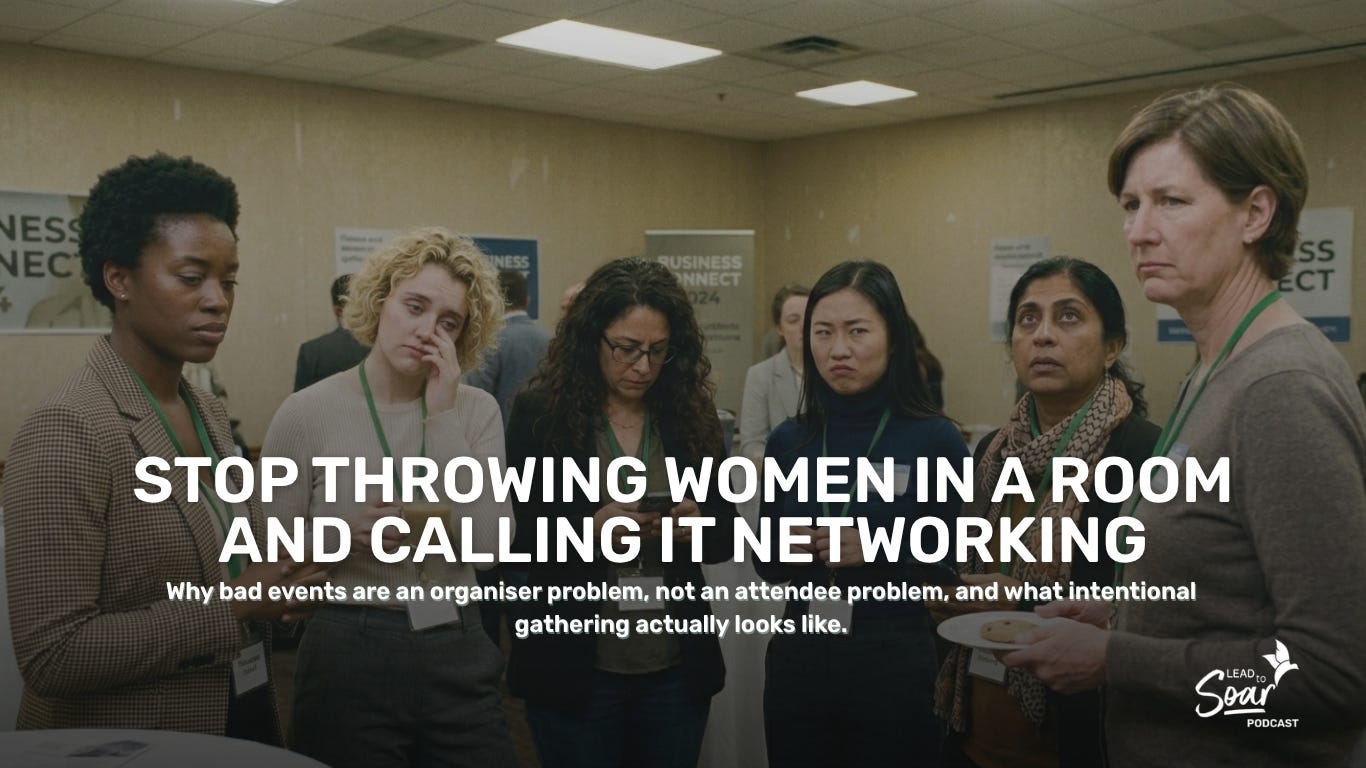 Stop Throwing Women in a Room and Calling It Networking | Most networking events for women are lazy. Not malicious. Lazy. Someone books a venue, lines up a speaker, fills the room with wine and canapés, and expects the magic to happen. It doesn't. And the women in the room get blamed for not working the crowd hard enough.In this episode, Mel Butcher and Michelle Redfern take a sharp look at what actually makes a gathering work, using Priya Parker's The Art of Gathering as their framework. They name the real problem: organiser accountability. Bad event design is not a personality mismatch or an introvert problem. It's a failure of purpose, structure, and intentionality.What they cover:Why the same tired formats keep getting recycled, and who benefits from thatWhat a well-designed networking event actually looks like in practice, including formats that have worked for both Mel and MichellePriya Parker's principle that a gathering without a clear purpose and a closed door isn't really a gathering at allWhy "prime people before they arrive" is one of the most underused tools in any organiser's kitHow to give attendees a framework for conversation rather than setting them loose to fend for themselvesWhy you are allowed to stop going to badly designed events, and when to give feedback insteadThis episode is primarily for the leaders, HR professionals, ERG chairs, and event organisers who create gatherings for women. If you run events, this one is for you. If you attend them, it will give you language for why something felt off, and the standing to say so. Get full access to Lead to Soar Podcast at leadtosoarpodcast.substack.com/subscribe | 34m 15s | ||||||
| 4/5/26 |  The Busy Trap: How Effective Women Leaders Actually Manage Their Time | "I don't have time" is one of the most common things Michelle hears from leaders across every level, every sector, every cohort. In this episode, Michelle and Mel get into what high BQ leaders actually do differently with their time and why "too busy" is often less about workload and more about prioritisation failures, people-pleasing, and a reluctance to push back on what lands on your plate. Includes a reframe that will make you rethink how you talk about your calendar, and the practical technique Michelle uses (and teaches) to push back on an overloaded task list without losing your sponsor's respect.Leave a commentIf this episode was useful, there are three simple ways to go further:Subscribe on SubstackThis is now the home of the Lead to Soar podcast. Subscribers get new episodes, curated guidance from the back catalogue, and written insights to help you navigate leadership and career decisions with sound judgement.Subscribe nowExplore the Lead to Soar NetworkLead to Soar is a leadership development network for ambitious women and for organisations serious about closing the leadership gender gap. Members get access to group coaching, practical leadership tools, and a network of women actively advancing their careers. ExploreShare the episodeIf this resonated, share it with a colleague, manager, or friend who might need it. Leadership is shaped by what we notice, name, and talk about. Get full access to Lead to Soar Podcast at leadtosoarpodcast.substack.com/subscribe | 25m 28s | ||||||
| 3/29/26 |  How Ambitious Women Tackle Ageism and Identity Bias | In this solo episode, Mel Butcher responds to two questions she has been asked by women in her network: one about whether to hide years of experience to avoid being judged as too young, and one about whether to anglicise a name on a resume to improve the odds of getting an interview.Both questions sit on top of the same structural reality: ageism and identity bias are real, documented, and operating in most workplaces and hiring processes right now.Mel draws on two interviews from the Lead to Soar archive to illustrate two completely different responses to the same problem. One woman refused to engage with a male-dominated networking culture entirely and built her career around that refusal. Another looked at the same culture and decided to master it on her own terms, bringing other women with her.Both strategies worked. Both were right. The question is which one fits you.What this episode covers:Ageism in both directions — why being seen as too young carries its own professional penalties, and why that rarely gets named directly.The research on name discrimination in hiring and what women are actually weighing when they consider using a nickname professionally.Two real stories of women who faced structural bias and chose opposite paths — and why that is not a contradiction.A framework for making the call that fits your values, your industry, and what you are willing to live with.This is a short episode. It is also one of the more honest conversations on the podcast about the decisions women make that most career advice refuses to touch.Leave a commentIf this episode was useful, there are three simple ways to go further:Subscribe on SubstackThis is now the home of the Lead to Soar podcast. Subscribers get new episodes, curated guidance from the back catalogue, and written insights to help you navigate leadership and career decisions with sound judgement.Subscribe nowExplore the Lead to Soar NetworkLead to Soar is a leadership development network for ambitious women and for organisations serious about closing the leadership gender gap. Members get access to group coaching, practical leadership tools, and a network of women actively advancing their careers. ExploreShare the episodeIf this resonated, share it with a colleague, manager, or friend who might need it. Leadership is shaped by what we notice, name, and talk about. Get full access to Lead to Soar Podcast at leadtosoarpodcast.substack.com/subscribe | 8m 03s | ||||||
| 3/15/26 |  Moral Ambition: Why Prestige Is Not the Same as Impact | In this episode of Lead to Soar, Michelle Redfern and Mel Butcher discuss Moral Ambition by Rutger Bregman.The conversation centres on Bregman’s critique of so-called “b******t jobs” — roles that are well-paid, high-status, and socially approved, yet exist largely to protect power, manage perception, or maintain systems rather than improve outcomes.Rather than focusing on individual morality, the discussion looks at how ambition has been shaped and narrowed. Certain careers are treated as inherently successful, while the question of whether the work is useful is rarely asked. Prestige, external validation, and momentum often replace impact as measures of success.Michelle and Mel also connect Bregman’s ideas to the work of Ralph Nader, who decades earlier was already calling out how talented people were being drawn into defending systems instead of fixing harm. The language has changed. The pattern has not.The episode also addresses the tension between effectiveness and moral signalling. When energy is spent on positioning and purity rather than action, momentum stalls and nothing changes. Progress has never required perfection. It has required people willing to act and accept pushback.Leadership takeawaysAmbition is not the problem. Where it is directed is.Prestige and usefulness are not the same thing.Systems don’t need bad actors to persist. They rely on talented people maintaining them.Moral positioning without action does not deliver change.Leaders are responsible for where talent is deployed and what work is rewarded.Watch: Rutger Begner at DavosLeave a commentIf this episode was useful, there are three simple ways to go further:Subscribe on SubstackThis is now the home of the Lead to Soar podcast. Subscribers get new episodes, curated guidance from the back catalogue, and written insights to help you navigate leadership and career decisions with sound judgement.Subscribe nowExplore the Lead to Soar NetworkLead to Soar is a leadership development network for ambitious women and for organisations serious about closing the leadership gender gap. Members get access to group coaching, practical leadership tools, and a network of women actively advancing their careers. ExploreShare the episodeIf this resonated, share it with a colleague, manager, or friend who might need it. Leadership is shaped by what we notice, name, and talk about. Get full access to Lead to Soar Podcast at leadtosoarpodcast.substack.com/subscribe | 30m 22s | ||||||
| 3/15/26 |  Why Women's Leadership Ambition Matters More than Ever Right Now | Ambition has acquired a negative connotation for women. Openly ambitious women are (too) often seen as selfish, excessive, or dangerous. At the same time, women are encouraged to be patient, resilient, and grateful, even as they navigate systems that are inherently resistant to change and unfair.In this episode of Lead to Soar, Mel Butcher and Michelle Redfern cut through the b******t and get real about ambition, not as status-chasing or ego, but as direction, choice, and responsibility.They challenge the idea that disengagement is neutral, explore the ripple effects of women’s career decisions on those who follow, and argue that ambition is not something women should wait to feel “safe” owning.We are not pretending barriers do not exist. We are saying that for many of us, we must not let them define our lives. The conversation covers:Why ambition is still judged differently in womenThe cost of waiting versus the cost of actingAmbition as a success orientation, not personalityLeadership responsibility beyond individual comfortWhy clarity beats hope, and agency beats enduranceThis episode is for women who are ready to decide what matters and then take deliberate international action.Leave a commentClosing Call to Action If this episode resonated:Subscribe to Substack for new episodes, curated guidance, and written leadership insights.Subscribe nowExplore the Lead to Soar Network for practical tools, group coaching, and women actively working on their careers.ExploreShare the episode with someone who needs permission to stop waiting and start deciding.ShareLeadership is shaped by what we choose to own. Get full access to Lead to Soar Podcast at leadtosoarpodcast.substack.com/subscribe | 28m 57s | ||||||
| 3/8/26 |  International Women’s Day 2026: Who Made You Free? | Let’s cut through the noise. International Women’s Day comes around. Brands share purple graphics. Panels discuss “empowerment.” Meanwhile, women’s rights are being eroded worldwide. So Mel Butcher asked the only question that matters:Who made you free?Michelle Redfern talks about her Nana and her Mum. She also discusses the women who made it possible for her to open a bank account, start a business, and have a voice.Freedom didn’t just fall from the sky. It was fought for. It was paid for. It’s not guaranteed.In this episode, we talk about:What it means to be a free woman in 2026The shift towards authoritarianism and anti-DEI backlashWhy women must stop accepting crumbsHow to practise collectivism at workWhat backing women truly looks likeWhy your spending, your voice, and your alliances matterThis isn’t a “feel inspired and move on” episode. It’s a reset. Because International Women’s Day isn’t just a vibe. It’s a responsibility.Truth BombsFreedom was fought for. It can be reclaimed.You are not self-made; you are woman-made.Collective strength surpasses individual outrage.Supporting women is a daily choice.Leave a commentIf this hits, don’t just nod along. Subscribe. Subscribe nowShare the episode with a woman you rate. And if you’re serious about building genuine power, join us in the Lead to Soar Network. We don’t do cupcakes. We focus on strategy, solidarity, and women supporting women.About Lead to SoarLead to Soar is a podcast and leadership platform for ambitious women and organisations serious about closing the gender leadership gap.Hosted by Michelle Redfern and Mel Butcher, the podcast goes beyond surface-level career advice to explore what it really takes to lead with clarity, credibility, and impact. Conversations are grounded in research, lived experience, and practical leadership frameworks, including The Leadership Compass.Lead to Soar is about fixing systems, not women, and supporting leaders to do work that matters, in ways that are sustainable and deeply human. Get full access to Lead to Soar Podcast at leadtosoarpodcast.substack.com/subscribe | 23m 37s | ||||||
Want analysis for the episodes below?Free for Pro Submit a request, we'll have your selected episodes analyzed within an hour. Free, at no cost to you, for Pro users. | |||||||||
| 3/1/26 |  Goal Setting for Managers: How to Set Annual Objectives With Your Team | If you’re about to run annual objectives with your team, you are holding a leadership moment in your hands. You can make it clear and useful, or you can end up with a set of goals that might look “nice” but not create the outcomes you want this year. In this episode, Mel and Michelle discuss the mindset Michelle used as a manager. “This is a discussion about a new contract. We’re contracting for outcomes.”Michelle says:“That contract is mutual. My job is to bring the strategic, commercial, and financial goals I’m accountable for, translate them into something my team can actually use, and then help each person turn that into objectives that make sense for their role.Before the one-on-one meetings, I strongly recommend a team briefing. I want the whole team to hear the same thing from me, in plain language: where the business is heading, what matters this year, and what our team’s positional purpose is. What do they pay us to do around here?Then I tell them how to prepare for the one-on-one.”Mel and Michelle then explore the fundamentals that team members should follow to prepare for their objective-setting exercise. Think about the accomplishments from last year, yes, but not just the one-offs. What are the repeatable contributions? Wins, metrics, fixes, launches. The stuff they can do again and build on.They want to identify 2 or 3 problems worth solving this year that align with the business priorities discussed earlier. Additionally, we want team members to approach their professional development with measurable outcomes in mind, rather than engaging in training for its own sake.Here’s why this matters. We see too many teams trying to write objectives with a missing link. Michelle discusses a case in which a group of employees lacked visibility into their manager’s goals and KPIs. They were still expected to write their own objectives. They were basically guessing what would “land”. That’s a leadership and transparency problem. Managers, once you’re in the one-on-one, use this question to cut through the noise:If we’re sitting here in a year’s time and we’re saying “we nailed it”, what are we celebrating?You’ll learn a lot from the answer. Some people will go straight to outcomes. Others will tell you they’re anxious, stretched, worried about skills, worried about what’s changing in the business. That’s useful data. It tells you what support they need from you as their manager.Then you get disciplined. Two or three objectives. Not ten. Ten is not a strategy.For each objective, you want a small number of measures. Two or three is usually enough. You’re aiming for evidence you can stand behind later. “I delivered what I said I would deliver” is a very different year-end conversation than “I was busy”.We also talk about what to do when the impact is not a straight line. Consulting is a good example. So is finance. You might not be able to draw a clean line between your work and the organisation’s growth. That doesn’t mean you can’t set a strong objective.Michelle also shares examples like a capability uplift project that strengthens frontline teams that win work, and a senior finance leader running structured lunch-and-learns to lift commercial acumen. Those are enablement objectives. They have a clear delivery commitment, a timeframe, and evidence points.That’s how you set your team up to finish the year able to point to a few outcomes and say, "We did that."If this work resonates with you, we invite you to explore the Lead to Soar Network. It exists to support women who want to lead with intention, depth, and clarity, alongside others doing the same work.You’re also warmly encouraged to comment on this article or join the chat.Leave a commentWant the practical tools that go with the episodes?Upgrade to paid to get the downloadable templates, checklists, and frameworks we reference, plus occasional offers for guest passes to the Lead to Soar network. If you’re serious about lifting your influence and impact this year, this is the easiest way to do it. Get full access to Lead to Soar Podcast at leadtosoarpodcast.substack.com/subscribe | 33m 03s | ||||||
| 2/22/26 |  Delegation Is Not Optional: The Leadership Skill That Separates Experts from Executives | Delegation is not about doing less.Delegation means leading at the level you want to be recognised for.In this episode, Mel and Michelle analyse a pattern we see over and over again in women’s careers. Talented, committed leaders become indispensable by excelling at execution, only to find that the very behaviour that got them promoted is now holding them back.Being the “go-to expert” feels safe. It feels responsible. It feels like protection against scrutiny. But staying in the detail comes at a cost to your energy, your team’s development, and your reputation as a strategic leader.We discuss what gets in the way of delegation. The double bind. The fear of being judged as lazy or incapable. The instinct to over-function in systems that already expect women to do more emotional and operational labour. And the belief that if you work harder, someone will eventually notice.They often don’t.Using the Leadership Compass, we walk through delegation across three lenses:Business Intelligence (BQ):Delegation is how leaders scale outcomes. Executives are not measured on personal output; they are measured on strategic and financial impact delivered through others. If you are doing work that someone else could reasonably learn to do, you are misallocating leadership capacity.Emotional Intelligence (EQ):What are you holding onto because letting go feels uncomfortable, risky, or irresponsible? Delegation requires trust, and for many women, trust has not always been rewarded. That makes delegation a skill that must be learned deliberately, not assumed.Social Intelligence (SQ):Your delegation habits shape your leadership brand. Leaders who hoard work become bottlenecks. Leaders who delegate well are known for developing others, creating leverage, and thinking beyond themselves.We also examine the consequences of not delegating: burnout, a reputation for micromanagement, disengaged teams, and leaders being passed over for stretch opportunities because they’re seen as “too busy” or too operational.We do not fix women. But we do name the systems and expectations that shape women’s behaviour, and give you practical ways to lead differently within them.To support this conversation, we’re sharing a short Expert to Executive tool that helps you audit where you’re operating now and what needs to shift if you want to be recognised as a strategic leader, not just a reliable one .Delegation isn’t a nice-to-have. It’s a must-have leadership skill. Key Topics CoveredWhy being the “go-to expert” becomes a career ceilingThe difference between asking for help and delegating with authorityGendered expectations and the delegation double bindHow poor delegation damages leadership reputation and team engagementDelegation through the Leadership Compass: BQ, EQ, and SQDeveloping others without abdicating responsibilityStrategic delegation as a pipeline and succession toolResources Referenced in the EpisodeMichelle’s Free Leadership Tools & DownloadsJoin the Lead to Soar Network. It’s a leadership community for women who want to lead with intention, depth, and clarity, alongside others doing the same work.If you’d like to take a look around, email contact@michelleredfern.com and you’ll receive a 30-day Guest Pass.You’re also warmly encouraged to comment on this article or join the chat.Leave a commentSubscribe nowAbout Lead to SoarLead to Soar is a podcast and leadership platform for ambitious women and for organisations serious about closing the leadership gender gap.Hosted by Michelle Redfern and Mel Butcher, the podcast goes beyond surface-level career advice to explore what it really takes to lead with clarity, credibility, and impact. Conversations are grounded in research, lived experience, and practical leadership frameworks, including The Leadership Compass.Lead to Soar is about fixing systems, not women, and supporting leaders to do work that matters, in ways that are sustainable and deeply human. Get full access to Lead to Soar Podcast at leadtosoarpodcast.substack.com/subscribe | 32m 32s | ||||||
| 2/15/26 |  The Life Audit: A Simple Way for Ambitious Women Leaders to Reset | We’re told (too often in our opinion) that the new year is about resolutions.Do more. Be better. Fix yourself.In this episode, we challenge that narrative and talk about what genuinely supports change over time.Reflective practice sits at the heart of effective leadership, yet many women are rarely given the space or structure to do it well. Michelle introduces The Life Audit, a practical tool she has developed and refined over many years to help ambitious women pause, recognise what feels out of alignment, and decide where to focus.The Life Audit begins with an honest assessment of key areas of life, including work and career, finances, relationships, physical wellbeing, time management, joy, social connection, and sense of contribution. Using a spider graph and a scale from crap to awesome, patterns emerge quickly. Those patterns often reveal where energy has been overextended, misplaced, or neglected.From there, the work becomes intentional and contained. Rather than trying to change everything at once, listeners select two to four priority areas and commit to a twelve-week reset. Each week includes a short reflection on what to stop, start, and continue, creating momentum through consistent, deliberate action rather than bursts of motivation.As we discuss in the episode, many women reach a point when life looks fine on paper, yet something feels off. When those signals are ignored, they tend to intensify. The Life Audit provides a structured way to notice earlier and respond with intention, before dissatisfaction turns into exhaustion or disengagement.This episode invites women to approach self-leadership with the same seriousness they bring to leading others, using reflection as a practical skill rather than a vague aspiration.Leave a commentIf this episode was useful, there are three simple ways to go further:Subscribe on SubstackThis is now the home of the Lead to Soar podcast. Subscribers get new episodes, curated guidance from the back catalogue, and written insights to help you navigate leadership and career decisions with sound judgement.Subscribe nowExplore the Lead to Soar NetworkLead to Soar is a leadership development network for ambitious women and for organisations serious about closing the leadership gender gap. Members get access to group coaching, practical leadership tools, and a network of women actively advancing their careers. ExploreShare the episodeIf this resonated, share it with a colleague, manager, or friend who might need it. Leadership is shaped by what we notice, name, and talk about.ShareAbout Lead to SoarLead to Soar is a podcast and leadership platform for ambitious women and for organisations serious about closing the leadership gender gap.Hosted by Michelle Redfern and Mel Butcher, the podcast goes beyond surface-level career advice to explore what it really takes to lead with clarity, credibility, and impact. Conversations are grounded in research, lived experience, and practical leadership frameworks, including The Leadership Compass.Lead to Soar is about fixing systems, not women, and supporting leaders to do work that matters, in ways that are sustainable and deeply human. Get full access to Lead to Soar Podcast at leadtosoarpodcast.substack.com/subscribe | 18m 24s | ||||||
| 2/8/26 |  What Smart People Do When Life Gets Messy and Work Gets Complicated | Subscribe now“Be authentic at work” is some of the most commonly given career advice, and some of the most dangerous, especially for women and others without structural power.In this episode Michelle Redfern and Mel Butcher call b******t on the idea that honesty and openness are always safe or rewarded at work. Instead, they explore what smart people actually do when life collides with work, and the stakes are high.From bereavement and illness to caring responsibilities and personal identity, this conversation examines how disclosure decisions are shaped not by good intentions but by power, culture, and psychological safety. Michelle reflects on her own career experiences of assimilation, self-protection, and learning when openness helps and when it harms.Rather than pushing performative authenticity, this episode offers a grounded framework for deciding what to share, what to withhold, and how to protect your credibility without disappearing or pretending.The episode also challenges leaders directly. When life inevitably intrudes on work, are you creating conditions where people feel safe asking for support, or are your systems and behaviours teaching them to stay silent?This is essential listening for women navigating complex career moments and for leaders serious about trust, retention, and humane workplaces.Leave a commentIf this episode was useful, there are three simple ways to go further:Subscribe on SubstackThis is now the home of the Lead to Soar podcast. Subscribers get new episodes, curated guidance from the back catalogue, and written insights to help you navigate leadership and career decisions with sound judgement.Subscribe nowExplore the Lead to Soar NetworkLead to Soar is a leadership development network for ambitious women and for organisations serious about closing the leadership gender gap. Members get access to group coaching, practical leadership tools, and a network of women actively advancing their careers. ExploreShare the episodeIf this resonated, share it with a colleague, manager, or friend who might need it. Leadership is shaped by what we notice, name, and talk about.Share Get full access to Lead to Soar Podcast at leadtosoarpodcast.substack.com/subscribe | 27m 54s | ||||||
| 2/1/26 |  How to Steer Your Review to Be About Results, Not Personality | Performance reviews are meant to assess contribution, results, and business impact. Yet for many women, they become subjective conversations about tone, confidence, or how they “come across.”In Episode 204, Michelle Redfern and Mel Butcher discuss why women are disproportionately judged on personality rather than performance, and what that means for career progression. Drawing on research and lived experience, they explore how biased feedback shows up in reviews and why it persists, even for high-performing women.This episode reframes the performance review as a business conversation, not a personal evaluation. Michelle shares practical language women can use to bring evidence to the table, ask for specific examples, and redirect vague or loaded feedback back to measurable outcomes. They also cover how to respond when feedback is unclear, unhelpful, or biased, including when to pause, take feedback on notice, or refuse to sign off on written comments that lack substance.This is a must-listen for women who want fair, strategic career progression and for leaders who want performance reviews that actually develop and retain talent.Below is the performance review checklist Michelle promised. Use it to prepare, stay anchored in evidence, and redirect the conversation back to outcomes when it drifts into personality or perception. You can also download a .pdf version.Performance Review Prep ChecklistA business-first guide for women1. Treat your review like a business meeting* This is about outcomes, not likeability* You are entitled to clarity, evidence, and specificity2. Prepare your evidence* Objectives and how you met or exceeded them* Results, metrics, milestones, risks reduced, problems solved* Examples of impact beyond your role* Written feedback gathered during the year3. Anchor the conversation to outcomesUse phrases like:* “The outcomes I delivered this year include…”* “Here’s where I moved the needle against priorities…”4. Redirect personality-based feedbackAsk:* “Can you give me a specific example?”* “How did that impact outcomes?”* “What would you like me to do differently, in practical terms?”5. Ask for advice, not vague feedback* “Where would you advise me to focus next year?”* “What should I stop, start, or continue?”6. Don’t respond on the spotYou can say:* “I’d like to take that on notice.”* “I need time to reflect before responding.”7. Debrief with your network* Sense-check feedback* Separate development from bias* Decide what to act on and what to discardBottom line:You are not there to be liked.You are there to be assessed on impact.If this episode was useful, there are three simple ways to go further:Subscribe on SubstackThis is now the home of the Lead to Soar podcast. Subscribers get new episodes, curated guidance from the back catalogue, and written insights to help you navigate leadership and career decisions with sound judgement.Explore the Lead to Soar NetworkLead to Soar is a leadership development network for ambitious women and for organisations serious about closing the leadership gender gap. Members get access to group coaching, practical leadership tools, and a network of women actively advancing their careers. Explore Share the episodeIf this resonated, share it with a colleague, manager, or friend who might need it. Leadership is shaped by what we notice, name, and talk about. Get full access to Lead to Soar Podcast at leadtosoarpodcast.substack.com/subscribe | 26m 16s | ||||||
| 12/28/25 |  Unlocking Your Voice: The Strategic Visibility Every Woman Leader Needs | Visibility does not equal influence. In this episode of the Lead to Soar Podcast, Michelle Redfern explains why many women leaders are seen and heard, yet still overlooked when it comes to power, promotion, and decision-making. Drawing on The Leadership Compass, she outlines how strategic visibility, grounded in business impact, credibility, and judgment, is what shifts women from contributors to influential leaders.This episode is a recording of a live Be Seen. Be Heard. Be Strategic. Workshop delivered inside the Lead to Soar Network. It offers a clear example of the strategic, evidence-based leadership development that members access throughout the year as part of their membership.The Lead to Soar Network Get full access to Lead to Soar Podcast at leadtosoarpodcast.substack.com/subscribe | 57m 15s | ||||||
| 12/21/25 |  Who Are You Called to Become as a Leader? | This isn’t your average leadership pep talk. In this episode, Michelle Redfern invites you into a quiet, reflective, and deeply practical session designed to help you pause, breathe, and think intentionally about the leader and the woman you are called to become.Drawing on her personal experience and the powerful Ikigai framework, Michelle shares the exact questions, journaling prompts, and mindset shifts that helped her shift from living on autopilot to leading with purpose.Whether you’re at a career crossroads, feeling a loss of joy in your current role, or sensing it’s time for a bold next move, this session is your invitation to step off the hamster wheel and reconnect with your future self.Before You Hit Play: This session is intentionally slower-paced. It’s quiet. Thoughtful. Michelle leaves space for you to reflect, write, pause and breathe.To get the most out of this episode:•:• Grab a notebook or journal• Bring a pen (and maybe a cuppa)• Give yourself space to think• Pause the episode when needed to reflect or writeYou’ll Explore:•:• The question that cracked Michelle wide open: Who are you called to become?• How to identify what still serves you—and what needs to be left behind• The difference between what you’re good at vs. what gives you joy• The power of listening to your inner coach instead of your inner critic• How to sketch and activate your personal Ikigai• A practical 30-day challenge to turn your insights into action.Take the Next Step:• Journal your answer to: Who are you called to become?• Complete your Ikigai sketch using the four prompts:• What do you love?• What are you good at?• What does the world need?• What can you be paid for?• Choose your bold 30-day move and write it down• Ask: What will future-me thank me for doing today?This session is part of Michelle’s ongoing commitment to help women stop shrinking and start soaring. If you’re not yet a member of the Lead to Soar Network, join us because the leadership journey is better when you’re not doing it alone.Links:On Ikigai: https://www.japan.go.jp/kizuna/2022/03/ikigai_japanese_secret_to_a_joyful_life.htmleThe Lead to Soar Network: https://leadtosoar.network/landing Get full access to Lead to Soar Podcast at leadtosoarpodcast.substack.com/subscribe | 48m 17s | ||||||
| 12/15/25 |  The Glass Cliff: What It Is and How Women Get Set Up | Being asked to “fix” an underperforming team or leader can be a genuine opportunity ... or a glass cliff. Michelle Redfern and Mel Butcher break down how to assess high-stakes roles, identify red flags, and determine whether you’re being set up to succeed or to take the fall. Essential guidance for ambitious women evaluating career-defining moves. Get full access to Lead to Soar Podcast at leadtosoarpodcast.substack.com/subscribe | 16m 30s | ||||||
| 12/10/25 |  Why LinkedIn Is No Longer Enough — Our Revised Career Advice for Ambitious Women | Women are heading into the end of 2025 more stretched, more visible, and more scrutinised than ever. At the same time, the platforms we once relied on to build our reputations have shifted under our feet. This 200th episode names what’s changed, what no longer works, and what ambitious women actually need to take themselves seriously in 2026.In this milestone conversation, Mel and I get real about the three things women cannot outsource: your online presence, your strategic network, and your boundaries.We cover:* Why LinkedIn is no longer the only serious option for your professional presence* How to think about your own domain, simple websites and being Google-ready* Strategic networking that feels meaningful, not sleazy in a bar with name tags* Designing your own gatherings so you control the format, energy and purpose* Moving from passive “I hope they notice me” to active targeted outreach* Michelle’s “I do not” list and how to build your own for 2026* End-of-year exhaustion, gendered expectations and what women can stop doing* How Lead to Soar and the podcast will evolve, including the move to Substack* A listener request for more fierce, forthright, offensive—not defensive—career adviceWhat you’ll walk away with:* Clarity on where to invest your time online* How to build a professional presence you actually control* The truth about networking that works* The boundary-setting that protects your energy and career* What to stop doing in 2026* Permission to go on the offensive in your leadershipThis episode also marks a significant shift.Lead to Soar now lives here on Substack.New episodes and supporting resources will land directly in your inbox. No algorithm decides whether you see them. (with a giant middle finger to unethical platforms that muzzle women’s voices)Perfect listening for ambitious women who are ready to stop leaving their careers to chance and start leading with intention.Listen with a pen in hand.There will be at least one thing you decide to stop doing — and one thing you’ll be ready to start — by the time the episode ends.If this episode was useful, there are three simple ways to go further:Subscribe on SubstackThis is now the home of the Lead to Soar podcast. Subscribers get new episodes, curated guidance from the back catalogue, and written insights to help you navigate leadership and career decisions with sound judgement.Explore the Lead to Soar NetworkLead to Soar is a leadership development network for ambitious women and for organisations serious about closing the leadership gender gap. Members get access to group coaching, practical leadership tools, and a network of women who are actively working on their careers. JOIN HEREShare the episodeIf this resonated, share it with a colleague, manager, or friend who might need it. Leadership is shaped by what we notice, name, and talk about. Get full access to Lead to Soar Podcast at leadtosoarpodcast.substack.com/subscribe | 45m 58s | ||||||
| 12/1/25 |  Professional Jealousy: What Is It & How Does it Show Up? | In this episode, Michelle Redfern and Mel Butcher tackle a workplace issue most people experience but rarely discuss openly: professional jealousy. They walk through how jealousy shows up, how it can be weaponised through policy or gossip, and why it can have serious consequences for someone’s reputation and career if it isn’t handled well.Michelle shares a real incident from her executive career at a major Australian bank, where a colleague’s jealousy escalated into an unnecessary and poorly managed HR process. The story lays bare how organisational systems can be misused when leaders act on hearsay instead of facts, and what happens when visibility or career momentum triggers insecurity in others.Mel adds her own experience of being confronted with jealousy-driven behaviour in a client meeting, and together they break down the leadership failures that allow this conduct to continue unchecked.At the heart of their conversation is practical advice for women: how to assess the situation, protect your credibility, understand your rights, and respond strategically when someone else’s jealousy edges into your professional lane.Key themes:• How professional jealousy manifests at work• Why it can escalate quickly when leaders fail to intervene• The difference between genuine organisational concerns and someone misusing “policy” to target a colleague• What ethical leadership looks like when jealousy surfaces• How to protect your professional reputation using SQ (Social Intelligence)• What to do when you have positional power – and what to do when you don’t• Why documentation, due diligence, and clarity on your obligations matter• How women can safely navigate and respond without burning political capitalTakeaways for women:• Know your rights and obligations before you respond.• If you’ve inadvertently breached something, correct it quickly.• If you haven’t breached anything, protect yourself through documentation, clarity, and strategic communication.• Build a strong reputation and network — long-term assets that withstand other people’s insecurity.Takeaways for leaders:• Don’t act on jealousy disguised as “concern.”• Address inappropriate behaviour immediately.• Use your positional power to prevent harm, not enable it.If this episode was useful, there are three simple ways to go further:Subscribe on SubstackThis is now the home of the Lead to Soar podcast. Subscribers get new episodes, curated guidance from the back catalogue, and written insights to help you navigate leadership and career decisions with sound judgement.Explore the Lead to Soar NetworkLead to Soar is a leadership development network for ambitious women and for organisations serious about closing the leadership gender gap. Members get access to group coaching, practical leadership tools, and a network of women who are actively working on their careers. Explore Share the episodeIf this resonated, share it with a colleague, manager, or friend who might need it. Leadership is shaped by what we notice, name, and talk about. Get full access to Lead to Soar Podcast at leadtosoarpodcast.substack.com/subscribe | 32m 34s | ||||||
| 11/24/25 |  Women’s Courage Will Define Leadership in the Age of AI | Technology is racing ahead — but courage and conscience must lead the way. In this episode, Michelle Redfern and Mel Butcher explore how women leaders can be the dissenting voices that keep ethics, empathy, and humanity at the centre of progress.If this episode resonated, I invite you to join the conversation in the comments and share what landed for you. You can subscribe to the Lead to Soar podcast here on Substack to receive new episodes, notes, and occasional tools straight to your inbox. And if you want to go further, Lead to Soar Network members get early access to episodes, live workshops, and practical resources designed to help women lead with clarity, credibility, and impact. Get full access to Lead to Soar Podcast at leadtosoarpodcast.substack.com/subscribe | 33m 36s | ||||||
| 11/17/25 |  How to Play the Long Game in Your Career | Your future self is counting on you. In this episode, Michelle Redfern and Mel Butcher explore how ambitious women can play the long game — building strategy, visibility, and momentum that leads to real career success.They explore how to show up for your future self by thinking and acting strategically, building credibility and confidence, and designing a clear direction rather than waiting for opportunities to appear. This is about career design — not chance.In this episode:• What it means to show up for your future self.• How to define what reaching your full potential looks, sounds, and feels like.• Why strategy isn’t just for organisations — it’s for your career.• The shift from loyal worker to strategic leader.• Practical ways to make choices your future self will thank you for.Leave a commentIf this episode was useful, there are three simple ways to go further:Subscribe on SubstackThis is now the home of the Lead to Soar podcast. Subscribers get new episodes, curated guidance from the back catalogue, and written insights to help you navigate leadership and career decisions with sound judgement.Subscribe nowExplore the Lead to Soar NetworkLead to Soar is a leadership development network for ambitious women and for organisations serious about closing the leadership gender gap. Members get access to group coaching, practical leadership tools, and a network of women who are actively working on their careers. Explore Share the episodeIf this resonated, share it with a colleague, manager, or friend who might need it. Leadership is shaped by what we notice, name, and talk about.Share Get full access to Lead to Soar Podcast at leadtosoarpodcast.substack.com/subscribe | 27m 28s | ||||||
| 11/10/25 |  Credibility and Visibility: Why You Need Both to Progress | Competence alone doesn’t create credibility. Michelle and Mel reveal why visibility and credibility must work together if you want to be chosen for high-value work. They share how to talk about your achievements without the cringe, use language that lands with decision-makers, and demonstrate leadership that moves the business forward.Leaders choose people they know, respect, and trust. If the right people can’t see your impact, they can’t bet on you.In this episode• The leadership equation: visibility + credibility = opportunity• Strategic self-promotion that doesn’t feel gross — linking outcomes to business results• Why “busy” doesn’t signal credibility (and what does)• Positional purpose: what they pay you and your team to be famous for• How to advocate for yourself and your team with a business lensLeave a commentIf this episode was useful, there are three simple ways to go further:Subscribe on SubstackThis is now the home of the Lead to Soar podcast. Subscribers get new episodes, curated guidance from the back catalogue, and written insights to help you navigate leadership and career decisions with sound judgement.Subscribe nowExplore the Lead to Soar NetworkLead to Soar is a leadership development network for ambitious women and for organisations serious about closing the leadership gender gap. Members get access to group coaching, practical leadership tools, and a network of women who are actively working on their careers. ExploreShare the episodeIf this resonated, share it with a colleague, manager, or friend who might need it. Leadership is shaped by what we notice, name, and talk about.Share Get full access to Lead to Soar Podcast at leadtosoarpodcast.substack.com/subscribe | 19m 47s | ||||||
| 11/3/25 |  From Hope to Strategy: Turning Ambition into Outcomes | Hope is not a strategy. Michelle and Mel show you how to define your full potential, state your ambition with a business lens, and build a roadmap that aligns your moves to real business outcomes. Practical prompts and language you can use this week.In this episode• Why “waiting to be noticed” keeps talented women stuck• What full potential can look like: role level, craft mastery, and financial security• Language that lands: from helper to enabler of growth• Building your roadmap: vision, next milestones, and measurable KPIs• Aligning success to business metrics: revenue, win rates, margin, cash, customer value• Finding a strategic mentor who helps you navigate the next stepResources• Inside the Lead to Soar Network: Hour of Power, Leadership MBA Library, strategic mentoring promptsLeave a commentIf this episode was useful, there are three simple ways to go further:Subscribe on SubstackThis is now the home of the Lead to Soar podcast. Subscribers get new episodes, curated guidance from the back catalogue, and written insights to help you navigate leadership and career decisions with sound judgement.Subscribe nowExplore the Lead to Soar NetworkLead to Soar is a leadership development network for ambitious women and for organisations serious about closing the leadership gender gap. Members get access to group coaching, practical leadership tools, and a network of women who are actively working on their careers. ExploreShare the episodeIf this resonated, share it with a colleague, manager, or friend who might need it. Leadership is shaped by what we notice, name, and talk about.Share Get full access to Lead to Soar Podcast at leadtosoarpodcast.substack.com/subscribe | 26m 54s | ||||||
| 10/27/25 |  Too Nice to Lead? Managing Up to an Ineffective Boss | We’ve all met this leader: pleasant, agreeable, and conflict-avoidant—the kind of manager everyone likes but few respect.In this Lead to Soar episode, Michelle Redfern and Mel Butcher dissect the “too nice to lead” phenomenon and offer practical strategies for ambitious professionals who report to an ineffective manager.What you’ll learn:• How to identify when niceness has replaced effectiveness• Why conflict avoidance erodes standards and trust• Scripts and strategies for managing up with outcomes and data• How to protect your energy and career progression while navigating underpowered leadership• What organisations must do to stop promoting accidental managersKey takeaway: Being nice doesn’t make someone a good leader—clarity, courage, and competence do.Leave a commentIf this episode was useful, there are three simple ways to go further:Subscribe on SubstackThis is now the home of the Lead to Soar podcast. Subscribers get new episodes, curated guidance from the back catalogue, and written insights to help you navigate leadership and career decisions with sound judgement.Subscribe nowExplore the Lead to Soar NetworkLead to Soar is a leadership development network for ambitious women and for organisations serious about closing the leadership gender gap. Members get access to group coaching, practical leadership tools, and a network of women who are actively working on their careers. ExploreShare the episodeIf this resonated, share it with a colleague, manager, or friend who might need it. Leadership is shaped by what we notice, name, and talk about.Share Get full access to Lead to Soar Podcast at leadtosoarpodcast.substack.com/subscribe | 29m 50s | ||||||
Showing 25 of 201
Sponsor Intelligence
Sign in to see which brands sponsor this podcast, their ad offers, and promo codes.
Chart Positions
2 placements across 2 markets.
Chart Positions
2 placements across 2 markets.