Let's Talk Risk! with Dr. Naveen Agarwal
by Casual and informal conversations about practical aspects of medical device risk management.
Insights from recent episode analysis
Audience Interest
Podcast Focus
Publishing Consistency
Platform Reach
Insights are generated by CastFox AI using publicly available data, episode content, and proprietary models.
Most discussed topics
Brands & references
Est. Listeners
Based on iTunes & Spotify (publisher stats).
- Per-Episode Audience
Est. listeners per new episode within ~30 days
10,001 - 25,000 - Monthly Reach
Unique listeners across all episodes (30 days)
25,001 - 75,000 - Active Followers
Loyal subscribers who consistently listen
15,001 - 40,000
Market Insights
Platform Distribution
Reach across major podcast platforms, updated hourly
Total Followers
—
Total Plays
—
Total Reviews
—
* Data sourced directly from platform APIs and aggregated hourly across all major podcast directories.
On the show
From 11 epsHosts
Recent guests
Recent episodes
LTR 153: Sherita Black on Building a Practical Policy for Risk Acceptability
May 1, 2026
29m 24s
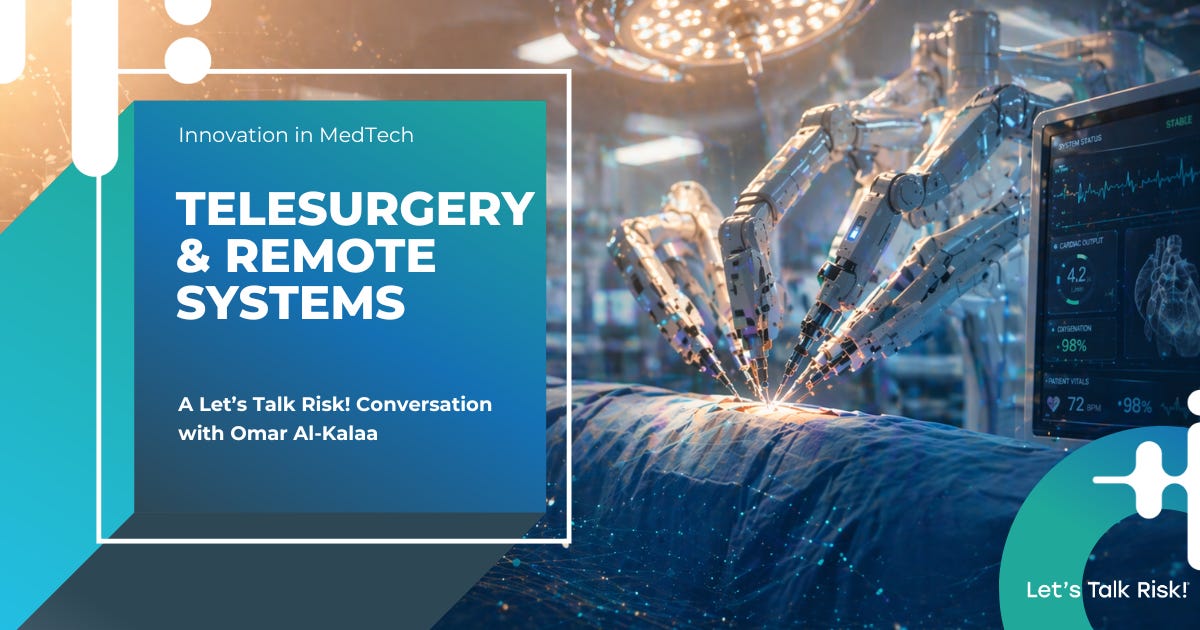
LTR 152: Omar Al Kalaa on Telesurgery and the Future of Remotely Controlled Medical Systems
Apr 24, 2026
36m 21s
LTR 151: Sarai Pahla on Managing Supply Chain Disruption Risk in Life Sciences
Apr 17, 2026
26m 01s
Case Study: How Patient Preference Data Rescued a High-Risk Device
Apr 10, 2026
20m 37s
LTR 150: Jonathan Kendler on Rethinking Human Factors Engineering for AI/ML-Enabled Devices
Apr 3, 2026
29m 27s
Social Links & Contact
Official channels & resources
Official Website
Login
RSS Feed
Login
| Date | Episode | Topics | Guests | Brands | Places | Keywords | Sponsor | Length | |
|---|---|---|---|---|---|---|---|---|---|
| 5/1/26 | ![]() LTR 153: Sherita Black on Building a Practical Policy for Risk Acceptability✨ | risk managementISO 14971+4 | Sherita Black | BDISO 14971 | — | risk acceptabilitypolicy+5 | — | 29m 24s | |
| 4/24/26 | ![]() LTR 152: Omar Al Kalaa on Telesurgery and the Future of Remotely Controlled Medical Systems✨ | telesurgeryremotely controlled medical systems+4 | Omar Al Kalaa | FDAMedTech+1 | — | telesurgeryremotely controlled systems+5 | — | 36m 21s | |
| 4/17/26 | ![]() LTR 151: Sarai Pahla on Managing Supply Chain Disruption Risk in Life Sciences✨ | supply chain risklife sciences+4 | Dr. Sarai Pahla | heart valvelife sciences+3 | — | supply chaindisruption+5 | — | 26m 01s | |
| 4/10/26 | ![]() Case Study: How Patient Preference Data Rescued a High-Risk Device✨ | patient preference datarisk management+3 | — | FDA | — | patient preferencerisk management+5 | — | 20m 37s | |
| 4/3/26 | ![]() LTR 150: Jonathan Kendler on Rethinking Human Factors Engineering for AI/ML-Enabled Devices✨ | human factors engineeringAI in medical devices+4 | Jonathan Kendler | MedTech | — | AIhuman factors+5 | — | 29m 27s | |
| 3/27/26 | ![]() LTR 149: Lavanya Ramnath on Risk Analysis, IDE Strategy, and Patient-Centered Design✨ | risk analysisIDE strategy+4 | Lavanya Ramnath | diabetes technologySaMD+2 | MedTech | risk analysisIDE+6 | — | 28m 32s | |
| 3/20/26 | ![]() LTR 148: Chris Daly on Companion Diagnostics, AI, and FDA’s Evolving Approach✨ | companion diagnosticsAI in MedTech+3 | Chris Daly | FDA | — | companion diagnosticsAI+5 | — | 29m 02s | |
| 3/13/26 | ![]() LTR 147: Richard Matt on Bringing Benefit–Risk Upstream in Design and Development✨ | risk managementmedical device design+3 | Richard Matt | — | — | risk managementbenefit-risk+3 | — | 26m 56s | |
| 3/6/26 | ![]() LTR 146: Ganesh Sabat on Scaling MedTech Through Quality✨ | MedTechquality management+4 | Ganesh Sabat | Sahajanand Medical TechnologiesMedArtha Capital | India | MedTechquality execution+4 | — | 25m 35s | |
| 2/27/26 | ![]() LTR 145: Holly Cotter on Avoiding the QMSR Scramble with Smart Quality Planning✨ | Quality Management System RegulationFDA inspection+4 | Holly Cotter | FDAISO 13485+2 | — | QMSRFDA+6 | — | 28m 21s | |
Want analysis for the episodes below?Free for Pro Submit a request, we'll have your selected episodes analyzed within an hour. Free, at no cost to you, for Pro users. | |||||||||
| 2/20/26 | ![]() LTR 144: Jean Blom on How Hazard-First Thinking Improves Risk Management✨ | risk managementhazard-first thinking+5 | Jean Blom | ISO 13485ISO 14971 | — | risk managementhazard-first thinking+6 | — | 28m 17s | |
| 2/13/26 | ![]() LTR 143: Jennifer Mascioli-Tudor on Leading Proactive Quality in the QMSR Era | Summary“Management review is no longer a check-the-box exercise. It’s the most powerful lever leaders have to drive proactive quality.”In this episode of the Let’s Talk Risk Podcast, Naveen Agarwal sits down with Jennifer Mascioli-Tudor, an experienced Quality and Regulatory leader, to unpack what QMSR readiness really means in practice.Jennifer shares what she’s seeing across the industry, from companies that are fully prepared to those that haven’t started, and explains why being ISO 13485 certified is not enough. The conversation dives deep into FDA inspection behavior, closed-loop risk management, management review as a leadership tool (not a formality), and the very real consequences of reactive quality systems.This episode is a must-listen for quality, regulatory, and executive leaders who want to move beyond compliance and build proactive, inspection-ready organizations.Chapters00:00 Welcome and Introduction02:20 ISO 13485 vs FDA inspections: where assumptions break down03:40 Closed-loop risk management across the total product lifecycle05:40 How FDA uses complaints, CAPA, and trends to escalate inspections09:35 Leadership mindset shift: from reactive fixes to proactive quality11:35 Management review as a strategic decision-making forum20:25 Inspection readiness as culture, practice, and people, not paperworkIf you enjoyed this podcast, consider subscribing to the Let’s Talk Risk! newsletter.Suggested links:* LTR: QMSR Readiness, Risk-Based Assurance and FDA Expectations.* LTR: 90-Day QMSR Readiness Action Pan for Leaders.* LTR: FDA Readiness for QMSR.Key Takeaways* Don’t wait for FDA to expose your gaps, identify and document them yourself* Treat QMSR as a strategic initiative, not a quality department project* Use management review to drive real discussion, decisions, and accountability* Focus on the critical few metrics, not dozens of unprioritized indicators* Train SMEs and cross-functional leaders to speak confidently about risk* Practice inspection scenarios before FDA shows up, not during the inspectionKeywordsQMSR, FDA inspection readiness, closed-loop risk management, ISO 13485, management review, risk-based decision making, proactive quality, trend escalation, cross-functional accountability, total product lifecycleAbout Jennifer Mascioli-TudorJennifer Mascioli-Tudor is currently the Founder and Principal Consultant at JMT Compliance Consulting offering consultant services to MedTech organizations in business, regulatory and quality management strategy. She is also an instructor at UC San Diego where she teaches regulatory fundamentals and design controls. Her industry experience includes leadership roles at J&J, Boston Scientific, Medtronic, and GE Healthcare. She holds a BSc from Eastern Michigan University, an MBA in Global Management, and is an ASQ Certified Quality Auditor.DisclaimerInformation and insights presented in this podcast are for educational purposes only. Views expressed by all speakers are their own and do not reflect those of their respective organizations.Parts of this article were created using AI-generated content, which was subsequently reviewed, edited, and fact-checked by the author to ensure accuracy and alignment with our standards. This is a public episode. If you'd like to discuss this with other subscribers or get access to bonus episodes, visit naveenagarwalphd.substack.com/subscribe | 30m 32s | ||||||
| 2/6/26 | ![]() LTR 142: Florian Tolkmitt on Clinical Evaluation, Risk, and the New ISO Draft Standard | Summary“For years, clinical evaluations were mostly a story. What was missing were clearly defined outcome parameters, something measurable that connects the state of the art to benefit–risk conclusions.”In this Let’s Talk Risk! conversation, host Naveen Agarwal welcomes back Florian Tolkmitt, Managing Director of Pro-Liance Global Solutions, for a timely and highly practical discussion on clinical evaluation for medical devices.The conversation centers on the newly released draft ISO standard for clinical evaluation (ISO/DIS 18969), why it was developed, and what problem it is trying to solve. Florian shares first-hand insight from his role in the ISO working group, highlighting common industry misunderstandings, especially around outcome parameters, state of the art, and the linkage between clinical evaluation and ISO 14971 risk management.Together, Naveen and Florian unpack new terminology such as clinical risk, clinical outcome parameters, and available knowledge, clarifying how these concepts are meant to sharpen focus on patient-relevant benefit–risk decisions without overloading clinical evaluation with non-clinical risk data. The episode closes with practical reflections on how manufacturers, especially those struggling with EU MDR expectations, can use this process standard to strengthen their clinical evaluation approach.Listen to the full 30-minute podcast or jump to a section of interest listed below. Chapters00:00 Welcome and introduction to the topic of clinical evaluation01:25 What companies still get wrong about clinical evaluation03:10 Overview of the new ISO/DIS 18969 draft standard05:30 Why the standard is process-focused, not regulatory06:20 ISO 14971 as a normative reference and the idea of “clinical risk”10:20 State of the art vs. “available knowledge”17:40 Clinical outcome parameters and measurable benefit–risk25:00 Why this standard matters and who will benefit mostIf you enjoyed this podcast, consider subscribing to the Let’s Talk Risk! newsletter.Suggested links:LTR: Clinical Evaluation Now More Important Than Ever Under EU-MDR.LTR: Smart Use of AI for Clinical Evaluation.LTR: Clinical Evaluation a Lifecycle Process Not a One Time Activity.Key Takeaways* Clinical evaluation is not a narrative exercise, it must be outcome-driven.* Not all risks belong in clinical evaluation; patient-relevant risks do.* Outcome parameters should be derived from state of the art, not after the fact.* The new ISO draft aims to harmonize global practice without reinventing regulations.* A strong clinical evaluation process improves both regulatory confidence and decision quality.KeywordsClinical Evaluation, ISO/DIS 18969, Risk Management, ISO 14971, EU MDR, Clinical Risk, Benefit–Risk Assessment, State of the Art, Post-Market Surveillance, Medical Device RegulationAbout Florian TolkmittFlorian Tolkmitt is the founder and owner of PRO-LIANCE GLOBAL SOLUTIONS GmbH providing consulting services in all aspects of clinical evaluation, regulatory affairs, risk and quality management. He is an expert in clinical evaluation, post-market clinical follow up and post-market reporting compliance. As a co-founder and board member of RAPS Deutschland e.V., he is very active in the regulatory community sharing his expertise and mentoring industry colleagues.Let’s Talk Risk! with Dr. Naveen Agarwal is a bi-weekly live audio event on LinkedIn, where we talk about risk management related topics in a casual, informal way. Join us at 11:00 am EST every Friday on LinkedIn.DisclaimerInformation and insights presented in this podcast are for educational purposes only, and not as legal advice. Views expressed by all speakers are their own and do not reflect those of their respective organizations.Parts of this article were created using AI-generated content, which was subsequently reviewed, edited, and fact-checked by the author to ensure accuracy and alignment with our standards. This is a public episode. If you'd like to discuss this with other subscribers or get access to bonus episodes, visit naveenagarwalphd.substack.com/subscribe | 27m 51s | ||||||
| 1/30/26 | ![]() LTR 141: Ashkon Rasooli on Applying an Agile Mindset to Risk-Based Quality Systems Under QMSR | Summary“Delaying a product that is adequately safe and effective is itself a risk, one we rarely acknowledge in our quality systems.”In this episode of the Let's Talk Risk Podcast, host Naveen Agarwal speaks with Ashkon Rasooli, a seasoned SaMD and AI/ML quality strategist, about what QMSR readiness really means for software-heavy medical device organizations.Ashkon explains why traditional hardware-centric quality thinking breaks down in software environments, where failures are deterministic, complexity is effectively infinite, and rapid iteration is the norm. He challenges the industry’s fixation on “bug-free” software and over-proceduralized QMS, arguing instead for quality systems that emphasize risk-based decision-making, shared ownership, and real-world practice.The conversation explores how QMSR’s deeper integration of ISO 13485 and risk management will reshape inspections, elevate expectations around cybersecurity and supplier oversight, and require QA/RA leaders to rethink their role—from compliance enforcers to system designers and collaborators.Chapters00:00 Welcome and introduction01:00 Fundamental differences between software and hardware risk04:50 Agile development vs. quality system control: where conflict arises07:40 Why “move fast and break things” fails in medical devices09:10 Bringing agility and ISO 13485 together through risk-based thinking12:05 QMSR’s implications for SaMD, cybersecurity, and supplier management16:20 Moving beyond procedures: practicing risk, not just documenting it20:20 Treating the QMS as a product with internal customers24:30 Delayed innovation as an overlooked form of patient riskSuggested links:* LTR: QMSR Readiness, Risk-Based Assurance and FDA Expectations. * LTR: 90-Day QMSR Readiness Action Pan for Leaders. * LTR: FDA Readiness for QMSR.Key Takeaways* Software risk is deterministic, not statistical: bugs fail 100% of the time once triggered.* Chasing “bug-free” software can delay safe, effective products and deny patients timely access.* Agile and quality are not opposites, but they must be reconciled through risk-based discipline, not speed alone.* Under QMSR, risk expands beyond safety to include cybersecurity, data integrity, and system reliability.* FDA inspections may increasingly link observations directly to deficiencies in risk-based decision-making.* A mature QMS must be practiced, not just documented; procedures alone won’t demonstrate control.* QA/RA leaders must treat the QMS itself as a product with internal users and continuously improve it.* Future quality leaders need enough technical fluency to engage engineering as partners, not adversaries.KeywordsQMSR, FDA readiness, ISO 13485, MDSAP, FDA inspections, quality system regulation, risk-based quality, CAPA, post-market surveillance, QA/RA leadershipAbout Ashkon RasooliAshkon Rasooli, is a medical device Quality Management Systems strategist specializing in SaMD, SiMD, and AI/ML-enabled technologies. He brings over a decade of experience across engineering, product management, regulatory, and quality roles, spanning large MedTech firms, big-tech environments, and VC-backed startups. Ashkon is the founder of EnGenius Solutions and is known for his pragmatic, “non-BS” approach to building quality systems that protect patients without stalling innovation.DisclaimerInformation and insights presented in this podcast are for educational purposes only. Views expressed by all speakers are their own and do not reflect those of their respective organizations.Parts of this article were created using AI-generated content, which was subsequently reviewed, edited, and fact-checked by the author to ensure accuracy and alignment with our standards.Let's Talk Risk! is a reader-supported publication. To receive new posts and support my work, consider becoming a free or paid subscriber. This is a public episode. If you'd like to discuss this with other subscribers or get access to bonus episodes, visit naveenagarwalphd.substack.com/subscribe | 27m 54s | ||||||
| 1/23/26 | ![]() LTR 140: Pujitha Gourabathini on Connecting Risk Management and Design Controls | Summary“Risk management should not be a compliance checkbox. It must actively govern design decisions and feedback loops across the product lifecycle.”In this Let’s Talk Risk! conversation, host Naveen Agarwal sits down with Pujitha Gourabathini, Quality Assurance and Risk Management leader at Becton Dickinson, to explore one of the most persistent challenges in MedTech: effectively integrating risk management with design controls.Pujitha shares practical, experience-based insights on why risk files often become disconnected from design inputs, verification strategies, and sustaining engineering changes. Drawing on real-world examples, she explains how “like-for-like” assumptions, tight timelines, and limited cross-functional engagement can quietly erode patient safety if risk is not continuously reassessed.The conversation goes beyond procedures to focus on culture, highlighting the importance of collaboration, early engagement, and continuous improvement to ensure risk truly governs design decisions. As QMSR approaches, this episode offers timely guidance for QA/RA and engineering leaders looking to move from checkbox compliance to lifecycle risk assurance.Listen to the full 30-minute podcast or jump to a section of interest listed below. Chapters00:00 Welcome and introduction01:00 Pujitha’s path into quality and risk management03:40 Where risk and design controls disconnect in practice05:20 Sustaining engineering: the most overlooked risk blind spot06:40 “Like-for-like” changes and dangerous hidden assumptions09:00 Proactive risk reassessment through continuous improvement11:10 Organizational barriers: timelines, awareness, and ownership25:05 Closing takeaways: culture, collaboration, and QMSR readinessIf you enjoyed this podcast, consider subscribing to the Let’s Talk Risk! newsletter.Suggested links:LTR: Managing Post-Market Design Changes.LTR: Building Safety by Design.LTR: Beyond Compliance - Building Good Practices Under QMSR.Key Takeaways* Risk management must actively inform design inputs, outputs, and verification, not exist as a standalone file* Sample sizes and verification strategies should be scaled to patient impact, not convenience* Sustaining engineering changes often carry hidden risk and deserve the same rigor as new product development* “Like-for-like” component changes can invalidate prior risk analyses if assumptions go unchallenged* Continuous improvement programs work best when risk awareness extends beyond Quality into engineering and project management* Early collaboration reduces rework, delays, and late-stage risk discoveries* QMSR raises expectations for closed-loop feedback between design, risk, and post-market dataKeywordsRisk management, design controls, QMSR, sustaining engineering, ISO 14971, patient safety, verification strategy, continuous improvement, safety culture, lifecycle riskAbout Pujitha GourabathiniPujitha Gourabathini is a Quality Assurance and Risk Management leader in the medical device industry with deep expertise in lifecycle risk integration, design controls, and post-market safety. She currently serves as a Quality Assurance Manager focused on risk management, where she leads cross-functional efforts to embed patient safety into both new product development and sustaining engineering activities.With hands-on experience across ISO 14971, FDA QSR/QMSR, EU MDR, and safety assurance practices, Pujitha is passionate about moving risk management beyond documentation toward practical, decision-driven application. She is an active contributor to industry discussions through writing, mentoring, and knowledge sharing—advocating for stronger safety culture, continuous improvement, and proactive risk ownership across organizations.Let’s Talk Risk! with Dr. Naveen Agarwal is a bi-weekly live audio event on LinkedIn, where we talk about risk management related topics in a casual, informal way. Join us at 11:00 am EST every Friday on LinkedIn.DisclaimerInformation and insights presented in this podcast are for educational purposes only, and not as legal advice. Views expressed by all speakers are their own and do not reflect those of their respective organizations.Parts of this article were created using AI-generated content, which was subsequently reviewed, edited, and fact-checked by the author to ensure accuracy and alignment with our standards. This is a public episode. If you'd like to discuss this with other subscribers or get access to bonus episodes, visit naveenagarwalphd.substack.com/subscribe | 26m 12s | ||||||
| 1/16/26 | ![]() LTR 139: Steve Silverman on FDA Readiness for QMSR | Summary“QMSR isn’t about regulatory obligation; it’s about managing business risk, protecting customers, and preserving market share.”In this episode of the Let's Talk Risk Podcast, host Naveen Agarwal is joined by Steve Silverman to explore a question that’s often left unspoken: Is the FDA ready for QMSR?Drawing on his experience as a former FDA leader and industry policy expert, Steve acknowledges that the current environment inside the agency is marked by workforce reductions, loss of institutional knowledge, and political disruption. But he also emphasizes that QMSR activation on February 2, 2026, is still very much on track. He cautions companies against “waiting it out” and explains why hoping for delays or informal grace periods is a risky strategy.The conversation dives into practical implications for manufacturers, including how FDA is preparing its inspectors, what the absence of updated QSIT guidance really means, why MDSAP certification is helpful but not sufficient, and how FDA is signaling stronger expectations around risk-based quality systems, especially in premarket reviews. The episode closes with clear advice for QA/RA leaders on how to frame QMSR readiness as a business risk and strategic opportunity, not just a regulatory exercise.Chapters00:00 Why FDA readiness for QMSR matters as much as industry readiness02:00 Inside FDA: disruption, workforce loss, and institutional impact04:12 Will QMSR really go live in February 2026?06:14 Lessons from MDSAP and parallels to QMSR rollout10:40 How FDA prepares inspectors for a new regulatory framework15:14 Why MDSAP certification is not a free pass under QMSR19:14 What FDA inspections may look like in early 202627:58 How QA/RA leaders should explain QMSR to the C-suiteSuggested links:* LTR: Communicating Effectively with Senior Executives. * LTR: 90-Day QMSR Readiness Action Pan for Leaders. * Steve’s Substack: What the FDA?.Key Takeaways* QMSR will activate on February 2, 2026, companies should not expect delays or extensions.* FDA has experienced significant disruption, including workforce reductions and loss of expertise, but core regulatory work continues.* Waiting to see how FDA “handles” QMSR is a high-risk strategy for manufacturers.* FDA inspectors are being trained internally to transition from QSR to QMSR, even without updated QSIT guidance.* MDSAP certification can ease the transition but does not replace FDA inspections or guarantee QMSR compliance.* FDA will continue enforcing recall and adverse event reporting requirements alongside QMSR.* Firms that demonstrate good-faith progress and a clear quality plan are likely to encounter a more collaborative FDA posture.* QMSR explicitly elevates risk as a lifecycle concept, spanning premarket, post-market, and business decision-making.* Leaders should assess their real exposure using post-market data and not assume compliance equals safety.* QA/RA leaders must translate QMSR work into business risk, market impact, and strategic value for executives.KeywordsQMSR, FDA readiness, ISO 13485, MDSAP, FDA inspections, quality system regulation, risk-based quality, CAPA, post-market surveillance, QA/RA leadershipAbout Steve SilvermanSteve Silverman, is the President of The Silverman Group. Steve spent more than a decade at FDA in leadership positions across the Agency. He adds private-sector expertise from consulting and representing industry members. Steve develops strategies that satisfy regulators and promote business needs. He holds a Bachelor’s degree in English Literature, and a JD in Law.DisclaimerInformation and insights presented in this podcast are for educational purposes only. Views expressed by all speakers are their own and do not reflect those of their respective organizations.Parts of this article were created using AI-generated content, which was subsequently reviewed, edited, and fact-checked by the author to ensure accuracy and alignment with our standards.Let's Talk Risk! is a reader-supported publication. To receive new posts and support my work, consider becoming a free or paid subscriber. This is a public episode. If you'd like to discuss this with other subscribers or get access to bonus episodes, visit naveenagarwalphd.substack.com/subscribe | 32m 12s | ||||||
| 1/9/26 | ![]() LTR 138: Michelle Lott on QMSR Readiness, Risk-Based Assurance and FDA Expectations | Summary“The industry is aware of QMSR, but they’re not moving. Many are still holding their breath, hoping something will change.”In this episode of the Let's Talk Risk Podcast, host Naveen Agarwal is joined by Michelle Lott for a deep and practical discussion on QMSR readiness as FDA’s February 2026 deadline rapidly approaches. Michelle shares a sobering view of where the medical device industry truly stands, highlighting a dangerous gap between awareness and action.The conversation explores how FDA is signaling its expectations well before inspections begin, particularly through new draft guidance for pre-market submissions. Together, Naveen and Michelle unpack what “risk-based approach” really means under QMSR, not just for design and development, but across supplier controls, CAPA, complaints, data analysis, and management review.They also examine one of the most consequential shifts under QMSR: FDA’s expanded authority to review management responsibility and system-level effectiveness. The episode closes on a forward-looking note, emphasizing the opportunity for QA/RA leaders to reposition themselves, not as compliance enforcers, but as strategic partners in prevention, assurance, and sustainable patient safety.Chapters00:00 Why QMSR readiness matters now01:00 Industry complacency and false hope for delays05:00 FDA signals through pre-market guidance09:00 Compliance vs. assurance: what FDA really wants11:00 What “risk-based” means beyond ISO 1497114:00 Where companies should prioritize immediately17:00 Management review and executive accountability26:00 The opportunity for QA/RA leadership under QMSRSuggested links:* LTR: Risk, CAPA and FDA Inspections under QMSR. * Lean RAQA: RAQA Services, Resources and Courses. * FDA: Voluntary Improvement Program (VIP).Key Takeaways* Many companies are aware of QMSR, but are still not acting with urgency.* ISO 13485 alignment significantly reduces compliance risk, but does not eliminate it.* FDA has already committed to inspecting against QMSR beginning February 3, 2026 and there is no grace period coming.* New PMA draft guidance signals FDA’s shift from compliance evidence to assurance of sustained safety and effectiveness.* “Risk-based approach” under QMSR applies across the entire QMS, not just ISO 14971 hazard analyses.* Management review is no longer protected territory; FDA can now assess how leadership identifies and responds to systemic risk.* The five chronic FDA pain points: CAPA, complaints, design controls, supplier controls, and nonconforming product, will matter even more under QMSR.* Strong QA/RA leaders can use QMSR as a platform to become prevention partners, not procedural gatekeepers.KeywordsQMSR readiness, FDA QMSR, ISO 13485, risk-based approach, risk-based assurance, compliance vs assurance, FDA inspections, management review accountability, CAPA effectiveness, supplier controls, quality system maturity, QA/RA leadershipAbout Michelle LottMichelle Lott is the founder of Lean RAQA, where she provides fractional RA/QA leadership, audit prep, quality system design, and regulatory strategy for MedTech startups and small companies. With 20+ years of experience and an RAC certification, Michelle has helped hundreds of firms navigate FDA submissions and ISO compliance, bringing clarity and efficiency to even the most complex regulatory challenges. DisclaimerInformation and insights presented in this podcast are for educational purposes only. Views expressed by all speakers are their own and do not reflect those of their respective organizations.Parts of this article were created using AI-generated content, which was subsequently reviewed, edited, and fact-checked by the author to ensure accuracy and alignment with our standards.Let's Talk Risk! is a reader-supported publication. To receive new posts and support my work, consider becoming a free or paid subscriber. This is a public episode. If you'd like to discuss this with other subscribers or get access to bonus episodes, visit naveenagarwalphd.substack.com/subscribe | 29m 43s | ||||||
| 12/19/25 | ![]() LTR 137: Priya Setty on QMSR, Risk-Based Assurance, and Building a Future-Ready RA Career | Summary“FDA isn’t asking whether you followed the procedure. They are asking whether your system can assure consistent outcomes in the real world.”In this episode of the Let's Talk Risk Podcast, Priya Setty joins host Naveen Agarwal to unpack why QMSR represents more than a procedural update; it’s a mindset shift toward assurance, credibility, and risk-based decision making across the entire product lifecycle. Priya shares how the FDA’s alignment with ISO 13485 elevates expectations for design controls, risk integration, software assurance, and role-specific competence.Drawing on her clinical roots, global regulatory experience, and work in regulatory intelligence, Priya discusses how RA/QA professionals can prepare for future expectations through deeper understanding of risk, building strong feedback loops, developing competence beyond training, and embracing leadership roles that shape culture, not just documentation.Chapters00:00 Why QMSR is a shift from compliance to assurance.01:00 Priya’s unconventional journey from occupational therapy to regulatory affairs.04:00 How FDA expects QMSR readiness to show up in pre-market submissions.07:00 Compliance vs. assurance: Priya’s analogy for FDA’s mindset shift.09:30 Software assurance, least burdensome validation, and risk-based thinking.13:00 Why QMSR requires more than documentation—evidence of decision-making maturity.17:00 The future of inspections: competence, culture, and systemic vulnerabilities.22:00 Priya’s advice on preparing for QMSR and building a future-ready RA/QA career.Suggested links:* FDA: Draft Guidance - QMS Information for PMA Reviews. * LTR: Megan Kane on Leading QMSR Readiness in a Startup. * LTR: A 90-Day QMSR Readiness Action Plan for Leaders.Key Takeaways* QMSR represents a mindset shift: from proving compliance through procedures to demonstrating assurance through real-world performance and decision-making maturity.* FDA now expects integrated, lifecycle risk management, not isolated risk files; risk thinking must visibly connect design, verification/validation, manufacturing, and post-market actions.* Pre-market submissions will reflect QMSR readiness by showing how risk management drives design decisions, supplier oversight, and verification strategies.* Software assurance is now explicitly risk-based, requiring validation proportional to intended use and potential impact, reflecting the “least burdensome” approach.* Competence, not just training, will be scrutinized, and systemic gaps may escalate into management responsibility findings under QMSR.* Culture becomes a quality system indicator, especially how organizations make decisions, close feedback loops, and connect signals to design controls.* QMSR transition challenges differ by maturity: ISO 13485–certified companies refine and align; non-certified companies must build foundational structures.* RA/QA professionals must evolve into cross-functional leaders, shaping risk-informed culture, strengthening feedback systems, and developing deeper expertise in standards and regulatory philosophy.* Personal career growth principles - curiosity, networking, boldness, persistence - remain essential, especially as AI and digital technologies reshape regulatory practice.KeywordsQMSR, Quality Management System Regulation, ISO 13485, Regulatory Affairs, Risk Management, Assurance Mindset, FDA Inspections, Software Assurance, Competence vs. Training, Regulatory Intelligence, Medical Devices, Digital Health.About Priya SettyGeethapriya (Priya) Setty is a regulatory affairs strategist and systems builder with over eight years in global regulatory affairs and more than twenty years in healthcare. Starting her career as a pediatric occupational therapist, Priya brings a unique blend of clinical insight and policy expertise to the evolving world of medical technology. She leads regulatory intelligence and digital transformation initiatives at a global medical device company, specializing in global regulatory strategy, regulatory intelligence, and digital health/AI compliance for high-risk devices. Priya is adept at navigating complex regulations such as the EU AI Act and FDA guidance, ensuring compliance is embedded in every innovation.A certified PMP, RAC (Devices), and ISO 13485 lead auditor, Priya is known for demystifying complex regulations and building systems that keep teams ahead of industry changes. Guided by her mantra, “make a choice, and make it happen,” she is dedicated to leadership, mentorship, and simplifying healthcare through curiosity and purpose-driven action.DisclaimerInformation and insights presented in this podcast are for educational purposes only. Views expressed by all speakers are their own and do not reflect those of their respective organizations.Parts of this article were created using AI-generated content, which was subsequently reviewed, edited, and fact-checked by the author to ensure accuracy and alignment with our standards.Let's Talk Risk! is a reader-supported publication. To receive new posts and support my work, consider becoming a free or paid subscriber. This is a public episode. If you'd like to discuss this with other subscribers or get access to bonus episodes, visit naveenagarwalphd.substack.com/subscribe | 31m 44s | ||||||
| 12/12/25 | ![]() LTR 136: Adam Isaacs Rae on What QMSR Really Changes and What It Doesn't | Summary“Under QMSR, FDA will still be FDA, but they’ll finally have broader authority to cite what they’ve always cared about.”In this Let’s Talk Risk! conversation, host Naveen Agarwal sits down with Adam Isaacs Rae to unpack one of the most misunderstood aspects of FDA’s new QMSR rule: the parts that aren’t changing.Adam brings a unique dual-lens perspective as both a medical device consultant and a lead auditor for certification bodies. With trademark clarity and humor, he explains why focusing only on “closing gaps” misses the real risk. The conversation dives into places where FDA will continue to operate exactly as before such as design control expectations, CAPA rigor, complaint handling scrutiny, and the agency’s ability to dig deeper under the broader ISO 13485 framework.Across thirty minutes, Naveen and Adam explore how QMSR will shift the conversation from timeliness to effectiveness, from dashboards to real risk thinking, and from procedural compliance to deliberate regulatory strategy in complex multi-market environments.Listen to the full 30-minute podcast or jump to a section of interest listed below. Chapters00:00 Introduction and welcome00:53 The story behind “The Other Consultants”02:22 Why QMSR prep must go beyond gap assessments03:12 What QMSR won’t change and why it matters04:59 Design control complexity under QMSR08:00 FDA’s deeper reach into complaints and risk13:41 CAPA becomes CA + PA and effectiveness takes center stage23:07 Key takeaways and closing remarksIf you enjoyed this podcast, consider subscribing to the Let’s Talk Risk! newsletter.Suggested links:LTR: 90-Day Action Plan to Review QMSR Readiness.LTR: Beyond Compliance - Building Good Practices Under QMSR.ACHIEVE Workshop: Using ChatGPT to Analyze Recalls and Adverse Events. Key Takeaways* QMSR changes the requirements, not FDA’s inspection philosophy. The agency will still probe deeply and expect strong evidence of safety and effectiveness.* Design control complexity will increase. Especially for manufacturers managing the same device across the US, EU, and UK under a unified system.* Risk integration becomes unavoidable. Under ISO 13485, FDA can now cite weaknesses in risk-linked processes more explicitly.* Complaint handling scrutiny will intensify. Inspectors can now ask for “your highest-risk complaints”, and expect a defensible rationale.* CAPA becomes CA + PA. Terminology harmonizes with ISO, but FDA’s expectations for root cause depth and recurrence prevention remain unchanged.* Effectiveness will take center stage. FDA will look beyond timeliness KPIs and challenge the thinking behind effectiveness criteria.* Effectiveness must be defined up front. Not after the corrective actions are completed, a common failure mode in CAPA systems.* Recurrence and escapes remain FDA’s biggest red flags. QMSR simply gives them broader grounds to write findings.* Manufacturers must rethink regulatory strategy. Reliance sounds attractive, but differing market routes require clear separation and intentional planning.* The biggest risks come from what QMSR doesn’t change. These unchanged legacy expectations can “sting” manufacturers who assume harmonization means simplification.KeywordsQMSR, ISO 13485, FDA inspections, design controls, CAPA, corrective action, preventive action, effectiveness criteria, complaint handling, risk-based quality, regulatory strategy, post-market surveillanceAbout Adam Isaacs RaeAdam Isaacs Rae is a medical device quality and regulatory leader and Managing Director of The Other Consultants and The Other Auditors. With over a decade of experience across global medical device manufacturers, regulatory bodies, and certification audits, Adam brings a rare dual perspective as both consultant and lead auditor for ISO 13485. He specializes in pragmatic, risk-based compliance strategies that balance regulatory rigor with business realities, and is known for his clear, conversational approach to complex topics like QMSR, CAPA, and international market access.Let’s Talk Risk! with Dr. Naveen Agarwal is a bi-weekly live audio event on LinkedIn, where we talk about risk management related topics in a casual, informal way. Join us at 11:00 am EST every Friday on LinkedIn.DisclaimerInformation and insights presented in this podcast are for educational purposes only, and not as legal advice. Views expressed by all speakers are their own and do not reflect those of their respective organizations.Parts of this article were created using AI-generated content, which was subsequently reviewed, edited, and fact-checked by the author to ensure accuracy and alignment with our standards. This is a public episode. If you'd like to discuss this with other subscribers or get access to bonus episodes, visit naveenagarwalphd.substack.com/subscribe | 27m 27s | ||||||
| 12/5/25 | ![]() LTR 135: Allison Komiyama on Rethinking Benefit-Risk in MedTech | Summary“We talk about risk all the time, but we forget to talk about the benefit. FDA’s job is to protect and promote public health, and benefit–risk is how those two missions meet.”In this episode of the Let's Talk Risk Podcast, host Naveen Agarwal sits down with Dr. Allison Komiyama, neuroscientist, former FDA reviewer, regulatory strategist, and founder of Bluestocking Health. Known for her ability to make complex FDA topics understandable and fun, Allison brings fresh clarity to one of the most misunderstood areas in risk management: benefit–risk evaluation.Together, they explore why benefit–risk thinking goes far beyond premarket submissions, how companies can use it to guide post-market decisions, and why QA/RA professionals have a massive leadership opportunity as technology accelerates faster than regulations can keep up. Allison also shares the inspiration behind her new venture, Bluestocking Health, and her mission to spark more accessible, joyful conversations about medical technologies.Chapters01:20 Introducing Allison Komiyama03:40 How FDA thinks about benefit and risk08:10 Why benefits must be evidence-based, not marketing claims10:45 The missing benefit–risk conversation in 510(k) submissions13:45 Reverse-engineering FDA’s benefit–risk guidance for real devices14:30 How AI/ML challenges traditional benefit–risk evaluation17:00 Why intended use and indications are the foundation18:40 Bringing marketing, clinical, and reimbursement into early conversations20:05 QA/RA as strategic leaders, not gatekeepers24:30 How the patient voice reframes quality and purpose26:00 The mission behind Bluestocking Health30:15 Final message for QA/RA professionals: “Keep talking to each other.”Suggested links:* FDA: Benefit-Risk Case Study for an AI/ML Device. * LTR: An Ideal Medical Device. * FDA: Benefit-Risk Guidance for 510(k) Submissions.Key Takeaways* Benefit–risk is fundamental to safety and effectiveness but there is no cookie-cutter formula. * FDA reviewers weigh benefit just as heavily as risk, but industry often forgets the benefit side.* Many devices enter the market via 510(k), where benefit–risk is rarely discussed, despite being essential.* FDA does provide benefit–risk guidance for substantial equivalence, a tool few companies actually use.* Post-market benefit–risk evaluation is critical; clearance is the starting line, not the finish line.* For AI/ML devices, understanding good machine-learning practices and PCCPs helps establish safe guardrails.* Intended use and indications are the anchor for any meaningful benefit–risk assessment.* QA/RA professionals can play a strategic leadership role by connecting benefit–risk to business, clinical, and patient perspectives.* Cross-functional conversations among engineering, marketing, reimbursement, clinical must start early, not at the end.* The patient voice remains the most powerful unifying force in developing safe, beneficial technology.KeywordsBenefit–risk evaluation, FDA submissions, 510(k)/De Novo/PMA, post-market safety, AI/ML devices, regulatory strategy, quality leadership, Bluestocking Health, patient-centric design, MedTech innovation.About Allison KomiyamaAllison Komiyama is the Founder & CEO of Bluestocking Health, a new platform dedicated to elevating conversations around medical technologies and helping patients, caregivers, and innovators better understand the devices that shape healthcare. A former FDA reviewer at CDRH, Allison has spent more than a decade supporting hundreds of submissions across the full product lifecycle, spanning startups to global enterprises. DisclaimerInformation and insights presented in this podcast are for educational purposes only. Views expressed by all speakers are their own and do not reflect those of their respective organizations.Parts of this article were created using AI-generated content, which was subsequently reviewed, edited, and fact-checked by the author to ensure accuracy and alignment with our standards.Let's Talk Risk! is a reader-supported publication. To receive new posts and support my work, consider becoming a free or paid subscriber. This is a public episode. If you'd like to discuss this with other subscribers or get access to bonus episodes, visit naveenagarwalphd.substack.com/subscribe | 32m 05s | ||||||
| 11/28/25 | ![]() LTR 134: James Pink on Responsible AI and Future of MedTech Safety | Summary“With great power comes great responsibility. The innovation in AI is incredible, but our assurance models must catch up if we’re to keep patients safe”In this thought provoking Let’s Talk Risk! conversation, host Dr. Naveen Agarwal welcomes James Pink, a global leader in medical device safety, risk, and regulatory strategy. James shares his deeply personal journey, from clinical engineering and auditing, to his life-altering health experience that reinforced his passion for patient safety.Together they unpack how artificial intelligence is transforming healthcare innovation, the gaps in current assurance models, and the urgent need for literacy, accountability, and human-in-the-loop oversight.The discussion highlights contrasts between EU and U.S. regulatory approaches, the concept of AI assurance, and why quality professionals must evolve from compliance guardians to informed custodians of safety in an AI-enabled world.Listen to the full 30-minute podcast or jump to a section of interest listed below. Chapters00:00 Welcome & Introduction 02:00 A Personal Story 05:00 AI’s Transformative Power 07:00 Regulatory Divergence 11:30 Understanding AI Assurance 15:00 Raising AI Literacy 18:00 The Human-in-the-Loop Imperative 23:00 Guardrails & Accountability 26:00 Key Takeaways & ClosingIf you enjoyed this podcast, consider subscribing to the Let’s Talk Risk! newsletter.Suggested links:LTR: Building Trustworthy AI and MedTech Readiness.LTR: Proactive AI Governance in MedTech.ACHIEVE Workshop: Using ChatGPT to Analyze Recalls and Adverse Events. Key Takeaways* Patient-safety passion often begins with personal experience — and sustains professional purpose.* AI innovation is racing ahead of our assurance and measurement systems.* The EU and U.S. regulatory models reveal opposite extremes; balance and shared responsibility are essential.* “AI literacy” should become a core competency for all QA/RA professionals.* Assurance in AI demands new tools, standards (e.g., ISO 42001, 22989), and human judgment.* Human oversight is indispensable: vigilance prevents overreliance and hubris.* Safety frameworks must evolve as fast as the technologies they govern.* Communities like the AI Safety Officer Network will drive the next era of responsible innovation.KeywordsAI safety, medical device risk management, patient safety, regulatory strategy, ISO 42001, human-in-the-loop, responsible innovation, AI assurance, EU AI Act, risk literacyAbout James PinkJames Pink is a leading voice in medical device safety and risk management with over 25 years of global experience spanning clinical engineering, notified bodies, and regulatory consulting.He is the Managing Partner at James Pink Advisory Services and Module Leader for Data Management and Digitalisation in Regulatory Affairs at TOPRA.A respected educator and expert witness, James has trained thousands of professionals worldwide and previously held senior leadership roles at Element Materials Technology and NSF International. He also founded the Medical Device Safety Risk Management and AI Safety Officer groups on LinkedIn, fostering global collaboration on responsible innovation and patient safety.Let’s Talk Risk! with Dr. Naveen Agarwal is a weekly live audio event on LinkedIn, where we talk about risk management related topics in a casual, informal way. Join us at 11:00 am EST every Friday on LinkedIn.DisclaimerInformation and insights presented in this podcast are for educational purposes only, and not as legal advice. Views expressed by all speakers are their own and do not reflect those of their respective organizations.Parts of this article were created using AI-generated content, which was subsequently reviewed, edited, and fact-checked by the author to ensure accuracy and alignment with our standards. This is a public episode. If you'd like to discuss this with other subscribers or get access to bonus episodes, visit naveenagarwalphd.substack.com/subscribe | 29m 11s | ||||||
| 11/21/25 | ![]() LTR 133: Megan Kane on Leading QMSR Readiness in MedTech Startups | Summary“If you’re a small company and feel stuck in the QMSR transition, use that startup energy. Get creative, tap your network, and find the experts who can help you get unstuck.”In this episode of the Let's Talk Risk Podcast, Megan Kane joins host Dr. Naveen Agarwal to unpack what the FDA’s new Quality Management System Regulation (QMSR) means for startups and small MedTech companies. She explains how the shift from checklist compliance to process-based assurance challenges teams to think differently - embedding risk management early, strengthening design controls, and elevating competence beyond routine training.Drawing from her diverse experience across AI-enabled SaMD, diagnostics, and implantables, Megan shares how agile organizations can turn regulatory change into an advantage. She discusses building risk-based quality systems, tapping external expertise through fractional leadership, and fostering a culture of continuous learning where expertise grows with every project.Chapters00:00 Why QMSR matters now02:00 Inside the startup mindset: energy, agility, and chaos04:30 From checklists to connected processes06:45 How FDA’s expectations are evolving09:50 Integrating risk management with design controls13:30 Competence vs. training: what QMSR really demands15:30 Startups and global thinking: harmonization as opportunity18:00 Leveraging networks and external expertise22:00 Building courage and translating skills to new domains24:00 Overcoming imposter syndrome and redefining expertise26:30 Final takeaways and Megan’s vision for ReliaSuggested links:* LTR: A 90-day plan to review QMSR readiness. * LTR: Risk, CAPA and FDA inspections under QMSR. * LTR: QMSR QuickTake #1: From compliance to assurance.Key Takeaways* The QMSR transition signals a shift from procedural compliance to process-based assurance.* Startups have a unique advantage. Their speed and adaptability can drive faster QMSR readiness.* The new regulation demands earlier integration of risk management into design and development.* FDA reviewers are already expecting deeper risk-to-design traceability, even premarket.* Competence, not just training, will define readiness under QMSR.* Leadership must create cultures that encourage learning and vulnerability, not perfection.* “Experts” aren’t the goal; continuous growth and shared learning are.* For startups, external networks and fractional leadership can fill critical capability gaps.* Global harmonization is coming; QMSR is the first step toward a unified framework.* Success depends on collaboration across the quality community, not isolated effort.KeywordsQMSR, ISO 13485, FDA, risk management, competence, startups, leadership, regulatory strategy, AI/ML, medical devicesAbout Megan KaneMegan Kane is a fractional regulatory and quality executive with expertise spanning medical devices, digital health, and AI-enabled SaMD. As Founder and Executive Director of Rellia, she helps early-stage MedTech companies navigate global regulatory pathways and develop practical, risk-based quality systems. Her career spans startups, global corporations, and contract manufacturing, giving her a unique lens on how to simplify complex regulations into sustainable systems. Rellia is an incubator for digital health startups, helping the next generation of healthcare innovators.DisclaimerInformation and insights presented in this podcast are for educational purposes only. Views expressed by all speakers are their own and do not reflect those of their respective organizations.Parts of this article were created using AI-generated content, which was subsequently reviewed, edited, and fact-checked by the author to ensure accuracy and alignment with our standards.Let's Talk Risk! is a reader-supported publication. To receive new posts and support my work, consider becoming a free or paid subscriber. This is a public episode. If you'd like to discuss this with other subscribers or get access to bonus episodes, visit naveenagarwalphd.substack.com/subscribe | 28m 42s | ||||||
| 11/14/25 | ![]() LTR 132: Bijan Elahi on Future of MedTech Safety and the 2026 Conference in Boston | Summary“This conference is really by the community and for the community - a place where people passionate about MedTech safety can come together to share ideas, learn, and make a difference.”In this Let’s Talk Risk! conversation, host Dr. Naveen Agarwal welcomes back renowned safety risk management expert Bijan Elahi to discuss the upcoming International MedTech Safety Conference 2026 in Boston.Bijan shares the inspiring story of how a grassroots effort among passionate professionals has grown into a global movement for advancing safety risk management in medical devices. From its beginnings at Medtronic headquarters to a sold-out conference in Amsterdam, this event has become a central hub for knowledge exchange between industry, academia, and regulators, including keynote participation from FDA CDRH Director Dr. Michelle Tarver.Together, Naveen and Bijan explore emerging themes shaping MedTech risk management today - AI and machine learning, combination products, and proactive safety by design - and highlight the many ways professionals can get involved in shaping the future of safety science.Listen to the full 30-minute podcast or jump to a section of interest listed below. Chapters00:00 Introduction and welcome01:40 Emerging themes in MedTech risk: AI and combination products03:30 Why Bijan created the MedTech Safety Conference05:00 From Medtronic to Amsterdam: a 400% growth story06:45 The 2026 theme: Proactive Safety by Design08:30 Academic and regulatory collaboration (Northeastern, MIT, FDA)10:00 QMSR and the growing role of risk-based assurance12:00 Conference structure: workshops, keynotes, collaboration day15:00 How to participate: speak, teach, or lead a discussion18:00 Abstract selection and deadlines21:00 New ISO documents on AI/ML and combination devices23:00 Early-bird registration and next steps25:00 Closing thoughts and key takeawaysIf you enjoyed this podcast, consider subscribing to the Let’s Talk Risk! newsletter.Suggested links:Conference Website: Program, Abstract Submission, Early Bird Pricing.LTR: Tips for Improving Collaboration in Risk Management.ACHIEVE Workshop: Using ChatGPT to Analyze Recalls and Adverse Events. Key Takeaways* The MedTech Safety Conference 2026 will be held at Boston at Northeastern University, from June 2-5, 2026.* The conference theme: “Proactive Safety - From Clinic to Home” emphasizes the focus on building safety into devices from concept.* The event has grown 400% since its first year, proving global momentum.* Dr. Michelle Tarver (FDA CDRH) is an invited speaker to deliver a keynote, highlighting the importance of safety in medical devices.* New ISO guidance documents 24971-2 (AI/ML) and 24971-3 (Combination Devices) are expected to launch just before the event.* The conference includes an expanded four-day program includes workshops, keynotes, and a “Day of Collaboration.”* It brings together industry, academia, and regulators in one shared forum.* AI and combination products are today’s top emerging risk themes.* Abstracts open through Dec 31, 2025; early-bird registration at medsafety.net.* This conference is a grassroots, non-commercial movement: by the community, for the community.KeywordsMedTech Safety Conference 2026, Proactive Safety by Design, Risk Management, QMSR Readiness, AI/ML in Medical Devices, Combination Products, ISO 24971-2, ISO 24971-3, FDA CDRH, Medical Device SafetyAbout Bijan ElahiBijan Elahi is the founder of MedTech Safety and a globally recognized expert on safety risk management of medical devices. Bijan is a technical fellow, and an affiliate professor at Drexel University, USA. Bijan is also a lecturer at Eindhoven University of Technology in the Netherlands, where he teaches risk management to doctoral students in engineering. He is a frequently invited speaker at international professional conferences, and is also a contributor to ISO 14971, the international standard on the application of risk management to medical devices. He has trained over 10,000 people worldwide and his book Safety Risk Management of Medical Devices, now in its second edition, is a bestseller.Let’s Talk Risk! with Dr. Naveen Agarwal is a weekly live audio event on LinkedIn, where we talk about risk management related topics in a casual, informal way. Join us at 11:00 am EST every Friday on LinkedIn.DisclaimerInformation and insights presented in this podcast are for educational purposes only, and not as legal advice. Views expressed by all speakers are their own and do not reflect those of their respective organizations.Parts of this article were created using AI-generated content, which was subsequently reviewed, edited, and fact-checked by the author to ensure accuracy and alignment with our standards. This is a public episode. If you'd like to discuss this with other subscribers or get access to bonus episodes, visit naveenagarwalphd.substack.com/subscribe | 27m 52s | ||||||
| 11/7/25 | ![]() LTR 131: Rick Wedge on the Human Side of Safety Risk Management | Summary“Be diligent, because one day, you might rely on the very device you helped design.”In this deeply personal and technically insightful episode of the Let's Talk Risk Podcast, host Naveen Agarwal speaks with Rick Wedge, a seasoned expert in risk management and design control for drug-device combination products.Rick shares his remarkable journey - from developing biosensors early in his career to depending on a glucose monitoring system to manage life without a pancreas. His story bridges the technical and human sides of medical innovation, revealing how living with diabetes transformed his understanding of patient experience, vigilance, and empathy in risk-based decision-making.Together, Naveen and Rick explore:* The evolution of continuous glucose monitoring (CGM) technology* What held back CGMs for decades, and what finally made them viable* How real-world data and device reliability shape patient trust* Why risk management must include emotional and psychological dimensions of user experience* The leadership challenge of turning “patient-centricity” from a slogan into a daily practiceThis conversation reminds every MedTech professional that behind every risk file is a real human story—and sometimes, that story could be our own.Chapters00:00 – Introduction: The human side of risk and living with diabetes02:00 – Rick’s medical journey and sudden onset of diabetes06:00 – Emotional and psychological recovery after surgery10:30 – From biosensors to combination products: a full-circle career13:30 – The rise of CGM technology and what made it possible18:00 – Data overload, trust, and the benefit-risk balance24:00 – Failures, vigilance, and lessons for risk professionals26:00 – Empathy as a leadership skill in risk management29:00 – Closing reflections: patient-centricity as personal missionSuggested links:* LTR: Why risk practitioners must build the empathy muscle. * LTR: The most important question - who is taking the risk?.* FDA: Dexcom G6 De Novo database entry.Key Takeaways* Risk is personal: The devices we design may one day keep us alive.* Empathy is technical: Design controls must reflect real human experience.* Patient-centricity needs proof: It’s shown in practice, not posters.* Data empowers, and overwhelms: More information isn’t always better.* Reliability builds trust: Every sensor failure is a lesson in vigilance.* Benefit-risk is dynamic: Even mature devices demand continuous balance.* Innovation carries responsibility: Breakthroughs require humility and care.* Experience changes perspective: Living the risk reshapes professional judgment.* Leadership starts with listening: Empathy drives safer, smarter teams.* Technology evolves, so must we: Staying curious sustains both progress and safety.KeywordsRisk management, design control, combination products, empathy, patient experience, diabetes, continuous glucose monitoring, benefit-risk, medical devices, leadershipAbout Rick WedgeRick Wedge is a risk management and design control leader with extensive experience in drug-device combination products. Over more than two decades in MedTech and pharma, he has led global initiatives in quality systems, design controls, and risk management aligned with ISO 13485, ISO 14971, and FDA 21 CFR Part 820.A trained scientist with a Ph.D. background in electrochemical biosensors, Rick began his career developing glucose sensors - technology that later became essential to his own health journey. Today, he combines deep technical expertise with a passion for patient-centric design and regulatory excellence, inspiring professionals to view risk management through both a technical and human lens.DisclaimerInformation and insights presented in this podcast are for educational purposes only. Views expressed by all speakers are their own and do not reflect those of their respective organizations.Parts of this article were created using AI-generated content, which was subsequently reviewed, edited, and fact-checked by the author to ensure accuracy and alignment with our standards.Let's Talk Risk! is a reader-supported publication. To receive new posts and support my work, consider becoming a free or paid subscriber. This is a public episode. If you'd like to discuss this with other subscribers or get access to bonus episodes, visit naveenagarwalphd.substack.com/subscribe | 30m 55s | ||||||
| 10/31/25 | ![]() LTR 130: Hannah Walter on Human Factors and Inclusive Design in Medical Devices | Summary“Talk to the people you are building the device for. Assumptions may speed development, but they often miss the human realities that determine whether a product succeeds or fails.”In this Let’s Talk Risk! conversation, host Dr. Naveen Agarwal sits down with Hannah Walter to explore the human side of medical technology. From robotic surgery consoles to AR/VR-assisted procedures, Hannah explains why human-machine interaction has become a critical design priority, and why early conversations about inclusivity can make or break product safety and adoption.They discuss how differences in motion sickness between male and female users, or colorblindness among technicians, can introduce hidden usability risks if overlooked. Hannah emphasizes the value of partnering with universities, learning from real users, and fostering open feedback loops between engineers and healthcare professionals.Her message is clear: by recognizing human variability, building empathy into design, and communicating early, teams can create safer, more effective medical devices, and avoid costly human factors failures that derail regulatory approval.Listen to the full 30-minute podcast or jump to a section of interest listed below. Chapters00:30 Introducing Hannah Walter02:39 Human Factors in Emerging Technologies05:25 Behavioral Adaptation in Virtual Environments07:50 Motion Sickness and Gender Differences10:45 Inclusive Design and Colorblindness13:32 Design Evolution and Adaptation17:18 Early Human Factors Conversations19:54 Practical Strategies for Inclusivity20:59 Standards, Guidance, and Research24:31 Key Takeaways and Closing ReflectionsIf you enjoyed this podcast, consider subscribing to the Let’s Talk Risk! newsletter.Suggested links:LTR: Think of human factors for AI as levels of automation.LTR: Understanding human factors aspect of AR applications in MedTech.LTR: Medical device recalls deep dive series - Part 1.Key Takeaways* Human factors must be integrated early, not treated as a final test.* Inclusivity isn’t optional - gender, color perception, and physical comfort all affect usability and safety.* Failure examples (e.g., color-blind-unfriendly devices) can be powerful motivators for change.* Academic partnerships can extend research beyond product-development constraints.* AR/VR environments highlight motion-sickness differences that designers must account for.* The FDA cites human-factors issues as a leading reason for product-clearance delays.* Iconography, feedback cues, and adaptive interfaces reduce user error.* Open dialogue with nurses, lab techs, and other users drives innovation.* Human-centered design is also business-centered - better usability means fewer recalls and more adoption.* “Don’t forget the human in human factors.”KeywordsHuman factors, inclusive design, usability engineering, AR/VR, motion sickness, robotic surgery, colorblindness, medical devices, human-machine interface, user experience, ergonomics, product development, safety, innovation, FDA guidanceAbout Hannah Walter, Ph.D.Hannah Walter is a Senior Human Factors Engineer specializing in usability engineering, cognitive and physical ergonomics, and accessibility in medical devices. She has extensive experience supporting the full product development lifecycle - from early user research and formative usability testing to validation, risk analysis, and regulatory submissions.Hannah earned her Ph.D. in Kinesiology (Human Movement Science) from the University of Minnesota, where her research explored motion sickness, postural adaptation, and human interaction in virtual environments. Before transitioning to industry, she served as an adjunct professor at the University of Minnesota, teaching courses on motor development and human perception.Her passion lies in advancing inclusive, human-centered design practices that bridge research, engineering, and user experience to make technology safer and more intuitive for everyone. Let’s Talk Risk! with Dr. Naveen Agarwal is a weekly live audio event on LinkedIn, where we talk about risk management related topics in a casual, informal way. Join us at 11:00 am EST every Friday on LinkedIn.DisclaimerInformation and insights presented in this podcast are for educational purposes only, and not as legal advice. Views expressed by all speakers are their own and do not reflect those of their respective organizations.Parts of this article were created using AI-generated content, which was subsequently reviewed, edited, and fact-checked by the author to ensure accuracy and alignment with our standards. This is a public episode. If you'd like to discuss this with other subscribers or get access to bonus episodes, visit naveenagarwalphd.substack.com/subscribe | 25m 51s | ||||||
Showing 25 of 164
Sponsor Intelligence
Sign in to see which brands sponsor this podcast, their ad offers, and promo codes.
Chart Positions
3 placements across 3 markets.
Chart Positions
3 placements across 3 markets.