
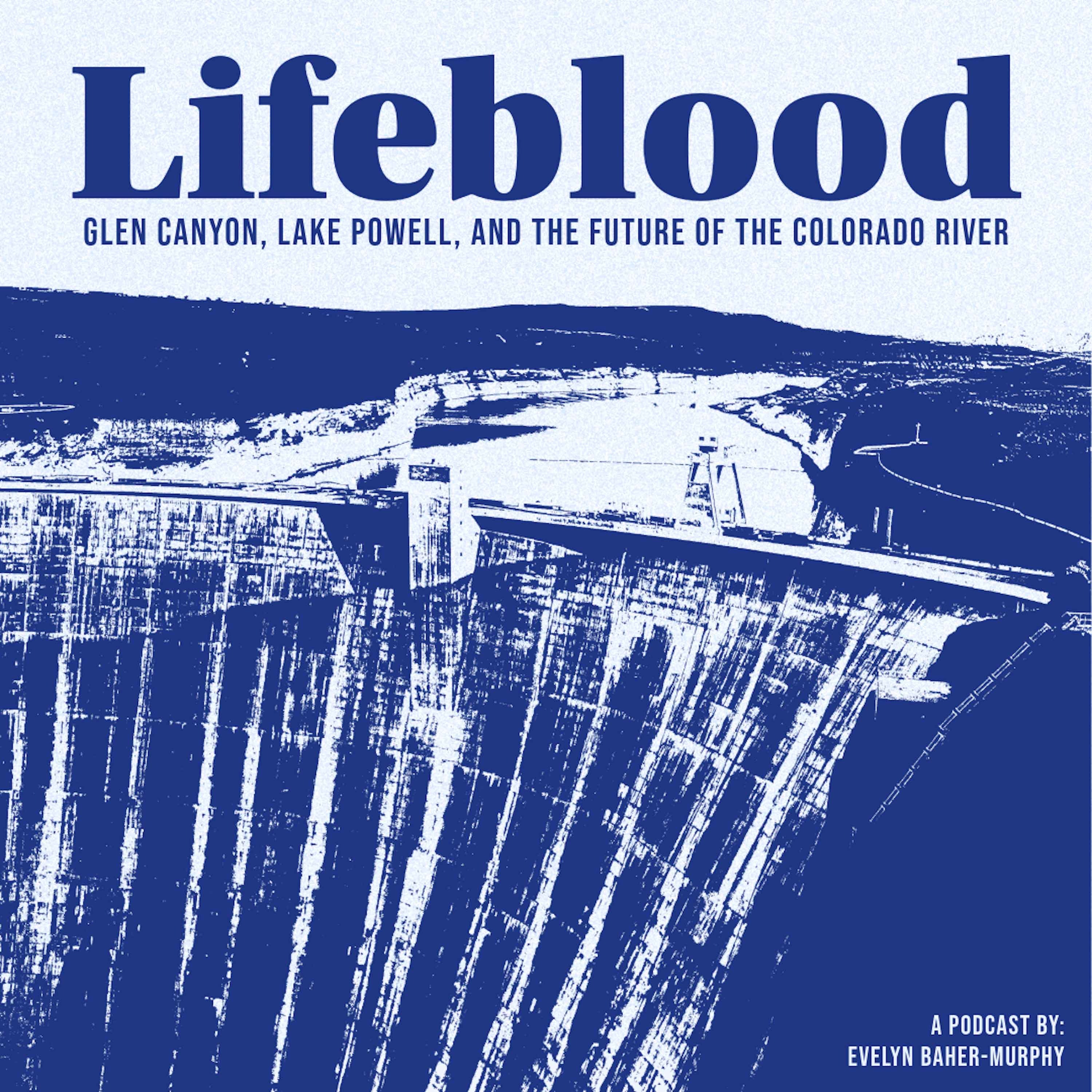
Lifeblood: Glen Canyon, Lake Powell and the Future of the Colorado River
by Evelyn Baher-Murphy
Is this your podcast?Insights from recent episode analysis
Audience Interest
Podcast Focus
Publishing Consistency
Platform Reach
Insights are generated by CastFox AI using publicly available data, episode content, and proprietary models.
Total monthly reach
Estimated from 1 chart position in 1 market.
By chart position
- 🇺🇸US · Nature#1965K to 30K
- Per-Episode Audience
Est. listeners per new episode within ~30 days
2.5K to 15K🎙 Weekly cadence·7 episodes·Last published 5mo ago - Monthly Reach
Unique listeners across all episodes (30 days)
5K to 30K🇺🇸100% - Active Followers
Loyal subscribers who consistently listen
1.5K to 9K
Market Insights
Platform Distribution
Reach across major podcast platforms, updated hourly
Total Followers
—
Total Plays
—
Total Reviews
—
* Data sourced directly from platform APIs and aggregated hourly across all major podcast directories.
On the show
Recent episodes
Sooner or Later: A River on the Horizon
Dec 14, 2025
37m 48s
Tempered Hope: A Canyon's Return
Oct 10, 2025
23m 46s
Deadpool: Black Lights at the Crime Scene
Sep 26, 2025
28m 08s
Glen Canyon: A Cathedral Drowned
Sep 12, 2025
25m 58s
Imaginary Hydrologies: The Colorado River Compact
Aug 29, 2025
24m 42s
Social Links & Contact
Official channels & resources
Official Website
Login
RSS Feed
Login
| Date | Episode | Description | Length | |
|---|---|---|---|---|
| 12/14/25 |  Sooner or Later: A River on the Horizon | Today, more dams are being removed in the U.S. than are being built. But what does that mean for Glen Canyon Dam? To answer that question, I spoke to conservation organizations, scientists, recreaters, and state and federal water managers. This episode dives into that story. Part 6 of a 6-part series.To keep up with the pod and see photos from Lake Powell , Antelope Point Marina, and my first smallmouth bass, follow @lifeblood.pod on Instagram.For more on the Fill Lake Mead First proposal, check out https://glencanyon.org/fill-mead-first/Written, hosted, and produced by Evelyn Baher-MurphyThis episode of Lifeblood was made possible by support from the Hulbert Center for Southwest Studies, the Colorado College Journalism Institute, the Utah Rivers Council, Colorado River and Trail Expeditions, Firefly Kitchens, Ceiba River Outfitters, and Outdoor Odysseys Sea Kayaking.Questions? Comments? Interested in sponsoring the pod? Contact: lifeblood.pod@gmail.com | 37m 48s | |
| 10/10/25 |  Tempered Hope: A Canyon's Return | When Lake Powell was full, many environmentalists believed Glen Canyon was lost forever, drowned beneath hundreds of feet of water. But today, with lake levels at historic lows, over 100,000 acres of Glen Canyon have re-emerged, challenging long-held narratives about environmental loss and recovery. This episode dives into that story. Part 5 of a 6-part series.To keep up with the pod and for photos of Glen Canyon's re-emergence, follow @lifeblood.pod on Instagram.For more info on Glen Canyon Archaeology, checkout: https://musnaz.org/collections/our-collections/anthropology-2/glen-canyon-2/For photos of returning rapids, checkout: https://www.returningrapids.com/trip-reportsWritten, hosted, and produced by Evelyn Baher-MurphyThis episode of Lifeblood was made possible by support from the Hulbert Center for Southwest Studies, the Colorado College Journalism Institute, the Utah Rivers Council, Colorado River and Trail Expeditions, Firefly Kitchens, Ceiba River Outfitters, and Outdoor Odysseys Sea Kayaking.Questions? Comments? Interested in sponsoring the pod?Contact: lifeblood.pod@gmail.com | 23m 46s | |
| 9/26/25 |  Deadpool: Black Lights at the Crime Scene | What happens when the foundation of the system that built the West starts to crack? In the early 2000s, the Colorado River Basin entered what climate scientists refer to as a megadrought, the driest period in over 1,200 years. As temperatures rose and runoff declined, our demand for water quickly outpaced a shrinking supply. Reservoirs like Lake Powell and Lake Mead began to drop — fast — revealing deep structural flaws. This episode unpacks the engineered risks, outdated policies, and looming threat of Deadpool, a point where Glen Canyon Dam may no longer be able to release any water downstream to the millions of people in Nevada, Arizona, California, and Mexico, whose lives depend on it. Part 4 of a 6-part series.To keep up with the pod and for photos of Lone Rock and Glen Canyon Dam, follow @lifeblood.pod on Instagram.Written, hosted, and produced by Evelyn Baher-MurphyThis episode of Lifeblood was made possible by support from the Hulbert Center for Southwest Studies, the Colorado College Journalism Institute, the Utah Rivers Council, Colorado River and Trail Expeditions, Firefly Kitchens, Ceiba River Outfitters, and Outdoor Odysseys Sea Kayaking.Questions? Comments? Interested in sponsoring the pod? Contact: lifeblood.pod@gmail.com | 28m 08s | |
| 9/12/25 |  Glen Canyon: A Cathedral Drowned | Construction of Glen Canyon Dam was completed in 1963. As Lake Powell rose behind the 710-foot concrete wall, archaeologists raced to document hundreds of cultural sites before they were inundated. But the loss extended far beyond cultural resources. The flooding of Glen Canyon transformed the Colorado River itself, cooling its waters, trapping sediment, and starving the Grand Canyon’s beaches and ecosystems of a vital resource. This episode dives into that story. Part 3 of a 6 part series.To keep up with the pod and for photos of Red Bud Alcove, follow @lifeblood.pod on Instagram.Written, hosted, and produced by Evelyn Baher-MurphyThis episode of Lifeblood was made possible by support from the Hulbert Center for Southwest Studies, the Colorado College Journalism Institute, the Utah Rivers Council, Colorado River and Trail Expeditions, Firefly Kitchens, Ceiba River Outfitters, and Outdoor Odysseys Sea Kayaking.Questions? Comments? Interested in sponsoring the pod? Contact: lifeblood.pod@gmail.com | 25m 58s | |
| 8/29/25 |  Imaginary Hydrologies: The Colorado River Compact | At Lee's Ferry, in Northern Arizona, on the western edge of the Navajo Nation, the Colorado River basin is divided into two regions. The Upper Basin includes the states upstream of Lee's Ferry - Colorado, Utah, Wyoming, and New Mexico - while the Lower Basin includes all of the downstream states - California, Nevada, and Arizona. That split is thanks to a document known as the Colorado River Compact, which largely determines how and when Colorado River water flows downstream. Unfortunately, when the Colorado River Compact was signed in 1922, the seven basin states made three huge allocation errors. This episode dives into that story. Part 2 of a 6-part series.To keep up with the pod and for photos of Devan Udall at Lee's Ferry check out @lifeblood.pod on Instagram.Written, hosted, and produced by Evelyn Baher-MurphyThis episode of Lifeblood was made possible by support from the Hulbert Center for Southwest Studies, the Colorado College Journalism Institute, the Utah Rivers Council, Colorado River and Trail Expeditions, Firefly Kitchens, and Outdoor Odysseys Sea Kayaking.Questions? Comments? Interested in sponsoring the pod? Contact: lifeblood.pod@gmail.com | 24m 42s | |
| 8/22/25 |  The Colorado River: A River Run Dry | The Colorado River has flowed from source to sea for 6 million years. It is old. Older than most things. And people have lived in relationship with the river for 1000's of years. Their descendants still call the river home. Yet today the river no longer reaches its historical terminus, the Sea of Cortez. This new reality coincides with the arrival of Anglo settlers and is a direct result of a series of policies that have affected where the river is allowed to flow and where the river is allowed to die. This episode dives into that story. Part 1 of a 6-part series.For photos of the Nankoweap Granaries and of Eli Reich dressed as Vishnu Schist for Halloween, follow the pod on Instagram @lifeblood.podWritten, hosted, and produced by Evelyn Baher-MurphyThis episode of Lifeblood was made possible by support from the Hulbert Center for Southwest Studies, the Colorado College Journalism Institute, the Utah Rivers Council, Colorado River and Trail Expeditions, and Outdoor Odysseys Sea KayakingQuestions? Comments? Interested in sponsoring the pod? Contact: lifeblood.pod@gmail.com | 16m 17s | |
| 8/20/25 |  Lifeblood - Episode: 0 | With support from the Hulbert Center for Southwest Studies, Utah Rivers Council, and Colorado River and Trail Expeditions, Lifeblood is a 6-part audio documentary, produced and narrated by me, Evelyn Baher-Murphy.When I first learned about the Colorado River, its rapids, its reservoirs, the millions of people who depend on it, and its uncertain future, I wanted to know more. So I set out on the road interviewing stakeholders, policy makers, and experts who care about the river, its resources, and how and where it flows. What I heard is a complicated story of flooded canyons, drowned archaeology, environmental mishaps, water policy miscalculations, megadrought, and hope for the future...hope for radical conservation.Throughout the series. I ask the questions "How did we get here?" and "How do we keep going?”Episode: 1 of Lifeblood airs on Friday, August 22nd.For additional content and updates, follow along on Instagram @lifeblood.podQuestions? Comments? Interested in sponsoring the pod? Contact: lifeblood.pod@gmail.com | 2m 17s |
Showing 7 of 7
Sponsor Intelligence
Sign in to see which brands sponsor this podcast, their ad offers, and promo codes.
Chart Positions
1 placement across 1 market.
Chart Positions
1 placement across 1 market.