

Insights from recent episode analysis
Audience Interest
Podcast Focus
Publishing Consistency
Platform Reach
Insights are generated by CastFox AI using publicly available data, episode content, and proprietary models.
Total monthly reach
Estimated from 2 chart positions in 2 markets.
By chart position
- 🇹🇷TR · Marketing#4710K to 30K
- 🇳🇿NZ · Marketing#190500 to 3K
- Per-Episode Audience
Est. listeners per new episode within ~30 days
3.1K to 9.9K🎙 Daily cadence·132 episodes·Last published yesterday - Monthly Reach
Unique listeners across all episodes (30 days)
11K to 33K🇹🇷91%🇳🇿9% - Active Followers
Loyal subscribers who consistently listen
4.2K to 13K
Market Insights
Platform Distribution
Reach across major podcast platforms, updated hourly
Total Followers
—
Total Plays
—
Total Reviews
—
* Data sourced directly from platform APIs and aggregated hourly across all major podcast directories.
On the show
Recent episodes
#137: AI visibility isn’t built on content alone - It’s built on citations
May 19, 2026
Unknown duration
#136: AI search can’t trust a brand it doesn’t understand. Here’s what to do
May 12, 2026
Unknown duration
#135: AI browsers are re-writing Marketing - From clicks to decisions
May 5, 2026
Unknown duration
#134: From ads to entertainment: Why brands using music videos are re-writing marketing
Apr 28, 2026
Unknown duration
#133: Do brands still need a website in the AI search era? The answer has changed
Apr 21, 2026
Unknown duration
Social Links & Contact
Official channels & resources
Official Website
Login
RSS Feed
Login
| Date | Episode | Description | Length | ||||||
|---|---|---|---|---|---|---|---|---|---|
| 5/19/26 | 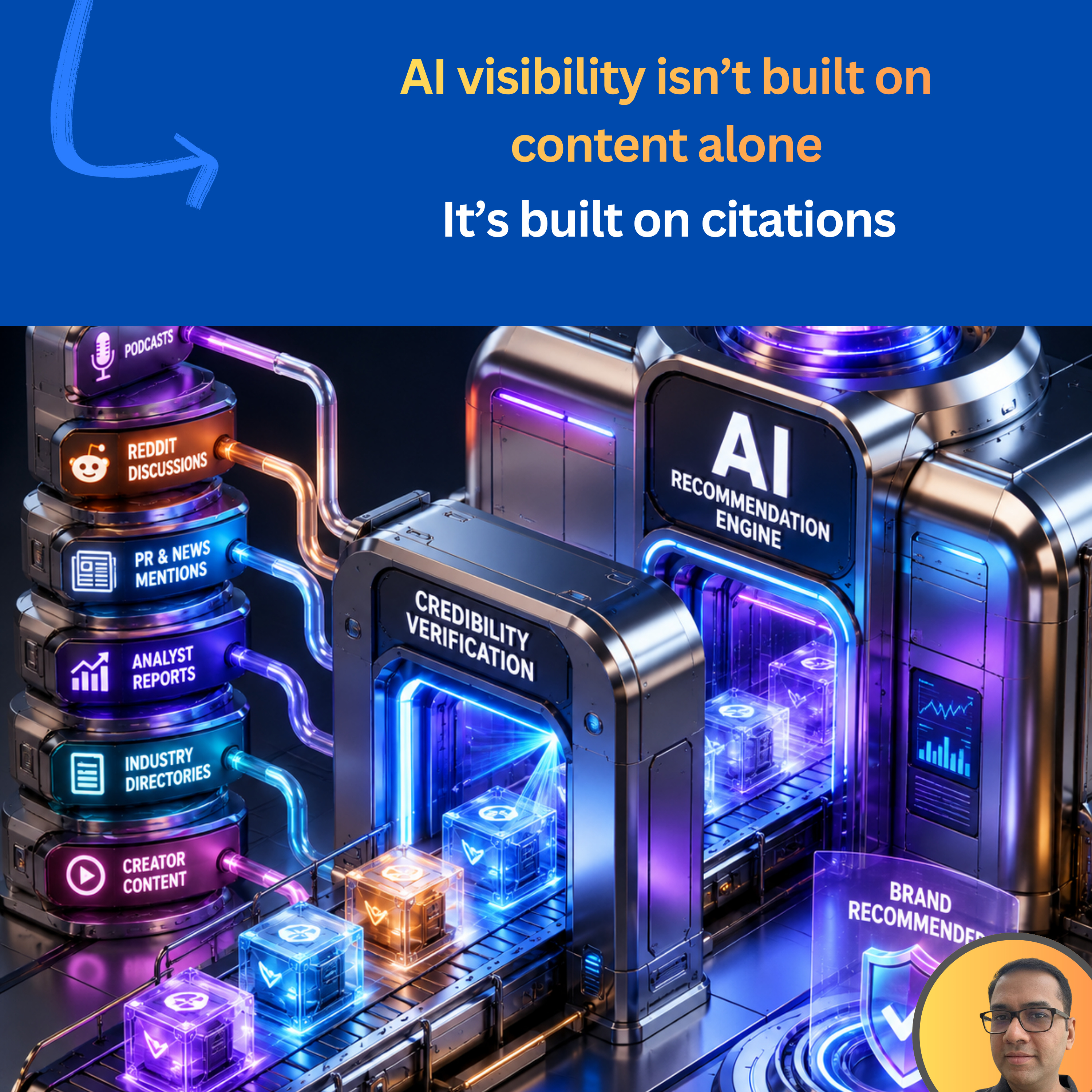 #137: AI visibility isn’t built on content alone - It’s built on citations | In a world obsessed with publishing more content, brands are learning a hard truth: AI doesn’t trust what brands say about themselves as much as what others say about them. In this episode of Likely **Marketing, we explore why AI visibility is no longer built on content alone, but on citations, credibility, and repeated validation across the web.From Reddit discussions and podcasts to digital PR, analyst reports, and industry directories, AI systems like OpenAI’s ChatGPT and Perplexity learn from the wider information ecosystem around your brand. Because in the AI era, visibility isn’t earned by publishing more. It’s earned when your brand becomes repeatedly cited, discussed, and trusted across the Internet.(00:00) Intro(01:12) The information environment AI actually learns from(03:07) How to ensure that your brand registers with AI, not just exist online(04:38) So, which channels can help brands register with AI?(09:15) Single mention is not enough, AI looks for pattern as an indicator of influence(11:36) Here’s a quick list of things to do to get cited by AI(13:52) A broader view on getting mentioned by AI | — | ||||||
| 5/12/26 | 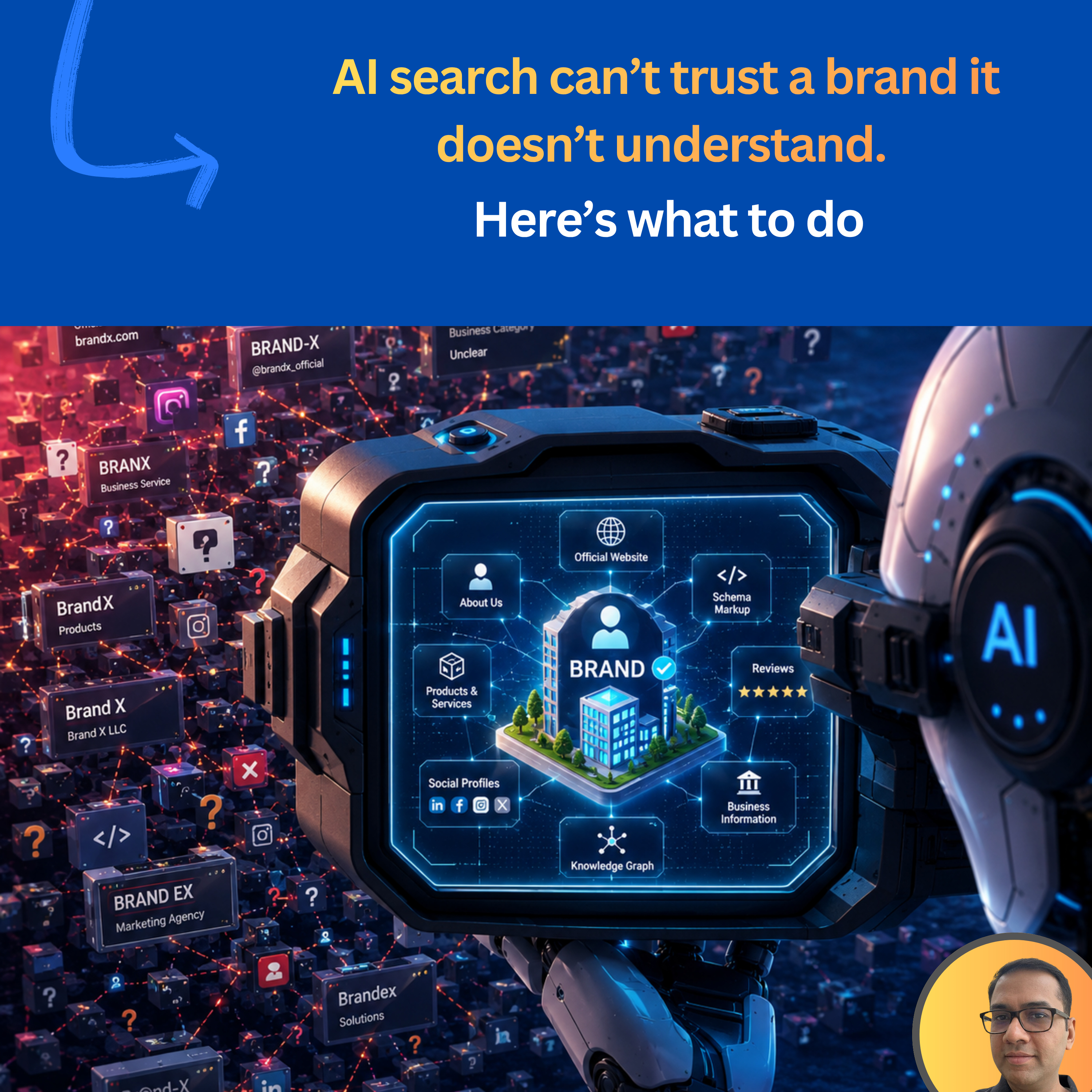 #136: AI search can’t trust a brand it doesn’t understand. Here’s what to do | In the age of AI search, brands are no longer competing only for rankings. They’re competing to be understood. When someone asks ChatGPT, Google AI Overviews, or Perplexity about a company, the machine first asks: “Who exactly is this brand?” In this episode, Shivendra explores Entity SEO — the invisible layer shaping visibility in AI search. From vague positioning and confusing brand names to schema markup, structured data, and consistent digital signals, discover why AI trusts clarity over noise. Because before AI can recommend your brand, mention it, or rank it, it needs to confidently understand who you are. AI search doesn’t reward the loudest brand. It rewards the clearest identity.(00:00) Intro(01:33) How AI solves the confusion of brand identity(05:13) How can brands reduce AI’s confusion?(08:14) How unclear positioning makes AI hesitate and what more can marketers do?(09:32) Bringing it all together: How to make sure AI understands your brand clearly | — | ||||||
| 5/5/26 | 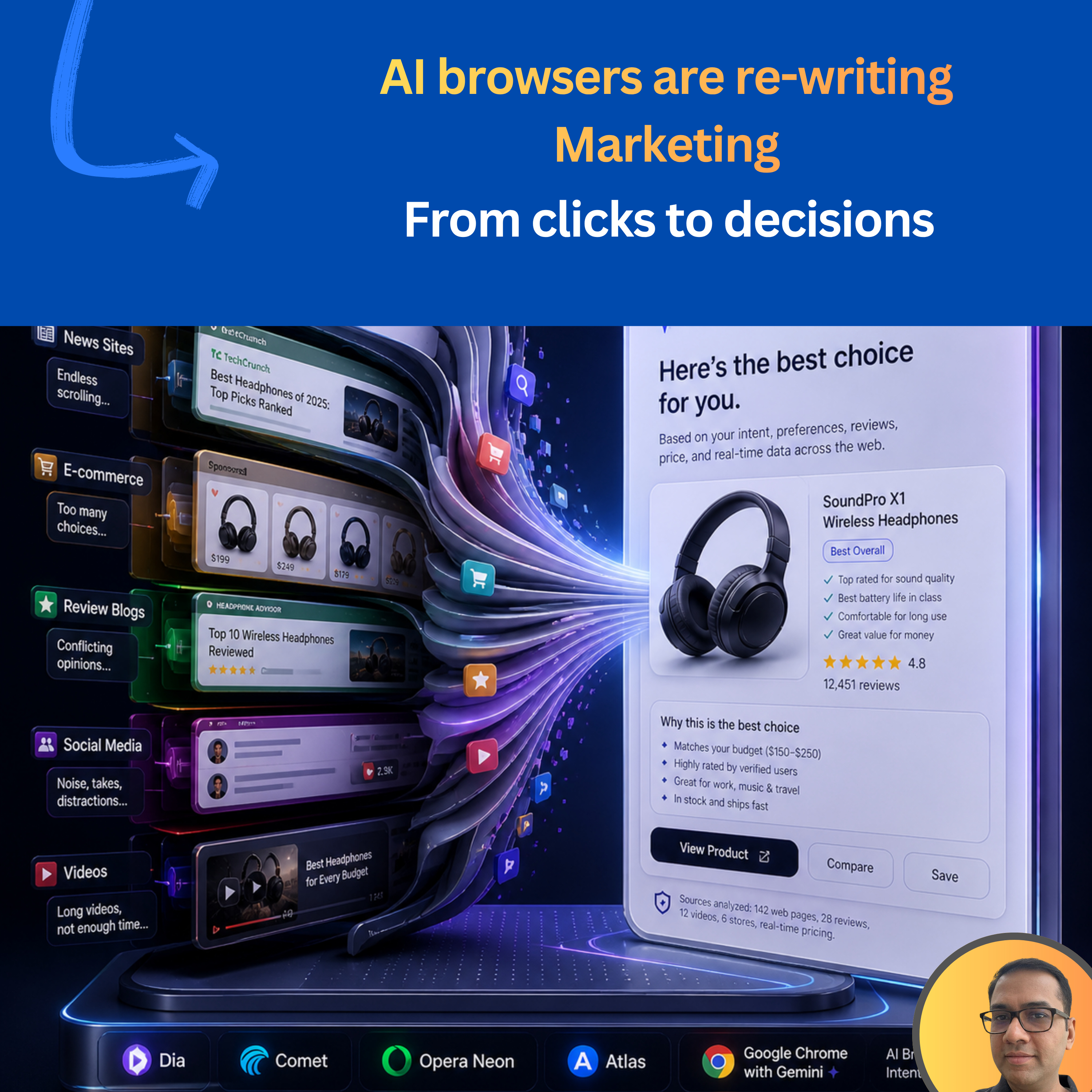 #135: AI browsers are re-writing Marketing - From clicks to decisions | The first version of the web gave us clicks. This one quietly takes them away. In this episode, we explore how AI browsers like Dia Browser, Comet Browser, Opera Neon, Atlas Browser, and Google Chrome are turning the internet into an intent-driven system where decisions happen before clicks. What starts as a search becomes a conversation, then an action—summaries replace scrolling, agents compare options, and workflows replace journeys. While cookies still exist, real power is shifting to context, memory, and AI-led actions. For marketers, this means your audience may never visit your site, yet still choose you. Visibility is no longer about ranking—it’s about being selected inside an answer. This is marketing for AI browsers—where influence happens before the click.(00:00) Intro(01:19) A snapshot of what’s new across each AI browser, so far(11:50) What are the AI browsers doing to lock-in the users?(13:58) How are AI browsers tracking user journeys, and how can marketers use that to their advantage?(17:35) How are AI browsers handling cookies?(20:24) What’s next for AI browsers and marketers? | — | ||||||
| 4/28/26 | 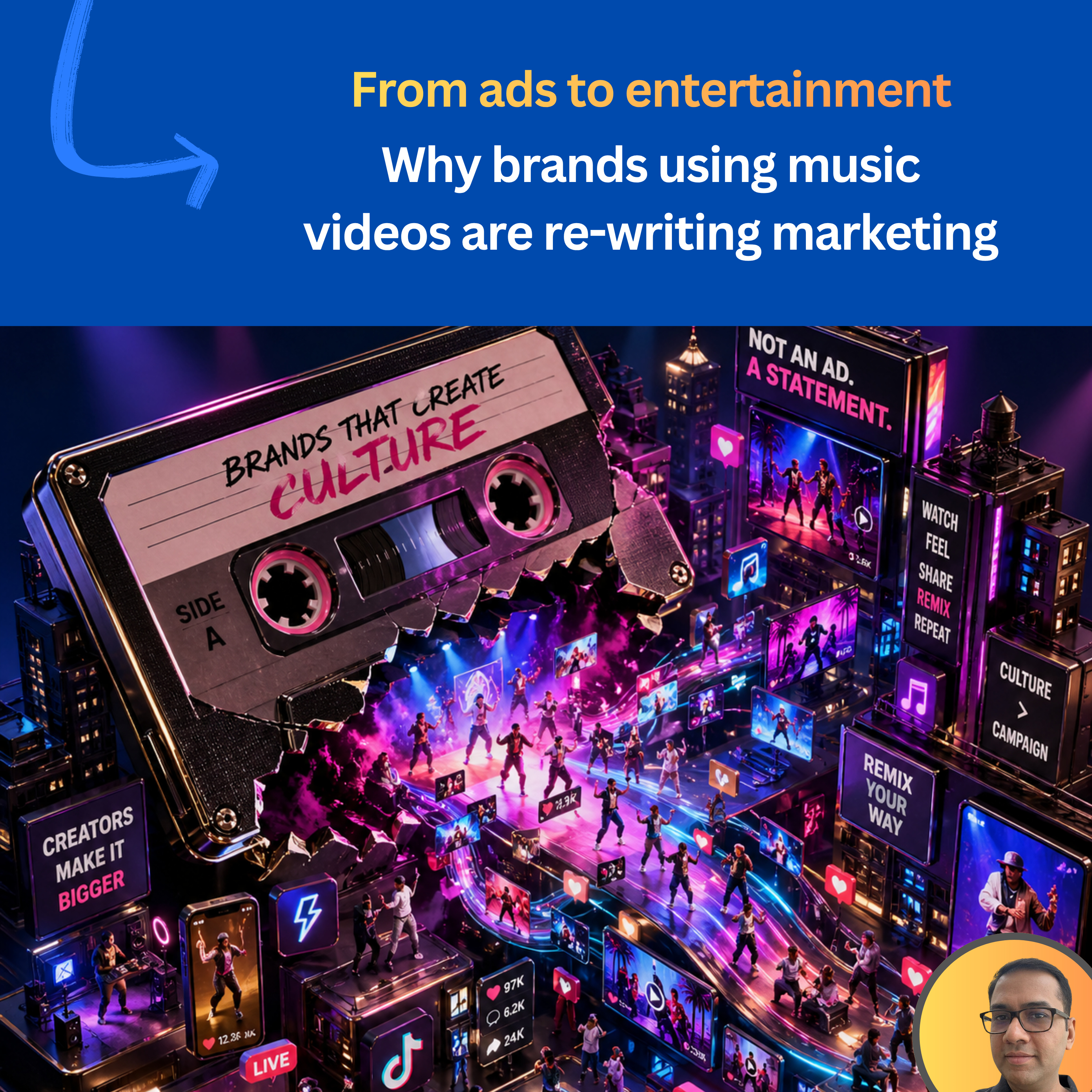 #134: From ads to entertainment: Why brands using music videos are re-writing marketing | It starts as a pattern you almost ignore—until it repeats. A clothing brand releases a music video. Then a fintech app. Then an airline. Not ads or placements, but full-scale productions with original songs, choreography, and stories. This episode explores the rise of brands using music videos to become culture, not just commercials. As audiences skip ads, brands are shifting from buying attention to earning it through entertainment-first storytelling. Music becomes the medium because it sticks, moves people, and gets shared—turning a single video into a campaign, a remix, a memory. From fashion to tech, brands are acting like studios, collaborating with artists and creating for participation, not just reach. The real question is no longer how to advertise, but what a brand is willing to create to truly matter.(00:00) Intro(01:06) What is this trend of brands creating music videos, exactly?(03:48) Why are brands creating their own music videos?(07:31) What kind of brands are leaning into music videos, and who are they targeting?(09:06) How does the economics of creating music videos look like? Is there a play for smaller brands?(11:41) Is a brand creating a music video similar to a scripted social series?(15:20) Patterns across brands using both, music videos and scripted social series(16:54) Where this leaves you as a marketer or brand… | — | ||||||
| 4/21/26 |  #133: Do brands still need a website in the AI search era? The answer has changed | AI didn’t kill websites, it made them invisible. There was a time when platforms like Google defined discovery, and ranking meant relevance. Websites were the internet’s home. But today, AI search, social platforms like TikTok, Instagram, and YouTube, and voice assistants intercept intent before a click ever happens. Answers are delivered instantly, journeys are compressed, and clicks are disappearing. Yet behind every AI-generated response lies a source, and that source is still a website. The role has shifted from destination to infrastructure: powering AI, building trust, and owning data. In the future of websites with AI search, your site isn’t the front door, it’s the engine.(00:00) Intro(01:12) How a website became “home” for businesses(04:47) Now, there are forces that are pulling discovery away from websites(10:57) So, what is the value of having a website now?(15:23) Should brands be investing in a website?(18:55) What is the likely future of websites in times to come? | — | ||||||
| 4/14/26 |  #132: From booth traffic to brand immersion: The new power of VR in events marketing | A quiet trade show aisle changes in seconds: one ordinary booth becomes a portal, and curious passersby step into branded worlds they can see, touch, and remember. In this episode, “From booth traffic to brand immersion: The new power of VR in events marketing,” we explore how VR for events marketing is transforming static booths into immersive experiences that attract crowds, deepen engagement, and generate measurable ROI. From virtual test drives and digital showrooms to gamified product storytelling, discover why brands are using VR to turn footfall into qualified leads, extend event reach beyond venue walls, and create unforgettable brand moments. As headset costs fall and immersive tech improves, VR is no longer event hype, it is becoming the next essential layer of experiential marketing.(00:00) Intro(01:19) What is VR for events? And how does it work?(04:24) Is adoption of VR for events really growing? What’s driving it?(07:46) Who’s using VR for events?(11:08) What is the ROI of using VR for events?(13:48) Is there a future where VR can replace in-person events?(16:23) What are the barriers to adoption of VR at trade shows?(19:12) What does the future for VR activations at events look like? | — | ||||||
| 4/7/26 |  #131: Instagram caption links for marketing are coming…and “organic” may never be the same | It began with a small shift inside Instagram, a simple “Add link” button that marketers had waited years for. But this wasn’t just a feature update. It was a signal. For a decade, “link in bio” shaped how traffic flowed, powering tools like Linktree and defining what organic growth looked like. Now, with caption links available only through Meta Verified, the journey from discovery to conversion collapses into a single tap, if you’re willing to pay. This episode explores how Instagram caption links for marketing turn frictionless conversion into a paid advantage, blur the meaning of “organic,” and quietly introduce a new reality: it’s no longer just about who earns attention, but who gets to convert.(00:00) Intro(01:40) Instagram caption links - how it works and why it matters(03:14) How Instagram caption links differ from Stories or bio links(05:09) Reasons why Meta decided to allow caption links on Instagram now(10:36) Are Instagram caption links a “deal sweetener” for a tiered social media?(13:18) The bigger question - are traffic and conversion from caption links truly organic?(14:58) Strategic takeaways for marketers, brands and creators with respect to Instagram caption links(18:09) Parting thoughts… | — | ||||||
| 3/31/26 |  #130: Why horror genre fans are marketing gold (and how to reach them right) | A flicker. A shadow. A heartbeat that isn’t yours. Millions press play not just to watch horror, but to feel something deeper. Horror fans aren’t passive viewers—they seek intensity, remember what moves them, and reward what earns their attention. In this episode, we explore the psychology behind this behavior—from sensation-seeking to emotional memory—and why it makes horror audiences more open, experimental, and deeply engaged. This isn’t a niche; it’s a high-value segment hiding in plain sight. From streaming personalization to immersive experiences and community-driven campaigns, brands are already tapping into it. But horror doesn’t reward interruption—it demands immersion, cultural sensitivity, and bold storytelling. When done right, it doesn’t just capture attention, it lingers. The question is: will your brand be worth the scare?(00:00) Intro(01:29) What research says about horror movie goers as consumers(07:55) How some brands use these traits of horror genre lovers(15:01) A practical playbook for marketers to target horror genre audience(18:18) When horror genre makes sense, and when it doesn’t | — | ||||||
| 3/24/26 |  #129: What horror movies reveal about attention, emotion, and audience behavior | You open your analytics dashboard, searching for the next big content bet—sports, food, drama but nothing sticks. Then you notice a pattern: horror. Not jump scares or gore, but something deeper. Since 2015, horror movies have evolved into a global attention engine with low budgets, massive ROI, and strong retention across theaters and streaming. But the real story lies in the audience—young, diverse, and highly engaged. They don’t just watch; they feel, share, and return. The reason is psychological. Horror taps into sensation-seeking and “safe fear,” delivering intense yet controlled emotional experiences that people often enjoy together. That shared emotion drives memory, loyalty, and community. For marketers, the lesson is simple but powerful: attention follows emotion, and loyalty follows shared experience. Horror movies were never just about fear, they reveal how audiences think, feel, and behave.(00:00) Intro(01:49) Love for horror stories has been growing rapidly…(04:23) …but who’s watching them? (audience demographics)(05:28) The psychology behind the desire to be scared(09:17) Quick takeaways on the horror genre and the underlying psychology of the audience | — | ||||||
| 3/17/26 |  #128: Should your content train AI or protect your brand? The Google AI opt-out dilemma | AI search is quietly rewriting the rules of discovery. With Google AI Overviews, users increasingly get answers directly on the search page without clicking a website. Convenient for users—but disruptive for publishers, creators, and brands whose content powers those answers. Now Google is exploring something unprecedented: letting websites opt out of AI-generated search summaries while staying visible in traditional search. This creates a strategic dilemma for marketers. Should your content train AI for visibility and credibility, or protect proprietary insights, traffic, and brand value? In this episode, we unpack the Google AI opt-out debate, how AI search is becoming a separate marketing channel, and why brands must decide which content should fuel AI discovery and which should remain protected in a zero-click search world.(00:00) Intro(01:57) How we got to the point when Google is ‘exploring’ AI opt-outs?(04:59) How does AI opt-in and opt-out tension affect discoverability?(07:34) How would it impact the data quality and training of AI?(11:01) In which cases can AI opt-out be beneficial for marketing?(13:03) In which cases can AI opt-out be risky for marketing?(14:51) Is there a power shift from platforms to content creators? Or is it a re-balancing?(16:22) Top 5 things marketers can take away from this AI-search opt-out conversation(18:41) Wrapping up… | — | ||||||
Want analysis for the episodes below?Free for Pro Submit a request, we'll have your selected episodes analyzed within an hour. Free, at no cost to you, for Pro users. | |||||||||
| 3/10/26 |  #127: AI for branding and marketing: In a world of AI noise, human stories win | We are living in an age of information overload where AI can generate content faster than ever. Feeds are full of polished posts, perfect visuals, and algorithm-friendly messages—yet most of it disappears from memory within seconds. This episode explores the growing tension in AI for branding and marketing. As generative AI floods the internet with “AI slop”—content that looks impressive but feels hollow—audiences are becoming better at spotting it and trusting it less. Interestingly, this shift is pushing some of the most thoughtful brands like Apple, Polaroid, Heineken, Muji, and Dove to move AI backstage. They use AI for research, insights, and personalization, but keep the brand story human. Because in a world of automated content, authentic human stories are becoming the real competitive advantage.(00:00) Intro(01:59) The AI slop has created a paradox for brands and marketers(05:17) Examples of brands avoiding AI-generated content, and why?(10:15) How are brands using AI quietly, in the background?(14:34) How can brands and marketers figure out whether they can lean on AI or not?(17:49) Few more words on this tension around using AI for branding and marketing… | — | ||||||
| 3/3/26 |  #126: Google Scenario Planner: The CFO-proof engine for smarter marketing decisions | The room goes silent. The CFO asks: “If we move budget, what happens to revenue?” In today’s privacy-first, AI-driven chaos, guesswork fails. This episode explores how Marketing Mix Modeling (MMM) is becoming a strategic edge through Google Meridian and Google Scenario Planner.Meridian analyzes aggregated, multi-channel data to uncover true incremental impact. Scenario Planner turns that model into a no-code control panel—letting marketers simulate budget shifts and forecast outcomes in real time.It’s not a silver bullet. It’s a cultural shift—from reporting what happened to modeling what to do next. Google Scenario Planner MMM could turn budget anxiety into evidence-backed strategy—if your organization is ready.(00:00) Intro(01:21) First, what’s marketing mix modeling (MMM)?(04:45) Meridien is Google’s attempt at making marketing mix modeling accessible for businesses(08:31) And Google’s Scenario Planner makes marketing mix modeling easier for businesses(10:54) Google Scenario Planner could change how marketing strategies are built(12:48) Which organizations are likely to adopt Meridien and Scenario Planner, and marketing mix modeling? And which ones are less likely to?(16:24) Closing thoughts… | — | ||||||
| 2/24/26 |  #125: Is curated advertising ending the era of cheap digital ads? | For years, digital advertising chased cheap scale. Programmatic buying promised low CPMs and limitless reach, but brands lost control of context. Ads appeared beside misinformation, low-value content, and misaligned audiences. Privacy laws tightened, cookies faded, CAC rose, and trust declined.This episode explores the rise of curated advertising — premium, handpicked environments like Private Marketplaces, trusted publishers, trade media, newsletters, communities, and AI chat surfaces. It’s a shift from buying everything to buying what’s worth it.Yes, CPMs may be higher. But the real metric is outcome. Curated advertising redefines CAC and ROAS through context, trust, and high-intent placements. Is this the end of cheap digital ads — and the return of quality?(00:00) Intro(01:28) What is curated advertising?(04:48) How does the curation mindset changes the game for SEM, social, trade media, and newsletters?(08:31) Are curated social - groups and communities - brand safe zones for advertising?(10:41) Where does chat-vertising or AI advertising sit?(12:27) Will curated advertising make online ads more premium? How will it affect CAC and ROAS?(14:30) Closing thoughts… | — | ||||||
| 2/17/26 |  #124: Digital equity in M&A: The asset exec boards forget, until the traffic disappears | The deal closes. Headlines celebrate synergy. Valuations look strong. From the $5T M&A peak of 2021 to regulator-blocked moves like Adobe’s attempted acquisition of Figma, boards focus on balance sheets. But between signing and rebranding, a quieter loss unfolds. A high-ranking domain is redirected, thousands of indexed pages collapse into generic URLs, backlinks break, and AI answers stop citing the brand. Traffic fades, pipeline tightens, revenue feels it.This episode explores digital equity in M&A—your algorithmic trust across search, backlinks, structured data, and AI visibility. Not brand perception, but discoverability inside Google and AI systems. As ecosystems consolidate, like Intuit acquiring Mailchimp, marketing stacks merge and so does risk.Digital dilution is measurable: lost rankings, shrinking organic leads, broken conversions. For startups and SMBs, digital equity becomes leverage if documented, valued, and protected. Map revenue to organic traffic, plan redirects before migration, monitor branded vs non-branded search, and guard your backlinks.Because M&A doesn’t just reshape companies. It reshapes visibility. Ignore digital equity and you inherit silent loss. Protect it and it becomes strategic power.(00:00) Intro(01:23) A quick look-see of the global M&A trends in the past 5 years(03:01) M&A deals are changing how marketers work(06:12) What is digital equity, and why is it an overlooked asset in M&A deals?(10:01) Takeaways from startups or SMB marketers if their company goes through M&A(14:08) Takeaways from startups or SMB marketers if companies behind their tech tools go through M&A(15:08) The bigger picture… | — | ||||||
| 2/10/26 |  #123: 400 million users later — why isn’t Threads a marketing priority yet? | At the start of the year, you open your marketing plan and wonder: is Threads worth the effort, or just another platform to maintain? When Meta launched it in 2023, 100 million users signed up in a week. Today, it sits at nearly 400 million monthly active users with strong engagement and Gen Z attention.So why aren’t marketers prioritizing Threads for marketing?This episode explores the tension between scale and significance. Threads has reach, lower ad costs, and Meta’s backing—but lacks clear positioning, mature ad products, and proven ROI stories. It feels powerful, yet undefined.Is Threads an early opportunity hiding in plain sight, or a platform still searching for its purpose? Listen in as we unpack whether it becomes a marketing essential—or remains a watchlist experiment.(00:00) Intro(01:08) Let’s start with the launch of Threads(02:44) Where does Threads stand today - users, behaviour and context(05:28) How are marketers and creators using Threads, right now?(07:40) Reasons behind why Threads is not a marketing priority, yet(10:36) What Threads is, and is not, providing to the brands, marketers and creators(12:18) What Threads needs to do going forward…(14:21) In summary… | — | ||||||
| 2/3/26 |  #122: Is in-game advertising the most undervalued growth engine in marketing? | I clear a puzzle level on my phone. Fireworks flash. A choice appears: watch 30 seconds, earn extra coins. I tap yes. That’s in-game advertising — opt-in, rewarded, seamless.In this episode, we explore why in-game advertising is becoming a core growth engine. Gaming is a $124B+ industry with 3B players across mobile, PC, console, AR, VR, and cloud. Gen Z attention lives here. Free-to-play models, rewarded video, and dynamic in-game ads are turning brands into part of the experience.From Roblox and Candy Crush to esports and console programmatic, immersion beats interruption.Is in-game advertising still experimental — or the next media pillar?(00:00) Intro(02:09) The fast-expanding world of games across platforms and geographies(07:15) What are the drivers behind pushing ads inside games?(09:08) Who’s winning with in-game advertising? Some real world examples…(13:20) Why aren’t more brands doing in-game advertising?(16:04) Which industries are taking advantage of in-game advertising quickly?(19:56) Looking through the telescope… | — | ||||||
| 1/27/26 |  #121: How brand collaborations (not so) quietly became the new marketing system | Two brands meet. Not on a billboard. Not in an ad break. But quietly—where trust already lives.Over the last five years, brand collaboration marketing has stopped being a flashy stunt and started behaving like a system. A new operating model for growth. One where brands borrow credibility, share culture, reduce risk, and expand meaning—together.In this episode, How brand collaborations quietly became the new marketing system, we trace how collaborations moved from hype to necessity. From product drops and shared audiences to value-led partnerships and immersive brand worlds. We unpack why some collaborations compound trust and community—while others collapse under misaligned audiences, values, or messaging.This isn’t a highlight reel. It’s a map. Of what works, what breaks, and why collaboration has become the fastest path to relevance in a trust-first, culture-driven market.Because the future of marketing isn’t brand protection.It’s brand expansion—through authentic, value-aligned partnerships.(00:00) Intro(01:13) Brand collaborations have been growing fast in the past 5 years(02:43) What kind of brand collaborations have been happening?(05:24) What are key drivers behind brand collaborations?(09:37) Situations when brand collaborations might go wrong…(14:08) Brand collaborations are here to stay…(15:49) Parting thoughts… | — | ||||||
| 1/20/26 | 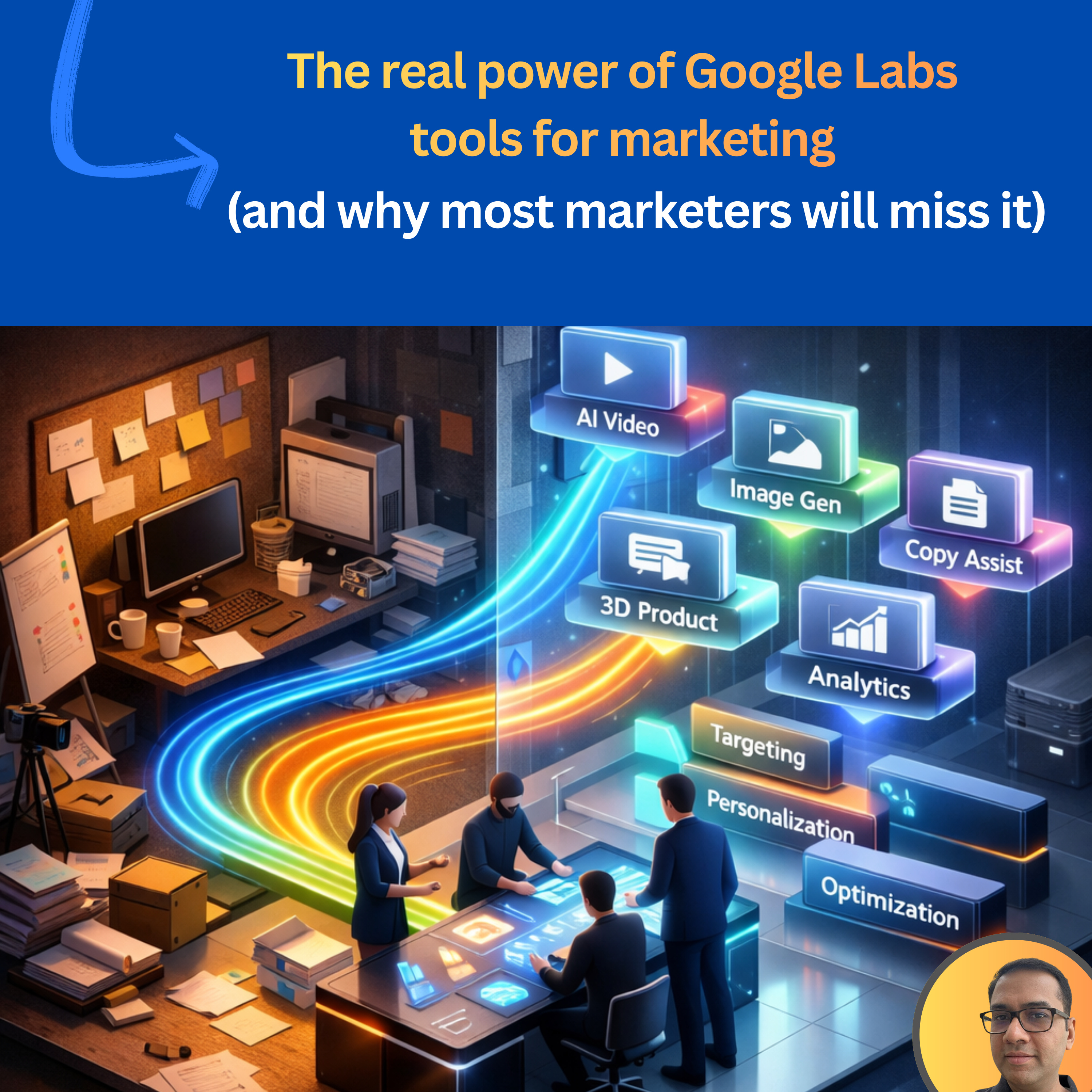 #120: The real power of Google Labs tools for marketing (and why most marketers will miss it) | Late one weekend, a marketer falls down a quiet rabbit hole called Google Labs—and realizes something important is happening in plain sight.This episode explores how Google Labs tools for marketing aren’t random AI experiments, but early signals of how Google is rebuilding its entire advertising ecosystem. From AI-generated images, video, music, and copy to conversational assistants and 3D product visualization, these tools reveal a future where creative production is instant, personalization is native, and experimentation happens at scale.But the real story isn’t speed. It’s power. As Google connects these tools to Search, YouTube, Performance Max, CTV, and GA4, marketing shifts from making more content to making smarter decisions. AI removes friction. Strategy becomes the differentiator.This is the real power of Google Labs tools for marketing—and why most marketers will miss it.(00:00) Intro(01:03) AI has created a quiet revolution in marketing(04:21) Inside Google Labs’ experimental content creation toolkit(08:33) Exploring Google’s experimental, edgy tech tools(11:29) Where can these AI tools fit in Google’s ecosystem?(15:05) How will GA4 measure performance if these tools are used or integrated with the Google ecosystem?(17:49) My take on Google Labs’ experimental tools… | — | ||||||
| 1/13/26 |  #119: What OpenAI really wants from Pinterest — Why marketers should care | What if OpenAI’s biggest missing piece isn’t better models—but better intent?This episode begins with a rumor: OpenAI might acquire Pinterest. But quickly, it becomes a story about where AI, search, and marketing are actually headed. Pinterest isn’t just a visual platform. It’s where humans plan, dream, decide, and shop—leaving behind rare, intent-rich visual signals at scale.We unpack why OpenAI would care about Pinterest’s 200+ billion images, Gen Z discovery behavior, and inspiration-to-purchase loops—and how that data could reshape AI image generation, AI commerce, and future ChatGPT interfaces.For marketers, the message is clear: search is turning visual, discovery is replacing keywords, and the funnel is collapsing into moments. This isn’t M&A gossip. It’s a preview of intent-driven, visual-first marketing in the AI era.Whether the deal happens or not, the shift already has.(00:00) Intro(01:18) Why would OpenAI even want to acquire Pinterest?(05:43) Is there a lacking in OpenAI’s models when it comes to image processing and image or video generation?(10:07) The possibility of Pinterest’s UI influencing Sora and ChatGPT ads(12:15) Whether OpenAI acquires Pinterest or not, it could mean a lot to brands and marketers(15:31) What is the bigger picture that emerges from this OpenAI acquiring Pinterest speculation? | — | ||||||
| 1/6/26 | 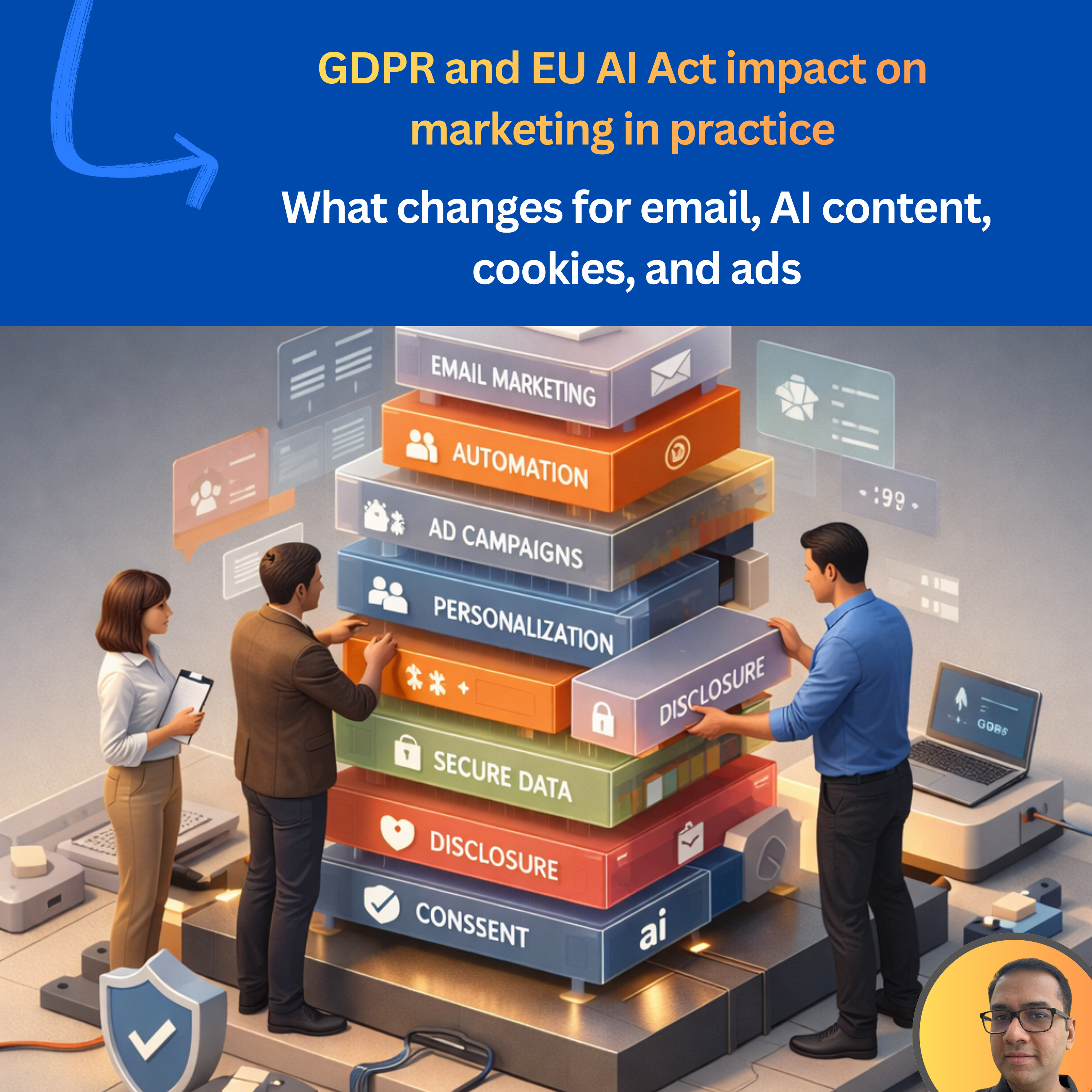 #118: GDPR and EU AI Act impact on marketing in practice: What changes for email, AI content, cookies, and ads | On a quiet January morning, over coffee, a single sentence captured the mood of modern marketing: “It feels like the rules keep changing, but no one tells us what the new rules are.”This episode is about those rules.As GDPR tightens enforcement and the EU AI Act comes into force, marketing enters a new phase—where data, AI, and personalization are no longer shortcuts to growth, but regulated responsibilities. Consent must be clear and provable. Cookies must be fair. AI-generated content must be disclosed. And algorithms that decide who sees what now come with legal accountability.This isn’t about killing AI or personalization. It’s about ending black-box marketing. If AI shapes targeting, profiling, or decisions, the responsibility sits with brands—not tools or platforms. And these laws don’t stop at Europe’s borders.In this episode, we break down what GDPR and the EU AI Act change in practice for email, AI content, cookies, ads, and automation—and why transparency, consent, and explainability are becoming the strongest performance levers of 2026.The future of marketing isn’t less data or less AI.It’s more responsibility, more clarity, and more trust—by design.(00:00) Intro(01:04) GDPR is seven years old and continues to change - but not necessarily simplifying things(06:47) The EU AI Act gets a makeover, and soon it will matter(08:24) What do the changes to GDPR and EU AI Act mean for the marketing toolkit?(14:17) Whom do GDPR and the EU AI Act hold responsible - companies or users?(16:06) Are GDPR and the EU AI Act applicable outside of the EU?(16:43) A few takeaways for brands and marketers(19:20) Should this worry brands and marketers? | — | ||||||
| 12/30/25 |  #117: What I Hope for Marketing in 2026 When AI Meets Trust and Community | Standing at the edge of 2025, this episode begins like a quiet realization rather than a breaking news alert. Marketing didn’t collapse under AI. It was clarified.In What I Hope for Marketing in 2026 When AI Meets Trust and Community, this story walks through a year where AI-powered search rewrote visibility, algorithms exposed empty tactics, and content abundance stripped marketing down to its core. Clicks became scarce, trust became currency, and community emerged as infrastructure—not a trend.As the noise grew louder, one truth became clearer: AI can scale speed, but it can’t scale belief. Brands that survived 2025 didn’t chase reach; they earned relevance. They didn’t automate authenticity; they designed for trust. They didn’t run campaigns alone; they built cultures people wanted to belong to.This episode looks forward to 2026 with intention and optimism—hoping for marketing where AI enhances thinking, visibility goes beyond clicks, trust is engineered into every touchpoint, and communities are treated as long-term assets.Because the future of marketing isn’t about being everywhere.It’s about being meaningful—where it matters most.(00:00) Intro(01:04) The ‘Visibility Crisis’ that brands and marketers faced in 2025(03:59) Marketers faced email marketing authentication issues(05:42) Social media marketing became more complex(07:29) AI created the paradox of content creation(08:55) Their conversion strategies had to fill the trust gap(10:02) Community-building became extremely important(11:48) 7 ways in which the marketing community coped with these shifts(16:04) What do I hope for marketing in 2026?(20:29) What marketers need to remember in 2026… | — | ||||||
| 12/23/25 |  #116: Visibility Broke. Conversion Changed. Creation Exploded. Marketing Tech in 2026 I’m Excited About | Boy, did 2025 fly by. As the year winds down, marketing finds itself at a strange, electric crossroads. Visibility broke. Conversion changed. Creation exploded. And in the quiet before 2026, everything suddenly makes sense.This episode is a short story about that convergence moment—when search slipped into conversations, when AI answers, creators, communities, CTV screens, and AR quietly replaced the ten blue links. It’s about how brands are no longer discovered, but recognized—inside ChatGPT, Reddit threads, YouTube living rooms, and Gen Z micro-communities.You’ll hear how conversion is shifting from manual targeting to algorithmic persuasion, from individuals to households, from data hacks to creative context—powered by AI ads, climate signals, and immersive AR experiences.And you’ll step into a world where content is no longer the bottleneck. AI browsers, design wars, and cinematic video tools have made speed meaningless. What matters now is meaning, storytelling, and intent.Marketing tech in 2026 isn’t about trends. It’s about execution in a system that finally matured. Grab a cuppa—this is the future marketers need to understand.(00:00) Intro(01:12) How people discover you, or you become visible to them, is actually changing (and fast!)(08:41) How is the process of turning attention into action changing?(11:50) Content creation tools are on overdrive, thanks to AI(15:17) What I expect all this tech to do for brands and marketers in 2026? | — | ||||||
| 12/16/25 |  #115: From Feeds to Inner Circles: Why Micro-Communities Are the Future of Marketing | In 2025, the social web is quietly shifting. Feeds are fading, and “inner circles” are rising. When TikTok launched Bulletin Boards, it seemed like just another feature—until creators realized it unlocked something the algorithm never could: direct, intimate community. Suddenly, platforms everywhere began rebuilding smaller, quieter digital rooms where real connection lives again.This episode dives into the return of micro-communities—why users crave them, why creators are reclaiming control, and why brands must learn to build belonging instead of chasing reach. From VIP groups to thought-leader hubs, the future of marketing belongs to those who can nurture community, not the feed. Step inside the new era where conversations go deeper, relationships get stronger, and loyalty grows in the spaces that feel like home.(00:00) Intro(00:55) Let’s talk about TikTok’s Bulletin Boards(03:19) Bulletin Boards have a nostalgic echo(04:44) TikTok’s Bulletin Boards is similar to what other social platforms have(07:32) Why are social platforms focusing on community features?(10:54) Practical ways B2C and B2B brands can benefit from online communities(13:33) Build an online community, but keep an eye on the challenges, too(14:43) Where is all this headed? | — | ||||||
| 12/9/25 |  #114: The Adobe & SEMRush Deal Is a Signal — Your Brand’s Online Visibility Is About to Change | When Adobe bought SEMRush for $1.9bn, it wasn’t just another tech acquisition—it was a signal. A signal that traditional SEO, Google-first thinking, and old visibility playbooks are collapsing faster than marketers expected. In this episode, we break down why Adobe made this move, what SEMRush brings to the table, and how AI-powered search is rewriting the rules of online discovery. From Generative Engine Optimization (GEO) to AI Overviews and brand citations inside ChatGPT, Perplexity, and Google’s AI, this is the new battlefield for visibility. If you run an e-commerce brand, a B2B company, or depend on organic traffic in any way, this episode will help you understand what’s changing—and how to stay visible when AI systems decide which brands get mentioned next.(00:00) Intro(01:29) Let’s start with a snapshot of the Adobe and SEMRush deal(03:15) Digging a bit deeper into the reasons why Adobe acquired SEMRush(04:50) How is Adobe is likely to fit SEMRush into its marketing toolbox?(07:29) What will happen to the SEMRush brand and product?(09:44) What is the view of the SEO community?(11:16) What the key takeaways for e-Commerce and B2B marketers?(14:22) Parting thoughts… | — | ||||||
| 12/2/25 |  #113: Brands Are Making You Binge Scripted Social Series — Without Knowing It’s Marketing | Social media isn’t just for posts anymore — it’s a binge-worthy streaming platform, and brands are turning into mini studios. In this episode, we dive into the rise of scripted social media series: entertaining, episodic content created by brands like Bilt, Alexis Bittar, Nike, and RedBull. From unbranded mockumentaries to AI-generated stories, discover how these series hook Gen Z and millennials, build communities, and redefine marketing. Learn why traditional ads are fading, how storytelling drives engagement, and why the future of social media marketing may look more like TV shows than commercials.(00:00) Intro(01:19) Why are brands creating scripted series for social media series?(04:22) Who’s engaging with these scripted series and what does the data say?(07:17) Scripted social is bringing the unbranded marketing trend with it…(09:57) … and changing the traditional social media content strategy.(12:52) Community building is the real value of scripted social(13:58) What is the likely impact on B2B marketing strategies?(15:37) Can scripted social series lead to conversions?(17:45) How does marketing look like in the new world of scripted social? | — | ||||||
Showing 25 of 131
Sponsor Intelligence
Sign in to see which brands sponsor this podcast, their ad offers, and promo codes.
Chart Positions
2 placements across 2 markets.
Chart Positions
2 placements across 2 markets.