
Insights from recent episode analysis
Audience Interest
Podcast Focus
Publishing Consistency
Platform Reach
Insights are generated by CastFox AI using publicly available data, episode content, and proprietary models.
Est. Listeners
Based on iTunes & Spotify (publisher stats).
- Per-Episode Audience
Est. listeners per new episode within ~30 days
1,001 - 10,000 - Monthly Reach
Unique listeners across all episodes (30 days)
5,001 - 25,000 - Active Followers
Loyal subscribers who consistently listen
501 - 5,000
Market Insights
Platform Distribution
Reach across major podcast platforms, updated hourly
Total Followers
—
Total Plays
—
Total Reviews
—
* Data sourced directly from platform APIs and aggregated hourly across all major podcast directories.
On the show
Recent episodes
Meaning: lost, or muddled by metaphysics?
Apr 28, 2026
1h 02m 07s
You can just bless things
Apr 4, 2026
7m 26s
You can’t sell enlightenment
Mar 31, 2026
13m 24s
The unaltered state
Mar 24, 2026
14m 36s
Personal experiences of sacredness & community
Dec 6, 2025
53m 42s
Social Links & Contact
Official channels & resources
Official Website
Login
RSS Feed
Login
| Date | Episode | Description | Length | ||||||
|---|---|---|---|---|---|---|---|---|---|
| 4/28/26 |  Meaning: lost, or muddled by metaphysics? Meaning: lost, or muddled by metaphysics? | John Vervaeke’s Meaning Crisis and my Meaningness address similar issues in similar frameworks. Yet there seem significant differences!Andrew Conner pinpointed some in his insightful essay “Is the ‘meaning crisis’ a real loss?”Coincidentally, he was visiting Charlie Awbery and me at the time, so we were able to discuss it in person, and recorded a video of our conversation.In addition to that, this post includes a section of links to relevant discussions elsewhere, assembled by Andrew; and a transcript in case you’d rather read than watch.A follow-up post, going live next Saturday, explains bits I botched during the recording and we deleted from this video. It’s about ways metaphysics muddles our thinking, feeling, and acting. And, about how we perceive sacredness in the actual world—such as in a salt shaker.Relevant discussions elsewherePrimary sources* John Vervaeke, Awakening from the Meaning Crisis (AftMC): YouTube playlist · series home · community transcripts* David Chapman, Meaningness * David Chapman, Meta-rationality* Andrew Conner, Is the “meaning crisis” a real loss?Chapman’s concepts, in the order they’re mentioned* Eternalism: meaningness.com/eternalism: the stance that meanings must be perfectly definite* Nihilism: meaningness.com/nihilism: the mirror-image stance, that since meanings aren’t perfectly definite, they don’t exist* The complete stance: meaningness.com/meaningness: recognizing meaning as inseparably nebulous and patterned* Nebulosity and pattern: meaningness.com/nebulosity* No world beyond the actual one: https://meaningness.substack.com/p/this-is-it* Stances trump systems: meaningness.com/stances-trump-systems* Materialism (as stance): meaningness.com/materialism* Textures of the complete stance: meaningness.com/textures-of-completion · wonder · curiosity · humor · play · enjoy-the-dance · creation* Vision, Instruction, and Action (Chapman’s PhD thesis, lightly revised)* Vividness: vividness.live · Approaching Vajrayana* Nobility arc: table of contentsVervaeke’s concepts, in the order they’re mentioned* Relevance realization: Vervaeke, Lillicrap & Richards (2012), “Relevance Realization and the Emerging Framework in Cognitive Science,” J. Logic and Computation 22(1): Oxford Academic · open PDF* Four P’s / Four Ways of Knowing (propositional, procedural, perspectival, participatory): Henriques overview · Vervaeke & Mastropietro, revised 4P paper* DIME / Ecology of Practices (Dialogical, Imaginal, Mindfulness, Embodiment): Vervaeke Foundation EoP page* Reverse-engineering enlightenment: AftMC Ep. 36 and Ep. 37* The sacred as inexhaustibility: AftMC Ep. 35 develops it; Ep. 50 ties it together* Cultural grammar: AftMC Ep. 38* Serious play: AftMC Ep. 17 (Gnosis and Existential Inertia)Developmental psychology, cognitive science* Robert Kegan, The Evolving Self (1982): Harvard UP* Robert Kegan, In Over Our Heads (1994): Harvard UP* The frame problem: SEP: Frame Problem* McCarthy & Hayes (1969): “Some Philosophical Problems from the Standpoint of Artificial Intelligence” (origin)* Dennett (1984): “Cognitive Wheels: The Frame Problem of AI” (philosophical generalization)Miscellaneous* Adjective ordering (“clear blue sky” vs “blue clear sky”): Cambridge Grammar: order of adjectives · Wikipedia: English adjective order (the so-called “royal order of adjectives”)* Bronze Age / Late Bronze Age Collapse: Bronze Age · Late Bronze Age collapseTranscript[Caveat: Generated by “AI,” inaccurate and in places misleading.][00:00:00] David: I thought maybe it would make sense for you to start by introducing your project here, what it is that you’re trying to do and why. And some background on John Vervaeke’s general project, because people may not be familiar with that.[00:00:29] Andrew: So I encountered your writing and his writing around the same time. I would guess about five to six years ago. It was kind of a time where a lot of things were breaking for me, and so I found them both incredibly useful. John Vervaeke recorded a 50-hour lecture series called Awakening from the Meaning Crisis, and you have written many partial books, which are probably far more than 50 hours of reading.In my mind they’re a little bit interleaved, and I found both of them very useful. Recently I wanted to figure out how your ideas interact. They’re both about the word “meaning” and different aspects of it. I think that both you and him have a diagnosis of what’s going on, and I wanted to understand how you saw each other’s ideas. I think I have a decent idea of the way you disagree, but you can correct me.[00:01:46] David: So I don’t know Vervaeke’s work well at all. I read a few of his academic papers, and I watched, I think, two episodes of the 50-hour meaning crisis series. Then I read a lot of blog posts from other people about his work. So I have a quite diffuse sense of it. Something you mentioned when we were talking about this earlier is that he has developed his ideas in further directions, or maybe even a different direction, since the meaning crisis series. And neither of us, I think, is very clear on quite how he’s gone.I thought it’d also be good to say that the Meaningness book I started working on 25 years ago, and I worked most of the ideas out during a six-month period when I was staying with Rin’dzin, who’s now Charlie, my now spouse —Andrew: Congratulations.David: Yeah, it’s great to be married to Charlie. On her kitchen table while she was off at work. This was when she was living in Bristol in the UK. So that book doesn’t really reflect my current understanding. It’s not that I disagree with anything or that I think it’s wrong, but there’s another 15-plus years of development since I put it on the web, which was in 2010 or 2012 or something like that. So we have two out-of-date understandings.[00:03:58] Andrew: Try to merge two out-of-date understandings, right. And see how they go. So I had written a tweet thread that may go out as a tweet thread, or maybe this conversation, or something like that. Perhaps we could go through it. I can kind of summarize. I think it’s useful to speed-run his ideas. Maybe you can interject with your background.The overall shape of his lecture series is that it’s a little bit entertaining. If you like watching him lecture, then it is an entertaining thing to watch. If you’ve never encountered the ideas, there’s a lot of learning. He’s knitting together thought from eastern, western, different branches of philosophy in very pleasant ways.One way of looking at what he’s doing is this intellectually entertaining sort of thing. I think that understates what his goal was, but there’s intellectual understanding there. The first half is largely a history lesson and the second half is largely cognitive science. Maybe we could go through a little bit. Would that be good?[00:05:22] David: And maybe I’ll throw in random, incoherent interjections periodically.[00:05:28] Andrew: That’d be great. That’s what we signed up for: David Chapman random interjections.I think looking back at his work, one of the fundamental things I realized is he believes we have lost something.[00:05:43] David: So I’ll interject right at the beginning. I think maybe I’ll get to the substance of my objection a little later, but I think we haven’t lost something. I think we probably disagree already at this point. I think we’ve gained an enormous amount. We have enormously more sophisticated ideas about meaning, and how it works and what it is and how to work with it, than at any time in the past.And the whole history that he tells — it’s great that he’s telling that history. It’s important to understand the history, to understand how we now understand meaning. But we’ve actually just accreted a whole lot of extra stuff. And there’s nothing that we’ve lost. A little later, I’ll get back to why I think he thinks that, and why I disagree.[00:07:00] Andrew: So if he approaches from “we’ve lost something,” it makes sense to do two things. One, that motivates understanding: well, how did we get to where we are now? So that motivates the history lesson. And then it motivates what he perceives as the solution space. How do we recreate the thing that we’ve lost?His idea is that around the Bronze Age, no one was worried about finding meaning. Meaning is all around us. It’s within the substrate of culture and nature, and it existed in the interplay of relationships and that kind of thing. Then you have this innovation that occurred across the world in many places that he calls the axial age, where metacognition developed — second-order thinking. Because of that, a separation of here and the divine emerged, and you see this separation in religions.You see it in religions that don’t exist anymore, and in current religions: we are here in the dirty realm of existence, and there is this pristine, divine existence that’s separated from us. Our goal is to figure out how do we connect to that thing. Both connect to it while we are living here, for divine inspiration and purpose and meaning, but also when we die. So there’s a story there about the afterlife.His story is that because of this, a lot of psychotechnologies were developed to try to meet this need of bridging the separation. So there’s meditation, dialectic, prayer, ethical discipline. All of the philosophies and religions develop from this. He would include shamanic medicine and that kind of thing, a way of tapping into this divine that is hidden from us.So we had three different orders that emerged. From what I can tell, the Middle Ages tried to recreate everything in the axial frame as stably as possible. He has three orders. The nominal order gave coherence — the universe is rationally ordered by logos, God, something like that. A normative order gave significance — there’s a hierarchy of value that’s available to us. And narrative order gave purpose. That’s history moving from creation through fall to redemption. A lot of this is Christian-inspired.Nominalism broke first because the scientists started doing what scientists do and started poking at the universe. And if the universe is just names, mental labels attached to things, then rational order just became arbitrary. You’re not getting a rational order from on high. The Reformation had God’s will as primary, so salvation comes through faith, and so you are starting to lose the other orders as well. You had less need for institutions, and these institutions were the things that were cultivating wisdom. The scientific revolution killed the universal telos, and the external world is purposeless matter in motion. So that’s his “fall.”Then the philosophers had their go of it. Descartes formalized the mind/matter split. The self is severed from the world. All meaning was relocated to the subjective side. Kant said we can never know the thing in itself. Romanticism tried to decorate everything, but it’s an absolute mess. So it doesn’t work. If we can’t touch reality, perhaps Will can. And so you have these cultural wills that assert themselves: communism, fascism, nationalism, that kind of thing.Where we find ourselves now is basically a system that had fallen apart. The Bronze Age had a stable system. Around the Middle Ages, a somewhat stable system. And we’ve basically deconstructed that second stable system. I’ll pause there. That’s the history side.[00:11:18] David: I think this history is really important. I also, in the Meaningness book, have a history that mostly covers the late 1800s up to the present. And it’s the same story. And this is standard-issue intellectual history. I don’t know his version of it, but I assume he’s following the standard story. I follow the standard story. And then I think we have somewhat different diagnoses of what to make of that.We were talking yesterday or the day before about why history and understanding history is important. We are heirs to an enormous amount of ideas that we’re mostly not even aware of. We just take them for granted. We may not even know that we have the ideas. Thought soup. These ideas actually are wrong. And the fact that we have the ideas without knowing we have the ideas, and they’re wrong ideas, that’s very significant.They distort the way that we are. In order to undistort our way of being, to return to some natural state, it is helpful to find out what the ideas are that we have without knowing it. I think Vervaeke uses the term “cultural grammar.”Andrew: Yeah, that sounds familiar.David: I think that’s nice, because grammar is something that we use constantly, and unless you’ve studied linguistics, you’re mostly unaware of the grammar that you’re speaking. It is shaping the way that we communicate without our being aware of it, and we can make it explicit. An example, which is sort of a famous example in English — there’s grammatical rules. When you have adjectives piling up in front of a noun. A clear blue sky.[00:14:17] Andrew: Yes. Like, why does “clear” go before “blue”?[00:14:20] David: Exactly. A blue clear sky — I mean, a lot of them actually just come out incoherent. It would just be wrong. A blue clear sky is not the same thing as a clear blue sky. This idea comes from Aristotle. Nobody knows this, but we are obeying a cultural grammar according to which things have essences and have accidental properties. And this is completely wrong, and it distorts everything. So I’ve gone off on a side ramp.[00:14:53] Andrew: This is what we’re here for.I can do the little speed-run. The second half of his lecture series is basically knitting together what the solution space might look like. He’s coming from the frame of “we’ve lost something, we need to restore it.” Let’s understand the things we have lost, and let’s just recreate those things.He uses two primary tools from cognitive science to motivate this. One is relevance realization, which has connection to the frame problem: how do we know what is relevant in any situation? We’re taking in so much information, and it’s almost like affordances just reach out to us. Things have affordances in a way that is kind of mysterious to us right now, and it’s still mysterious to AI. It’ll probably become very relevant as AI is operating in the real world: how do you actually pull relevance from a system in a way that is meaningful?[00:16:07] David: This is what my PhD thesis was about. So Vervaeke and I are sharing a lot of cognitive background. We’re actually working with mostly the same set of ideas.[00:16:21] Andrew: It’s lovely, because the two of you diverge and then come back. So he calls this relevance realization. He has a story of how this works, but in general you have this tension between overfitting and underfitting, and the human mind is trying to find this balance between the two. He highlights here that relevance is not a property of objects. If you’re looking for meaning in life, you’re looking in the wrong place. You’re not gonna find meaning in life. Relevance is the dance between interactions.The other tool he uses, which I think sticks in a lot of people’s brains from his lectures, is his four P’s — four ways of knowing. He basically creates these categories that largely is pointing to: there is more than propositional knowledge. We can make propositions about things, and a lot of our left-brainy world really likes propositions about things. But there are very obvious ways of knowing that aren’t propositions. So he has the procedural — that’s knowing how. The perspectival, which is knowing what it is like. And the participatory, which is knowing by being. You can kind of think of a hierarchy from the propositional all the way through to the way of being. If you try to establish your meaning normatively through propositions, it’s very weak, because propositions themselves are pretty flimsy. You’re not gonna find meaning there. Largely you’re gonna find meaning in this embodied sense of involvement. So those are the two tools he uses. Any thoughts?[00:18:21] David: From a cognitive science perspective, I think his account of how relevance realization works is probably wrong. I don’t think that’s very relevant to the meaning crisis, so I won’t go into that. I really like the four P’s. The propositional versus procedural is standard in cognitive science going back to forever, but putting in the participatory and perspectival, I like that. Andrew: It’s one of the things that stuck with me: hey, when you find yourself being very literal about things in the propositional, look another way. It’s just very useful. [00:19:12] So he takes these two things. Relevance is coming from this process that’s occurring, so something feels relevant to us, thus meaningful to us, through this process. And there are these other ways of knowing. How do we cultivate both of these? How do we tune them? How do we shape them?So he creates this framework called DIME, which is basically a four-legged stool that recreates what we’ve lost. If you were to look back, what did these people have? They had elements of this four-legged stool. Practices. The four practices are: dialogical, which is basically mind experiencing mind in the external, to work through self-deception in some way. You have to interact with the world, you have to interact with other minds, debate them, that kind of thing.There’s the imaginal, which transforms perspective. He uses the phrase “serious play.” He thinks we’ve lost play —David: I love that phrase.Andrew: — and that we should be seriously playing. He has quite an elaborate construction of what the imaginal is doing in our world.The mindful — this is meditation practices. And embodiment. For him, I think this is Tai Chi, but any kind of movement practice that trains bodily foundation.[00:20:44] David: So, a question. He has the Bronze Age where meaning was a non-problem, and then in the axial age it becomes a problem. These practices sound to me like axial age practices. So it’s not the case that these are the way that in the Bronze Age, meaning was a non-problem. These were ways in which the axial age tried to overcome their failure to be like people in the Bronze Age. And it didn’t work in the axial age, so why should we believe it would work now?[00:21:33] Andrew: That’s a great point. I don’t know his account well enough about why in the Bronze Age meaning didn’t need these practices. It could be something along the lines of: metacognition had not fully been developed, and to do these practices you need some layer of metacognition. And so I think if you’re subject to your experience, in some ways you avoid some of the flaws as well. I’m guessing, to some extent.Do wild deer out in the mountains have meaning problems? No. Well, it’s because they don’t think about their situation and their lot in life, and they’re not looking for cosmic significance, I assume. I hope not.So now I get to — I think I’ve bastardized Vervaeke by compressing 50 hours into 15 minutes. Then I summarize your beliefs, following the same arc. Maybe it’d be better coming from you. So what’s the diagnosis? What went wrong, if anything?[00:23:00] David: Well, this is where my story now is probably somewhat different than it was when I wrote the 10% of the Meaningness book which is actually up on the web.I think you say later: well, Vervaeke believes in philosophy, he thinks philosophy is good. I think philosophy is bad. And in particular — I mean, philosophy is footnotes to Plato, that’s a famous phrase. The ancient Greeks were enormously confused and wrong about everything. And in my view, Vervaeke has a lot of respect for them, devotion for them, that I don’t share.I think the cultural grammar that we have is largely descended from the ancient Greeks trying to solve problems with inadequate tools, and their problems were ones we don’t have. But we’ve got the kind of bric-a-brac, or residue, a lot of broken furniture. It’s like we’re living in a house that is stuffed with ancient, broken-down furniture. And what we need to do is to clear out all the stuff that we’ve been somehow having to make our way around, and have some open space, and leave the things that actually do still work.One fundamental idea in the cultural grammar, cognitive grammar, I forget what he says, is that real things are perfectly definite. This is Plato’s theory of forms. And anything that’s not perfectly definite isn’t really real, and is defective, and needs to kind of be stuck in a box so it’ll behave and have the proper form it’s supposed to have. And he applies this to, you know, salt shakers or whatever. This isn’t a real salt shaker from Plato’s point of view. This is a bad approximation to the form of a salt shaker, which lives in heaven.So the meanings that we have, we discover that they are nebulous, meaning they’re not perfectly definite. And that seems unacceptable because Plato said so. And then we conclude that these aren’t really meanings at all. They’re fake meanings, and all meanings are fake because all meanings turn out to be nebulous. They’re not perfectly definite. And what he’s calling the meaning crisis is the fact that this became apparent during the 20th century.There’s the whole history before that, which it’s helpful to understand, but my history is basically a history of the 20th century because that’s when this problem became apparent. The idea that meanings must be perfectly definite — “patterned” is the word I use — they must conform to a pattern. That’s the Platonic Form. This idea I call eternalism. It’s a term from Buddhism. The idea that because meanings are not perfectly definite, they don’t exist at all — that’s nihilism.The standard histories of the 20th century say that nihilism is a huge problem. That’s, I think, what Vervaeke is addressing in the meaning crisis series. It’s also what all kinds of thinkers have been addressing. Nietzsche was kind of the first person to point this out and start to grapple with it. And all worthwhile philosophy since Nietzsche has been working within his problematic, I think.So the part of the Meaningness book that’s semi-written is basically saying: look, meaning is somewhat patterned. Different meanings have different degrees of definiteness or patternedness to them. But it’s always also nebulous — changing and indefinite and sort of fluid and impossible to pin down. And if that’s unacceptable, then you kind of go in one of these two wrong directions of eternalism and nihilism. And the book basically just said: well, don’t do that, ‘cause that doesn’t work. It makes you miserable and confused, and it’s better not to be miserable and confused.And then it has some sketches of practices that are not very well worked out, for working with nebulous meaning, and working with your confusions. There’s a series of confusions that come out of failure to do that. These practices are not very well worked out. And I think toward the end of this you present a partial criticism of both Vervaeke’s work and of mine. And one of the things you say is: you don’t seem to have practices here. And it’s true enough, I didn’t have a practice there. And I kind of feel like I have a little more to say about that now than I did in 2010, or whenever it was that I was writing it up.[00:30:15] Andrew: To me, what stuck out most was this eternalism–nihilism axis. You also had other axes.David: Yes. They’re kind of secondary.Andrew: It’s basically confusions, flawed ways of thinking, that if you are existing on that axis, you will fall toward an attractor basin that is somewhat miserable.David: That’s a nice way to put it.Andrew: So one of the meta things I like is that you are recognizing two polar ways of being that both have something true to say that the other doesn’t recognize. So nihilism recognizes the nebulosity that eternalism doesn’t recognize. Eternalism recognizes the pattern that nihilism doesn’t recognize. And so it’s this beautiful move of: they both recognize the truth in each other, and the resolution is they’re both making the same mistake. For you in Meaningness, the mistake is not recognizing the nebulosity and pattern, which you call the complete stance. Not recognizing that they’re inseparable and they’re both always there.The other interesting thing is, I think Vervaeke often thinks about things in terms of balance. The right action, which I think is a kind of Theravada way of thinking about things. Yours is not — you’re not trying to balance two things. You’re not trying to balance eternalism and nihilism. You’re recognizing: oh, they’re both wrong about something.So I think we can now interplay. You alluded a little bit before that you think his diagnostic is wrong. He starts in the wrong place of believing philosophy, or believing the ancient Greeks.[00:32:16] David: So you characterize Vervaeke as saying that we’ve lost something and we need to reconstruct it. I don’t think we’ve lost anything. The way of being of the Bronze Age is always immediately available, and we actually live that way much of the time anyway. When we’re making breakfast, we are not concerned with problems of meaning. It’s obvious. The world is obvious. Things are as they seem to be. And the ancient Greeks got this idea that somehow things are very different than they seem to be. You know, the real world is completely different from this, and we need to figure out how to get to the real world. And that’s not the situation we find ourselves in.We do have problems of meaning, but there being some other world is not a helpful way of approaching that at all. What we have is 2,600 years’ worth of accumulated ideas about meaning that we all, without knowing it, without having studied philosophy at all, we’re all downstream from philosophy. I say the toxic effluent of philosophical production. We’re drinking in these philosophical waste products. They come into our bodies and our brains, and they’re polluting us.So what’s needed is to find these wrong ideas and point to them and say: oh, this is why that’s wrong. Here’s how acting on the basis of that wrong idea causes trouble. And then let’s not do that anymore.The kind of utopian vision of “wouldn’t it be nice to live in the Bronze Age?” — he probably doesn’t say that. I think he likes technology. But wouldn’t it be nice to have direct access to meaning? Well, we do have direct access to meaning. What has gone wrong, what we lost, is the credibility of eternalism. That is the definition of postmodernity: postmodernity is the condition in which grand meta-narratives are no longer credible. Grand meta-narratives are these eternalistic structural theories of meaning. And starting in 1971, nobody could believe them anymore.And so we lost that, but that wasn’t a terrible thing. I mean, it had some benefits, but we’re better off without it. Nietzsche was starting the work of deconstructing the terrible wrong ideas we got from the Greeks, and that was one of them. And hooray, we’re rid of that.There were certain benefits: if you could be a good Christian, it solved a lot of problems for you. And it’s no longer possible to be a good Christian, or at least it’s extremely difficult. People who think they’re Christians aren’t. And serious Christians say this about most people who think they’re Christians: they’re actually moralistic therapeutic deists. That’s the phrase from recent theological thinking — that most Christians are actually that. They don’t actually believe in the Christian story, in the details that matter. They think God is a vague source of some kind of nice morality, and is kind of your parent/psychotherapist/best friend. And deist in the sense of: well, he doesn’t really exist exactly, but there’s sort of a something. And this isn’t Christianity.So it would probably be nice to be a Christian. I can’t imagine doing it myself. I don’t think anybody can imagine it now. If you were born after 1971, you’ve grown up in a world in which it’s impossible to actually believe in any of these things. So we did lose that. But better off without it. Although it has left a lot of people feeling confused.Andrew: Unmoored.David: Yes. So there’s this sense of groundlessness. And that is something where Vajrayana Buddhism, which is very influential for me, has the tools to work with. And there are other approaches and tools for working with that, which are realistic in a way that eternalism isn’t.And so for me, the way forward is to both clear out the wrong, bad ideas and also to have the practices. And here I very much agree with Vervaeke, that practice, as well as intellectual understanding — you need both. The practices are very important, and practices for finding meaning, those are available. But they’re not emphasized in the culture now.[00:39:24] Andrew: Another aspect that I like about your view is that you’re already very close to the complete stance. Because if you fully believed the other stances, it would be largely unworkable. It’d be difficult to exist in the world. And so in many ways, they’re self-terminating. People have these a priori, or even prior to beliefs, and that permeates and leaks into their life. But practically, a nihilist probably has a favorite song, unless they’re in deep depression or something like that. Meaning still leaks out. That’s an interesting perspective, because it seems that not much needs to be done.[00:40:18] David: Meaning is everywhere obvious. This is a salt shaker. It has a meaning. It’s used for shaking salt. There’s not a lot of complexity here. In Dzogchen — a branch of Vajrayana Buddhism — rigpa, which is sort of the goal for Dzogchen, is the natural state, and it’s the state in which things are just obvious and things are as they seem to be. When you’re making breakfast and putting salt on your scrambled eggs, you don’t have a problem. It’s interesting.[00:41:30] Andrew: So I think we’ve talked a bit about Vervaeke’s investment in ancient philosophy, which you disagree with. The systemic tools that might address this — should we talk about ethics at all? I think there’s probably a difference in how you and Vervaeke perceive ethics.[00:41:37] David: I can say a little about how I think about it, but I don’t know how Vervaeke thinks about it.Andrew: My sense — and I could be wrong — is that in many ways he wants to cultivate virtue. I see a little bit of this Platonic form leaking out. That there is a right way to be, and you are trying to align yourself toward that way.[00:42:10] David: Cultivating virtue seems like a good idea. Because I emphasize the inseparability of nebulosity and pattern, I think ethics is always going to be somewhat nebulous, to varying degrees, in varying ways. I don’t think you can have a system of ethics which is the correct system. I don’t think that there’s always a well-defined right thing to do. In a lot of situations it’s nebulous what’s right to do. But one can and should make an effort to do right things.[00:42:56] Andrew: Would it be useful to talk about stances trumping systems? Because I think that’s another disagreement you might have. He is constructing DIME as a system — that if you do the system, you will find meaning, you’ll restore this thing that’s been broken. Can you talk a bit about your view of stances?[00:43:25] David: Stances are simpler than systems. They’re prior to systems. They’re sort of attitudes that you take toward whatever — meaning, in this context. So the attitude that meanings don’t exist is nihilism. The attitude that the only purposes that really count are kind of materialistic, egocentric ones — that’s a stance. You don’t need a big theory that says the only thing that really matters is me and the people I immediately care about, and basically I want to get all the goodies and everything else is some kind of airy-fairy. That’s what I call the stance of materialism. And everybody falls into that all the time. We all do, including people who are explicitly rejecting it. One just naturally does. But it’s a confused stance, because it is denying that there are purposes — altruistic purposes, or artistic purposes — that are not materialist in this sense. So it is making a false distinction and coming down on one side of that and denying the other side of it.I’m not against systems at all. Vajrayana is a very elaborate structure, a highly structured system with its own embedded system of logic and enormous conceptual complexities. And I think it’s great. But I have a meta-systematic view, meaning I don’t take that or any system as being some kind of ultimately true and correct thing. It’s useful in some circumstances. And I don’t know whether this DIME thing he takes to be some kind of ultimately correct thing either. As a system of practice, that may just be what it is. Vajrayana is a system of practice — it’s got different things that you do, and they fit together in a particular way. Andrew: I wouldn’t be shocked if he were to say that DIME is a solution to where we find ourselves right now. [00:46:17] And that a different people group at a different time might have a different set. There may not even be four — there may be a different set of practices. I think he is fairly committed to these practices. They’re fairly generic. If I say “embodiment,” that doesn’t really tell you what to do. Inside of that, you have to explore.To me it feels like something has collapsed, and this is a structure that he’s going to inflate, and inside of that, meaning can exist. And if you’re missing any of the legs, it’s almost like the volume collapses in some way. It seems to me decently pragmatic. I wouldn’t be surprised if a lot of the ways he’s changed is developing this a bit more. Okay, in what ways does DIME become an object that someone can treat as a religion: “I did my little movement practice, I argued with someone and whatever, and I still don’t feel meaning”?I wouldn’t be surprised if Awakening from the Meaning Crisis was a theory of structure, and that since then he’s tried to refine the practices, or something like that. But neither of us know.[00:47:30] David: Yeah, I like all of those practices. I’m not sure how he’s using it. It doesn’t seem obvious why those four things. They all seem like good things, and I can kind of see how you might think you need something from each of those categories.[00:48:00] Andrew: Another lens, that you only talk about in other places, and he doesn’t talk about at all, is your influence from Robert Kegan. Another way of viewing some of the disagreements. My theory is it is actually a Kegan thing, where it almost seems as though he is providing a Kegan three-to-four system for someone to reboot something. And it can be immensely practical, even if you followed him directly and took some of his metaphysics, because in some ways you are figuring out: what am I, if I’m not identified by my group? Can you speak a little bit about this?[00:48:53] David: That seems insightful. I don’t know whether it’s accurate, because I don’t know enough about his stuff. But there is a pre-systematic way of being, a systematic way of being, and a meta-systematic way of being. And each going from one of those to the next is a radical personal transformation. According to this theory, which I think is substantially right, it reorganizes everything about you. And it is tremendously valuable to go from pre-systematic to systematic. And that’s roughly what the ancient Greek philosophers were doing. They were going from a pre-systematic way of being to something that was beginning to be systematic. I think in retrospect, people project a lot of rationality and systematicity onto the Greek philosophers that wasn’t yet there. They could kind of see what rationality would be, but they hadn’t actually got it yet, properly. That’s an interesting historical point that may be consequential.But you described DIME as a well-structured system where you know what you’re supposed to do. It’s got procedures and it’s got a theory. Any sort of structure that you really take on board and take into yourself, and remold yourself to fit some system — that is the three-to-four transition. It has its costs, but it is very, very valuable.I am much more interested in the stage four to stage five transition, which is systematic to meta-systematic. I don’t understand it very well. Nobody understands it very well. I write about it a lot. I said that I could view DIME from a meta-systematic point of view, or I can view Vajrayana from a meta-systematic point of view, as a contextually useful set of tools that you can apply for particular purposes in particular situations, but it’s not some kind of truth or correct way of being.[00:52:20] Andrew: That’s lovely. And Vervaeke does use the phrase “reverse-engineering enlightenment.” So it does seem to me that he’s trying to figure out the system that gets you there, right?[00:52:47] David: Yeah. I’m on board with that. I mean, I’m not on board with enlightenment, but the engineering metaphor — I’m an engineer by training. I like that metaphor. It appeals to me. Yes, that sounds great: let’s reverse-engineer enlightenment so we know what to do. I find that really appealing. And I also put on my stage-five hat and say: well, yeah, that’s not the way things work, actually.[00:53:11] Andrew: Nice. I think we’ve completed the loop. I talk a little bit about sacredness, but I think this probably touches what we’ve talked about before: whether sacredness is a thing that we can get to, or whether it’s everywhere and you need to observe it.David: Yes.Andrew: I think that could be another difference, where he has this Platonic bathwater in his cells that makes him want to find the sacred someplace else. And the sacred is always right here, right now.My mile-high view is that his architecture fails as ideology. It may be useful in the circumstance someone finds themselves in, but as a grand narrative of what happened, how we got to where we are, the diagnosis of where we are, and the solution — it’s probably partial, or it may not be situationally relevant.You mentioned that Meaningness actually doesn’t prescribe very much. It just waves its hands a little bit. How has your thinking evolved since then?[00:54:31] David: I wish I knew. I feel pretty confused. I find my situation to be very frustrating, because I have an enormous amount that I want to say and I don’t have time. Both in the sense that I’m sixty-something, and I’ve got a limited number of years left. But also the amount of time that I have free within a week to write is limited.And during the past 15 years when I haven’t had much time to write, my thinking has gone in all kinds of different directions, and I kind of see everything tying together, and that’s really exciting to me. The Meaningness book has a very defined structure. It really is a system, and it’s got these tables that neatly outline the different stances and what all their properties are, those little boxes. In the same way that “reverse-engineering enlightenment” is appealing to me, those boxes are appealing to me. But I can’t do that anymore. My understanding doesn’t fit into boxes. And that, I suppose, could be a sign of continuing to move from four toward five.I was involved with Vajrayana intensively from about 1998 to 2008, and then much less until the last year and a half or two years. So the period leading up to writing the Meaningness book, as far as I did, was very heavily influenced by Vajrayana, which I was practicing intensively. And my thinking now is again intensively influenced by Vajrayana, because (for some insane reason) I’ve been teaching it. And then there’s a period in between where I was just not thinking along those lines so much, and things went in lots of different directions.So the meta-rationality material, I see as being the same thing presented a different way, but it is meant as a practice. Meta-rationality isn’t a theory, it’s a practice. It’s stuff that we do. And it is working with nebulosity and pattern in a practical way. Again, the book is largely unwritten, so there’s a lot of draft material about how in practice do you deal with a world in which things are nebulous and patterned at the same time.And then, you’re talking about cultivating virtue. I had this arc a year ago about nobility and how to cultivate nobility, and there’s a lot more to say about that. And there’s a lot to say about ethics. And there’s a lot to say about — I don’t know, sex and gender has been something that’s been on my mind a lot recently.There’s a bit right near your end that I love. Vervaeke: “The sacred is inexhaustible. Reality always exceeds any frame; no matter how much you understand, there’s always more. The experience of the sacred is the recognition that the inexhaustibility of reality and the inexhaustibility of your own relevance realization resonate with each other. Within that recognition, the gap between self and world heals.”I mean, that is Vajrayana. That is the essence of Vajrayana. Vervaeke isn’t influenced by Vajrayana as far as I know, although he is influenced by the Kyoto School of Zen philosophy, which historically is influenced by Vajrayana. So there is maybe some connection there.Chapman: “The sacred is wonder, heightened agendaless attention combined with suspension of habitual interpretation.” I think that’s the same thing. It’s more about what you’re not doing: not fixating, not denying, not interpreting. You’re experiencing nebulosity and pattern together, which has a specific experiential flavor that “inexhaustibility” lacks.I don’t know. I think, “inexhaustible” — the world is just, if you’re open to perception, all this wonderful complexity that you also can’t pin down. And the appropriate response to the unbelievable vivid complexity of just whatever is in front of you — the salt shaker. My God, you just look at it and there’s so much detail. This brushed stainless steel — this won’t show on the camera, but there’s really fine detail in here. It’s beautiful.[01:00:55] Andrew: The salted rust.[01:00:59] David: Yes. There’s just a lot going on there. And you wonder at that, and you just say: oh, I thought this was something really mundane, but there’s some kind of chemical process going on here that I don’t know what it is. That’s fascinating.So curiosity — I have what I call the textures of meaningness. Wonder is the first one. Curiosity is the second one. Play is the fourth, I think. And serious play — I think I used the phrase “serious play” in there too. What’s the third? Humor, I think. Humor, playfulness, enjoyment, and creation. Andrew: I’m loving the salt shaker. Someone even thought to put these glass ridges, which I assume make it slide across the table better. [01:01:54] Yeah, there’s a lot of detail. Well, thank you. This is absolutely lovely. I think this will be helpful. This is a public episode. If you'd like to discuss this with other subscribers or get access to bonus episodes, visit meaningness.substack.com/subscribe | 1h 02m 07s | ||||||
| 4/4/26 |  You can just bless things You can just bless things | TranscriptYou can bless things. It’s easy! You can do this!You just go around blessing things.You don’t need a clerical collar, you don’t need a fancy hat (although the hat might help).This is a non-denominational practice. It’s not particularly religious; you can be of any religion, or no religion.There’s no prerequisites. It’s easy! You just do it.This is a practice of perception, of appreciation, of connection, of expanding benevolence.It’s not a metaphysical practice. The point is your intention, not the effect that it might have on whatever it is that you’re blessing.I normally do this silently, but for this video I’m going to do it out loud, which feels kind of dorky, but this way you can hear what I’m thinking.When you do it, you can do it silently. I found the practice is embarrassing at first, even if you do it silently; but if you overcome your embarrassment, it becomes ecstatic.Bless this place.Bless this trail. I, personally, bless this place.Bless everything here.Bless the flowering trees.Bless this house. May it keep its inhabitants safe and comfortable.Bless this amazing purple plum tree. Bless these willows. Bless the creek. Bless the petals.Bless the sun. Bless the sky, the clouds. Bless the creek, bless these new green leaves, bless last year’s dead leaves, the petals on the surface of the creek.Bless these fluffy white flowering shrubs. Bless the shrubbery. Bless the shrubbers.Bless last year’s dead grass; bless this year’s grass, just starting to come up.Bless the path.The path that takes us from the base to the result, and delights us along the way.Bless my feet that carry me on the path, my legs that support me, the ground that supports me. Bless gravity!Bless these birds. Bless the cottonwoods that are just starting to get leaves. Bless the contrail.Bless these plums. Bless these three plum trees, each individually.Bless these dandelions.Bless this fruit orchard. Bless the fruit that will come from the fruit orchard. Bless those who planted the fruit orchard. Bless those who will enjoy the fruit. Bless the carpet of petals on the ground. Bless the forsythias.Bless the dog poop bag. No, it’s gloves! Bless whoever thoughtfully put the gloves in a place where someone might find them again.Bless those who clean up after their dogs, bless their dogs, bless the love they have for their dogs.Bless the warmth of the day. Bless the wind, the breeze, caressing my skin.Woo! Bless the bunny. Hello, bunny! Bless you, bunny! Two bunnies! Bless you both.Bless this manhole cover, that is undoubtedly doing something important.Bless… Danielle Amanda Quillman Heilmann, who died in her twenties, with a ginkgo leaf. Bless her memory. Bless those who remember her. Bless them for providing this bench.Bless the bridge. Bless the bridge makers. Bless the Continental Custom Bridge Company. Bless the solidity of the iron. Bless everything made of iron everywhere. Bless the sound it makes.I bless the neighborhood. I bless this house. I bless the people who live in this house. I bless their future. May they always know happiness.Bless this place. Bless all phenomena here. Bless all beings here. Bless all beings everywhere now and forever.Bodhi. Svaha. So mote it be. This is a public episode. If you'd like to discuss this with other subscribers or get access to bonus episodes, visit meaningness.substack.com/subscribe | 7m 26s | ||||||
| 3/31/26 |  You can’t sell enlightenment You can’t sell enlightenment | Transcript (ish)Dzogchen is the branch of Buddhism that I’m most influenced by; that I love most. It’s extraordinarily compelling and exciting and beautiful. It’s in some sense the basis of pretty nearly everything that I write.It has several serious problems, though. One is that you can’t sell it. And this problem is nearly fatal. Every religion has to have some economic basis. This is something we resist in the West; going back to Martin Luther, whose slogan was “Every man his own priest.” His idea was that everybody (every man at least) should be able to read the Bible in his own language, and understand it. Then he should form his own direct relationship with God, without a priest intermediating. This is a very attractive idea! It eliminates the class of religious professionals, who had become corrupt and parasitic in Europe at that time.The problem is, this doesn’t actually work. Most people are not capable of being their own priests. Not any more than most people are capable of being their own plumber. DIY religion sounds great, but hardly anyone can make it work. You need professionals to do the job. So, in many Protestant denominations, there’s a “pastor” role which is officially definitely not a priest, but performs most of the same functions in practice.Buddhism is also a religion that needs religious professionals. In Asia, there were professional Buddhist clergy. And, in Asian cultures, there were various economic arrangements that made it feasible to support a class of religious professionals. Those depended on cultural patterns that we don’t have in the West. The main one, monasticism, mostly doesn’t work in the West, despite attempts.This is a big problem for Buddhism in the West. On the one hand, we want, and actually need, full time professional teachers. But we don’t think we ought to pay for them. And it’s not clear what the payment model should be. So we’ve mostly followed the pastor model, from Protestantism. That has worked pretty okay, although not ideally, in many cases. It doesn’t work for dzogchen.But the Asian models didn’t work for dzogchen, either! The problem is, dzogchen has nothing to sell. At least, not in its original version, which is the one that I care about. That’s sometimes called “pristine” dzogchen. Later, dzogchen got modified, repeatedly over centuries, to overcome this problem, along with several other genuine problems with it. So Tibetans added things that you could sell, but those actually messed it up, I think.You can sell secrets, but dzogchen isn’t secretOne thing you can sell is secrets. So Scientology, if you keep going with it, at each level, you pay much more, and you get told the next chunk of the secrets. But all of the secrets of Scientology eventually came out, and you can find them on the internet for free.In Tibet, they tried this model, and supposedly dzogchen was extremely secret. That pretense was retained until dzogchen came to the West, and then the store got given away. So now you can find the whole thing on the internet.The original version of dzogchen simply told you what enlightenment is and what it’s like. And that’s extremely simple. It’s two or three sentences, maybe. And it’s not easy to sell two or three sentences!And also, they’re no use, because they don’t make any sense. What is enlightenment? What’s it like? If you understand the brief description, you say, “yeah; yeah, that’s what it’s like.” And if you don’t understand it, there’s no further explanation possible. You can ask questions, and the answers may sound interesting, but usually they don’t help. I have a post about this, called “A non-statement ain’t-framework.” It explains why you can’t explain dzogchen.What actually happens is: if you meditate in certain ways, quite a lot, eventually you start to see it. And then, at that point, the two sentence explanation can suddenly make sense.So you could try to sell this secret, but it’s useless, and people would feel like they didn’t get their money’s worth. And anyway, it’s on the internet!In Tibet, secrecy mostly didn’t solve the economic problem either. So the way they addressed it was to add more things to dzogchen which you can sell. Two of them are methods and entertainment.You can sell methods, but dzogchen has no methodsYou can sell a method for getting to enlightenment. In Tibet, tantra is considered the main method for getting to enlightenment. So you can sell tantra. Tantra has many complicated methods, and it takes a lot of in-person instruction to learn those methods, and you can charge for the expertise and labor of teaching them. So that works for tantra.(I should say that in Buddhism, as in Christianity, it’s mostly considered gauche to put a straightforward price tag on religious services. So instead there are implicit norms and deniable negotiations. I can see good reasons for this, but on the whole I find transparent arrangements more copacetic.) There’s no point asking ChatGPT how to get to Paris if you’re in Paris.Anyway, this doesn’t work for dzogchen, because it doesn’t have any instructions. Because it’s not a path. It’s not a method. There is no method. It’s just a description, of enlightenment. Once you’re enlightened, you don’t need a method. “Dzogchen,” in Tibetan, means “full completion.” It’s what you get when you’ve completed tantra. You don’t need any instructions at that point. It’s like: there’s no point asking ChatGPT how to get to Paris if you’re in Paris.So, to make dzogchen saleable, a whole lot of methods got added to it, which (in my view) violate the spirit of the thing, and are actually a step backward. The methods are kind of dzogchen-flavored, but they’re essentially tantric methods. And tantric methods are great. I love tantra! But it’s not dzogchen. And it’s missing the point.Student: How do I get enlightened?Teacher: You already are.Student: No I’m not.Teacher: . . . Student: Everybody is doing these way-out esoteric mystic things and getting enlightened. Tell me how to do that!Teacher: [sighs] OK, first you need to stand on your head…You can sell entertainment, but dzogchen isn’t entertainingAnother thing you can sell is entertainment. Most people in Medieval Tibet didn’t have internet access, so there wasn’t enough entertainment to go around, and that created demand for something better than watching yaks chew their cud. So rituals, which had been genuinely religious, were recycled as entertainment. Those became the main form of public spectacle in Tibet. And lots of extra foofaraw was added to these religious rituals, to make them more entertaining. Primarily, this was done with tantra; but once you’ve started adding methods to dzogchen, you can do the same thing, so you can have big public dzogchen rituals.That is actually a contradiction in terms, again in my view. If pristine dzogchen could be said to have any rituals at all, they take about two seconds, and are improvised one-on-one on the spot. But that’s not something you can charge for.And because dzogchen had the reputation of being the fanciest kind of Buddhism, the idea was it must have super-duper rituals. So a dzogchen ritual was something very special that you would pay a lot of money to go and see, and it would be highly entertaining; or you’d hope it would be. That subsidized the actual work of dzogchen professionals, so maybe it was a good thing. But it’s dishonest.Dzogchen is still available, despite its unsellabilitySo, where does this leave us, here and now?It leaves us with the main forms of “dzogchen,” the ones widely taught and practiced, being diluted, adulterated with tantra. Maybe you could even say corrupted. And that’s fine, if you understand that’s what you are getting. They are probably great for what they are! I don’t know, I haven’t tried them seriously. Tantra is great, and tantra that’s pretending to be dzogchen is probably extra good! It’s just, there’s a conceptual confusion here, and it’s a motivated confusion, and this results in a lot of incoherent explanations, and duplicity, maybe even a kind of sleaziness in the relationship between teachers and students.I said that the unsellability of dzogchen was nearly fatal. But fortunately, the original, pristine thing is still available. In fact, it’s much more available than it ever was in Tibet, or at least than it had been in hundreds of years, because there’s no longer any attempt at secrecy. But if you want it, you need to know what you are looking for. And you aren’t going to get it on its own—unless for some reason you can understand the two-sentence explanation when you find it on the internet. No one can sell it to you, so it only comes as part of a package deal. You can get full-strength, unadulterated dzogchen from someone who mostly teaches tantra, yet maintains a clear distinction between the two. You can get it from someone very holy, with a gold-embroidered hat, who drops the two sentences in the middle of a days-long lecture series on archaic Tibetan metaphysics. You can get pristine dzogchen from a professor in a Western university classroom, who gives you the straight dope in an off-hand way while lecturing on Buddhist history. You can get it from an informal meditation teacher. That’s probably the best bet!You might get it from a crazy street person in a Starbucks, who trades it for your building her a web site. This is a public episode. If you'd like to discuss this with other subscribers or get access to bonus episodes, visit meaningness.substack.com/subscribe | 13m 24s | ||||||
| 3/24/26 |  The unaltered state The unaltered state | Many people in the West pursue meditation in order to experience altered states. Meditation is sometimes considered a safer alternative to taking psychoactive drugs, with roughly similar effects. The jhanas are altered states of consciousness, for example. Buddhist tantra also produces diverse altered states, using various methods.In Western Buddhism, the usual idea is that enlightenment itself is a special kind of experience. It’s an altered state of consciousness, also in the way that psychedelic drugs can produce altered states. This is roughly consistent with some traditional Buddhist ideas about enlightenment, although not others. For example, in some tantric systems, the endpoint of the path, enlightenment itself, is said to be the simultaneous union of clarity, bliss, and emptiness. Those are often explained more-or-less as altered states of consciousness. Then tantra is a collection of methods that produce altered states, including ultimately that union. (There are other explanations of tantra that are more metaphysical; less psychological.)I don’t want to denigrate altered states, in any way. I think they can be fascinating, enjoyable, meaningful, and useful. However, the branch of Buddhism I care most about, dzogchen, denies that enlightenment is an altered state.In fact: Exactly the opposite! Enlightenment is the unaltered state. The dzogchen word for enlightenment is “rigpa,” which is defined as the natural state. You might say it is the state in which you are not altering your mind.Nearly all the time, we are in an altered state, which is called samsara. Samsara is the state in which you are constantly poking at your mind in order to get it to behave better—instead of leaving it as it is, in its natural condition.So you might suppose that rigpa is the special state in which you don’t do that. But this is actually wrong. Samsara is also nirvana. It too is enlightenment. It is also rigpa.The thing is, rigpa is always present. It’s not something you produce. Rigpa is not something you produce, because it’s always already there. It’s something you notice. Or don’t notice. Dzogchen is not like tantra. It has no methods for getting to enlightenment. From dzogchen’s point of view, tantra’s attempts to produce enlightenment are impossible and absurd. It’s like trying to get to Paris from Notre-Dame Cathedral. You’re already there! You are right at the center of it! Just look, and you’ll see Paris all around you! Everything you can see is more Paris!Rigpa’s present, regardless of what state you are in. Samsara is nirvana, because rigpa is there, even when you’re samsara-ing. You, personally—you—are fully enlightened, right now.Maybe it doesn’t seem like that?An alternative term, that’s considered more or less equivalent in Tibetan Buddhism, is tamalgyi shepa, which literally means “ordinary mind.” So, rigpa is ordinary mind, which is the ultimate goal of dzogchen, which claims to be the ultimate form of Buddhist practice.Tax preparation seems the exact opposite of enlightenment …In my experience, tax preparation seems the exact opposite of enlightenment. It’s certainly the exact opposite of meditation! A typical basic meditation instruction is: whenever you notice that you are thinking, let go of it, and return to open awareness. My recipe for efficient tax preparation is: whenever I notice I am aware, squash that, and return to Schedule 8849 line 2 column h, trying to force it, by narrowing my thinking, to equal Form 1099-B Box A. This is miserable. It’s probably a better example of samsara than the dramatic torture scenarios you can read about in scripture. At least there’s energy in those!But rigpa is there, just the same. Or so I am told! I don’t recommend my anti-meditation recipe as a religious practice. It’s better if you can meditate while doing your taxes. I can’t!When you stop samara-ing, it’s easier to notice rigpa. The samsara is a bit of a smokescreen.There’s particular circumstances in which it’s difficult to samsarize. They are ones in which rigpa might become obvious. Sacred texts have a standard list, which includes things like sneezing, orgasm, dreaming, dying, fainting, stubbing your toe with a sudden pain.In each of these experiences, it is more difficult to do samsara, so you may have a recognition of rigpa. It could become obvious. It’s difficult to think. Thinking is totally compatible with rigpa, but it tends to obscure it. Each of these experiences might also be considered an altered state of consciousness. That’s not the rigpa, but altered states make it easier to notice. Remember, though, that rigpa is ordinary mind; it’s the same when you are coming and when you are doing your taxes.Unfortunately, each of the things on the standard list has some difficulty that make it not particularly easy to find rigpa there. Easier than when doing taxes, but not easy. Sneezing, for example, is extraordinary. There’s a moment when you know you are going to sneeze, and there’s a unique, overwhelming itchy tickling feeling that pervades your physical body, subtle energy channels, and mind, and you can’t think, and rigpa is right there—and the whole thing lasts only a fraction of a second, and then you immediately lose it. Similarly, fainting, orgasm, and sudden sharp pains may last only a little longer. Tantra has esoteric techniques for prolonging these. That’s one of the points of sexual tantra. If you prolong and intensify orgasm, there’s more likelihood that you will notice, in the middle of it, “Ah! there’s rigpa here.” This may be difficult to arrange, though. Pain might be easier, but it’s difficult to have intense enough pain for long enough without injuring yourself. There are esoteric methods for that too, but generally people would rather have an hour-long orgasm than an hour-long torture session.The problem with dreaming and dying is that they make you stupid. You get caught up in some compelling, illusory drama which distracts you from your intention to recognize rigpa. Again, there are esoteric techniques, but they are difficult.Dying is supposed to be the best and most important opportunity for recognizing rigpa. That’s what the so-called “Tibetan Book of the Dead” is about. Unfortunately, though, you don’t die very often, so you don’t get a lot of practice.People in hell don’t realize how lucky they areThe exception is if you’re in hell. According to Buddhist metaphysics, after you die, which realm you get reborn in depends on your emotional state. If you are angry, you get reborn in hell. Some of the Buddhist hells—there are several Buddhist hells—some of them are so lethal that you die almost immediately after rebirth. So you are born in hell, and get sliced to bits by whirling knife blades, or crispy-fried in boiling oil, and you die two seconds later. If that makes you mad, you get sent straight back.So being in hell is actually a great opportunity for dzogchen practice, because you’re dying every few seconds. Countless opportunities to recognize rigpa! People in hell don’t notice how lucky they are, because hell is unpleasant. It’s the same problem as with prolonged pain. It makes you stupid, and you forget to practice. Everybody in hell is stupid. Don’t go to hell. It’s a stupid place.So tantra is a collection of methods that produce altered states, I guess you could say. The point is not the altered states for their own sake. Well, maybe. As I said, tantric theory says enlightenment is the union of clarity, bliss, and emptiness. Why is that enlightenment? I mean, it’s nice. You don’t suffer, I guess. The point of enlightenment as originally conceived was to stop suffering. And if you’re experiencing clarity, bliss, and emptiness, then you’re not suffering, which is nice for you. Rather like orgasm. It’s kind of difficult to do samsara in these states.From point of view of dzogchen, the value of the state is that it makes it exceptionally easy to recognize rigpa. I think some people would say it is rigpa, but I’m not necessarily convinced. Rigpa is ordinary mind, remember!It’s easiest to find rigpa when your mind is clear and sharp, but you are not distracted by thoughts or bad feelings. That’s not necessary; rigpa is there when you are obsessing about the awful thing someone said about you at work, or you’re short on sleep and your brain feels full of glue. But it helps.Meditation helps notice rigpaSo there are particular types of meditation that tend to produce that clear, undistracted state of mind. It’s pretty ordinary. You probably wouldn’t call it an “altered state of consciousness”; it’s not like taking drugs.However, “clear and undistracted by bad feelings or thoughts” is pretty much the same as “clarity, bliss, and emptiness!” Except you haven’t turned the volume up to eleven. That makes it safer and easier than esoteric tantric methods. Or drugs. It might be slower; tantra is fast but dangerous. Supposedly fast, and supposedly dangerous! I think both are often exaggerated. “Meditation” is not all one thing. Most types of meditation aren’t about this. They don’t aim for it, and probably won’t help.You will probably need many hundreds, perhaps thousands, of hours of practice of the type that does—and it’s still easy to miss the point. It helps to have someone checking your progress, and redirecting you if you get a bit off course.You need to know what you are trying to notice, and until you’ve seen that a few times, you don’t notice it, even though it’s right there all the time. Even right now! As you are listening to this! It’s rigpa!Pure obviousnessRigpa has been called “pure obviousness.”[Holds up an eggplant] This is rigpa![Rings a bell] This is rigpa! This is a public episode. If you'd like to discuss this with other subscribers or get access to bonus episodes, visit meaningness.substack.com/subscribe | 14m 36s | ||||||
| 12/6/25 | 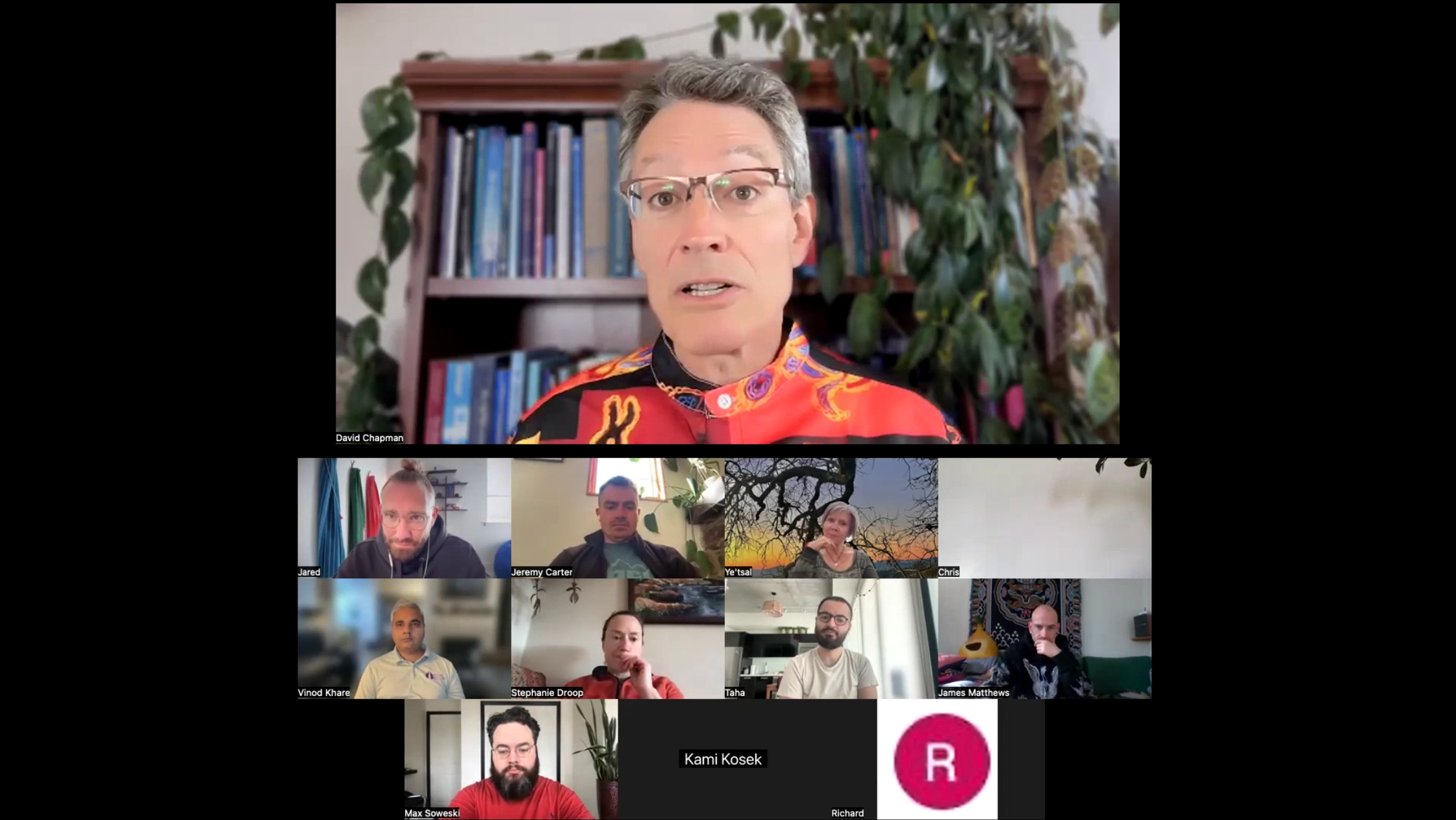 Personal experiences of sacredness & community Personal experiences of sacredness & community | A facilitated discussion of how the participants find sacredness in the actual world—and in community.This Vajrayana Q&A session is an Evolving Ground online discussion I co-hosted with Jared Janes. You can get some sense of the eG style here. We don’t go in for “dharma talks,” much less lectures. All our meetings, both in person and online, are highly interactive, mainly created in the moment by the participants.There’s a transcript below. But first: several announcements!I’ll co-host the next Vajrayana Q&A on Saturday, December 13th, 10:30 a.m. US Eastern time, 7:30 a.m. Pacific. That will actually be the last one, too! Don’t miss it! It’s free! Instructions for how to join are included here.Starting in January, the Vajrayana Q&A series will be replaced with the monthly Evolving Ground Q&A, co-hosted by Charlie Awbery and Jared Janes. It’s free to all eG members. Membership is also free; you can join here.Also starting in January, Charlie and I will begin a new monthly online meeting series in a similar format. The first one will be on Sunday, January 11th, at 10:30 a.m. US Eastern time, 7:30 a.m. Pacific. You can join via Zoom with this link.Charlie and I are scheming up a new collaborative project for 2026. It’s not about Vajrayana Buddhism. It’s based in several other topics we’re both excited about—like personal development, pro-social entrepreneurship, and cultural upgrades through nobility. We are aiming to provide better ways to learn and engage in meta-systematic practice.We’re in early planning stages, and would love to hear what excites you! We’re happy to discuss, or answer questions about, any of the subjects we write or speak about. If you post preferred topics, questions, or reflections here, it’ll help us know what to concentrate on in the session, and we’ll make sure to cover as many as possible.Transcript[“AI” generated, lightly proofread, may contain egregious errors]David Chapman: This is a Q&A, so primarily it’s an opportunity for participants to ask questions, and that can lead to discussion. I can answer some questions, but that’s not exactly the point here.When there’s a break in the flow of questions, or if nobody can think of anything, then I can talk about what I’m doing at the moment, which is writing about sacredness without metaphysics. Sacredness as an interactive, situated, in-the-moment activity or perception, rather than some kind of abstract thing involving a lot of conceptual stuff. So that could be a topic if nobody has questions, but I’m hoping that everybody has brought some burning question that we can all discuss.Chris, you’re grinning like you might have one.Chris: Well, I wouldn’t say I came with a specific question in mind. I mostly, I haven’t come to an eG meeting besides the weekly sits in a while, but something on my mind right now, it’s kind of a general topic. So I’m related to eG, I’m in a local Shingon group with a teacher, and also I was born a Christian, and the difference in terms of community, locally speaking, where I am at least, but I think in a lot of Western places period, is there’s a real Christian community; and connections, and the impacts of that, that have at least trickled down from that religion, and then the associated practices and communities. And I’m curious about, as Buddhism moves into the West, it feels like the practices, the technologies are one thing, but then there’s this whole thing that I think, at least partly, we’re working on here.But I’m just curious about, as a Western practitioner born into a Christian tradition, who’s primarily practicing Buddhist traditions for the past 15 years or so, is there a happy meeting place for those two traditions, and what might that look like, and how do I not get burned at the stake?David Chapman: It sounds like there’s two questions there, maybe one is some kind of happy union or coexistence of Buddhism and Christianity possible, and the other is one about the nature of local in-person community.Regarding the second, I think it’s something that Buddhism in America has been spotty about. There are groups that are quite like a Christian congregation in the degree of closeness and mutual support. That’s relatively uncommon, and I think that’s something of a weakness. Buddhism in the West has been presented as individualistic, in a way that it is not in Asia. That’s a Westerly distortion or invention, and probably serves important needs for some people who don’t want the social aspect of religion. And maybe that’s what makes Buddhism attractive for a lot of Americans, but it also can be a big lack.I wasn’t raised Christian and have never been part of a Christian congregation. I can’t speak to that part. Maybe someone else here could.I’m looking at Max.Max Soweski: I don’t know. I mean, I was thinking about this recently because I did grow up Roman Catholic, and I was the most serious little Catholic boy you would have ever met. I was very, very devoted in a way that probably came off as kind of annoying to a lot of people.The thing that I was reflecting on recently is that in the Catholic community that I grew up in, there was a sense of community, sometimes of people coming together, but it did not often feel very sacred. It did not often feel very much connected to our practice, which was to bring us closer to God, at least ostensibly. And it really was not until eG that I found a community of people where it was possible, in group settings, to have that connection to sacredness and to do that together.And so I’m not quite sure what to do with these two things, or even how much this pertains to your interest, Chris. Basically, we would do like potlucks and get like the kids together for Sunday school and stuff like that. But there wasn’t a whole lot of ecstatic union with God happening in group settings.David Chapman: And do you experience… I mean, that ecstatic union with God is, I guess that’s yidam practice for us. Do you experience something in eG that is that combination and what’s that like?Max Soweski: I do. I mean, I think that the yidam practice, specifically the Gesar sadhana that you created, David, is a good example of in a group setting. So just a bunch of people coming together in a room, doing the sadhana together.What it’s like is very intense, very connective. I had the sense of really being connected to the people that were practicing this with me, both in terms of like, we’re all bringing something into being together. There was that sense.There was a sense that we were participating in something that was naturally available together. All those things that I just mentioned were notably absent from my upbringing in Roman Catholicism. I mean, again, ostensibly that’s what all of it’s about. All of these teachings, all of this catechism, all of these rule sets are meant to systematize that contact.And yet it seemed totally absent as I was growing up. And it seems very present in eG to me.David Chapman: I’m completely foreign to Christianity, but I find the descriptions I’ve read of charismatic practice, of Pentecostalism, any other denominations of that sort, seem intriguingly similar. And it’s interesting how kind of low status that is considered by middle-class, upper-middle-class American Christians. It’s like embarrassing and ignorant and somehow.Max Soweski: Last thing I’ll say about Roman Catholicism. That is exactly the sense that I had growing up in Roman Catholicism is that it was somewhat embarrassing to be too enthusiastic about your spirituality, even at church or even like in discussions with other religious people, which to me seems like just a total bug, actually. I don’t find that that’s a very good thing.David Chapman: Stephanie, you have your hand up?Stephanie Droop: It’s very different in the UK. At least some people I know. So I come from that kind of born again charismatic Christian family that you mentioned.And my parents and two of my brothers still go to church. And I’m always quite admiring and envious of the community they have. They have such a strong, big, like—all ages, cool young people, fashionable people, and they’re all really professional and middle class and successful people.So I haven’t been to a church service for a very long time, but theylove it. They have their kind of ecstatic union stuff, but then they also then go and have a fire pit on the beach and a barbecue and pray there. And they’re all kind of very touchy-feely with each other.They really help each other out for everything. They move each other’s houses and look after kids and stuff. And they just love each other’s company. They do all their fun hobby stuff together. They have whiskey appreciation, they get drunk, they brew beer, they’re always outside. They’re always having fires and they’re doing all the stuff, the same stuff that any other normal fun person does.And they’re always touching each other, hugging each other, and they’re just a really nice bunch of people. Like there’s no drama, agro. They just seem to love life and appreciate life and be really doing it quite well.And like attending to the whole question of building community in a very wise and skillful and kind of interesting way. It’s just that there’s Christianity underneath it all, which is a little bit, you know. So, it’s definitely not that they’re kind of ashamed of it. I even think it’s a little bit, a tiny bit class based; but the other way from what you were saying, that it is only middle-class people and educated people. And if ever anyone working class joins the church, I’ve kind of sometimes worried a little bit that, that they were a little bit hoodwinked into it by thinking, “Oh, if I joined this church and follow these people, maybe I’ll get a nice house.”But the leadership class of the church are aware of that, and they try to diffuse it, and try to make sure that doesn’t happen, because we’ve talked about that. I mentioned that, and they agreed and said it was a problem, and that they had to be aware of it and stuff. So they’re very warm, empathetic and open people in general.Chris: Yeah. I suppose that kind of everything people have said kind of clarifies my question back to Vajrayana. Is there an element of, not necessarily elitism, but, kind of a more fine filter, that maybe will—in terms of the West not having this foundation of? You could say like folk Buddhism, that, in terms of that experience, that very nice experience I would say, Stephanie, you’re discussing in terms of community. Is there something about the filter of Vajrayana, or even just Buddhism, that maybe naturally leads to social forms in the West that are just going to be the way they are now?David Chapman: I think the social forms of Buddhism in America, I can’t speak for the rest of the West, are quite varied. And that’s partly dependent on which flavor of Buddhism, but it’s also, I think, just a matter of the particular social group the Sangha.There is a kind of elitist intellectual strain in American Vajrayana, which does go back to Tibet.But there’s also Ngak’chang Rinpoche, who was my teacher and Charlie’s for a long time, he really emphasized that this is not about class. He considered himself to be working class. He very actively encouraged working class people to be involved, and also encouraged the kind of close-knit community that we’ve been talking about. I think that worked sometimes and failed other times, and that has a lot to do with the particular individuals involved, probably more than anything doctrinal.I know many of us are involved in creating local community for eG. Yetsal is very much creating local community in the Boulder-Denver area, Ari in the Bay area, others elsewhere. Maybe that’s a bit of a work in progress, but my impression is that it’s quite highly functional for some people here.Chris, where are you physically? I don’t know.Chris: I’m in Vermont and, and I might say very lucky to have access to a Shingon teacher. Just total luck, I suppose.David Chapman: So is there a community around that teacher or is it more individual?Chris: So, Jim Sensei is the teacher here. He is the senior North American student of Ajari Tanaka, and Hokai Sobol is a senior student in Europe. So it is Mandala. People are from all over, there’s people in Canada, people spread out over North America, who are a member of Mandala Vermont. But more people local in Vermont, at least that I have engaged with. People are moving to Japan, or living in Japan, and you can go on pilgrimage in Japan.And so it’s three continents, I suppose not bad, but it’s a pretty small, tight knit group from what I understand so far. I’ve only been a member for about a year or so.David Chapman: I’m writing about sacredness without metaphysics, as an immediate interactive experience. Jared and I were talking just before we started this session. There is a super moon currently, a full moon where the moon is at its closest to the earth and it’s exceptionally large and bright.It was full a couple of nights ago. Charlie and I went for dinner and a drink to our favorite brewpub. And when we got there, the moon was just above the horizon, which makes it look much bigger than it normally does. And it just kind of was like, and, and we both got out of the car and just stood and stared at it for a couple of minutes, because it was, well, an experience of the sacred.And something I find really interesting is cross-culturally, there are certain things that are pretty reliably regarded as sacred. There’s the sky, there’s things that appear in the sky, like the moon and the sun. Mountains are very often regarded as sacred; big odd rocks; trees, particularly old, unusual looking trees.I think, even for people who would never say that they regard trees as sacred, it’s easy to see which trees somebody else might regard as sacred.So I’ve got a couple of pictures here. [Shows them.] This is an absolutely beautiful, huge tree. And this is another huge tree, which is kind of ugly actually. I think one of these is obviously sacred and the other one is obviously not.I think it’s this one that is sacred. And there’s a crowd of people. This is a tourist attraction somewhere on the East coast. And people come and look at it and, and they say, “This is mesmerizing, it’s spooky.” And many of them are probably good Christians, and the idea of trees being sacred might be anathema to them, but they respond to that. And so there’s a sense in which sacredness is not subjective and it’s something that we see and do spontaneously.There’s another example I found. So this is from a blog post. I’ll stick it in the chat.Just about every hill on West Ardnamurchan [apparently somewhere in Scotland] has some sort of cairn at its summit. This one is on Creag an Airgid, the Silver Crag. When we come across one, each of us dutifully adds a new stone, but without really thinking about why we do it, other than that perhaps it will bring us good luck. So sometimes we add an extra one and think of someone in hope that it’ll bring them good luck too.I think I’ve got a picture of this cairn. Mountains are regularly experienced as sacred, and the cairns on them are experienced as sacred.It’s just a very natural thing to do when you get to the top of a mountain to put an extra stone on. I think people do that without thinking about it, but it’s meaningful in some way. So I think another, another thing that’s natural to do, but that is embarrassing,Throwing pennies into fountains!You can bless things. You don’t have to have any special qualification to bless things. You don’t need a clerical collar, you don’t need a funny hat. You can just go around blessing things.You go to a place and it occurs to you, you just think, “I bless this place.” You could say it out loud. You could think about what that means, what you hope for it, but in a conceptual way, just kind of vision of uplift. And this is a natural sacred activity, that I think people do without thinking about it. But if you did think “this isn’t something I’m supposed to be doing,” why not?I wonder if any of this, I wonder if any of this resonates and what experiences you’ve had that it might bring to mind.Vinod Khare: Yeah. It’s interesting because I’m reading, uh, this book called, uh, How God Becomes Real.David Chapman: Yes! I was reading that while writing this.Vinod Khare: Okay. What comes to mind is that there is a counterpoint to what you’re saying. So I can see what you’re saying that there are certain places, things, activities that kind of have this spontaneous feeling of sacredness. But what comes to mind is that we can also make things sacred.So if I look at Hinduism in India, for example, both of these ideas exist. There are places, shrine cities, that are considered to be sacred and they are kind of special. You get something there that you don’t get elsewhere, but at the same time, you can go to a village and there’ll be a completely ordinary tree. And the women in the village are performing rituals with that tree. So it’s sacred for them. Right.And it has been made sacred by the performance of this ritual, perhaps over generations. So that’s something that I see in my own life as well, in terms of practice, that you can experience something as spontaneously sacred, or you can deliberately go and make something sacred.Like one practice I did in my Zen days was just making the mundane ordinary, right? Zen people love to like wash dishes mindfully, do the laundry mindfully. And so that was a deliberate practice of evoking sacredness in everyday activity.And sacredness can go away. That was another thing that came up, a lot of what I see in India, for example, just because of the crowds and the bad maintenance of the shrine, for example, a lot of places have lost their sacredness, right? So that can, that’s another aspect.David Chapman: Jan, you have your hand up?Jan: Yeah, I, this resonates a lot. In a way, there’s both, as you were saying, David, this sense in which some things are objectively, interculturally sacred. And then also like the Vinod, what you were saying reminded me of the story of the Buddha’s canine tooth. You can also make random anything sacred, through repetition and practice.What came to me was this image of, you can pour holy water over anything, but if you pour it in a bowl, it’ll stick around more easily than just on the street.Yetsal: I feel like because of all my practices that I have found sacredness in things that I didn’t even expect to be sacred. I think that’s because there’s a lot more awareness and appreciation for very simple things. But they have this sacredness to them, then they get, yeah. I’ve noticed that happened a lot with practice.David Chapman: In this piece I’m writing, I’m emphasizing the possibility of finding sacredness, for people who, I’m sort of writing for STEM rationalists, who have rejected the concept because it doesn’t objectively exist. And for them, the idea that it is possible to find sacredness at all might be revelatory, if it’s presented in a way that strips off the metaphysics that usually goes with it.For practitioners, it’s explicit in Buddhist Tantra that one aims to perceive everything and to interact with everything as sacred. And perhaps that is also the Zen approach that Vinod was speaking of, I don’t know.I was thinking about this in relationship with the distinction between Tantra and Dzogchen. In Tantra, because it’s kind of artificial, it’s method-based, it’s making things happen, so you can ritually cause something to be sacred; and that’s tremendously valuable. And you’re trying to get to the point where everything appears sacred through effort and method and repetition and so on.Whereas in Dzogchen, things appear as sacred or they don’t appear as sacred, and whether or not they’re sacred isn’t particularly clear, and all of that’s just fine, so you don’t need to be cranking it up in the way that that happens in Tantra. So you’re allowing sacredness, and then you’re allowing it to draw you in, and you see the cairn, and this can be non-conceptual or it could be conceptual; but you do the ritual action of putting the stone on the cairn just because that’s what spontaneously arises as the affordance of the situation.Max?Max: This particular distinction is what’s really interesting to me, the distinction between naturally available sacredness and finding that spontaneously, versus this ritualistic enactment of sacredness.So to bring this stream back to the Max as a young Roman Catholic stream from before, I have this memory of being, I don’t know, like six or something like that. And I had this little container that is intended to hold holy water, for Catholics. I can’t remember what it’s called. I’m sure there’s some Latin name for it because it’s Catholicism.And I had this container, and I think it was empty, and I filled it up with water from my garden hose. And it felt like since the container had held holy water, it followed that some of that sacredness would be left over, and could be amplified into the new water that I added. And I went around and I blessed all of these sapling trees that were in my yard. We were trying to grow some new trees or something.And I was always trying to do stuff like that as a kid. Like I really desperately wanted to enact sacredness. And most of the time it didn’t work. I really have this memory of the supreme disappointment of trying to call forth sacredness and it not working.And, contrast that with… I was traveling for work a couple of weeks ago, and I was in the airplane, and air travel is a thing that a lot of people find really difficult. I found it difficult in the past, but it’s like this amazing thing.You’re, you’re soaring through the sky. You’re actually in the sky as a human being. It is amazing to do that.And you’re all lined up in rows with people like in pews in church, you can see the backs of people’s heads lined up in front of you all the way through the fuselage. And, I just remember I was looking out the window, it was towards sunset. We were above a cloud layer and the colors of the sun as it was setting on the clouds, the shape of the clouds, just had this inviting quality to it.And as I just relaxed my gaze and looked at the clouds, it was like they started to run like rivers, like parallel rivers. Um, very hard to describe this, just this non-ordinary motion. And that sense just sort of lit up the entire experience of being in this plane, and the shape of the back of people’s heads just took on this tenderness to it that I felt.And it was like the whole plane was just beatified, including the lady crammed in next to me with the leaky nose, who was constantly coughing and sniffling and stuff like that. I mean, that would have just been a terrible experience for me just a few years ago; but I found natural sacred. Sacredness was just readily available there.David Chapman: Yeah, that was wonderful. I was near tears. For the benefit of anybody who’s watching a recording of this, everybody’s got that little heart icon lit up.I’ve always found flying to be astonishing, and I’m always amazed that people, I mean, it can be a grind, but astonished that people don’t find it astonishing.I’m reminded of a time when I was flying from Britain to San Francisco. When you do that, you’re going practically over the North pole. And it was late at night, and there was this astonishing display of aurora. I’ve never seen anything like it.And I was looking out the window at the aurora borealis and looking around the airplane as well. And essentially nobody else was.And it’s like, this is something I’ve only ever seen once in my life. It is unbelievably beautiful and not like anything else.And a sense of something having gone wrong. Although I don’t want to condemn the people who were not looking out the window. Maybe they looked out and said, “Oh yeah, that’s pretty.” And then, you know, went back to whatever they were doing. And that’s very understandable.You know, in the same way you can look at a rock or tree that somebody finds sacred and say, “Well, yeah, I can kind of see that.” But so what?James?James Matthews: Um, strikes me that a lot of the descriptions of sacredness could overlap with a lot of descriptions of what people would describe as “awe.” Would you be willing to compare and contrast in your view between sacredness and awe, David?David Chapman: Yeah. So, there’s a series of things that are, that could be confused with sacredness. I’ve got a little list.There’s the sacred, there’s metaphysical, supernatural, mythic, religious, spiritual, sublime (in the technical aesthetic sense, which we’ll come back to). And there’s the good, which includes ethically or morally good. All of those are separable.You could have any one of those without any of the others, or any combination of them, but they tend to all get glommed together.There’s a very famous book on the sacred by Rudolf Otto, which is— it’s translated in different ways. The title basically is The Sacred, and it’s very influential. He defined the experience of the sacred as a mysterium tremendum et fascinans, which means a terrifying and fascinating mystery. And those are two aspects of the sacred, in his very influential theory.Um, Jared adds: “I like Paul Tillich’s framing for sacred, which is “that which is of ultimate concern to you.” One of the things I write about in this post is that the sacred is where we find big purposes. And I didn’t know that quote from Tillich.So, awe is something that tends to go with sacredness. The two experiences often come together, but they’re not necessarily the same. So for example, watching a rocket launch, which I’ve never done, but would kind of like to. The Space-X rockets nowadays are really, really big. And, the flames and so on when they’re taking off, and these descriptions I’ve read of people’s experience of watching that is one of overwhelming awe. But I think not very many people would describe that as sacred.So they’re not the same thing. There also can be experiences of the sacred, which are just comfortable and they’re not awesome. I’m thinking of some places in the mountains where there’s a rock formation that just feels really welcoming and friendly. You sit there and you feel like everything is okay. And there’s a sacredness about that, as a kind of a stillness and a warm, uplifted stillness that has a sacred quality. So the awe and the sacred are often go together, but they are separable.James, you have something to follow on about your question?James Matthews: No, I guess as potentially part of the target audience for your upcoming article or post on sacredness: I have somewhat of an aversion to the term. But I’ve felt in awe of things, right?Like that’s, that’s not something that I really have a choice over in a lot of instances. So it feels like there’s the potential there for that to be kind of an in, to accepting that things could be sacred. Yeah.David Chapman: Yeah. I think that seems just right to me. That would be a place to start.Jared: David, I like your saying awe being a result. And I was trying to think of, “Ooh, what is another result?” There’s this preciousness, where it’s not like, but it’s like, Oh, you know, like this really, uh, prized non-explosive, but like gentle holding, that as a reaction to sacred, that kind of feels like it’s maybe the two are on some sort of spectrum.Very gentle and definitely not awe, but still a common result I have from sacred experience.David Chapman: In the chat, Max says, “I was looking at my sleeping wife one night last month, touched the top of her head and had the sense that if the purpose of my entire life was only to experience what this is like, that would be excellent. Not awesome, but sacred still.”I have certainly had that experience.And Stephanie says, “I’ve felt awe without sacredness, usually for some extreme manifestation of stupidity or evil or single-minded devotion to something ridiculous.”I mean the extreme evil, this thing may tie in with the tremendum aspect of the sacred, of the terrifying. I have a page on black magic. This is on Buddhism for Vampires. Black magic, I think people get into it because they want to reach the sacred, but they are rejecting a lot of the stuff that goes with that typically, but they still can feel the pull, the fascinans pull of the sacred, and black magic is a degraded attempt to get at the sacred through taboo. And this is an aspect of Vajrayana. There are Vajrayana practices where we do that in order to approach the sacred in this sort of left-hand way.Taha, I think you’re next.Taha: I noticed that when you went through your little list, as you were talking about the awe and the sacred and stuff, we didn’t talk about beauty. That seems like a big door to, for example, talk about beauty in mathematics, like when you have like symmetry between stuff. I’m curious, what do you think about that?David Chapman: Yeah, I think often it is part of it. In aesthetic theory, there’s a distinction made between the sublime and the beautiful. The sublime is an aesthetic reaction to something that is overwhelming and somewhat horrifying. There’s a lot of art of various sorts where that’s the principle, so it’s not beautiful exactly as such. So maybe this relates to this sense we had earlier of there’s awe, but there’s also comfortable sorts of sacredness. And the comfortable sort might very often go with a sense of beauty.I’ve certainly experienced mathematics as sacred also, and awesome. There’s moments when you get a mathematical proof, and the experience of it is like descriptions of people’s enlightenment experiences. And there’s actually this sense of brilliant white light and choirs of angels. It’s not literal, but that’s what it feels like.Apostol: For me also sacredness has this strong heart, heart element, like you sense something, you see something, you experience something sacred and it hits you in the heart in a almost rapturous way. Lately I’ve been feeling it when I’ve been doing the small rituals of mine, connecting with the land spirits around here. And there is something about that, about connecting with something bigger, something “beyond”—the whole devotional thing, right?David Chapman: Um, I’m wondering if this resonates with other people’s experience. I would love to hear sort of specific anecdotes or in personal stories of if this brings something to mind.Before I got into Vajrayana Buddhism, I was a, a Neopagan Wiccan, and we did that kind of ritual of connecting with land and air. And so I have a sense of that.Apostol: I’m pretty sure in Vajrayana, there’s also like these kinds of practices with connecting with land spirits quite a lot, actually. They’re smoke rituals, fire rituals.David Chapman: The Gesar material, which we’ve started exploring in eG, has a lot of that. It’s a lot about connecting with land spirits.Apostol: I have one specific example, which was kind of before I got too devotional. It’s a little bit weird and funny.In my first retreat, it was online, I was doing it here. I was doing Green Tara mantra, and I was also doing a lot of metta practices. “May you be happy. May you be healthy.”People would share how they’re preparing to get into a psychedelic ceremony. And I would spontaneously feel like I want to bless them. And I started like saying, “May your ceremony be well, may you be protected, may you be…” Just similar to the phrases that I was doing on the retreat.And that was very well received and valued in that community. Someone has something important that’s going on, that’s somewhat risky, and you’re blessing it in order for it to turn out well, I guess. That’s the purpose of blessing for them to be well.David Chapman: I have an example of a connection with the sacred in a ritual context. It’s not a Buddhist one, it was in my neopagan days. It was very intense. I remember it very clearly. It was at a large pagan gathering.There was a ritual after dark. There was a huge bonfire. We were all seated around the bonfire. And the way that the neopagan rituals start is by calling the quarters, which means invoking with the spirits of the four directions. This is invoking the local spirits.And when it came around to the last of the quarters, there was a pond next to the site where this bonfire was. And when the quarter was called, it was twilight. It was actually dark, but we could see from the bonfire this enormous shape emerging out of the pond.And it was sort of black and it was terrifying, but also fascinating. It was like, what was happening here?! Because this was reality, and there really was this thing coming out of the pond.There was a humanoid figure, and it lurched toward us, and then began speaking.And so, this book is kind of a founding text of Wiccan neopaganism. Certainly at the time that I was doing it. By Margo Adler, it’s called Drawing Down the Moon. The moon being one of the things that we just described earlier as being obviously sacred. It’s got a naked witch on the cover because that sells things.So it became apparent that this enormous shape that had emerged out of the pond, like, how could anything come out of this pond? Everything was—there was nothing in the pond.The enormous shape that emerged out of the pond was Margo Adler. She had been, she went into the pond, she had been underwater throughout the beginning of this ceremony, breathing through a snorkel, and then emerged at this time.And it was unbelievably and dramatic because it was obviously impossible. And, you know, she was enormous, I mean, a very large woman. So that was one of the most memorable nights of my life. I mean, that was just the beginning and it went on after that.We’re officially at an hour. I guess that means we’re supposed to stop recording. The good stuff always happens after the recording ends. You know, anybody who’s watching this recording, you need to know that the good stuff in eG meetings happens after the end of the recording.Jared: I had a complaint about that one time. I apparently did a really bad cliffhanger. I was like, “Ooh, that’s a really good question; let’s stop the recording.”Before we go off recording, I did want to say something because I was just reflecting recently back to Chris’s original question. And I’m feeling this connection between sacredness and the universality versus the specificity and how different traditions have a very deliberate way of constructing or revealing or creating sacredness.I realized that the thing that I’m interested in the most is creating methods that are open enough for them to be entertained by anybody who’s coming from their own religious background. I think the tragedy of method for discovering or creating sacredness is that it can make it unaccessible to others because of metaphysical or spiritual commitments or something like that. And that feels really sad to me.And to Max’s point, and David talking about sacred from the perspective of Dzogchen, I think the punchline there is everything has potential for sacredness. And if you’re genuinely open to that emerging at any moment, it could come up and surprise you at any moment. And that’s the most miraculous type of sacredness that I like.So I have a bias for that a little bit. Charlie and I actually were just recently talking about creating some more methods for in-person groups to step into. And as we were talking here, I was realizing I would want those methods to do was be completely accessible to anybody, whether they’re a Christian or Hindu or Buddhist or a rationalist or whatever you want to call it.So yeah, I don’t know. That’s some thoughts, Chris, of connecting all the dots here. And maybe now we’ll go off recording.Sorry, guys! This is a public episode. If you'd like to discuss this with other subscribers or get access to bonus episodes, visit meaningness.substack.com/subscribe | 53m 42s | ||||||
| 11/18/25 |  Dzogchen Street Preacher #0: Kadag Dzogchen Street Preacher #0: Kadag | “Dzogchen Street Preacher” is the overall title for a series of performance pieces I planned in 2009. This extremely brief one, “Kadag,” was meant to introduce the whole thing.I was on the verge of recording them when there was a mundane emergency that took all my time for a year. When I had the opportunity to work again, the Meaningness book seemed more important.But less fun! There’s a bit of slack in my life now, and yesterday I decided to take a few hours to record this one. That was fun, and it’s a way to salvage a tiny piece of a project I put a ton of love and attention into, long ago, when I was a different person than I am now.The video might somehow stand on its own, and communicate something… but explanation might help.KadagKadag is a key term in Dzogchen, the branch of Buddhism I’m most influenced by. The usual translation is “primordial purity.” That may be misleading.Kadag is the recognition that nothing is impure—and therefore nothing is pure, either. Purity is a metaphysical distinction, not something found in the actual world. “Primordial” is meant to communicate that.In the video, I substituted “evenly.” The point is that nothing is more pure than anything else, because this is a nonsense concept from the beginning.So what?When you recognize kadag, you recognize that nothing is fundamentally wrong with the world. There are no spiritual, existential, or cosmic problems. Only practical ones, which you can address practically, instead of metaphysically.Then you don’t have to wring your hands about the supposed Problem of Suffering. Suffering is not a Great Evil, it’s just a thing that happens. So it is actually possible to enjoy everything.There also is nothing fundamentally wrong with you. You are not impure, stained by original sin, inadequate, or rotten at the core. You are just fine—just as you are.In Dzogchen, the non-method for recognizing kadag is trekchöd.Kadag is not a Pollyanna-ish attitude. There are many things we don’t like and want to change. And that is good! Let’s do it!Street PreacherThe frame-story for the “Dzogchen Street Preacher” series is a personal alter-ego in which I’m that.Dzogchen teaching is usually overburdened with Tibetan religious decorum and status-hierarchy nonsense, so it’s tiresome and intellectual and reaches nearly no one.The idea that I could stand on a street corner and rant at passers-by about Dzogchen is entertainingly ridiculous. But it might also be effective, and therefore important? I admire people who have the courage and charisma to do this:Although I have reservations about both his message and some aspects of his delivery!While I was recording this, some homeless people politely asked what I was doing, and kindly offered to move the garbage bags full of their possessions out of the way. I explained, and politely declined. It adds to the atmosphere of primordial purity, I think, although I didn’t say that.I didn’t preach at them, because that would have been rude. I think.Western BuddhismMy former Buddhist teacher, Ngak’chang Rinpoche, loves the culture of the cowboy-era American West. There’s layers of meaning in that, and how it relates to Vajrayana. One aspect, though, is a pun. “Western Buddhism” is often what Consensus Buddhism called itself. There was a consensus that “Western Buddhism” was becoming a thing, and that it was the right thing; and yet a lot of wrangling in Consensus Buddhist publications about what it was, and what it should be. That was all quite silly and quite distasteful; but now it’s all ancient history, and no one cares anymore.But—what would “Western Buddhism” mean, if it was a thing? Obviously, Western Buddhists should dress like this:That’s from a Vajrayana Buddhist retreat on a horse ranch in Montana in 2004. We all dressed as Western Buddhists, and rode horses up into the mountains, and shot single-action 1880s-style revolvers at paper targets, and had wrathful empowerments in the evenings.It was on this retreat that my now-spouse Charlie Awbery and I got together.In the picture, that’s me on the left. It’s a Sangha friend on the right, not Charlie. I think Charlie took the picture.Anyway, that was a daytime Western Buddhist outfit, for riding and shooting. In the evenings, we were more elegant. Specifically, I wore the same outfit that appears in the video.Ngak’chang Rinpoche was amused by it. It looks like a cowboy-era priest’s get-up. He teased me by calling me “Preacherman”; and I rolled with the joke.It was ridiculous, of course. Being a priest was as far from my concept of myself as anything possibly could be.In the last year, I have somehow inadvertently transformed into my most-distant self-possibility: acting as a tantric Buddhist priest, performing the religion’s central ritual role, with gods and miraculous transformations and all that razzmatazz.Life is very strange. Especially when you are Western Buddhist.OuttakesI filmed this on the spur of the moment. I had planned to draft Charlie as camera crew, and also to do a bunch of voice work and practice runs beforehand; but Charlie was at a conference in LA and it was possibly the last day of the year when the weather would cooperate, so I just did it. I did nine takes, but couldn’t check whether any of them were any good, for boring technical reasons, and was afraid they might all be lousy. I’m reasonably happy with how it came out, although I think I could have done better if I’d been able to review the first few takes before continuing.Anyway, some takes are quite different from others. I thought you might be amused to watch another couple. And maybe you can tell me which of the three you like best!I wonder if I should substitute one of these for the one I chose to put at the top of this post. What do you think? Which do you prefer? This is a public episode. If you'd like to discuss this with other subscribers or get access to bonus episodes, visit meaningness.substack.com/subscribe | 0m 19s | ||||||
| 11/4/25 |  Maps of Meaningness Maps of Meaningness | Before controversy and fame, Jordan Peterson was a psychologist theorizing myth and meaning.Jake Orthwein points out striking similarities in Peterson’s work and David’s. Along with them, fundamental disagreements: partly due to Peterson bringing a Christian perspective, and Chapman a Vajrayana Buddhist one.Nihilistic catastrophes ※ Chaos and order ※ Reconciling myth and rationality ※ Interactionist cognitive science ※ The purpose of lifeJake intercut our conversation with brief relevant clips from Jordan Peterson’s classroom lectures and media interviews. It’s fun seeing the commonalities and contrasts!In this post:* The Making Of: demons and the idiot* Sections and topics in the video, with timestamps so you can find them* Further reading: books &c. we refer to, with links* “AI”-generated “transcript” (not safe for human consumption)Demons and the idiotThis podcast has been years in the making. Our attempts were incessantly obstructed by malicious demons, who don’t want you to see or hear it. Eventually this became comical, although also frustrating.To be fair to the demons, progress was also frequently obstructed by an idiot. Namely: me, David. I fumbled the technology repeatedly.After finally getting to record the conversation, I applied “AI” to remove pauses and “ums” and such. This improved the audio track, but makes the video extremely jerky. Also, I used “AI” to make it appear as though we are looking at the camera when we weren’t. An uncanny, demonic appearance results. And, because I am an idiot, I did this irreversibly. Sorry about that!Next time, I will perform extensive exorcisms and protective rituals. And also learn how to use software before inflicting it on Jake’s invaluable contribution. Or leave the editing to him; he’s a professional!Sections and topics00:00:00 Introduction00:01:05 David summarizes Meaningness (his book): it’s about the inseparability of nebulosity and pattern.00:05:01 The intellectual lineage of Meaningness is mainly the same as that of Jordan Peterson’s Maps of Meaning. However, David draws on Vajrayana Buddhism where Peterson draws on the Western tradition, particularly Christianity.00:07:48 Nihilism, as explained by Nietzsche and as in Buddhism, is a key topic for both of us. Psychological lineages: German Romanticism, Carl Jung, Jean Piaget, Robert Kegan, Robert Bly.00:10:54 Jake summarizes Peterson’s project and intellectual lineage. The catastrophes of the twentieth century. Recovering the mythic mode as compatible with rationality. Envisioning positive futures and preventing nihilistic ones.00:20:59 The history of the gradual collapse of meaning. Tradition, modernity, postmodernity: communal/choiceless, systematic/rational, and postrational/nihilistic modes.00:32:20 A future that combines the advantages of different historical modes of culture, social organization, and psychology, avoiding their disadvantages. Subdividing the past century: totalitarianism, countercultures, subcultures, atomization. Those abandoned, in order, nobility, universality, rationality, and coherence. We can restore all of those, but not as absolutes.00:43:32 Jake explains Peterson’s somewhat different take on the same historical periods. Rationalism and modernity as the result of encountering alien cultures.00:53:02 Jake explains Peterson’s “universal grammar” of myth in the Western tradition: Chaos is the Great Mother, Order is the Great Father, the Divine Son mediates between them. Peterson maps this onto twentieth century history.00:56:43 David explains how Vajrayana Buddhism’s understanding of emptiness and form is fascinatingly similar to Peterson’s account of chaos and order, and also quite different. This may account for our fundamentally different attitudes, despite sharing much of our intellectual backgrounds. Personifications of chaos in Babylonian and Buddhist mythology: Tiamat and Prajñaparamita are the same goddess, viewed in radically different ways.01:05:06 Positive and negative aspects of the characters in Peterson’s mythology. The self-sacrifice of Jesus, the Divine Son (a theme we return to later).01:09:55 Our shared lineage in “4E,” interactionist cognitive science, and our rejection of rationalism. Heidegger, situated activity, Gibson, affordances, rigpa in Dzogchen. The frame problem in AI research, and how David (and others) resolved it in the late 1980s. “You see meaning and then infer object rather than see object and infer meaning.”01:23:09 How the Ancient Greeks rejected the mythic mode and invented rationalism, as an eternalistic response to a nihilistic crisis. How Nietzsche finally diagnosed the failure of rationalism, and realized that would lead to another nihilistic crisis. His rejection of the delusion of a supposed True World, more real than the apparent one, in Twilight of the Idols.01:34:07 Peterson’s account of Christian soteriology, and its justification for social action. Buddhism’s lack of a social vision. Social vision is a form of purpose. Rationalism has no account of purpose. You have to go to myth for that!01:39:19 The influence of AI planning research on Peterson’s thinking. My debunking of that (with Phil Agre, influenced by Lucy Suchman and Hubert Dreyfus) in the 1980s. Francisco Varela’s reformulation of subplans as micro-identities in micro-worlds.01:47:28 Self-sacrifice as essential in identifying purpose: in the Western tradition, and in Buddhism.01:50:56 Demons subjugated at last! Credits roll.Further reading: books &c. we refer toIn the order we refer to them in the podcast, explicitly or implicitly:* Jordan B. Peterson, Maps of Meaning* David Chapman, Meaningness* Friedrich Nietzsche, The Will to Power* Jordan B. Peterson, “A Psycho-ontological Analysis of Genesis 2-6”* Robert Kegan, The Evolving Self* Robert Bly, A Little Book on the Human Shadow* Jordan B. Peterson and Joseph L. Flanders, “Complexity Management Theory: Motivation for Ideological Rigidity and Social Conflict”* The Alliance for Responsible Citizenship* David Chapman, “Fundamentalism is counter-cultural modernism”* David Chapman, Meaningness and Time; includng “How meaning fell apart”* David Chapman, “The mythic mode: from childhood, throughout life”* Jean-Francois Lyotard, The Postmodern Condition: A Report on Knowledge* David Chapman, “Desiderata for any future mode of meaningness”* Bryan Burrough, Days of Rage* Francis Fukuyama, The End of History and the Last Man* David Chapman and Philip E. Agre, “Abstract Reasoning as Emergent from Concrete Activity”* Hubert L. Dreyfus, What Computers Still Can’t Do: A Critique of Artificial Reason* James J. Gibson, The Ecological Approach to Visual Perception* Friedrich Nietzsche, The Twilight of the Idols* David Chapman, “This is it!”* David Chapman, “Charnel ground”* Jordan B. Peterson, “Three Forms of Meaning and the Management of Complexity”* George A. Miller, Eugene Galanter, and Karl H. Pribram, Plans and the Structure of Behavior* Philip E. Agre, “Toward a Critical Technical Practice: Lessons Learned in Trying to Reform AI”* Jamgon Mipham, Gesar: Tantric Practices of the Tibetan Warrior King* Philip E. Agre and David Chapman, “Pengi: An Implementation of a Theory of Activity”* Lucy Suchman, Human-Machine Reconfigurations: Plans and Situated Actions* David Chapman, “Doing being rational: polymerase chain reaction”* Hubert L. Dreyfus, Being-in-the-World: A Commentary on Heidegger’s Being and Time, Division I* Francisco J. Varela, Ethical Know-How“AI”-generated “transcript”This is inaccurate and actively misleading in places. I wouldn’t recommend reading it. It’s mostly so people can find it in web searches.On the other hand, it’s often unintentionally hilarious, so there’s that.[Update, 16 November 2025: Andrew Shade Blevins kindly fed the original “AI” transcript through a script that uses ChatGPT to fix things up. The result may possibly be even more inaccurate, having gone through two rounds of “AI” distortion, but it certainly reads better! So I’ve replaced the original version with his.][00:00:00] Jake Orthwein: The occasion of this conversation, much delayed but long anticipated, is just for you and I to get a chance to talk about your work, of which I’ve been an enormous fan for, I don’t know, seven years or whatever it is now. Maybe more.We’ve decided to frame it as comparing your work to Jordan Peterson’s, both because of Jordan’s significance in the zeitgeist and because he has worked on similar problems, but also because the differences between the two of you are illuminating.[00:00:50] David Chapman: Well, we’ve been talking about this for years and years and planning to do a podcast, and there’s been demonic obstruction. Like every time we go to record, something goes wrong.[00:01:02] Jake Orthwein: Very nearly food poisoning deterred us as well.[00:01:05] David Chapman: Right. I thought maybe I would start by just giving a short overview of what I think the Meaningness project is.It’s a book. There’s a website, which is meaningness.com, confusingly. There’s also meaningness.substack.com, which is a different thing. Meaningness.com is the book. It is meant to be a self-help manual for relating well with meaning, and I think it’s important that I don’t see this as an intellectual project.It’s a practical project. The Meaningness book explains ways of relating to meaning that work and ways of relating to meaning that don’t work. The ones that don’t work make you miserable and ineffective or cause you to cause trouble for other people. The ways that do work ideally make you joyful and creative and productive, and this is better, so it’s better to do the better things.That’s what the book says. I have a style of understanding and explaining which starts from the abstract and general and works towards the specific, and a lot of what’s on the website is quite abstract and general. Because I know that other people have different styles of learning, I’ve put in some specifics near the beginning.There’s a tendency to misunderstand Meaningness as philosophy. And philosophy is taken to be an intellectual thing that’s interesting as opposed to practical. And I really want the Meaningness book to be practically useful. We’ve been talking for quite a while about the ways in which my interests and work and style are similar to Jordan Peterson’s and different. I’ve dressed up in Jordan Peterson’s style today because I thought that would be funny.He always wears something like this, and I actually really like that. So I’m doing that today. But my writing, my thinking style is similar to his as well. There’s an underlying theme that goes through everything that I do, which is the inseparability of nebulosity and pattern. Nebulosity is the aspects of the world that are fluid, constantly changing, impossible to pin down, indefinite. Pattern is the aspects of the world that are solid, enduring, well-defined, structured. Everything is some of both of those things, so they’re inseparable. This isn’t a metaphysical thesis; it’s just if you consider things in the world, that’s how they are. And you just look and you see. The underlying idea in the Meaningness book is that we tend to try to pull those apart and deny one or the other somehow, and that’s because nebulosity—we think we don’t like it. We think it is constantly undercutting us because we can’t get complete understanding of anything because it’s changing out from under us all the time, and therefore we can’t get control, and therefore we can’t make things go the way that we want them to go.They go some other way instead. So we’d like to impose structure or pattern on everything, and that doesn’t work because we can’t do it. And then when we try to do it, it fails, and it would be better to go with the flow. That’s the whole message of the book, and then there’s just a whole lot of applications of that.This is very interestingly similar to one of the fundamental themes in Jordan Peterson’s work, as you’ve pointed out repeatedly. We’ve had a lot of really interesting conversations about this. Chaos and order are fundamental for him. And those are not quite the same, but very closely related.[00:05:01] Jake Orthwein: Yeah, I think the way they’re not quite the same is very interesting. It accounts for much of the difference in your styles and approaches. When you get into the details of like what exactly the difference would be between nebulosity and pattern, or even emptiness and form, which is one of those frames you’re taking on to talk about nebulosity and pattern, it’s not quite the same thing as chaos and order, even though they sound very similar.You mentioned that you don’t see it as an intellectual project. There are intellectual sources to it, and I remember it was very illuminating for me after encountering Meaningness and having some Buddhist and a little bit of cognitive science context. So I sort of could orient, but it also felt very sweet, generous. And what is this? It’s a very novel presentation. And then working my way through your appendix for the reading page, starting to piece together this whole set of lineages that then make the text make a lot more—I’m not even sure it makes it make more sense because you do try to make it stand on its own without the baggage of philosophy, but it put it in context for me in a way that I didn’t have before.So maybe you could say something just about the intellectual lineage that Meaningness sits in, even if it’s not intellectual in itself.[00:06:18] David Chapman: Yes. I do draw on a lot of sources. I do footnote them. It’s spooky reading Jordan Peterson’s work because we are mainly in the same intellectual lineages and drawing on the same sources.[00:09:39] Jake Orthwein: Yeah, that’s actually a surprising omission. I’ve sent you that one clip where Jonathan Pageau brings up Kegan to him and he doesn’t quite latch onto it, which suggests to me that he’s not super aware of that despite the fact that he himself is doing psychoanalytic and constructive developmental synthesis in his work all the time. You clearly mentioned you’re in the lineage of Carl Jung. That’s somewhat surprising to me. Is Robert Bly the person you’re putting there or, ‘cause he—[00:10:05] David Chapman: He’s my main entry point into that, yes.[00:10:08] Jake Orthwein: Okay. Okay. I remember you having some kind of suspicion toward Jung. Maybe it was all the selfie language or the romanticism. But I wouldn’t have situated you in his lineage as obviously.[00:10:18] David Chapman: Well, yes, he is in romantic lineage, which means that he overemphasizes emotions and feelings and stuff inside your head relative to the outside world. And I think that’s a big mistake. But in the past century, he’s the person who was most influential in the understanding of the mythical mode of myth, dreams, fantasies, obscure images, and that’s tremendously important for me.[00:10:54] Jake Orthwein: Okay. So maybe since you’ve just laid out how you see both the project and the lineage of Meaningness, I’ll say something about how I see Peterson’s and I think probably throughout the conversation I’ll do the Peterson foil just ‘cause I’m familiar with that work. So he is very consciously responding to the problem of nihilism as framed by Nietzsche. He sees the risk of nihilism much more strongly than you do, which also influences how he frames the events of the 20th century.So you don’t quite frame it as a nihilistic catastrophe. You say that people were worried about a nihilistic catastrophe, but much of what was happening was actually a defense against the threat of nihilism, for example, through totalitarianism. And Peterson, he would view that through the nihilistic lens of the loss of the prior meaning system. But in Maps of Meaning, which is pre-fame Peterson, and it’s him at his most systematic and comprehensive, he very explicitly was saying he was plagued by nightmares of nuclear holocaust during the Cold War, which is when he began writing it.[00:11:57] Jordan Peterson: I found myself suffering from two things. One was a very lengthy sequence of nightmares about nuclear destruction. And they’re very affecting dreams.[00:12:09] Jake Orthwein: That set him on this adventure to understand how it could have been possible that we’d find ourselves in such a situation.[00:15:54] David Chapman: Yeah. That point about the mythic mode being oriented to action, that’s, I think a piece that’s missing in Jung, and I think it’s terrific that Peterson picks up on that.[00:16:07] Jordan Peterson: This is one of the things that the psychoanalysts, I think didn’t get quite right, although Jung touched on it in his later work. There’s not, all of you isn’t inside your head. And for the psychoanalysts, a lot of the work that you were doing on yourself was on your, on the relationship, say between your conscious and your unconscious mind, but tremendous amount of that was sort of inside your skull, so to speak. But the phenomenologists, the phenomenological approach enables you to start reconceptualizing the psyche as something that extends beyond you and, and always will. And so that you can work on its reconstruction at any level of analysis where your own nervous system is signaling to you that there’s a problem.[00:16:56] David Chapman: I’m less concerned with totalitarianism, medieval, and the wars of the 20th century than he is. And that’s just a matter of, I guess, personal interest. I mean, it’s not like those things aren’t tremendously important and globally there is a worrisome turn towards authoritarianism that may develop into totalitarianism. I’m more worried about that now than I was a few years ago.It’s interesting. Peterson’s dream. We’re almost the same age. We grew up in similar circumstances, and I remember as a kid having dreams of streams of bombers on the horizon flying toward me, and I could see what was about to happen. And this is something that was very alive in everyone’s mythic understanding at that time.This was really gripping. My parents had a very half-assed nuclear fallout shelter in the basement. This was a normal thing to do. So, yeah, I feel that, and there’s lots of people who worry about potential catastrophes and there’s a lot fewer people who think about what could we really like to have happen?And that’s much more difficult. And I’m trying to grope my way toward positive future visions. I don’t hear that in his—[00:18:28] Jake Orthwein: In his mild defense, I mean, I think he is trying to do that a lot more now. It takes a different shape, certainly than it would for you. It’s much more explicitly Christian, or at least Christian inflected.I don’t know if you’ve seen this ARC thing that he recently founded. It’s his answer to the World Economic Forum. ARC is Alliance for Responsible Citizenship. It’s a big conference that’s all about positive visions for the future. Especially I think in its early years, it’s got a lot of, here’s what we don’t want, we don’t want the damn postmodernists, you know, blah blah blah.But its mission statement is at least about forging positive visions for the future. So I think he’s trying there.David Chapman: That’s really good to hear.Jake Orthwein: Yeah. The one interesting point about the Cold War background—I wrote about this at one point—but at some point I realized that part of the reason I got the sort of bug of your work, and to some extent Peterson’s also so much, was because of, like, 9/11 as a similar sort of foundational event.I was very young. But much of my teenage years were coming into more and more consciousness of whatever context produced 9/11, and 9/11 was also this return of history moment from a sort of sense that those kinds of things had ended that I had in my childhood.And just this problem of like, why do people—at that point I would’ve framed it as—believe such different things? How can that motivate them to action in such dramatic ways? And I remember reading, for example, “Fundamentalism Is Countercultural Modernism”—a mouthful of a title of one of the posts in Meaningness, which is about, to some extent, about jihadism.That interest definitely motivated me to get really, really curious about these questions of meaning and belief and so forth as well. Maybe one other thing that would be helpful as context, because this is a point of contrast to Peterson, and it’s not that you necessarily view totalitarianism as differently bad, but I think he’s got this frame that most of what happened in the 20th century is fallout of the death of God, which is to say that it’s mostly a nihilism problem.He would frame it as the atheistic totalitarianism of Stalin and the morally nihilistic totalitarianism of Hitler through to postmodernism in some way. And the story you tell is like a little bit different because it has this complete stance lens and this developmentalist lens. Maybe give a little gloss on the second part of the book, the Meaningness and Time part of the book story from choice through to modernity and modernity’s collapse or systematicity collapse.[00:20:59] David Chapman: Yeah, I mean, I think he is right and this does come from Nietzsche that the problems of the 20th century came from the collapse of what I call eternalism, which is the insistence that despite all evidence, the world is completely patterned and ordered by some cosmic ordering principle, which you would identify at this point with the Christian God.I guess that’s Nietzsche’s realization. He said, look, imagine that you live within a belief system and then something arises to challenge the belief system. Not only does the belief system collapse, but something worse happens. Your belief and belief systems collapses. And that’s the road to not—now it doesn’t have to because you can jump from one belief system to another, but sometimes that doesn’t work.Is that you do a meta critique and you say, oh, I was living in this protective structure and it turned out to be flawed. Okay. One alternative is jump to another protective structure. Fine. Another alternative is protective structures themselves are not to be trusted. Bang, you’re in chaos. How the hell are you gonna get out of that?That’s the pathway nihilism. Well, you can work your way through that. That’s difficult. Or you can do what Jung would regard as a soul-damaging move and you can sacrifice your new knowledge and re-identify with something rigid and restricted, which is what I would say is happening to some degree with the people in Europe who are turning to a regressive nationalism as an alternative to the current state of chaos.It’s like I know that people need to identify with local groups. I understand that. But that they risk the danger of making the state the ultimate God. And that’s order, but that’s not a good replacement for chaos. It’s just another kind of catastrophe. Right? Too much order, too much chaos, both catastrophes.[00:22:53] David Chapman: I think it’s equally and maybe even more a collapse of belief in rationalism, that being the internalistic insistence that rationality can give us all the answers to everything and is always correct. And if you’re just rational, everything will work out right. I think that much more than Christianity was what animated the high point of modernity, which is the 1880s to 1890s, and then again around 1950, 1950s for high points for modernity.So the meaningless and time story is, historians would say, a periodization. It’s dividing history into periods with different characteristics and treating those as homogeneous, and these periods correspond to the developmental stages in personal psychology from the Kegan lineage. I’m by no means the first person to recognize that the progression of historical development is interestingly similar to the progression of personal development.There’s a lot more to say about why that is true, but that’s a side issue. So the first stage is what I call the communal mode, which is the mode of people living in a village or a hunter-gatherer band. It is just about your relationships with a few dozen people.[00:24:37] Jake Orthwein: Just to be clear, it’s not the first stage of Kegan’s developmental system. It’s the correspondence to the third stage of Kegan’s developmental system. But it’s the first stage in the sense that it’s what human adults would’ve landed in for most of human history once they’re functioning members of their society, their traditional society.[00:24:57] David Chapman: That’s right. We now live in postmodernity. Many people living in postmodernity have the psychology of the communal mode. Many people are living as if they were in a small village, and that is how they understand things. And this is what drives a lot of current politics.We are evolved to live in small groups, and people have innate political reasoning. I believe you can see this in other apes, and our understanding of global politics, our nation-scale politics in many cases is by analogy, implicitly to the political dynamics of a village of a hundred people. And that really doesn’t work, and that’s a huge problem.[00:25:44] Jake Orthwein: There’s something interesting that I think both you and Peterson do that’s been very influential on me, which I associate it with this phrase that’s in Kegan, where he describes each developmental stage as both an achievement and a constraint. And often from a later perspective, the temptation is to look back on a prior stage only in terms of the sense in which it’s constraint and not in the sense in which it’s achievement. And one can do the same thing with respect to history and see all the ways that they hadn’t yet learned the things that we learned without realizing the extent to which they had triumphed or figured out very important things and arrived at functional equilibrium as best they could.[00:26:23] Jordan Peterson: That’s how our civilization works. It’s like there’s all these ruined people out there. They’ve got problems like you can’t believe. Off they go to work and do things they don’t even like. And look, the lights are on. My God. It’s unbelievable. It’s a miracle. It’s a miracle. And we’re so ungrateful college students, the postmodern types, they’re so ungrateful.You know, they don’t know that they’re surrounded by just a bloody miracle. It’s a miracle that all this stuff works, that all you crazy chimpanzees that don’t know each other can sit in the same room for two hours, sweltering away without tearing each other apart. Because that’s what chimps do.[00:27:01] Jake Orthwein: And both you and Peterson have a generous and gratitude-based relationship to history that I think is partly informed by that developmental lens, which is very interesting, even as you see the limitations.[00:27:14] David Chapman: Yes. The mythic mode of being, acting, thinking, feeling, seeing is stage two. This is something that develops in children around the ages of five to nine, maybe. This is the mode of dreams, of make-believe, of visions, of things being other things, like when kids are playing, the sofa becomes a pirate ship, and it’s simultaneously a sofa and a pirate ship.This is a stage two thing, and that’s how the mythical mode works. And that’s tremendously important. And one of the big problems, and Peterson says this and I think it’s absolutely true, one of the big problems with our current way of being is the denial of that, to say that’s irrational. It’s bad. You shouldn’t do that. And we all do it anyway.I mean, we as adults, we still have dreams and occasionally visions and fantasies, and we act as heroes or kings or whatever it is. And that is really important. And Bly was very big on this. Robert Bly, who is in the Jungian lineage, very influential on me, reclaiming that is a project that we need to undertake.David Chapman: So the communal mode was gradually replaced with the systematic mode, which is the rational construction of society, culture, and psychology. This corresponds to stage four in the Kegan lineage, and that’s modernity. So there’s premodernity, which is the communal mode, and there’s modernity, which is a systematic mode.And in the late 1800s, we started to outgrow that because we started to see its inherent contradictions. We started to understand the limitations of rationalism, of systematicity, of imposing pattern, everything, and this fantastic accomplishment. I mean, modernity is wonderful. Great. It’s incredible what we were able to do.It’s a miracle. So much progress was driven by the rationalist delusion that we could get control, and we did get a lot of control over a lot of things. And we understood so many things, and we learned so much that over the twentieth century reached the point where it no longer became tenable. Postmodernity was defined by Lyotard as the condition of incredulity toward grand metanarratives. Grand metanarratives are these overarching stories that provide structured meaning for everything. These are what I call eternalism. That’s a Buddhist term, but it says there’s some kind of eternal cosmic ordering principle which decrees that things will be like this.And so progress with a capital P or science with a capital S and Christianity itself in the versions that were most predominant in terms of power, at least in the 1800s, was also a grand metanarrative that became difficult to actually believe in. So in 1971 or thereabouts, everybody stopped believing in these things.And then what? We were confronted with groundlessness. We had believed in modernity that we had built these wonderful structures on solid ground, and that just dissolved. And so postmodernity is this condition of, whoa, now what? And if the now what is nothing? That’s nihilism. And in a certain sense, postmodernity began with the First World War because people had believed that civilization had become so moral, so advanced that war had been eliminated and this was never gonna happen again.They went into World War I thinking, this will be over in a few weeks. It’s not a big deal. Our side is gonna win because God is on our side and rationality and science and reason are on our side. And, you know, 30 million people dead later or whatever the number was. And then like that, it was like, oh.Something went absolutely terribly wrong there. And that enabled, I think, and I think this is part of Peterson’s story, that enabled the catastrophes of fascism and communism as a response. These were attempts to impose order on the chaos that had broken out by force.[00:32:20] Jake Orthwein: There’s one other piece of your story that I like a lot, and that also is sort of interesting contrast to Peterson where another term you use in Meaningness in Time for the communal mode is the choiceless mode, because of the way people relate to their traditions of meaning and their culture, which is as though there were no alternatives, because they’re unlikely to encounter alternatives and also not by reference to justifications, but because they’re in the concrete practices of the culture that you just get enculturated into without having to tell many step why stories about them. And then one way you describe modernity as a project or, I guess it would be modernity as systematic eternalism or stage four eternalism is an attempt to recover choice by way of certainty. And then that was the failure.It was the failure of those certainty projects and their different guises that really initiated postmodernity.[00:33:19] David Chapman: Yes. Everything I write is like one-tenth written. The actual point of Meaningness in Time is supposed to be about the future. And the future is a hypothetical mode of social and cultural organization I call the fluid mode. There is a preposterously named webpage, which is “Geeks, MOPs, and Sociopaths in Subculture Evolution” for any future mode of meaningness. And this is again, this idea of wanting to recover what is good in previous developmental stages. Ideally we ought to provide all of the benefits of each of these previous historical modes without their downsides.And the great thing about the choiceless mode is you just don’t have to worry about a whole lot of junk. The amount of bureaucratic nonsense we have to deal with as adult Americans in 2025 is insane, the number of institutions that you have relationships with. It’s literally hundreds. Insurance paperwork takes a huge part of everyone’s time.[00:34:25] Jake Orthwein: We found a way to get this bugaboo of yours into the conversation. Your bureaucratic paperwork existence. So the choiceless mode is—[00:34:34] David Chapman: You don’t have to do any insurance paperwork. That’s what’s great about it. But you also have close relationships with some kind of a community, and that’s what’s most important for you.[00:35:38] Jake Orthwein: Yeah, I think that differentiation that you do within the 20th century is also an interesting point of contrast to Peterson, where it’s different in some ways, structured reactions to the breakdown of modernity. The countercultures were reacting to something, the subcultures were reacting to something. Totalitarianism was reacting to something and each just trying to recover something while also trying to get rid of what they perceive as the reason why modernity failed.[00:36:04] David Chapman: Yes. Well, totalitarianism was the first response, and that is let’s simply reimpose order by force of arms and the apparatus of the state. And that didn’t work because it’s so heavy-handed that it made everybody’s lives miserable. And I mean, you know, everybody knows this story. Various totalitarian regimes collapsed. There still are totalitarian regimes, but on the whole, the world became much less that way.So postmodernity is the point where at some level everyone understood that modernity was no longer working in the United States. In the early seventies, there was a real danger of a nihilistic collapse, and there was a lot of attempt to reinstate order by force there, you know, violent clashes. We worry now about political violence, and I think it’s right to worry about it, but the level of political violence in the United States in the early 1970s far exceeds anything we’ve experienced so far. And people forget that.[00:37:12] Jake Orthwein: This book, Days of Rage, everybody is citing again recently ‘cause it’s about this sort of forgotten period of political violence in the seventies.[00:37:20] David Chapman: Yeah. So there were series of reactions to modernity starting, I guess the Beats were the first kind of anti-modern, this is 1950s. They were really in the Romantic lineage. They were not really significant except as precursors to the 1960s hippie counterculture, which was also in the Romantic tradition.So the Romantics were a group of German intellectuals in the late 1700s, early 1800s who reacted against the European Enlightenment. So they recognized the errors and limitations of rationalism and actually extolled the mythic mode and the emotions and poetry. And woo, all the stuff that the hippies picked up on quite a long later without really realizing that that’s what they were doing.But the hippie movement was really creative and interesting and did point out what was going wrong with American modernity, and that merged with the New Left movement, which was new because it wasn’t about unions and working class versus the owners. It was a cultural movement, primarily against the excessive rigidity and pattern being imposed by 1950s modernism.So these two things came together. That was the sixties to seventies counterculture that generated a lot of political violence came out of that, but also eventually that became so mainstream that that was the whole left half of Western culture and society for decades was rooted in that.There was also a Christian counterculture that said the modernity of the 20th century had, as Peterson said, lost touch with God. And this needed to be rectified by reinstating Christianity as the center of Western culture and of American culture and the operation of the American state. And that was quite successful for a while too.Both of these are now over. They were, you know, even like five years ago, they were still kind of stumbling along and were still the backdrop to American culture and politics. I think that’s no longer true.[00:39:58] Jake Orthwein: I want to put one frame around this because just the extent of the logic is very interesting to me. So you define in Meaningness and Time systematicity as being characterized by universality, rationality, and coherence. And then each of the—I think those are the three, right? And then each of these reactions are surrendering one of those and attempting to recover others of those. So the countercultures on your account surrendered rationality, but also, but still had pretenses to universality. And that’s part of the—and coherence of their destruction and coherence. Yeah, exactly. Yeah. Sorry, go ahead.[00:43:32] Jake Orthwein: I’m gonna do a little stepping back just to reorient people in case they’ve lost the thread, but also from my own memory. I’ll try to give what I think of as Peterson’s slightly different account of the twentieth century.So I think we might have glossed over this, but the solution that you provide or the methods you suggest in the first part of the Meaningness book, which you talk about confused stances with respect to meaningness of monism, dualism, nihilism, and eternalism. Nihilism and eternalism are the sort of central ones. Monism and dualism are sort of symptomatic, I guess you could say, of eternalism or nihilism. Those are the four extremes in a Nagarjunian reading of the same material. And the failure to fall into any of those confused stances you call the complete stance, which neither fixates nor denies nebulosity and pattern but recognizes them to always be inseparable, which I think you did say, but spread out over the beginning of the conversation. Is there anything about that you’d like to correct?[00:44:30] David Chapman: No, that’s really a very nice summary.[00:44:34] Jake Orthwein: Okay. So then, to graph that onto your twentieth-century story, there was the choiceless or communal mode, which inhabited stage three developmental position. It could be lived unreflectively for lack of any alternatives or anything to challenge it.And then there’s this idea of a primordial encounter between different communal mode cultures that forces them to begin this process of justifying their practices by reference to ever deeper meanings, which is what initiates modernity and the need to situate everything on an ultimate justification that is supposed to be universal.And one way of thinking about it is that the Enlightenment came out of a bunch of religious wars that were racking Europe, which is sort of an encounter of these different communal mode or traditionalist cultures. The Enlightenment says in part, well, we all don’t want to die violent deaths, so at least we can agree on that and sort of retreat to that position and take a, at least at the level of the state, take a live and let live posture with respect to these other doctrinal differences.[00:45:40] Jake Orthwein: This is something Nietzsche pointed out with regards to the psychological consequences of European colonialism on Europe. So he said, okay, imagine Europe is, uh, Christendom, all things considered when the European expansion started. Okay, now the Europeans go out into the world and, yeah, there’s some arguments within Christendom about which branch of Christianity should rule, you know, and there’s doubters. But basically, as far as the Europeans were concerned, the cosmos was structured according to Judeo-Christian precepts. It was just that assumption network.Okay. So now the Europeans go out in the world and they find out that there’s a lot of different belief systems equally well developed or arguably equally well developed, apparently predicated on different axiomatic systems. Okay. So now that brings up, that’s doubt. So the doubt is, well, you know, the Japanese Chinese, they seem to be doing pretty well and they’re not, or better, even in some regards. I think you could argue that when the Europeans hit Japan, that the Japanese had attained a higher level of sophisticated civilization in many ways. They’re certainly well advanced on the hygienic front, for example.And so that’s the first doubt. The first doubt is, oh, oh, there’s a bunch of belief systems. But then Nietzsche pointed out, but then there’s a secondary doubt, which is once you realize that a belief system per se, especially a relatively core one can collapse, that raises not only the specter of which belief system is correct, but another specter, which is, well, what makes you think any belief system is justifiable? Right. And that’s the nihilist trap. It’s like, well, everything is meaningless.[00:47:26] Jake Orthwein: And you can see the sort of developmental logic by which modernity comes into being like, almost literally. Like, why do you think that? Which forces you to develop a justification and push your way down the stack until you get toward more and more universal or seemingly universal meanings. Does that sound right to you?[00:47:45] David Chapman: Yes. Uh, it’s really interesting that I hadn’t thought about it quite that way. Rationalism, I think, comes from this encounter with other cultures and then trying to justify your own. And the Greeks did that. There was the Dark Ages where everybody forgot.I see modernity—I mean, this is my education as a scientist, maybe—I see modernity as coming to a significant extent from the Newtonian revolution there. The medieval worldview was the synthesis of Christianity and the Aristotelian worldview, and that collapsed with the discovery of heliocentrism. That the sun is at the center of the universe, not the Earth. And that seems to—that seems like just a fact, and it’s not particularly significant. Who cares? Center what? And now the sun isn’t the center of the universe anyway, but the whole medieval worldview turned out to rest on the fact that the Earth was at the center.And when it was realized that it is not, there was a nihilistic crisis. This is mostly forgotten, but there was a period there where atheism became a serious consideration as a result of the collapse of that worldview feeling. This nihilistic sense of collapse of nothing is true anymore because that whole worldview was invalidated.And luckily Newton came along very shortly after that and restored rationality. And what you describe, which is historians would point to the Treaty of Westphalia where all of the major European powers agreed that they would not go to war about religion. Every state got to deal with religion on its own and weren’t going to have pan-European wars that killed tens of millions of people again.Uh, so Newton came along and restored rationality, and there’s a whole new worldview that underwrote the Enlightenment and the scientific revolution and everything up to 1971. Newton found certainty. And the possibility of full understanding and of full control seemed available. So rationality had never actually worked before. It was worshiped in theory, but Greek rationality, it just didn’t work. And the Newtonian rationality actually worked as incredible. So that I think is a very important foundation of modernism.And I think it’s—I’m not sure to what extent this is true, but I argue in Meaningness that it was a significant factor—the end of Newtonian physics with relativity and quantum actually, in the same way that heliocentrism destroyed the medieval worldview. Relativity and quantum played a significant role along with other things in destroying the modern worldview.[00:51:09] Jake Orthwein: I think there’s actually in the Francis Fukuyama book, The End of History and the Last Man, when he’s framing all of this, I think he literally says this is born of two crises: the political crisis of the two world wars and the intellectual crisis of Western rationalism, which is what you just sketched, the intellectual crisis of Western rationalism.But you also say in the Meaningness in Time book this Western nation-state thing also fell apart with the First World War, because the whole point of the Western nation-state was to prevent these pan-European wars, which of course the First World War put the lie to. And so both of those things were falling apart at the same time: the political stream of “here’s how we’re going to mitigate violence” and the intellectual stream, or the epistemological stream. And within like a two-decade span, both of them fell apart in a dramatic way.So I talked about your solution, this framing of nihilism, eternalism, monism, dualism, and then the confused stances, and then the complete stance, which doesn’t do that. And then one can inhabit or not the complete stance in any given developmental stage, but the tendency historically was an eternalistic position. And then when that eternalism collapsed, it collapsed into nihilism.And what you’re doing in your positive vision is talking about how to both inhabit the complete stance with respect to any of these different stages, which has to do with this recovering what was valuable about prior epochs and prior developmental stages, and sketch what a functional stage five would look like that isn’t just postmodern nihilism, but that actually is a robust vision.I set all that up by way of comparison to where Peterson ends up. So as I said before, he starts with this Nietzsche and death of God, and Nietzsche’s prophecy that there’ll be totalitarianisms because of that in the 20th century. That came true to some extent, and then says that part of what happened was that we lost access to the insights of this mythic mode of cognition when rationality ate Christianity.And in Maps of Meaning, he tries to give a more explicit account of what meanings, or what implications for action, were encoded in the mythic tradition of the West. And then to provide a kind of somewhat like universal grammar—and I think you might take issue with this way of talking about it—but like a somewhat universal grammar for interpretation of those myths to understand the essence of them.And this is this division into, there are different ways of describing it, but the Great Father, the Great Mother, and the Divine Son. The Great Father is order, or explored territory, or the known, and many other things: culture. Great Mother is unknown, unexplored territory and nature, and chaos. And the Divine Son is the individual that mediates between those two, ideally neither pathologically identifying with the Great Father nor pathologically identifying with the Great Mother, but riding this border so as to always be updating the culture with this confrontation with the potential, while not allowing it to collapse into the chaos and dissolution.[00:54:20] Jordan Peterson: I produced this map because I was trying to understand the fundamental substructure of the mythological world. I think that’s the right way of thinking about it, and I’m not claiming that this is the only way it can be represented, because I know full well that it can be represented other ways. But it’s a pretty good schema: known territory, or what’s explored; unknown territory, or what’s not explored; the transformation or the dilution of one into the other; and then the reconstitution of that.That’s what an election does, right? It’s like, okay, we have our leader who’s the person at the top of the dominance hierarchy and defines the nature of this particular structure. There’s an election, it’s regulated chaos. No one knows what’s going to happen. It’s the death of the old king. Bang. We go into a chaotic state. Everyone argues for a while, and then out of that argument they produce a consensus, and poof, we’re in a new state. Right?That’s the meta-story, right? Order, chaos, order—but it’s partial order, chaos, reconstituted and revivified order.[00:55:26] Jake Orthwein: When he maps it on the 20th century, he talks about pathological identification with the Great Father as the fascist, the sort of archetypal fascist, and pathological identification with the Great Mother as the archetypal decadent. And I think he wants to say this has something to do with Hitler as the fascist and Stalin as the decadent, or something like right and left pathologies.But he would want to say that part of what came along with the fall of Christianity was the fall of this ethic of embodying Logos—we can get into what that means—but embodying this individual inhabiting the border between order and chaos, which is part of why in the totalitarianisms of the 20th century, you see this either pathological identification with the Great Father in authoritarian fascism or pathological identification with the Great Mother.[00:56:43] David Chapman: Yeah. Reading Maps of Meaning is kind of surreal for me because so much of it is parallel to—I mean, I only came across it relatively recently—so a lot of it is parallel to my thinking that had gone on for decades before. And at the same time, there’s a fundamentally different orientation, and I think this is because I’m in the Vajrayana Buddhist tradition, and he is now explicitly a Christian. I believe he was sort of on the edge of being that when he was writing Maps of Meaning.I mean, I feel from where I stand, the story you just outlined has a lot of insight in it and is also importantly wrong in a lot of respects. I think the fundamental underlying difference is that in Buddhism—so let’s go back to this word chaos—it’s really interesting. It means something different in ancient Greek, particularly in the pre-Socratic era before rationalism got seriously underway. Chaos means unformed. It means without a fixed form.So it is fluid and hard to define, fuzzy around the edges. It’s squishy. In Buddhism, key terms are emptiness and form, and these are a pair in the same way that chaos and order are for Peterson and generally the Western tradition. Emptiness means unformed. It is what is not nailed in place. Emptiness in the Buddhist sense is much closer to the ancient Greek notion of chaos than to a modern notion of chaos.Chaos now means lots of contending forces heading in different directions and fighting each other, and that’s not what chaos meant to the pre-Socratic Greeks. Emptiness in Buddhism is seen to be good or at worst neutral and to be a necessary complement to form. And the Heart Sutra, which is a key scripture, says emptiness is form, form is emptiness, emptiness is no other than form, form is no other than emptiness. These are—it’s not even just that they’re inseparable. It’s that they’re in some sense the same thing. They’re just aspects of everything that we encounter. Emptiness is the goal for some branches of Buddhism. You’re trying to get to this unformed state.Peterson comes back repeatedly to this ancient Babylonian myth of Tiamat, who is the personification of chaos, which is unformedness. She is also a dragon or sort of snake goddess, and she is subterranean and identified with water. She is the ocean in some sense.[00:59:49] Jordan Peterson: So I’m gonna tell you a story like that, and it’s the story of Marduk, and it’s the Mesopotamian story. And Mesopotamia is one of the earliest civilizations, and it emerged as a consequence of the amalgam of Middle Eastern tribes. So over a very long period of time, you could think the gods of all of these tribes were warring in an abstract space, in a conceptual space. And out of that, a meta-story emerged, and this is the meta-story, and it’s one of a host of similar meta-stories that came out of the Middle East, one of which is the account in Genesis.Okay, so here’s the story. So there are two primary deities to begin with, Apsu and Tiamat. Now, in order to understand that, well, here’s how the Mesopotamians conceptualized the world. There was a—let’s call it a disc—that’s salt water. Well, why? Well, what happens when you go to the end of the continent? Salt water everywhere, right? So wherever you go, you run into salt water. So that’s the disc that surrounds everything.Now, why is it a disc? The world is a dome on a disc. Why? Well, say you’re standing in the middle of a field. What does the world look like? A dome on a disc. So it’s a phenomenological representation. So the bottom of the dome is the ground on which you stand. What happens if you dig? You hit water, fresh water. So the dome of the land is on a disc of fresh water. What happens if you go to the edge of the land? You run into salt water. The dome of the land is on a disc of fresh water on a disc of salt water.Okay, those are the two gods. Tiamat is god of salt water, and Apsu is god of fresh water. And it’s happenstance in some sense because that’s the masculine and the feminine, and they could be attributed all sorts of different geographical areas. Okay, so the two primary gods are Apsu and Tiamat. Tiamat is female and Apsu is male, and they’re locked together in an inseparable embrace.Okay, so how do you understand that? Easy. Yin and yang. It’s the same idea. Here’s another representation. This is a cool one. I’ve got a couple of them here that are really cool. This is from China. So this is Fuxi and Nüwa. I think I’ve got that right, but I just love that reference. It’s so insanely cool, this representation. So you see the sort of the primary mother and father of humanity emerging from this underlying snake-like entity with its tails tangled together.[01:02:43] David Chapman: And in the Enuma Elish, which is this Babylonian mythical cycle, Tiamat has to be slain by Marduk, who is the representative of order. And she’s seen as highly negative.[01:02:58] Jake Orthwein: She’s chaos itself, right? She gave birth to everything. This is no joke. And so they send one god out after another to confront her, and they all come back with their tails between their legs. There’s no hope.And then one day there’s a new god that emerges, and that’s Marduk. And the gods know—as soon as he pops up, they know he’s something new. Remember, and this is happening while the Mesopotamians are assembling themselves into one of the world’s first great civilizations. So all the gods of all those tribes are coming together to organize themselves into a hierarchy, to figure out what proposition rules everything.And so Marduk is elected by all the gods, and he says, “Look, I’ll go out there and I’ll take on Tiamat, but here’s the rule from here on: you follow me. I determine destiny. I’m the top god. I’m the thing at the top of the hierarchy.” And all the other gods say, “Hey, look, no problem. You get rid of chaos, we do exactly what you say.”Now, Marduk has eyes all the way around his head, and he speaks magic words. Those are his primary attributes. And so he takes a net and he goes out to confront Tiamat, and he encloses her in a net, which I think is so cool because it’s an encapsulation, right? It’s a conceptual encapsulation. He encloses chaos itself in a conceptual structure. He puts it in the net, and then he cuts her into pieces. And he makes the world.[01:04:16] David Chapman: In Buddhism, emptiness is personified as the goddess Prajnaparamita, which means the perfection of wisdom. She has some kind of relationship with the nagas. Nagas are water demons who live underground and are snake demons.So it’s the same myth, but Prajnaparamita is the ultimate goal, up to a certain point at least, in Buddhism, and we worship Prajnaparamita, and that is the highest good, and you’re not going to go around slaying her. If you’re extremely lucky and you’re a tantric Buddhist, you hope that you might someday have the chance to make love to Prajnaparamita. This is the consummation of the Buddhist path in some sense. I think that’s the fundamental underlying difference in our worldviews.[01:05:06] Jake Orthwein: I sort of agree with everything you said, but I think—I want to see if I can bolster the case for Peterson a bit more, because I do think that’s the underlying difference. Buddhist and Western streams, and Peterson as an inheritor of much more the Western stream than the Buddhist one.So there is this way of thinking about it where—and much of life feels this way—where you are attempting to defend fragile order against entropy, against chaos, and hold things together. And a hero myth like the Enuma Elish seems to correspond to that, where you’re wresting order from chaos and then defending it against the forces that would dissipate it.But one piece I left out of my account of Peterson’s metamythology, or this sort of grammar of myth, is that each of those different archetypes—the great father, great mother, and divine son—has a positive and a negative manifestation. So the great father, the positive manifestation is the sort of protective aspect of culture, and the negative manifestation is the tyrannical aspect of culture. For example, the great mother—the positive aspect is the creative and generative aspect, and the negative aspect is the devouring, destructive aspect.And then the divine son is the hero and the adversary, which is a little bit more confusing to me how exactly that fits on this border between order and chaos for the adversary. But all that is to say, he doesn’t say the great mother is just uniformly a devouring chaos agent with no positive aspects. And he does usually talk about the experience of being the hero as not as encounter necessarily exclusively with chaos, but as encounter with potential, which is quite a bit like unformedness that you convert into the habitable order, and you’re always supposed to be at the bleeding edge of it, identified, so to speak, with the great father as against the chaos and unformedness.So he is not uniformly this old-school hero slaying the dragon and thinking everything outside the city gates is evil and demonic. And there’s a way that that maps onto his reading of the Christian story, because in the Bible there’s this evolving account of sacrifice and what sorts of sacrifices are appropriate in relationship to God.Certainly the Old Testament God can seem like a capricious, not all too nice figure demanding sacrifices to allow you to sustain the—it’s like you must appease God as this other thing to allow you to defend your tenuous, orderly condition. But on Peterson’s reading of the Christ myth, and this is not just Peterson, the ethic elevated to the highest place is this ethic of voluntary self-sacrifice, which does—[01:10:29] David Chapman: Uh, this goes back to the mid-1980s. I think encountering Heidegger through the work of Hubert Dreyfus was a key piece of that. But I had a background in cybernetics going back before that, and that has this view, and this is the view that what is primary is interaction. It is perception and how we are effective in concrete action, like lifting up a coffee mug and swallowing it. You know, I can see the coffee mug on the table in front of me. I can see how to pick it up. I reach for it. I pick it up. This isn’t calculated, um, rationally we’re in constant dialogue with our world, the physical world and the social world. And that’s something that the rationalist tradition just, just doesn’t look at it, it’s not part of the story except as an afterthought.And so in the mid-1980s, I was doing artificial intelligence in rationalist tradition, more or less, although I already was a weirdo and slightly off the main track and encountered Heidegger. And my then collaborator, Phil Agre, and I worked out drawing on, on a lot of cognitive science stuff that was all kind of marginal. So there’s the work of the Gibsons in perceptual psychology, for example.[01:12:10] Jake Orthwein: Which is hugely influential on Peterson, I should say. So Ecological Approach to Visual Perception is one of Peterson’s go-to citations. This is the person who coined, uh, the, the idea of an affordance.[01:12:21] David Chapman: Yes, an affordance for those who who may not know is something that you see that immediately suggests an action. So the coffee mug on the table, um, suggests the action of grasping it by the handle and lifting it up. This is an affordance for grasping, and the world is full of affordances, and that’s how we get around. And everything that we do is mainly a matter of acting on affordances that we perceive.And when we’re in interaction with a person, the things that I say afford opportunities for you to interrupt and add what you have to say and and vice versa. That deeply influenced the way that I think about everything that it is. Interaction is the primary thing to understand. Not reasonings sitting in an armchair.And this actually ties in a lot with Vajrayana Buddhism, and especially Dzogchen, which is the branch of Buddhism that I’m most influenced by. Dzogchen is all about perception and how we interact with the world through seeing so the kind of fancy term in Dzogchen is rigpa, which is Dzogchen’s word for enlightenment, more or less.[01:15:12] David Chapman: Exactly that.[01:15:12] Jake Orthwein: And then the other association is Rigpa’s nondual awareness, which I guess is like what’s going on in this affordances for action picture, because if you’re seeing something in terms of its possibilities for action for you, you’re not yet constructing yourself as a subject and it as an object separate from you. You’re just in a flow of interaction with an environment. Is that right?[01:15:38] David Chapman: Yes.[01:15:40] Jake Orthwein: Cool. Interesting. Okay, so I’ll just say something about this, the influence this has on Peterson. There’s a wonderful talk that I’ve sent you a bunch of times where he comes about two inches from saying your name. I mean, he says, I don’t remember their names, but there were a couple people in the AI lab in the eighties at MIT.[01:15:58] Jordan Peterson: The AI researchers solved this problem, and part of the way they solved it was by embodying cognition, incarnating artificial intelligence in an embodied structure, and the first people to really propose that that was absolutely necessary—I don’t necessarily know the first people, but I know that an MIT researcher named Rodney Brooks, who by the way invented the Roomba, some of you may have a Roomba and it’s kind of a laughable little object, but not really because it can sort of move around your house without falling down the stairs and your two-year-old can’t do that. So the Roomba isn’t nothing, right. And Brooks was one of the first people who really recognized that to solve the problem of perception, we would have to duplicate the process of evolution in hardware.[01:16:47] Jake Orthwein: This is in a talk called “The Problem of Perception,” where what he means by the problem of perception is what you guys talked about as the frame problem, which a bunch of your graduate work was about, which started as a concrete problem in robotics and then got generalized philosophically to this problem of relevance and the problem of how to reduce the infinite complexity of the world down to those aspects of the world that we do perceive.The reason why 4E-type things are part of the solution to this is that you sort of evolve to construe the world in certain narrow ways that have to do with the kind of thing that you are. You don’t encounter the world as it is first and then have to select from among that—the world presents itself to you in terms of the kind of being that you are. And that automatically narrows the frame of perception dramatically.And then perception is being narrowed still further by your goals, your motivations, what sorts of states are active in you, and the actual embodied situation that you find yourself in each moment. So you’re never doing this rationalist view from nowhere from which you have to deduce what’s relevant. You’re always—the world is giving you a relevance moment by moment by moment, which is the Heidegger “always already meaningful” picture. Is that right?[01:18:02] David Chapman: That’s a great summary.[01:18:04] Jordan Peterson: It’s necessary for you to look at the world through a limited frame of reference. The reason for that is you’re not very smart. Your consciousness can only handle about four bits of information per second. It’s not very much given that the number of bits of information coming at you from the external world are for all practical purposes infinite. You’re like Aldous Huxley suggested—your brain seemed to be primarily a reducing agent.[01:19:06] Jake Orthwein: In this talk that I mentioned where he very nearly mentions David’s name, he says the way he describes it in terms of utilization behavior. Maybe we’ll just clip this when we post this conversation, because I think it’d be cool to see it.[01:19:17] Jordan Peterson: There’s a condition called utilization behavior. It’s got an interesting neuropsychological condition. And generally if it is affected right-handed people, that’s relevant here because of lateralization. If you have left prefrontal damage, you sometimes will engage in utilization behavior. And what happens if you are afflicted by this neuropsychological condition is that you lose the ability to inhibit your motor response to the presentation of an object.Now that’s worth thinking about, even though it doesn’t sound like it’s something that’s necessarily worth thinking about because what do you mean motor response to an object? Because we think object thought, motor response, but that’s not how it works. The object itself announces its utility in the perception. And so what that means is that your eyes, which map, let’s say patterns of arrays, that’s a good way of thinking about it. They map that onto your visual system and, but part of your visual system is actually your motor output system.And so that when I look at, let’s say this bottle, you think, I think bottle hand grip drink, but seeing bottle is hand grip and hand grip is drink. And so if you have a utilization behavior, you lose the ability to inhibit the motor response to the object. And so if you had this condition, I put a cup in front of you, you would pick it up and drink from it. And if you walk down a hallway and there’s a door open, you will go through the door and it’s not because you see the object door and think door and then think walk through and then walk through. Even though that’s what you think.You think it’s that door is a walkthrough place and if you lack inhibition, you can’t stop acting out the perception. And so what that implies is that at some direct level, and this is the science, not the philosophy, you don’t see objects and infer meaning. You see meaning and infer objects. And that’s really something you can think about that for like 40 years because it looks like it’s true factually. And that’s a strange thing too, right? It’s very strange claim to say that the facts support the notion that the primary object of perception is meaning not objects.[01:21:45] Jake Orthwein: Utilization behavior is a certain kind of behavior that people exhibit when they have a certain kind of brain damage, where they can’t help but enact the motor response associated with a perception. So if they see a door, they’ll open the door. If they see a cup, they’ll pick up the cup, they’ll grasp the cup. And this is meant to show that the suggestion for action is embedded in the perception not inferred from a prior perception of an object.And so the way Peterson puts it is you see meaning and then infer object rather than see object and infer meaning. And this world of mythology that he sketches, he calls it the world as a forum for action. It’s a world of affordances. Then the rationalist mistake was to see those sort of imagistic descriptions of the world as a forum for action. And these kind of constituent elements of such a world, like such a world always has chaos or unformedness or potential in such a world.Always has the known, and they’ll talk about tools and obstacles or friends and adversaries, these sorts of things that are always there in the perceptual and social world when construed in terms of its relevance for action. The mistake would be then taking the imagistic descriptions of that that are meant to evoke it, concretizing them into propositional descriptions, looking for those things in the world and failing to find them and then throwing out the myth.You have a fascinating story about how this happened with Tiamat, who we spoke about earlier, becoming everything is water, like in some rational sense. Maybe you could describe that.[01:23:09] David Chapman: Yeah. I mean, there’s a historically fascinating process where the myth of Tiamat got assimilated into Greek mythology and then, well, we can go through the steps briefly. Parmenides was a key figure in this. He was a Greek guy, so the myth of Tiamat. Parmenides, he transformed that. He wrote this book, which prioritizes the unformed over form. He said, actually, in the unformed, there is no change. There is no distinction.[01:26:30] Jake Orthwein: It’s like a return of good cheer.[01:26:33] David Chapman: Yeah. Breakfast. He says breakfast.[01:26:37] Jake Orthwein: For some context, there’s a bit from Nietzsche that I actually haven’t heard Peterson mention, although I’m sure it’s influential on him, and that you do mention in the further reading part of Meaningness where he summarizes the entirety of the Western tradition in its relationship to the idea of what he calls the true world.So in Nietzsche, there’s this idea that we posit the existence of a true world apart from the world of our experience whenever the apparent world, the world we experience, fails to satisfy our longing for stable meanings. And then we project in some elsewhere a true world that doesn’t have any of the defects, the seeming defects of the apparent world, and then construe life as a project of getting from the apparent world to the true world.And in this passage from Twilight of the Idols called “How the True World Became a Fable,” he talks about Plato’s world of forms as the beginning of that in the Western tradition, or one beginning of that you could say, like original meaning crisis in the way that we talk about it now that happened among the Greeks to which Plato’s assertion of a world of forms was responsive. I think you said that there was this nihilistic crisis and then the typical response to a nihilistic crisis is an eternalistic crackdown, and you sort of see Plato as an eternalistic crackdown. Take it away.[01:27:57] David Chapman: Yeah. I recorded a little video talking, had video of myself a few months ago, which was about this and just saying, look, you know, we’re here. This is, this is actually it. This is it. And there isn’t any other world that we can escape to. This is also a Vajrayana Buddhist idea that the horror of living in the actual world makes us want to escape it.And this is described as the entire universe being a charnel ground. A charnel ground is a place where unclaimed dead people were just dumped outside the city someplace, and they would get eaten by wild animals or rot. And if you imagine the entire universe being that with no escape, then possibility opens up because instead of trying to escape into some imaginary heaven, you say, okay, I actually have to deal with this.This is the world I’m in. It is full of tigers and rotting corpses, and the real world actually is full of all kinds of horrors, is also full of all kinds of extraordinary joys and beauties and connection and satisfaction.And these things are inseparable. This is, uh, you know, Nietzsche’s doctrine of the eternal recurrence. Is this also that you can imagine that time has stopped? If you’re kind of feeling miserable wherever you are, you can just stop. You stop time, and you imagine this moment is going to go on forever, and then you can relax into that because you know it’s only as terrible as it is.[01:29:39] Jake Orthwein: Well, before that, the first line is something like the true world is inhabited by the wise man and he lives in the true world. And then the true world gradually becomes more and more remote where it’s not attained but hoped for. He talks about Plato’s world of forms is one of them. Like the Christian heaven is one such true world. The Kantian noumenon is one such true world. And then after the Kantian noumenon, it becomes so remote as to cease to be regulative of behavior basically, or like inspiring or motivating.[01:30:12] David Chapman: Kant says the noumenon is inaccessible. We cannot know anything about it. That’s what’s left of the Platonic forms, and the noumenon is how things actually are as opposed to how they appear. That’s the phenomenon.I was educated as an engineer, and this is a key part of my worldview, is things are pretty much the way they appear to be. The whole idea that the world is an illusion, or that things are actually very different than how they appear and one needs to do spiritual practice to see through the illusion and find the truth behind the appearance. You know, it’s a coffee mug. It works like coffee mugs work. This is, we know this.[01:30:57] Jake Orthwein: I’m gonna, I’m gonna try to, I don’t know if I’m gonna get this right, but I want to go back to the Nietzschean real, uh, true world theories thing and talk about the relationship to Peterson. Okay? So in this Nietzsche true world story where you posit a true world, when the apparent world thwarts your longing for stable meanings, um, and then he describes how this happened in the Western tradition. The true world grew more and more remote and then ceased to be regulative. And that is roughly the same thing as the death of God.In another way, it’s like on what were you basing your sense, the eternal meaning. And then when that gets so remote from experience that it stops being motivating, then that’s the same as the death of God. Part of the reason this is interesting in comparison to Peterson is that, so when Peterson talks about how we solve the frame problem, that he’s now in the habit of saying the frame that we put on our perception is a story like, uh, you know, this is why he talks about the significance of narrative.But what he’s referring back to in his earlier work is what he called, I think, like motivation, action perception, schemas or something like that. And there’s, there are these drawings of, uh, uh, imagine circle that says the unbearable present, the imagined or hoped for future, or something like that. And then a planned sequence of behavior that gets you from the unbearable present to the hoped for future. And in any given moment at different nested scales, you’re inhabiting some conception like that, that you’re motivated by some sense of where you are, some sense of where you’re going, some sense of what you’re gonna do to get there.[01:32:21] Jordan Peterson: This is the smallest unit of meaning that makes up a referential frame. I think it has three elements. The basic framework is something like this, and you’re always looking at the world through this framework. And the framework has as one pole where you are and what you’re doing, where you are now. So that’s point A.You’re always trying to get from point A to point B because you’re a linear creature and you’re embodied, so you’re moving. And so fundamentally, what you’re looking at the world through is a sequence of maps. And maps tell you how to get to where you want to go. And so the map specifies where you are because obviously you can’t get anywhere if you don’t know where you are.And many people, of course, are confused about where they are, so they don’t get anywhere. And you also have to know where you’re going, and that’s point A and point B. And every time you look at the world, you’re looking through a framework that has those two valued points implicit in your cognitive structure.And generally what you think is where you’re going is better than where you are because otherwise, why would you go there? Now some people do choose to go to places that are worse than where they are, but they’re a special case. You probably live with some of them.[01:33:31] Jake Orthwein: And then what counts as chaos or what counts as like an interruption of your schema is defined relative to whichever one of those you’re holding.And then a sort of narrative structure that everybody’s familiar with of like, you’re in an ordinary world, then you’re confronted with an inciting incident or an anomaly, and then you descend into chaos and then you get back into a better world is one of those things when the plan sequence of behavior encounters anomaly. So you sort of descend into chaos and then you do it again. But that split between the unbearable present and the hope for future has this shape of the Nietzschean true world.Because the uppermost version of one of those schemas is religious on Peterson’s account. And in like a Christian frame, the unbearable present is the fallen world, and the hope for future is heaven. And the whole soteriology is about getting from here to there.But there’s a weird wrinkle, and this is, I don’t even understand how this works in Christian doctrine, which is that somehow in the wake of Christ, you’re already saved and you’re trying to bring about the kingdom of God. So there’s this collapse of that distinction between the true world and the hope for future and also some sense that you’re working to bring about the kingdom of God here on earth.And Buddhism does have that collapse of the two. That’s the Samsara Nirvana claim in some way is that you go from thinking, I’m in Samsara and I’m trying to get to Nirvana to realizing that they’re the same world. When you recognize the prior context in which such conceptions of not being where you want to be arise, but it doesn’t have this, let’s bring about the Kingdom of God thing on earth all that much.You can’t really use Buddhism to galvanize somebody to a story about progress. And by the same token, I think Christianity and maybe Peterson’s construal Christianity is quite galvanizing to like, let’s get out there and confront some chaos and build a great future. And yet the present is always the unbearable present. You know, he literally labels it, the unbearable present on the diagram. And I just think that’s interesting. It maybe relates to what we were talking about before.[01:35:30] David Chapman: Yeah. There’s a couple things there. One is we could talk about plans, but—[01:35:34] Jake Orthwein: I was gonna ask you about this. ‘Cause Peterson cites at some place, the Pribram and Lanter—[01:35:41] David Chapman: Miller Lanter. Pribram, yeah. The foundational scripture of planning.[01:35:45] Jake Orthwein: Yeah. Which you and Phil critiqued as part of your work. So there might be some source of distinction between you guys there, but maybe that’s a little in the weeds.[01:35:53] David Chapman: Maybe we’ll skip that for now. I think it is true and important that Buddhism does not have a social vision, and that’s a real failure. And when Buddhism encountered modernity in the mid-1800s, thoughtful Buddhists identified that as, you know, this is a real strength of Western modernity and of Christianity. And they tried to import that with not much success on the whole.Something that I’ve been thinking about a lot in the past couple of years is that Dzogchen, the branch of Buddhism that I’m most influenced by, Dzogchen in particular, does not have a good theory of action. It says you spontaneously act beneficially.So one of my great heroes in Buddhism is a character called Jamgön Mipham. He is late 1800s, early 1900s. Something I’m fascinated by is that his work seems in some ways modern and modernity was coming into Tibet at that time, and I don’t know. I’d love to understand to what extent he may have been influenced by that.He invented or transformed mythos. This book here, right behind me, this is the mythos of King Gesar, which is a collection of Tibetan folk tales or epics, and he transformed that into a Buddhist social doctrine and an account of action and of how you go about acting and what it means to act well. I think a lot of the details of that don’t work outside of what was essentially a medieval kingdom in Tibet. But the fact that there is, that there is highly motivating for me to try to figure out how to take that vision forward.[01:37:53] Jake Orthwein: I was talking about the similarity and structure between Nietzschean true world theories and what Peterson calls motivation, action perception, schemas, which are sort of the frames that we put on our perception that consists of some sense of where you are, some sense of where you’re going and how you’re gonna get there in accordance with which the valence of things, for example, manifest themselves. So like whether something is perceived as a tool or an obstacle depends on what kind of story like this you imagine yourself to be inhabiting.[01:38:19] David Chapman: Right. So going back to the cognitive science and the work that Phil and I did in the 1980s, and then that’s influenced my thought ever since. Purpose is enormously important in the solution to the frame problem, but also obviously in action.And rationalism doesn’t have an account of purpose. It has goals or some kind of objective function or something which just falls out of the sky. And it’s not questioned, it’s never explained. And most of the story doesn’t actually involve it at all. I mean, you do reasoning, and eventually, I mean, and there’s the goal there somewhere, but that’s really not part of the story.Bringing purpose in is fundamental in the mythic mode, but also if we’re gonna have some vision of the future, inevitably, purpose is a huge part of that. What do we actually want? Why do we want it? What are the trade-offs? How do we get there?[01:39:19] Jake Orthwein: Maybe we should talk about the planning thing, ‘cause I think it actually is relevant in this motivation, action perception, schema. It’s unbearable present, and then the future, and then a planned sequence of behavior.Part of this is coming out of this lineage in cognitive science about these sort of nested plans that we might construct to get to this imagined future. You’ll be much more equipped to talk about this, but maybe you could say what the Lashley Pribram planning stuff was, and then how you and Phil critiqued it. Because Peterson definitely does cite that. I mean, he relies on it.[01:39:46] David Chapman: Yeah. There’s a lineage there for which Miller Lashley Pribram is kind of the source text, although obviously there’s always antecedents for everything. The view was that the way that action occurs is you have a goal which falls out of the sky. That’s your goal, and you’ve got your current state of the world. The goal is a different state of the world, and you reason logically about what series of actions can I take that will get me from here to there? And then you execute the plan. You take those actions one at a time.And there’s a flowering of interactionist cognitive science in the late 1980s that came out of the work of Lucy Suchman, who is a student of Hubert Dreyfus and out of Hubert Dreyfus’s critique of AI, which was really a critique of this view. In part Lucy Suchman was an anthropologist, but also educated as a cognitive scientist. So she wrote a book that was very heavily influential for Phil Agre and for myself and for many other people that says, look, we’re actually constantly in interaction with the world. Yes, we may think vaguely about how we’re gonna get from here to there, but the actual actions are these responses to affordances along the way.And the problem with planning is that plans always fall through. Like constantly. Whatever you thought you were going to do doesn’t work. The method of anthropology that Suchman used is to look at videotapes of people actually doing things. And you find that it’s like literally once every few seconds, if you watch a scientist doing an experiment, once every two seconds, something goes wrong and they course correct immediately.And this is almost always unproblematic. So your plans falling through isn’t a crisis because the world is full of affordances that let you correct. And by and large, that’s how we get through the day and that’s how our lives go. I mean, you might have some idea of I want to be a great scientist and therefore I will go to university and then I will do this and I will, whatever the thing is, the nesting is, okay.These are high-level goals that you first make a high-level plan with the key waypoints, and then to get from each of those to the next, you make another plan, which is a subplan, and to get from a subgoal to the next subgoal, you have another plan. And that’s what I guess Peterson is referring to.[01:42:25] Jake Orthwein: There’s an interesting wrinkle. He definitely sees that that doesn’t give you an account of where the purposes came from, which is part of why he is making this a religious critique of the rationalist tradition. Where do the purposes come from? And even now when he has this conversation with predictive processing people, he is always saying they’re not just predictions, they’re desires, they’re motivated.And he also thinks about those maps, those motivation, action perception, schemas, as personalities. He’ll describe them as nested personalities rather than just nested goal structures to give some sense of the way that they’re embodied and embedded and so forth and motivated.[01:43:01] David Chapman: I’m really glad to hear that. I love that he is challenging the predictive processing people on that basis, because that’s my first of many gripes with predictive processing is exactly that. There’s no account of you’re actually trying to do something.[01:43:16] Jake Orthwein: Well, and so when he draws that nested diagram that would be drawn as hierarchical goals and plans to achieve those goals, he actually draws it as nested personalities culminating in the ideal personality, which would be like religious—of Christ as the most abstract general vision of what the perfect person is.[01:43:47] David Chapman: I like the idea of these as personalities that is concordant with the mythical mode. I’m not happy with the fixed hierarchy or there being some ideal. That thought doesn’t work for me. But yeah.[01:44:02] Jake Orthwein: I want, I wanna maybe just to relate this planning stuff to earlier stuff we talked about. So in sort of Heidegger terms, this critique that you just described that you and Phil were making of the planning tradition would be described as going from the idea that breakdown is a peripheral phenomenon to that breakdown is sort of the central phenomenon. And is that, is that fair to say?[01:44:24] David Chapman: Or? I wouldn’t say it’s central. I’m just saying it, I, I would just say it’s extremely common. Okay. And also that it’s usually unproblematic breakdown in Heidegger. I guess I, I distinguish trouble from breakdown. So things go wrong all the time, but you can almost always repair trouble.A breakdown occurs when you can’t see how to repair trouble. And then you step back and go into the rational mode and say, okay, objectively what is going on here? How can I understand this in order to get control and then I can restore the ordinary, normal unreflective mode of coping?[01:45:06] Jake Orthwein: That’s, that’s always been confusing to me. ‘Cause I always thought it was sort of the other way, like the experience of breakdown is your rationalism fails, so you’ve gotta get embedded in the details. But I guess, I guess both, both happen. I think[01:45:18] David Chapman: that’s, yeah, both of those do happen. I think my memory is that[01:45:22] Jake Orthwein: you, you’re right about Heidegger. I just, I’m just saying that right?[01:45:26] David Chapman: Well, I mean, that would assume that we’re in the rational mode most of the time and is one of Heidegger’s central insights is that we’re not, I mean, we’re most of the time, not in rational mode. That’s not how we actually do things.[01:45:41] Jake Orthwein: Okay. So to, to keep drawing this connection. So there’s a passage from Francisco Varela that I’ve sent you. Francisco Varela being another father of embodied cognitive science. It’s in a book called Ethical Know-how. He also talks about this, these sort of emergent personalities that show up to cope with different parts of the world that we’ve learned to cope with. He talks about them as, as micro worlds and micro identities ‘cause the, the subject and object are co-constituting here.So it’s like a sense of what the world is and what you are, are co-arising. Each time one of these, these things arises. But he says all the interesting stuff occurs in the, the hinges between micro worlds, which, which happens in breakdown because in some way that’s when you could say like, that’s when the world gets in. That’s when like the world is calling forth fresh action from you. And then that will then later become a sort of a habitual structure. But in, in that hinge, you’re, you’re generating fresh and a Buddhist frame, compassionate responsiveness to circumstance.And then he goes on to describe this ethical vision of seeing the, he says virtual in the book. He means empty, basically nature of each of those micro worlds and micro identities, which allows you to always be doing the compassionate, responsive thing when it’s called for by, by circumstance. Interestingly, in Peterson, when I, and this is this, this clip is in my, in my film, which you’ve seen. He’s got this diagram on the board of one of these motivation action perception schemas.And he’s like, well, hold on a minute. You don’t wanna identify with this condition of order because it can fall apart and it will fall apart. But you don’t actually even, even wanna identify with this one either, because when you get there, it will also fall apart. And that forces you to go up one layer and say, you want to identify with the willingness to continually undergo that cycle of repair and breakdown and repeating it over and over and over again.And that’s where you get this idea that the topmost personality is this self-sacrificial Christ-like figure who is ongoingly willing to die and be reborn. And by that willingness transcends the the cyclical samsara-like character of death and rebirth.[01:47:45] Jordan Peterson: What’s the ultimate order doing this? Willingness to do that? That’s the ultimate order, right? It’s order at a different level of analysis. And you can see that’s what’s represented in that idea. That’s what that idea means. That’s the Phoenix, right? The Phoenix is something that lives, ages and then allows itself to be consumed by fire and then reemerges and the old Phoenix gets old and burns and the new Phoenix reemerges.[01:49:25] Jake Orthwein: It’s weird. I think he ends up in a very similar place, but through a different trajectory.[01:49:30] David Chapman: That’s really interesting. Varela is influenced by more or less the same thread of Vajrayana Buddhism that I am. In Buddhism, there is the idea of a bodhisattva who is somebody who vows not to escape from samsara into nirvana, but rather to choose to be reborn in suffering over and over and over again in order to benefit others.And in Zen, this is taken for granted, but there’s an interesting doctrine, which is to say the person I was one second ago is already dead. I am being reborn now. I’m a different person. As my world changes, as circumstances change, of course, my compassionate response to benefit others needs to change too and spontaneously. This is Lhundrub again. I’m going to be a different person. I’m going to be reborn as someone else in order to benefit new circumstances.[01:50:38] Jake Orthwein: Yeah. I honestly think this is sort of—I mean in the Maps of Meaning book, when he is talking about this, he’s got a picture of these, this bodhisattva image that has a thousand nested ones behind it, probably where it goes back and back and back into the thangka. I mean, he explicitly talks about the bodhisattva rather than just Christ. It does. This is fun, man. I’m glad we’re finally—yeah.[01:50:59] David Chapman: I’d be really happy to do this again if there’s more topics we could—[01:51:04] Jake Orthwein: We totally should. Yeah, absolutely. I’ll just say thank you very much. It is a super huge pleasure to finally get to do this, and I look forward to many more, but this has been exactly what I hoped it would be.[01:51:14] David Chapman: Great. I’m really glad to hear that. I’ve enjoyed it too. I think it’s going to be a great podcast. I’ve been planning this for several years and it keeps falling through for weird reasons, and it’s great to actually having done it.[01:51:28] Jake Orthwein: Yes. Yes. It’s in the can now. Let’s not close the window before the upload saves. This is the last chance for the demons to intervene.[01:51:36] David Chapman: So I will push the stop button and then it will continue uploading and— This is a public episode. If you'd like to discuss this with other subscribers or get access to bonus episodes, visit meaningness.substack.com/subscribe | 1h 51m 49s | ||||||
| 6/26/25 |  What's the connection between gender and meta-rationality? What's the connection between gender and meta-rationality? | Rationality is stereotypically masculine. What about meta-rationality?Transcript:Charlie: What’s the connection between gender and meta-rationality?David: I had never thought to ask that!The systematic mode of being, or the rational mode of being, is male-coded, or masculine-coded. Meta-rationality involves an openness that surrounds systematicity, or rationality; or may just completely transcend it. And that is possibly feminine-coded? Or at any rate, it’s either feminine or non-gendered.Charlie: Mm-hmm.David: I’m thinking actually now, in Vajrayana, how there’s often a sequence of: female-coded, male-coded, non-dual.Charlie: Mmm.David: And meta-rationality is analogous in some ways to non-duality in Buddhism. So maybe it is also… it is a little farfetched, but could be analogized to transcending gender; or being— I really don’t like the word “non-binary,” but we haven’t got a better one.Charlie: Mm.David: One of the things that is important in Vajrayana is practicing a yidam of the opposite sex. Not exclusively, but that is part of the path: to step into a new alien possibility that shakes up your attachment to the fixed identity that you have.So, female is analogized with emptiness, and you go from emptiness to form, which is analogized with male, and then to the—Charlie: Right, so,David: —non-duality that is—Charlie: Yeah, so I wanted to pick up on that, and say that you’re starting with the feminine, in Buddhist tantra you’re starting with emptiness, and that is connected to wisdom. And then the male aspect: you’re connecting to form, to compassion. And then the non-duality: to the inseparability of both of those.And interestingly, in our culture, fluidity is more female-coded. And I wonder now whether the move into meta-systematicity, and beyond highly systematized thinking, is actually difficult, and one of the ways that it’s prevented, possibly, is that for men, moving out of that rigidly defined, very easily legible way of being looks and feels like a move toward “more feminine.” And because things are so clearly segmented culturally and socially, it’s very difficult for guys to do that.David: Yeah. It’s not a coincidence, presumably, that the tech industry has an awful lot of—a preponderance of—male participants.Charlie: Mm-hmm.David: Because this is basic gender psychology: that men are systematizers.Charlie: Say more about meta-rationality, in terms of our social circumstances, and gender.David: Well, I mean, before you can move into meta-rationality, you have to have mastered rationality. And to the extent that that is seen as masculine-coded, that could be an obstacle for women.Empirically, in the research done in the 1970s and '80s, many more men moved into what Piaget originally called “stage four,” which is the rational, systematic way of being, and that actually caused huge trouble at the time. There’s a famous book by the psychologist Carol Gilligan, who was a researcher in adult developmental theory, called In a Different Voice. I read it at the time it came out, which must have been early eighties? I thought it was brilliant then. Now it is hard to know why it seemed brilliant. Basically she just rejected the whole paradigm of rationality being a stage. And said: okay, maybe for men that’s how it works. But for women, there’s a different series of stages. And this was seen at the time as a breakthrough in feminist theory. Now the ways that people understand gender politics, that would be unacceptable; to say there’s separate hierarchies for men and for women. But that was very exciting at the time.But in her system, women never got to rationality! That just was, that’s a male thing. So, because meta-rationality does require rationality as a prerequisite, in terms of gender one would expect that one would find fewer women being meta-rational.Charlie: Hmm.David: However! As you’ve pointed out, there is then a move away from the rigidity that is masculinely coded, and in a direction which might be understood as toward more of a center position, a non-duality of the genders, at the meta-rational level. So maybe once women have accomplished rationality, which certainly a great many do, it may very well be that it’s then easier for them to move to the meta-rational stance.I don’t know. The problem is, this whole field, as an academic discipline, was abandoned in the wake of Carol Gilligan’s work! It just became too politically hot to handle. And so we have no empirical data on any of this. We’re just kind of guessing on a basis of anecdote.Charlie: Mm-hmm. So the whole field originally was centering around a relationship with rationality; and it came out of, and in conversation with, the rational tradition. I came at it via systematicity rather than rationality. And for a long time I actually thought of the field as being about systematicity; which is strongly connected to and related with rationality, but is not the same. And it seems to me that if we understand the stages in relation to systematicity, not only in relation to rationality, that there’s a lot more space there for understanding, for example, “stage four” in Kegan’s terms; understanding that as being about a relationship with systems.And when you look at it from that perspective, there are many ways in which a female-coded relationship with systematicity could be drawn. I’m thinking about some of my female clients and how a lot of the work that we do together is about systematizing emotional experience, systematizing boundaries and perspectives.David: Yeah. Piaget was a cognitivist, so he thought rationality was what was there. I think Kegan, a big part of his contribution was in extending that to systematicity in the relational and emotional domains.And my most recent post was about the fact that tech people (who tend to be male) tend to systematize in the work domain before they learn to systematize in the emotional and relational domains, and then they need to catch up.Charlie: Mm-hmm.David: And it’s not surprising that for women, they might do the relational and emotional domains first. And I gave the example of high level sales executives, who do have a very systematic understanding of relationship. And a lot of those people are women. That’s a much more evenly split.Charlie: Hmm. I didn’t realize that.David: It would depend on the industry, but I wouldn’t be surprised if it was disproportionately women.Charlie: Mm-hmm. This is a public episode. If you'd like to discuss this with other subscribers or get access to bonus episodes, visit meaningness.substack.com/subscribe | 8m 50s | ||||||
| 4/30/25 |  Priests and Kings Priests and Kings | The common civilizational pattern of a separate priesthood and aristocracy casts light on current political dysfunction.This video follows “Nobility and virtue are distinct sorts of goodness.” You might want to watch that one first, if you haven’t already.These are the first two in a series on nobility. There will be several more. Subscribe, to watch them all!TranscriptMany successful civilizations have two elite classes. They hold different, complementary, incommensurable forms of authority: religious authority and secular authority.This usually works reasonably well! It’s a system of checks and balances. Competition and cooperation between the classes restrains attempts at self-serving overreach by either.I think this dynamic casts light on current cultural and political dysfunction. At the end of this video, I’ll sketch how it has broken down in America over the past half century—perhaps not in the way you’d expect! In following videos, I’ll go into more detail, and suggest how we might respond.Archetypically, historically, and allegoricallyFirst, though, I’ll describe the dynamic archetypically, historically, and allegorically.Archetypically, the two elite classes are the priesthood and the aristocracy. They hold different types of authority (and therefore power).Priests hold authority over questions of virtue. They claim both exceptional personal virtue and special knowledge of the topic in general. On that basis, they dictate to everyone else—both aristocrats and commoners—what counts as goodness in personal life, and in local communal life.Kings, or more generally a secular ruling class, hold authority over the public sphere. They claim to exercise their power nobly. They may consider that’s due either to innate character, strenuous personal development, or both. That would justify a legitimate monopoly on the use of violence, and authority to dictate the forms of economic and public life.This typically leads to an uneasy power balance. The two classes need each other, but also are perpetually in competition. Priests provide popular support to the aristocracy by declaring that they rule by divine right—or proclaim that the gods are angry with aristocratic actions, so virtue demands opposing them. Priests reassure aristocrats that they, personally, will have a good afterlife—or warn of a bad one when they don’t do what priests say they should. Priests depend on the aristocracy for most of their funding, for protection, and for favorable legislation. The aristocracy can increase or decrease that, or threaten to.It’s extremely difficult for either class to displace the other entirely. Things generally seem to go better when they cooperate. Especially when priests are, in fact, reasonably virtuous, and the nobility are reasonably noble. Otherwise, they may collude with each other against everyone else.Sometimes, though, one side or the other is dominant, and subordinates or even eliminates the other class.Theocracy, in which priests usurp the role of secular rulers, does not go well. Priests try to increase their authority by inventing new demands of virtue. In the absence of secular restraining power, there is no limit to this. Most people do not want to be saints. When priests seize secular power, they unceasingly punish everyone for trivial or imaginary moral infractions. This is the current situation in Iran, for example. It’s bad for everyone except the priests. I expect it is unsustainable in the long run. Eventually there comes a coup, a revolt, a revolution, and the priests get defenestrated. (That’s a fancy word for “thrown out of a window.”)Secular rulers taking full control of religion also does not go well. A classic example was Henry VIII. He rejected the Pope’s supreme religious authority and seized control of the Church. He confiscated its lands and wealth, dissolved its institutions, and summarily executed much of its leadership. He was able to do that through a combination of personal charisma; the power and wealth that came with kingship; and the flagrant corruption of the Church itself, which deprived it of broad popular support.After clobbering the Church, Henry’s reign, unconstrained by virtue, was arbitrary, brutal, and extraordinarily self-interested. Economic disaster and political chaos followed.Henry was succeeded by his daughter Mary, England’s first Queen Regnant. She used her father’s tactics to reverse his own actions. She restored the Church’s wealth and power through brutal and arbitrary executions. For this, she was known as “Bloody Mary.”She was succeeded by her younger sister Elizabeth I. Elizabeth re-reversed Mary’s actions. She established the new Church of England, designed as a series of pragmatic compromises between Catholic and Protestant extremists.Elizabeth was, on the whole, a wise, just, prudent, and noble ruler—which demonstrates that the archetype of a Good King has no great respect for sex or gender. Likewise, the reign of “Bloody Mary” demonstrates that women are not necessarily kinder, gentler rulers than men.How modernity ended, and took nobility down with itAllegorically, archetypically, such colorful history can inform our understanding of current conundrums. You might review what I’ve just said, and consider what it might say about American public life in 2025.Now I will sketch some more recent, perhaps more obviously relevant history.On the meaningness.com site, I have explained how modernity ended, with two counter-cultural movements in the 1960s-80s. Those were the leftish hippie/anti-war movement and the rightish Evangelical “Moral Majority” movement. Both opposed the modernist secular political establishment, on primarily religious grounds. Both movements more-or-less succeeded in displacing the establishment.Revolutions can be noble. I think the 1776 American Revolution was noble. It was noble in part because the revolutionaries respected the wise and just use of legitimate authority. They accepted power, and ruled nobly after winning.The American counter-cultural revolution two hundred years later refused to admit the legitimacy of secular authority. Its leaders instituted a rhetorical regime of permanent revolution. For the past several decades, successful American politicians have claimed to oppose the government, and say they will overthrow it when elected; and, once elected, they say they are overthrowing it, throughout their tenure.This oppositional attitude makes it rhetorically impossible to state an aspiration to nobility. You can’t uphold the wise and just use of power if you refuse to admit that any government can be legitimate. Nobility, then, was cast as the false, illusory, and discarded ideology of the illegitimate establishment. In the mythic mode, we could say that everyone became a regicide: a king-killer. After a couple of decades of denigration, nearly everyone forgot what nobility even meant, or why it mattered, or that it had ever existed outside of fantasy fiction.Secular authority in the absence of nobilitySecular authority persisted, nonetheless. What alternative claim could one make for taking it? There are two.First, there is administrative competence. This was an aspect of nobility during the modern era, which ended in the 1970s. “Modernity,” in this sense, means shaping society according to systematic, rational norms. Developed nations in the twentieth century depended on enormously intricate economic and bureaucratic systems that require rational administration. One responsibility of secular authority is keeping those system running smoothly.Both counter-cultures rejected systematic rationality, as a key ideological commitment. However, it was obvious to elites, inside and outside government, that airplanes need safety standards, taxes must be collected, someone has to keep the electric power on. A promise of adequate management was key to institutional support from outside elites during the late twentieth and early twenty-first centuries. That kept a new establishment in power.However, it lacked popular appeal. Managerialism is not leadership, which is another aspect of nobility—one that more people more readily recognize. And, as modernity faded into the distant past, beyond living memory, later generations failed to notice that technocratic competence matters: because we will freeze or starve without electricity.Accordingly, virtue has displaced competence in claims to legitimate authority. Initially, this came more from the right than from the left. The 1980s Moral Majority movement aimed for secular power, justified by supposedly superior virtue. Some American Christians explicitly aimed for theocratic rule.However, for whatever reasons, the left came to dominate virtue claims instead. They gradually established a de facto priesthood: a class of experts who could tell everyone else what is or isn’t virtuous. Initially it claimed authority only over private and communal virtue; but increasingly it extended that to regulate public affairs as well. In some eyes, it began to resemble a theocracy. It did increasingly display the theocratic characteristics that I described earlier. And, in punishing too many people for too many, increasingly dubious moral infractions, it overreached; and seems now to have been overthrown.Regicide and defenestration, OK; but then what?This religious analogy was pointed out by some on the right, fifteen years ago. I think there is substantial truth in it. However, I think they are terribly wrong about the implications for action. I’ll discuss that in my next post.If the ruling class is neither noble nor even competent, but can claim only private virtue, then metaphorical regicide (or defenestration for the priesthood) is indeed called for. That’s justified whether their claims to virtue are accurate or not. Whichever opinion about trans pronouns you consider obviously correct, holding that opinion does not justify a broad claim for secular authority.But… now what? Perhaps there is some noble prince in waiting, biding his time, cloaked in obscurity, like Aragorn, rightful King of Gondor?More likely, some commoners will need to reclaim, re-learn, and rework nobility. As did Frodo, son of Drogo, “a decent, respectable hobbit who was partial to his vittles.”Maybe… that should be you! As I’ve pointed out before, you should be a God-Emperor. Maybe now is a good time to get started on that? This is a public episode. If you'd like to discuss this with other subscribers or get access to bonus episodes, visit meaningness.substack.com/subscribe | 12m 49s | ||||||
| 4/28/25 |  Nobility and virtue are distinct sorts of goodness Nobility and virtue are distinct sorts of goodness | Nobility is the wise and just use of power.Nobility is not moral virtue. They are not in conflict; they may correlate, but they don't always coincide.Nobility is the proper matter of politics.TranscriptSermonetteNobility is the dark matter of society. The pull of dark matter holds galaxies together. Without it, stars would spin off into intergalactic space. Nobility holds societies together. Without nobility, societies disintegrate.Once, the now-dark matter of nobility was brilliant, and shone throughout space. With nobility, society grows strong, prosperous, decent, and glorious. But it was eclipsed, obscured by virtue, and now it is invisible. The gravitas that held society together is ebbing away. Bits collide, and fragments are flying off into intergalactic space.Virtue cannot hold society together. Rule by virtue is theocracy, which engenders repression and revolt, which engenders collapse.Tyranny also cannot hold a society together forever. It saps the strength of society, and engenders corruption, which engenders collapse.Distinguishing nobility from virtueOkay, so this is a sermonette; so it had to start with some sort of religious-sounding cosmic nonsense. I will speak more plainly for the rest of this.I want to distinguish nobility and virtue, as two quite different types of goodness. I think there are many types of goodness, and much trouble results from trying to assimilate them into a single kind. In particular, much of our current social, cultural, and political trouble stems from having subordinated nobility to virtue.This is not about the words. I’m not going to say that “nobility” and “virtue” really mean certain things, or should mean those things. Rather, I want to point at a distinction; and these words are the best I can find for these two types of goodness. I think my use more-or-less lines up with the usual understandings, but both terms are vague in common usage, and may overlap. For example, nobility, and its constituent characteristics of wisdom, justice, decency, and magnificence, might all be counted as virtues.Nobility is the wise and just use of power. Nobility is the aspiration to manifest glory for the benefit of others. Nobility is using whatever abilities we have in service of others. Nobility is seeking to fulfill our in-born human potential, and to develop all our in-born human qualities.By “virtue,” I mean roughly the currently popular understanding of “ethics.” Or, it would be more accurate to use the slightly archaic word “morals.” Whereas nobility is a quality of public actions, virtue is a matter of private life. Virtue inheres in having good mental contents: you think, feel, and say good things. It manifests also as qualities in private relationships—“private” including one’s friends, family, and immediate community.Nobility is not virtue. It does not require virtue. They are not in conflict; they may correlate, but they don’t always coincide. You can be a morally bad person and yet act nobly. You can be a morally outstanding person and act ignobly, through cowardice, ignorance, or incompetence. Virtuous actions are not necessarily or typically noble, although they may be.Neither nobility nor virtue are intrinsic or immutable character traits. They are developed through intention and effort. Developing either does not necessarily develop the other.Nobility does not require authority or position. Power is capability for action. Authority and position can give power, but they are neither necessary nor sufficient. Nobility is a quality that anyone can possess, regardless of position. We can all aspire to nobility. We all can be noble. We all are noble sometimes. We can aspire to be noble more often, and more effectively.Nobility as the proper matter of politicsNobility is a topic that I’ve been wanting to write about for twenty years now. I have an enormous quantity of notes and sketchy drafts. It’s become clear that I will never write that up, because there’s too much of it. I am hoping that this new format—which I’m calling “radio sermonettes” to poke friendly fun at myself—will make it possible to chop the topic up into bite-sized pieces, to make key parts of what I have to say available. These may also be more accessible for you than my usual long-winded, somewhat academic-sounding book chapters.Nobility is the essence of politics. Nobility concerns the right use of power, which is the proper matter of politics.And yet, nobility is a temporarily lost possibility. At the same time it is the essence of politics, it is not political in the current sense.Nothing I will say is concerned with what is the correct form of government. In particular, I am not advocating an aristocracy; that is an absurd anachronism. I am not advocating any other sort of autocracy, or authoritarianism.Nor will I discuss right versus left; this is not about that. Nor do I advocate political centrism. Much less will I discuss any specific political issue, nor political parties, elections, or whatever is the current scandal in which someone said something they weren’t supposed to.Rather, I will discuss what nobility is; how we lost it; and how we might restore it—both as individuals and as a society.I will discuss the history of how nobility was lost. And because the form of nobility that last existed is no longer adequate for current conditions, I believe we need to construct a new conception of nobility, a new practice of nobility. As a practical matter, I will suggest activities informal groups or organizations may employ to promote the development of nobility. This is a public episode. If you'd like to discuss this with other subscribers or get access to bonus episodes, visit meaningness.substack.com/subscribe | 7m 56s | ||||||
Want analysis for the episodes below?Free for Pro Submit a request, we'll have your selected episodes analyzed within an hour. Free, at no cost to you, for Pro users. | |||||||||
| 4/26/25 |  What is stage five (like)? What is stage five (like)? | A visual, kinesthetic, embodied experience 𐡸 A fish-eye lens and a magnifying glass 𐡸 The little clicker wheel 𐡸 Nurturing a plot of woodland 𐡸 Becoming the space, unstuck in time 𐡸 Freed up to playLike most of my posts, this one is free. I do paywall some as a reminder that I deeply appreciate paying subscribers—some new each week—for your encouragement and support.TranscriptWhat is the right question?“Stage five” is a concept in adult developmental stage theory. That is—or used to be—a branch of academic psychological research. I think it may be very important. But stage five is somewhat mysterious. It’s not clear what it is.Before asking “what is stage five?”, there’s several other questions one ought to ask. Starting with: “IS stage five?” I mean, is this even a thing? Or is it just some sort of psychobabble woo? Why should we believe in this?And then, what sort of thing is stage five, if it’s a thing at all? What is a stage, actually? How do we know whether something is a stage or not? How many are there? Which are they?These are skeptical questions one ought to ask if you’re interested in adult developmental stage theory. Especially if you use it, or are considering using it.I’m not going to address them at all now! That’s because the academic literature on this sucks. The answers available are vague, and they’re not well supported by empirical research. So I’m setting all this aside for now—although I plan to come back to it.An exciting interdisciplinary sceneInstead, I’m going to give several answers to “what is stage five?”, as if this was a clearly meaningful question. I’m going to give several because different theorists describe it in different ways.That’s because they came to adult developmental stage theory with different intellectual frameworks, from different disciplines. In the 1970s and '80s, there was a really exciting scene, mainly at Harvard, in which researchers from different fields and departments were trading ideas about this.Their different ideas seemed similar in important ways, but they also had major disagreements, reflecting their different lenses.So, were they all actually talking about the same thing, like the blind men and the elephant? Or were they actually describing quite different things, all of which they called “stage five” for inadequate reasons? Unfortunately, academic research in this area ended almost completely around 1990, probably for political reasons. And that means that at about the time that they were starting to do really good scientific tests of whose ideas were valid, if anyone’s, the whole thing just ended.So we don’t know.I’m mostly going describe my own understanding of stage five. It’s is generally consonant with that of many researchers in the field, but also somewhat eccentrically different. That’s because I came to the scene with different background knowledge than anyone else.Everyone in the field starts from cognitive developmental psychology, and particularly Jean Piaget’s four-stage theory of children’s cognitive development. His fourth and final stage he called “formal operations.” He thought the essence of that was the use of propositional logic, a simple mathematical system.Later researchers extended Piaget’s stage four to systematic rational thinking in general.Piaget explicitly denied that there could be any stage five, because he somehow thought propositional logic was the highest form of cognition.Starting in the early 1970s, researchers found that here are further, more powerful forms of cognition. They exceed not only propositional logic, but systematic rationality in general. Or, so the researchers thought; and I agree; and that’s what we call “stage five.”I come to this with backgrounds also in cybernetics, ethnomethodology, existential phenomenology, and Vajrayana Buddhism. And those have shaped—maybe distorted—the way I understand stage five.* From cybernetics, I understand developmental stages as patterns of interaction of an organism and its environment. The typical framing of cognitive psychology is in terms of representations held in an individual mind; I’m skeptical of those.* From ethnomethodology, I am skeptical that we even have “individual minds.” Or, at least, I think this is a misleading way of understanding ourselves. Our patterns of interaction are manifestations of our culture and our local social environment. They are not primarily personal.* From existential phenomenology, I am moved to investigate what being in a stage is like. “Being” is the existential part, and “what is it like” is the phenomenological part. I’m influenced particular by work of Maurice Merleau-Ponty, who emphasized the role of the body, and of active perception, in experience.* And from Vajrayana Buddhism, I take the habit of seeing all phenomena in terms of the interplay of nebulosity and patterning. Nothing is either entirely definite or entirely arbitrary. We are nebulous and patterned; everything we interact with is nebulous and patterned; the interactions themselves are nebulous and patterned.Unfortunately, the insights each of these four disciplines are notoriously difficult to express in plain language. Cybernetics communicates in mathematics; ethnomethodology and existential phenomenology use long made-up words and abnormal sentence structures; Vajrayana is transmitted in ritual and poetry, not prose.I’m going to try to describe stage five as an experienced interaction, as a way of perceiving and acting, rather than theorizing about supposed mental structures, as cognitive psychologists do. I’m going to do my best to speak plainly, but describing the texture of experience is going make me come out, I’m afraid, sounding like a stoned hippie!After I babble a bit, I’ll summarize briefly some descriptions of stage five from academic cognitive scientists. They may be talking nonsense, but at least they sound sober.What stage five is likeSo what I’m going talk about is a visual, kinesthetic, embodied experience, and that’s especially difficult to talk about. It’s easy to talk about thinking, because that’s already largely in words. And I think a distinctive feature of stage five is that it is not so much about thinking in words.What I’m going to describe is not a mystical experience, not hallucinating, not a special state of consciousness. It’s really difficult to express what kind of thing it is. What I’m hoping is that you may recognize some of it, remember having been that way. I think these are experiences that anyone can have, “at” any stage, if that’s even a meaningful thing to say. What may be distinctive about stage five is that they become more common, and that you gain more skill in being in these ways.So the first aspect of what I want to talk about is what I call “the open field of activity.” Imagine that you are in front of, looking out on, a plane; a landscape. And there’s all this stuff happening on this landscape. Like, things are emerging out of the plane, they’re popping out of the ground, and they dance around. They maybe change color, they bump into each other, and then they subside back into the field. These are the “happening things.”In this quasi-metaphorical description I’m giving, these are not generally physical objects. They are matters that call for care, or that impinge as relevant to your concerns.Sometimes these seem to be coming at you from all directions, tasks, interruptions, people emoting, public events, and you may feel embattled, and this can be overwhelming. I think this is an experience that everyone has had, this feeling of stuff coming at you, metaphorically. And that can give a sense of what sort of description I’m trying to give.In a more characteristically stage five experience, you have panoramic vision over the whole field of activity. Your view is from outside, and above. At the same time you can see accurately extremely fine details of these emerging phenomena. It’s like you’re looking through a fish-eye lens and a magnifying glass at the same time. So you see the forest and you see the trees. And you see the leaves on the trees, and the caterpillars walking on the leaves on the trees! So you don’t get lost in the details, and you don’t get lost in space.Another aspect of this is that you are not detached, you’re engaged. The experience of stage four can be like looking at the world through a heads-up display. So there’s a transparent piece of glass that has projected on it engineering diagrams, or an org chart, that is telling you what you are seeing, and categorizing it and representing it. This is the experience of stage four.At stage five, you can still do that when it’s useful; but more typically, you’re actually looking directly at the world, you’re perceiving without an interposed representation. You can still, when it’s useful, turn the heads-up display on, and use some kind of rational system, some systematic ontology, for perceiving, conceptualizing the world. That can often be very useful; and stage five can do everything that stage four can do.But you also have, like, a little clicker wheel, so you can choose different heads up displays, different representations of the world in different conceptual schemas. You can use different frameworks for perception, and you can actually look with multiple ones simultaneously. This is a very characteristic aspect of stage five.In stage five, caring about lessens; caring for increases. You are intimately involved in the details of the field of activity, because you care for them. It’s more like tending a garden than like building and operating a machine, which is the experience of stage four. It’s more nurturing, less controlling. At stage four, you relate to everything in terms of “What does this mean to me? What do you mean to me? What can I do with this thing?”Although, a garden is still pretty top down; like, you decide where to put which rose bush, and you put some tulips over here. Maybe a better metaphor would be taking responsibility for a plot of woodland that you nurture. So you make sure that there’s adequate water in a drought. You clear out diseased trees. You build brush piles to provide habitat for small mammals. Foresters do this. They pile up dead branches, and rabbits or weasels, or I don’t know what, live in there.This metaphor of “nurturing” might sound nice. And that’s not really the point. Part of caring for a plot of woodland is uprooting invasive plant species. It’s setting traps for pest animal species. It’s building a fence around the plot to keep out wild dogs. If 30 to 50 feral hogs break through the fence, a semi-automatic rifle might be called for.The next aspect of stage five I’d like to talk about is what I call “becoming the space.” And this is a sense that your self, your awareness, becomes fused with the field of activity, the space within which everything happens. So in some sense, you feel like you are doing everything that occurs in the field of activity, because you are the space. And at the same time, you’re not doing anything, because you are just the space. You are not any longer an isolated individual in your head who is doing the thing: one thing, and then the next thing. It’s a continuous flow of activity, that is interaction across all of the participating entities, human, and material, and information technology, or whatever.This sense of extending through space—you also feel decentered in time, and like you extend through time. So you become aware of your place in history, and that you are in the middle of a lineage of people doing things, thinking and feeling and being, in ways that are shaping you now. This can extend centuries into the past, centuries into the future; but also just years, or any period of time.And just as with the spatial metaphor—where you’re seeing all the details, you’re getting this really close-in look, and you’re seeing the whole picture— With time, you’re both… You’re much more present, in the now. In stage four, your time is structured. It is scheduled. You have deadlines, you’re doing this, and then you’re doing this and you know what’s going to happen next. The stage five experience of time is of being here now without the structure. It’s also the experience of being across centuries, because you’re not separate from those who have gone before. They are being you, and you are being the future; all of the people who come after you.There’s a quote from Abraham Maslow that I find really moving. He said:I had a vision once, at Brandeis University. It was at commencement. I had ducked commencement for years, but this one I couldn’t duck; I was corralled. And I felt there was something kind of stupid about these processions and idiotic medieval caps and gowns. This time, as the faculty stood waiting for the procession to begin, for some reason there was suddenly this vision. It wasn’t a hallucination. It was as if I could imagine very vividly a long academic procession.(This makes me cry, actually.)It went way the hell into the future, into some kind of misty, cloudy thing. The procession contained all my past colleagues, all the people I like, you know, Erasmus, Socrates. And then the procession extended into a dim cloud in which were all sorts of people not yet born. And these were also my colleagues. I felt very brotherly toward them, these future ones. It’s the transcending of time and space, which becomes quite normal.Robert Kegan, who’s one of the foremost theorists in this area, says that in his data set, he finds that nobody really gets to stage five until age forty. You have to have had decades of experience in order to begin to get this sense of one’s extension in time, of being the past and being the future at the same time. And maybe it’s not until you get to forty that that really sinks in and shapes you.This sense of the diffusion of oneself, of being extended, being the space, leads you to experience “me” as being one of the things that happens within the space of activity. So “me” is just one object among all these other happening things. It’s not that you stop having a self, it’s that the selfing is an activity that happens within the space that you are. And lots of different kinds of selfing activity may arise from the field, and dance around, and then submerge again.And this is very funny! It leads to a sense of humor about oneself. You can’t take yourself seriously if you’re just this little dancing puppet. So you’re much less bothered by people’s negative opinions about you, because the “me” is not an especially significant thing in there.So you’re freed up to play. It’s serious play, because you do care for the whole field, but you’re not identified with outcomes. You are aware of risks; you take sensible actions. You may be unhappy when things go badly, but it’s not saying something about you so much anymore.Within the field of activity, because you are seeing through multiple lenses, there’s a lot of scope for paradox, for contradiction, that you’re seeing in different ways simultaneously. And this is really funny, and enjoyable, because contradiction is no longer a problem. You can integrate both sides of a contradiction, without needing to resolve it in favor of one side or the other; because these are both valid ways of looking at things.So that was me sounding like I’m on drugs.Academic accountsI’m going to now briefly talk about a series of academic characterizations of stage five. It may actually be helpful to see how each of these descriptions is incomplete or inaccurate; so one can understand what stage five is in terms of what it isn’t, quite. Similarly, a lot of the standard explanations of stage five are in terms of what it isn’t; namely, stage four.As you’ve heard, it’s really difficult to describe stage five in its own terms. And as you move toward a new stage, or are not yet firmly embedded in it, it’s actually a lot easier to look back at the previous stage, and say “not that,” than to look forward, or down or around, and say, okay, this is where I am now, and this is how it is. This is on top of the problem that stage five, unlike stage four, is mostly not about explicit representations, which are easy to verbalize.The term “stage five” itself is really a “what it isn’t” description: namely, it isn’t stage four; it’s something else. It’s good as a term, and I use it a lot, because it’s basically meaningless. It doesn’t try to tell you what stage five is, and so that leaves it as an open space of possibility; where a bunch of these other academic terms are trying to nail it down, in a way that doesn’t seem to be all that helpful.Calling it “stage five” does drag in Piaget’s stage theory, which is definitely questionable. “Is there actually such a thing as a stage?” This is a question! And using the term “stage five” prejudges that; so I actually also like to use other terms, which don’t prejudge that.I use the term “fluid.” This is good primarily by contrast with stage four, which is really marked by its rigidity, its dualism. Stage four is about “this, not that”: sharp distinctions, logic. There’s a couple of problems with the term “fluid.” One is that it could describe stage three, which is also non-rigid. Another is that a fluid is homogeneous and undifferentiated, and stage five isn’t that. So the term “fluid” might point toward what I call “monism,” the “All Is One” idea; that is definitely not what stage five is about! Stage five, we saw, is intensely attuned to details and differences, as well as the big picture.The first term for stage five was “post-formal.” That is defining it in terms of what Piaget had said stage four was, namely formal. There’s a quote here, from a review article:Various theories arose, which were based on the assumption. The distinctive characteristic was the acceptance and integration of various, at times incompatible, truths; which were highly dependent upon context, and upon the way in which the subject perceives them; without the subject needing, as in stage four, to look for and find a single truth. Such theories provoked great enthusiasm in the scientific community.I think that is a relatively accurate description of an important aspect of stage five. “Post-formal” points to a rejection of propositional logic, which goes all the way back to Aristotle. It’s the logic of the Law of the Excluded Middle; that every statement is either absolutely true or absolutely false; and that’s something that stage five critically rejects.This is not a new idea. So, one of the first terms applied to stage five, in the 1970s, was “dialectical”; and this is going back to Hegel, who is not my favorite person. But we do have to admit that Hegel had a bunch of ideas that were wrong in detail, but in general trend turned out to be really important and correct in some ways; and one was his rejection of Aristotelian true/false logic. And that’s what “dialectic” is supposed to be about. It’s taking multiple frameworks and aiming for a synthesis, or at least working with the contradiction, without trying to resolve it.Another early term besides “dialectical” that was applied to stage five was “reflective.” This is good because it describes the way that stage five stands apart from systems and can take this view from above and around; not being locked into a system, but looking outside on top of it; and being able to intervene in systems from outside.This isn’t, however, really unique to stage five. Kegan says that each stage is in some sense a theory of the previous stage. So stage four is a theory of stage three. Relationships are the substance, or a critical part of the substance, of stage three, and they’re not thematized. You are in relationships. Stage four is a theory of relationships. It structures relationships, and you have to reflect on relationships. So reflectiveness is not actually a distinctive feature of stage five. One develops into stage four by conceptualizing the limitations and failure modes of stage three.There’s another problem with the term “reflection,” which is it is typically taken to be a cognitive operation. It’s thinking about, and this is actually deemphasized in stage five. I mean, certainly, in stage five, you do all kinds of difficult thinking; but that’s not the distinctive substance of it.Other terms that are applied to stage five in the literature are “relativistic” and “contextual.” This could also describe stage three, which is similar to stage five in some ways. There’s a stage three attitude of “everybody’s opinion is equally valid, because everybody has their own experience”; and that could be understood as relative and contextual. Stage five is relativistic and contextual, again, relative to stage four.“Meta-systematic” is a term that I use, and that other theorists in the field use. It is, again, a way of talking about this ability to see things in multiple ways simultaneously. But as a term it’s problematic, because it suggests that’s all you’re doing, and it centers systems. Stage five is not primarily about systems, in the way that stage four is. Stage five uses systems, sometimes, when they’re useful. But that’s not, again, its substance.There’s another problem here, which is that “meta-systematic” suggests a system of systems. This is a very common misunderstanding. Stage five is not itself a system; is not a system of systems. Understanding how a superordinate system can subsume and incorporate another system within itself: that just gives you another system. This is a stage four recursive operation. It’s not stage five. What one subsumes systems within, at stage five, is the space, the field of activity. Systems appear as entities that pop out of the ground, they spin around, and they go “flomp!”, back into the ground.The term “inter-individual” is used in Kegan’s book The Evolving Self as the term for stage five. It points towards this decentering of one’s self. But it again leaves intact the idea that there are distinct selves; that stage five is again about how selves relate to each other. And in stage five they interpenetrate in a way that they don’t at stage four; and they are structured in a way that they aren’t at stage three. But, at stage five, selves are not the thing; and this is I think, a limitation in Kegan’s understanding.In his later book, In Over Our Heads, he used the term “self-transforming.” Again, this centers “self” as the key thing. It also has the problem that each stage represents a fundamental transformation of selfing, a very different mode of “self” occurring, than the previous one. So transformation is an aspect of every stage; or every transition, at least. I think he’s pointing to the fact that at stage five, transformation continues, and it’s a deliberate act; and that is actually true and important. But again, the self is not the key thing, I think.At stage five, because the self is no longer an entity, there isn’t a coherent thing that could act to transform itself. Rather the delocalized patterns of activity, which we think of as selfing, continue to transform, not through the action of the self on itself, but through interaction with everything in the context, the situation, the field, the space of activity. That’s what accomplishes the transformation.I’m sounding like a stoned hippie again. This is a public episode. If you'd like to discuss this with other subscribers or get access to bonus episodes, visit meaningness.substack.com/subscribe | 35m 40s | ||||||
| 4/19/25 |  Stage five is nothing special Stage five is nothing special | A nine-minute radio sermonette.I think I may be doing a bunch of these. Subscribe to get all of them!Possibly I’ll create one every day or two! And maybe you don’t want that many emails? So I could post these as Substack Notes, and collect them into emailed posts, sent once a week maximum?What do you think?TranscriptIn the 1970s, researchers in cognitive developmental psychology discovered something that may have great practical power; and is underappreciated, I think.The researchers applied Jean Piaget’s four-stage model of childhood cognitive development to college students and other adults. The fourth stage in Piaget’s theory is formal rationality, and the researchers found, first, that many adults are not able to reliably think systematically, rationally, or formally.This may not come as a surprise to you, but it did to them at the time! It contradicted Piaget’s beliefs.More importantly, the researchers found that some adults, after mastering rationality, went on to develop a further form of cognition, which they called post-formal; or meta-systematic; or stage five.Stage five is less about problem solving, which is the essence of stage four, than about problem finding, choosing problems, and formulating them. And stage five often applies multiple or unexpected forms of thought, when in complex, nebulous situations. By contrast, stage four tends to unthinkingly apply some supposedly-correct rational method, disregarding contextual clues that some other approach might work better.I’ve written quite a lot about this, because I think it’s critical now for cultural and social progress, as well as personal and intellectual development.However, while I said that stage five seems underappreciated to me, it may also be over-appreciated, in a sense, by some people. There is a tendency to sacralize it; to treat it almost religiously. This is a pretty common misunderstanding!Achieving stage five does not make you special in any way. It’s not sainthood, enlightenment, ultimate wisdom, or any other sort of perfection.Making stage five sound special is misleading and unhelpful, because it puts it out of reach. It suggests that only super-duper-special people could ever be that way. But, in fact, it’s an unusual but feasible way of being.You don’t need to be something special to make the transition from stage four to stage five. You don’t need any expectation or intention of becoming something special. Those are obstacles, actually! Because specialness is a metaphysical idea. So, thinking that stage five is something ultimate leads you to try to reach it through spiritual, philosophical, metaphysical means, almost by magic, where you think that it’s going to descend on you out of the sky. And this doesn’t work!You can work towards stage five in a practical way. It’s not something that just happens to you because you’ve gotten to be sufficiently meritorious. You actually have to do the work. And doing that unlocks new capabilities, even before you can consistently inhabit the way of being. Before you’re “at” stage five, you can begin to do the thing.So, I wonder where this wrong idea, that this is a special, almost religious achievement— where does this idea come from? It seems to be a natural human thing to harbor a hope for ultimacy: for a possibility that we can transcend the mundane world; that we can become special, elevated above this ordinary place. And making stage five special, sacred in a secular sense, seems to be a manifestation of that hope.To be fair, there are genuine similarities between stage five and some Buddhist conceptions of enlightenment. Stage five does involve a partial melting of the imaginary boundary between yourself and everything else. You realize that you are in constant interaction with your circumstances, and that you and your environment are constantly reshaping each other, so your experience of self and time and space expands.This is not, however, an experience of not having any sort of self. It’s rather that you encompass a broader and more precise vision of the diverse details of the world.You may come to find that you have different selves in different situations. And at first this may seem frightening, fake alienating, or confusing, like which is the “real me.”But, with growing confidence, you find that you can step into dissimilar, unfamiliar contexts, and become whatever they need. This fluidity of self is always a work in progress. It’s never perfected, but it’s a capacity that you can develop increasingly.I think that to be useful, or even meaningful, developmental theory needs to be based in detailed, realistic observation of actual people engaged in actual activities. For stages one through four, the Piagetian program, that’s been done extensively. But when it comes to stage five, there’s much less of that than I would like. And this makes me quite uncomfortable in talking about it, because we are really relying to a significant extent on personal experience and anecdata.Sometimes when people recognize that stage five is a merely mundane capability, they want it to be metaphysical. And so they posit some stage six, or even a hierarchy of further stages, as leading to a metaphysical perfection of what it means to be human, and to transcend being human even, maybe. This gives rise to metaphysical speculation, rather than empirical investigation. And there’s a lot of nonsense in the adult developmental literature as a consequence.That said, there are quite a few down-to-earth, practical, empirical studies of stage five in the academic literature. Less than I would like, but we can draw understanding and inspiration from those that have been done. This is a public episode. If you'd like to discuss this with other subscribers or get access to bonus episodes, visit meaningness.substack.com/subscribe | 8m 53s | ||||||
| 4/17/25 |  Fivefold confidence Fivefold confidence | Emptiness, form, and the Big Bang 𐡸 How understanding creates students 𐡸 Buddhism outside institutionsThis short video explains two stanzas from the Evolving Ground invocation liturgy. The first is an origin myth, and the second explains the prerequisites for successful Buddhist teaching. Each reworks traditional themes and scriptural motifs in a contemporary worldview.The video is extracted from a recording of an Evolving Ground Vajrayana Q&A session. I host those monthly, and they’re free for all Evolving Ground members. Membership in Evolving Ground is also free.TranscriptOrigin myth, metaphysics, physicsPrimordial chaos and eternal order:Quantum flux and unified field:Emptiness explodes into form:Diversity and unity emerge.I would say this text is simultaneously extremely traditional and also extremely untraditional.There’s an order to it, which is emanational. “Emanational” is the idea that everything comes from emptiness, and there are successive waves of manifestation out of emptiness. Emptiness is perfectly simple, and form emerges through, initially, energy; and then form.And this can have a metaphysical interpretation, and that’s very traditional. I don’t like the metaphysical interpretation. The first paragraph is just very slightly snarky in this way. It is saying: traditionally we have the emanation from emptiness, and this is a little bit metaphysical. This is an allusion to the big bang, in current physics. And this is a sort of a slightly snarky commentary on, look, if we have to have an origin story, let’s have one that is modern Western understanding instead of this thing; but at the same time, it’s being the traditional emanational story. So it’s, it’s kind of doing both things at once!Fivefold confidenceBecause emptiness and form exist, time and place come into being.Because receptive awareness exists, understanding comes into being.Because understanding exists, students come into being.Because students exist, teachers come into being.The fivefold confidence is traditionally called the “five perfections” or the “five certainties.” It can be taught in a variety of quite different seeming ways. I will briefly sketch a religious or metaphysical interpretation, a practice interpretation, and a pragmatic interpretation.The five things are the time, the place, the teaching, the— traditionally, the word is “retinue”— the students; and the teacher.So there’s those five things, and the religious way of presenting this is that every Buddhist scripture begins with that: “Thus have I heard: Once the Blessed One was teaching at Raja Griha on Vulture Peak Mountain,” yada yada yada, this is the way scriptures begin.So it’s setting the place and the time and the teacher. It’s like, “together with a great gathering of bodhisattvas.” This is the Heart Sutra version. There’s who’s there, and then what the teaching is, and the whole rest of the scripture is what the teacher said on this particular occasion.In Tantra, the teacher is a Sambhogakaya Buddha. That means a Buddha made of energy. And the retinue is a group of enlightened supernormal beings. And the place is some kind of fairyland. And the time is eternity. The tantric Buddha is timeless and is speaking to us right now in this instant. One can find that inspiring, and it makes sense of the structure of a scripture.The practice of this is a practice of pure vision. This is describing a gathering, in which teaching occurs. We can practice seeing each other as being fully enlightened divine beings. And this makes the teaching more feasible.The pragmatic interpretation is that in order for a real life down-to-earth practice session on Zoom to be effective, these are the five conditions that need to be in place. And for you to participate fully and effectively, it’s helpful to be confident in each of those five factors: that you are in the right place, at the right time, with an adequate group of students who you feel copacetic feelings for; and the teaching is one that is relevant to you, and that will make sense, and maybe (at best) be inspiring. And the teacher has some sort of basic idea of what they’re talking about, which is dubious in my case.Time and place come into being“Because emptiness and form exist, time and place come into being.” That’s just the pragmatics of mundane reality. But because we have some appreciation for what “emptiness and form” means, this is a place and this is a time where we can explore that.Understanding comes into being“Because receptive awareness exists, understanding comes into being.” Before it’s meaningful to engage in a session like this, you need to have some kind of pre-understanding of why this is attractive and interesting and relevant for you. Students come into beingBecause that pre-understanding exists, that is what means that you are a participant. (The word here is student.)Teachers come into being“Because students exist, teachers come into being.” Uh, this is simultaneously traditional and untraditional. In institutional Buddhism, somebody gets designated as a teacher by, and blessed by, an institution. And they’re told, yes, you’re a teacher. But! In Tibet, it’s also very traditional for people to gather around some person just because they seem to know what they’re talking about, and maybe are inspiring in some way. And then that person winds up being drafted, essentially, as a teacher. So that’s the sense in which, because students exist, teachers come into being. This is a public episode. If you'd like to discuss this with other subscribers or get access to bonus episodes, visit meaningness.substack.com/subscribe | 8m 32s | ||||||
| 4/14/25 |  This is it! This is it! | A seven-minute radio sermonette.I think I may be doing a bunch of these. Subscribe to get all of them!Possibly I’ll create one every day or two! And maybe you don’t want that many emails? So I could post these as Substack Notes, and collect them into emailed posts, sent once a week maximum?What do you think?TranscriptThis is it! We’re actually here. I’m here in this room you can see behind me maybe, if you’re watching, not listening. You can hear my voice. I’m in a place. I’m in this world.You’re in a place. You’re in a room, you’re out walking, you’re driving in a car, and you can see what place you’re in. We are in the actual world.There are people of a religious or philosophical bent, they say, no, this isn’t the real world. We’re not really here. Everything we see is an illusion. Or, this is a garbage world. We’re stuck here, but the real world is somewhere else. It is quite different and it is much better. The “real world” might be somewhat unimaginable. We can have some fantasies about it, but what we do know, they say, is that it is perfect!This is a vision that is attractive when it seems like this world is no damn good. The message that this is a garbage world then becomes really attractive, and we want a way of escape to some other, better world.So this is an idea that is just absolutely part of our basic way of being, and we’re imaginatively living in some fantasy land a lot of the time. We’re not actually willing to admit that we are here.The only reason for thinking that there might be some better world is the sense that life couldn’t be so unfair that we’re stuck here in a world that is completely meaningless, worthless. It is dust and ashes. It’s garbage.The idea that there is some other better world is obviously false. And so there’s a way of reacting to that, which is to say, yeah, we have to face up to the fact that this is all there is. “Is this all there is? Yeah. This is all there is. So I guess we have to make the best of it.”This leads to a kind of brutal materialism, in which we imagine, okay, the world is actually meaningless, but we evolved to like some things and dislike some other things. And so, we haven’t actually got any choice here. All we can do is try to get as much of the stuff we like as possible, and accumulate it and consume it. And try to get rid of as much of the bad stuff. This isn’t even hedonism. I mean, hedonism would be better than this! This is a grind. Hedonism is a kind of carefree enjoyment of sensory pleasure where you can get it. This kind of materialistic outlook is actually joyless.So this fantasy that there’s a better world leads to the fantasy that this world is meaningless and ordinary; and that all that is possible is engaging with it in an ordinary way. It’s like: Birth, school, work, death! Birth, school, work, death! Birth, school, work, death! Is that all there is? “Yeah, that’s all there is,” this materialist view says.And that’s completely wrong. Because the world isn’t ordinary. The world is absolutely extraordinary. The actual world, not this imaginary fantasy world. The actual world is incredible. It is just amazingly beautiful. If you look around wherever you are. There’s colors, there’s shapes, there’s things happening.There’s plants growing here, and there’s these books that are such incredible colors! And we don’t want to see that, because the extraordinariness is threatening. It could be overwhelming. The beauty is overwhelming. The possibility of joy is overwhelming because it can be taken away at any moment.And the horror, the amount of absolute terror and suffering that is going on in the world, we just don’t want to deal with any of that. It’s just too much. And so we unsee it. And we know yes, flowers are beautiful. Okay, yes, everybody knows that. And yes, you can look at flowers and they’re nice.And we also know there’s horrific wars going on with people being bombed and mutilated and dying in the street and living in absolute terror. And that’s somewhere else. “Let’s be in the ordinary world because the extraordinary world is too much to deal with.” So we narrow our scope of vision to what’s immediately on our plate... Taxes are due tomorrow, we’d better stick to taxes. There’s nothing more ordinary than taxes, let’s face it. “And that’s life.”So we shut out the actual world and live in a different fantasy world, not the fantasy world of the perfected philosophical utopia, or religious enlightenment or something. We live in the fantasy world of ordinariness. It is possible to start poking holes in the cloak of unseeing we put in front of the world, and to let a little light in, so that suddenly the intense red and blue of these books shows up as something remarkable and not just, “oh yes, that’s a book.” Then we don’t have to live in the ordinary world. We can live in the actual world, which is extraordinary.Like most of my posts, this one is free. I do paywall some as a reminder that I deeply appreciate paying subscribers—some new each week—for your encouragement and support. It’s changed my writing from a surprisingly expensive hobby into a surprisingly remunerative hobby (but not yet a real income). This is a public episode. If you'd like to discuss this with other subscribers or get access to bonus episodes, visit meaningness.substack.com/subscribe | 7m 11s | ||||||
| 4/11/25 |  Rigpa and ethical nihilism Rigpa and ethical nihilism | Rigpa is Dzogchen’s word roughly equivalent to “enlightenment.” But what is rigpa, actually? And what does it imply for ethics? A conversation with Varun Godbole.This is a clip from the monthly Q&A I host for Evolving Ground, a community for contemporary Vajrayana practice. Participation in the Q&A sessions is free for Evolving Ground members, and membership in Evolving Ground is also free. Our next Vajrayana Q&A is tomorrow, Saturday April 12th, 2025!TranscriptThat’s rigpaVarun: I’m still not sure I understand what rigpa is or why you would want it. Which is, which is like, um, yeah. Would you, would you be willing to, like, talk—David: Oh, you look like you’re enjoying yourself? Are you enjoying yourself?This isn’t a trick question. It’s just a straightforward one. You’ve got a big grin!Varun: I, I’m enjoying the absurdity of the question itself. It’s like, yeah, these practices—for reasons I don’t understand, but I’m doing them anyway—towards a goal I can’t comprehend or understand! But, I guess it’s fine, and I’m doing it anyway, with a bunch of people that are cool, whose company I enjoy, for reasons I don’t know. And I don’t know, there’s like an element of absurdity that just comes to my head when I ask this question, and I can’t help but laugh at it.David: Yeah. So that’s rigpa.Varun: What?David: That’s rigpa.Varun: What?David: So the element of absurdity and, and, and finding the humor in this situation. There’s rigpa.Varun: Right.I don’t know how to react to what you just said.David: Perfect.Varun: Right. So is this it? I’m enlightened? Is that, is that, is that what you’re saying? Is that, is that right?David: Yeah. Everybody’s always enlightened. And rigpa’s kind of noticing that, and finding the absurdity in an ordinary situation, and enjoying that is… That can cut straight to it.Isn’t that just nihilism?Varun: But isn’t that— if I pull this thread too much, isn’t that just nihilism?David: Why?Varun: Because… I don’t know, isn’t it good to do good things?David: Yeah, it is.Varun: But how will I know what’s good? If it’s just all vibes, then aren’t I just like doing whatever I want, effectively?David: Ah… right. Um,Varun: Isn’t that—David: This is, this is a different question! Um, If you start from the absurdity and the enjoyment, then you won’t be doing what you want. You’ll be spontaneously acting beneficially.Varun: Yeah. So this is what I have trouble with, right? I’m acting spontaneously, but how do I know it’s actually beneficent?David: You don’t.Varun: But then…David: I mean, you can never know whether what you do is going to be beneficial. I mean, one should be sensible, and sensitive, and understand basic ethical principles. And no amount of that is ever going to guarantee that what you do is not going to be harmful or hurtful.Um, there isn’t any framework within which we can find certainty about anything, but in particular about benefit. We can develop the intention to be beneficial, which is what Bodhisattvayana is about. Bodhisattvayana is about developing that heartfelt sense of wanting everybody to be well. But that doesn’t mean that you’re actually going to be able to do anything about it. It doesn’t mean you’re never going to hurt people. You will.Varun: I see. So rigpa isn’t really about normativity in some sense.David: Absolutely not. Yes.Varun: Okay. That’s really helpful.It seems like, I think, I think what I struggle with, with rigpa, right, is: I don’t know how to square that with this idea that I want to engage in ethical behavior, but I may self-deceive myself about whether I’m being ethical or not, in various ways of the word self, like the term self-deception.David: Mm-hmm.Varun: And if I understand you correctly, what I’m hearing is that rigpa isn’t really about, like these Dzogchen practices aren’t really about ethics.David: Not at all. Absolutely not at all. This is a public episode. If you'd like to discuss this with other subscribers or get access to bonus episodes, visit meaningness.substack.com/subscribe | 7m 13s | ||||||
| 1/28/25 | 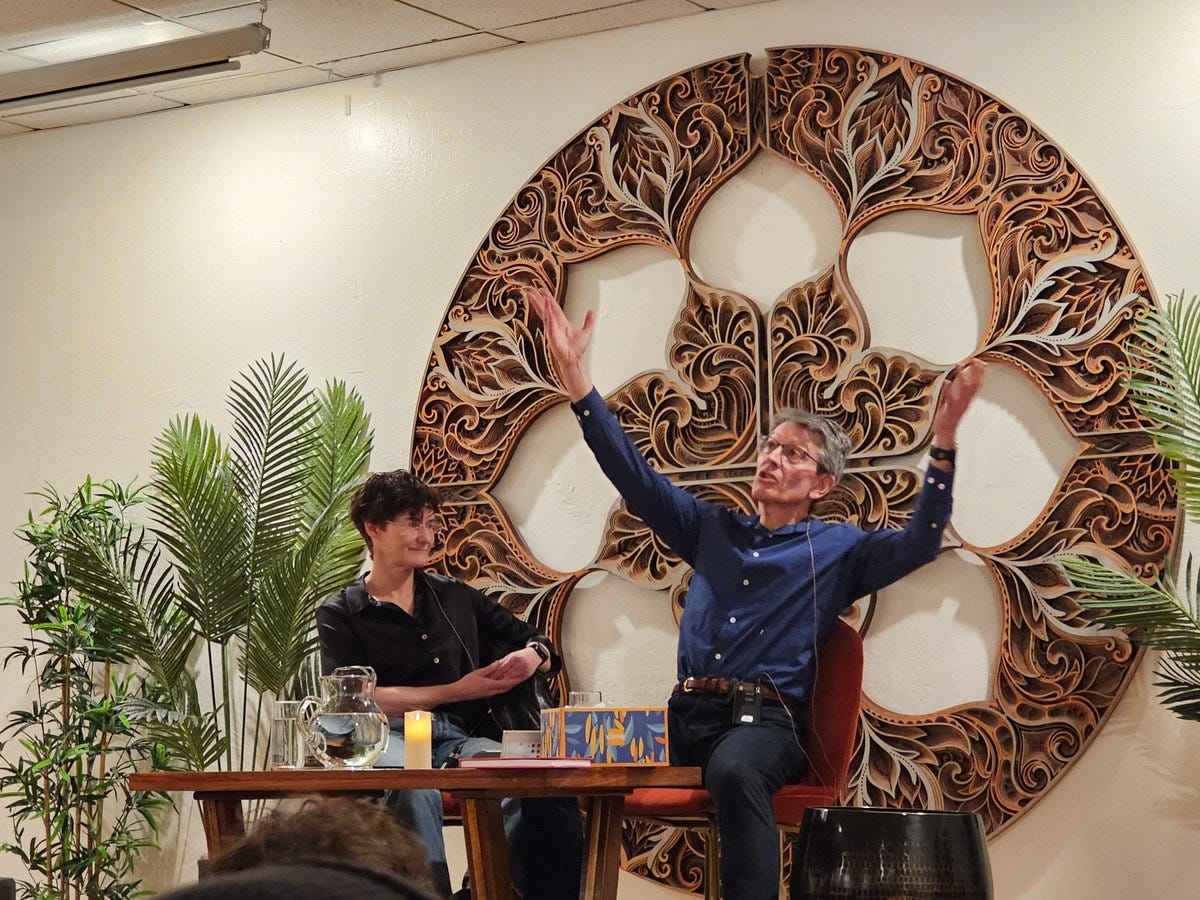 The incomparable value of being wrong The incomparable value of being wrong | What is learning math good for? — Robert Kegan and “meaning-making” — Existentialism’s error — Narcissism and tyranny — How can we avoid radical relativism? — My experience of teachingThis is the video from my January 2025 monthly AMA (“Ask Me Anything”).As a cine auteur, for previous AMA recordings, I have insisted on the director’s cut, editing both the video and text transcript carefully, out of respect for viewers, listeners, and readers.The CFO of the studio, Nebulonic Media Productions Inc., put his foot down this time. It takes more than two full days for me—the creator and director of the thing!—to edit the hour’s recording. He says they can’t afford that anymore. They want efficiency, they want me to ship product, they want—blah, blah, blah, business-speak.I am an artist, I said! No, he said, you are employed as a media professional, which means optimizing yadda yadda, and don’t you forget it.So this is management’s cut. They made an intern run the video through “artificial intelligence,” and he pushed a couple buttons, and it cut out some “ums,” and it generated a transcript that bears nearly zero resemblance to what I said. It’s a travesty.(Let me know what you think!)Thanks to all who participated! And specifically to Nicolai Amrehn, Fatima Ali, Vinod Khare, Peter, Max H, Jared Janes, COPONDER, Adam Tropp, and Mike Travers, for posing and/or helping answer questions.There’s an embarrassing error in this at 6:48. I meant to say that US GDP is around $35 trillion (actually $29 trillion in 2024), but said billion. It was Bill Gate’s fortune that was (at the time) around $35 billion. Sections0:00 Max Langenkamp’s Reader’s Guide to David Chapman1:00 Evolving Ground book club: Pema Chödrön3:23 What is learning math good for?4:34 You can check many public claims with a little math8:59 Learning what it means to be wrong lets you appreciate formal rationality11:50 Mathematics is the ideological basis for the modern world16:43 How does meaningness differ from meaning-making?19:24 Robert Kegan and "meaning-making" in educational theory21:28 Existentialism's error: subjective theories of meaning26:07 We can't be special. We shouldn't be ordinary. We can be noble.30:35 Heidegger, authenticity, and being-toward-death35:38 How can we avoid radical relativism?47:02 The meaningfulness of programs, programming languages, and programming paradigms52:47 Hope for more sensible governance54:19 Approaching Vividness: new course, now in beta56:15 My experience of teaching: thank you! This is a public episode. If you'd like to discuss this with other subscribers or get access to bonus episodes, visit meaningness.substack.com/subscribe | 58m 08s | ||||||
| 12/30/24 |  When the proof comes as white light and angels When the proof comes as white light and angels | The felt experience of mathematics — witchcraft and black magic — “Shut up, kid!” — what is a real number? — shocked and embarrassed — clouds all the way down — a choir of angels singing — painting Cthulhu’s third eye on the walls of our mathematics and science departmentsVideo from a monthly live Ask-Me-Anything!The transcript is below. The web page adds fun illustrations, and a wonderful comic strip, as mentioned in the video!But first, how to join us next time:It will be Sunday, January 26th, 9 a.m. Pacific Time. To participate, you need to subscribe (free or contributing), if you haven’t already.It helps me a lot if you pose questions ahead of time, so I can prepare a bit! You could post them as a comment here, or you can put them in the chat thread.TranscriptThe book Mathematica, by David BessisBig series of questions from Tobin Davis-Jones in the web chat, which I found fascinating because it connects with something that’s personally very important for me. His questions are, and observations concern, or are sparked by, a book called Mathematica by David Bessis.He began by asking if I’ve read that. I haven’t. A number of people have recommended it to me, and said “this is going to be relevant for you.” I read a bunch of reviews and boy, it sure is relevant for me! I gave a copy to my spouse Charlie Awbery for their birthday, which was a couple weeks ago, and they’ve been reading it and raving about it. So I’m planning to borrow it when they’re done.Envisioning: the felt experience of mathematicsTobin says, “Students of rationality often complain that the symbols on the page of rationality are impossibly dull and intimidating. Bessis says that that’s because we neglect to explain that there’s an associated living internal experience of imagination and intuition that is required to really understand and apply formal methods.”Yes! Part Three of my meta-rationality book is supposed to go into this in a lot of detail. If you go to the metarationality.com site and find Part Three, which is called “Wielding the power of meaninglessness: Taking rationality seriously,” that has a sketch, currently only, of what I’m going to be saying about this.For lack of a better word, I call this process of “imagination and intuition,” I call it “envisioning,” because it is similar to mental imagery, but it’s not the same. It has a kinesthetic component. There’s a wonderful piece by Terry Tao, who’s one of the greatest living mathematicians, about how when he was trying to understand a particular difficult piece of mathematics, he was rolling around on the floor, his whole body, feeling the effect of some mathematical function.There’s a great quote from Einstein about this, where he says, um, it’s partly sort of visual, but it’s partly… propriostatic, proprio… that word! So you’re actually grabbing the mathematical objects, and you’re doing things with them.Like most of my posts, this one is free. I do paywall some as a reminder that I deeply appreciate paying subscribers—some new each week—for your encouragement and support. It’s changed my writing from a surprisingly expensive hobby into a surprisingly remunerative hobby (but not yet a real income).I’ve thought a lot about this. I was a math undergraduate. I saw people struggling with this. And for a lot of them, the problem was, and I found this really difficult myself. I got better at it. But translating between the symbols and the really felt experience of the mathematical dynamics, the objects in motion?Tobin asked, “Is this part of meta-rationality?” I categorize it in the book as being part of what I call “advanced rationality.” Advanced rationality comes when your cookbook of methods that you were taught runs out, and you have to confront this situation without any definite method. And envisioning becomes particularly important at that point.Envisioning is also really important in meta-rationality, but I think it’s not necessarily part of meta-rationality as I use that term.Is the stage theory of development correct or necessary?Tobin asks, “You tend to position meta-rationality as a discrete stage that comes after rationality. Must there be stages?”This is an excellent question. This is controversial in the literature on this topic. I have a draft webpage about this. It’s fairly high priority. I want to get to it sooner rather than later.This stage model is just a model. Like all models, formal and informal models, you have to apply it intelligently in a particular situation, and bear in mind that its applicability is always an imperfect fit; there’s some nebulosity. And be aware of the ways in which the model can mislead as well as illuminate. The stages aren’t really discrete, they do shade into each other, and whether they’re even meaningful for a particular purpose can vary.Tobin says, “Or, can meta-rational thinking be incorporated into teaching and learning even when a student hasn’t yet mastered rational techniques?”Well, I think full mastery is not necessary, but you need to have basic proficiency with a chunk of rationality before you could be meta-rational with regard to that chunk. And meta-rationality particularly comes into its own when either you’ve got a choice of rational systems you might apply; or you can’t find any, and you have to create a new one from scratch. So there’s some amount of proficiency with rationality that’s needed first, but certainly this envisioning thing is something I think we could and should be teaching much earlier and much more.Mathematics is witchcraft and black magicThere’s a quote here from Mathematica:The more I advanced, the further I dove into the heart of mathematics, the more I learned to master the techniques that facilitate deep understanding and creativity, the more it began to resemble witchcraft and black magic.Well, here at this point, my ears prick up in a big way! Because I have practiced witchcraft in Wicca before I became a Buddhist, and black magic is a big part historically of Vajrayana, which is the style of Buddhism that I practice. I’ve got a whole website called Buddhism for Vampires, which is essentially about that, and it’s sparked by my horror at realizing that this very nice religion that I was practicing, which is all grounded on taking a vow to always benefit all sentient beings— how can black magic be a part of that? This is a big question. So I’ve got a website about it. And wow, this connects with mathematics?Mathematica, the book, goes on:Descartes thought that mathematicians guarded their secrets for fear of losing their prestige. The real explanation is undoubtedly more trivial. Mathematicians are simply afraid of being called insane.I’ve got another explanation which I will suggest. I’m not sure about this, but if you admit that you’re doing black magic when you’re doing mathematics, maybe that could be a bit embarrassing or problematic. So, yeah!“Bessis describes many truly great mathematicians who, when pushed in private, describe their methods in mystical terms: whispered by God, visited by spirits in dreams, communing with the universe, third eyes and sixth senses.” (Sixth sense is envisioning, I think!) “These ways of thinking produced undeniable results, and yet there isn’t a place in our current rationalist culture for that kind of language.”Yes, I’m constantly down on rationalism for being an inadequate, incomplete, wrong story about how rationality works, and Part Three of the meta-rationality book is my alternative story about how mathematics works, and about how rationality works: science, engineering, mathematics.“These are brilliant mathematicians with real results trying to tell us something about how their brains do rationality.”Yes, it’s not what you get taught in the STEM curriculum, which teaches you rationalism, which is a basically religious theory of rationality, which is unhelpful. I observed this a lot. I did an undergraduate degree in mathematics and then I did a PhD in computer science; while I was doing that, I took a bunch of graduate level math courses. So I saw a lot. There’s my own experience of doing mathematics, and other STEM subjects. I went on and I did a lot of molecular biology, and then worked in a chemistry company. So I saw how people do rationality, and I have the experience of doing rationality, and the rationalist story is inadequate.The taboo against talking about what mathematics isWith regard to math in particular, there is a very unhelpful taboo against talking about what it is like and how we do it. And I gather that’s what Bessis’ book is about. So I’m really excited to read that.When I was a math undergraduate, I’d often put up my my hand to ask a question in class. I wasn’t trying to be difficult, but I’d ask, “What is this thing? What are we doing here? How does this work?” And the answer was always, basically, “Shut up, kid!” And my fellow math undergraduates weren’t willing to talk about it, really, either.There’s a particular moment that I remember vividly, as a turning point for me. I was in an introductory analysis class, which… when you do calculus, the calculus class is all lies. The things they tell you aren’t true; they’re simplifications, which is good pedagogy. They’re directionally correct, but every single statement has… the reality is much more complicated. And the analysis class, you basically just go back over the whole of the calculus curriculum, and do it over again with fewer lies.So it’s about real numbers, which is what calculus is mostly about. And I put up my hand, and the professor called on me, and I said, “So, uh, I don’t, um, what is a real number?” And the professor actually looked kind of shocked and flustered. And he paused for a minute to kind of collect himself, and then he said, “Well, if this was a foundations class, this is a sort of question we might address, but this isn’t, so we’re going to go on.”I was like, “Well, hold on a moment. Um, I’ve had that answer before, a few times, and I kind of, I’m taking analysis because I thought this would tell me the foundations of calculus, that we would get real here and explain what was going on. And, um, but so apparently I need to take the foundations class. In this department, at this university, which is the foundations class?”And then he looked shocked again. He said, “Well, maybe there’s something in the philosophy department… yeah, they don’t do one either. Um, you could go to Harvard, you could see if they have one.” (I was at MIT at the time, and MIT and Harvard students can take each other’s classes.) So he didn’t know where you could find out what a real number was. He probably didn’t know himself! He was shocked and embarrassed, and then hurriedly went on with what he wanted to say about whatever it was.So I decided, at this point, I wasn’t going to get any answers. And I went to the library and dug around, and spent a couple of days there, and got the— Yeah! Dan Dapper says “Dedekind cuts.” I got the official answer, which satisfied me at the time. There’s two official stories about what real numbers are, which are Dedekind cuts and Cauchy sequences, which are really interesting! They’re also kind of wrong. And when people realized at the beginning, early 20th century, that this doesn’t actually work, there was a major crisis, and it kind of looked like mathematics might just completely fall apart. I’ve got a page on meaningness.com called “How rational certainty collapsed,” which is about what happened then.And the reality is, if you look for foundations for mathematics… People go into mathematics thinking they’re going to find absolute truth, and if you dig deep enough under those supposed absolute truths, you find it is clouds. There is no foundation other than clouds. It’s clouds all the way down. And I think a lot of mathematicians have read about this, and they realize there’s something scary there; and this is another part, probably, of why there’s a taboo about real talk about what math is, because it’s on sand, or clouds.I’m ranting.Blinding white light and angelsI’ll tell one more story, which is relevant to the mystical aspect.This was some years later. I was in a graduate-level seminar on Kolmogorov complexity, which is, uh, you may have heard of Solomonoff induction. Kolmogorov complexity is essentially the same idea with a slightly different formalism. There’s a third version of it due to Gregory Chaitin. They all had more or less the same idea at the same time. This is fascinating stuff.There’s a problem set, homework assignment, that had like five questions on it maybe, and the day before I had done problems one through four, which were not too difficult, and problem five I didn’t get done. And so I started in the morning working on problem five. I was working on that all day, nonstop. To do mathematics, you really need to focus, and if it’s a hard problem, you need to focus continuously, without interruption for long periods. So it was like late afternoon, early evening maybe. I hadn’t gotten anywhere. It was really frustrating.And then suddenly I had, I received this insight. It was a really big deal. I actually can’t remember this. I think I was in the room that I shared with Mike Travers, who’s in our session here now! Um, sitting at the desk there. I have the diary entry from it, which is all I know, but the diary entry said this insight came to me as blinding white light and a choir of angels singing. I think that must be metaphorical? I don’t think that was my literal experience, but it was the best I could do to communicate something that felt really important to me as a spiritual experience. And once I had this, I had to translate whatever this felt sense of the insight was into the symbols on the page that I could turn in as a homework assignment. But the experience was the thing.So I think we should talk about these things! You know, it’s sort of embarrassing to say “I had a mystical experience.” It makes it sound like it was a big deal, but it was just a homework assignment. I wasn’t proving anything new. I was being dumb. It shouldn’t have taken me all day to do this.Let’s tell those taboo stories about mathematical experience!Tobin asks “When thinking of someone such as a young scientist in the making, how can we help that person to make sense of such stories?”Well, I think we should just tell them. I mean, you can find some of these stories. I’ve been collecting them to put into Part Three of the meta-rationality book, but they’re few and far between!People are… it’s a taboo because it’s embarrassing. It’s like talking about your personal experience of sex. Several people said this to me. And, you know, I’m more willing to talk about my personal experience of sex than most people are. So I lack some kind of inhibition; that makes me willing to talk about math.I think we should try and explain as best we can, even though these experiences are not very effable. They’re a little bit effable. I mean, just being able to say you have to translate between the symbols on the page and some kind of internal experience: that may be something that a lot of people are missing. When I saw people struggling with math, I think in a lot of cases it was because they didn’t know even that they should be making that translation, much less how. I don’t know how to teach how to do that, but I think we could try to draw our experience? We could paint it?In a 2019 tweet thread, I asked how we can help each other break the code of silence. “A podcast series? A public, recorded virtual conference/workshop? A subreddit? A dedicated web site?”That thread was a follow-on to this one, about the experience of “envisioning.” There were many interesting replies, too!What is your experience of envisioning like? Or other felt experiences of doing rationality? Please leave a comment!I think we all have the sense that we’re bad at it. There’s a passage from Richard Feynman, who was one of the greatest physicists of all time, and one of the ones who was most willing to talk about what it is like. Not very willing! But he’s got a passage where he talks about his experience of what I call “envisioning,” and he kind of dumps on himself. He says it’s “a kind of half-assed semi-vision thing.” And the “semi-vision” is right because it’s also “motoric.” There’s a passage from Einstein where he says it’s got this motor aspect to it, of moving things. But, you know, Feynman was embarrassed to talk about his experience of this! So, we should all admit to feeling, “Uh, you know, I’m embarrassed to talk about this because I don’t think I’m very good at it.”And I felt like I didn’t quite have what it would take to become a professional mathematician. And I think that was partly a suspicion of “Yeah, I’m actually bad at that.” I was actually much better at the symbols on the page. I can do that. That makes me more like a computer scientist than like a mathematician.So Tobin asked, “Can we embed those experiences in a kind of meta-rational understanding?”Yes. Part Four of the meta-rationality book, which I’m struggling with now, is supposed to do that.“Do we need to invent new, more polite terms for this kind of thing?”I invented the word “envisioning,” because it’s a little more polite than “this half-assed, semi-vision-like thing.”Rationality is embarrassing because it’s freaky! Not respectable!“Or should we just use the old freaky ones?”Well, let’s try both! We’re not talking about this at all. So we can talk about it lots of different ways and see what works for people.“Should we paint third eye symbols on the brutalist walls of our mathematics and science departments?”Yes! Let’s do that! I’m reminded of, again, in the undergraduate house that I shared with Mike Travers, who’s here now. There was a very talented artist who was our roommate also. We were in a four person room. He painted a comic, in which there was the third eye symbol, from a dollar bill, in a pyramid. And we were reading this book called Illuminatus!, which I’ve written a webpage about somewhere. I recommend it. It’s freaky! There’s the tentacles of Cthulhu along the bottom of the pyramid, and he had a hand coming out of the bottom of the pyramid, pointing at the tape of a Turing machine, with cabalistic symbols on the Turing machine tape. And I just loved this, and I wanted to paint it on the corridor wall of the MIT Artificial Intelligence Lab. I think it would have been fantastic. So yeah, let’s do that kind of thing.Let’s make explicit that what we’re doing is freaky. Rationalism is all about trying to make rationality acceptable and respectable. And it really kind of isn’t.The cartoon, by Dave MankinsMike Travers put me in touch with Dave Mankins, who drew the comic strip I exclaimed over in the video. It’s titled Mens et Manus, “mind and hand,” which is the official motto of MIT.Dave has kindly given me permission to reproduce it here, under the CC-BY-NC-SA license. It originally appeared in 1981 in Link, an MIT student newpaper we both wrote for. (Link was founded by our friend Brewster Kahle, who later founded the Internet Archive, sharing the same ideals.)I hadn’t seen this in forty-three years! It’s just as fun as I remember it! This is a public episode. If you'd like to discuss this with other subscribers or get access to bonus episodes, visit meaningness.substack.com/subscribe | 21m 00s | ||||||
| 11/28/24 |  Myth, adult developmental stages, and entrepreneurship Myth, adult developmental stages, and entrepreneurship | How thoughts work — goddesses at the origin of philosophy — inspiration in adult development — how myths transform society and culture — Spock and Jimi Hendrix — entrepreneurship, purpose, and valueVideo from a monthly live Ask-Me-Anything!How to participate next time, and more info: https://meaningness.substack.com/p/myth-adult-development-entrepreneurshipUnexpected connectionsEverything is connected to everything else; and this is very inconvenient! It’d be much tidier if everything would stay in its own box. But, it’s also fascinating and wonderful how things connect. And we’re going to see ways in which my recent posts, and the questions, and my random rambling are going to tie together in ways that I find unexpected, and really kind of cool.My “bad brain” joke, and the nature of mindI made a series of jokes about my “bad brain.” My bad brain decides what I’m going to write, because it gets really excited about something or other and says, we’re writing that! And I say no, that’s dumb, and there’s no good reason to write that, I’ve got too many things to write already; and my brain says, nope, nope, we’re writing that! And I’m like, yeah, you write that! But usually my brain doesn’t, so_ I_ have to write it, and this is really quite annoying!This is a joke. And, I got some feedback from people who I think didn’t quite get the joke. And I was talking with my spouse Charlie Awbery, who is a meditation teacher, and they said, “Well, this is a joke which you get if you meditate; and if you don’t meditate, maybe you don’t see the point of the joke.”The point of the joke is: when you start meditating, you have the idea that you’re gonna, like, clear your mind and concentrate, and all of the stupid mental junk will go away. And the first thing you discover is, you can’t do that. You try to do that, and all these thoughts keep happening.The traditional phrase is “monkey mind.” It’s like, you know, a mischievous monkey that is jumping around, and getting into trouble and turning everything upside down, and pulling things out of where they’re supposed to be, and throwing around, and creeping up behind you and pinching you, or biting you, and it’s quite painful. Your thoughts are like that.You think, okay, there’s something wrong with me. I had no idea that this is happening in my mind. You start to realize in ordinary life that this is happening too. As you meditate more, you realize that this is just what minds do. It’s the natural function of mind, and as you let that be, the monkey calms down. Some of the time.But thoughts keep arising. The type of meditation that I do, that my spouse Charlie teaches, it’s a non-goal to make that stop. Because the goal is the natural state of mind.So, when I complain about having a bad brain, it’s, it’s this monkey mind phenomenon. And this is just funny because this is how minds are. This is everybody’s mind.Some people misunderstood me as saying that there’s something defective about my brain, and that’s probably true, but it’s not what I was joking about. I wasn’t complaining that I have some kind of mental health problem or something. It’s just, I get excited about things. And then I’m moved to write about them.And this sense of there’s me and there’s my brain— is a kind of joking metaphor for this sense that we’re not some unified individual with control over our own thoughts. We don’t have control over our own thoughts for the most part. That’s not how it works.Philosophy is bad because it pollutes our thought soupAnd this is a main part of why philosophy is bad. Philosophy is bad because you think thoughts that you think are your own thoughts, and you think you’re in charge of those thoughts, and you’re figuring things out.But the reality is, our thoughts are almost entirely drawn from the soup in our culture of thoughts that people have had before. And all we’re doing is repeating them. We think we’re thinking thoughts, but actually the thoughts are just happening, and they’re ones that we’ve picked up.And the ones that are about meaning, purpose, value, ethics, the traditional subjects of philosophy: these are thoughts that somebody had twenty-five hundred years ago, who was completely out to lunch and wrong about everything, but they slipped into the culture, and they’ve been repeated, for millennia, with slight variations; and then they come up in awareness, and we think they’re our thoughts.And we’re thinking bad thoughts that don’t actually make any sense, and we don’t notice because we don’t see how thinking works!Encouraging communityRight, so I’ve been writing about why philosophy is bad, and I wrote that I have very mixed feelings about this, because this is one of my bad brain’s projects, and I’m not sure it’s actually a good thing to be doing, and I’m not sure if I’m going to continue.But it drew a lot of attention and comments, which suggests that it may be an exciting topic that is worth pursuing, or it may just be that it’s rage bait, or some kind of bait that is drawing people, in a way that’s not healthy, and I should drop it like a hot potato. I’m not sure about that still.However, one thing that’s exciting for me is seeing how, uh— Used to be, the comments on my posts were addressed only to me, but there’s increasingly conversation among people with each other, on my posts. And that seems like the beginnings of an emerging community around the kinds of things I write about. And that’s something I want to encourage! I decided that would be a project for this year, at the beginning of the year when I was doing my annual planning. And I mentioned in one of my monthly roundup posts that I was going to do this, and several people said No no, that trades off against time spent writing the real stuff, and we want you to write the real stuff. Not create community, because who cares about that!Well, I do care about it. I hope you’ll come to care about it too. So I think it is worth putting some of my time into, even though it is really time-consuming. I spent essentially all day yesterday answering comments on the most recent philosophy post.How myth got mutated into metaphysicsAbout that post: there is something very weird in the middle of it, when suddenly there’s all these dramatic illustrations, and weird bits of text that don’t seem to connect, and what is that about? I find this very interesting. There’s something emerging there, that I haven’t completely got a handle on yet. It’s starting to assemble itself, and this is the sort of impersonal nature of thinking. I don’t— I don’t do the stuff that supposedly I do. It just arises in mind. And, you know, I can, sometimes it’s a lot of work, sometimes I can guide it some, but primarily it’s an autonomous process that is impersonal. I’ll come back to this, because this really relates to the questions from both Vinod and Nick.If you follow the links in that weird bit with the dramatic irrelevant illustrations, you’ll get some hints about what’s going on there. This is about myth, and mythopoesis, and the emergence of metaphysics out of myth.I’m gonna say just a little bit about this. This is going to come out, I think, as a thing. It’s now a bunch of semi-connected thoughts, but I’m going to give you a through-line, I think, that is the outline of the story.So in the beginning, there was Tiamat. Before the heavens and the Earth, there was Tiamat who was the waters of the ocean, and she was chaos.This is in the Mesopotamian myth cycle called the Enuma Elish. The word that’s translated “chaos” in the Enuma Elish, and the Greek word chaos, do not mean what “chaos” means in English. It means unformed.So the world was unformed, and Tiamat mated with Apsu, who was the fresh water of the rivers, and she brought forth the heavens and the earth, and the trees and the greenery, the animals, and monsters. She is the mother of everything. She is also the devourer and the destroyer of everything.Hesiod. He’s not counted as a philosopher, he’s kind of a proto-philosopher. He systematized the Greek myths, and he addressed them to questions that subsequently became called the philosophical questions.Uh, G-M-L comments, “This sounds a bit Discordian.” Yes! There’s a very clear connection there.Hesiod’s myths are partly a retelling of the Enuma Elish— I think, and it’s not just my opinion.Thales counts as the first philosopher, for some reason. His main doctrine was that everything is water. Tiamat is water, and the origin of everything.Parmenides, who is right at the cusp between myth and metaphysics, he rode a magical chariot into the watery underworld and met a goddess, and she gave him philosophy.Zeno was his student, who codified Parmenides’ understanding as a series of logical proofs.Plato’s main work, I mentioned, was trying to make sense of this. Plato was concerned with forms. Remember, chaos is “unformed.”Nagarjuna is the origin of Mahayana philosophy. He was concerned with the relationship between form and emptiness, which is the unformed.Where did he get his stuff? He got it from water demons, snake demons.The philosophy that he espoused concerns what’s called Prajnaparamita, which is the “perfection of wisdom.” “Wisdom” in Buddhist philosophy means the recognition of emptiness. And Prajnaparamita, emptiness, chaos, is personified as a goddess.So, if you look at that weird middle section of my “Philosophy Doesn’t Work” , which is about myth and metaphysics and how they relate, what I just said may make that make more sense.Inspiration in adult developmental stage transitionsNick Gall has a series of interesting questions in the preliminary chat, which are about inspiration, and self-transcendence, and stage five in adult developmental theory, and how these relate to each other. They draw on an academic article that I haven’t read, and so I may not be able to address all of what he wanted to hear.Inspiration is tremendously important to me, and I hope you can hear in my incoherent rambling about ancient philosophy and dragons that I’m inspired by this. It’s really exciting for me at the moment, trying to make sense of this, and the material is drawing me. This is highly meaningful to me in some way that I don’t really fully understand yet.So I’ll come back to inspiration in a moment, but stage five in adult developmental theory… I’ll say some things about it, but this is something that nobody understands very well. There’s very little scientific study of it. The whole thing may be really pretty off. I can speak from my limited understanding and my limited personal experience. I think at the moment that’s all anybody can do.In general, stage transitions involve both a push, which is a repulsion for your previous stage, and a pull, which is an inspiration drawing you toward the next stage. So you start to understand the limitations and failure modes of your previous stage, and you become disgusted with it, and that pushes you away, and you may find yourself in chaos: in an unformed space in which nothing is fitting anymore, and that can be terrifying. It can be depressing. Nihilism is an eruption of emptiness, or chaos, into awareness that you can’t deal with.Hopefully, you manage to avoid that, because as you move away from the previous stage, you start to get a view of the next stage, that is glimmering in the future ahead of you, and this is inspiring, and pulls you forward, even though you don’t understand it yet and you can’t quite see it.So in the three to four transition, you become sick of your social community, because everything is emotional drama. And people are constantly having these insane feelings about nothing that make no sense. And it’s impossible to get anything done because everybody is distracted by some relationship thing. And not doing what needs to be done. So you’re driven away from that.And then you start to see, "Oh! Well, you know, if we had some clear responsibilities here, and if we had some coherent ideas about how we were relating to each other, such that we would reliably get along, and be able to work together, and not have constant drama, and if everything actually made sense, because there were some clear categories that things fit into, that would be much better! And that’s the inspiring vision of stage four that pulls you forward into this rational, systematic mode.Then at some point you realize the limitations of that, that it’s very rigid, that you’ve put yourself in a box, and you’ve become an isolated individual. You’re trapped in your system of rationality. You have become a machine, a robot, going through the motions, executing a program, and it’s dead, you know, the life has gone out of it, and then you may go into a stage 4.5 nihilistic depression, where you realize that doesn’t work. But again, there’s chaos. Without rationality, there’s just chaos, and you’re tossed about on this black sea of unformed nothing!Stage five and self-transcendenceAnd then you get the vision of stage five! And that pulls you forward and it’s inspiring.Nick quotes some sections of my piece called “The Cofounders,” which is about how the entrepreneurial cofounders of a tech company… That the relationship between them develops from stage four to stage five. And the bits he quotes are from stage 4.8, which is the point where you’ve got the inspiration, you’re most of the way there, you can’t quite consistently be in a stage five way.So what happens at stage five? Nick talked about self-transcendence; and I’m a little wary of this word “transcendence,” because this sounds like philosophy, it sounds specifically like early 19th century German philosophy; and philosophy is bad, and early 19th century German philosophy is kind of exceptionally distasteful in a lot of ways.However, in each of these stage transitions, according to Robert Kegan’s version of this theory, there is what he calls a relativization of an old self, and the emergence of a new self. The old self becomes an object within the space of the new self.And that could be seen as transcendence; I don’t like the word, but it’s the same, maybe the same idea. I don’t know, I haven’t read this article.Stage five is different from the others in that the new self is not a self in the same sense. Each of these selves are structurally different, but the self at stage five is non-personal. You “become the space.” It’s very hard to talk about this without sounding like you’re on acid. Within awareness, everything is arising. Whatever is happening, is happening. And that is not separate from you. And this is not some kind of non-self exactly, it’s not that your self disappears, it’s just that yourself becomes a collection of stuff that appears on essentially the same basis as everything else within this space. You understand yourself as a space, not a box. You know, a self is the box. We’ve got some stuff in it, and everything else is outside. And at stage five, that just opens out.Nick comments that “‘Self-transcendence’ comes from psychology. For example, Maslow’s highest level wasn’t self actualization, it was self-transcendence.” I read Maslow a couple of years ago. I was really impressed! This was a book that was popular when I was a teenager, and people thought it was great. And it sounded kind of dumb. But I read his book and I was very impressed with it. I recommend giving some possibility to checking that out.So this self-transcendence into stage five relates with that impersonality of mind, which you can discover in meditation.MythopoesisAnd it relates to the process of mythopoesis. There’s a famous, very influential essay by Tolkien, called On Fairy Stories, which is about mythopoesis, which is the creation of myths. Hesiod, who I mentioned, is sort of the original for mythopoesis. He apparently collected a lot of different Greek myths from around Greece, and systematized them into a coherent story, which then became canonical.Tolkien, I think, understood himself to be doing mythopoesis on an individual basis. It was Middle Earth: The Lord of the Rings, The_ Silmarillion_, it was his creation. Which is true in some sense, obviously. But in general, mythopoesis is a social, cultural process that is not personal.This bizarre story that I told you with a lot of Greek people in it, and goddesses, feels quite impersonal to me.I should say I actually got partly interested in this because Jordan Peterson is obsessed with Tiamat. I think he’s obsessed with Tiamat in a quite different way, but I was contemplating his lectures on this, and that was part of what got me started.Myths transform can societySo Vinod Khare asks, “In what ways do you find myths useful for people today? You’ve written extensively about the utility of myth for personal transformation. What other usefulness do you find in the mythical mode of thinking?”I think it is tremendously important for developing culture and society; and Tolkien very much felt this. He was creating a new origin mythology for England, which he felt didn’t have the kind of myths that the Celts did, and the Finns did, and of course the Greeks.So, lot of it came out of his experience of the First World War, but he wanted to create something that was going to be transformative for England.I want to create something that can be transformative now for whomever, and myth is a way to do that. Myth operates at this watery, deep, underground level, that is primal, and tremendously important and inspiring, even if it makes no sense. And yet it makes sense in this mythical mode, not in the rational mode.And I said in that “Philosophy Doesn’t Work” piece that the mythical mode and the rational mode are not in conflict. The rationalist Greeks got the idea that these are in conflict, we need to get rid of the myths because they’re not true, and we need to replace them with rationality, and from that they created metaphysics, which was a disastrous mistake in my view.Myths and fantasy and science fiction“What similarities and dissimilarities,” Vinod asks, “do you find between ancient, well established mythical entities such as Zeus or Vajravarahi, and more modern, contemporary mythical entities from Hollywood or fantasy novels. Are they on an equal footing, in some sense? Or not?”There’s a related question he asked, which is “What kind of fiction do you like to read? What value, if any, do you find in reading or watching fiction, besides enjoyment for our day to day lives?”So, I do read and love fantasy fiction, with dragons and heroes and witches and creepy underground stuff; and I think it is the modern expression of the mythical mode.Oh, Vinod says, “This makes me think of how the myth-making of Golden Age science fiction ushered in much of the technological progress later.” Yeah! I mean, that stuff was tremendously inspiring. I just caught the end of the golden age when I was a kid, which was in the steam age or something. Heinlein was an enormous inspiration for me, and I went into artificial intelligence because of Heinlein novels. I think that is a form of modern mythology. I think that sword and sorcery novels— I mean, a lot of them are junk, because 95 percent of everything is junk, but the best of them tell you something about human possibility that I think is really important.Yidam practice, Spock, and Jimi HendrixVinod asks, “How similar is yidam practice”— That is a tantric Buddhist practice of, relating to, and perhaps becoming, a deity. I wrote about this somewhat obliquely in a recent piece called “You Should Be a God-Emperor”; there’s also a more straightforward piece on Vividness about this.“How similar is yidam practice to considering ‘What would Spock do?’ That one is actually personal. I spent my teenage years regularly trying to imitate and embody Spock, who is my favorite Star Trek character. The effect, I think, was emotional dissociation, and getting really good at technical subjects, and infrequent explosions of anger, which is exactly what I would expect from taking on Spock as a yidam.”This is a wonderful story! Thank you, Vinod.I think asking in a conceptual way “What would Spock do?” is not completely in alignment with the traditional practice of yidam, which is non-conceptual. It’s important in some ways that it’s non-conceptual. But otherwise, I think, yes, this probably is meaningfully similar.My former teacher, Ngak’chang Rinpoche, had a similar story about this, which is, he had a poster of Jimi Hendrix on the wall. Ngak’chang Rinpoche was an aspiring blues musician, and so this poster of Jimi Hendrix was like the thangka, the religious icon of the deity. And he said that you put this on your wall, and then you adopt the mudra of the yidam. So the mudra is the kind of bodily posture and gestures of the yidam. And the Jimi Hendrix mudra is: terrrrlzlzlzlp! So, he became a semi-pro blues musician, and was quite successful at that for some years. So maybe that worked for him.Hollywood mythologyVinod mentions Hollywood; and a lot of Hollywood stuff is quite explicitly drawn from mythology, in a somewhat degraded form, and sometimes that seems kind of vile. But I think a lot of it works because it is mythology. And when it’s good, it’s good partly because it’s bringing myths to life, and making them [THUMP!] They hit you in the chest. And that’s what myths should do. If it’s some story that you’re reading without any emotional impact, then there’s not much point in that!G-M-L in the chat is mentioning the Dune films. I actually haven’t seen those. Charlie, my spouse, watched them and was excited. I loved the Witcher series on… Netflix, I guess? And the video game Witcher 3, Charlie and I both played that through, before watching the TV series and found it very affecting. The Witcher is a tantric sorcerer, sort of? Doing the things that a tantric sorcerer does, and we’re like, yeah, this is tantra!And the Lord of the Rings movies were, for both of us, quite impactful; because again, Tolkien was deliberately engaged in mythopoeisis.My experience of entrepreneurshipMaybe I’ll go on to Steph’s questions, which are about entrepreneurship, and purpose and value in major life projects. Steph said that I’ve started a company, “Can you tell us more about that?” I will, but I asked Steph for what in particular might be of interest, and why she was asking. She said “It’s all in the vein of what should I do with my life.” And there’s a series of questions she asked, and her path to entrepreneurship is strikingly similar to mine, so it’s possible that the analogy may be somehow interesting.I’ll say a little about mine first. I got fascinated by artificial intelligence due to reading Heinlein novels. And I went and got a PhD in artificial intelligence. Toward the end of that, I realized that it was a dead end field that was not going to progress, and there was no point in continuing with it. And AI couldn’t answer the questions that I came to it with, which was questions about the nature of mind. Which I’ve gotten to have better answers to through practicing meditation. And other ways.Then I had a Ph. D., and what do I do, because I’m not going to do AI research? I had a existential crisis of purpose. What is my purpose in life now? My purpose has been artificial intelligence for 20 years. And that’s just a dead end. Along the way, I got extraordinary programming chops, and thought, okay, how do I use those to do something else? And I wanted to do whatever was going to be of greatest benefit.I thought something in the area of medical research and health seemed like a good bet. And I went into computer stuff in pharmaceutical research, which is about inventing new drugs. I did that at a small, very screwed up company for a few years; and then started my own, even smaller company, that was successful enough that I was able to retire, in 2002, I think.Entrepreneurship, and purpose and value in major life projectsSo, what does that have to do with Steph’s questions?Steph asks “I’m asking about startup life because for some reason that’s a direction that’s really hot for me at the moment.” Yeah, I mean, I found entrepreneurship inspiring. There is a draw, because it’s creating something that is completely new, and you’re really up against reality there. It’s not conceptual; I mean, concepts play some role, but you’re actually creating a thing, and you have to become the space. As founder, you are the space within which the company happens. That can drive people into stage five, and my piece called “The Cofounders” is basically about that.Steph says, “I’m on an incubator scheme, getting a lot of support and encouragement. I’m finding a natural, buzzy fit in this early stage.” That sounds great! The incubator hadn’t been invented yet when I was doing this, I think.Steph says, “But it’s all froth.” That doesn’t sound so great! I think Steph is maybe expressing some question of whether the apparent purpose is real. And that’s a question I am constantly asking myself, and always have been, because purpose is nebulous, and there’s never going to be a definite answer.Steph says, “I’m going to keep developing and validating my idea”; even with some uncertainty she expresses: “I can’t decide how committed I am to the lifestyle. I want purposefulness more than anything, but I also don’t want to sacrifice down time. I don’t want to work more than 46 or so hours a week.”Yeah, that’s tough… I’m not sure it’s realistic to found a company in 46 hours a week. I wouldn’t say it can’t be done; I don’t know. I routinely worked seventy hours a week, often more. My spouse, Charlie, is a founder now of a small organization that’s growing rapidly, and Charlie works routinely seventy hours a week, sometimes more. And it is brutal. That’s just a realistic fact about this.But, if you have a one-person business, and you’re not aiming to grow rapidly… Managing people is very time-consuming, but an individual, solo business might very well be done in 46 hours a week or less. And there may be ways to run a more substantial business as a normal sized job; I don’t know.Within eG, which is our community, that Charlie and Steph and a number of others of you are in, there are quite a number of entrepreneurs who have been through this process, and might be available as a resource.What is software expertise best used for?Steph says, “The other issue is more fundamental. It is: what questions are computational methods best suited for? I’m fairly deep into computational cognitive science,” as I was, “but it’s become clear that computational modeling is not the best tool to study the human mind,” which is what I figured out in about 1989, which was a great disappointment!“I got into it because I was fascinated by the riddle of the mind, but I now see that, this was just an expensive toy case for me to study to learn computing”— there really are surprising analogies here, Steph! “Now that I have my programming, statistics, and probability, I want to leave ideas of the mind for meditation, and instead find an application for the methods that I learned. I’m a generalist.”Yeah, I think being a generalist is critical in entrepreneurship, because you have to do everything in the beginning. The founders are also the people who assemble the furniture, and who talk to lawyers, and raise money, and deal with people’s personal crises, and get the health plan in place, and you have to be a generalist to be willing to do that, and if you’re not willing, you’re not able.“Surely I must be able to use it now for good, but what and how?” Very good questions!“I have some ideas for causal modeling in health tech, like some reasoning tool for normal people to quantify how many minutes they’d need to run to offset eating a donut, and keep diabetes at bay for the same amount of time, that sort of thing.”I think this is a great space to be in! I don’t know any specifics. There is a member of the eG community who founded, grew, and recently sold a similar-sounding company, that was a personal health metrics startup. He might be willing to talk to you. I’ll check with him, and put the two of you in touch if he’s up for it.I wish I could be more specific for stuff, but I’m out of that, all of those fields, and things are quite different now than they were almost thirty years ago, when I was doing this.Founding a startup is a mythopoesisI’m finding another connection, which is: A successful startup is a myth. The idea initially is probably completely unrealistic, but it’s inspiring. It has an emotional impact and to be a successful founder, you need to inspire people with the myth of the company.At some point that can become dysfunctional. The famous case—and it’s in this space!—is Theranos, which was a startup founded on an inspiring myth of dramatically cheaper, more convenient blood testing, or medical testing in general, which could have a huge impact. And the founder inspired employees, and venture capitalists, and the press. And the myth was brilliant, and inspiring; it’s exactly the sort of thing that I would want to do, and it sounds like the sort of thing that Steph would want to do. The problem was it wasn’t true.At some point, the myth has to draw reality to its vision, and bridge that gap.It maybe relates to this idea of meta-rationality, and stage five perhaps, being, in part, about the interplay of different modes of thinking, feeling, and acting. In the meta-rationality book, I talk about reasonableness and rationality; but the mythical mode is another one that I don’t talk about in that book. But connecting rationality, which is reality-based, with myth is what a founder does.Philosophy is a disaster for the same reason Theranos wasI’m just making this up as I go along! Thoughts are thinking me! I don’t know where this stuff is coming from.So, Elizabeth Holmes was the founder of Theranos, wasn’t able to do that for whatever reason.And I think the Greek philosophers also failed. All of philosophy is downstream from their failure to bridge rationality and myth. Rationality was new, they didn’t know how to do this. They observed that the myths were false, like Theranos’ medical tests were false. They said, “Okay, we don’t want to do that. That would be wrong. So we’re going to get rid of the myths, and just be rational, and address the subjects of the myths with rationality instead of myths.” And that’s what philosophy is; and it doesn’t work.Décalage: slippage and lagThere’s a question here: “Can you talk more about the transition from stage 3 to 4 to 5 in the sense of how you can be in different stages at different parts of your life? I feel I may be at stage five in my professional life, but transitioning between 3 and 4 in relevance to spiritual friendship and community.”Unfortunately, I can’t see who asked that, so I can’t credit, and this is an excellent question. This is a key question. I think it’s the key question in adult stage theory, which does throw the whole thing into question.Technically, it is called décalage, which means slippage between domains of life. Professional life and personal life, or interpersonal life, are different domains of meaning. And I think it’s actually extremely common for one to experience and operate at different stages in these different domains; and that can cause a lot of trouble.For technical people, it’s extremely common to be at stage four, and even to be moving forward out of stage four cognitively, while still being stuck back at stage three, or dragging oneself from three to four, relationally.I think there’s a valuable possibility there, which is to reflect on the way that you are in the domain that you’re more advanced in, and try to find analogies between that and the domains in which you are lagging. There are structural analogies between these domains, such that stage four in the relational domain is structurally similar to stage four in the cognitive domain, or the professional domain. So if you can bring those into correspondence reflectively, that can be a powerful way of accelerating development in domains where you may feel a little stuck.Companies and cultsNick Gall is asking, “This passage from ‘The Cofounders’,”—that’s the piece I wrote—“strikes me as gesturing towards company myth-making: ‘Some said the company was turning into a cult, and we lost a few of our best people. It was a calculated risk. Most stayed, and some say the training has radically improved their lives, outside work, as well as in it.’”Yes! So, “turning into a cult”: that is related to company myth-making.Robert Kegan, whose version of adult stage developmental theory is the one that’s most influential for me, and for many people… I think it’s his most recent book, was a study of three different companies that tried to actualize his theory. One of them was Bridgewater, which is a gigantic investment company that is uniquely successful financially; and within the financial industry, it is widely regarded as a cult. It has a sacred text, which was written by the founder, and it has weird ritual practices.And for outsiders, the big question is, was this company incredibly successful because of this bizarre off-putting mythology? Or, is that just an accident, and it was successful for some other reason? I don’t know the answer to that. There’s some discussion in Kegan’s book, that is very interesting, but I think not very illuminating, to be honest.Relational stage four: professionalismThe bit about “most stayed, and some say the training has radically improved their lives, outside work as well as in it”… I get contacted very often by people in technical management who say, “The people that work for me, they’re STEM educated, they are cognitively at stage four, possibly even beyond, but they are operating in their relationships with their colleagues and with me at stage three; and this really is causing a lot of trouble. How, how can I encourage these people to move to stage four interpersonally?”Stage four interpersonally in a company context is what we call “professionalism,” and this is something that… I think it’s become much more of a problem than it used to be. It used to be understood that if you were a “white collar worker,” you had to behave in certain ways, and relate to your coworkers in certain ways. And due to cultural changes, that requirement is no longer feasible. But having everybody in a company that’s trying to get work done relating to each other in stage three ways is really very difficult, and causes all kinds of interpersonal problems, but also, concrete problems in not getting the work done.Consensus Buddhism is stage threeUh, Apostol says, “For me, the transition from three to four in spiritual community was triggered by a total failure to get my needs met at a stage three community. I realized it was a structural problem.”Yeah, that’s really interesting! My critique of a lot of modern spiritual communities, particularly what I call “Consensus Buddhism,” which is kind of the “nice” version of Buddhism, is that it is stage three; it is unstructured; it’s about relationships and emotions. That’s all great stuff! But it has its limitations, and depending on where you are personally, this may not work for you; and it sounds like for Apostol that didn’t work, and moving into a community with more structure was helpful.Have a great holiday! See you in a month!Okay! This has been great. Thank you for showing up! We’ve got 45 people currently. Probably some people have dropped in and out. It’s a great turnout. It’s wonderful to see some familiar faces, many familiar faces, and some new people. And I’ll be doing this again in a month or so. Have a great holiday.See y’all! This is a public episode. If you'd like to discuss this with other subscribers or get access to bonus episodes, visit meaningness.substack.com/subscribe | 44m 40s | ||||||
| 11/9/24 |  Vajrayana, Ultraspeaking, and adult stage transitions Vajrayana, Ultraspeaking, and adult stage transitions | Following our earlier conversation about Ultraspeaking and Vajrayana, we add adult developmental stage theory to the mix: three transformational frameworks in synergy.We recorded this when Charlie was in Berlin on a Chinese martial arts retreat. Charlie had had been away from home for more than a month, after teaching several Vajrayana retreats in New York. The video signal was not good, so this is audio only.TranscriptCharlie: I was thinking about the kinds of changes that occur through this kind of practice that we’re talking about, changing ways of being and communication; and how that can be seen through a lens of adult development as well, which is something that you and I are both very interested in, that I’ve trained in as well.I think both Ultraspeaking and Evolving Ground have the potential to facilitate development from what you might call a socialized mode into self-authorship; and for some, from self-authorship into self-transforming mode. Or at least to play a part in that developmental journey.David: Just to interrupt, the modes you’ve just described are the ones labeled three, four, and five in many systems, like Robert Kegan’s.Charlie: Yes, that’s right. So in socialized mode, one of the characteristics of finding yourself in that way of being—which we all do in certain contexts—is a heightened concern with how others might think of me, or more emphasis on fitting into an external, accepted, rightness or role, like that is the right role, and it would be wrong to behave contrarily to that. So these are different ways in which a socialized mode can constrain a way of being.And Ultraspeaking facilitates exploding through that, because you can practice putting aside what other people think of me, you can become more and more aware of how you constrain yourself by concern for what other people think, and practice stepping into a mode of not worrying so much about that.And in Evolving Ground, we do the same thing in our personal autonomy module, with very different exercises, very different practices of awareness. We may bring some self-reflection practices, or pair work into that, but we’re doing the same thing. We’re facilitating this move away from, limiting concern with “How do I look to other people? What what are other people thinking of me here?” Having the confidence to simply say it how it is, or express what’s going on internally without having to fit in.So that is one way that the move from more socialized into a more self-authored, more self-principled, self-confident, autonomous way of being is facilitated through both those methods.And then, from self-authored, as you move from a self-authored, or in the Kegan framework that would be a stage four way of being, which is very systematic, predictable in some ways, you know what you’re going to say, you got it all planned out. Now, if you approach Ultraspeaking and you’re in that way of life, it can be very challenging to have that sense of certainty uprooted in a good way, actually put yourself on the line and go into a situation where you, you cannot be certain how you’re going to do, or what’s going to crop up on the timer, or it can really help just push a little bit beyond that almost over-certain, overconfident—David: I saw that when I did the brief taster course. There were some people who really wanted to give a talk, with a series of bullet points, and they were going to do that no matter what. And at some point, they broke through, because they realized that actually was not going to work given the format, right? And they had to do something different.Charlie: It’s so interesting, because the way that that happens experientially is you realize you have— I had the experience of, “Oh! People experience me-in-that-mode as somewhat kind of disconnected.” And I felt that disconnection myself. I felt almost like a glitch with reality. It’s like the jigsaw piece, you think that everything’s fitting in very neatly. And suddenly you have this new perspective that, “Oh, I’m imposing my thing on reality. I’m like, I’m doing my thing.” And all of that melts away. It doesn’t have to be like that. And that is the move from structured, systematized imposition on the world into a more fluid, interactive way of being. That, that is very moving indeed. Very moving. I, you know, I can feel myself choking up now even thinking about how opening and liberating that is.It is moving. You know, I’ve seen so many people go through that kind of transformative process, both with Evolving Ground and with Ultraspeaking.David: I see that also in what I do, a lot of tech people who at some point realize that their rationalism and their principles and their certainty about how things are and should be— it can crumble and be devastating, but it can also just be a, “Ahhh…”—Charlie: Yeah.David: —a letting go, a relaxation, a realization that things are much bigger than you had thought, and much more excitingly vivid than the world view in which everything fits together neatly in some jigsaw puzzle that you learned in computer science undergraduate courses.Reality is, is, is so real and, and so—Charlie: Squishy.David: Yeah. Well, it’s squishy and it’s got sharp pointy bits as well, and it’s—Charlie: Yeah.David: You just want to lick the whole thing!Charlie: That’s very tantric.David: I mean, I use the word “nebulosity,” which is a step beyond squishy. It’s just cloud-like. And then there’s almost nothing there; but yet it kind of swirls around in patterns sometimes. If you’re actually walking through fog, it’s not uniform, it’s ultimately squishy, you can usually not feel it at all.Charlie: Yeah. Squishy has a playfulness to it as well.When I look back over my own change, and actually how difficult that was at times, the hard stuff came first. The walking through fog and the, uh, the, I mean, the drop into awful, awful, uh, loss of some sense of meaningful communication.That was the, the fog-like experience that I, I kind of sort of knew that I would move through that in some way. And, you know, we’re talking about, uh, an experience from years back way before, um, Evolving Ground and Ultraspeaking, but the fog-like quality of that — cognitively, but not only cognitively, it just in experience, like literally one day to the next, not, not having any clear direction or way forward.All of that came before the playful capacity to dance with whatever happens and, you know, “whichever way it goes, may it go that way,” and moving into the more vivid, vibrant— uh, I’m being metaphorical here, but it actually felt that way as well.David: Yeah.I think we might do a whole podcast on this, if you’re up to it at some point; but in terms of adult developmental theory, I would characterize what you went through as a classic stage 4.5 nihilistic confusion, depression; and it was remarkable seeing, being with you through that, and seeing how it went. And I was trying to be as supportive as I could, with limited ability. I think.Charlie: Well, also we were on separate continents for a long period of time.David: A lot of it. Yeah, right. Yeah.Charlie: Yeah. And you were, you were core support for me through that process. I, I intentionally self-isolated, I think as well.David: Yes. That’s why it was difficult. And I think that’s a very natural thing to happen at that phase. Where you have understood that you can no longer be how you were, but you can’t yet see what the next better possibility is. At best, you’re very confused. At worst, one can be very depressed; and a lot of what I do is trying to help people through that.Charlie: Same here, now. A lot of my coaching ends up facilitating that process. Hopefully, you know, I don’t think it has to be depression, and actually I wouldn’t characterize my own process as depression, so much as just misery. I was just really, really unhappy for a long time. Which is not the same as depression.David: Mm hmm.Charlie: And even in that I enjoyed localized contextual experience. And I think that actually is how I moved through that as well.David: Yes, that is how you get out of it. Find things to enjoy. Even if they don’t seem meaningful in a larger context. And then you find the meaning in those, and then that spreads.Charlie: Yeah.David: We tried to record a podcast about helping STEM people deal with this, more or less.Charlie: Right? Yeah, we did. And we did do a recording, right? We did record it.David: It didn’t work out very well. We’ve gotten better at this process, although I need to do a lot more Ultraspeaking practice.Charlie: It’s nice when we’re in the same room, you know, not just the same Zoom “room,” but the same physical room.David: I miss you.Charlie: I miss you. It strikes me that’s actually quite a funny thing to say when we’re here in real time together. I miss your physical being.David: Well, it is not the same. We spent a lot of years of our relationship being forced to be on different continents by circumstances, and we didn’t even have, you know, Zoom then. It was…Charlie: We both enjoy being together, and being alone together.If you don’t enjoy your own company, and if you can’t enjoy being alone, then there’s always going to be some kind of neediness in communication with others in relationships that you build over time with others. So one of the practices that I’ve been suggesting to people: “What’s the longest you’ve been on your own for?”That also is an aspect of the whole move from socialized or stage three mode into the stage four, self-authoring mode. There’s some sense of self confidence, self trust, self reliance, that actually I don’t think it’s really possible to have, without having experienced liking your own company. You can partially experience autonomy and authorship without knowing that, because you can have a confidence in your own principles, or a confidence in differentiating self. But unless you’ve really leaned into that extreme of possibility in terms of socialized context, then there’s some experience that is not yet known there.Now I’m thinking of a parallel with the Four Naljors practice. Opening Awareness facilitates moving into an experience of “emptiness” or “spacious clarity,” which is at an extreme end of the range of possibilities: nothing going on in mind. It’s like you really move into experiencing something separate and distinct, in order to get a flavor for what that is.And then with Moving Awareness, you’re moving into a very different experience, in order to get a sense of what is distinct there. I am so going off on tangents!David: Well, there’s a parallel here. The move into emptiness, and the move into being alone; and then the move back into form, but with the recognition that it is empty: this is like the Ox Herding pictures, which is a classic Zen metaphor. You first you go on the path of emptiness; you go looking for emptiness; you find emptiness. And then you bring emptiness back to the town. The metaphor for emptiness is the ox. You bring emptiness back into the town and you reenter society. So that motion is the motion of the Four Naljors also.Charlie: Right. Right.David: And it is the experience of solitary retreat; and that experience of returning to society after you’ve done intensive retreat can be very disorienting, and the natural thing to try to do at that point is to return to habits, and snap back into your former way of being as quickly and thoroughly.Sometimes you can’t; it depends on how intensively you’ve been practicing. If you’ve been practicing really intensively for a long time, you can’t. Everything breaks down, and you can’t actually fulfill your habitual role anymore.There’s an intermediate position where you’re not snapping back into the role and you’re not unable to cope, but you see how you’re being, and how the world is, with new eyes, because you no longer are applying habitual interpretations to everything constantly.Charlie: Right. And so you see your interactive patterns coming back online, and you watch that, or you experience that happening with a new kind of awareness. We’ve had a lot of conversations with people post-retreat, in especially Vajra Retreat in Evolving Ground, where that re-enculturation— Because each group retreat has its own culture, and its own intentional culture as well. And the move back into wider society can be a difficult integration. It can be a marvelous integration as well, but it’s not predictably so. We do a lot of work on how to move into that process.And now I’m thinking back to our conversation about moving from self-authoring certainty into that fog, of nebulosity and meaninglessness, and how that in a way is parallel too. There’s a similar move there. Suddenly the ground is taken out from under you, and then as you come back into new meaning-making, you’re finding your way somehow. You cannot fit back into old habits. You can feel yourself grasping at that, and it doesn’t work. And so something new has to come online.Anything else before we…?David: No. Yeah, no, I think we’re done. I’m glad you’re enjoying Berlin.Charlie: Oh, yeah. Oh, I love Berlin. Oh, wow. I’ve just been wandering around today, just going to different parks and walking to the center and Museum Island. Oh, god, it’s beautiful. Really enjoyed it here. This is a public episode. If you'd like to discuss this with other subscribers or get access to bonus episodes, visit meaningness.substack.com/subscribe | 20m 47s | ||||||
| 10/24/24 |  Ask Me Anything! October 2024 edition Ask Me Anything! October 2024 edition | “What do you think you’re doing? And, um, why?”This is a recording of a Substack live video AMA (“ask me anything”) session I hosted two days ago.Around fifty people attended! I enjoyed it, and hope everyone else did too.We had a preliminary discussion in the subscriber chat, which was very helpful for collecting questions and getting the conversation started.I’ll do these monthly, for as long as there is interest. To participate, you need to subscribe (free or contributing), if you haven’t already:You also need the Substack mobile app (iOS or Android): The next live AMA session will be Saturday November 23rd, at 9:00 a.m. Pacific Time; noon Eastern. If you have the app open then, you’ll get a notification with a button to join. I’ll open a preliminary chat thread on the 20th.TranscriptI’m moved by how many people are showing up here. This is really great. Many people who, who I recognize and many people who I don’t know yet.This format, the technology is less interactive than, for example, Zoom, which might be better. I thought I’d give this a go, partly just because it’s easily available, and partly I would like to support Substack. This is a new technology that they’re trying out. I really like Substack. I want them to succeed. So, giving this a trial run for their sake is a little bit of what I’m doing here, although it’s not the main thing.I will dive in at the deep end. Benjamin Taylor asked a number of very hard questions, along with giving some very nice words of support, which I really appreciate— both the hard questions and the words of support. They could probably boil down to something like, “What do you think you’re doing? And, um, uh, why?”And this is very hard because I don’t know, I don’t have, I don’t have good answers here. So, the first question is, “Is this one overall project, or many different projects?” And that’s a very on-point question.And the answer is, it does feel to me like one huge project, because I have only one thing to say, which is: things go better when you don’t try to separate nebulosity and pattern. It’s very tempting to try to do that, because we don’t want nebulosity. We do want pattern to deliver control and certainty, so that you would know what to do, and have some confidence that things are going to go well. And that can never be guaranteed, because of nebulosity. So it’s good to always bear the nebulosity in mind.This is a pattern that, it’s, it’s a phenomenon that is found in every domain of human experience and endeavor. So, uh, each of the many writing projects are looking at how this theme of pattern and nebulosity plays out in that realm. For example, the meta-rationality book is about how taking nebulosity into account is necessary for outstanding work in the domain of rational work.So that’s the overall project. Um, embarrassingly, that means I’ve left a very large number of unfinished applications of that central theme in different areas.Benjamin asks, “What are you hoping to achieve overall? Indeed, how do you see your job, role, or identity as a public intellectual?” Relatedly, Xpym asked, “How important do you see your own work in the grand scheme of things? Does humanity seem likely to figure out and widely adopt the complete stance?” (The complete stance is what you get if you don’t separate pattern from nebulosity.) Uh, “Is humanity likely to figure that out and figure out meta-rationality anytime soon? If I stop contributing tomorrow; if I don’t stop.”I have no idea. I, I find this very difficult. Well, I find it very difficult because I, in a sense, because I don’t try. I really don’t have much in the way of identity as far as my work goes. I, I do the work and I try to do it as well as I can, as much as I can, and I try to make it as useful and interesting as I can. But like what is my role in that? I mean, it’s just that the writing happens and, and in some ways I’m not really involved, and I don’t form an identity as an intellectual or a writer or it’s, it’s not, I don’t know, I said these questions were difficult, I, I, and that I can’t answer them, so, but you know, maybe my non-answer is actually the best thing I can do here.I want the work to be as useful as possible, and I think some of the ideas are important. They’re not necessarily original to me. I’m not sure anything that I have written is actually original. Uh, a lot of it is just repackaging ideas from particular academic literatures, or other sources, in ways that make them accessible. So in a sense, I’m a popularizer. Um, there’s probably some original synthesis in there, but I don’t, I mean, if I, if you’re an academic, you need to be really clear on this is my contribution. It’s mine. And I’m not interested in that.I’m trying to read the chat as we go along here. Mike Slaton says: “It’s interesting that someone can know me from Twitter, vampire fiction, technical writing, a podcast, or this.”Yeah, this is an attempt to feel out how I can be most useful and how the ideas, if they do have some value, can be most broadly disseminated in a way that they can be taken up and put to use.”Some updates on the status of the websites, the AI book, the substack, etc. Are all the sites still active projects? How am I currently prioritizing them? What sorts of things might you expect to do when?”The AI book is finished, it’s published. The website is, has the full text of the book along with some other related essays. I may write more about AI, in which case I would put it on that site. At the moment, I have nothing to say, because nobody knows what’s going on. It’s very confusing.The other websites are all works in progress that— I think I’ve added something to each of the websites within the past year or so, and I expect I will keep doing that.At the beginning of this year, I said, okay, I want to finish something. I’m going to concentrate on the meta-rationality book. I will finish that by the end of the year. I will do nothing else; when I have time to work, I will just work on meta-rationality.Around about May, I realized that I was neglecting large parts of the readership by doing just that, and that it would be better to continue interleaving. So there’s been a lot of Vajrayana material that I’ve posted on Substack recently.Um, also I realized this in the last month or so that the meta-rationality project is not going as I hoped. I had a detailed plan. Part of the plan was it would be no more than 200 pages. And at the rate that I’m currently going, it would be enormously more than that. So either I need to step back and do a much more superficial treatment; which might be the right thing, although I feel like a lot of the ideas really probably can’t get across without a lot of explanation and examples.The other possibility would be to say, okay, this is a many-year project, like the Meaningness book, and I will just keep plugging away at it, and pieces will come out incrementally. I don’t know which of those is the better approach. I’m going to be trying to think about that hard over the next month or so.All of the current writing goes on Substack. That’s because Substack has better distribution than my own websites. That’s partly because I used to promote my own websites via Twitter; that works less well than it used to. Substack is working well for me. My intention is that the writing that is part of one of the projects for which there is a website, I will copy back from Substack onto those websites, when I get around to it, or it seems appropriate or something. I haven’t done any of that yet, but that is the plan. So the websites are not abandoned, even though Substack is where all the writing has gone over the past year.I can talk about my writing process, and that gets to several of the questions that were in the chat previously. Um, we have to talk about my brain. I have a very bad brain. I, I have ideas that are rationally worked out and very sensible about what I ought to write, and I have plans and outlines and priorities. And, I don’t get a, I don’t get a say in this. I mean, I can make plans as much as I like, and what actually happens is my brain does what it wants to do. So, I will be working on the meta-rationality book, which I think is serious and important and, uh, um, you know, might be very useful for a lot of people.And, my brain gets some idiotic idea, like, “You really ought to write about the Dalai Lama’s piss test for enlightenment.” And I say “No, that’s, that’s ridiculous! Uh, this is a completely silly topic.” And my brain says, “Well, that’s what we’re going to write about.” And I say, “No, no, we’re writing about meta-rationality; it’s important.” And my brain says, “Nope, I’m writing about the piss test.” And it goes off and does that, and I don’t get a choice.The weird thing is that those are often the things that are— go viral and become most influential. For example, “Geeks, MOPs, and Sociopaths” was… it’s essentially a footnote. It’s a long footnote to an unwritten section of Meaningness and Time. And the section of Meaningness and Time that is unwritten is actually important. And “Geeks, MOPs, and Sociopaths” is an offhand observation that my brain suddenly decided: today, that’s what we’re writing. And it took about three hours, and that’s probably my best known piece of work. So, and “The Piss Test,” it’s this little entertaining piece of nothing that increased the Substack subscribers by about a third in the course of a week.So maybe my brain’s a lot smarter than I am, and I should just let it do whatever it thinks is best. I feel like it’s important to be disciplined and follow a plan, but, uh, but I don’t get a choice. So, you know, what happens is what happens anyway.This relates to a question from ruby, about my approach to note taking. Uh, this is part of my writing process in general. This is kind of embarrassing. My approach to note taking is plain text files. My brain gets an idea. It says, “We need to write about this.” And I say, “no, that’s dumb.” It says, “no, we’re writing about that.” Um, and so I say, “Oh, all right,” I create a text file for that, I give it a title, uh, I stuff a couple of sentences from my brain into it, and then I try to forget about it. And over time, it accumulates notes from my background reading; uh, citations from academic literature, quotes from people’s blogs, um, and then bits of outline, bits of draft text. And these can accumulate for… there’s some files like that which are 20 years old, that pop out 20 years later. More often it’s a few years, sometimes it’s a few months.Uh, sometimes my brain gets an idea, and insists on writing the whole thing right now, and then, then it comes out that day. But those are things that are in some sense trivial.The note files are not cross referenced, they’re not in any fancy, uh, something like Obsidian, which looks really cool, and I like the idea, but I feel like, um, I, I, I don’t want to be administering my notes, I just want to stuff stuff in there and get it out of my head, and then I come back to it years later, and then that thing comes out.Excellent question. Disciplined note taking is undoubtedly a good idea, and I don’t do it.Frazer Mawson— thank you for all these questions, I really appreciate the questions, they’re great. “Will we ever get a Meaningness book? I’ve actually never made it to the end because I find reading books on my computer screen so painful!”This is a hard question I don’t have an answer to, like all of these questions. So the Meaningness book is— there’s an outline; what is on the web is maybe 15 percent of what the outline says is supposed to be there, which means, obviously, I’m never going to finish it because I’ve been working on the Meaningness book, and putting pieces on the web, since 2010. Right, I’m doing about 1 percent of it per year, so it would be finished in the year, uh, 2110. I may live that long, but it will take some medical advances, which are… uncertain. So, uh, the whole book is not going to happen, probably!I have thought that it would be good to extract from it pieces that could stand alone as a paperback or a Kindle book. People very often do ask for that.I made the AI book into an actual book as an experiment, partly to see how much interest there actually is in a official book as opposed to a website. The answer is, there are less than a little less than 250 copies of the AI book in existence as a official book, as opposed to the website. Anything I post anywhere gets upwards of 2000 readers, probably. It’s hard to translate web analytics into actual readership. But it seems like there, in the case of that book, it’s less than, like, a ten to one ratio. And that would not be worth the amount of effort and time it takes to turn other things into finished books.However, I finished the text of the AI book in February 2023, and put the whole thing on the web. I had intended that, immediately afterward, that would become a paper and Kindle book. I got quite sick then and was sick through most of 2023 and really didn’t, I wasn’t able to work, uh, until December. And I spent December turning the, uh, AI book text into a finished book. So that took a month. Uh, I don’t think it was worth it for 250 copies, but, because there was that long delay, maybe anybody who wanted to read that material had already read it on the web. And if there was actually new stuff that went into a book, people would want to read it in book form.I don’t know how to gauge that. I periodically do polls on how many people would want to read a finished book. Uh, the answers are, are not interpretable. One possibility that came to mind while I was contemplating this yesterday is to run a Kickstarter. A Kickstarter, the model is you pledge a certain amount of money, and if enough people pledge that money, then a project happens. And, if not, then you get your money back. A Kickstarter, which said, okay, if a thousand people will pledge the price of a book, whatever that is, you know, twenty dollars or something, uh, that means there’s enough interest that it’s worth actually making a physical book, and I would go ahead. So if that seems like a good idea that you would want to go ahead with, then please let me know.Chris asks, “I’d be interested in details on your sitting practice. Uh, how long you aim to do it per day, how you structure it, how you keep it fresh and alive, how you keep going with it. I’m struggling to fit mine into a hectic family life. Looking for inspiration. Thank you!”Uh, thank you, Chris. I probably shouldn’t answer this question. I’ll do my best. I don’t feel I’m an expert on meditation. I don’t teach meditation. I write about Vajrayana theory. To an extent, I very tentatively have been teaching Vajrayana theory. So I would ask these questions of a meditation teacher who knows what they’re doing.But I will say, my own practice is very undisciplined now, and I don’t recommend that. Everybody says it’s important to practice every day and to practice for a set amount of time. I’m not sure that advice is always good. If you can manage it, especially as a beginner, it is really good. Um, when I was a beginner, which is… a long time ago… I’m still a beginner. I’m not actually very good at meditation, which is why I don’t teach it, but when I was starting out, I aimed for 45 minutes a day and managed that most days. I was running a technology company at the time, so somehow it was possible to fit that in along with the 70 hour work week that I had. My life, personal life has been really chaotic in the past 15 years, and my discipline has disintegrated. So now it is very much a matter of, sometimes I’m inspired and I do it and sometimes I’m not.I think the inspiration is key. And if you think that you want to meditate more, finding that inspiration, looking at what your motivations are, thinking about times when meditation seemed valuable, thinking about why, thinking about where you hope it may take you, and being reasonably concrete about that, and not thinking about “Enlightenment,” because who the hell knows what that means. Think concretely about what you want. And then think about “How will my meditation practice support that.” That is probably what’s going to take you forward. Again, I would recommend talking to somebody who knows what they’re talking about.So I’m looking at the chat here… Benjamin Taylor asks good questions. “What was the tech company I ran?”It was a, um, an informatics company for management of certain kinds of chemical information in the pharmaceutical drug discovery industry. I happened into that because I’d been doing AI, and AI was at the time at an impasse. There was no progress possible, as far as I could see. And I also was increasingly thinking that AI, if it did make progress, it would probably be a bad thing, which on the whole is still my belief. So I didn’t want to continue with AI.But I had these technical skills and I thought, “What can I do that’s actually going to be valuable?” And applying those in the pharmaceutical drug discovery area seemed like one of, it seemed like the thing that I could do that would be most useful and practical. So that’s what I did.Govind Manian asks, “I would be very interested to hear you talk about where Vajrayana and adult developmental theory need to be, to meet the current moment, and what’s challenging about getting there.”That’s potentially three different questions. There’s what does Vajrayana need to do? What does adult developmental theory need to do? And there’s, uh, the question of a synthesis there, which I think is possible.Regarding Vajrayana, first of all, I would say this is a question for my monthly Vajrayana Q&A, but really that question is maybe better addressed to my spouse, Charlie Awbery, who, um, co-founded an organization called Evolving Ground, which is devoted to exactly this question, of working out a contemporary interpretation of Vajrayana that meets current needs. Govind and Charlie are good friends, so, uh, I, this is, this is advice that Govind doesn’t need, but that everyone else or some other people might find useful: talk to Charlie.Um, adult developmental theory is very influential for, for myself and also for Charlie. Uh, we talk about it a great deal, and we do see a lot of opportunities for synthesis between that and Vajrayana, and are actively working on that.For the theory itself, what I think is really important at this stage is somebody to do some good science. Because we’ve got a lot of theory that’s all very interesting, and there’s a lot of anecdotes. I can give personal anecdotes. Lots of people can give anecdotes saying this is really helpful. But we don’t have solid data, which should not be very difficult to get. But somehow somebody with enough background in psychometrics, academic psychology of development, somebody needs to do the work.That probably needs funding, which is probably difficult to get from standard sources. Uh, if anybody has money burning a hole in their pocket that they want to use to support some kind of science, thinking about how that might happen could be something to do.I want to know whether the theory is true. What parts of the theory are true? What parts of the theory are off somewhat? Overall, I think it’s true and important, but it would be really good to demonstrate that, partly just to make it more widely known and accessible. This, this is a, an academic psychology research project.There’s a lot of metarational work here to be done, which is problem identification. So, what, exactly what questions are we trying to answer, and that, that question is inseparable from what methods can we use to answer those questions.I mean, the most interesting question for me is what interventions can help people through stage transitions, and I’m particularly interested in the stage four to stage five transition, which is from rationality to meta-rationality, or from, uh, a systematic way of approaching life into a fluid, interactive way of approaching life. That’s what I’m most interested in. Figuring out exactly what the academic research question there is would be a lot of work.Um, I’m afraid I don’t know how to pronounce this name. It’s E G E M E N, Egemen, perhaps. “After reading the stuff that you published, I started exploring, finding my own way. Instead of learning, reading, consuming, and taking advice from others. Is this hubris or freedom? How should one strike the balance between the subjective feel on how to approach meaningness, meditation, and Buddhism, and under which circumstances should one take advice instead?”Uh, these are excellent, very difficult questions. This is a question coming from a stage five point of view. It’s a meta question, of how do I… how best to approach the object level? Everything in, at the stage five level, has to be responsive to purposes and circumstances, and it’s going to be, in this case, very individual. So I can’t give generalized advice about this.Um, I think that the statement of the question is excellent, because it points at this in terms of there being a balance, um, between doing one’s own experimentation and having some trust in one’s own ability to make sense of things; and also recognizing that we’re all fallible, and sometimes advice and mentoring are extremely important. And, uh, going back and forth between those, and through experience, learning where it’s time to seek advice, uh, this has to be somewhat a matter of feel. There aren’t any definite guidelines or principles possible here, I think.james asks, uh, “You said that you don’t regard yourself as a philosopher because philosophers use methods that you do not use. I find this very puzzling, because I regard the primary and original method of philosophy to be verbal, verbal argumentation. Simply making good arguments for beliefs and approaches to life. Something that you (meaning me) certainly do a lot of.”This is in reference to an offhand note I posted on Substack the day before yesterday, I think, um, which got a lot of responses, mainly hostile, um, because I said that philosophy is bad. I do believe philosophy is bad and we should stop it. Uh, That’s partly a slightly trollish statement. Because it’s trying to get a rise. Because I want to understand what people think is valuable about philosophy. That is, non-academics. I mean, academic philosophers have their own ideas about this, but there’s a lot of people who find value in philosophy, and I don’t fully understand what’s going on there, and I think there’s an important misunderstanding that I would like to elucidate; but I haven’t located exactly what the misunderstanding is.Um, I’m not sure whether to write about this. It’s a big topic that I don’t understand very well yet. It could be another book project, and I don’t want to do another book project! I want to finish at least one of the ones that I’ve already got underway! But maybe there’s some way of doing something much smaller that would still be useful.Argumentation is very important in some parts of philosophy, maybe not all of them. Continental philosophy in the past half century has not been interested in argumentation, and I think it was right to make that move. Continental philosophy in the last half century has a lot of serious defects, but I think that was a correct move.I don’t make arguments for beliefs, for the most part. I’m not interested in that. And that’s because at the meta-rational level, we’re not seeking the truth of propositions. Because what truth means is contextual, it’s purpose dependent. This is the opening of the meta-rationality book: “Is there any water in the refrigerator?” “Yes.” “Where? I can’t see it.” “It’s in the cells of the eggplant!” Was that true? I mean, in some sense, yes. And in some sense, no. So, the question at the meta-rational level is what do we even mean by truth in, in, in, in, a particular circumstance for a particular purpose; and is truth even a question of interest?It may be much more important to make good distinctions, for example; and distinctions aren’t true or false. Uh, they are illuminating in a different way. The value of distinctions is also recognized within philosophy. I’m just using that as an example of something where you shouldn’t really argue that a distinction is right. You argue that a distinction is useful for certain purposes. And that’s not really a truth claim as such, or it’s not a philosophical truth claim. I mean, the way you do that is by pointing at specific examples of, here’s how that distinction turned out to be useful in this situation. That’s what I try to do. So the meta-rationality book is illustrated with people introducing new distinctions, for example, and how that played out as being useful in some practical way.Ludwig Yeetgenstein— it’s a reference to Wittgenstein, who’s one of the philosophers who’s most influenced me— says, “I got interested in your writing via Meaningness. At some point later, I read some of Hubert Dreyfus writing on AI and was pleasantly surprised to see you cited there. I realized then that I didn’t actually know anything about your professional background in AI work. Can you give a summary of your background before you got into your current phase of writing?”Um, I’m old enough that I’ve done a lot of odd things. When I was a kid, uh, I was interested in “the mind.” I’m no longer interested in the mind. I’m interested in thinking, but I don’t think minds have very much to do with thinking. But as a kid I was interested in the mind, and so, uh, cognitive science was just really getting underway when I was a kid. So I was really excited by that. There was this synthesis of cybernetics and artificial intelligence and linguistics and neuroscience and anthropology, and all these disciplines that seemed to have something important to say about the mind.Also I, I loved computers. I, I, I still love computers, although I also hate them. So I, went and did a PhD in artificial intelligence. I did academic work in that field that was influential at the time. It’s all long since forgotten, so I have no academic credentials.In the course of that, I, I realized that AI was a dead end because it had this basis in rationalism, which is Hubert Dreyfus’ critique of it, and I understood at a certain point that he was right about that, and I, uh, with my collaborator, Phil Agre, we tried to work out what would a non-rationalist approach to artificial intelligence be, and we had some success with that. Dreyfus wrote an interesting paper called “What is Heideggerian AI, and how it would have to be more Heideggerian to work,” or something like that. And it was basically about our work. Dreyfus, for those who don’t know, was a prominent critic of AI. He was a professor of philosophy at Berkeley. He was probably the foremost scholar of Heidegger of his era. I didn’t know him well, but I regard him as one of my important teachers as well as influences.So then I, I mentioned earlier, I decided AI was a dead end. I went into the pharmaceutical industry to apply what I knew there. Uh, I did that for a few years and decided that was a dead end. I was getting more and more serious about my Buddhist practice. I retired and, um, my plan had been to practice full time… -ish. I thought I’d be also writing something. That didn’t work out as expected. But I did learn an enormous amount, so it wasn’t time wasted.The Meaningness project actually came out of that. It originated as an attempt to make sense of the Buddhist doctrine of emptiness and form, which is an academic subject within Buddhism that is enormously complicated, enormously obscure. And I thought, well, “I can write up a popular version of this that will make sense to people and that’ll be valuable.” And, uh, you know, that turned into this unfinishable, gigantic book about everything. So, that’s something about my background.Chapter23 asks, “I’d love to feel the differences between meaningfulness and Integral or metamodernism.”Oh, that’s a good question. I know it’s a good question because I’m not exactly sure what the answer is. I think there, there is a lot in common there. There’s an essay on the meaningness site called “I Seem to be a Fiction,” which is kind of about my relationship with Ken Wilber’s work. The joke is that I may have been fictionalized as a character in one of his books. I don’t know whether that’s true, but it would make sense if it were true. So it’s partly just, that’s a good joke. Uh, um, but partly it’s trying to sort out what do I think about his work and um, I, I kind of gave up at a certain point. There’s a crossover, but I’m not getting a good answer here.Mike Slaton says: it’s very difficult to navigate my work because this, it’s scattered across six or more websites. And it, it all is, because there’s one overarching theme, it’s all cross linked. Uh, and it’s… I’ve been writing it, when I can, for, uh, fifteen years now, ish. So, Mike says, “I would never have known about Francis Schaeffer, who was an evangelical theologian who was influential mid 20th century, how he, in some sense, tried to do what I’m doing.”Yeah, that was a weird and exciting discovery. And I wrote it up just because it was weird, and I, you know, I like weird things. It amuses me.” The culture war,” Mike continues, “is so confusing and hard to understand.” Yeah, I mean, I find it confusing and hard to understand. And in 2016, when I wrote that, I was that was sort of top of mind for me. Um, I still think about it a lot. I still have a lot of draft essays about the culture war. And I think I have some things to say that are different and might be useful.But, you know, there’s so much written about the culture war. And there’s so much danger of audience capture. There is so, people have such strong feelings that they want to argue, and I, I’m not interested in arguing, it’s, it, uh, so, you know, I, if I say anything about the culture war, I’ll just put something out there and not try to argue it.This is not a good way of building an audience, but, I, there’s a podcast coming up which is about the relationship between my work and the work of Jordan Peterson when he was an academic psychologist, before he became a cultural warrior. Uh, there’s a lot of connections between our, our intellectual work when he was being an academic psychologist. Um, and then he became a culture warrior, he was captured by his audience, and that did not go well for him personally, I think, as well as probably his attempt to intervene in the culture war was at most partly successful, but maybe actually counterproductive. So, that’s a cautionary tale for me, personally.Max Soweski says, “What do you make of the bifurcation between ‘me’ and ‘my brain,’ with conflicting priorities? I have the same thing, like there’s a current of desire I can tap into that often feels separate from me and seems threatening, scary, or unintuitive.”Um, yeah. Uh, I mean, life is weird. Uh, brains are weird. They, they, who knows what, what they’re up to. Um, you know, I have this complicated relationship with my brain that is— Yeah, it works out well enough on the whole. Uh, I, I wish it was more obedient, but maybe it’s better that, uh, I give it free rein. On the other hand, if I gave it free rein, then there’d be this outpouring of ridiculousness, and that would be entertaining, perhaps, but maybe not so valuable.I think my brain does things it enjoys. And I think it’s important to be both useful and to enjoy yourself, and to help other people enjoy themselves by producing things that are enjoyable, that are fun, that are weird, that get you thinking. So, uh, so I, I try to combine those, and I do the boring stuff and my brain does the fun stuff, and maybe it works out for the best.So, um, we’re basically at time here. Uh, I want to thank all of you for participating. I’m really, uh, pleased that so many of you took the time to show up, um, and for the excellent difficult questions, many of them somewhat embarrassing.Please let me know what you think about this format. Would you like me to do this again? Is this broadcast only format— I’m a little unsure about that. Let me know what you think. And also, any advice or thoughts you have about how this went and what you’d like to see in the future, that would be great.Thank you all, and, I hope to see you again, um, maybe in this format, or maybe elsewhere. So long. This is a public episode. If you'd like to discuss this with other subscribers or get access to bonus episodes, visit meaningness.substack.com/subscribe | 43m 41s | ||||||
| 10/15/24 |  Why Tibetan bureaucrats replaced battlemages with monks Why Tibetan bureaucrats replaced battlemages with monks | This is a free preview of a paid episode. To hear more, visit meaningness.substack.comThis video is for paying subscribers only. There’s a brief “teaser” for free subscribers that ends in in a cliff-hanger. This comes in the “too much fun!” category of paid posts.Military use of Buddhist Tantra helps explain why it is so weirdI extracted this seven-minute video from my September 2024 Vajrayana Q&A. In that session, we discussed the weirdness of the Buddhist Tantra we have inherited; and how it evolved as a series of adaptations to diverse, extreme historical contexts. Practices that made sense in India or Tibet a thousand years ago don’t make sense now, because political, economic, social, cultural, and military conditions are different.Understanding which aspects of Vajaryana addressed which historical conditions can help us choose which parts we want to make use of ourselves. For example, the city-destroying ritual of the Caṇḍamahāroṣaṇa Tantra is probably no longer worth bothering with.However, understanding historical changes in military applications of tantra partly explains how monastic Buddhism displaced other sorts in Tibet. This matters because monasticism is mostly not appropriate for our current conditions. Recognizing that its dominance depended partly on outmoded military considerations may confirm that our rejection is sensible.TranscriptI can tell a ridiculous story if you like?In 1967 or 1968, there was a gigantic anti-war demonstration at the Pentagon. I think it was, at that time, the largest political demonstration that had ever been in the United States. And it was organized by a coalition of hippies and new left activists, and they decided to have a ritual in which they would, through the positive vibes of everybody present, they would levitate the Pentagon.They negotiated with the Department of Defense. They wanted to raise it 300 feet into the air, and the negotiators from for the Department of Defense, there was a hard negotiation and they whittled it down to 10 feet. The hippies were not allowed to levitate the Pentagon more than 10 feet off the ground.So, when the day came, there was this enormous celebratory anti-war thing, and everybody sat in a circle around the Pentagon and chanted Om, and had good vibes, and were aiming at raising the Pentagon. So those were the nice, peaceful magic users.There was also a small contingent, and I think it may only have been one person, who was Kenneth Anger, who’s a known avant-garde filmmaker, who is also an occultist, who discovered that in the Caṇḍamahāroṣaṇa Tantra, which is one of the key tantras of mahayoga, which is one of the tantric yanas, there is a ritual for destroying an enemy city when you’re at war. You do this ritual and the buildings all just collapse.... The rest is for paying subscribers only ... | 2m 16s | ||||||
| 10/10/24 |  Ultraspeaking and Vajrayana are like peanut butter and jelly because...? Ultraspeaking and Vajrayana are like peanut butter and jelly because...? | Ultraspeaking trains you in confident, effective speaking; and is also a path for spontaneous personal transformation.Vajrayana trains you in confident, effective action; and is also a path for spontaneous personal transformation.We find them startlingly similar, although one offers courses in a consequential everyday competence, and the other is an ancient Indian religion.This thirty-nine-minute video records a spontaneous, mostly-unplanned conversation between Charlie Awbery and David Chapman.Charlie is an Ultraspeaking coach, currently leading the Fundamentals Level Two course; and co-founder of the Evolving Ground Vajrayana meditation community. David writes about Vajrayana at Vividness, and has written previously about his brief Ultraspeaking experience. We are married, and co-teach Vajrayana sometimes.Ultraspeaking’s Fundamentals course trains you to let go of trying to sound polished or professional while speaking, in order to communicate confidently and naturally, which connects you with your audience emotionally. That means being fine with “um”s and silences and restarts and garbled syntax. Your audience doesn’t care about that—they care about you!Accordingly, when David edited the video, he left all that in—where he’s usually edited his videos to “sound more professional” with constant cutting.Effective conversation, and also effective professional presentations, depend almost as much on eye contact and body language as on what is said. Although this recording is available as an audio podcast, you will find it more engaging, and it will make better sense, if you watch the video, at meaningness.substack.com/ultraspeaking-and-vajrayana.TranscriptCharlie: So you were shy about recording a game, and you said you didn’t want to record a game.David: Yeah, I’m feeling better today than I was. Uh, we could try it and, uh, see what happens.Charlie: I’ll go into coach mode and, uh, share my screen with you and… What’s your favorite game?David: So I haven’t done any of these in six months, so I don’t remember what any of them are. I think the one that is, uh, a whole series of three second prompts was, was fun.Charlie: Autocomplete, rapid.David: Yeah.Charlie: I’ll put it on fairly slow too. Let’s give you 15 rounds so you can get into it. All right.David: I said, “I don’t want to do this!”Charlie: Yes, you did.David: Okay, coach!Charlie: That’s, that’s contrary. That is totally contrary to the spirit of Ultraspeaking.David: Right.Charlie: You can spontaneously leap into it. It doesn’t matter if you make a mistake. The whole point is that you should make a mistake. Otherwise you’re not at your edge, right? You’re not pushing yourself beyond your usual capacity.But anyway, this is a warmup. So off you go.David: Ready, set, go!Rolling windows down is like cash because you have to peel them off.Paper is like a dentist because you can clean your teeth.DNA is like artificial sugars because it’s sweet.Blue cheese is like sweating because it’s salty.Meeting your soulmate is like building a bridge because it’s a connection.Staying up late is like plumbers because, I don’t know!Time travel is like alcohol because it’s disorienting.A judge is like…A puzzle is like babies because they’re annoying.Toothpaste is like breathing because you put them in your mouth.An engine is like beards because it’s um.Breaking your phone is like fear because it’s horrible.Shame is like reptiles because they’re scary.Underwear is like tipping because they’re annoying.Anxiety is like friendship— bleagh!Charlie: You haven’t done it for six months. Not bad. You didn’t end strong. You did, you did a bleagh at the end. So, do you remember one of the tenets is “end strong”? So it doesn’t matter what you say, you end with a good, strong line.And “staying in character” is you, um, you stay in the mode, you don’t break out of what you are saying or, or delivering. So you would not let your inner critic come in. So you don’t comment on yourself like, uh, that was bad, I’m doing terribly or, uh, got it wrong again. Or, you know, you never step out of that, uh, that mode of just going with the flow, whatever’s going on inside.How was it? It looked fun.David: Yeah. I mean, it is inherently fun.Charlie: Yeah.David: Because I haven’t done this in six months and, you know, I only did this introductory taster course and have been meaning to go back to Ultraspeaking ever since, but I have not had the time to do that. Uh, I, I was planning to do a bunch of the games to prepare for our recording today, and I got violently sick two days ago and have recovered this morning.Charlie: I’m glad you’re feeling better. And you know, it may be, uh, it may be better that you’re unprepared. From the Ultraspeaking perspective, a lot of it is about being willing to step into the unknown, and sometimes preparation goes against that. But you can over-prepare for things or, uh, try to follow a set of bullet points or something like that, and then find that you’re actually not, uh, not alive in the speaking in some way.David: Yes, that was my experience when I did a lot of public speaking, for work and for school, that it’s definitely possible to over-prepare, and sticking closely to a script is a real mistake. Uh, on the other hand, when you want to deliver a bunch of specific content, then having the right degree of familiarity with that is helpful.Charlie: If you’re familiar with your content, then you have this bow and arrow technique that Ultraspeaking teaches in, I can’t remember where, it’s probably the Professional level course that we teach this. It’s that you set yourself a direction and you can meander all over the place so long as you’re heading in roughly that direction.You can tell stories, you can go off on a tangent, you can, go with, uh, something that you hadn’t thought, and you can connect with your audience at the same time as still heading in that direction.So the arrow is the way that you’re heading. It’s your main point, your one key point or whatever it is. And then your bow is the heading off in that direction, doing all of the embellishments or finding different things to include.David: I thought we might start by talking about how we found Ultraspeaking and first did it and what happened.Charlie: That’s a good idea. Yeah.David: It’s a bit difficult to remember because this was three years ago, something like that.Charlie: 2022 was when I did my first course in February, 2022.David: There was, uh, leading up to that, there were several months when various friends of ours were really excited about it and had done it and, um, we both found it intriguing and I wanted to do it or at least was considering doing it, and I didn’t have time, and you went ahead and did do it. And it was amazing for you, I gather.Charlie: Surprisingly, I had not, uh, I had not expected to have the kind of breakthrough and personal, um, I think I would call it personal transformation that happened during that first Fundamentals session. Five weeks, the Fundamentals course is five weeks. And then I immediately did the Fundamentals course again because I had such a good time doing it. I loved it.But it was week two of the Fundamentals that I had what I would call a breakthrough in understanding something experientially in my speaking, and it’s very difficult to put a finger on exactly what that is, what happens.One of the promises that Ultraspeaking makes is, we will, we will give you a breakthrough. And they keep to that promise and follow up with each individual, and hundreds of people now, hundreds of people I have seen have that experience, and go through that same transformative process as I did.David: I think that’s remarkable. It’s personal for me in a way. Partly from my own brief experience with Ultraspeaking, but more from just seeing from the outside how dramatically you changed. And you didn’t talk about it at the time, but I could just see that something major had happened that your whole way of being really changed.I think for me, I sort of saw, I only became aware of it gradually over a period of a small number of weeks, but it was only that. I guess for you, it was just at a very specific time.Charlie: There was a moment, there was a moment in a cohort, in a single rep that I remember, um, that was a turning point. I think a lot of people do have that, uh, instantaneous realization, which is, we were going to talk about how this is similar to Vajrayana in some ways, and, uh, instantaneous understanding, something just clicking, uh, that experience of suddenly finding myself in flow, telling a story.I don’t think I had ever, ever in my life told, consciously decided to tell a story before. And it hadn’t even crossed my mind that that’s something that I could do. And, you know, maybe many people do naturally do that. Certainly I didn’t, at all. And having the experience of being in that and telling the story, and suddenly understanding something that had not been clearly seen previously. I hadn’t seen it myself, that I had a very strong public/private boundary. There were certain things that I would think not appropriate for public speaking, and other, uh, a kind of presentation mode, and a way of speaking to an audience that was appropriate or was congruent; and that there was a, um, set of experiences or a way of being or a private mode that I had that really was very, very private as well.And just experiencing that boundary come crashing down, it was like a, it was like the floodgate. So not in ter— not, uh, you know, I wasn’t crying or, uh, or anything. It was much more sort of energetic, high energy, uh, fun experience for me, for, for others. It’s an opening up of a deep vulnerability. I think those things go together as well.But it was like the, like, uh, a water pressure having built up on a dam and then that just pushing, like cascading and everything suddenly flowing. And it was very exciting, really exciting and very funny. And, you know, everybody in the pod was laughing, and we were just having a good time. So I remember that moment very well indeed.But I think that was, that was a point in a gradual change that occurred in my speaking as well. Because there are lots of techniques. Ultraspeaking isn’t, eventually, a technique or a set of techniques. It’s, it’s far greater than that, but there are tenets, there are techniques, there are many, many, many practice methods that you can engage with.And as you go through that process, then something in your demeanor, your way of being, your capacity in different circumstances, comes online.David: Overall, I think what is most interesting for Ultraspeaking for me is its usefulness as a means of personal transformation or personal development, and I’ve seen that in you.Charlie: Those two are not the same, you know. I want to interrupt there.And this is another way that it is fascinatingly, uh, parallel to Vajrayana. Within Vajrayana, there’s, uh, uh, tension between developmental path, progressive path, linear step by step; uh, and the transformative path, which is you, you go through and include, and find a more expansive, uh, more inclusive, uh, way of being in the world. This is very Buddhist Tantra. And Ultraspeaking, from my perspective, Ultraspeaking is about including more and more and more in your speaking.It’s not rejecting. It’s not saying, Oh, you, you’ve got to do this one thing and you mustn’t say “um,” and you mustn’t do, you mustn’t have your, uh, you know, the, the very kind of public speaking style where you’ve got to be, um, in speaker mode. And I’m going to tell you a story. And we’ll start with this way. And I’ll use my hands and, you know, go into very professional speaking mode.And it’s not about doing this thing and not that thing. It’s about how much more range do you have? How much more energy can you have than your usual range? What else can you include? More and more and more.And in the Opening Awareness book that I wrote, that’s one of the tenets that we have in meditation practice as well. You don’t cut off certain parts of your experience. You become more aware, more attuned to what is happening in your sense fields, in your experience, visual field, in your, in your, everything you can hear in the sensation in your body, in everything that’s going on around you.So Ultraspeaking is more connecting like that.And that, that is akin to the transformative approach in Vajrayana. And yet, at the same time, it’s very clear that you can say, Oh, last week, uh, I was a bit shy about doing that sort of communication; now, I feel really quite confident with it. And six months ago, I wasn’t, uh, I wasn’t able to speak in a more conversational tone. I still had a little bit of a performative mode going on and, uh, I seem to have been able to drop that. And then if I look a couple of years ago, Oh, I didn’t know how to pause. I wasn’t even comfortable with silence.Like, how many people are uncomfortable with silence in, in a conversation? Even just with friends, you know. It’s extraordinary. Week three of the Fundamentals is actually quite challenging for many people. It’s my favorite.David: That one is about silence?Charlie: Yeah, it’s about pausing and silence, and I ended up running some workshops for Ultraspeaking on pausing, confidence and pausing. And that comes very naturally to me, maybe because of having spent so many months in silence? Enjoying, enjoying my own company.David: That’s in the context of meditation retreats.Charlie: Right.Actually, let’s, let’s do a game, why not? Do my favorite game.So Snowglobe trains you to take a breath and relax.David: Do you want to contextualize these games a bit, to explain what a game is and how they function, in terms of, uh, Ultraspeaking, or do you just want to go into this?Charlie: I think it will become clear through a demo. Ultra, the Ultraspeaking app has a number of different games and they’re all set up to help you practice, through multiple reps, one particular method or aspect of speaking.So Snowglobe is set up to facilitate pausing, breathing, while you speak.Sitting in a tea house on the top of a mountain with a view over the sea into the distance.I can hear sounds from many, many, many miles away. They’re very faint.Sweating buckets. I have been sitting here for hours. I mean hours. There are flies buzzing around. It’s, it’s intense. I can feel drips down my body, but I’m not moving.I’m not moving.I can think of so many experiences like that. And there’s something about sitting in discomfort over many hours. Suddenly, it pops. Something changes. And the idea, the very idea of being uncomfortable doesn’t exist anymore. It’s weird.Charlie: And there’s nothing, nothing except vividness, vastness, intensity of sensation and the present moment. And it’s beautiful.I wish that for everybody.That was a little bit perform-y.And I think it’s quite good to be able to push yourself a little bit into that edge of, uh, of putting on a show for others in a little way.And yet that was also for me, uh, very sincere. I was talking from my own experience and remembering, reliving a moment, going into what that actually was like, and doing my best to speak from that experience.And that kind of dropping in, tuning into an experience, and speaking from that place: that was one of the ways that I experienced a real breakthrough in being able to connect with people that I’m speaking to.So I think there are many ways in which it’s possible to say, oh, there are these parallels with Vajrayana, like silence. Being comfortable with silence, being comfortable with uncertainty, not knowing what on earth is going to pop out of my mouth next. I don’t know! I never know these days. I don’t care.David: That was, I think, the aspect of Ultraspeaking that was most salient for me, was the experience of spontaneous action, where the action is actually the speech. That, spontaneous action is considered to be, in a sense, the pinnacle of accomplishment in Vajrayana, from the point of view of the Dzogchen branch of Vajrayana at least.It’s… spontaneous action is a expression of the recognition of: everything is transparent and unreal, and at the same time, everything is solid and extremely real, and because you have both of those at once, you can act in the real world on the basis of “This is solid and real, and this situation needs something that’s going to come from me”; and at the same time, because it’s the whole thing is a, you know, a movie that is playing and fundamentally, you know, just a joke, then you act without needing to have a whole kind of commentary and elaborate theory of what you’re doing and planning and preparation. You just do what’s needed.Charlie: One of the ways that that works, I think, both in Vajrayana and in Ultraspeaking, is that your mind just clears. You’re not preempting. What am I going to say? What are they going to say? What am I going to say?And we wrote together that piece “Relating as beneficent space.” That is coming at the experience from a different direction. It’s clearing your mind and then being able to drop into the present and not have all of the chatter going on. An effect of Ultraspeaking is that it drops you into that experience, because you very gently, very carefully can put aside your inner critic, your, “Oh, what are they going to think of me? What is, um, what am I going to say here? How am I, how am I sounding to everybody else?” But all of that, you can drop it because you’ve got the confidence to just be with whoever you’re speaking to, whoever you’re with.So Ultraspeaking, I think comes at that spontaneous, uh, communication, spontaneous action in context, from the perspective of speaking.In Vajrayana, one way of categorizing is mind, speech, body. A lot of what I’ve been doing in the recent, um, stuff that I’ve been creating for Evolving Ground, the Liberating Shadow, a lot of that is coming at it through body first. And only after experiencing that spontaneous activity through embodied interaction, first of all on your own and then embodied interaction, only then do you start bringing voice online.So there are these different windows in, I think, or different routes that end you up in a pretty similar place.David: That theme of confidence born from the courage of, which I have manifestly failed to display here, but I did when I, I did a, an introductory taster course, um, six months ago in Ultraspeaking, which was an extraordinary experience for me. And I have been meaning to go back ever since.The confidence of being able to do those games that that you get from, from just doing it, and from getting feedback from a cohort of, of people who are also discovering that they can do things that seem impossible. There’s a kind of buoyancy that also comes with specifically… I’m thinking of some particular tantric practices from Vajrayana that produce that same kind of buoyancy, in my experience.Charlie: Actually this is reminding me that, um, that I think that’s highly intentional in Ultraspeaking and in Evolving Ground. And we have the same intention to create, uh, an optimistic, positive, supportive, holding environment, a community, we call it in Evolving Ground, it’s a “community of practice,” and we have very explicit norms of being, ways of communicating.We have, um, how to skillfully disagree, we have, uh, engaging with doubt, we have, uh, curious skepticism. These are all norms that have come about organically through, um, being meta to, and being aware of our interactions, patterns of interactions, and dialing in those that really work well, to be supportive for people in their practice. So we’ve done a lot of that conscientiously in Evolving Ground, and there’s a very similar, it’s not, not quite the same, but there’s a similar atmosphere.I love that word. There is an atmosphere of communication in the two communities that I think is really complimentary. So a lot of people from Evolving Ground, because I’ve raved about Ultraspeaking so much, people have gone from Evolving Ground into Ultraspeaking, and have become coaches now as well, which is fantastic.And then people from Ultraspeaking have come into the Evolving Ground community, and have just fit immediately into the community group dynamics, because of that similarity.And what I want to say about it is that there, there is a, there’s a supportive, positive mode of feedback. One of the ways that we describe that in Evolving Ground is: “There are no rules.” There’s kindness and there’s awareness, and you bring those into your support, so that if you’re critical, you do that in a way that is positive and helpful. It’s, it’s inclusive of more, rather than don’t do this, don’t do that. It’s much more about, uh, and what else I want to see, or something else you might consider.The similarity between the two communities, that they’re very complimentary. And Evolving Ground, as a community of practice, we have created a sandbox environment, which you can step into and try things out, and practice a mode of being, a way of being, without having to take that with you immediately into high stakes situations, or have it as a personality, or a, this is something that I have to do on a permanent basis, or whatever.So there’s this sense of creating almost like a method box, or a, uh, a trial place. Again and again and again and again, we do it in Zoom rooms, we do it in our different monthly gatherings, we do it on all of our events. It’s a safe, supportive, testing environment.Ultraspeaking does the same thing. You have small pods. The coach to student ratio is amazing. It’s usually one coach to three students, and we go into breakout rooms and often the students are also giving— participants, I should say, are also giving feedback to each other, so you get very good at testing things out, in reps with each other. So there’s a similarity in methodology there that I think is really effective. Really effective.So we’re talking about something completely different in Evolving Ground. We’re talking about maybe, uh, tantric practice or, um, or engaging with our Fundamentals path, or whatever it is, but we have a very similar way of, way of enculturating a particular kind of interactive dynamic that works. It works beautifully.And you see people transforming as well in that. People changing over, uh, over years through friendships that they’ve made, through practices that they’re engaged with together.So actually in Evolving Ground, we had an Ultra Tantra apprentice group all of last year, and it’s still continuing into this year, which was apprentices, eG apprentices who have done Ultraspeaking, and are talking about and bringing their Ultraspeaking experience into Evolving Ground, and looking at the similarities.Like for example, we had a whole session on yidam practice. In some way, yidam is a formalized, traditional way of stepping into something different. A structure is externally provided, you step into it, and you simply become that. Now a lot of the Ultraspeaking games are doing that for speaking. You’re following a timer, you’re given a topic, and off you go. You’re stepping into being confident and talking about pickles, or whatever it is. And if, if you can feel confident talking about pickles in the fridge, or any topic that’s given to you, then you begin to find that confidence in relation to whatever your context is.And tantric practice is a lot about confidence in context, about coming from a spaciousness that means you’re kind of comfortable in your own skin. You can be in any context, it doesn’t matter how difficult or unusual.Life is full of unknowns, and there’s something about the spaciousness that comes from Buddhist tantric practice that I have experienced is similar in the Ultraspeaking context as well. It facilitates relaxing because you’re okay with silence, you’re okay with space, you’re okay with going with the flow.Actually, a lot of the, uh, the topics are quite funny and, uh, and enjoyable in the Fundamentals. And then you have the Professional level course, which I think is really much better to do that after you’ve done the Fundamentals. And in the Professional level course, you get thrown some really quite challenging uh, presentation topics.One of the things that, uh, PL1, that’s the Professional Level One, ends up doing, and I don’t want to preempt anyone’s experience here, but you, you basically are put on the spot and you have to give a presentation, a five minute presentation, uh, off the top of your head with only a few minutes to prepare.And that is very, very good practice. I didn’t like it at all the first time I did it. It was all over the place. It was an absolute disaster. But I’ve gotten a little better at that now.David: I had a thought about why practice in communication, and developing the ability for communication, is particularly functional as a method of personal transformation. And from a Buddhist point of view, one is what one is in interaction. There isn’t a solid, separate, continuous, defined self. And there’s, there’s an accumulation of habits, which are sort of what we think of as self. In, in spontaneous communication, you’re not being driven by those habits as much, because you are responding to the interaction and you’re nodding at me in a way which suggests I can go on here. And, and, and what I say is, is spontaneously relevant.Charlie: Right. So the, the phrase that I use for that is that your, your center of awareness is in the space of interaction. Very often when we’re communicating, our center of awareness by habit is inside our head. And culture, and psychology, and everything that we’ve learned since we were knee high to a grasshopper, is training us to be inside our head. And to worry about what is going on inside our head. And if we can train ourselves a little bit to let that drop, and move into the space of interaction, so that that is where our attention is, and that is what we’re interested in, and that is where our, uh, possibility where the center, yeah, the, the space of possibility is, what is happening here now, rather than everything that’s going on inside. It’s quite freeing. It’s really liberating. This is a public episode. If you'd like to discuss this with other subscribers or get access to bonus episodes, visit meaningness.substack.com/subscribe | 39m 14s | ||||||
| 10/3/24 |  How understanding Vajrayana theory boosts Vajrayana practice How understanding Vajrayana theory boosts Vajrayana practice | The point of Vajrayana is to change your way of being. It has effective methods for that, but they are weird and complicated and difficult, and there are a vast number of them. It can be overwhelming. It's difficult to know where to start, and traditional approaches and curricula may not suit you. Understanding Vajrayana theory—how and why it works, and for which goals—helps you navigate the complexity, to practice efficiently and enjoyably.I extracted this eighteen-minute video from the recording of my September 2024 Vajrayana Q&A. It includes my ten-minute introductory explanation, a participant’s questions about it, and answers from me and from Jared Janes.I offer these live Zoom gatherings monthly: answering questions, and maybe asking some, and leading discussion. The next one is October 12th. These are sponsored by Evolving Ground, the Vajrayana practice community co-founded by my spouse Charlie Awbery. The sessions are available only to eG members, but membership is free. If you are not a member, you can sign up, and you’ll get an email with information on how to access the eG Discord forum. The top item in the forum is Events, and if you scroll the Events to Saturday the 10th you’ll get the zoom link.If you have questions about this discussion, you could ask them in a comment here on Substack—or attend the next Q&A!TranscriptDavid: I’m going to begin each of these Q&A sessions with a little talk. Partly this is in case you haven’t got any questions, you could ask about whatever I blather about. But that’s not necessary at all. You can completely ignore my little talk and ask me whatever is most exciting for you.I’m going to talk this time about the relationship between the theory of Vajrayana and the practice, and why understanding the theory is actually important; and how in order to understand the theory you need to actually know something about the history, which is kind of tedious because there’s an enormous amount of the history. But the practice doesn’t always make sense unless you know about things that happened many centuries ago.Practice questions are often the really burning ones, where you really want an answer, because you’re a bit stuck in your practice, or you’re a bit stuck in your life even, or you see some opportunity. You can kind of see it, but there’s a doorway and you’re not sure how to access it. And you’re like, “Okay, I know that’s there. But how do I get there?” That can be highly motivating. And you so hope that if you ask the question, you get a good answer, then you’ll be able to move through that door.Theory questions often are really dry. You have some kind of a jigsaw puzzle and there’s a missing piece. You know, there’s a missing piece in the theory and you just want to know, “Okay, what goes in this hole?” And that kind of question… I mean, I like that kind of thing. It’s less vital than something that’s coming out of practice, but it’s still good to understand what those gaps are.I said last time that Vajrayana has a crystalline logic. And that is what makes sense of the theory, but it also is an enormous mess of contradictions and conceptual confusions. And that’s why maybe having this kind of a Q& A session can be helpful.Traditional teachers of Vajrayana can’t see this, usually, and they can’t really help sort out these things. It’s like, if you go on a long vacation, you’re away from home for a couple of weeks, you come back and you suddenly realize your house is a god-awful mess. And you didn’t see that before, because you were living inside it, and it’s just how things are. The Tibetans live inside the system. They don’t stand outside it, so they can’t see what a mess they’ve got. Because it’s home, it’s sacred, you don’t question it.There are exceptions. There are some exceptional Tibetan lamas who’ve been able to see the whole thing, understand the logic, and explain it to Westerners. Without that, we would be completely lost. So we have to be very glad that there are a few who are able to do that.We wouldn’t know what the point was without that explanation. It would just be this vast mass of esoteric practices, which, like, “So what?” The point is not an intellectual one. Primarily Vajrayana practice actually follows the theory closely. And the theory, in the case of Vajrayana, the theory is just a theory of the practice. It’s not a theory of life, the universe, and everything. It’s not a philosophy. It’s not trying to explain where the universe came from or something. This is a religion that is just about the practice.That’s where the theory bites. If you don’t understand the theory, you can’t really understand the practice. You can take practice instructions and put them into practice, and that may work somewhat, but usually the practice instructions are really condensed. There’s a lot of not-said stuff, of details.And if you have a teacher you work with closely you, you can just try to do what the instructions say. And go to your teacher and say “I tried this and it didn’t work. What am I doing wrong?” And do that over and over again. But not everybody has a teacher. The teacher is not always available. You don’t want to be bugging them all the time.If you understand the theory, you can actually see those details. You can work it out for yourself: why the practice works, how it works, and what the point is; and then you can fill in the details for yourself.You might get that wrong. You want to go to your teacher and say, “I didn’t really understand this, but on the basis of theory, I thought, okay, probably it’s like this. So I did that and it seemed to work. Did I get it right?” And your teacher says, “Well, yeah, kind of, but you know, if you want to walk on water, this practice is efficacious, but you need the pontoons as well.” Or whatever.The other thing is that the theory tells you the why. Why you would want to be practicing, what the point is. This is easy to miss, because there’s just this mass of details, and the point isn’t explained.And so, as an example of a common misunderstanding of the why, people think Vajrayana is a collection of methods for accessing weird states of consciousness, which are exciting. And the practices do often put you into weird states of consciousness, but that’s not the point. And people can spend years, having weird hallucinations or whatever, and think that’s the point. And that’s a sidetrack that you could waste all of your time on, instead of actually following the path toward the point.Because the theory is a theory of the practice, the two of them illuminate each other; the more practice you do, the more sense the theory will make. The more you understand the theory, the more sense the practice makes.Confusions come from the fact that the religion had to repeatedly adapt to new circumstances. And because the whole thing is sacred, the scriptures are the literal words of enlightened Buddhas living in the sky, you can’t say, “Well, that was then, this is now.” You have to innovate by pretending that the old texts say what you want to say, which is appropriate to what you think the current circumstances are.And the thing is, people have different ideas about what the right thing is for current circumstances, or they’re in different circumstances. And so there’s all these divergent interpretations of what the scriptures really mean. And then people argue about this; and without the historical context, there’s no logic to the arguments. It’s just, “Well, what it really says is this!” “No, what it really says is that.” It’s like, well, somebody said it said this because that was addressing a particular problem, at a time, with a reasonable understanding.I’d like to read a quote from a recent Substack post by Rob Horning. It’s about the importance of open ended curiosity in computer science research; and how the big picture understanding which you get with that curiosity relates to all the details. He said:If you don’t know how to navigate a discipline’s canon, if you can’t map it, situate different resources ideologically, recognize disputes and contested points, recapitulate the logic of different arguments from different points of view, then you probably don’t know what you’re talking about, regardless of how much information you can regurgitate.This, I think, applies very much to Tibetan Buddhism. There’s people who have read a huge number of books, or have been to endless boring dharma talks with fancy teachers, and they’ve assimilated all of these esoteric details, but they don’t actually know what the fundamental principles are, and how everything fits together.I would include a lot of the fancy Tibetan lamas in that. They know how to regurgitate a lot of information. And I, it’s really arrogant for me to say this, but they don’t actually know what the point is.So this is why the history and the theory matter. To fully understand your own practice, you need to know how to navigate the canon, how to relate competing religious claims to these old conflicts, that really mattered at one time but are now irrelevant. You see why the practice is as it is in the light of that.So, yeah, that’s enough, blah, blah, blah from me. If I was a traditional teacher, I’d go on for another couple of hours because that’s the way they do things. I’m perfectly happy and capable of doing that, but. Instead, let’s have some questions.Ask me anything!Alta: This is Alta, I’m not on camera, but there’s some things that I’d love to hear you explore a little more. One I think about how, in psychotherapy or some modalities for personal development, healing, change, we’ll say conceptual understanding is the booby prize! Because, especially when it’s about how we are living, it’s about changing how we be, our emotional experiences, how they’re expressed, our reactivity. So that’s one: just, “Huh! How much conceptual understanding is necessary.”Then the other part is, in the somatic work and tradition that is mostly where I live, we do a lot to try to communicate, emphasize, encourage people to understand the principle of a given somatic practice, so that then they are able to pursue or experience or identify that principle in other things.So let’s say there’s a principle of deepening awareness of what’s happening at the level of sensation, and we do that through something called centering; but you could do that through a body scan, or you could do that taking a walk . There are other practices that get to the same point.Is it possible inside of this methodology, which has a whole lot of what I would call decoration, right? Is it possible to reduce things to core principles? Or do you mean that understanding is both of the social context and historical context in which something evolved, plus the theory of the overall path.David: Right. These are excellent questions, which very directly address what I wanted to communicate.It’s true. I think the point that the conceptual understanding is the booby prize is very applicable to Vajrayana, and it is often missed. And there’s a lot of people who approach it intellectually, and they do a huge amount of book learning. And that’s just missing all of what’s important. No matter how much book learning you have, it’s pointless unless you’re doing the practice, and getting the results of the practice; and the results of the practice are to change your life: to change your experience subjectively, but more importantly, to change the way that you are in the world.So, yes, the intellectual understanding is a booby prize if it’s there without the rest. The value of it is only to support the practice, because the theory is a theory of the practice.Unfortunately, because Vajrayana is such a mess, that hasn’t been sorted out really well by anybody, some amount of the intellectual understanding, I think, is really important just in order to make sense of the practice.The second question was, is it the case that there are fundamental principles, that are relatively simple, that make the practices make sense, and then the details of the practice, are not that important? And I think you said it was decorative, which is exactly right. “Ornamental” is actually a common word used in describing Vajrayana.And that is… it’s just delight: in the complexity, the vividness, the colorfulness of the world, and of creativity, that somebody who really has done a lot of the practice and understands it, can create new material that is alive and beautiful and complicated and ramifies in all directions. Tantra just revels in that, but when you’re coming to it new, all you see is, “There’s so much of this stuff. What is it all for?” And that’s again where the theoretical understanding of the principles is helpful, in seeing what is beautiful ornamentation, decoration, and what is really at the core of it.There’s also one other point you made, about there being multiple practices with much the same effect, and that is very true in Vajrayana. There’s endless practices, and in some sense, they’re all just pointing at experiencing the inseparability of emptiness and form; clarity, bliss and emptiness; duality and non-duality. Everything is just pointing at that. These are non-separate. It doesn’t matter what you do. I mean, it’s just ridiculous kinds of practices, but they’re all pointing to that.Alta: Thank you. That, that is so helpful. Especially that, there’s a way that when we think about art, right, that part of what’s so glorious about it is that it’s, in a sense, non-utilitarian. It’s just, it just is. And it’s this, effusiveness of the human existence. And in a way that, that gives me another way to think about what I was calling decorative or the ornamental, that it’s that celebration of the multiplicity of form, right?It’s not like, yeah, we’re just going to celebrate it, and therefore not in a sense, utilitarian. It isn’t the point. It’s the, it’s part of the result.David: Yes.Alta: OK. Gotcha.That’s helpful. That’s enormously helpful. I might actually then make it through that book.Jared: I was going to say too, one thing that I do appreciate about the multiplicity, that took some time to move into, is just that personal fit and aesthetic preference, and just vibe of practices. Because there’s such a vast variety of things, it makes it— there’s an abundance of possible ways of engaging in practice, and everybody’s different.And if you look around long enough, people are going to find their “Ooh, yeah, this is my, this is my vibe; but that, that teaching seems a little dry for me; or this one’s a little overly ornamental, and I like it a little bit more essentialized, or this one’s, ‘Ooh, so much heart here.’”The multiplicity also, I think, affords for a lot of people to make informed personal decisions about the types of practices that most resonate with them as well, which is fun. And the fact that they all are pointing at the same principle, as David said, is a reassuring punchline. This is a public episode. If you'd like to discuss this with other subscribers or get access to bonus episodes, visit meaningness.substack.com/subscribe | 18m 02s | ||||||
| 9/10/24 |  Can enlightenment (or the complete stance) end suffering? Can enlightenment (or the complete stance) end suffering? | There’s a wrong idea about the end of suffering. Probably wrong. I mean, maybe some people don’t suffer. I don’t know anybody like that.Spiritual suffering is unnecessary, though. I have the recipe for eliminating it, and it works.An audio recording of my long answer to a question, in a live Q&A session organized by Jessica B. three years ago. (Thanks Jess!)Monthly Q&AsI’m doing Q&As like this monthly now. I don’t usually go on at such length! The next one is Saturday, September 21st, at 10:30 a.m. Eastern / 7:30 a.m. Pacific.LinksWeb links for some topics mentioned:The “complete stance” acknowledges the inseparability of nebulosity and pattern. It’s formally analogous to some Buddhist conceptions of enlightenment, in which you recognize emptiness and form simultaneously.Meaningness: the book. It’s free online, only about 20% written, and apparently useful in its current form.Vividness, my take on Vajrayana BuddhismNgak’chang Rinpoche and Khandro Dechen“Meeting Naropa’s Dakini”: an improbable story, on my site Buddhism for Vampires, that is as true as I could make it. In the audio, I misremember the title as “Meeting Tilopa’s Dakini”; she appeared to both Tilopa and Naropa (as well as to me).Marpa, founder of the Kagyü School of Tibetan BuddhismThe charnel ground and the Pure Land. In the recording, I refer to the Pure Land as “the god realm,” which is inaccurate. In some versions of Buddhism they’re more-or-less the same thing, but not in Vajrayana.“Misunderstanding Meaningness Makes Many Miserable”: In the recording, I say that Meaningness does not address suffering in general, only spiritual suffering specifically. This web page explains that briefly.The book offers a method for ending what could be called existential, cosmic, or spiritual suffering. The whole book explains the method, with periodic, increasingly difficult summaries. The first is “Accepting nebulosity resolves confusions about meaning.”“The novel that I wrote the first quarter of” is The Vetali’s Gift. It’s now about 40% done, and free online. Maybe I will finish it before I die.The scene in which “the hero’s girlfriend is dying horribly” is “Love and Death.”TranscriptJess: What does it look like to feel shock, despair, et cetera, and still maintain the complete stance?David: Right. I can give a Buddhist answer to this and I can give a Meaningness book answer to it. There’s a connection, and they’re also not the same thing. So you’ll get some sense of that, maybe, out of my two different answers.So, some versions of Buddhism make a big deal out of suffering and say that Buddhism has the answer to suffering, and that if you do Buddhism right, then you won’t suffer. That might be true; I don’t know. I’m pretty skeptical. In the traditions that I’ve practiced Buddhism in, that’s not really the line. And my experience— I don’t have an experience of not suffering. I would say that meditating and practicing Buddhism does seem to lessen suffering and it changes your relationship with it.I’ll tell a couple of stories that are relevant, and then do a theoretical thing.So, my former teachers, Ngak’chang Rinpoche and Khandro Dechen, about 10 years ago their sixteen year old son got tongue cancer, which is a really unusual thing.His tongue was surgically removed, which was horrifying. Unfortunately, they didn’t catch it early enough, and it metastasized, and he died slowly over the next nine months or so.I wasn’t there for this, so this is second hand; but what people who I know well said about what they observed was that Ngak’chang Rinpoche and Khandro Déchen were obviously devastated. And that it was as horrifying for them as it would be for anyone. And at the same time that there was a clarity and spaciousness and acceptance in the way that they dealt with the situation, practically and also with their own suffering, that seemed extremely unusual.They’re as much a candidate for enlightenment as anybody that I have known personally. And I don’t think they didn’t suffer.This echoes a story. The most recent thing I wrote was called “Meeting Tilopa’s Dakini,” which is about a story of the founding of the most important lineage of Tibetan Buddhism, the Kagyü lineage. The lineage chant, it begins: “Great Vajradhara, Tilo, Naro, Marpa, Mila, Lord of Dharma Gampopa,” et cetera, et cetera. There’s Tilo, Naro-pa, Marpa. My story was about Tilopa and Naropa. Naropa was the one who met the dakini, who I met in a Starbucks in San Francisco 1300 years later. His primary student was a Tibetan named Marpa. Marpa founded this most important branch of— politically most important branch of Tibetan Buddhism. (It’s not the one that I primarily practice.)Marpa, when he was in his fifties, his son, who was about thirty, died of some illness, and his son was going to be his successor, carry on the lineage. Instead, the chant goes, Marpa, Mila; Milarepa was the continuation of the lineage.When his son died, Marpa spent weeks being miserable and crying and wailing and making a big fuss and being miserable. And people said, “Oh, Marpa, we thought you were enlightened. Why are you miserable? You’re supposed to have gone beyond suffering!”I think his answer was basically “f**k off!” I can’t remember. You know, there’s some sort of a story about what he said. But again, the point is, he’s regarded as one of the most enlightened people in Tibetan history. So, your son dies, you’re going to be miserable for a few weeks!And it’d be, you know, if enlightenment meant that your son dies horribly and you say, “Oh, okay, whatever. You know, what’s for lunch?” It would seem like there was something wrong, actually.So, I think there’s a wrong idea of the end of suffering. Probably wrong. I mean, you know, maybe some people don’t suffer. I don’t know anybody like that.On the other hand, there’s this sense, that Ngak’chang Rinpoche and Khandro Déchen apparently manifested, of having space around the suffering, having clarity about the suffering, and not inflicting that suffering on everybody else. Meditation seems to tend to do that for you, just kind of automatically; but there are specific practices that are relevant to that.One that I’ve written about is a pair of practices. They’re written about as separate practices, but I recommend taking them together, which is the charnel ground and the god realm. And the charnel ground is the practice of viewing all experience as an absolute nightmare. And if you see everything as an absolute nightmare, an extremely claustrophobic situation in which you can’t escape horror, that can open out into a sense of freedom in the middle of a nightmare, because there is no hope of escape.It’s the sense that somehow what is happening is wrong, and it shouldn’t be like this, and if things were different, and blah, blah, blah, blah. That line of thinking is not helpful. It’s extremely natural, I do it all the time; but to the extent that you can let go of that kind of thinking, that’s a productive way of dealing with negative valence.The paired practice is the god realm, which is one of seeing everything as perfect just as it is. That reality can’t be improved upon, and that the seemingly horrifying aspects of experience are actually— There is a kind of crystalline perfection to things playing out the way that they do, however that is.Neither of these are a Truth, but as a way of seeing, they can be helpful ways of dealing with experience.So that’s a Buddhist answer. The Meaningness answer is related, although not so colorful.First of all, the Meaningness book explicitly doesn’t try to address most forms of suffering. It’s only addressing kinds of suffering that are caused by misunderstandings of meaning.The kinds of suffering that it addresses are ones where we make things mean something extra on top of whatever they naturally do. Suffering is naturally meaningful to us; that’s just how human beings are. It’s the addition of cosmic meaning, or spiritual meaning, on top of the suffering, that makes it worse than it really needs to be. And the practices in that book are ones of talking yourself out of adding on those extra things that aren’t necessary.So these are two takes on the same approach, but very different flavor.When my sister was dying— she had metastatic cancer also— I was sitting at her hospital bed, and there was blood pouring out of her mouth, because when you’re in the late stages of cancer, your gums bleed.And, there’s this scene, in the novel that I wrote the first quarter of, where the hero’s girlfriend is dying horribly, and there’s blood pouring out of her mouth. And I, you know, I was sitting there with my sister, and blood was pouring out of her mouth. H. P. Lovecraft, a master of writing horror fiction, said the problem with writing horror fiction is that the things you wrote about start coming true.And I was watching my sister dying, and I thought, “Oh! This is the scene that I wrote five years ago in my novel. This is really funny!” And, being willing to let go of the meaning of “This is how I’m supposed to feel about watching my sister die,” and being willing to say, “Oh, watching my sister die, this is really funny!” — that sort of humor in the face of horror. And you also can feel wonder and joy at the same time as, “Oh my god, there’s blood pouring out of my sister’s mouth!” So that was the first thing.And then the second thing is, being willing to feel whatever the negative emotion is clearly doesn’t necessarily— it doesn’t make it any less negative, inherently. It may make it more acute. But again, not adding extra stuff on allows you to feel it more clearly. And there is a transformational value in that clarity of negative emotion. When we add extra meaning on top of negative emotion, it blurs and blunts it— which can be a coping strategy that is valuable when it’s overwhelming and more than we can deal with. But just feeling whatever the sadness or pain or horror is, as straightforwardly as possible, can change the way you relate with the negativity in a positive way.A more interesting question is whether you can actually eliminate spiritual suffering. I think the answer to that is yes, because I think I have done that. I’m prone to depression and I suffer in lots of ways. The kinds of questions and problems that the book is about I found agonizing in my twenties, maybe my thirties. And I just don’t have any trouble with those anymore. So, I could be fooling myself in some way, but I think it probably actually does work.Depression is a not-very-good way of dealing with suffering. It’s a tempting way, because it works somewhat. It’s a way of dulling yourself to the pain. And then, you know, you don’t feel the pain so much, but it’s not, it’s not actually a good way to be. It’s one of my typical ways of dealing with pain and trying to dull it. There’s lots of other ways that are not-good ways of dealing with pain. Drinking a lot, for example. If you drink a lot, it actually kind of works. Or if you overeat, it actually kind of works. But these are not good ways of dealing with pain. Depression is another not-good way of dealing with pain.Depression is a way of dealing with any kind of emotion that’s too intense, by just turning the master volume knob on your existence down, and slowing everything down and muting everything. And the problem is, you can’t mute the bad stuff without muting the good stuff. So you wind up in a space where everything is gray. And then the gray gets to be darker and darker gray.And then somehow you have to pull yourself out of that by finding some little bits of color and you have to be willing to let those in. You say “Yeah, everything is horrible, but I do like blueberry jam, and I’m enjoying this blueberry jam on toast.” And that just admits a little bit of light, and when you’re depressed, you don’t want to do that! You want to just cut everything off and say everything is uniformly bad. If you’re willing to let a little bit of light in, then you can work your way out of the depressive spiral.I’m sorry, that was an incredibly long answer to a very simple question. If I answered all the questions with a half hour long rant about things that happened thirteen hundred years ago, we probably wouldn’t get very far. This is a public episode. If you'd like to discuss this with other subscribers or get access to bonus episodes, visit meaningness.substack.com/subscribe | 12m 35s | ||||||
| 8/24/24 |  Transmitting ways of being, without dominance ploys Transmitting ways of being, without dominance ploys | We both aim to transmit ways of being. That demands a different mode than conventional teaching, which explains facts, concepts, theories, and procedures.David attempts to transmit meta-rationality—not a theory or method, but a way of being, namely “actually caring for the concrete situation, including all its context, complexity, and nebulosity, with its purposes, participants, and paraphernalia.”We both attempt to transmit Vajrayana Buddhism. That is a way of being: it includes elaborate doctrines and practices, but those are not the point. The point is effective beneficent activity, enabled by liberation from fixed patterns of thinking, feeling, and acting.Vajrayana can be subdivided into Buddhist tantra and Dzogchen. Both include multiple, non-ordinary, centuries-tested ways of transmitting the way of being. Tantra uses elaborate ritual methods, such as abhisheka/wang/empowerment, which David described briefly in “You should be a God-Emperor,” and which we discuss in this podcast episode. Dzogchen relies on obscure non-instructions, as in “A non-statement ain't-framework.”Traditional Vajrayana demands particular patterns of teacher-student interaction that in the podcast we describe as “gross.” They rely on dominance/submission dynamics, and we don’t believe they work well anymore. Charlie has developed an alternative approach, discussed in the podcast. (Also in “The learning relationship in contemporary Vajrayana” and “How to learn Buddhist tantra.”)The podcast is a recording of a spontaneous conversation, in which David sought and received advice from Charlie on how to be as a teacher.TranscriptDavid: We have these discussions that are really animated and exciting, and usually about 30 minutes into them when we’re more or less done, we say, damn, we should have been recording this.Charlie: How many times?David: Yeah, this happens every few days. And this time, 20 minutes into one of them, I said, okay, let’s stop, drop everything, and try and record something, and see. But we’ve now got the context of 20 minutes of animated discussion of a topic. And if we go back over it, it’s not going to be the same, but maybe we can talk about it a bit to introduce it, and then there was some stuff I was going to add on, and that was the point where I thought, okay, maybe we can record that.Charlie: I remember the conversation starting when you expressed some discomfort around finding that people were beginning to be sycophantic or adulatory or have some response to your writing recently that triggered this reaction of discomfort of, well, can you say more about what that was?David: Yeah, having started writing on Substack has changed the way I think about relating to an audience in ways that I don’t really understand very well. I want to get a better understanding of my side of the relationship with the audience. And also, what is functional for readers or listeners. And you know, what can I do that’s most useful? And I was seeing that some of the pieces I’ve written recently, and the most recent piece was the God Emperor piece, have gotten a lot of attention in ways that I’m not really completely comfortable with. There’s a sense of: I don’t want to be writing clickbait, I don’t want to be sensationalistic. With both that and The Piss Test, which also went somewhat this way, I wasn’t intending, or mostly not intending to be sensationalistic. I was just trying to explain a thing. There’s bits in there that are kind of deliberately over the top, but that’s just a normal part of how I communicate.I worry about a number of different dynamics. One is that I might get sucked into writing that kind of piece rather than the much more serious things, and I think the more serious things are more important. Those are the ones that I really want the readers to take onboard. I’m worried about audience capture, where one gradually becomes a caricature of oneself in response to an audience liking a thing and then you do more of that thing and then your audience drifts into being more and more one sided of, they just want that entertainment; and then, you know, you can wind up being stupid.I said I was uncomfortable with a lot of things, not that it was going to stop me, but that I need to think it through. And one of them is a discomfort with some people going over the top on the fan thing. And you asked me why that’s uncomfortable for me and partly it’s just being autistic and awkward, and not really wanting to be seen in some ways. I said I fear the possible ego inflation that could come with people going on about “Oh, you’re so great,” and some people do that, not a lot, but sometimes it’s kind of over the top. It’s partly how that makes me feel, but it’s more of this sense that they’re putting themselves down by doing that. Sometimes! I mean some people just genuinely offer appreciation, which is very genuine. And I think for them, that’s good. It may make me uncomfortable, but that’s not significant. But I think some people debase themselves in some kind of effort to maybe communicate genuine appreciation? Possibly in some cases it’s manipulative.And you’d given me a lot of good advice, but we had gotten to talking about the way this functions in traditional Vajrayana, which both of us find really off -putting and just gross.There’s this social norm of, I mean, it’s called devotion, but it’s, it isn’t devotion. It’s usually fairly fake, and it’s this hyper-effusive adulation combined with this dominance and submission dynamic. You know, I was just writing about master and slave morality. That was my jumping off point for the God Emperor piece, although mostly I just said this is stupid, but people do that. People are behaving like slaves to the lama and that’s just, it’s gross.Charlie: It’s predictable, it’s very prescribed, it’s the same from one person to another. That’s one of the ways that it’s different to appreciation, which is usually very personal and specific.David: I’ve been trying for eight years to move into a teaching role. You very kindly have provided a venue for me to start doing that, which is happening the day after tomorrow. So that brings up questions about what is my role? As something like a teacher. You’ve been working with this question for yourself for, well, decades, but especially since forming Evolving Ground four years ago?Charlie: Yeah.David: Yeah. You said a little about how you’ve handled that and how you’ve changed the way do it. And how we both feel that avoiding the traditional teacher-student dynamic that comes in Vajrayana, that’s gross. We don’t want that. And yet, there are some aspects of that that are functional and I was suggesting to you a few days ago that, in fact, you have separated yourself from some of the functional parts of that role in order to avoid the dysfunctional parts, and I was encouraging you to pick up a bit more of the functional parts. But you said you wanted to speak about sycophancy in general and how you think about that and how gross it is?Charlie: Well, so, there’s the whole question of role or not role, or whether, we individually relate to what we are doing as role, and the extent to which we might step into a role.In Evolving Ground it’s very explicit that role is a fluid concept, and there are some structures that people can move in and out of, including in the in the learning experience. And in the providing, the teaching, the mentoring, whatever. One does not take a fixed role and that is it, always that role in that context.So there’s a different way that role, and relationship with role, is being offered and explored. But for me personally, it’s not so much about role anymore. It’s much more about how am I in this particular situation with this particular person or this group. What is the dynamic here?So it’s a question of reading. It’s like I would read a room or a group dynamic or an interaction, and then be responsive in that situation. So it has much more of an immediate question around way of being, or response, than it is a general question for me now.One of the reasons that we both left traditional context was because of that dynamic. Because the predictability of it makes it very dead. It’s actually just not interesting to be in circumstances that are that prescribed, and that people are behaving in a very particular way that is not coming from their individual experience, or it’s so boxed into a way of expressing that it’s very samey.David: I think of Jordan Peterson as a cautionary tale that— I don’t know what happened with him, but it seems that the pressure of his being guru to millions of people somehow caused severe trouble for him. And I’m not going to be guru to millions of people for lots of reasons, but on a smaller scale that is a potential long term concern.I’m much more concerned for the person doing the fan thing in a way that seems unhealthy for them, and I would like to find a way to be such that they don’t feel, whatever the motivation is for doing that, they don’t feel that they want to or need to do that, because it’s not actually good for them.Charlie: Wouldn’t want anybody going over the top here.David: Yes, god forbid anybody go over the top about tantra!Charlie: Oh, no.David: That’s right out in tantra.I would be interested, if you’re willing to talk about it, you said that you have taken various tacks on this in Evolving Ground. You’ve changed the way that you are in a teaching situation, as a matter of skillful means in addressing some issues like this. And then I wanted to say, hey, I think actually, you may be partly missing the mark, or going too far in that— particularly in the context of transmission, is where this came up in an earlier conversation a few days ago, where I feel that something in this region is importantly functional. And when sane traditionalists talk about there being no substitute for the tantric lama, and the whole thing can’t function without that, they’re talking about transmission. And maybe we need to delete this section; it’s a sensitive topic. I think, based on something you said a few days ago, there may be an opportunity for you to relax certain things that you have set up as off limits for yourself, for very good reasons.Charlie: There are a number of themes. There’s charisma, which is quite topical at the moment, so it could be interesting and useful to talk about that. There’s power, which overlaps, and is not the same. There’s transmission…So I’ll say something about what I’ve practiced with, how things have changed it a little bit. I appreciate you wanting to see more of what you know I have done in the past, and I’m capable of: around that stepping into a particular way of being that is very conducive to atmosphere and to transmission.I’ll say something about that in a traditional context: there’s a particular kind of dynamic, it, it involves a way of being that is supported by the structure of a traditional context, in that anyone who doesn’t fit into that immediately deselects themselves, or is deselected by the group.So there is an intense focus. And a coherent atmosphere, that can be found very quickly in a traditional context, because of that setup. And a key aspect of that setup is the lama in the center of that mandala of interactions, everybody’s attention on the lama. And the lama behaves— this is really very much more tantric than a Dzogchen style, to be honest. The lama behaves in a way that— It might be called charismatic. There’s a lot of direct relating, maybe eye contact; aspects of interaction that would normally be associated with social dominance. So, examples of that: long staring eye contact beyond what would be a conversational norm. Unwavering.Often people will call it “presence.” It’s just so easy to do that. It’s so easy to cast your spell on somebody so that they become subdued into awe. And of course that functions, in that context.At this point I am confident that it’s possible to transmit, in the traditional sense, transmit the experience of being in non-ordinary state, or being in a different way of being, interacting in a way that is highly non-ordinary, and beneficial and conducive to extraordinary experience, and extraordinary things happening.And I think it’s possible for that to occur without the power-play. And in fact, often what is confused as transmission is the power aspect of that, and the dominance and submission. And of course it does work, but then the people who are operating in that context think that it is the same thing. They believe that in order to get the juice, we’ve got to go into this mode. You even hear people talking about going back to a particular lama to get the thing and to get that experience. And there’s a kind of hypnosis that comes along with that.It’s an extraordinary experience. I mean, I’ve certainly had that myself, and it makes a lot more non-ordinary mind state accessible, but the question that I’ve had and that I, I’m pretty confident that I’ve answered now, is that it ought to be possible to— if you can access that kind of a state, open presence of awareness, let’s call it, it ought to be possible to access that in different contexts, without relying on the crutch of being back in that context with that person, with those people.And so a lot of the work that I do in my one on one, or in different group contexts, is ensuring that, when something extraordinary happens, that it’s also embedded into that experience, that it is entirely possible to find it in different circumstances. And a lot of the methods that I’m developing are in order that that can be possible. So that’s the transmission part of the traditional context, and how it could look and feel very different.And the charisma that is connected with that. And, you know, there’s a lot of discussion recently, which is really quite interesting around, well, what is charisma? And often I think charisma is confused with that power, to hold attention, hold— traditional word— hold the mandala, only through that social-dominance way of being. And actually, what’s really interesting is being able to do that when that isn’t there. That’s exciting. The very predictable, go into a retreat setting and be in the presence of this person who’s really stepping into a role, and behaving in a guru way, being the guru; actually that just personally to me that doesn’t appeal. I can do that, and I know well enough now that just I don’t like that. It’s something to do with seeing how much that limits the potential of other people who fall into that mode. I don’t think it’s any particular person who could fall into that. It’s just circumstances. You know, something can just happen in certain circumstances that make that possible. And it is so extraordinary when you have that experience that you can see why people get stuck in it.David: A very funny thing happened. Well, it’s funny for me.Charlie: What was that?David: Very funny thing happened earlier today, which is you said to me, you said, “You are much more traditional than Evolving Ground.” And I was like “Me? I’m more traditional?? I thought I was the least traditional explainer of Vajrayana on the planet!”Charlie: No you’re not! That’s so funny!David: You know, there’s people giving me all kinds of flack for, you know, I have no right to speak about Vajrayana because, you know, you’re not doing the whatever. So that that was very funny.But I want to come back to— In the “God Emperor” piece, I wrote about abhisheka, wang, as it traditionally was; and that’s not the way anybody does it now. But wang is a ritual that is orchestrated by the lama, is centered on the lama, and there is a decorum around it. The participants need to understand what is expected of them very clearly. They need to understand— well, often they don’t. I mean, very often in wang, nobody has any idea why they’re there; but ideally they should understand clearly what’s going on, and why they’re there, and what their role is, such that they will receive the transmission.And part of that is— so I think this may be, you know, where I’m more traditional, and you’re going to reject this. Part of that is visualizing the lama as the yidam. For me, that was highly functional. And the ritual decorum around how one relates to the lama, for me was highly functional, just in the context of wang. Otherwise, a lot of the time it seemed fake, forced, unnecessary, and not actually good for anybody involved.Charlie: Oh yeah, I totally agree. I mean, for me, in the empowerment, the formal empowerment situation, that was very moving, sometimes very moving indeed.David: For the sake of listeners, wang, abhisheka, and "empowerment" are three different words for the same ritual.Charlie: So yeah, I would use the English and I’d just say formal—David: —formal, formal empowerment, formal transmission, right—Charlie: transmission or empowerment, yeah. And those circumstances, if you are open to just stepping in to the structure and the experience of ritual, that can be very transformative and moving and beautiful. It can be a beautiful experience.David: So I don’t know if you are avoiding doing that out of personal discomfort?Charlie: How do you mean, in Evolving Ground? We’re just not quite at that point yet. We have formal tsok. We have a chöd practice. We have various group rituals.But the whole way of relating to ritual and bringing a meaningful, alive, electric ritual experience into being— that takes a long time. You know, for a start, you have to have a group of people who have spent years together already, bonding and having a shared language and shared context of interest and practice. And that’s why we say we’re a “community of practice.”There is that base now, there are those connections and friendships. The first group ritual that we had was January 2022, and we’ve been building on that, building on that experience, but the— yeah, we just haven’t gotten around to having the formal empowerment there yet.But yidam practice: we have Evolving Ground yidams now. I mean, you can’t have an empowerment without a yidam, right? So you have to have, you have to have theDavid: you have to haveCharlie: have to haveDavid: yidams.Charlie: Yidam first.Also, we have very consistently been constructing everything from perspective of Dzogchen understanding and framework and view. And that means that there is a particular flavor to the practices that come into being. And empowerment isn’t the first thing that you would set up and create, when you’re working from that perspective.David: Right. Well, I’m thinking more about transmission in general, when there is some ritual element to it. And, one of the things I often say is, I actually have no idea what you do! You put it nicely that my relationship with Evolving Ground is nebulous. And my standard joke is that my official Evolving Ground title is Sangyum, which means the lama’s wife. So I, you know, I don’t know what you do. Maybe—Charlie: Well, a lot of what I do is very personal as well. So, you know, in some sense you wouldn’t, and other people don’t, because the relationship that I have with one person is not the same as, or exactly the same as the relationship that I have with another.And, we do have plenty of group contexts. But you know, in a way it would be better to ask other people what I do.David: Mm-Hmm. Yeah.Charlie: I guess?David: Well, maybe I should don my anthropologist hat and interview a bunch of Evolving Ground students to find out.Charlie: Yeah. And I don’t think it’s, you know, this isn’t false humility. It’s: a lot of what I do is seeing the possibility space, and seeing and encouraging the potential in some very serious and experienced practitioners in Evolving Ground.There was a lovely story, today actually. I was with Tanner. So we were having this conversation about a sudden shift that he experienced in relation to talking to people about politics. He had been getting to this point where he had opinions, but it was really important to be honest in those opinions, and take them and share them with family and with his friends. And he was getting into these heated, really quite painful discussions, and falling out with people, and relationships were getting very difficult. And he spoke to Ari, who is a long term practitioner and apprentice in Evolving Ground. And he said, “Oh, Ari just said this one thing, and everything changed from that moment.”I said, “Well, what, what did he say? Amazing! I, you know, tell me.” And he said, “Oh, he said ‘Really pay attention to the care more than the opinion. I tend to just be more focused on care than what the opinion is.’ And everything just shifted and changed.”So there’s a context that, because of the relationships within Evolving Ground, there’s this ongoing discussion and conversation. So it’s much, much more of a continued conversation that gives rise to that kind of transmission.David: Right. Yeah, I mean, it seems consistent with Dzogchen, and I guess maybe I’m just thinking about empowerment because I wrote about it a few days ago. I think you have said before that transmission typically in Evolving Ground is one-on-one.Charlie: Not necessarily now, because we have so many group retreats now that a lot of— vajra retreat in Evolving Ground I’ll always start by giving— we’ll have a talk on atmosphere. I say a lot about what it is about an atmosphere that is coherent, not disparate, that can give rise to everybody being on the same page, a shared awareness. And when you’re in that space, that’s electric. It’s an amazing experience, when you know, and everybody knows, everyone in the same room is aware in the same space of awareness. And you can’t really have that if people are off doing their own, you know, some people are chatting in this corner and that corner.It’s like when you have a dinner party and there’s a small enough group that everybody’s having the same conversation. That is such a different experience to everybody sitting, talking to the person next to them. And some people are talking to the other people down there, and then there’s just this very different kind of atmosphere.It’s not that there’s anything wrong or right with either sort of atmosphere, it’s simply that when there is a shared experience of awareness, then all other kinds of shared meaningful experience can come online. But you need that atmosphere first.So we teach that. We look at, well, how does that happen? What is it that gives rise to that kind of experience? How do we facilitate that as a group?And then transmission occurs, through the ritual, through spontaneous stuff that happens in those circumstances.David: Cool. I have often wished that I was involved with Evolving Ground, much more intimately, from the beginning, but I haven’t been able to due to circumstances.We actually started out talking about sycophancy, and how the traditional Vajrayana setup demands it, as well as encourages it, and you have found ways of not encouraging it, or actively disencouraging it; and it might be useful for me, because we started out this conversation with my saying that that was making me a bit uncomfortable, and making me think about how do I relate to my audience on Substack. And if I’m starting to teach, how do I feel and think about this, and what can I do to be helpful in discouraging artificial sycophancy.Charlie: You just relate to them as an adult. You know, if somebody goes into, you know, makes themselves small for whatever reason, you simply just continue regarding them and talking with them and, and seeing them as an adult, and as capable, responsible, interesting, delightful person that you want to understand and connect with.David: That sounds easy. Good. In that case, probably I should stop being concerned.Charlie: Say more?David: Something I learned in business is that as an executive, your personality defects are multiplied by the number of levels of hierarchy below you. If you’ve got five levels of people below you, any personality defects you have are going to get blown up fivefold. And that means if you’re going to be operating at that level, you really need to sort out your personality defects. And a lot of people don’t, and you know, there’s a lot of psychopathic CEOs. I think the same thing happens with any kind of status hierarchy. it happens pretty clearly with a significant number of Tibetan lamas who go off the rails. They would be fine being a town priest, but, when they have millions of followers, they get themselves in deep trouble.Charlie: Do you think of yourself as having defects that you need to be careful about?David: Yeah!Charlie: What are those?David: What are my personality defects? In some ways, I fundamentally just don’t care about people. I have dedicated my life very seriously to the benefit of other people. I just about always try to be kind and decent in interactions. There’s exceptions, but usually I manage that. But there is a level at which I just don’t actually care. So that’s one thing.I have the standard kleshas, if we want to use Buddhist terms. I do have a tendency to grandiosity, which you’ve seen me joke about a lot, but I think you haven’t actually seen me in that mode because I’ve been hiding in a cave for 25 years.Charlie: I have totally seen you in that mode.David: Oh, I see. All right, fine. Right. So yes, ego inflation is a real danger for me, and there’s a lot of things that I have chosen not to do, for precisely that reason. Before I was involved with Buddhism, I was involved with Wiccan Neopaganism, which is actually tantric and it’s actually modeled on Hindu Tantra, although officially it isn’t, but that’s where a lot of it comes from.And just because nobody else was doing the job that needed to be done, I gradually effectively transitioned into a guru role. People wanted that from me. I could do it. And having not gone at all far down that road— I was, I don’t know, 26, 27, 25. It was very clear to me that this was nuts. I was utterly unqualified for this role, and nobody should be looking to me for what they were looking to me for. So I just left.Charlie: So how does that connect to your big inflated grandiose ego?David: Well, I could see that there was, I mean, I it wasn’t an actual possibility, but it was a hypothetical possibility that I could have rolled with that. And, you know, I can in fact be very charismatic. I’m not sure you’ve ever seen that.Charlie: I think I’ve seen that, too. Yeah, yeah. Yeah, I can think of certain circumstances, yeah.David: So, I mean it wasn’t a real temptation, but it was a hypothetical temptation, and that was bad enough. And again, there was a point where I was suddenly famous in artificial intelligence, and I had fans and groupies, who were being sycophantic and adulatory in ways that I thought were quite inappropriate. I had a lot of reasons for leaving artificial intelligence, but being uncomfortable with that probably was number three.When have you seen me being charismatic?Charlie: When you wear a business suit. And you move into a different way of being.David: That’s interesting.Charlie: So you’re quite different when you’re in that mode. Often it involves— when you’re wearing different clothes, actually. So when—David: Clothes make the man! That is tantric principle.Charlie: Times in Montana when you were behaving in a very magnetic way. So, I associate charisma with the two Buddhakarmas, magnetism and the power one, destroying, those two. And there’s a mode of being that is very direct and clear, that I do think is charismatic. And I think it’s not associated with the more common social dynamics that, once you can see those, they just become really tedious, and just uninteresting. And yeah, there’s something very different about a way of being that is clear and present and commanding, but not commanding of any particular person for anything. It doesn’t need anything.I had a lot of conversations with Barine around need and perceived need. She’s had a lot of experience with different teachers in very different contexts, and something she really picks up on when somebody is needing the energy from the audience or the students, for their own sense of well being, or sense of being important or status or whatever it is. And it’s so obvious.It’s also really obvious when you just don’t need something from people. And that can be frustrating for some people.David: One of the things that has impressed me about some of the lamas that have impressed me is exactly that sense that that they— well, I think it’s actually maybe related to the sense in which I don’t care about people. It’s that I don’t actually need anything from anybody.Charlie: Well, I was going to ask you when you said that: What do you make of the contradiction of “in some way, at some level, I don’t care about other people at all, and I have dedicated my whole life to other people?”David: Yeah. I think I said that partly because I don’t feel I understand it very well. Maybe this is self-congratulatory. I do think it’s related to the sense that I don’t need people to be any particular way or do anything. Maybe it’s the opposite of narcissism? Being narcissistic means that you constantly need the reinforcement and… I was about to say I’m indifferent to it, but we started out with my saying that in some ways I’m actually actively uncomfortable with it. Maybe that’s out of a fear that I am also narcissistic as well as anti-narcissistic. That I am, historically have been, prone to ego inflation. It doesn’t seem to happen anymore, so maybe after six decades I’ve grown up a little bit, I don’t know.And you did say that you had modified the way that you taught in the first— I think you said it was in, like, in the first year or so of EG— in order to deliberately discourage that, and I said that I wanted to know how you had done that, and I don’t think you’ve answered yet.Charlie: Well, I went out of teacher mode, I stopped giving presentations. All of the early recordings of eG, they’re just me blathering on for like 20 minutes, 30 minutes, 40 minutes, just giving a presentation, teaching a thing. It’s the closest that we had been to “giving a dharma talk.” I never give dharma talks now. I might— five minutes, ten minutes maximum, give an introduction to a topic if it’s not something that we’ve talked much about before or spent a lot of time on.Usually I will teach in the way of having conversation, and eliciting experience, encouraging people to talk about their own experience, and hearing about their experience, and asking questions and responding, such that something will just arise in context. And I might— some kind of rant will arise or something that might seem to be useful given where the conversation is going.It’s not that there isn’t teaching and learning happening, but it’s much more fluid. We have this phrase “the learning relationship,” and it’s much more that the attitude is one of “what is there to learn here?” Not “what is there to explain?” And if you simply have that holding attitude, everything changes. The method changes, the method of transmission changes, the method of interaction changes. And it becomes much less “Here is an expert giving a talk”; people retain only about 5 percent of that anyway. And it’s much more interesting, it’s much more alive for the people engaged in that topic, because they’re actually relating whatever it is to their lives.I mean, it seems pretty obvious, but it’s not the way that it’s usually. I do think, I really do think Evolving Ground has developed its own style in this area.And each of the gathering types are very distinct, they have their very own particular method or mode of interaction that is not the same across the board. So, for example, we’ll have one that is much more a Q&A circumstance, where everybody in the room is invited to give their answers from their experience, from their practice. Or, another one is much more of a deep dive where one person is exploring their practice, facilitated by others there. So there are these different modes that have naturally grown, and it’s much more interesting, I think.David: So I have a couple of questions about that. Maybe I’ll ask all the questions at once, so I don’t forget them and then you can forget them instead! One is, How does this relate to discouraging dysfunctional sycophancy? And the second one isn’t a question, it’s more of a comment, which is that I assembled a “dharma talk” out of your doing that thing, and turned it into this video presentation about tsa lung in Dzogchen, which I think is great, and has about a thousand views on YouTube so far. So I’m not the only person who thinks it’s great. So possibly I have misled everybody about what you do, but maybe giving dharma talks might actually sometimes be useful. The third thing is, when you suggested that I start doing a monthly Q&A, I think one of the things you said was something roughly along the lines of “You’re much better at giving boring theoretical and historical explanations of boring stuff—”Charlie: Sure I didn’t say exactly that.David: “…and doing a traditional boring dharma talk…”Charlie: although it is true.David: So I, I will bore everybody to death with these things.Charlie: Well, we’ve been looking for a guru.David: Right, well if drafted I will not serve.You know, I think I’m good at answering boring questions with boring answers. More seriously I’m good at giving conceptual explanations of things. It’s a different mode than what you do, that is also useful for some people and—Charlie: Yeah, I mean, it depends on the context. There are contexts in which I will give much, much more theoretical framing, and answer questions theoretically. It depends. The monthly regular gatherings tend to be more personal experience oriented. The book club sometimes can be more theoretical. But courses, and certain classes and retreats, there’ll be much more of that, providing some historical context, or teaching on the principle of something, or giving a little bit of a framing, or a theoretical, much more of a kind of “talk” style. So I do do that, sometimes, certainly not averse to that in some congruent context.What was the first question that you asked?David: How does this mode discourage sycophancy?Charlie: Oh, because, it isn’t simply, let’s everybody share experience here. There is an, element of inviting people to bring their experience. And that does provide an interesting context for what arises from that. Usually there is a lot of riffing on that, such that it’s not simply a “let’s all share our feelings” and it’s much more considered than pure expression. Many people are contributing. I mean, if you were going to be sycophantic, you’d have a hard job, because you’d have to like, be keeping up, like it would really difficult because because everybody is shining. Everybody is actually very interesting.And the more that you bring out people, to their edge, of their practice or their life experience— because we’re always relating it back to life experience— the more that somebody gets into that zone where “actually, this is something I really don’t quite understand about how I can work with this, or what this is, or what’s going on here,” then it’s interesting.If you’re inclined to sycophancy, it’s a very difficult context to manifest that in, because, you know, our community norms are that we’re encouraging skillful disagreement, we’re training curious skepticism, we’re, you know, these are baked into the nature of the interactions. So that’s one reason.Another reason is that nobody is there giving an expert opinion and “talk.” And therefore there isn’t a reference point on which to glom your sycophancy.I want to have more conversation about charisma, or even if we don’t call it charisma, you know, there really is something that can happen in interactions that is very powerful. And it would be easy for— I don’t know whether we want to keep this on the recording at all or not— but there are moments in which I can choose to be powerful, and that isn’t a problem for me, and I can just move into that mode, and execute, or provide what is needed. Certainly, at this point in Evolving Ground, I still don’t do that very much at all. I might do it occasionally, in individual circumstances, or very small group circumstances. It’s too easy for me.I don’t think the reason that I don’t do that is because it’s easy. It’s partly to do with fit. That kind of mode really does work very well with people who are more inclined towards making themselves insignificant. And, to the extent that people do tend to do that in Evolving Ground, I want to encourage the opposite. I really encourage people to see their difference, to see how they’re autonomous, to have that as their base. That’s our base for the Fundamentals, one of our bases, and it’s important for entering into any tantric practice: that you’re quite adept at knowing your own boundaries, knowing how to be different, being able to express difference, autonomy. All of the things that go wrong in traditional contexts would not go wrong, if people had available that capacity to self-distinguish. And set aside from difficult or unhealthy group dynamics.So we’re very actively encouraging that mode, and it is somewhat contrary to that to move into a mode that is easily powerful and conjuring with atmospheres and interactions. Those two things do not sit easily together. So I tend to just be a little cautious around that.David: Yeah. Just conceptually, a very interesting question, if you have a group of self-authored, confident, self-contained people, how to structure a ritual atmosphere, which can actually draw on that, and that empowers a different kind of ritual atmosphere, where there’s a sense of, “Okay, everybody here is actually powerful, and knows they’re powerful, and therefore together we can do magical things.”Charlie: That’s the question that we’ve been answering, basically. And it works. And it’s amazing. And we have had circumstances that speak to that desire and that necessity, and we’ve had enough circumstances that answer that, and provide for that, that we know that, yeah, we’re, we’re doing that now.David: That’s what you’re doing. You’re confident you can do that, yeah.Charlie: Yeah. That’s what we’re doing in the, in the small group ritual retreats, like the chöd retreat that we just had in New York.David: Cool.Charlie: It is. This is a public episode. If you'd like to discuss this with other subscribers or get access to bonus episodes, visit meaningness.substack.com/subscribe | 46m 25s | ||||||
Showing 25 of 30
Sponsor Intelligence
Sign in to see which brands sponsor this podcast, their ad offers, and promo codes.
Chart Positions
6 placements across 6 markets.
Chart Positions
6 placements across 6 markets.