
Insights from recent episode analysis
Audience Interest
Podcast Focus
Publishing Consistency
Platform Reach
Insights are generated by CastFox AI using publicly available data, episode content, and proprietary models.
Total monthly reach
Estimated from 2 chart positions in 2 markets.
By chart position
- 🇳🇱NL · Investing#4130K to 100K
- 🇳🇿NZ · Investing#943K to 10K
- Per-Episode Audience
Est. listeners per new episode within ~30 days
17K to 55K🎙 ~2x weekly·54 episodes·Last published yesterday - Monthly Reach
Unique listeners across all episodes (30 days)
33K to 110K🇳🇱91%🇳🇿9% - Active Followers
Loyal subscribers who consistently listen
13K to 44K
Market Insights
Platform Distribution
Reach across major podcast platforms, updated hourly
Total Followers
—
Total Plays
—
Total Reviews
—
* Data sourced directly from platform APIs and aggregated hourly across all major podcast directories.
On the show
Recent episodes
Tokenized Assets: The Market Plumbing Contest
Jun 11, 2026
51m 28s
Hawkish Weakness: ECB Hikes, Dollar Flows, and Kalshi/Polymarket as Stablecoin Demand Markets
Jun 4, 2026
36m 09s
The Yen Battlefront: Europe's Weak Hand and the Dollar Stablecoin Hierarchy
May 28, 2026
41m 51s
Treasury Supremacy: Stablecoins, Bitcoin, and the Building New Dollar Rails
May 21, 2026
1h 05m 03s
The Funding Squeeze: Sovereigns, Money Markets, and AI Compute
May 15, 2026
1h 18m 09s
Social Links & Contact
Official channels & resources
Official Website
Login
RSS Feed
Login
| Date | Episode | Description | Length | ||||||
|---|---|---|---|---|---|---|---|---|---|
| 6/11/26 |  Tokenized Assets: The Market Plumbing Contest | TL;DR: U.S. inflation is still rising, but the impulse is decelerating. Matt connects CPI, Hormuz energy flows, dollar onshoring, and tokenized securities into one Mine Print Hash thesis: capital-market gravity is moving away from the old offshore/continental system toward U.S./Western Hemisphere rails.📄 SummaryCPI: High, But DeceleratingMatt says the key is the impulse: CPI was 0.47% month-over-month, annualizing to 5.6%, a “big impulse” (00:03:22). But after three post-Epic Fury prints, “the second derivative is negative,” meaning the impulse is slowing (00:03:59). * March was mainly energy as Brent/WTI spiked. Now services/shelter matter more, though Matt criticizes owners’ equivalent rent as a survey-based price signal (00:04:53).U.S. Broadening TestTransportation has stopped contributing in CPI, while core goods were negative month-over-month (00:07:29). * Matt’s read: higher food and energy costs are forcing households to pull back elsewhere, so the U.S. may be absorbing the shock through weaker discretionary demand.Europe Looks More ExposedThe ECB hiked rates into weakening growth and falling demand for money/borrowing (00:08:08). Matt highlights Lagarde’s view that the shock is broadening through Europe, calling that “the opposite of transitory” (00:09:24). Despite the hike, the euro remains under pressure versus the dollar (00:11:14).Hormuz, U.S. Energy Exports & Dollar OnshoringMatt cites EIA data showing U.S. crude exports exceeded 6 million barrels per day since Iran (00:15:51). With exports and prices both up roughly 50%, he argues dollar cash flows into the U.S. may have at least doubled (00:19:24). * This supports the shift from an offshore liability-dollar world toward onshore dollar flows tied to U.S./Western Hemisphere energy.LNG, Europe & the Old World vs. New WorldMatt calls U.S. LNG exports the “rubber meets the road” data point (00:22:52). Europe is now a major destination, replacing the prior Russia-to-Europe commodity relationship after Nord Stream (00:23:43). Europe once had leverage over commodity suppliers, but not the same leverage against the U.S.Conflicting Hormuz RealitiesMatt contrasts headlines saying maritime insurance costs are 4,000x higher with Trump’s claim that 100 million barrels moved safely through Hormuz via 200 ships (00:27:50). His conclusion: either traffic collapses, or insurance premiums fall. “This tug of war” has to resolve (00:30:01).Tokenization as a Monetary BattleCameron shifts to tokenized equities/RWAs, noting over $1.4B in tokenized value today (00:31:51). Matt says the trend has tripled since January 2025 and is part of a collateral battle (00:31:59). Tokenization can move real-world collateral into offshore crypto/DeFi systems; the U.S. defense is faster rails: 24/7 trading, faster settlement, and better back offices (00:35:06).Settlement Rails: BIS vs. Stablecoins + BitcoinMatt points to DTC, NSCC, SIP, NYSE, Nasdaq, and CME preparing for new infrastructure (00:36:20). T+2 to T+1 was a major 2022 shift, but real-time 24/7 settlement may arrive much faster (00:37:34). * He contrasts BIS tokenized central bank reserves/CBDC-style outside money with the U.S. route of stablecoins plus Bitcoin-like inside money (00:40:30). Genius Act stablecoins already function as tokenized government debt backed by Treasury IOUs (00:41:30).🔑 Key Takeaways* Watch services/core goods to confirm whether U.S. CPI keeps slowing.* Europe appears more exposed to sustained energy-driven purchasing-power loss.* U.S. crude/LNG exports are central to dollar onshoring.* Hormuz shipping/insurance data is the near-term stress test.* Tokenized securities are a battle over collateral, settlement, and monetary control.* Capital-market gravity appears to be leaving Basel/Frankfurt/London for U.S.-centered rails.📱 Social Media* Mine, Print, Hash: https://x.com/MinePrintHash* Matt Dines: https://x.com/LeveredUSTs* Cameron Otsuka: https://x.com/CameronOtsuka🔗 Links* 🎧 Subscribe to Mine, Print, Hash: https://api.substack.com/feed/podcast/3184485.rss* 🌎 Build Asset Management: https://getbuilding.com* ⚓ Build Bond Innovation ETF: https://bfix.fund* 📈 Build Secured Income Fund I: https://buildbitcoin.com This is a public episode. If you would like to discuss this with other subscribers or get access to bonus episodes, visit www.mineprinthash.com | 51m 28s | ||||||
| 6/4/26 |  Hawkish Weakness: ECB Hikes, Dollar Flows, and Kalshi/Polymarket as Stablecoin Demand Markets | TL;DR: Eurozone hawkish weakness, dollar liquidity squeeze, and stablecoin rails.📄 SummaryECB Hikes Into WeaknessCameron Otsuka and Matt Dines open Mine Print Hash Week 23 with markets signaling “potentially tough times ahead for the Eurozone” as swaps price a June 11 ECB hike and roughly three 25 bps hikes by year-end (00:00:12).* Matt frames this as “hawkish weakness”: the ECB is hawkish on rates, but the underlying economy is weak (00:02:12).The Four-Week T-Bill “Smoking Gun”Matt calls the four-week Treasury bill move the key signal, labeling it “Drowning Man Gasping for Air” after the Memorial Day rush into T-bills (00:03:33).* The Hormuz/Epic Fury commodity shock cut global energy supply, forced non-energy-producing developed markets to scramble for dollars, and pushed liquidity into New York: “the direction of liquidity flows is into New York” (00:06:23).* Higher commodity inputs choke demand, delay spending, and reduce borrowing/growth.Fed Balance Sheet Expansion Buys RunwayThe hosts tie dollar inflows to Fed “Reserve Management Purchases,” which Matt says began after the December 2025 end-of-QT announcement (00:07:08).* Fed T-bill holdings were growing at nearly a 900% annualized pace before April 7, then slowed toward roughly 100%—still “hundreds of billions of dollars” this year (00:07:43).* Matt calls this a “battle of attrition” where the ECB blinking first shows the U.S. has passed the pressure to Europe (00:09:00).German Yields And The ECB’s 3% DefenseTo pull savings back into euro money markets, the ECB must raise the short end while preventing long-end Bund yields from breaking higher. Matt says Christine Lagarde needs to defend the German yield around 3% to avoid a sovereign-debt “long end hiccup” (00:12:19).* He compares 2026 to 2022: both feature geopolitical commodity squeezes, but now Europe carries more of the adjustment burden (00:13:17).Gold, The Old Dollar, And The Stablecoin DollarThe FT headline that gold replaced Treasuries as the top reserve asset is framed not as Eurozone strength, but as evidence that the old offshore eurodollar system is being drained (00:14:56).* Matt says the dollar is shifting from an “offshore liability” system toward an “asset-based dollar” built around stablecoins (00:15:30).CFTC Approval And New Market RailsCameron introduces the CFTC’s approval of Kalshi BTC perpetuals as a new way to source Bitcoin liquidity outside legacy venues (00:18:50).* Matt says this is part of the shift from counterparty-balance-sheet liquidity and central clearing toward stablecoin-funded rails (00:20:31).* CME and Intercontinental Exchange reactions are presented as evidence that legacy exchange moats are shrinking as Kalshi, Polymarket, Hyperliquid, and similar platforms compete (00:22:25).Polymarket Shows The Stablecoin FlywheelA Polymarket Browns Super Bowl bet illustrates the plumbing: users fund with USDC, both sides post collateral, and stablecoins sit in escrow while T-bill yield flows through issuers and partner revenue-share arrangements (00:25:00).* Prediction markets, crypto hedging, and global event contracts become another demand source for stablecoins beyond cross-border settlement (00:28:34).Bitcoin Reserve: “Deliberate Speed”The final topic is Scott Bessent’s testimony that the U.S. is moving on the Bitcoin Reserve at “deliberate speed” (00:31:32).* Despite weak Bitcoin sentiment, Matt sees this as part of a U.S. roll-up of new dollar rails so control stays in New York and D.C. rather than offshore (00:32:23).🔑 Key Takeaways* The ECB is being forced to hike into weakness while the U.S. captures dollar liquidity.* Stablecoin rails are challenging legacy exchange and clearing monopolies.* Prediction markets and BTC perps may become major stablecoin demand engines.* Bitcoin weakness does not invalidate the long-term Reserve/stablecoin-dollar framework.📱 Social Media* Mine, Print, Hash: https://x.com/MinePrintHash* Matt Dines: https://x.com/LeveredUSTs* Cameron Otsuka: https://x.com/CameronOtsuka🔗 Links* 🎧 Subscribe to Mine, Print, Hash: https://api.substack.com/feed/podcast/3184485.rss* 🌎 Build Asset Management: https://getbuilding.com* ⚓ Build Bond Innovation ETF: https://bfix.fund* 📈 Build Secured Income Fund I: https://buildbitcoin.com This is a public episode. If you would like to discuss this with other subscribers or get access to bonus episodes, visit www.mineprinthash.com | 36m 09s | ||||||
| 5/28/26 |  The Yen Battlefront: Europe's Weak Hand and the Dollar Stablecoin Hierarchy | TL;DR: Europe’s energy shock is becoming sovereign-debt stress, offshore dollar liquidity is signaling disinflation, and Japan is the next battleground in the stablecoin vs. eurodollar transition.📄 SummaryEurope Admits The Energy ShockCameron Otsuka frames the episode around Europe’s energy/debt stress, the offshore dollar system, and Japan’s role in stablecoins (00:00:04). Matt Dines says Europe is “admitting it’s lost this phase of the Iran fight” through energy and commodity supply chains (00:01:31). * EU officials expect oil/gas prices to stay elevated through 2027, while Christine Lagarde “double stamped” that price levels will likely be higher after the crisis (00:02:48). * Throughline: weaker commodity access means higher input costs, lower growth, sovereign-bond stress, and more ECB/European monetary centralization.ECB Forecasts: Lower Growth, Higher PricesMatt highlights eurozone real GDP growth near 0.9%, “spitting distance from zero,” while inflation forecasts move higher (00:04:19). * He separates CPI inflation from monetary inflation: energy can lift measured prices while reducing private-sector demand for new debt (00:04:53). * The ECB Financial Stability Review is the “real payload”: sustained energy shock can force “abrupt repricing” in sovereign bonds, pushing yields up and bond prices down globally (00:06:02).Money Markets Show Eurodollar StressCameron asks how this connects to U.S. money markets (00:08:48). Matt points to Memorial Day trading in the 4-week T-bill, where offshore flows bid the bill sharply lower in yield, as evidence of excess dollar supply and weak demand for new credit (00:10:00). * His read: Europe’s squeeze is growth-reducing and disinflationary from a credit-money standpoint, even if CPI energy prices rise (00:14:00).Japan Becomes The Next BattlegroundMatt calls Japan the next major theater in the move “from the offshore euro dollar to the stablecoin dollar future” (00:18:00). * Japan imports commodities, invoices them in dollars, and cannot rely on yen globally. That forces Japanese banks through legacy offshore dollar rails to access Treasury-like dollar claims (00:20:00). * Yen weakness and gold priced in yen show Japan needs dollar liquidity without depending solely on the old eurodollar/SWIFT structure (00:22:00).Stablecoins As A One-Hop Treasury ClaimMatt argues T-bill-backed stablecoins can give Japan direct access to a one-to-one Treasury claim, settling commodity trades while bypassing the “VIG” of the Belgium-centered SWIFT/eurodollar system (00:26:00). * If Japan integrates stablecoins, other dollar-needing economies could follow, tightening the noose around the old offshore eurodollar framework (00:32:00).Tether, Liquidity, And The Transition SignalCameron asks about Tether “breaking the buck” (00:33:35). Matt says Tether’s exchange rate versus offshore dollars has trended down since May, signaling liquidity being pulled out of stablecoins and back into the credit-dollar system (00:34:00). * He contrasts legacy Tether with regulated, T-bill-backed stablecoins under the Genius Act framework, saying the compliant version is closer to the U.S. Treasury-backed dollar future (00:36:00). * Japan’s June 1 stablecoin implementation is the test: “If Japan stays upright throughout the summer,” the U.S.-led monetary transition gains momentum (00:38:00).🔑 Key Takeaways* Europe faces higher energy prices, lower real growth, and sovereign-debt repricing risk.* CPI inflation can rise while monetary/credit inflation weakens.* Offshore dollar markets show weak borrowing demand and a bid for short-term collateral.* Japan is critical because it must import commodities, source dollars, and defend yen/JGB stability.* T-bill-backed stablecoins are presented as the new rail to bypass eurodollar/SWIFT friction.* If Japan holds this summer, the stablecoin/Treasury transition accelerates.📱 Social Media* Mine, Print, Hash: https://x.com/MinePrintHash* Matt Dines: https://x.com/LeveredUSTs* Cameron Otsuka: https://x.com/CameronOtsuka🔗 Links* 🎧 Subscribe to Mine, Print, Hash: https://api.substack.com/feed/podcast/3184485.rss* 🌎 Build Asset Management: https://getbuilding.com* ⚓ Build Bond Innovation ETF: https://bfix.fund* 📈 Build Secured Income Fund I: https://buildbitcoin.com This is a public episode. If you would like to discuss this with other subscribers or get access to bonus episodes, visit www.mineprinthash.com | 41m 51s | ||||||
| 5/21/26 |  Treasury Supremacy: Stablecoins, Bitcoin, and the Building New Dollar Rails | TL;DR: The “new dollar” framework: Bessent’s 3-3-3 plan, stablecoins, Bitcoin reserves, and money-market stress point to a U.S. monetary transition away from CBDCs and legacy fiat credit expansion.📄 SummaryBessent’s 3-3-3 Plan & The New DollarCameron frames the episode around Scott Bessent’s 3-3-3 goal: 3% real growth, a 3% deficit, and 3 million additional barrels of domestic energy production. Matt says the key message is: “We’re going to monetize the asset side of the U.S. balance sheet for the American people” (00:02:53).* Stablecoins, Bitcoin reserves, digital asset regulation, and energy policy are milestones in one broader monetary transition.* Matt’s core claim: “It’s a new dollar. It’s going to be a different dollar” (00:04:21).Private Money vs. CBDCsMatt argues the 2024 election was effectively a referendum on public money/CBDCs versus private-sector dollar issuance via stablecoins. He defines stablecoins as “private money issuance” (00:03:39).* The Biden-era path pointed toward CBDCs and state-controlled rails; the Trump/Bessent path pivots toward private stablecoins, Bitcoin, and commercial-bank-led rails.* Matt says this path “stops the progression of this existing system’s perpetual credit expansion” (00:05:53).Five-Step Implementation RoadmapMatt’s milestones: shift policy toward innovation; organize federal Bitcoin under Treasury; merge Fedwire/FedNow with stablecoin rails; tailor bank regulation; and cement CBDC rejection with private stablecoin primacy (00:12:49).* EO 14178 revoked Biden’s EO 14067 and redirected policy away from CBDCs (00:17:31).* EO 14233 created a strategic Bitcoin reserve framework; ARMA would treat Bitcoin more like gold on the federal balance sheet (00:20:29).Fed Access & Ledger IntegrityThe next phase is connecting crypto/stablecoin rails to existing settlement infrastructure. Matt points to Kraken receiving a Fed master account and EO 14405 as steps toward central-bank settlement access (00:26:39, 00:29:02).* Ledger integrity is the key risk. Matt uses Synapse as the warning: 100,000+ Americans and $265M+ in deposits were caught in a failure where “we didn’t know who owned what” (00:34:45).Global Uptake: Japan, Gold & Competing SystemsMatt says Japan’s move to onboard U.S. dollar stablecoins proves the product is gaining international adoption (00:38:49).* China’s competing track is visible in gold: Hong Kong’s new gold clearing system and Shanghai price discovery represent an alternative asset-backed architecture (00:42:53).* Matt is watching Tokyo as the Western/Pax Silica financial gateway, analogous to Hong Kong’s gateway role into mainland China (00:46:56).Money Markets: Ships Going Into HarborThe episode closes by tying the transition to current stress. With Hormuz and commodity supply shocks pressuring inflation and global curves, Matt watches money markets for defensive positioning.* This week, $24B moved into RRP after allocations had been zero, signaling cash is “going to ground” (00:55:04).* The Fed may buy time by slowing T-bill purchases rather than cutting immediately, but if supply shocks hit growth, cuts may eventually be needed (00:57:04).🔑 Key Takeaways* Bessent’s project is a monetary transition: monetize U.S. assets, elevate Bitcoin as a reserve asset, and scale private stablecoin dollar issuance.* The U.S. is rejecting CBDCs in favor of private-sector stablecoin primacy.* Executive orders are the “forms”; legislation like ARMA is the “concrete.”* Ledger integrity is the key risk as crypto rails merge with Fed and bank infrastructure.* Japan’s stablecoin adoption and China’s gold-clearing push show competing monetary architectures emerging.* Money markets are signaling caution; the “ships are coming into harbor” as cash moves defensively.📱 Social Media* Mine, Print, Hash: https://x.com/MinePrintHash* Matt Dines: https://x.com/LeveredUSTs* Cameron Otsuka: https://x.com/CameronOtsuka🔗 Links* 🎧 Subscribe to Mine, Print, Hash: https://api.substack.com/feed/podcast/3184485.rss* 🌎 Build Asset Management: https://getbuilding.com* ⚓ Build Bond Innovation ETF: https://bfix.fund* 📈 Build Secured Income Fund I: https://buildbitcoin.com This is a public episode. If you would like to discuss this with other subscribers or get access to bonus episodes, visit www.mineprinthash.com | 1h 05m 03s | ||||||
| 5/15/26 |  The Funding Squeeze: Sovereigns, Money Markets, and AI Compute | TL;DR: Stablecoin dollars, money-market stress, and AI compute constraints are all converging into one macro regime shift.📄 SummaryClarity Act and the Monetary ForkCameron Otsuka and Matt Dines open Mine Print Hash with Kevin Warsh “confirmed as Fed Chair” (00:00:39), then shift to the Clarity Act and GENIUS Act as the week’s key monetary development. * Matt frames the Tillis-Alsobrooks compromise as historically significant: a fork in the road for stablecoins, Treasury bills, and dollar issuance. * He argues the offshore dollar system “is being completely rewired” (00:03:38).Stablecoins as a Return to Treasury-Backed MoneyMatt connects the stablecoin framework to pre-1967 silver certificates, arguing stablecoins separate monetary issuance from bank lending and credit creation. * Pre-1971, people could exit the credit system through metal-backed money; today, “Your dollar is someone else’s liability” (00:08:25). * Stablecoins are described as a Treasury-bill-backed “evolutionary step” rather than a hyperinflationary revolution. * The Clarity Act has passed out of committee, but Matt warns it can still be killed in markup: “The Clarity Act can get killed here” (00:12:36).UK/EU Response: Walled Gardens vs. Open Dollar RailsThe discussion turns international: the Bank of England, UK digital ID push, and ECB “Eurostablecoins” are framed as defensive responses to a U.S.-led stablecoin dollar system. * Matt contrasts open architecture dollar rails with permissioned “walled garden” systems (00:18:04). * Sovereign funding pressure becomes the battlefield, with UK gilt yields and weak Eurozone GDP signaling stress.Money Markets: Late-Cycle Liquidity SignalsMatt argues money markets are flashing late-cycle warning signs, saying the system is “past the seventh inning stretch” (00:25:13). * Rising short interest in short-duration Treasury ETFs like BIL is interpreted as levered funds tapping low-cost cash. * SOFR futures show levered funds hedging against higher future funding costs; Matt’s key read: “SOFR is going to have to rise someday” (00:37:03). * Dealers can hedge through swaps, but rising sovereign yields reduce their capacity to absorb risk.Markets, Inflation, and the New Fed/Treasury PlaybookLiquidity is showing up in QQQ, semiconductors, Micron, and AI-linked equities, but CPI/PPI constraints remain the key limiting factor. * Matt stresses this is not the old 1982–2021 bond bull market playbook; “the game itself may look different” for Fed, Treasury, and global dollar behavior (00:48:24). * April CPI/PPI pressure is tied to shelter, energy, transportation, warehousing, and supply-chain bottlenecks.AI Buildout: Memory, Compute, and Credit CapacityCameron and Matt identify RAM, SSDs, hard drives, labor, and fabs as bottlenecks for the AI data-center boom. * Matt summarizes the growth model as “more compute equals more growth” (00:56:58). * Samsung labor issues, Chinese DDR5 progress, Micron capacity limits, and China trade policy all feed into whether the AI buildout can scale. * Roundhill’s switch from a 2x meme-stock ETF to a 2x memory ETF is treated as a cycle marker.Compute Futures and the Financialization of AIThe CME/Silicon Data compute futures launch is framed as structurally important because it could turn compute into a centrally priced, hedgeable commodity. * Matt compares it to WTI futures in 1983 and Bitcoin futures in 2017: futures can stabilize prices, improve cash-flow certainty, and unlock credit. * “By lowering risk, you’ll get a credit expansion” (01:08:11). * AI credit demand is expected to widen corporate debt spreads and shift bond indices toward hyperscaler issuance.U.S.-China: Dialogue Channels ReopenThe episode closes with Trump’s China visit. Matt argues the key outcome was not media spin, but the creation of U.S.-China trade and investment boards (01:16:20). * The goal is to keep non-sensitive trade flowing while negotiating sensitive AI, semiconductor, and national security issues.🔑 Key Takeaways* Stablecoin legislation is being framed as a historic rewiring of dollar issuance.* Treasury-bill-backed stablecoins may separate money from lending in a way fiat banking blurred.* UK/EU digital money responses look more permissioned than the U.S. framework.* Money markets are showing late-cycle leverage and future rate-stress signals.* AI infrastructure is the new liquidity sink, but memory, compute, labor, energy, and credit are binding constraints.* Compute futures may become a major tool for stabilizing AI input costs and expanding credit.* U.S.-China trade boards are a constructive step toward managing AI-era geopolitical competition.📱 Social Media* Mine, Print, Hash: https://x.com/MinePrintHash* Matt Dines: https://x.com/LeveredUSTs* Cameron Otsuka: https://x.com/CameronOtsuka🔗 Links* 🎧 Subscribe to Mine, Print, Hash: https://api.substack.com/feed/podcast/3184485.rss* 🌎 Build Asset Management: https://getbuilding.com* ⚓ Build Bond Innovation ETF: https://bfix.fund* 📈 Build Secured Income Fund I: https://buildbitcoin.com This is a public episode. If you would like to discuss this with other subscribers or get access to bonus episodes, visit www.mineprinthash.com | 1h 18m 09s | ||||||
| 5/7/26 |  The Trans Adriatic Pipeline: Eurasian Energy Corridor Chess Game | TL;DR: Energy corridors are the chessboard upon which major powers are competing.📄 SummaryTrans-Adriatic Pipeline & the Great-Power ChessboardCameron Otsuka and Matt Dines open Mine Print Hash Week 18 by framing recent Trans-Adriatic Pipeline news as more than an energy story: it is a window into “political maneuvers” and influence campaigns around strategic corridors (00:00:12). Matt says the region sits between the “big four” spheres of influence — the U.S., China, Russia, and continental Europe/EU — and should be understood as a “chess game” where every move forces a response (00:02:14, 00:02:47). The throughline: pipelines, trade routes, currency blocs, and diplomatic summits are all part of the same contest over resources and influence.EU-Armenia Summit: Europe Moves Into the CaucasusMatt highlights the May 4–5 EU-Armenia summit in Yerevan, attended by 30+ European leaders plus Canadian PM Mark Carney, NATO Secretary General Mark Rutte, and Ukrainian President Volodymyr Zelenskyy (00:05:07). He views the summit as an attempt to pull Armenia further into the EU economic sphere through connectivity partnerships. Matt warns the move is “pushing the situation towards more instability, in my opinion, not less” because Armenia sits between Azerbaijan, Georgia, Turkey, and Iran — a sensitive corridor already shaped by decades of conflict (00:07:12).Resource Access Is the PrizeThe discussion turns to pipelines and the “access to resources” framework from Daniel Yergin’s The Prize (00:09:48). Matt argues Europe’s shortage of energy access explains much of its geopolitical activity, as suppliers fight for access to demand markets and Europe tries to integrate east-west energy flows through Anatolia, the Balkans, and Central Europe. The proposed Trans-Caspian Pipeline is described as the “big Kahuna” because it would extend Europe’s energy integration across the Caspian toward Turkmenistan, tying into “new Silk Roads” and the revival of land-based trade routes (00:23:19, 00:24:16).Information War & Russia’s WarningMatt contrasts Austria’s supportive reaction with Russia’s negative reaction. Austria emphasizes fighting FIMI — foreign interference and misinformation — while Russia warns that Armenia is becoming a platform for the Kiev regime (00:14:38, 00:17:18). The episode connects this to modern influence campaigns: “there’s a lot of spin on the ball out there,” so the hosts emphasize going directly to source material where possible (00:15:40).Bulgaria, Romania, Hungary: Stress on the EU PeripheryThe hosts broaden the lens to Bulgaria, Romania, and Hungary. Bulgaria adopted the euro in January, but recent elections showed political pushback toward the EU-aligned path (00:09:14, 00:26:52). Romania’s government collapse and the Romanian leu weakening to record lows become the episode’s financial chart, illustrating how countries between the EU and Russia absorb pressure from larger blocs (00:29:26, 00:30:14). Matt’s key point: the periphery is being “pulled apart and stressed and stretched” by heavyweight competition (00:38:02).U.S.-Iran Diplomacy & China’s RoleThe final section shifts to U.S.-Iran negotiations. Matt contrasts the older JCPOA framework with a new 14-point MOU that is structured as a phased trust-building process rather than a “zero to one overnight” deal (00:45:05, 00:47:16).China becomes a key actor, with Matt saying China “put its thumb on the scales” by pressuring the IRGC to cool tensions and by limiting loans to refineries buying sanctioned Iranian oil (00:49:07, 00:51:07). However, an attack on a Chinese oil tanker in the Strait of Hormuz is framed as escalatory and a test of whether diplomacy can hold (00:55:26).🔑 Key Takeaways* Energy infrastructure is the surface story; resource access, currency alignment, and trade-route control are the deeper story.* Armenia is a critical hinge point in the Caucasus, and EU engagement there may force reactions from Russia, Turkey, Iran, China, and the U.S.* The Trans-Caspian / New Silk Road corridor could reshape 21st-century land trade and determine who captures value across Eurasia.* Peripheral European states like Bulgaria, Romania, and Hungary are early signals of stress inside the EU-Russia tug-of-war.* The U.S.-Iran 14-point MOU is presented as the best hope for de-escalation, but actors inside Iran, China, and the region may still sabotage the process.* Matt’s closing frame: Eastern Europe through Ukraine, the Caucasus, Iran, Israel, and Syria is “a giant mess” and likely “the story of the next five to ten years” (00:57:16).📱 Social Media* Mine, Print, Hash: https://x.com/MinePrintHash* Matt Dines: https://x.com/LeveredUSTs* Cameron Otsuka: https://x.com/CameronOtsuka🔗 Links* 🎧 Subscribe to Mine, Print, Hash: https://api.substack.com/feed/podcast/3184485.rss* 🌎 Build Asset Management: https://getbuilding.com* ⚓ Build Bond Innovation ETF: https://bfix.fund* 📈 Build Secured Income Fund I: https://buildbitcoin.com This is a public episode. If you would like to discuss this with other subscribers or get access to bonus episodes, visit www.mineprinthash.com | 58m 06s | ||||||
| 4/30/26 |  Sphere of Influence Skirmishes: Fed Politics, Central Bank Stress, and Resource Competition | TL;DR: Central bank stress, dollar liquidity, and resource competition are converging.📄 SummaryFrom Kinetic Conflict To Financial StressCameron Otsuka and Matt Dines frame Mine Print Hash Week 17 around stress moving from the Iran/Persian Gulf military layer into finance, FX, and resource procurement. The throughline: disrupted commodity flows are pushing central banks into a “bad quadrant” of soft growth, energy-linked inflation, and FX risk (00:00:23).Japan: BOJ Holds, Then IntervenesMatt starts with Japan, where the Bank of Japan held short-term rates steady at 75 bps instead of hiking, even as inflation pressure rises. The follow-through was Ministry of Finance FX intervention: “central authorities in Japan buying yen and selling dollars,” creating yen strength / dollar weakness (00:03:25). Matt reads Japan as “play[ing] nice” with the U.S. dollar system while managing its own inflation backdrop.Europe: ECB Signals Potential June HikesThe ECB also did not hike, but Matt says officials are telegraphing: “don’t be surprised… if we need to hike in June” if tightness persists (00:09:17). Europe’s weaker growth footing shows up in ECB policy and Brussels’ AccelerateEU program, aimed at energy resilience amid tight Persian Gulf exports (00:11:22).Fed: A Boardroom Battle, Not Just A Rate DecisionThe Fed’s April meeting had “no real changes” on rates or balance sheet policy, but Matt focuses on the politics: four dissents, regional Fed presidents resisting an easing bias, and Jerome Powell signaling he may stay on as governor. Matt argues this is not simply Trump vs. Powell, but a “Powell versus Warsh Proxy War” over the steering wheel of the FOMC (00:36:11).UAE, OPEC, And Dollar Swap LinesThe resource-competition section starts with the UAE exiting OPEC. Matt connects this to reports that the UAE wanted U.S. dollar swap-line access, calling it “bending the knee” to Washington/New York and the domestic U.S. financial system (00:42:48). Cameron adds other potential swap-line candidates: South Korea, Singapore, Qatar, and Bahrain.Pax Silica: Cooperation Or Kinetic CompetitionThe U.S.-EU critical minerals MOU becomes the cooperative version of the same resource scramble. Matt frames critical minerals, energy, semiconductors, AI supply chains, Bitcoin, and dollar plumbing as parts of Pax Silica. The hopeful path is coordination over price floors, stockpiling, and supply rather than wider conflict (00:46:05).AI Sovereignty: China, Meta, Anthropic, And ChipsCameron then connects sovereign resource competition to AI. China blocked Meta’s acquisition of Manus-related AI assets, citing technology/IP concerns (00:53:43). The U.S. similarly pushed back on Anthropic expanding access to its Mythos model and halted tooling shipments to Chinese chipmaker Hua Hong (00:55:10). Matt reads this as Beijing and Washington defining their power-projection borders over AI, chips, human capital, and national-security tech.Gold: The Smoking GunThe episode closes with gold. Matt notes gold’s three-year bull market and recent consolidation/bull flag, saying gold is signaling the intermediate stress phase has reached central banking: “gold is your smoking gun here” (01:00:29). He expects the unstable Iran/Persian Gulf equilibrium to resolve through a major historical-scale development in the next 3–6 months.🔑 Key Takeaways* Iran/Persian Gulf disruption is now a central-bank, FX, and resource-procurement problem.BOJ, ECB, and Fed responses differ, but all point to monetary stress from resource tightness.* The Fed story is framed as Powell vs. Warsh and technocratic vs. capital-owner monetary regimes.* UAE’s OPEC exit and swap-line ambitions suggest a new dollar-centered energy alignment.* Pax Silica ties together AI, chips, critical minerals, energy, Bitcoin, and dollar liquidity.Gold is the key market signal that the current quasi-equilibrium is unstable.📱 Social Media* Mine, Print, Hash: https://x.com/MinePrintHash* Matt Dines: https://x.com/LeveredUSTs* Cameron Otsuka: https://x.com/CameronOtsuka🔗 Links* 🎧 Subscribe to Mine, Print, Hash: https://api.substack.com/feed/podcast/3184485.rss* 🌎 Build Asset Management: https://getbuilding.com* ⚓ Build Bond Innovation ETF: https://bfix.fund* 📈 Build Secured Income Fund I: https://buildbitcoin.com This is a public episode. If you would like to discuss this with other subscribers or get access to bonus episodes, visit www.mineprinthash.com | 1h 02m 28s | ||||||
| 4/24/26 |  Gold & Iron ⇢ Bitcoin & Silica | TL;DR: Pax Silica, gold, iron, and Bitcoin.📄 SummaryGold and Iron: A Historical FrameworkCameron Otsuka and Matt Dines open with Fritz Stern’s Gold and Iron as the lens for the episode: how Bismarck built a new German order by combining military power, finance, industrialization, and political coalition-building.* The key analogy: Bismarck’s era transformed feudal Europe into an industrial state system; today’s post-2008 order is transforming into something new (00:06:33).* Finance is central: Bismarck was not a financier, but his banker played the financial role behind the geopolitical project (00:08:32).Bismarckian Playbook: Winning Begets WinningMatt connects Bismarck’s victories in Schleswig-Holstein, Austria, and France to modern foreign-policy momentum. His core point: political legitimacy can shift quickly once victories begin stacking. “The secret ingredient is winning” (00:16:19).* He frames Iran, Venezuela, and other flashpoints as part of a broader geopolitical poker game rather than isolated headlines.* The throughline: foreign-policy wins can be converted into domestic political capital.Pax Silica: The Emerging New OrderThe episode’s main theme is Pax Silica, described as the Trump administration’s framework for AI, logistics, supply chains, critical minerals, trade, finance, Bitcoin, and military alignment. Matt says it “encompasses all of the key trends right now” (00:18:01).* The Philippines’ April 16 entry, with a 4,000-acre special economic zone on Luzon, is framed as a major logistics and trade-route win (00:21:27).* Indonesia’s April 13 defense cooperation agreement matters because the Strait of Malacca and Indonesian waters are critical for energy and supply-chain routes into East Asia (00:24:53).* Matt argues this is not simple “deglobalization,” but a reordering into a new U.S.-led globalization framework (00:26:50).UAE Swap Lines & The Dollar SystemMatt calls the UAE’s interest in U.S. swap lines one of the biggest recent developments. Because the dirham is dollar-pegged, he argues the UAE is signaling a desire to align with the U.S. Treasury and Fed rather than the old offshore-dollar/London-centered system (00:33:13).* He uses DONIA vs. SOFR to show how UAE dollar funding is tied to New York dollar liquidity (00:40:33).* The takeaway: swap lines are not de-dollarization; they show countries trying to enter the “good orbit” of the emerging U.S.-led order (00:34:41).Domestic Liquidity: Tariff Refunds as TailwindThe discussion then shifts to U.S. tariff refunds. Matt argues that if courts strike down prior tariff structures, refunds become liquidity injections into the domestic economy while the administration moves to a new tariff framework (00:50:07).* He frames this as turning a headwind into a tailwind for U.S. businesses and financial markets (00:51:15).Bitcoin, INDOPACOM & Military ArchitectureMatt highlights testimony that the U.S. military is running at least one Bitcoin node and testing the protocol to secure military networks (00:52:43).* He argues Bitcoin is the “hash” layer of the future financial architecture and links it to INDOPACOM’s role across the same trade routes Pax Silica is organizing (00:54:39).* “What is Bitcoin? It’s the solution to the Byzantine generals problem” (00:55:49).Spirit Airlines & Domestic Coalition-BuildingThe episode closes with the reported Trump administration rescue deal for Spirit Airlines. Matt sees it less as a standalone airline story and more as a Golden Iron-style coalition move: preserving low-cost travel for lower- and middle-income voters while expanding the administration’s political support base (00:56:20).* The broader point: international wins can be converted into domestic support, and the next three to six months could reshape political expectations (01:01:24).🔑 Key Takeaways* Gold and Iron is the core framework: statecraft = finance + military + industrial strategy + coalition management.* Pax Silica is presented as the emerging U.S.-led architecture for AI, chips, energy, minerals, logistics, trade routes, Bitcoin, and defense.* The Philippines and Indonesia developments are critical because Luzon, Malacca, and Indonesian waters are strategic choke points.* UAE swap-line interest signals demand for access to New York-centered dollar liquidity, not de-dollarization.* Bitcoin is framed as the base-layer trust protocol for the next financial-defense architecture.* Spirit Airlines is interpreted as a domestic coalition-building move, not just an airline bailout.📱 Social Media* Mine, Print, Hash: https://x.com/MinePrintHash* Matt Dines: https://x.com/LeveredUSTs* Cameron Otsuka: https://x.com/CameronOtsuka🔗 Links* 🎧 Subscribe to Mine, Print, Hash: https://api.substack.com/feed/podcast/3184485.rss* 🌎 Build Asset Management: https://getbuilding.com* ⚓ Build Bond Innovation ETF: https://bfix.fund* 📈 Build Secured Income Fund I: https://buildbitcoin.com This is a public episode. If you would like to discuss this with other subscribers or get access to bonus episodes, visit www.mineprinthash.com | 1h 12m 22s | ||||||
| 4/9/26 |  Ceasefire and Contagion | TL;DR: The Iran ceasefire is one small but critical step in a much larger Middle East “reordering” that is now showing up across FX, sovereign debt, commodities, and even AI infrastructure.📄 Summary100 years of context: from World War I to todayMatt frames the current Iran ceasefire as part of “the largest reorder of the Middle East since World War I” (00:00:31). He traces the setup from the collapse of the Ottoman, Russian, Austro-Hungarian, and German empires after WWI, then argues that 9/11, the Iraq/Afghanistan wars, the 2008 crisis, the Arab Spring, and Syria all accelerated the breakdown of that old order.Why the 14-day Iran ceasefire mattersMatt’s core claim is that the recent U.S.-Iran ceasefire window is not a final settlement, but a chance for the U.S. side to gain a “beachhead” with factions inside Iran. He says the action was “competent and decisive enough to force a counterparty to the table” (00:08:48), but warns the next two weeks are dangerous because entrenched interests tied to the old system have incentives to sabotage any progress (00:09:27).Cross-asset contagion is the key macro signalThe macro takeaway is simple: “we’re seeing cross asset contagion now”. Matt says instability first appeared in FX, especially the Japanese yen, then spread into sovereign debt, then into commodities.* Yen: earlier ceasefires brought relief rallies, but newer episodes show a more fragile global order.* Sovereign debt: U.S. Treasuries and French OATs are presented as stress gauges for the broader fiat/debt system.* Oil: WTI is the clearest sign that regional instability has reached the real economy, especially through energy and shipping chokepoints tied to Iran and the Strait of Hormuz.The throughline: trade routes, empire, and system architectureA recurring theme is that wars, sanctions, trade routes, and financial plumbing are all one story. Matt ties Persia/Iran to both the old Silk Road and modern maritime chokepoints, and even argues 9/11’s attack on the World Trade Center symbolized an assault on the global trade system itself.AI as the next layer of the same reorderingIn the final section, Cameron Otsuka shifts to Anthropic’s new Mythos model and Project Glasswing. He says Mythos is being portrayed as a major leap over GPT-5.4 and powerful enough that Anthropic is limiting access while companies patch vulnerabilities (00:40:07). The timing matters to Matt: he sees AI infrastructure, Gulf energy, data centers, and defense contracts as part of the same emerging order. “We’ve achieved Skynet at this point”, while Matt treats the AI buildout as either a massive misallocation or a pillar of the next U.S.-led system.🔑 Key Takeaways* The episode’s main thesis is that the Iran ceasefire is a tactical event inside a much bigger century-long geopolitical reset.* Matt believes markets are the best lie detector: watch FX, sovereign debt, and oil to judge whether the ceasefire produces real progress.* The same reordering affecting borders and trade is, in their view, now extending into AI, cybersecurity, and infrastructure buildout.📱 Social Media* Mine, Print, Hash: https://x.com/MinePrintHash* Matt Dines: https://x.com/LeveredUSTs* Cameron Otsuka: https://x.com/CameronOtsuka🔗 Links* 🎧 Subscribe to Mine, Print, Hash: https://api.substack.com/feed/podcast/3184485.rss* 🌎 Build Asset Management: https://getbuilding.com* ⚓ Build Bond Innovation ETF: https://bfix.fund* 📈 Build Secured Income Fund I: https://buildbitcoin.com This is a public episode. If you would like to discuss this with other subscribers or get access to bonus episodes, visit www.mineprinthash.com | 50m 44s | ||||||
| 4/2/26 |  The Return of Productive American Growth | TL;DR: The Brent/WTI “flippening,” the Artemis II launch, and stress in private-credit plumbing all point to the same story: a messy but accelerating return to American-led growth.📄 SummaryBrent/WTI “flippening” as the opening signalMatt Dines says the key market tell is that “the WTI price was quoting above the Brent crude reference price” (00:01:50). He frames that as more than an oil-market anomaly: a possible “changing of the guards” in commodity pricing away from Europe and toward the U.S./Gulf Coast complex (00:05:46). The episode ties that shift to broader geopolitical realignment around Iran, Venezuela, and the Persian Gulf.Artemis II as proof of a new frontierCameron Otsuka opens with Artemis II as a landmark American achievement, and Matt argues the mission matters because growth needs a frontier to expand into. His core point is that “new technologies will just keep extending the frontier” (00:13:23), and that America has to prove it can still fund productive, civilization-scale projects rather than just inflate asset prices. In that framing, Artemis is both symbolic and practical: a test of whether the U.S. can still lead on big, real-economy ambitions.Productive debt vs. financial inflationA major throughline is the distinction between debt that builds new capacity and debt that merely marks up existing assets. Matt argues the post-1980 credit regime produced too much financial inflation and not enough productive investment, while AI and space now create a chance to redirect slack resources into real projects. “Those resources need to go towards productive projects” (00:18:56), with Artemis presented as one example.Artemis Accords as coalition mapThe discussion then zooms out geopolitically: the Artemis Accords are treated as a map of the countries aligning with a U.S.-led project. Matt reads the signatories as a “leading indicator” of where resources, alliances, and long-duration cooperation may flow next (00:23:22), contrasted with China/Russia and Belt and Road countries on the land-based side of the global system.Why Goldman’s loan-shorting tool isn’t readyThe second half shifts to capital markets. Matt explains Goldman’s delayed product for shorting leveraged loans as evidence of how opaque, illiquid, and hard-to-price that market is. His takeaway is that private credit looks more like a liquidity squeeze than a full credit event so far: the plumbing is strained, but the system has not yet clearly broken.JGB auction stress and market volatilityThe final market signal is Japan’s weak 10-year JGB auction, which Matt treats as another warning that balance-sheet liquidity is tightening. He suggests that could mean more volatility in risk assets over the next several weeks, even if the bigger structural story still favors U.S.-led growth.🔑 Key Takeaways* The episode’s main thesis is that oil pricing, space exploration, and credit-market plumbing are all parts of one narrative: a re-centering of growth, capital, and strategic leadership around the U.S.* Artemis is presented not just as a moon mission, but as proof that America can still define the next productive frontier.* Private credit is portrayed as vulnerable, but the speakers stop short of calling it a 2008-style credit collapse.* Matt’s closing synthesis: “We’re in the stage where we’re back to American led growth” (00:44:38).📱 Social Media* Mine, Print, Hash: https://x.com/MinePrintHash* Matt Dines: https://x.com/LeveredUSTs* Cameron Otsuka: https://x.com/CameronOtsuka🔗 Links* 🎧 Subscribe to Mine, Print, Hash: https://api.substack.com/feed/podcast/3184485.rss* 🌎 Build Asset Management: https://getbuilding.com* ⚓ Build Bond Innovation ETF: https://bfix.fund* 📈 Build Secured Income Fund I: https://buildbitcoin.com This is a public episode. If you would like to discuss this with other subscribers or get access to bonus episodes, visit www.mineprinthash.com | 47m 33s | ||||||
Want analysis for the episodes below?Free for Pro Submit a request, we'll have your selected episodes analyzed within an hour. Free, at no cost to you, for Pro users. | |||||||||
| 3/26/26 |  Iran Hyperinflation Signals the Next Step | TL;DR: The Iran conflict is a fight over who controls Iran’s state, economy, and strategic geography, specifically targeting the IRGC’s hybrid role as a paramilitary and economic empire, with hyperinflation acting as the clearest sign that the system is breaking.📄 Summary* Iran’s core issue is structural, not just military. Matt says Iran effectively has “two separate power factions” (00:01:57): a civilian government and an IRGC-centered power bloc that grew into a “private equity” plus “private military” regime. That framing is the throughline for the whole episode.* The IRGC is described as having evolved from a post-1979 militia into something that “looks like a private equity shop” (00:05:22), with control or influence across oil and gas, pipelines, construction, cybersecurity, and infrastructure. Matt argues this makes it the real operating power inside Iran, not just a military appendage.* Matt lays out three possible outcomes. Path one is the preferred Western/GCC outcome: “decapitate the IRGC” (00:07:51), leave the civilian branch standing, and shift Iran into a more “palatable” order for GCC states and China (00:08:43). Path two is a bad-but-stable muddle where the IRGC survives and the status quo continues: “steady state, muddle along” (00:09:26). Path three is the nightmare scenario: a “failed state scenario” (00:09:36) that would dwarf Iraq or Afghanistan in scale and cleanup cost.* Hyperinflation is presented as the on-the-ground signal that the regime is under extreme stress. He estimates inflation dynamics at roughly 115% annualized and compares Iran’s trajectory to other historic hyperinflations (00:13:49). The standout tell is the new 10 million rial banknote (00:16:36), which Matt uses to argue Iran is in wartime monetary breakdown.* The Central Bank of Iran matters because it is not independent in his framework. Matt argues it is subordinate to the civilian government, but since that civilian layer is itself captive to the IRGC, the central bank ends up financing the broader IRGC war machine rather than pursuing price stability (00:19:52).* Foreign integration is where Matt thinks the endgame becomes visible. He argues the likely steady-state bargain is GCC capital/equity ownership, Chinese infrastructure buildout via Belt and Road, and U.S. financial control over the strategic choke point around Iran (00:31:06). His shorthand is that “all of the oil out of Iran is going towards China” (00:31:55), while the GCC becomes the key swing bloc.* The final takeaway is that nothing is guaranteed in war, but expectations should focus less on daily headlines and more on who ends up owning the military, financial, and infrastructure layers. Matt’s closing idea is that this could produce a “next model” (00:39:08) for control of the region if the IRGC is removed and replaced by a GCC-China-U.S. arrangement.🔑 Key Takeaways* The episode’s main thesis is that hyperinflation, governance, and geopolitics are all the same story: monetary collapse reflects a deeper struggle over who actually runs Iran.* Matt sees the IRGC not merely as a military force, but as an entrenched economic-political system that outside powers are trying to cut out.* The preferred outcome in his framework is not full democratic regime change, but a managed transition from IRGC dominance to a civilian/GCC/China/U.S. balance.* The biggest signal to watch is not rhetoric, but whether the IRGC is truly uprooted from finance, infrastructure, and state control.📱 Social Media* Mine, Print, Hash: https://x.com/MinePrintHash* Matt Dines: https://x.com/LeveredUSTs* Cameron Otsuka: https://x.com/CameronOtsuka🔗 Links* 🎧 Subscribe to Mine, Print, Hash: https://api.substack.com/feed/podcast/3184485.rss* 🌎 Build Asset Management: https://getbuilding.com* ⚓ Build Bond Innovation ETF: https://bfix.fund* 📈 Build Secured Income Fund I: https://buildbitcoin.com This is a public episode. If you would like to discuss this with other subscribers or get access to bonus episodes, visit www.mineprinthash.com | 40m 28s | ||||||
| 3/19/26 |  Money Madness: The Central Bank Competition Heats Up | TL;DR: This week’s U.S. and U.K. crypto-policy moves are really a fight over monetary control: whether states accommodate new digital rails or try to absorb and suppress them. That regulatory split then flows through to stablecoins, capital movement, gold, Bitcoin, sovereign debt, and the broader “capital wars” shaping the next monetary order.📄 SummaryWhat “central bank independence” really meansMatt says the phrase is misleading. In practice, it is about how much control an institution has over monetary authority, capital, and policy inside a jurisdiction. At the far extreme, he says, it can become “a monetary cartel” (00:03:07) that is insulated from public accountability.U.S. policy shift toward accommodationCameron highlights the SEC’s new interpretation, tied to Paul Atkins, that digital commodities, collectibles, tools, and payment stablecoins are not securities, while tokenized traditional securities still are. Matt places this inside a broader U.S. model: split the space across agencies instead of letting one regulator absorb everything.* Matt says the recent MOU among U.S. regulators effectively carves up the new economy and clarifies jurisdiction, with a further “Clarity Act” expected in 2026. His read is that the U.S. is trying to let this new rail grow inside a defined framework rather than fully suppress it.U.K. policy shift toward controlThe Bank of England’s proposed regime for sterling-denominated systemic stablecoins takes the opposite approach. Cameron flags the treatment of unhosted wallets; Matt says the U.K. view is basically “Probably not” for self-custodied use at scale, because those wallets sit outside the perimeter of regulator control.* Matt argues the U.K. is trying to “absorb and suppress” the frontier by capping adoption of stablecoin rails rather than accommodating them. His blunt summary: “What it means is control” (00:15:16). He treats this as a live test of whether tighter control protects a system or drives capital elsewhere.Markets, Iran, and the “capital wars”The discussion then widens: since the February 28 Iran actions, they see oil pressure, higher rates, tighter liquidity, and stress in global markets. Their claim is that the geopolitical contest is showing up directly in money and debt markets.* Matt says stablecoins are where the regulatory argument becomes measurable. U.S. dollar stablecoins already “dwarf” every other sovereign-currency stablecoin market, which he treats as evidence that the more permissive framework is winning early.* They connect non-monetary gold exports and Bitcoin demand to the same theme: capital seeking alternative rails when existing monetary systems look more restrictive or unstable. Matt pushes back on the usual bear-market obituary by saying every drawdown brings calls that “Bitcoin [is] dead” (00:25:19), but the structural case remains.* Matt’s closing framework is that sovereign debt and energy markets are revealing which blocs are under the most pressure. Europe, especially, looks vulnerable if Persian Gulf energy flows remain disrupted. His final warning is that the most centralized systems face the greatest danger if a rival, less restrictive model starts “eating your lunch” (00:42:15).🔑 Key Takeaways* Crypto regulation is not treated here as a narrow legal issue; it is presented as a contest over monetary sovereignty.* The U.S. is framed as accommodating digital rails through regulatory division; the U.K. is framed as enclosing them inside existing control structures.* Stablecoin adoption is the clearest real-time indicator of which model is attracting capital.* Gold, Bitcoin, sovereign debt, and energy markets are all tied together in the episode’s bigger “capital wars” thesis.📱 Social Media* Mine, Print, Hash: https://x.com/MinePrintHash* Matt Dines: https://x.com/LeveredUSTs* Cameron Otsuka: https://x.com/CameronOtsuka🔗 Links* 🎧 Subscribe to Mine, Print, Hash: https://api.substack.com/feed/podcast/3184485.rss* 🌎 Build Asset Management: https://getbuilding.com* ⚓ Build Bond Innovation ETF: https://bfix.fund* 📈 Build Secured Income Fund I: https://buildbitcoin.com This is a public episode. If you would like to discuss this with other subscribers or get access to bonus episodes, visit www.mineprinthash.com | 42m 37s | ||||||
| 3/13/26 |  Major Energy Market Reset Underway | TL;DR: A major global trade realignment is underway, driven by shifting consumption markets, Middle East energy routes, and the financial dominance of the U.S. dollar. Geopolitics, shipping routes, and currency systems intersect to reshape global macro markets.📄 SummaryGlobal Trade RealignmentThe episode opens with a discussion of a major shift in global trade patterns, framed as a split between Western markets and Asia. Cameron Otsuka notes that the current geopolitical environment reflects “a realignment in terms of these consumption markets that are so important to every… large economic player in the world” (00:00:51).* Matt Dines positions the current moment as a restructuring of where goods flow and which economies dominate end-consumption demand.* The discussion frames current geopolitical tensions as competition for control over trade flows and the markets that consume them.Historical Context of Trade and Energy RoutesA key part of the framework is understanding how energy exports from the Persian Gulf drive global trade dynamics. Matt highlights that Middle Eastern shipping routes effectively represent “a proxy for all of the seaborne exports from the Persian Gulf that’s then traded with the rest of the world” (00:20:05).* The U.S. is less dependent on these exports than in the past due to domestic energy production after the fracking boom.* However, these routes remain critical for global markets, making the region a geopolitical focal point.Geopolitics as a Battle for Resource Supply ChainsIran and broader Middle East tensions are described as proxy conflicts within a larger struggle over resource supply chains and global market share.* Matt explains that the region represents competition “for the market share of the supply resources starting in the GCC… trading with the rest of the world” (00:40:10).* These conflicts affect shipping, energy distribution, and ultimately financial markets tied to global commodities.The Financial Layer: Trade Settlements and the Dollar SystemBeyond physical goods, every trade flow has a financial transaction attached to it. Matt emphasizes that “on the other side of that movement of goods, you have to have a financial transaction… that is where the rubber is meeting the road” (00:40:32).* This leads into a discussion of the U.S. dollar’s global role and the structure of international settlement systems.* The hosts connect modern dollar dominance to earlier global monetary systems, including historical references to the Spanish “mil dollar” that influenced global currency standards.Dollar Anchoring and Global Currency SystemsThe episode explores how many currencies remain effectively tied to the U.S. dollar through pegs or monetary alignment.* Matt explains that countries anchoring their currencies to the dollar create a broader “dollar standard” across global finance (00:33:55).* This structure reinforces U.S. financial influence even when the country is not directly involved in the physical trade flows.Market Strategy in a Geopolitical EnvironmentAs geopolitical tensions intensify, Matt argues that macro investors must pay close attention to market structure and technical indicators.* In wartime or high-tension environments, technical signals in macro assets become especially important for understanding shifts in capital flows and risk regimes.🔑 Key Takeaways* Global trade is reorganizing around competing consumption blocs, particularly between Western economies and Asia.* Middle East energy routes remain central to global trade even as U.S. energy independence rises.* Many geopolitical conflicts function as proxy battles for control of supply chains and shipping lanes.* Financial settlement systems — especially the U.S. dollar standard — are the backbone of global trade.* Understanding both physical trade flows and financial currency systems is essential for interpreting modern macro markets.📱 Social Media* Mine, Print, Hash: https://x.com/MinePrintHash* Matt Dines: https://x.com/LeveredUSTs* Cameron Otsuka: https://x.com/CameronOtsuka🔗 Links* 🎧 Subscribe to Mine, Print, Hash: https://api.substack.com/feed/podcast/3184485.rss* 🌎 Build Asset Management: https://getbuilding.com* ⚓ Build Bond Innovation ETF: https://bfix.fund* 📈 Build Secured Income Fund I: https://buildbitcoin.com This is a public episode. If you would like to discuss this with other subscribers or get access to bonus episodes, visit www.mineprinthash.com | 53m 35s | ||||||
| 3/5/26 |  Final Nail in the Coffin for 20th Century Global Trade? | TL;DR: The “old world” system (maritime trade insurance + post-2008 central-bank plumbing) is cracking, and the U.S. is trying to backstop and rebuild the rails.📄 SummaryTrade System TeardownCameron Otsuka and Matt Dines frame the episode around “global trade going back to the old world” and why the real story is the insurance/route infrastructure behind headlines (00:00:24).* Iran strikes: focus on the chokepoint, not the missiles: They walk through “Operation Epic Fury” and the regional spillover, but argue the market-moving angle is maritime war-risk coverage and the trade routes it enables: “the maritime insurance angle… [is] the key story” (00:01:09).* War-risk insurance pulled = market failure + energy bottleneck: Matt says insurers can’t price the risk: “We can’t charge a premium high enough… actuarially profitable”, turning the Persian Gulf into a bottleneck for “energy exports, both oil and LNG” to Asia/Europe (00:05:13).* The Band-Aid: DFC political-risk backstop (and its limits): They cite a Trump-era move to have the DFC provide “political risk insurance and guarantees” for Gulf trade (00:07:09), noting DFC instruments lack the global acceptance (and claims-handling infrastructure) of legacy hubs like London—making this a stopgap, not an overnight replacement (00:08:29).* Parallel systems + wider geopolitics (Russia/Ecuador): Comparing to the 1980s tanker war, Matt highlights today’s uninsured “black… fleet” moving Russian/Venezuelan/Iranian oil outside legacy P&I markets (00:30:03). They tie this to broader U.S.-led reordering, including “military action in Ecuador against terrorist organizations” as part of Western Hemisphere consolidation (00:35:52).Capital Markets Roundtable: Rewiring Credit Creation After QETopic two shifts to a D.C. roundtable where “the U S treasury… is encouraging commercial banks… [to] upend how credit creation… is done” (00:37:54). The thesis: move away from the “QE framework” (00:40:27), push the Fed back toward lender-of-last-resort plumbing, and modernize the discount window (“We’re moving the discount window”) with pre-registered collateral for faster crisis liquidity (00:42:52).* Crypto meets the dollar rails: Kraken’s Fed master account: In the “last story,” they say Kraken getting a Fed master account reduces bank “toll road” markups to access dollar settlement rails (00:47:23–00:49:21), improving cost structures for Bitcoin/crypto firms. They extend the logic to stablecoin rails and treasury-bill collateral underpinning tokenized dollar claims—then end with an investing metaphor: old-world breakdowns are “your Sears”… “Cut your losses” (00:55:15).🔑 Key Takeaways* Watch war-risk insurance and maritime routes as leading indicators for trade/energy shocks.* Expect more U.S.-led “backstops” (like DFC) while new institutions/acceptance networks are built.* The post-2008 QE regime is being challenged; policy is shifting toward bank-led lending + updated emergency liquidity plumbing.* Dollar “rails” access is becoming a competitive moat (and bottleneck) for crypto/fintech; Bitcoin/stablecoin infrastructure is being pulled into legacy settlement.📱 Social Media* Mine, Print, Hash: https://x.com/MinePrintHash* Matt Dines: https://x.com/LeveredUSTs* Cameron Otsuka: https://x.com/CameronOtsuka🔗 Links* 🎧 Subscribe to Mine, Print, Hash: https://api.substack.com/feed/podcast/3184485.rss* 🌎 Build Asset Management: https://getbuilding.com* ⚓ Build Bond Innovation ETF: https://bfix.fund* 📈 Build Secured Income Fund I: https://buildbitcoin.com This is a public episode. If you would like to discuss this with other subscribers or get access to bonus episodes, visit www.mineprinthash.com | 56m 52s | ||||||
| 2/27/26 |  Iran Realignment is the Key Domino to the New Geopolitical Order | TL;DR: A “monetary transition” is accelerating a rethink of global trade links, and it’s showing up in wartime-style capital markets (strategic equity + supply-chain stockpiles) and in EU leadership uncertainty (Lagarde trial-balloon resignation).📄 SummaryRestructuring Global TradeCameron frames the week’s main theme as “restructuring global trade” (0:48). Matt zooms out to the Silk Road and the idea that civilizations’ relationships ultimately “comes down to trade as that key linkage” (3:25). From there, he connects today’s headlines to geopolitics: “Iran, center of attention” (2:04), U.S.-Iran talks in Oman “centered around the nuclear deal” (2:07), and military posture in the Persian Gulf—arguing these are all symptoms of a rapidly shifting trade/energy/security map that fits the show’s “monetary transition” framing (3:59).Wartime Capital MarketsThey argue capital allocation is starting to look more “wartime” and strategic, not purely ROI-driven. The clearest example is big-tech/semis tie-ups: “Meta and AMD agreeing to an AI chip deal” (70:34), with “Meta…own[ing] as much as 10% of AMD stock” (70:37). The broader point is that equity is being used like a supply-chain tool: taking stakes to lock inputs and “stockpile for critical supplies” (72:13), including mentions of rare earths and semiconductor capacity.Lagarde / ECB Leadership ShockThe “last story” centers on Christine Lagarde (83:39) and why a potential early exit matters for Europe’s political economy. Matt frames ECB leadership as elite “deal-making” (88:30) meant to balance major power centers inside the EU, then argues Lagarde’s possible “exit stage left” (89:26) lands in a moment when Europe is struggling to execute big initiatives (he cites a perpetual roadmap vibe—“we’re going to release the CBDC”—that never quite arrives) (95:31). The discussion ties back to the larger throughline: in a monetary transition, institutional credibility, execution, and leadership continuity become market-moving variables.🔑 Key Takeaways* “Restructuring global trade” is the umbrella theme: security flashpoints (Iran/Oman talks, Gulf posture) are treated as trade/energy plumbing under stress (2:04).* “Wartime capital markets” = strategic equity and partnerships to secure chips, inputs, and industrial capacity (70:34).* Lagarde uncertainty is positioned as a signal about EU governance/competitiveness during a high-stakes monetary and geopolitical reshuffle (83:39).📱 Social Media* Mine, Print, Hash: https://x.com/MinePrintHash* Matt Dines: https://x.com/LeveredUSTs* Cameron Otsuka: https://x.com/CameronOtsuka🔗 Links* 🎧 Subscribe to Mine, Print, Hash: https://api.substack.com/feed/podcast/3184485.rss* 🌎 Build Asset Management: https://getbuilding.com* ⚓ Build Bond Innovation ETF: https://bfix.fund* 📈 Build Secured Income Fund I: https://buildbitcoin.com This is a public episode. If you would like to discuss this with other subscribers or get access to bonus episodes, visit www.mineprinthash.com | 1h 41m 04s | ||||||
| 2/12/26 | 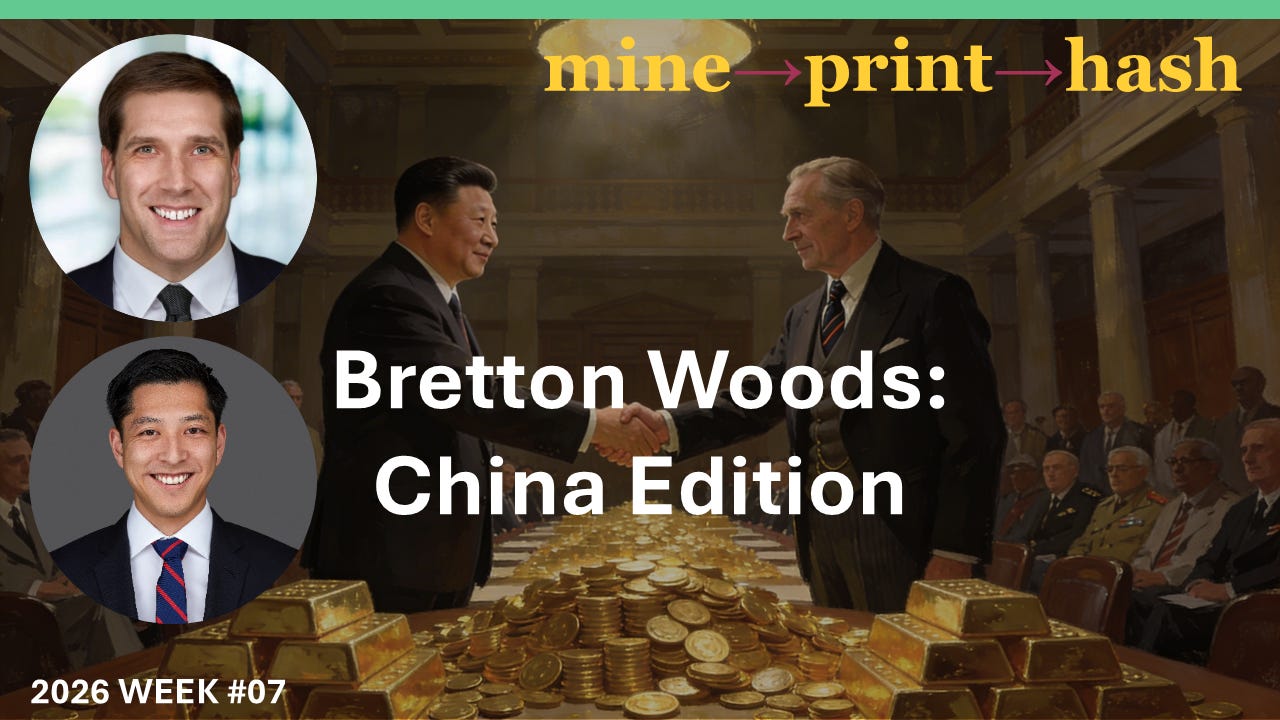 Bretton Woods: China Edition | TL;DR: China bids for reserve currency status, the U.S. builds a new dollar architecture, and everyone is still finding their dance partners.📄 SummaryBretton Woods Redux: China’s Gold-Backed Reserve Currency BidXi Jinping called internationally for the Chinese RMB/Yuan to attain global reserve currency status. Matt Dines frames this as a copy-paste of the post-WWII Bretton Woods system, where the U.S. dollar sat at the center, redeemable into gold -- except now China is being asked to fill that role. Critically, it is gold, not the euro or yuan, eating into the dollar’s reserve market share since the mid-2010s (5:00-7:00). Gold inventories on the Shanghai Futures Exchange are ramping up, consistent with backing a new gold-linked yuan system. Visits from Mark Carney, Keir Starmer, and Gavin Newsom to Beijing signal the “old school globalist coalition” courting China into this central role (11:40-12:10). Matt argues this path would require China to let the yuan appreciate, undermining its export-driven growth engine -- “a defining decision” for the rest of the 21st century (19:00-30:00). Chinese regulators urging banks to reduce U.S. Treasury exposure is consistent with this revaluation thesis, not panic selling (16:30-18:10). For the shift to work, Chinese domestic consumption would need to rise dramatically, reversing over a century of export-led growth (31:20-34:30).Russia’s Shifting LoyaltiesJust weeks after headlines about Russia gearing up to issue Yuan-denominated bonds (Nov 2025), a Kremlin memo surfaced pitching a return to the dollar system and outreach to the Trump administration. Matt likens the current geopolitical positioning to a “debutante ball” where nations are still choosing dance partners: “Don’t assume that all the partnerships are set until it’s all said and done” (22:00-24:40). The Russia-China “partnership without limits” may not be as locked in as it appeared.The New Dollar System: H.R. 3390 and the Discount WindowThe U.S. is not sitting idle -- it is building its own new dollar architecture. H.R. 3390, pushed by the American Bankers Association, would require the Fed to modernize its discount window from a slow, stigmatized, phone-call-based process into a real-time, API-driven, tokenized collateral system. Matt notes the discount window failed to function as lender of last resort in both 2008 and March 2023, when Silicon Valley Bank’s run played out in hours (35:00-42:00). This modernization dovetails with the Genius Act, stablecoins, and SOFR -- all pieces of an emergent domestic dollar framework distinct from the old offshore Bretton Woods dollar.CME’s Tokenized Cash Coin and Commodity SettlementOn its earnings call, CME Group announced development of a tokenized cash coin with Google for crypto collateral. Matt sees this as the commodities settlement venue migrating from London and Switzerland to Chicago and New York, onto new digital rails. He notes this is a “Rube Goldberg” approach when Bitcoin already exists as a peer-to-peer cash settlement system that solves the Byzantine Generals problem, but acknowledges the migration will be a multi-step process (47:00-50:30).Sovereignist Movement and Japan’s SupermajorityTakaichi’s LDP won a two-thirds supermajority in Japan’s elections, enabling potential constitutional reform. Matt places this alongside the U.S., Argentina, and upcoming elections in Brazil and Colombia as part of a growing sovereignist bloc aligned with a new dollar trading system (43:20-44:50).AI Deflationary Scare and Google’s 100-Year BondAlphabet issued a massive multi-currency bond (USD, GBP, CHF) for AI buildout. The GBP tranche included a 100-year bond -- demand for ultra-long duration signals deflationary panic. Matt highlights the sentiment flip: in 2023-2024, mentioning AI in a press release was bullish; in early 2026, “you put AI in a headline next to a stock’s name -- sell” (53:00-59:00). The SaaS software sector (IGV) is getting crushed as markets price in AI-driven disruption as deflationary.🔑 Key Takeaways* Gold is the real competitor to the dollar in international reserves, not the yuan or euro.* China accepting reserve currency status would require yuan appreciation and a historic shift toward domestic consumption.* Russia’s geopolitical alignment remains fluid -- do not assume partnerships are final.* H.R. 3390 and CME’s tokenized cash coin are milestones in a new U.S. dollar architecture built on modern settlement rails.* Bitcoin remains the ultimate peer-to-peer settlement solution, though the migration path will be messy.* The AI narrative has flipped from euphoria to deflationary fear, driving demand for ultra-long duration bonds.📱 Social Media* Mine, Print, Hash: https://x.com/MinePrintHash* Matt Dines: https://x.com/LeveredUSTs* Cameron Otsuka: https://x.com/CameronOtsuka🔗 Links* 🎧 Subscribe to Mine, Print, Hash: https://api.substack.com/feed/podcast/3184485.rss* 🌎 Build Asset Management: https://getbuilding.com* ⚓ Build Bond Innovation ETF: https://bfix.fund* 📈 Build Secured Income Fund I: https://buildbitcoin.com This is a public episode. If you would like to discuss this with other subscribers or get access to bonus episodes, visit www.mineprinthash.com | 1h 00m 15s | ||||||
| 2/5/26 | 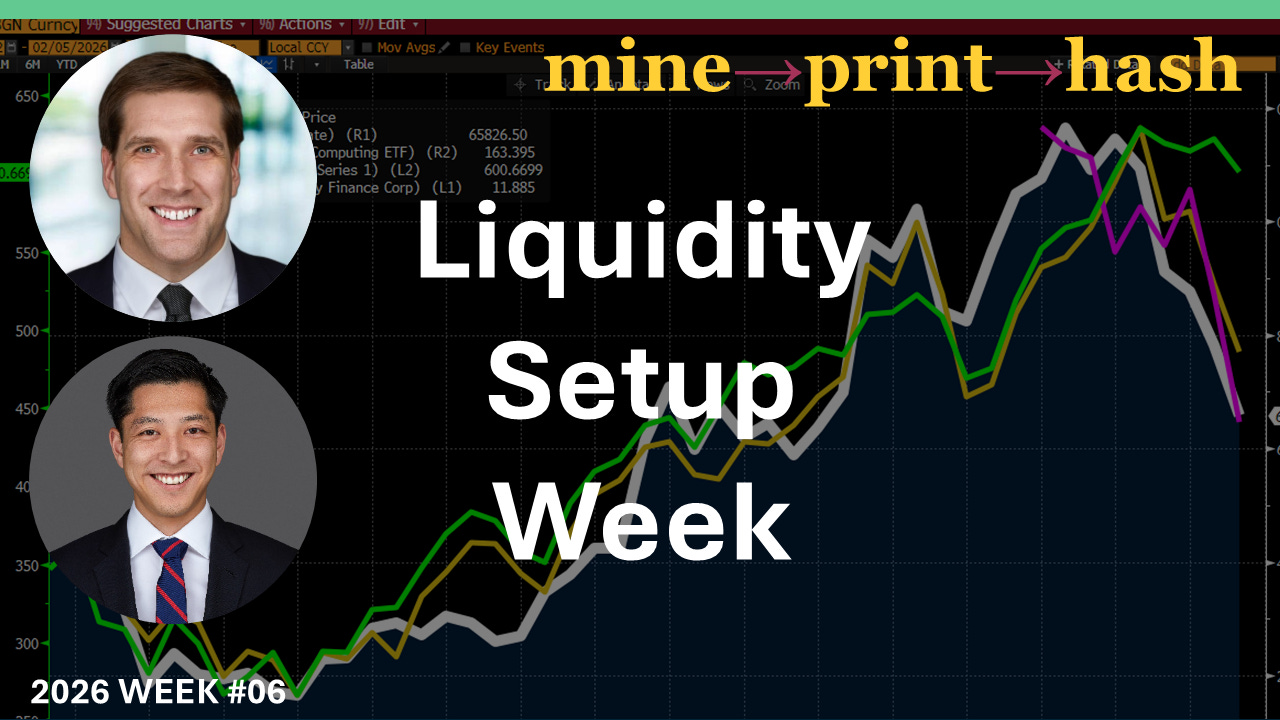 Liquidity Setup Week | TL;DR: Liquidity setup week. US industrials bull market confirmed, Japan elections loom, and Bitcoin takes the pain.📄 SummaryUS ISM Manufacturing: Bull Market ConfirmedThe US ISM Manufacturing PMI printed at 52.6, a major beat versus the 48.5 consensus expectation. Matt Dines calls out that the consensus “tends to herd with each other and get these signals wrong” at inflection points (3:28). This expansionary reading confirms the Dow Theory breakout MindPrint Hash flagged weeks ago between industrial equities (XLI) and the Dow Jones Transportation Index. The signal: the US goods-producing economy is in a bull market, echoing Treasury Secretary Bessent’s stated objective to “grow our way out of this” and “run it hot” (4:17).Fed H.8 Report: Early Innings of Re-IndustrializationBank lending data through January 21 shows an uptick in commercial and industrial (C&I) lending, with annualized rate of change moving positive. Matt stresses this is “first, second inning of this thing playing out” and “nowhere near overheated” relative to 2023-2024 plateaus or the March 2020 CARES Act surge (12:27). Deposits show a seasonal downtick typical of January, and banks are tapping debt markets post-earnings blackout for funding. Key watchpoint: cash reserves, as the Fed monitors whether banks have ample reserves to settle transactions in an above-trend growth economy (14:31). Sectors with structural tailwinds in this environment, US industrials and small caps, have been outperforming in the current pullback (11:23).Japan Snap Elections: The Yen Carry Trade’s Last ChapterSunday’s Japanese general elections are the geopolitical headline of the week. PM Takaichi’s LDP currently holds 198 seats and is looking to consolidate power. Key thresholds: 233 (simple majority), 243 (stable majority), 261 (absolute majority, the target), and 310 (two-thirds supermajority). Goldman expects LDP to pick up roughly 65 seats to reach 263, which would allow passage of initiatives without opposition cooperation (21:47). The bigger picture: Japanese banking, the BOJ, and the political regime are all aligned to address inflation, which means JGB yields will keep rising. Matt states bluntly that the yen carry trade, the second-largest global liquidity pool, is “not long for this world” (16:03). Combined with the offshore dollar system already being dismantled via SOFR and LIBOR deprecation, the only remaining option for economies dependent on cross-border financing is to mark up gold, explaining the secular bull market in precious metals (18:07).Bitcoin and SaaS Sell-Off: Liquidity Tip of the SpearBitcoin’s crash from around 124K to 65-66K is painful but, in Matt’s view, cyclical rather than fundamental. BTC trades at roughly a 1.5 beta to the cloud computing/SaaS sector (SKYY), and the hoped-for NASDAQ decoupling “has not happened yet” (26:36). The sell-off reflects a global liquidity suck: offshore dollar gone, yen carry trade unwinding, US re-industrialization absorbing capital, and margin calls forcing portfolio liquidation. Matt notes that despite the carnage, private business engagements he is seeing suggest major credit firms still view continued Bitcoin ascent as “where the puck is going” (29:40). On the SaaS narrative, Cameron Otsuka pushes back on headlines blaming Claude’s Cowork release for the SaaSpocalypse, noting “there is zero way that Claude Cowork release is what caused all of this” and the actual driver is the liquidity and macro trend Matt has outlined (31:13).🔑 Key TakeawaysUS manufacturing PMI at 52.6 confirms industrial bull market; lean into US industrials and small caps as structural outperformers.Bank C&I lending is inflecting positive but remains early innings; watch cash reserves as the Fed’s key constraint.Japan elections Sunday: 261+ LDP seats would be a strong result, accelerating the end of the yen carry trade and supporting the gold bull thesis.Global liquidity is contracting as two major funding sources (offshore dollar, yen carry) are being shut down; gold is the last accommodation tool.Bitcoin sell-off is liquidity-driven and cyclical, not a fundamental breakdown; ride it out.SaaS/cloud destruction narrative is overstated; the real story is the macro liquidity regime, not AI product launches.📱 Social MediaMine, Print, Hash: https://x.com/MinePrintHashMatt Dines: https://x.com/LeveredUSTsCameron Otsuka: https://x.com/CameronOtsuka🔗 Links🎧 Subscribe to Mine, Print, Hash: https://api.substack.com/feed/podcast/3184485.rss🌎 Build Asset Management: https://getbuilding.com⚓ Build Bond Innovation ETF: https://bfix.fund📈 Build Secured Income Fund I: https://buildbitcoin.com This is a public episode. If you would like to discuss this with other subscribers or get access to bonus episodes, visit www.mineprinthash.com | 33m 05s | ||||||
| 1/30/26 |  The Bermuda Triangle: Japanese Life Insurers, US Private Credit & Indonesia's Money Center | TL;DR: Kevin Warsh nominated for Fed Chair, Japanese life insurers signal stress, Bessent calls for "Bountiful 2026."📄 SUMMARYKevin Warsh Nominated for Fed ChairMatt Dines analyzes the nomination through the lens of Walter Bagehot's "Lombard Street" framework for central bank governance. Warsh fits the ideal profile: younger (forward-looking 20-year time horizon), prior Fed experience (2006-2011 Board of Governors), not actively involved in banking but has the network, and maintains a low-risk personal capital approach.- "Managing the cash reserve of the country is as precious a deposit as any set of men can have the care of" (2:30)- Kevin Hassett served as a decoy to shield Warsh from politicization until the May deadline compressed the confirmation timeline (6:30)- Matt critiques prior Fed chairs: Greenspan became a "little monarch" (40-year tenure, Time Magazine worship), while Bernanke represents the "vain and shallow person in authority" who "may do infinite evil in no long time" per Bagehot's warning (12:00)Japanese Life Insurance Crisis and the "Bermuda Triangle"The 40-basis point two-day selloff in Japanese 40-year JGBs (January 20th) was a "six sigma event" per Scott Bessent at Davos. The root cause is forced selling from Japanese life insurers whose annuity products promising 1-2% yields are now uncompetitive as short-term rates approach 1%.- For every 100 bips increase in JGB yields, surrender rates rise 25 basis points, accelerating forced selling (40:30)- Duration mismatch flipped from +4-5 (favoring insurers in falling rate environment) to -1.5, eating into equity capital (41:30)- The "Bermuda Triangle" connects Japanese life insurers to US private credit (Apollo/Athene, KKR) and offshore reinsurance markets - watch these linkages as stress develops (43:30-47:00)- Japan may need a BTFP-style facility for regional banks (shinkin banks) and insurers to prevent forced selling (47:30)Bessent's "Bountiful 2026" - Non-Inflationary GrowthTreasury Secretary Scott Bessent is pitching a non-inflationary economic boom. He means CPI-measured price stability, not zero monetary inflation - he expects credit expansion backed by real productivity and productive investment rather than malinvestment.- Dow Theory signals intact: US industrials breaking out with transportation sector joining despite volatility (52:00)- Core policy thesis: revitalizing Main Street, re-industrializing America, providing real economic growth (54:30)Dollar Outlook and Potential False BreakdownThe DXY broke below its post-2008 bullish channel this week against the euro. Some analysts are calling this a potential "false move" that could reverse if the euro experiences structural weakness. A euro breakdown would represent a different dynamic than the coordinated dollar weakness and gold markup driven by Bessent and major banks (54:30).🔑 KEY TAKEAWAYS- Kevin Warsh represents a generational shift in Fed leadership philosophy - younger, more aligned with Bagehot's principles than the Greenspan-Bernanke-Yellen era.- Watch the "Bermuda Triangle" (Japan life insurers + US private credit + offshore reinsurance) for contagion risk through Q1 2026.- End of quarter (March) could see liquidity stress develop into a volatility event.- US plus Japan coordination may be enough to navigate the Japanese financial system repricing, but expect turbulence.- Dollar structural weakness continues, but monitor for false breakout if euro fundamentally weakens.- 2026 shaping up as a major year for monetary history - buckle up.📱 SOCIAL MEDIA- Mine, Print, Hash: https://x.com/MinePrintHash- Matt Dines: https://x.com/LeveredUSTs- Cameron Otsuka: https://x.com/CameronOtsuka🔗 LINKS- 🎧 Subscribe to Mine, Print, Hash: https://open.spotify.com/show/7bvfjkPjQ67Eugg8EYdoe5- 🌎 Build Asset Management: https://getbuilding.com- ⚓ Build Bond Innovation ETF: https://bfix.fund- 📈 Build Secured Income Fund I: https://buildbitcoin.com This is a public episode. If you would like to discuss this with other subscribers or get access to bonus episodes, visit www.mineprinthash.com | 59m 49s | ||||||
| 1/23/26 |  Davos 2026: Sovereigntists vs. Globalists and Geopolitical Power Shifts | TL;DR: Fed under fire, Greenland geopolitics intensify, and Iran's currency collapse signals a new era.📄 SUMMARYDavos 2026: A "Wake-Up Call" for Western InstitutionsMatt Dines and Cameron Otsuka analyze the World Economic Forum meeting in Davos, noting a starkly different tone from previous years. Christine Lagarde appeared visibly flustered in her CNN interview, calling the moment "a wake-up call, a bigger one than we ever had" and announcing Europe would do a "SWAT analysis" and develop a "Plan B" to become more independent (3:00). The hosts argue this represents the final attempt to build consensus around post-WWII institutional frameworks that have been propagating since the late 90s - "those days are over in my opinion" (16:20).Two Competing Power Factions EmergeThe hosts outline two distinct geopolitical camps. The sovereigntist faction includes the Trump coalition, Japan's Takaichi government, Taiwan, and the semiconductor industry including TSM, Jensen Huang (Nvidia), and Lisa Su (AMD) - all aligned around national sovereignty and industrial capacity. The opposing faction includes Christine Lagarde, Ursula von der Leyen, Gavin Newsom, Mark Carney, and CCP-aligned interests pushing for preserved institutional structures and business integration with China.Taiwan Semiconductor Investment Signals AlignmentTSMC announced major commitments to U.S. manufacturing: $250 billion in credit guarantees for Arizona facilities plus another $250 billion investment from Taiwan capital committed to onshore supply chain buildout (23:30). Matt notes the Arizona fabs have already produced first 2-nanometer chips, demonstrating progress on capabilities. The semiconductor industry leadership being Taiwanese by descent - Jensen Huang and Lisa Su have family ties to the island - reinforces their alignment with the sovereigntist faction.Japan's Political RealignmentFollowing Trump's election, Japan announced snap elections under Takaichi (25:00). The LDP flipped coalition partners from Kometo - which Matt describes as aligned with CCP appeasement and "don't rock the boat" policies - to the Japan Innovation Party. This represents a meaningful shift in Japanese foreign policy orientation away from China accommodation.The Greenland Framework and Board of PeaceGreenland emerges as a key battleground, with the Trump administration pushing territorial expansion while Gavin Newsom "frustratedly calling for whoever he can elicit some response from" (34:50). The hosts connect this to the broader "Board of Peace" framework attempting to resolve the Gaza situation outside traditional UN structures - a routing of post-war legacy institutions (49:15).🔑 KEY TAKEAWAYS- Davos 2026 represents a pivot point where Western institutional leadership publicly acknowledged loss of control, pivoting to "Plan B" defensive positioning.- The Trump administration's deep bench at Davos signaled this movement has 10-15 years of momentum and will not dissipate when Trump leaves office.- Semiconductor industry alignment with the sovereigntist faction - evidenced by TSMC's massive U.S. investment - follows real results over unproven clean tech promises.- Japan's coalition realignment from CCP-friendly Kometo to Japan Innovation Party represents meaningful geopolitical repositioning.- Xi Jinping's cards may not be as strong as presumed given the internal purges and external alliance shifts.- Midterms and 2028 remain critical events; this is "Game 3" not the series finale.📱 SOCIAL MEDIA- Mine, Print, Hash: https://x.com/MinePrintHash- Matt Dines: https://x.com/LeveredUSTs- Cameron Otsuka: https://x.com/CameronOtsuka🔗 LINKS- 🎧 Subscribe to Mine, Print, Hash: https://open.spotify.com/show/7bvfjkPjQ67Eugg8EYdoe5- 🌎 Build Asset Management: https://getbuilding.com- ⚓ Build Bond Innovation ETF: https://bfix.fund- 📈 Build Secured Income Fund I: https://buildbitcoin.com This is a public episode. If you would like to discuss this with other subscribers or get access to bonus episodes, visit www.mineprinthash.com | 53m 09s | ||||||
| 1/16/26 |  Iran Goes Weimar, DOJ vs. Powell & Arctic Standoff: The Monetary War Escalates | TL;DR: Fed under fire, Greenland geopolitics intensify, and Iran's currency collapse signals a new era.📄 SUMMARYFed in Check: DOJ Subpoena and Criminal ThreatThe Trump administration escalated its pressure on the Federal Reserve with a DOJ subpoena and criminal indictment threat against Fed Chair Jerome Powell. Matt Dines frames this as the Fed being pulled from the sidelines onto the battlefield in a broader conflict between legacy institutions and disruptive forces.- Powell responded publicly, claiming the threat stems from his refusal to force rates down (2:02).- Matt notes this represents the Fed's legacy structure from the FDR era now being directly challenged: "The Fed has been pulled in as an institution to that side on the kind of incumbencies who are being challenged by the disruptive wave" (6:14).- The Genius Act and stable coins present Treasury with a viable alternative to the Fed's monopoly on currency, creating competing monetary architectures (8:30).Greenland at a Crossroads: Geopolitical Stakes RiseGreenland's strategic value encompasses military positioning (access to the Arctic, proximity to Russia/China), emerging Arctic shipping routes, and massive mineral deposits (rare earths, uranium, zinc, iron ore).- Denmark's claim dates back 700-800 years to the pre-Columbus Kalmar Union era (16:00).- France and Germany sent reconnaissance troops to Greenland on January 15th, signaling EU resistance to US acquisition (25:17).- Matt ranks inhibitors to US success: unified EU response is the biggest obstacle, while Danish military action or international condemnation carry little weight (25:58).- The US-EU relationship is now at a knife's edge point in the broader monetary and geopolitical transition.Iran: Currency CollapseThe Iranian rial's dollar peg collapsed completely this week, resulting in what Matt describes as a "true Weimar-style inflationary outcome" for the Iranian people.- The June 2025 bunker buster strikes on Fordow and other nuclear facilities removed the pretext for intervention, but the monetary attack may have been equally strategic (36:08).- Iran's largest crypto exchange, Nobitex, was hacked in late June, draining approximately $90 million. Matt views this as part of the same coordinated operation: "Start thinking about the attack on the monetary infrastructure" (38:38).- Bitcoin and stablecoin adoption are deeply rooted in Iran, serving as "the life raft of last resort" for populations facing monetary instability (47:30).- The 1979 revolution era is "coming to its own logical conclusion" as Iran enters a new era. At its core, this is "a printing and hashing story as well as a humanitarian crisis" (58:00).🔑 KEY TAKEAWAYS- The Fed's legacy monetary structure is now directly in conflict with Treasury-backed stable coins and Bitcoin alternatives.- Greenland acquisition faces primary resistance from unified EU response. Denmark cannot compete militarily with US interests.- Iran's currency collapse demonstrates how monetary warfare and cyber operations are displacing traditional kinetic intervention.- Bitcoin and stablecoin adoption accelerate in regions with monetary instability, benefiting US Treasury interests even abroad.- The interconnected themes of Fed conflict, Greenland geopolitics, and Iran collapse all trace back to the mine-print-hash framework: mining (resources/minerals), printing (monetary policy/currency), and hashing (crypto/digital alternatives).- 2026 continues to be a pivotal year for monetary architecture transitions globally.📱 SOCIAL MEDIA- Mine, Print, Hash: https://x.com/MinePrintHash- Matt Dines: https://x.com/LeveredUSTs- Cameron Otsuka: https://x.com/CameronOtsuka🔗 LINKS- 🎧 Subscribe to Mine, Print, Hash: https://open.spotify.com/show/7bvfjkPjQ67Eugg8EYdoe5- 🌎 Build Asset Management: https://getbuilding.com- ⚓ Build Bond Innovation ETF: https://bfix.fund- 📈 Build Secured Income Fund I: https://buildbitcoin.com This is a public episode. If you would like to discuss this with other subscribers or get access to bonus episodes, visit www.mineprinthash.com | 59m 45s | ||||||
| 1/8/26 |  Venezuela, Dow Theory, and Western Hemisphere Integration | TL;DR: Western Hemisphere economic integration is underway - Venezuela, Dow Theory, and what to watch in 2026.📄 SUMMARYVenezuela: The Climax of Phase OneThe U.S. extraction of Maduro represents a major geopolitical shift. Matt characterizes it as flawless execution reflecting months of preparation. Key observations:- Cyber capabilities: The U.S. cut power to Caracas and exploited BGP inconsistencies, with reports that Chinese defense systems failed to respond (6:00-8:30).- Not regime change per se, but integration of Venezuela into the Western Hemisphere economic orbit, similar to the Argentina currency swap in October 2025 (9:30-13:00).- The Caracas Stock Exchange surged roughly 40% as capital fled the bolivar seeking assets to preserve purchasing power (15:00-17:30).- Trump announced Venezuela will export approximately $2.8B in oil to Gulf Coast refineries and must purchase only American-made goods (19:00-22:00).- Expect stablecoins under the Genius Act framework to facilitate these trade flows, bypassing European offshore dollar banks. Watch Tether ($190B) and Circle/USDC ($75B) market caps for confirmation (23:00-28:00).Dow Theory: Confirming the US Goods Economy Bull MarketDespite doom scrolling, economic data tells a different story. US third quarter productivity rose at its fastest pace in two years.- XLI (Industrials ETF) broke out in 2024 after three years of consolidation and is now hitting all-time highs post-Liberation Day. Members include GE Vernova, Caterpillar, Raytheon, and Lockheed Martin (36:00-42:00).- Transportation index is following through with its own breakout, confirming the industrials move. According to Dow Theory, when both industrials and transports show bullish trends simultaneously, it signals a genuine goods economy bull market (42:00-48:00).- The US trade gap has shrunk to GFC levels on tariff effects, shifting production from rest-of-world to the Western Hemisphere (34:00-36:00).Things to Watch- Supreme Court tariff ruling could come Friday. Polymarket shows a 24% chance the court rules in Trump's favor on IEEPA authority. Three hard nos (Sotomayor, Kagan, Brown Jackson), three hard yeses (Alito, Kavanaugh, Thomas), and three swing votes (Roberts, Gorsuch, Barrett) will decide (49:00-56:00).- Housing policy: Trump announced a ban on institutional investors purchasing US housing stock - highly popular with younger voters ahead of midterms (52:00-53:00).- French debt yields: Watch the ascending triangle pattern testing 3.5%. A breakout higher signals the ECB is losing its ability to defend French sovereign debt, with broader implications for the EU under Christine Lagarde's leadership (58:00-62:00).🔑 KEY TAKEAWAYS- Venezuela integration signals Western Hemisphere economic consolidation is accelerating. Watch stablecoin market caps and commodity trading house activity.- Dow Theory confirms US goods economy bull market: both industrials and transports breaking out post-Liberation Day.- Supreme Court ruling on tariffs Friday could create short-term volatility but won't change the long-term direction.- French debt yields near breakout could signal EU financial stress.- This is a dollar story: tariffs, stablecoins, and Western Hemisphere integration all point to onshore dollar dominance.📱 SOCIAL MEDIA- Mine, Print, Hash: https://x.com/MinePrintHash- Matt Dines: https://x.com/LeveredUSTs- Cameron Otsuka: https://x.com/CameronOtsuka🔗 LINKS- 🎧 Subscribe to Mine, Print, Hash: https://open.spotify.com/show/7bvfjkPjQ67Eugg8EYdoe5- 🌎 Build Asset Management: https://getbuilding.com- ⚓ Build Bond Innovation ETF: https://bfix.fund- 📈 Build Secured Income Fund I: https://buildbitcoin.com This is a public episode. If you would like to discuss this with other subscribers or get access to bonus episodes, visit www.mineprinthash.com | 1h 04m 02s | ||||||
| 12/24/25 |  BITCOIN AND THE INNOVATOR'S DILEMMA - BUILD WEEKLY ROUNDUP - 2025 WEEK #52 | TL;DR: Bitcoin collateral pilot, innovator's dilemma, and digital sovereignty tensions.📄 SUMMARYBitcoin vs. Metals: Reality Check for the CommunityMatt Dines and Cameron Otsuka open by addressing the disconnect between Bitcoin community expectations and market reality. While metals have been breaking out, Bitcoin has had a flat to down year, leading to low sentiment.- The breakage of metals pricing mechanisms was one of the most important financial developments of 2025 (3:28)- Weak assumptions like four-year cycles and rainbow charts need to be abandoned in favor of understanding what is "structurally intact" in Bitcoin's core value proposition (7:00)CFTC Crypto Collateral Pilot: A Foundational ShiftThe primary focus of the episode is the December 8th CFTC announcement allowing BTC, ETH, and USDC as collateral in derivatives markets through a pilot program. Matt frames this through the Innovator's Dilemma lens.- FCMs (Futures Commission Merchants) can now use these digital assets for margin in futures contracts (17:08)- Matt emphasizes the US is making "the foundationally correct move" by focusing on crypto-native assets like Bitcoin itself, while UK pursues RWAs and the EU pushes the digital euro, which Matt calls "vaporware specs out of desperation" (31:23)- The US dominates interest rate derivatives with $366 trillion notional, dwarfing the UK ($172T) and EU ($76T) combined (39:16)- Bitcoin is "working its way up the stack" from serving early adopters to now approaching international trade settlement, the highest-end market (51:31)EU vs. US Digital Sovereignty TensionsThe third topic addresses growing friction between the US and EU over platform speech and regulatory overreach.- Matt views this as former "roommates" moving apart, with the US retaliating against EU fines on US tech companies and extraterritorial regulation (57:43)- The US national security document released recently prioritizes the Western Hemisphere first, signaling a new arrangement for international trade (59:07)- This digital sovereignty confrontation represents a significant event in the evolving multipolar world order (59:49)🔑 KEY TAKEAWAYS- The CFTC pilot program signals the US is building its financial infrastructure on Bitcoin, a strategic advantage over UK/EU approaches focusing on tokenized assets or CBDCs.- Bitcoin investors should revisit assumptions based on pattern recognition (four-year cycles) and focus on structural fundamentals as the asset matures toward institutional settlement use cases.- Watch for Bitcoin adoption in international commodity trade settlement as the disruptive technology works its way to serving the highest-end customers.- US-EU relations are fracturing across financial and digital domains, expect continued divergence in regulatory approaches and potential trade realignment.- Key figures to follow: Paul Tudor Jones, Scott Bessent, and the commodity trading house ecosystem where highest-signal Bitcoiners operate.🔗 LINKS- 🎧 Subscribe to the Build Weekly Roundup: https://open.spotify.com/show/7bvfjkPjQ67Eugg8EYdoe5- 🌎 Build Asset Management: https://getbuilding.com- ⚓ Build Bond Innovation ETF: https://bfix.fund- 📈 Build Secured Income Fund I: https://buildbitcoin.com📱 SOCIAL MEDIA- Build Asset Management: https://twitter.com/BuildMarkets- Matt Dines: https://twitter.com/LeveredUSTs- Cameron Otsuka: https://twitter.com/CameronOtsuka- Dave Martin: https://twitter.com/DaveMSocial This is a public episode. If you would like to discuss this with other subscribers or get access to bonus episodes, visit www.mineprinthash.com | 1h 00m 50s | ||||||
| 12/19/25 |  GLOBAL SOVEREIGN DEBT SURVEY - BUILD WEEKLY ROUNDUP - 2025 WEEK #51 | TL;DR: Global funding conditions favor US dollar markets as capital migrates from Europe and Japan. The BOJ is the next central bank to watch. The Trump Media/TAE Technologies fusion merger raises significant skepticism.📄 SUMMARYGlobal Sovereign Debt SurveyMatt Dines walks through a year-end review of global sovereign bond markets, highlighting a key divergence. US dollar-denominated rates are trending down across the US and Latin America (Brazil, Argentina, Mexico), while euro-denominated and yen-denominated rates are trending up.- The divergence reflects capital migrating from offshore markets (primarily Europe) into the Western Hemisphere and US domestic markets through New York (4:30).- France and Germany are both at 52-week highs in yields, with French OATs up 51 bps and German Bunds up 60 bps year-over-year (6:00).- Despite popular perception, the core trend in US Treasury yields since the new administration took office has been down, not up. Matt notes that "most people... would say rates are blowing out... not realizing that the core trend since this new administration took office has been down in yields" (11:30).- The US Treasury will focus on using bills at the front end to finance itself, suggesting a steepening yield curve with front end coming down while long end remains supported. Matt sees "green light for expansion of credit in the domestic United States" heading into early 2026 (14:00).- French sovereign debt has tested resistance five times this year with increasing cadence, suggesting "a market that wants to actually break out and move higher" in yields (20:30).- Japan's 10-year debt chart looks "much more concerning" than the US from a portfolio manager perspective (21:30).- A squeeze in global funding markets could emerge from Japanese yen and JGB dynamics combined with Eurozone pressures (36:00).Trump Media + TAE Technologies Fusion MergerA surprising announcement: Trump Media Group (DJT) is merging with TAE Technologies, a nuclear fusion company, in a 50/50 share deal with Deon Nunes as co-CEO.- TAE has received $1.3 billion from notable investors including Google/Alphabet and Chevron, but remains "not even close to commercial viability" with timelines suggesting 2030-2035 for commercialization (44:30).- The deal raises only $300 million in capital, which Matt calls "a drop in the bucket" for building a commercial nuclear facility (52:00).- Matt draws parallels to the South Sea Company bubble of 1720, warning this looks like a "liquidity scheme" targeting retail investors through meme stock dynamics (53:00).- Devin Nunes has a background in agriculture and farming with "no nuclear degrees" to lead a cutting-edge fusion company (43:30).🔑 KEY TAKEAWAYS- Global capital is migrating from Europe and Japan into US dollar markets, driving down dollar-denominated yields while euro-denominated yields rise.- US Treasury market has room for support to step in despite volatility; the secular trend under the current administration has been down in yields.- Watch the BOJ closely as they have the "possession arrow" in terms of who moves next in monetary policy.- The DJT-TAE merger warrants significant skepticism; $300M is nowhere near sufficient for a commercial fusion facility, and timelines appear unrealistic.- The combined dynamics of US funding conditions point toward credit expansion domestically, not doom and gloom, for early 2026.🔗 LINKS- 🎧 Subscribe to the Build Weekly Roundup: https://open.spotify.com/show/7bvfjkPjQ67Eugg8EYdoe5- 🌎 Build Asset Management: https://getbuilding.com- ⚓ Build Bond Innovation ETF: https://bfix.fund- 📈 Build Secured Income Fund I: https://buildbitcoin.com📱 SOCIAL MEDIA- Build Asset Management: https://twitter.com/BuildMarkets- Matt Dines: https://twitter.com/LeveredUSTs- Cameron Otsuka: https://twitter.com/CameronOtsuka- Dave Martin: https://twitter.com/DaveMSocial This is a public episode. If you would like to discuss this with other subscribers or get access to bonus episodes, visit www.mineprinthash.com | 1h 01m 45s | ||||||
| 12/12/25 |  TRADE ROUTE CONTROL - BUILD WEEKLY ROUNDUP - 2025 WEEK #50 | TL;DR: Trade route control and naval power are the key differentiators in a fracturing world order.📄 SUMMARYFed Reserve Management Purchases (RMP)Matt Dines explains the Fed's newly announced Reserve Management Purchases program starting December 12th, which involves $60 billion in monthly T-bill purchases similar to 2019's repo market intervention. This effectively ends QT and begins balance sheet expansion at the short end of the yield curve.- The program brings down discount rates on bills, working out the last bit of inversion in the yield curve (2:00-3:30).- With the fed funds rate now at 3.5-3.75%, a positively sloped yield curve incentivizes banks to borrow short and lend long, enabling credit expansion: "from here on out, we're looking for credit expansion to pull the plane up" (9:00-9:30).Russian Oil: Lukoil Divestiture SagaOFAC mandated Lukoil sell approximately $22 billion in international oil assets with a deadline extended to January 17th. Xtellus Capital Partners has emerged as the preferred bidder with a cashless asset swap proposal.- Xtellus is a New York-based broker dealer with historical ties to Russian entity VTB, now severed, positioning them as a middleman for cross-border capital transactions (20:00-21:30).- The deal structure works around sanctions since the transaction cannot operate through the US dollar financial system (22:00-22:30).Venezuela and Trade Route ControlThe US Navy commandeered a Venezuelan oil tanker, signaling the importance of naval power over physical possession of resources. Matt draws a historical parallel to Napoleon's defeat.- Napoleon's quote: "If it had not been for you English I would have been emperor of the east...but wherever there is water to float a ship, we are sure to find you in our way" (34:00-34:30).- Matt emphasizes: "if you don't have control of the shipping lanes, it's basically impossible to win this game" (35:30-36:00).- This connects to broader commodity flows and their value as collateral in fiat-based credit systems during this era of monetary transition.JP Morgan Rising Cost OutlookJPM announced rising costs of approximately $105 billion (up from ~$101 billion), driven by technology and headcount expenses. They issued year-end bonuses to lower-level employees feeling inflation's pinch.- Matt references Warren Buffett's 1970s shareholder letters: "It is difficult for business and enterprise to basically preserve value in an environment where their denominated unit of activity for transacting in an economy is debasing" (46:50-47:15).- Jamie Dimon stated at a conference: "A weak Europe is a risk for the United States" - highlighting the interconnected nature of sovereign debt concerns and geopolitical risk (48:00-49:00).🔑 KEY TAKEAWAYS- The Fed's RMP signals a shift from QT to balance sheet expansion, creating conditions for credit expansion over the next 3-12 months as the yield curve normalizes.- Russian oil asset divestiture requires creative deal structures (cashless asset swaps) to navigate sanctions while preserving property rights perceptions.- Control of trade routes and naval power, not resource ownership, is the decisive competitive advantage in the fracturing world order.- Rising costs at major financial institutions like JPM reflect the broader challenge of operating in an inflationary environment with a debasing currency.- Europe's weakness presents systemic risk to the US as the unipolar world order fractures into regional spheres🔗 LINKS- 🎧 Subscribe to the Build Weekly Roundup: https://open.spotify.com/show/7bvfjkPjQ67Eugg8EYdoe5- 🌎 Build Asset Management: https://getbuilding.com- ⚓ Build Bond Innovation ETF: https://bfix.fund- 📈 Build Secured Income Fund I: https://buildbitcoin.com📱 SOCIAL MEDIA- Build Asset Management: https://twitter.com/BuildMarkets- Matt Dines: https://twitter.com/LeveredUSTs- Cameron Otsuka: https://twitter.com/CameronOtsuka- Dave Martin: https://twitter.com/DaveMSocial This is a public episode. If you would like to discuss this with other subscribers or get access to bonus episodes, visit www.mineprinthash.com | 50m 08s | ||||||
| 12/4/25 |  ECB URGES GOLD RETHINK - BUILD WEEKLY ROUNDUP - 2025 WEEK #49 | TL;DR: Supply squeezes, gold sovereignty, and softening jobs signal late-cycle stress.📄 SUMMARYThe RAM SqueezeCameron Otsuka and Matt Dines discuss Micron's decision to exit its consumer RAM business (Crucial brand) to focus on data center demand. Micron is the third-largest memory chip provider globally, behind Samsung and SK Hynix.- The AI capex buildout is described as the growth engine of the US economy: "We're betting it all on red here. AI is what we're going to go with" (5:09).- DDR5 memory prices have begun spiking since mid-September as data center demand bumps against supply capacity (6:30-6:50).- Matt Dines frames this as a broader late-cycle dynamic where resources get priced out in an "auction" until the marginal buyer gets squeezed: "The winner's curse... he wins the chips. But at that point all the resources price out" (9:55-10:01).- This resource squeeze is visible across multiple inputs: GPUs, memory, transformers, and labor. The hosts note these supply constraints will persist through the 2020s growth wave.Italy's Gold and ECB TensionsGiorgia Meloni's party is pushing to declare Italy's 2,500 tons of gold reserves as property of the Italian people, prompting ECB concern.- Italy's gold is split roughly 50/50 between Rome and the Federal Reserve Bank of New York. Critically, none is in Brussels or Frankfurt (34:10-35:15).- Matt explains that ECB holdings are tiny compared to member nations: "ECB's gold reserves are tiny in comparison" (36:00).- The gold rally reflects a shift in perception: "Power is tilting away from that centralized authority, the technocratic project in the EU, and more towards those own sovereign nation states" (36:42-36:51).- The hosts note this fits a broader European trend including Germany's upcoming pension vote and political fragmentation. Matt's takeaway: "Where is the gold stored? It's in Rome. It's in New York... that's the horse to bet on".US Jobs SofteningThe ADP employment survey for November showed a 32,000 job loss, with contraction across both goods-producing and services sectors since Liberation Day.- The Fed's focus has clearly shifted to full employment as the binding constraint for 2025 policy (42:28-42:30).- US workforce growth has dropped from 2% annually pre-COVID to approximately 1.2% post-COVID: "It's shrunk by something like 40%... that is significant" (50:46-50:52).- Job cuts are starting earlier than typical seasonal patterns: "They've already started even a little bit earlier, which is signaling... things might be a little softer than even we thought" (52:55-53:00).- Despite soft jobs data, inflationary pressures remain in industrial metals (silver, copper), suggesting continued purchasing power erosion ahead.🔑 KEY TAKEAWAYS- AI capex is creating supply squeezes across memory, GPUs, and labor that will define the 2020s growth cycle.- Italy's gold move signals broader European fragmentation away from ECB authority toward sovereign nation states.- US jobs are softening post-Liberation Day, shifting Fed focus firmly to employment over inflation.- Hard-backed reserve currencies and gold positioning matter more in this post-COVID debasement environment.- Watch for yield curve steepening and rate cuts to potentially re-engage credit creation and job growth.🔗 LINKS- 🎧 Subscribe to the Build Weekly Roundup: https://open.spotify.com/show/7bvfjkPjQ67Eugg8EYdoe5- 🌎 Build Asset Management: https://getbuilding.com- ⚓ Build Bond Innovation ETF: https://bfix.fund- 📈 Build Secured Income Fund I: https://buildbitcoin.com📱 SOCIAL MEDIA- Build Asset Management: https://twitter.com/BuildMarkets- Matt Dines: https://twitter.com/LeveredUSTs- Cameron Otsuka: https://twitter.com/CameronOtsuka- Dave Martin: https://twitter.com/DaveMSocial This is a public episode. If you would like to discuss this with other subscribers or get access to bonus episodes, visit www.mineprinthash.com | 54m 13s | ||||||
Showing 25 of 62
Sponsor Intelligence
Sign in to see which brands sponsor this podcast, their ad offers, and promo codes.
Chart Positions
3 placements across 2 markets.
Chart Positions
3 placements across 2 markets.