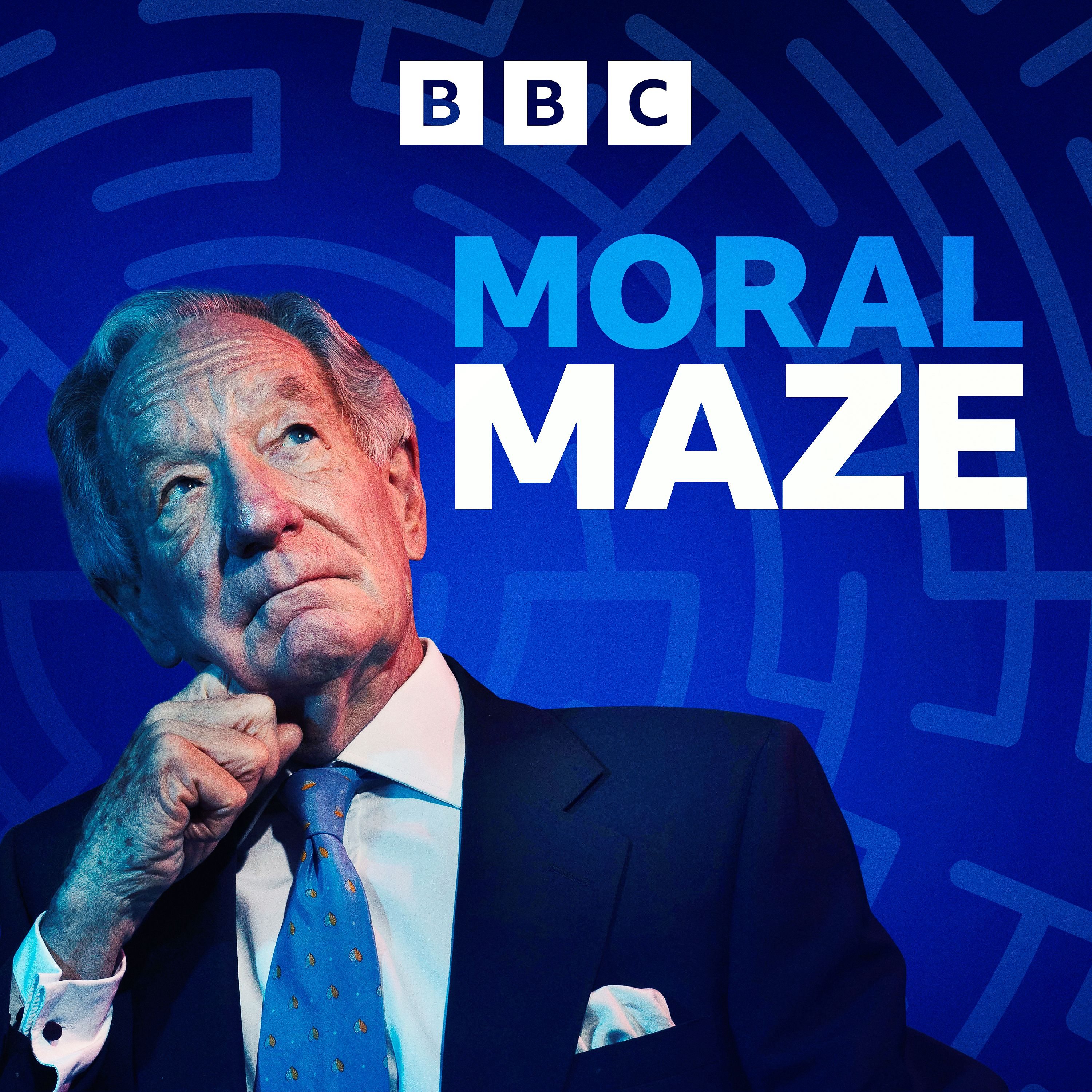
Moral Maze
by BBC Radio 4
Is this your podcast?On the show
From 16 epsHosts
Recent guests
Recent episodes
23/09/2026
Sep 24, 2026
56m 43s
16/09/2026
Sep 17, 2026
56m 48s
How should we respond to warnings of end times and catastrophe?
Sep 10, 2026
56m 41s
How should we respond to rising mental distress?
Sep 3, 2026
56m 51s
Data Centres: Whose Thirst Comes First?
Aug 27, 2026
56m 39s
Insights from recent episode analysis
Audience Interest
Podcast Focus
Publishing Consistency
Platform Reach
Insights are generated by CastFox AI using publicly available data, episode content, and proprietary models.
Most discussed topics
Brands & references
Total monthly reach
Blended from 1 signal.
Built from
By chart position
- 🇬🇧United Kingdom · Religion & SpiritualityHOME#219.6K to 60K
- 🇮🇪Ireland · Religion & Spirituality#42201 to 1.3K
- 🇮🇳India · Religion & Spirituality#176163 to 1.0K
- 🇯🇵Japan · Religion & Spirituality#134147 to 920
- 🇰🇷South Korea · Religion & Spirituality#132121 to 756
- Per-Episode Audience
Est. listeners per new episode within ~30 days
10K to 65K🎙 Daily cadence·278 episodes·Last published 3w ago - Monthly Reach
Unique listeners across all episodes (30 days)
35K to 217K🇬🇧92%🇮🇪2%🇮🇳2%+4 more - Active Followers
Loyal subscribers who consistently listen
14K to 87K
Market Insights
Platform Distribution
Reach across major podcast platforms, updated hourly
Total Followers
—
Total Plays
—
Total Reviews
—
* Data sourced directly from platform APIs and aggregated hourly across all major podcast directories.
Social Links & Contact
Official channels & resources
Official Website
Login
RSS Feed
Login
| Date | Episode | Topics | Guests | Brands | Places | Keywords | Sponsor | Length | |
|---|---|---|---|---|---|---|---|---|---|
| 9/24/26 | 23/09/2026 | Live debate examining the moral issues behind one of the week's news stories. #moralmaze | 56m 43s | ||||||
| 9/17/26 | 16/09/2026 | Live debate examining the moral issues behind one of the week's news stories. #moralmaze | 56m 48s | ||||||
| 9/10/26 | How should we respond to warnings of end times and catastrophe? | America’s Vice-President, J. D. Vance, has been talking about the end of the world, saying he “wouldn’t be shocked” if the Anti-Christ was walking amongst us.Most people are living incomparably better lives than generations ago - and history is full of warnings of apocalypse - so how should we respond to warnings of catastrophe and end times?Do such warnings encourage moral behaviour? Do they spur people to take action on important issues - or can they lead to despair and paralysis. Do thoughts of an end give life more meaning?Should we take threats to the way we live as a warning to look after our loved ones - or is it an opportunity to think more widely and work out how to strengthen our community ties. Which end of the political spectrum is more likely to resort to the language of doom-laden prophecy, and to what end?What does this increasingly apocalyptic view of the world tell us about the world we live in, the problems we face, and the society we’ve become?Witnesses: Leigh Price, Elizabeth Oldfield, Dr Ian Paul and Dr Daniel Nilsson DeHanas Presenter: Michael Buerk Panellists: Anne McElvoy, Matthew Taylor, Mona Siddiqui, Tim Stanley Producer: Catherine Murray Asst Producer: Jay Unger Editor Chloe Walker | 56m 41s | ||||||
| 9/3/26 | mental healthantidepressants+5 | — | NHS | England | mental distressantidepressants+7 | — | 56m 51s | ||
| 8/27/26 | AI data centresenvironmental impact+4 | Giles FraserMona Siddiqui+2 | BBC Radio 4AI+1 | — | data centresAI+5 | — | 56m 39s | ||
| 8/20/26 | Is empathy ever a weakness? | Reform's Robert Jenrick has described Britain’s welfare system as “suicidal empathy.” It’s also the title of a recent book by the Canadian marketing Professor Gad Saad, who argues that a misdirected sense of empathy can lead to favouring certain people over others – for example, the criminal over the victim. The idea has gained an admirer in Elon Musk who said that "the fundamental weakness of Western civilization is empathy". The claim is that unconditional compassion is not a strength but a soft spot to be exploited, clouding our moral judgements. Critics argue that empathy is the moral foundation of care for the most vulnerable in society and righteous anger against injustice. They see the language of “toxic” or “parasitic” empathy as laying the groundwork for inhuman treatment. Rousseau saw pity as the most natural of human virtues – an instinct which makes us not simply walk on by when we see someone suffering. Removing empathy, in other words, makes us both less human and less humane. Whether in the realm of welfare policy, immigration numbers or prison conditions, the philosophical argument is between those who say feeling for others is the foundation of morality, and those who believe empathy can be a moral liability.Chair: Michael Buerk Panel: Mona Siddiqui, Tim Stanley, Sonia Sodha and Ella Whelan. Witnesses: Matt Goodwin, Paul Sagar, Philippa Smethurst and Luke Bretherton. Producer: Dan Tierney Assistant producer: Peter Everett Editor: Chloe Walker | 56m 41s | ||||||
| 7/28/26 | networkssocial capital+4 | — | BBC Radio 4Hay Festival | — | networkssocial capital+6 | — | 56m 41s | ||
| 7/2/26 | American idealshypocrisy+4 | — | AmericaBBC Radio 4+1 | America | Thomas JeffersonDeclaration of Independence+5 | — | 57m 18s | ||
| 6/26/26 | localismnational cohesion+4 | — | Scottish ConservativesPlaid Cymru+2 | — | localismpolitics of place+5 | — | 57m 30s | ||
| 6/18/26 | human exceptionalismartificial intelligence+4 | Ash SarkarJames Orr+1 | — | — | human dignityAI+4 | — | 57m 17s | ||
Want analysis for the episodes below?Free for Pro Submit a request, we'll have your selected episodes analyzed within an hour. Free, at no cost to you, for Pro users. | |||||||||
| 6/11/26 | World Cupmorality+5 | Ash SarkarGiles Fraser+2 | FIFA | United StatesMexico+1 | World Cupmorality+8 | — | 57m 36s | ||
| 6/5/26 | political responsibilityshort-termism+3 | — | LabourHS2 | Britain | politicsleadership+3 | — | 57m 18s | ||
| 4/9/26 | educationhumanities+4 | — | BBC Radio 4STEM | — | educationhumanities+5 | — | 57m 20s | ||
| 4/2/26 | human space flightethics+5 | Dr Simeon BarberDr Stuart Parkinson+2 | NASAOpen University+2 | — | Artemis 2moon mission+6 | — | 57m 16s | ||
| 3/27/26 | established churchChurch of England+4 | — | Church of EnglandGreen Party | — | Church of EnglandArchbishop of Canterbury+6 | — | 57m 33s | ||
| 3/19/26 | economic shockssacrifice+4 | — | BBC Radio 4 | warmodern democracies+1 | economic shockssacrifice+5 | — | 57m 30s | ||
| 3/12/26 | foreign policymorality+4 | — | United StatesUnited Kingdom+1 | — | foreign policymorality+5 | — | 57m 17s | ||
| 3/5/26 | Middle East conflictmilitary ethics+3 | — | United StatesIsrael | Iran | Iranmilitary strikes+3 | — | 57m 17s | ||
| 12/24/25 | truthreality+5 | Mona SiddiquiGiles Fraser+2 | BBC Radio 4 | — | truthempirical data+5 | — | 56m 49s | ||
| 12/18/25 | cultural erasurefar-right populism+5 | Giles FraserInaya Folarin-Iman+2 | Church of EnglandAlternative fur Deutschland | EuropeGermany | Tommy RobinsonChurch of England+6 | — | 56m 40s | ||
| 12/11/25 | Should children be banned from social media? | As Australia begins its pioneering social media ban for under-16s, governments around the world will be watching closely. The move, which represents a significant challenge to Big Tech's dominance, aims to protect children from online harms like cyberbullying, grooming, exposure to violent/misogynistic content, as well as anxiety and depression linked to excessive screen time and addictive platform designs. Should other countries, including the UK, follow suit? Evidence suggests social media ‘doom scrolling’ changes our brainwave activity, affecting attention spans (children are reading less than in the past), altering reward pathways with dopamine ‘hits’, and influencing emotional regulation and social processing (combined with a decline in outdoor play). Critics argue a blanket social media ban treats all under-16s as a homogeneous risk group, denying them moral agency, rather than distinguishing between responsible and problematic use. Others fear a loss of mainstream online community spaces could lead to further isolation and push some teenagers toward more dangerous platforms or behaviours.Should children be banned from social media?Chair: Michael Buerk Panel: Carmody Grey, Mona Siddiqui, Giles Fraser and Anne McElvoy Witnesses: Jennifer Powers, Timandra Harkness, James Williams and Tony D Sampson. Producer: Dan Tierney | 56m 43s | ||||||
| 12/4/25 | The Jury: Moral Innovation or Historic Relic? | The jury trial has been around for almost 1,000 years. Magna Carta, in 1215, enshrined the principle that “No free man shall be... imprisoned… except by the lawful judgement of his peers.” That could be about to change, under the proposal by the Justice Secretary, David Lammy, to restrict jury trials to the most serious cases. The aim is to deal with an unprecedented backlog in the courts. Britain, thus far, has been in the minority: most countries around the world rely on judges – not juries – to evaluate the evidence, assess guilt, and deliver justice. Those in favour of juries see them as a moral institution, putting justice in the hands of randomly-selected ordinary people, rather than those of the state or a legal elite, and so reducing the chance of a biased or blinkered verdict. Opponents argue that juries can be obstacles to justice, not immune to prejudiced decisions, and lacking the expertise to weigh up the evidence in complex cases. While some see the jury system as a redundant relic of the past, others believe the deliberative democratic principle it embodies should be extended to other areas of public life in innovative ways. Should we, as some suggest, replace the House of Lords with a second chamber full of randomly-selected representative voters? Those in favour of citizen juries in politics, as well as in the governance of public institutions, believe they can provide greater democratic legitimacy and lead to better decisions, through a combination of lived experience and expert guidance. Those against citizen juries say they undermine a fundamental democratic principle: one person, one vote. Chair: Michael Buerk Panel: Matthew Taylor, Inaya Folarin-Iman, Tim Stanley and Mona Siddiqui Witnesses: Sir Simon Jenkins, Fiona Rutherford, Anna Coote and Tom Simpson Producer: Dan Tierney. | 56m 29s | ||||||
| 11/26/25 | Politics: Whose Morality Is It Anyway? | The Dutch historian Rutger Bregman, whose BBC Reith Lectures start this week, is calling for a moral revolution to change our societies for the better, charting how small groups of committed people – abolitionists, suffragettes, and temperance activists – have brought about positive social change. Politics, Bregman argues, is in trouble in an age of apathy and backsliding democracy: “The moral rot runs deep across elite institutions of every stripe”, he says, “if the right is defined by its shameless corruption, then liberals answer with a paralyzing cowardice”. So where might our moral salvation come? What are the deep values that underpin our contrasting political worldviews – left and right – and which should we look to prioritise now? Does any part of the political spectrum have the greatest claim to morality?Chair: Michael Buerk Panel: Matthew Taylor, James Orr, Mona Siddiqui and Tim Stanley. Witnesses: Tim Montgomerie, Eleanor Penny, Joanna Williams, Paul Mason Producer: Dan Tierney. | 56m 47s | ||||||
| 11/19/25 | How much should we consider the role of moral luck? | The Channel 4 documentary, ‘Hitler's DNA: Blueprint of a Dictator’ has carried out a controversial genetic analysis of the Nazi leader. The test shows "very high" scores - in the top 1% - for a predisposition to autism, schizophrenia and bipolar disorder. This not a diagnosis, however, and there have been concerns about whether such speculation stigmatises these conditions.While we shouldn’t seek to explain a person’s moral character and actions simply through genetics, there are many other aspects of our lives we can’t control, and which can nevertheless influence our behaviour and the judgements of others. These, include our upbringing and the circumstances we happen to be placed in (war, oppression, abuse) as well as the outcome of our actions (e.g. whether someone happens get away drink-driving, or not). If this is all a question of moral luck, how much should it be taken into consideration in our judgments of others? And where does that leave human agency, responsibility and culpability?One view is that moral blame should be based solely on someone’s intentions and the choices they make. Moral responsibility, it’s argued, rests on rational will, and unlucky life chances should not excuse bad or criminal behaviour. However, in the criminal justice system, mitigating circumstances, while not excusing bad behaviour, are presented to reduce the severity of a person's culpability.How do we untangle what is in someone’s control, and what is a matter of luck, when it comes to the combinations of nature and nurture that make up the people we are? If we focus too much the things we can’t control, would we ever be able to make any moral judgments at all? Or should we think more about the presence of moral luck in our everyday lives and work harder to understand rather than blame?Chair: Michael Buerk Panel: Matthew Taylor, Sonia Sodha, Jonathan Sumption and Inaya, Folarin-Iman. Witnesses: Kirsty Brimelow, Peter Bleksley, Susan Blackmore and David Enoch. Producer: Dan Tierney | 56m 47s | ||||||
| 11/13/25 | What should we expect from a father? | This year’s John Lewis Christmas advert puts an emotional focus on a father-son relationship. It shows a dad and his teenage boy struggling to put their feelings into words. It points to what many observe as a wider crisis in fatherhood. Numerous studies suggest that an involved father significantly improves a child's life chances. However, in the UK, a teenager is more likely to own a mobile phone than live with their dad, according to a 2025 report from the Centre for Social Justice.The reasons are complex. Traditionalists cite changing gender roles leading to conflicting societal expectations on men and a confusion of male identity. Progressives suggest the pressure on dads to be strong for their family, both financially and emotionally, makes it difficult for them to demonstrate vulnerability, and that leads to guilt, stress and burnout. Youth workers report how the lack of a male role model at home can make space for other damaging influences - in the real world and online, in gangs and in the “manosphere” - pushing a very narrow definition of masculinity, and begetting more ill-equipped fathers.What should be the role of a father, practically, emotionally and morally? How, if at all, should it be different from that of the mother? Do we expect too much or too little of fathers? Do children always need fathers in their lives? How should we address the ‘rinse-and-repeat’ cycle of absent fathers?Chair: Julie Etchingham Panel: Carmody Grey, Giles Fraser, Anne McElvoy and James Orr. Witnesses: Tony Rucinski, Genevieve Roberts, Anton Noble, Ed Davies. Producer: Dan Tierney. | 56m 59s | ||||||
Showing 25 of 278
Pitch Fit is a Pro feature
See how bookable this show is for guests, which brands already advertise, the per-episode ad value, and the best-fit guest and sponsor profile. The numbers are blurred on the free plan.
How readily this show books outside guests like you.
How proven this show is for host-read sponsorships.
For Guests
ProFor Advertisers
ProUpgrade to Pro to unlock guest cadence, sponsor categories, fit scores, and per-episode ad value for this show.
Similar Audience Demographics
Podcasts that attract a similar listener profile




Chart history for Moral Maze
Peaked at #21 in United Kingdom, currently #21 in United Kingdom.
| Market | Genre | Peak | Current | Trend |
|---|---|---|---|---|
| United Kingdom | — | #21 | #21 | — |
| Ireland | — | #42 | #42 | — |
| New Zealand | — | #70 | #70 | — |
| PT | — | #98 | #98 | — |
| South Korea | — | #132 | #132 | — |
| Japan | — | #134 | #134 | — |
| HK | — | #156 | #156 | — |
| CZ | — | #161 | #161 | — |
| India | — | #176 | #176 | — |
Chart Positions
9 placements across 9 markets.
Chart Positions
9 placements across 9 markets.