
Insights from recent episode analysis
Audience Interest
Podcast Focus
Publishing Consistency
Platform Reach
Insights are generated by CastFox AI using publicly available data, episode content, and proprietary models.
Total monthly reach
Estimated from 1 chart position in 1 market.
By chart position
- 🇨🇦CA · Natural Sciences#6430K to 100K
- Per-Episode Audience
Est. listeners per new episode within ~30 days
21K to 70K🎙 Biweekly cadence·43 episodes·Long inactive - Monthly Reach
Unique listeners across all episodes (30 days)
30K to 100K🇨🇦100% - Active Followers
Loyal subscribers who consistently listen
9K to 30K
Market Insights
Platform Distribution
Reach across major podcast platforms, updated hourly
Total Followers
—
Total Plays
—
Total Reviews
—
* Data sourced directly from platform APIs and aggregated hourly across all major podcast directories.
On the show
Recent episodes
#40 - Tim Ryan
Feb 2, 2023
Unknown duration
#39 - Controversial Words (Wild/Wilderness)
Jan 20, 2023
Unknown duration
#38 - Thanatology (Life with Death Left In)
Dec 9, 2022
Unknown duration
#37 - Being Indigenous in the Modern World VII
Nov 25, 2022
Unknown duration
Bonus Episode - MEEA 2020 Annual Conference Recording
Nov 28, 2021
Unknown duration
Social Links & Contact
Official channels & resources
Official Website
Login
RSS Feed
Login
| Date | Episode | Description | Length | ||||||
|---|---|---|---|---|---|---|---|---|---|
| 2/2/23 |  #40 - Tim Ryan | Tim Ryan is an expert on heritage skills, tool making, and the history of intermontane tribes of the Northwestern United States. He's currently the Department Head of Cultural and Language Studies (CALS) Program at Salish Kootenai College where he teaches classes on Indigenous STEM. tim_ryan@skc.edu ~ Like this show? Leave us a review here... even one sentence helps! And if you leave your Twitter handle we'll be sure to thank you personally! You can also Support the Show on PayPal. | — | ||||||
| 1/20/23 |  #39 - Controversial Words (Wild/Wilderness) | Today we talk about a word that's captivating to some, terrifying to others, and controversial in many ways... Wild. We go over the definition, etymology, our own opinion, and various perspectives from other writers that have touched on the words wild, wilderness, and nature. Enjoy! ~ Links and Resources: Tending the Wild The Wilderness Act Dudley Edmondson Ralph Waldo Emerson A Sand County Almanac The Trouble with Wilderness Definitions Etymology The Black & Brown Faces In America's Wild Places | — | ||||||
| 12/9/22 | #38 - Thanatology (Life with Death Left In) | Although a difficult topic to talk about, we both realized that thanatology was important enough to do an entire episode on. This field of study is associated with a wide variety of disciplines that include everything from sociology and anthropology to medical professions like working as a mortician or a medical examiner for a police department. In this episode, we go over the history of thanatology, some of the dominant philosophies, and our own opinions on this important but seldomly discussed field of study. ~ Links and Resources: Chapple, H. S., Bouton, B. L., Chow, A. Y. M., Gilbert, K. R., Kosminsky, P., Moore, J., et al. (2017). The body of knowledge in thanatology: an outline. Death Stud. 41, 118–125. doi: 10.1080/07481187.2016.1231000 Chen, S.-C. (2009). The fusion of life and health-spiritual education. Natl. Educ. 50, 7–13. Chen, S.-C. (2012). Oriental humanities, mindfulness and life education. Paper Presented at the Life Education Symposium (Taipei: IEEE). Chen, S.-C. (2013). Overview and reflection on the 20-year national education life education curriculum. Natl. Educ. 53, 1–6. doi: 10.1054/nedt.2000.0850 Fonseca, Luciana & Testoni, Ines. (2011). The Emergence of Thanatology and Current Practice in Death Education. Omega. 64. 157-69. 10.2190/OM.64.2.d. Chakhssi, F., Kraiss, J.T., Sommers-Spijkerman, M. et al. The effect of positive psychology interventions on well-being and distress in clinical samples with psychiatric or somatic disorders: a systematic review and meta-analysis. BMC Psychiatry 18, 211 (2018). https://doi.org/10.1186/s12888-018-1739-2 Hampton M, Baydala A, Bourassa C, et al. Completing the Circle: Elders Speak about End-Of-Life Care with Aboriginal Families in Canada. Journal of Palliative Care. 2010;26(1):6-14. doi:10.1177/082585971002600103 Kastenbaum R. Reconstructing Death in Postmodern Society. OMEGA - Journal of Death and Dying. 1993;27(1):75-89. doi:10.2190/P4XJ-EGNE-E157-G3QN Lea Waters, Sara B. Algoe, Jane Dutton, Robert Emmons, Barbara L. Fredrickson, Emily Heaphy, Judith T. Moskowitz, Kristin Neff, Ryan Niemiec, Cynthia Pury & Michael Steger (2022) Positive psychology in a pandemic: buffering, bolstering, and building mental health, The Journal of Positive Psychology, 17:3, 303-323, DOI: 10.1080/17439760.2021.1871945 Lee, J. E., & Person, N. (n.d.). Tips for teaching a death and dying undergraduate course. https://www.apadivisions.org. Retrieved December 2, 2022, from https://www.apadivisions.org/division-20/publications/newsletters/adult-development/2021/10/facing-death Meagher, D. J., and Balk, D. E. (eds) (2013). Handbook of Thanatology. London: Routledge. Phan HP, Ngu BH, Chen SC, Wu L, Lin WW, Hsu CS. Introducing the Study of Life and Death Education to Support the Importance of Positive Psychology: An Integrated Model of Philosophical Beliefs, Religious Faith, and Spirituality. Front Psychol. 2020 Oct 8;11:580186. doi: 10.3389/fpsyg.2020.580186. PMID: 33117246; PMCID: PMC7578223. Straka TM, Mischo M, Petrick KJS, Kowarik I. Urban Cemeteries as Shared Habitats for People and Nature: Reasons for Visit, Comforting Experiences of Nature, and Preferences for Cultural and Natural Features. Land. 2022; 11(8):1237. https://doi.org/10.3390/land11081237 Doka, K. J. (2013). “Historical and contemporary perspectives on dying,” in Handbook of Thanatology: The Essential Body of Knowledge for the Study of Death, Dying, and Bereavement, eds D. E. Balk and D. K. Meagher (London, UK: Routledge... | — | ||||||
| 11/25/22 |  #37 - Being Indigenous in the Modern World VII | We're back! In this episode, we go over some updates and where the podcast is heading. ~ Like this show? Leave us a review here... even one sentence helps! And if you leave your Twitter handle we'll be sure to thank you personally! You can also Support the Show on PayPal. | — | ||||||
| 11/28/21 | Bonus Episode - MEEA 2020 Annual Conference Recording | This is a recording from the Montana Environmental Educators Association 2020 Annual Conference, where we presented to a group of educators across Montana who were interested in learning about ethnobotany. We went over definitions, our perspectives, and some practical tips that we thought were important to understand. And we thought this would be a good time to share this as a podcast since the seasons are changing and a lot of people just finished having big dinners with lots of delicious foods, including plants. Enjoy! ~ Like this show? Leave us a review here... even one sentence helps! And if you leave your Twitter handle we'll be sure to thank you personally! You can also Support the Show on PayPal. | — | ||||||
| 10/31/21 | #36 - Halloween 2021 | We're back! And we're beginning our brand new season with a fun Halloween episode. We share stories about the Deer Woman, go over the differences between horror and terror and then wrap it all up by giving some of our favorite recommendations for spooky movies to watch this season. Enjoy! Oh yeah! HEADPHONES RECOMMENDED... ~ Links and Resources: Like this show? Leave us a review here... even one sentence helps! And if you leave your Twitter handle we'll be sure to thank you personally! You can also Support the Show on PayPal. | — | ||||||
| 1/9/21 | #35 - Seasonal Rounds | Happy New Year! We're glad to be back. On today's podcast, we have a conversation about a concept called Seasonal Rounds. This idea is something expressed in one form or another by all humans and even people in the cities can't escape it. The changes we've observed in the seasons are one of the biggest influences we have upon any changes in our behavior so we thought it would be fun to explore it NDN Science Style... We dive into this topic with our own stories from Montana and discuss some of the science that surrounds this idea, and we even get into what this idea looked like for ancient Greeks. ~ Links & Resources: The Reason for the Seasons Wim Hof Berkes Diagram on page 1257 Toasted Sister Podcast ~ Like this show? Leave us a review here... even one sentence helps! And if you leave your Twitter handle we'll be sure to thank you personally! You can also Support the Show on PayPal. | — | ||||||
| 12/12/20 | #34 - Interview with Patrick Yawakie | Patrick Yawakie has been working on food sovereignty and voter awareness for years, and we finally got him on the show. We talked about lots of stuff including life, love, his current project called Decolonize Turtle Island, and as always, his three tips for being Indigenous in the modern world. Enjoy! ~ Links & Resources: People's Food Sovereignty Program Decolonize Turtle Island ~ Like this show? Leave us a review here... even one sentence helps! And if you leave your Twitter handle we'll be sure to thank you personally! You can also Support the Show on PayPal. | — | ||||||
| 11/28/20 | #33 - The Biggest Flood Ever! | This event was so epic! It's almost impossible for us to truly wrap our minds around but we do our best on today's episode. Although there have been other events of comparable size, this was potentially the largest flood event in Earth's history. The only other event that's potentially larger happened in Siberia. This "lake" carved a path through the Rocky Mountains that still frames the landscape around places like Missoula and Camas Prairie, MT. Enjoy! ~ Links & Resources: Red Earth, White Lies by Vine Deloria Jr Ice Age Flood Institute Floodscapes Map Explore Ice-Age Floods and Glacial Features - An Interactive Map Montana Natural History Center Mystery of the Megaflood on Nova Post-Glacial Radiocarbon Ages for the Southern Cordilleran Ice Sheet Glacial Lake Missoula Documentary 1 Glacial Lake Missoula Documentary 2 ~ Like this show? Leave us a review here... even one sentence helps! And if you leave your Twitter handle we'll be sure to thank you personally! You can also Support the Show on PayPal. | — | ||||||
| 11/14/20 | #32 - Interview with Devon Parfait | He's a fellow GIS nerd, future chief of his people, and currently working on studying coastal land loss to help those that are most at risk of the dangers of sea-level rise. Today we welcomed Devon Parfait onto the show and although Annie wasn't able to be there, we're glad to highlight his story. Here are some of the main ideas we talked about: - Devon's research on coastal land loss and its impacts in Louisiana - How he got into GIS and his love of science - His childhood experience with finding out he would be chief one day - The Nature/Nurture dichotomy and balance in the modern world - The ups and downs of modern technology and social media - Police brutality and the complex conversations we need to have about it - Louisiana tribes and the challenges of restoring coastlines - His love of people and psychology, and his passion for film and acting - The value of seeing different perspectives and hard conversations - His 3 Tips for Being Indigenous in the Modern World ~ Links and Resources: Supersymmetry News Feed Eradicator (Chrome Extension) Accelerated Learning Techniques Workbook Accelerated Learning Techniques Index Katharine Hayhoe The Coddling of the American Mind 12 Rules for Life ~ Like this show? Leave us a review here... even one sentence helps! And if you leave your Twitter handle we'll be sure to thank you personally! You can also Support the Show on PayPal. | — | ||||||
Want analysis for the episodes below?Free for Pro Submit a request, we'll have your selected episodes analyzed within an hour. Free, at no cost to you, for Pro users. | |||||||||
| 11/7/20 | #31 - What a Crazy Year! | We realized that we needed to do a bit of an update about where we've been over the last year and although we meant to keep it short, we started talking politics... you know how that goes. We talked about life, love, and sadness. We share about what we've been up to and where we're going, and then we went down the political rabbit hole for about twenty minutes. Enjoy! ~ Like this show? Leave us a review here... even one sentence helps! And if you leave your Twitter handle we'll be sure to thank you personally! You can also Support the Show on PayPal. | — | ||||||
| 10/31/20 | #30 - Scary Stories to Tell on the Rez | We're back! And thank you so much for all of the support over the past year while we've been reorganizing, reenergizing, and generally getting our shit together. This episode is all about scary stories. Enjoy! ~ Links and Resources: List of Indigenous Scary Movies Shudder (Stream Scary Movies) ~ Like this show? Leave us a review here... even one sentence helps! And if you leave your Twitter handle we'll be sure to thank you personally! You can also Support the Show on PayPal. | — | ||||||
| 10/31/19 | 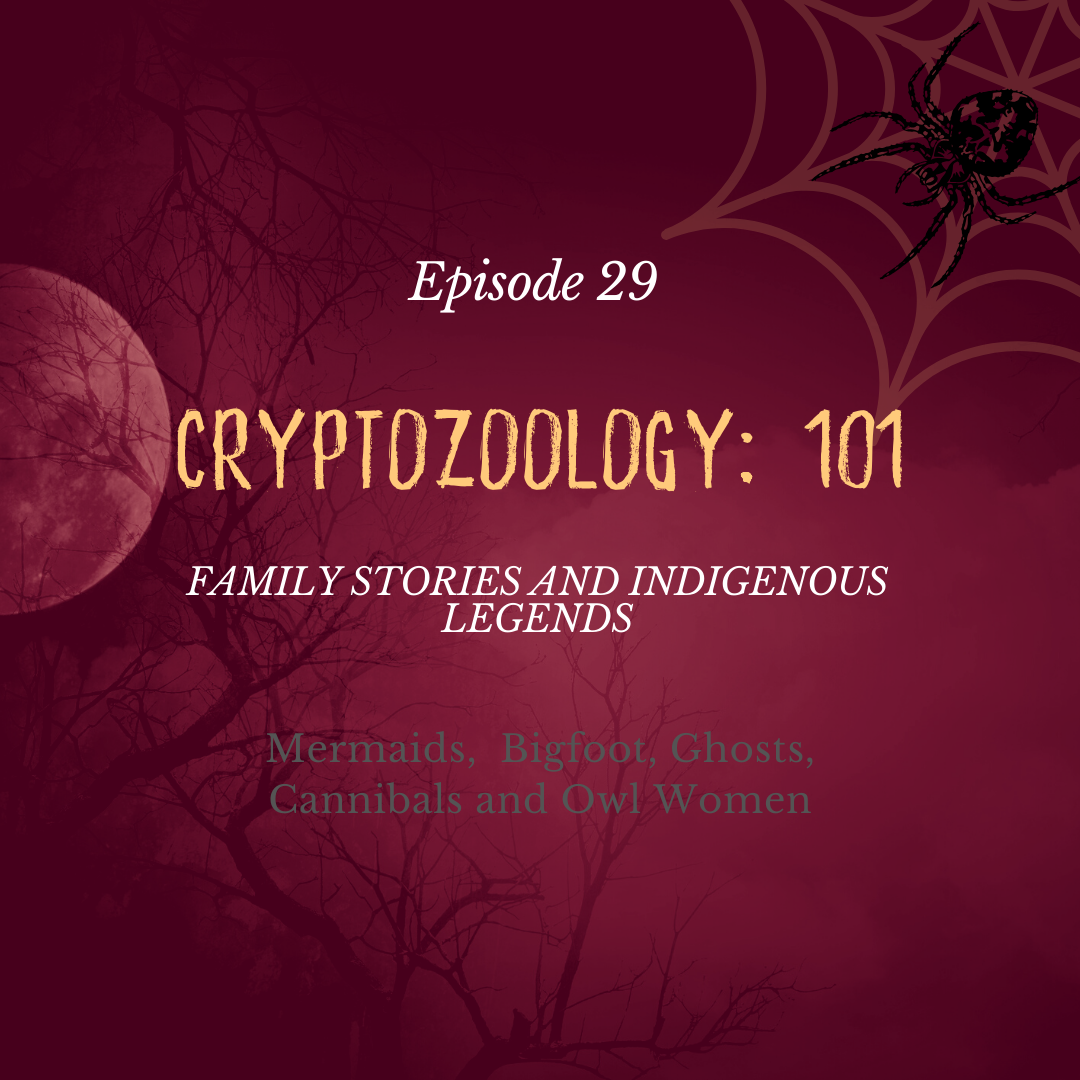 #29 - Cryptozoology: 101 | This is a special Halloween episode, where Annie's father Gene Sorrell shares his spooky stories on cryptids and ghosts. The topic of this episode is just looking at mythical creatures and beings from a cultural historic cryptozoological worldview. There are many indigenous people that have passed down stories over many generations. The episode will give a brief overview to help listeners learn about the science that they may have never heard about. Main Ideas: - Definitions for Cryptozoology, cryptid, and pseudoscience - Cryptozoology: Real Science or Pseudoscience? - Annie's Father's stories on Bigfoot, Mermaids, and Ghosts - Tah-tah-kle-ah - Cannibal Dwarves - Yara-ma-yha-who ~ Links & Resources: www.moderncryptozoology.wordpress.com/category/annotated-bibliography Peter Dendle (2006) Cryptozoology in the Medieval and Modern Worlds, Folklore, 117:2, 190-206, DOI: 10.1080/00155870600707888 www.legendsofamerica.com/teihiihan-cannibals www.deliriumsrealm.com/yaramayhawho www.ratthaus.net/hftp/tag/tah-tah-kle-ah ~ Like this show? Leave us a review here… even one sentence helps! And if you leave your Twitter handle we’ll be sure to thank you personally! You can also Support the Show on PayPal. | — | ||||||
| 10/20/19 | #28 - NAAEE Conference Live Recording | This is a live recording of Annie Sorrell and Tommy Mackey at the North American Association for Environmental Education (NAAEE) 48th Annual Conference in Lexington, Kentucky on October 17, 2019. The topic of this session was focused on the diverse interests in environmental science that have grappled with the differences between mainstream quantitative science and qualitative Indigenous science. This hands-on presentation is for education practitioners who have questions about what these differences mean for environmental education. Be sure to check out the link below to download the PowerPoint so you can follow along. Main Ideas: - the importance of place - Indigenous perspectives on land - how a worldview shaped Onondaga Lake - how a worldview shaped the Mission Mountain Tribal Wilderness - moving forward with two lenses ~ Links & Resources: NAAEE Workshop PowerPoint Searching for Synergy: Integrating Traditional and Scientific Ecological Knowledge in Environmental Science Education by Robin Kimmerer Two-Eyed Seeing into Environmental Education: Revealing its "Natural" Readiness to Indigenize by Margaret McKeon North American Association for Environmental Education ~ Like this show? Leave us a review here... even one sentence helps! And if you leave your Twitter handle we'll be sure to thank you personally! You can also Support the Show on PayPal. | — | ||||||
| 10/6/19 | #27 - Interview with Neil Patterson Jr. | Today we had Neil Patterson Jr. on the show. Although Annie wasn't able to be there, it was a lot of fun and we're glad to be able to highlight Neil and his story. He's done all sorts of things and has experienced a lot in his life. He went from only wanting to hunt and fish to teaching about Indigenous issues and traditional ecological knowledge in a university setting. Neil's had quite the journey and continues to contribute to academia, to science, and to a vision for better futures for all people. Here are some of the ideas we talk about: - Neil's love for the outdoors and damming streams as a kid - How he found his way to college and the role of family encouragement - The differences between technologies and their effects on people - His adventures toward becoming a teacher and mentor - The challenges inherent in multiculturalism - Some of the biggest/hardest realizations that led to learning ~ Links and Resources: National Film Board of Canada The Ecology and History of Onondaga Laken (a talk by Neil at the Skä-noñh Center) Northville-Placid Trail Robert Griffing Painting ~ Like this show? Leave us a review here... even one sentence helps! And if you leave your Twitter handle we'll be sure to thank you personally! You can also Support the Show on PayPal. | — | ||||||
| 9/22/19 |  #26 - Being Indigenous in the Modern World V | On today's episode, we took a different approach to this big topic and worked with Selina Kenmille, her son Leighton Wise Spirit, and Heather Atwin to have a round table discussion instead of the usual back-and-forth we have between just the two of us. We touch on all sorts of topics ranging from fry bread and Indin' tacos to suicide awareness and coping tools for everyday life. This was a heartfelt episode that was fun, and sad, and inspired both of us to be better people. Enjoy! Here are some of the ideas we talk about: - Variations on frybread making - Struggles with alcohol and drinking - What it's like being a teenager on the rez - The benefits of doing things that are scary - Modern technology and socializing - The challenges of being and having parents - How we cope with difficult situations - The connection between food, habits, and health - Differences in social, cultural, and economic situations - Our different perspectives on responsibility - Having transgender children and siblings - The complexity and nuance of emotions - 5 tips for being Indigenous in the Modern World ~ Links & Resources: Fry Bread Recipe (But be sure to ask your grandma too!) Suicide Prevention Hotline YouTube Video about Responsibility 12 Rules for Life by Jordan Peterson ~ Like this show? Leave us a review here... even one sentence helps! And if you leave your Twitter handle we'll be sure to thank you personally! You can also Support the Show on PayPal. | — | ||||||
| 8/11/19 | #25 - Hidden Words and Multiple Meanings | In today's episode, we talk about those words that have some sting to them. You know those words... the ones that get us cringing or offended when someone mentions them. Well, we talk about a few of the ones we've explored or experienced over the years. We also talk about how we respond to these words and how their meanings can differ. Here are some of the main ideas we talk about: - Indigifact about the Declaration of Independence - Controversial words and their definitions - How do we react and respond to these words ~ Links & Resources: Declaration of Independence Online Dictionary Online Etymology Dictionary ~ Like this show? Leave us a review here... even one sentence helps! And if you leave your Twitter handle we'll be sure to thank you personally! You can also Support the Show on PayPal. | — | ||||||
| 7/28/19 | #24 - Fire Revolution | Today's our first official episode of Revolution Science, a series of episodes about the major revolutions that have occurred throughout human history. And it all begins with fire. In this episode, we start by going over the definitions of revolution and evolution. Then we get into describing some of the main theories behind why we think fire is potentially the first revolution for humans. Here are some of the main ideas we talk about: - IndigiFacts about the oldest human fossils - The earliest evidence of fire use by humans - The different types of evidence - The "Cooking Hypothesis" and human evolution - Different uses of fire and its effects on plants ~ Links & Resources: oldest *Homo Sapiens* fossils oldest *Homo* fossils Definition of revolution Definition of evolution Evidence of fire use: 1, 2, & 3 Control of Fire in the Paleolithic Human Brain Expansion during Evolution Is Independent of Fire Control and Cooking The discovery of fire by humans: A long and convoluted process The nutritive value of cooked camas as consumed by Flathead Indians ~ Like this show? Leave us a review here... even one sentence helps! And if you leave your Twitter handle we'll be sure to thank you personally! You can also Support the Show on PayPal. | — | ||||||
| 7/14/19 |  #23 - Being Indigenous in the Modern World IV | We're back! And to get back in the groove, we decided to do another episode on the topic of Being Indigenous in the Modern World (#BIMW). This is a big topic and we bounce around to different topics a lot, but that's a part of why it's so fun to record these episodes. Enjoy! Here are some of the main ideas we talk about: - IndigiFact about How Cats Land on Their Feet - Updates on why we took a month off - What makes this topic so broad/wide-reaching - Sustainable/Renewable/Clean/Green Energy - Some Ideas to Be Indigenous in the Modern World ~ Links & Resources: How do cats land on their feet? Links: 1, 2, 3, 4 Do toilets spin in the opposite direction in the Southern Hemisphere? Links: 1, 2 Are cats good mousers? Links: 1, 2, 3 Ecological complexity, fuzzy logic, and holism in indigenous knowledge Jaden Smith's Water Filter & Food Truck Zealandia ~ Like this show? Leave us a review here... even one sentence helps! And if you leave your Twitter handle we'll be sure to thank you personally! You can also Support the Show on PayPal | — | ||||||
| 5/5/19 | Correction Reflections... Again | Today’s episode is all about being wrong… we caught ourselves making mistakes on three separate episodes. Although being wrong is okay, correcting yourself when you recognize that you're wrong is important. On today's show, we correct ourselves for some mistakes we made in three episodes (#16, #21, and #22), and then we reflect on it. Here are some of the main ideas we talk about: - Greg Gianforte DID support recognizing the Little Shell - Coffee isn't the 60th most-traded commodity - The Netherlands is not the top consumer of coffee - Mark Twain's Quote was not originally him - Workers might not make a dollar a day in Chiapas - Margarin Misunderstanding - Coffee Half-life isn't 12 hours - Hippocrates is older than Jesus - New York City doesn't have 12 million people ~ Links & Resources: How much coffee gets traded? One and Two Per Capita Coffee Consumption Mark Twain Quote Margarin Coffee Half-life: One and Two Hippocrates: One and Two New York City Population Women Pharaohs ~ Like this show? Leave us a review here... even one word or one sentence helps! And if you leave your Twitter handle we'll be sure to thank you personally! | — | ||||||
| 4/21/19 | #22 - Ethnobotany | Ethnobotany can be looked at in different ways. On one hand, it describes the people-plant relationships that Indigenous cultures have always relied on. And on the other, it can be seen as the discipline within science that studies these relationships, plant biology, and their stories. In this episode, we dive into definitions, and some history, and we even talk about aliens a little bit. We also go over why we think this is an important topic and how we view plant relationships. Here are some of the main ideas we talk about: - Definitions of botany and ethnobotany - Differences between botany and ethnobotany - The history of ethnobotany - Our perspectives on plant relations - Seasonality and Gratitude ~ Links & Resources: Cryptozoology Merriam-Webster Definitions of Botany and Ethnobotany Ethnobotany History Egyptian Ethnobotany Pregnancy Tests Lavender and Xenoestrogens Hippocrates, Aldo Leopold, & Native Pragmatism Camas and Bitterroot Witness to Injustice Blanket Exercise Support the show by rockin' a shirt or a hoodie for the Being Indigenous in the Modern World (#BIMW) Merchandise Campaign. ~ Like this show? Leave us a review here... even one word or one sentence helps! And if you leave your Twitter handle we'll be sure to thank you personally! | — | ||||||
| 3/31/19 | #21 - NDN Coffee Science | Today’s episode is all about coffee. AKA: the good old morning brew—the life-saving afternoon pick-me-up—and the fabled cup of Joe. But before we get carried away with all that, we get into some stats about coffee. Then we talk about some of the challenges of its production, preparation, transportation, roasting, and selling. This is a cherished drink that's faced a lot of controversy for centuries, having associations with revolutions, addiction, mold toxins, and the all-too-common "coffee jitters". At the end of the show, we talk about Indigenous farmers using coffee as a way to become more food sovereign. Here's some of what we talked about: - Coffee Stats and Facts - History and Revolutions - Mold toxins (mycotoxins) - How to avoid mold toxins - NDN Coffee Sovereignty ~ Links & Resources: Coffee Statistics: Gallup, CreditDonkey, USGS, World Atlas, & USDA Another Podcast Episode about Coffee Coffee Documentary Coffee History Links 1, 2, 3, & 4 Coffee and Revolutions 1 & 2 Processing the bean Moldy Movie Mycotoxins Map of World for Mold 91.7 percent of samples contaminated with mold this study showed above study's mold levels to be above-recommended levels Mycotoxin-Induced Neurotoxicity Ochratoxin A and Mutagenesis/Oxidative Stress Carcinogenic and genotoxic effects of mycotoxins Coffee Bean Transport—A Global Journey Cooperation, Fair Trade, and the Development of Organic Coffee Growing in Chiapas Can agroecological coffee be part of a food sovereignty strategy in Puerto Rico? Coffee and the Shock Doctrine in Puerto Rico Coffee Recommendations: 1, 2, 3, & 4 ~ Like this show? | — | ||||||
| 3/17/19 | #20 - Traditional Ecological Knowledge (live recording from SUNY-ESF) | This is a recording of the live stream we did at SUNY-ESF for a class called Indigenous Issues in the Environment. The topic of this episode is Traditional Ecological Knowledge, also known as TEK. We start off by going over definitions of TEK, then we share our personal experience with it and how this idea has shaped our views as scientists. We also ask the students to define TEK and explore this in different contexts by asking the students questions and sharing some of the principles. Enjoy! Here are some of the main points we went over: - Definitions of TEK - Worldviews and Social Systems - The Challenge of Defining Words - Convergence of knowledge systems - Healing, Restoring and Connecting to Land - Indigenous Research Agenda ~ Links & Resources: TEK Definition (Berkes 1992) Worldview Diagram Worldview Definition (Vidal 2008) Native Pragmatism Decolonizing Methodologies Wisdom Sits in Places ~ Like this show? Leave us a review here... even one word or one sentence helps! And if you leave your Twitter handle we'll be sure to thank you personally! | — | ||||||
| 3/3/19 | #19 - Interview with Robin Kimmerer | On today's show, we interview Dr. Robin Kimmerer. She's our major professor in the Sowing Synergy Program, she's an amazing botanist and the author of Braiding Sweetgrass, and she's also written numerous articles about traditional ecological knowledge. Robin shares all sorts of interesting stories with us. She talks about her childhood, important mentors, and her journey as an Indigenous scientist. Enjoy! In this episode, Dr. Kimmerer shares things like: - One of her favorite memories and her connection to plants - The role of culture and education in her life - Shifts in her thinking and reaching out to mentors - Restoration ecology and learning from plants - Ecological, Biocultural, and Reciprocal Restoration - Science paradigms and value systems - Robin's tips for being Indigenous in the modern world ~ Links and Resources: Braiding Sweetgrass: Indigenous Wisdom, Scientific Knowledge, and the Teachings of Plants Gathering Moss: A Natural and Cultural History of Mosses ~ Like this show? Leave us a review here... even one sentence helps! And if you leave your Twitter handle we'll be sure to thank you personally! | — | ||||||
| 2/17/19 | #18 - Interview with Kaya DeerInWater | Kaya DeerInWater is a close friend of ours and we’re excited to finally have him on the show. He’s the other member of our graduate cohort and we’ve wanted to have him on the show for over a year now. Kaya’s a dedicated and loving family man, he’s a brilliant botanist in the making, and he has a lot of knowledge about ecological restoration. Some of the main things we talk about today are: - Kaya’s childhood, his connection to culture, and academic background - How he got from California to graduate school in New York - Some of the challenges he faced doing his research - Where his love for plants started and made its way into his work - The usefulness of his research for other Indigenous communities - His children and the legacy he wants to leave them - Kaya’s 3 tips for being Indigenous in the modern world ~ Links & Resources: Bob Marshall Info: Source 1, Source 2, Source 3 ~ Like this show? Leave us a review here... even one word or one sentence helps! And if you leave your Twitter handle we'll be sure to thank you personally! | — | ||||||
Showing 25 of 43
Sponsor Intelligence
Sign in to see which brands sponsor this podcast, their ad offers, and promo codes.
Chart Positions
1 placement across 1 market.
Chart Positions
1 placement across 1 market.