

Insights from recent episode analysis
Audience Interest
Podcast Focus
Publishing Consistency
Platform Reach
Insights are generated by CastFox AI using publicly available data, episode content, and proprietary models.
Most discussed topics
Brands & references
Est. Listeners
Insufficient chart data. Estimates will improve as the show charts.
- Per-Episode Audience
Est. listeners per new episode within ~30 days
N/A🎙 Daily cadence·252 episodes·Last published 3d ago - Monthly Reach
Unique listeners across all episodes (30 days)
N/A - Active Followers
Loyal subscribers who consistently listen
N/A
Market Insights
Platform Distribution
Reach across major podcast platforms, updated hourly
Total Followers
—
Total Plays
—
Total Reviews
—
* Data sourced directly from platform APIs and aggregated hourly across all major podcast directories.
On the show
From 12 epsHosts
Not detected.
Recent guests
Recent episodes
Is Space Exploration Still a Pipe Dream?
Jun 25, 2026
Unknown duration
Book Discussion with 'Lean Spark' Authors Jaideep Prabhu, Priyank Narayan, Mukesh Sud
May 10, 2026
54m 22s
Understanding the Space Economy with Harvard Business School Professor Matthew Weinzierl
May 9, 2026
52m 14s
[Arguable] Factories or Fiber? What Will Actually Make Developing Countries Rich?
Apr 23, 2026
47m 43s
Career Principles with INSEAD Professor Dr. Linda Brimm
Apr 20, 2026
23m 42s
Social Links & Contact
Official channels & resources
Official Website
Login
RSS Feed
Login
| Date | Episode | Topics | Guests | Brands | Places | Keywords | Sponsor | Length | |
|---|---|---|---|---|---|---|---|---|---|
| 6/25/26 | Is Space Exploration Still a Pipe Dream? | Space is back at the centre of economic and geopolitical conversations. Over the past few years, SpaceX has become one of the most important technology companies in the world, Starlink has reached millions of users, and Starship has opened a new debate about what becomes possible next.In this episode, Dhruva speaks with Utkarsh and takes a slightly different approach from the podcast’s usual debate format. Rather than arguing a position, Dhruva plays the role of an interested sceptic and asks questions to explore one central idea: are we at the beginning of a new era in the space economy?The conversation begins with why space is suddenly attracting so much attention again. It then turns to SpaceX and the economics of access to space, asking what bottlenecks have existed in the past and what new technologies are making possible now. From there, the discussion widens to the business model of space itself, including three possible paths for the sector: colonising space, using space as a resource, and generating technological spillovers that create value on Earth.The episode also explores the geopolitical question, including the relationship between private companies and governments, and the risks that come with an increasingly strategic space domain. It closes with a broader historical question about what would need to happen for us to say that SpaceX truly changed the course of history. | — | ||||||
| 5/10/26 | 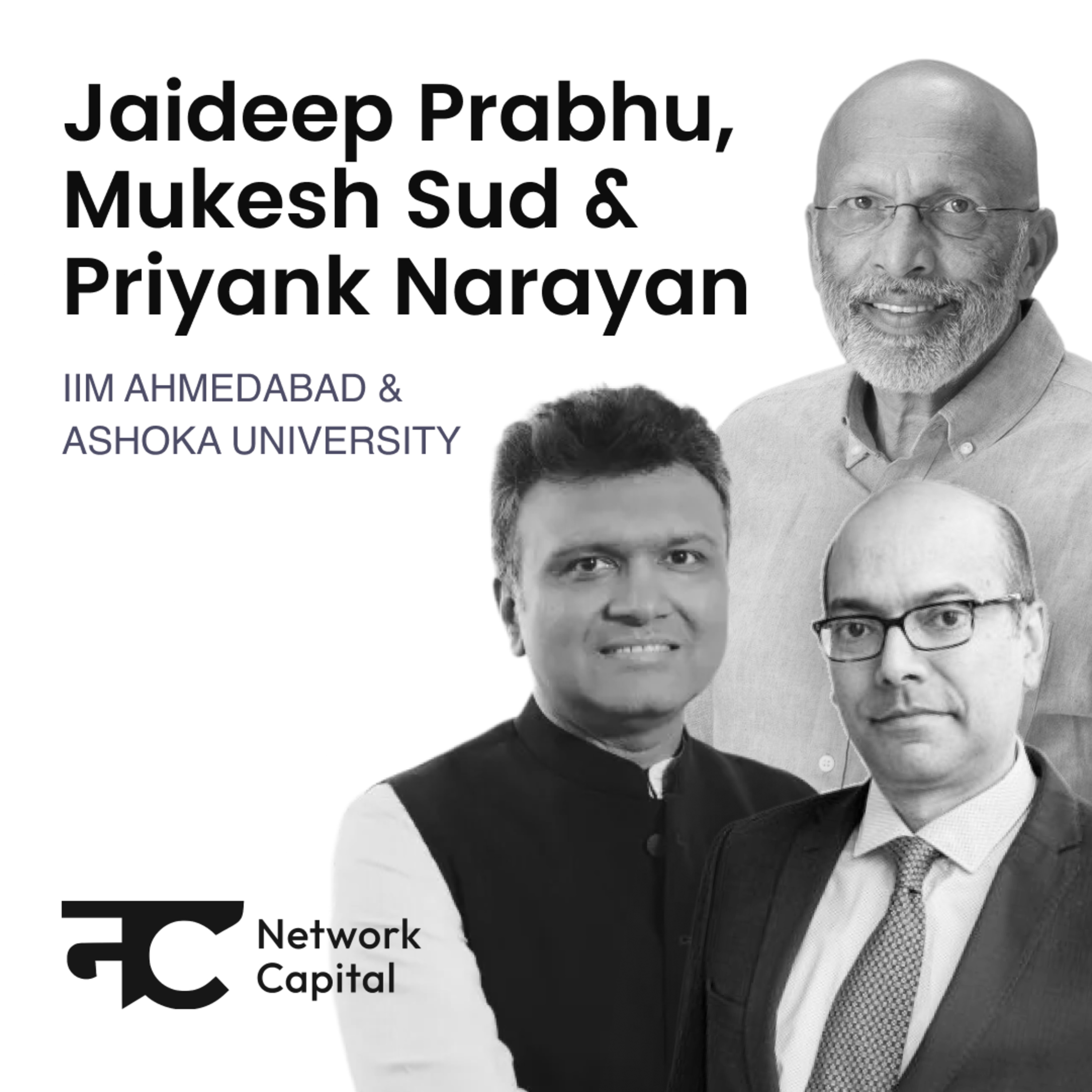 Book Discussion with 'Lean Spark' Authors Jaideep Prabhu, Priyank Narayan, Mukesh Sud✨ | frugal innovationhigh-tech jugaad+4 | Jaideep PrabhuPriyank Narayan+1 | ISROLean Spark | India | frugal innovationLean Spark+8 | — | 54m 22s | |
| 5/9/26 | Understanding the Space Economy with Harvard Business School Professor Matthew Weinzierl✨ | space economyeconomic policy+3 | Matthew Weinzierl | Harvard Business SchoolNational Bureau of Economic Research+3 | New York | space economyeconomic policy+3 | — | 52m 14s | |
| 4/23/26 | [Arguable] Factories or Fiber? What Will Actually Make Developing Countries Rich?✨ | factoriesfiber+8 | — | — | — | — | — | 47m 43s | |
| 4/20/26 | Career Principles with INSEAD Professor Dr. Linda Brimm✨ | career principlesorganizational behavior+1 | Dr Linda Brimm | INSEADMBA | Paris | INSEADMBA+2 | — | 23m 42s | |
| 4/18/26 | Career Principles with Nobel Laureate Dr. Robert Shiller✨ | career principleseconomics+2 | Dr Robert Shiller | Yale UniversityDepartment of Economics+3 | — | Nobel LaureateYale University+2 | — | 40m 15s | |
| 4/14/26 | Is this the end of the American empire?✨ | American empireglobal power dynamics+3 | — | We are all birds of a distant land | U.S.America+2 | American dominanceChina+3 | — | 44m 49s | |
| 3/24/26 | Discussion with Management Consultant Turned Award-Winning Novelist Santanu Bhattacharya✨ | novelswriting+2 | Santanu Bhattacharya | One Small VoiceDeviants+10 | IndiaLondon | One Small VoiceDeviants+2 | — | 50m 36s | |
| 2/17/26 | Fully Remote Companies Disadvantage Elite Performance Cultures✨ | remote workelite performance cultures+2 | Dhruva | — | — | talent poolbias+3 | — | 43m 13s | |
| 12/15/25 | [Arguable] Should religion play an important role in people’s lives?✨ | religionmorality+10 | — | — | — | religious institutionsdivision+3 | — | 52m 08s | |
Want analysis for the episodes below?Free for Pro Submit a request, we'll have your selected episodes analyzed within an hour. Free, at no cost to you, for Pro users. | |||||||||
| 12/1/25 | [Arguable] Should we strive for equality of opportunity or equality of outcome?✨ | equality of opportunityequality of outcome+4 | — | — | — | meritindividual choices+3 | — | 55m 14s | |
| 11/16/25 | [Arguable] Two Techno-Optimists Argue if Digital Minimalism Makes Life Better✨ | digital minimalismdigital detox+2 | — | Arguable | — | techno-optimismdistraction+2 | — | 50m 07s | |
| 11/1/25 | [Arguable] Is There an AI Bubble in the Stock Market?✨ | AIstock market+3 | — | NVIDIAJPMorgan+1 | U.S. | NVIDIAmarket cap+4 | — | 50m 16s | |
| 10/31/25 | Reimagining the space economy with Turkish astronaut Tuva Atasever | Born in August 1992 in Ankara, Türkiye, Tuva Atasever attended the Bilkent University, where he received a Bachelor of Science in Electrical and Electronics Engineering. After completing his undergraduate studies in 2014, Atasever moved to the United States and received a master’s degree in photonics from the University of California, Irvine. In addition, in 2018 Atasever completed the Space Studies Program (SSP) organized by Delft University of Technology, European Space Research and Technology Centre, and International Space University (ISU).After receiving his Master’s degree in 2016, Atasever co-founded and acted as the CEO of Blue Dot VR where he worked on creating compelling experiences in virtual reality to induce pro-social, pro-environmental, and empathetic behaviors in users. In 2017,Atasever co-founded another startup called HyperSight, Inc., which focused on augmented reality.After working on those ventures and gaining life-changing experiences, Atasever started working for ROKETSAN, Inc as an avionics systems engineer responsible from the avionic subsystems in the Micro Satellite Launch Vehicle (MSLV) and Space Sounding Rocket (SSR) development projects. As the payload integration manager for SSR, Atasever’s latest responsibility at ROKETSAN included selecting scientific and commercial payloads that were going to be launched on the SSR, creating technical requirements for those payloads, and successfully integrating them on the launch vehicle following the design verification process.In May of 2022, Atasever enthusiastically applied for the first-ever astronaut selection campaign of the Turkish Space Agency (TUA). After passing all the phases successfully, he was selected as one of the first two astronauts of Türkiye.Atasever enjoys swimming, outdoor running, camping, and backpacking, previously journeying across several national parks in Northern and Southern California and along the Mediterranean coast.Atasever is honored and excited for the opportunity to be a part of the historic Ax-3 mission as the backup mission specialist, and looks forward to advancing Türkiye’s human spaceflight program in close cooperation with international partners to improve people’s lives here on Earth. | — | ||||||
| 10/25/25 | Is It Okay to Break a Friendship Over Political Differences? | Once, politics was something you debated and moved on from. Today, it can redraw the boundaries of who we call a friend. In this episode of Arguable, we ask a question that’s become uncomfortably common: when someone you care about stands for ideas you find intolerable, should you preserve the relationship or protect your principles?We explore how political identity has evolved into moral identity, how social media turns differences into declarations, and why disagreement now feels like disloyalty.Is friendship about shared values or shared history? Can empathy coexist with conviction? | — | ||||||
| 10/11/25 | The Political Right Wins Because the Left Lacks Vision | This episode examines the uneasy balance between moral ambition and political realism. Has the right’s coherence come at the cost of empathy, or has the left’s pluralism diluted its sense of purpose? Are voters choosing certainty over openness or merely responding to fatigue with ambiguity?In this debate, we put forward two contrasting arguments. One side contends that the right’s success stems from its ability to offer direction, meaning, and belonging at a time of social uncertainty, while the left, preoccupied with management and moral positioning, has lost its visionary core. The other side argues that this framing overlooks how complexity, pluralism, and empathy make the left’s project inherently more demanding and perhaps more relevant in a fractured world. | — | ||||||
| 9/30/25 | Pros and Cons of a Global Career: Mental Models, Visas, Aspirations, and Hard Choices with Abhilasha Sinha | HBS & IIT Delhi | The U.S. H-1B lottery just ended, and thousands of ambitious professionals are asking themselves the same question: is chasing a global career still worth it?Immigration rules are tightening, borders are harder to cross, and belonging feels more elusive than ever.In this episode, we think through the promise and pitfalls of building a life across countries. We’ll talk about the upside - bigger markets, faster growth, new horizons, and the downside - visa anxiety, dislocation, and the quiet ache of distance.Harvard Business School graduate Abhilasha Sinha shares her reflections and mental models about • Where you build your career, and how much of yourself you lose or find in the process. • Does living “between worlds” expand us, or does it fracture us?• What does success look like when the passport is as important as the résumé?• Is a global career still a realistic ambition? | — | ||||||
| 8/30/25 | [Arguable] Is Taylor Swift a model millennial business leader, or is her economic empire an exception that can’t be replicated? | Taylor Swift has built an empire that redefines what it means to be an artist-entrepreneur. Her ownership battles, billion-dollar tours, and mastery of narrative have been hailed as a leadership blueprint for a new generation. Yet critics argue her success rests on singular talent, timing, and cultural lightning strikes that no strategy can replicate.This episode debates whether Swift offers a replicable playbook for millennial leadership—or whether her empire proves she’s the rare exception who can’t be copied. | — | ||||||
| 8/28/25 | Discussing The New Geography of Innovation with Mehran Gul | Previously a Fulbright Scholar, Fox International Fellow and Teaching Fellow at Yale, Gul has also been a Lead for the Digital Transformation of Industries at the World Economic Forum in Geneva, and an Expert on Higher Education, Entrepreneurship, and Industrial Policy at the United Nations Industrial Development Organisation in Vienna. His book The New Geography of Innovation won the Financial Times/McKinsey Bracken Bower Prize for writers under 35. In this episode you will learnHow the geography of innovation is shifting and what it means for the new world order The art of connecting innovation, geography, and ambition with the help of illustrative case studiesHow to write a deeply-researched book | — | ||||||
| 8/16/25 | [Arguable] Are side hustles a distraction or a creative outlet for reinvention? | In order to thrive at work, must we always be working? For many young professionals, the hours outside work are no longer a refuge. In this episode of Arguable, Dhruva and Utkarsh explore the shifting line between hobbies and side hustles, and what that says about careers today. Are side hustles a smart form of insurance in an unpredictable economy, or a symptom of a culture that demands we monetise every interest? Do they help us discover new sides of ourselves, or simply extend the workday into our free time? In order to thrive at work, must we always be working? | — | ||||||
| 8/1/25 | [Arguable] Obsession with Stoicism, Protein Shakes, and Padel Leaves the Modern Millennial Utterly Dissatisfied | This episode explores whether the modern millennial’s embrace of stoicism, rigorous health routines, and padel reflects a genuine search for meaning or a set of coping mechanisms that ultimately fall short. Has the rise of self-discipline and structured lifestyles created a more resilient generation, or has it led to a quiet sense of emptiness masked by routine?We examine the social and psychological roots of these trends, asking whether the appeal of ancient philosophy, physical optimisation, and curated leisure is a response to instability or a retreat from vulnerability and connection. | — | ||||||
| 7/27/25 | From Studying Literature to Building a Tech Career: Discussion with Spotify’s Arunima Anand | We live in an era of disciplinary chauvinism. While most hiring managers agree that deep generalists are precious for the modern workplace, they tend to hesitate before giving a shot to someone from a non-traditional background. That’s why it is important to study the careers of people like Arunima Anand who pivoted her career from literature and is building her category of one at Spotify, one of the fastest growing companies in the world. In this masterclass, you will learnHow to position yourself as a deep-generalist who can add tangible value from day 1How to attract interesting opportunities in fast-growing sectorsHow Spotify really works and why the Asian market is critical for its success Biography | — | ||||||
| 7/25/25 | Meaningful Careers in Public Policy and Lessons on Resilience with Urvashi Prasad (Former Director, NITI Aayog) | Urvashi Prasad has spent the last 15 years trying to make the world a kinder, fairer, and better place through her policy-based interventions in heathcare. Armed with degrees from Cambridge and LSTH, she worked as a director at NITI Aayog, and was awarded the India-UK Achievers Award. In addition to sharing principles and frameworks for building meaningful careers in public policy, Urvashi opens up about losing her beloved father and being diagnosed with cancer soon after. We admire her resilience and are proud to share her story with you. Here you will learnHow governments attempt to address systemic challenges in sectors like healthcareHow young professionals can carve out interesting and impactful careers in public policy How to make sense of life when you lose your beloved parent and are diagnosed with cancerUrvashi Prasad is a public health and policy advisor with over 15 years of leadership across government, academia, and grassroots innovation. As Director in the Office of the Vice Chairperson at NITI Aayog, India’s apex policy think tank, she helped shape the country’s COVID-19 response strategy, monitor Sustainable Development Goals in real time, and spearhead national programs advancing public health, gender equity, and social inclusion.A co-author of India’s first Voluntary National Review presented at the UN High-Level Political Forum in 2017, Urvashi’s policy insights have been featured in 150+ publications globally. She is also the British Council’s UK Alumni Ambassador for SDG 10, an Honorary Professor at De Montfort University, UK, and a member of the World Economic Forum’s Expert Network. Her accolades include the India-UK Achievers Honors and recognition among India's most influential women. In 2023, she founded Spcace by Urvashi, a pioneering platform amplifying patient voices.Diagnosed with Stage 4 ALK-positive lung cancer at age 35, Urvashi now brings lived experience to the policy table --challenging invisibility in cancer discourse and driving recognition of under-researched malignancies in young adults. Her advocacy bridges science, storytelling, and systemic reform.She holds a master’s in public health from the London School of Hygiene & Tropical Medicine, an MPhil in Bioscience Enterprise from Cambridge University, and a Bachelor's in Biological Sciences (Genetics) from the University of Birmingham, UK. In 2024, Urvashi received an honorary doctorate for her work in public health and policy. | — | ||||||
| 7/19/25 | How to Raise Happy and Successful Children: Esther Wojcicki on Parenting, Grief, and Growth | Esther Wojcicki is a renowned educator and journalist, best known for her transformative parenting philosophy outlined in her books In this episode, she shares the principles that guided her as a mother to Susan Wojcicki, former CEO of YouTube, Anne Wojcicki, founder of 23andMe, and Dr Janet Wojcicki, a professor of paediatrics at UCSF.She reflects on how childhood trauma, loss and adversity can be met with trust, respect, independence, collaboration and kindness—the values at the heart of her TRICK framework. We also explore how her philosophy contrasts with more authoritarian approaches to parenting, such as those advanced by Amy Chua in Battle Hymn of the Tiger Mother. Esther argues that success does not require pressure or fear, but rather autonomy, connection, and trust.Esther also discusses grief - a constant in most of our lives. This conversation goes well beyond parenting. It is about finding strength through meaning, creating space for healing, and choosing stories that uplift rather than confine. Esther’s insights offer a profound reminder that while loss is part of life, it does not have to define it. | — | ||||||
| 6/29/25 | Reimagining India’s Economy: A Conversation with former BCG Chairman and Planning Commission Member Arun Maira | What kind of economy does India need—not just to grow, but to serve its people with dignity and purpose? In this episode, we speak with Arun Maira, former Member of India’s Planning Commission, Chairman of BCG India, and author of Reimagining India’s Economy: An Inquiry into the Real Costs of Economic Growth.Tracing his journey from Tata Motors to the highest levels of government, Maira reflects on what it takes to transform systems—both economic and institutional. He shares lessons from his work on industrial policy, capability-building, and ethical leadership, and calls for a bold shift away from GDP obsession toward a model grounded in inclusion, learning, and care.We discuss: • Why India is at a moral and economic crossroads • What a “learning economy” looks like in practice • How to design jobs-led growth that restores dignity to work • Why systems thinking and listening must be central to leadership todayA compelling conversation with one of India’s most original thinkers on development, purpose, and how to shape an economy that works for everyone. | — | ||||||
Showing 25 of 184
Pitch Fit is a Pro feature
See how bookable this show is for guests, which brands already advertise, the per-episode ad value, and the best-fit guest and sponsor profile. The numbers are blurred on the free plan.
How readily this show books outside guests like you.
How proven this show is for host-read sponsorships.
For Guests
ProFor Advertisers
ProUpgrade to Pro to unlock guest cadence, sponsor categories, fit scores, and per-episode ad value for this show.