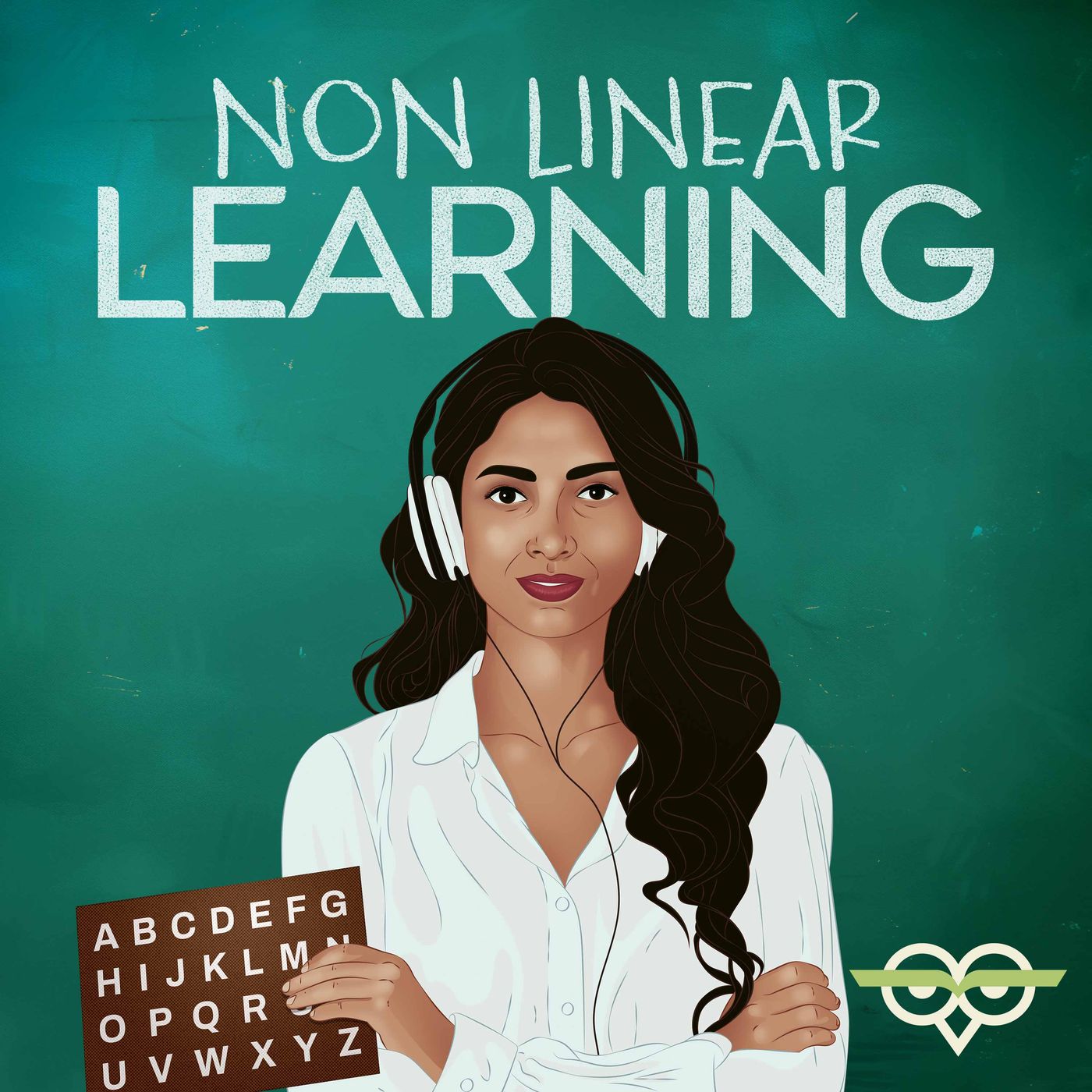
Non Linear Learning - Rethinking Education for Neurodivergent Learners
by Vaish Sarathy
Is this your podcast?Insights from recent episode analysis
Audience Interest
Podcast Focus
Publishing Consistency
Platform Reach
Insights are generated by CastFox AI using publicly available data, episode content, and proprietary models.
Most discussed topics
Brands & references
Est. Listeners
Insufficient chart data. Estimates will improve as the show charts.
- Per-Episode Audience
Est. listeners per new episode within ~30 days
N/A🎙 ~2x weekly·204 episodes·Last published 1w ago - Monthly Reach
Unique listeners across all episodes (30 days)
N/A - Active Followers
Loyal subscribers who consistently listen
N/A
Market Insights
Platform Distribution
Reach across major podcast platforms, updated hourly
Total Followers
—
Total Plays
—
Total Reviews
—
* Data sourced directly from platform APIs and aggregated hourly across all major podcast directories.
On the show
From 10 epsHosts
Recent guests
Recent episodes
207. Where there is deficit, there is also great strength - with Mark Talaga
Jun 15, 2026
29m 00s
206. What the IEP Is Not Telling You - A Special Ed Insider Breaks It Down (with Dr. Diana Fannon)
May 19, 2026
41m 09s
205. Why the Smartest Brains Are Also the Most Dysregulated | Dr. Andrew Hill
Apr 30, 2026
57m 31s
204. Do Support Groups Actually Work? The Hard Truth About Finding Your People - with Sara Intonato
Apr 2, 2026
43m 01s
203. Your student with Down Syndrome belongs in a mainstream Physics Class
Mar 11, 2026
45m 27s
Social Links & Contact
Official channels & resources
Official Website
Login
RSS Feed
Login
Resolving iTunes ID\u2026 if this persists, the podcast may not be indexed on Apple Podcasts.
| Date | Episode | Topics | Guests | Brands | Places | Keywords | Sponsor | Length | |
|---|---|---|---|---|---|---|---|---|---|
| 6/15/26 | ![]() 207. Where there is deficit, there is also great strength - with Mark Talaga | We talk a lot about what our students can't do. But something that educators have found over the years is that there is a scatter to the skills we see in our students. The wildly uneven profile that we see could actually be a blessing. Mark Talaga, counselor, speaker, and founder of the Center for Identity Potential, joins the podcast to talk about asynchronous development in gifted and twice-exceptional learners. And here's what hit me: we're working the same problem from opposite ends. Where there is a sharp strength, there is often a significant deficit, but the opposite is true as well! This conversation got under my skin in the best way. Tune in to this episode to learn: What "asynchrony" actually means in gifted and disabled learners Why IQ tests fail kids on both ends of the bell curve Why labels are meaningless in education Why nurturing a spike / sharp interest (even if it seems "irrelevant") is critical. You can find Mark Talaga's podcast, Hopelessly Gifted, on Apple Podcasts and Spotify, or visit centerforidentitypotential.com. | 29m 00s | ||||||
| 5/19/26 | ![]() 206. What the IEP Is Not Telling You - A Special Ed Insider Breaks It Down (with Dr. Diana Fannon)✨ | IEPspecial education+4 | Dr. Diana Fannon | disabilityedpros.com | — | IEPspecial education+5 | — | 41m 09s | |
| 4/30/26 | ![]() 205. Why the Smartest Brains Are Also the Most Dysregulated | Dr. Andrew Hill✨ | dysregulationneuroscience+4 | Dr. Andrew Hill | Peak Brain InstituteGifted and Tortured | — | dysregulationautistic learners+5 | — | 57m 31s | |
| 4/2/26 | ![]() 204. Do Support Groups Actually Work? The Hard Truth About Finding Your People - with Sara Intonato✨ | support groupsneurodivergent learners+3 | Sara Intonato | — | — | support groupsneurodiversity+5 | — | 43m 01s | |
| 3/11/26 | ![]() 203. Your student with Down Syndrome belongs in a mainstream Physics Class✨ | special educationinclusion+4 | Sruthi Muralidharan | public schoolsemiconductor industry+1 | high school | Down syndromespecial education+6 | — | 45m 27s | |
| 2/2/26 | ![]() 202. Inflammation, Energy, and Learning: A Functional Medicine Lens with Dr. Kendall Stewart✨ | functional medicineneurodivergent learners+5 | Dr. Kendall Stewart | Non Linear Education (NLE)www.drkendalstewart.com+1 | — | inflammationneurotransmitter balance+8 | — | 41m 12s | |
| 1/20/26 | ![]() 201. dIs School Costing Your Child Too Much? A Homeschooling Conversation✨ | homeschoolingeducation system+3 | Victoria Lenormand | GeminidirectionsInstagram | — | homeschoolingeducation+5 | — | 34m 49s | |
| 1/1/26 | ![]() 200. Five "Helpful" Parenting Tips That Limit Autistic Learning✨ | autismparenting+4 | — | — | — | autistic learningparenting tips+5 | — | 12m 49s | |
| 12/8/25 | ![]() 199 Evidence, Rage, and Relief: A Mom–Son Team on Finding Spelled Communication✨ | non-speaking autismtext-based communication+4 | RafaelDaria | Spelling the Tea on AutismSubstack+1 | — | autismnon-speaking+6 | — | 43m 28s | |
| 11/28/25 | ![]() 198 How Understanding Apraxia changes your child's Education - with Dana Johnson✨ | apraxiacommunication+3 | Dana Johnson | Spellers MethodSpellers Method Tampa | — | apraxiamotor planning+5 | — | 43m 03s | |
Want analysis for the episodes below?Free for Pro Submit a request, we'll have your selected episodes analyzed within an hour. Free, at no cost to you, for Pro users. | |||||||||
| 11/17/25 | ![]() 197 Beyond Burnout: GABA Support, Mitochondria, and Realistic Help for Parents of Disabled Kids✨ | parentingautism+4 | Dr. Scott Sherr | buccal trochesTroscriptions+2 | — | GABAmitochondria+5 | — | 35m 49s | |
| 11/7/25 | ![]() 196 Oxytocin, Autism, and the Problem of "Blunt" Measurements | In this episode, psychiatrist and researcher Dr. Eric Strobl joins Dr. Vaish Sarathy to talk about a new re-analysis of the SOARS-B trial on oxytocin and autism. While earlier studies found no clear benefit, Dr. Strobl's fine-grained, item-level analysis using machine learning uncovered consistent evidence that oxytocin can enhance social-emotional reciprocity the ability to engage, connect, and respond in social contexts. Together, they discuss: Why most autism drug trials fail to show benefit What "blunt outcome measures" really mean in clinical research How machine learning can extract signal from noise in complex data What oxytocin actually does (and doesn't do) in real life How future studies could use more nuanced, individualized measures Resources and Links Mentioned Study Discussed: Strobl E et al. (2024). "Item-Level Analysis Reveals Oxytocin Improves Social-Emotional Reciprocity in Autism Spectrum Disorder." Preprint Original SOARS-B Trial: Parker KJ et al. (2017). "A Randomized Clinical Trial of Oxytocin in Children and Adolescents with Autism Spectrum Disorder." Journal of the American Medical Association (JAMA Psychiatry) Link Related Reading: Oxytocin and Social Behavior On machine learning in psychiatry: Nature – Machine learning in mental health research Key Takeaways Oxytocin may help but not for everyone. Its most reliable effect seems to be reducing social anxiety and improving comfort in social exchanges. Measurement matters. "Blunt" outcome scales can bury meaningful results under noise. Item-level, data-driven analysis reveals nuance traditional methods miss. Autism heterogeneity is real. The same outward behavior can stem from different root causes - so future trials need precision tools, not averages. Hope through better science. New methods aren't about hype—they're about accuracy, compassion, and smarter research design. About Dr. Eric Strobl Dr. Strobl is a psychiatrist and data scientist at the University of Pittsburgh who develops innovative machine-learning algorithms to uncover hidden structure in medical data. His current work focuses on autism, neurodevelopmental conditions, and the use of AI to improve clinical trial design. About Dr. Vaish Sarathy Dr. Vaish Sarathy is a TEDx speaker, PhD chemist, educator, and mom to a non-speaking autistic teen poet with Down syndrome. She hosts the Non Linear Learning podcast and leads the Non Linear Education course for parents and educators who believe that every brain can learn, given the right way to teach. Stay Connected Instagram: @drvaishsarathy Free Guide: Turn ON Your Child's Learning Switch Join the Non Linear Education Waitlist: Get on the list here → | 33m 33s | ||||||
| 10/30/25 | ![]() 195 What's Your Excuse? Lessons on Problem-Solving, Asking for Help, and Doing the Next Thing | This may be the most heartfelt episode I've ever recorded. In this deeply human conversation, Maxwell Ivey: The Blind Blogger, and I talk about what it means to keep moving when life doesn't hand you easy options. Maxwell lost his sight as a child, taught himself to code, built a business, and learned to ask for help without shame. We talk about the quiet power of asking, the courage to act before conditions are perfect, and a rare take on gratitude-not as politeness, but as the willingness to use what's been given. Somewhere along the way, we find ourselves reflecting on The Four Agreements and how "don't take things personally" and "don't make assumptions" become essential mindsets in the world of disability and education. It's unpolished, honest, and full of wisdom that only comes from lived experience. Stay to the end to hear Maxwell sing his original song, Don't Wait on Someday. You can find Maxwell at theblindblogger.net. | 46m 06s | ||||||
| 10/16/25 | ![]() 194 Every Skill Can Be Built: Inside Non Linear Education with Daria Kotenko | In this special episode, NLE student and mom of a non-speaking speller, Daria Kotenko, interviews me about the ideas behind Non Linear Education: why “readiness” is a myth, how to teach anything through interest and tolerance, and what it really means to assume intelligence aggressively. We talk about the Web vs Bridge model of learning, building sensory capacity, and how parents can make education joyful and age-appropriate in just 10–15 minutes a day. 👉 Join Non Linear Education before doors close (Friday 11:59 PM PT) | 30m 29s | ||||||
| 10/13/25 | ![]() 193 The Myth of Readiness: Why Waiting Holds Our Kids Back | How long have you been waiting for your child to be ready? Ready to sit still, focus, or “start learning”? In this episode, Dr. Vaish Sarathy dismantles one of the most persistent myths in special education: the idea that readiness must come before learning. Drawing on neuroscience and real-world experience, she explains experience-driven neuroplasticity how the brain builds readiness through meaningful action, not waiting. You’ll learn 3 practical ways to start teaching complex ideas right now—no perfect calm, no perfect focus required. If you’re ready to move from waiting to learning, join Vaish inside Non Linear Education, her signature course for parents and educators teaching advanced academics to every kind of brain. 🔗 www.drvaishsarathy.com/nonlineareducation [LIVE FOR A VERY SHORT TIME] | 5m 27s | ||||||
| 10/3/25 | ![]() 192 The Cost of Low Expectations (and the #1 Shift to Break Free) | The biggest barrier in your child’s education isn’t Autism, Down syndrome, or even learning disabilities. It’s low expectations. When a 12-year-old is handed board books or toddler math, the hidden message is: “This is all I think you can do.” That belief shapes motivation, behavior, trust, and hope for the future. In this episode of Non Linear Learning, Dr. Vaish Sarathy unpacks the true cost of low expectations and shares the #1 shift to break free: speaking to your child with age appropriate language. You’ll hear: Why “presuming competence” isn’t enough How low expectations create a vicious cycle of poor behavior and lost trust ONE Simple way to change this and expand your child’s thought process 👉 Ready to raise the bar? Join Dr. Vaish for her free live webinar on How to Teach your Child ANYTHING!. Save your spot here: www.drvaishsarathy.com/learningskills. | 11m 39s | ||||||
| 9/30/25 | ![]() 191. When Compliance Fails: Dr. Robin Harwick on Democratic Education for Neurodivergent Teens | In this episode of Non Linear Learning, Dr. Vaish Sarathy speaks with Dr. Robin Harwick, founder of The Pearl Remote Democratic High School, a groundbreaking online school designed for teens who don’t fit into traditional education especially autistic, ADHD, and otherwise neurodivergent learners. Together, we explore: Why compliance-based systems harm learning (and why they persist) How democratic education gives back autonomy, voice, and safety What it actually looks like to co-create curriculum with neurodivergent students How to spot when your child’s IEP is a red flag, not a lifeline Why some students with PDA or ODD thrive when given real choice Whether you’re homeschooling, advocating at an IEP meeting, or simply wondering if there’s any alternative to the status quo—this episode will expand your thinking and offer a glimpse into what education could be. 🔗 Learn more about The Pearl: https://thepearlhighschool.org 🧠 Join the limited time free workshop offered by Dr Vaish Sarathy "What if your Autistic child could learn Anything?" https://www.drvaishsarathy.com/learningskills 🎧 Like the show? Leave a rating or review and share this episode with someone who’s tired of the compliance trap. | 23m 37s | ||||||
| 9/11/25 | ![]() 190. Exploring the science of Failure for you and your Autistic learner | In this edition of Non Linear Learning, Dr. Vaish Sarathy and co-host Searmi Park unpack the buzz around “productive failure”and flip it on its head for neurodivergent learners. Inspired by Manu Kapur’s work and his recent conversation on 10% Happier, Vaish and Searmi explore when failure can deepen learning, when it harms, and why the word we’re actually looking for is exploration, not failure at least for this audience. In this episode Productive failure what we think it means Why we don’t “design failure” for autistic students Parents as the ones who “fail productively” Real-life stories A challenge for listeners Key takeaways Exploration > evaluation. Our learners already face constant performance tests; they don’t need “engineered” failure. Hold the bar high, detach from outcomes. You can keep rigor and still protect nervous systems. Make the “failure” yours. Parents and educators can iterate on the environment, task, and supports instead of labeling the child. Build a web, not a bridge. Let detours teach the terrain. Resources & Links Book: Productive Failure: Unlocking Deeper Learning Through the Science of Failing by Manu Kapur Podcast that sparked this convo: 10% Happier with Dan Harris “Let’s Normalize Failure (The Right Kind) | Manu Kapur.” (Spotify) Try this at home (Quarterly Challenge) Pick one stretch experience your child “can’t do”—museum hour, library time, a short concert, a new trail, and scaffold it respectfully (sensory-wise, regulation-wise). Debrief afterwards: What worked? What needs one tweak? What surprised you? About your hosts Dr. Vaish Sarathy — TEDx speaker, PhD educator, creator of Non Linear Education, and mom to a non-speaking autistic poet with Down syndrome. Searmi Park — Concertmaster, Eugene Symphony; founder of Autism Mustang Alliance; mom to a non-speaking autistic young adult. Support the show 💌 Get the free guide: Turn ON your child’s learning switch 🎓 Join the Non Linear Education waitlist ⭐ If this episode helped, please leave a 5-star review—and if it didn’t… maybe skip the review this time 😉 | 27m 43s | ||||||
| 9/1/25 | ![]() 189. What Dyslexia Research Can Unlock for YOUR Autistic Learner | When we think of dyslexia, most people imagine a reading problem. But the real story is far more complex and non linear - and the lessons from dyslexia research can open new doors for autistic learners (yay!). In this episode, I talk with Russell Van Brocklen, founder of Dyslexia Classes and known as The Dyslexia Professor. Russell shares why dyslexia is less about reading and more about how the brain organizes ideas - and how strategies that work for dyslexic learners may also translate to autistic students who think and learn in unique ways. We explore: Why dyslexia is not just a reading issue but a brain organization issue. How focusing on a child’s special interest unlocks motivation and comprehension. Why writing (typing) before reading is the breakthrough many students need. The crossover between dyslexic and autistic learners as specialists, not generalists. And of course, what you can do RIGHT NOW! Listen, I know your autistic child may struggle outside their super special interests - and you may be struggling with how to help them move laterally to a different topic. THIS conversation will give you some ideas to think about. Here’s the freebie Russell mentioned in the podcast: https://dyslexiaclasses.com/nonlinearlearning/ You are a non linear parent, and you deserve a non linear path! Next Step: Get on the waitlist for my course, Non Linear Education, where I teach parents how to build advanced, age-appropriate learning for their kids with disabilities. And if you found this episode helpful, please leave a review. Your words may be exactly what another parent needs to discover this podcast and know they’re not alone. | 17m 02s | ||||||
| 8/8/25 | ![]() 188 Rethinking College Readiness: Why Life Skills Aren’t Enough for Students with Disabilities | In this episode of Nonlinear Learning, we challenge the conventional path parents often take when preparing children with disabilities for higher education. We discuss why focusing solely on life skills, physical independence, and basic academics can leave students unprepared for the real demands of college. Instead, I outline the true foundation that fosters genuine readiness for higher education and guess what - there is a key factor there - MOTIVATION. How do we build that? Tune in to learn more. You’ll discover: Why physical independence, while valuable, doesn’t guarantee college readiness. How fluent academic communication—whether through speech, AAC, or spelling-based systems—unlocks learning potential. and more... Links & Resources: Join the waitlist for the Nonlinear Education Learn more about Dr. Vaish Sarathy | 13m 18s | ||||||
| 7/31/25 | ![]() 187 Not a "Math Person"? That’s a Myth - even if your child has Down Syndrome | Why are so many of us terrified of math—but not history, art, or reading? In this episode of Nonlinear Learning, Dr. Vaish Sarathy sits down with Dr. Aditya Nagrath, founder of Elephant Learning, to why math anxiety exists and why it disproportionately affects children with disabilities. Tune in to learn: Why math anxiety shows up earlier and more intensely than other academic anxieties How early gaps in understanding compound into full-blown learning trauma by 3rd grade What the phrase “I’m not a math person” is really masking—and how to dismantle it The problem with waiting until a child is “ready” for math This is for parents burned out by the grind of addition, AND educators trying to find a new way forward ... Key Quotes: “The real problem isn’t the math—it’s the meaning we’ve assigned to our struggles with it.” — Dr. Aditya Nagrath “There is no diagnosis that disqualifies someone from understanding math. You just have to meet them at their level.” — Dr. Vaish Sarathy Resources & Mentions: Learn more about Dr. Nagrath and Elephant Learning: www.elephantlearning.com Listen to Vaish’s TEDx talk: "Who Decides How Smart You Are?" https://www.drvaishsarathy.com/ | 29m 02s | ||||||
| 7/18/25 | ![]() 186 Allowing Imperfection - The Teaching Strategy that leads to the most growth | One of the biggest hurdles in disability education is the Insistence on Completion / Perfection. In this episode, Dr. Vaish Sarathy breaks down the one rule that every parent and educator of disabled children needs to hear: Progress in Learning requires gaps. And refusing to move forward until every milestone is mastered is the fastest route to stagnation. She uses the lens of game theory to map out a “payoff matrix” that compares the risks of moving forward (even when skills are shaky) to the devastating cost of waiting. Spoiler: the risks of progressing are minimal. The potential payoff? Life-changing. You can sign up for the waitlist for Vaish's path breaking course: Non Linear Education here: www.drvaishsarathy.com/nonlineareducation Drop a queestion for Vaish to answer at nonlinearlearningpodcast@gmail.com | 9m 07s | ||||||
| 7/2/25 | ![]() 185 Ancient Wisdom, Modern Needs - Ayurveda, Regulation & Learning with Anuradha Gupta | I am joined by Ayurvedic practitioner Anuradha Gupta in this episode to look at how Ayurveda can support emotional regulation, and learning of neurodivergent children and their caregivers. We talk about: What doshas and gunas really are, and how they shape your child’s emotions, attention, and learning The Ayurvedic principle of chatushpad and why a child’s progress is inseparable from a parent’s wellbeing Strategies for Vata, Pitta, and Kapha imbalances in autistic and non-speaking children How to regulate when breathwork isn’t possible, and why co-regulation matters more than ever Why honoring your child’s natural tendencies isn’t permissive parenting—it’s transformational Learn Sudarshan Kriya (SKY Breath Meditation): https://www.artofliving.org/us-en/sky | 36m 54s | ||||||
| 6/27/25 | ![]() 184: Gestalt, Scripting, Echolalia and the Speech vs Language problem! | Is your child's speech meaningful? In this unfiltered episode of Non Linear Learning, co-hosts Dr. Vaish Sarathy and Searmi Park talk about the difference between speech and language, and why that may be everything in educating our kids with disabilities. Here's what they talk about: Why scripting and echolalia aren’t proof of limited cognition The danger of over-labeling learners as "gestalt processors" How presumed competence starts where speech ends Why academics—not behavior—is the best way to detect intention This is the episode for you if you’ve ever wondered: Is my child’s speech meaningful? How do I know if they understand but can’t express it? What should I do when I don’t know what’s motor, comprehension, or behavior? 👉 If this episode made you think or gave you hope, please leave a review so others can find us. It makes all the difference. | 37m 14s | ||||||
| 6/20/25 | ![]() 183 When Speech Isn’t Language: Understanding the Real Barrier to Communication | Does your child echo everything you say—but struggle to express their own thoughts? In this episode of Non Linear Learning, Dr. Vaish Sarathy tackles one of the most misunderstood differences in developmental education: the gap between speech and language—and why recognizing this difference can completely shift how you teach your autistic child. You'll learn: How speech apraxia and motor planning issues can mask true intelligence Why “presuming competence” often means “presuming apraxia" A powerful mindset shift that could change everything for your child’s learning journey Free Resource Download your free guide to Non Linear Learning: www.drvaishsarathy.com/nonlinearlearning Do :) Leave a Review If this episode gave you a new perspective, help us reach more parents and educators by leaving a review wherever you listen. | 6m 10s | ||||||
Showing 25 of 207
Pitch Fit is a Pro feature
See how bookable this show is for guests, which brands already advertise, the per-episode ad value, and the best-fit guest and sponsor profile. The numbers are blurred on the free plan.
How readily this show books outside guests like you.
How proven this show is for host-read sponsorships.
For Guests
ProFor Advertisers
ProUpgrade to Pro to unlock guest cadence, sponsor categories, fit scores, and per-episode ad value for this show.
