
Insights from recent episode analysis
Audience Interest
Podcast Focus
Publishing Consistency
Platform Reach
Insights are generated by CastFox AI using publicly available data, episode content, and proprietary models.
Est. Listeners
Based on iTunes & Spotify (publisher stats).
- Per-Episode Audience
Est. listeners per new episode within ~30 days
10,001 - 25,000 - Monthly Reach
Unique listeners across all episodes (30 days)
25,001 - 75,000 - Active Followers
Loyal subscribers who consistently listen
5,001 - 15,000
Market Insights
Platform Distribution
Reach across major podcast platforms, updated hourly
Total Followers
—
Total Plays
—
Total Reviews
—
* Data sourced directly from platform APIs and aggregated hourly across all major podcast directories.
On the show
Recent episodes
PODCAST DISCUSSION OF THE IRAN PAPERS - VOLUME II
Apr 26, 2026
48m 56s
Blockade News 22 April 2026
Apr 22, 2026
3m 14s
IRAN UPDATE 21 APRIL
Apr 21, 2026
4m 02s
BLOCKADE NEWS 16 APRIL 2026
Apr 16, 2026
3m 12s
BLOCKADE NEWS 15APL2026
Apr 15, 2026
3m 51s
Social Links & Contact
Official channels & resources
Official Website
Login
RSS Feed
Login
| Date | Episode | Description | Length | ||||||
|---|---|---|---|---|---|---|---|---|---|
| 4/26/26 | 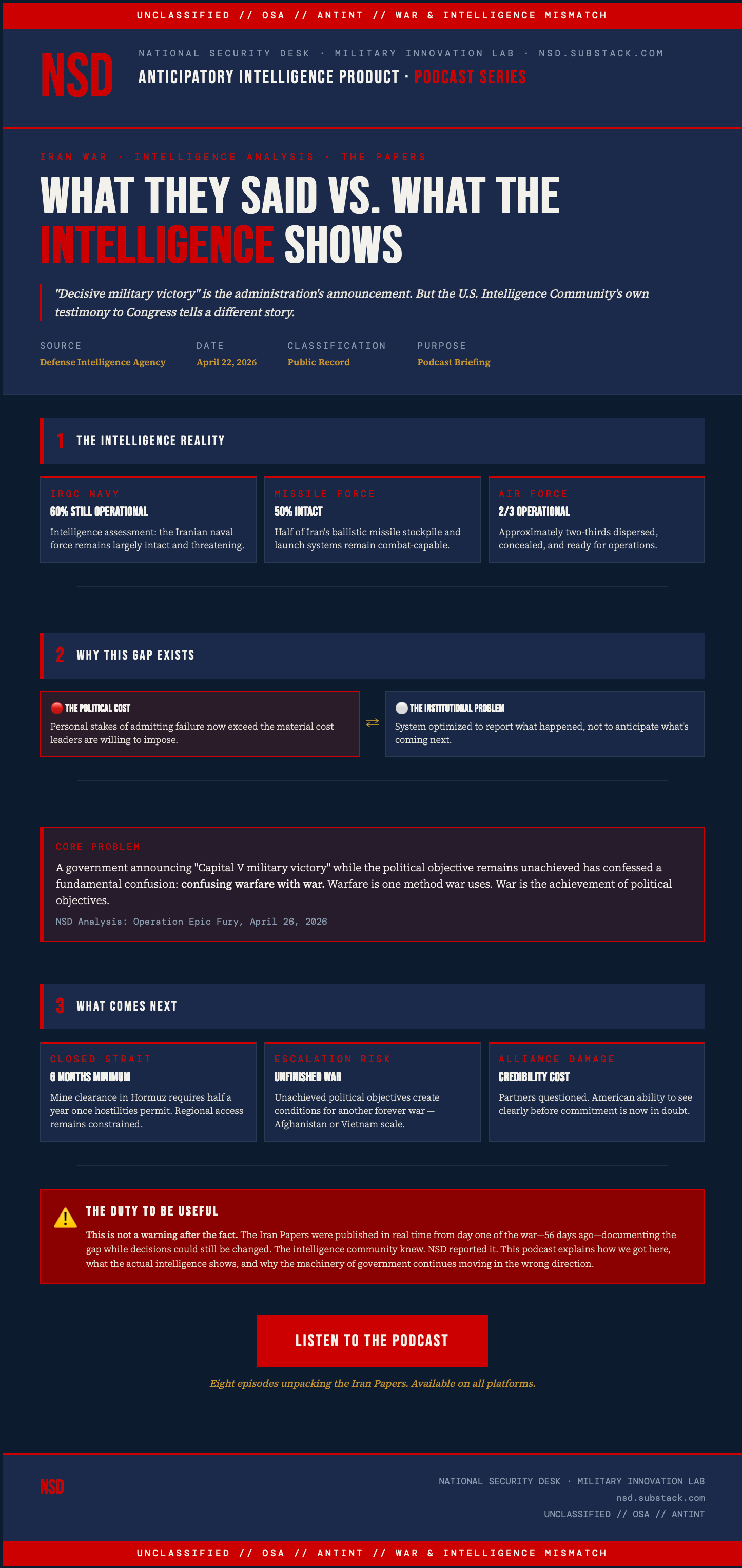 PODCAST DISCUSSION OF THE IRAN PAPERS - VOLUME II PODCAST DISCUSSION OF THE IRAN PAPERS - VOLUME II | WASHINGTON DC 26APL2026FULL REPORTThe National Security Desk offers these posts freely, but your support is necessary and appreciated. Please subscribe, paid if you’re able, or leave a tip.Thank you This is a public episode. If you would like to discuss this with other subscribers or get access to bonus episodes, visit nsdpodcasts.substack.com | 48m 56s | ||||||
| 4/22/26 | 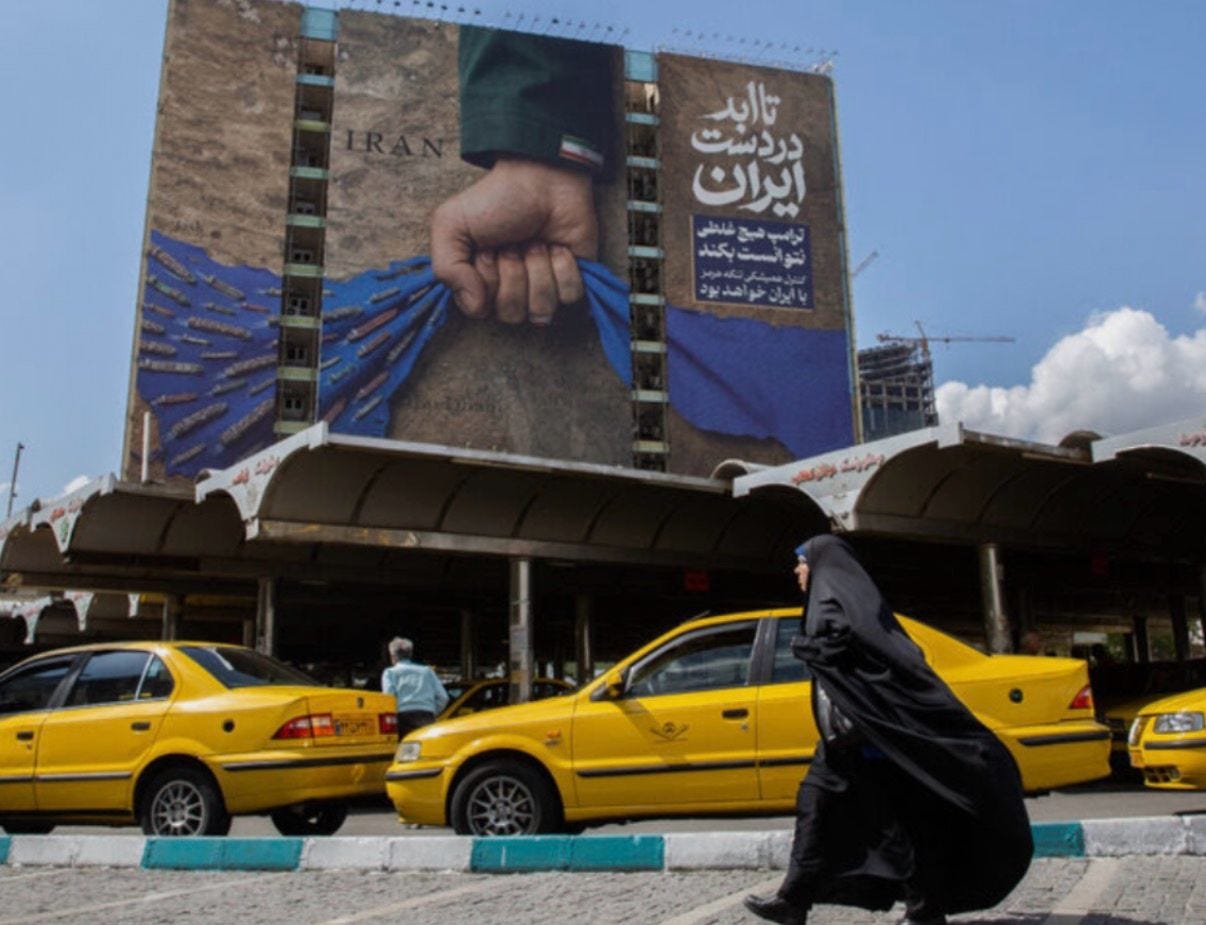 Blockade News 22 April 2026 Blockade News 22 April 2026 | “Control of the strait of hormuz will be iran’s forever” - billboards and banners like this all over Iran (H/T Ian Bremmer)WASHINGTON DC 22APL2026FULL REPORT HERE The National Security Desk offers these posts freely, but your support is necessary and appreciated. Please subscribe, paid if you’re able, or leave a tip.Thank you This is a public episode. If you would like to discuss this with other subscribers or get access to bonus episodes, visit nsdpodcasts.substack.com | 3m 14s | ||||||
| 4/21/26 | 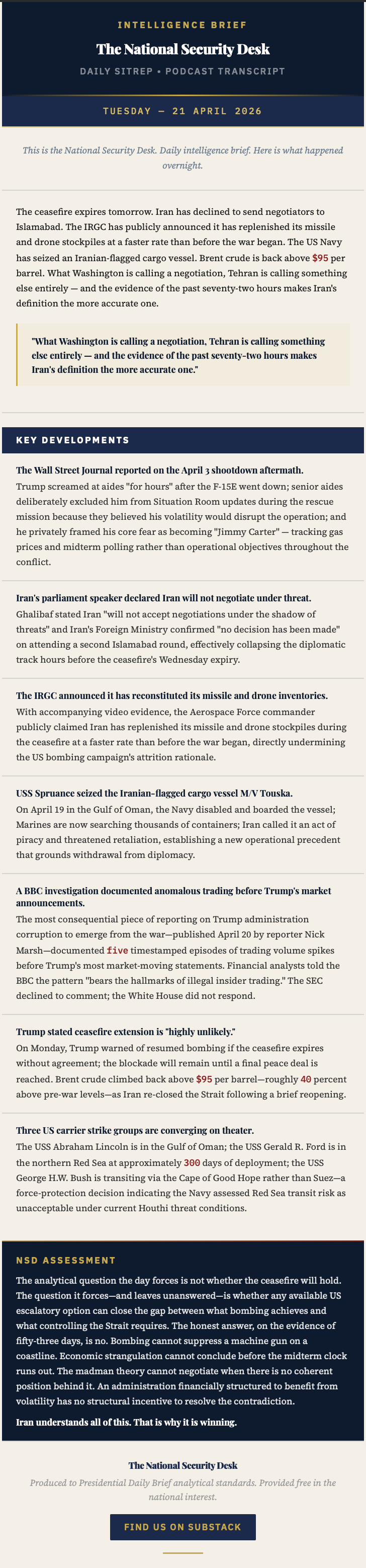 IRAN UPDATE 21 APRIL IRAN UPDATE 21 APRIL | WASHINGTON DC 21APL2026FULL REPORTThe National Security Desk offers these posts freely, but your support is necessary and appreciated. Please subscribe, paid if you’re able, or leave a tip.Thank you This is a public episode. If you would like to discuss this with other subscribers or get access to bonus episodes, visit nsdpodcasts.substack.com | 4m 02s | ||||||
| 4/16/26 | 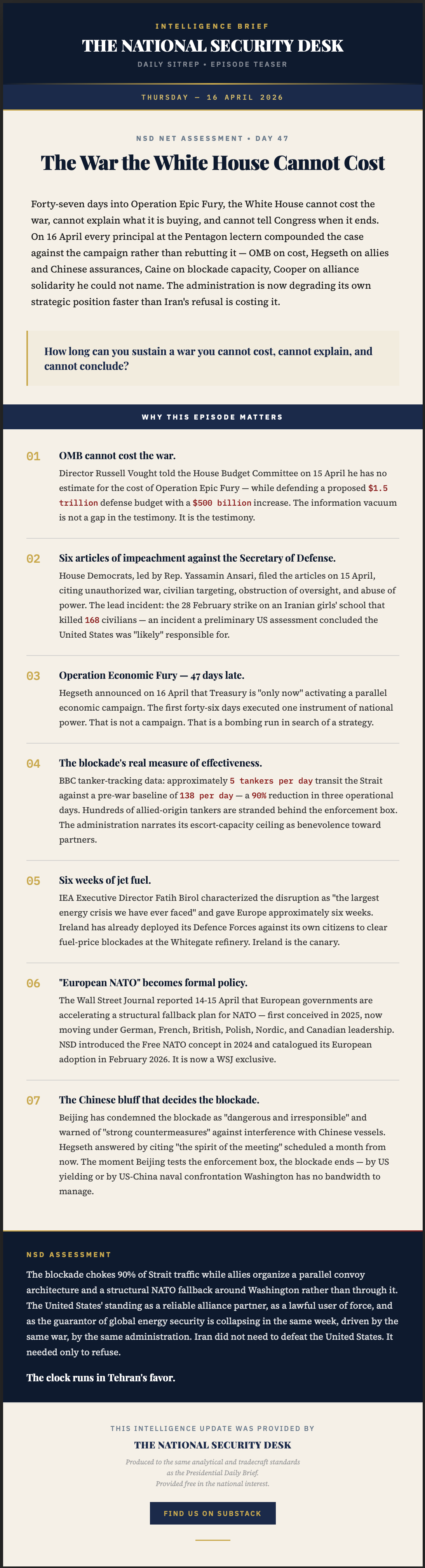 BLOCKADE NEWS 16 APRIL 2026 BLOCKADE NEWS 16 APRIL 2026 | WASHINGTON DC 16APL2026FULL ASSESSMENT HEREThe National Security Desk offers these posts freely, but your support is necessary and appreciated. Please subscribe, paid if you’re able, or leave a tip.Thank you This is a public episode. If you would like to discuss this with other subscribers or get access to bonus episodes, visit nsdpodcasts.substack.com | 3m 12s | ||||||
| 4/15/26 | 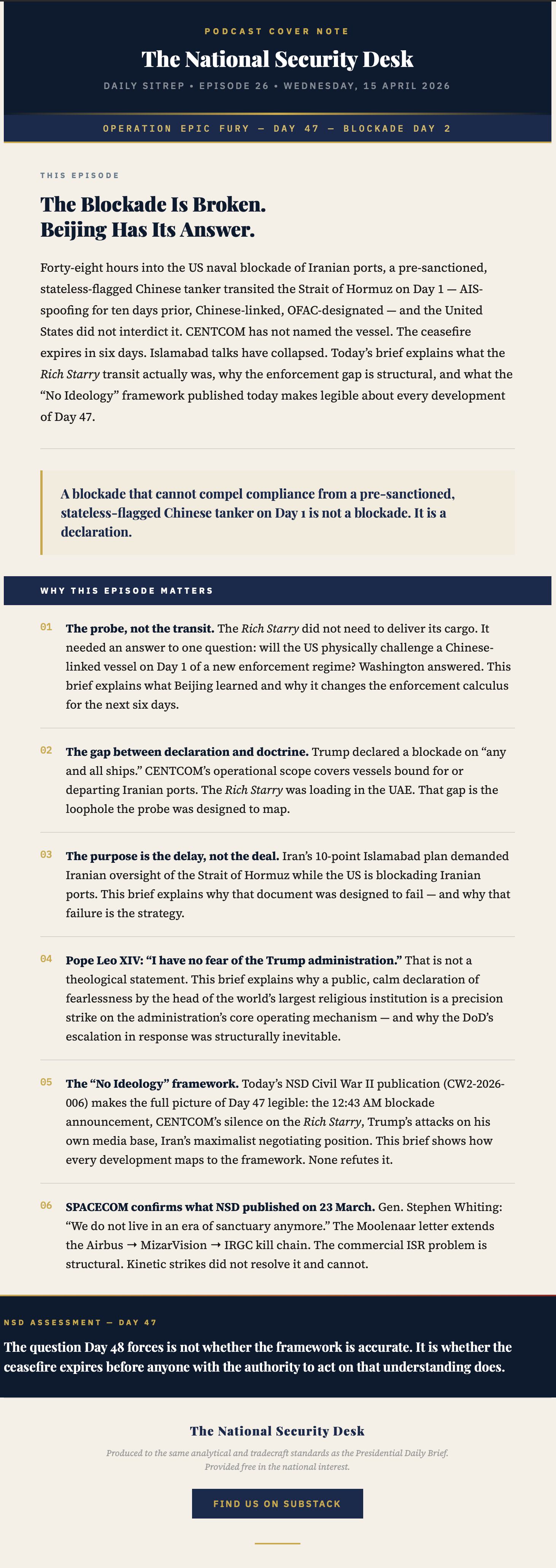 BLOCKADE NEWS 15APL2026 BLOCKADE NEWS 15APL2026 | WASHINGTON DC 15APL2026FULL REPORT HEREThe National Security Desk offers these posts freely, but your support is necessary and appreciated. Please subscribe, paid if you’re able, or leave a tip.Thank you This is a public episode. If you would like to discuss this with other subscribers or get access to bonus episodes, visit nsdpodcasts.substack.com | 3m 51s | ||||||
| 4/14/26 |  What if the World Just Ignores Trump? What if the World Just Ignores Trump? | WASHINGTON DC 14APL2026China is ignoring Trump. Saudi Arabia wants to ignore Trump. And the MAGA base is now ignoring — or openly attacking — Trump. When adversary, anchor ally, and domestic coalition reach the same calculation simultaneously, the question is no longer about the Iran campaign. It is about whether American strategic authority survives the answer.China’s Rich Starry transited Hormuz with Iranian-origin product while Beijing condemned the blockade as illegal. Washington did nothing. Every flag state with ships in the region watched. The cost of ignoring Trump was tested on Day 1 and validated. Saudi Arabia — the anchor of Trump’s May 2025 Gulf tour, the partner whose alignment was visible proof Washington had outcompeted Beijing — is now pressing for the blockade to be dropped entirely. MBS does not move on tactical disagreement. He moves when the strategic math has changed.The domestic fracture follows the same logic. Tucker Carlson called the war “the single biggest mistake any American president in my lifetime has made.” Alex Jones demanded 25th Amendment action on air. MTG called for removal. Joe Rogan, who endorsed Trump, says his audience feels betrayed. From the opposite flank, Levin and Bolton condemn him for settling short of regime change. There is no position Trump can occupy that satisfies both. His 482-word Truth Social response — calling critics “stupid people” and “losers” who are “not MAGA” — is a principal publicly arguing he still commands a coalition that has stopped following him.Three separate power centers. Three independent calculations. One shared conclusion.Why does this matter? Once the cost of ignoring a principal is openly demonstrated to be lower than the cost of obeying him — and validated by actors of this weight — the threshold does not reset. The episode examines what that calculus means not just for Hormuz, but for American strategic authority globally.Who should listen to this? Strategists modeling alliance cohesion under contested leadership; intelligence analysts tracking how domestic instability compounds operational credibility abroad; policy advisors whose planning still treats US deterrence posture as a stable input; and anyone assessing whether the Iran campaign caused this deterioration or merely made it undeniable.The National Security Desk offers these posts freely, but your support is necessary and appreciated. Please subscribe, paid if you’re able, or leave a tip.Thank you This is a public episode. If you would like to discuss this with other subscribers or get access to bonus episodes, visit nsdpodcasts.substack.com | 11m 23s | ||||||
| 4/14/26 | 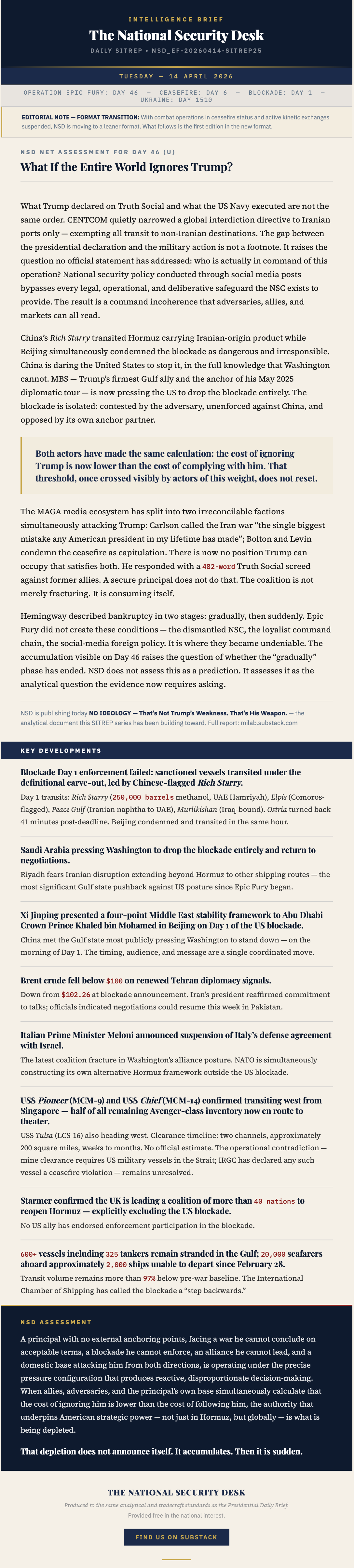 BLOCKADE BUSTING NEWS-14 APRIL BLOCKADE BUSTING NEWS-14 APRIL | WASHINGTON DC 14APL2026FULL REPORT HEREThe National Security Desk offers these posts freely, but your support is necessary and appreciated. Please subscribe, paid if you’re able, or leave a tip.Thank you This is a public episode. If you would like to discuss this with other subscribers or get access to bonus episodes, visit nsdpodcasts.substack.com | 3m 50s | ||||||
| 4/14/26 | 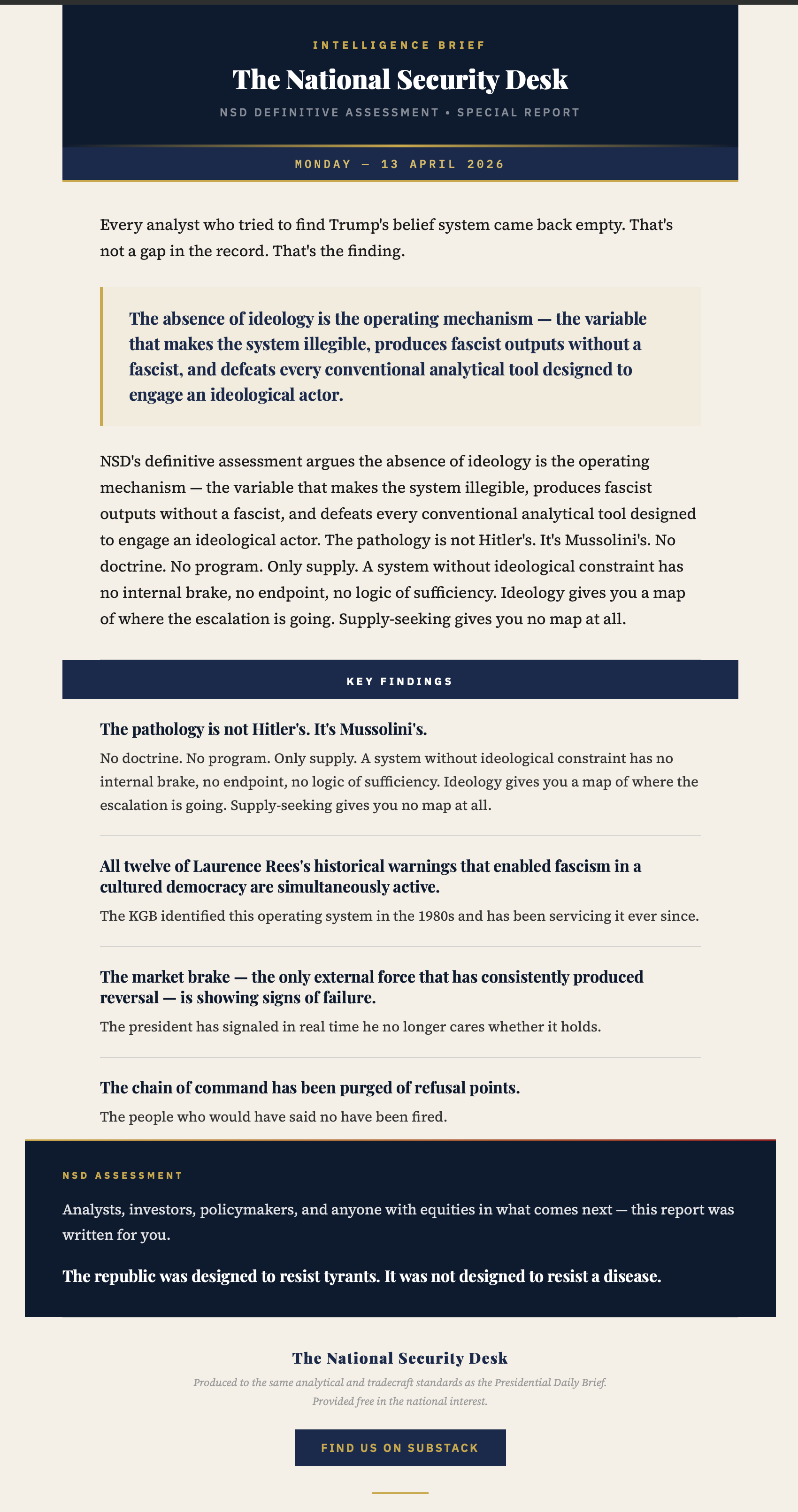 NO IDEOLOGY NO IDEOLOGY | WASHINGTON DC 13APL2026The National Security Desk offers these posts freely, but your support is necessary and appreciated. Please subscribe, paid if you’re able, or leave a tip.Thank you This is a public episode. If you would like to discuss this with other subscribers or get access to bonus episodes, visit nsdpodcasts.substack.com | 47m 28s | ||||||
| 4/13/26 |  WAR NEWS 13 APRIL WAR NEWS 13 APRIL | WASHINGTON DC 13APL2026FULL REPORT HEREThe National Security Desk offers these posts freely, but your support is necessary and appreciated. Please subscribe, paid if you’re able, or leave a tip.Thank you This is a public episode. If you would like to discuss this with other subscribers or get access to bonus episodes, visit nsdpodcasts.substack.com | 4m 26s | ||||||
| 4/12/26 |  TRUMP’S BLOCKADE MAKES EVERYTHING WORSE TRUMP’S BLOCKADE MAKES EVERYTHING WORSE | WASHINGTON DC 12APL2026Hours after peace talks collapsed in Islamabad, the president ordered a total naval blockade of the Strait of Hormuz — the waterway his own war was supposed to reopen — and claimed the right to board foreign-flagged vessels anywhere on earth. NSD assesses this is the most likely path chosen and the most catastrophic one available.NSD’s branches and sequels analysis maps six scenarios from the blockade declaration. The option Trump is most likely to pursue — total closure, universal interdiction — carries a 30% probability and produces a great-power confrontation worse than the Cuban Missile Crisis: no limited objective, no selectivity, no back-channel, no off-ramp. Chinese escorts are already in theater. China sails tanker convoys under warship escort through a Strait America claims to blockade, and Washington must either board a Chinese vessel or watch the blockade collapse on day one.Against this, NSD produces a strategic option no government agency or think tank has proposed. Scenario F: abandon the blockade, open the Strait for all traffic, and convert military presence from coercion into a guarantee of global energy security. This dissolves China’s reason to oppose Washington, restarts stranded oil flows, and reframes the narrative from aggressor to liberator. NSD assigns it 5% probability — the strongest logic paired with the least likely decision-maker.The capability gap compounds everything. Dedicated minesweepers were scrapped five weeks before the war. The two destroyers inside the Strait carry 90 missile cells each but zero mine-clearing systems, and Iran’s kill chain — Chinese targeting, Russian electronic warfare, Iranian fires — remains intact.Why does this matter? Every closure of the Strait — by Iran or by Washington — advances Tehran’s position. The blockade does not recover American leverage. It destroys it. The question is whether anyone between the president and the fleet commander can convert this order into something survivable.Who should listen to this? Naval strategists tracking magazine depth in contested chokepoints. Intelligence analysts assessing the Chinese-Russian-Iranian kill chain and Aegis survivability. Gulf policy specialists watching alignment shift toward Beijing. Anyone advising on Hormuz contingencies who has not seen the Scenario F option — because until this publication, it did not exist.FULL REPORT HEREThe National Security Desk offers these posts freely, but your support is necessary and appreciated. Please subscribe, paid if you’re able, or leave a tip.Thank you This is a public episode. If you would like to discuss this with other subscribers or get access to bonus episodes, visit nsdpodcasts.substack.com | 39m 13s | ||||||
Want analysis for the episodes below?Free for Pro Submit a request, we'll have your selected episodes analyzed within an hour. Free, at no cost to you, for Pro users. | |||||||||
| 4/11/26 | 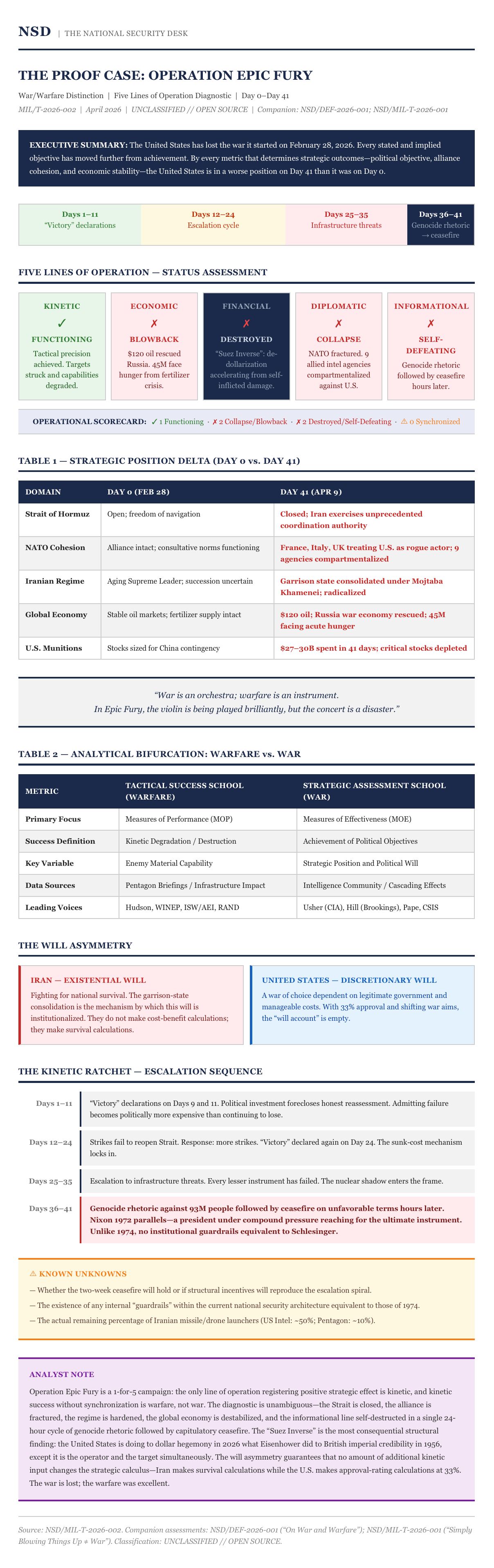 DEFEAT - US War Against Iran DEFEAT - US War Against Iran | WASHINGTON DC 11APL2026America has lost the war with Iran. That does not mean the war will end. The United States spent $27–30 billion, fired thousands of irreplaceable precision munitions, and killed the Supreme Leader — and every stated objective of Operation Epic Fury is further from achievement on Day 41 than it was on Day 0.This assessment dismantles the analytical divide defining the debate. One school — Hudson, WINEP, ISW/AEI — scores kinetic destruction and declares victory. The other — a former CIA Senior Intelligence Service officer, Brookings, Chicago, CSIS, the Realist tradition — applies the only standard that determines whether wars are won or lost: has the political objective been achieved? Their answer is unanimous.The campaign handed Iran something more powerful than the nuclear weapon it was launched to prevent. Before February 28, any vessel could transit the Strait of Hormuz freely under international law. Now Iran controls transit, charges tolls exceeding $1 million per ship, and selects who passes. A nuclear weapon is a deterrent you cannot use. The Strait is a weapon Iran uses every day. The cost-exchange ratio on interceptors runs 106-to-1 against the United States. The Pentagon claims 90% degradation of Iranian capability; U.S. intelligence assesses roughly half remains intact.NSD applies its five-line diagnostic — kinetic, economic, financial, diplomatic, informational — and finds one line functioning, four in collapse. The regime survived and consolidated. Nine allied intelligence agencies have compartmentalised against the U.S. executive branch. The president escalated from liberation rhetoric to genocide threats in six weeks, then accepted a ceasefire on unfavourable terms hours later. The sunk cost fallacy and what NSD calls the kinetic ratchet are now operating in tandem — an escalation spiral with no internal brake.Why does this matter? If you believe tactical destruction equals strategic success, this assessment identifies the exact analytical failure that produced that conclusion in Vietnam, Afghanistan, and Iraq — materialising now against a live campaign.Who should listen to this? Defence planners assessing U.S. readiness against China after massive munitions depletion. Intelligence analysts tracking the divergence between Pentagon claims and IC assessments. Arms control professionals evaluating whether the campaign created a more dangerous Iran. Congressional staff weighing the $200 billion supplemental against what it actually bought.FULL ASSESSMENT HEREThe National Security Desk offers these posts freely, but your support is necessary and appreciated. Please subscribe, paid if you’re able, or leave a tip.Thank you This is a public episode. If you would like to discuss this with other subscribers or get access to bonus episodes, visit nsdpodcasts.substack.com | 47m 34s | ||||||
| 4/10/26 |  WAR NEWS 10 APL WAR NEWS 10 APL | WASHINGTON DC 10APL2026FULL ASSESSMENT HEREThe National Security Desk offers these posts freely, but your support is necessary and appreciated. Please subscribe, paid if you’re able, or leave a tip.Thank you This is a public episode. If you would like to discuss this with other subscribers or get access to bonus episodes, visit nsdpodcasts.substack.com | 3m 32s | ||||||
| 4/9/26 | 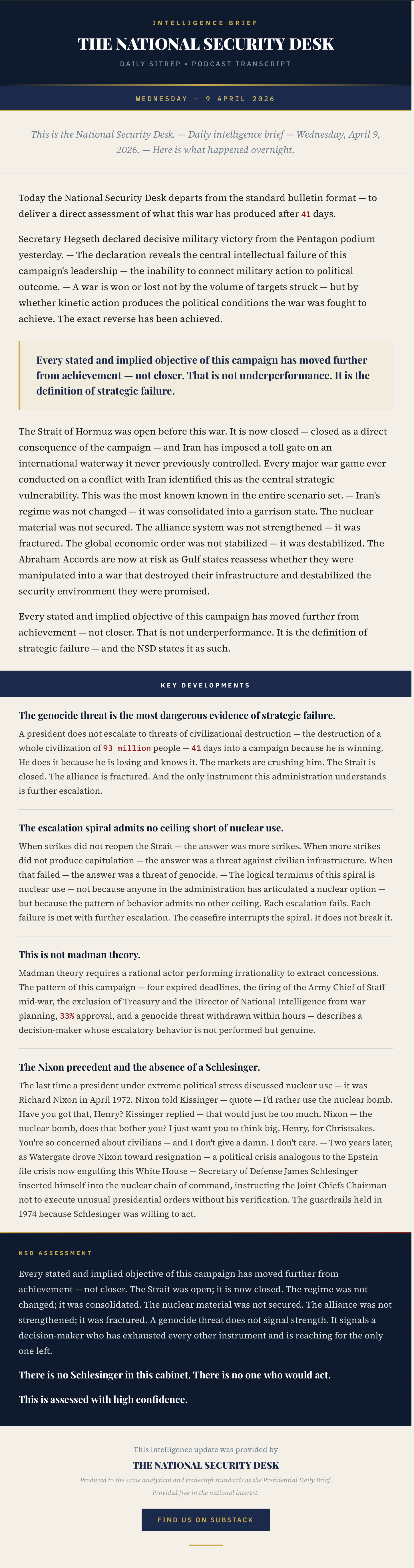 WAR NEWS COMMENTARY 9 APRIL WAR NEWS COMMENTARY 9 APRIL | WASHINGTON DC 09APL2026FULL REPORT HEREThe National Security Desk offers these posts freely, but your support is necessary and appreciated. Please subscribe, paid if you’re able, or leave a tip.Thank you This is a public episode. If you would like to discuss this with other subscribers or get access to bonus episodes, visit nsdpodcasts.substack.com | 4m 44s | ||||||
| 4/8/26 |  WAR NEWS SUMMARY 8 APRIL WAR NEWS SUMMARY 8 APRIL | WASHINGTON DC 2026FULL SITREP HEREThe National Security Desk offers these posts freely, but your support is necessary and appreciated. Please subscribe, paid if you’re able, or leave a tip.Thank you This is a public episode. If you would like to discuss this with other subscribers or get access to bonus episodes, visit nsdpodcasts.substack.com | 3m 24s | ||||||
| 4/8/26 |  PODCAST DISCUSSION - 25TH AMENDMENT PODCAST DISCUSSION - 25TH AMENDMENT | WASHINGTON DC 7APR2026Nine years of warnings exposed a pattern no one wanted to name — until every ring of institutional trust broke on the same day.NSD’s complete record tracks five concentric rings of credibility collapse around the Trump presidency: former officials, GOP politicians, allied governments, allied intelligence agencies, and the MAGA base itself. Each ring broke at a higher threshold than the last, and none reconsolidated after breaking. The April 7, 2026 nuclear threat against Iranian civilian infrastructure is the first moment in this nine-year arc where all five rings entered simultaneous alarm — from Marjorie Taylor Greene calling for the 25th Amendment to Five Eyes partners classifying the United States as a security risk.The former-officials ring is the deepest and most damning. Nineteen people who served inside the Trump White House — including four four-star generals, two Secretaries of Defense, and a Secretary of State — have publicly labeled him fascist, unfit, or dangerous. John Kelly confirmed Trump praised Hitler. Mark Milley called him “the most dangerous person ever to this country.” These are not partisan opponents; they are the people Trump himself selected.The intelligence ring is the most structurally consequential. Eight allied agencies have either designated the US a formal security risk, reduced intelligence sharing with American counterparts, or erected compartmentalized barriers against the US executive branch. New Zealand’s NZSIS now categorises “Trumpism” alongside Chinese and Iranian political-warfare operations. The foundational architecture of Western intelligence cooperation has been functionally severed — not by an adversary, but by the alliance’s leading member.What makes April 7 different from January 6 is the MAGA ring. The base held through every prior crisis. It took an explicit threat of nuclear strikes on a civilian population to fracture it — and when it broke, it broke fast: Greene, Alex Jones, Candace Owens, and Anthony Scaramucci all called for removal within hours.Why does this matter? If you believe the institutional guardrails around the presidency are intact, this record dismantles that assumption ring by ring. The question is no longer whether the warnings were issued — it is why the constitutional mechanism every faction now demands has not been activated.Who should listen to this? Alliance managers tracking Five Eyes and NATO cohesion, intelligence professionals navigating compartmentalization protocols with US counterparts, congressional staffers assessing 25th Amendment mechanics, and anyone whose strategic planning still assumes a functioning US interagency process.FULL REPORTThe National Security Desk offers these posts freely, but your support is necessary and appreciated. Please subscribe, paid if you’re able, or leave a tip.Thank you This is a public episode. If you would like to discuss this with other subscribers or get access to bonus episodes, visit nsdpodcasts.substack.com | 13m 06s | ||||||
| 4/7/26 |  THREATENING GENOCIDE IS A CRIME THREATENING GENOCIDE IS A CRIME | WASHINGTON DC 7APL2026The President of the United States threatened to erase a civilization on a public platform — and under the ICJ’s 1996 Advisory Opinion and the Genocide Convention, the threat itself is already a crime, complete at the moment of utterance, whether a weapon falls or not.This episode disassembles the legal, operational, and behavioral architecture surrounding the statement “a whole civilization will die tonight.” The analysis establishes that the conventional ceiling against Iran’s deepest nuclear facilities has been reached: the MOP inventory is depleted, Pickaxe Mountain sits under granite beyond any conventional weapon’s penetration capability, and replacement munitions will not arrive until January 2028. Three options remain — a commando raid 480 kilometers inland through an active warzone, acceptance of entombed uranium, or a tactical nuclear weapon. U.S. defense officials have assessed the third as the only guarantee.The episode then surfaces the contradiction that collapses the institutional case for nuclear use against buried nuclear sites: the weapon’s own fission products — cesium-137, strontium-90, iodine-131 — would generate orders of magnitude more radiation than the uranium being targeted. The bomb designed to solve the nuclear problem becomes the nuclear problem. The only targeting logic that survives is punitive.That finding opens the episode’s most consequential analytical move: the separation of institutional targeting logic from behavioral targeting logic. Thirty-nine days of documented escalation show a pattern directed not at military-strategic targets but at the people and institutions that refuse to submit. The behavioral trajectory does not point at a mountain facility in the desert. It points at Tehran. The most dangerous scenario is the one in which the punitive impulse is laundered through the institutional vocabulary of deeply buried targets and conventional limits — a decision made for one reason and explained by another.Why does this matter? If you assess nuclear employment probability using Cold War deterrence assumptions — mutual assured destruction, rational-actor models, institutional constraints — you are measuring with a ruler built for a different problem. None of those conditions apply here. The episode forces a recalibration.Who should listen to this? Nuclear command authority specialists evaluating the Colangelo/Kehler legal framework for order refusal. Arms control professionals tracking post-New START proliferation dynamics. Intelligence analysts assessing whether behavioral pattern analysis should override institutional-rational targeting assumptions. Military officers in the chain of command between a presidential order and a launch mechanism.FULL ASSESSMENT HEREThe National Security Desk offers these posts freely, but your support is necessary and appreciated. Please subscribe, paid if you’re able, or leave a tip.Thank you This is a public episode. If you would like to discuss this with other subscribers or get access to bonus episodes, visit nsdpodcasts.substack.com | 21m 01s | ||||||
| 4/7/26 | 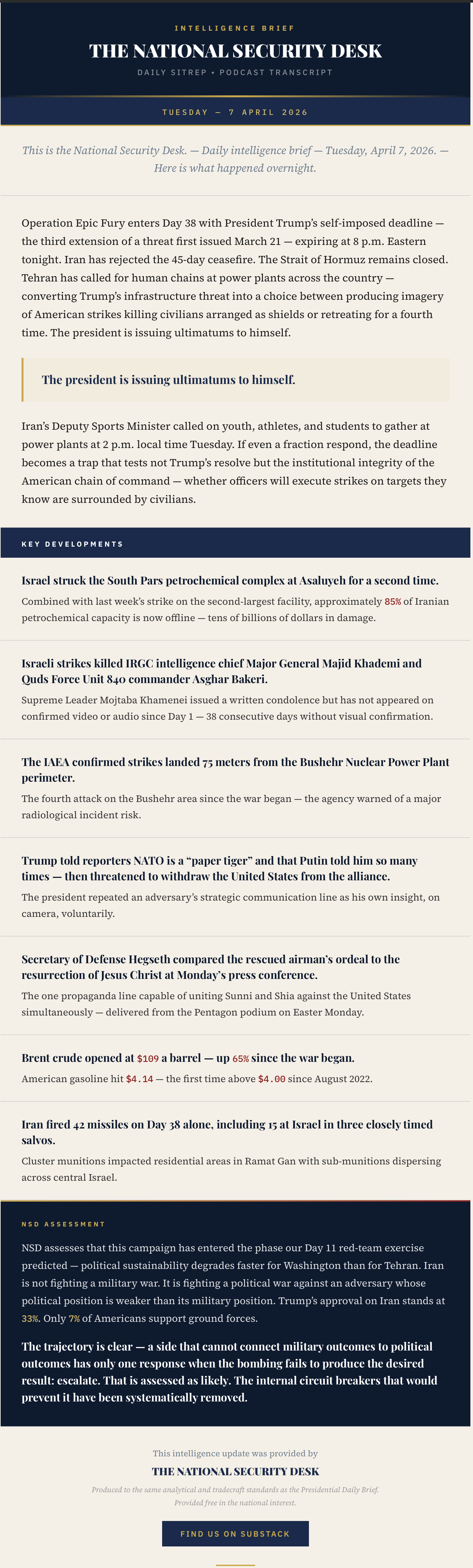 NEWSCAST 7 APRIL 2026 NEWSCAST 7 APRIL 2026 | WASHINGTON DC 07APRIL2026FULL ASSESSMENT HEREThe National Security Desk offers these posts freely, but your support is necessary and appreciated. Please subscribe, paid if you’re able, or leave a tip.Thank you This is a public episode. If you would like to discuss this with other subscribers or get access to bonus episodes, visit nsdpodcasts.substack.com | 4m 06s | ||||||
| 4/6/26 |  PODCAST DISCUSSION: TACTICAL NUCLEAR WEAPON USE IN IRAN INDICATED AS POSSIBLE PODCAST DISCUSSION: TACTICAL NUCLEAR WEAPON USE IN IRAN INDICATED AS POSSIBLE | WASHINGTON DC Inside the episodeTwo non‑expert voices — standing in for the thoughtful, politically awake citizen — work through the core questions that define this moment:* How “Praise be to Allah” on Easter Sunday became a strategic gift to the IRGC* Why domestic opposition inside Iran has been crippled by U.S. behavior* How a collapsing U.S. presidency creates nuclear‑use incentives no adversary can deter* What “no visible ceiling” means in escalation theory when the president is losing politically* Why regime change is now more plausible in Washington than in Tehran* How tactical nuclear use becomes thinkable when the decision‑maker sees no consequences that matter to himThis isn’t an expert panel. It’s two ordinary Americans trying to make sense of extraordinary danger — and discovering, step by step, that the logic of the war is inseparable from the logic of a presidency in freefall.---Who should listenThis episode is designed for anyone who feels the ground shifting beneath American politics and wants a clear, unvarnished explanation of why.🎧 National‑security professionalsBecause the escalation dynamics described here — especially the absence of mutual assured destruction — represent the most volatile nuclear‑risk environment since the early Cold War.🎧 Policy thinkers and analystsBecause the episode dissects how strategic communication, domestic legitimacy, and nuclear incentives intersect when a president enters a regime‑survival phase.🎧 Journalists and political observersBecause the story unfolding is not just about Iran. It’s about the fragility of American decision‑making under a leader whose incentives no longer align with national interests.🎧 Concerned citizensBecause the stakes are no longer abstract. They are immediate, measurable, and visible in the president’s own words.🎧 Anyone who senses something is deeply wrongBecause this episode gives language, structure, and analytic clarity to the unease many people feel but can’t yet articulate.The National Security Desk offers these posts freely, but your support is necessary and appreciated. Please subscribe, paid if you’re able, or leave a tip.Thank you This is a public episode. If you would like to discuss this with other subscribers or get access to bonus episodes, visit nsdpodcasts.substack.com | 18m 29s | ||||||
| 4/6/26 |  NEWS - MONDAY 6 APRIL NEWS - MONDAY 6 APRIL | WASHINGTON DC 6APL2026 FULL REPORTThe National Security Desk offers these posts freely, but your support is necessary and appreciated. Please subscribe, paid if you’re able, or leave a tip.Thank you This is a public episode. If you would like to discuss this with other subscribers or get access to bonus episodes, visit nsdpodcasts.substack.com | 3m 51s | ||||||
| 4/3/26 |  NEWSCAST 4 mins: SITREP 18 NEWSCAST 4 mins: SITREP 18 | WASHINGTON DC 03APL2026Trump conceded Iran’s most powerful weapon without firing a shot — and the coalition meant to take it back is already fracturing from the inside.On Day 35 of Operation Epic Fury, the center of gravity shifted from kinetic strikes to something the Pentagon has no doctrine for: Iran is running a diplomatic counter-offensive through the Strait of Hormuz, and it is working. Tehran has signed bilateral passage deals with at least seven nations, converting the chokepoint it seized on February 28 into a loyalty test that pays countries to abandon Washington’s position. The forty-nation coalition the UK convened to address the Strait is being hollowed out before it can act. The United States did not attend the summit. Brent crude closed above one hundred and nine dollars.The president told allies to retake the Strait themselves — a position France publicly rejected as unrealistic, with Macron accusing Trump of hollowing out NATO through daily contradictions. Spain and Italy have now closed airspace to US aircraft conducting Iran operations, turning allied access denial from diplomatic protest into a structural logistics constraint on the campaign itself. The UN Security Council postponed its vote on authorizing defensive force after Iran’s foreign minister warned against provocation. No new date is set.Meanwhile, Trump was briefed on a special operations plan to seize nine hundred and seventy pounds of highly enriched uranium from underground Iranian facilities. The operation would require weeks to months of sustained ground presence — the exact commitment profile the president’s political timeline cannot absorb. The critical question is not whether the plan exists but whether Trump has authorized execution. That single decision separates a contained air campaign from an open-ended ground war.The Pentagon continues to signal escalation logistics: a carrier strike group departed Norfolk, eighteen A-10s are deploying to Central Command, and the 31st Marine Expeditionary Unit has arrived in theater. The same week, Hegseth fired the Army Chief of Staff and two generals — reportedly after resistance to blocking officer promotions — replacing senior leadership mid-campaign with commanders drawn from units now deploying to the fight.Why does this matter? Trump has surrendered the Strait of Hormuz — Iran’s primary economic leverage — while claiming victory on the military front. If your operating assumption is that the air campaign is producing strategic results, this episode forces you to reconcile that belief with the fact that Iran’s most consequential weapon is now stronger than it was on Day 1, and the coalition meant to counter it is being dismantled by Tehran’s deal-making faster than Washington can respond.Who should listen to this? Strategic planners tracking the gap between kinetic campaign metrics and political outcomes. Energy security analysts modeling Hormuz disruption scenarios. NATO alliance managers watching real-time cohesion failure. Intelligence officers assessing whether the nuclear seizure mission has moved from briefing to authorization. Anyone whose planning assumptions depend on this war staying short.FULL REPORTThe National Security Desk offers these posts freely, but your support is necessary and appreciated. Please subscribe, paid if you’re able, or leave a tip.Thank you This is a public episode. If you would like to discuss this with other subscribers or get access to bonus episodes, visit nsdpodcasts.substack.com | 3m 39s | ||||||
| 4/2/26 | 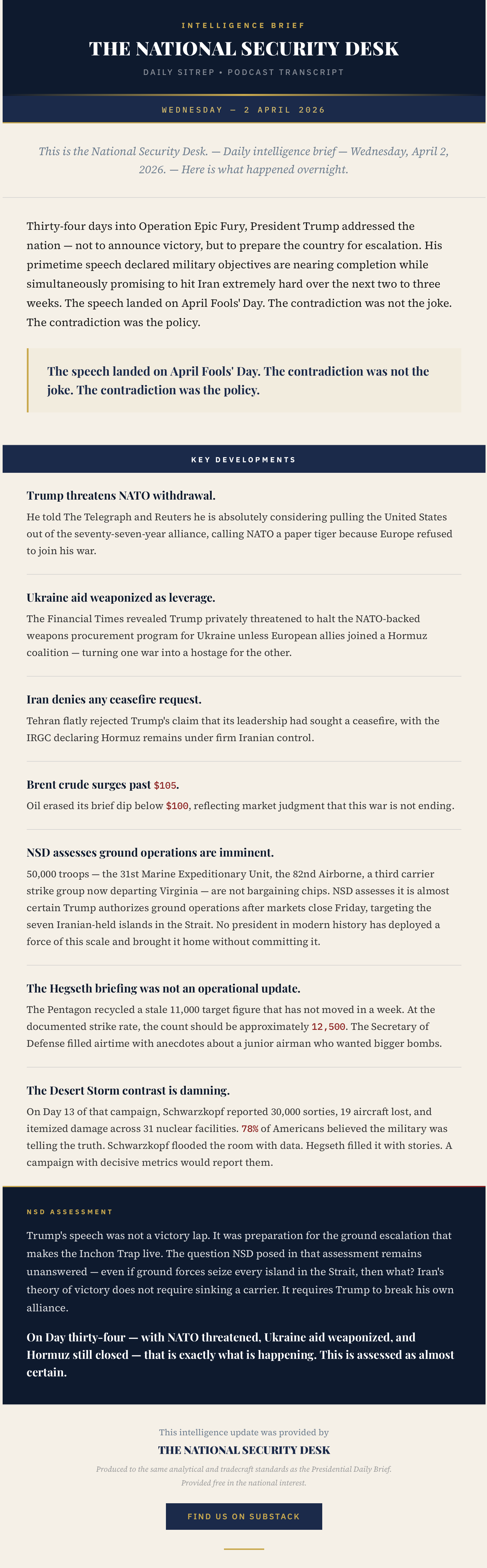 NEWSCAST - SITREP 17 NEWSCAST - SITREP 17 | WASHINGTON DC 02APL2026Trump Broke His Own Alliance Day 34: The IRGC didn’t need to sink a carrier.Fifty thousand troops in theater. Three carrier strike groups. The 82nd Airborne. The 31st MEU with full amphibious assault capability.And on April Fools’ Day, the president threatened to pull out of NATO.Iran fired its largest missile barrage in weeks — on Passover Seder night. Cluster warheads hit Bnei Brak. Two seven-month-old infants wounded.The Strait of Hormuz remains closed. Brent crude back above $105. Gulf loadings collapsed 74% in March.Trump promised to bring Iran back to the Stone Age in two to three weeks — while telling Reuters there’s no reason for us to do this.A third carrier just departed Virginia. The Pentagon recycled a stale target count from a week ago. Hegseth filled his briefing with troop anecdotes instead of operational metrics.Ukraine aid is now leverage for a Hormuz coalition nobody is joining.What the air campaign destroyed, what it didn’t, and why a ground escalation after Friday close is almost certain.These wars are converging. The alliance is fracturing under American pressure, not Iranian.If you track energy markets, alliance politics, force posture, or the strategic logic that turns air campaigns into ground wars — this is the brief that tells you what’s actually happening before the headlines catch up.FULL SITREPPresidential Daily Brief-level intelligence. Open source. Free. Subscribe and stay ahead of the cycle. Subscribe to the NSD SITREP: Subscribe to the NSD Podcast: The National Security Desk offers these posts freely, but your support is necessary and appreciated. Please subscribe, paid if you’re able, or leave a tip.Thank you This is a public episode. If you would like to discuss this with other subscribers or get access to bonus episodes, visit nsdpodcasts.substack.com | 3m 36s | ||||||
| 4/2/26 |  PODCAST DISCUSSION: Simply Blowing Things Up ≠ WAR PODCAST DISCUSSION: Simply Blowing Things Up ≠ WAR | WASHINGTON DC 02APL2026No stated war aim of Operation Epic Fury has survived 48 hours without being contradicted — by the same officials who stated it.Thirty-one days into the largest US military operation since Iraq, the public record reveals something more consequential than battlefield outcomes: the complete absence of a governing political objective. NSD tracked every publicly stated war aim by every named official across the full first month of Operation Epic Fury. The findings are unambiguous. The operation has been simultaneously presented as a counter-proliferation strike, a regime-change war, a resource-seizure campaign, a maritime enforcement action, and a coercive negotiation tool — often within the same news cycle, often by the same people.The analytical centrepiece is a distinction most commentary ignores: the difference between war and warfare. War synchronises kinetic, economic, diplomatic, financial, and informational lines of action toward a single political purpose. Warfare is organised force along one line. Only the kinetic line of Operation Epic Fury functions with any coherence. The diplomatic line contradicts itself daily. The informational line is chaos. The economic line is generating blowback. By NSD’s framework, this is warfare — not war. It is destruction disconnected from political logic.The 11,000-strike figure the administration cites as its primary success metric has no denominator. No official has stated the total target set, the percentage struck, the percentage remaining, or the effect produced beyond the strike itself. That number sits four levels of abstraction from anything connected to a political outcome — and it is the only metric on offer.One day before the strikes began, Oman announced a diplomatic breakthrough: Iran had agreed to halt enrichment, accept full IAEA verification, and irreversibly downgrade its enriched material. The strikes destroyed that track hours later. Meanwhile, Iran’s parliamentary speaker publicly advised investors to treat presidential announcements as reverse indicators — and was proven correct within hours when a $3 trillion market-cap swing followed a single Trump statement.Why does this matter? If you believe Operation Epic Fury is succeeding because the strike counts are impressive, this assessment dismantles that assumption at the structural level. The question it forces is not whether the US can destroy Iranian military assets — it can — but whether destruction without a stable political objective, a defined end state, or synchronised lines of action constitutes anything recognisable as strategy. The answer determines whether this operation resolves or escalates.Who should listen to this? Defence planners evaluating campaign coherence against Clausewitzian fundamentals. Intelligence analysts tracking the gap between stated objectives and observable outcomes. Policy advisors assessing whether the administration’s coercive signalling retains any credibility for future crises. Strategic communicators watching threat credibility degrade in real time. Anyone whose professional judgment depends on distinguishing kinetic activity from political progress.Full Report HereThe National Security Desk offers these posts freely, but your support is necessary and appreciated. Please subscribe, paid if you’re able, or leave a tip.Thank you This is a public episode. If you would like to discuss this with other subscribers or get access to bonus episodes, visit nsdpodcasts.substack.com | 22m 59s | ||||||
| 4/1/26 |  On War and Warfare On War and Warfare | WASHINGTON DC 2026ABSTRACTThis paper presents a comprehensive definitional framework for war and warfare, establishing that war is the pursuit of a political objective sustained by political will, while warfare is the operational activity conducted in its service. The framework identifies political will — generated by the legitimacy of government, cause, and conduct — as the governing variable that determines whether wars are won or lost, regardless of material superiority. It disaggregates war into five simultaneous lines of operation (kinetic, economic, financial, diplomatic, informational) and five modes of warfare ordered by escalation logic (deception, dissuasion, coercion, compellence, escalation), treating violence as a variable along a continuum rather than a binary. The paper argues that American strategic failure is structural rather than contingent: a recurring “kinetic trap” in which the United States substitutes one form of warfare for the entirety of war, measuring success by destruction rather than political achievement. It extends Clausewitz’s foundational insight into a modern operational architecture that includes the nation/state distinction, the constitutional foundation of American will, the innovation asymmetry between existential and discretionary combatants, credibility as finite currency, time as a strategic variable, an expanded Powell Doctrine with NSD additions, a complexity gradient matching means to ends, a cognitive bias catalog explaining why known lessons go unlearned, and the concept of sovericide — the terminal condition in which a government’s war against its own constitutional foundations renders it incapable of waging coherent war abroad. The framework is applied to the current American strategic environment, concluding that the failure is not military but political: a government at war with its founding principle cannot generate the national will to sustain war.FULL REPORT HEREThe National Security Desk offers these posts freely, but your support is necessary and appreciated. Please subscribe, paid if you’re able, or leave a tip.Thank you This is a public episode. If you would like to discuss this with other subscribers or get access to bonus episodes, visit nsdpodcasts.substack.com | 19m 46s | ||||||
| 4/1/26 |  PODCAST DISCUSSION: IRAN Magazine Depth - NSD Validated PODCAST DISCUSSION: IRAN Magazine Depth - NSD Validated | WASHINGTON DC 1APL2026An independent open-source publication diagnosed the structural failure mode of a $25 billion air campaign three days before five intelligence sources confirmed it to Reuters. The four days since have produced nothing but additional validation.On March 24, NSD published an assessment that the Pentagon’s 90 percent suppression claim measured the wrong thing — opening-day surge volume instead of confirmed arsenal destruction. On March 27, Reuters reported U.S. intelligence can verify destruction of roughly one-third of Iran’s missile arsenal. That is a threefold gap between the public narrative and the classified reality, and the Pentagon knew while its spokespeople repeated the higher figure on camera.The structural floor NSD identified on Day 18 — the band within which Iranian launch capacity oscillates but does not collapse — is now the defining feature of Day 31. Iran fired 15 ballistic missiles at the UAE on Day 27 alone. On Day 28, an Iranian strike on Prince Sultan Air Base damaged U.S. refueling aircraft and an E-3 Sentry, injuring 29 soldiers. On Day 29, Houthis opened a new axis of fire against Israel. On Day 30, the UAE intercepted 16 ballistic missiles and 42 drones in a single engagement. The campaign did not break through the floor. It is living on it.The underground problem NSD flagged as the central variable — Known Unknowns KU-5 and KU-6 — is now the intelligence community’s own operating uncertainty. More than a dozen large underground facilities remain unassessed. Tunnel entrances have been struck; whether the tunnels themselves have collapsed is epistemic dark space. NSD framed this as a hypothesis on March 24. The IC is living it as an unanswered question on March 31.The most consequential concession came from the administration itself. The White House has abandoned reopening the Strait of Hormuz as a war objective — the waterway through which 20 percent of global daily oil supply once transited. The President publicly articulated the logic NSD laid out a week earlier: even near-total suppression does not solve the Strait problem. The administration is no longer extending deadlines. It is rewriting what winning means.Why does this matter?If you believe the campaign is working because the Pentagon says it is, this episode dismantles that position with the Pentagon’s own data. If you believe open-source analysis cannot compete with classified intelligence, the timeline disproves it. The method that produced NSD’s assessment — and the method that failed to make the classified version public — are both laid bare. One of them is broken, and it is not the one operating from a single desk.Who should listen to this?Intelligence analysts questioning why assessments they hold internally are not constraining public narrative. Defence planners modelling campaign culmination points against dispersed, tunnelled adversaries. Procurement officials evaluating whether the F3K kill chain has reached its practical ceiling. Journalists covering Pentagon briefings who need the analytical framework to distinguish performance metrics from effectiveness metrics. Anyone whose job requires knowing whether this war is being won — and who has noticed the answer keeps changing.FULL REPORT HEREThe National Security Desk offers these posts freely, but your support is necessary and appreciated. Please subscribe, paid if you’re able, or leave a tip.Thank you This is a public episode. If you would like to discuss this with other subscribers or get access to bonus episodes, visit nsdpodcasts.substack.com | 16m 09s | ||||||
| 4/1/26 |  PODCAST DISCUSSION - Iran Still Has Enough Uranium for Ten Nuclear Bombs PODCAST DISCUSSION - Iran Still Has Enough Uranium for Ten Nuclear Bombs | WASHINGTON DC 1APL2026Four hundred and forty-one kilograms of uranium enriched to 60% purity — enough for ten nuclear weapons — survived Operation Midnight Hammer. The administration that claimed total obliteration knew within seventy-two hours that it hadn’t worked.Most of that material is now sealed inside Isfahan’s tunnel complex, deliberately backfilled by Iranian engineers, inaccessible to both the IAEA and the weapons that were supposed to destroy it. Unknown quantities may have been moved to Pickaxe Mountain, a granite bunker buried deeper than any munition in the U.S. arsenal can reach. The agency that once verified Iran’s compliance hasn’t inspected a single bombed site since June 2025. Nobody — not Washington, not the IAEA, not Israeli intelligence — can say with confidence where all the fissile material is.The policy thread that produced this situation is traceable to a single decision. The JCPOA held Iran’s stockpile at 300 kilograms enriched to 3.67%, under the most intensive inspection regime in arms control history. The 2018 withdrawal removed those constraints. By June 2025, Iran had accumulated 441 kilograms at 60% — a level at which 99% of the separative work toward weapons-grade is already done. The strikes were supposed to fix that. They didn’t destroy the material. The second war, launched during Ramadan while negotiations were reportedly producing movement, has made things measurably worse on every axis.The CWMD ground mission now being floated as the only remaining option is not the commando raid the public has been sold. CNN reported it would require a significant conventional ground force. The material is stored as pressurized uranium hexafluoride — a single breached cylinder produces hydrogen fluoride gas lethal in an enclosed space. Iranian engineers have deployed potentially thousands of dummy containers. The IRGC unit guarding the sites has indicated it will treat any raid as existential. Former officials with decades of material-recovery experience have called successful extraction “nearly impossible.”Meanwhile, Iranian hardliners are now openly demanding NPT withdrawal and a nuclear weapon — positions that were taboo six months ago. The two figures who most constrained that impulse, Khamenei and Ali Larijani, are both dead. The IRGC now dominates nuclear decision-making with no institutional counterweight.Why does this matter?If you believe the air campaign solved the Iran nuclear problem, this discussion dismantles that assumption with the administration’s own intelligence. If you believe the ground option can still retrieve the situation, the force-protection arithmetic and hazard profile presented here will change your calculation. The window between a scattered, uninspected stockpile and a weaponization decision is closing, and the tools that were supposed to prevent this — inspections, then bombs — have both failed.Who should listen to this?Defence planners evaluating the feasibility of a CWMD ground campaign in Iran. Intelligence analysts tracking Iranian fissile material location and weaponization indicators. Arms control professionals assessing what a post-JCPOA verification regime could look like. Policymakers and staffers working the Iran file who need to distinguish between the administration’s stated position and the operational reality behind it. Anyone whose professional judgment depends on the question of whether two military campaigns have made a nuclear-armed Iran more likely, not less.Full Report HereThe National Security Desk offers these posts freely, but your support is necessary and appreciated. Please subscribe, paid if you’re able, or leave a tip.Thank you This is a public episode. If you would like to discuss this with other subscribers or get access to bonus episodes, visit nsdpodcasts.substack.com | 12m 38s | ||||||
Showing 25 of 58
Sponsor Intelligence
Sign in to see which brands sponsor this podcast, their ad offers, and promo codes.
Chart Positions
2 placements across 2 markets.
Chart Positions
2 placements across 2 markets.