Insights from recent episode analysis
Audience Interest
Podcast Focus
Publishing Consistency
Platform Reach
Insights are generated by CastFox AI using publicly available data, episode content, and proprietary models.
Most discussed topics
Brands & references
Est. Listeners
Based on iTunes & Spotify (publisher stats).
- Per-Episode Audience
Est. listeners per new episode within ~30 days
25,001 - 50,000 - Monthly Reach
Unique listeners across all episodes (30 days)
25,001 - 75,000 - Active Followers
Loyal subscribers who consistently listen
15,001 - 40,000
Market Insights
Platform Distribution
Reach across major podcast platforms, updated hourly
Total Followers
—
Total Plays
—
Total Reviews
—
* Data sourced directly from platform APIs and aggregated hourly across all major podcast directories.
On the show
From 1 epsHosts
Not detected.
Recent guests
Recent episodes
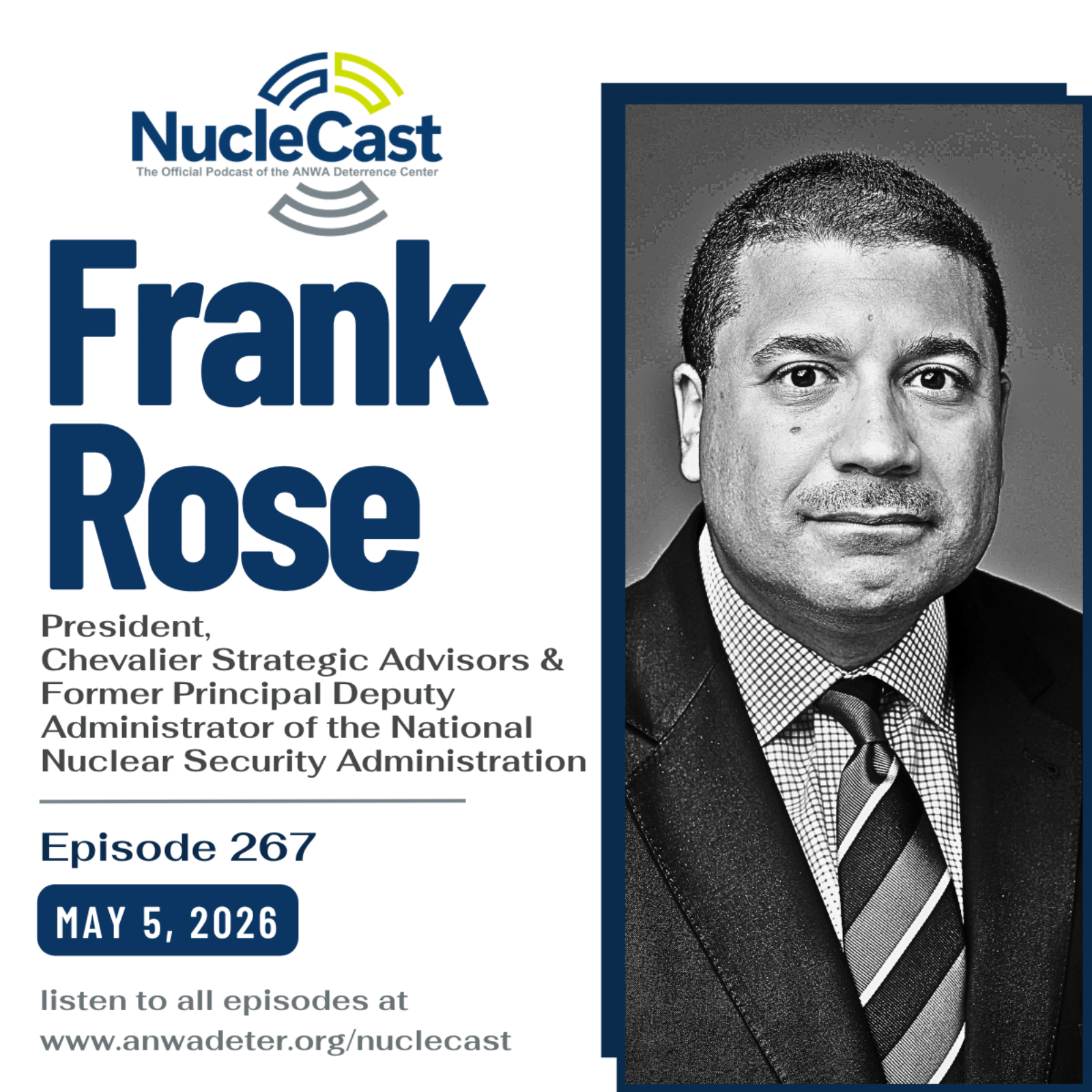
Frank Rose: Reimagining Arms Control for the 21st Century
May 5, 2026
32m 45s
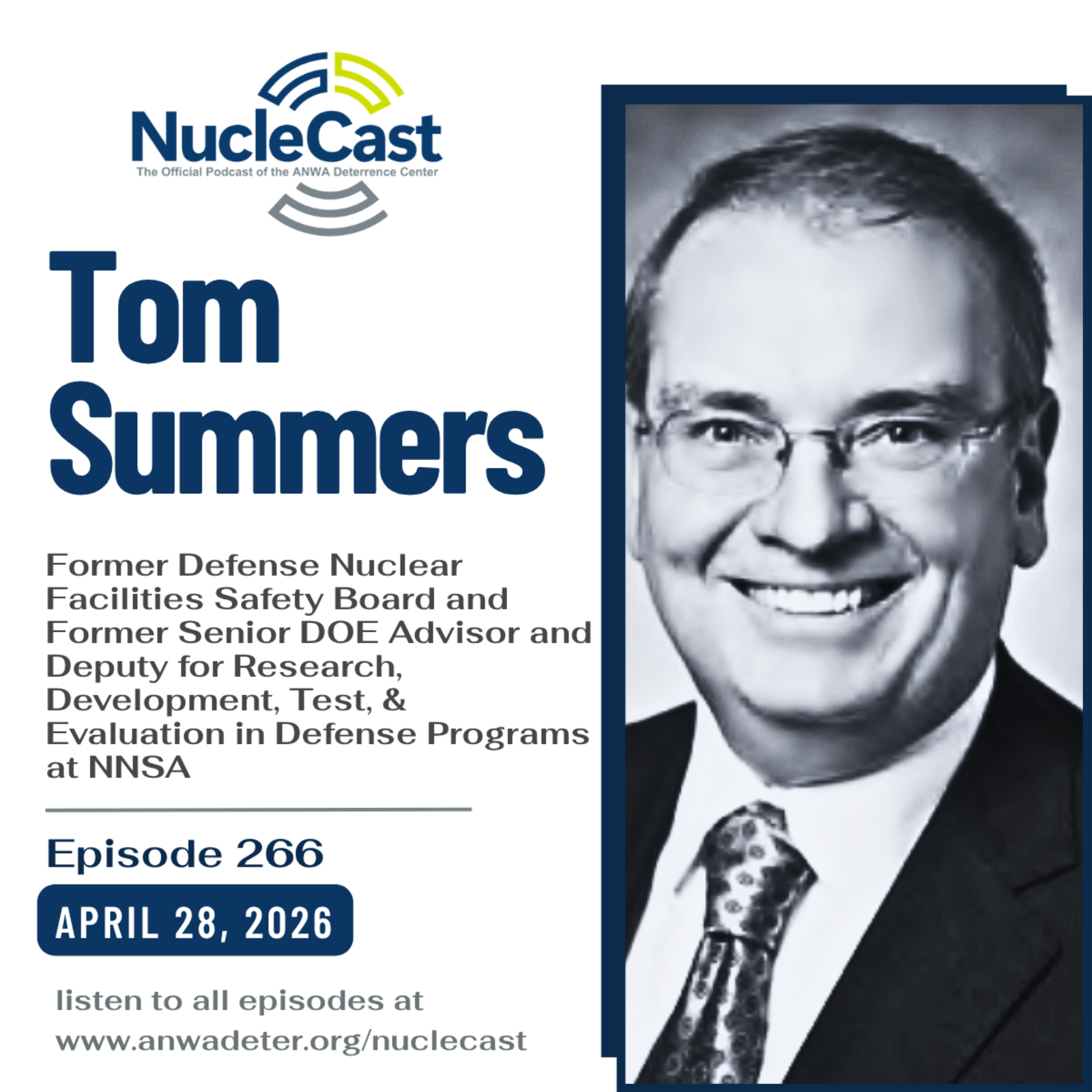
Tom Summers: Artificial Intelligence at the Nuclear Threshold
Apr 28, 2026
33m 07s
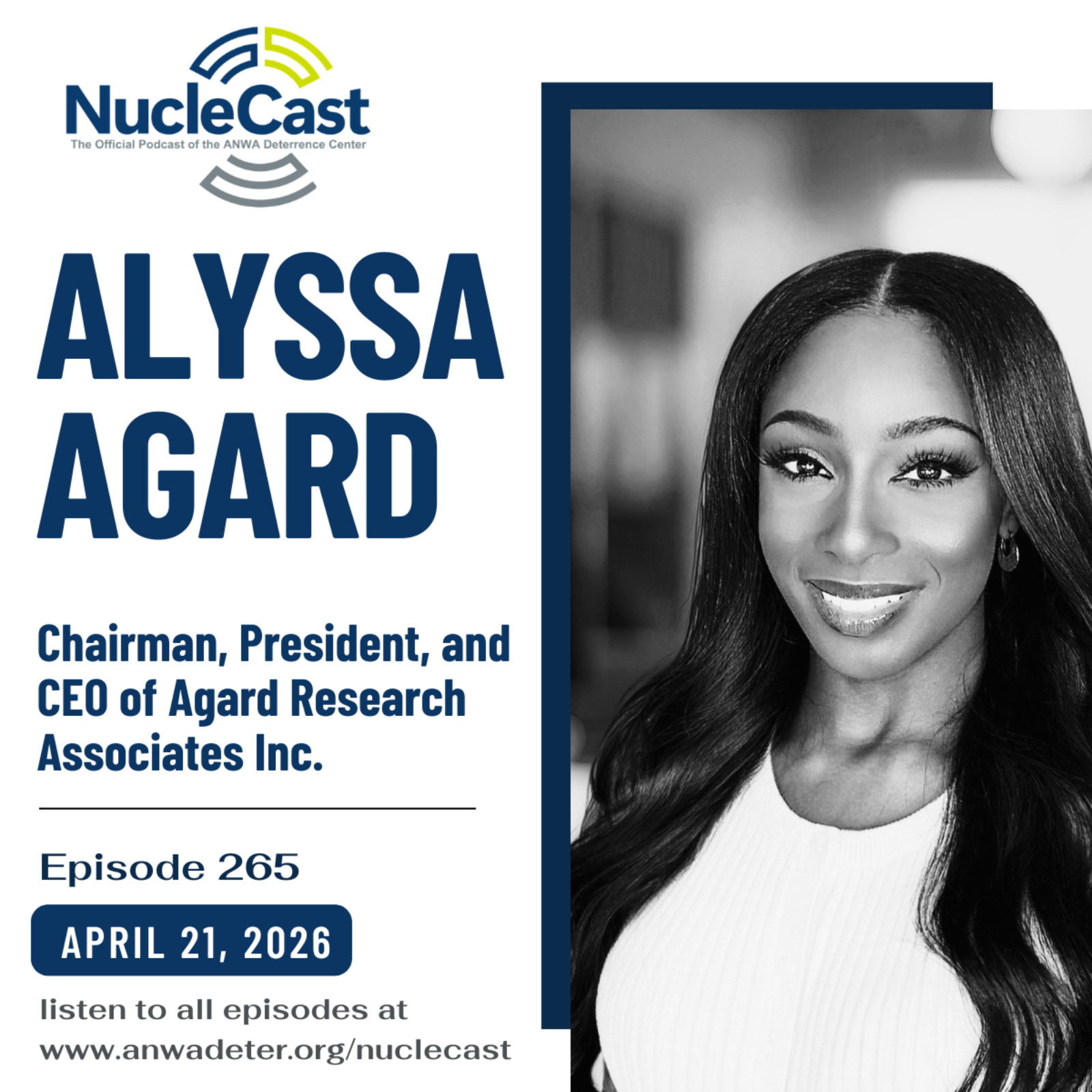
Alyssa Agard: China’s System Destruction Strategy
Apr 21, 2026
27m 45s
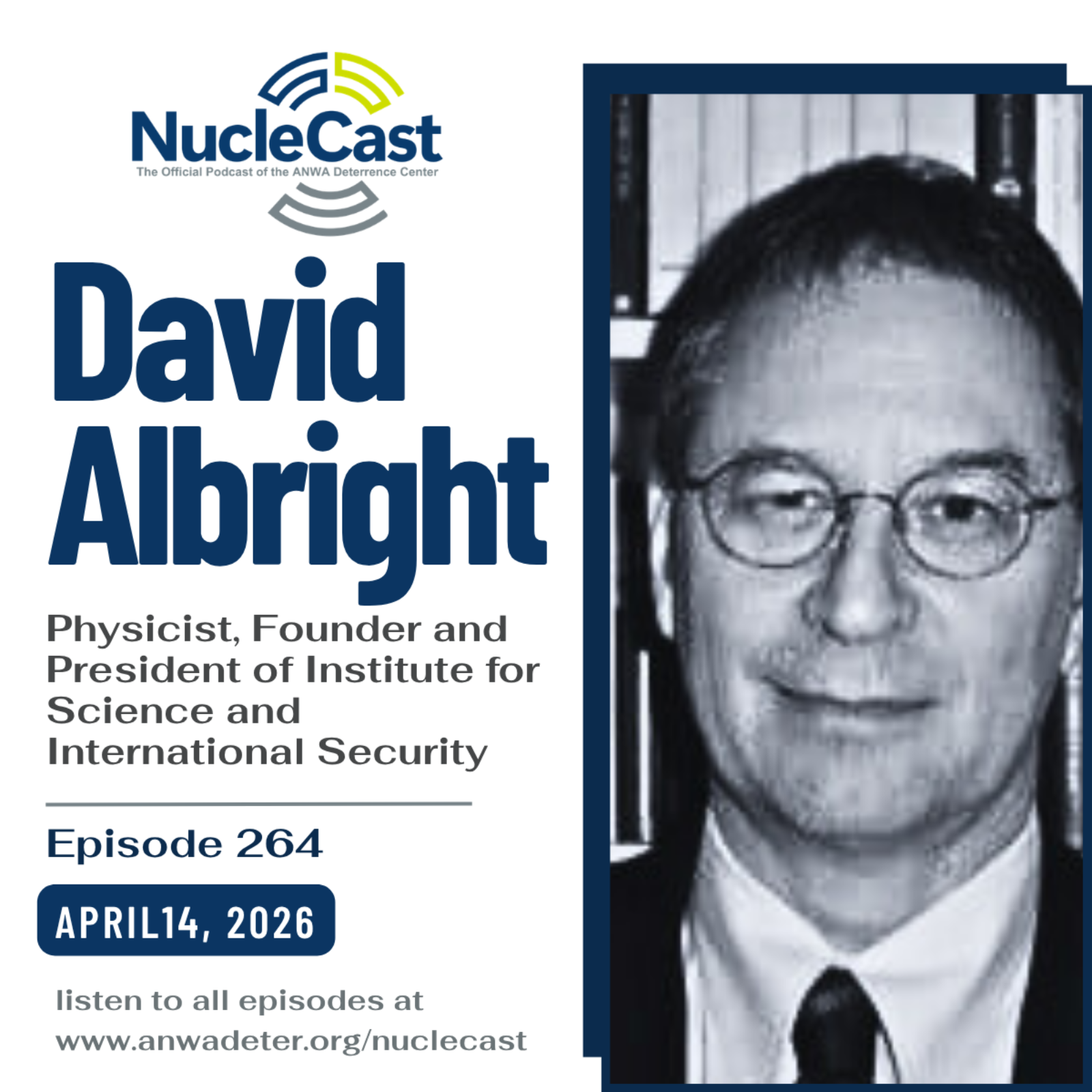
David Albright: Iran, Inspections, and the Future of Nonproliferation
Apr 14, 2026
34m 49s
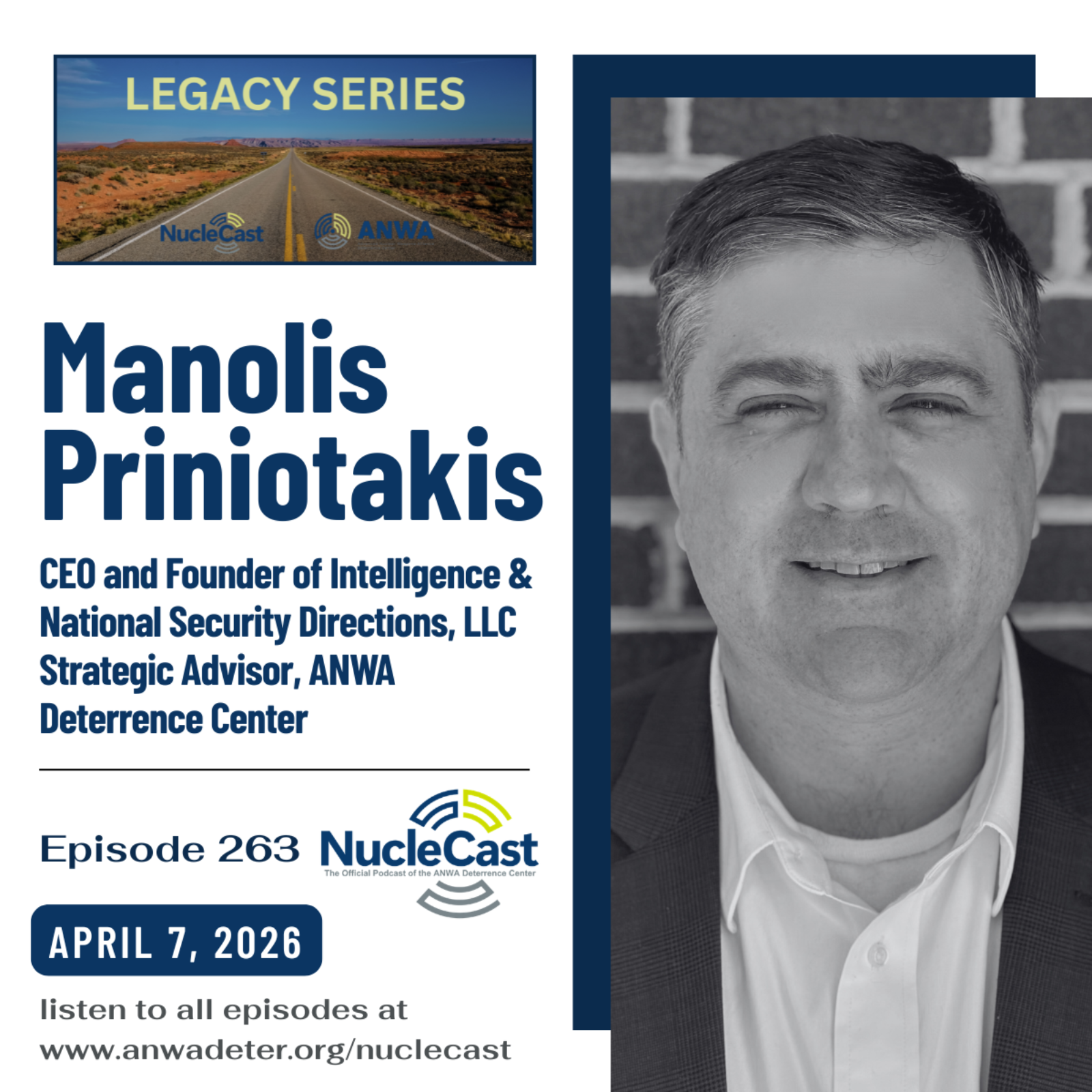
Manolis Priniotakis: Inside Nuclear Intelligence, From the Manhattan Project to Today
Apr 7, 2026
33m 51s
Social Links & Contact
Official channels & resources
Official Website
Login
RSS Feed
Login
| Date | Episode | Topics | Guests | Brands | Places | Keywords | Sponsor | Length | |
|---|---|---|---|---|---|---|---|---|---|
| 5/5/26 | ![]() Frank Rose: Reimagining Arms Control for the 21st Century | Former senior national security official Frank Rose joins the conversation to examine the future of arms control, nuclear policy, and strategic stability in an increasingly complex global environment. Drawing on his extensive experience in arms control, missile defense, and nuclear security, Rose offers a candid assessment of how arms control must adapt to a world shaped by great‑power competition, emerging technologies, and evolving threats from China and other strategic competitors. He explores arms control not as an end in itself, but as a practical tool for managing risk to the United States and its allies. The discussion also takes a hard look at the National Nuclear Security Administration (NNSA)—its structure, mission, and strategic role—and considers whether organizational reform may be necessary to meet future nuclear security challenges. Rose addresses the technological pressures reshaping deterrence, the realities of stockpile stewardship, and why sustaining credibility may require difficult choices in the years ahead. Frank A. Rose is President of Chevalier Strategic Advisors, a strategic advisory firm focused on the intersection of geopolitics, national security, and defense technology. He advises companies, investors, and institutions on strategic risk, government engagement, and emerging defense and dual-use technologies.Previously, Rose served as Principal Deputy Administrator of the National Nuclear Security Administration (2021–2024), where he helped oversee the U.S. nuclear security enterprise. He also served as Assistant Secretary of State for Arms Control and Deputy Assistant Secretary of State for Space and Defense Policy (2009–2017), leading U.S. policy on nuclear deterrence, arms control, missile defense, space security, and allied defense cooperation. Earlier in his career, he was a Professional Staff Member on the House Armed Services Committee and a policy advisor at the U.S. Department of Defense. Rose is a frequent commentator and author on national security and strategic technology issues, with appearances across major media outlets and policy forums. He holds a B.A. in History from American University and an M.A. from King’s College London. Follow us on YouTube: https://youtube.com/@nuclecast3665?si=h1kCO6NqUtL87w6q Follow on LinkedIn: https://linkedin.com/company/nuclecastpodcast Subscribe RSS Feed: https://rss.com/podcasts/nuclecast-podcast/ Rate: https://podcasts.apple.com/us/podcast/nuclecast/id1644921278 Email comments and topic/guest suggestions to Kimberly@anwadeter.org | 32m 45s | ||||||
| 4/28/26 | ![]() Tom Summers: Artificial Intelligence at the Nuclear Threshold✨ | Artificial Intelligencenuclear deterrence+4 | Tom Summers | Defense Nuclear Facilities Safety BoardNational Nuclear Security Administration+1 | — | AInuclear security+5 | — | 33m 07s | |
| 4/21/26 | ![]() Alyssa Agard: China’s System Destruction Strategy | NucleCast welcomes, emerging scholar Alyssa Agard who talks about Chinese strategic thinking, system destruction warfare, and what these concepts mean for the future of deterrence and strategic stability. Drawing on Chinese military theory, the discussion explores how Beijing approaches conflict—not by matching capabilities symmetrically, but by targeting critical systems to destabilize adversaries from the outset.Agard breaks down how the People’s Liberation Army integrates artificial intelligence, hypersonics, and other advanced technologies into its military strategy, and why these developments complicate traditional deterrence models. The conversation also examines the security dilemma created by rapid technological competition and whether China’s current military posture is as stable as it appears.Beyond strategy and technology, this episode highlights the importance of cultivating the next generation of defense thinkers. Agard shares her own path into defense policy and explains why recruiting and mentoring young professionals is essential to sustaining credible deterrence in an era of accelerating change.Alyssa Agard is the Chairman, President, and CEO of Agard Research Associates Inc. (ARA), a 501(c)(3) nonprofit research institute and think tank based in New Jersey. She is a Master of Public Policy candidate at Rutgers University, concentrating in Political Processes and Institutions, with a research focus in foreign affairs and defense policy. Her work centers on Chinese military modernization, strategic competition, and the intersection of emerging technology with nuclear deterrence and strategic stability. Her recent work includes "The Intelligentized Security Dilemma: Systems Destruction Warfare, Technological Entanglement, and the Erosion of Strategic Stability," and she is currently pursuing research on fallout mitigation capabilities, environmental war planning, and their implications for deterrence theory. She also serves as an Archival Research and Policy Intern at Monmouth Battlefield State Park, and publishes the Vita Republica newsletter through ARA.Article: https://urldefense.proofpoint.com/v2/url?u=https-3A__www.agardresearchassociates.org_the-2Dintelligentized-2Dsecurity-2Ddilemma&d=DwMF-g&c=euGZstcaTDllvimEN8b7jXrwqOf-v5A_CdpgnVfiiMM&r=ZvXeIT1LIz3UUCN7C8qCJhqw-7OlcTkFBtdJmO9qO78&m=JsLBXHVP7nHdvNnClzUPRlwHKYGB3Dt-WZ3ZkEg-pBoRuJLUqSFOaX6BMGh1no2T&s=MnAGKUwyt19xLZbJJrOzDxZIsNtHyDlUj-yiggOZ8HU&e=Socials:Follow on Twitter at @NucleCastFollow on LinkedIn: https://linkedin.com/company/nuclecastpodcastSubscribe RSS Feed: https://rss.com/podcasts/nuclecast-podcast/Rate: https://podcasts.apple.com/us/podcast/nuclecast/id1644921278Email comments and topic/guest suggestions to NucleCast@anwadeter.org | 27m 45s | ||||||
| 4/14/26 | ![]() David Albright: Iran, Inspections, and the Future of Nonproliferation | In this episode of NucleCast, renowned nuclear expert David Albright offers a clear‑eyed assessment of Iran’s nuclear program—where it began, where it stands today, and the risks that lie ahead. Drawing on decades of experience tracking nuclear proliferation, Albright explains how Iran built its nuclear capabilities, the role of foreign assistance and clandestine networks, and why enrichment capacity remains at the center of global concern.The conversation examines current regional tensions, including Israeli threat perceptions and the broader implications of ongoing conflict for nuclear escalation. Albright also explores how quickly Iran could move toward a nuclear weapon, the challenges facing international inspections and diplomacy, and the critical leadership role the United States must play in preventing further proliferation.Looking ahead, this episode considers possible future scenarios—from diplomatic breakthroughs to worst‑case outcomes—and closes with reflections on what a lasting path toward security and nonproliferation might look like in one of the world’s most volatile regions.David Albright, a physicist, is Founder and President of the non-profit Institute for Science and International Security in Washington, DC. He has conducted numerous assessments of secret nuclear weapons programs throughout the world, and the means states use to obtain nuclear weapons capabilities. During his career, Albright has testified numerous times on nuclear issues before the U.S. Congress and advised numerous governments. He has spoken to many groups, technical workshops, and conferences. He has published many reports on the Institute’s website and also in Science, Scientific American, the New York Times, The Washington Post, The Wall Street Journal, the Bulletin of the Atomic Scientists, Science and Global Security, Washington Quarterly, and Arms Control Today. The media have frequently cited Albright, and he has appeared often on television and radio. Albright has authored or co-authored nine books, including Revisiting South Africa’s Nuclear Weapons Program, Illicit Trade Networks—Connecting the Dots, Peddling Peril: How the Secret Nuclear Trade Arms America’s Enemies, Solving the North Korean Nuclear Puzzle, Taiwan’s Former Nuclear Weapons Program, and Iran’s Perilous Pursuit of Nuclear Weapons. He received a Master of Science in physics from Indiana University in 1980, a Master of Science in mathematics from Wright State University in 1977, and a Bachelor of Science from Wright State University in 1975. Albright also received an Honorary Doctorate of Humane Letters from Wright State University in 2007.Socials:Follow on Twitter at @NucleCastFollow on LinkedIn: https://linkedin.com/company/nuclecastpodcastSubscribe RSS Feed: https://rss.com/podcasts/nuclecast-podcast/Rate: https://podcasts.apple.com/us/podcast/nuclecast/id1644921278Email comments and topic/guest suggestions to NucleCast@anwadeter.org | 34m 49s | ||||||
| 4/7/26 | ![]() Manolis Priniotakis: Inside Nuclear Intelligence, From the Manhattan Project to Today | In this Legacy Series episode of NucleCast, Manolis Priniotakis explores the history and evolution of nuclear intelligence—from its origins during the Manhattan Project to the sophisticated capabilities shaping nuclear security today. Manolis brings deep insight into the missions, institutions, and technologies that have defined this critical field.The conversation traces early efforts such as the Alsos Mission in World War II, the transition from military-led intelligence to civilian agencies, and the expanding role of organizations like the Department of Energy and the Office of the Director of National Intelligence. We also examine how advances in nuclear forensics have strengthened attribution and nonproliferation efforts, while highlighting the challenges posed by emerging technologies and evolving threat environments.Manolis Priniotakis is a U.S. national security leader with more than two decades of experience shaping intelligence strategy, operations, and education. He is the CEO and Founder of Intelligence & National Security Directions, LLC, and a Non‑Resident Senior Fellow at the University of South Florida’s Global and National Security Institute. Formerly a senior leader in the Office of the Director of National Intelligence and Chief of Staff for DOE Intelligence and Counterintelligence, he has overseen national‑level intelligence operations, strategy, and budgets. In 2024, he received the Presidential Rank Award for Meritorious Service.Socials:Follow on Twitter at @NucleCastFollow on LinkedIn: https://linkedin.com/company/nuclecastpodcastSubscribe RSS Feed: https://rss.com/podcasts/nuclecast-podcast/Rate: https://podcasts.apple.com/us/podcast/nuclecast/id1644921278Email comments and topic/guest suggestions to NucleCast@anwadeter.org | 33m 51s | ||||||
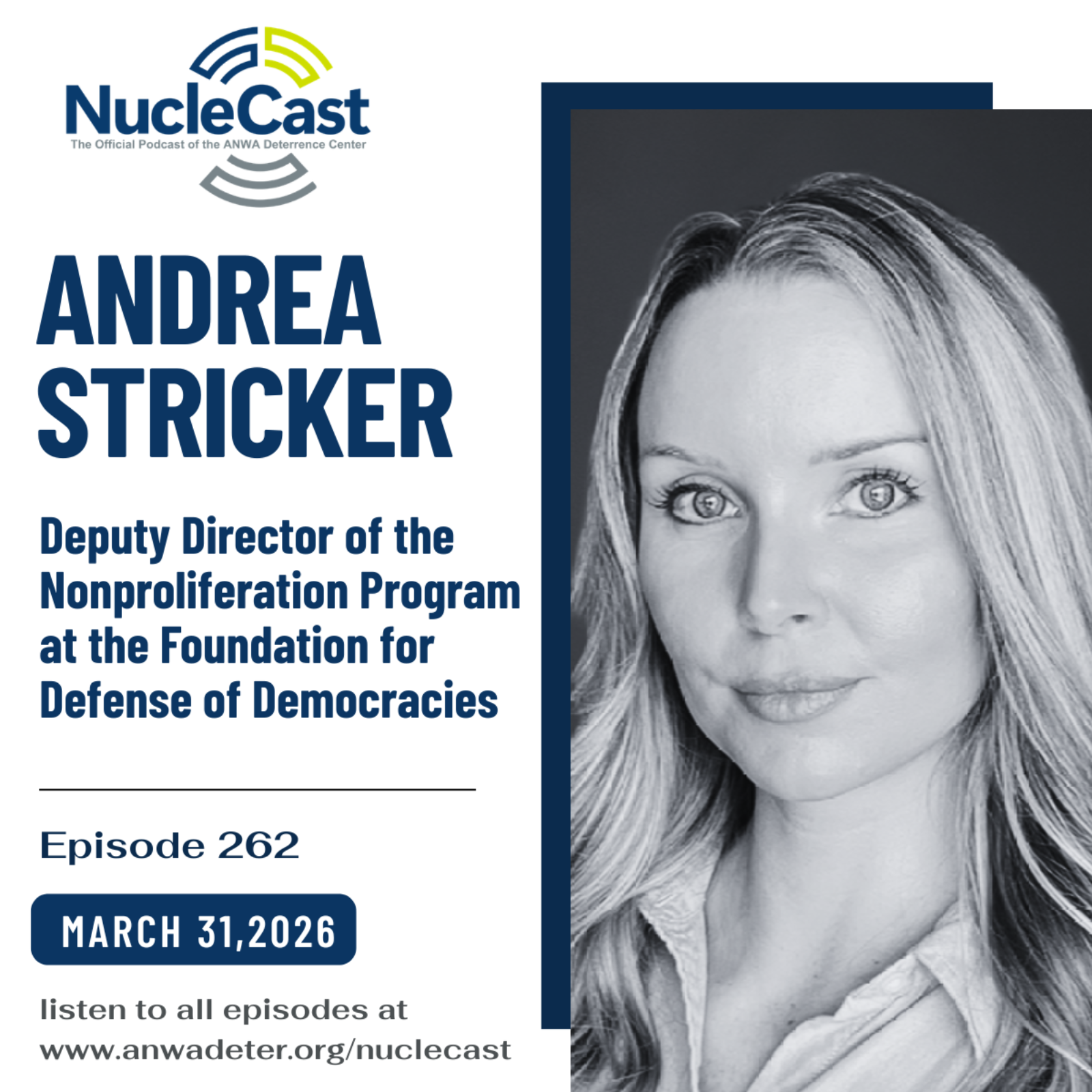
| 3/31/26 | ![]() Andrea Stricker: Iran’s Nuclear Path and What the Latest Strikes Mean for Global Security | In this episode of NucleCast, Adam speaks with Andrea Stricker, Deputy Director of Nonproliferation Programs at the Foundation for Defense of Democracies, about the current state of Iran’s nuclear program and the implications of recent U.S. and Israeli military actions.Stricker breaks down Iran’s nuclear weapons pathway, assesses the impact of recent strikes on key facilities and personnel, and explains what setbacks mean—and do not mean—for Tehran’s long‑term ambitions. The conversation explores Iran’s ability to rebuild its program, timelines for potential weaponization, and the risks posed by highly enriched uranium stockpiles and deeply buried enrichment facilities.The discussion also examines Iran’s strategic motivations, regime survival calculus, and historical lessons from cases like North Korea, offering insight into future proliferation risks and the challenges facing U.S. and allied efforts to prevent a nuclear‑armed Iran.Andrea is an expert on nuclear weapons proliferation and counterproliferation, open-source proliferation and policy analysis, and strategic commodity trafficking. Andrea has extensively researched Iran’s nuclear program, including its history, the regime’s proliferation efforts and technical advances, and diplomatic agreements. She is the co-author of five books on nuclear proliferation and is frequently cited by the media.Socials:Follow on Twitter at @NucleCastFollow on LinkedIn: https://linkedin.com/company/nuclecastpodcastSubscribe RSS Feed: https://rss.com/podcasts/nuclecast-podcast/Rate: https://podcasts.apple.com/us/podcast/nuclecast/id1644921278Email comments and topic/guest suggestions to NucleCast@anwadeter.org | 31m 55s | ||||||
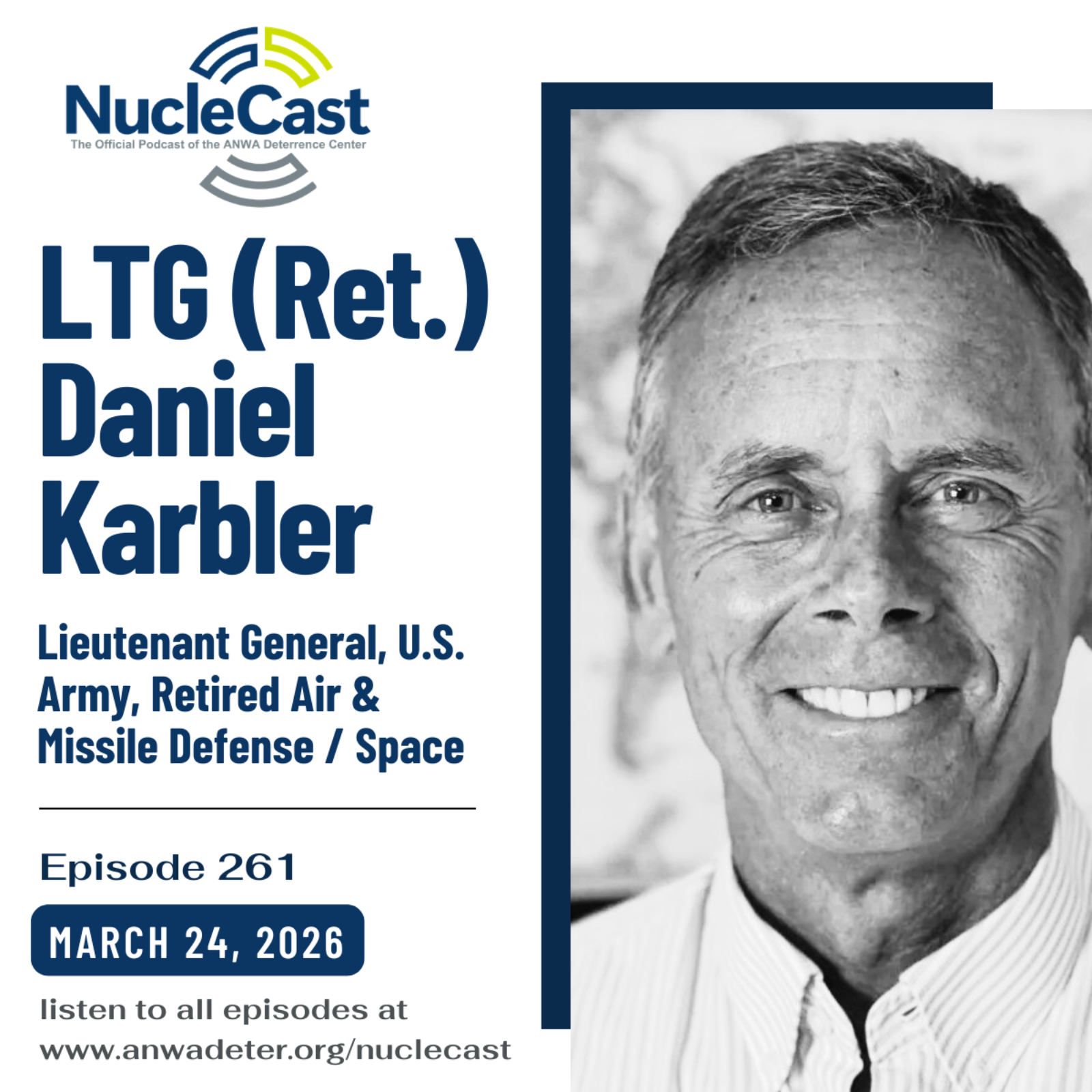
| 3/24/26 | ![]() LTG (Ret) Dan Karbler: Defending the Skies, Air and Missile Defense in a High‑Threat World | In this episode of NucleCast, retired Lieutenant General Dan Karbler joins the podcast to examine the evolving landscape of air and missile defense amid ongoing regional conflicts and accelerating technological change. Drawing on decades of operational and strategic leadership, LTG Karbler discusses how layered missile defense—from strategic homeland defense to tactical systems—is adapting to increasingly complex threats.The conversation explores Iranian drone and missile activity in the Middle East, the role of systems such as THAAD, Patriot, and counter‑UAS, and the challenges of sustaining and reconstituting missile defense capabilities at scale. Lt Gen Karbler also offers insights into the Golden Dome concept for homeland missile defense, emerging future threats, and what deterrence requires in an era of precision missiles, massed drones, and rapid technological diffusion.For nearly 37 years, Dan served our nation in a variety of positions in the United States and around the world. An expert in Air and Missile Defense and Space Operations, he has extensive experience in effectively leading large and complex military commands, conducting operations, requirements and capability development, test and evaluation, and budget formulation. Prior to retiring from the Army as a Lieutenant General, he led the U.S. Army’s Space and Missile Defense Command (SMDC), a globally dispersed organization across 23 locations and 11 time zones responsible for providing homeland and regional air and missile defense and space operations. During that time, Space and Missile Defense Command was named “The Army’s Best Place to Work” in 2022 and 2023. Since retiring, Dan has joined the Center for Security and International Studies (CSIS) as a senior advisor to the Missile Defense Project and has been a frequent contributor on national security matters to Merit Street News. He sits on the advisory board for TCOM and was recently appointed to the board for the Military Child Education Coalition (MCEC). During the past year, Dan served as a technical advisor and actor in the upcoming movie, “A House of Dynamite.” Dan has a Master’s degree in Strategic Studies from the U.S. Army War College, a Master’s degree in Business Administration from Benedictine College, and a Bachelor’s Degree from the U.S. Military Academy at West Point.Socials:Follow on Twitter at @NucleCastFollow on LinkedIn: https://linkedin.com/company/nuclecastpodcastSubscribe RSS Feed: https://rss.com/podcasts/nuclecast-podcast/Rate: https://podcasts.apple.com/us/podcast/nuclecast/id1644921278Email comments and topic/guest suggestions to NucleCast@anwadeter.org | 35m 18s | ||||||
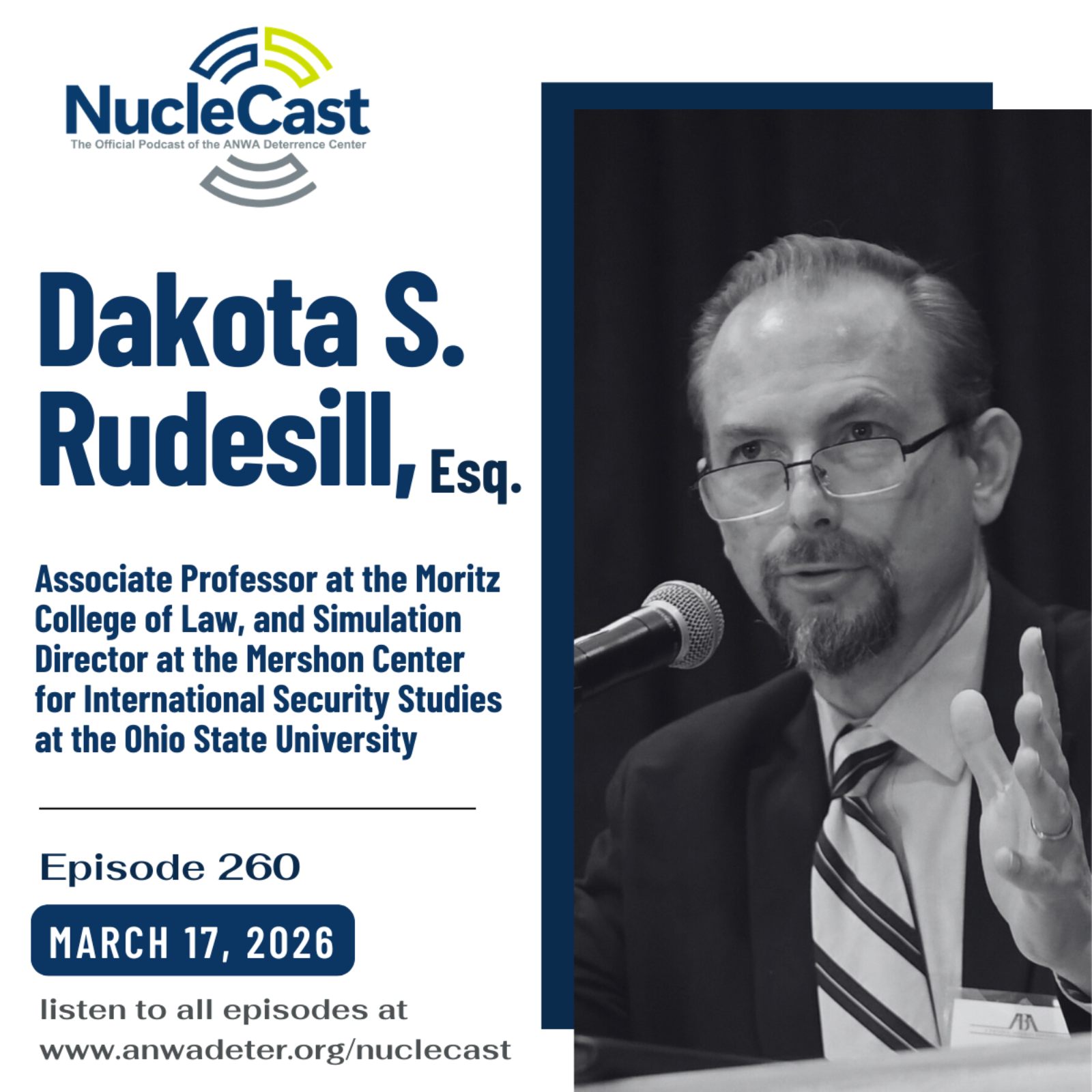
| 3/17/26 | ![]() Dakota Rudesill: Who Decides War? Law, Power, and the Use of Force Against Iran | In this episode of NucleCast, Professor Dakota Rudesill, Esq. examines the legal boundaries that govern the use of military force, with a particular focus on the United States and Iran. Drawing on constitutional law, international law, and decades of historical precedent, Rudesill unpacks who truly holds the authority to take the nation to war—and under what conditions.The conversation explores the President’s powers of self‑defense, Congress’s constitutional role in declaring war, and how the War Powers Resolution of 1973 has shaped (and complicated) modern U.S. military action. From “operations less than war” to undeclared conflicts and contested legal justifications, Rudesill explains how legal gray areas have expanded over time—and why the rule of law remains essential to maintaining democratic accountability and global stability. This episode offers a clear, rigorous look at how law, power, and nuclear‑era decision‑making intersect in moments of crisis.Socials:Follow on Twitter at @NucleCastFollow on LinkedIn: https://linkedin.com/company/nuclecastpodcastSubscribe RSS Feed: https://rss.com/podcasts/nuclecast-podcast/Rate: https://podcasts.apple.com/us/podcast/nuclecast/id1644921278Email comments and topic/guest suggestions to NucleCast@anwadeter.org | 38m 05s | ||||||
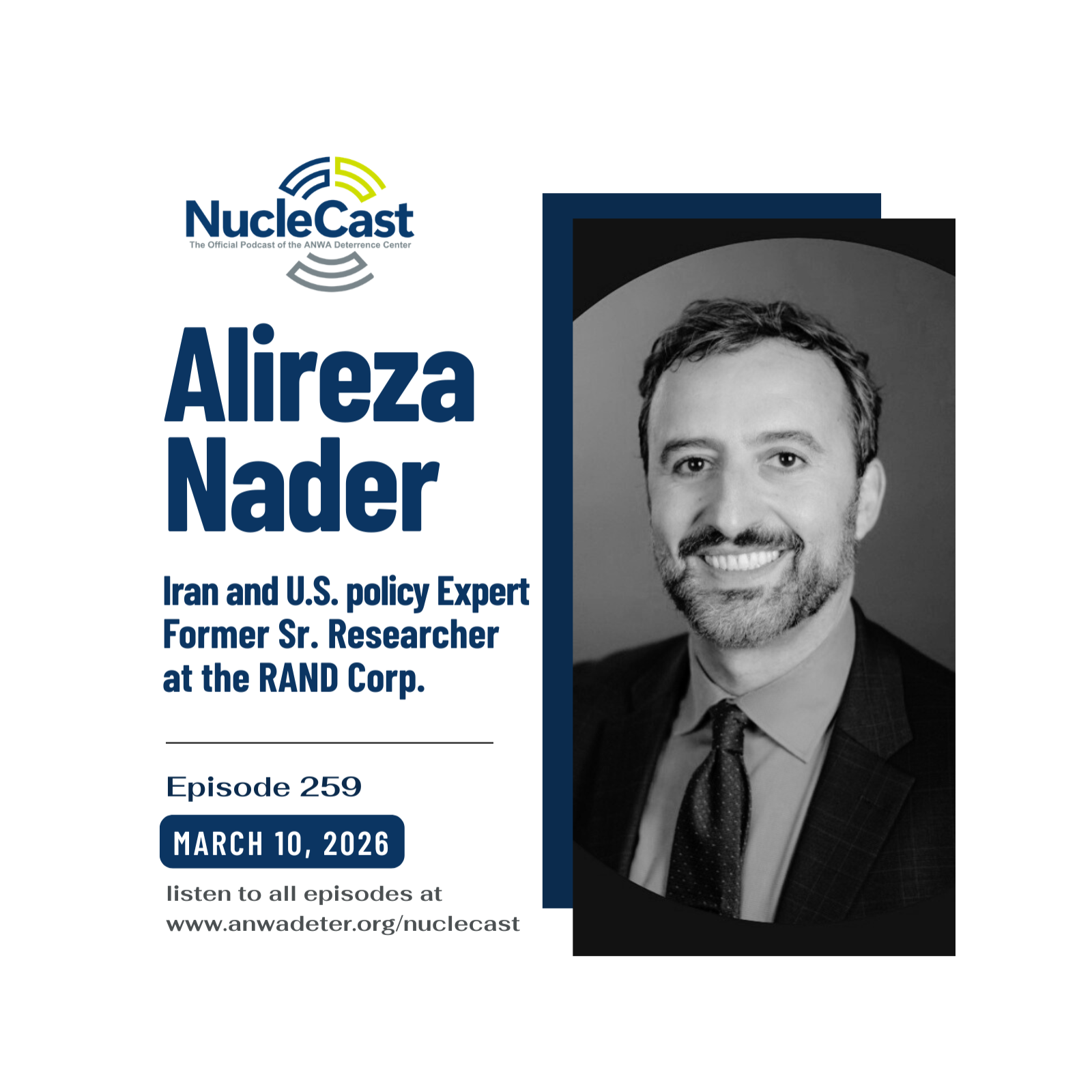
| 3/10/26 | ![]() Alireza Nader: Inside Iran’s Military Conflict: Risks, Strategy, and What Comes Next | In this episode of Nuclecast, Iran analyst Alireza Nader breaks down the current military conflict involving Iran and what it means for the Middle East and beyond. Drawing on decades of expertise, Nader examines Iran’s strategic military doctrine, including its reliance on drones and missiles, and explains how regional power dynamics are shaping the conflict’s trajectory.The conversation explores high‑stakes scenarios for Iran’s future—from regime survival to the risks of collapse or civil war—while unpacking the internal pressures facing the Islamic Republic, including public trauma, protests, and economic strain. Nader also addresses the roles of the United States, Israel, and regional actors, and offers a candid assessment of why overthrowing the regime would be extraordinarily difficult.Throughout the episode, listeners gain insight into Iranian public sentiment, misconceptions about U.S.–Iran relations, and the strategic calculations that will influence how long this conflict may last. This is a clear-eyed discussion of one of the most consequential security challenges facing global stability today.Socials:Follow on Twitter at @NucleCastFollow on LinkedIn: https://linkedin.com/company/nuclecastpodcastSubscribe RSS Feed: https://rss.com/podcasts/nuclecast-podcast/Rate: https://podcasts.apple.com/us/podcast/nuclecast/id1644921278Email comments and topic/guest suggestions to NucleCast@anwadeter.org | 33m 53s | ||||||
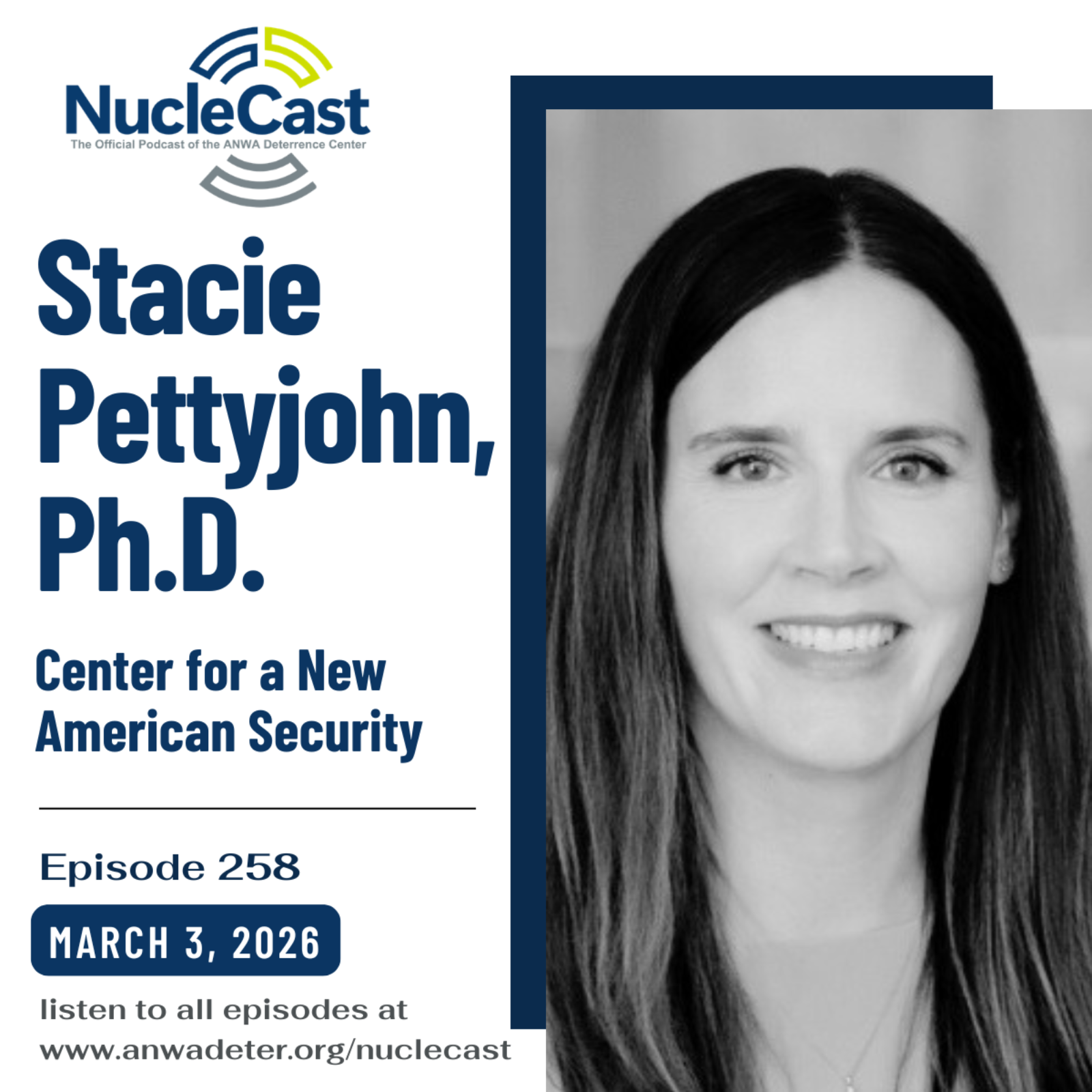
| 3/3/26 | ![]() Stacie Pettyjohn: AI Development in Defense and Nuclear Deterrence | In this episode of NucleCast, Adam is joined by Dr. Stacie Pettyjohn, senior fellow and director of the Defense Program at the Center for a New American Security, for a thoughtful discussion on the growing role of artificial intelligence in defense and military operations.Dr. Pettyjohn explores how AI is increasingly shaping everything from logistics and decision‑making to nuclear command and control, while weighing the potential benefits against the serious risks of integration. The conversation examines AI’s capabilities and limitations, the ethical and strategic challenges it presents, and what its use could mean for nuclear deterrence and autonomous weapons.She emphasizes the importance of balancing innovation with safety, responsibility, and strategic stability as AI becomes more deeply embedded in modern defense systems.Stacie Pettyjohn is a senior fellow and director of the Defense Program at the Center for a New American Security. A leading expert on U.S. defense strategy, force planning, airpower, and wargaming, her work focuses on the future of warfare, including artificial intelligence, autonomous systems, drones, and nuclear deterrence in a multipolar world. Previously, she served on the Joint Staff, chaired a Defense Department advisory subcommittee on force integration, and spent more than a decade at RAND Corporation leading major studies and defense wargames. Her work has appeared in Foreign Affairs, The Wall Street Journal, The Washington Post, and other major outlets. She holds a PhD from the University of Virginia.Socials:Follow on Twitter at @NucleCastFollow on LinkedIn: https://linkedin.com/company/nuclecastpodcastSubscribe RSS Feed: https://rss.com/podcasts/nuclecast-podcast/Rate: https://podcasts.apple.com/us/podcast/nuclecast/id1644921278Email comments and topic/guest suggestions to NucleCast@anwadeter.org | 34m 58s | ||||||
Want analysis for the episodes below?Free for Pro Submit a request, we'll have your selected episodes analyzed within an hour. Free, at no cost to you, for Pro users. | |||||||||
| 2/24/26 | ![]() Derek Williams: Evaluating the Evolving Nuclear Landscape and Global Security | Colonel Derek “Kiwi” Williams joins NucleCast for a wide‑ranging discussion on the evolving nuclear landscape and what it means for global security. Together, they examine recent developments in nuclear testing, including China’s reported testing activities and the use of decoupling techniques, and assess their implications for strategic stability.The conversation also explores the consequences of the expiration of the New START treaty, debating whether the future points toward renewed arms control frameworks or an emerging arms race. Host Adam Lowther and Williams dive into the role of hydro nuclear testing and stockpile stewardship in maintaining confidence in nuclear forces, as well as why a credible nuclear deterrent remains central to national security.Throughout the episode, they unpack the enduring importance of the nuclear triad, the challenges of nuclear proliferation, and how deterrence strategies must adapt in an increasingly competitive strategic environment.Colonel Derek “Kiwi” Williams is a strategic planner in the Plans and Policy Directorate at U.S. Strategic Command. A U.S. Air Force Weapons School graduate, he has extensive experience in bomber operations, nuclear planning, and deterrence strategy, including leadership roles at Air Force Global Strike Command, the Air Staff, and as Director of Operations for the 23d Bomb Squadron. He is the founder of the School of Advanced Nuclear Deterrence Studies, a former Air Force Fellow at Sandia National Laboratories, and a fellow at the National Institute for Deterrence Studies. Colonel Williams holds advanced degrees in defense and strategic studies and aerospace engineering, with additional certifications in nuclear weapons policy, effects, and operations.Episode Correction: NNSA does Hydrodynamic experiments (weapon representative geometries) LLNL's Contained Firing Facility (CFF).Socials:Follow on Twitter at @NucleCastFollow on LinkedIn: https://linkedin.com/company/nuclecastpodcastSubscribe RSS Feed: https://rss.com/podcasts/nuclecast-podcast/Rate: https://podcasts.apple.com/us/podcast/nuclecast/id1644921278Email comments and topic/guest suggestions to NucleCast@anwadeter.org | 41m 59s | ||||||
| 2/17/26 | ![]() Christopher Stone: Redefining Defense, Homeland Priorities and Global Strategy | Join host Adam Lowther and guest Christopher Stone, a senior fellow at the National Institute for Deterrence Studies, as they delve into the intricacies of the National Defense Strategy (NDS) on this episode of NucleCast. Explore the critical debate around the perceived shift in American defense priorities, particularly the focus on Homeland Defense and its implications for global strategic dynamics. Christopher Stone offers a compelling argument against the notion of isolationism, emphasizing the enduring importance of strategic encirclement and the evolving geopolitical landscape. This episode provides a deep dive into the strategic considerations shaping U.S. defense policy, with insights into the roles of China, Russia, and other global players. Christopher Stone is a prominent figure in space policy, currently serving as a Senior Fellow for Space Deterrence at the National Institute for Deterrence Studies, where he focuses on research related to space warfare strategies and deterrence, particularly in the context of great power competition; he previously held a position as a Special Assistant to the Deputy Assistant Secretary of Defense for Space Policy at the Pentagon, giving him significant experience in the field of U.S. space policy development at a high level.Socials:Follow on Twitter at @NucleCastFollow on LinkedIn: https://linkedin.com/company/nuclecastpodcastSubscribe RSS Feed: https://rss.com/podcasts/nuclecast-podcast/Rate: https://podcasts.apple.com/us/podcast/nuclecast/id1644921278Email comments and topic/guest suggestions to NucleCast@anwadeter.org | 35m 53s | ||||||
| 2/10/26 | ![]() Robert Peters: Greenland, Could it Become the Next Flashpoint Between US, Russia, and China? | Greenland’s strategic importance is hotter than ever—and the questions about the U.S. desire to secure access aren’t just political posturing. In this eye-opening episode, defense expert Bob Peters from the Heritage Foundation reveals why Greenland is a critical security linchpin for North America, and why fears of U.S. invasion are utterly unfounded.From Cold War radar stations to today’s race to contain Chinese and Russian influence in the Arctic, Bob unpacks the real reasons Greenland matters—its location, resources, and the growing geopolitical contest. You’ll discover how Arctic nations are competing for dominance, why China’s icebreakers signal a serious threat, and how the U.S. plans to boost its defenses without breaking NATO.We break down the myths surrounding President Trump’s stance on Greenland, revealing that hyperbole and strategic signaling drive much of the chatter. Plus, insights into how Greenland’s potential independence could reshape regional power dynamics and why the U.S. relationship with Denmark remains vital.If you care about national security, Arctic geopolitics, or the future of NATO, this episode is essential listening. Bob’s straightforward analysis cuts through the noise—arming you with the knowledge to understand why Greenland is much more than a distant ice patch, but a battleground of influence that could define the next decade of global power.Robert Peters is a Senior Research Fellow for Strategic Deterrence in The Heritage Foundation’s Allison Center for National Security. For many years, Peters served as a Senior Research Fellow at National Defense University’s Center for the Study of Weapons of Mass Destruction, where he focused on nuclear deterrence issues, countering weapons of mass destruction, and counterproliferation. In the first Obama Administration, Peters served as the Special Advisor for Countering Weapons of Mass Destruction in the Office of the Secretary of Defense, where he worked on the New START nuclear arms control treaty, the 2010 Nuclear Posture Review, and the 2010 Quadrennial Defense Review. In addition, Peters held positions at Northrop Grumman and the Potomac Institute for Policy Studies.A prolific writer, Peters’ published works include examinations of the impact of Chinese nuclear expansion and Russian withdrawal from arms control, the prospect for future arms control, the need for a new nuclear posture review, and the mission to eliminate North Korean weapons of mass destruction.Socials:Follow on Twitter at @NucleCastFollow on LinkedIn: https://linkedin.com/company/nuclecastpodcastSubscribe RSS Feed: https://rss.com/podcasts/nuclecast-podcast/Rate: https://podcasts.apple.com/us/podcast/nuclecast/id1644921278Email comments and topic/guest suggestions to NucleCast@anwadeter.org | 30m 53s | ||||||
| 2/3/26 | ![]() Maj. Gen. Brook Leonard, USAF (Ret): The Hidden Danger of Space Dependency We Still Underestimate | Major General Brook Leonard delves into the evolving role of space in military strategy and its implications for global security. The conversations highlight Leonard's experiences in operationalizing space within the U.S. military, emphasizing the transition of space from a supportive to a warfighting domain. Leonard discusses the strategic importance of integrating air and space capabilities, the challenges of operating in a congested space environment, and the necessity of international cooperation to establish norms for space safety and security.The discussions also explore the strategic mindsets of adversaries like China and Russia, noting their differing approaches to space warfare. Leonard emphasizes the need for the U.S. to adapt its strategies to these threats, highlighting the importance of understanding space as a critical enabler and potential vulnerability. The conversations conclude with Leonard's wishes for greater public awareness of space's importance, improved U.S. strategic innovation, and easier access to space, drawing parallels to historical expansions like the railroads in the American West.Socials:Follow on Twitter at @NucleCastFollow on LinkedIn: https://linkedin.com/company/nuclecastpodcastSubscribe RSS Feed: https://rss.com/podcasts/nuclecast-podcast/Rate: https://podcasts.apple.com/us/podcast/nuclecast/id1644921278Email comments and topic/guest suggestions to NucleCast@anwadeter.org | 34m 47s | ||||||
| 1/27/26 | ![]() Ben Zweibelson, PhD: Bad War Stories, Lessons from the Battlefield | Dr. Ben Zweibelson, a retired US Army officer and author of "Bad War Stories" delves into the complexities of military planning, particularly in the context of nuclear deterrence and the lessons learned from two decades of conflict in Iraq and Afghanistan. Dr. Zweibelson discusses how traditional military strategies often fall short in real-world applications, emphasizing the need for innovation and adaptability in military doctrine. He shares personal anecdotes from his deployments, highlighting the emotional toll of war and the disconnect between military operations and strategic outcomes. Dr. Zweibelson's book, "Bad War Stories," serves as a critique of the glorified narratives often portrayed in Hollywood, contrasting them with the harsh realities faced by soldiers. He argues that many military professionals are trapped in outdated thinking, which hinders effective planning and execution. The episode concludes with a discussion on the future of nuclear strategy in light of emerging technologies like artificial intelligence and quantum computing, stressing the importance of curiosity and innovation in military institutions.Socials:Follow on Twitter at @NucleCastFollow on LinkedIn: https://linkedin.com/company/nuclecastpodcastSubscribe RSS Feed: https://rss.com/podcasts/nuclecast-podcast/Rate: https://podcasts.apple.com/us/podcast/nuclecast/id1644921278Email comments and topic/guest suggestions to NucleCast@anwadeter.org | 37m 22s | ||||||
| 1/20/26 | ![]() Dr. John Copper - Taiwan in Focus: History, Identity, and the Realities of U.S.–China Tensions | In this episode of NucleCast, Adam talks with Professor John Copper, a leading expert on Taiwan, to discuss the complex history and current geopolitical landscape of Taiwan. The conversation explores Taiwan's identity, its relationship with China, and the implications of US-China relations. Professor Copper emphasizes the exaggerated urgency of China's reunification efforts and highlights Taiwan's unique position as a democracy in a region of authoritarianism. The discussion also touches on the historical context of Taiwan's development, the challenges it faces, and the potential paths forward for its future.Dr. John F. Copper is the Stanley J. Buckman Distinguished Professor of International Studies (emeritus) and author of more than 40 books on Asia and international affairs. His newest book is Taiwan's Presidents: Profiles of the Majestic Six (Routledge, 2024).00:00 Introduction to Taiwan's Complex History02:11 Current Geopolitical Tensions and Perspectives 17:07 Historical Context of Taiwan's Identity26:09 Wishes for Taiwan's Future RelationsSocials:Follow on Twitter at @NucleCastFollow on LinkedIn: https://linkedin.com/company/nuclecastpodcastSubscribe RSS Feed: https://rss.com/podcasts/nuclecast-podcast/Rate: https://podcasts.apple.com/us/podcast/nuclecast/id1644921278Email comments and topic/guest suggestions to NucleCast@anwadeter.org | 42m 43s | ||||||
| 1/13/26 | ![]() Hugh White: Navigating the US-China Rivalry: An Australian Perspective | Professor Hugh White from the Australian National University discusses the evolving security landscape in the Asia-Pacific region, particularly in light of China's rise as a global power. The conversation explores the implications of the US-China rivalry for Australia, the role of allies, and the necessity of nuclear deterrence in maintaining regional stability. White expresses concern about Australia's reliance on the US and the need for a more self-reliant defense strategy as the geopolitical dynamics shift. The discussion culminates in White's wishes for clearer strategic understanding and cooperation among nations in addressing the challenges posed by China.Hugh White AO is Emeritus Professor of Strategic Studies at the Australian National University. His work focuses primarily on Australian strategic and defence policy, Asia-Pacific security issues, and global strategic affairs especially as they influence Australia and the Asia-Pacific.He has served as an intelligence analyst with the Office of National Assessments, as a journalist with the Sydney Morning Herald, as a senior adviser on the staffs of Defence Minister Kim Beazley and Prime Minister Bob Hawke, and as a senior official in the Department of Defence, where from 1995 to 2000 he was Deputy Secretary for Strategy and Intelligence, and as the first Director of the Australian Strategic Policy Institute (ASPI).In the 1970s he studied philosophy at Melbourne and Oxford Universities. He was the principal author of Australia’s 2000 Defence White Paper.His major publications include Power Shift: Australia’s future between Washington and Beijing, [2010], The China Choice: Why America should share power, [2012], Without America: Australia’s future in the New Asia [2017], and How to defend Australia [2019]Chapters00:00 Introduction to Australian Security Perspectives02:14 The Rise of China and Its Implications05:45 Australia's Strategic Dilemmas09:28 Military Dynamics in the US-China Rivalry13:44 The Role of Allies in Regional Security19:36 China's Global Ambitions and Regional Responses24:07 Nuclear Deterrence in a Changing Landscape29:28 Wishes for Future Strategic ClaritySocials:Follow on Twitter at @NucleCastFollow on LinkedIn: https://linkedin.com/company/nuclecastpodcastSubscribe RSS Feed: https://rss.com/podcasts/nuclecast-podcast/Rate: https://podcasts.apple.com/us/podcast/nuclecast/id1644921278Email comments and topic/guest suggestions to NucleCast@anwadeter.org | 39m 51s | ||||||
| 1/6/26 | ![]() Byron Ristvet: Inside Nuclear Testing: History, Strategy, and Readiness (Part 2) | This is part two of a discussion featuring Dr. Byron Ristvet. The episode delves into the intricacies of nuclear testing, covering topics such as the history and types of nuclear tests conducted by the United States, Russia, and China. Byron shares insights into the technical and strategic aspects of nuclear testing, including the development and safety testing of nuclear weapons, the evolution of testing methods, and the challenges faced in maintaining nuclear readiness. The conversation also touches on the importance of deterrence and the current state of nuclear testing infrastructure.Socials:Follow on Twitter at @NucleCastFollow on LinkedIn: https://linkedin.com/company/nuclecastpodcastSubscribe RSS Feed: https://rss.com/podcasts/nuclecast-podcast/Rate: https://podcasts.apple.com/us/podcast/nuclecast/id1644921278Email comments and topic/guest suggestions to NucleCast@anwadeter.org | 57m 48s | ||||||
| 12/16/25 | ![]() Byron Ristvet: Inside Nuclear Testing, History, Readiness, and Policy Implications (Part 1) | In this episode of NucleCast, Adam talks with Dr. Byron Ristvet to discuss the complexities of nuclear testing, its historical context, and the current state of nuclear readiness. They delve into the types of nuclear tests, the role of various laboratories, and the controversial history surrounding Rocky Flats. The conversation highlights the importance of understanding nuclear policy and the implications of testing in today's geopolitical landscape.Currently, Dr, Ristvet is a consultant to Sandia National Laboratory and Lawrence Livermore National Laboratory for studies on nuclear test detection, and through Keystone International and MSTS, a consultant to LANL, DoE IN-1 and NNSA/NFO. He is a Senior Mentor in Sandia’s Weapons Intern and Professional Development programs, and low yield nuclear monitoring research. Prior to his semi-retirement in February 2017, Dr. Ristvet was a senior subject matter expert (SME) to DTRA’s Research and Development Directorate in the areas of nuclear and conventional weapons effects and testing, hard and deeply-buried-target characterization and defeat, counter-terrorism, cooperative threat reduction, knowledge preservation, nuclear test readiness, and to the Defense Threat Reduction Information Analysis Center. Prior to the underground nuclear testing (UGT) moratorium in 1992, he was the UGT containment scientist for the Defense Nuclear Agency. Based on his experience, he is an advisor to the U.S. intelligence community on foreign nuclear programs. Dr. Ristvet had a key role in DoD’s Cooperative Threat Reduction efforts with the Russian Federation nuclear laboratories and the Kazakhstan National Nuclear Center. He is currently an Octant Associates consultant for DTRA nuclear proliferation prevention activities at the Semipalatinsk Test Site in Kazakhstan. Chapters00:00 Introduction to Nuclear Testing and Its Importance01:20 Understanding Nuclear Testing: Types and History05:38 Current State of Nuclear Testing and Readiness09:05 The Role of Laboratories in Nuclear Weapons Development13:34 Debunking Myths: The Rocky Flats Controversy18:27 Types of Nuclear Testing Conducted19:54 Key Takeaways and Future ConsiderationsSocials:Follow on Twitter at @NucleCastFollow on LinkedIn: https://linkedin.com/company/nuclecastpodcastSubscribe RSS Feed: https://rss.com/podcasts/nuclecast-podcast/Rate: https://podcasts.apple.com/us/podcast/nuclecast/id1644921278Email comments and topic/guest suggestions to NucleCast@anwadeter.org | 35m 09s | ||||||
| 12/9/25 | ![]() Ben Souther: Accelerating What Matters: Urgency, Accountability, and Large‑Scale Delivery | In this episode of NucleCast, Ben Souther discusses the complexities of managing data in large projects, particularly focusing on the requirements from various stakeholders, including government regulations and internal procedures. He emphasizes the importance of navigating through extensive data to ensure successful project execution.Ben Souther is the general manager of the Environmental and Security business line of Bechtel’s Nuclear, Security, and Environmental global business unit. Ben is an accomplished professional with more than 20 years of extensive experience and knowledge in automation, engineering, construction, delivery, and project management positions for Bechtel. His current portfolio includes the oversight of multiple government projects, operating sites, and national laboratories focused on nuclear security and nuclear waste management for the U.S. Department of Energy.Ben joined Bechtel on the Waste Treatment Plant project in 2002 supporting project automation efforts and in 2006 he began working on the Pueblo Chemical Agent-Destruction Pilot Plant project serving in various roles in project controls and construction. Other previous senior leadership roles include deputy project manager, business manager, and vice president of the Bechtel LLC working for the U.S. Army on Kwajalein Atoll in the Marshall Islands in 2011. He served as executive assistant to the president of NS&E from 2013 to 2015 and then went on to become an M&BD manager for the Defense & Security business line.He received his bachelor’s in business administration (Cum Laude) (Management Information Systems) from Washington State University and is PMI Project Management Professional (PMP) certified.Socials:Follow on Twitter at @NucleCastFollow on LinkedIn: https://linkedin.com/company/nuclecastpodcastSubscribe RSS Feed: https://rss.com/podcasts/nuclecast-podcast/Rate: https://podcasts.apple.com/us/podcast/nuclecast/id1644921278Email comments and topic/guest suggestions to NucleCast@anwadeter.org | 33m 10s | ||||||
| 12/2/25 | ![]() Rob Kittinger: Human Factors in Nuclear Safety | In this episode of NucleCast, host Adam Lowther engages in a thought-provoking conversation with Rob Kittinger, a seasoned expert from Sandia National Labs. They delve into the critical role of human factors in nuclear safety and explore the intriguing dynamics of the AI race between the US and China. From the potential pitfalls of human error to the strategic implications of AI advancements, this episode offers a deep dive into the challenges and opportunities shaping our nuclear future. "Other examples of color vision affecting job safety can be found here: https://waggonerdiagnostics.com/pages/law-enforcement "Robert Kittinger, Ph.D. is a Senior Fellow at the National Institute for Deterrence Studies (NIDS). He spent nearly 10 years at Sandia National Laboratories, culminating in the Nuclear Threat Science department and working in Nuclear Emergency Support and Counterterrorism & Counter-Proliferation (CTCP). During his time at Sandia, he was also a 2017 graduate of the prestigious Weapon Intern Program (WIP).Before joining Sandia, Dr. Kittinger spent over five years as a civilian in the U.S. Navy and was part of a five-person tech startup, BookLamp, which was acquired by Apple in 2013. Following his tenure at Sandia, he served as a senior researcher at Amazon and currently holds the role of Chief Research Officer at a MedTech company.Socials:Follow on Twitter at @NucleCastFollow on LinkedIn: https://linkedin.com/company/nuclecastpodcastSubscribe RSS Feed: https://rss.com/podcasts/nuclecast-podcast/Rate: https://podcasts.apple.com/us/podcast/nuclecast/id1644921278Email comments and topic/guest suggestions to NucleCast@anwadeter.org | 34m 23s | ||||||
| 11/25/25 | ![]() Curtis McGiffin: Shaping the Age of Techno-Strategic Power | Adam sits down with Curtis McGiffin—strategist, educator, and co-author—to explore his groundbreaking argument for redefining national instruments of power. Curtis introduces DIMET, adding “Technology” to the traditional DIME framework, and explains why high-tech capabilities have become a standalone measure of national strength. The discussion dives into how technological innovation is reshaping deterrence, influencing global power dynamics, and driving the future of warfare. Plus, Curtis shares insights from the National Institute for Deterrence Studies’ proposed Nuclear Posture Review, offering bold recommendations for strengthening U.S. nuclear deterrence in an era of rapid change.Link to Paper: Curtis McGiffin, DIMET: Shaping the Age of “Techno-Strategic” Power, No. 637, September 22, 2025 – NippSocials:Follow on Twitter at @NucleCastFollow on LinkedIn: https://linkedin.com/company/nuclecastpodcastSubscribe RSS Feed: https://rss.com/podcasts/nuclecast-podcast/Rate: https://podcasts.apple.com/us/podcast/nuclecast/id1644921278Email comments and topic/guest suggestions to NucleCast@anwadeter.org | 39m 42s | ||||||
| 11/18/25 | ![]() Brian Groft: Nuclear Ops, The A&AS Mission and DTRA’s Evolving Role | In this episode of NucleCast, Adam interviews Brian Groft, a senior leader at Systems Planning and Analysis (SPA), to discuss the A&AS mission and its significance in supporting the Department of Defense. Groft shares insights on the role of A&AS contractors, the importance of DTRA in nuclear operations, and the differences between various types of contracting. They also discuss the future of DTRA, the costs associated with government versus contractor roles, and the need for improved collaboration between contractors and government agencies.Brian Groft possesses 16 years of experience leading teams of scientists and engineers providing technical advisory services to government customers responsible for challenging homeland security and national defense missions. He serves as the Strategic Growth Manager for SPA which includes providing executive leadership in the defense and homeland security industry with emphasis in chemical, biological, radiological, nuclear, and explosive defense (CBRNE), Counter WMD, System Engineering, and R&D fields.Socials:Follow on Twitter at @NucleCastFollow on LinkedIn: https://linkedin.com/company/nuclecastpodcastSubscribe RSS Feed: https://rss.com/podcasts/nuclecast-podcast/Rate: https://podcasts.apple.com/us/podcast/nuclecast/id1644921278Email comments and topic/guest suggestions to NucleCast@anwadeter.org | 35m 47s | ||||||
| 11/11/25 | ![]() Brent Sadler: Reviving American Sea Power, Maritime Strategy and National Security | In this conversation, Brent Sadler discusses the critical importance of maritime issues in relation to national security and economic stability. He emphasizes the need for a dedicated maritime advisor to the president and highlights the current gaps in leadership within the Navy's shipbuilding sector. The conversation underscores the necessity of interagency coordination to ensure timely delivery of warships and the overall revival of American maritime strength.Brent Sadler joined Heritage Foundation after a 26-year Navy career with numerous operational tours on nuclear powered submarines, personal staffs of senior Defense Department leaders, and as a military diplomat in Asia. As a Senior Research Fellow, Brent’s focus is on maritime security and the technologies shaping our future maritime forces, especially the Navy.Brent is a 1994 graduate with honors of the United States Naval Academy with a degree in Systems Engineering (robotics) and a minor in Japanese. As a 2004 Olmsted Scholar in Tokyo, Japan, he studied at Keio University, Jochi University and the United Nations University. He has a master of arts from Jochi University and master of science from National War College, where he graduated with distinction in 2011 and received several writing and research awards.In 2011, he established the Navy Asia Pacific Advisory Group (NAPAG), providing regionally informed advice directly to Chief of Naval Operations’ (CNO). He again served on the CNO’s personal staff in 2015-2016, playing a key role in developing the Defense Department’s Third Offset. At Pacific Command from 2012-2015, he held numerous key positions. As lead for Maritime Strategy and Policy, he incorporated all 10 Association of Southeast Asian Nations (ASEAN) into the first regional maritime domain awareness forum and was instrumental in the eventual passage of the $500 million-dollar Maritime Security Initiative. As Special Advisor on Japan, and a Council of Foreign Relations International Affairs Fellow in Tokyo, he played a key role in revising the U.S. and Japan Defense Guidelines. As Deputy Director Strategic Synchronization Group, he oversaw a think-tank like body of over 30 advisors and analysts. Brent led the Commander’s Rebalance Task Force coordinating execution of the President’s Defense Strategic Guidance—Rebalance to the Asia-Pacific resulting in over $12 billion USD of additional monies budgeted in fiscal years 2013 through 2015 during a time of fiscal austerity.Following his final tour on CNO’s staff, Brent returned to Asia as Senior Defense Official, Defense and Naval Attaché in Malaysia. During his tenure he played a key role in coordinating responses to the USS McCain collision in August 2017, opened several politically sensitive ports and airfields to U.S. forces, oversaw unprecedented expansion of U.S. military relations, and steadied relations during the historic May 2018 national elections ushering in an opposition party for the first time since independence.Socials:Follow on Twitter at @NucleCastFollow on LinkedIn: https://linkedin.com/company/nuclecastpodcastSubscribe RSS Feed: https://rss.com/podcasts/nuclecast-podcast/Rate: https://podcasts.apple.com/us/podcast/nuclecast/id1644921278Email comments and topic/guest suggestions to NucleCast@anwadeter.org | 33m 41s | ||||||
| 11/4/25 | ![]() Kyle Balzer / Bob Peters: Reimagining the Sentinel ICBM: A Mobile Future | Adam interviews Dr. Kyle Balzer and Bob Peters on their recent article in Breaking Defense. They discuss the future of the Sentinel ICBM program, particularly the potential for mobile basing options. They explore the cost implications, strategic effectiveness, and the need for political engagement to advocate for a more robust nuclear deterrent. The conversation emphasizes the importance of adapting to a changing threat environment, particularly with the rise of peer competitors like China, and the necessity of public discourse on nuclear strategy.Kyle Balzer is a Jeane Kirkpatrick Fellow at the American Enterprise Institute, where he specializes in US nuclear strategy and policy. He is currently working on a book project, The Revivalist: James R. Schlesinger and the Rebirth of Cold War U.S. Nuclear Strategy. It examines the origins of diagnostic net assessment and competitive nuclear strategies. His work has been published in Breaking Defense, National Review Online, The Hill, The National Interest, and War on the Rocks. Robert J. Peters is Chief of the Strategic Integration Directorate within the Strategic Trends and Effects Department (STED) at the Defense Threat Reduction Agency (DTRA). He leads efforts to generate actionable insights on counter-WMD and emerging threats, assess agency effectiveness, and foster strategic dialogues with allies through research and exercises.Previously, Peters was a Senior Research Fellow at the National Defense University’s Center for the Study of Weapons of Mass Destruction. He also served as Special Assistant to the DASD for Countering WMD at the Office of the Secretary of Defense-Policy, and held roles at Northrop Grumman and the Potomac Institute.He holds an MA in National Security Studies from Georgetown University and a BA in Political Science and History from Miami University. His published work includes articles in Strategic Studies Quarterly, 38 North, and the Nonproliferation Review.Article Link: Forge ahead with the Sentinel ICBM, but consider making it mobile - Breaking DefenseSocials:Follow on Twitter at @NucleCastFollow on LinkedIn: https://linkedin.com/company/nuclecastpodcastSubscribe RSS Feed: https://rss.com/podcasts/nuclecast-podcast/Rate: https://podcasts.apple.com/us/podcast/nuclecast/id1644921278Email comments and topic/guest suggestions to NucleCast@anwadeter.org | 32m 51s | ||||||
Showing 25 of 267
Sponsor Intelligence
Sign in to see which brands sponsor this podcast, their ad offers, and promo codes.
Chart Positions
2 placements across 2 markets.
Chart Positions
2 placements across 2 markets.