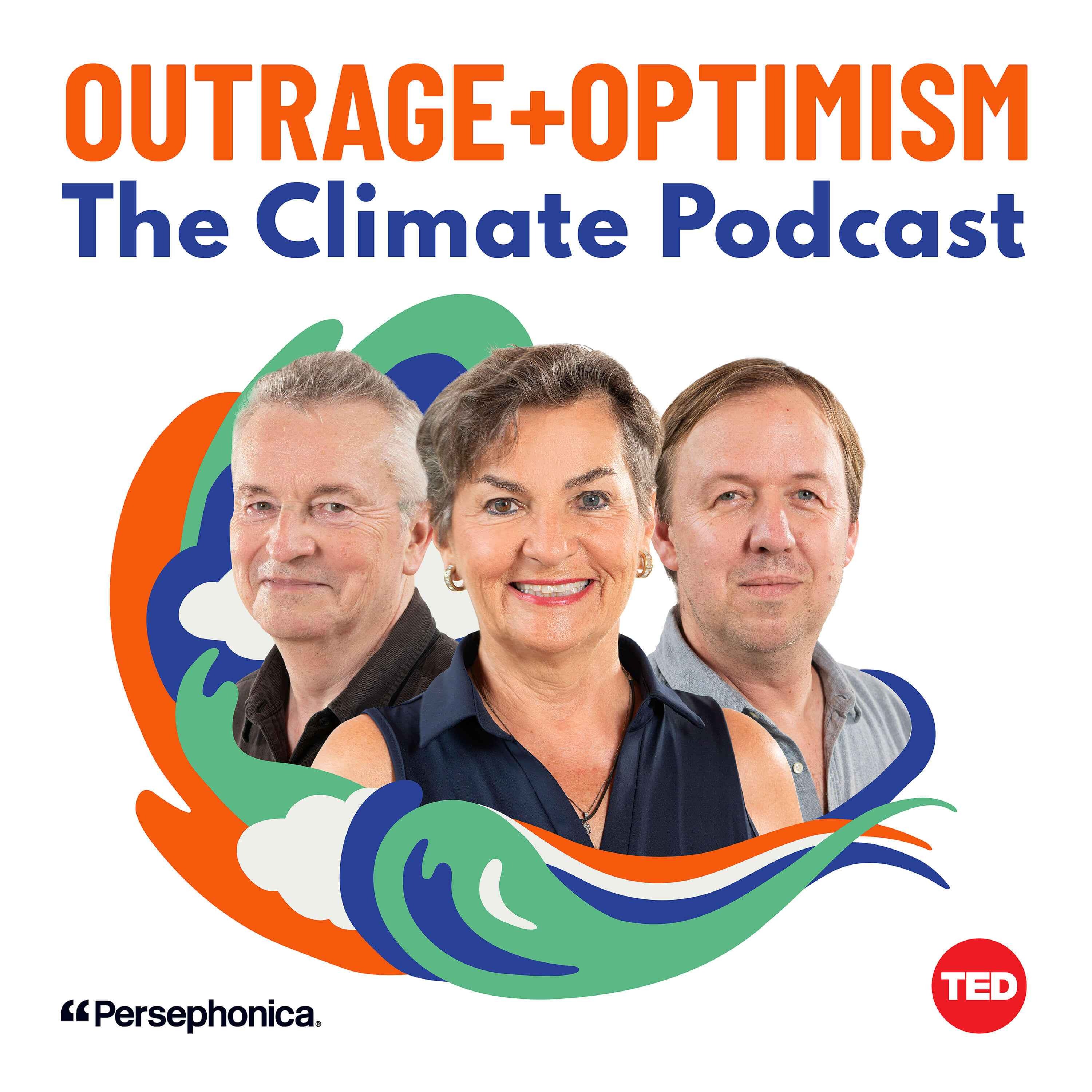
Outrage + Optimism: The Climate Podcast
by Persephonica and Global Optimism
Is this your podcast?Persephonica is an independent podcast creator collaborating with Global Optimism, an organization known for its commitment to driving climate action and fostering sustainable practices. Together, they produce "Outrage + Optimism: The Clima…
Insights from recent episode analysis
Audience Interest
- climate change discussions
- sustainable business practices
Podcast Focus
- climate news analysis
- interviews with experts
Publishing Consistency
- weekly episodes
- active for seven years
Platform Reach
- available on major podcast platforms
- growing listener community
Insights are generated by CastFox AI using publicly available data, episode content, and proprietary models.
Most discussed topics
Brands & references
Total monthly reach
Estimated from 25 chart positions in 25 markets.
By chart position
- 🇬🇧GB · Science#23100K to 300K
- 🇦🇺AU · Science#6730K to 100K
- 🇰🇷KR · Science#9510K to 30K
- 🇳🇱NL · Science#1271K to 10K
- 🇨🇱CL · Science#3410K to 30K
- Per-Episode Audience
Est. listeners per new episode within ~30 days
56K to 180K🎙 Daily cadence·389 episodes·Last published today - Monthly Reach
Unique listeners across all episodes (30 days)
186K to 599K🇬🇧50%🇦🇺17%🇰🇷5%+22 more - Active Followers
Loyal subscribers who consistently listen
56K to 180K491 real followers tracked across platforms
Market Insights
Platform Distribution
Reach across major podcast platforms, updated hourly
Total Followers
—
Total Plays
—
Total Reviews
—
* Data sourced directly from platform APIs and aggregated hourly across all major podcast directories.
On the show
From 22 epsHosts
Recent guests
Recent episodes
What’s India Building?: Tales from the Biggest Transition on Earth
Sep 3, 2026
Unknown duration
India: Life Inside Delhi's 'Airpocalypse'
Aug 27, 2026
Unknown duration
The Clock is Ticking: Forty Seconds to Explain the Climate Crisis
Aug 20, 2026
Unknown duration
Beyond Politics: Should we take the heat out of the climate crisis?
Aug 13, 2026
Unknown duration
Cheapest Energy in History. Still Heading for 3 Degrees?
Aug 6, 2026
Unknown duration
Social Links & Contact
Official channels & resources
Official Website
Login
RSS Feed
Login
| Date | Episode | Topics | Guests | Brands | Places | Keywords | Sponsor | Length | |
|---|---|---|---|---|---|---|---|---|---|
| 9/3/26 | What’s India Building?: Tales from the Biggest Transition on Earth | "This will never work in India."That's what Indian truck manufacturers said about electric freight. Now they build the trucks.Something is going on here at a speed the rest of the world has not yet noticed. Solar capacity has gone from under three gigawatts to more than 160 in ten years. Across the same decade, 171 million people moved out of extreme poverty.But in eastern Delhi, a woman who has lived beside an open mountain of garbage for fifty years asks Tom Rivett-Carnac for one thing: tell the world about us.So, in the second of three episodes from India, Tom goes looking for what is really driving this change, what it looks like up close, and whether it can deliver for the people who need it most.A cement executive who set a net zero target in 2018, when nobody else in his industry had, will give you the business case that green is profitable. Ask him what is actually driving him and he gives a different answer. Truck drivers on the Bengaluru highway who can now hear well enough to talk in the cabins. A nine-year-old with a bicycle. This is the largest transition of its kind anywhere on earth, and it is happening right now.With Delhi-based journalist and filmmaker Adnan Bhat on the ground, and Dia Mirza, Shyla Raghav and Prachi Shevgaonkar on what it all adds up to.So what does it look like from the inside? And what happens to the people it hasn't yet reached?Disclosure: the electric freight programme in this episode, Laneshift, was founded by The Climate Pledge, which Global Optimism co-founded with Amazon, alongside the city network C40.Learn More⛰️ Read how Delhi's garbage mountains became heat bombs for the people who work them, Al Jazeera on the waste pickers of Ghazipur, a landfill now roughly as tall as the Qutub Minar💧 Watch The Waterman of India, Decode Mediacom's film on Dr Rajendra Singh, whose johads and check dams have revived five rivers across drought-hit Rajasthan🧊 Watch Sonam Wangchuk build an automated ice stupa, the artificial glaciers that freeze winter water into towers and release it when Ladakh needs it in spring🌾 Learn more about Andhra Pradesh's natural farming programme, which has moved more than 1.7 million farmers off chemical-heavy methods and won the 2026 Food Planet Prize🏗️ Understand why cement is so hard to clean up, from Chatham House🗳️ See what Indians actually think about climate change, the Yale programme's opinion maps covering 634 districts🎤 Leave us your voice notes and questions for upcoming episodes on SpeakPipeJoin the conversation:Instagram @outrageoptimism LinkedIn @outrageoptimism YouTube @OutrageandOptimismOr get in touch with us via this form.Senior Producer: Ben Weaver-HincksIndia Producer and translator: Adnan BhatShow Runner: Caitlin Hanrahan Exec Producer: Ellie CliffordThis is a Persephonica production for Global Optimism and is part of the Acast Creator Network. Hosted on Acast. See acast.com/privacy for more information. | — | ||||||
| 8/27/26 | India: Life Inside Delhi's 'Airpocalypse' | In Delhi, lung cancer is no longer a smoker’s disease. It’s a breather’s disease.But the most polluted capital on earth sits in a country running five years ahead of its Paris clean power target. In the first of three dispatches from India, Tom Rivett-Carnac is joined by Dia Mirza, one of the biggest names in Indian cinema and a UN Environment Goodwill Ambassador, and Shyla Raghav, formerly Chief Climate Officer at TIME, who describes "a mix of pride, a mix of heartbreak, and, as well, possibility."With Delhi-based journalist Adnan Bhat guiding and translating, Tom traces the path India is trying to build - development founded on renewable energy, clean transport, and a refusal to accept that getting richer has to cost the earth.We meet Bhavreen Kandhari, who stopped relying on the government's air quality figures and started keeping her own. Now, she says, every citizen is a scientist. On a good day, indoors, her monitor reads six times the safe limit. And, Dr Arvind Kumar, who has been operating on Delhi's lungs since the 1980s. Here, he says, “a child becomes a smoker from the first breath.” But he has yet to see dirty air written onto a death certificate in India.And in Old Delhi, Bilkis drives a lavender electric rickshaw. She switched because it was cheaper and easier to drive, she says. Which may be how this actually gets done.Can India grow, bring a fifth of humanity with it, and build a better road than the one the West took and then closed behind it?Learn More🌍 Read IQAir's World Air Quality Report, which has ranked New Delhi the world's most polluted capital for eight years running📈 Understand what air pollution costs India on the Lancet Countdown's India data sheet👩👧 Explore Warrior Moms, the network Bhavreen Kandhari co-founded in 2020, now 38,000 mothers across 19 states, with guides on filing air quality RTIs and writing to your MLA🩺 Learn more about the Lung Care Foundation, set up by Dr Arvind Kumar after black deposits started appearing in the lungs of patients who had never smoked⚖️ Read about Ella Adoo-Kissi-Debrah, the first person anywhere to have air pollution recorded as a cause of death, the precedent Dr Kumar wants India to follow🛺 Get up to date on Delhi's switch to electric autos, under which only electric three-wheelers can be newly registered in the city from January 2027⚡ See how India passed 50% non-fossil power capacity in July 2025, five years ahead of the target it set under the Paris Agreement 🎤 Leave us your voice notes and questions for upcoming episodes on SpeakPipeJoin the conversation:Instagram @outrageoptimism LinkedIn @outrageoptimism YouTube @OutrageandOptimismOr get in touch with us via this form.Senior Producer: Ben Weaver-HincksIndia Producer and translator: Adnan BhatShow Runner: Caitlin Hanrahan Exec Producer: Ellie CliffordThis is a Persephonica production for Global Optimism and is part of the Acast Creator Network. Hosted on Acast. See acast.com/privacy for more information. | — | ||||||
| 8/20/26 | The Clock is Ticking: Forty Seconds to Explain the Climate Crisis | The summer of 2026 burned the largest wildfire in Spain's recorded history and the largest France has seen since the Second World War. June's heat killed more than 10,000 people across Europe. A heat dome held North Africa and the Sahel above 45°C for days. In Assam, the Brahmaputra put 700,000 people out of their homes.But it was in the United States, in its hottest month in 132 years of records, that climate reporting found its biggest audience of the summer, in the least likely slot imaginable.Footballers at the FIFA Men's World Cup had to stop mid-half to drink, cool down and put on ice vests. Two US broadcasters held the rights to those three minutes. One sold them to advertisers. The other used them to explain why the players were stopping at all. This week Christiana Figueres speaks with Vanessa Hauc, Emmy award-winning anchor at Noticias Telemundo and creator of its climate unit, Planeta Tierra. Vanessa got Telemundo to hand her time during the hydration breaks. Forty seconds, Saudi Aramco's branding in shot, to tell viewers why the players needed to stop. While competitors sold advertising slots generating an estimated $1bn globally, millions tuned in to Vanessa explaining how human-driven climate change, caused by burning fossil fuels, was responsible for the crisis.Tom Rivett-Carnac and Paul Dickinson join Christiana to pick apart why simply reporting a hotter world is still treated as a provocation, and the three of them take stock of a summer of record heat, Spain's tumbling power prices and the case for telling the economic story better.What does it take to reach people who will never open a scientific paper but will not miss a match? And why is telling it like it is still the risky option?Plus, a first look at the next three episodes. Tom has been somewhere that holds the best and the worst of this transition at once. Stay tuned for the end of the episode.Learn More⚽ Read Climate Change Big Player at FIFA World Cup 2026, the World Weather Attribution study Vanessa's team built the reporting on📺 Watch Noticias Telemundo Planeta Tierra, the only Spanish-language environmental news programme streaming in the US, created and directed by Vanessa📰 Read The World Cup Story (Almost) No One Told from Covering Climate Now, on how Telemundo became the only US broadcaster to connect the hydration breaks to a warming planet🗳️ Explore NRDC's polling with Latino Decisions, which found nine in ten Latinos want government action on climate🌡️ Understand why Latino neighbourhoods carry the heaviest heat burden, UCLA research showing more than twice the share of workers in heat-exposed jobs like agriculture and construction⚡ Get up to date on Ember analysis’s about how Spain decoupled its electricity prices from gas🎤 Leave us your voice notes and questions for upcoming episodes on SpeakPipeJoin the conversation:Instagram @outrageoptimism LinkedIn @outrageoptimismOr get in touch with us via this form.Senior Producer: Ben Weaver-HincksEdited by: Miles MartignoniShow Runner: Caitlin Hanrahan Exec Producer: Ellie CliffordThis is a Persephonica production for Global Optimism and is part of the Acast Creator Network. Hosted on Acast. See acast.com/privacy for more information. | — | ||||||
| 8/13/26 | Beyond Politics: Should we take the heat out of the climate crisis? | Somewhere along the way, acting on a threat to all of humanity became a political act. Not a simple matter of science and economics, but a signal of whose side you are on.So, what would it take to change the political narrative around climate? This week, Christiana Figueres, Tom Rivett-Carnac and Paul Dickinson answer some difficult questions gathered for our live event at Bath Abbey, postponed when extreme heat made the venue unsafe - as if we needed another reminder of the urgency of this crisis.They ask: can we lift the climate out of party politics altogether? Does real leverage sit with the decisions made in national capitals, or is it only on the COP conference floor while the cameras are rolling? And if vested interests and lobbying can’t be removed, how do we meet them head on, with an equal and opposite force.This episode tries to answer the challenge we all face: do we seek to depoliticise this crisis, or fight for it in the open? And, now that the climate crisis has become a political hot potato, can we change course in time?Learn More🌍 Explore the Earthshot Prize, Prince William's platform for scaling climate solutions🗳️ Read about Climate Assembly UK, the citizens' assembly that brought 100+ people together to shape how the country reaches net zero, and why the format keeps vested interests at the door🚭 Understand Article 5.3 of the WHO Framework Convention on Tobacco Control, the treaty clause Paul points to that shields health policy from the tobacco industry📢 Read how The Hague banned fossil fuel advertising, a world-first local law that survived a court challenge in 2025💸 Revisit the fossil fuel divestment movement, the student-led campaign, which pushed institutions holding trillions to pull money out of coal, oil and gas🎬 Watch The People's Emergency Briefing, the film built to give the public the same starting picture of the crisis their governments often will not explain🎤 Leave us your voice notes and questions for upcoming episodes on SpeakPipeJoin the conversation:Instagram @outrageoptimism LinkedIn @outrageoptimismOr get in touch with us via this form.Senior Producer: Ben Weaver-HincksEdited by: Miles MartignoniShow Runner: Caitlin Hanrahan Exec Producer: Ellie CliffordThis is a Persephonica production for Global Optimism and is part of the Acast Creator Network. Hosted on Acast. See acast.com/privacy for more information. | — | ||||||
| 8/6/26 | Cheapest Energy in History. Still Heading for 3 Degrees? | Solar power now costs a thousandth of what it did in 1976. Batteries are down more than ninety percent in a decade. By the logic of economics, the climate problem should be close to solved. It isn't. We are on track for close to three degrees of warming, and politics is sliding in the wrong direction.Few people have thought as long, or as clearly, about the economics of climate change as Lord Adair Turner, chair of the Energy Transitions Commission and first chair of the UK's Climate Change Committee. This week, Christiana Figueres and Tom Rivett-Carnac sit down with him to work out what’s going wrong. Turner doesn’t soften it. The "electrotech stack" of solar, batteries and motors keeps collapsing in price in a way fossil fuels never can. Sub-Saharan Africa could leapfrog the fossil era outright. China's bet on electrification makes America's wager on cheap gas look like a costly mistake. But the movement he has spent two decades inside has also sold a story it never should have: that the transition would cost no one anything.So what closes the gap between what the technology makes possible and what our politics will allow? Who pays for the parts that aren't cheap? And if money alone can’t avoid a 3°C hotter future, what can?Learn More🎧 Watch Adair Turner’s three LSE lectures, the full “Limiting Climate Change While Growing Prosperity” series this conversation distils.⚡ Explore the Energy Transitions Commission and its “Protecting Paris” work on staying well below two degrees.🌡️ Read the IEA’s World Energy Outlook 2025 to see where the near three-degree current-policies trajectory comes from.🚢 Understand the IMO’s Net-Zero Framework, the global shipping carbon price that stalled in London last October.🎤 Leave us your voice notes and questions for upcoming episodes on SpeakPipeJoin the conversation:Instagram @outrageoptimism LinkedIn @outrageoptimismOr get in touch with us via this form.Producer: Ben Weaver-HincksEdited by: Miles MartignoniShow Runner: Caitlin Hanrahan Exec Producer: Ellie CliffordThis is a Persephonica production for Global Optimism and is part of the Acast Creator Network. Hosted on Acast. See acast.com/privacy for more information. | — | ||||||
| 7/30/26 | Europe’s Summer of Fire: The New Normal? | Europe is burning. Wildfires are still alight in the hills outside Bordeaux and the countryside west of Madrid. More than 300,000 people across France and Spain have been forced from their homes, and both countries remain on high alert as they enter the fourth heatwave of the summer. As we publish this episode, new fires are breaking out across Greece and Turkey.With the continent warming at more than twice the global average, a new frontline of the climate crisis has emerged. Meanwhile, nearly three in four UK newspaper articles about June's record heatwave made no mention of climate change, and into that gap come competing narratives: arson conspiracies, weather manipulation, "it was hotter in 1976". Are we being gaslit?Tom is joined by Friederike Otto, co-founder of World Weather Attribution, to unpack what so much coverage is missing. Are these extreme events being caused by climate change? How do we know? And how can we tell a better story?He then speaks with Emma Howard Boyd, former chair of the UK Environment Agency, now chair of the UK's new National Heat Risk Commission. She has spent her career translating slow-moving climate risk for institutions built to move fast - in government, in finance, and now at a commission created for precisely this moment. Emma’s doesn’t claim to have the answers, but she does have ideas. She calls for a shift from emergency response to strategic planning, and for local, mayor-led heat plans like Heat Ready London to ensure schools, hospitals and railways are built for the temperatures now arriving.Every decision we take now either builds in resilience or locks in vulnerability. Which are we choosing? How are we going to bring more people with us? And can institutions built for fast disasters learn to see a slow one?Learn More:🔎 Read the ECIU analysis finding three in four UK newspaper articles on the record June heatwave didn’t mention climate change🔬 Check out World Weather Attribution, for more on latest research and attribution science.🛰️ Get the latest data on wildfires in Europe from the EC Joint Research Centre📊 See the rapid analysis from LSHTM, Imperial College London and the Met Office estimating more than 2,700 heat-related deaths in England and Wales in May and June📋 Find out about the National Heat Risk Commission, chaired by Emma Howard Boyd, reporting later this year🌍 Explore the London Climate Resilience Review and the Heat Ready London plan⚖️ Learn more about ClientEarth’s work using the law to protect life on Earth🎤 Leave us your voice notes and questions for upcoming episodes on SpeakPipeJoin the conversation:Instagram @outrageoptimism LinkedIn @outrageoptimismOr get in touch with us via this form.Producer: Ben Weaver-HincksShow Runner: Caitlin HanrahanExec Producer: Ellie CliffordThis is a Persephonica production for Global Optimism and is part of the Acast Creator Network. Hosted on Acast. See acast.com/privacy for more information. | — | ||||||
| 7/23/26 | China, COP31 and Chagos: What’s happening behind the headlines? | In the nine hours after the Los Angeles wildfires, before the climate movement could get its shoes on, the narrative was being written. Through social media, podcasts and talking heads on cable news, the truth was buried behind a deliberate strategy of disinformation. In the twenty-one months since China's emissions have flatlined, everyone is asking whether this is a blip or a trend. And across 640,000 square kilometres of protected ocean, nobody is quite certain what happens next.You have probably seen these stories reported. But what is actually going on out there?This week, Christiana Figueres, Tom Rivett-Carnac and Paul Dickinson go after the questions underneath the headlines. What is actually changing, who is blocking progress, who is telling the story? And who holds power? Can a COP presidency really be split between two governments, one holding the diplomacy and the other the logistics? Christiana, who has run a few COPs, thinks it collapses over furniture. Is the addiction to profit an economic problem or a psychological one? Tom and Paul fight (amicably) about billionaires.Meanwhile, 1,600 communities across the UK have screened a film briefing the public on a crisis their government will not explain to them. If they can move that fast, what would it take for the rest of us to match them?LEARN MOREOn China's emissions 📉 Read Carbon Brief's analysis showing China's CO2 emissions flat or falling for 21 months, the data behind Christiana's answer; and their more recent finding that China's CO2 climbed 2% in early 2026 because of wasted wind and solar, a reminder of how bumpy a plateau can beOn the Chagos Marine Protected Area 🐠 Explore the Chagos Trust on why the archipelago holds some of the healthiest coral reefs left in the world🌊 Read the Living Oceans Foundation on plans for a new multi-use marine protected area in the Chagos ArchipelagoOn local power🏘️ Browse Carbon Copy, the climate charity co-founded by Ric Casale, mapping place-based action across the UK💷 Read how Warrington funded local renewables through community municipal bonds, open to residents from £5On briefing the nation🎬 Watch The People's Emergency Briefing, the 50-minute film built from the November 2025 Westminster briefing📍 Find a screening near you on the National Emergency Briefing's interactive map🎤 Leave us your voice notes and questions for upcoming episodes on SpeakPipeJoin the conversation:Instagram @outrageoptimism LinkedIn @outrageoptimismOr get in touch with us via this form.Producer: Ben Weaver-HincksEdited by: Miles MartignoniPlanning: Caitlin Hanrahan Exec Producer: Ellie CliffordThis is a Persephonica production for Global Optimism and is part of the Acast Creator Network. Hosted on Acast. See acast.com/privacy for more information. | — | ||||||
| 7/16/26 | climate activismoil and gas+3 | Lauren MacDonald | ShellInternational Energy Agency | CamboRosebank+1 | climate changeactivism+6 | — | 40m 59s | ||
| 7/9/26 | climate litigationclimate justice+4 | Joana SetzerCatherine Higham | ShellGrantham Research Institute+3 | — | climate changelitigation+7 | — | 49m 50s | ||
| 7/2/26 | climate crisishope+4 | Christiana FigueresTom Rivett-Carnac+1 | What We Owe the Future | — | climate despairearth grief+3 | — | 38m 14s | ||
| 6/25/26 | climate actionpolitics+4 | Kate GallegoRachel Kyte | C40 Global Urban Data Centre PactUN Secretary-General | UKLondon | climate actionextreme weather+5 | — | 57m 56s | ||
| 6/18/26 | AI investmentdata centres+3 | Nick Reece | SpaceXSouthern Environmental Law Center | Morgan County, GeorgiaBoxtown in South Memphis | AI data centresSpaceX+3 | — | 48m 37s | ||
| 6/11/26 | climate adaptationextreme heat+3 | — | Count Us In | USMexico+1 | extreme heatWorld Cup+5 | — | 37m 31s | ||
| 6/4/26 | climate changepolitics+4 | — | — | UKIreland+3 | heatwavesclimate crisis+6 | — | 34m 57s | ||
| 5/28/26 | philanthropyclimate action+3 | Jennifer Kitt | Climate LeadICJ+2 | — | climate givingphilanthropy+3 | — | 52m 11s | ||
| 5/21/26 | climate lawAI governance+3 | — | ClientEarth | New ZealandGreece+1 | climate lawsuitAI constitution+3 | — | 46m 43s | ||
| 5/14/26 | aviationjet fuel crisis+4 | Karel BockstaelRoxanne van Rijn | Call Aviation to Action | — | jet fuelaviation emissions+3 | — | 50m 59s | ||
| 5/7/26 | David Attenboroughenvironment+4 | David Attenborough | BBCInternational Whaling Commission | Cambridge | David Attenboroughclimate podcast+5 | — | 40m 01s | ||
| 4/30/26 | climate changeAMOC+5 | David ShukmanDr Willem Huiskamp | Potsdam Institute for Climate Impact ResearchThe Day After Tomorrow+1 | — | AMOCclimate communication+5 | — | 45m 47s | ||
| 4/23/26 | fossil fuelsclimate change+4 | Mary RobinsonVanessa Nakate | First Conference on the Transition Away from Fossil FuelsUNFCCC+1 | IranStrait of Hormuz | oil crisisenergy transition+6 | — | 43m 11s | ||
| 4/16/26 | environmental healthcommunity action+5 | Emily DonovanSarah Alexander | Clean Cape FearMaine Organic Farmers and Gardeners Association+3 | — | forever chemicalsPFAS+5 | — | 42m 43s | ||
| 4/9/26 | sea-level risehealth crisis+4 | Ofa KaisamyProfessor Anne Poelina+1 | Lancet CommissionGuardian | — | sea-level risehealth emergency+5 | — | 42m 57s | ||
| 4/2/26 | climate changeEl Niño+4 | Andrew Kruczkiewicz | Red Cross Red Crescent Climate CentreColumbia Climate School+3 | — | El Niñoclimate preparedness+3 | — | 36m 37s | ||
| 3/26/26 | extreme weatherclimate change+5 | Louis Ramirez | Flooded People UK | Southern AfricaPakistan+3 | extreme weatherflooding+5 | — | 36m 52s | ||
| 3/19/26 | energy crisisoil dependence+4 | Bruce Douglas | Global Renewables AllianceGlobal Wind Energy Council | IranStrait of Hormuz | Iran crisisoil prices+5 | — | 41m 39s | ||
Showing 25 of 409
Pitch Fit is a Pro feature
See how bookable this show is for guests, which brands already advertise, the per-episode ad value, and the best-fit guest and sponsor profile. The numbers are blurred on the free plan.
How readily this show books outside guests like you.
How proven this show is for host-read sponsorships.
For Guests
ProFor Advertisers
ProUpgrade to Pro to unlock guest cadence, sponsor categories, fit scores, and per-episode ad value for this show.
Similar Audience Demographics
Podcasts that attract a similar listener profile

Zero: The Climate Race
Bloomberg

The Climate Question
BBC World Service

Rewilding the World with Ben Goldsmith
Ben Goldsmith

Science Weekly
The Guardian

Cleaning Up: Leadership in an Age of Climate Change
Michael Liebreich, Bryony Worthington

Planet: Critical
Rachel Donald

The Great Simplification with Nate Hagens
Nate Hagens
Distribution & Reach
About the show, platforms, and key insights.
Distribution & Reach
About the show, platforms, and key insights.
Persephonica is an independent podcast creator collaborating with Global Optimism, an organization known for its commitment to driving climate action and fostering sustainable practices. Together, they produce "Outrage + Optimism: The Climate Podcast," which highlights the urgency of climate change while inspiring listeners to engage with solutions. The podcast stands out for its blend of informed discourse and hopeful narratives, featuring discussions with influential figures in climate policy and sustainability. Each episode delves into significant climate events, offering insights from former UN climate chief Christiana Figueres, political strategist Tom Rivett-Carnac, and sustainable business consultant Paul Dickinson, creating a platform for optimism amidst challenging topics. Listeners, ranging from climate advocates to casual consumers of environmental news, tune in for a mix of actionable insights and uplifting discussions. The show's value lies in empowering its audience to remain engaged and motivated in the fight against climate change, making it a vital resource for those committed to making a positive impact.
By the numbers
- Total followers: 491
- Total reviews: 441
Platforms
TuneIn
- Followers: 27
Podcast App
- Followers: 464
- Reviews: 441
Audience
professionals, general
Key insights
What the show covers
- climate news analysis
- interviews with experts
- behind-the-scenes insights
- inspiration for climate action
Audience interests
- climate change discussions
- sustainable business practices
- environmental policy updates
- community engagement in climate action
Platform reach
- available on major podcast platforms
- growing listener community
- engagement through social media
- collaborations with climate organizations
Publishing consistency
- weekly episodes
- active for seven years
- 389 total episodes
- reliable information source
Chart history for Outrage + Optimism: The Climate Podcast
Peaked at #23 in United Kingdom, currently #23 in United Kingdom.
| Market | Genre | Peak | Current | Trend |
|---|---|---|---|---|
| United Kingdom | — | #23 | #23 | — |
| CL | — | #34 | #34 | — |
| KE | — | #44 | #44 | — |
| MY | — | #63 | #63 | — |
| Australia | — | #67 | #67 | — |
| HU | — | #82 | #82 | — |
| BE | — | #86 | #86 | — |
| HK | — | #88 | #88 | — |
| Norway | — | #93 | #93 | — |
| SG | — | #94 | #94 | — |
| South Korea | — | #95 | #95 | — |
| IS | — | #102 | #102 | — |
| VN | — | #102 | #102 | — |
| AR | — | #109 | #109 | — |
| Ireland | — | #116 | #116 | — |
| PE | — | #123 | #123 | — |
| New Zealand | — | #127 | #127 | — |
| Netherlands | — | #127 | #127 | — |
| ID | — | #141 | #141 | — |
| Finland | — | #149 | #149 | — |
Chart Positions
25 placements across 25 markets.
Chart Positions
25 placements across 25 markets.