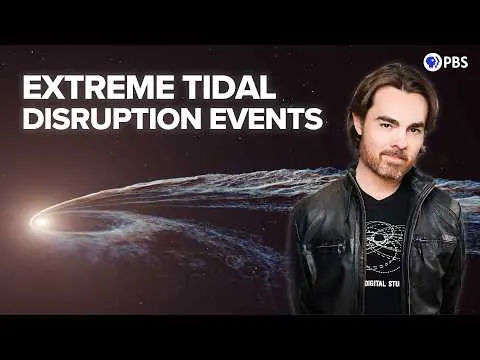
The NEW PHYSICS of Black Hole Star Capture | Extreme Tidal Disruption Events
From PBS Space Time by PBS
May 3, 2026 · 24 min
About this episode
The episode discusses the physics of black hole star capture and tidal disruption events in the Milky Way.
PBS Member Stations rely on viewers like you. To support your local station, go to:http://to.pbs.org/DonateSPACE Sign Up on Patreon to get access to the Space Time Discord! https://www.patreon.com/pbsspacetime If you track the motion of individual stars in the ultra-dense star cluster at the very center of the Milky Way you’ll see that they swing in sharp orbits around some vast but invisible mass—that’s the Sagittarius A* supermassive black hole. These are perilous orbits, and sometimes a star wanders just a little too close to that lurking monster, leading to its utter destruction in the spectacular phenomenon known as a tidal disruption event. We’ve never seen a TDE in the Milky Way, but we’ve seen them in distant galaxies—and we now know how to spot stellar destructions so extreme that they reveal properties of the black hole itself. Check out the Space Time Merch Store https://www.pbsspacetime.com/shop Sign up for the mailing list to get episode notifications and hear special announcements! https://mailchi.mp/1a6eb8f2717d/spacetime Search the Entire Space Time Library Here: https://search.pbsspacetime.com/ Hosted by Matt O'Dowd Written by Matt Caplan, Andy Santarelli & Matt…
People in this episode
Host: Matt O'Dowd
Topics covered
- black holes
- tidal disruption events
- Milky Way
- supermassive black holes
- stellar destruction
- astronomy
Keywords
- black hole
- Sagittarius A*
- tidal disruption event
- star cluster
- Milky Way
- stellar destruction
- astronomy
- supermassive black hole
Mentioned in this episode
Organizations: PBS, PBS Member Stations, Space Time
More episodes of PBS Space Time
- How Earth ACTUALLY Moves Across the Galaxy · June 13, 2026 · 25 min
- Heisenberg Made a Discovery in 1925. We Still Can't Fully Account for It · June 13, 2026 · 33 min
- The Final Obstacle to (Nearly) Infinite Energy · June 12, 2026 · 26 min
- Do We Need an UPDATED Dark Matter Model? · June 12, 2026 · 20 min
- How Are Quasiparticles Separate From Particles? · June 12, 2026 · 20 min
- What Supernova Distance Would Initiate Mass Extinction? · June 12, 2026 · 20 min
Explore listener stats, chart rankings, contacts and more on the PBS Space Time podcast page.