
Insights from recent episode analysis
Audience Interest
Podcast Focus
Publishing Consistency
Platform Reach
Insights are generated by CastFox AI using publicly available data, episode content, and proprietary models.
Most discussed topics
Brands & references
Total monthly reach
Estimated from 1 chart position in 1 market.
By chart position
- 🇳🇴NO · Business#137500 to 3K
- Per-Episode Audience
Est. listeners per new episode within ~30 days
250 to 1.5K🎙 Weekly cadence·107 episodes·Last published 2w ago - Monthly Reach
Unique listeners across all episodes (30 days)
500 to 3K🇳🇴100% - Active Followers
Loyal subscribers who consistently listen
200 to 1.2K
Market Insights
Platform Distribution
Reach across major podcast platforms, updated hourly
Total Followers
—
Total Plays
—
Total Reviews
—
* Data sourced directly from platform APIs and aggregated hourly across all major podcast directories.
On the show
From 11 epsHosts
Recent guests
Recent episodes
“The answer isn’t more AI — it’s better signal.”
Jun 4, 2026
54m 24s
Going All In: Using AI to Build Better Assessments
Apr 27, 2026
48m 24s
Quality Research Shows the Real Impact of AI @ Work
Mar 30, 2026
58m 17s
The Truth About AI Based Talent Assessment
Feb 23, 2026
48m 53s
Why Recruiting Tech is (Still) Not Helping Candidates and How to Fix It
Jan 19, 2026
47m 43s
Social Links & Contact
Official channels & resources
Official Website
Login
RSS Feed
Login
| Date | Episode | Topics | Guests | Brands | Places | Keywords | Sponsor | Length | |
|---|---|---|---|---|---|---|---|---|---|
| 6/4/26 |  “The answer isn’t more AI — it’s better signal.”✨ | AI in hiringassessment methods+4 | Robert Newry | Arctic ShoresAccenture | — | AIhiring+6 | — | 54m 24s | |
| 4/27/26 |  Going All In: Using AI to Build Better Assessments✨ | AI in assessmentsI/O psychology+3 | Taylor Sullivan | Workera | — | AI assessmentsI/O psychology+3 | — | 48m 24s | |
| 3/30/26 |  Quality Research Shows the Real Impact of AI @ Work✨ | AI impact on worktalent assessment+3 | Louis Hickman | — | — | AIwork+5 | — | 58m 17s | |
| 2/23/26 |  The Truth About AI Based Talent Assessment✨ | AI in talent assessmenthiring technology+3 | Nathan Mondragon | ProboTalentHireVue | — | AItalent assessment+5 | — | 48m 53s | |
| 1/19/26 |  Why Recruiting Tech is (Still) Not Helping Candidates and How to Fix It✨ | recruiting technologycandidate experience+4 | Doug Berg | Match2 | — | recruitingtechnology+5 | — | 47m 43s | |
| 12/19/25 |  AI Education, Personalized Learning, and the Future of Work✨ | AI educationpersonalized learning+4 | Erica Salm Rench | Sidecar AI | — | AI literacypersonalized learning+5 | — | 44m 00s | |
| 11/21/25 |  Jobs, Security, and Survival: Is Universal Basic Income in our Future?✨ | Universal Basic Incomelabor market+3 | Conrad Shaw | CommingleBootstraps | — | Universal Basic IncomeUBI+3 | — | 56m 21s | |
| 10/27/25 |  You Can’t Microwave Skills Based Hiring! Here’s the Five Star Recipe!✨ | skills-based hiringorganizational transformation+3 | Ashley Walvoord | VerizonWalmart+2 | — | skills-based hiringorganizational change+3 | — | 46m 08s | |
| 10/9/25 |  How to Prepare for the Future of Hiring NOW!— Lessons from Two Decades of HR Tech Research✨ | HR technologytalent acquisition+4 | Madeline Laurano | Aptitude Research | — | generative AIATS+5 | — | 47m 10s | |
| 9/19/25 |  AI Adoption is a Human Problem, Not a Tech Problem✨ | AI in the workplacehuman-centered design+3 | Alexis Fink | MicrosoftIntel+2 | — | AI adoptionworkplace technology+5 | — | 54m 02s | |
Want analysis for the episodes below?Free for Pro Submit a request, we'll have your selected episodes analyzed within an hour. Free, at no cost to you, for Pro users. | |||||||||
| 8/28/25 |  Overcoming Obstacles to AI Adoption Through Creative Play✨ | AI adoptioncreativity+4 | Jimmy Lepore Hagan | Mayda Tokens | — | AIcreativity+5 | — | 1h 12m 08s | |
| 8/18/25 |  Creativity Is the Gateway to AI Transformation | My creative experience building an AI podcast co-host says it all. Hear all about it on the next episode of the Psych Tech @ Work Podcast - coming soon!AI skills are essential but dauntingAI adoption is accelerating—over 70% of companies report they’re actively integrating AI tools into their workflows. But for the people expected to use those tools, it’s a different story.Most professionals say they feel unprepared or even anxious about using AI on the job. Traditional training often falls short with AI skills because it focuses on tools, not mindset.And the stakes are high: as AI becomes embedded in everyday work, careers will increasingly rely on comfort and expertise with AI.This gap and the demand for innovative strategies to close it has been top of mind for me. Good news - my fascination with AI led me to a solution! (more on this later)Creativity unlocks AI skillsI recently gave a talk at a meeting of the New Orleans AI Philosopher’s group (AKA NOAI), on AI and the future of our local economy.At this event I saw a talk by Jimmy Lepore Hagan—an artist, designer and educator—who shared a fascinating approach to AI adoption that is fresh, unique, and noteworthy.Jimmy’s talk was about the value of creativity in lowering fear of AI. He demonstrated some concepts from a workshop series he has developed featuring a series of low stakes, creative exercises grounded in design thinking to help people build comfort, confidence, and curiosity when working with AI.As a workplace psychologist I immediately saw the potential for a collaboration - applying Jimmy’s hands-on educational model to my world to help people leaders solve a difficult problem.As someone who’s spent decades applying psychological science to the development and measurement of human traits in the workplace, I have experience understanding the impact of creativity on outcomes that are directly related to work performance.As I processed this stuff- I took a step back and reviewed foundational research that shaped my earlier work—this time, through the lens of AI. The connections stood out immediately. Traits like divergent thinking, cognitive flexibility, and creative self-efficacy have long been linked to performance, but they also play a critical role in how people approach new, uncertain technologies. The evidence is clear: creativity and experiential learning do more than build skills—they tap into deeply human strengths that make people more open, adaptable, and ready to thrive in the face of change.My dance with AI says it allIt became pretty clear to me that a collaboration with Jimmy could really have some legs.To get the ball rolling I invited Jimmy to be a guest on my Podcast “Psych Tech @ Work”.To prepare I wanted to gain some first hand experience with using creativity to help me sharpen my AI skills.I suck at coding and the requirement to use Python for this definitely gave me some anxiety, but I knew ChatGPT could somehow have my back.Thus came the idea to challenge myself (and have some fun) building an AI podcast co-host, Mayda Tokens.Mapping out and executing a workflow to bring Mayda to life threw me plenty of curveballs. Some of ChatGPT’s more noteworthy and frustrating shenanigans included:* Multiple times ChatGPT relentlessly tried, and continually failed, to solve technical issues; but would not give up until I suggested that we were going in circles in a blind alley and maybe we should explore alternative methods. This prompt led immediately to a set of viable alternatives that would never have been explored if I hadn't decided to pull the plug.* When I backed ChatGPT into a corner I was flabbergasted when, instead of hallucinating a solution or looking for another option, it simply refused to help me. This was a head scratching result that must have exposed a ghost in the machine because its prime directive is NEVER to say NO!* As I explored different options for Mayda’s voice, my text to speech output randomly switched to Japanese and then to emoji* As we hit dead ends trying to figure out how to bring Mayda into my podcast studio, I stupidly followed its instructions to run to Best Buy and Guitar Center to buy unnecessary hardware that neither place actually sold.In the three weeks it took to bring Mayda to life, I became hyper-focused—borderline obsessed—with working through many obstacles. The dopamine hits I got each time we solved a challenge together reminds me that my brain chemistry is essential for accessing and applying uniquely human traits like creativity, critical thinking, resilience, and tolerance for ambiguity.The interplay between my human biology and psychology was essential for winning the day, and my experience building Mayda really hammered home the value of creative collaboration with AI.Our workshop is the gateway to fearless AI skillsLearn how we’re helping companies build fearless, AI-ready teams.Viewing AI as a dance partner is the paradigm that serves as the foundation of our workshop. Instead of lectures, videos, and formulaic exercises; we use creative, hands-on activities that help people relate to AI in a way that feels playful, safe, and real.In our workshop participants explore AI through:* Improvised dialogue with generative models* Creative prompt challenges* Group problem-solving sprints* Human-AI art collaborations* Guided reflection and peer feedbackBy mapping each of these design thinking centric, hands-on exercises to psychological principles—like creative self-efficacy, openness to experience, and experiential learning—the workshop becomes more than fun. It becomes a stealth learning experience where participants not only gain essential AI skills, they undergo cognitive changes that empower them to believe in the value of partnering with AI.We believe our workshop can be a difference-maker for companies navigating AI transformation—and a real competitive advantage for those that are bold enough to think differently about AI adoption.To learn more about our workshop, the collaborative ideas behind it, and meet Mayda Tokens Visit our workshop page and be sure to listen to our conversation about it on the next edition of my Psych Tech @ Work podcast. This is a public episode. If you would like to discuss this with other subscribers or get access to bonus episodes, visit charleshandler.substack.com | 4m 38s | ||||||
| 5/12/25 |  Scaling AI Innovation for Hiring: Lessons from the Frontlines | Guest: Christine Boyce, Global Innovation Leader at ManpowerGroup/Right Management“We have to stress-test innovation in the messiness of real-world hiring, not just ideal lab conditions.”-Christine BoyceIn this episode of Psych Tech @ Work, I’m joined by my longtime friend Christine Boyce, Global Innovation Leader at ManpowerGroup/Right Management, to explore how innovation — especially around AI — is reshaping hiring and talent development at scale, and why solving for trust, transparency, and operational realities matters more than ever.SummaryAt the heart of this conversation is the reality that scaling AI innovation in hiring brings massive complexity. While AI offers incredible promise, solving for accuracy, fairness, and operational reality becomes exponentially harder when you're dealing with a large number of unique clients.Christine Boyce, through her work at ManpowerGroup & Right Management, operates at the intersection of these challenges every day. Unlike internal talent acquisition leaders who focus on one organization's needs, Christine must help innovate across a vast client portfolio. Each client presents different barriers — from data limitations, to ethical concerns, to regulatory pressures — and innovation must be modular, defensible, and adaptable to succeed.This vantage point gives Christine a unique, big-picture view of how AI adoption really plays out across industries and markets.We dive into the practical challenges of innovating responsibly: earning trust, scaling solutions across diverse environments, and balancing speed with fairness. Christine’s work at ManpowerGroup & Right Management highlights how innovation must be deeply disciplined if it is to achieve true scale and impact.The Core Challenge: Scaling Accuracy and FairnessAt the heart of using AI for hiring lies the challenge of achieving accuracy and fairness at scale. AI’s true value isn’t just its ability to make individual decisions — it’s in processing vast amounts of data and automating judgment across thousands of candidates. However, scale magnifies both strengths and weaknesses: minor biases can grow into systemic problems, and small inefficiencies can snowball into major failures.Staffing firms like ManpowerGroup offer critical real-world lessons:* Scale forces discipline — Every AI tool must be rigorously vetted for fairness, transparency, and defensibility before deployment.* Real-world variation stresses the system for the better — Tools must flexibly adapt to diverse jobs, industries, and candidate pools. This makes the overall path of innovation better and drives great learnings across the board.* Speed must not erode trust — Productivity gains must still respect ethical standards and candidate experience.* External accountability keeps AI honest — Clients demand transparency, validation, and explainability before adoption.Real Barriers to AI Adoption: What Clients Are FacingDespite AI's potential, Christine identifies several persistent hurdles that she faces when serving her diverse slate of clients:* Resistance to Behavior Change: Even demonstrably valuable AI tools often struggle against entrenched workflows and distrust of automation.* Ethical and Trust Concerns: Clients demand AI systems that are transparent, explainable, and defensible, fearing reputational or regulatory risks.* Vendor Noise Overload: Saturation by "AI-washed" vendors makes it hard to differentiate true innovation from hype.* Mismatch Between Hype and Practical Needs: Clients need tools that solve today’s operational problems — not just futuristic visions disconnected from reality.* Fear of Creeping AI Adoption: Organizations worry about AI capabilities being embedded into systems without visibility or intentionality.* Compliance and Regulation Anxiety: Global and local regulations (like the EU AI Act or pending US laws) create urgency for proven, compliant AI solutions.* Talent Data Readiness: Without clean, structured internal data, even the best AI solutions struggle to deliver meaningful results.These challenges aren't isolated — they reveal the broader realities companies must manage when trying to adopt AI responsibly at scale.Ultimately, client concerns have a hand in AI innovation because they are critical for the adoption of these technologies, shaping how staffing firms and vendors must design, validate, and deploy solutions.There’s an inherent tension between the drive for scale and the need for trust, fairness, and operational reality.Christine’s experience demonstrates that true innovation in AI for hiring isn't just about introducing new tools — it’s about creating resilient, transparent systems that can adapt to real-world complexity. Managing the tension between speed, scale, trust, and fairness represents the path to a bright future. This is a public episode. If you would like to discuss this with other subscribers or get access to bonus episodes, visit charleshandler.substack.com | 52m 21s | ||||||
| 4/15/25 | 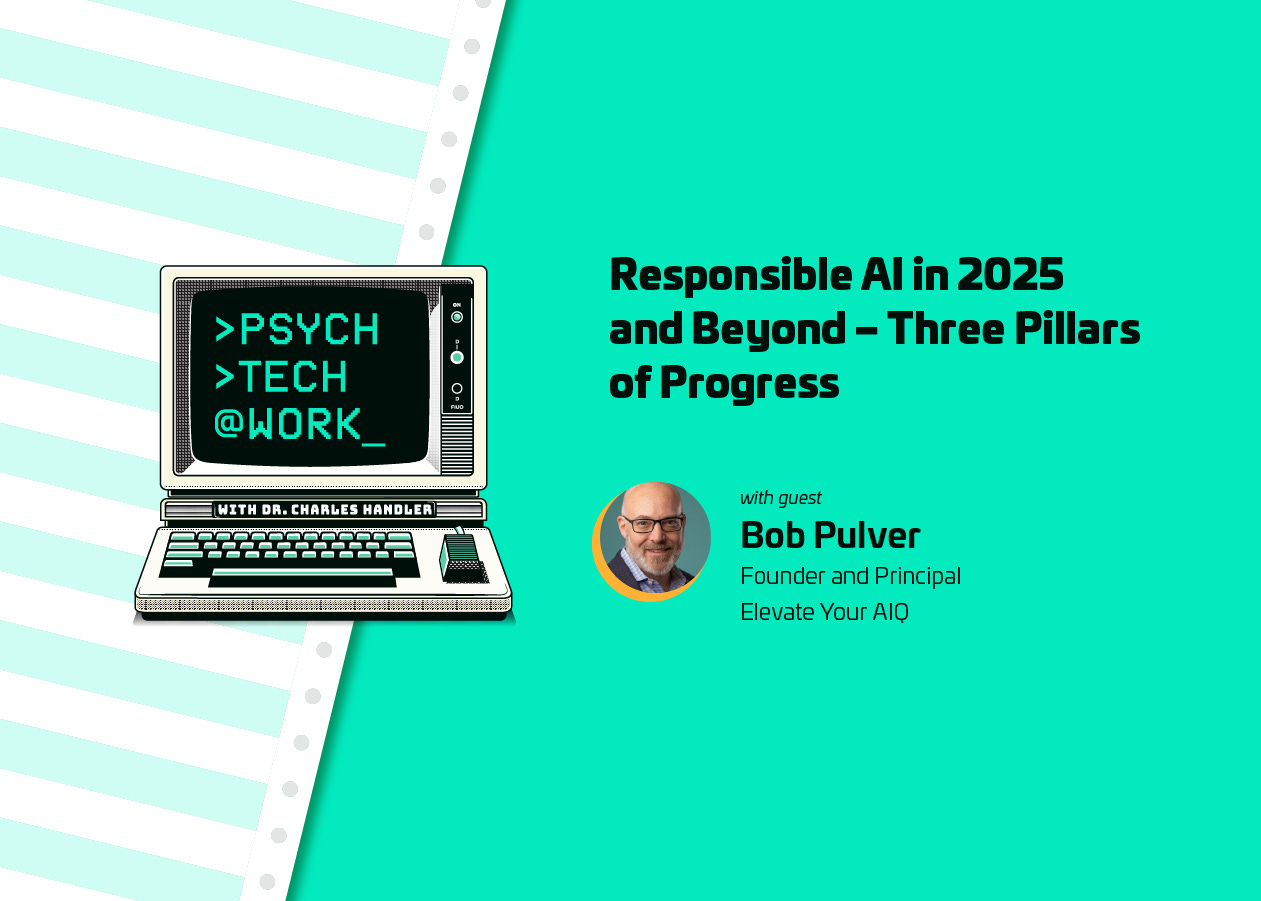 Responsible AI In 2025 and Beyond – Three pillars of progress | "Part of putting an AI strategy together is understanding the limitations and where unintended consequences could occur, which is why you need diversity of thought within committees created to guide AI governance and ethics." – Bob PulverMy guest for this episode is my friend in ethical/responsible AI, Bob Pulver, the founder of CognitivePath.io and host of the podcast "Elevate Your AIQ." Bob specializes in helping organizations navigate the complexities of responsible AI, from strategic adoption to effective governance practices. Bob was my guest about a year ago and in this episode he drops back in to discuss what has changed in the faced paced world of AI across three pillars of responsible AI usage. * Human-Centric AI * AI Adoption and Readiness * AI Regulation and GovernanceThe past year’s progress explained through three pillars that are shaping ethical AI:These are the themes that we explore in our conversation and our thoughts on what has changed/evolved in the past year.1. Human-Centric AIChange from Last Year:* Shift from compliance-driven AI towards a more holistic, human-focused perspective, emphasizing AI's potential to enhance human capabilities and fairness.Reasons for Change:* Increasing comfort level with AI and experience with the benefits that it brings to our work* Continued exploration and development of low stakes, low friction use cases* AI continues to be seen as a partner and magnifier of human capabilitiesWhat to Expect in the Next Year:* Increased experience with human machine partnerships* Increased opportunities to build superpowers* Increased adoption of human centric tools by employers2. AI Adoption and ReadinessChange from Last Year:* Organizations have moved from cautious, fragmented adoption to structured, strategic readiness and literacy initiatives.* Significant growth in AI educational resources and adoption within teams, rather than just individuals.Reasons for Change:* Improved understanding of AI's benefits and limitations, reducing fears and resistance.* Availability of targeted AI literacy programs, promoting organization-wide AI understanding and capability building.What to Expect in the Next Year:* More systematic frameworks for AI adoption across entire organizations.* Increased demand for formal AI proficiency assessments to ensure responsible and effective usage.3. AI Regulation and GovernanceChange from Last Year:* Transition from broad discussions about potential regulations towards concrete legislative actions, particularly at state and international levels (e.g., EU AI Act, California laws).* Momentum to hold vendors of AI increasingly accountable for ethical AI use.Reasons for Change:* Growing awareness of risks associated with unchecked AI deployment.* Increased push to stay on the right side of AI via legislative activity at state and global levels addressing transparency, accountability, and fairness.What to Expect in the Next Year:* Implementation of stricter AI audits and compliance standards.* Clearer responsibilities for vendors and organizations regarding ethical AI practices.* Finally some concrete standards that will require fundamental changes in oversight and create messy situations.Practical Takeaways:What should I/we be doing to move the ball fwd and realize AI’s full potential while limiting collateral damage?Prioritize Human-Centric AI Design* Define Clear Use Cases: Ensure AI is solving a genuine human-centered problem rather than just introducing technology for technology’s sake.* Promote Transparency and Trust: Clearly communicate how and why AI is being used, ensuring it enhances rather than replaces human judgment and involvement.Build Robust AI Literacy and Education Programs* Develop Organizational AI Literacy: Implement structured training initiatives that educate employees about fundamental AI concepts, the practical implications of AI use, and ethical considerations.* Create Role-Specific Training: Provide tailored AI skill-building programs based on roles and responsibilities, moving beyond individual productivity to team-based effectiveness.Strengthen AI Governance and Oversight* Adopt Proactive Compliance Practices: Align internal policies with rigorous standards such as the EU AI Act to preemptively prepare for emerging local and global legislation.* Vendor Accountability: Develop clear guidelines and rigorous vetting processes for vendors to ensure transparency and responsible use, preparing your organization for upcoming regulatory audits.Monitor AI Effectiveness and Impact* Continuous Monitoring: Shift from periodic audits to continuous monitoring of AI tools to ensure fairness, transparency, and functionality.* Evaluate Human Impact Regularly: Regularly assess the human impact of AI tools on employee experience, fairness in decision-making, and organizational trust.Email Bob- bob@cognitivepath.io Listen to Bob’s awesome podcast - Elevate you AIQ This is a public episode. If you would like to discuss this with other subscribers or get access to bonus episodes, visit charleshandler.substack.com | 54m 44s | ||||||
| 3/18/25 |  The Reality of Skills-Based Hiring Rests on Three Essential Pillars- with Jason Tyszko | “We have to move beyond the idea that a skills-based job description is enough—there needs to be validation, assessment, and a clear pathway for job seekers to prove their abilities.”-Jason TyszkoIn this episode of Psych Tech @ Work, I sit down with Jason Tyszko, Senior Vice President of the U.S. Chamber of Commerce Foundation, to discuss what it really takes to make skills-based hiring a reality. Jason oversees the Foundation’s T3 Innovation Network, a public-private initiative aimed at creating a more equitable and inclusive job market. T-3 focuses on using digital tools to improve communication between different parts of the job market, ensuring that all learning is recognized and valued. T-3’s mission to bridge gaps between employers and workers via the advancement of skills-based hiring makes Jason one of the world’s foremost authorities on the subject.Our conversation is a must for anyone interested in understanding the REALITIES required for true skills-based hiring. Most conversations on the subject are more hype than substance, but not this one! Jason takes us deeper into the reality of what it will take to make skills based hiring more than just an empty buzzword.To ground our conversation in a dose of reality, Jason boils success with skills based hiring into these three pillars.* Interoperable Skills Data* To make skills-based hiring a reality, we need standardized, structured, and widely accepted skills data that flows seamlessly across education providers, employers, and workforce systems.* Without interoperability, skills data remains fragmented, making it difficult for employers to assess candidates meaningfully.* Employer Engagement and Adoption* Employers must align job descriptions, hiring processes, and internal mobility pathways around skills rather than degrees or traditional credentials.* Many organizations support skills-based hiring in theory but fail to implement it fully due to ingrained legacy practices.* Technology Infrastructure and Ecosystem Readiness* AI, job-matching platforms, and hiring tools must be built to recognize and evaluate skills accurately, rather than simply filtering candidates based on outdated proxies like job titles or degrees.* Systems should support skills validation, assessment, and transparent career pathways to ensure fair and effective hiring decisions.Jason explains how these pillars support and enable five critical but often overlooked elements that are essential to making skills-based hiring work: 1. Learning and Employment Records (LERs) & The LER Resume Standard* What it is: LERs are digital, verifiable records of a person’s skills, training, certifications, and work experience. Instead of relying on traditional resumes or self-reported skills, LERs allow employers to see a structured, validated record of a candidate’s capabilities.* Why it matters: Today’s hiring systems don’t talk to each other. Skills data is trapped in different platforms (learning management systems, certifications, HR software). LERs allow skills-based hiring to function at scale by ensuring a candidate’s credentials are portable and universally recognized.* LER Resume Standard: This is a newly developed resume format built to process LERs, ensuring HR tech systems can read, compare, and use skills-based data more effectively.2. Durable Skills* What it is: Unlike technical skills (which can quickly become outdated), durable skills are long-lasting, transferable skills like critical thinking, adaptability, leadership, and collaboration.* Why it matters: Most AI-driven hiring tools over-prioritize technical skills, but durable skills are what truly drive career success. Without a way to assess and validate them, companies risk hiring for short-term needs instead of long-term potential.3. The Interoperability Layer* What it is: A technical framework that allows skills data from different platforms to connect and work together—like an API that helps job boards, HR systems, and learning platforms “speak the same language.”* Why it matters: Right now, skills-based hiring is fragmented because every company and HR tech provider uses different skills taxonomies and formats. An interoperability layer standardizes how skills data is shared, making it easier for employers to evaluate candidates based on a common skills framework.4. Employer-Led Recognition* What it is: A system where workers’ skills are validated by their employers and colleagues, not just through certifications or formal education. This could involve peer endorsements, manager assessments, or internal training validations.* Why it matters: Most skills-based hiring focuses on externally validated credentials (e.g., certificates, degrees), but many people develop critical skills on the job. Without a structured way to recognize and verify these skills, businesses overlook talent that is already in their workforce.5. Skills Wallets* What it is: A digital, user-controlled repository where individuals can store, manage, and share verified records of their skills, credentials, and learning experiences.* Why it matters: Unlike traditional resumes or degree transcripts, Skills Wallets give workers full ownership of their skills data, making it portable across jobs, industries, and learning platforms. This enables lifelong learning and career mobility in ways that existing hiring systems do not support.* Skills-based hiring has the potential to transform the workforce, but it won’t succeed without system-wide changes in HR technology, workforce data, and employer incentives. Jason’s insights reveal the often-ignored challenges and solutions that can make this shift truly scalable and effective. If you’re in talent strategy, workforce development, or HR technology, this episode provides a realistic roadmap for making skills-first hiring work.* Learn more about the T3 Innovation Network: t3networkhub.org* Contact Jason This is a public episode. If you would like to discuss this with other subscribers or get access to bonus episodes, visit charleshandler.substack.com | 59m 01s | ||||||
| 3/12/25 |  Are These 4 AI Mistakes Sabotaging Your Talent Strategy? | In our recent LinkedIn Live session my esteemed colleague, Neil Morelli, founder of Workplace Labs, and I present a philosophical but practical approach to the adoption of HR Tech tools.Check out the full video of the presentation attached to this post and our accompanying slides (found at the bottom of the post).Here is a quick overview of the ideas that form the foundation of the presentation.“The highest-level goal of the talent acquisition (TA) function is to ensure that an organization has the right people, in the right roles, at the right time, to drive business success.”-Chat GPT 4o & your hosts’ combined 50 years of experienceTalent leaders are feeling the pressure to executeModern hiring problems such as resource constraints, candidate scarcity and overload, the move to skills based hiring, and avoiding bias have talent leaders feeling the pressure to find fast solutions!Relieving these pressures often create a temptation to put tools before strategy. AI is a great example of this.The stakes are high, and AI offers a compelling solution- or does it? AI is complex and making decisions about it requires a strong foundation of knowledge and careful planning.In this presentation we discuss 4 common mistakes in the adoption of HR tech, with a focus on AI tools (are there any other types these days?).We discuss how a tools first mentality is often the root cause of these four common mistakes and offer guidance on how to avoid them. 1. Missing AI’s ‘creeping normality': As technology becomes more entrenched in your processes and vendors add new functionalities that are accessible, adoption often occurs with little oversight or consideration. When it comes to solving problems related to talent supply or overload, AI recruitment platforms are increasingly embedding “talent matching” functionalities that create risk without any substantial rewards. 2. Chasing Skills Without Definition or Direction: We can all agree that skills based hiring has merit. But it requires alignment on what a skill means to your organization and a holistic view of where they matter and why. Merely removing resumes from the evaluation process or adopting tools, AI or otherwise, that claim to support skills based hiring without a holistic strategy is a dead end street.3. Failing to evaluate your firm’s culture and climate for adopting AI based tools: There is a maturity required for the successful adoption of AI based tools. Understanding your firm’s readiness for AI based tools, and ensuring that you are ready to go all in is essential. Education on, and knowledge of, AI across the entire organization is a big part of successful adoption. 4. Letting vendors dictate strategy and adoption: Most vendors do offer products that can have an impact, and their messages make it tempting to jump right in. Before biting on a shiny new object, adoption of any AI based tool should be pre-empted by a house made strategy. Vendors must be held to a standard evaluated by domain experts using a framework built on the principles of ethical and effective use of AI.At the end of the presentation we provide a case study that probably feels pretty relatable to any talent acquisition professional. Here we tell a story of how mistakes are made and provide insights to help create the awareness needed to avoid them.No one is perfect - but AI alone will not create perfection. Keeping things in perspective and a thoughtful and methodical process that is not driven by fear is essential to the successful adoption of AI technologies.Download our slides here This is a public episode. If you would like to discuss this with other subscribers or get access to bonus episodes, visit charleshandler.substack.com | 50m 16s | ||||||
| 2/28/25 | 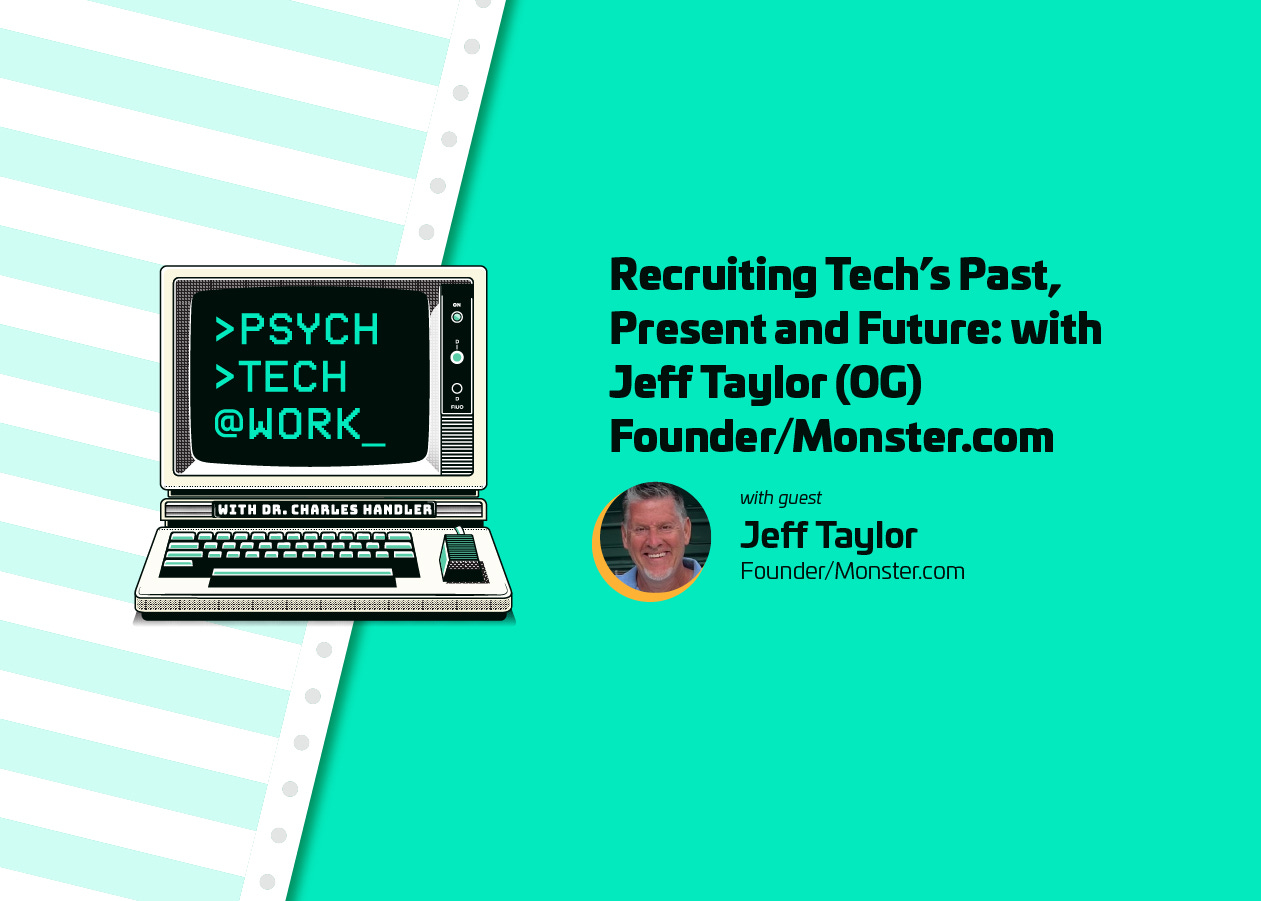 Recruiting Tech’s Past, Present and Future- W/Jeff Taylor: OG, Founder @ Monster.com & Boomband | "The hiring industry is at a breaking point—AI is putting pressure on old systems that were never designed for this level of automation."–Jeff TaylorIn this episode of Psych Tech @ Work, I am joined by Jeff Taylor, serial entrepreneur and founder of Monster.com, & Boomband a revolutionary new platform that is looking to turn hiring on its ear.Few people have shaped the hiring industry as profoundly as Jeff, whose vision transformed job search from a niche experiment into an industry standard. Jeff’s journey—from building the first large-scale job board to continuously innovating in the talent acquisition space—gives him a unique perspective on where hiring technology has been and where it’s headed, making him the perfect guest to explore the next big disruptions in talent acquisition and how AI is reshaping the hiring process.. In our time together we reminisce about the story behind Monster’s memorable Superbowl ads. (Who can forget the kid saying: “I want to claw my way up to middle management!” ) and the formative impact my job at Monster (circa 2000) has had on my career. But enough about me! Our conversation explores the rapid acceleration of AI in recruiting, from automating sourcing and matching to the potential risks of AI-generated applications flooding hiring systems. Jeff happily shares his candid thoughts on why hiring technology has stagnated, how AI is creating new challenges for recruiters, and what companies must do to stay ahead in an increasingly automated hiring landscape. We also discuss the core concepts behind Boomband, Jeff’s new social hiring platform.Topics Covered:* Monster.com’s origin story and how it transformed hiring and created the “job board” industry.* The shift from traditional job search to AI-driven sourcing and candidate matching and what this means for the future of hiring.* The pros and cons of AI-generated resumes and job applications—are we heading toward an overload of unqualified applicants?* The failure of legacy hiring systems to keep up with modern job-seeker behavior.* The potential for AI to create more personalized and predictive hiring experiences and Boomband Jeff’s new venture that is focused on creating a new paradigm for hiring (again!).Takeaways:* Job boards revolutionized hiring—but they haven’t evolved fast enough. The core concept of posting jobs and waiting for applications hasn’t fundamentally changed in decades.* AI is making job search more efficient but also more chaotic. Automated resume generation and mass applications are overwhelming recruiters and breaking traditional applicant tracking systems.* Legacy hiring technology is struggling to adapt. The demand for AI-powered sourcing and skills-based hiring is exposing the limitations of old-school job posting and resume-matching platforms.* The next frontier of hiring is predictive and personalized. Jeff envisions AI-driven career pathing, real-time job market intelligence, and new ways to match candidates based on abilities, not just experience.Jeff’s perspective on AI-driven hiring, the changing nature of job search, and where hiring technology must go next makes this conversation a must-listen for anyone interested in the future of work. This is a public episode. If you would like to discuss this with other subscribers or get access to bonus episodes, visit charleshandler.substack.com | 47m 44s | ||||||
| 2/14/25 | 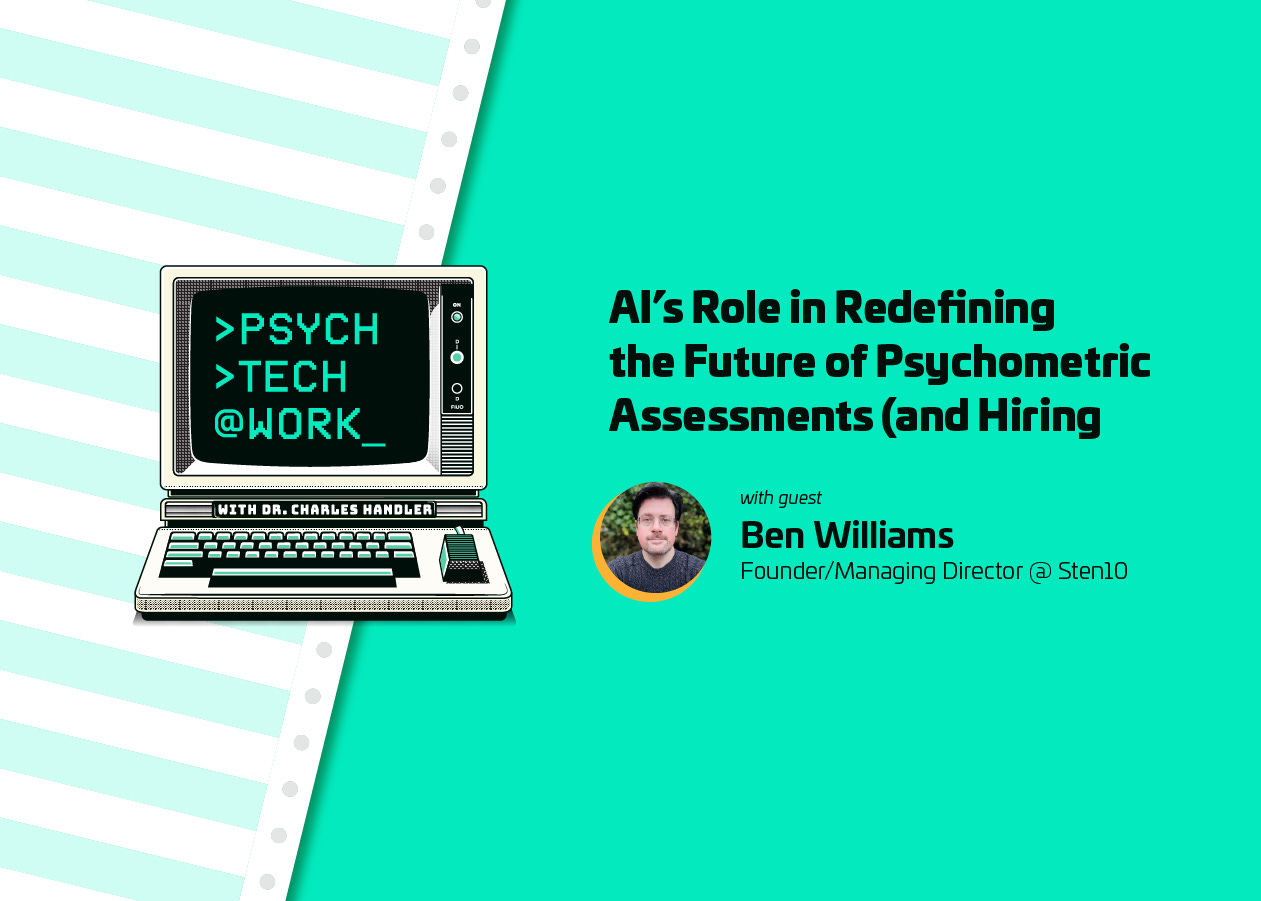 AI’s Role in Redefining the Future of Psychometric Assessments (and Hiring) | “The future of assessments is about customization at scale. AI allows us to generate and adapt assessments in real-time, making them more relevant to specific job roles.”–Ben WilliamsIntroduction: In this episode of Psych Tech @ Work, I sit down with Ben Williams, Managing Director of Sten 10, to discuss how AI is reshaping the field of psychometric assessments and hiring processes. Our conversation dives into the evolving landscape of AI-driven assessments, the ethical considerations of using AI in hiring, and the challenges of maintaining transparency and fairness while incorporating new technologies. Ben shares insights into blending AI with traditional assessment tools and how this impacts the future of selection processes.Key Topics Covered:* The role of AI in automating and customizing assessments* Emerging challenges in trust, fairness, and explainability in AI-powered hiring* The importance of designing job-specific psychometric tools that align with organizational needs* AI's potential in generating, scoring, and validating assessments* Future implications of AI on entry-level and senior hiring rolesSummary:We explore AI’s role in streamlining psychometric assessments while addressing challenges in maintaining transparency and fairness. Ben describes how Sten 10 has integrated AI to make assessment processes faster and more personalized without losing the critical human oversight needed for ethical hiring practices. We also discuss prompt engineering, AI literacy, and the limitations of AI-generated assessments. One significant takeaway is the growing importance of designing highly contextual and customized assessments using AI while ensuring they remain interpretable and meaningful.We touch on real-world examples, including how AI can generate coaching tips and personality profiles, as well as potential concerns regarding the over-reliance on AI outputs. The conversation also highlights emerging roles related to AI governance and the need for regulatory oversight to ensure fair hiring practices.Key Takeaways:* AI augments, but doesn’t replace human oversight: While AI is making assessments faster and more scalable, the need for human validation remains critical to ensuring fairness.* Custom psychometric assessments are the future: Moving beyond off-the-shelf tools, companies can develop highly specific and job-relevant assessments using AI.* Prompt engineering for assessments: Organizations can create better assessment tools by focusing on AI prompt development and optimization.* AI literacy is essential for hiring professionals: As AI becomes more embedded in hiring, HR professionals need to understand its benefits and limitations to apply it responsibly.* Trust and explainability are key: Companies must prioritize transparency to gain candidate trust and meet regulatory standards.Conclusion:AI’s role in hiring is evolving rapidly, and the opportunities for innovation are endless. However, as Ben notes, the path forward requires a careful balance between technological advances and maintaining human control. By designing psychometric tools with AI and human collaboration, organizations can achieve a fairer and more effective hiring process.Take It or Leave It? Articles:* “Ineffective Human-AI Interactions and Solutions” — Oxford Review* Summary: This article delves into the factors influencing human-AI collaboration, including cognitive load and decision control. Ben highlights how integrating AI into familiar tools like Slack and Word can reduce friction and improve adoption.* “AI and Public Perception: What Americans Really Think” — Center for Data Innovation* Summary: A survey reveals mixed feelings about AI, with curiosity decreasing and negative emotions on the rise. Ben critiques the contradictions in public attitudes toward AI and how these perceptions could shape its future adoption in hiring. This is a public episode. If you would like to discuss this with other subscribers or get access to bonus episodes, visit charleshandler.substack.com | 1h 01m 25s | ||||||
| 1/31/25 |  What does AI know about Skills Based Hiring? Listen and find out! | “We need global standards to define and verify skills, or we’ll be left with confusion and inconsistency across industries.” -Notebook LM’s Deep Dive Podcast HostsSkills based hiring is all the rage, and so is AI.So what happens when you mix the two?In this special edition of Psych Tech @ Work, I handed the mic over to AI using Google’s Notebook LM. The result? A fully AI-generated exploration of the evolving world of skills-based hiring. But how well did AI do at covering this complex and nuanced topic? So how did it do? Listen and decide for yourself.In the meantime- Here is a short summary to pique your curiosity.Skills-based hiring promises to break down barriers and redefine how we think about qualifications, but it’s not without challenges. This episode examines how companies can move beyond traditional degree requirements and leverage diverse learning pathways. It also highlights the shift from career ladders to flexible, lattice-like models and the critical role of leadership in making these transformations happen.Key Takeaways:* AI is a tool, not the solution: Organizations need both AI-driven assessments and human judgment to effectively identify and verify skills.* Degrees aren’t everything: Employers must embrace non-traditional education pathways to access untapped talent.* Lifelong learning is essential: Workers should continuously upskill and showcase their abilities through portfolios and personal branding.* The career ladder is outdated: Flexible career paths based on transferable skills are the future.* Leadership drives change: True transformation in hiring practices requires bold decisions beyond tech implementation.Conclusion:This AI-powered episode demonstrates the potential of using AI for content creation while also showing its limitations. AI did a great job providing structure and highlighting key points, but human oversight remains essential to ensure deeper exploration and address the human factors that technology alone can’t fully capture. Skills-based hiring requires more than AI—it needs leaders willing to rethink and redesign hiring practices with empathy and inclusivity in mind.Please listen and share your thoughts on how these robots did exploring the issues and drawing meaningful conclusions! This is a public episode. If you would like to discuss this with other subscribers or get access to bonus episodes, visit charleshandler.substack.com | 23m 23s | ||||||
| 1/10/25 |  Bridging Leadership, Psychological Safety, and Technology with Alison Eyring | “Technology should enable human connection, not replace it.”—Alison EyringIntroductionIn this episode, I’m joined by my friend Alison Eyring, an IO psychologist with decades of experience in the realm of global leadership and talent development and the founder of Produgie.I have known Alison for a very long time - in fact she was my first “real world” project sponsor back in 1994!It was a pleasure to welcome Alison to the show for a great conversation about the role of human centered design when building software to help leaders do their thing! Summary:Our conversation explores the intersection of leadership psychology and technology design. Alison shares insights on how psychological safety can be both measured and improved, emphasizing its critical role in team dynamics and organizational success. We dive into her approach to developing tools tailored to user needs, the importance of cultural agility for global leaders, and how technology can both enhance and challenge workplace trust. Throughout, Alison highlights how organizations can foster meaningful change through a combination of data, design, and human connection.Key Topics Covered:* The psychology behind software usability and human-centered design.* Measuring and improving psychological safety within teams.* The evolving role of AI in leadership and organizational development.* Using adaptive tools to support leaders in achieving greater impact.* The challenges and opportunities of cultural agility in a globalized workforce.Takeaways:* Psychological Safety: Leaders can actively improve psychological safety, a critical element for team effectiveness and engagement, by fostering trust and transparency.* Cultural Agility: Leadership in a global context requires a combination of self-awareness, competencies, and experiences to navigate cultural differences effectively.* Data-Driven Insights: Organizations can gain actionable insights from assessments and development tools to better understand leadership strengths and weaknesses.* Human-Centered Design: Building technology for HR or leadership should prioritize the user’s challenges and needs, not just the buyer’s demands.* AI in Leadership: AI can support leaders in providing feedback, fostering growth, and driving measurable outcomes, but its use must be transparent and human-supervised.Take It or Leave It Articles:* “The Homework Apocalypse” by Ethan Mollick* Summary: This article discusses how educators are grappling with AI tools used by students for coursework and the need to rethink educational approaches. Alison critiques the rapid pace of AI developments and emphasizes the importance of teaching judgment and understanding bias in AI-generated insights.* “Psychological Safety in the Workplace”* Summary: This article explores what psychological safety is, what erodes it, and how organizations can foster it. Alison highlights the timeless nature of this topic and its centrality to leadership and organizational success. This is a public episode. If you would like to discuss this with other subscribers or get access to bonus episodes, visit charleshandler.substack.com | 52m 28s | ||||||
| 12/19/24 |  Deconstructing Jobs in the Age of AI: Skills, Work Redesign, and The Future of Work | "AI isn’t replacing people—it's augmenting them. The people who know how to use AI will replace those who don’t: "Redesigning jobs is about understanding which tasks humans excel at and which tasks AI can handle—then finding the perfect balance."Guest:Sania Khan* Labor Economist, founder of Inflection Point Consulting, Chief Economist at a leading talent intelligence AI company, Senior Economist at the Bureau of Labor Statistics (BLS)Summary:In this episode of Psych Tech @ Work, I welcome a new friend and brilliant Labor Economist Sania Khan, whose unique perspective blends macroeconomic labor trends, AI-driven work redesign, the evolution of skills, and the future of workSania shares insights from her experience at the Bureau of Labor Statistics and her work with emerging talent intelligence tools to tackle one of today’s hottest topics: how jobs are being fundamentally deconstructed into tasks, skills, and competencies.We dig into how AI is reshaping work—from automating routine tasks to creating new opportunities—and what this means for businesses and individuals. Sania makes the case for job redesign as an essential forward looking strategy for organizations as they adapt to the increasing role of AI in redefining the rules of work.We agree that the world of work will increasingly find itself tied to a skills based economy which will require solving the challenge of moving beyond buzzwords like “skills-based hiring” and focus on aligning emerging technologies with human potential.This will require building consistent skills taxonomies, focusing on durable skills like problem-solving and critical thinking, and the gap between hype and reality when it comes to AI’s impact on the labor market. Topics Covered:* Deconstructing Jobs with AI* How AI is automating tasks within jobs, freeing workers for more meaningful work.* The importance of job redesign to align organizational goals with evolving roles.* Skills-Based Hiring and Skills Taxonomies* Why a globally accepted definition of "skills" remains elusive and how this hinders interoperability across platforms.* The challenge of relying on resumes and job descriptions as source materials for skills analysis.* The Future of Work and AI's Impact* AI’s dual role: creating efficiencies while raising concerns about job replacement.* Predictions for future jobs—like AI specialists, prompt engineers, and responsible AI officers—and how organizations can prepare.* Durable Skills and Adaptability* Why “durable skills” like problem-solving, critical thinking, and agility will define professional success.* How workers can future-proof their careers by learning to work with AI, not against it.Takeaways:* AI is reshaping work by automating routine tasks, but humans remain critical for complex, meaningful roles.* Organizations must focus on job redesign to capitalize on AI while ensuring employees do meaningful, value-added work.* Skills-based hiring is promising but hindered by inconsistent taxonomies and unreliable data sources.* Durable skills—like critical thinking, problem-solving, and adaptability—are the key to navigating AI-driven change.* Workers who learn to augment their skills with AI will have the greatest advantage.* New roles like AI specialists, responsible AI officers, and prompt engineers will emerge as businesses adopt more advanced technologies.Articles Discussed in the "Take It or Leave It" Segment:* "Research: How GenAI is Already Impacting the Labor Market" – Harvard Business Review* Summary: A data-backed look at how generative AI is reducing demand for automation-prone gig work while increasing competition in the labor market. Sania underscores the importance of becoming exceptional at your craft to remain competitive.* "How AI Is Fueling Long-Term Job Growth" – Fast Company* Summary: A positive perspective on AI’s role in creating new jobs, like AI specialists and data scientists. Sania challenges the overly optimistic forecasts, noting the need for realistic strategies to align skills with emerging roles.This episode provides a compelling look at the intersection of technology, skills, and workforce transformation—a must-listen for leaders navigating the evolving world of work. This is a public episode. If you would like to discuss this with other subscribers or get access to bonus episodes, visit charleshandler.substack.com | 1h 02m 27s | ||||||
| 12/6/24 |  Understanding Cultural Agility in Global Work Environments | "The most important competency for success in global assignments? Humility—being willing to learn how to succeed in a new cultural context."* Paula CaligiuriPaula is THE expert in this realm!In this episode, I welcome Paula Caligiuri, a renowned expert in cross-cultural psychology and global leadership and author of many books about cross-cultural adaptation and career happiness, the latest ones being:Build Your Cultural Agility: The Nine Competencies of Successful Global Professionals (2021)Live for a Living: How to Create your Career Journey to Work Happier, Not Harder (2023, co-authored with Andrew Palmer)I have known Paula for almost 30 years. Her research played an essential role in my dissertation which was on cross-cultural adaptation in expatriate work assignments. While I do not work in this area, Paula sure does! She has dedicated her career to research and practice on the psychology of cross-cultural adaptation in both the personal and professional realms.I really enjoyed the opportunity to speak with Paula about the intricacies of cultural agility, the challenges faced by individuals working internationally, and how organizations can better prepare their employees for success in diverse environments.Cultural Agility is the name of the game.Our conversation is anchored by the concept of “Cultural Agility”, a combination of awareness, competencies, and experiences that allow individuals to be effective in multicultural environments. Paula describes it as being made up of:* Awareness: Understanding one's own values and how they compare to different cultural contexts.* Competencies: The skills needed to enter a novel environment, learn it, and be effective. These include both relationship-oriented competencies (like perspective-taking, relationship-building, and humility) and personal self-oriented competencies.* Experiences: Exposure to different cultural contexts, though Paula emphasizes that experiences alone are not enough.Paula notes that cultural agility involves the ability to adapt and thrive in unfamiliar cultural settings. She emphasizes that it's not just about giving people experiences abroad, but also equipping them with the knowledge and skills to navigate cultural differences effectively.Biology is a critical factor in adaptationProbably the most interesting thing I learned from our conversation was the role hormones play in cultural agility because they can help individuals handle greater levels of novelty comfortably and effectively, and that those with higher cultural agility are often better able to adjust to more challenging cultural contexts. Did you know that- elevated cortisol levels in response to cultural unfamiliarity can impair cognitive functions, making it challenging to interpret social cues and adapt behaviors appropriately.Or that The novelty of a new culture triggers the brain's reward system, releasing dopamine, which can enhance our motivation to engage and learn in the new environment.I didn’t!Adaptation begins with undertaking activities that put our chemicals in balance!Assessment plays a central role in adaptationI am not going to pass up the opportunity to talk about assessments. Paula has taken what she has learned and created the myGiide assessment, which measures cultural value and cultural agility competencies providing users with insights into their cultural values and biases, allowing for comparative analysis with other cultures and identifying potential areas of conflict or misunderstanding. The assessment is free. I took it and found the insights it provided me super valuable.myGiide is also an example of the role technology plays in cross-cultural adjustmentThe impact of technology on cultural adaptation may surprise you.I went into our conversation thinking Paula would gush about how technology has made adapting to other cultures much easier. But I was wrong!* Technology is a "double-edged sword" for cultural adaptation. It allows people to stay connected to home, potentially reducing feelings of isolation. However, overreliance on home connections can hinder full immersion and engagement with the local environment.* Technology should not replace real-world experiences and interactions. It should be used as a tool for learning and support. Excessive use of social media and video calls can become a "crutch" that impedes adjustment to the new cultural context. Direct engagement with the host culture remains crucial for successful adaptation because cultural differences are "exacerbated" in virtual environments due to the lack of in-person cuesBusinesses must step up to help their expats be successfulWhen it comes to expat assignments, businesses should:* Create a pipeline of culturally agile professionals through strategic talent management practices, including the recruitment, selection, and development of employees with the ability to work effectively across cultures.* Assess bench strength in cultural competencies, not just technical skills, for roles that involve international or multicultural work.* Use assessments to identify employees who are ready for international assignments or have the potential to develop cultural agility.* Provide targeted support for employees on international assignments, including in-country cultural coaching and AI-powered tools like the chatbot in the MyGuide platform.This episode’s Take it or Leave it? articles are:"Global Mobility in 2024: Trends and Predictions"* Summary: This vendor-published article outlines the changing landscape of global mobility, including shorter assignments, digital nomads, and the rise of technology platforms for managing mobility. Paula critiques the "nothing new here" approach, emphasizing the need for deeper cultural training."Thriving, Not Just Surviving: How Targeted Therapy Makes All the Difference for Expats"* Summary: This article explores the psychological stress faced by expats and the importance of targeted therapy. Paula reflects on her early research into expat mental health, reinforcing the need for specialized support to help individuals adapt to new cultural environments. This is a public episode. If you would like to discuss this with other subscribers or get access to bonus episodes, visit charleshandler.substack.com | 47m 50s | ||||||
| 11/15/24 |  Success in Talent Acquisition = Foundation First, Tools Second- w/Linda Brenner | "Hiring is broken not because of a lack of tools, but because we lack a disciplined, strategic approach. Technology only works when we have the right foundation."–Linda Brenner* In this episode of Psych Tech @ Work, I welcome my long time friend and collaborator Linda Brenner for some straight talk about the challenges facing TA leaders in the age of talent shortages, AI, and general global insanity.* This conversation serves as a roadmap for talent acquisition leaders looking to rethink their strategies, streamline their processes, and make smarter use of technology.* Linda explains why many companies struggle to attract and retain top talent despite using sophisticated AI and other technology solutions. We delve into the importance of aligning TA strategies with business goals, building clear processes, and minimizing reliance on outdated ATS systems that often hinder rather than help hiring efforts.We discuss the complexities of AI in recruitment, including video interview assessments and chatbots, and Linda highlights the need for human oversight in areas like candidate engagement and relationship building. Topics Covered:Talent Acquisition Audits:* Linda describes her process for auditing talent acquisition, from evaluating business goals to diving deep into data, processes, and technology use.* Common issues found in TA audits, including lack of alignment, undefined processes, and inconsistent use of ATS systems.AI and Video Interviews: * How AI is currently used in TA and Linda’s views on the limitations and potential pitfalls, particularly around legal considerations and candidate engagement.Skills-Based Hiring Misconceptions:* The difference between true skills-based hiring and keyword matching.* Why many organizations aren’t yet ready to execute skills-based hiring effectively due to foundational issues in their processes and technology.Takeaways:Foundation First, Tools Second: AI and advanced tools can’t solve underlying issues. Establishing clear, consistent processes aligned with business goals is essential before adding new technology.Strategy over tactics: TA leaders should build a strategy that accounts for different types of roles and aligns with company growth goals, instead of relying solely on quick fixes.Consider the Candidate Experience: Long, inefficient hiring processes lead to drop-offs and high turnover. Streamline processes with candidate engagement in mind.AI as a Support Tool, Not a Solution: Use AI to support administrative tasks and data collection but maintain human oversight, especially in high-stakes areas like interviews and candidate assessment.This epsiode’s "Take it or Leave it" Articles1. AI-Enabled Work Ethic" by Charles HandlerIn this article, I explore whether generative AI is an asset or liability for job candidates and employers. We discuss the ethical considerations around candidates using AI tools in applications and how companies could structure policies to evaluate AI competency fairly. 2. The Future of Talent Acquisition and AI" from ForbesThis article suggests that companies not using AI in talent acquisition will fall behind. Linda and I debate this, with Linda arguing that AI should only be implemented after TA processes are clearly defined and aligned with business objectives. This is a public episode. If you would like to discuss this with other subscribers or get access to bonus episodes, visit charleshandler.substack.com | 1h 02m 15s | ||||||
| 10/31/24 |  LLMs, Talent Assessments, & Hiring- Research Meets Practice | "We’re generating assessments faster than ever, but our real test is ensuring that these tools are fair and reliable across diverse candidate groups."–Louis HickmanIn this episode I welcome my friend, super dad, and ex- professional wrestler Louis Hickman for a killer conversation about the ins and outs of using LLMs to create and score assessments.Louis is a professor at Virginia Tech specializing in research on AI and large language models in assessment and hiring processes. He knows a thing or two about this stuff and we waste no time tackling some really great topics centering around the cutting edge of research and practice on the subject of LLMs and assessments.This is a must listen episode for anyone developing, or considering developing, LLM based assessments. Or anyone who wants to educate themselves about how LLMs behave when asked to be I/O psychologists.Topics Covered:* LLMs in Assessment Center Role-Plays:* Using LLMs to simulate realistic role-play scenarios for assessments, with the challenge of ensuring consistent, replicable candidate experiences.* Evaluating Open-Ended Text with LLMs:* How LLMs score open-ended responses and the observed biases, especially when diversity prompts only partially reduce disparities.* Consistency in AI Scoring:* Ensuring LLMs apply scoring criteria consistently across diverse candidates and settings.* Applicant Reactions to AI Interviews:* How candidates perceive AI-driven interviews, with many expressing discomfort due to the perceived inability to influence AI decisions compared to human interactions.* Predicting Responses to Assessment Items:* The potential for LLMs to predict candidate responses without actual data, though accuracy remains limited by model training and inherent biases.* Impact on Academic Research:* LLMs' influence on research publications, with concerns over AI tools favoring self-generated content and potentially amplifying biases in academic discourse.Listen to the episode to hear the skinny on these topics and more!And of course we have fun with this episode’s “Take it or Leave it” articles.Article 1 “The Impact of Generative AI on Labor Market Matching.” An MIT Exploration of Generative AI”, explores the use of LLMs on matching job seekers and employers.Article 2Four Singularities for Research: The Rise of AI is Creating Both Crisis and OpportunityIn this article from Ethan Mollick’s Substack blog One Useful Thing discusses the positive and negative impact of LLMs on academic research. This is a public episode. If you would like to discuss this with other subscribers or get access to bonus episodes, visit charleshandler.substack.com | 1h 02m 17s | ||||||
| 10/17/24 | 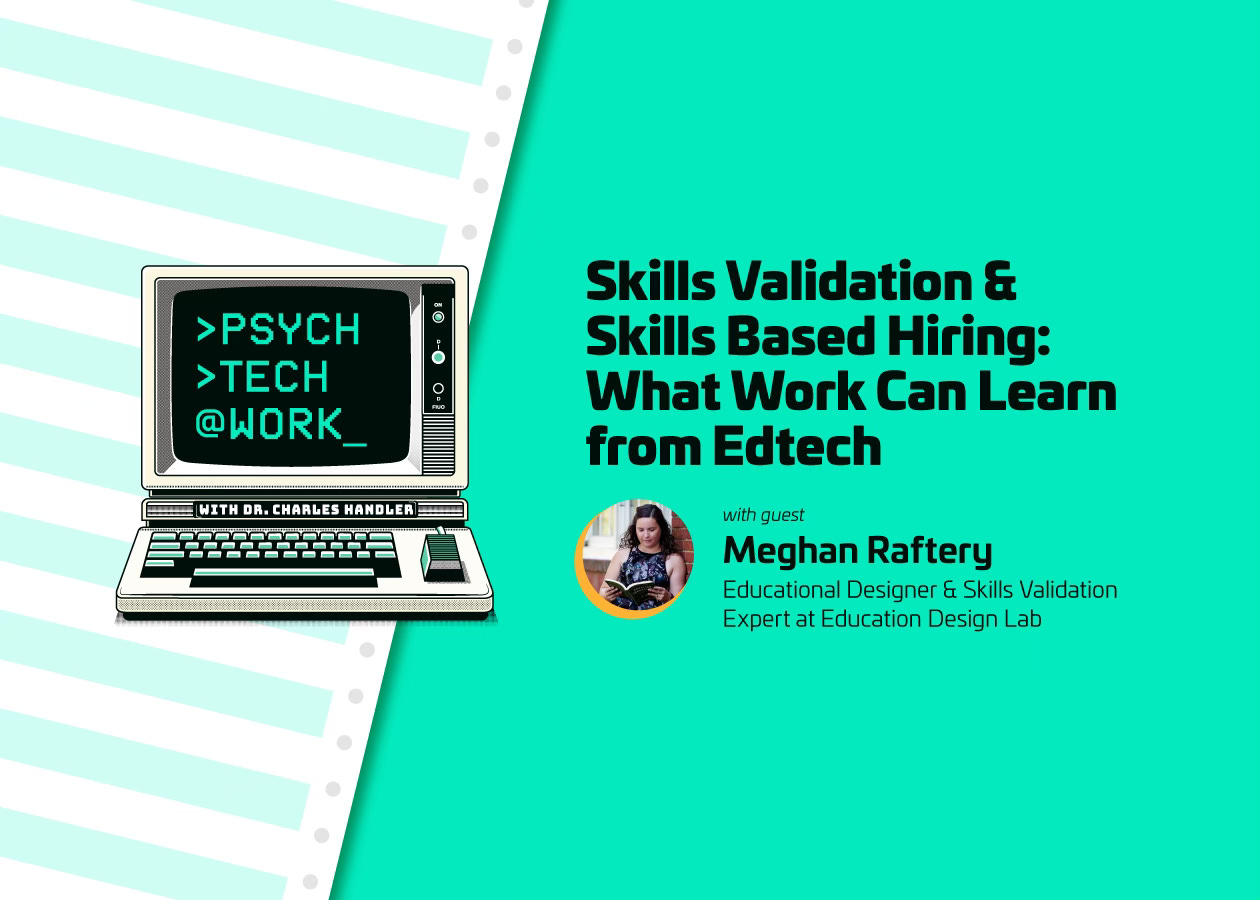 Skills Validation & Skills Based Hiring: What Work Can Learn from Edtech | Meghan: "Skills are the driver of the future of work. Without validation, there’s no trust, and without trust, you can’t make decisions based on skills."In this episode of Psych Tech @ Work I welcome my new friend Meghan Raftery who is an Education Designer and skills validation expert who works at Educational Design Lab - a community that is dedicated to doing skills based hiring the right way by ensuring that skills are verified and portable across the world of education and work. Meghan offers a fresh perspective on skills-based hiring, microcredentialing, and how education and work can align more effectively to prepare students and workers for the future. Meghan shares her experience transitioning from K-12 education to the world of workforce development and dedicating her efforts to focusing on how to validate skills in a measurable, trustworthy way. She explains how microcredentialing can break down complex skills into smaller, demonstrable pieces that people can stack together over time to build toward larger career goals.In our conversation Meghan highlights the importance of aligning educational outcomes with workplace needs, particularly through skills validation systems that help employers trust the skills applicants bring to the table. She shares how her team uses human-centered design to create pathways for "STARS" (Skilled Through Alternative Routes) and provides practical insights into how employers can leverage these tools to open doors for candidates who may not have traditional degrees but possess the skills needed for success.Topics Covered:* Microcredentialing and Skills Validation:* Defining microcredentials and how they differ from traditional credentials by breaking down skills into smaller, measurable units.* The concept of stackable credentials, where individuals can build a portfolio of verified skills over time.* Human-Centered Design in Education:* The importance of involving the people closest to the problem in designing solutions for skills validation.* How Education Design Lab connects learners, educational institutions, and employers to design skills validation systems that work for all stakeholders.* Skills-Based Hiring and Employer Engagement:* Challenges employers face in trusting non-traditional credentials.* How companies can work with organizations like Education Design Lab to ensure they receive reliable, validated skills signals from job applicants.Takeaways:* Trust Through Validation: For skills-based hiring to succeed, employers need validated evidence of skills, not just resumes or self-assertions.* Microcredentials Build Careers: Breaking down skills into smaller, stackable microcredentials allows learners to build toward larger career goals in a personalized way.* Human-Centered Design: Involving those closest to the problem—whether students, job seekers, or employers—ensures that the solutions developed are relevant and effective.* Collaboration Is Key: Employers, educators, and governments must collaborate to build systems that bridge the gap between education and the workforce, ensuring skills are verified and trusted. This is a public episode. If you would like to discuss this with other subscribers or get access to bonus episodes, visit charleshandler.substack.com | 1h 01m 51s | ||||||
Showing 25 of 109
Pitch Fit is a Pro feature
See how bookable this show is for guests, which brands already advertise, the per-episode ad value, and the best-fit guest and sponsor profile. The numbers are blurred on the free plan.
How readily this show books outside guests like you.
How proven this show is for host-read sponsorships.
For Guests
ProFor Advertisers
ProUpgrade to Pro to unlock guest cadence, sponsor categories, fit scores, and per-episode ad value for this show.
Chart Positions
1 placement across 1 market.
Chart Positions
1 placement across 1 market.