

Insights from recent episode analysis
Audience Interest
Podcast Focus
Publishing Consistency
Platform Reach
Insights are generated by CastFox AI using publicly available data, episode content, and proprietary models.
Total monthly reach
Estimated from 14 chart positions in 14 markets.
By chart position
- 🇬🇧GB · Physics#25100K to 300K
- 🇩🇪DE · Physics#42100K to 300K
- 🇺🇸US · Physics#48100K to 300K
- 🇦🇺AU · Physics#6230K to 100K
- 🇨🇦CA · Physics#9130K to 100K
- Per-Episode Audience
Est. listeners per new episode within ~30 days
327K to 1.0M🎙 ~2x weekly·15 episodes·Last published 1w ago - Monthly Reach
Unique listeners across all episodes (30 days)
653K to 2.0M🇬🇧15%🇩🇪15%🇺🇸15%+11 more - Active Followers
Loyal subscribers who consistently listen
261K to 816K
Market Insights
Platform Distribution
Reach across major podcast platforms, updated hourly
Total Followers
—
Total Plays
—
Total Reviews
—
* Data sourced directly from platform APIs and aggregated hourly across all major podcast directories.
On the show
Recent episodes
Binoculars, an optical superpower through engineering - Ep 16
Jun 16, 2026
Unknown duration
A space telescope architect’s odyssey from Hubble to Webb and beyond with Lee Feinberg - Ep 15
May 12, 2026
Unknown duration
Project Silica and the future of data storage with James Clegg - Ep 14 - Rays and Waves
Apr 6, 2026
Unknown duration
LIGO and the birth of gravitational-wave astronomy with Gabriele Vajente - Ep 13 - Rays and Waves
Mar 10, 2026
Unknown duration
Optical tweezers with Halina Rubinsztein-Dunlop - Ep 12 - Rays and Waves
Feb 10, 2026
Unknown duration
Social Links & Contact
Official channels & resources
Official Website
Login
RSS Feed
Login
| Date | Episode | Description | Length | ||||||
|---|---|---|---|---|---|---|---|---|---|
| 6/16/26 |  Binoculars, an optical superpower through engineering - Ep 16 | A pair of binoculars might be the closest thing to a superpower you can buy. That is how a friend once described them while gifting a pair to his wife, and it is easy to see why.In this episode of Rays and Waves, Daniel and Steven explore the surprisingly rich optical engineering behind binoculars. From magnification and aperture to prisms, coatings, and color performance, we follow the history of binoculars.What seems simple is full of clever design trade‑offs. This episode connects everyday optics to fundamental engineering principles, revealing why small choices make a big difference in how we see the world.If you enjoy the show, share it with your colleagues, subscribe, and leave us a review. Got thoughts or questions? Reach out at rays.and.waves.podcast@gmail.comIntro music is Good Vibe by Twisterium. Thanks for the great tunes! | — | ||||||
| 5/12/26 |  A space telescope architect’s odyssey from Hubble to Webb and beyond with Lee Feinberg - Ep 15 | From Hubble’s breathtaking images to the deep infrared view of the James Webb Space Telescope, space-based observatories have transformed how we see the universe. They reveal black holes, probe dark energy, trace the birth of stars, and even let us study the atmospheres of distant planets, pushing astronomy into entirely new territory.In this episode of Rays and Waves, Daniel and Steven sit down with Lee Feinberg, a true veteran of space telescope engineering. Lee joined NASA during the Hubble era and played a key role in diagnosing and correcting its original optical flaw, helping restore one of the most important scientific instruments ever built.Lee then went on to spend more than two decades on the James Webb Space Telescope as Optical Telescope Element Manager. We explore the critical decisions that shaped Webb, from selecting beryllium for its segmented primary mirror to developing new ways to test a deployable telescope at cryogenic temperatures, as well as the "cup up" optical test configuration that made full system testing possible on the ground.This conversation dives into the optical engineering behind humanity’s most ambitious telescopes and what it takes to build instruments capable of looking back to the earliest moments of the universe.If you enjoy the show, share it with your colleagues, subscribe, and leave us a review. Got thoughts or questions? Reach out at rays.and.waves.podcast@gmail.comIntro music is Good Vibe by Twisterium. Thanks for the great tunes!Outro music by Lee Feinberg and fellow NASA engineers. Recorded back in the 90s! | — | ||||||
| 4/6/26 |  Project Silica and the future of data storage with James Clegg - Ep 14 - Rays and Waves | In a quiet laboratory, bursts of ultrafast laser light are etching humanity’s information deep inside glass, layer by layer, voxel by voxel. Long after today’s hard drives and magnetic tapes have failed, this glass may still faithfully preserve our data, readable thousands of years into the future.In this episode of Rays and Waves, Daniel and Steven dive into Microsoft Research’s Project Silica with their Senior Optical Engineer James Clegg. This is an ambitious effort to redefine cold data storage using focused femtosecond lasers. By writing information as sub‑micron, laser‑induced modifications to optical properties in hundreds of stacked layers, Project Silica turns glass into a truly three‑dimensional memory medium. These tiny structures are projected to remain stable for over 10,000 years and can be read out at any time using wide‑field microscopy combined with powerful machine‑learning algorithms.Our conversation explores the physics behind laser‑matter interactions, the optical engineering challenges of writing and reading data in three dimensions, and what it takes to scale such a radical storage technology. We also discuss why long‑term archival storage matters, how this approach compares to traditional media, and what it means to build technology with millennia‑long time horizons.Project Silica has been under development at Microsoft for nearly a decade, and the team recently published a comprehensive open‑access Nature paper detailing this remarkable achievement: https://www.nature.com/articles/s41586-025-10042-wIf you enjoy the show, share it with your colleagues, subscribe, and leave us a review! Got thoughts or questions? Reach out at rays.and.waves.podcast@gmail.comIntro music is Good Vibe by Twisterium. Thanks for the great tunes!Outro music is Aranas Ananas with James Clegg on drums! | — | ||||||
| 3/10/26 |  LIGO and the birth of gravitational-wave astronomy with Gabriele Vajente - Ep 13 - Rays and Waves | 1.3 billion years ago, two black holes collided in a distant galaxy, sending ripples through the fabric of spacetime. On September 14, 2015, those ripples finally reached Earth and humanity detected gravitational waves for the very first time.In this episode of Rays and Waves, Daniel and Steven sit down with Dr. Gabriele Vajente, Deputy Head of Systems Science and Engineering at LIGO, who was a postdoc on the project during that historic detection. For more than fifteen years, Gabriele has been at the center of the groundbreaking technologies and discoveries that have opened an entirely new window on the universe.We explore how LIGO’s exquisitely sensitive instruments can measure distortions thousands of times smaller than a proton, the optical engineering innovations that make it possible, and what gravitational-wave astronomy reveals about some of the most violent events in the cosmos. At the heart of it all are the people like Gabriele who’ve dedicated decades to pushing physics and engineering to their limits.If you enjoy the show, share it with your colleagues, subscribe, and leave us a review! Got thoughts or questions? Reach out at rays.and.waves.podcast@gmail.comIntro music is Good Vibe by Twisterium. Thanks for the great tunes! | — | ||||||
| 2/10/26 | 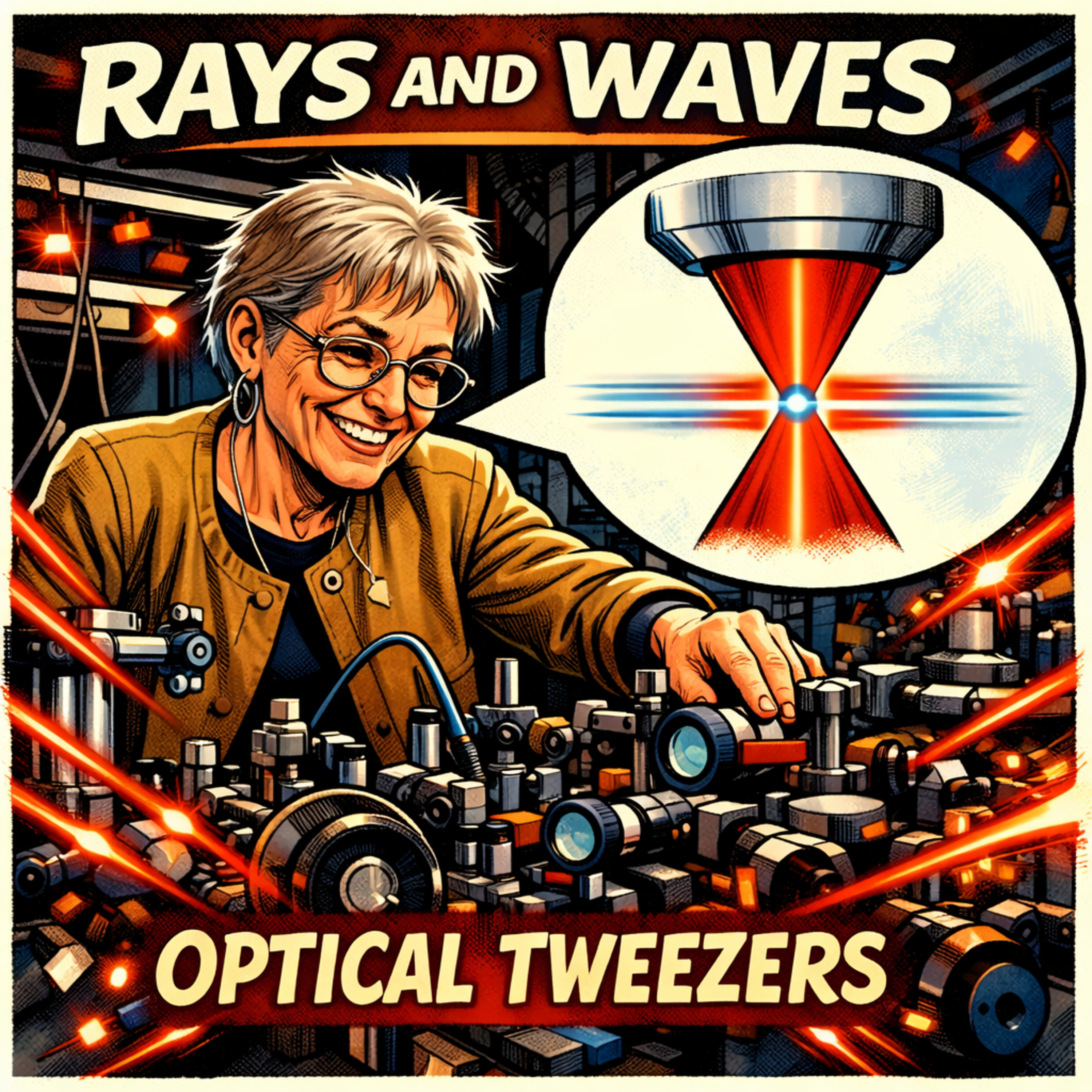 Optical tweezers with Halina Rubinsztein-Dunlop - Ep 12 - Rays and Waves | In this episode of Rays and Waves, Daniel and Steven take a nostalgic dive back into the world where they both began their scientific journeys: optical tweezers. These remarkable tools, using tightly focused laser beams to exert forces and torques on microscopic objects, have transformed how we manipulate cells, DNA, bacteria, and so much more. Their invention by Arthur Ashkin in 1986 ultimately earned him the 2018 Nobel Prize in Physics, and today, optical manipulation stands as a thriving field with thousands of active researchers.Our guest is one of its true pioneers. For more than four decades, Halina Rubinsztein‑Dunlop has been at the forefront of exploring how light can push, twist, and guide matter. Her work spans quantum optics, optically driven micromachines, and cutting‑edge applications in biological systems. Her impact has been recognized at the highest levels, including the SPIE Gold Medal (the society’s most prestigious honor), and she will soon serve as an SPIE Director for the 2026–2028 term.Halina is also a powerful advocate for women in science, a topic we excitedly dive into during our conversation.If you enjoy the show, share it with your colleagues, subscribe, and leave us a review! Got thoughts or questions? Reach out at rays.and.waves.podcast@gmail.comIntro music is Good Vibe by Twisterium. Thanks for the great tunes! | — | ||||||
| 1/13/26 | 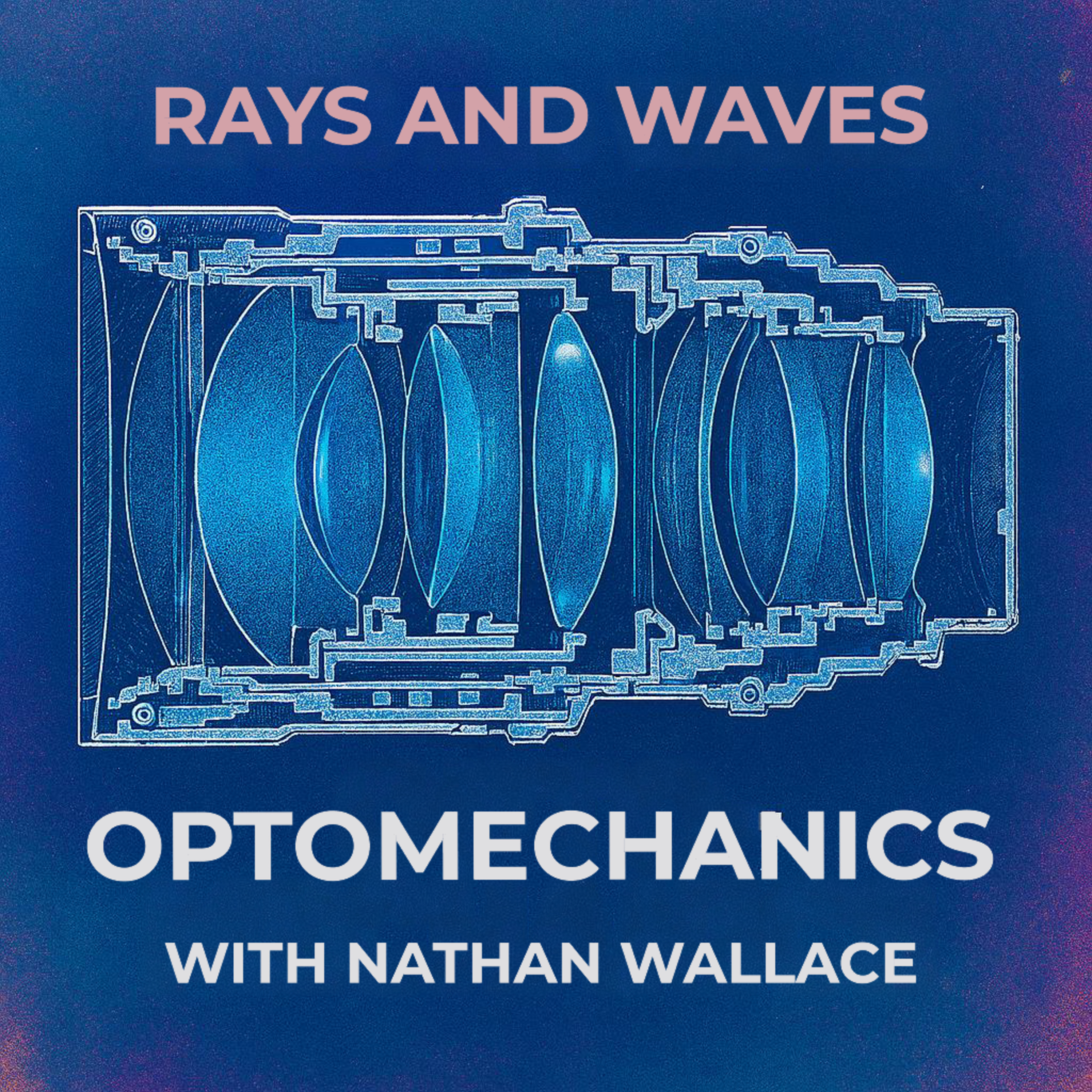 An Optomechanics Bootcamp with Nathan Wallace - Ep 11 - Rays and Waves | When we think about optical systems, lenses and light often steal the spotlight. But behind every high-performance optical instrument lies a critical foundation: Optomechanics. From precision mounts to thermal stability, the mechanical design determines whether an optical system performs flawlessly or fails spectacularly.In this episode of Rays and Waves, Daniel and Steven sit down with Nathan Wallace, an optomechanical expert from Optikos, to explore the art and science of building the structures that hold optics together. We dive into why optomechanics is more than just “hardware,” how tolerances and alignment drive system performance, and what it takes to design for environments ranging from factory floors to outer space.If you enjoy the show, share it with your colleagues, subscribe, and leave us a review! Got thoughts or questions? Reach out at rays.and.waves.podcast@gmail.comMusic is Good Vibe by Twisterium. Thanks for the great tunes! | — | ||||||
| 12/9/25 | 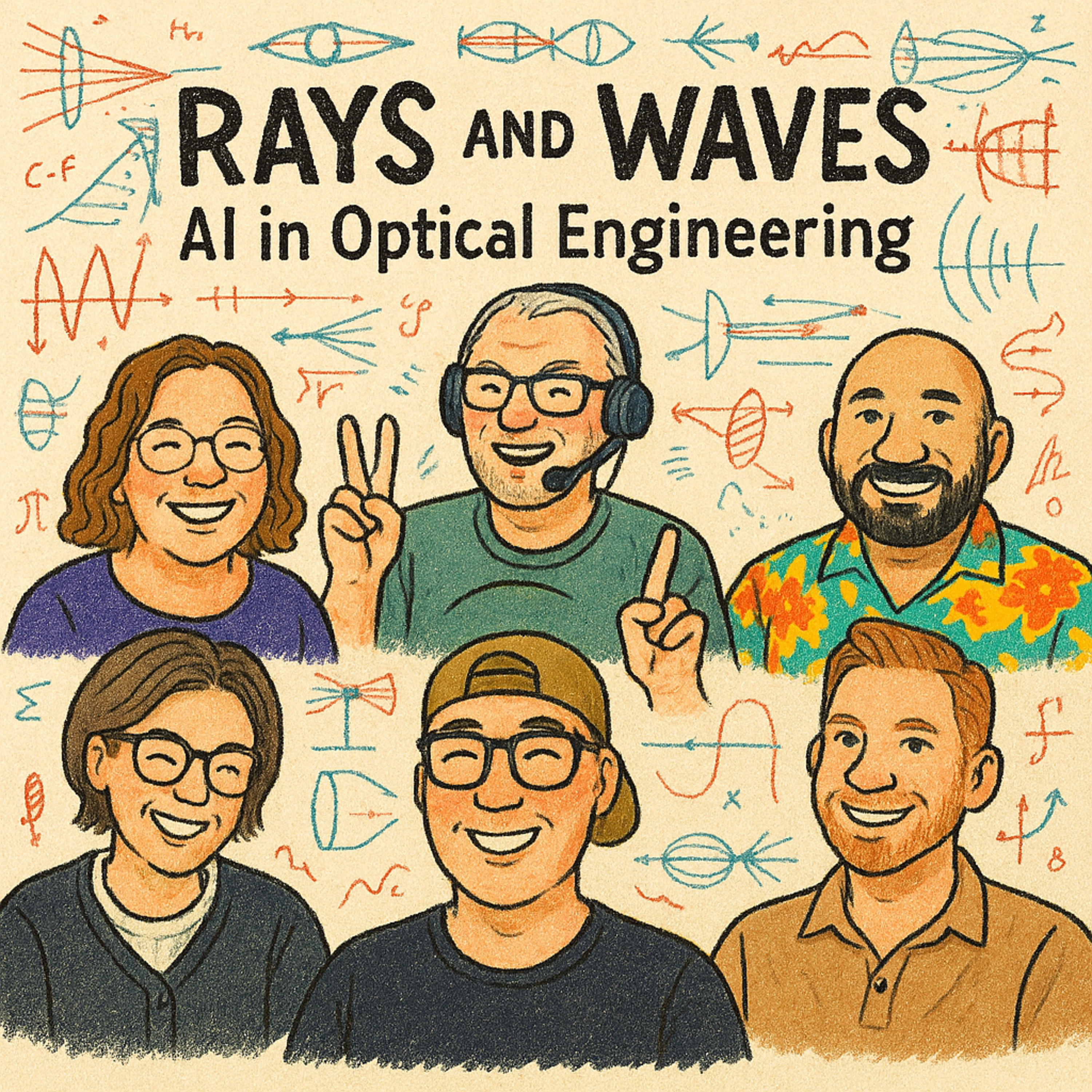 AI in Optical Engineering Panel Discussion - Ep 10 - Rays and Waves | The current narrative is that Artificial Intelligence is reshaping industries at breakneck speed. Is optics no exception? In this special episode of Rays and Waves Daniel and Steven host the show's very first panel discussion! They bring together six experts from across the optics landscape to try to understand: How will AI change optical engineering?From accelerating lens design to enabling smarter photonic systems, AI promises breakthroughs but also raises big questions about trust, transparency, and the role of human expertise.The panel consists of Craig Olsen, Jenny Atwood, Erin Elliot, Akil Bhagat, Cory Boone, and Roinan Siew, and they cover the opportunities and challenges that come with integrating AI into optical workflows.Stuff mentioned in the episode:Material Craig mentioned Ronian sent out: Future of optical system and lens design in the AI eraThe effect Craig mentions is Gell-Mann amnesia effect (https://en.wikipedia.org/wiki/Gell-Mann_amnesia_effect)If you enjoy the show, share it with your colleagues, subscribe, and leave us a review! Got thoughts or questions? Reach out at rays.and.waves.podcast@gmail.comIntro music is Good Vibe by Twisterium. Thanks for the great tunes! | — | ||||||
| 11/4/25 |  An Unsung Hero: Optical Standards with Eric Herman - Ep 9 - Rays and Waves | Standards may not grab headlines, but they quietly shape the world. In this episode of Rays and Waves, we shine a light on the unsung hero of modern optical engineering: optical standards.From the fiber optics enabling global connectivity, via laser grocery scanners, to the precision lenses the James Webb telescope, none of it works without agreed-upon rules and measurements. These standards ensure interoperability, safety, and reliability across millions of devices.Joining Daniel and Steve is Eric Herman, a dedicated volunteer helping to develop and maintain these critical frameworks. Together, we’ll explore how standards are created, the challenges of keeping pace with cutting-edge technology, and why this work matters more than ever.If you enjoy the show, share it with your colleagues, subscribe, and leave us a review! Got thoughts or questions? Reach out at rays.and.waves.podcast@gmail.comIntro music is Good Vibe by Twisterium. Thanks for the great tunes! | — | ||||||
| 10/7/25 |  Erwin De Baetselier and Luceda's first-time-right automated PIC design- Ep 8 - Rays and Waves | In this episode, we sit down with Erwin De Baetselier, the CEO of Luceda, a company at the forefront of software innovation for Photonic Integrated Circuits (PICs). As PICs continue to reshape the landscape of optical systems—from data centers to quantum labs—the tools used to design and simulate them are becoming just as critical as the hardware itself.Luceda’s software empowers engineers and researchers to model, optimize, and scale photonic designs with precision and speed. We dive into how their platform bridges the gap between photonic theory and manufacturable reality, and why design automation is key to unlocking the full potential of integrated photonics.Whether you're deep in the weeds of waveguide layouts or just curious about the future of chip-scale optics, this conversation offers a behind-the-scenes look at the software driving the PIC revolution. Join Steven and Daniel as they explore the intersection of photonics and design automation with Luceda’s visionary leader.If you enjoy the show, share it with your colleagues, subscribe, and leave us a review! Got thoughts or questions? Reach out at rays.and.waves.podcast@gmail.comIntro music is Good Vibe by Twisterium. Thanks for the great tunes! | — | ||||||
| 9/16/25 |  Miniaturising Optics with Photonic Integrated Circuits - Ep 7 - Rays and Waves | In this episode, we explore the rise of Photonic Integrated Circuits (PICs), which aim to compress the sprawling optical setups found on lab benches into compact, chip-scale systems. These integrated platforms are becoming foundational for technologies like high-speed data communication, LIDAR, optical quantum computing, AR/VR, and biotech diagnostics—where size, modularity, and manufacturability are critical.We take a closer look at how PICs are built, what makes them so transformative, and why the market is growing at a rapid pace. Whether you're an engineer, researcher, or just fascinated by the future of photonics, this episode offers a view into the architecture driving next-gen optical systems. Join Steven and Daniel as they explore PICs!If you like the show, tell your friends and colleagues about it! And like, subscribe, and all that! If you want to get in touch, shoot us an email on rays.and.waves.podcast@gmail.comIntro music is Good Vibe by Twisterium. Thanks for making sweet music! | — | ||||||
Want analysis for the episodes below?Free for Pro Submit a request, we'll have your selected episodes analyzed within an hour. Free, at no cost to you, for Pro users. | |||||||||
| 6/10/25 |  Gerard Milburn's Path to Photonic Quantum Computing and Beyond - Ep 6 - Rays and Waves | In the last episode of Rays and Waves about linear optical quantum computers we discussed how using photons as qubits is good in many ways. However, the biggest hurdle is that photons don’t like interacting with each other, which makes the critical two-qubit gates difficult to create. But a 2001 discovery showed it was in fact possible to effectively make two-qubit interactions and therefore a full quantum computer solely with linear optical elements, single photon sources and detectors. This discovery catalysed a wealth of research into optical quantum computers which in aggregate has today made it a viable contender to a path to scalable fault tolerant quantum computers.The scheme that opened the floodgates for optical quantum computers is referred to as the KLM protocol after its originators Knill, Laflamme, and Milburn.For this episode we have the honour of talking to said Milburn on the Rays and Waves podcast!If you like the show, tell your friends and colleagues about it! And like, subscribe, and all that! If you want to get in touch, shoot us an email on rays.and.waves.podcast@gmail.comStuff mentioned in the episode:- Looking Glass Universe video about Quantum Eraser: https://www.youtube.com/watch?v=sAm7iVdAvTA&t=1154s- Ezra Klein interview about AGI: https://youtu.be/Btos-LEYQ30?feature=sharedIntro music is Good Vibe by Twisterium. Thanks for making sweet music!Outro music is Slowly Comes The Angels by fermionik | — | ||||||
| 5/6/25 |  Optical Quantum Computers - Ep 5 - Rays and Waves | In this episode of Rays and Waves we speak about Linear Optical Quantum Computers. There has been lots of talk about quantum computers in the science media lately. Both companies and academic labs are hard at work to build the sought-after fault-tolerant quantum computer.As it turns out, one approach to building quantum computers is with optics. Join us as we explore the pros and cons with this light-based approach to quantum computers.If you like the show, tell your friends and colleagues about it! And like, subscribe, and all that! If you want to get in touch, shoot us an email on rays.and.waves.podcast@gmail.comGood resources to learn more:- Original KLM paper: Knill, Emanuel, Raymond Laflamme, and Gerald J. Milburn. "A scheme for efficient quantum computation with linear optics." nature 409.6816 (2001): 46-52.- Good review: Slussarenko, Sergei, and Geoff J. Pryde. "Photonic quantum information processing: A concise review." Applied physics reviews 6.4 (2019).- Lecture notes: Myers, C. R., and R. Laflamme. "Linear optics quantum computation: an overview." Quantum Computers, Algorithms and Chaos (2006): 45-93.Game: Quantum Odyssey (https://store.steampowered.com/app/2802710/Quantum_Odyssey/)Intro music is Good Vibe by Twisterium. Thanks for making sweet music! | — | ||||||
| 3/25/25 |  Tracing 'A Pencil of Rays' with Katsumoto Ikeda - Ep 4 - Rays and Waves | In this episode of Rays and Waves we speak to Katsumoto Ikeda. Kats runs a brilliant webpage about optical design called “A Pencil of Rays” (https://www.pencilofrays.com/). He has worked as an optical designer for well over a decade. and is now the Application Engineer Manager at Ansys in Japan. Join Daniel, Steven, and Kats in a riveting conversation about optical design.If you like the show, tell your friends about it! And like, subscribe, and all that! If you want to get in touch, shoot us an email on rays.and.waves.podcast@gmail.comIntro music is Good Vibe by Twisterium. Thanks for making sweet music! | — | ||||||
| 2/18/25 |  Mark Nicholson's Optical Design Journey - Ep 3 - Rays and Waves | In this episode of Rays and Waves we speak to Mark Nicholson. Few people have made a bigger impact on how modern optics is designed and analysed. Mark was for 30 years involved with Zemax, one of the optical design software giants on the market. Nowadays Mark is retired, but continues to heavily impact the optics industry by running a YouTube channel called Design Optics Fast which teaches a modern approach to optical design. Join Daniel and Steve as they quiz Mark on his career and best advice to coming optics generation.If you like the show, tell your friends about it! And like, subscribe, and all that! We'd love to hear from you, so feel free to reach out via email at rays.and.waves.podcast@gmail.comIntro music is Good Vibe by Twisterium. Thanks for making sweet music! | — | ||||||
| 1/17/25 | 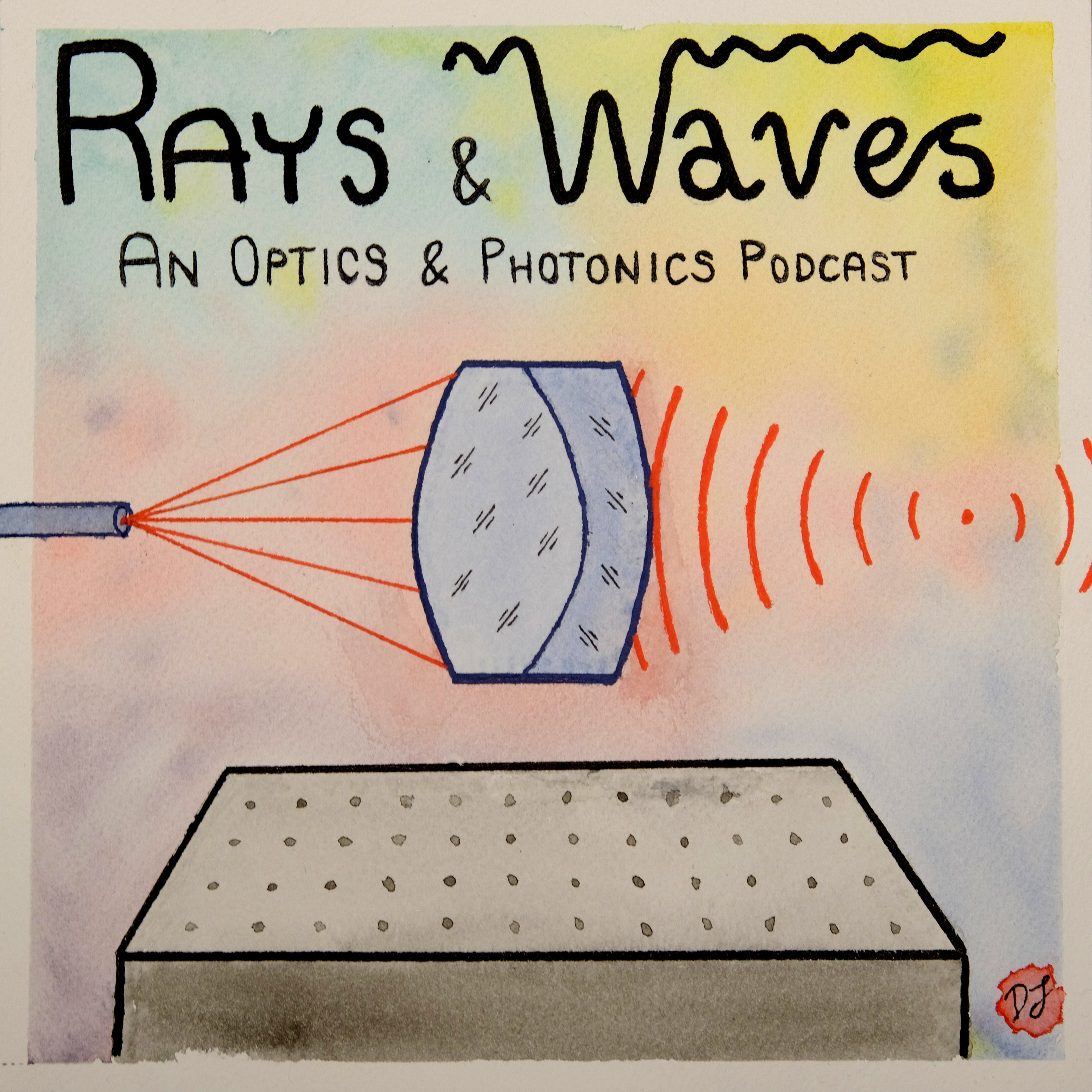 Introducing 'Rays and Waves' - A New Optics Podcast | In this episode of Rays and Waves we get to know the podcast purpose and the hosts a bit. Join Daniel and Steve in the episodes to come as they explore the vast world of optics. If you like the show, tell your friends about it! And like, subscribe, and all that! If you want to get in touch, shoot us an email on rays.and.waves.podcast@gmail.com Intro music is Good Vibe by Twisterium. Thanks for making sweet music! | — | ||||||
| 1/17/25 |  Optical Design - Ep 2 - Rays and Waves | In this episode of Rays and Waves we speak about Optical Design. Optical products are all around us, ranging from phones, cameras, cars, communication, grocery shopping, medical devices, and almost everything in between. How to design them? Join Daniel and Steve as they explore optical design from fundamentals of the thin lens equation learned in high school physics to how high-level optical systems are designed today. If you like the show, tell your friends about it! And like, subscribe, and all that! If you want to get in touch, shoot us an email on rays.and.waves.podcast@gmail.com Intro music is Good Vibe by Twisterium. Thanks for making sweet music! | — | ||||||
| 1/17/25 |  Optical Communication - Ep 1 - Rays and Waves | In this episode of Rays and Waves we speak about Optical Communication. Join Daniel and Steve as they explore how information transfer through hair-thin glass fibres are changing the world. While data rates have grown by over 10 billion times since the first commercial systems we are still signalling the fall of Troy with fire beacons by blinking lights on and off, only mind-numbingly fast! If you like the show, tell your friends about it! And like, subscribe, and all that! If you want to get in touch, shoot us an email on rays.and.waves.podcast@gmail.com Intro music is Good Vibe by Twisterium. Thanks for making sweet music! | — | ||||||
Showing 17 of 17
Pitch Fit is a Pro feature
See how bookable this show is for guests, which brands already advertise, the per-episode ad value, and the best-fit guest and sponsor profile. The numbers are blurred on the free plan.
How readily this show books outside guests like you.
How proven this show is for host-read sponsorships.
For Guests
ProFor Advertisers
ProUpgrade to Pro to unlock guest cadence, sponsor categories, fit scores, and per-episode ad value for this show.
Chart Positions
14 placements across 14 markets.
Chart Positions
14 placements across 14 markets.