

Insights from recent episode analysis
Audience Interest
Podcast Focus
Publishing Consistency
Platform Reach
Insights are generated by CastFox AI using publicly available data, episode content, and proprietary models.
Total monthly reach
Estimated from 4 chart positions in 4 markets.
By chart position
- 🇯🇵JP · Places & Travel#1981K to 10K
- 🇮🇱IL · Places & Travel#3910K to 30K
- 🇮🇩ID · Places & Travel#101500 to 3K
- 🇦🇹AT · Places & Travel#125500 to 3K
- Per-Episode Audience
Est. listeners per new episode within ~30 days
8.4K to 32K🎙 Weekly cadence·5 episodes·Last published 2w ago - Monthly Reach
Unique listeners across all episodes (30 days)
12K to 46K🇮🇱65%🇯🇵22%🇮🇩7%+1 more - Active Followers
Loyal subscribers who consistently listen
3.6K to 14K
Market Insights
Platform Distribution
Reach across major podcast platforms, updated hourly
Total Followers
—
Total Plays
—
Total Reviews
—
* Data sourced directly from platform APIs and aggregated hourly across all major podcast directories.
On the show
Recent episodes
AMA Podcast (S-02, E-16) with Kevin Dias, Founder of Ambiki and The Problem-First Method
Jun 5, 2026
54m 15s
AMA Podcast (S-02, E-15) with Dominic Carter, CEO, The Carter Group and co-founder of Living Best
May 30, 2026
1h 03m 52s
AMA Podcast (S-02, E-14) with Daichi Kunii, CEO of ReDelta
May 24, 2026
1h 00m 39s
AMA Podcast (S-02, E-13, Session 3 of 3・The Fall) with Steven Gan, the founder of Japan's first debt collection agency run by a foreigner
May 8, 2026
1h 55m 48s
AMA Podcast (S-02, E-12, Session 2 of 3・The Rise) with Steven Gan, the founder of Japan's first debt collection agency run by a foreigner
May 8, 2026
1h 07m 12s
Social Links & Contact
Official channels & resources
Official Website
Login
RSS Feed
Login
| Date | Episode | Description | Length | ||||||
|---|---|---|---|---|---|---|---|---|---|
| 6/5/26 | 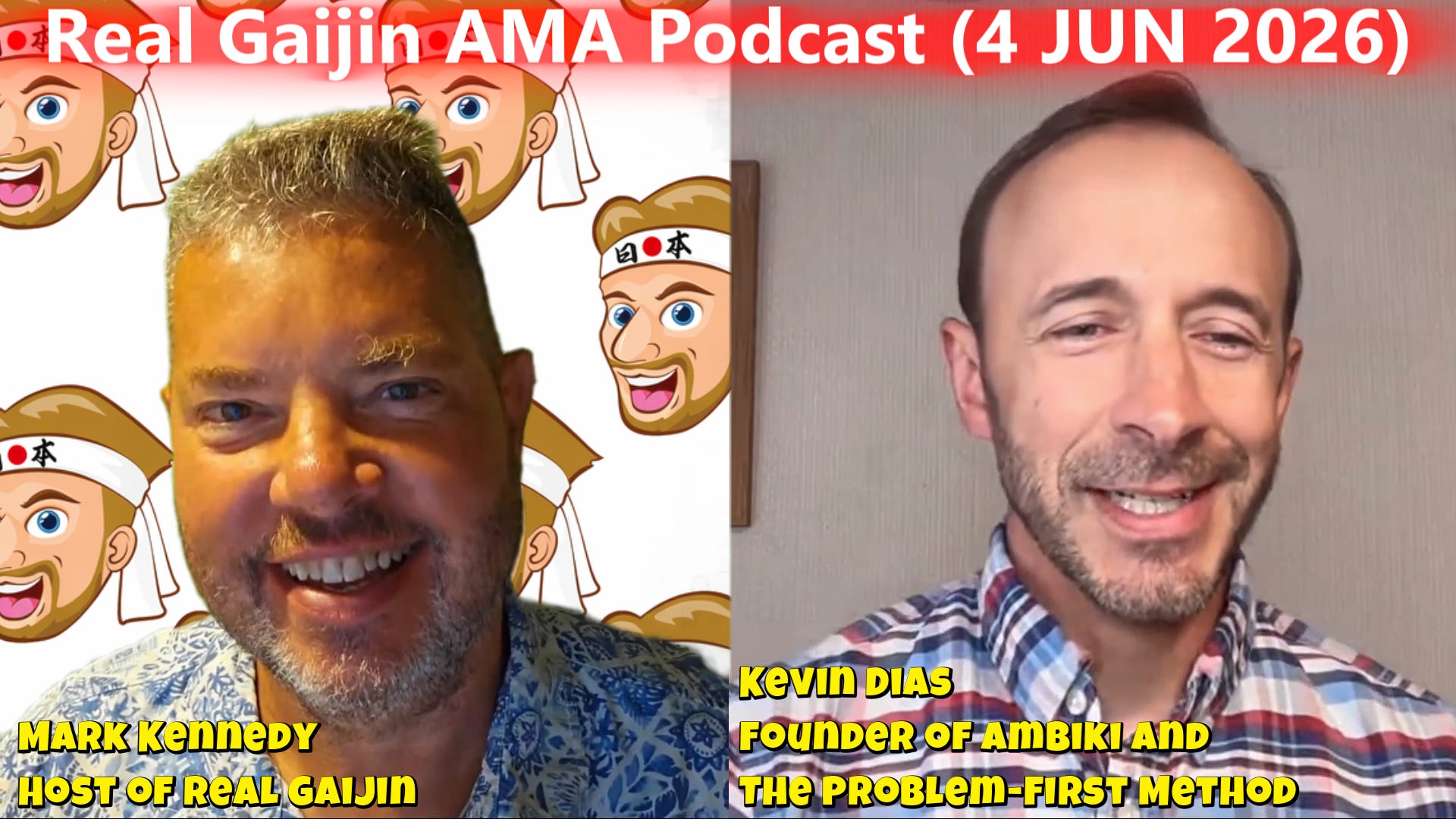 AMA Podcast (S-02, E-16) with Kevin Dias, Founder of Ambiki and The Problem-First Method | Imagine if pediatric therapists could spend less time on paperwork and more time helping children communicate, move, and thrive. Innovative software platforms are transforming how clinics operate across the healthcare industry, and pediatric therapy is no exception. In this episode, we explored how technology, artificial intelligence, and thoughtful software design are helping speech-language pathologists, occupational therapists, and physical therapists reduce administrative burdens, improve patient care, and establish more sustainable practices.This episode of Real Gaijin’s Ask Me Anything (AMA) podcast series featured an expert in this emerging field, Japan-based Kevin Dias, Founder of Ambiki and The Problem-First Method.Who is he?Kevin Dias is the founder of Ambiki, a healthcare technology company that develops electronic medical record (EMR) and practice management software for pediatric speech, occupational, and physical therapy clinics. Originally from the United States, Kevin has lived in Japan since 2008. His career has taken him from investment banking and English teaching to translation technology and healthcare software. Prior to launching Ambiki, Kevin served as the CTO of Sidekick Therapy Partners. There, he helped develop a custom practice management platform that supported the company’s rapid growth from roughly 70 to over 180 clinicians in just three years.In 2026, Kevin published The Problem-First Method, a book that challenges organizations to focus on solving real problems instead of creating solutions in search of a problem.He currently lives in Oyama, Japan, with his wife and three sons.On the agendaIn this conversation, Kevin shared his journey from the United States to Japan and his unconventional career path from English teaching and technology to healthcare software. We discussed the challenges pediatric speech-language pathology (SLP), occupational therapy (OT), and physical therapy (PT) practices face, such as clinician burnout, staffing shortages, and the administrative burden that often prevents therapists from providing patient care. Kevin explained why existing electronic medical record (EMR) systems often fail to meet the needs of pediatric providers, how Ambiki was designed to address these shortcomings, and how AI can help clinicians without replacing them. We also discussed the lasting impact of teletherapy, lessons learned from scaling a healthcare technology company, the principles behind his book The Problem-First Method, and his vision for the pediatric therapy clinic of the future.Key takeaways* Increasing your “Luck Surface Area”: Kevin emphasized the importance of proactively learning new skills and taking risks to create more opportunities. He describes this process as increasing one’s “luck surface area.” He demonstrated this concept by teaching himself programming and attempting to solve operational problems during his time as an English teacher. This willingness to go beyond his initial job duties eventually facilitated his successful pivot into the tech industry.* Leveraging remote work structures: Running a U.S.-based company from a rural area in Japan required Kevin to master asynchronous communication and strategic time management. He is successfully balancing his professional responsibilities with his life abroad by waking up early to overlap with U.S. business hours for meetings and dedicating his remaining time to deep, focused work.* The “Problem-First Method”: At the core of his business, Ambiki, is the “Problem First Method,” a philosophy that focuses on deeply understanding the specific pain points of a niche customer base. After identifying that speech-language pathologists were underserved by existing software, Kevin built a tailored operating system that addressed their complex administrative and clinical workflows rather than attempting to provide a generalized product.* The value of local community: Reflecting upon his experience living in Japan, Kevin highlighted how deep integration into a local Japanese neighborhood can provide a vital, supportive safety net. After a frightening health incident involving his middle son, his rural neighbors’ immediate, caring response transformed his perspective on local communal obligations. Being an active, contributing member of the community is a significant and rewarding part of living in Japan, he says.TimelineSubstack does not yet have the functionality to allow you to use a link to jump to a specific section like YouTube’s “chapters.” Please refer to the times listed below to navigate through our hour-long conversation. Thank you for your understanding.Links* Substack: https://substack.com/@kevindias2* LinkedIn: https://www.linkedin.com/in/kevin-dias-ambiki/* Ambiki Website: https://ambiki.com/* The Problem-First Method Book Website / Bookstore: https://problem-first-method.com/#TheProblemFirstMethod #FounderStory #ExpatEntrepreneur #LifeInJapan #HealthcareTech #FromTeachingToTech #KevinDias #Ambiki #AIinHealthcare #PediatricTherapy #SpeechTherapy #OccupationalTherapy #PhysicalTherapy #DigitalHealth #創業ストーリー #外国人起業家 #ヘルスケアテック #教育からテックへ #ケビンディーアス #医療分野におけるAI #小児療法 #言語療法 #作業療法 #理学療法 #デジタルヘルス #RealGaijin #リアル外人Please note that you can subscribe to Real Gaijin for free. If you are so inclined, you can also purchase an annual subscription for a relatively small fee.However, I understand that even the lowest level of annual subscription allowed by Substack may seem too high for many. If you just want to buy a coffee for Real Gaijin (or maybe a green tea), you can also make a small donation here:https://buymeacoffee.com/realgaijinAll levels of support - including just liking a particular article and/or leaving a comment - are very welcome. Thanks again for reading.While Real Gaijin lives in Substack, you can also find Real Gaijin on a few other platforms (listed in alphabetical order).https://www.instagram.com/real_gaijin_on_substack/https://www.threads.net/@real_gaijin_on_substackhttps://www.tiktok.com/@real.gaijinhttps://x.com/Real_Gaijin_https://www.youtube.com/@RealGaijinhttps://www.linkedin.com/in/mark-wilt-kennedy/ Get full access to Real Gaijin at realgaijin.substack.com/subscribe | 54m 15s | ||||||
| 5/30/26 |  AMA Podcast (S-02, E-15) with Dominic Carter, CEO, The Carter Group and co-founder of Living Best | Japan is experiencing one of the most significant demographic shifts in modern history, including a shrinking population, rapid aging, labor shortages, depopulation of rural areas, and increasing strain on healthcare and social infrastructure. However, this seemingly dire situation is not all doom and gloom. For entrepreneurs, investors, and care providers willing to look beyond the headlines, these challenges are creating new markets.This episode of the Real Gaijin’s Ask Me Anything (AMA) series features an expert in this emerging field, Dominic Carter, CEO, The Carter Group.Who is he?Dominic was born and raised in Australia. He studied marketing and Japanese at the University of New South Wales. Dominic began his career at Millward Brown, a branding, media, and communications consultancy, before relocating to Japan at age 24 to establish and lead the company’s local office.A serial entrepreneur with over 25 years of experience building and leading businesses in Japan, Dominic has cultivated strong relationships with clients and partners in various sectors, including market research, market entry, executive search, ad tech, video gaming, and VR. He specializes in prescient marketing analysis and strategy attuned to Japanese culture and the nuances of the Japanese buyer. He is now the CEO of The Carter Group. Through its network of affiliated firms and investments, The Carter Group supports the success of global companies in Japan.In 2022, Dominic co-founded Living Best, a pioneering age-tech platform that identifies high-potential longevity and age-tech concepts from North America and beyond. The platform connects these concepts with commercial opportunities and capital in Japan. His work bridges technology and philosophy, drawing on Japanese concepts such as ikigai (living with purpose・生きがい) and pin pin korori (living well and dying quickly・ピンピンコロリ) to guide innovations that enhance quality of life as we age.Dominic has delivered keynotes at major global forums, including the AGE-WELL Conference in Canada and the Centre on Aging and Health’s Distinguished Lecture at the University of Regina. He regularly contributes to the broader business community through guest lectures and consultative roles, offering his insights on market entry, entrepreneurship, and consumer and societal megatrends in Japan.On the agendaWe explored the opportunities created by Japan’s demographic trends in sectors such as aging technology, health technology, elder care innovation, robotics, automation, preventive healthcare, wealth management, and AI-driven productivity solutions. Dominic explained that we should view Japan not as a case study in decline, but rather as one of the world’s most important real-time laboratories for aging societies and the businesses built to serve them.Key Takeaways* Japan’s aging population is more of a predictable business opportunity than a crisis. Japan’s demographic challenges have been apparent for decades and are often exaggerated as an impending catastrophe. Although caring for the current elderly population is resource-intensive, Japan has largely managed the transition successfully. A bigger challenge lies ahead: the large group of people currently in their 50s will eventually require support from a much smaller younger generation. This will create strong demand for technologies and services that help people maintain their independence for longer periods of time.* Age-tech encompasses far more than nursing homes and caregiving robots. Dominic defines it as any product or service that helps people compensate for, prevent, or manage the effects of aging beginning as early as age 50. This spectrum ranges from wellness and preventive technologies, such as fitness tracking, gait analysis, brain training, and personalized health monitoring, to care-focused solutions, including fall detection systems, mobility aids, exoskeletons, and caregiving robots. This broad definition expands the total addressable market far beyond traditional elder care.* The biggest commercial winners will solve problems without creating more work. Many promising technologies fail because they disrupt existing workflows or create additional burdens for caregivers and care facilities. Solutions that operate quietly in the background, reduce costs, lower hospital readmission rates, improve safety, or seamlessly integrate into daily routines are far more likely to be adopted than technologies that require extensive retraining or behavioral changes.* Personalized wellness may become one of the most important age-tech sectors. Although robotics and autonomous transportation currently attract the most attention, Dominic believes that the larger, long-term opportunity may be in personalized health optimization. Advances in diagnostics, biomarkers, AI-driven health monitoring, individualized treatments, and preventive interventions could help people extend their healthy life span, delaying or even avoiding the need for formal care. Japan, a country where people already embrace regular health screenings, may prove to be a particularly fertile market for such solutions.* The future belongs to proactive individuals who take responsibility for their own aging journey. Personal responsibility was a recurring theme throughout the discussion. Dominic emphasized that many people in their 50s and 60s recognize that they cannot rely on the family-based support systems enjoyed by previous generations. Those who actively plan ahead, embrace technology, maintain digital literacy, monitor their health, and experiment with new solutions will likely be better positioned to remain independent and enjoy a higher quality of life as they age.TimelineSubstack does not yet have the functionality to allow you to use a link to jump to a specific section like YouTube’s “chapters.” Please refer to the times listed below to navigate through our hour-long conversation. Thank you for your understanding.Links* Substack: https://substack.com/@dominiccarter* LinkedIn: https://www.linkedin.com/in/dominiccarterjapan/* The Carter Group Website: https://the-carter-group.com/en/* Living Best Website: https://living-best.tech/* The World’s Real-time Laboratory for Age-Tech White Paper: https://living-best.tech/age-tech-white-paper/#DominicCarter #TheCarterGroup #LivingBest #AgingSociety #Demographics #AgeTech #HealthTech #Longevity #SilverEconomy #JapanBusiness #JapanEconomy #HealthcareInnovation #ElderCare #DigitalHealth #MedTech #ドミニクカーター #カーターグループ #リビングベスト #ヘルステック #長寿 #シルバーエコノミー #ヘルスケアイノベーション #高齢者ケア #デジタルヘルス #メドテック #長寿経済 #RealGaijin #リアル外人Please note that you can subscribe to Real Gaijin for free. If you are so inclined, you can also purchase an annual subscription for a relatively small fee.However, I understand that even the lowest level of annual subscription allowed by Substack may seem too high for many. If you just want to buy a coffee for Real Gaijin (or maybe a green tea), you can also make a small donation here:https://buymeacoffee.com/realgaijinAll levels of support - including just liking a particular article and/or leaving a comment - are very welcome. Thanks again for reading.While Real Gaijin lives in Substack, you can also find Real Gaijin on a few other platforms (listed in alphabetical order).https://www.instagram.com/real_gaijin_on_substack/https://www.threads.net/@real_gaijin_on_substackhttps://www.tiktok.com/@real.gaijinhttps://x.com/Real_Gaijin_https://www.youtube.com/@RealGaijinhttps://www.linkedin.com/in/mark-wilt-kennedy/ Get full access to Real Gaijin at realgaijin.substack.com/subscribe | 1h 03m 52s | ||||||
| 5/24/26 |  AMA Podcast (S-02, E-14) with Daichi Kunii, CEO of ReDelta | Currently, there are hundreds of thousands of SMEs in Japan with no designated successor. Despite having solid financials and a long list of satisfied customers, many of these firms are at risk of ceasing operations because there is nobody to take over once the current owner retires, becomes incapacitated, or passes away. Thus, there are ample opportunities to acquire such firms or take an equity stake in them. But how do you uncover such opportunities, determine the seller’s motivation, assess business performance, and navigate Japan’s cultural and legal landscapes to close a deal?This episode of Real Gaijin’s Ask Me Anything (AMA) series features a Japanese individual with an extensive background working with foreigners.Who is he?Daichi Kunii (國井大地) was born and raised in Japan and is now the CEO of ReDelta, a Tokyo-based boutique M&A advisory firm. Previously, Daichi worked at Deloitte Touche Tohmatsu, where he gained extensive experience in cross-border M&A and developed deep expertise in global financial practices and complex transaction structures. In 2019, he founded ReDelta, an enterprise dedicated to connecting Japanese SMEs with their counterparts in the ASEAN region.On the agendaWe covered the following topics and also took several questions:* What kind of opportunities are available (industries, scope, geography, etc.)?* What is the process for assessing a potential seller and approaching them with an offer?* What kinds of deal structures are possible and common (e.g., full- or partial-equity acquisition, seller rollover, support for the post-merger integration transition/hand-off, advisory contract)?* What are past success cases?* What are the pitfalls regarding the potential clash of business cultures and expectations on both sides?Key Takeaways* Japan’s SME market, driven by succession, is dominated by privately held small businesses that are often underappreciated. These businesses are in sectors such as food and beverage (F&B including small-scale restaurants and pubs, which are called izakaya in Japanese), small-scale manufacturing, and hospitality, especially traditional inn (ryokan) and hot spring (onsen) properties. Many manufacturing firms facing succession issues generate less than US $7 million in annual revenue and have only 10–12 employees. Meanwhile, ryokan deals may involve approximately $2 million in annual revenue and profit margins below 10–15%. The “Japan M&A Finder” database from ReDelta includes hundreds of current opportunities that are much smaller in scale (can check 3 opportunities/month for free or pay US $150/month for unlimited access). Valuations commonly use EBITDA multiples of 3x–6x, and deals often close within three to four months because the financial structures are relatively simple. With prices like these, it should be possible to recoup the initial investment within three to four years. An important nuance is that many buildings, machinery, and facilities were fully depreciated decades ago and may have a balance sheet value of only 1 yen, even though they are still operationally valuable. Daichi also noted that, while distressed sellers may occasionally accept discounted offers, foreign buyers should generally avoid “lowball” tactics. Offers materially below 90% of the asking price can damage trust and reduce the likelihood of a successful transaction. Additionally, ReDelta usually charges fees equivalent to 3% of the valuation or $7,000, whichever is greater. Separate fees for post-acquisition consultation are charged monthly and vary depending on the size of the business.* Trust and employee continuity often outweigh price in Japanese succession deals. Daichi emphasized that sellers care deeply about their employees’ and the local community’s future after retirement. Foreign buyers who demonstrate respect for staff, long-term commitment, and genuine appreciation for the business culture are far more likely to succeed. In many cases, buyers must formally commit to maintaining associate employment for two to three years post-acquisition. Sellers are often reassured when buyers present the acquisition as a means of preserving the company, protecting jobs, and continuing the founder’s legacy rather than as a hostile takeover.* Two distinct categories of foreign buyers are emerging in Japan’s succession-driven M&A market. According to Daichi, many Singapore-based buyers act primarily as financial investors, focusing on acquiring businesses with significant assets, such as ryokans and hotels, for their land and real estate value. In contrast, many North American and European buyers are “hands-on” operators seeking a lifestyle change, retirement opportunity, or long-term relocation to rural Japan. These buyers often become personally involved in managing the business after the acquisition and are motivated as much by lifestyle and community integration as by financial returns. While many transactions are completed in cash, financing is also possible through Japanese regional banks, megabanks, or lenders in the buyer’s home country, particularly in Singapore.* Buying an existing Japanese business is often faster and less risky than starting one from scratch, especially for foreigners. Daichi argued that acquisitions allow buyers to “buy time” by inheriting existing employees, customer relationships, operating licenses, distribution channels, and stable revenue streams. This is particularly valuable for foreigners who are unfamiliar with Japanese business culture or lack local networks. Rather than spending years building trust and infrastructure, buyers can immediately step into an operating business and gradually modernize it.* The biggest risks are often cultural and operational, not financial. Daichi noted that many small Japanese firms have relatively simple accounting structures, meaning legal compliance, labor practices, permits, and cultural integration matter more than sophisticated financial engineering. Foreign buyers may face resistance in rural areas where employees and communities are unfamiliar with foreign ownership. Establishing credibility, clearly communicating intentions, and respecting local culture are essential for long-term success. The “storytelling” around why the buyer wants the business can materially affect employee morale and seller confidence.* Preparation and seriousness strongly influence whether Japanese sellers agree to a deal. Daichi stressed that first impressions are critical. Those who thoroughly research the company, understand the founder’s background, ask informed questions, and show genuine respect tend to gain seller confidence quickly. Conversely, buyers who appear opportunistic or poorly prepared often fail, even if they become more serious later on. In Japan’s SME succession market, personal credibility and relationship-building are central to successful M&A execution.TimelineSubstack does not yet have the functionality to allow you to use a link to jump to a specific section like YouTube’s “chapters.” Please refer to the times listed below to navigate through our hour-long conversation. Thank you for your understanding.Key contacts (and resources)* ReDelta Website: https://redelta.co.jp/en* Japan M & A Finder: https://app.redelta-ma.com/en* LinkedIn: https://www.linkedin.com/in/daichi-kunii/* Substack: Japan Bridge Insights#DaichiKunii #ReDelta #JapanSMEs #JapaneseBusiness #MandA #JapanBusiness #CrossBorderMAndA #JapanInvesting #SMEAcquisition #BusinessAcquisition #Entrepreneurship #JapanOpportunity #AcquireInJapan #SuccessionPlanning #PrivateEquity #ASEANBusiness #ForeignEntrepreneurs #JapanEconomy #DealMaking #國井大地 #株式会社リデルタ #リデルタ #日本企業 #中小企業 #事業承継 #後継者不足 #クロスボーダーMandA #企業買収 #日本投資 #中小企業MandA #事業買収 #起業家 #日本経済 #日本ビジネス #事業承継問題 #プライベートエクイティ #ASEANビジネス #外国人起業家 #日本で起業 #企業再生 #ディールメイキング #地方創生 #RealGaijin #リアル外人Please note that you can subscribe to Real Gaijin for free. If you are so inclined, you can also purchase an annual subscription for a relatively small fee.However, I understand that even the lowest level of annual subscription allowed by Substack may seem too high for many. If you just want to buy a coffee for Real Gaijin (or maybe a green tea), you can also make a small donation here:https://buymeacoffee.com/realgaijinAll levels of support - including just liking a particular article and/or leaving a comment - are very welcome. Thanks again for reading.While Real Gaijin lives in Substack, you can also find Real Gaijin on a few other platforms (listed in alphabetical order).https://www.instagram.com/real_gaijin_on_substack/https://www.threads.net/@real_gaijin_on_substackhttps://www.tiktok.com/@real.gaijinhttps://x.com/Real_Gaijin_https://www.youtube.com/@RealGaijinhttps://www.linkedin.com/in/mark-wilt-kennedy/ Get full access to Real Gaijin at realgaijin.substack.com/subscribe | 1h 00m 39s | ||||||
| 5/8/26 | 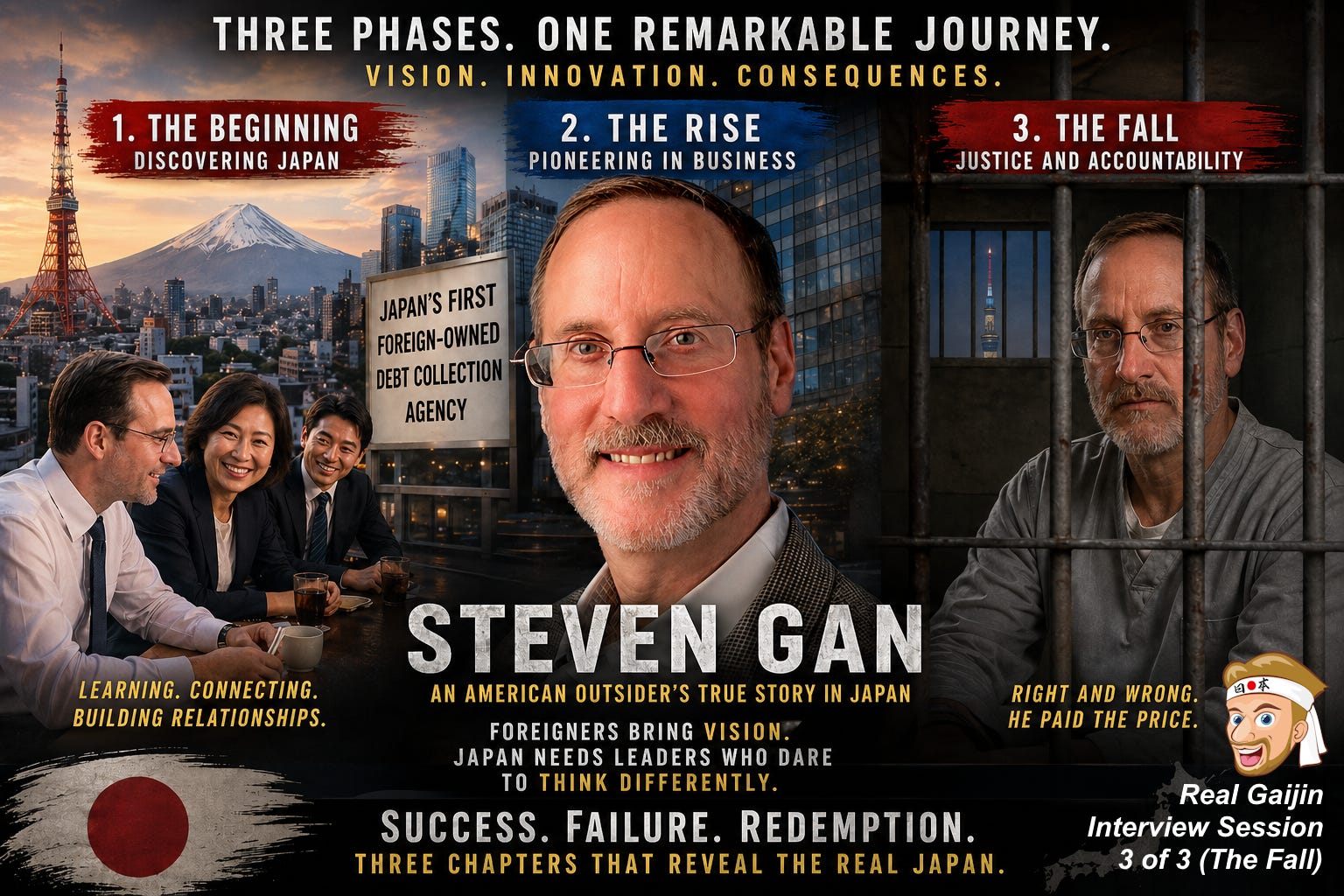 AMA Podcast (S-02, E-13, Session 3 of 3・The Fall) with Steven Gan, the founder of Japan's first debt collection agency run by a foreigner | Foreign businesspeople often push the boundaries of conventional business practices in Japan. They have the vision, technical expertise, and drive necessary to think outside the box and achieve their goals. Japan, a conformist and chronically conservative society, often needs this kind of disruptive leader. Periods of foreign influence help propel Japanese society forward.Today’s guest has a lot in common with Carlos Ghosn, the former head of Nissan. Both are foreign businesspeople who gained prominence as outsiders in Japan’s challenging business environment, only to face serious legal consequences. However, their responses to these consequences differ significantly. Our guest admitted his wrongdoing, submitted to the Japanese legal process, and served his prison sentence despite his strong conviction that he had done nothing wrong. In fact, he had sought legal advice prior to launching his business to support his position. In contrast, Ghosn denied the charges and fled the country to avoid prosecution. These cases highlight the broader narrative that, while they both reflect the risks faced by outsiders navigating Japan’s institutional and cultural boundaries, especially in legal “gray areas,” they also illustrate different approaches to accountability, justice, and personal responsibility.Real Gaijin is privileged to introduce exceptional foreigners who, in one way or another, have made Japan their home or are closely involved with the country. Each story offers insights into how to best interact with the Japanese, and today’s guest is no exception.Who is he?Meet Steven (”Steve”) Gan, an American business professional, author, and credit risk expert. He founded the first debt collection agency run by a foreigner during Japan’s turbulent post-bubble era and has spent decades living and working in Japan. Steve chronicled this experience in his 2016 memoir, Making It & Breaking It in Japan: My True Story of Songs, Sins, and Solitary. The book became an Amazon bestseller in the Foreign Cultures category and is valued by educators and executives seeking a cross-cultural understanding of Japan’s business environment and legal systems.After returning to his hometown of Chicago, Steve founded Stellar Risk Management Services, Inc. in the U.S. His work emphasizes intercultural management and financial ethics, bridging U.S.–Japan business practices.Three stories in oneAs it is simply not possible to do justice to Steve’s long tenure in Japan in a single hour-long podcast, we have split this true story into three pre-recorded sections.* Initial experience in Japan and working for a traditional Japanese company* Starting the country’s first debt collection agency run by a foreigner, which achieved extraordinary success* Colliding with the harsh justice system and eventually facing legal consequences that led to his imprisonment in TokyoEpisode 3 of 3: “I fought the law, and the law won”We discussed how Steve’s business ran afoul of the authorities, leading to his imprisonment. Steve explained how he navigated this crisis both in and out of court appearances and being locked up in the Tokyo Detention Center in a country with a 99% conviction rate, thanks mainly to the tremendous support of his immediate family, business colleagues, and loyal customers.Key take-aways* In Japan, disruption often triggers institutional resistance rather than market competition: Steve’s business succeeded by introducing an aggressive, outcome-based debt collection model that filled a clear market gap. However, success itself became the liability. As the firm grew from a niche operation into a thriving, national business, it began to threaten established professional monopolies, especially those in the legal sector. Rather than competing based on service quality or pricing, the “Committee that Guards Against Illegal Activities Performed by Non-Attorneys” (now “Committee on Regulation of Non-Lawyer Activities”・非弁護士取締委員会) of the Tokyo Bar Association leveraged a regulatory interpretation of Article 72 of the Attorney’s Law to challenge the legitimacy of the entire model. This illustrates a structural dynamic in Japan: innovation that encroaches on protected domains often invites administrative or legal suppression rather than open competition. * Legal ambiguity can persist until it is forcefully resolved, and the process can outweigh the substance: Despite multiple legal opinions supporting Steve’s business model, as well as the active use of his service by law firms, some of Japan’s “mega-banks,” and government entities, the company operated in a “gray zone” that remained vulnerable. The subsequent investigation revealed a system heavily oriented toward procedural outcomes, particularly obtaining a signed confession, rather than adjudicating underlying legality. The inability to have legal counsel present during questioning, pressure to sign statements, and high conviction rate all point to a system driven by process where compliance matters as much as legal merit.It is important to note that back in 2004, Japan still lacked a formal plea-bargaining system. This reflected a criminal justice framework that relied more heavily on prosecutorial discretion, confessions, and negotiated remorse than on American-style legal dealmaking. This changed in 2018 when Japan introduced a limited form of plea-bargaining known as the “cooperative agreement system.” However, Japan’s system remains far narrower in scope than the American version: it is primarily designed for white-collar and organized crime investigations and focuses on suspects providing evidence against other individuals or organizations rather than simply pleading guilty to their own crimes in exchange for reduced punishment.Ultimately, Steve’s refusal to concede guilt prolonged the process, exposing how legal ambiguity is often resolved through pressure rather than clarity. * Foreign-led innovation in Japan carries asymmetric risk, especially when it scales up: Steve explicitly frames his experience as a cautionary tale: Being a foreign disruptor amplifies visibility and vulnerability. Early-stage novelty may be tolerated—or even celebrated—but once the model gains traction and begins to reshape an industry, the level of scrutiny intensifies. Media exposure, such as book publication and an NHK documentary, accelerated growth and backlash, effectively forcing regulators to act. The comparison to other high-profile foreign executives underscores a broader pattern: Outsiders can catalyze change in Japan, but they lack institutional protections and informal networks that buffer domestic actors. Therefore, scaling innovation is not just a business challenge, but also a political and cultural one. Link to Session 1 of 3Link to Session 2 of 3Silver liningDespite experiencing such a tumultuous journey, which included the meteoric growth of a startup only to be dealt a proverbial “Go to Jail. Go directly to Jail. Do not pass Go. Do not collect $200” card from the Japanese equivalent of the game of Monopoly, there is a silver lining. Steve still loves Japan and was able to “rise from the ashes like a phoenix.” After returning to the United States in 2005, he founded Stellar Risk Management Services in Illinois. Today, the company advises Fortune 500 clients on credit, collections, and financial risk strategies. The company specializes in helping firms expand safely while minimizing exposure to bad debt.Today, Steve publishes a monthly newsletter written in Japanese called The Stellar Journal, which is distributed to roughly 14,000 readers.TimelineSubstack does not yet have the functionality to allow you to use a link to jump to a specific section like YouTube’s “chapters.” Please refer to the times listed below to navigate through our hour-long conversation. Thank you for your understanding.Books (by Steve)* 青い目の債権取り立て屋・奮闘記 (“Chronicle of the Struggles of a Blue-Eyed Debt Collector”): Published in Japanese.* Making It & Breaking It in Japan: My True Story of Songs, Sins, and Solitary: Published in English.Key contactsWebsite: https://www.stellarrisk.com/Newsletter: https://www.stellarrisk.com/blogLinkedIn: https://www.linkedin.com/in/stgan/IAESTE Internship: https://iaeste.org/internshipsJapan America Society of Chicago: https://jaschicago.org/Thunderbird School of Global Management: https://thunderbird.asu.edu/#JapanBusiness #ForeignEntrepreneurs #StevenGan #CrossCulturalBusiness #JapanLegalSystem #BusinessEthics #CarlosGhosn #DebtCollection #TokyoBarAssociation #TokyoDetentionCenter #ExpatLifeJapan #日本ビジネス)#外国人起業家 #スティーブンギャン #異文化ビジネス #司法制度 #ビジネス倫理 #カルロスゴーン #東京弁護士会 #債権回収 #米国公認会計士 #外資系企業 #アドバンスアンドアソシエイツ株式会社 #延滞売掛金の回収 #与信管理相談士 #キャッシュフロー問題 #日本での外国人生活 #東京拘置所 #RealGaijin #リアル外人Please note that you can subscribe to Real Gaijin for free. If you are so inclined, you can also purchase an annual subscription for a relatively small fee.However, I understand that even the lowest level of annual subscription allowed by Substack may seem too high for many. If you just want to buy a coffee for Real Gaijin (or maybe a green tea), you can also make a small donation here:https://buymeacoffee.com/realgaijinAll levels of support - including just liking a particular article and/or leaving a comment - are very welcome. Thanks again for reading.While Real Gaijin lives in Substack, you can also find Real Gaijin on a few other platforms (listed in alphabetical order).https://www.instagram.com/real_gaijin_on_substack/https://www.threads.net/@real_gaijin_on_substackhttps://www.tiktok.com/@real.gaijinhttps://x.com/Real_Gaijin_https://www.youtube.com/@RealGaijinhttps://www.linkedin.com/in/mark-wilt-kennedy/ Get full access to Real Gaijin at realgaijin.substack.com/subscribe | 1h 55m 48s | ||||||
| 5/8/26 | 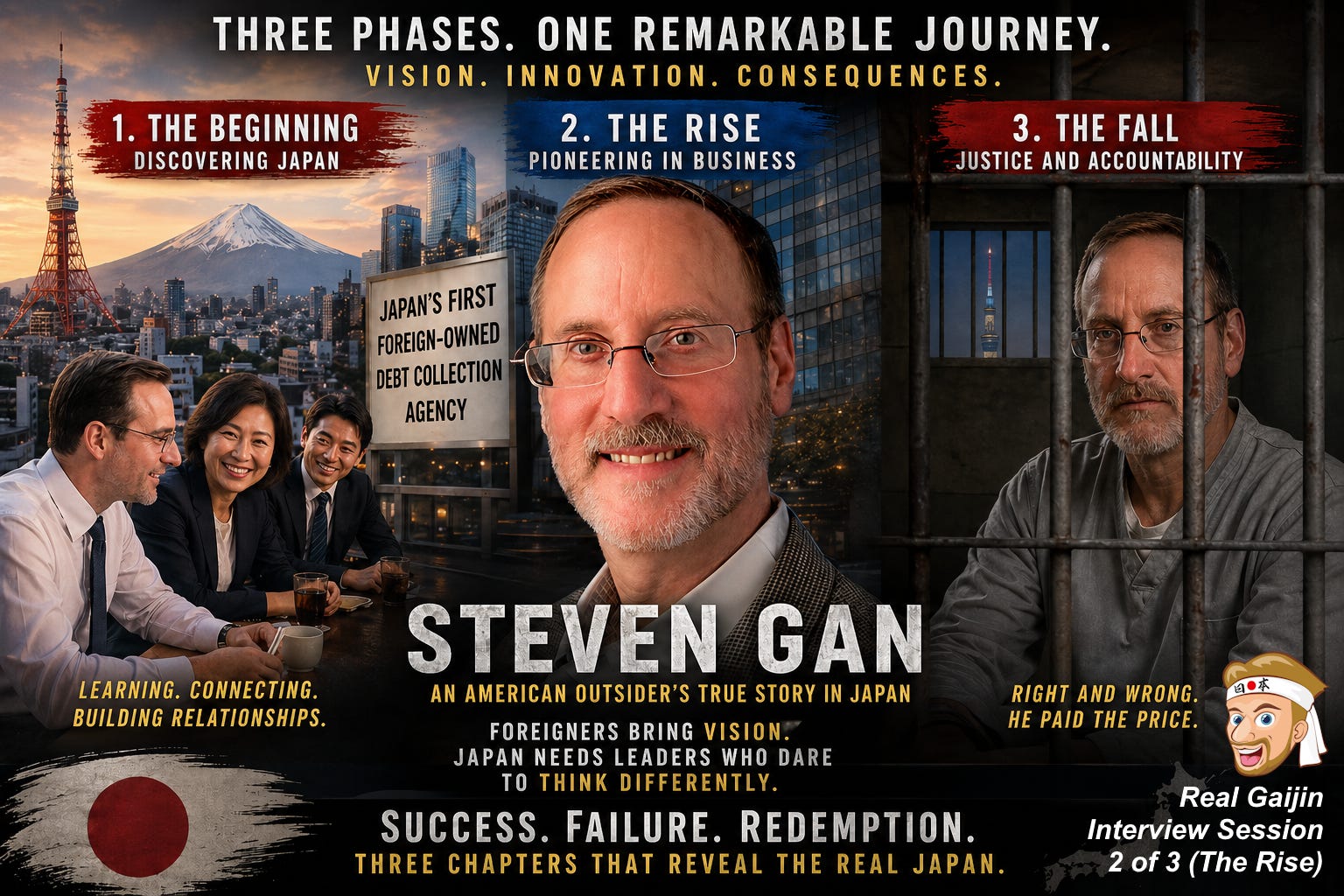 AMA Podcast (S-02, E-12, Session 2 of 3・The Rise) with Steven Gan, the founder of Japan's first debt collection agency run by a foreigner | Foreign businesspeople often push the boundaries of conventional business practices in Japan. They have the vision, technical expertise, and drive necessary to think outside the box and achieve their goals. Japan, a conformist and chronically conservative society, often needs this kind of disruptive leader. Periods of foreign influence help propel Japanese society forward.However, such innovations can sometimes cause such a stir that those in power become determined to quash gaiatsu (外圧), or external influence, that threatens the status quo.Today’s guest has a lot in common with Carlos Ghosn, the former head of Nissan. Both are foreign businesspeople who gained prominence as outsiders in Japan’s challenging business environment, only to face serious legal consequences. However, their responses to these consequences differ significantly. Our guest admitted his wrongdoing, submitted to the Japanese legal process, and served his prison sentence despite his strong conviction that he had done nothing wrong. In fact, he had sought legal advice prior to launching his business to support his position. In contrast, Ghosn denied the charges and fled the country to avoid prosecution. These cases highlight the broader narrative that, while they both reflect the risks faced by outsiders navigating Japan’s institutional and cultural boundaries, especially in legal “gray areas,” they also illustrate different approaches to accountability, justice, and personal responsibility.Real Gaijin is privileged to introduce exceptional foreigners who, in one way or another, have made Japan their home or are closely involved with the country. Each story offers insights into how to best interact with the Japanese, and today’s guest is no exception.Who is he?Meet Steven (”Steve”) Gan, an American business professional, author, and credit risk expert. He founded the first debt collection agency run by a foreigner during Japan’s turbulent post-bubble era and has spent decades living and working in Japan. Steve chronicled this experience in his 2016 memoir, Making It & Breaking It in Japan: My True Story of Songs, Sins, and Solitary. The book became an Amazon bestseller in the Foreign Cultures category and is valued by educators and executives seeking a cross-cultural understanding of Japan’s business environment and legal systems.After returning to his hometown of Chicago, Steve founded Stellar Risk Management Services, Inc. in the U.S. His work emphasizes intercultural management and financial ethics, bridging U.S.–Japan business practices.Three stories in oneAs it is simply not possible to do justice to Steve’s long tenure in Japan in a single hour-long podcast, we have split this true story into three pre-recorded sections.* Initial experience in Japan and working for a traditional Japanese company* Starting the country’s first debt collection agency run by a foreigner, which achieved extraordinary success* Colliding with the harsh justice system and eventually facing legal consequences that led to his imprisonment in TokyoEpisode 2 of 3: Start-up Success in TokyoWe discussed how Steve founded and successfully developed the first debt collection agency run by a foreigner in Japan in 1992. He introduced international credit risk practices to a tightly regulated market. Through publications, seminars, and television appearances, Steve became a prominent advocate for professional credit management and corporate accountability. His firm served hundreds of clients, promoting transparency and modern business standards in Japanese finance.Key take-aways* In Japan, relationship-first networking can be a primary engine of business creation: Steve deliberately used informal settings, especially izakayas (Japanese pubs) and karaoke, as a structured strategy to build trust, exchange business cards, and generate leads. These relationships later translated directly into clients, partnerships, and market insight. This demonstrates that social integration is often a prerequisite to gaining a foothold in the market.* Successful market entry often depends on identifying structural inefficiencies and navigating legal constraints creatively: Steve identified a clear gap: small-to-mid-sized debt collection was underserved due to stigma (association with the Yakuza or Japanese mafia) and misaligned incentives for law firms. By leveraging a legal workaround (partnership structures) and targeting neglected claims, he created a viable niche. The broader takeaway is that opportunities in Japan often exist in regulatory gray zones or culturally avoided sectors.* Reframing a stigmatized industry through ethics and value creation can enable growth: Rather than using coercion, Steve’s firm adopted a “soft collection” model, prioritizing dialogue, repayment plans, and employment support for debtors. This differentiated the company from the Yakuza and traditional collectors, reshaping its public image and enabling media exposure, institutional trust, and large enterprise clients. In effect, ethical repositioning became a competitive advantage.Spoiler alertSteve’s account of his first encounter with a skip tracing service (as advertised), which later turned out to be a local enforcer of the Japanese mafia, or Yakuza, will undoubtedly grab your attention. Skip to around 32:38.Link to Session 1 of 3Link to Session 3 of 3Silver liningDespite experiencing such a tumultuous journey, which included the meteoric growth of a startup only to be dealt a proverbial “Go to Jail. Go directly to Jail. Do not pass Go. Do not collect $200” card from the Japanese equivalent of the game of Monopoly, there is a silver lining. Steve still loves Japan and was able to “rise from the ashes like a phoenix.” After returning to the United States in 2005, he founded Stellar Risk Management Services in Illinois. Today, the company advises Fortune 500 clients on credit, collections, and financial risk strategies. The company specializes in helping firms expand safely while minimizing exposure to bad debt.Today, Steve publishes a monthly newsletter written in Japanese called The Stellar Journal, which is distributed to roughly 14,000 readers.TimelineSubstack does not yet have the functionality to allow you to use a link to jump to a specific section like YouTube’s “chapters.” Please refer to the times listed below to navigate through our hour-long conversation. Thank you for your understanding.Books (by Steve)* 青い目の債権取り立て屋・奮闘記 (“Chronicle of the Struggles of a Blue-Eyed Debt Collector”): Published in Japanese.* Making It & Breaking It in Japan: My True Story of Songs, Sins, and Solitary: Published in English.Key contactsWebsite: https://www.stellarrisk.com/Newsletter: https://www.stellarrisk.com/blogLinkedIn: https://www.linkedin.com/in/stgan/IAESTE Internship: https://iaeste.org/internshipsJapan America Society of Chicago: https://jaschicago.org/Thunderbird School of Global Management: https://thunderbird.asu.edu/#JapanBusiness #ForeignEntrepreneurs #StevenGan #CrossCulturalBusiness #JapanLegalSystem #BusinessEthics #CarlosGhosn #DebtCollection #TokyoBarAssociation #TokyoDetentionCenter #ExpatLifeJapan #日本ビジネス)#外国人起業家 #スティーブンギャン #異文化ビジネス #司法制度 #ビジネス倫理 #カルロスゴーン #東京弁護士会 #債権回収 #米国公認会計士 #外資系企業 #アドバンスアンドアソシエイツ株式会社 #延滞売掛金の回収 #与信管理相談士 #キャッシュフロー問題 #日本での外国人生活 #東京拘置所 #RealGaijin #リアル外人Please note that you can subscribe to Real Gaijin for free. If you are so inclined, you can also purchase an annual subscription for a relatively small fee.However, I understand that even the lowest level of annual subscription allowed by Substack may seem too high for many. If you just want to buy a coffee for Real Gaijin (or maybe a green tea), you can also make a small donation here:https://buymeacoffee.com/realgaijinAll levels of support - including just liking a particular article and/or leaving a comment - are very welcome. Thanks again for reading.While Real Gaijin lives in Substack, you can also find Real Gaijin on a few other platforms (listed in alphabetical order).https://www.instagram.com/real_gaijin_on_substack/https://www.threads.net/@real_gaijin_on_substackhttps://www.tiktok.com/@real.gaijinhttps://x.com/Real_Gaijin_https://www.youtube.com/@RealGaijinhttps://www.linkedin.com/in/mark-wilt-kennedy/ Get full access to Real Gaijin at realgaijin.substack.com/subscribe | 1h 07m 12s | ||||||
| 5/8/26 | 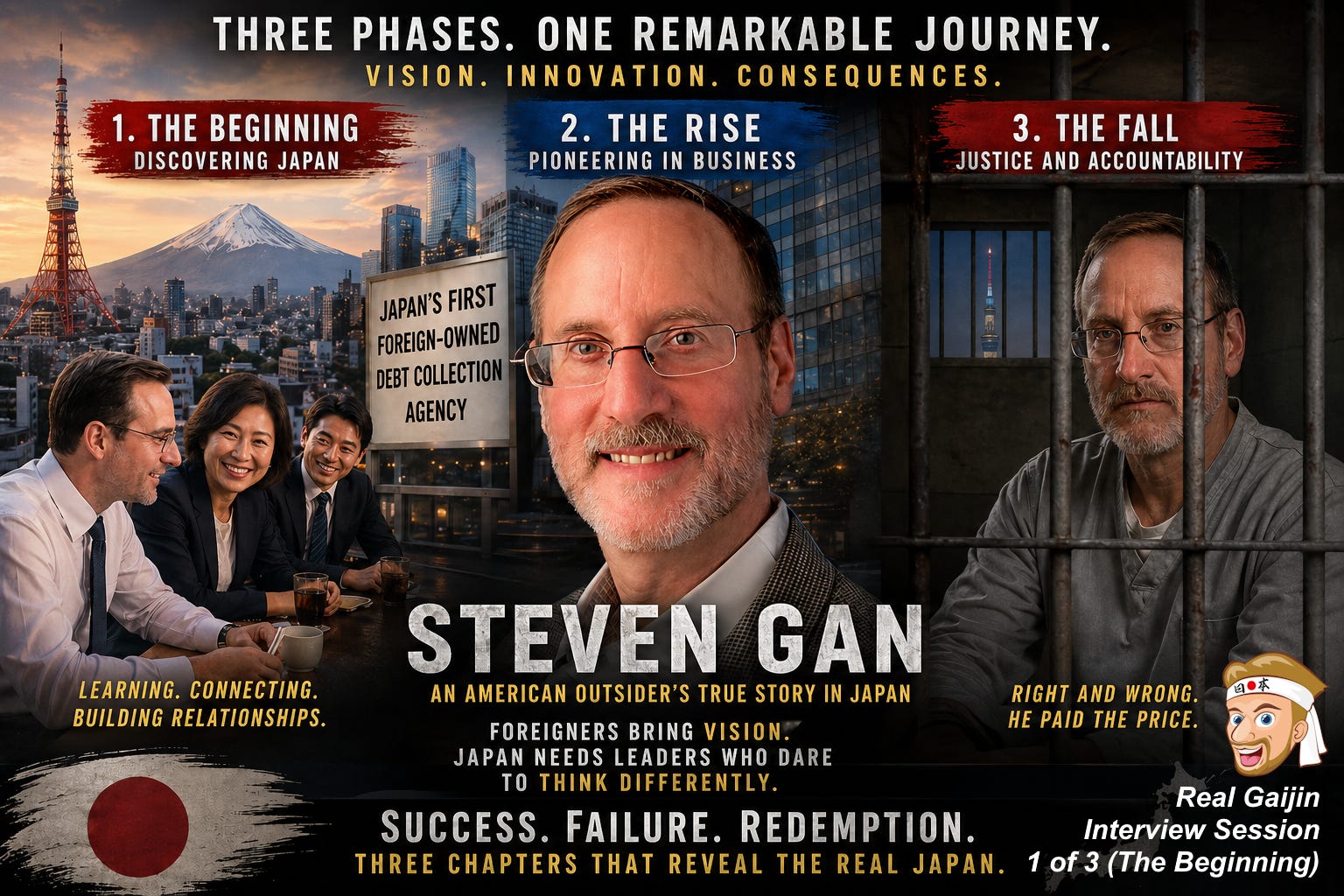 AMA Podcast (S-02, E-11, Session 1 of 3・The Beginning) with Steven Gan, the founder of Japan's first debt collection agency run by a foreigner | Foreign businesspeople often push the boundaries of conventional business practices in Japan. They have the vision, technical expertise, and drive necessary to think outside the box and achieve their goals. Japan, a conformist and chronically conservative society, often needs this kind of disruptive leader. Periods of foreign influence help propel Japanese society forward.However, such innovations can sometimes cause such a stir that those in power become determined to quash gaiatsu (外圧), or external influence, that threatens the status quo.Today’s guest has a lot in common with Carlos Ghosn, the former head of Nissan. Both are foreign businesspeople who gained prominence as outsiders in Japan’s challenging business environment, only to face serious legal consequences. However, their responses to these consequences differ significantly. Our guest admitted his wrongdoing, submitted to the Japanese legal process, and served his prison sentence despite his strong conviction that he had done nothing wrong. In fact, he had sought legal advice prior to launching his business to support his position. In contrast, Ghosn denied the charges and fled the country to avoid prosecution. These cases highlight the broader narrative that, while they both reflect the risks faced by outsiders navigating Japan’s institutional and cultural boundaries, especially in legal “gray areas,” they also illustrate different approaches to accountability, justice, and personal responsibility.Real Gaijin is privileged to introduce exceptional foreigners who, in one way or another, have made Japan their home or are closely involved with the country. Each story offers insights into how to best interact with the Japanese, and today’s guest is no exception.Who is he?Meet Steven (”Steve”) Gan, an American business professional, author, and credit risk expert. He founded the first debt collection agency run by a foreigner during Japan’s turbulent post-bubble era and has spent decades living and working in Japan. Steve chronicled this experience in his 2016 memoir, Making It & Breaking It in Japan: My True Story of Songs, Sins, and Solitary. The book became an Amazon bestseller in the Foreign Cultures category and is valued by educators and executives seeking a cross-cultural understanding of Japan’s business environment and legal systems.After returning to his hometown of Chicago, Steve founded Stellar Risk Management Services, Inc. in the U.S. His work emphasizes intercultural management and financial ethics, bridging U.S.–Japan business practices.Three stories in oneAs it is simply not possible to do justice to Steve’s long tenure in Japan in a single hour-long podcast, we have split this true story into three pre-recorded sections.* Initial experience in Japan and working for a traditional Japanese company* Starting the country’s first debt collection agency run by a foreigner, which achieved extraordinary success* Colliding with the harsh justice system and eventually facing legal consequences that led to his imprisonment in TokyoEpisode 1 of 3: Early DaysWe discussed Steve’s first experience of Japan during the Bubble Era. We heard how he survived and thrived as a newly qualified engineer from abroad in the completely unfamiliar environment of a traditional Japanese company in the early 1980s. Steve then recounted how he returned home to Chicago to earn an accounting degree and join the family business. Eager to return to Japan, years later Steve found a way to go back to Tokyo and take up a position at Nippon Motorola. This time, however, he was treated differently and had to forge new friendships using an unconventional approach.Key take-aways* Success in Japan is determined by adaptability, not just enthusiasm: Steve’s first internship was successful because he followed critical behavioral heuristics: patience, humility, and a willingness to “go with the flow.” In contrast, his later return was initially unsuccessful because he overcorrected—his excessive enthusiasm and assertiveness disrupted group harmony. The core lesson is that cultural calibration matters more than effort or intent.* Making an effort to learn the language is a high-leverage signal that unlocks social and professional access: Even minimal Japanese proficiency (e.g., greetings, phone handling, and basic interactions) significantly improved Steve’s ability to integrate into Japanese society, while his peers who avoided learning the language struggled. Beyond the mechanics of communication, speaking the language signaled respect and lowered barriers, accelerating the formation of trust both inside the company and in broader social settings.* Informal networks, such as izakaya (Japanese pub) and karaoke culture, are critical to relationship-building and business outcomes: Formal workplace channels failed to provide feedback or integration, but informal environments enabled authentic connection. Through repeated, low-pressure social participation, especially karaoke, Steve built relationships, gained acceptance, and generated business opportunities. This suggests that relational capital in Japan is often built outside of formal structures.Link to Session 2 of 3Link to Session 3 of 3Silver liningDespite experiencing such a tumultuous journey, which included the meteoric growth of a startup only to be dealt a proverbial “Go to Jail. Go directly to Jail. Do not pass Go. Do not collect $200” card from the Japanese equivalent of the game of Monopoly, there is a silver lining. Steve still loves Japan and was able to “rise from the ashes like a phoenix.” After returning to the United States in 2005, he founded Stellar Risk Management Services in Illinois. Today, the company advises Fortune 500 clients on credit, collections, and financial risk strategies. The company specializes in helping firms expand safely while minimizing exposure to bad debt.Today, Steve publishes a monthly newsletter written in Japanese called The Stellar Journal, which is distributed to roughly 14,000 readers.TimelineSubstack does not yet have the functionality to allow you to use a link to jump to a specific section like YouTube’s “chapters.” Please refer to the times listed below to navigate through our hour-long conversation. Thank you for your understanding.Books (by Steve)* 青い目の債権取り立て屋・奮闘記 (“Chronicle of the Struggles of a Blue-Eyed Debt Collector”): Published in Japanese.* Making It & Breaking It in Japan: My True Story of Songs, Sins, and Solitary: Published in English.Key contactsWebsite: https://www.stellarrisk.com/Newsletter: https://www.stellarrisk.com/blogLinkedIn: https://www.linkedin.com/in/stgan/IAESTE Internship: https://iaeste.org/internshipsJapan America Society of Chicago: https://jaschicago.org/Thunderbird School of Global Management: https://thunderbird.asu.edu/#JapanBusiness #ForeignEntrepreneurs #StevenGan #CrossCulturalBusiness #JapanLegalSystem #BusinessEthics #CarlosGhosn #DebtCollection #TokyoBarAssociation #TokyoDetentionCenter #ExpatLifeJapan #日本ビジネス)#外国人起業家 #スティーブンギャン #異文化ビジネス #司法制度 #ビジネス倫理 #カルロスゴーン #東京弁護士会 #債権回収 #米国公認会計士 #外資系企業 #アドバンスアンドアソシエイツ株式会社 #延滞売掛金の回収 #与信管理相談士 #キャッシュフロー問題 #日本での外国人生活 #東京拘置所 #RealGaijin #リアル外人Please note that you can subscribe to Real Gaijin for free. If you are so inclined, you can also purchase an annual subscription for a relatively small fee.However, I understand that even the lowest level of annual subscription allowed by Substack may seem too high for many. If you just want to buy a coffee for Real Gaijin (or maybe a green tea), you can also make a small donation here:https://buymeacoffee.com/realgaijinAll levels of support - including just liking a particular article and/or leaving a comment - are very welcome. Thanks again for reading.While Real Gaijin lives in Substack, you can also find Real Gaijin on a few other platforms (listed in alphabetical order).https://www.instagram.com/real_gaijin_on_substack/https://www.threads.net/@real_gaijin_on_substackhttps://www.tiktok.com/@real.gaijinhttps://x.com/Real_Gaijin_https://www.youtube.com/@RealGaijinhttps://www.linkedin.com/in/mark-wilt-kennedy/ Get full access to Real Gaijin at realgaijin.substack.com/subscribe | 1h 04m 04s | ||||||
| 4/12/26 |  AMA Podcast (S-02, E-10) with Andrew Neuman, a Japan-Based Professional and Adoptive Parent | Japan records relatively few adoptions each year. The majority are adult adoptions tied to family succession, not placements of unrelated children. True child adoptions, especially of children from the welfare system, remain limited. Against this backdrop, foreign adoptive parents are a small but notable edge case, navigating a system that is both structurally restrictive and culturally cautious.Today, Real Gaijin was privileged to speak with a longtime Japan resident originally from California who made the momentous decision to adopt a Japanese child and raise them in a bicultural setting.Who is he?Andrew Neuman, a Japan-based professional and adoptive parent, has firsthand experience navigating the country’s complex and often opaque adoption system. His experience gives him a rare, practitioner-level perspective on the structural, legal, and cultural dynamics that shape adoption in Japan, from the constraints of the special adoption framework, which is called Tokubetsu Yoshiengumi (特別養子縁組) in Japanese, to the practical realities of raising a child across cultural and linguistic boundaries. His story provides insight into the discrepancy between policy design and lived experience, as well as the broader question of how family formation is evolving in a rapidly aging society.On the agendaWe heard about Andrew’s family’s experiences in the context of how Japan’s adoption process operates. We examined instances where the system breaks down in practice, the reasons behind the persistent gap between the number of children in need of “forever homes” and the limited number of successful adoptions, and the ways in which institutional incentives influence these outcomes.Key Takeaways* Japan’s adoption system is significantly underutilized. This leaves a stark gap between the number of children in need of “forever homes” and the number of children who are actually adopted. Though approximately 42,000 children cannot live with their biological parents, most of whom remain in institutional settings, only 300 to 500 adoptions occur annually. This means that only a tiny fraction of eligible children transition into permanent family environments each year. This underscores a structural imbalance driven by legal constraints, cultural preferences for bloodline continuity, and limited adoption throughput.* The adoption process, particularly for foreign applicants, is highly constrained, hierarchical, and psychologically demanding. Prospective parents must navigate strict prioritization rules that place non-Japanese couples, especially those living abroad, at the lowest tier. They must also endure long periods of uncertainty with no guaranteed outcome. The process requires candid self-assessment about what challenges prospective parents can handle. It is less about choosing a child and more about proving suitability within a rigid system. At the same time, a practical takeaway from the discussion is the importance of seeking guidance from adoptive parents who have already gone through the process. Their firsthand experience can help set expectations, reduce uncertainty, and provide critical emotional and procedural support.* Go deeper: Restrictions on the age of adoptive parents, especially the mother, are a standard but variably enforced feature of adoption policy across countries. These restrictions reflect concerns about long-term caregiving capacity and generational fit. In Japan, although there is no uniform legal cutoff, adoption agencies and courts impose strict de facto limits. They typically favor adoptive mothers in their 20s and early 40s for infant adoptions. Flexibility increases for older children, though matching odds are sharply reduced beyond the mid-40s. By contrast, the United States has no formal age caps, relying instead on a holistic “fitness” standard. However, agencies often impose soft ceilings tied to the parent’s ability to raise a child to adulthood. Other countries take a more rules-based approach. South Korea enforces explicit upper age limits; China uses tiered systems that restrict older parents to harder-to-place children; and India applies combined parental age thresholds that vary by the child’s age. Two consistent patterns emerge across all systems: age constraints are stricter for infant adoption and relax for older children, and maternal age is often treated as the primary gating factor, whether formally codified or informally applied.* Becoming an adoptive parent of a Japanese child—especially as a non-Japanese national—requires a structured, multi-stage process with limited flexibility. Applicants must first engage an accredited agency (often in their home country), complete extensive documentation and screening over several months, and then have their case reviewed by a Japanese intermediary, such as International Social Services Japan. Approval is followed by a potentially multi-year waiting period for a match. After that, the process shifts to Japan and includes travel, legal custody procedures, and a mandatory 6 ~ 18 month “period of nurturing.” During this period, prospective parents must reside temporarily in Japan to establish and demonstrate a stable parent-child relationship before finalization. Importantly, applicants cannot “hedge” across multiple countries or agencies. They must commit to a single pathway, which increases the risk and time commitment of the process.TimelineSubstack does not yet have the functionality to allow you to use a link to jump to a specific section like YouTube’s “chapters.” Please refer to the times listed below to navigate through our hour-long conversation. Thank you for your understanding.Key contacts (and resources)* LinkedIn: https://www.linkedin.com/in/aneuman/* International Social Service Japan (page for “Prospective Adoptive Parents”): https://www.issj.org/adoption-web-en/paps/* The Nippon Foundation (Happy Yurikago Project): https://en.nippon-foundation.or.jp/what/projects/youth/happy_yurikago* U.S. Embassy & Consulates in Japan (Adoption): https://jp.usembassy.gov/services/adoption/* Japan Children Support Association: https://npojcsa.com/en/index.html* Children and Families Agency (Global Site): https://www.cfa.go.jp/en* Adopt International: https://www.adoptinter.org/* Short Documentary “Japan’s Throwaway Children | 101 East |日本の捨て児”* Discussion of “What it’s like to adopt a child in Japan” with Andrew#AndrewNeuman #Adoption #ChildWelfare #Parenting #Bicultural #ExpatLife #SocialPolicy #Demographics #SpecialAdoptionFramework #アンドリューニューマン #ニューマンアンドリュー #養子縁組 #児童福祉 #子育て #バイカルチャー #海外生活 #社会政策 #人口動態 #特別養子縁組 #RealGaijin #リアル外人Please note that you can subscribe to Real Gaijin for free. If you are so inclined, you can also purchase an annual subscription for a relatively small fee.However, I understand that even the lowest level of annual subscription allowed by Substack may seem too high for many. If you just want to buy a coffee for Real Gaijin (or maybe a green tea), you can also make a small donation here:https://buymeacoffee.com/realgaijinAll levels of support - including just liking a particular article and/or leaving a comment - are very welcome. Thanks again for reading.While Real Gaijin lives in Substack, you can also find Real Gaijin on a few other platforms (listed in alphabetical order).https://www.instagram.com/real_gaijin_on_substack/https://www.threads.net/@real_gaijin_on_substackhttps://www.tiktok.com/@real.gaijinhttps://x.com/Real_Gaijin_https://www.youtube.com/@RealGaijinhttps://www.linkedin.com/in/mark-wilt-kennedy/ Get full access to Real Gaijin at realgaijin.substack.com/subscribe | 1h 13m 50s | ||||||
| 3/29/26 |  AMA Podcast (S-02, E-09) with Derek Cirillo and Nick McLoota, the Co-founders of Yuki Homes | Japan has consistently ranked high on the bucket lists of foreign visitors in recent years. While Japan is a wonderful place to visit year-round, it boasts some of the best snowboarding and skiing in the world, making it a must-visit destination for winter sports enthusiasts.Almost all snowboarders and skiers have heard of the world-famous Niseko ski resort, but there is a lot more to Japan’s skiing scene. Today, Real Gaijin introduces a pair of Americans who know Japan’s backcountry well.Meet Derek Cirillo and Nick McLoota, the co-founders of Yuki Homes.These young entrepreneurs fell in love with JAPOW and some of the best snowboarding and skiing resorts in Hokkaido. Together with a third partner, they decided to invest in their own property in Otaru to use as a home base for long visits (40 or 50 days at a time, for example). When they are not in town, they rent out the property on Airbnb, Rakuten Travel, and other online travel agencies (OTAs).After learning how many other foreigners had similar dreams and having a Reddit post about their own experience go viral, Derek and Nick decided to start their own real-estate consulting agency. Their agency connects overseas skiers and investors with Japanese real-estate brokers and other support services, such as local property managers, remodeling construction contractors, and tax accountants. Now, Yuki Homes helps foreign clients take advantage of Japan’s growing stock of affordable homes near some of the world’s best snowboarding and skiing destinations.Yuki Homes is now a full-service provider and expanding across JapanYou might recall that we first met the team at Yuki Homes last summer, well before the snow had fallen in Hokkaido this winter. ICYMI, see here:That didn’t stop the pair, though, from expanding their network across Japan (when they weren’t surfing in Miyazaki). Yuki Homes now has many more satisfied clients, and their Instagram following has ballooned. They now have a full team handling property tours, renovations and short-term rental management throughout Japan for buyers from the US, UK, Australia and Canada — with a special focus on Otaru, Asahikawa, and Miyoko. Despite the fact that most of their clients do not have long-term visas or local bank accounts, business is booming. Yuki Homes currently has seven remodeling projects underway, for example.Key takeaways (from our conversation on 29 MAR 2026)* From Snowboard Trip to Scalable Real Estate Venture: The business model behind Yuki Homes was born from a clear arbitrage opportunity: inexpensive rural Japanese properties, particularly those near ski resorts, combined with strong international demand for seasonal stays. After all, Japan currently offers the only affordable world-class ski locations. Derek and Nick found that comparable ski homes in North America were too expensive, but Japan offered similar or better snow conditions at a much lower price. They didn’t just decide to purchase property themselves; they also developed a process to help others do the same. Thus, Derek and Nick turned their personal experience into a brokerage-plus-advisory service that guides foreign buyers through the process of acquiring, renovating, and monetizing property. * Operational Complexity—and Resulting Value—of Local Execution: The business is not just about sourcing properties. It depends heavily on a distributed network of local experts across Japan. This includes licensed real-estate agents who handle legal compliance, local contractors who manage renovations, property checkers, and even neighbors to mitigate friction. The founders split responsibilities, with one handling front-end acquisition and client advisory and the other handling post-purchase execution and income optimization. This hybrid model—part concierge and part project manager—is essential in a market where language barriers, regulatory nuances, and local trust networks are decisive factors.* Handling Japan’s Regulatory Complexity on Your Behalf: Regulatory structure—particularly Japan’s minpaku (short-term rental) versus ryokan (hotel) licensing regime—fundamentally shapes investment outcomes. Minpaku properties face strict limitations, often capped at 180 rental days or further restricted locally, while hotel licenses allow for full-year operation, though they require higher compliance costs, such as fire safety measures, inspections, and proximity requirements for emergency contacts. Yuki Homes actively steers clients toward hotel-compliant properties to ensure long-term viability, especially amid tightening enforcement driven by concerns about overtourism. In effect, regulatory arbitrage, not just property price, is central to the investment thesis. TimelineSubstack does not yet have the functionality to allow you to use a link to jump to a specific section like YouTube’s “chapters.” Please refer to the times listed below to navigate through our hour-long conversation. Thank you for your understanding.Key contacts* Yuki Homes’ Instagram (Just DM them via IG for the fastest response): https://www.instagram.com/yukihomesjapan/* Yuki Homes’ Website: https://www.yukihomes.com/* Yuki Homes’ Substack (check out “The Bento Box” released every Friday for a showcase of a few select properties):* NipponHomes Dot Com (Zillow-like Tool): https://www.nipponhomes.com/* Kiroro Snow World: https://www.kiroro.co.jp/* PowderHounds: https://www.powderhounds.com/#JapanRealEstate #SkiProperty #Japow #Hokkaido #JapanRealEstate #Akiya #SkiJapan #ExpatLife #JapanInvesting #スキーリゾート #ジャパウ #北海道 #不動産投資 #空き家 #スキー日本 #YukiHomes #RealGaijin #リアル外人Please note that you can subscribe to Real Gaijin for free. If you are so inclined, you can also purchase an annual subscription for a relatively small fee.However, I understand that even the lowest level of annual subscription allowed by Substack may seem too high for many. If you just want to buy a coffee for Real Gaijin (or maybe a green tea), you can also make a small donation here:https://buymeacoffee.com/realgaijinAll levels of support - including just liking a particular article and/or leaving a comment - are very welcome. Thanks again for reading.While Real Gaijin lives in Substack, you can also find Real Gaijin on a few other platforms (listed in alphabetical order).https://www.instagram.com/real_gaijin_on_substack/https://www.threads.net/@real_gaijin_on_substackhttps://www.tiktok.com/@real.gaijinhttps://x.com/Real_Gaijin_https://www.youtube.com/@RealGaijinhttps://www.linkedin.com/in/mark-wilt-kennedy/ Get full access to Real Gaijin at realgaijin.substack.com/subscribe | 1h 04m 11s | ||||||
| 3/19/26 |  AMA Podcast (S-02, E-08) with "Anna," a Licensed Care Worker at an Elderly Care Facility in Osaka | Japan’s rapidly aging population is putting unprecedented pressure on its long-term care system. Few issues illustrate this strain more clearly than the debate over the Specified Skilled Worker (SSW) visa program. Supporters argue that foreign caregivers are essential to sustaining elder care services as the Japanese workforce shrinks. However, critics worry about the social and political implications of expanding immigration in a historically cautious country.Political rhetoric around immigration shows little sign of cooling. Yet, one perspective is often missing from the debate: the voices of the essential foreign workers themselves.To shed more light on this situation, Real Gaijin spoke with a licensed caregiver at an elderly care facility in Osaka. As an essential worker on the front lines of Japan’s healthcare challenges, our guest outlined her journey from the Philippines to a training program in Yokohama and ultimately to a long-term care home in Osaka. She told us about her work responsibilities and provided a firsthand perspective on the labor shortage in Japan’s care homes. She also shared her personal perspective on addressing some of the bigger issues, such as who will care for the rapidly growing elderly population, and expressed her wish for caregivers from abroad to be more welcomed by Japanese society as a whole.Who is she?Anna, who prefers to use only her first name for this interview, is a registered nurse in the Philippines. She currently works as a licensed care worker, the Japanese equivalent of a certified nursing assistant (CNA), in an elderly care facility in Osaka.Originally, Anna came to Japan as a care worker candidate under the Economic Partnership Agreement (EPA) from 2021 to 2025. She recently passed the national care worker exam, also known as the kaigo fukushi kokka shiken (介護福祉士国家試験).Anna was kind enough to reach out to Real Gaijin after reading “Japan Quietly Rewrites the Rules for Foreign Care Workers: How a new “partial pass” exam system is extending visas and reshaping Japan’s elder care labor strategy.” So, who better to ask about working as a foreign caregiver at a Japanese elder care home?On the agendaWe traced Anna’s journey from the Philippines to Japan and discussed what her experience was like participating in the EPA program. We also talked about her current role as a caregiver in Osaka, her legal status in Japan, particularly in relation to her nursing degree from the Philippines, and her plans to continue living and working in Japan.Key takeawaysWe could have continued for many more hours and certainly covered a lot of ground during the podcast, but some of the big takeaways were the following:* Japan is already structurally dependent on foreign caregivers.Foreign care workers are not just filling marginal gaps; they are now structurally embedded in Japan’s elder care system. In Anna’s facility, the majority of staff are foreign. In the four years she has worked there, she has not seen a single new Japanese care worker join—a fact that strongly signals a collapse in the domestic labor supply for this sector. Her observation that younger Japanese workers are largely unwilling to enter the caregiving field reinforces this idea, leaving “heavy lifting” (both literal and operational) to foreign staff. The implication is structural, not cyclical: absent major policy or labor-market changes, Japan’s care system will remain dependent on continued inflows of foreign labor, regardless of political rhetoric around immigration.* The system extracts high human capital, but does not leverage it effectively.There is inefficiency—and arguably misallocation—of skilled labor within Japan’s caregiving pipeline. Anna is a fully qualified nurse in the Philippines, yet she is employed as a clinical nurse assistant (CNA) in Japan because her credentials are not recognized. In order to advance, she must work full-time while studying Japanese for a difficult national certification exam, effectively re-credentialing from scratch. While the system is structured and supportive, offering training, matching, and visa pathways, it imposes a lengthy, language-intensive conversion process that delays the full utilization of existing medical expertise. This suggests a policy tension: Japan urgently needs skilled healthcare labor, yet it maintains high institutional barriers that slow the integration of professionals who are already trained.* Economic incentives, not cultural preferences, drive migration decisions.Migration decisions are primarily economic and pragmatic, not ideological. Anna explicitly frames her decision to stay in Japan as a function of the relative viability of the labor market: while the Philippines offers cultural comfort, it does not offer comparable employment opportunities or wages. Meanwhile, policy frictions, such as rising visa and residency costs, directly impact workers whose salaries remain relatively low, raising questions about sustainability and fairness. Anna’s perspective reshapes the immigration debate, portraying foreign workers as rational economic actors who weigh trade-offs across global labor markets rather than passive beneficiaries of Japan’s system. For policymakers, this implies that tightening financial or administrative burdens could reduce Japan’s competitiveness in attracting and retaining this workforce. For example, the government recently proposed increasing the application fee for permanent residency from 10,000 yen ($63) to 300,000 yen ($1,900). This increase would place a significant financial burden on Anna. Since she would have to pay the fee herself, Anna has suggested setting the fee at a graduated rate based on the applicant’s income. Additionally, the Japanese government plans to raise the fees for renewing various work visas. For many care workers at the bottom of the pay scale who, unlike Anna, have not yet passed the national care worker exam, these annual additional fees will be a significant financial burden. Thus, there will soon be a new disincentive for relatively low-paid care workers from abroad to remain in Japan.* There’s a discrepancy between how much foreign caregivers contribute and how much they’re socially acknowledged.Anna emphasizes that many foreign caregivers undergo years of language training and certification studies and perform physically demanding work to provide high-quality care, often to Japan’s most vulnerable population, including centenarians and individuals with dementia. Yet, she feels that Japanese society does not fully appreciate this commitment and, in some cases, makes generalized or negative assumptions about foreigners. Her request is not abstract; she asks that Japanese people judge individuals based on their actions rather than stereotypes and recognize that foreign caregivers are quietly and diligently working to support the country’s aging population. Foreign caregivers are already essential to the system, yet social acceptance and acknowledgment have not kept pace with their indispensable role in caring for Japan’s parents and grandparents.TimelineSubstack does not yet have the functionality to allow you to use a link to jump to a specific section like YouTube’s “chapters.” Please refer to the times listed below to navigate through our hour-long conversation. Thank you for your understanding.Key contacts* Substack: https://substack.com/@annainjpgFull disclosureFor an unknown reason, possibly related to the release of significant new functionality by Substack last week, we experienced technical difficulties during the live video session. This limited the audience’s ability to listen to the discussion and participate via chat. Anna and I continued to record. We apologize for any inconvenience and encourage you to enter your questions in the comments below. One or both of us will address your questions and concerns.Real Gaijin is working with Substack to ensure that we do not continue to experience these sorts of technical difficulties.#ImmigrationJapan #ForeignWorkersJapan #SpecifiedSkilledWorker #SSWVisa #ElderCareJapan #JapanHealthcare #LaborShortage #EssentialWorkers #EconomicPartnershipAgreement #EPA #日本の移民 #日本の外国人労働者 #特定技能労働者 #特定技能ビザ #日本の介護 #日本の医療 #人手不足 #必須労働者 #介護福祉士国家試験 #経済連携協定 #RealGaijin #リアル外人Please note that you can subscribe to Real Gaijin for free. If you are so inclined, you can also purchase an annual subscription for a relatively small fee.However, I understand that even the lowest level of annual subscription allowed by Substack may seem too high for many. If you just want to buy a coffee for Real Gaijin (or maybe a green tea), you can also make a small donation here:https://buymeacoffee.com/realgaijinAll levels of support - including just liking a particular article and/or leaving a comment - are very welcome. Thanks again for reading.While Real Gaijin lives in Substack, you can also find Real Gaijin on a few other platforms (listed in alphabetical order).https://www.instagram.com/real_gaijin_on_substack/https://www.threads.net/@real_gaijin_on_substackhttps://www.tiktok.com/@real.gaijinhttps://x.com/Real_Gaijin_https://www.youtube.com/@RealGaijinhttps://www.linkedin.com/in/mark-wilt-kennedy/ Get full access to Real Gaijin at realgaijin.substack.com/subscribe | 1h 03m 11s | ||||||
| 3/14/26 | 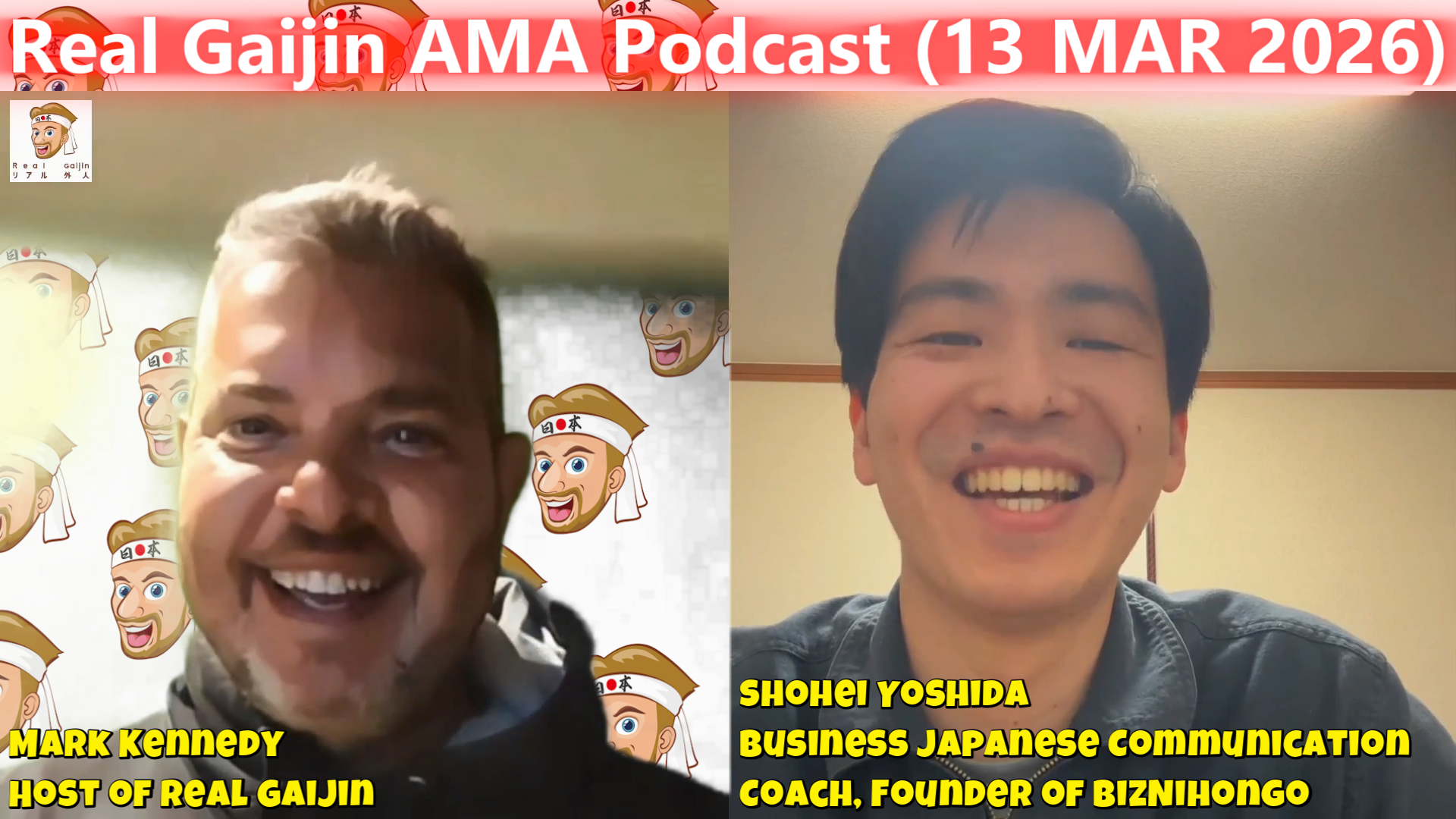 AMA Podcast (S-02, E-07) with Shohei Yoshida, Business Japanese Communication Coach and Founder of BizNihongo | According to documents submitted to the Cabinet by the Immigration Services Agency on March 10, 2026, the number of foreign residents in Japan reached a record high of approximately 4.13 million at the end of fiscal year 2025, surpassing the 4 million mark for the first time. The population increased by about 360,000 during fiscal year 2025 alone and by over 1 million in the past three years.Especially given these numbers, demand for Japanese language learning continues to increase as Japan’s economic, technological, and cultural influence remains significant and the country opens more to international business and tourism. Many professionals find that basic conversational ability is no longer sufficient. Companies increasingly expect foreign partners, managers, and specialists to have business-level proficiency, which is necessary for handling negotiations, formal correspondence, and culturally nuanced communication. Mastery of honorific keigo (敬語), industry-specific vocabulary, and implicit communication norms is particularly valuable because Japanese business culture relies heavily on subtle language cues to convey hierarchy, intent, and trust. Consequently, Japanese language study is shifting from a hobby to a strategic skill for individuals seeking to work effectively with Japanese firms or within Japan’s domestic market.Our guest on today’s Real Gaijin AMA podcast knows first-hand just how challenging it can be to learn a foreign language—especially when your goal is to use it professionally.Who is he?While Real Gaijin‘s Ask Me Anything (AMA) series typically features one inspiring “real gaijin,” or foreigner, our guest today was a Japanese individual who has an extensive background working with foreigners. Shohei Yoshida (吉田菖平) was born and raised in Japan but always knew his mission was to bridge Japan and the rest of the world. He has taught Japanese at the university level in both Malaysia and the U.K. He started his own online learning academy called BizNihongo to offer clear, practical support for building confidence in Japanese business settings.On the agendaWe traced Shohei’s journey from his hometown of Kumamoto, where TSMC is located, to the U.K. and Malaysia, and then back to Japan. Thus, he has personal experience with the challenges of improving his English while living abroad — the proverbial shoe on the other foot.Although he is a native Japanese speaker, Shohei explained that he initially lacked confidence in speaking business Japanese while working and job hunting for Japanese companies. He then described how he overcame this obstacle using various resources. Just imagine how much more difficult this would be for a foreigner trying to get hired by a Japanese firm. This experience led Shohei to establish BizNihongo. He outlined how his specialized coaching program for business professionals is completely customizable depending on each student’s needs. The program offers coaching to build confidence and in-depth instruction in workplace honorific Japanese, or keigo. Shohei also reviewed BizNihongo’s supportive community, which is free to join. This community helps business professionals connect and share experiences. He also discussed his online course catalog and one-on-one consultation options.Key takeawaysWe could have continued for many more hours and certainly covered a lot of ground during the podcast, but some of the big takeaways were the following:* Business Japanese is fundamentally different from everyday Japanese.Shohei emphasized that learning Japanese for casual conversation is not the same as learning it for professional environments. Business communication requires mastery of formal structures, hierarchy-sensitive language, and situational nuances—skills that even native Japanese speakers sometimes struggle to apply in professional contexts. Specialized instruction in business Japanese exists to bridge this gap, and many foreign professionals seek training after reaching intermediate proficiency.* Language learning for professionals must be goal-oriented and practical.Rather than traditional classroom teaching, the program described in the podcast focuses on customized, one-on-one coaching tied to real professional objectives, such as preparing for meetings, presentations, and client interactions. Shohei recommends weekly sessions combined with small daily practice (even 10–15 minutes) as a more effective structure for busy professionals than large group classes.* Language and culture in Japan are inseparable—especially in business contexts.A central point of discussion is that learning Japanese involves more than just grammar and vocabulary; it also requires an understanding of the cultural assumptions embedded in the language. Expressions often reflect social awareness, hierarchy, and concern about inconveniencing others—values that influence communication in Japanese workplaces. Therefore, effective business Japanese instruction must teach linguistic forms and the cultural context that determines when and why those forms are used.TimelineSubstack does not yet have the functionality to allow you to use a link to jump to a specific section like YouTube’s “chapters.” Please refer to the times listed below to navigate through our hour-long conversation. Thank you for your understanding.Key contacts* Substack: https://substack.com/@shoheiyoshida* Website of BizNihongo: Contact Shohei to sign up for a free initial consultation; Find more details here: https://www.biz-nihongo.com/* LinkedIn: https://www.linkedin.com/in/shohei-yoshida-biz/Full disclosureFor an unknown reason, we experienced technical difficulties during the live video session, which several people from around the world tuned into. Shohei and I re-recorded the interview later in the day, following the same format as the original live session, including the questions we received from listeners. Sorry for any inconvenience.Additional resource for learning JapaneseThis guide is based on my experience studying Japanese for nearly 40 years (and counting), and it has not been approved by Shohei. However, you may find some of the tips helpful.#JapanBusiness #InterculturalManagement #CrossCulturalLeadership #JapaneseCorporateCulture #GlobalLeadership #CorporateGovernance #ServantLeadership #HRStrategy #ExecutiveCommunication #GlobalExpansion #RochelleKopp #JapanInterCulturalConsulting #日本ビジネス #異文化マネジメント #クロスカルチャーリーダーシップ #日本企業文化 #グローバルリーダーシップ #コーポレートガバナンス #サーバントリーダーシップ #人事戦略 #経営者コミュニケーション #グローバル展開 #ロッシェルカップ #カップロッシェル#ジャパンインターカルチュラルコンサルティング #RealGaijin #リアル外人Please note that you can subscribe to Real Gaijin for free. If you are so inclined, you can also purchase an annual subscription for a relatively small fee.However, I understand that even the lowest level of annual subscription allowed by Substack may seem too high for many. If you just want to buy a coffee for Real Gaijin (or maybe a green tea), you can also make a small donation here:https://buymeacoffee.com/realgaijinAll levels of support - including just liking a particular article and/or leaving a comment - are very welcome. Thanks again for reading.While Real Gaijin lives in Substack, you can also find Real Gaijin on a few other platforms (listed in alphabetical order).https://www.instagram.com/real_gaijin_on_substack/https://www.threads.net/@real_gaijin_on_substackhttps://www.tiktok.com/@real.gaijinhttps://x.com/Real_Gaijin_https://www.youtube.com/@RealGaijinhttps://www.linkedin.com/in/mark-wilt-kennedy/ Get full access to Real Gaijin at realgaijin.substack.com/subscribe | 42m 47s | ||||||
Want analysis for the episodes below?Free for Pro Submit a request, we'll have your selected episodes analyzed within an hour. Free, at no cost to you, for Pro users. | |||||||||
| 3/5/26 |  AMA Podcast (S-02, E-06) with Rochelle Kopp, Founder and Managing Principal of Japan Intercultural Consulting | In a global economy where deals fail more often due to misread signals than poor strategy, today’s guest on the Real Gaijin AMA podcast has built a career decoding the unwritten rules of Japanese business.Who is she?Few professionals have observed Japanese corporate culture from as many vantage points as Rochelle Kopp. She is an American who has moved back and forth between the U.S. and Japan for more than 30 years. Now in her fourth stint living in Japan, she first arrived in her 20s. Rochelle returned to build a career in the United States and has since come back to Tokyo twice more. Each time, she has returned with a deeper, more analytical perspective on how Japan works and how it is changing. As the founder and managing principal of Japan Intercultural Consulting, Rochelle advises Japanese and global companies on the operational realities of cross-cultural management, including executive communication, human resource issues, post-merger integration, and the strategic challenges of global expansion.Rochelle also serves as an outside director at two publicly listed Japanese companies, bringing an independent, international perspective to traditionally insular governance environments. She is the author of The Rice-Paper Ceiling: Breaking through Japanese Corporate Culture and more than 30 books in Japanese on cross-cultural communication, business English, and leadership.On the agendaWe began the discussion by noting our many shared connections, including our mutual friends from our hometown near Chicago, our shared interest in Japanese culture and language, and our experience of having lived in both the United States and Japan.The conversation then turned to Rochelle’s career and her insights into cross-cultural business dynamics between Japan and other countries. She explained that her early exposure to Japanese culture led her to pursue internships and professional roles in Japan. This experience ultimately shaped her consulting focus on helping organizations navigate cultural differences in management, communication, and human resources.We discussed topics such as Japanese consensus decision-making (nemawashi), indirect communication styles, differences in compensation systems, and the challenges that Japanese companies face when expanding internationally. Rochelle provided practical examples from the manufacturing and global business sectors, such as Japanese engineers working in U.S. factories, difficulties with technology transfer, and cross-cultural misunderstandings. She emphasized the importance of training both sides to communicate effectively.The interview also covers generational changes in Japan’s workforce, the evolving global operations of Japanese firms, leadership styles influenced by sports culture, and how Japanese management approaches compare with the fast-iteration model of Silicon Valley.Key takeawaysWe could have continued for many more hours and certainly covered a lot of ground during the podcast, but some of the big takeaways were the following:* Many business misunderstandings stem from cross-cultural communication differences: A central theme of the discussion is the subtle yet consequential differences between Japanese and Western communication styles. Japanese communication often relies on indirect language, contextual cues, and consensus-building processes, such as nemawashi. In contrast, American business culture tends to value directness and literal interpretation. This mismatch can lead to misunderstandings. For instance, when a Japanese colleague says something “will be difficult,” they may actually mean “do not proceed,” but an American may hear it as a challenge to overcome. Effective intercultural collaboration therefore requires an explicit effort from both sides. Japanese professionals must provide clearer context and direction in international settings, and Western colleagues should ask clarifying questions rather than assuming the literal meaning. * Global expansion exposes structural management challenges in Japanese companies: Japanese firms that expand abroad, especially in manufacturing, often rely heavily on expatriate engineers to run overseas operations and transfer technical expertise. However, without clear goals, structured training processes, and cross-cultural preparation, knowledge transfer often fails. Rochelle describes cases in which local employees were never fully trained, leaving companies dependent on Japanese expatriates, a costly and unsustainable practice. Successful firms address this issue by setting explicit training objectives for expatriates and preparing them to teach effectively in different cultural environments. They also train local employees to learn within Japanese organizational frameworks. These changes can significantly reduce dependence on expatriates and improve operational sustainability.* Japanese corporate culture is evolving, yet it still carries strong traditional influences: The interview highlights several shifts within Japanese organizations in recent decades. Younger workers are increasingly willing to change jobs rather than stay with a single employer for life, which challenges traditional lifetime employment norms. At the same time, many older management behaviors, such as hierarchical leadership styles influenced by school sports culture, continue to shape workplaces. Rochelle also notes an increase in internationalization. Non-Japanese executives are now reaching senior roles and serving on the boards of Japanese companies, which was rare in the past. These trends indicate a gradual transformation as Japanese companies adapt to globalization while retaining distinctive cultural patterns in leadership, decision-making, and employee management.TimelineSubstack does not yet have the functionality to allow you to use a link to jump to a specific section like YouTube’s “chapters.” Please refer to the times listed below to navigate through our hour-long conversation. Thank you for your understanding.Key contacts* Substack: https://substack.com/@rochellekopp* Website of Japan Intercultural Consulting: https://japanintercultural.com/* LinkedIn: https://www.linkedin.com/in/rochellekopp/* Bestselling book (only one among more than 30 titles): The Rice-Paper Ceiling: Breaking through Japanese Corporate Culture#JapanBusiness #InterculturalManagement #CrossCulturalLeadership #JapaneseCorporateCulture #GlobalLeadership #CorporateGovernance #ServantLeadership #HRStrategy #ExecutiveCommunication #GlobalExpansion #RochelleKopp #JapanInterCulturalConsulting #日本ビジネス #異文化マネジメント #クロスカルチャーリーダーシップ #日本企業文化 #グローバルリーダーシップ #コーポレートガバナンス #サーバントリーダーシップ #人事戦略 #経営者コミュニケーション #グローバル展開 #ロッシェルカップ #カップロッシェル#ジャパンインターカルチュラルコンサルティング #RealGaijin #リアル外人Please note that you can subscribe to Real Gaijin for free. If you are so inclined, you can also purchase an annual subscription for a relatively small fee.However, I understand that even the lowest level of annual subscription allowed by Substack may seem too high for many. If you just want to buy a coffee for Real Gaijin (or maybe a green tea), you can also make a small donation here:https://buymeacoffee.com/realgaijinAll levels of support - including just liking a particular article and/or leaving a comment - are very welcome. Thanks again for reading.While Real Gaijin lives in Substack, you can also find Real Gaijin on a few other platforms (listed in alphabetical order).https://www.instagram.com/real_gaijin_on_substack/https://www.threads.net/@real_gaijin_on_substackhttps://www.tiktok.com/@real.gaijinhttps://x.com/Real_Gaijin_https://www.youtube.com/@RealGaijinhttps://www.linkedin.com/in/mark-wilt-kennedy/ Get full access to Real Gaijin at realgaijin.substack.com/subscribe | 58m 24s | ||||||
| 2/16/26 |  AMA Podcast (S-02, E-05) with Michelle Lyons, a British inventor and social designer who supports regenerative tourism in Japan | Japan has become one of the most popular destinations for people in their early 20s to 30s. This is due to a combination of affordability, cultural richness, and social media visibility that few other countries can match. A weak yen has lowered the cost of long-haul travel, and efficient transportation, personal safety, and high-quality food make it easy to pack a lot into short trips—an important factor for young travelers with limited vacation time. Meanwhile, anime, fashion, design, gaming, and contemporary art coexist seamlessly with traditional culture, creating highly “shareable” experiences that circulate widely on platforms like Instagram, TikTok, and YouTube. The result is a powerful feedback loop: friends see their peers exploring Tokyo neighborhoods, rural onsen (hot spring) towns, or Japan’s seasonal festivals and quickly add these destinations to their travel wish lists. This reinforces Japan’s status as a near-default international destination for a globally mobile younger generation.Today’s guest on the Real Gaijin AMA podcast is acutely tuned into this vibe and intent on protecting and revitalizing rural Japan.Who is she?Meet Michelle (Michelle Lyons), a British inventor and social designer who supports regenerative tourism in Japan. As the founder of Point North, she designs strategic visitor engagement tools that address socioeconomic, environmental, and cultural issues affecting destinations big and small.In 2023, Michelle created Parks & Japan to combine her passions for Japanese culture, national parks, and experience design. After discovering the complex tourism challenges stretching from Okinawa to Hokkaido, Parks & Japan evolved into a purpose-driven project dedicated to protecting and revitalizing rural Japan.On the agendaWe began with some basic questions about Michelle’s background. However, the conversation covered a wide range of topics related to the concept of regenerative tourism and Michelle’s upcoming first visit to Japan in May.Key takeaways* Regenerative tourism: Regenerative tourism is a travel model that goes beyond the sustainability goal of minimizing harm. Instead, it seeks to generate net-positive environmental, social, cultural, and economic outcomes for destinations. Rather than focusing solely on reducing emissions or waste, regenerative tourism takes a systems-based approach in which visitors, operators, and local stakeholders work together to restore ecosystems, strengthen community resilience, preserve cultural identity, and keep economic value in the region. This can include conservation-linked visitor experiences, community-led enterprises, reinvestment mechanisms that build local wealth, and clear limits on carrying capacity to prevent overuse. The central premise is straightforward yet ambitious: tourism should measurably improve a place. Michelle aims to incorporate these principles into her Parks & Japan initiative by designing visitor engagement strategies that protect Japan’s national parks and contribute to the long-term revitalization of rural communities.“Sustainable tourism is no longer enough. We need tourism that actively regenerates the places, cultures, and ecosystems it touches.” - Anna Pollock, founder of Conscious Travel, and a British strategist, thought leader, and speaker best known for pioneering the concept of regenerative tourism, which seeks to move beyond sustainability by restoring and enriching communities and ecosystems* Parks & Japan Project: Michelle is on a mission to raise awareness — especially among international visitors — of Japan’s national parks. One issue is that a single park, the Fuji-Hakone-Izu National Park, attracts more than half of all visitors to Japan’s national parks. She would like to encourage more hiking and nature enthusiasts to visit the other 34 national parks scattered throughout the country. Michelle also wants to encourage visitors to “get off the beaten path” and explore the often-neglected sections within each park. In particular, Michelle has been developing illustrated “Field Quest” booklets in English for each national park. These self-guided activity guides lead visitors through a themed trail or area using structured tasks and prompts. The booklets typically include observation exercises, checkpoints, and interpretive questions that encourage active engagement with the park’s natural or cultural features. The idea is to maintain an analog, screen-free experience to help those participating in the activity stay present and in tune with their surroundings. Essentially, they transform a passive visit into a participatory learning experience while guiding movement along designated routes.* How you can assist Michelle: Michelle has been using LinkedIn to network with various “Friends of National Parks” in Japan, but she is eager to connect with other hiking enthusiasts. After listening to the live podcast, one listener graciously invited Michelle to visit the Jogasaki Kaigan coast, which is part of the Fuji-Hakone-Izu National Park. Michelle intends to return to Japan after her first visit this May and ultimately visit all 35 national parks. For now, she plans to base herself in Kanto during this first adventure. Please feel free to reach out to Michelle with suggestions for places to visit — especially to get more of a feeling for the real Japan than a typical tourist experience. Additionally, Michelle plans to launch the first ten field quests on Kickstarter this summer. As one viewer suggested, Michelle is also interested in finding volunteers to test her draft copies of the field quests.TimelineSubstack does not yet have the functionality to allow you to use a link to jump to a specific section like YouTube’s “chapters.” Please refer to the times listed below to navigate through our hour-long conversation. Thank you for your understanding.Key contacts* Substack: * LinkedIn - Michelle: https://www.linkedin.com/in/itsmichellelyons/* LinkedIn - Parks & Japan: https://www.linkedin.com/company/parks-and-japan/* Instagram: https://www.instagram.com/parksandjapan/* National Parks of Japan: https://www.japan.travel/national-parks/* Point North: https://pointnorthbrandco.com/#JapanTravel #TourismIndustry #RegenerativeTourism #NationalParks #BrandExperience #Parks&Japan #PointNorth #MichelleLyons #日本旅行 #観光産業 #リジェネラティブツーリズム #国立公園 #ブランド体験 #ブランドエクスペリエンス #自然観光 #ミシェルライオンズ #RealGaijin #リアル外人Please note that you can subscribe to Real Gaijin for free. If you are so inclined, you can also purchase an annual subscription for a relatively small fee.However, I understand that even the lowest level of annual subscription allowed by Substack may seem too high for many. If you just want to buy a coffee for Real Gaijin (or maybe a green tea), you can also make a small donation here:https://buymeacoffee.com/realgaijinAll levels of support - including just liking a particular article and/or leaving a comment - are very welcome. Thanks again for reading.While Real Gaijin lives in Substack, you can also find Real Gaijin on a few other platforms (listed in alphabetical order).https://www.instagram.com/real_gaijin_on_substack/https://www.threads.net/@real_gaijin_on_substackhttps://www.tiktok.com/@real.gaijinhttps://x.com/Real_Gaijin_https://www.youtube.com/@RealGaijinhttps://www.linkedin.com/in/mark-wilt-kennedy Get full access to Real Gaijin at realgaijin.substack.com/subscribe | 49m 56s | ||||||
| 2/6/26 |  AMA Podcast (S-02, E-04) with Richardson Handjaja, publisher and editor of the Animenomics newsletter | Anime is no longer just pop culture. It is a complex global business involving IP licensing, streaming economics, merchandising, live events, and, increasingly, technology-driven change. With more than 300 new anime series launched each year, it’s clear that the industry has gone global. In this conversation, we examine how the anime and manga industry works, where the pressure points are in the value chain, and how global markets, data, and innovation are reshaping this traditionally opaque sector.Today’s guest on the Real Gaijin AMA podcast is truly a subject matter expert who joined us from Minnesota in the United States.Who is he?Meet Richardson Handjaja, the publisher of Animenomics, a reader-supported English-language newsletter published every Wednesday that is focused on the economics and strategy behind anime and manga. This online publication goes far beyond merely announcing new titles based on press releases. Drawing on his background at MyAnimeList and in B2B revenue operations, Richardson brings a data-driven, industry-first lens to a field that is often only covered through fandom or press releases.On the agendaWe began with some basic questions about Richardson’s background. However, the conversation covered a wide range of topics related to the business dynamics of the anime and manga industries.Key takeaways* Fundamental market drivers: The Japanese anime and manga industries are structurally similar to the global music recording industry in that value creation, ownership, and monetization are divided into three distinct categories.* The first layer consists of the creatives: mangaka (manga artists), light-novel authors, anime directors, animators, composers, and voice actors who are often associated with a particular animation studio (e.g., MAPPA, A-1 Pictures, CloverWorks, Production I.G., Toei Animation, and Bones). These individuals are analogous to songwriters, performers, and producers in music. These individuals generate the creative work but usually don’t retain meaningful ownership of the resulting intellectual property. They are compensated upfront (through fees, advances, page rates, or salaries), with limited long-term participation in downstream success.* The second layer consists of production-side rights holders, who are usually production committees, or seisaku iinkai (制作委員会) in Japanese, composed of publishers, broadcasters, and music labels. These committees function much like record labels in the music industry. They finance production, aggregate risk, control the master intellectual property (IP), and decide how the IP is exploited across formats and markets. Just as record labels own master recordings and publishing rights, production committees hold decisive control over adaptation rights, international licensing, merchandising, and spin-offs. Most of the long-term economic value accrues at this layer. Some big names in this segment include Aniplex, Sony Music, and Kadokawa.* Third are the distribution channels, which closely parallel each other across industries. In anime and manga, this includes TV broadcasters, streaming platforms (e.g., Crunchyroll and Netflix), theaters, digital manga apps, and overseas licensors of related merchandise (e.g., character figurines made by Bandai Namco, Good Smile Company, and Toho, the maker of Godzilla figurines). In music, it includes streaming services, radio, physical retail, and live performance promoters. These channels typically do not own the IP, yet they exert significant leverage over discovery, reach, and revenue share. In both industries, shifts in distribution technology, particularly streaming, have increased the power of platforms while compressing margins upstream. This reinforces a system in which creatives remain distant from most IP-driven returns.* Merchandising is “up for grabs”: Although the relationship between creatives and production-side rights holders in anime and manga is relatively stable, merchandising is the most fluid and contested aspect of the industry. Creatives are largely locked into established arrangements, such as page rates, commissions, or work-for-hire contracts, while production committees reliably control intellectual property (IP) ownership and licensing decisions. This division of labor is well understood and reinforced by institutions, and it is unlikely to change quickly. Merchandising, however, sits downstream from content creation and IP control. This makes it more sensitive to shifts in consumer behavior, technology, and global demand. Merchandising is “up for grabs” because it is no longer confined to traditional categories such as figurines, DVDs, and apparel sold through domestic retail channels. Digital goods, in-game items, NFTs (or their successors), direct-to-consumer storefronts, limited global drops, experiential merchandise, and data-driven fan targeting are reshaping how value is captured. New entrants—including platforms, overseas partners, e-commerce specialists, and creators—can sometimes enter this layer without fully disrupting the upstream IP structure. As a result, merchandising has become the primary arena where experimentation happens, margins can expand, and bargaining power can shift, even as the core creative and production framework remains largely fixed.* Shout-out to potential collaborators: Richardson is essentially doing it all on his own: researching and analyzing the industry, developing and curating content for Animenomics, and publishing Animenomics on Substack. While he has a growing network of collaborators who help him cover specific markets, such as Latin America and Southeast Asia, he is eager to find additional market insiders worldwide with whom to partner. If you’re a fan of anime and manga and are interested in market dynamics, or if you work in the industry, first become a subscriber to Animenomics. Feel free to reach out to Richardson to discuss potential collaborations, as well.TimelineSubstack does not yet have the functionality to allow you to use a link to jump to a specific section like YouTube’s “chapters.” Please refer to the times listed below to navigate through our hour-long conversation. Thank you for your understanding.Key contacts* Animenomics Substack: * LinkedIn: https://www.linkedin.com/in/rhandjaja/* The Association of Japanese Animations (日本動画協会): https://aja.gr.jp/english/japan-anime-data* More about Smart Brevity (style of writing employed by both Animenomics and Real Gaijin): The Art of Smart Brevity - Write Less, Say More | Jim VandeHei | TEDxOshkosh#AnimeIndustry #JapanBusiness #MediaEconomics #IPStrategy #StreamingPlatforms #CreatorEconomy #GlobalMedia #AIinMedia #Animenomics #RichardsonHandjaja #アニメ業界 #日本ビジネス #コンテンツ産業 #知的財産 #配信ビジネス #エンタメ業界 #海外市場 #AI活用 #アニメノミクス #ハンジャヤリチャードソン #RealGaijin #リアル外人Please note that you can subscribe to Real Gaijin for free. If you are so inclined, you can also purchase an annual subscription for a relatively small fee.However, I understand that even the lowest level of annual subscription allowed by Substack may seem too high for many. If you just want to buy a coffee for Real Gaijin (or maybe a green tea), you can also make a small donation here:https://buymeacoffee.com/realgaijinAll levels of support - including just liking a particular article and/or leaving a comment - are very welcome. Thanks again for reading.While Real Gaijin lives in Substack, you can also find Real Gaijin on a few other platforms (listed in alphabetical order).https://www.instagram.com/real_gaijin_on_substack/https://www.threads.net/@real_gaijin_on_substackhttps://www.tiktok.com/@real.gaijinhttps://x.com/Real_Gaijin_https://www.youtube.com/@RealGaijinhttps://www.linkedin.com/in/mark-kennedy-5b50b71/ Get full access to Real Gaijin at realgaijin.substack.com/subscribe | 1h 08m 18s | ||||||
| 1/30/26 |  AMA Podcast (S-02, E-03) with the Founder of "Lisa in Sapporo," Interpreter, Local Navigator and Publisher of Unlocking Japan | Japan is currently welcoming record numbers of tourists, with more than 40 million expected again in 2026. The northern island of Hokkaido is famous for its “Japow” snow, winter festival, and delicious seafood, and it is a perennial draw for international and domestic tourists, especially during the winter months.However, Japan is struggling to accommodate the influx of foreign tourists. The hospitality industry is on the front lines of this extraordinary interest in Japan. Unfortunately, there are few local innkeepers and travel experts who are familiar with, capable of, or comfortable dealing with foreign visitors. This has prompted a backlash among the local population, who complain of overtourism due to overcrowding in popular destinations like Kyoto (see here for more information). Thus, it takes a special kind of host to address such concerns while providing world-renowned Japanese hospitality.Today’s guest on the Real Gaijin AMA podcast is a Japanese native with a global perspective who assists foreign visitors in Japan. She is an expert in cross-cultural relations and enjoys showing her international guests her home base of Sapporo. Having experienced life in a foreign place herself, she strives to provide her clients with a personalized service that makes them feel right at home.Who is she?Meet Lisa, the founder of “Lisa in Sapporo,” a travel concierge service in Hokkaido. Lisa is a talented woman who works as an interpreter and local guide for visitors to her home base of Sapporo. She supplements her travel guide activities with her role as the host of a wonderful new Airbnb, called minpaku (民泊) in Japanese. Her apartment is located in a residential area with quick and easy subway access to the heart of Sapporo.In her spare time, Lisa publishes her own Substack, Unlocking Japan, which provides a wealth of information about the country.Lisa has always been passionate about learning about other cultures. At 30 years old, she seized the opportunity to move to Rwanda with her five-year-old son as a single mother. Africa opened up a whole new world for this young, bilingual mom. As a result, she returned to Japan and relocated to Sapporo with a new global perspective. As you can imagine, she is an intriguing host who knows how to best meet her guests’ needs.In Sapporo, she runs a local travel concierge service called “Lisa in Sapporo.” It is an invaluable resource for any visitor who wants an authentic experience and to see Hokkaido’s largest city from a local’s perspective. Her service offering includes guided tours and travel advice.The propertyJust in time for the busy winter season in Sapporo, Lisa partnered with a regional property management company with a large network of short-term rentals on Japan’s northernmost main island, Hokkaido to launch her Airbnb.Thanks to Lisa’s hospitality — omotenashi (おもてなし) in Japanese — and the high-grade amenities of this cozy apartment in a quiet residential area of the city, guests will feel right at home in Sapporo. Make a reservation simply by sending Lisa a DM via Substack or via WhatsApp. This will allow you to communicate directly with the host, providing more flexibility. For example, you could ask for permission to check out later than the normal time of 10 a.m.Follow this link to see the property for yourself: https://lisa-in-sapporo.my.canva.site/lisa-in-sapporoIt is a 52-square-meter (560-square-foot) “2LDK” apartment with one bathroom. It is located on the ground floor of an eight-unit, multi-story wooden apartment building that is approximately 40 years old. Lisa’s apartment can accommodate up to seven guests (4 beds and 3 futons). Technically, the regulations stipulate that each guest must have at least 3.3 square meters (35.5 square feet), but Lisa wants her guests to be comfortable. She mostly rents to families with two or three generations visiting together, and there is just enough space for everyone by Japanese standards. Usually, the apartment is occupied by 4 or 5 people. While costs vary depending on the season, the typical fee is 20,000 yen (approximately $129 USD per night), with a minimum stay of two nights.The property is in a great location, only a four-minute walk from the closest subway station. It’s five stops north of Sapporo Station and other parts of downtown Sapporo, such as the main shopping area, Odori, and the famous Susukino nightlife district. Moreover, the closest convenience store is only one minute away on foot, and there are many good restaurants near the property, including some that serve Sapporo’s famous ramen, soup curry, and Genghis Khan barbecue. It is also only a three-minute drive to an expressway entrance for easy access to neighboring Otaru and some of Hokkaido’s most famous ski resorts.The website also has information about Lisa’s guided walking tours, which include a visit to the famous Sapporo Beer Brewery and Beer Garden.On the agendaFirst, to set the stage, we explored Lisa’s personal and professional journey abroad. This includes her time in Rwanda, where she visited the actual “Hotel Rwanda,” also known as the Hôtel des Mille Collines. We discussed her decision to return to Japan and her motivation for starting the “Lisa in Sapporo” travel concierge service in Hokkaido.Next, we took a deep dive into her decision to expand by partnering with an Airbnb property management company. We had a very candid discussion of the following:* Startup phase (finding and preparing the property)* Decision to work with a property management company (trade-offs, fee structure, communications protocol, etc.).* Daily operations (including guest relations and the unexpectedly challenging process of finding cleaning and linen providers)* Financial reality (revenue, costs, and scaling)* Being a good neighbor (navigating challenges with neighbors and local sentiment about short-term rentals, especially given some high-profile instances of trouble with such properties, mainly in Tokyo and Osaka)If you’re considering doing something similar, today’s discussion may have provided the inspiration you need to take the next step. If you’re already an Airbnb host in Japan, today was a great opportunity to share ideas, as some of our listeners mentioned during the live session.Key takeawaysLisa volunteered all sorts of practical lessons she had learned the hard way, and we could have continued the discussion for hours. Some highlights include the following:* Sourcing a property: In popular areas such as Sapporo, there are many restrictions on whether a property can be rented out short-term and, if so, how many days per year it can be rented out (e.g., 180 days for “simple lodging” versus year-round like a hotel). Most homeowners associations in condominiums prohibit landlords from renting out units as minpaku (民泊), or Airbnb. Competition for rental properties is fierce, and available rentals, particularly those zoned for year-round use, are snapped up within the first few hours of being listed. While not all landlords are interested in tenants who rent out their units on Airbnb, most tend to charge a significant premium for such properties. For example, the other tenants in the multi-unit apartment building where Lisa’s Airbnb is located pay about 50,000 to 60,000 yen (approximately $325 to $390) per month for rent, whereas Lisa pays 80,000 yen ($520).* Option to manage the property on your own: If you are an aspiring Airbnb host looking to maximize your profit margin, it would be best to rent out a portion of your own home. This could include one or more apartments in a multi-unit complex where you live. This way, you can legally avoid using a property management service.* If you have a large budget: Ideally, if you have the luxury of building your own facility from the ground up, which would naturally require a relatively high initial investment, then it would be best to include more than one bathroom in each apartment.* Financials: Lisa in Sapporo is just barely on track to break even and recoup her initial investment within three years, although she received more than thirty bookings almost immediately after listing the property last autumn. Currently, during the high season in Hokkaido (December to February), she averages monthly sales of about 500,000 yen (approximately $3,250). Although the monthly rent is relatively low, after paying a 20% commission to her property management company and an additional 15% to online booking services, as well as covering routine expenses for cleaning, linens, garbage collection, utilities, and snow removal from the property’s parking space, not much operating profit remains at the end of the month.* Catch 22: In popular areas like Sapporo, where there is a lot of competition from other Airbnb properties, there tend to be relatively few service providers. Additionally, ancillary support businesses tend to contract almost exclusively with well-established property management companies. Thus, if you try to save money by avoiding a property management company, it may be difficult to find support services that can meet your scheduling requirements, such as the five-hour period between check-out and check-in in between guests. In a pinch, you may have to clean the property and wash the linens yourself.* Premium for garbage collection: When using a property management service, garbage disposal is classified as “business waste,” a premium service beyond routine garbage collection. Guests are instructed to leave all waste inside the apartment, and the cleaning company is responsible for throwing out the garbage. However, special collection bags are required, and they cost more than regular waste disposal bags. Small expenses like this tend to add up and put further pressure on profit margins.* Extra expenses in the dead of winter: Lisa learned the hard way that she must keep the heat on 24/7 during the winter months to prevent the water pipes from freezing. Additionally, after a huge snowstorm—of which there have been several this year—if your property doesn’t have a “snow melting pit,” called a yusetsuko (融雪槽) in Japanese, you must pay extra for snow removal from the apartment’s parking space(s). If you plan to run an Airbnb from your home in Hokkaido, keep the logistics of snow removal in mind, too. For example, you will probably need extra space to dump excess snow.* Must budget for unforeseen, one-time upgrades especially at the beginning: While this was essentially a growing pain that was easily resolved, Lisa had a group of guests who used so many electrical heaters and appliances simultaneously that they tripped the circuit breaker. Consequently, she had to pay to upgrade the electrical system to handle the added capacity.* Watch out when you set the minimum length of stay: Initially, the online travel agencies (OTAs) allowed only a one-night minimum stay. However, this resulted in cleaning expenses of almost 10,000 yen ($65) per group, making it prohibitively expensive. Lisa subsequently changed her policy to require a minimum stay of at least two nights. Live and learn!* Limited direct communication with guests (hidden indirect costs): While Airbnb and other OTAs are great for attracting new business — especially when a property management service is also involved — it can sometimes be difficult for hosts to communicate directly with their guests. Hosts like Lisa who work with a property management company may also face restrictions when responding to guest ratings and comments.* Trying to maintain good relations with neighbors and avoiding “minpaku trouble”: Tenants in multi-unit apartment complexes tend to react skeptically when Airbnb rentals are permitted. The main concerns are rent increases, noise, garbage disposal, and security. Lisa has mitigated the potential problem of loud noises by renting the ground floor unit. Hosts who plan to operate their property on a year-round basis are required to install a camera security system next to the apartment door. The occupant of the apartment next to Lisa’s reacted negatively when the camera was installed, believing that they would also be under surveillance. It took a lot of patience and humility to placate this neighbor.* Trial by fire: Although Lisa and her property management company use bilingual manuals to encourage guests to respect their neighbors, most guests don’t consult the manuals. Lisa learned the hard way, after her very first ever guest parked in the wrong space, that clear signage is generally the best approach. It’s also not uncommon for guests who don’t read the manual to take matters into their own hands. Lisa shared an instance when a guest threw their garbage in the wrong communal bin, despite the stated rule to leave all waste in the apartment at check-out. Needless to say, Lisa’s landlord has her number on speed dial!TimelineSubstack does not yet have the functionality to allow you to use a link to jump to a specific section like YouTube’s “chapters.” Please refer to the times listed below to navigate through our hour-long conversation. Thank you for your understanding.Key contacts* Lisa in Sapporo Main Site (with information about the property): https://lisa-in-sapporo.my.canva.site/lisa-in-sapporo* Contact Lisa in Sapporo by DM via Substack or via WhatsApp* Sapporo Beer History Tour & Local Life Walk (book via Airbnb): https://www.airbnb.com.mt/experiences/6769398* Unlocking Japan Substack: #LisaInSapporo #JapanTravel #Hokkaido #Sapporo #JapaneseHospitality #Omotenashi #AirbnbJapan #Minpaku #TourismBusiness #SmallBusinessJapan #Airbnb日本 #民泊 #日本旅行 #北海道旅行 #札幌旅行ガイド #札幌グルメ #RealGaijin #リアル外人Please note that you can subscribe to Real Gaijin for free. If you are so inclined, you can also purchase an annual subscription for a relatively small fee.However, I understand that even the lowest level of annual subscription allowed by Substack may seem too high for many. If you just want to buy a coffee for Real Gaijin (or maybe a green tea), you can also make a small donation here:https://buymeacoffee.com/realgaijinAll levels of support - including just liking a particular article and/or leaving a comment - are very welcome. Thanks again for reading.While Real Gaijin lives in Substack, you can also find Real Gaijin on a few other platforms (listed in alphabetical order).https://www.instagram.com/real_gaijin_on_substack/https://www.threads.net/@real_gaijin_on_substackhttps://www.tiktok.com/@real.gaijinhttps://x.com/Real_Gaijin_https://www.youtube.com/@RealGaijinhttps://www.linkedin.com/in/mark-kennedy-5b50b71/ Get full access to Real Gaijin at realgaijin.substack.com/subscribe | 1h 07m 31s | ||||||
| 1/28/26 |  AMA Podcast (S-02, E-02) with Dr. Izabelle Grenon, Intercultural Expert, Speaker & Japan Relocation Consultant | When a businessperson is offered the opportunity to relocate to Tokyo to manage a team in Japan, it is commonly recognized as a promotion. The emotions involved can range from elation at being selected for such a challenging and exciting international assignment to concerns about how to lead a Japanese or cross-cultural team, as well as questions about the relocation process and how to support the adaptation of a spouse and children to a new culture and environment.Today’s guest is an expert in cross-cultural relations, adaptation, and education. She helps families from around the world prepare for an international move to Japan and supports leaders managing global teams or working across borders.Who is she?Meet Dr. Izabelle Grenon.Dr. Izabelle Grenon, a long-term expat originally from Canada, is a renowned keynote and guest speaker on cross-cultural relations, cultural intelligence, and effective collaboration across difference. She is also a trusted Japan relocation consultant and language acquisition expert.Dr. Grenon holds a PhD in Linguistics from the University of Victoria in Canada and spent over a decade as an Associate Professor at one of Japan’s top universities, the University of Tokyo. During her 20-year academic career, she presented her research at international conferences and published in leading academic journals.She also holds a degree in Entrepreneurship and brings over twenty years of leadership experience managing projects and teams across creative industries, academic research, and international conference planning. Having lived across four continents, she has led multicultural teams in cross-cultural settings and worked closely with leaders and experts across multiple countries.Today, Dr. Grenon brings her expertise to a wider audience as a keynote speaker for public and private events, an education consultant for schools, a Japan relocation consultant for individuals and families, and an intercultural specialist supporting leaders working in global and cross-cultural environments.Her work as a Japan relocation consultant is people-centered. Rather than offering concierge services, Dr. Grenon empowers individuals, families, and professionals to build a new life independently in their new country. From cultural orientation to practical guidance, she helps clients understand their rights and options so they can truly feel at home in Japan.On the agendaWe began by exploring Dr. Grenon’s personal and professional journey to Japan.Dr. Grenon subsequently explained how her firsthand experience shaped her approach to Japan relocation, cross-cultural relations, and leadership, with a focus on supporting professionals and families as they navigate the complexities of Japanese bureaucratic and cultural systems.We discussed her work as a keynote and guest speaker, highlighting cross-cultural relations, cultural identity, and strategies for effective collaboration across very different cultural mindsets.Key takeaways* Enrolling Children in Public School System: Relocating one’s family to Japan can be anxiety-inducing for parents of young children, especially if there is no extra funding to enroll them in private or international schools. In this case, the only option is to enroll them in a traditional Japanese elementary school. The key issue in that case is language proficiency. When an immigrant family attempts to enroll a child of elementary age who does not speak Japanese in a regular public elementary school in Japan, enrollment is generally permitted. However, the support environment is uneven and highly localized. Once enrolled, the child is placed in a mainstream classroom with Japanese peers. There is no nationwide requirement for schools to provide intensive Japanese as a Second Language instruction. Although policy guidance exists from the Ministry of Education, Culture, Sports, Science, and Technology, implementation depends heavily on municipal budgets and staffing. Support varies widely by location. In larger cities or areas with higher immigrant populations, schools may offer part-time Japanese language classes, bilingual support staff, or volunteer aides. In many smaller municipalities, support may be limited to ad hoc assistance from teachers, community volunteers, or classmates. Some schools use translated notices or pictograms for basic communication, but full academic accommodations are often minimal.* Implications of Gender Inequality: Although banks in Japan do not formally discriminate by gender in mortgage lending, gender inequality emerges indirectly, particularly through career interruptions linked to childbirth and childcare. This problem is further exacerbated by maternity harassment (matahara). Since mortgage underwriting places heavy weight on continuous employment and stable income, women who are pregnant, on maternity or parental leave, or who have recently returned to work may be assessed as higher risk due to temporary income disruption. Although this approach is framed as gender-neutral risk management, it disproportionately affects women because they are far more likely to experience career interruptions. In some cases, they are pressured into reduced roles, sidelined positions, or forced to resign due to maternity harassment. When such workplace practices weaken a woman’s employment status or income trajectory, the impact can directly affect mortgage outcomes, resulting in lower loan amounts, stricter terms, or delayed approvals. Thus, conservative lending standards can unintentionally amplify structural and workplace gender inequality rather than merely reflecting neutral financial risk.* Attitudes about Immigration to Japan: One of Dr. Grenon’s most interesting experiences at the University of Tokyo was learning about her students’ views on immigration to Japan. Almost all of them cited similar pros and cons. On the one hand, many students understood the need to allow more foreigners, particularly as a source of labor, to address demographic and labor shortage issues. However, opponents of immigration often cite the erroneous argument that immigrants commit a disproportionate amount of crime. Dr. Grenon invited an expert on crime statistics to present evidence proving that, in general, immigrants in Japan are not the cause of rising crime rates, which surprised most of the students. The data show that foreign visa holders are actually less likely to commit a crime because the risk of being expelled from the country is much greater than the punishment for a Japanese national convicted of a similar offense.TimelineSubstack does not yet have the functionality to allow you to use a link to jump to a specific section like YouTube’s “chapters.” Please refer to the times listed below to navigate through our hour-long conversation. Thank you for your understanding.Key contacts* Website: https://izabellegrenon.com/* LinkedIn: https://www.linkedin.com/in/izabellegrenon/* Book: Finally, please note that Dr. Grenon has published The Japan Guide: From Renting to Rice Cooking, which is available worldwide on Amazon. This book is designed to be an up-to-date resource for anyone planning to relocate to Japan.#IzabelleGrenon #JapanRelocation #ExpatFamilySupport #LivingAndWorkingInJapan #CrossCulturalLeadership #InterculturalUnderstanding #イザベルグレノン #日本で働く外国人 #異文化リーダーシップ #異文化理解 #海外駐在家族 #RealGaijin #リアル外人Please note that you can subscribe to Real Gaijin for free. If you are so inclined, you can also purchase an annual subscription for a relatively small fee.However, I understand that even the lowest level of annual subscription allowed by Substack may seem too high for many. If you just want to buy a coffee for Real Gaijin (or maybe a green tea), you can also make a small donation here:https://buymeacoffee.com/realgaijinAll levels of support - including just liking a particular article and/or leaving a comment - are very welcome. Thanks again for reading.While Real Gaijin lives in Substack, you can also find Real Gaijin on a few other platforms (listed in alphabetical order).https://www.instagram.com/real_gaijin_on_substack/https://www.threads.net/@real_gaijin_on_substackhttps://www.tiktok.com/@real.gaijinhttps://x.com/Real_Gaijin_https://www.youtube.com/@RealGaijinhttps://www.linkedin.com/in/mark-kennedy-5b50b71/ Get full access to Real Gaijin at realgaijin.substack.com/subscribe | 1h 12m 45s | ||||||
| 1/16/26 |  AMA Podcast (S-02, E-01) with Timothy Connor, Founder and CEO of Synnovate, a boutique advisory focused on Go-to-Market strategy in Japan | Foreign brands often misjudge Japan, not because it is “closed,” but because it is unforgiving of superficiality. Many arrive armed with global playbooks, confident that past success will translate. However, they discover that Japan quietly but methodically rejects offerings that feel rushed, overly marketed, or insufficiently localized. In Japan, product-market-fit is more about credibility than scale. It requires packaging that signals care, service that anticipates needs before they are voiced, and messaging that respects context rather than shouting through it. Brands that mistake politeness for acceptance or early curiosity for loyalty often find themselves stalled—present but irrelevant. In Japan, failure rarely comes with drama. It comes with indifference, which is far harder to reverse.To kick off the second season of the Real Gaijin AMA podcast series, we were pleased to welcome a guest expert who helps foreign brands navigate the Japanese market.Who is he?Meet Timothy Connor.Timothy is a bilingual and bicultural longtime resident of Tokyo. He has 25+ years of experience in consumer-related businesses, including B2B2C and B2C. He has developed a deep understanding of the Japanese market, its consumers, and the unique aspects of doing business in Japan, where building trust relationships is essential.As CEO of Synnovate, Timothy creates growth strategies, oversees their implementation, and collaborates with local master distributors or franchisors to drive business expansion. Using his bilingual and bicultural expertise, he builds trust relationships with distributors and partners, and then innovates products, sales and marketing channels, and promotional activities.Marketing to Japanese consumers requires a highly developed customer experience and attention to quality details, an aspect sometimes overlooked by foreign brands. As a non-Japanese individual, Timothy often sees opportunities that Japanese partners do not, and he has more flexibility than Japanese individuals to think outside the box.From working on nearly 50 brands new to the market, Timothy has developed an AI Agent that can draft an initial 12 to 15 month go-to-market launch plan. However, as he says, AI needs MI, or market intelligence, and that is what he brings to the table.Based on his experience, Timothy developed the concept of strategic leadership: a distinct, skills-based approach to determining the type of leader a business needs at each stage of growth. He is also an accomplished country manager and managing director who can step into a startup or interim role to enable rapid growth and/or change as necessary.Key takeawaysWe could have continued the discussion, especially regarding the case studies, for hours. Some highlights include the following:* Do Your Homework in Advance: Like many foreign companies, even global powerhouses such as IKEA sometimes mistakenly assume that their international strategy will work in Japan — not necessarily and often not.* IKEA Had to Learn That Lesson the Hard Way: Taking a one-size-fits-all approach to launching the Japanese branch often leads to unintended and unwanted consequences. After initially retreating from the Japanese market, IKEA did not give up. They took time to study the market, learn customer needs, and transform their approach, combining elements from their global brand and product portfolio with localized solutions. These solutions included smaller-sized furniture, a limited selection of curated products for the Japanese market, and experimentation with the “urban store format” as an antenna store.* Cold Stone Creamery Failed to Study Japanese Consumer Preferences: Despite its initial big splash in the market, this high-end ice cream brand failed to develop brand loyalty. While the showmanship of watching your ice cream being made right in front of you (on a cold stone) was novel at first, it failed to nurture repeat customers or encourage regular visits to their stores. Moreover, their product lineup was too sweet and expensive for the Japanese market. Cold Stone Creamery also lacked a strong local partner and a means to distribute packaged goods through retail channels. Ultimately, they were undone by Japan’s extensive network of convenience stores and supermarkets that offer consumers ready access to a wide variety of reasonably priced ice cream products.* Even with a Strong Local Partner a Foreign Brand Can Still Fail without Localization: Ben & Jerry’s failed not once, but twice! Before being acquired by Unilever, they were wooed to Japan by 7-Eleven. On the surface, this would almost guarantee a successful rollout. They started by simply shipping relatively large pints of unmodified ice cream to Japan. The relatively large tubs of ice cream didn’t fit in freezers, the flavors were odd, and the product names were confusing. Whether 7-Eleven counseled Ben & Jerry’s to launch with more localized versions of their products is still a mystery, but even if the company had been given such advice, it’s likely that they simply ignored it. In any case, 7-Eleven gave this experiment about six months, but they shut it down when it became clear that it just wasn’t working. Normally, the window of opportunity to prove success via the convenience store channel is only two weeks to a month! After being acquired by Unilever, Ben & Jerry’s tried again to penetrate the Japanese market, but they fell victim to the same problem that did in Cold Stone Creamery. They sold scoops in stores rather than packaged goods. Ultimately, Ben & Jerry’s was unable to nurture repeat customers who had grown accustomed to visiting their stores for a scoop of ice cream. Additionally, despite their reputation for environmental activism in the United States, Ben & Jerry’s did not leverage this aspect of their brand in Japan. Their second venture into the Japanese market proved to be too little, too late, especially against the entrenched local competition, even after trying to make a go of it for more than five years!* Navigating Social Media in Japan: Unlike in the West, LINE, a superapp run by the Korean firm Naver, dominates the social media (or “SNS”) landscape in Japan. It followed mixi, which has essentially gone by the wayside. Additionally, while LinkedIn is steadily gaining popularity among English speakers as the “Facebook” for business, Facebook is still used by Gen X and Boomers not only to share personal updates, but also to publish business press releases in Japanese. However, younger generations have largely migrated to YouTube, Instagram, and TikTok. Interestingly, WhatsApp has a relatively low market share in Japan.TimelineSubstack does not yet have the functionality to allow you to use a link to jump to a specific section like YouTube’s “chapters.” Please refer to the times listed below to navigate through our hour-long conversation. Thank you for your understanding.Key contacts* LinkedIn: https://www.linkedin.com/in/timothyconnor/* Synnovate Website: https://www.synnovate.jp/* Representative Case Studies: Unfortunately, we ran out of time during the podcast to discuss Mister Donut versus Dunkin’ Donuts and Converse, but they are interesting topics. Timothy frequently publishes brief case studies like these on LinkedIn and is always available to answer questions and exchange comments.* IKEA* Social Media in Japan* Cold Stone Creamery* Mister Donut vs. Dunkin’ Donuts* Converse* Ben & Jerry’s#TimothyConnor #Synnovate #JapanMarketEntryStrategy #JapanBusinessAdvisory #GoToMarketJapan #ProductMarketFitJapan #JapaneseConsumerInsight #FuquaSchoolOfBusiness #GlobisGraduateSchoolOfManagement #ティモシーコナー #シノベイト #日本市場参入戦略 #日本ビジネスアドバイザリー #日本中小企業アドバイザリー #日本におけるプロダクトマーケットフィット #日本オムニチャネル戦略 #日本デジタルトランスフォーメーション戦略 #日本の消費者インサイト #異文化リーダーシップ #RealGaijin #リアル外人Please note that you can subscribe to Real Gaijin for free. If you are so inclined, you can also purchase an annual subscription for a relatively small fee.However, I understand that even the lowest level of annual subscription allowed by Substack may seem too high for many. If you just want to buy a coffee for Real Gaijin (or maybe a green tea), you can also make a small donation here:https://buymeacoffee.com/realgaijinAll levels of support - including just liking a particular article and/or leaving a comment - are very welcome. Thanks again for reading.While Real Gaijin lives in Substack, you can also find Real Gaijin on a few other platforms (listed in alphabetical order).https://www.instagram.com/real_gaijin_on_substack/https://www.threads.net/@real_gaijin_on_substackhttps://www.tiktok.com/@real.gaijinhttps://x.com/Real_Gaijin_https://www.youtube.com/@RealGaijinhttps://www.linkedin.com/in/mark-kennedy-5b50b71/ Get full access to Real Gaijin at realgaijin.substack.com/subscribe | 1h 08m 58s | ||||||
| 12/31/25 |  AMA Podcast (S-01, E-23) with Jeremy Sanderson, British entrepreneur, living in Japan since 1998 | Over the past year, Real Gaijin has introduced a diverse group of foreigners who either live in Japan or have significant ties to the country. To spice things up, we have also interviewed a few Japanese nationals who are engaged with Japan’s foreigner community.As our viewers have learned, there is no single formula for finding success in one’s adopted country, but all of our guests have one thing in common: they have learned to create their own success. Many have overcome significant personal setbacks, emerging much stronger. Often, the catalyst is a move to Japan.To conclude the first season of the Real Gaijin AMA podcast series, we were pleased to introduce an “old-timer” who has made the most of his adopted homeland since first arriving in Japan during the heyday of its Bubble economy in the late 1980s. After a varied career, our guest took Hernán Cortés’ advice to “burn the ships” to heart. Cortés was the Spanish conquistador who led the expedition that conquered the Aztec Empire. To motivate his crew and prevent them from considering returning home, Cortés burned the ships that had brought them to the New World. Similarly, our guest made a bold move in 1998 when he moved to Japan full-time and never looked back.Who is he?Meet Jeremy Sanderson.Jeremy is a self-described “poster child for landing on one’s feet.” After arriving in Japan almost penniless and with no prior business experience or qualifications, he went on to create a fantastically happy life that has sustained his family rather well over the years.Jeremy is, of course, incredibly modest. A graduate of SOAS University of London, he is a British entrepreneur who has called Japan home for almost three decades. Jeremy specializes in venture-company market entry consulting and interim management. He has successfully introduced, incorporated, and managed a broad range of companies in Japan, including those in the fields of aids to navigation and safety systems for offshore wind farms, industrial LED lighting import and retail, automotive products import and retail, eyewear import and retail, executive search and human resource services, recruitment process outsourcing management, and serviced office and coworking facility setup and management. Jeremy lives and works in Tokyo, conducting most of his business in Japanese.Fun factsPrior to moving to Japan, Jeremy had an eleven-year career in the London Metropolitan Police Force, but he was not your typical “copper” by a long shot! At one point, he was even the guardian of Princess Diana and danced with the late Queen Mother during the famous Ghillies Ball, the annual private dance and dinner hosted by the British monarch at Balmoral Castle in Scotland, which is a formal thank-you event for the estate staff, ghillies (gamekeepers), and local workers who support the royal family during their time at Balmoral.Despite his affinity for Cortés’ famous directive, Jeremy is also an avid sailor. Not only is he the captain of his own vessel Cold Gin, which he keeps in Japan, but he has also crewed on an extended voyage in the North Sea and other waters.Real Gaijin is a reader-supported publication. To receive new posts and support my work, consider becoming a free or paid subscriber.Key takeawaysAs Jeremy alluded throughout the interview, opportunities seemed to fall serendipitously into his lap, which he took full advantage. Some highlights include the following:* Make Your Own Luck: As Jeremy described, he “fell into” a series of positions throughout his long career as a result of fortuitous circumstances. While there must have been an element of luck involved, Jeremy is a lifelong learner who never settles for doing a half-fast job. Once he sets his sights on something, he throws himself into studying as much as he can about the subject. This approach, as well as his demonstrable networking skills, has helped him make his own luck.* Overcoming Adversity: Like many entrepreneurs, Jeremy was inspired to start his own business after being fired. He had a falling out with a previous business partner and realized the relationship was no longer viable. Thanks to his extensive personal network, however, it wasn’t long before an investor approached him to become a partner in a new venture. On a deeper level, though, Jeremy was able to overcome adversity because he had consciously decided to make a life in Japan, no matter what it took. He described this as deciding early on whether he would be “living here” or “camping here” (on a more transient basis). “Many foreign residents in Japan are hedging. They’ve got one foot here and one foot in their own country, thinking, ‘If things go belly-up, I can always go home.’” - Jeremy SandersonJeremy explained that, like Cortés, he “burned his boats” almost upon arrival and certainly after the first year in Japan. Jeremy’s wife, a Japanese national, also strongly supports this philosophy. Years ago, her wise counsel (and undoubtedly still today) reinforced Jeremy’s determination to commit fully to a life anchored in Japan.* The Higher the Barrier to Entry, the Higher the Reward: Jeremy, building upon his years of experience, advises foreigners who want to make it in Japan to avoid jobs with low barriers to entry, such as teaching English, which many Westerners do. Jeremy was so serious about this idea that he was prepared to sleep in a park before resorting to teaching English.TimelineSubstack does not yet have the functionality to allow you to use a link to jump to a specific section like YouTube’s “chapters.” Please refer to the times listed below to navigate through our hour-long conversation. Thank you for your understanding.Key contacts* LinkedIn: https://www.linkedin.com/in/jeremy-sanderson-62b86734a/* Sabik Offshore (wind farms): https://sabik-offshore.com/* TYRI Lights: https://tyrilights.com/#JeremySanderson #BritishEntrepreneur #LondonMetropolitanPoliceForce #SabikOffshore #TYRILights #SandersonIcon #OffshoreWindFarms #IndustrialLEDLighting #RecruitmentProcessOutsourcingManagement #ForeignersWorkingInJapan #SOASUniversityOfLondon #ジェレミーサンダーソン #英国人起業家 #ロンドン警視庁 #サビックオフショア #TYRIライツ #サンダーソンアイコン #洋上風力発電所 #産業用LED照明 #採用プロセスアウトソーシング管理 #日本で働く外国人 #ロンドン大学SOAS #RealGaijin #リアル外人Please note that you can subscribe to Real Gaijin for free. If you are so inclined, you can also purchase an annual subscription for a relatively small fee.However, I understand that even the lowest level of annual subscription allowed by Substack may seem too high for many. If you just want to buy a coffee for Real Gaijin (or maybe a green tea), you can also make a small donation here:https://buymeacoffee.com/realgaijinAll levels of support - including just liking a particular article and/or leaving a comment - are very welcome. Thanks again for reading.While Real Gaijin lives in Substack, you can also find Real Gaijin on a few other platforms (listed in alphabetical order).https://www.instagram.com/real_gaijin_on_substack/https://www.threads.net/@real_gaijin_on_substackhttps://www.tiktok.com/@real.gaijinhttps://x.com/Real_Gaijin_https://www.youtube.com/@RealGaijinhttps://www.linkedin.com/in/mark-kennedy-5b50b71/ Get full access to Real Gaijin at realgaijin.substack.com/subscribe | 57m 54s | ||||||
| 12/12/25 |  AMA Podcast (S-01, E-22) with Laurier Tiernan, a multidisciplinary Canadian artist living in Tokyo | Japan is home to many foreign residents who pursue creative endeavors, following in the footsteps of artists who found inspiration in their adopted homeland. For example, Ernest Hemingway developed his journalistic style and literary voice during his years in Paris with the “Lost Generation.” Mary Shelley spent years traveling and living in Italy, drawing inspiration from exile and loss. Josephine Baker fled American racism and became one of France’s most beloved performers. She later joined the French Resistance, becoming a symbol of artistic and political courage. Even The Beatles transformed from a local band into the world’s most influential musical act while living the expatriate life in Hamburg’s clubs.Today, Real Gaijin was pleased to introduce a singer-songwriter, freelance bassist, narrator, voice-over artist, guitarist, vocalist, and poet who draws creative inspiration from their adopted home of Tokyo.Who is they?Meet Laurier Tiernan.Originally from Alberta, Canada, Laurier Tiernan arrived in Japan 23 years ago. They started out as a punk rock musician but have since expanded their reach as an interdisciplinary artist with multiple creative endeavors.Earlier this year, Tiernan published their first book of poetry, Fifty-Five Ways to Survive. The bilingual collection of graphic poetry traces a journey from despair to resilience and spiritual connection.Wide-Ranging TalentLaurier divides their time between Tokyo and Edmonton, Alberta. His writing has appeared in major publications across three continents. As a voice-over artist, he has worked on TV commercials, regular programs on NHK, and audiobooks such as Secrets of the Forsaken. Laurier is also a musician, and their songs have aired on over 100 radio stations worldwide. His handwritten poems were featured in “Living While Marginalized,” an exhibition of LGBTQ+ and BIPOC artists hosted by the Penticton Art Gallery in British Columbia. In the same year, Laurier debuted in the TOHO film Yokai Daisenso: Guardians as Dracula. They currently host Tiernan depuis Tokyo on CKRP, a French-language radio station in Alberta.Key TakeawaysSome highlights from our nearly hour-long discussion are listed below:* Overcoming Adversity: The inspiration behind Fifty-Five Ways to Survive is Laurier’s personal story of surviving a life-threatening illness, dealing with a severe medical condition and financial hardship, and overcoming the challenges of being a member of a marginalized community.* A Wide Range of Advice for Foreign Resident Creatives in Tokyo: Laurier offered lots of practical advice throughout the interview, from explaining that getting a gig in Tokyo as an indie musician typically involves “pay to play” terms to sharing the Japanese saying, “If you’re on time, you’re late.”* Work Hack — The Discipline of Journaling: For more than 30 years, Laurier has religiously filled three pages of a notebook every day with handwritten notes to record thoughts and ideas that they subsequently draws upon for creative expression. Good suggestion!TimelineSubstack does not yet have the functionality to allow you to use a link to jump to a specific section like YouTube’s “chapters.” Please refer to the times listed below to navigate through our hour-long conversation. Thank you for your understanding.Key Contacts* Instagram: https://www.instagram.com/laurier_tiernan_writer/* Facebook: https://www.facebook.com/laurier.tiernan.personal/* i-Pairs Inc. Website: https://i-pairs.co.jp/narrator/laurier-tiernan/* Impleo Narrator Index Website: https://narratorindex.impleo.co.jp/laurier-tiernan/* Heartful Human Voice Website: https://www.hh-voice.jp/%E8%8B%B1%E8%AA%9E-%E7%94%B7%E6%80%A7%E3%83%8A%E3%83%AC%E3%83%BC%E3%82%BF%E3%83%BC/laurier-tiernan/* LinkedIn: https://www.linkedin.com/in/lauriertiernan/* nature airliner: https://natureairliner.com/#LaurierTiernan #FiftyFiveWaysToSurvivePoemsForStrength #CinquanteCinqVoiesDeSurvie #RadioPresenter #songwriter #singer #VoiceOverArtist #poet #writer #SoundEngineer #WorkingInJapanAsAForeigner #ロリエーティエナン #ラジオパーソナリティ #作詞家 #歌手 #ナレーター #詩人 #作家 #音響技術者 #外国人ライター #外国人ミュージシャン #外国人声優 #外国人モデル #サウンドエンジニアリング #RealGaijin #リアル外人Please note that you can subscribe to Real Gaijin for free. If you are so inclined, you can also purchase an annual subscription for a relatively small fee.However, I understand that even the lowest level of annual subscription allowed by Substack may seem too high for many. If you just want to buy a coffee for Real Gaijin (or maybe a green tea), you can also make a small donation here:https://buymeacoffee.com/realgaijinIn addition to offering a way to make a one-time, small donation equivalent to the price of a cup of coffee, Buy Me Coffee now supports recurring donations. Real Gaijin has three levels, including the following:Pine or sho (松) in Japanese (gold level) for US$10/monthBamboo or chiku (竹) in Japanese (silver level) for $5/month (same as a regular subscription via Substack)Plum or bai (梅) in Japanese (bronze level) for only US $1/monthIn Japanese, shō-chiku-bai (松竹梅) literally means “pine–bamboo–plum.” As is often the case for course meals in certain restaurants, on sake menus, or box lunch bento sets, shō-chiku-bai is often used instead of “gold–silver–bronze.”For readers with some knowledge of Japanese, yes, the word for “pine” is “matsu.” In this case, however, the on-yomi (音読み) is used. Similarly, the word for bamboo is “take,” but the on-yomi is “chiku.” Similarly, the word for plum is “ume,” but the on-yomi is “bai.”No Need to Pay Me: All levels of support - including just liking a particular article and/or leaving a comment - are very welcome. Thanks again for reading.While Real Gaijin lives in Substack, you can also find Real Gaijin on a few other platforms (listed in alphabetical order).https://www.instagram.com/real_gaijin_on_substack/https://www.threads.net/@real_gaijin_on_substackhttps://www.tiktok.com/@real.gaijinhttps://x.com/Real_Gaijin_https://www.youtube.com/@RealGaijinhttps://www.linkedin.com/in/mark-kennedy-5b50b71/Next Get full access to Real Gaijin at realgaijin.substack.com/subscribe | 57m 35s | ||||||
| 12/5/25 |  AMA Podcast (S-01, E-21) with Biju Paul, Founder & CEO of TopTech Informatics, a Leading Provider of IT and Network Support Services to SMEs in Japan | As many foreign residents of Japan know well, settling in, developing your own network, and finding your footing in the business world can be challenging, especially at the beginning. Succeeding often requires superhuman effort and determination.Recently, Real Gaijin was pleased to introduce someone who persevered through difficulties to found and lead one of Japan’s leading IT and network support service providers for small- and medium-sized enterprises (SMEs).Who is he?Meet Biju Paul.Originally from Kerala, India, he arrived in Japan 31 years ago. He worked in a variety of management roles at foreign-affiliated companies in Japan’s investment banking sector before starting his own company, TopTech Informatics. TopTech provides IT and network support services to small- and medium-sized enterprises (SMEs) in Japan and currently has offices in Tokyo, Hong Kong, and India. Biju has a proven track record of developing and implementing high-performance global projects and achieving high customer satisfaction. He currently consults with various industries on cybersecurity.Biju has never taken his success for granted and has always been committed to giving back to the communities in which he lives. After the 2011 earthquake and tsunami disaster in Japan, he led teams of volunteers from Tokyo to clean up houses and public areas in the Tohoku region. Over the course of one year, more than 1,000 volunteers participated in these cleanup operations.In Kerala, India, Biju established the Thoppil Charitable Foundation, a charity that helps poor students meet their financial needs to complete their education.Talented at Getting out of “a sticky wicket”Outside of work, Biju is an avid cricket player and the current president of the oldest Indian cricket club in Japan, the Indian Engineers Cricket Club. Biju is also one of the founders of the Tokyo Cricket Association, where he currently serves as president.Off the fieldBiju is one of the founding members of the Indian Malayalee community in Tokyo and has held various leadership positions within the community. As a fluent Japanese speaker, he has built a strong network of contacts and partnerships across the Asia-Pacific region. He is also an active member of various chambers of commerce in Japan. As a long-term resident of Japan with cross-cultural and intercultural experience, he regularly consults with Japan Railways and Japanese banks to improve their services for foreigners living in or visiting Japan. Biju is also a guest lecturer at Aoyama Gakuin University in Tokyo.Key TakeawaysAlthough Biju is usually very modest, during the podcast, we convinced him to open up about his personal journey to Japan. Some highlights include the following:* Overcoming Adversity: As American author, entrepreneur, and motivational speaker Tony Robbins said, “Life happens for you, not to you. It’s in your moments of decision that your destiny is shaped.” After being laid off following the dot-com bubble burst and being unable to find a new job right away, Biju took the bold step of founding TopTech Informatics. While it naturally took a lot of hard work and determination to make this new venture a success, Biju says that hitting rock bottom in his business career provided the impetus to start again and thrive in ways he never dreamed possible. It’s interesting how many successful entrepreneurs become business leaders after being fired from a steady position.* Sage Advice for Achieving Success in Japan as a Foreigner: In addition to striving to master the Japanese language, Biju emphasizes the importance of patience, active listening, paying close attention to clients’ needs, and taking a long-term approach to building lasting relationships based on mutual trust. This translates into offering fair prices, which has helped Biju attract and retain a large base of repeat customers, many of whom provide him with referrals.* The Importance of Giving Back: Biju has balanced his life between his devotion to his family, his role as leader of TopTech Informatics, and his commitment to philanthropy. Biju is well aware of how much he has gained from the support of many people in Japan. Thus, when Japan was in dire need following the 3/11 “triple disaster” in 2011, Biju sprang into action. He mobilized a concerted effort to provide relief to victims of the earthquake, tsunami, and nuclear disaster in Tohoku. However, Biju did not simply collect money for this worthy cause. For over a year, he devoted his weekends to leading groups of volunteers from his church in cleanup efforts.TimelineSubstack does not yet have the functionality to allow you to use a link to jump to a specific section like YouTube’s “chapters.” Please refer to the times listed below to navigate through our hour-long conversation. Thank you for your understanding.Key Contacts* Website for TopTech Informatics: https://www.toptechinfo.com/* LinkedIn: https://www.linkedin.com/in/bijupaul/#BijuPaul #TopTechInformatics #WorkingInJapanAsAForeigner #ビジュポール #トップテック #トップテックインフォマーティックス #RealGaijin #リアル外人Please note that you can subscribe to Real Gaijin for free. If you are so inclined, you can also purchase an annual subscription for a relatively small fee.However, I understand that even the lowest level of annual subscription allowed by Substack may seem too high for many. If you just want to buy a coffee for Real Gaijin (or maybe a green tea), you can also make a small donation here:https://buymeacoffee.com/realgaijinIn addition to offering a way to make a one-time, small donation equivalent to the price of a cup of coffee, Buy Me Coffee now supports recurring donations. Real Gaijin has three levels, including the following:Pine or sho (松) in Japanese (gold level) for US$10/monthBamboo or chiku (竹) in Japanese (silver level) for $5/month (same as a regular subscription via Substack)Plum or bai (梅) in Japanese (bronze level) for only US $1/monthIn Japanese, shō-chiku-bai (松竹梅) literally means “pine–bamboo–plum.” As is often the case for course meals in certain restaurants, on sake menus, or box lunch bento sets, shō-chiku-bai is often used instead of “gold–silver–bronze.”For readers with some knowledge of Japanese, yes, the word for “pine” is “matsu.” In this case, however, the on-yomi (音読み) is used. Similarly, the word for bamboo is “take,” but the on-yomi is “chiku.” Similarly, the word for plum is “ume,” but the on-yomi is “bai.”No Need to Pay Me: All levels of support - including just liking a particular article and/or leaving a comment - are very welcome. Thanks again for reading.While Real Gaijin lives in Substack, you can also find Real Gaijin on a few other platforms (listed in alphabetical order).https://www.instagram.com/real_gaijin_on_substack/https://www.threads.net/@real_gaijin_on_substackhttps://www.tiktok.com/@real.gaijinhttps://x.com/Real_Gaijin_https://www.youtube.com/@RealGaijinhttps://www.linkedin.com/in/mark-kennedy-5b50b71/ Get full access to Real Gaijin at realgaijin.substack.com/subscribe | 1h 00m 54s | ||||||
| 11/21/25 |  AMA Podcast (S-01, E-20) with Daniel J. Mills, Ed.D., Professor at Ritsumeikan University and Publisher of The FI Professor Website | DisclaimerThe information discussed in this podcast is for educational and informational purposes only. It should not be considered financial, investment, tax, or legal advice. The views expressed by the host and guest are their own and do not constitute recommendations. Always conduct your own research and consult a qualified financial professional before making any decisions.Do you remember any college professors who made their subjects come alive by connecting theory and practice? Today, Real Gaijin was pleased to introduce someone who excels at doing just that, particularly in the areas of financial literacy and personal finance. These are two subjects in which everyone should be interested and have at least a basic level of competence.We were fortunate to be speaking with Daniel J. Mills, Ed.D., a professor in the Faculty of Economics at Ritsumeikan University, today. He shared his insights on financial literacy education, paying particular attention to the challenges faced by foreign residents — especially Americans — living in Japan.Who is he?Meet Professor Daniel J. Mills, whom we referred to as “Daniel” during the AMA “live video” podcast.Originally from California, Daniel has lived and worked in Japan for more than two decades. This bilingual resident foreigner graduated from California State University, Northridge, where he majored in comparative religion with a focus on Asian religions. He also has a TESOL degree from Shenandoah University and an Ed.D. from the University of Wyoming. He is a certified financial educator and has taught at Ritsumeikan University for 15 years. You may have read some of his work on The FI Professor website, which provides a wealth of resources for US expats in Japan. Daniel is also the editor-in-chief of the Computer-Assisted Language Learning Electronic Journal. He co-authored the Think Big for Business textbook series and is currently working on new projects to provide accessible, practical financial guidance. In short, Daniel is an expert on personal finance and is especially talented at teaching others the ins and outs of personal finance from the perspective of a fellow American expat based in Japan.Today, in addition to delving deeper into Daniel’s path to Japan, Real Gaijin asked him to share some of what he teaches his students, whether they are young or young at heart.Key TakeawaysToday’s discussion was very much a “survey class,” covering a variety of subjects at a high level. However, it was clear that Daniel had more information to share and could have provided more detail on several topics. The main takeaways from today’s talk are as follows: * Top Priority 3 Core Practices: Within the first 30 days of settling into a new job and home in Japan, Daniel recommends doing these three things first:* Track and analyze your cash inflows and outflows in real time to create a personal balance sheet and net worth statement. Drill down to a fairly granular level to see exactly how much is coming in and going out.* Develop a method for “forced savings” (e.g., open two bank accounts: one for day-to-day expenses and another for future investments).* Begin making investments, but only after paying off any high-interest credit card debt.* The Coming Use of AI to Clamp Down on Tax Noncompliance: Daniel predicts that, in the future, tax authorities around the world—including the National Tax Authority (NTA) in Japan and the Internal Revenue Service (IRS) in the U.S.—will proactively identify errors. Stay tuned, and get compliant sooner rather than later.* The Big Picture: Don’t Become Overwhelmed Take it one step at a time. As Daniel counsels, “It’s easy to make progress, and that’s all you need to do.”TimelineSubstack does not yet have the functionality to allow you to use a link to jump to a specific section like YouTube’s “chapters.” Please refer to the times listed below to navigate through our hour-long conversation. Thank you for your understanding.Coming up* Grant from the Japanese Government: Daniel will be studying the intersection of personal finance, financial literacy education, and AI. He is the recipient of a prestigious Grant-in-Aid for Scientific Research or Kagaku Kenkyūhi Josei Jigyō (科学研究費助成事業) in Japanese. Daniel will be taking this research on the road next year as a visiting professor at California Lutheran University. Expect great things! (He’ll still be keeping up The FI Professor with the new perspective of being “on the road.”)* Think Big for Personal Finance textbook series: Scheduled to be published in 2026.* Dedicated personal finance course at Ritsumeikan University: In the works…Stay tuned for an upcoming announcement.* Expansion of The FI Professor website: Daniel has plans to launch a “Survival Guide for American Finances in Japan” and update the blog post “What’s in The FI Professor’s Portfolio?”* Pet project: Daniel may create a step-by-step guide with screenshots that shows how to navigate the Interactive Brokers platforms (“asking for a friend”).* Immediate short-term: If you’re planning to be in Osaka on Sunday, November 30, 2025, you can see Daniel present here:The registration form is on @intogether2022 (Instagram) profile page.Key Contacts* Website: https://www.thefiprof.com/* LinkedIn: https://www.linkedin.com/in/daniel-j-mills-ed-d-037b351a/* Substack: https://thefiprof.substack.com/* Ritsumeikan University (立命館大学): https://www.ritsumei.ac.jp/* Computer-Assisted Language Learning Electronic Journal: https://callej.org/index.php/journal* Think Big for Business textbook series: https://www.akebonopress.com/think-big-landing#TheFIProfessor #DanielMills #RitsumeikanUniversity #PersonalFinance #FinancialLiteracyEducation #FinancialIndependence #WorkingInJapanAsAForeigner #ThinkBigForBusiness #ダニエルミルズ #立命館大学 #パーソナルファイナンス #金融リテラシー教育 #経済的自立 #外国人として日本で働く #RealGaijin #リアル外人Please note that you can subscribe to Real Gaijin for free. If you are so inclined, you can also purchase an annual subscription for a relatively small fee.However, I understand that even the lowest level of annual subscription allowed by Substack may seem too high for many. If you just want to buy a coffee (or maybe a matcha latte) for Real Gaijin, you can also make a small donation here:https://buymeacoffee.com/realgaijinIn addition to offering a way to make a one-time, small donation equivalent to the price of a cup of coffee, Buy Me Coffee now supports recurring donations. Real Gaijin has three levels, including the following:Pine or sho (松) in Japanese (gold level) for US$10/monthBamboo or chiku (竹) in Japanese (silver level) for $5/month (same as a regular subscription via Substack)Plum or bai (梅) in Japanese (bronze level) for only US $1/monthIn Japanese, shō-chiku-bai (松竹梅) literally means “pine–bamboo–plum.” As is often the case for course meals in certain restaurants, on sake menus, or box lunch bento sets, shō-chiku-bai is often used instead of “gold–silver–bronze.”For readers with some knowledge of Japanese, yes, the word for “pine” is “matsu.” In this case, however, the on-yomi (音読み) is used. Similarly, the word for bamboo is “take,” but the on-yomi is “chiku.” Similarly, the word for plum is “ume,” but the on-yomi is “bai.”No Need to Pay Me: All levels of support - including just liking a particular article and/or leaving a comment - are very welcome. Thanks again for reading.While Real Gaijin lives in Substack, you can also find Real Gaijin on a few other platforms (listed in alphabetical order).https://www.instagram.com/real_gaijin_on_substack/https://www.threads.net/@real_gaijin_on_substackhttps://www.tiktok.com/@real.gaijinhttps://x.com/Real_Gaijin_https://www.youtube.com/@RealGaijinhttps://www.linkedin.com/in/mark-kennedy-5b50b71/ Get full access to Real Gaijin at realgaijin.substack.com/subscribe | 1h 15m 20s | ||||||
| 11/13/25 |  AMA Podcast (S-01, E-19) with Pascal Gudorf, founder & CEO of Japan Business Insights (JBI) and Author of "Getting to 'Yes' in Japan" | Japan is back! Due to headwinds from the Chinese market, European manufacturers and brands have recently shown renewed interest in the Japanese market. While many large companies have been active in Japan for decades, small-to-medium-sized enterprises (SMEs) are curious about new opportunities there but often don’t know how to develop and implement a market entry strategy. They need a market access specialist like today’s guest, Pascal Gudorf, founder and CEO of JBI (Japan Business Insights).Who is he?Pascal Gudorf is a Japan resident with over 20 years of experience. Originally from Germany, he has lived and worked in Japan since 1999.He served as editor-in-chief of JAPANMARKET, the leading magazine for German companies doing business in and with Japan. Previously, he worked for the German Chamber of Commerce and Industry in Japan before joining Mitsui & Co., one of Japan’s most powerful trading companies. There, he spent six years helping equipment manufacturers from Germany, Austria, Switzerland, Italy, Sweden, and the United Kingdom deliver projects for Japanese customers.Back in Japan, Pascal transitioned to working as an independent market entry consultant. In 2023, he founded his own management consultancy, JBI (Japan Business Insights). He helps startups and SMEs succeed in some of Japan’s most demanding sectors, including cleantech, energy, mobility, and infrastructure services. Pascal continues to represent ECOS and the State of Thuringia, bridging the innovation ecosystems of Germany and Japan. He is based in Fukuoka.What does Japan Business Insights do?Pascal’s consulting firm helps clients develop strategies for entering the Japanese market and provides guidance to foreign companies looking to expand there. Japan Business Insights offers continuous support to help clients overcome challenges after entering the market through the formation of a direct subsidiary, joint venture, or distribution channel partnership.Pascal is also the co-author, with longtime colleague Richard Mort, of Getting to “Yes” in Japan. He is a prolific LinkedIn contributor who frequently publishes original industry trend reports in English on the Japan Business Insights website.Key Takeaways* Be aware of cultural differences: Developing at least a rudimentary level of proficiency in Japanese is highly advantageous for succeeding in business in Japan, but studying the nuances of Japanese culture is critical. Pascal, who is fluent in Japanese, English, German, and French, often counsels his European clients to approach their Japanese counterparts in the context of Geert Hofstede’s Uncertainty Avoidance Index (UAI). The UAI measures how strongly different cultures are threatened by ambiguity and uncertainty, as well as how much they rely on rules, structure, and predictability to reduce anxiety. High-UAI cultures, such as those in Japan, Greece, Portugal, France, and many Latin American countries, tend to emphasize clear rules, detailed planning, job security, and risk avoidance. This reflects a preference for stability and discomfort with improvisation. Conversely, low-UAI cultures, including Singapore, Denmark, Sweden, the U.K., and the U.S., are generally more comfortable with ambiguity, experimentation, flexible rules, and entrepreneurial risk. Countries in the middle range, such as Germany and China, blend structure with pragmatism, tolerating uncertainty when it supports efficiency or long-term goals. Overall, the index highlights how deeply cultural values shape people’s tolerance for risk, innovation, and social norms.* Entrepreneurship outside Japan’s megacities: After serving in Germany, Pascal and his family moved back to Japan just before the pandemic. Despite having spent decades living and working in Tokyo, Pascal made the bold choice to open his own market access consultancy in Fukuoka, a growing regional city in the southwestern part of the country. His success proves that enterprising foreigners can succeed in Japan’s business world outside the megacity centers of Greater Tokyo, Osaka, and Nagoya.* Advance preparation is key: Pascal has helped many European businesses develop effective go-to-market strategies, establish wholly owned subsidiaries, find partners, and optimize existing operations in Japan over the years. He gives virtually all of his clients one piece of advice: approach the Japanese market having done plenty of advance preparation. Don’t try to wing it. Do your homework in advance and come prepared with a long list of questions.TimelineSubstack does not yet have the functionality to allow you to use a link to jump to a specific section like YouTube’s “chapters.” Please refer to the times listed below to navigate through our hour-long conversation. Thank you for your understanding.Key Contacts* Substack (Japan Business Secrets): * LinkedIn: https://www.linkedin.com/in/pgudorf/* Website: https://www.jbi.one/#PascalGudorf #JapanBusinessInsights #JBI #JapanBusinessSecrets #JapanSME #CrossBorderJapan #JapanMarketEntry #RealGaijin #パスカルグドルフ #中小企業 #日本中小企業 #日本クロスボーダー #日本市場参入 #日本中小企業買収 #外人 #外国人 #リアル外人Please note that you can subscribe to Real Gaijin for free. If you are so inclined, you can also purchase an annual subscription for a relatively small fee.However, I understand that even the lowest level of annual subscription allowed by Substack may seem too high for many. If you just want to buy a coffee (or maybe a matcha latte) for Real Gaijin, you can also make a small donation here:https://buymeacoffee.com/realgaijinIn addition to offering a way to make a one-time, small donation equivalent to the price of a cup of coffee, Buy Me Coffee now supports recurring donations. Real Gaijin has three levels, including the following:Pine or sho (松) in Japanese (gold level) for US$10/monthBamboo or chiku (竹) in Japanese (silver level) for $5/month (same as a regular subscription via Substack)Plum or bai (梅) in Japanese (bronze level) for only US $1/monthIn Japanese, shō-chiku-bai (松竹梅) literally means “pine–bamboo–plum.” As is often the case for course meals in certain restaurants, on sake menus, or box lunch bento sets, shō-chiku-bai is often used instead of “gold–silver–bronze.”For readers with some knowledge of Japanese, yes, the word for “pine” is “matsu.” In this case, however, the on-yomi (音読み) is used. Similarly, the word for bamboo is “take,” but the on-yomi is “chiku.” Similarly, the word for plum is “ume,” but the on-yomi is “bai.”No Need to Pay Me: All levels of support - including just liking a particular article and/or leaving a comment - are very welcome. Thanks again for reading.While Real Gaijin lives in Substack, you can also find Real Gaijin on a few other platforms (listed in alphabetical order).https://www.instagram.com/real_gaijin_on_substack/https://www.threads.net/@real_gaijin_on_substackhttps://www.tiktok.com/@real.gaijinhttps://x.com/Real_Gaijin_https://www.youtube.com/@RealGaijinhttps://www.linkedin.com/in/mark-kennedy-5b50b71/ Get full access to Real Gaijin at realgaijin.substack.com/subscribe | 1h 05m 28s | ||||||
| 10/24/25 |  AMA Podcast (S-01, E-18) with Larry Kieffer, aka The Headhunter Dad | There are the “old hands” of Japan—foreign professionals who arrived decades ago, before bilingual signage, Google Maps, and sushi restaurants on every corner. They’ve built careers, raised families, and witnessed Japan’s transformation from the bubble era to the digital age. They’re fluent not just in language, but also in the unspoken rules. They’ve learned to navigate bureaucracy, hierarchy, and the subtle art of reading the room. For many of them, Japan isn’t just an exotic assignment or a temporary phase; it’s home. Their stories reveal what it means to belong to a place that officially still considers you a guest.Today, we were fortunate to speak with Larry Kieffer, a longtime Tokyo resident who has built a successful executive recruiting business. He shared his insights about the Japanese job market from the perspective of a father.Who is he?Meet Larry Kieffer, also known as “The Headhunter Dad.”Originally from New York, Larry sold pots, pans, skis, and tennis rackets before moving to Hawaii. There, he earned an MBA through a cooperative program between the University of Hawaii and the Japan American Institute of Management Science (JAIMS). He moved to Japan in 1995 and joined a Japanese recruiting firm. In 1999, he shifted gears to join an internet venture focused on web-based recruiting. In 2002, he launched his own executive recruiting firm. Larry is currently the COO of Fidel Consulting, Japan’s leading IT staffing firm. He is a certified personnel consultant and was a board member for the nonprofit Tokyo English Lifeline. Larry also works as an adjunct professor at Temple University, where he teaches a Professional Development Strategies course to help undergraduates prepare for their careers.Larry has two children, a son and a daughter. He has spent much of his career in the recruiting world contemplating how to offer career advice to young people from the perspective of a father providing counsel to his children. This led to the creation of The Headhunter Dad newsletter over 15 years ago.Key Takeaways* The Headhunter Dad: Whether you believe it or not, there are lessons you can teach kids as young as five, six, or seven that will positively impact their ability to land a job in the future. One such lesson is instilling confidence. Larry has researched and written extensively on this subject. Parents should accept early on that their children will have to compete against an ever-expanding pool of qualified applicants from around the world for the jobs of the future. Check out his blog/newsletter for more details.* Recurring themes of job descriptions: Based on his 30+ years of experience, Larry can confidently say that, beyond technical requirements, employers continue to search for candidates who are skilled in communication, problem-solving, and teamwork. Therefore, any aspiring job candidate would be wise to emphasize their capabilities in these three areas.* Opportunities for foreigners seeking jobs in Japan: Japanese language proficiency remains key. However, there are plenty of other opportunities, such as international sales, beyond the common entry points to the Japanese job market: teaching English and recruiting. The IT field tends to be different because it is English-centric. Japan is currently facing an extreme shortage of qualified IT engineers. Thus, it is now possible to land a new job in this field in Japan without local language proficiency.TimelineSubstack does not yet have the functionality to allow you to use a link to jump to a specific section like YouTube’s “chapters.” Please refer to the times listed below to navigate through our hour-long conversation. Thank you for your understanding.Key Contacts* Substack: * LinkedIn: https://www.linkedin.com/in/fidelconsulting/* Website: https://www.headhunterdad.com/* Fidel Consulting: https://fidelconsulting.com/en/* Temple University, Japan Campus: https://www.tuj.ac.jp/#LarryKieffer #TheHeadhunterDad #NewUniversityGraduatesJapan #EntryLevelJobMarket2025 #JobHuntingInJapan #ParentalSupportForJobSeekers #CareerGuidanceJapan #WorkingInJapanAsAForeigner #JobSearchAdviceJapan #ExecutiveRecruiter #FidelConsulting #キーファーラリー #新卒採用 #就活 #就職活動 #エグゼクティブリクルーター #フィデルコンサルティングPlease note that you can subscribe to Real Gaijin for free. If you are so inclined, you can also purchase an annual subscription for a relatively small fee.However, I understand that even the lowest level of annual subscription allowed by Substack may seem too high for many. If you just want to buy a coffee (or maybe a matcha latte) for Real Gaijin, you can also make a small donation here:https://buymeacoffee.com/realgaijinIn addition to offering a way to make a one-time, small donation equivalent to the price of a cup of coffee, Buy Me Coffee now supports recurring donations. Real Gaijin has three levels, including the following:Pine or sho (松) in Japanese (gold level) for US$10/monthBamboo or chiku (竹) in Japanese (silver level) for $5/month (same as a regular subscription via Substack)Plum or bai (梅) in Japanese (bronze level) for only US $1/monthIn Japanese, shō-chiku-bai (松竹梅) literally means “pine–bamboo–plum.” As is often the case for course meals in certain restaurants, on sake menus, or box lunch bento sets, shō-chiku-bai is often used instead of “gold–silver–bronze.”For readers with some knowledge of Japanese, yes, the word for “pine” is “matsu.” In this case, however, the on-yomi (音読み) is used. Similarly, the word for bamboo is “take,” but the on-yomi is “chiku.” Similarly, the word for plum is “ume,” but the on-yomi is “bai.”No Need to Pay Me: All levels of support - including just liking a particular article and/or leaving a comment - are very welcome. Thanks again for reading.While Real Gaijin lives in Substack, you can also find Real Gaijin on a few other platforms (listed in alphabetical order).https://www.instagram.com/real_gaijin_on_substack/https://www.threads.net/@real_gaijin_on_substackhttps://www.tiktok.com/@real.gaijinhttps://x.com/Real_Gaijin_https://www.youtube.com/@RealGaijinhttps://www.linkedin.com/in/mark-kennedy-5b50b71/ Get full access to Real Gaijin at realgaijin.substack.com/subscribe | 1h 06m 26s | ||||||
| 10/4/25 |  AMA Podcast (S-01, E-17) with Charles McJilton, Non-Profit Professional | Although he still has a long runway ahead of him, today’s guest, who has spent decades living in Japan, has already had enough experiences to last multiple lifetimes.Who is he?Meet Charles McJilton.Charles’ journey took him from living in a cardboard house along Tokyo’s Sumida River to founding Japan’s first food bank and graduating from The John F. Kennedy School of Government, commonly referred to as “Harvard Kennedy School” of Harvard University. Believing that tools, not charity, create real change, he pioneered innovative approaches to hunger relief, disaster response, and nonprofit management in Japan. Currently, at Frontline Associates, he is applying AI and negotiation tools to address some of the world’s most complex humanitarian challenges. McJilton’s story embodies resilience, authenticity, and a redefinition of societal contribution.Key Takeaways* First-hand Experience of Living in a Japanese Slum: As part of his involvement with the Missionaries of Charity Brothers founded by Mother Teresa, Charles spent 15 months living in a cardboard box on the banks of Tokyo’s Sumida River with a community of day laborers, both current and former. This experience, vastly different from how most foreign residents experience the country, changed Charles’s outlook on life entirely. * Second Harvest, Japan’s First Food Bank: Charles helped found Second Harvest, Japan’s first food bank. Although he has since left the mission-based organization, Second Harvest continues to provide free hot meals, act as a harvest pantry, deliver food directly to those in need, supply other food banks, and promote advocacy and development to create a food safety net for Japan. Second Harvest and the Alliance of Japan Foodbanks provide disaster relief in the event of natural disasters, such as earthquakes, tsunamis, and floods.* Using AI as a Frontline Negotiator: Charles attended the John F. Kennedy School of Government at Harvard University, also known as the Harvard Kennedy School. He is now working with the Japan Red Cross and the Harvard Humanitarian Initiative to use new artificial intelligence (AI) tools to conduct initial 48-hour assessments, manage supply chains after natural disasters, and negotiate access.TimelineSubstack does not yet have the functionality to allow you to use a link to jump to a specific section like YouTube’s “chapters.” Please refer to the times listed below to navigate through our hour-long conversation. Thank you for your understanding.Key Contacts* Substack: * LinkedIn: https://www.linkedin.com/in/charles-mcjilton-5482615/* Missionaries of Charity Brothers: https://www.mcbrothers.org/* Harvard Humanitarian Initiative: https://hhi.harvard.edu/* The John F. Kennedy School of Government, commonly referred to as “Harvard Kennedy School” of Harvard University: https://www.hks.harvard.edu/* Alliance of Japan Foodbanks: https://foodbanking.or.jp/* Frontline Associates: https://www.frontline-associates.org/#CharlesMcJilton #SanyaTokyoSlums #SumidaRiver #CardboardHouse #FoodBankJapan #SecondHarvestJapan #JapanNonprofitInnovation #TohokuDisasterReliefNGO #AIInHumanitarianAid #FrontlineNegotiator #HarvardKennedySchool #MissionaryOfCharityBrothers #マクジルトンチャールズ #三亜 #東京のスラム街 #段ボールハウス #フードバンクジャパン #セカンドハーベスト #日本の非営利団体 #交渉担当者 #ハーバード大学ケネディスクール #神の愛の宣教者会 #RealGaijin #リアル外人Please note that you can subscribe to Real Gaijin for free. If you are so inclined, you can also purchase an annual subscription for a relatively small fee.However, I understand that even the lowest level of annual subscription allowed by Substack may seem too high for many. If you just want to buy a coffee (or maybe a matcha latte) for Real Gaijin, you can also make a small donation here:https://buymeacoffee.com/realgaijinIn addition to offering a way to make a one-time, small donation equivalent to the price of a cup of coffee, Buy Me Coffee now supports recurring donations. Real Gaijin has three levels, including the following:Pine or sho (松) in Japanese (gold level) for US$10/monthBamboo or chiku (竹) in Japanese (silver level) for $5/month (same as a regular subscription via Substack)Plum or bai (梅) in Japanese (bronze level) for only US $1/monthIn Japanese, shō-chiku-bai (松竹梅) literally means “pine–bamboo–plum.” As is often the case for course meals in certain restaurants, on sake menus, or box lunch bento sets, shō-chiku-bai is often used instead of “gold–silver–bronze.”For readers with some knowledge of Japanese, yes, the word for “pine” is “matsu.” In this case, however, the on-yomi (音読み) is used. Similarly, the word for bamboo is “take,” but the on-yomi is “chiku.” Similarly, the word for plum is “ume,” but the on-yomi is “bai.”No Need to Pay Me: All levels of support - including just liking a particular article and/or leaving a comment - are very welcome. Thanks again for reading.While Real Gaijin lives in Substack, you can also find Real Gaijin on a few other platforms (listed in alphabetical order).https://www.instagram.com/real_gaijin_on_substack/https://www.threads.net/@real_gaijin_on_substackhttps://www.tiktok.com/@real.gaijinhttps://x.com/Real_Gaijin_https://www.youtube.com/@RealGaijinhttps://www.linkedin.com/in/mark-kennedy-5b50b71/ Get full access to Real Gaijin at realgaijin.substack.com/subscribe | 1h 06m 41s | ||||||
| 9/19/25 |  AMA Podcast (S-01, E-16) with Menya Hinga, Founder and CEO of MH Health Coaching | Most of us want to be fit but struggle with time, habits, and the feeling that maybe it’s just “genetics.” Menya Hinga once felt the same way—until a decade of self-study transformed his health and mindset. Since 2011, he’s built a career in Tokyo helping thousands of individuals and top companies make sustainable health choices. As founder of MH Health Coaching, co-founder of SOGO Fitness (Japan’s largest free fitness community), and head coach of the CoFit Movement, Menya has become an inspiration to both fitness seekers and foreigners building communities in Japan. In this conversation, we explore his journey, his methods, and how he balances it all—including raising four young children.Just remember: “Menya, like Kenya, but with an ‘M.’”Key Takeaways* Finding a Good Source of Truth is Hard: Ironically, the problem used to be the difficulty of finding resources to improve overall health. Now, thanks to the internet, the problem is that there are too many sources of information. The challenge lies in sifting through vast quantities of data to identify the most relevant resources.* Evolution as a Personal Trainer: Menya spent the early part of his career primarily focusing on face-to-face interaction to help improve his clients' physical fitness. As MH Health Coaching has evolved, Menya has transitioned into a more holistic resource, helping his clients manage food, fitness, sleep, and stress.* Balancing Helping Clients Achieve Short-Term Goals with Good Habit Formation for Long-Term Health and Fitness: Menya focuses on learning how a potential new client is currently struggling. He probes to understand their goals and uncover what is holding them back from achieving them. Armed with this information, Menya and the client define short-term goals, after which Menya gets to work helping the client achieve their objectives. However, he is focused not only on helping clients achieve short-term goals, but also on helping them develop good habits to improve their health and fitness in the long term.TimelineSubstack does not yet have the functionality to allow you to use a link to jump to a specific section like YouTube's "chapters." Please refer to the times listed below to navigate through our hour-long conversation. Thank you for your understanding.Key Contacts* MH Health Coaching: https://www.menyahinga.com/* LinkedIn: https://www.linkedin.com/in/menyahinga/* SOGO Fitness: https://sogofitness.org/* CoFit Movement: https://cofitmovement.com/* Credentials* NSCA-Certified Personal Trainer® (NSCA-CPT): https://www.nsca.com/certification/nsca-cpt/* Mike Boyle Strength and Conditioning (MBSC): https://www.bodybyboyle.com/* Precision Nutrition (PN): https://www.precisionnutrition.com/* Recommended Reading: Also consult Menya’s “High Performance Reading List”* Good book written to put you to sleep (while still keeping your attention): Why We Sleep: Unlocking the Power of Sleep and Dreams by Mathew Walker* Keep it going with Atomic Habits: An Easy & Proven Way to Build Good Habits & Break Bad Ones by James Clear* Don’t lose momentum with The Power of Habit: Why We Do What We Do in Life and Business by Charles Duhigg* Powerspot Pilates Studio Run by Menya’s Partner Risa: https://www.powerspot.co.jp/#MenyaHinga #HealthCoach #WellnessCoach #PersonalTrainer #FitnessInstructor #MHHealthCoaching #SOGOFitness #CoFitMovement #MikeBoyleStrengthAndConditioning #CrossBorderJapan #PrecisionNutrition #NationalStrengthAndConditioningAssociation #AnimalFlow #RealGaijin #ヒンガメンヤ #ヘルスコーチ #ウェルネスコーチ #パーソナルトレーナー #フィットネスインストラクター #外人 #外国人 #リアル外人Please note that you can subscribe to Real Gaijin for free. If you are so inclined, you can also purchase an annual subscription for a relatively small fee.However, I understand that even the lowest level of annual subscription allowed by Substack may seem too high for many. If you just want to buy a coffee (or maybe a matcha latte) for Real Gaijin, you can also make a small donation here:https://buymeacoffee.com/realgaijinIn addition to offering a way to make a one-time, small donation equivalent to the price of a cup of coffee, Buy Me Coffee now supports recurring donations. Real Gaijin has three levels, including the following:Pine or sho (松) in Japanese (gold level) for US$10/monthBamboo or chiku (竹) in Japanese (silver level) for $5/month (same as a regular subscription via Substack)Plum or bai (梅) in Japanese (bronze level) for only US $1/monthIn Japanese, shō-chiku-bai (松竹梅) literally means “pine–bamboo–plum.” As is often the case for course meals in certain restaurants, on sake menus, or box lunch bento sets, shō-chiku-bai is often used instead of “gold–silver–bronze.”For readers with some knowledge of Japanese, yes, the word for "pine" is "matsu." In this case, however, the on-yomi (音読み) is used. Similarly, the word for bamboo is "take," but the on-yomi is "chiku." Similarly, the word for plum is "ume," but the on-yomi is "bai."No Need to Pay Me: All levels of support - including just liking a particular article and/or leaving a comment - are very welcome. Thanks again for reading.While Real Gaijin lives in Substack, you can also find Real Gaijin on a few other platforms (listed in alphabetical order).https://www.instagram.com/real_gaijin_on_substack/https://www.threads.net/@real_gaijin_on_substackhttps://www.tiktok.com/@real.gaijinhttps://x.com/Real_Gaijin_https://www.youtube.com/@RealGaijinhttps://www.linkedin.com/in/mark-kennedy-5b50b71/ Get full access to Real Gaijin at realgaijin.substack.com/subscribe | 1h 04m 14s | ||||||
| 9/12/25 |  AMA Podcast (S-01, E-15) with Mika Fukutomi, Founder and Managing Partner of INVJapan | If there were ever a time to search for a potential acquisition target or take an equity stake in a small-to-medium-sized enterprise (SME) in Japan, it would be now. But how do you uncover such opportunities, determine the seller’s motivation, assess business performance, and navigate Japan's cultural and legal landscapes to close a deal? Enter today's guest. She is Mika Fukutomi, founder and managing partner of INVJapan, a boutique advisory firm that specializes in this type of investment.Key Takeaways* Many Potential Acquisition Targets: There are hundreds of thousands of opportunities to take over an existing business in Japan right now. Many of these businesses lack a clear successor and are available in a variety of industries. Use Mika's new Akamira.ai app to search for them. Additionally, you don't need to emigrate to Japan to purchase these SMEs or acquire a majority interest in them.* Accelerated Market Entry: Compared to a greenfield investment, which requires starting from scratch, purchasing an existing business offers many advantages. Depending on the business, taking over an existing one can provide speed to market, an established brand reputation, an existing cash flow, skilled employees, infrastructure, and regulatory approvals. In some cases, you may also inherit valuable intangible assets, such as licenses and patents.* Win-Win: In addition to cash, SME M&A deals often provide sellers with access to modern management techniques and overseas sales channels. Ethical buyers can combine a series of such acquisitions to take advantage of economies of scale (e.g., a chain of hotel properties).TimelineSubstack does not yet have the functionality to allow you to use a link to jump to a specific section like YouTube's "chapters." Please refer to the times listed below to navigate through our hour-long conversation. Thank you for your understanding.Key Contacts* INVJapan: https://www.invjapan.org/* Akamira.ai: https://akamira.ai/Landing* LinkedIn: https://www.linkedin.com/in/mikafukutomi/#MikaFukutomi #INVJapan #SME #JapanPrivateMarket #JapanSME #CrossBorderJapan #InvestJapaneseSME #JapanMarketEntry #JapanSMEAcquisition #RealGaijin #福富みか #中小企業 #日本のプライベートマーケット #日本中小企業 #日本クロスボーダー #日本市場参入 #日本中小企業買収 #外人 #外国人 #リアル外人Please note that you can subscribe to Real Gaijin for free. If you are so inclined, you can also purchase an annual subscription for a relatively small fee.However, I understand that even the lowest level of annual subscription allowed by Substack may seem too high for many. If you just want to buy a coffee (or maybe a matcha latte) for Real Gaijin, you can also make a small donation here:https://buymeacoffee.com/realgaijinIn addition to offering a way to make a one-time, small donation equivalent to the price of a cup of coffee, Buy Me Coffee now supports recurring donations. Real Gaijin has three levels, including the following:Pine or sho (松) in Japanese (gold level) for US$10/monthBamboo or chiku (竹) in Japanese (silver level) for $5/month (same as a regular subscription via Substack)Plum or bai (梅) in Japanese (bronze level) for only US $1/monthIn Japanese, shō-chiku-bai (松竹梅) literally means “pine–bamboo–plum.” As is often the case for course meals in certain restaurants, on sake menus, or box lunch bento sets, shō-chiku-bai is often used instead of “gold–silver–bronze.”For readers with some knowledge of Japanese, yes, the word for "pine" is "matsu." In this case, however, the on-yomi (音読み) is used. Similarly, the word for bamboo is "take," but the on-yomi is "chiku." Similarly, the word for plum is "ume," but the on-yomi is "bai."No Need to Pay Me: All levels of support - including just liking a particular article and/or leaving a comment - are very welcome. Thanks again for reading.While Real Gaijin lives in Substack, you can also find Real Gaijin on a few other platforms (listed in alphabetical order).https://www.instagram.com/real_gaijin_on_substack/https://www.threads.net/@real_gaijin_on_substackhttps://www.tiktok.com/@real.gaijinhttps://x.com/Real_Gaijin_https://www.youtube.com/@RealGaijinhttps://www.linkedin.com/in/mark-kennedy-5b50b71/ Get full access to Real Gaijin at realgaijin.substack.com/subscribe | 56m 08s | ||||||
Showing 25 of 59
Pitch Fit is a Pro feature
See how bookable this show is for guests, which brands already advertise, the per-episode ad value, and the best-fit guest and sponsor profile. The numbers are blurred on the free plan.
How readily this show books outside guests like you.
How proven this show is for host-read sponsorships.
For Guests
ProFor Advertisers
ProUpgrade to Pro to unlock guest cadence, sponsor categories, fit scores, and per-episode ad value for this show.
Chart Positions
4 placements across 4 markets.
Chart Positions
4 placements across 4 markets.