
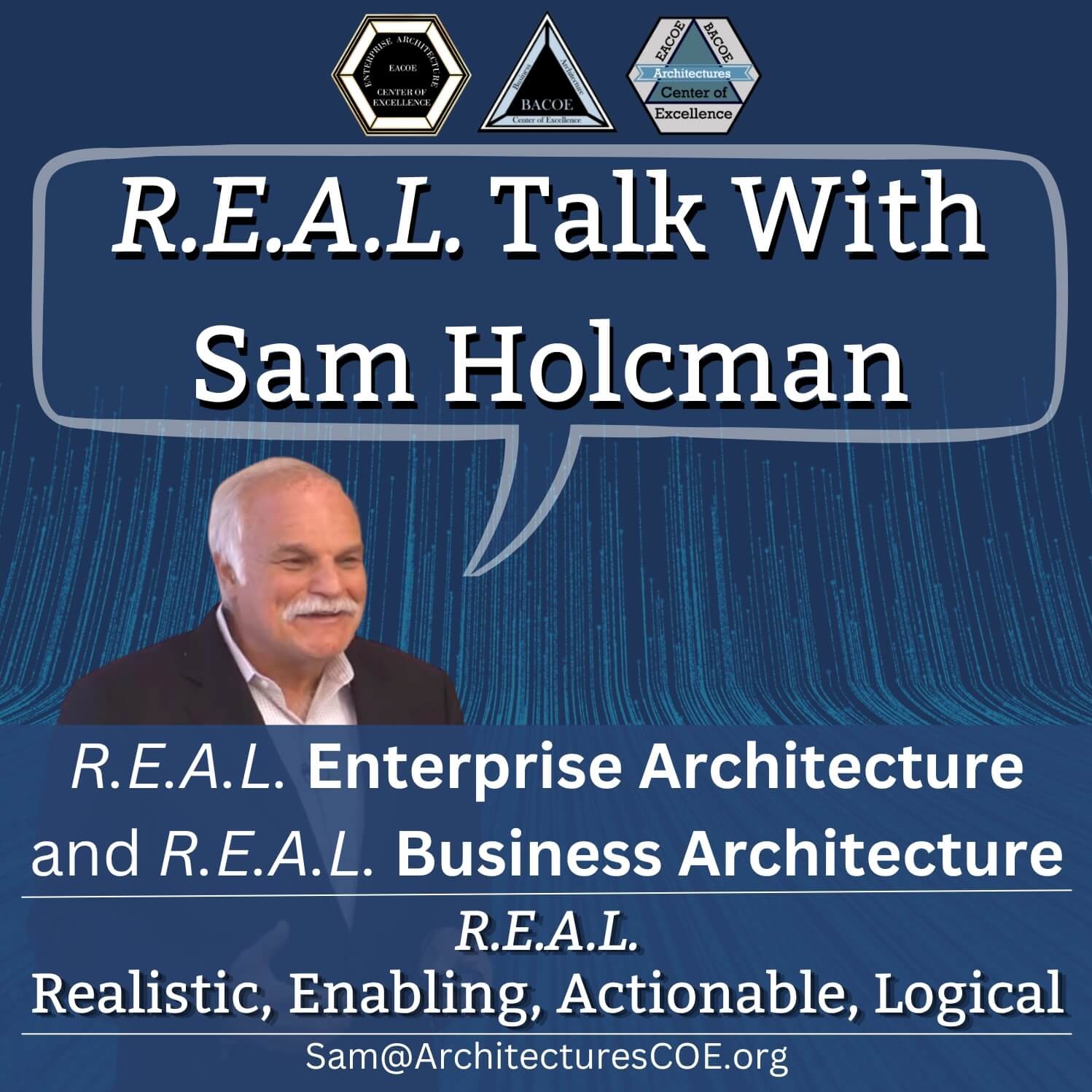
Insights from recent episode analysis
Audience Interest
Podcast Focus
Publishing Consistency
Platform Reach
Insights are generated by CastFox AI using publicly available data, episode content, and proprietary models.
Total monthly reach
Estimated from 1 chart position in 1 market.
By chart position
- 🇫🇮FI · Management#154500 to 3K
- Per-Episode Audience
Est. listeners per new episode within ~30 days
250 to 1.5K🎙 ~2x weekly·239 episodes·Last published yesterday - Monthly Reach
Unique listeners across all episodes (30 days)
500 to 3K🇫🇮100% - Active Followers
Loyal subscribers who consistently listen
200 to 1.2K
Market Insights
Platform Distribution
Reach across major podcast platforms, updated hourly
Total Followers
—
Total Plays
—
Total Reviews
—
* Data sourced directly from platform APIs and aggregated hourly across all major podcast directories.
On the show
Recent episodes
Ford’s New EV “Assembly Tree” - What It Means for Enterprise Architecture and Business Architecture
May 11, 2026
Unknown duration
A Manifesto for the Professionalization of Enterprise Architecture and Business Architecture
May 7, 2026
Unknown duration
Enterprise Architecture and Business Architecture Briefing - May 2026
May 5, 2026
Unknown duration
From Semantic Hubs to Enterprise Augmented Intelligence™: The Missing Step in Agentic AI
May 3, 2026
Unknown duration
Purchased Models, Off-the-Shelf Ontologies, and Why Everything Old Is New Again
Apr 28, 2026
Unknown duration
Social Links & Contact
Official channels & resources
Official Website
Login
RSS Feed
Login
| Date | Episode | Description | Length | ||||||
|---|---|---|---|---|---|---|---|---|---|
| 5/11/26 |  Ford’s New EV “Assembly Tree” - What It Means for Enterprise Architecture and Business Architecture | Ford’s new electric truck program is being called its “Model T moment” – not because it’s just another vehicle, but because Ford is tearing up a century of manufacturing practice to build something fundamentally different. In doing so, they have replaced the traditional assembly line with what they call an “assembly tree”: a modular way of building that uses far fewer parts, far less complexity, and a completely new production logic.Enterprise Architecture (EA) and Business Architecture (BA) are at a similar crossroads. Most organizations are still using an architectural “assembly line”: long sequences of phases, hand‑offs, documents, and exams that were designed for a slower, more predictable world. These legacy, exam‑centric certifications, methodologies, and frameworks add steps and artifacts, but struggle to produce architectures executives actually use to run and change the business.The Enterprise Architecture Center Of Excellence (EACOE) and The Business Architecture Center Of Excellence (BACOE) represent the modern alternative. They are not “another framework” running down the same line. They are the architecture equivalent of Ford’s assembly tree: a new way of producing outcomes, built around a small number of powerful, reusable components that can be combined quickly to solve real business problems. | — | ||||||
| 5/7/26 | A Manifesto for the Professionalization of Enterprise Architecture and Business Architecture | Enterprise Architecture and Business Architecture are at the same inflection point that software engineering has reached. When a field confuses vocabulary for competence, titles for capability, and exams for professional readiness, it creates a class of certified people who can describe the work without being able to do the work.That model is no longer good enough. The next era of Enterprise Architect and Business Architect certification must move away from exam-centric credentialing and toward practitioner-based professionalization grounded in evidence, judgment, and demonstrated delivery. | — | ||||||
| 5/5/26 | Enterprise Architecture and Business Architecture Briefing - May 2026 | Enterprise Architecture (EA) and Business Architecture (BA) have moved decisively toward the center of enterprise transformation in the last 30 days, especially as organizations try to operationalize AI at scale. Recent market and thought-leadership signals show a clear shift away from architecture as static documentation and toward architecture as a business decision capability focused on speed, risk, investment, and operating-model change. | — | ||||||
| 5/3/26 | From Semantic Hubs to Enterprise Augmented Intelligence™: The Missing Step in Agentic AI | In a recent CIO article, by Martin De Saulles, “How effective are semantic hubs in moving agentic AI forward?” the authors argue that semantics are now the backbone of enterprise AI, especially as organizations rush to deploy agentic AI systems at scale. They highlight a critical shift: the challenge is no longer just moving and storing data but ensuring that data means the same thing wherever and however it is used.That is precisely the problem space Enterprise Augmented Intelligence (EAI™) was designed to address. And it is the space EACOE and BACOE have been working in for more than fifty years. | — | ||||||
| 4/28/26 | Purchased Models, Off-the-Shelf Ontologies, and Why Everything Old Is New Again | This topic is one that should sound familiar to anyone who has been around enterprise architecture, transformation, or banking, as one example, for more than a few years: everything old is new again. The latest version of the old story is being told through “purchased models,” “off-the-shelf ontologies,” and what some are now calling the semantic operating system for banking, as one example. Buying somebody else’s model of your industry is not a new idea. It is a very old idea in very new packaging. Twenty-five years ago, it was sold as reference architectures, industry models, enterprise blueprints, and packaged best practices. Accenture sold it. IBM sold it. The Big Four sold it. Entire consulting practices were built around the claim that if you adopted a prebuilt model of your enterprise, you could move faster, reduce risk, and leapfrog the painful work of figuring out your own organization. But here is the Real Talk. | — | ||||||
| 4/24/26 | Your AI Problem Is not Data Debt – It is Executive Relevance | There is a lot of noise right now about Artificial Intelligence (AI) strategy, and one phrase you have probably heard is this: “Your AI strategy will fail if you do not fix your data debt.”Now, there is truth in that. Years of fragmented systems, inconsistent definitions, and patchwork reports really are catching up with us. AI will expose every weakness you have buried in your data.But if you take that message into the C‑suite or the boardroom, and you lead with “data debt” and “process standardization,” you will lose the audience that matters most.Today, I want to reframe the issue. Your biggest AI problem is not data debt. Your biggest AI problem is executive relevance.The real issue: multiple versions of the truth. | — | ||||||
| 4/21/26 | You are Flying Atlas V Missions in a New Glenn World | I want to talk about legacy thinking.Not old thinking. Not wrong thinking. But thinking that was right - sometimes brilliantly right - and then calcified into doctrine.Look up at the sky. Something remarkable just happened in space.Blue Origin flew New Glenn - their massive, orbital-class rocket - for the third time.And they flew it on a booster they already landed and refurbished. The same first stage. Flying again.That is not a space story. That is a legacy story. And yes, there was a glitch on cargo release.The exact same pattern is playing out in enterprise architecture and business architecture right now. The certification became the thing itself. Organizations stopped asking whether the certification and framework served the mission - and started asking whether the mission was being performed according to the certification and framework. Do not keep flying Atlas V missions in a New Glenn world.The new paradigm is not coming. It has arrived.The only question left is whether your organization will be the one catching up - or the one leading the way. | — | ||||||
| 4/20/26 | Why Poor Data Foundations Undermine AI Success | Organizations are learning a costly lesson: AI does not fail first because of the model; it fails because of the data foundation beneath it. More than half of generative AI projects were abandoned after proof of concept by the end of last year, largely because organizations lacked the data readiness required to move from controlled pilots into production environments.This is precisely why EACOE matters. The Enterprise Architecture Center Of Excellence provides the disciplined, practitioner-based framework required to turn scattered, inconsistent, under-governed enterprise data into an architecture that AI can trust, interpret, and scale against. The EACOE AI Data Modeling Master Class operationalizes that discipline by teaching organizations how to build the semantic, governance, and modeling foundation that production-grade AI now demands. This broadcast is based on the work of Joanne Carew titled How poor data foundations can undermine AI success, CIO – April 17, 2026 | — | ||||||
| 4/17/26 | Coffee Grinders - Certifiers - and Real Practitioners | Let us be honest - most Enterprise Architects and Business Architects start the day the same way.You roll out of bed, scroll through overnight emails, open at least six tabs of frameworks you will only partially read, warm up yesterday’s coffee because the meeting starts in five minutes, and think…Maybe today I will finally fix that capability model.Because let us face it - every good architect knows their day does not really start until they have had that first cup of caffeine.And speaking of coffee - let me share something interesting that caught my attention.Despite what your friend who refuses to drink anything, but single‑origin pour‑over might tell you, becoming a real coffee expert is not easy. And oddly enough, that is a problem for Wall Street.Starbucks may be on every corner, but qualified coffee graders - the folks who certify bean quality for the commodities market - are in serious short supply.According to the Wall Street Journal, these graders endure a brutal three‑stage competency program: a written exam, a three‑hour coffee grading session, and then a live tasting in front of proctors, identifying defects right down to the bean.Miss one - and you start over.Only five to eight percent pass. That is tougher than passing the California bar exam – or any EA or BA exam I have seen.And it got me thinking: imagine if our industry had that kind of rigor.In Enterprise Architecture and Business Architecture, too many certifications promise instant expertise.Take TOGAF®, for example - you memorize a framework, pass a multiple‑choice test, and suddenly you are called “certified.”Or the Business Architecture Guild’s® CBA® certification - memorize definitions, answer questions, check a box.It is like calling yourself a coffee grader because you can tell the difference between a cappuccino and a macchiato.Look, learning theory matters. But real-world skill does not come from picking the right answer on a multiple-choice exam - it comes from building, evaluating, and adapting.That is why I sometimes say: certifications that only test recall create “credentialed beginners.” You may have sixty percent of the vocabulary, but not the muscle memory.And that is exactly where EACOE and BACOE take a different approach. | — | ||||||
| 4/15/26 | Process Visualization: A Best Practice Blueprint for Reworking Processes Before AI | CIOs are under intense pressure to harness AI to drive efficiency, innovation, and competitive advantage - but as a recent CIO article states on reimagining business processes makes clear, the first step is not to “automate faster,” but to rethink how work actually happens before a single model is deployed. In this context, the EACOE Process Visualization approach emerges as a best‑practice methodology for reworking processes in preparation for AI, ensuring that organizations automate optimized workflows, not legacy inefficiencies. | — | ||||||
Want analysis for the episodes below?Free for Pro Submit a request, we'll have your selected episodes analyzed within an hour. Free, at no cost to you, for Pro users. | |||||||||
| 4/11/26 | Palantir's Real Secret Sauce - Ontologies | If your AI and analytics investments still feel like disconnected projects instead of an enterprise capability, this episode of Real Talk with Sam Holcman shows how Palantir quietly turned ontologies into a strategic moat - and how the same ontology‑driven principles behind EACOE and BACOE can turn your architecture into an execution engine for real business outcomes. | — | ||||||
| 3/16/26 | The Ten Most Misunderstood Words in EA/BA | If you are a CIO, CTO, or Architecture Manager, you are already paying an “architecture tax” you never approved.It shows up as overlapping platforms, programs that cannot finish, and “strategic” projects that quietly die after burning millions. The surprising culprit: ten everyday EA/BA words that your organization thinks it understands - but does not.When these words are fuzzy, your architecture is fuzzy. And fuzzy architecture is expensive. | — | ||||||
| 3/9/26 | Ontology in AI: The Hidden Skill That Makes Architecture and Your Career Work | In both EACOE enterprise architecture and BACOE business architecture, ontology is the backbone: it tells us what kinds of things exist in the enterprise, how they relate, and how those meanings stay consistent as we automate, integrate, and apply AI.Today, that makes ontology not just a theoretical idea, but one of the most valuable, underused skills in the AI job market – and a critical success factor for serious Enterprise Architecture and Business Architecture work.What an Ontology Really Is: Kinds of Things Together and Their Relationships In information and computer science, an ontology is a formal description of knowledge in a domain – the kinds of things (concepts/classes) and the relationships between them. It is more than a glossary; it is a structured model of meaning that both humans and machines can use. | — | ||||||
| 2/24/26 | Business Architecture - Belonging to a Club or Practicing a Discipline | Welcome to Real Talk with Sam Holcman - where we stop confusing activity with progress and start talking about how businesses actually work.Today I want to talk about something touchy in the Business Architecture world: the difference between belonging to a club and practicing a discipline. Specifically, the world of the Business Architecture Guild® and its BIZBOK® Guide on one side… and BACOE, the Business Architecture Center Of Excellence, on the other. | — | ||||||
| 2/23/26 | How to Help the CEO Understand Enterprise and Business Architecture - Without Losing Your Job | Many CEOs excel in vision, leadership, and financial acumen - yet remain only vaguely familiar with the disciplines of Enterprise Architecture (EA) and Business Architecture (BA). They hear the words. They see the frameworks. But they do not always connect with the business value that drives strategy, change, and decision-making. That gap can be dangerous. | — | ||||||
| 2/18/26 | What Is In and Out In Enterprise Architecture (EA) In 2026 From Exams to Practice | Enterprise Architecture (EA) is shifting decisively from theory-heavy, exam-driven certification to demonstrated, practice-based competence that delivers measurable business outcomes. In: Practitioner-based paths that validate portfolios, scenarios, workshops, and demonstrable outcomes - certifying that you can architect, not just that you can pass an exam. Out: Credentials earned solely by scoring above a cutoff on multiple-choice exams, which increasingly fail to differentiate between memorization and actual capability. | — | ||||||
| 2/16/26 | Having A Lot of Data Is Not the Same as Having AI Ready Data | Organizations have been stockpiling data for years, expecting that one day it will become a strategic asset. With generative AI, that moment has arrived - but without disciplined data practices, the promise quickly turns into frustration. The differentiator is no longer access to powerful models; it is the ability to shape, govern, and trust the data that feeds them, which is exactly the gap the AI Data Modeling Masterclass is designed to close. | — | ||||||
| 2/13/26 | LLMs Copyright Infringement as a Service | Let us start with the uncomfortable truth: large language models - ChatGPT, Gemini, Claude, Perplexity, and their peers - are built on a foundation that looks suspiciously like “copyright infringement as a service.” These systems could not exist without consuming massive quantities of human-created text, images, and code. In another industry, that would be called derivative work. In AI, it is called innovation. | — | ||||||
| 7/29/24 | Project Management Post COVID November 2019 | Project Management, most notably in the Enterprise Architecture and Business Architecture realm has become significantly more difficult and complicated. We will describe the four project management approaches to these Architecture development efforts and the skills required in the post-November 2019 environment. | — | ||||||
| 9/27/23 | What can Wayne Gretzky Teach Technology Personnel, EA’s. and BA’s? | Wayne Gretzky is a G.O.A.T. – Greatest Of All Time. He holds many records in the National Hockey League. But what can he teach us as Technology Professionals, Enterprise Architects or Business Architects? Have a listen to this Podcast! | — | ||||||
| 9/11/23 | Rethinking the Cloud First Approach | A technology department's goal should be to put the computing processing and storage in the right location that supports the Enterprise's needs and business objectives. We suggest that an Architected Cloud approach – that optimizes both on-premises and off-premises environments is not only gaining traction but is optimal. We explore the reasons for this and how to optimize what many organizations are considering to be their long-term approach – an architected hybrid deployment strategy. | — | ||||||
| 8/23/23 | What is Strategy? Part 3 – Fool’s Gold | In this third episode of What is Strategy, we discuss Fool’s Gold, so you will not be fooled! | — | ||||||
| 5/26/23 | Business Architecture – The Definition | In this Broadcast, we will define Business Architecture, what it is, its components, audience, and its output – Business Capabilities to achieve the Organization’s Goals, and Objectives. | — | ||||||
| 5/2/23 | Artificial Intelligence Components | This Broadcast will define and describe the four components of an Artificial Intelligence Environment. | — | ||||||
| 6/17/20 | Process Mining the Complement to Data Mining | In the age of digital transformation, big data, cloud computing, one fundamental fact remains. What we in organizations are doing is processing data. Technology departments have many names nowadays. But fundamentally, they process data. We outline our approach to understanding processes – Process Mining that leads to a Business Process Warehouse. We review benefits & challenges, & outline field-proven approaches to obtaining benefits. We will also outline the methodology used to guide efforts. | — | ||||||
Showing 25 of 248
Sponsor Intelligence
Sign in to see which brands sponsor this podcast, their ad offers, and promo codes.
Chart Positions
1 placement across 1 market.
Chart Positions
1 placement across 1 market.