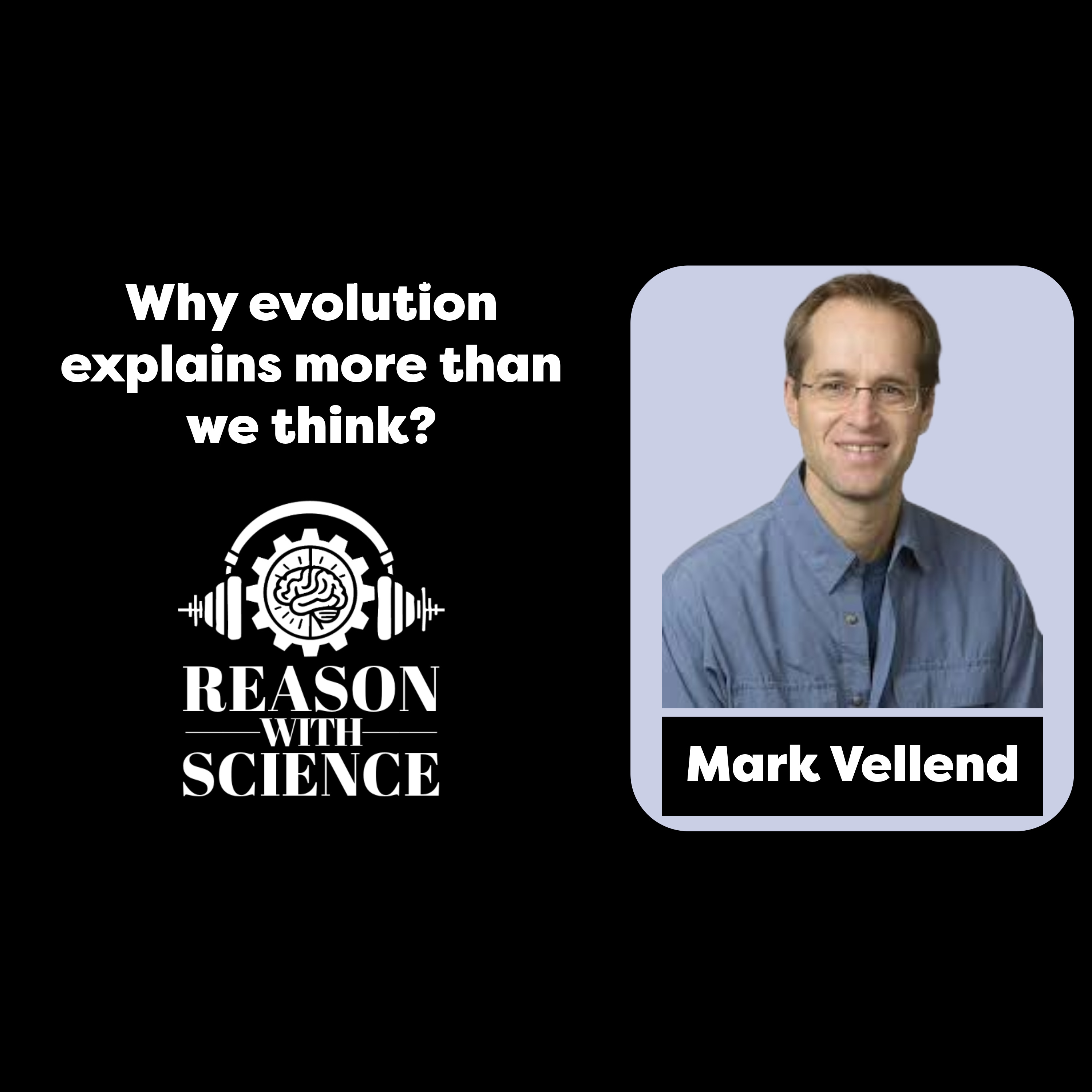
Why evolution explains more than we think
From Reason with Science by Jitender Kumar
December 12, 2025 · 1h 3m · Season 88 · Episode 88
About this episode
Mark Vellend discusses how evolution is a universal principle that applies to various complex systems beyond biology.
Evolution is often misunderstood as a process limited to biology and genes. In this in-depth conversation, evolutionary ecologist Mark Vellend challenges that narrow view and presents a powerful idea: evolution is a universal principle that governs all complex systems. In this episode of Reason with Science, we explore how evolution applies not only to living organisms, but also to languages, technologies, cultures, institutions, scientific theories, economics, and artificial intelligence. Drawing on his book Everything Evolves: Why Evolution Explains More Than We Think (From Proteins to Politics), Mark Vellend explains why evolutionary theory deserves recognition as a general science of change, alongside physics. We discuss:- •What makes a system evolutionary in the most fundamental sense • Why Darwinism shaped — and narrowed — our understanding of evolution • How languages evolve through everyday use and variation • Why technologies advance through trial, error, and selection • How cultural norms, ideas, and institutions evolve over time • The role of randomness, contingency, and selection beyond biology • Evolutionary thinking in AI, economics, and complex systems • Tipping…
People in this episode
Host: Jitender Kumar
Guest: Mark Vellend
Topics covered
- evolution
- complex systems
- cultural evolution
- technological advancement
- artificial intelligence
- scientific theories
Keywords
- evolution
- ecology
- cultural norms
- technologies
- randomness
- selection
- feedback loops
- change
Mentioned in this episode
Books & works: Everything Evolves: Why Evolution Explains More Than We Think
More episodes of Reason with Science
- How sleep shapes the developing Brain with Mark Blumberg I Infant sleep neuroscience I Podcast · November 29, 2025 · 1h 24m
- The Metabolic Truth: Rethinking Calories and Energy with Herman Pontzer | Lifestyle | Health | Food · October 18, 2025 · 1h 16m
- Predicting future of the Planet with J. Doyne Farmer I Reason with Science | Complexity Economics · October 14, 2025 · 1h 10m
- Is evolution predictable? with Simon Conway Morris | Reason with Science | Emergence | Convergence · August 9, 2025 · 1h 47m
- How nature builds complexity | Ricard Solé | Reason with Science | Liquid brains | Synthetic worlds · July 26, 2025 · 1h 51m
- Human evolution and culture with Agustín Fuentes | Reason with Science | Creativity | Cooperation · July 18, 2025 · 1h 7m
Explore listener stats, chart rankings, contacts and more on the Reason with Science podcast page.