

Insights from recent episode analysis
Audience Interest
Podcast Focus
Publishing Consistency
Platform Reach
Insights are generated by CastFox AI using publicly available data, episode content, and proprietary models.
Total monthly reach
Estimated from 3 chart positions in 3 markets.
By chart position
- 🇺🇸US · Philosophy#1575K to 30K
- 🇭🇺HU · Philosophy#143500 to 3K
- 🇷🇴RO · Philosophy#188500 to 3K
- Per-Episode Audience
Est. listeners per new episode within ~30 days
1.8K to 11K🎙 Daily cadence·162 episodes·Last published yesterday - Monthly Reach
Unique listeners across all episodes (30 days)
6K to 36K🇺🇸83%🇭🇺8%🇷🇴8% - Active Followers
Loyal subscribers who consistently listen
2.4K to 14K
Market Insights
Platform Distribution
Reach across major podcast platforms, updated hourly
Total Followers
—
Total Plays
—
Total Reviews
—
* Data sourced directly from platform APIs and aggregated hourly across all major podcast directories.
On the show
Recent episodes
Carrying Stories with Care: The Power of Embodied Connection and Compassionate Witnessing
Jun 4, 2026
Unknown duration
The Win-Win Workplace: Why the Strongest Companies Start with Worker Voice
May 28, 2026
Unknown duration
Human-Centered Higher Ed: How SNHU Scales Restorative Practices System-Wide
May 21, 2026
Unknown duration
Youth Reintegration and Restorative Justice in Belize with Dr. Aveka Mano
May 14, 2026
Unknown duration
The Sustainability Myth: What Schools Get Wrong About Restorative Practices
May 7, 2026
Unknown duration
Social Links & Contact
Official channels & resources
Official Website
Login
RSS Feed
Login
| Date | Episode | Description | Length | ||||||
|---|---|---|---|---|---|---|---|---|---|
| 6/4/26 |  Carrying Stories with Care: The Power of Embodied Connection and Compassionate Witnessing | In this episode of Restorative Works, host Claire de Mezerville Lopez is joined by Deanna Zilske, school leader, theater director, and restorative practitioner, to explore the powerful intersection of restorative and embodied theater practices. Drawing from her work with a community of educators, artists, and practitioners, Deanna shares how integrating narrative practices, such as compassionate witnessing and reauthoring maps, with movement, voice, and improvisation can deepen storytelling, empathy, and connection. When words are not enough, the body becomes a powerful tool for expression, allowing individuals to explore lived experiences, trauma, and preferred futures in ways that feel both accessible and transformative. Deanna also shares moving examples from the group's experience, illustrating how embodied storytelling can support healing, release, and reconnection, both with oneself and with others. As one participant reflected, the process created an opportunity to listen differently and to carry others' stories with greater care and empathy. Deanna Zilske currently serves as the Principal at Jaffrey Grade School in Southwestern New Hampshire. Before that, Deanna served as Principal at Keene Middle School and as a Principal and Instructional Coach at Harrisville-Wells Memorial School. In addition to her work in education, Deanna currently directs the Lions Club Foundation's annual Summer and Winter Musicals. Before moving into administration, Deanna built her foundation with ten years of classroom teaching experience and a background in theatre and arts education. She holds a Master of Science in Restorative Practices, alongside Graduate Certificates in Relational Facilitation for Healing Trauma and Change Implementation in Organizations and Social Systems from the International Institute for Restorative Practices. In addition, she holds a CAGS in Education Administration, an MTA in Elementary Education, and a BA in Theatre Arts. Tune in to discover how embodied theater practices can expand restorative work, opening new pathways for expression, understanding, and collective transformation. | — | ||||||
| 5/28/26 |  The Win-Win Workplace: Why the Strongest Companies Start with Worker Voice | We are joined by Harvard researcher, author of The Win-Win Workplace, and founder of Future Forward Strategies, Dr. Angela Jackson, to discuss how organizations can redesign work to strengthen both employee well-being and business performance. Backed by research across more than 1,700 companies, Dr. Jackson makes a clear, data-driven case for human-centered leadership. She reveals how organizations that invest in employees through practices such as centering worker voice, reimagining benefits, and fostering inclusive innovation see improvements not only in employee morale but also in performance. These strategies directly impact retention, engagement, and long-term financial success, reframing well-being as business-critical, not optional. Dr. Jackson shares how understanding employees' lived realities, such as caregiving responsibilities and access to childcare, directly impacts retention and performance. She offers a concrete example of a company that introduced on-site childcare after identifying it as a key barrier for employees, resulting in a 98% retention rate among women during the pandemic. Dr. Angela Jackson is a leading voice on the future of work and CEO of Future Forward Strategies, a labor market intelligence firm focused on helping organizations grow through continuous learning and innovation. A lecturer and researcher at Harvard University, she equips executives with practical strategies to build high-performing workplaces that strengthen engagement, productivity, and long-term growth. Her work has appeared in Harvard Business Review and Stanford Social Innovation Review, and she is frequently featured in The New York Times, Forbes, The Wall Street Journal, Fortune, BBC, and The Economist. She has spoken at TED, South by Southwest, and ASU GSV. Previously, Dr. Jackson was managing partner at New Profit, where she launched the Future of Work Grand Challenge, reskilling 25,000 workers into living-wage jobs. She began her career in global leadership roles at Viacom and Nokia. Her debut book, The Win-Win Workplace, is a New York Times bestseller. Tune in for real-world examples that shift toward more inclusive, responsive, and adaptive workplace cultures where well-being, performance, and innovation are mutually reinforced. | — | ||||||
| 5/21/26 |  Human-Centered Higher Ed: How SNHU Scales Restorative Practices System-Wide | We are joined by Program Manager in the Office of Diversity and Inclusion at Southern New Hampshire University (SNHU) Jen Torres, to explore what sustainable, system-wide implementation of restorative practices in higher education really looks like. Jen brings a practitioner's lens to a challenge many institutions face: how to move from reactive, discipline-focused approaches toward proactive, relationship-centered campus communities. She walks us through SNHU's three-year restorative practices implementation process that brings theory to life through real-life examples. From using AI tools to audit communication for relational language to tracking real-time shifts in restorative practices approaches with students, these stories demonstrate how innovation and human-centered practice can coexist and thrive. On the topic of the use of AI, Jen reminds us that technology can enhance efficiency, but it cannot replace human connection. In an era of eroding trust, restorative practices become essential to rebuilding and maintaining strong relationships. Jen M. Torres serves as program manager, social justice advocate, and liberatory learning designer for SNHU's Office of Diversity and Inclusion. With over 16 years of experience across education, nonprofit, and corporate sectors, Jen founded SimplyLead, LLC, and specializes in antiracist practice, conflict transformation, restorative practices, and liberatory approaches to leadership and culture repair. Her work centers on dismantling systemic inequities while helping teams and institutions move through conflict with honesty, accountability, and care. Known for blending deep relational practice with clear strategy, Jen designs and facilitates spaces that are brave, grounded, and action-oriented. Through workshops, leadership development, and collaborative learning experiences, she helps teams build cultures rooted in belonging, shared responsibility, and lasting change, where conflict is engaged as an opportunity for growth, learning, and collective transformation. Tune in to discover what it takes to truly weave restorative practices into the fabric of higher education. | — | ||||||
| 5/14/26 |  Youth Reintegration and Restorative Justice in Belize with Dr. Aveka Mano | We are joined by criminologist, researcher, and educator at the University of Belize, Dr. Aveka Mano, to hear about the impact of restorative practices on the lived realities behind complex issues like gang involvement, human trafficking, and youth reintegration, and its connection to higher education. Dr. Mano challenges traditional approaches to justice by emphasizing long-term reintegration over short-term punishment. She highlights how stigma, lack of opportunity, and systemic gaps often push individuals back into cycles of harm, and how restorative practices can interrupt that pattern. She asks us to consider what it would be like if we prepared individuals leaving institutional systems with the same intentionality we bring to higher education. Dr. Avekadavie Parasramsingh Mano is an assistant professor and distinguished researcher at the University of Belize within the Faculty of Management and Social Sciences. Trained at the University of the West Indies, she specializes in Criminology and Criminal Justice, with a focus on Belize's socio-legal landscape. Dr. Mano is widely recognized for her fieldwork on gang culture, human trafficking, and sex worker migration. Her scholarship engages with complex issues at the intersection of crime, human rights, and social inequality. Beyond academia, Dr. Mano collaborates with the Forensics Department, the Leadership Intervention Unit, and other organizations working with at-risk youth. Her work is grounded in a commitment to bridging theory and practice to advance sustainable approaches to crime prevention and community development in Belize. Tune in to discover Dr. Mano's roadmap for sustainable crime prevention rooted in early intervention, community collaboration, and restorative practices. | — | ||||||
| 5/7/26 |  The Sustainability Myth: What Schools Get Wrong About Restorative Practices | We are joined by Lan Nguyen and Jennifer Vermillion, two restorative justice leaders who take us beyond surface-level change to discover what it truly takes to sustain restorative practices in schools and communities across complex educational systems. Together, they unpack a critical tension facing educators and administrators today: why restorative practices are widely embraced, yet so difficult to sustain. Lan challenges the urgency-driven culture that dominates schools, calling for a strategic shift that asks school leadership to do less, go deeper, and prioritize meaningful transformation over constant initiative overload. Jennifer builds on this foundation, emphasizing embodiment over checkbox implementation. She highlights that educators are often expected to practice restoration without ever experiencing it. The result? Burnout, skepticism, and initiatives that fade fast. She argues that real change begins when individuals and systems align and when restorative practices are lived, not just learned. Jennifer is a project specialist with the San Diego County Office of Education, providing professional learning and coaching on restorative practices and implementation. Before working with the County Office, Jennifer spent 5 years with a non-profit, supporting schools in San Diego with their restorative practices implementation, training, and student leadership initiatives. She provided direct services in addressing conflict issues between students, families, and school staff through a restorative justice model that kept youth out of the justice system. She received her bachelor's degree in psychology and her master's degree in peace and justice studies. Lan is a futurist, educator, and leader who is passionate about designing and implementing more liberatory ways of engaging, teaching, and leading in schools. In her work, she critiques and examines systems of power, applies participatory and humanizing approaches to systems change, and uses a decolonial lens to understand issues of educational and social inequity. Lan has held diverse roles in K-12 education, supporting local, statewide, and national projects on community engagement and school climate. She currently supports restorative justice practice implementation across San Diego County at the San Diego County Office of Education. Tune in to walk away with actionable insights on implementing restorative justice with fidelity, building educator buy-in, and creating conditions for sustainable change. | — | ||||||
| 4/30/26 |  Choosing Engagement: Creating Culture from the Ground Up | The reality of today's organizations: tension runs high, trust feels fragile, and progress stalls under the weight of reactivity. Seasoned practitioners Kristina Katayama and Miriam Zachariah join us to explore relational methods for charting a path forward rooted in awareness, connection, and intentional change. With decades of experience across education, leadership, and organizational transformation, Kristina and Miriam reveal what truly drives lasting change in complex systems. They tell stories of lived practice, showing how leaders and teams can break free from cycles of defensiveness, conflict avoidance, and burnout. Instead of focusing solely on what's broken, they introduce an "appreciative approach", a mindset shift that uncovers what's already working and expands it into sustainable transformation. They share why readiness, not hierarchy, drives meaningful engagement. Rather than relying on top-down mandates, this approach invites participation, builds shared ownership, and fosters cultures of belonging without "othering." This episode brings systems thinking, nervous system awareness, and restorative practices into one integrated conversation. Through real-world stories, including a simple yet powerful moment of workplace courage, Kristina and Miriam demonstrate how individual agency fuels collective change. Kristina Katayama is the founder and lead consultant of Be Possible. With over 25 years of experience, she supports discerning, legacy-minded leaders across public, nonprofit, and private organizations who are called to effect social change beyond their job description. Her work helps leaders and teams transform conflict into connection and operationalize values through nervous-system-wise, relational practices in everyday interactions. Kristina designs appreciative, action-learning processes that build relational accountability, strengthen agency at every level, and create scalable micro-practices for vibrant engagement, trust, and collaboration. Grounded in appreciative inquiry, adaptive leadership, and trauma-informed principles, her approach integrates organizational change, leadership practice, and healthy nervous-system dynamics. Miriam Zachariah has been a public school educator for over 30 years and recently retired as an elementary school principal. She has continued her grandfather J.L. Moreno's work to facilitate human connection, manage conflict, and foster collaborative decision-making in communities. She is a recognized trainer in restorative practices and Peacemaking Circles. The focus of her work as an educator, consultant, and trainer has been on developing community in workplaces, intervening in conflict, and fostering educational practices that decolonize schools for those whose voices have been silenced. Tune in to discover how small, intentional shifts, like observing internal reactions, speaking up with clarity, or amplifying moments of connection, can ripple outward to transform entire teams. Connect with Be Possible on LinkedIn and Instagram, access their 5-minute quiz: "What's really driving tension on your team?" to get a snapshot of what may be underneath recurring friction, silence, stress, or stalled accountability on your team, and view video clips of clients describing their experience. | — | ||||||
| 4/23/26 |  Beyond the Basics: Leading Sustainable Restorative Practices in Schools | Discover what it really takes to sustain restorative practices in today's complex school systems. In this episode of Restorative Works, host Claire de Mezerville-López, alongside co-hosts Dr. Michael Washington and Dr. Doug Judge, welcomes veteran educator and systems leader Saundra Hensel. With more than 35 years in education and nearly a decade leading district-wide implementation, Saundra brings unmatched clarity to one of the field's biggest questions: What makes restorative practices stick? Saundra unpacks how her district scaled training across 70 schools while staying grounded in a critical truth: that training alone doesn't guarantee faithful implementation. Instead, she reveals a blueprint built on intentional design that includes whole-school engagement, long-term investment, and a commitment to building internal capacity before rollout ever begins. She discusses initiative overload as a common tension in education. Rather than positioning restorative practices as "one more thing," she shows how they strengthen and align with existing frameworks like PBIS, social-emotional learning, and trauma-informed care. Saundra Hensel has been an educator in various roles for over 35 years. She left a career in higher education administration to teach high school in Chicago Public Schools, then moved to Jefferson County Public Schools in Louisville, KY, in 2009. In fall 2016, Saundra was asked to join a team at the district level that was to begin implementing restorative practices. She is currently the behavior systems manager, supporting schools in implementing restorative practices and Positive Behavior Interventions and Supports. Saundra is a National Board Certified Teacher in English, with a bachelor's degree in interpersonal and small group communication and a master's degree in education and school administration. Tune in to hear how sustainable change demands both patience and precision, because meaningful change doesn't happen overnight, but it does happen with intention. | — | ||||||
| 4/16/26 |  Reimagining Education Through Universal Design for Learning with Mirko Chardin | We are joined by nationally and internationally recognized educator, leadership coach, and bestselling author Mirko Chardin for a deeply reflective conversation about healing school communities through restorative practices and equity-centered design. Drawing from lived experience and decades of leadership in education, Mirko shares how schools can move beyond compliance-driven systems and cultivate cultures rooted in trust, belonging, and authentic relationships. Throughout the conversation, Mirko explores the principles behind Universal Design for Learning (UDL) and how educators can intentionally design classrooms that anticipate learner needs rather than reacting to them. Rather than treating equity as an afterthought, he argues that schools must plan for it from the start by creating multiple pathways for students to engage, understand, and demonstrate learning while maintaining rigorous expectations for all. As a school founder, Mirko has spent decades supporting schools and organizations in moving from compliance-driven systems toward cultures rooted in trust, accountability, and relationships. He is the co-author of Restorative Practices That Heal School Communities and Equity by Design, and his work draws deeply from lived leadership experience, restorative practices, storytelling, and social-emotional learning. Mirko partners with school leaders, executive teams, and organizations who are navigating change, conflict, and cultural transformation. For educators, school leaders, and advocates for equitable education, this conversation offers both inspiration and practical insight into how restorative frameworks can create classrooms and communities where every student can thrive. | — | ||||||
| 4/9/26 |  Organizing for Change: Restorative Justice and Community Transformation with Dr. James W. McCarty | Boston University Professor James W. McCarty, Ph.D., joins us to explore how restorative justice and conflict transformation can reshape the way communities engage in disagreement, repair harm, and build collective power. Dr. McCarthy invites listeners to rethink one of society's most misunderstood realities: conflict. Rather than treating conflict as something to avoid, he reframes it as a powerful opportunity for growth, learning, and social change. From personal relationships to large-scale movements, conflict is the friction necessary to experience new futures. He discusses the critical role of community in navigating conflict. Whether within social movements, faith communities, or grassroots organizing efforts, strong relationships provide the foundation for constructive dialogue and collective accountability. Practices such as peacemaking circles and storytelling help communities surface difficult truths while strengthening the relational bonds that make change possible. A clinical assistant professor and director of the Religion and Conflict Transformation Program at Boston University's School of Theology, Dr. McCarthy also serves as a faculty affiliate with the Institute on Culture, Religion, and World Affairs at the Pardee School of Global Studies. He is the author of multiple peer-reviewed journal articles and the editor of two books, the most recent of which is The Business of Incarceration: Theological and Ethical Reflections on the Prison-Industrial Complex (Cascade) published in 2025. Tune in to discover valuable insights into how dignifying relationships and courageous conversations can transform conflict into an invitation for growth. | — | ||||||
| 4/2/26 |  Justice That Heals: Inside the Practice of Restorative Lawyering with Brenda Waugh | What if the practice of law could heal instead of harm? In this episode of Restorative Works! Podcast, Dr. Claire de Mézerville López welcomes lawyer, mediator, and restorative justice facilitator Brenda Waugh for a compelling conversation about restorative lawyering. Brenda shares how she transformed her traditional legal career into a justice-centered practice rooted in healing, dignity, and human connection. The conversation explores how restorative lawyering, the practice of legal services grounded in the principles of restorative practices, reframes the traditional legal focus on "rights" versus "needs." While legal systems often balance competing rights, restorative practices center human needs, relationships, and accountability. By shifting the process from adversarial to collaborative, lawyers can reduce trauma, create space for dialogue, and empower the people most affected by harm. Brenda also shares inspiring stories of working outside formal legal systems, like supporting a young student facing expulsion and helping families navigate loss when institutions fall short. These moments reveal an undeniable truth that sometimes the most meaningful justice emerges through listening and being present. Brenda is the founder of Waugh Law & Mediation, where she brings over 30 years of experience, compassion, and creativity to help clients navigate legal challenges—from contracts and workplace disputes to collaborative divorces. A former litigator and advocate for victims of family violence and consumers, Brenda has mediated thousands of cases and served as counsel for the West Virginia Senate Judiciary Committee. She earned a master's degree in conflict transformation from Eastern Mennonite University and is a certified collaborative professional. Brenda also shares her expertise nationally through seminars and published articles on restorative lawyering, alternative dispute resolution, and lawyer wellness. Her new book, Becoming a Restorative Lawyer, explores how legal professionals can build justice-centered, healing approaches in their practice. Tune in to discover how restorative lawyering reimagines legal practice, and how a more human-centered approach to justice can create deeper, lasting change. | — | ||||||
Want analysis for the episodes below?Free for Pro Submit a request, we'll have your selected episodes analyzed within an hour. Free, at no cost to you, for Pro users. | |||||||||
| 3/26/26 |  Intergenerational Power and the Future of Education Justice with Dr. Juan Pablo Blanco | In this episode of Restorative Works! Podcast, Dr. Claire de Mézerville López welcomes Juan Pablo Blanco, Ph.D., for a discussion about intergenerational collaboration, youth leadership, and education justice as a basis for transforming systems that affect youth and families. Dr. Blanco brings more than a decade of experience in community organizing and community-engaged research to this conversation. As Research Manager at CYCLE, The Center for Youth and Community Leadership in Education at Roger Williams University, he works alongside youth, parents, and community organizations to make research accessible, actionable, and rooted in lived experience. Drawing from his own journey as an immigrant and longtime organizer, Dr. Blanco shares how inequitable systems pushed him toward collective action, and how those experiences now shape his commitment to language justice and intergenerational power. Dr. Blanco explains how CYCLE brings together young people and caregivers to co-create equity indicators, challenge traditional data practices, and transform research into a tool for advocacy rather than exclusion. He unpacks why school and district data often misses what communities care about most and how changing that process can lead to more transparent, relational, and just systems. Dr. Blanco currently serves as the research manager at CYCLE (the Center for Youth and Community Leadership in Education) at Roger Williams University in Providence, RI, and as an adjunct professor. CYCLE supports young people and parents engaged in education justice efforts throughout New England and beyond. In this capacity, Dr. Blanco is part of CYCLE's Research and Learning team, supporting community organizations with their research needs and training community members on how to conduct their own research and engage with data for advocacy and organizing. Dr. Blanco holds a doctorate in Community Engagement from Point Park University, a Master of Science in Critical Ethnic and Community Studies, and a Bachelor of Arts in Philosophy from the University of Massachusetts Boston. His dissertation focused on intergenerational collaboration between young people and adults in education justice spaces in Rhode Island. He is currently developing resources for the field based on the findings of this study. Tune in to gain a greater understanding of why relationship-building, trust, and restorative practices-rooted responses to conflict are not "extras," but essential to sustainable change. | — | ||||||
| 3/19/26 |  Beyond Suspension: Transforming School Culture with Amy Hart | Dr. Claire de Mézerville López welcomes Amy Hart, principal of Stanley Elementary in Wichita, Kansas, to the Restorative Works! Podcast. Drawing from more than 14 years in education, Amy shares how relationship-centered leadership improves school culture, even amid systemic change, limited resources, and community mistrust. Through a real-world story involving two fifth-grade students on the brink of a physical fight, Amy illustrates why conversations rooted in restorative practices create lasting change. Instead of relying on suspension as a solution, her school engaged families, centered accountability, and facilitated conversations that allowed the harm to be named and repaired. This story brings restorative justice in education to life and shows how trauma-informed leadership builds safety, trust, and resilience. The episode also explores what it means to lead during disruption. As a "welcoming school" absorbing hundreds of new students without additional staff, Stanley Elementary faced fractured trust and growing pains. Amy explains how her team responded by returning to their mission, vision, and shared values—embedding restorative and trauma-informed approaches into every system, expectation, and relationship. From listening and learning circles to inclusive community events, the school rebuilt its foundation and strengthened its capacity to serve all students. Amy is the principal of Stanley Elementary in Wichita, Kansas, where she has proudly served for the past four years. With 14 years of experience in education, Amy began her career as a middle school teacher, spending seven years teaching English language arts, math, and broadcast journalism. Her passion for leadership led her to become an assistant principal for three years before stepping into her current role. Amy is trained in trauma-informed practices and restorative practices approaches, ensuring that every student feels supported and valued. Guided by transformational leadership principles, she believes that all students and staff can achieve success when provided with the right resources and feel empowered to grow. Amy is committed to fostering a positive, inclusive school culture where learning thrives and relationships matter. Tune in to learn how restorative practices frameworks help leaders shift power from control to collaboration, creating environments where students, staff, and families feel seen, valued, and accountable to one another. | — | ||||||
| 3/12/26 |  The Stories We Tell Ourselves: Shaping Healthy Self-Talk Through Children's Literature | Welcome to season four of Restorative Works! Podcast! In this episode, Dr. Claire de Mézerville López welcomes Johari "J.P." Mitchell for a discussion around positive self-talk, children's literature, and how the power of storytelling helps shape how we relate to ourselves and one another. J.P. explores how children's literature, especially picture books, can serve as a restorative practices tool across all ages. She emphasizes the concept of restorative practices-rooted self-talk: the internal narratives we use to make sense of shame, grief, identity, and belonging. J.P. illustrates how stories offer young people and adults pro-social alternatives to dealing with shame. She explains how picture books act as mirrors and windows, reflecting our inner lives while inviting us to step into experiences we may not yet have lived. Through age-appropriate storytelling, children gain language for complex emotions like loss, difference, and empathy long before crisis arrives. This proactive exposure builds emotional literacy, resilience, and relational capacity. The episode also challenges the assumption that children's books are only for children. J.P. and Claire reflect on how picture books speak powerfully to adults, educators, parents, and leaders by reconnecting us to the "child within" and creating space for intergenerational dialogue. From navigating grief to understanding identity and difference, children's literature becomes a shared entry point for meaningful, restorative conversations. Johari "J.P." Mitchell is an educator, writer and speaker whose passion is helping leaders link vision to opportunity through the power of words. J.P. is a restorative practices trainer with Columbus City Schools, as well as a 2-time TEDx speaker, author, and Gallup-Certified Strengths Coach. She lives in Columbus, Ohio with her family. Tune in to learn how to become a friend of children's literature, not just a consumer, and use stories as a bridge to stronger relationships and healthier communities. | — | ||||||
| 3/5/26 |  Integrating Restorative Practices Across the Curriculum with Erika Schwanbeck | How can restorative practices deepen learning in subjects like English, social studies, music, art, or science? In this episode, Claire de Mezerville López and Nikki Chamblee are joined by restorative practices instructional coach Erika Schwanbeck on the Restorative Pedagogies series of the Restorative Works! Podcast to explore what meaningful curriculum collaboration can look like in practice. Erika shares concrete examples of how concepts of restorative practices can be intentionally woven into content instruction through reflective circle lessons, student-centered assessments, and collaborative planning with teachers. From analyzing historical leadership through the Engagement Window to writing Blues songs connected to emotional regulation, she illustrates how restorative practices support critical thinking, voice, and relevance across disciplines. The conversation highlights the power of shared language, reflective tools, and student agency—not only to strengthen school culture, but also to enhance understanding of academic content. Erika emphasizes restorative practices as a way to slow down learning in order to go deeper, helping students connect curriculum to their lived experiences while building empathy, accountability, and relational skills. Erika Schwanbeck is a Restorative Practices Instructional Coach at the secondary level in the Hatboro-Horsham School District, bringing 20 years of educational experience to her role. In her role, Erika designs and facilitates proactive programming that builds community, strengthens relationships, and equips staff with practical strategies to foster a positive school climate. She also provides responsive support through restorative conferences that prioritize accountability, connection, and repair. In addition, Erika teaches a middle-level restorative practices course designed to help students develop the skills needed for empathy, communication, and problem-solving. Tune in to explore how integrating restorative practices into lesson plans can transform the learning experience in any classroom. | — | ||||||
| 2/26/26 |  Building Readers Through Relationships with Jamee Cox | In this episode of Restorative Works!, the Restorative Pedagogies Series continues with a rich, practice-forward conversation on how restorative practices transform English Language Arts classrooms from the inside out. Host Claire de Mezerville López is joined by co-host Nikki Chamblee and special guest Jamee Cox, an eighth-grade English Language Arts teacher and IIRP Graduate School student, for a grounded exploration of what it means to teach reading, writing, and critical thinking through relationships. This episode centers on a timely and pressing question for K–12 educators: Can restorative practices deepen academic learning, not just strengthen school culture? Drawing from her classroom experience in Texas, Jamee makes the case that relationships are not an "add-on" to instruction; rather, they are the pathways to engagement, comprehension, and meaningful learning. At a time when students read less, test more, and often disengage from traditional instruction, Jamee shares how circles and community-centered dialogue reignite students' interest in reading and learning. Jamee offers concrete examples of restorative pedagogy in action, from using the restorative conferencing questions to analyze fiction and character development, to journaling practices that build literacy while honoring student voice. The conversation also explores the human side of teaching. Jamee speaks candidly about navigating grief, emotional resilience, and self-restoration while leading a middle school classroom. Jamee Cox is a current IIRP Graduate School student and eighth-grade teacher at DeSoto Independent School District in DeSoto, Texas. She previously served as a restorative practices specialist for Fort Worth Independent School District in Fort Worth, Texas, working in a network of 10 schools, where she trained teachers, administrators, and staff in restorative practices. Tune in to learn how dignifying relationships and intentional community-building can transform English Language Arts instruction and help students learn not only how to read and write, but how to connect, reflect, and grow. | — | ||||||
| 2/19/26 |  Science, Curiosity, and Learning Through Relationship with Kate Shapero | What happens when science education is designed as a relational, exploratory process rather than a rigid set of steps? In this episode, Claire de Mezerville López and Nikki Chamblee welcome science educator and restorative practitioner Kate Shapero to the Restorative Pedagogies series of the Restorative Works! Podcast to examine how restorative practices can transform the science classroom. Kate reflects on curiosity, experimentation, and learning from mistakes as essential elements of scientific thinking—and how these processes depend on trust, emotional safety, and strong relationships. Through stories from her classroom, she illustrates how student-led exploration, play, and collaborative problem-solving foster both scientific understanding and social-emotional growth. The conversation explores how restorative practices support risk-taking, perseverance, and teamwork in scientific inquiry, while also developing communication and relational skills that extend beyond the classroom. Kate invites educators to see restorative practices not as separate from content, but as integral to how students learn, collaborate, and engage deeply with science and with one another. Kate Shapero is a Science Education and Restorative Practices Specialist with over 20 years of experience. After completing her undergraduate degree, she developed and taught science curriculum in independent and alternative schools in the Philadelphia area. Working with pre-K through postgraduate learners, she specializes in progressive curriculum design that is experiential, meaningful, and joyful. As a restorative practitioner, Kate collaborates with students, teaching teams, classroom communities, parent groups, and administrative staff to improve community relational health. Kate's current work includes facilitation, coaching, and professional development. She earned a Bachelor of Science in Bioscience and Biotechnology from Drexel University in 2003 and a Master of Restorative Practices and Education from the IIRP Graduate School in 2010. Tune in to explore how integrating restorative practices into lesson plans can transform the science classroom. | — | ||||||
| 2/12/26 |  Restorative Practices as a Pedagogical Approach with Nikki Chamblee | In this opening episode of the Restorative Pedagogies series, Claire de Mezerville López and Nikki Chamblee to the Restorative Works! Podcast to explore what it means to approach teaching through a restorative practices lens. Moving beyond the idea of restorative practices as solely relational or disciplinary tools, Claire and Nikki reflect on pedagogy as a human-centered practice—one that honors voice, agency, belonging, and emotional safety as foundations for learning. Drawing on research, classroom experience, and theory, they discuss how integrating restorative practices into curriculum planning can create conditions where mistakes are welcomed as part of growth, creativity is nurtured, and students can remain engaged even when learning feels challenging. Together, they examine how restorative practices support high academic expectations without reverting to fear-based or punitive approaches, and how educators can intentionally embed relational processes into content instruction across subject areas. This episode sets the stage for the series by inviting listeners to rethink what effective teaching looks like when dignity, connection, and accountability are held together. Nikki Chamblee, Ph.D., has been an educator for over 19 years. She currently serves as an Instructor and Implementation Coach for the IIRP, providing training and coaching to support districts in effectively planning implementation. Her area of focus is the interweaving of restorative practices with other district initiatives. She is licensed in New York and Texas in the areas of English Language Arts, Special Education, and English as a Second Language. From 2017 - 2022, she served as a Coordinator of Restorative Practices for two districts in the Dallas-Fort Worth area. She received Tier 1 and Tier 2 training in restorative practices from the Morningside Center for Teaching Social Responsibility and restorative discipline training from the Texas Education Agency. She holds a Graduate Certificate in Restorative Practices from the IIRP. Tune in to explore how integrating restorative practices into lesson plans can be a game-changer for your classroom. | — | ||||||
| 2/5/26 |  Redefining Justice: Eric S. Lee on Prevention, Purpose, and Community Healing Justice | Claire de Mézerville López welcomes Eric S. Lee to the Restorative Works! Podcast. Eric S. Lee, Executive Director of Full Circle Restorative Justice, joins us to explore a visionary model for transforming how communities guide young people toward healthier, more connected futures. He shares the three-pronged framework that drives Full Circle Restorative Justice: a youth diversion program that offers accountability without lifelong consequences, a restorative schools initiative designed to disrupt the school-to-prison pipeline, and a community services program that builds restorative literacy across organizations, families, and neighborhoods. He explains how each program plays a vital role—but how the real transformation emerges when they work in harmony, creating a system that replaces punishment with connection and isolation with belonging. Eric S. Lee leads Full Circle Restorative Justice in Colorado. After building a successful career as a chef and restaurant owner of five restaurants in Boulder County, he felt called to something deeper: helping people heal. He pivoted into youth mentorship, holistic life coaching, and restorative justice work, blending compassion, accountability, and spiritual growth. Today, Eric leads one of Colorado's most innovative restorative justice initiatives, transforming school cultures, supporting at-risk youth, and teaching communities how to replace punishment with connection. He also serves as the host of The Spiritual Justice Podcast. He's also the author of 29 Degrees: How to Live a Life of Inner Peace, Joy, and Purpose Regardless of Circumstances, as well as two other books, all rooted in the belief that peace isn't found in comfort, but in purpose, passion, love, and service. Tune in to hear more from Eric and consider this: when we orient young people toward their highest selves and give them tools to navigate conflict, they can lead us toward a more compassionate society. | — | ||||||
| 1/29/26 |  Architecture for Healing: Creating Dignified Spaces for Community and Care | Claire de Mézerville López welcomes Deanna Van Buren and Adrienne Hogg to the Restorative Works! Podcast. We are joined by Deanna Van Buren, Co-Founder and Executive Director of Designing Justice + Designing Spaces (DJDS), and Adrienne Hogg, Co-Executive Director of Community Works. Together, we explore how spaces, rooms, buildings, and environments in which we gather directly shape our nervous systems, our sense of dignity, and our ability to repair harm. Deanna reframes "trauma-informed design" as designing for well-being, offering a body–mind–spirit lens on how spaces can regulate, inspire, and care for us. Adrienne shares how Community Works brings this philosophy to life by creating warm, culturally rooted, non-institutional spaces where young people, survivors, families, and staff feel seen, grounded, and capable of restoration. From reimagining classroom design in higher education to redefining what justice spaces can communicate, the conversation weaves together architecture, community wisdom, creative practice, and systems change. Both guests illuminate how co-designing that deeply involves communities, including those most impacted by harm, becomes its own restorative practice. Deanna Van Buren is the co-founder and executive director of Designing Justice + Designing Spaces. An architecture and real estate nonprofit working to end mass incarceration through place-based solutions, DJDS builds infrastructure that addresses its root causes: poverty, racism, unequal access to resources, and the criminal justice system itself. Van Buren has been profiled by The New York Times and has written op-eds on the intersection of design and mass incarceration in outlets such as Politico, Architectural Record, and Stanford Social Innovation Review. Her TEDWomen talk on what a world without prisons could look like has been viewed more than one million times. She is the only architect to have been awarded the Rauschenberg Artist as Activist fellowship, and she is also the recipient of UC Berkeley's Berkeley-Rupp Architecture Prize and Professorship. Van Buren received her bachelor's degree in architecture from the University of Virginia and her master's degree from Columbia University, and she is an alumna of the Loeb Fellowship at Harvard's Graduate School of Design. Adrienne Hogg is co-executive director at Community Works. In this role, she focuses on finance, administration, and operations in addition to working with her co-executive director on strategic and development activities. Prior to joining Community Works, Adrienne founded Gather Locally, a startup e-commerce technology company. Before starting Gather Locally, Adrienne was the head of finance and controller for several public and private corporations in the life sciences and construction industries, where she managed accounting, finance, human resources, legal, and facilities. She is an Oakland native who received bachelor's and master's degrees from the UC Berkeley, Haas School of Business. Tune in to learn more about how the spaces we build reflect the futures we believe in. | — | ||||||
| 1/22/26 |  Writing, Healing, and Accountability in Prisons in Jammu & Kashmir | Claire de Mézerville López welcomes Mushtaq Ahmed Malla to the Restorative Works! Podcast. Mushtaq joins us and shares his journey that weaves together youth education, mental health counseling, child rights advocacy, and an unwavering commitment to creating humane, relationship-centered systems of justice. He discusses how his Fulbright–Humphrey Fellowship at the University of Minnesota introduced him to restorative practices and connected him with a global network of practitioners. He explains how those insights sparked innovative programs inside his facilities in the Jammu and Kashmir Prisons Department in India, including Writing to Victims, a reflective writing initiative inspired by apology-letter models he observed in the United States. By turning this concept into a structured competition and a circle-based process, he invites incarcerated people to confront their choices, articulate their emotions, and begin the difficult work of self-understanding. The initiative has already led to powerful personal breakthroughs. Mushtaq plans to compile selected writings into a future publication. Throughout the episode, Mushtaq reflects on what relationship-building means in a prison context, why indigenous cultural knowledge matters, and how restorative approaches can shape policing, schools, reentry, and even national criminal justice policy. His vision points to a future where restorative justice becomes a recognized and respected alternative that supports safety, accountability, and dignity across communities worldwide. Mushtaq currently serves as the Superintendent in the Jammu and Kashmir Prisons Department, a role he has held for over 12 years. He is responsible for the administration and management of a prison as its head. As a leader in the prison system, he has focused on young offenders and their reformation, with special attention to their access to education. Before working in prisons, he worked in the field of child rights protection for 6 months with the National Commission for Protection of Child Rights, India, and in the field of mental health counselling and awareness with organizations Médecins Sans Frontiers/Doctors Without Borders (MSF) and Action Aid in Kashmir, India. He holds a bachelor's degree in science and a master's in social work (MSW) from Kashmir University. Tune in, as this conversation shines a light on how restorative practices take root in some of the most challenging environments and how they open pathways to accountability, healing, and hope. Email: Sakb.mushtaq@gmail.com | — | ||||||
| 1/15/26 |  Unclenching the Fist: Breaking Patterns, Reclaiming Ourselves | Claire de Mézerville López welcomes Nikki Fynn, Ed.D., to the Restorative Works! Podcast. We are joined by Dr. Nikki Fynn, a restorative education and leadership consultant whose journey through guilt, grief, and shame has reshaped her approach to healing, leadership, and human-centered systems. She shares with us a pivotal moment from 2018, when a mentor's story about a monkey trapped by its own grip opened a new path for self-examination. That metaphor sparked a deep exploration into the "pulp" she was holding, false beliefs about worthiness, over-functioning, hyper-independence, and the emotional labor she thought she owed the world. Her narrative invites us to reflect on the stories that keep us stuck and to imagine what becomes possible when we finally let go. She explains how expressive arts, attunement, and holding space became essential tools in her healing and now shape her consulting work with nonprofits, leaders, and communities. Dr. Fynn reminds us that transformation doesn't happen through correction, but through connection, presence, and being truly seen. With 20 years of trauma-informed education experience, Dr. Fynn taught inclusion to pre-service teachers, supported neurodiverse students through transitions, and secured funding for education and enrichment programs that serve youth of all ages. Equipped with a doctorate in education leadership, a certification in expressive arts, and a master's in public health, she hosts "Words of Heart" sessions for adults to help them with relational issues that influence their professional success. Dr. Fynn's personal restorative work has shaped her leadership approach as a compassionate disruptor in dysfunctional systems. She applies her expertise to grant writing, capacity building, and burnout prevention in nonprofit organizations. Tune in to hear Dr. Fynn's message: when we reclaim our nervous systems, embrace our differences, and examine our patterns with compassion, we build healthier teams, stronger communities, and more humane organizations. View "Words of Heart" sessions: https://restorativeducation.carrd.co/ View art from restorative sessions: https://www.redbubble.com/people/GrowthUP/shop?asc=u Linktree: https://linktr.ee/GrowthUpEducation Email: growthuped@gmail.com LinkedIn @ Nicole Penelope Fynn | — | ||||||
| 1/8/26 |  Dean's Roundtable Collaborative Episode: From Aspirations to Action | In this special collaborative episode, Claire de Mézerville López is joined by cohost Bridget Johnson, current IIRP graduate student and founder of the Deans' Roundtable, an organization that supports student life professionals. Together, they dive into this collaborative episode on Restorative Practices That Move the Needle. Through the power of storytelling and the exchange of in-depth experience, they engage leaders to talk about the implementation of restorative practices, focusing on what it looks like to experience a significant collective transformation that centers community and group empowerment. They are joined by leaders in education: Javaid Khan, Erin Dunlevy, and IIRP Vice President for Partnerships, Keith Hickman. The panel names a truth many schools and workplaces struggle to confront—hierarchy and efficiency often overshadow relationships. Guests explore why slowing down feels risky, why vulnerability can unsettle leaders, and why communities still default to punitive systems even when they aspire to healing. Erin highlights how true restorative work demands time and trust-building, emphasizing that you cannot restore what has not yet been built. Keith moves the discussion toward the deeper paradigm shift required, urging leaders to move from "fixing to facilitating" and from "power over to power with." He shares how structures of belonging, thoughtful preparation, and shared norms transform spaces into communities capable of meaningful change. Javaid brings a practical lens, illustrating how schedules, routines, and institutional habits, though inanimate, behave like living barriers unless leaders approach them with curiosity and intention. He shares the transformative power of modeling vulnerability and staying present with staff as they navigate new ways of working. Bridget and Claire guide the dialogue toward the heart of the issue: restorative practices are not quick solutions. They are long-term commitments to culture change, shared language, and humanizing one another in everyday moments, not only in times of harm. Tune in to find inspiration and clear direction for educators, leaders, and communities seeking sustainable transformation. | — | ||||||
| 1/1/26 |  Revisiting Voice to Power in Restorative Justice with Marlee Liss | This week we're revisiting our conversation with Marlee Liss from January 18, 2024! Claire de Mézerville López welcomes Marlee Liss to the Restorative Works! Podcast. Marlee speaks with us about her experiences as a survivor of sexual assault. Her case made history as the first in North America to conclude with restorative justice processes through the courts. She describes her experience in the traditional court system as one where her voice, needs, and ability to make decisions in her best interest were dismissed. Concerning the use of restorative justice processes, Marlee emphasizes how imperative it is to engage with fully prepared, skillful, humane, trauma-informed, and attentive individuals who are striving to meet the needs of survivors. She provides examples of centering and identifying survivor's needs and making space to hear directly from them. Marlee Liss is a somatic educator, award-winning speaker, author, restorative justice advocate and lesbian Jewish feminist. She has supported thousands of women and non-binary folk in healing shame, transforming trauma, and bridging healing with justice. Marlee's work has been featured in Forbes, Huff Post, Buzzfeed, the Mel Robbins Show, and more. As an award-winning speaker, she's delivered talks for: The US Military SAPRO, Vanderbilt University, Fordham University, Trauma & Recovery Conference, Women's Mental Health Conference at Yale, National Sexual Assault Conference, and more. Marlee was 1 of 25 survivors on an elite panel for the National Action Plan to End Gender Based Violence informing federal policy, and her story was made into a documentary directed by Kelsey Darragh, The Limits of Forgiveness, which premiered on December 17, 2025! Tune in to learn more about Marlee's perspective on the future of restorative justice and the potential of continued healing for survivors and offenders of violent crimes. | — | ||||||
| 12/25/25 | 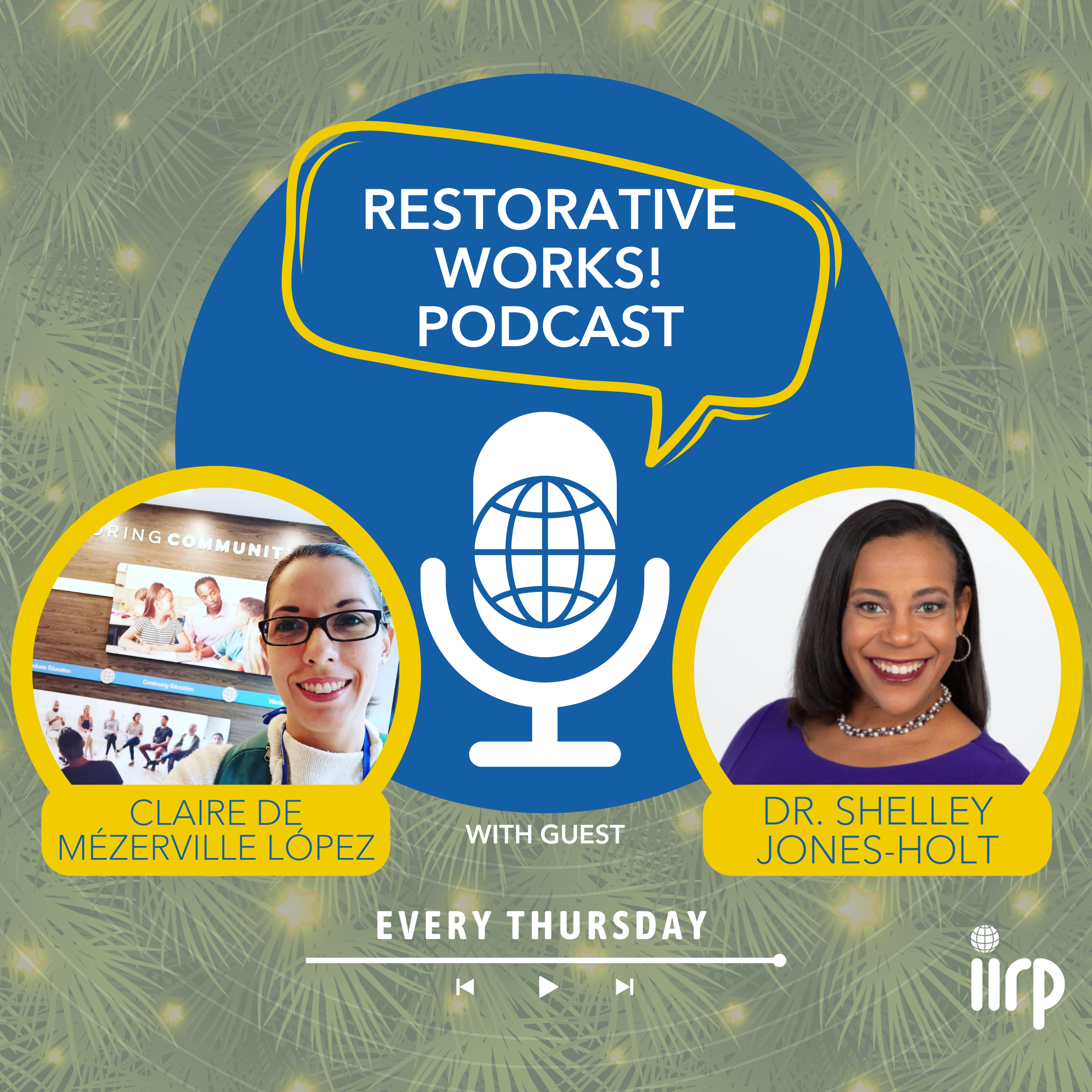 Reflecting on Courageous Conversations with Dr. Shelley Jones-Holt | This week we're revisiting our podcast episode from November 23, 2023! Claire de Mézerville López welcomes Shelley Jones-Holt, Ed.D., to the Restorative Works! Podcast, World Conference series. This series of conversations were held during the 2023 IIRP World Conference, Building Thriving Communities: A Radical Approach Through Restorative Practices, held in Detroit, MI, October 2-4, 2023. Dr. Shelley shares with us how to have courageous conversations around race and other complex topics by first creating a safe space for those conversations to occur. She emphasizes the importance of preparation by establishing norms and agreements before opening a dialogue and defining terms so that participants can share a common language. Dr. Shelley addresses the natural feeling of shame that can arise when we are faced with things we lack, may they be knowledge, experience, or depth of understanding. She also speaks about how to navigate the emotions that follow a shame response, emphasizing that they should never be barriers to creating and coming to a place of understanding. Dr. Shelley currently serves as a Courageous Leadership Consultant providing training, facilitation, coaching, and support to equity driven teams and organizational, legislative, educational, and family leaders across the nation. She is the founder of Leadership Legacy Consulting, LLC, and the visionary behind the non-profit Family Legacy 5, which focuses on providing structural, adaptive and technical support to educational, corporate, and family leaders. Her emphasis on a restorative approach is foundational to engaging in uncomfortable conversations about controversial topics, such as race and identity oppression. The expansion to empower families through family leadership training for all was birthed through the realization that the mental models that drive systemic change originate not at school or work, but at home. Tune in to learn more about Dr. Shelley's approach to addressing hard conversations with care and humility, and check out Family Legacy 5 and Leadership Legacy Consulting. | — | ||||||
| 12/18/25 |  Letters That Never Arrived: How Storytelling Moves Policy and People | Claire de Mézerville López welcomes Blair Kirby and Professor Mark Osler to the Restorative Works! Podcast. Blair and Mark join us to illuminate how restorative practices intersect with clemency work, storytelling, and systemic reform. Their conversation opens a window into the human impact of policies that often feel remote, revealing how small acts of recognition and repair can shift entire systems toward healing. Mark tells us about his commutation clinic at the University of St. Thomas School of Law, where he guides students as they uncover untold stories, meet directly with clients inside federal prisons, and learn how authentic narrative reshapes justice. Blair, a third-year law student and senior editor of the Journal of Law and Public Policy, brings her own lens as a former data analyst turned advocate. Her retelling of a first-degree murder clemency case, where three heartfelt apology letters were lost inside the corrections system, reveals how transparency and communication influence a victim's family's capacity to heal. Together, Mark and Blair describe how the commutation clinic operates at both the individual and systemic level, helping incarcerated people tell the fuller stories of their lives while also proposing legislative reforms that expand access to second chances. They highlight clients whose transformations demonstrate the power of rehabilitation, the role of narrative in restorative justice, and the responsibility of legal advocates to restore humanity, not simply file petitions. Blair grew up in South Korea and came to the US on her own at 15. After graduating from Macalester College with degrees in Applied Mathematics, Statistics, and Economics, she worked with government agencies, such as the Food and Drug Administration (FDA) and the Centers for Disease Control and Prevention (CDC) on epidemiology studies during the COVID-19 pandemic as a data and policy analyst in the Bay Area of California. She is currently a student at the University of St. Thomas School of Law (MN). Mark is the Robert and Marion Short Professor of Law at the University of St. Thomas, where he was chosen as Professor of the Year in 2016, 2019, and 2022. He also holds the Ruthie Mattox Preaching Chair at First Covenant Church, Minneapolis. His writing on clemency, sentencing, and narcotics policy has appeared in the New York Times, the Washington Post, and The Atlantic and in law journals at Harvard University, Stanford University, the University of Chicago, Northwestern, Georgetown, the University of Texas, Ohio State, UNC, William and Mary, and Rutgers. A former federal prosecutor, he won the case of Spears v. United States in the U.S. Supreme Court, with the Court ruling that judges could categorically reject the 100-to-1 ratio between crack and powder cocaine in the federal sentencing guidelines. Mark is a graduate of the College of William and Mary and Yale Law School. Tune in to discover how storytelling, advocacy, and courageous leadership move restorative justice from theory into action. | — | ||||||
Showing 25 of 169
Sponsor Intelligence
Sign in to see which brands sponsor this podcast, their ad offers, and promo codes.
Chart Positions
3 placements across 3 markets.
Chart Positions
3 placements across 3 markets.