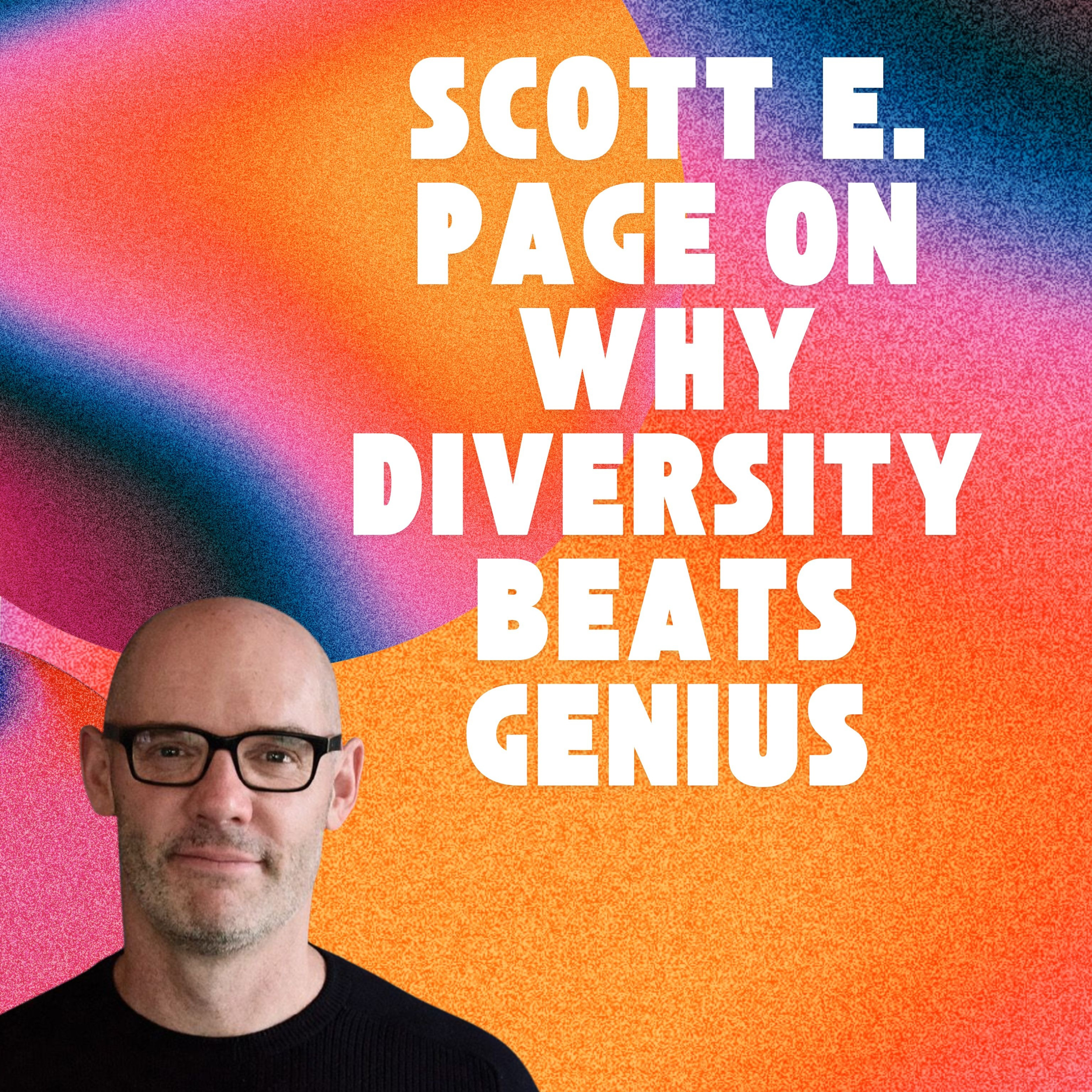
#28 – Scott Page: Why Diversity Beats Genius
About this episode
Scott E. Page discusses the importance of diversity in teams and its impact on performance in complex tasks.
Welcome back to scaling theory. My guest today is Scott E. Page , Distinguished University Professor of Complexity, Social Science, and Management at the University of Michigan, and an external faculty member at the Santa Fe Institute. He is an elected member of the National Academy of Sciences and the American Academy of Arts and Sciences, and a recipient of the Guggenheim Fellowship. His books include The Difference, Diversity and Complexity, The Diversity Bonus, and The Model Thinker. In this episode of Scaling Theory, Scott walks us through what complexity actually is. He unpacks the difference between complicated and genuinely complex systems, explains why cognitively diverse teams systematically outperform homogeneous ones on complex tasks, and what that means for how organizations scale. We also take up path dependence, the spillover effects of overlapping games across platform ecosystems, and where complexity tools have changed real decisions in practice. We close on the single open problem whose resolution would most reshape our understanding of social systems. As you will hear, Scott’s thinking is exceptionally clear. It is always a pleasure to talk with him and to…
More episodes of Scaling Theory
- #30 – Matthew O. Jackson on How Networks Quietly Shape What You Believe
- #27 – Cass Sunstein: On Scaling Liberalism
- #26 – W. Brian Arthur: On Economies, Santa Fe, and a Life in Ideas
- #25 – Cristina Bicchieri: The Scaling of Norms
- #24 – Robin Hanson: The Scaling of Futarchy
- #23 – Thibault Schrepel: Adaptive Regulation
Explore listener stats, chart rankings, contacts and more on the Scaling Theory podcast page.