
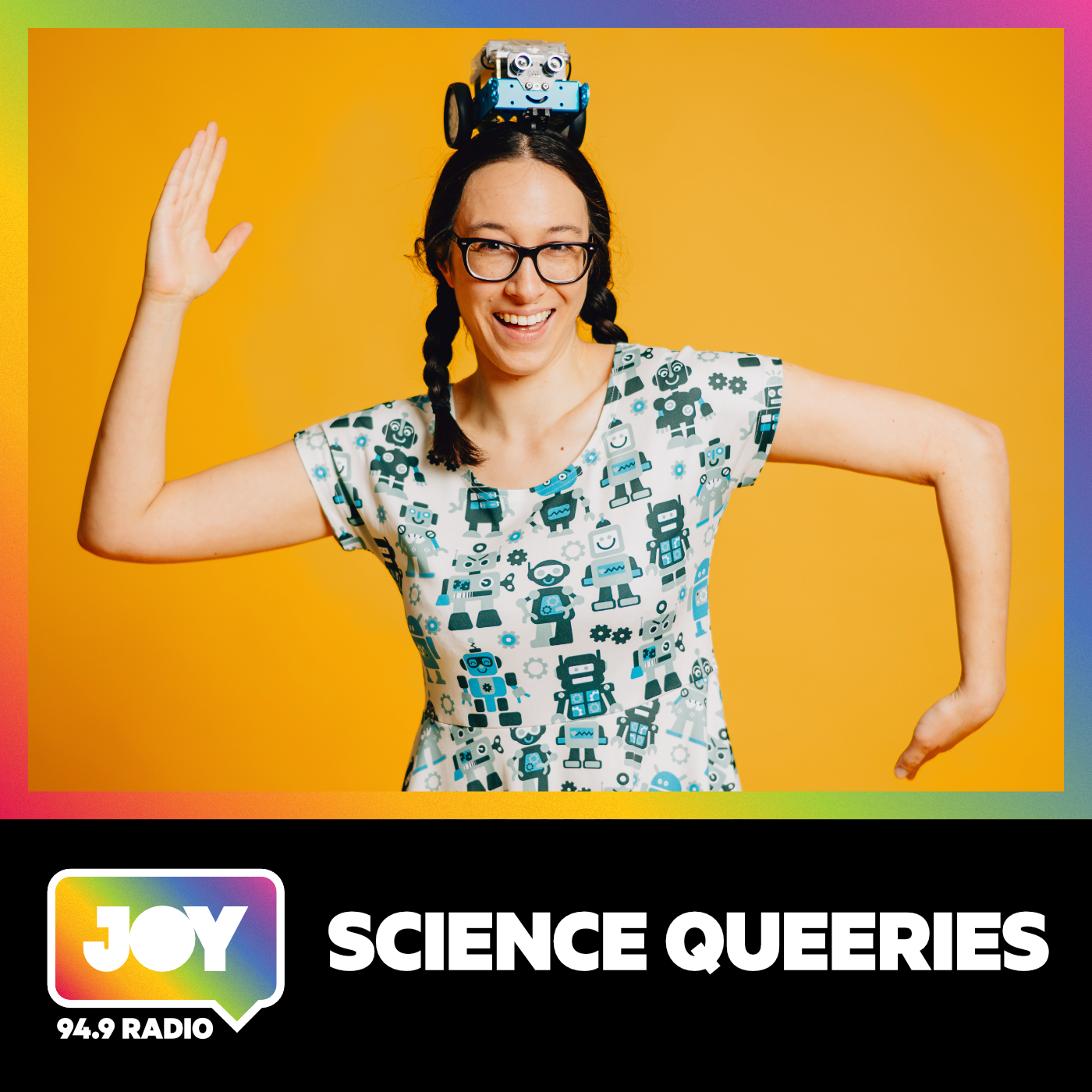
Science Queeries
by JOY 94.9 - Rainbow Community Podcasts for our LGBTI, LGBTIQA+, LGBTQIA+, LGBT, LGBTQ, LGB, Gay, Lesbian, Trans, Intersex, Queer Communities
Is this your podcast?Insights from recent episode analysis
Audience Interest
Podcast Focus
Publishing Consistency
Platform Reach
Insights are generated by CastFox AI using publicly available data, episode content, and proprietary models.
Most discussed topics
Brands & references
Est. Listeners
Insufficient chart data. Estimates will improve as the show charts.
- Per-Episode Audience
Est. listeners per new episode within ~30 days
N/A🎙 ~2x weekly·50 episodes·Last published 4d ago - Monthly Reach
Unique listeners across all episodes (30 days)
N/A - Active Followers
Loyal subscribers who consistently listen
N/A
Market Insights
Platform Distribution
Reach across major podcast platforms, updated hourly
Total Followers
—
Total Plays
—
Total Reviews
—
* Data sourced directly from platform APIs and aggregated hourly across all major podcast directories.
On the show
From 15 epsHost
Recent guests
Recent episodes
Hop to It: Saving Australian Marsupials
Jun 22, 2026
Unknown duration
Bug Appetite for Sustainable Food
Jun 9, 2026
44m 38s
Brain-storming Solutions for Neurological Disorders
Jun 2, 2026
42m 06s
Ovary-coming obstacles for ovarian cancer treatment
May 23, 2026
41m 09s
Digging up Dirt on Soil Ecotoxicology
May 20, 2026
37m 49s
Social Links & Contact
Official channels & resources
Official Website
Login
RSS Feed
Login
| Date | Episode | Topics | Guests | Brands | Places | Keywords | Sponsor | Length | |
|---|---|---|---|---|---|---|---|---|---|
| 6/22/26 | Hop to It: Saving Australian Marsupials | Australia’s iconic marsupials are going extinct at an alarming rate. But innovative science is offering hope. One in six human couples rely on assisted reproduction technologies like IVF…and marsupials may need to rely on these technologies too – it’s just that we can’t use the exact same tools across humans and marsupials. Understanding the unique biology of marsupial reproduction could revolutionise conservation. This week, we’re peeking inside the pouch. Dr Jen Hutchison from The University of Melbourne explores marsupial pregnancy, how assisted reproduction technologies like IVF could help preserve endangered species, and how the de-extinction of the Tasmanian Tiger could restore what we’ve lost. Originally aired 9th June, 2026. The post Hop to It: Saving Australian Marsupials appeared first on Science Queeries. | — | ||||||
| 6/9/26 | Bug Appetite for Sustainable Food✨ | insect proteinsustainable food+3 | Lee Cadesky | — | — | insectssustainable protein+3 | — | 44m 38s | |
| 6/2/26 | Brain-storming Solutions for Neurological Disorders✨ | neurological disordersgenetic testing+4 | Dr Matt Coleman | Murdoch Children’s Research InstituteUCB Pharmaceuticals | — | neurological disordersgenetic testing+5 | — | 42m 06s | |
| 5/23/26 | Ovary-coming obstacles for ovarian cancer treatment✨ | ovarian cancerimmunotherapy+3 | Dr Amy Wilson | Ovarian Cancer Research Foundation | — | ovarian cancerimmunotherapy+3 | — | 41m 09s | |
| 5/20/26 | Digging up Dirt on Soil Ecotoxicology✨ | soil ecotoxicologyenvironmental science+4 | Erin Koster | The University of Melbourne | — | soilecotoxicology+5 | — | 37m 49s | |
| 5/16/26 | Mould Matters & Future Fungicides✨ | fungicidessustainable agriculture+3 | Dr Donovan Garcia-Ceron | Victorian Strawberry Industry Certification Authority Research | — | fungicidesfungal infections+5 | — | 41m 32s | |
| 4/30/26 | B Positive: Immune Cell-ebrating Immunity✨ | immunityblood donation+4 | Dr Liam Kealy | Monash University | — | immunityblood donation+5 | — | 38m 50s | |
| 4/22/26 | Clits, Tits and Science Bits✨ | clitoral sciencelactation+4 | Dr Naomi Koh Belic | Science Queeries | — | clitoral erectionslesbian co-lactation+4 | — | 44m 31s | |
| 4/20/26 | Sperm-ission Impossible: Male Contraceptives✨ | male contraceptivessperm biology+3 | Luke Baz | The University of Melbourne | — | contraceptionsperm+3 | — | 38m 53s | |
| 4/12/26 | Infection Inspection✨ | infectionspathogens+4 | Alyssa Sinaga LacsinaAanika Bray | The University of MelbourneAmgen Scholars | South-East Asia | infectionspathogens+5 | — | 38m 20s | |
Want analysis for the episodes below?Free for Pro Submit a request, we'll have your selected episodes analyzed within an hour. Free, at no cost to you, for Pro users. | |||||||||
| 4/12/26 | Reef-ormation Through Crab-servation✨ | Great Southern Reefcitizen science+3 | Dr Elodie Camprasse | — | Great Southern ReefAustralia | Great Southern Reefcitizen science+3 | — | 39m 03s | |
| 3/31/26 | Baked In: how racism shows up in food & STEM✨ | food racismSTEM+3 | Anastasia Le | MSGLGBTQIA++2 | — | food racismSTEM+5 | — | 45m 04s | |
| 3/27/26 | Innately You: Depathologising Being Intersex✨ | intersexdepathologisation+5 | Paul Byrne-Moroney | The I in UsWorld Health Organisation | Australia | intersexdepathologisation+5 | — | 43m 36s | |
| 3/25/26 | One Planet, Three Crises✨ | climate changebiodiversity loss+4 | Nina RossDylan Scott | The University of Melbourne | AustraliaNew Zealand | planetary crisischytrid fungus+4 | — | 38m 33s | |
| 3/17/26 | Skull and Crossbones: Brains, Bones & Teeth✨ | bone structureosteoporosis+3 | Caitlyn TanNuthara Manuwelge+1 | The University of Melbourne | — | osteoporosisbrain tumours+3 | — | 38m 50s | |
| 3/4/26 | Toad-ally Thirsty: Going Out with a Bang✨ | frog conservationchytrid fungus+3 | Venice Chan | University of Melbourne | Australia | frogschytrid fungus+5 | — | 41m 44s | |
| 2/24/26 | Good Moon Rising: The Science of Lunar New Year | Chúc mừng năm mới! 恭喜发财! 새해 복 많이 받으세요! Happy New Year! Lunar New Year is celebrated by millions of people around the world. The celebration isn’t just cultural — it’s also astronomical. It’s tied to the night sky and is shaped by observations of celestial objects that stretch thousands of years. Explore the science behind Lunar New Year. Find out how the Moon became one of humanity’s oldest timekeepers. We meet the zodiac animals, unpacking why there are twelve of them and what Jupiter might have to do with it all. We look at the Moon’s real-world power — how it literally moves our oceans and shapes ecosystems. So, as this new lunar year begins, may your tides be high and your gravity strong, pulling all sorts of good things towards you. Originally aired 17th February, 2026. The post Good Moon Rising: The Science of Lunar New Year appeared first on Science Queeries. | — | ||||||
| 2/15/26 | Sea-ing Change in Sydney Harbour | Sydney Harbour is one of the most iconic waterways in the world — but beneath the postcard views lies a complex ecological story of sea-rious degradation, recovery, and renewal. In this episode of Science Queeries, we honour the late Professor Emma Johnston — marine ecologist, champion for equity in science, and a true tide-turner. She laid the scientific foundations for understanding and restoring Sydney Harbour’s ecosystems. Building on that legacy, Dr Cat chats to Dr Paco Martinez Baena from the Sydney Institute of Marine Science. He leads Project Restore — an initiative restoring and reconnecting habitats to boost biodiversity in Sydney Harbour. Because, when you restore the across habitats, the whole system can rise with the tide. Thanks to Emma Johnston’s enduring influence, Sydney Harbour isn’t just staying afloat — it’s current-ly rewriting its future. Shell yeah. Originally aired 10th February, 2026. The post Sea-ing Change in Sydney Harbour appeared first on Science Queeries. | — | ||||||
| 2/9/26 | Slay the Binary: Inside the Animal Queendom | Biological sex in nature is far from simple – and the animal queendom proves it. From fish that change sex, to intersex whales, to species that reproduce without males at all, this episode dives into the wonderfully non-binary reality of animal anatomy and reproduction. Some animals are born one sex and become another. Some respond to temperature, social structures, or hormones. Others simply opt out of sex altogether. Dr Cat is joined by Zoe Walder from Museums Victoria to explore how sex, anatomy and reproduction work across the animal kingdom – and why human ideas about “male” and “female” don’t always fit the science. This episode celebrates the diversity, flexibility and fabulousness of life on Earth. Because in nature, binaries are optional – and the queendom always reigns. Originally aired 3rd February, 2026. The post Slay the Binary: Inside the Animal Queendom appeared first on Science Queeries. | — | ||||||
| 1/28/26 | Waddle We Know About Penguins? | Penguins may live at the bottom of the world, but they’ve risen to the very top of our hearts. For Penguin Awareness Day, Dr Cat and archeologist Dr Wenjing Yu are sliding onto the Antarctic ice to celebrate these iconic birds. Having voyaged to Antartica as part of Homeward Bound, a leadership program for women and non-binary people in STEM, they encountered thousands of penguins in the wild. They chat about the penguins they met, what makes penguins such extreme overachievers, and why life in the cold demands clever adaptations. From first impressions to deep dives into penguin behaviour, survival, and sheer charisma, this episode proves that you don’t need to fly to be cool. Sometimes the best science comes with a tuxedo and a clumsy belly slide. Originally aired 20th January, 2026. The post Waddle We Know About Penguins? appeared first on Science Queeries. | — | ||||||
| 1/17/26 | Paws for Thought: Are Dogs Happy? | We spend over $20 billion a year on our dogs in Australia — but are our dogs actually happy, or just very well accessorised? This week on Science Queeries, Dr Cat is sniffing out the science of dog happiness with interdisciplinary researcher at the University of Melbourne, Dr Mia Cobb. While animal welfare science has focused on preventing negative experiences, she is finally asking the tail-wagging question: are working dogs and pet dogs having positive experiences? From behaviour and body language to hormones in saliva, Mia explains how researchers are working to create one of the first scientifically validated measures of dog happiness — and why humans are surprisingly bad at judging how our dogs are really feeling. Originally aired 13th January, 2026. The post Paws for Thought: Are Dogs Happy? appeared first on Science Queeries. | — | ||||||
| 1/14/26 | Past Weather, Future Problems | What if the key to Australia’s climate future is hidden in its past? When we talk about climate change, we often picture satellites, supercomputers, and graphs stretching into the future. But this week on Science Queeries, we’re turning back the clock, digging into dusty data, early thermometers and rain gauges, handwritten weather diaries, and historical records to understand what’s coming next. Dr Cat is joined by a climate scientist, Ruchit Kulkarni who’s part historian, part statistician, and part detective. Working at the University of Melbourne and ARC Centre of Excellence for 21st Century Weather, he uncovers how Australia’s past climates help us make sense of today’s extreme weather – especially heatwaves and bushfires. Explore how historical climate records reveal patterns we can’t see in modern data alone, and how looking back helps us plan for risk. When it comes to preparing for extreme weather, hindsight might just be our most powerful forecasting tool. *This podcast has been re-uploaded following an audio issue. As much as we want to be vocal about climate change, we don’t want you to have to listen to multiple voices at once. Originally aired 16th December, 2025. The post Past Weather, Future Problems appeared first on Science Queeries. | — | ||||||
| 12/11/25 | Culture Shock | This week, we cell-ebrate how far biomedical science has come. We start with the basics: why scientists grow cells in labs, how they do it, and why sometimes a cell line is better than borrowing cells from a real human. Then, we sit with the story of Henrietta Lacks and the immortal HeLa cells that were taken from her cancer (without consent) that revolutionised medicine. We tackle the massive ethical reckoning they demand. To finish, a leap into the future with organoids and 3D bioprinting, where researchers are literally growing tiny organs and printing living tissues. Originally aired 9th December, 2025. The post Culture Shock appeared first on Science Queeries. | — | ||||||
| 12/5/25 | T-cell-ebrating Progress: HIV, Immunity & Hope | HIV targets the very immune cells meant to protect us. But science – and community – keep fighting back. This World AIDS Day, Dr Cat and Dr Jen Juno chat about how HIV infects CD4 T cells and can lead to AIDS, and how ART and PrEP have transformed lives, empowering HIV+ people to thrive, to build relationships, to have sex and families without fear, and to know they are not a risk to the people they love. But there is still no cure for HIV. Dr Jen is an immunologist who explores the role of T cells in infectious diseases. She leads a research group at The University of Melbourne and the Peter Doherty Institute for Infection and Immunity. She is studying the lesser-known, unconventional or “hipster” T cells that could bring us closer to a cure. While there’s still a long way to go in terms of ensuring access to treatment for all who need it, and working towards a cure, there’s a lot to T cell-ebrate in terms of how far we’ve come. Originally aired 2nd December, 2025. The post T-cell-ebrating Progress: HIV, Immunity & Hope appeared first on Science Queeries. | — | ||||||
| 11/29/25 | Stuffed With Science | Before you check out at the Black Friday sales… check this Science Queeries episode out. Why do we fall into a festive food coma after a big Christmas or Thanksgiving feast? Is it the turkey, the carbs, or just the emotional aftermath of spending too many hours with relatives? Dr Cat is serving up a full Thanksgiving science spread. We’re carving into the psychology that makes Black Friday deals so irresistible. We’re turkey-ing (talking?) about whether your holiday roast really makes you sleepy and the delicious chemistry behind the Maillard reaction: the reason foods turn golden brown, smell incredible, and taste delicious. So, before you spend more money than you intended (or indulge in enough food to send you into a food coma)…spend a little time listening to this. Originally aired 25th November, 2025. The post Stuffed With Science appeared first on Science Queeries. | — | ||||||
Showing 25 of 50
Pitch Fit is a Pro feature
See how bookable this show is for guests, which brands already advertise, the per-episode ad value, and the best-fit guest and sponsor profile. The numbers are blurred on the free plan.
How readily this show books outside guests like you.
How proven this show is for host-read sponsorships.
For Guests
ProFor Advertisers
ProUpgrade to Pro to unlock guest cadence, sponsor categories, fit scores, and per-episode ad value for this show.