
Insights from recent episode analysis
Audience Interest
Podcast Focus
Publishing Consistency
Platform Reach
Insights are generated by CastFox AI using publicly available data, episode content, and proprietary models.
Most discussed topics
Brands & references
Total monthly reach
Estimated from 1 chart position in 1 market.
By chart position
- 🇬🇷GR · Government#743K to 10K
- Per-Episode Audience
Est. listeners per new episode within ~30 days
1.5K to 5K🎙 ~2x weekly·20 episodes·Last published 3d ago - Monthly Reach
Unique listeners across all episodes (30 days)
3K to 10K🇬🇷100% - Active Followers
Loyal subscribers who consistently listen
1.2K to 4K
Market Insights
Platform Distribution
Reach across major podcast platforms, updated hourly
Total Followers
—
Total Plays
—
Total Reviews
—
* Data sourced directly from platform APIs and aggregated hourly across all major podcast directories.
On the show
From 10 epsHosts
Recent guests
Recent episodes
Shadow Politics, June 21, 2026
Jun 22, 2026
Unknown duration
Shadow Politics, June 14, 2026
Jun 15, 2026
Unknown duration
Shadow Politics, June 7, 2026
Jun 8, 2026
54m 57s
Shadow Politics, May 31, 2026
Jun 1, 2026
53m 06s
Shadow Politics, May 24, 2026
May 25, 2026
53m 46s
Social Links & Contact
Official channels & resources
Official Website
Login
RSS Feed
Login
| Date | Episode | Topics | Guests | Brands | Places | Keywords | Sponsor | Length | |
|---|---|---|---|---|---|---|---|---|---|
| 6/22/26 | ![]() Shadow Politics, June 21, 2026 | Shadow Politics with Senator Michael D. Brown and Co-host Liberty Jones Unstoppable in Iowa: India May on Rural Power, Health Care, and Speaking Truth to Power Guest, India May, Political Candidate, Speaker, Advocate A Grassroots Conversation About Local Courage In this episode of Shadow Politics, hosts Michael D. Brown and Liberty Jones welcome India May, Democratic candidate for Iowa House District 58, covering Floyd, Chickasaw, and Bremer counties. Michael introduces her as a nurse, librarian, medical examiner investigator, mother, and community advocate who gained attention after publicly confronting Senator Joni Ernst about Medicare and Medicaid cuts. The episode focuses on local power, rural politics, health care, LGBTQ rights, campaign finance, voter access, and what it means for an ordinary citizen to step into public leadership. Discovering the Power of One Civilian Voice India says one of the biggest lessons she has learned over the past year is how much power civilians truly have. She points to her public criticism of Senator Joni Ernst, who later announced retirement, and her scrutiny of her opponent’s unpaid property taxes, after which he paid them. India’s point is that people do not have to wait until they hold office to make a difference. By speaking plainly, documenting facts, and refusing to be silent, ordinary citizens can pressure powerful figures and create real consequences. From Independent Voter to Democratic Candidate Liberty asks India about the difference between her expectations and the realities of running for office. India explains that she spent much of her voting life as an independent and is now running as a Democrat in red, rural Iowa. She says she has been pleasantly surprised by the number of people willing to step up, volunteer, knock doors, join parades, and publicly support a campaign that calls for change. She describes live music, community energy, and people applauding the campaign at local events as signs that many rural Iowans know something is wrong and want a different direction. A Campaign Rooted in Fair Voting When Liberty asks what policies are most important to India, she names voting reform as her top priority. India supports efforts discussed by Iowa gubernatorial candidate Rob Sand to make voting more fair and less dependent on party structures. She criticizes Iowa’s ban on ranked-choice voting and says she is interested in open primaries, star voting, approval voting, and ballot measures. Her goal is to make Iowa’s political system more responsive to voters rather than party machinery. Medicaid, Mental Health, and a Broken Health System Michael asks about India’s well-known confrontation with Senator Ernst over Medicaid cuts and how those cuts affect Iowans. India says Iowa has already been ahead of the curve in damaged health care because Medicaid was privatized in 2016. She describes delayed care, denied care, unpaid reimbursements to hospitals, work requirements, and hospitals struggling to stay open. She also says Iowa ranks at the bottom for inpatient mental health care availability and faces severe health care deserts, rising cancer concerns, and limited oncology access across many counties. The “Big Beautiful Bill” and Political Timing India argues that federal cuts tied to the so-called “big beautiful bill” will be devastating and says the timing of implementation appears politically calculated. According to her, the cuts are delayed until November, creating an opening for Republicans to blame Democrats if the party balance changes after the election. Michael responds that this shows she has learned one of the central lessons of politics: policy and timing are often structured to shape public blame. Christianity, MAGA, and Moral Accountability The conversation turns to religion and politics when Michael, speaking as a Christian and father of an openly gay daughter, asks how Christians reconcile cruelty | — | ||||||
| 6/15/26 | ![]() Shadow Politics, June 14, 2026 | Shadow Politics with Senator Michael D. Brown and Co-host Liberty Jones Across the Divide: Trump, Iran, Immigration, and the Search for Common Ground A Conversation Meant to Make America Think Again In this episode of Shadow Politics, host Former Senator Michael D. Brown opens the program with the show’s mission: to make America think again by listening to all sides before forming opinions. He introduces guest William Shelton, an arborist, small business owner in the DMV area, native Washingtonian raised in Fairfax, Virginia, political science graduate of Old Dominion University, libertarian, Christian, father, gun owner, and self-described patriot. The episode centers on why Shelton voted for Donald Trump in 2024 and how his views reflect a broader segment of American political opinion. Why William Shelton Voted for Donald Trump Michael begins by asking Shelton what leadership characteristics matter most to him and how Trump meets them. Shelton says voters often do not get to choose ideal candidates; instead, candidates are packaged and presented, leaving people to choose between the available options. He says he did not find Trump’s first presidency offensive enough to prevent him from voting for Trump again in 2024. Shelton points to Trump’s presence, his ability to speak to his base, his appeal to a certain understanding of America, and his support for lower taxes and reduced regulation as reasons Trump appealed to him as a small business owner. Iran, War, and the Question of Intervention Michael then asks about the war with Iran, arguing that Iran did not have nuclear weapons, that the United States spent heavily, and that the Strait of Hormuz was already open before the conflict began. Shelton responds by connecting the issue to broader Republican and libertarian debates about war, referencing Ron Paul and the Tea Party’s antiwar instincts. He says that if the public claims about Iran’s uranium enrichment, ballistic missile capability, and regional influence through groups such as Hamas and Hezbollah were accurate, then military action could be justified if it reduced a future threat with limited loss of life. Michael challenges that view, comparing the situation to the Bay of Pigs and arguing that the intervention may have backfired. Liberty Jones Joins the Debate Co-host Liberty Jones joins after technical issues and presses Shelton on the logic of intervention. She asks how this action would achieve its stated goals, how weapons could be kept from extremists if civilians were armed, and why critics should be dismissed as politically motivated rather than answered on the merits. Shelton answers by returning to the example of appeasement and by arguing that Iran’s leadership cannot be trusted. Liberty pushes back by questioning whether immigration, instability, and religious conflict are being oversimplified, especially when broader social, economic, colonial, and policy histories are involved. Religion, Immigration, and Western Identity The conversation broadens into religion, immigration, and national identity. Shelton argues that Muslim-majority nations such as Saudi Arabia, the United Arab Emirates, Kuwait, and Dubai should take in more Muslim refugees, asking why many migrants instead go to Western countries. Michael counters that religious nationalism is dangerous whether it comes from Islamic governments or Christian fundamentalists in the United States. Liberty adds that immigration problems cannot be reduced only to religion and must also be understood through policy, education, crime enforcement, opportunity, and historical power dynamics. Trump, Race, and Immigration Claims Michael raises questions about Donald Trump and race, saying Trump has a documented history involving racial discrimination in housing. Shelton pushes back by pointing to Trump’s support among some Black, Latino, and immigrant voters. Michael responds that most Black voters did not suppo | — | ||||||
| 6/8/26 | ![]() Shadow Politics, June 7, 2026✨ | Barney FrankDC statehood+3 | Barney Frank | House Financial Services CommitteeDodd-Frank Act | DC | Barney FrankDC statehood+5 | — | 54m 57s | |
| 6/1/26 | ![]() Shadow Politics, May 31, 2026✨ | ranked choice votingD.C. elections+3 | Monica Holman Evans | District of Columbia Board of Elections | D.C. | ranked choice votingD.C. elections+3 | — | 53m 06s | |
| 5/25/26 | ![]() Shadow Politics, May 24, 2026✨ | American historydemocracy+5 | Marianne Williamson | Declaration of Independence | — | Marianne WilliamsonAmerican history+5 | — | 53m 46s | |
| 4/27/26 | ![]() Shadow Politics, April 26, 2026✨ | media integrityclickbait politics+4 | Josh Levs | CNNNew York Times+1 | — | media integrityclickbait+5 | — | 57m 15s | |
| 4/20/26 | ![]() Shadow Politics, April 19, 2026✨ | Iran conflictIndigenous history+4 | — | Smithsonian National Museum of the American Indian | IranStraits of Hormuz | IranIndigenous rights+4 | — | 55m 07s | |
| 4/13/26 | ![]() Shadow Politics, April 12, 2026✨ | political debateconservatism+5 | Noah Witherspoon | Turning Point USARepublican party | — | politicsdebate+5 | — | 58m 32s | |
| 3/31/26 | ![]() Shadow Politics, March 30, 2026✨ | D.C. sovereigntypolitical mobilization+4 | Jonetta Rose Barras | Southern Christian Leadership Conference | District of Columbia | D.C. leadershipcitizen army+5 | — | 58m 14s | |
| 3/23/26 | ![]() Shadow Politics, March 22, 2026✨ | local autonomyCongressional Delegate+4 | Brooke Pinto | DC Council | Washington, D.C. | local autonomyDC Council+5 | — | 53m 16s | |
Want analysis for the episodes below?Free for Pro Submit a request, we'll have your selected episodes analyzed within an hour. Free, at no cost to you, for Pro users. | |||||||||
| 3/16/26 | ![]() Shadow Politics, March 15, 2026✨ | US military dominancecyber-kinetic warfare+4 | Joe Sestak | U.S. Department of Defense | China | military powercyber warfare+5 | — | 54m 41s | |
| 3/2/26 | ![]() Shadow Politics, March 1, 2026✨ | DC identitylocal journalism+4 | Liberty JonesPetula Dvorak | The Washington Post | Washington D.C. | Washington D.C.local journalism+4 | — | 55m 54s | |
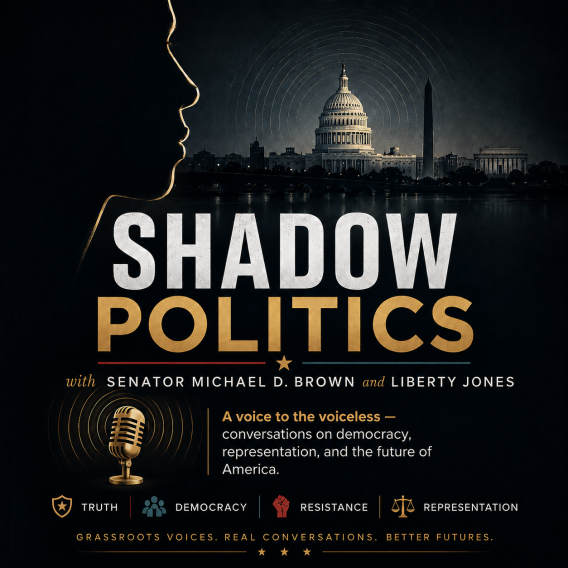
| 2/23/26 | ![]() Shadow Politics, February 22, 2026 | Shadow Politics with Senator Michael D. Brown and Co-host Liberty Jones Guest, Charles Moreland 1st US Representative for DC - The Legacy of Activism In this episode of Shadow Politics, a profound dialogue between Senator Emeritus Michael D. Brown and Representative Charles Moreland, the first elected U.S. Representative for the District of Columbia. They reflect on the mentorship of Jesse Jackson, the historical parallels between DC’s struggle and global civil rights movements, and the urgent need for a grassroots mobilization to achieve full statehood. The Catalyst of the 1990s: Jesse Jackson’s Influence The election of Charles Moreland and Jesse Jackson in 1990 marked a turning point for the District of Columbia. Jackson, a veteran of the Civil Rights Movement, brought national gravitas to the "Shadow" delegation, teaching local leaders the importance of visibility and national lobbying. Despite initial local skepticism regarding his arrival, Jackson acted as a master mentor, emphasizing that the fight for DC was a logical extension of the march from Selma to Montgomery. Symbolic Protests and Civil Disobedience The movement for statehood was characterized by direct action, including blocking Pennsylvania Avenue and dumping tea on the steps of the IRS to protest "taxation without representation". These acts were intended to mirror the founding principles of the United States, highlighting the irony that the "cradle of democracy" denies basic voting rights to its own residents. The "Home Rule" Trap vs. True Statehood A significant portion of the discussion focuses on the inadequacy of "Home Rule," which Moreland describes as a "dictatorship of the powerful over the powerless". Unlike a state, DC's local laws and budget are subject to Congressional veto, and its residents lack voting members in the Senate and House. The speakers argue that many residents have developed a "slave mentality," accepting the illusion of democracy provided by a local mayor while the federal government retains ultimate control over their finances and judicial appointments. Political Analysis and the Path Forward The dialogue touches on the 2024 election, with Moreland critiquing the Democratic Party for failing to prioritize statehood when they held the majority. He attributes political shifts to deep-seated racism and gender bias, noting that voter suppression is often ignored in mainstream post-election analysis. Ultimately, the speakers conclude that statehood will not be granted through polite lobbying alone; it requires a mass movement where citizens demand their rights, echoing Frederick Douglass’s maxim that "power concedes nothing without a demand". The conversation serves as both a historical record and a call to action. While the legacy of leaders like Jesse Jackson and Florence Pendleton provided a foundation of hope, Moreland and Brown emphasize that the "lightning bug" of Home Rule is no substitute for the "lightning bolt" of statehood. The path to freedom requires DC residents to shed the "slave mentality" and demand the same rights enjoyed by every other citizen in a modern democracy. | — | ||||||
| 2/16/26 | ![]() Shadow Politics, February 15, 2026 | Shadow Politics with Senator Michael D. Brown and Co-host Liberty Jones Guest, Mr. Charles "Chuck" Hicks, Mr. Black History from the D.C. Black History Celebration Committee In this episode of Shadow Politics, host Michael D. Brown and co-host Liberty Jones engage in a profound conversation with civil rights veteran Chuck Hicks, known as "Mr. Black History." The discussion bridges the gap between the 1960s struggle and contemporary political challenges, emphasizing that the fight for equality is a continuous process that requires both historical memory and active participation. The Persistence of Systemic Racism The dialogue highlights a sobering reality: racism in America has not disappeared but has often been "pushed under the rug," only to resurface with renewed intensity. Chuck Hicks argues that while significant gains were made during the Civil Rights Movement, these successes led to a dangerous level of comfort among the public. This complacency allowed regressive forces to slowly regain control, exemplified by the current composition of the Supreme Court and the resurgence of overt white supremacy. The speakers suggest that the current political climate, characterized by aggressive tactics from the government and law enforcement, makes the modern struggle in many ways more difficult than in decades past. Lessons from Modern Resistance The recent protests in Minnesota serve as a central case study for modern resistance. Hicks marvels at the "surge of energy" from a new generation that stood "toe-to-toe" with federal authorities and ICE. This movement is characterized by its inclusivity and innovative tactics—such as using crystals to signal the arrival of ICE agents—demonstrating that even small, organized groups can have a massive impact. The conversation underscores that mass marches, like the Million Man March, remain vital because they "rejuvenize" activists, allowing them to carry the energy of a large movement back to their local communities. Education as a Tool for Liberation A significant portion of the discussion focuses on the critical role of Black history in the American education system. With "civics history" fading from school curricula, Hicks advocates for the return of "Freedom Schools"—after-school programs held in churches and community centers to teach the contributions of African Americans, Latinos, and other marginalized groups. The hosts reflect on how historical narratives, such as the Amistad story, are often omitted from standard textbooks, leaving even highly educated citizens ignorant of the foundational struggles for justice in the United States. Intersectionality and the Economic Struggle The speakers address the evolving terminology of social justice, specifically the term "People of Color." While individual groups maintain their unique identities (Black, Asian, Latino), the term represents a "collective power of unity" against a shared experience of racism. However, Hicks notes that the modern fight has expanded beyond race to include a battle against "greedy" capitalism. He points out that economic disparities—such as the lack of supermarkets in predominantly Black wards compared to wealthy white ones—are tools of control that affect the "average person" regardless of race, as inflation and stagnant wages make it impossible for working families to survive. The discussion concludes with a message of resilient hope. By drawing strength from history and maintaining a unified front across different racial and economic backgrounds, the speakers believe that current hardships "too will pass." The ultimate goal remains a "United" States where the multicultural tapestry is recognized as the nation's greatest innovation and source of strength. | — | ||||||
| 2/2/26 | ![]() Shadow Politics, February 1, 2026 | Shadow Politics with Senator Michael D. Brown and Co-host Liberty Jones Guest, Zahra Aminpour, a human rights activist and supporter of the Iranian resistance movement In this episode of Shadow Politics, Iranian human rights activist Zahra Aminpour discusses the pivotal role of women in the fight for a secular democracy in Iran. The conversation explores the historical context of the 1979 revolution, the brutal tactics of the current regime, and the specific transition plans proposed by the resistance. Aminpour also draws striking parallels between the struggle for unity in Iran and the current political polarization in the United States. Detailed Summary The Historical Context and Women's Role Contrary to common Western perceptions, Iranian women have traditionally been socially, culturally, and economically active. The 1979 revolution and the subsequent rise of the current regime stripped women of their civil rights, enforcing strict dress codes and requiring male permission for travel and education. Despite these restrictions, women have resisted by outperforming men in higher education—particularly in STEM fields—and maintaining strong digital connectivity. The regime's attempt to suppress women has paradoxically emboldened them to become the leaders of the current resistance movement. The 1979 revolution itself was born out of legitimate grievances against the Shah’s brutal police force (SAVAK) and economic disparities, exacerbated by the historical trauma of the 1953 coup. However, a power vacuum allowed Khomeini to exploit the populace's frustration. Once in power, the theocratic regime executed tens of thousands of progressives and consolidated control through violence, betraying the people's hope for democracy. Life Under the Regime and the Strategy of Fear The regime maintains power through collective punishment; if a young person protests, their entire family faces imprisonment or execution. Public executions are used as a terror tactic to quell dissent. Women face specific brutality regarding hijab enforcement, as seen in the case of Mahsa Amini, and political prisons are filled with citizens ranging from doctors to teachers. Despite this oppression, Iranians maintain resilience through private acts of joy and community, refusing to let the regime strip them of their humanity. The NCRI Transition Plan The resistance rejects both the current theocracy and the former monarchy. The National Council of Resistance of Iran (NCRI) proposes a specific roadmap: Immediate Goal: Topple the dictatorship via popular uprising. Interim Period: Establish a provisional government for 6 months. Key Milestone: Hold the first free elections to form a National Assembly. Long Term: A 2-year process to draft a new constitution and establish full governance institutions. The Path to Secular Democracy The Iranian people are not seeking reform; they are chanting "Down with the dictatorship" and demanding a secular democracy. The resistance is organized under the National Council of Resistance of Iran (NCRI), led by President-elect Maryam Rajavi. This coalition represents diverse ethnicities and religions and has garnered bipartisan support globally. Their plan involves a six-month provisional government followed by free elections to draft a new constitution, ensuring self-determination without external military intervention. Policy Recommendations and Global Action Aminpour argues strongly against negotiating with the current regime, viewing it as illegitimate and unreformable. Instead, the international community should isolate the regime politically and economically through targeted sanctions. Crucially, the West should provide technological support to ensure Iranians have internet access to share their reality with the world. The resistance emphasizes the right of the Iranian people to defend themselves and topple their own government, acknowledging that while they do not want foreign war, the in | — | ||||||
| 1/26/26 | ![]() Shadow Politics, January 25, 2026 | Shadow Politics with Senator Michael D. Brown and Co-host Liberty Jones Guest, Monica Hopkins, Executive Director of the ACLU of the District of Columbia - ICE overreach, the threat of martial law, and reimagining democracy in a polarized America. In this episode of Shadow Politics, the hosts and Monica Hopkins discuss the precarious state of American democracy, highlighting fears regarding the potential invocation of martial law and the aggressive deployment of federal law enforcement like ICE. The conversation explores the critical need for institutional checks and balances, the unique political struggles of Washington D.C. regarding statehood and home rule, and the necessity of restoring civility to bridge the widening political divide. Detailed Summary The Threat of Executive Overreach and Martial Law The discussion begins with concerns that current civil unrest could be a precursor to the President invoking the Insurrection Act or martial law to suspend election results. Hopkins acknowledges these fears, citing the deployment of ICE in Southern California and Minnesota, and the National Guard in D.C. and Chicago, as evidence of a "pathway being developed" toward government overreach. However, she notes that pushback from figures like Representative Comer regarding ICE's presence in Minnesota suggests that a total consolidation of power might face internal political resistance. The consensus is that while the threat is real, the public's refusal to stay silent is a crucial countermeasure. Institutional Checks and the Role of the Judiciary A significant portion of the dialogue focuses on whether democratic institutions can withstand authoritarian pressure. While there is concern that Congress represents a failure to check executive power, Hopkins emphasizes that the Supreme Court is not the only judicial body; thousands of local courts across the country are ruling against administration overreach. She highlights that the concept of "due process" is becoming part of the common vernacular as citizens realize that individuals should not be treated as guilty until proven innocent. The group agrees that while relying solely on leaders to respect limits is dangerous, the combination of judicial rulings and public outcry provides a necessary defense. Immigration Enforcement and Agency Accountability The conversation turns to the specific conduct of ICE, described by the hosts as resembling a "rogue law enforcement agency." Hopkins argues that the chaos created by ICE—such as stopping off-duty local officers and demanding papers—erodes public safety trust so severely that the agency must pull back. While state governments cannot legally force federal agents out, Congress holds the power of the purse and can defund these operations. The difficulty of holding federal agents accountable is highlighted by the ACLU's ongoing, six-year lawsuit regarding the Lafayette Square protests, demonstrating the challenges posed by qualified immunity and the distinction between local and federal liability. Washington D.C.: A Testing Ground for Policy Hopkins explains that D.C. often serves as a laboratory for restrictive policies before they are applied nationally. She clarifies that the ACLU of D.C.'s fight for "statehood" encompasses both the proactive path to full representation and the defensive battle to protect existing "home rule." The discussion touches on the "Schedule F" executive order, which attempted to strip civil service protections from federal workers—a major issue for D.C.'s workforce. The ACLU is actively educating Congress members to prevent them from circumventing the D.C. Council's legislative authority. Bridging the Political Divide Drawing on her experience leading the ACLU in Idaho, Hopkins contrasts the "D.C. bubble" with the rest of the country. She suggests that Democrats often fail by "talking down" to the middle of the country and missing the shared values that exist in the center of t | — | ||||||
| 1/19/26 | ![]() Shadow Politics, January 18, 2026 | Shadow Politics with Senator Michael D. Brown and Co-host Liberty Jones Guest, Markus Bachelor - Running for U.S. shadow senator of the district of Columbia In this episode: Hosts Former Senator Michael D Brown and Liberty Jones interview Markus Bachelor who is runningfor U.S. shadow senator of the district of Columbia. Bachelor discusses the necessity of D.C. statehood for self-determination and democracy, highlighting his long-term advocacy, past political experience, and urgency in addressing local government challenges, such as education and community stability issues. Join us for an interesting discussion in Grassroots Politics in Washington D.C. | — | ||||||
| 1/12/26 | ![]() Shadow Politics, January 11, 2026 | Shadow Politics with Senator Michael D. Brown and Co-host Liberty Jones Guest, Dr Oye Owolewa - Washington DC's Shadow Representative In this episode: Hosts Former Senator Michael D Brown and Liberty Jones interview Dr. Oye Owolewa Washington D.C.'s Shadow Representative on various topics including, experience challenges, police subsidies, economic factors related to and for young people and homeowners, and how to revitalize communities without federal hindrance. The discussion also touches on team priorities, grassroots accountability, visual responsiveness, and change. Join us for an interesting discussion in Grassroots Politics in Washington D.C. | — | ||||||
| 1/5/26 | ![]() Shadow Politics, January 4, 2026 | Shadow Politics with Senator Michael D. Brown and Co-host Liberty Jones The New Year, 2026 | — | ||||||
| 12/22/25 | ![]() Shadow Politics, December 21, 2025 | Shadow Politics with Senator Michael D. Brown and Co-host Liberty Jones Reviewing the Year of 2025, our Disappointments and Our Hopes for the Future | — | ||||||
Showing 20 of 20
Pitch Fit is a Pro feature
See how bookable this show is for guests, which brands already advertise, the per-episode ad value, and the best-fit guest and sponsor profile. The numbers are blurred on the free plan.
How readily this show books outside guests like you.
How proven this show is for host-read sponsorships.
For Guests
ProFor Advertisers
ProUpgrade to Pro to unlock guest cadence, sponsor categories, fit scores, and per-episode ad value for this show.
Chart Positions
1 placement across 1 market.
Chart Positions
1 placement across 1 market.

