
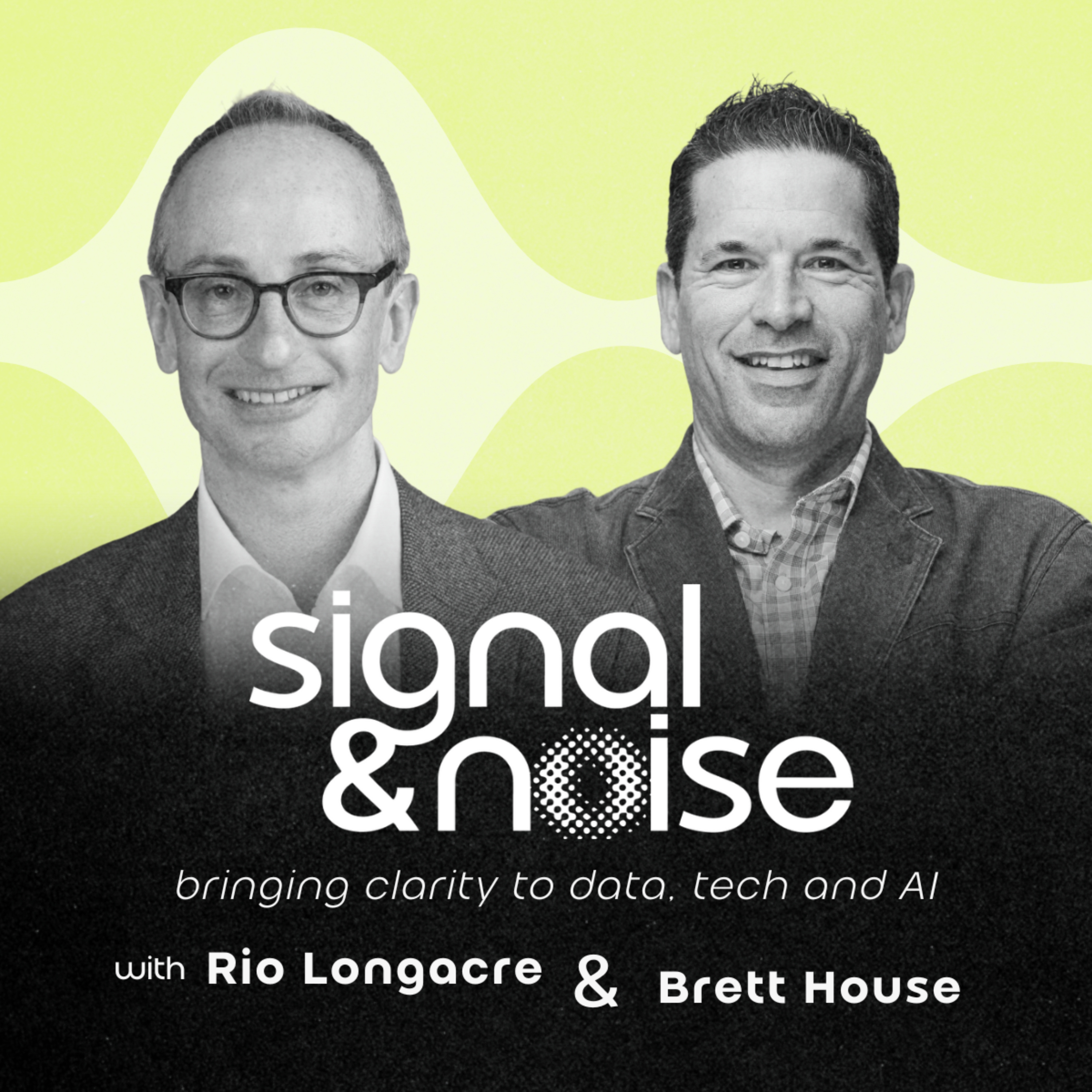
Insights from recent episode analysis
Audience Interest
Podcast Focus
Publishing Consistency
Platform Reach
Insights are generated by CastFox AI using publicly available data, episode content, and proprietary models.
Total monthly reach
Estimated from 2 chart positions in 2 markets.
By chart position
- 🇺🇸US · Tech News#1225K to 30K
- 🇨🇴CO · Tech News#150500 to 3K
- Per-Episode Audience
Est. listeners per new episode within ~30 days
1.6K to 9.9K🎙 Daily cadence·27 episodes·Last published yesterday - Monthly Reach
Unique listeners across all episodes (30 days)
5.5K to 33K🇺🇸91%🇨🇴9% - Active Followers
Loyal subscribers who consistently listen
2.2K to 13K
Market Insights
Platform Distribution
Reach across major podcast platforms, updated hourly
Total Followers
—
Total Plays
—
Total Reviews
—
* Data sourced directly from platform APIs and aggregated hourly across all major podcast directories.
On the show
Recent episodes
Getting Sh*t Done: Tom Amies-Cull on Fixing Broken Agency Operating Models
May 14, 2026
Unknown duration
When AI Rewrites Work: Jennifer Borchardt on Jobs, Power, and the Human Cost
May 11, 2026
Unknown duration
POSSIBLE 2026 Day 3: The AI Endgame, Agentic Media, and Rebuilding the Ad Stack
May 8, 2026
Unknown duration
POSSIBLE 2026 Day 2: Where AI Meets the Real Operating System of Marketing
May 6, 2026
Unknown duration
Possible 2026 Day 1: AI, AdTech, CTV & the Future of Media | Signal & Noise Compilation
May 5, 2026
Unknown duration
Social Links & Contact
Official channels & resources
Official Website
Login
RSS Feed
Login
| Date | Episode | Description | Length | ||||||
|---|---|---|---|---|---|---|---|---|---|
| 5/14/26 |  Getting Sh*t Done: Tom Amies-Cull on Fixing Broken Agency Operating Models | Most companies don’t fail at strategy. They fail at execution=.In this episode of Signal & Noise, Brett House and Rio Longacre sit down with Tom Amies-Cull—a seasoned operator who has spent two decades inside the most complex, high-pressure agency environments, including senior leadership roles across IPG, Dentsu, and Kinesso.This isn’t a conversation about AdTech plumbing.It’s about something far more fundamental—and far more broken:How organizations actually work.Or more accurately… why they often don’t.Drawing from years inside the machine, Tom unpacks the uncomfortable truth behind transformation in large, matrixed organizations:It’s not a strategy problem. It’s a coordination problem. It’s a leadership problem. It’s an operating model problem.As he puts it: “Transformation usually fails not because companies lack strategy, but because they can’t convert intent into coordinated behavior.”This is a candid, sometimes blunt breakdown of what actually gets in the way of change:Why most “transformations” are just reorgs in disguiseHow internal politics quietly kill executionThe real reason employees aren’t change-resistant—they’re resistant to bad changeWhy strategy decks and org charts are not operating modelsHow unclear decision rights create organizational paralysisThe hidden role of middle management as the “connective tissue” of executionWhy leadership teams say they want accountability—but often avoid it in practiceThere’s a lot of industry noise right now about agencies evolving into platforms, operating systems, and AI-powered machines.Tom brings this conversation back to reality:Most organizations are further away than they think.Not because the vision is wrong—but because the underlying systems (people, incentives, culture, decision-making) aren’t built to support it.The result?Pockets of excellence… held together by heroic effort, not scalable design.Everyone is talking about AI.But Tom reframes it:AI isn’t a technology problem.It’s an operating model and leadership problem.AI can accelerate planning, production, and activation—but it cannot fix:Fragmented P&LsMisaligned incentivesPoor leadership behaviorsBroken decision-making structuresIf those don’t change, AI just makes dysfunction happen faster.We also explore why indie agencies and PE-backed firms may have an edge right now:Less structural debtFaster decision-makingClearer accountabilityStronger focus on value creationWhile legacy holdcos wrestle with complexity, challengers are moving faster—and with purpose.This episode is about closing the gap between:What companies say they are…and what they are actually capable of doing.Because in today’s environment, speed matters.Clarity matters.Execution matters most.Agency transformationOperating models and org designLeadership in complex organizationsAI’s real impact on the industryThe future of holding companies…this is a must-listen.📩 Connect with Tom:Find him on LinkedIn or through his advisory work (linked in show notes)🎧 Follow Signal & Noise:Subscribe for more unfiltered conversations with operators shaping the future of media, advertising, and AI. | — | ||||||
| 5/11/26 |  When AI Rewrites Work: Jennifer Borchardt on Jobs, Power, and the Human Cost | What happens when AI stops being a tool—and starts redefining what work actually is?In this episode of Signal & Noise, Brett House and Rio Longacre sit down with Jennifer Borchardt—UX leader, systems thinker, and newly minted Signal & Noise Executive Voice contributor—to unpack one of the most urgent questions of our time: What does AI mean for jobs, identity, and society itself?Drawing on decades of experience at firms like Sapient, Slalom, Wells Fargo, and U.S. Bank, Jennifer brings a rare perspective that blends design, behavioral science, and real-world systems thinking. This isn’t a surface-level conversation about productivity gains—it’s a deep dive into the structural shifts already underway.Together, they explore:Why the labor-based economy may be fundamentally incompatible with AGIThe rise of the “hyphenate worker”—and the slow death of specializationHow AI is unbundling work, eliminating entry-level pathways, and reshaping career trajectoriesThe uncomfortable truth about who benefits—and who gets left behindWhy most companies are still wildly unprepared, despite the hypeThe growing tension between innovation, regulation, and power concentrationAnd the deeper question few are asking: If work disappears, what happens to meaning, identity, and purpose?Jennifer also reacts to major industry frameworks, including the OpenAI “Industrial Policy for the Intelligence Age” and the Stanford University AI Index, highlighting the gap between bold policy visions and real-world human impact.This episode is equal parts optimistic and unsettling. Because while AI promises unprecedented productivity and wealth creation, it also forces us to confront a harder reality:Work isn’t just income. It’s identity. And we’re about to rewrite both.🎙️ About Jennifer BorchardtJennifer is a UX and digital transformation leader who has spent her career at the intersection of design, technology, and human behavior. She recently joined Signal & Noise as an Executive Voice contributor, where she explores the societal implications of AI and the future of work.📖 Companion ArticleDon’t miss Jennifer’s long-form piece on Signal & Noise:“Architecting Resilience in the Intelligence Age” — a deeper exploration of the ideas discussed in this episode.If you’re building, hiring, leading—or just trying to stay relevant—this conversation is required listening.Because AI isn’t just changing how we work. It’s changing why we work. | — | ||||||
| 5/8/26 |  POSSIBLE 2026 Day 3: The AI Endgame, Agentic Media, and Rebuilding the Ad Stack | This compilation episode captures the final day of POSSIBLE 2026 in Miami — where the tone shifts from hype to clarity. Filmed entirely on-site, these conversations reflect what leaders actually think after three days of meetings, launches, and late-night debates.The signal coming out of Day 3 is clear: The industry is moving from tools → systems, from workflows → agents, and from execution → orchestration. This is where AI stops being a feature — and starts becoming infrastructure.Who’s Featured:- Mano Pillai — Co-CEO & Co-Founder, HyperMindZ: Why AI needs a control layer to manage autonomous systems at scale.- Anthony Dominguez — Senior Director, Multichannel Marketing, Orange142: The reality of multichannel execution and why coordination is still broken.- Ian Maier — GM, AdTech, Hightouch: How the composable CDP model is reshaping activation and challenging legacy stacks.- Laura Foster — SVP, Marketing, GumGum: Moving beyond targeting to moment + mindset as the real driver of performance.- Michael Akkerman — Chief Business Officer, Digital Turbine: The untapped opportunity in in-app media and the importance of relevance.- Luc Benyon — Marketing Director at Adsquare: How platform dynamics and buyer behavior are shifting in a fragmented ecosystem.- Sebastian Pinzon — Data & AdTech Strategist: Why interoperability and data infrastructure are becoming non-negotiable.- Joanna Drews — Co-Founder and CEO at HyphaMetrics: Bridging strategy and execution in a rapidly changing landscape.- Joshua John — Head of DSP Strategy, at Yahoo!: The future of DSPs in an agentic, automated workflow world.- Crystal Wallace — COO at Omnicom's Kinesso: The gap between transformation strategy and real execution.- Adam Woods — Chief Product Officer, Incubeta: Rebuilding the agency model around AI-native operating systems.Key Themes* Agentic AI and autonomous media execution* Control layers, governance, and orchestration* The collapse of legacy AdTech workflows* From point solutions → integrated systems* Why timing, context, and signals matter more than everFinal Thought: Day 3 wasn’t about what’s possible. It was about what’s already happening —and how fast the rest of the industry needs to catch up. | — | ||||||
| 5/6/26 |  POSSIBLE 2026 Day 2: Where AI Meets the Real Operating System of Marketing | Day 2 of POSSIBLE in Miami was Signal & Noise at full speed—filming live from the Press Room, sitting down with some of the sharpest operators across adtech, martech, and AI. If Day 1 was about setting the stage, Day 2 was about how it actually works—the systems, tradeoffs, and rewiring happening underneath the industry.Here’s who we spoke with—and what they unpacked:Adam Heimlich (Chalice AI) — Agentic media buying, containerized decisioning, fixing broken DSP modelsAna Mourão (Black & Decker) — First-party data activation, martech–adtech convergence, retail mediaMike Finnerty (Mutinex) — AI-powered MMM, incrementality at speed, killing “great but late” measurementXander Kotsatos (Aqfer) — Zero-copy data, infrastructure economics, data pipelines as the new moatDavid Nyurenberg (InterMedia Advertising) — Digital evolution, agency strategy, performance realitiesDoug Lauretano (Tuple) — DSP reinvention, supply path inefficiencies, unlocking “lost” inventoryNeej Gore (Zeta Global) — Identity graphs, decisioning systems, AI as the marketing brainSara Martinez (Tracer) & Vinny Rinaldi (Hershey’s) — Semantic layers, measurement clarity, brand executionJill Randell (Fuse) — AI for insights, fixing broken dashboards, trust in dataTom Koch (TwelveLabs) — Video understanding AI, multimodal models, unlocking unstructured data Todd Ulise (Nomix Group) — AI, Synthetic Creators, and Commerce at ScaleThe big themes from Day 2:This wasn’t surface-level AI hype. The throughline was clear:AI is moving from tools → systems → decisioning layersData is still the bottleneck (and the battleground)The stack is collapsing into “operating systems”Measurement is being rebuilt from first principlesThe open web vs. walled gardens fight is evolving—not endingAcross every conversation, one idea kept coming up:The winners won’t just use AI—they’ll re-architect around it.From agentic trading models to real-time MMM, from identity graphs to video intelligence, Day 2 showed what the industry looks like when you zoom past the buzzwords and into the machinery.And it’s clear:The future of marketing isn’t just automated—it’s negotiated, orchestrated, and deeply data-native.This compilation brings together the sharpest insights, debates, and moments from the floor.👉 Want the full conversations?Each interview is available individually on our YouTube channel.About Possible 2026Possible is one of the fastest-growing gatherings in media, marketing, and technology—bringing together brands, platforms, agencies, and innovators to define what’s next. More from Day 3 coming soon. | — | ||||||
| 5/5/26 |  Possible 2026 Day 1: AI, AdTech, CTV & the Future of Media | Signal & Noise Compilation | Recorded live from the MadConnect Mansion in Miami, this special Signal & Noise episode captures Day 1 of Possible 2026—bringing together some of the sharpest operators across advertising, media, data, and AI.Across a full day of rapid-fire interviews, Rio Longacre, Brett House, and Krish Raja sat down with industry leaders to unpack what’s actually happening beneath the surface of the hype cycle.Dave Rosner — On the untapped power of publisher data and the buy-side blind spotPete Blackshaw — On brand trust in an AI-driven discovery landscapePatrick Duggan — On AI monetization and the race to profitabilityErez Levin — On ad quality, attention, and the race to the bottomAubriana Alvarez Lopez — On orchestration, AI, and fixing the adtech operating modelNathan Lindberg — On gaming, creators, and the next media frontierMK Marsden — On AI’s impact on sales and the future of the revenue engineSarah Caputo — On CTV monetization, frequency, and the viewer experienceFrom AI-driven operating models and monetization strategies to CTV fragmentation, ad quality, and the rise of new creator ecosystems—Day 1 of Possible made one thing clear:The industry isn’t lacking innovation—it’s struggling to operationalize it.This compilation brings together the sharpest insights, debates, and moments from the floor.👉 Want the full conversations?Each interview is available individually on our YouTube channel.Possible is one of the fastest-growing gatherings in media, marketing, and technology—bringing together brands, platforms, agencies, and innovators to define what’s next. Day 1 set the tone: AI is here, but execution is the real battleground.More from Day 2 coming soon. | — | ||||||
| 5/4/26 |  Beyond the Stack with Lucas Longacre & Viktor Williamson | What does it actually mean to be “full stack” in a world where AI is starting to write the code for you?In this episode of Signal & Noise, Lucas Longacre sits down with Viktor Williamson for a deep, practitioner-led conversation on the evolution of software engineering—from fundamentals to the fast-emerging agentic future.This marks Lucas’s second long-form appearance on S&N and builds on his work as an Executive Voices contributor, bringing a product-led perspective to a rapidly shifting technical landscape.Together, Lucas and Vik break down:What “full stack” actually means—and why it’s becoming more critical than everHow modern frameworks like Next.js are reshaping development paradigmsWhy performance, flexibility, and cross-functional thinking are redefining engineering rolesThe real impact of AI and agentic coding on how software gets builtWhy engineers are shifting from writing code → reviewing, guiding, and orchestrating itThe growing importance of accessibility, security, and human-centered design in modern systemsBut this isn’t just a technical conversation—it’s a philosophical one.As AI accelerates development, the question isn’t whether engineers will be replaced. It’s whether they can evolve fast enough to stay relevant.“We’re not doing less work. We’re being asked to do more—with higher expectations and faster timelines.” From personal projects and “disposable apps” to the future of software as hyper-personalized infrastructure, this episode explores where the craft of engineering is headed—and what it means to stay human in the loop.Full stack as a mindset, not just a skillsetAgentic coding and the rise of AI-assisted developmentFrom builders to orchestrators: the new role of engineersPersonal software, micro-apps, and the death of bloated platformsAccessibility and security as non-negotiablesHuman judgment in an automated worldViktor Williamson is a full stack engineer, educator, and mentor with a passion for human-centered development. With roots in front-end engineering and deep experience across the stack, Vik brings a rare combination of technical depth, communication skill, and real-world perspective on how engineers learn, build, and evolve. | — | ||||||
| 4/27/26 |  The Activation Gap: Rob McLaughlin on Why First-Party Data Still Isn’t Moving the Needle | Everyone agrees first-party data matters. So why is almost none of it actually showing up in media?In this episode of Signal & Noise, Rio Longacre and Brett House sit down with Rob McLaughlin, Founder & CEO of AUDIENCES, to unpack one of the biggest disconnects in modern marketing: the gap between data strategy and data activation.Despite years of investment in CDPs, clean rooms, cloud migrations, and identity graphs, less than 3% of media spend is actually informed by first-party data. That’s not a tooling problem. It’s a model problem.Rob breaks down why the industry has been stuck—and what needs to change:Why first-party data is widely understood… but rarely usedWhere activation actually breaks (hint: it’s not just tech)How data movement, cost, and org friction quietly kill executionWhy brands are still paying a “tax” to use their own dataAnd why the future isn’t more platforms—it’s less movement, more signalMarketers didn’t fail to invest. They failed to connect.Most brands now have:Cloud infrastructureMassive first-party datasetsSophisticated media partnersBut the “last mile”—getting that data into live campaigns—is still fragmented, expensive, and slow. The result? Campaigns ship without it. Rob’s thesis is simple—but disruptive: Stop moving data. Start moving signals.AUDIENCES flips the model:Keep data inside the brand’s cloudActivate directly from the sourceEliminate onboarding, duplication, and unnecessary costThis isn’t just cleaner architecture—it changes:Privacy dynamics (no data copying)Cost structure (no per-record tax)Speed of activation (real-time, not batch)Forget the buzzwords. This is where it works:Suppression → Stop wasting spend on existing customersSeed audiences → Outperform platform-native targetingLookalikes → Scale what actually drives valueRetail media & supply-side data → Unlock real reachAnd yes—brands are still getting retargeted with products they already bought.This episode goes beyond tactics into structure:Why the future agency looks more like an operating system than a service layerWhy identity + infrastructure is becoming the real differentiatorHow the balance of power is shifting back toward data ownersAnd why agencies without deep data integration risk becoming assemblers—not operators“CDPs are irrelevant in a cloud-native world.”“There should not be a tax on activating your own data.”“The problem isn’t that brands lack data—it’s that they can’t use it.”CMOs and Heads of Media trying to unlock real performance from 1P dataData & platform leaders stuck between cloud investment and activation realityAgency leaders navigating the shift from services → infrastructureAnyone tired of hearing “first-party data is the future” without seeing resultsExplore AUDIENCES: https://weareaudiences.comConnect with Rob McLaughlin: https://www.linkedin.com/in/robanalytics/If you’re building at the intersection of data, media, and AI—this is your playbook.Subscribe to Signal & Noise on:SpotifyApple PodcastsYouTube🔍 What You’ll Learn⚡ The Big Idea: The Last Mile Is Broken🧠 A Different Model: Signals, Not Datasets🚀 Where First-Party Data Actually Wins🏗️ What This Means for Agencies & HoldCos💥 Hot Takes from Rob🎯 Who This Episode Is For🔗 Learn More🔊 Listen & Subscribe | — | ||||||
| 4/22/26 |  From Strategy to Scale: George Musi on What Actually Drives Growth Inside Agencies | Everyone says they want growth. Very few organizations are actually built to deliver it.In this episode of Signal & Noise, we sit down with George Musi—former executive across Publicis, WPP, IPG, and Horizon, now an advisor to Fortune 500 and high-growth companies—to unpack why growth consistently breaks inside large organizations.This is not a conversation about frameworks or slideware.It’s about what actually happens when strategy hits reality.George brings an operator’s lens to one of the biggest disconnects in the industry right now: companies are overflowing with ideas, AI roadmaps, and transformation narratives—but still struggle to execute consistently. Why growth is structurally hardGrowth doesn’t fail because of a lack of strategy—it fails because of how organizations are wired. Incentives, silos, and decision-making systems break execution long before ideas do.The HoldCo → Operating System shift (and what’s real vs narrative)Every agency claims to be building an “operating system.”George explains why most of these are still fragmented point solutions—and what a true system actually requires.Why agencies are colliding with consultancies and platformsAs agencies move into data, tech, and integration, they’re stepping directly into the territory of firms like Accenture and Deloitte—while also competing with platforms like Google and The Trade Desk.AI is not a tool problem—it’s an operating model problemMost companies are layering AI on top of broken systems.The result: more noise, not more output.Real impact requires rebuilding how knowledge, workflows, and decisions actually operate.The real future of the agency modelThe FTE-based, labor-driven model is under pressure.What replaces it? Outcome-based partnerships, deeper expertise, and a shift toward “growth architects” over execution vendors.Why institutional knowledge is the ultimate advantageData is commoditized. Models are commoditized.The real differentiator is the ability to capture, retain, and compound organizational knowledge over time—and most companies are terrible at it.Strategy isn’t the problem. Execution systems are.AI amplifies what already exists—it doesn’t fix it.The agency model is being reshaped from labor → leverage.The winners will be those who build systems of intelligence, not just tools.Growth will be owned by those who can connect strategy, operations, and execution into a single system.George also joins Signal & Noise as part of our Exec Voices platform—bringing a no-BS perspective on growth, go-to-market, and what actually works inside complex organizations.If you care about where agencies, consultancies, and platforms are heading—and what it really takes to scale—this is a must-listen.Listen on Spotify | Watch on YouTube | Read more at signalandnoise.aiWhat we cover:Key takeaways: | — | ||||||
| 4/20/26 |  The GTM Slop Problem: Marc Sabatini on the Six Dimensions of GTM. Partner Buying, and Winning the US Market | Most B2B companies don’t fail because the product is bad.They fail because the system around it is broken.In this episode of Signal & Noise, we sit down with Marc Sabatini, Co-Founder and Chief Commercial Officer at HighSignals, to break down what Brett has been calling the GTM Slop Problem—and why so many launches stall before the market even has a chance to decide.Marc has spent 30+ years operating at the intersection of product, sales, marketing, and customer success—the exact place where strategy either turns into revenue… or quietly falls apart. This is not a theory episode.This is how go-to-market actually works—or doesn’t—in the real world.1. Why GTM breaks before the market even decidesThe biggest failure point isn’t competition.It’s internal:Misaligned teamsFuzzy narrativeNo shared systemNo clear ICPAs Marc puts it: “It’s not just slop from inexperience. It’s slop from lack of coordination.” 2. The Six Dimensions of GTM (and where they fall apart)We walk through the six dimensions every company thinks they have dialed in:Narrative (not messaging—commercial logic)ICP & targeting (focus vs. “sell to everyone”)Competitive readinessOffer & proofField enablementActivation & measurementThe takeaway:Most companies don’t have weak pieces.They have weak connections between the pieces.3. Problem Market Fit vs. Product Market Fit vs. Platform Market FitOne of the most important frameworks in the episode:Problem Market Fit → You can sell, but it’s messyProduct Market Fit → You can scalePlatform Market Fit → You can compoundMost companies get stuck in the first phase—generating revenue without ever building a system that scales.4. Why “great products win” is a mythThe uncomfortable truth:The best product rarely wins.The best go-to-market does.Even strong products fail when:Narrative is unclearProof is weakSales is improvisingCustomer success is disconnectedOr simply:Too much activity. Not enough coherence.5. Partner-Based Buying is changing everythingBuyers aren’t buying alone anymore.Agencies, SIs, cloud partners, and ecosystems are now:Influencing decisionsValidating vendorsActing as gatekeepersWhich means:You’re not just selling to the end buyer.You’re selling to the entire buying system.And that changes your proof stack completely.6. Why most companies fail entering the US marketMarc breaks down a common pattern:Too broad ICPWeak local proofMisread buyer expectationsActivity without tractionThe result:Burned time, burned budget, and burned field trust.7. The real job of GTM: building a system, not running campaignsThis is the core idea of the episode:GTM is not marketing.GTM is not sales.GTM is not a launch plan.It’s a connected commercial system.And when that system breaks:Messaging gets blamedSales gets blamedProduct gets blamedBut the real issue is lack of alignment and orchestration.There’s more product being built right now than ever before.AI has lowered the barrier to creation.But it hasn’t solved:PositioningDifferentiationCommercial executionIf anything, it’s made the problem worse.More products.More noise.More GTM slop.Founders trying to turn product into revenueCROs, CMOs, and GTM leaders fixing broken systemsAnyone launching B2B SaaS or AI productsOperators tired of “more activity” being the answerIf there’s one idea to walk away with, it’s this:A launch is not ready just because the product is ready.It’s ready when the system around it is coherent.Most companies never get there. | — | ||||||
| 4/15/26 |  Ad Fraud, Part 2: Dr. Augustine Fou on Hidden Fees, Phantom Outcomes, and the Agentic Al Trap | In Part 1, we talked about bots. In Part 2… we follow the money.Brett and Rio sit down again with Dr. Augustine Fou, and this time the conversation goes deeper—and gets a lot more uncomfortable. Because the real issue isn’t just fraud. It’s the system that quietly profits from it.We break down what actually happens between the moment a marketer places a bid and the moment a publisher gets paid. The gap is bigger than most people realize. In one example, a $1.50 CPM turns into just $0.15 for the publisher. In another, increasing your bid doesn’t get you better inventory—it just means someone in the middle keeps more of your money. And a lot of what gets reported as “performance” can be completely fabricated—clicks, conversions, even analytics data .This episode is about that hidden layer most teams never see: take rates, pass-through opacity, spoofed supply, and the growing gap between what advertisers pay and what publishers actually receive.Then we turn to what’s coming next: agentic AI.Because if your inputs are broken, automation doesn’t fix it—it just scales the problem faster. The same systems that already struggle with transparency are now being handed more autonomy, more budget, and more control.We get into why blended averages hide the truth, why the industry’s long-standing “1% fraud” narrative doesn’t hold up, and why so many optimization systems are quietly steering budgets toward cheaper, lower-quality inventory. We also unpack the difference between “attention” and actual human engagement—and why so much of what’s sold today is closer to performance theater than real outcomes.By the end, this isn’t just a critique—it’s a playbook.If you’re a marketer, this episode will change how you think about where your dollars are going, who’s extracting value in the supply chain, and what you can do—right now—to take back control.Because the real question isn’t:“Is there fraud?”It’s: “Who’s getting paid—and how much are they taking?” | — | ||||||
Want analysis for the episodes below?Free for Pro Submit a request, we'll have your selected episodes analyzed within an hour. Free, at no cost to you, for Pro users. | |||||||||
| 4/13/26 |  From Publishers to Platforms: Evgeny Popov on CTV, Career Exits, and the Future of Television | Careers in AdTech don’t follow a straight line. They follow the market.In this episode of Signal & Noise, we sit down with Evgeny Popov, a global media operator whose career cuts across publishers, agencies, AdTech platforms, and now television data—from News Corp to Lotame, Verve, and today at Samba.This isn’t just a career story.It’s a map of how the industry actually works.Because Evgeny has seen every layer of the ecosystem up close—how publishers monetize, how agencies operate, how data platforms scale, and how companies position themselves for exits. And now he’s sitting at the center of the next major shift:the transformation of television into a data-driven, measurable, and programmable channel.1. From engineer to global AdTech operatorEvgeny didn’t start in media—he started in engineering. That technical foundation became a career advantage as the industry shifted toward data, automation, and programmatic systems. 2. Building a career across every layer of the ecosystemPublishers → agencies → DSPs → data platforms → CTVThis wasn’t random. It created a rare, full-stack perspective on how media actually functions—and where the leverage sits.3. What actually drives successful exits in AdTechEvgeny has been part of multiple acquisitions. The takeaway:It’s not just about product. It’s about timing, signal, and positioning within the market.4. Why relationships matter more than people admitIn an industry that constantly reinvents itself, networks compound.Or as Evgeny puts it: “I collect good humans.” 5. Inside Samba and the rise of ACR dataWe break down how Automated Content Recognition (ACR) actually works—and why it’s becoming one of the most important data signals in the CTV ecosystem:What’s actually being watched (not just served)Cross-platform viewership across streaming, linear, and gamingA deterministic layer in an increasingly fragmented landscape6. The real state of CTV (beyond the hype)CTV is growing fast—but measurement is still broken.Fragmentation, inconsistent currencies, and platform silos are holding the market back.7. Television is becoming a data problemNot a media problem.Not a creative problem.A data + identity + measurement problem.And whoever solves that layer controls the future of TV advertising.We’ve spent the last decade talking about:ProgrammaticIdentityData platformsBut television is where all of it converges.And for the first time, we’re seeing:Deterministic signals (ACR)Cross-platform measurementReal competition for the “currency” layerThis isn’t just the evolution of TV.It’s the reconstruction of the largest media channel in the world.AdTech operators thinking about where the market is headingAnyone working in CTV, streaming, or measurementEarly-career folks trying to understand how to actually build a career in this industryPeople who want the real version of how this ecosystem works—not the slideware versionIf you strip everything else away, this episode comes down to one idea:The people who win in this industry aren’t the ones who stay in one lane.They’re the ones who understand how the entire system connects.Evgeny is one of those people. | — | ||||||
| 4/8/26 |  The Old MarTech Stack Is Breaking, Part I: Semantic Layers Are the New Keeper of Data and Advertising with Leighton Welch & Sarah Martinez from Tracer | In this episode of Signal & Noise, we sit down with Leighton Welch (CTO) and Sarah Martinez (CCO) from Tracer to unpack a fundamental shift happening across enterprise data, marketing, and advertising:The stack is being rebuilt around data—not applications.And at the center of that rebuild? The semantic layer.This conversation goes beyond the usual “data unification” talking points. Instead, we break down the five structural shifts reshaping enterprise data strategy right now—and why they matter more than ever as AI moves from experimentation to execution.Tracer provides a practical lens into this transformation. Not as another dashboard or point solution, but as a system designed to solve a harder problem: How do you create shared, trusted business logic across fragmented systems so both humans and AI can act on the same truth?1. Why enterprise data strategy is suddenly back on the front burnerAI didn’t create the data problem—but it exposed it. As Leighton puts it, AI is forcing organizations to prioritize initiatives they should have tackled a decade ago, from centralized data ownership to consistent definitions. 2. The five shifts redefining the stackSemantic layers as the new business logic layerWarehouse-native architecture replacing SaaS silosZero-copy activation reducing data duplicationGovernance becoming infrastructure—not complianceAI readiness as the new forcing function3. The semantic layer as the control plane for AIIf AI is the operating layer, then definitions, context, and trust become the system of control. Without a shared “data dictionary,” agents don’t just fail—they amplify inconsistency.4. Why monolithic SaaS is under pressureEnterprises are moving away from copying data into every tool. The warehouse is becoming the system of record, and everything else is being forced to justify its existence.5. The real problem: not data, but meaningMost companies don’t lack data—they lack agreement on what that data actually means. Tracer’s approach focuses on turning raw data into reusable, governed business logic that can power decisions across teams.6. AI readiness isn’t about models—it’s about foundationsClean data, consistent taxonomy, shared definitions, and governance aren’t “nice to have.” They are prerequisites. Without them, AI becomes a very fast way to make very bad decisions.For years, the industry debated identity vs. platforms, CDPs vs. composability, centralization vs. federation.But that’s not the real shift.The real shift is this: Data is no longer an input to the system.It is the system.And the companies that win won’t be the ones with the most data—they’ll be the ones with the most trusted, reusable, and operationalized context.CMOs and marketing leaders trying to make AI realData and analytics teams dealing with fragmented stacksAdTech/MarTech operators navigating warehouse-native architecturesAnyone tired of waiting 6 months for insights that are outdated on arrivalIf you take one thing from this episode, it’s this:AI doesn’t fix bad data. It exposes it.And the semantic layer is how you fix it. | — | ||||||
| 4/6/26 |  The CDP Redux: Category Creation to AI Fragmentation, with Dale Renner, CEO of Redpoint Global | The CDP isn’t dead—but it’s definitely not what it used to be.In this episode, Rio Longacre and Brett House sit down with Dale Renner, CEO of Redpoint Global—and one of the earliest architects of the space—to revisit the rise, fragmentation, and uncertain future of the CDP.From helping shape the first-ever CDP deal to navigating today’s fractured landscape, Dale unpacks what actually happened—and where things went sideways .They get into:Why the category splintered across identity, segmentation, and activationThe real tension between marketing, IT, and data ownership—and why most CDPs failed to bridge itHow “everyone became a CDP,” turning the category into a mile-wide, inch-deep messWhy many companies ended up with multiple CDPs—and still didn’t solve the problemThe hidden truth: without high-quality data and identity, personalization is just noiseAnd most importantly—what comes next.As AI reshapes the stack, Dale makes a clear bet:The future isn’t vendor-built platforms or pre-packaged agents.It’s data readiness, composable architectures, and company-owned agentic layers—built on top of systems that can actually handle identity, scale, and complexity.Because in the end, this was never about CDPs. It was always about the data. | — | ||||||
| 3/30/26 |  Evangelists, Not Mascots: Why AdTech CEOs Are Failing at Marketing — and How to Fix it with Joe Zappa | AdTech has built some of the most sophisticated technology in the digital economy — and some of the most forgettable marketing.In this episode of Signal & Noise, we sit down with Joe Zappa, Founder & CEO of Sharp Pen Media, to unpack a hard truth the industry rarely confronts:You can’t outsource belief.For decades, AdTech companies have treated marketing as something downstream — polish it, package it, delegate it. But Joe argues that’s exactly where things go wrong. When CEOs hide behind feature lists, jargon, and generic positioning, marketing becomes interchangeable. And in a crowded ecosystem where everyone claims better targeting, better measurement, and better AI, invisibility becomes the real risk.Joe makes the case that the CEO must be the chief evangelist — not a mascot, not a quote-approver, but an active communicator who can clearly articulate:What’s broken in the industryWhat they believe about the futureWhy their company existsAnd why anyone should careWe go deep on:Why AdTech messaging collapses into samenessThe difference between product speak and narrativeHow to build a simple, usable messaging “Bible”Why controversy is often safer than invisibilityThe collapse of institutional gatekeepers — and what that means for foundersHow AI can amplify clarity — or create “slop cannons”Why humanities training may be more valuable than ever in the AI eraThis conversation isn’t just about marketing tactics. It’s about leadership, conviction, and attention in a world where distribution is democratized and authenticity matters more than ever.If you’re a founder, CEO, CMO, product leader, or operator in AdTech, MarTech, or media — this episode will challenge how you think about voice, visibility, and responsibility. Because in 2026, you don’t win by having the best deck. You win by having the clearest belief. | — | ||||||
| 3/25/26 |  Structure the Ambiguity: Lucas Longacre & Zach Grumet on Product, AI, and the Real Work of Building | Lucas Longacre officially joins Signal & Noise—and in his debut episode as an Executive Voices contributor, he starts exactly where great product work begins: in the mess.In this conversation, Lucas sits down with Zach Grumet—product leader, operator, and one of the key figures behind Lucas’s own transition into product—to unpack what it actually means to “structure the ambiguity.”This isn’t a conversation about frameworks or buzzwords. It’s about the real work:Why product managers don’t “ship features”—they own the messHow unclear problems, bad communication, and organizational friction kill good productsThe difference between product managers and actual product leadersWhy most teams solution too early—and miss the problem entirelyAnd how AI is quietly rewriting the rules of product development in real timeAlong the way, they get into the uncomfortable truths: failed decisions, broken processes, internal chaos—and why those moments are where real product thinking is forged.From reducing onboarding friction to predicting parking enforcement patterns (yes, really), Zach brings battle-tested lessons from FinTech, HealthTech, and SaaS—while Lucas connects it to a new reality where prototyping happens in hours, not quarters.But beneath it all is a bigger question: If AI accelerates everything… what actually matters more?This episode is about clarity in a world that’s only getting noisier. And it’s just the beginning. | — | ||||||
| 3/23/26 |  Rewriting the Rules of Programmatic: Adam Heimlich on Agentic Bidding, ARTF, and Building Chalice AI | Programmatic advertising has spent the last 15 years optimizing for one thing: speed.But somewhere along the way, we lost something more important—control, transparency, and true decisioning intelligence.In this episode of Signal & Noise, we sit down with Adam Heimlich, Founder & CEO of Chalice AI, to unpack what happens when an operator who spent decades inside the system decides to rebuild it from the ground up.Adam’s perspective is different. He’s not theorizing about programmatic—he ran it. He understands the incentives, the inefficiencies, and the architectural limitations of RTB and DSP-driven buying. And now he’s building a new model.We cover:Why RTB infrastructure is fundamentally constrained by legacy “pipes”- How Chalice is using containerized decisioning to move logic closer to the bidstream- What the Agentic RTB Framework (ARTF) actually is—and why it mattersWhy AI agents may reshape how media decisions are made (and who controls them)The shift from platform-centric buying → modular, agent-driven ecosystems- Why data is commoditized—but modeling and service are notThe real implications of agentic trading and AI-native marketplacesWe also go beyond the tech:Adam’s transition from agency operator to founder- Building Chalice alongside his partner Ali ManningThe reality of startup life vs. the mythologyAnd yes… the philosophy behind AdTech shitpostingThis is a conversation about more than bidding mechanics. It’s about whether the entire architecture of digital advertising is about to change—and who wins if it does.If you care about where programmatic is actually heading—not just what vendors are selling—this one is worth your time.👇 Subscribe for more Signal & Noise🌐 signalandnoise.ai🎙️ Available on Spotify, Apple, and YouTube | — | ||||||
| 3/16/26 |  Vibe Analytics: The End is Nigh for Analytics Tech? Brett and Rio chat with Adam Greco. | What if dashboards are dying—and analytics is about to feel more human? In this episode of Signal & Noise, hosts Brett House and Rio Longacre sit down with Adam Greco, one of the most influential voices in digital and product analytics, to unpack a provocative idea: Vibe Analytics.Adam—former Omniture and Amplitude leader and current Product Evangelist at Hightouch—argues that the future of analytics won’t be defined by dashboards, SQL queries, or rigid reporting tools. Instead, it will be driven by natural language, AI-powered interfaces, and warehouse-native architectures that let teams ask questions the way humans think.Together, we explore:- What “Vibe Analytics” actually means—and why it’s more than a buzzwordWhether traditional analytics platforms like Adobe, Amplitude, and Tableau are at risk- How AI and conversational UX could democratize analytics (and de-specialize it)- What this shift means for analysts, marketers, CMOs, and data teams- Why warehouse-native stacks built on Snowflake and Databricks are foundational to what comes next- We also dig into real-world implications for measurement, attribution, personalization, and data collaboration—and debate whether this moment represents evolution… or extinction… for legacy analytics tech.If you work in analytics, marketing, product, or data—and you’ve ever felt constrained by dashboards—this is a conversation you don’t want to miss. Enjoy! | — | ||||||
| 3/11/26 |  RampUp Requiem: Rio Longacre & Krish Raja on Identity, Data Collaboration, and the Future of AdTech | Every year, leaders from across advertising, technology, and media gather in San Francisco for RampUp, the annual conference hosted by LiveRamp. Over the past decade, RampUp has become one of the most influential events in the AdTech ecosystem—bringing together brands, agencies, publishers, data providers, and technology platforms to discuss the future of identity, data collaboration, and responsible advertising.LiveRamp sits at the center of that conversation. The company built its reputation as a pioneer in identity resolution—helping marketers connect fragmented consumer signals across devices, platforms, and channels in a privacy-conscious way. Today, LiveRamp’s technology powers a broad data collaboration ecosystem that allows organizations to safely match, analyze, and activate data across partners, platforms, and clean room environments. As the advertising industry moves deeper into a world defined by privacy regulation, signal loss, and AI-driven decisioning, LiveRamp’s role as a neutral identity and data collaboration layer has only grown more important.In this special Signal & Noise episode, Rio Longacre and Krish Raja kick things off with a recap of RampUp 2026, sharing their perspective on the biggest themes from the event—from the evolution of identity infrastructure to the rise of retail media networks, the increasing importance of data collaboration, and the growing influence of AI across the marketing ecosystem.The episode then features a series of conversations with some of the industry’s leading voices who attended RampUp:Shailley Singh, COO & EVP of Product at IAB Tech Lab, discussing the future of industry standards, interoperability, and the technical infrastructure shaping digital advertising.Leigh M. Freund, CEO of Network Advertising Initiative (NAI), on privacy, regulation, and the evolving role of self-governance in digital advertising.Austin Leonard, VP/GM of Dollar General Media Network, exploring the continued rise of retail media and how new entrants are building powerful commerce-driven advertising platforms.Daniel Block, Head of Corporate Business Development at Fetch Rewards, on the growing role of consumer data platforms and loyalty ecosystems in modern marketing.Scott Messer, Founder & CEO of Messer Media, offering an independent operator’s perspective on the current state—and future direction—of AdTech.Together, these conversations paint a picture of an industry that is rapidly evolving. Identity is being rebuilt. Data collaboration is becoming a core operating model. Retail media continues its explosive growth. And AI is beginning to reshape how campaigns are planned, executed, and optimized.In other words, RampUp 2026 offered a glimpse into the next phase of digital advertising—and in this episode, we separate the signal from the noise. | — | ||||||
| 3/9/26 |  AI Doesn’t Fix Data Problems — It Amplifies Them: Acxiom's Crystal Wallace on Governance, Agentic Workflows & the End of “Monolithic SaaS” | In this episode of Signal & Noise, Rio and Brett sit down with Crystal Santos Wallace — enterprise operator, data leader, and longtime architect of modern marketing infrastructure across global holdcos — for a candid conversation about what AI is actually doing inside agencies.Crystal has worked across the major networks and now operates at the intersection of data, identity, and transformation at Omnicom and Acxiom. She’s seen data evolve from passive record-keeping to operational truth — and now into fuel for agentic systems.Her thesis is simple but sharp: AI doesn’t fix broken data. It makes broken data louder.What We CoverFrom Platformization to Agentic Workflows:For the last decade, marketing technology has centered on “monolithic SaaS” platforms promising integration and control. Crystal argues we’re entering a new phase — not the death of platforms, but their transformation. The future isn’t fewer systems; it’s orchestrated systems, powered by agents and governed by design.Governance Is Not Optional:As AI accelerates, governance becomes existential. From model access and data leakage risks to inappropriate automated outputs, Crystal makes the case that compliance, security, and policy must evolve alongside innovation — not trail behind it. Human-in-the-loop isn’t a philosophical preference; it’s a risk mitigation strategy.Synthetic Audiences & Continuous Learning:We explore the rise of synthetic focus groups, digital twins, and always-on modeling. Used correctly, these tools compress the research cycle and create test-and-learn loops at scale. Used carelessly, they amplify bias. The difference? Data quality and disciplined inputs.The Changing Commercial Model:As AI reshapes workflows, the traditional FTE model inside agencies comes under pressure. Crystal speculates about usage-based, tokenized, and outcome-oriented commercial structures — and why the winners will balance technical literacy with strategic altitude.The Future CMO:Tomorrow’s CMO isn’t just a brand steward. They’re an orchestrator of systems, a translator between data science and business strategy, and a leader who understands enough about AI to direct it — without being consumed by it.This is a conversation about scale, identity, governance, and the pace of change. It’s also a reminder that technology doesn’t absolve us of responsibility. It magnifies it.If you’re navigating AI transformation inside an agency, a brand, or a data organization — this one’s for you.🎙️ Subscribe to Signal & Noise wherever you listen. | — | ||||||
| 3/2/26 |  The UX Reckoning: Designing for an Agentic AI World with Drew Burdick, Founder of StealthX | For decades, user experience has been built around a simple assumption: the human is the operator. We click, swipe, navigate, and tell systems what to do. But that assumption is breaking down.In this episode of Signal & Noise, hosts Rio Longacre and Brett House sit down with Drew Burdick to explore what happens when AI systems stop waiting for instructions and start acting on our behalf. As agentic AI moves from experimentation to production, UX is no longer about screens and flows—it’s about designing relationships, trust, and alignment between humans and autonomous systems.Drew brings a practitioner’s perspective on how UX must evolve when agents anticipate intent, take action across systems, and reason about outcomes. We dig into what “Agentic UX” really means, which long-held UX assumptions no longer apply, and why the next generation of interfaces may be invisible, conversational, or entirely new in form.The conversation covers emerging interaction models, transparency and control, trust calibration, failure states, and the ethical responsibilities designers inherit when machines begin making decisions. We also discuss how UX teams, designers, and organizations need to restructure skills, roles, and workflows to stay relevant in an agentic world.This episode is for designers, product leaders, and technologists grappling with a fundamental shift: when AI becomes a collaborator instead of a tool, experience design becomes one of the most strategic disciplines in the company. | — | ||||||
| 2/24/26 |  The Cost of Keeping Quiet: Ad Fraud, Incentives & The Silence Protecting Billions, with Sarah Caputo & David Nyurenberg | The marketing industry spends more than $4,000 per U.S. household every year.Analysts estimate that 20–30% of that spend may be lost to waste, inefficiency, and outright fraud — tens of billions of dollars annually.So here’s the uncomfortable question:If everyone knows the plumbing is broken… Why does the system keep running?In this episode of Signal & Noise, Rio Longacre and Brett House sit down with Sarah Caputo & David Nyurenberg to unpack what rarely gets said out loud: the persistence of media waste isn’t just a technology problem — it’s an incentive problem.From opaque take rates and arbitrage models to CTV supply path manipulation, from procurement-driven CPM pressure to vanity metrics masquerading as performance — this conversation pulls back the curtain on how the ecosystem actually works.Sarah and David bring firsthand experience from agencies, holding companies, publishers, and the brand side. They share real stories of:Arbitrage margins north of 80%Inventory labeled one way and delivered anotherContract loopholes that block transparencyThe career risk of asking the wrong questionsAnd the quiet pressure to “not rock the boat”The uncomfortable truth? Silence is often rewarded. Transparency can be punished. But it doesn’t have to be this way.We dig into what brands can do right now — from contractual protections and audit rights to internal capability building — to regain leverage and reduce exposure to hidden inefficiencies.If you work in AdTech, MarTech, CTV, programmatic, or media buying, this episode will feel very familiar.If you’re on the brand side, it may change how you think about your next RFP.Read the companion article:👉 https://www.signalandnoise.ai/post/the-cost-of-keeping-quietSubscribe for more candid, operator-level conversations about advertising, media, technology, and the incentives shaping what’s next.No hype. No spin. Just signal. | — | ||||||
| 2/23/26 |  Where GTM Meets CX: Your Operating System for Growth - Part 2 with Brett House | Part 2 of this series. If you haven’t watched Part 1, start there for the core framework on aligning GTM and CX as one operating system.In this episode, we look at real-world examples of companies that either connect—or fracture—GTM and customer experience.We reference operator-driven clarity at DoubleVerify, premium ecosystem consistency at Apple, channel fragmentation in Auto, mature orchestration at Flywheel, and competitive GTM tempo from OpenAI.We also touch on ServiceNow, HubSpot, and Datadog as B2B SaaS examples of alignment done well.The throughline is simple: when GTM and CX operate as one system, growth becomes repeatable—not accidental. | — | ||||||
| 2/23/26 |  Where GTM Meets CX: Your Operating System for Growth - Part 1 with Brett House | GTM is not messaging. It’s the operating system that turns value into adoption.GTM is the promise you make to the market. Customer experience is the proof the customer lives with.When GTM and CX are disconnected, you get three predictable failures:Story drift: sales sells one thing, onboarding delivers another, CS explains the gapAdoption drag: the product may be good, but the experience doesn’t get users to value fast enoughTrust decay: customers don’t renew based on features, they renew based on the outcomes they felt. | — | ||||||
| 2/17/26 |  From Boom to Burden: Is Commerce Media a Growth Driver or a Brand Tax? | Commerce media is exploding—projected to surpass $100B in US ad spend by 2028—but beneath the hype, a harder question is emerging: is this truly incremental growth, or just a rebranded tax on brand dollars?In this episode of Signal & Noise, hosts Rio Longacre and Brett House sit down with Amie Owen, Global Chief Commerce Officer at IPG Mediabrands, to cut through the noise surrounding retail and commerce media.With Amazon and Walmart controlling roughly 80-85% of U.S. retail media spend—and more than 200 retail media networks now live—brands are facing growing fragmentation, opaque measurement, and rising pressure to “pay to play” on the digital shelf.Together, we unpack:- The difference between retail media and commerce media—and why it matters- Why many brands see commerce media as both a growth engine and a brand tax- How closed-loop attribution and deterministic purchase data are reshaping media strategy- Whether retail media is truly incremental—or simply reallocating trade spend- The role of CTV, clean rooms, and commerce signals in the next wave of growth- How agencies can help brands navigate fragmentation, standardization, and measurement chaos- What AI, agentic systems, and commerce data mean for the future of media planningIn a wide-ranging discussion, Amie brings a pragmatic, operator’s perspective—grounded in real client outcomes—on how brands should think about commerce media in 2025 and beyond: where to lean in, where to push back, and how to avoid confusing scale with success.If you’re a CMO, media leader, or brand navigating retail and commerce media today, this episode will help you separate signal from noise. | — | ||||||
| 2/10/26 |  The CDP Reckoning: Reality, Hype, and Life After the Magic Quadrant | The Customer Data Platform, or CDP, was supposed to be marketing’s system of record. Instead, it’s become one of the most fragmented—and misunderstood—categories in the stack.In this episode of Signal & Noise, hosts Brett House and Rio Longacre sit down with Matthew Niederberger, Founder of MarTech Therapy, for a candid, practitioner-level conversation about where the CDP market actually stands today—and where it’s headed next.Matthew brings 20+ years of hands-on MarTech experience and a global perspective from working directly with brands across Europe and beyond. Together, the group unpacks why so many CDP initiatives stall, why buyers remain confused despite a decade of “category maturity,” and why analyst frameworks like the Gartner Magic Quadrant are becoming increasingly misaligned with how marketing technology is really bought and used.This isn’t a vendor ranking episode. It’s a reality check.Topics include:Why the CDP category feels both overcrowded and incompletePlatform CDPs vs. composable stacks—and where agentic AI actually fitsThe hidden costs of monolithic ecosystems and switching frictionWhy “data quality” still matters more than architecture diagramsHow regional maturity (especially in Europe) changes buying behaviorWhat marketers should actually trust when evaluating CDP optionsWhether “CDP” survives as a standalone category—or dissolves into something else entirelyIf you’re a CMO, CIO, MarTech leader, or practitioner navigating CDP decisions in 2025, this episode will help you separate signal from noise—and avoid buying technology that looks great on a quadrant but fails in the real world.👉 Subscribe to Signal & Noise on YouTube, Spotify, and Apple Podcasts for weekly, no-BS conversations on data, tech, and AI—and what actually matters next. | — | ||||||
Showing 25 of 37
Sponsor Intelligence
Sign in to see which brands sponsor this podcast, their ad offers, and promo codes.
Chart Positions
2 placements across 2 markets.
Chart Positions
2 placements across 2 markets.