
Insights from recent episode analysis
Audience Interest
Podcast Focus
Publishing Consistency
Platform Reach
Insights are generated by CastFox AI using publicly available data, episode content, and proprietary models.
Total monthly reach
Estimated from 4 chart positions in 4 markets.
By chart position
- 🇮🇸IS · News Commentary#147500 to 3K
- 🇸🇬SG · News Commentary#177500 to 3K
- 🇭🇰HK · News Commentary#178500 to 3K
- 🇦🇪AE · News Commentary#182500 to 3K
- Per-Episode Audience
Est. listeners per new episode within ~30 days
1.4K to 8.4K🎙 Biweekly cadence·8 episodes·Last published 1mo ago - Monthly Reach
Unique listeners across all episodes (30 days)
2K to 12K🇮🇸25%🇸🇬25%🇭🇰25%+1 more - Active Followers
Loyal subscribers who consistently listen
600 to 3.6K
Market Insights
Platform Distribution
Reach across major podcast platforms, updated hourly
Total Followers
—
Total Plays
—
Total Reviews
—
* Data sourced directly from platform APIs and aggregated hourly across all major podcast directories.
On the show
Recent episodes
Sinocism live on US-China relations with the FT’s Demetri Sevastopulo
Mar 17, 2026
59m 36s
LIVE with Bill Bishop: The world order is shifting — and China is moving fast to shape it.
Feb 3, 2026
36m 33s
The Zhang Youxia case - Sinocism Live with Bill Bishop and Drew Thompson
Jan 29, 2026
1h 02m 02s
Sinocism Live: Beijing’s strategy to remake global security
Nov 20, 2025
1h 07m 53s
Sinocism Live: Understanding China's Exam-centric Education System
Oct 31, 2025
1h 12m 38s
Social Links & Contact
Official channels & resources
Official Website
Login
RSS Feed
Login
| Date | Episode | Description | Length | ||||||
|---|---|---|---|---|---|---|---|---|---|
| 3/17/26 | 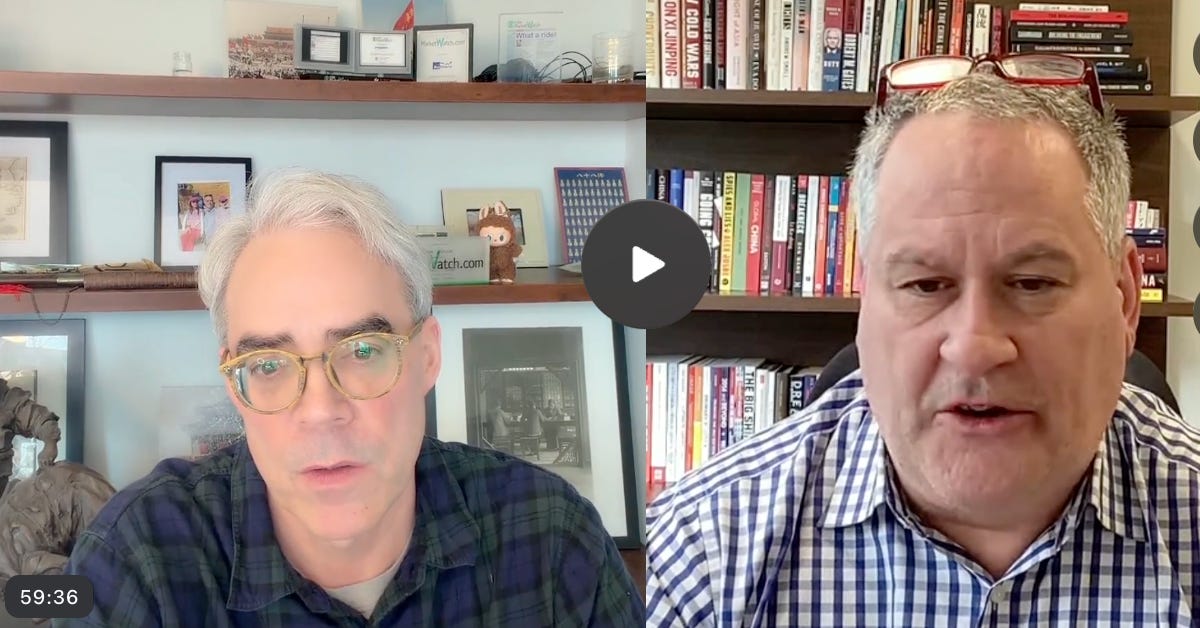 Sinocism live on US-China relations with the FT’s Demetri Sevastopulo | This a recording of a March 17 live conversation I had with Demetri Sevastopulo, US-China correspondent for the Financial Times. You can read all his recent FT stories here, and subscribe to him on Substack @ Demetri SevastopuloWe had a fascinating conversation about US-China relations, now and in Trump’s first term, when he was Washington Bureau Chief, for the FT, Trump’s delayed China trip and why it may be delayed longer than 5-6 weeks, Taiwan, and the visit later this week to Washington by Japanese Prime Minister Takaichi.Thank you to Demetri and everyone who tuned in live, and apologies for the brief technical glitch at the start. This is a public episode. If you'd like to discuss this with other subscribers or get access to bonus episodes, visit sinocism.com/subscribe | 59m 36s | ||||||
| 2/3/26 |  LIVE with Bill Bishop: The world order is shifting — and China is moving fast to shape it. | Thank you Inês Carrières, LeftieProf, scott murphy, Andrew Polk, Dan Houghton, and many others for tuning into my live video with Tara Palmeri! This is a public episode. If you'd like to discuss this with other subscribers or get access to bonus episodes, visit sinocism.com/subscribe | 36m 33s | ||||||
| 1/29/26 | 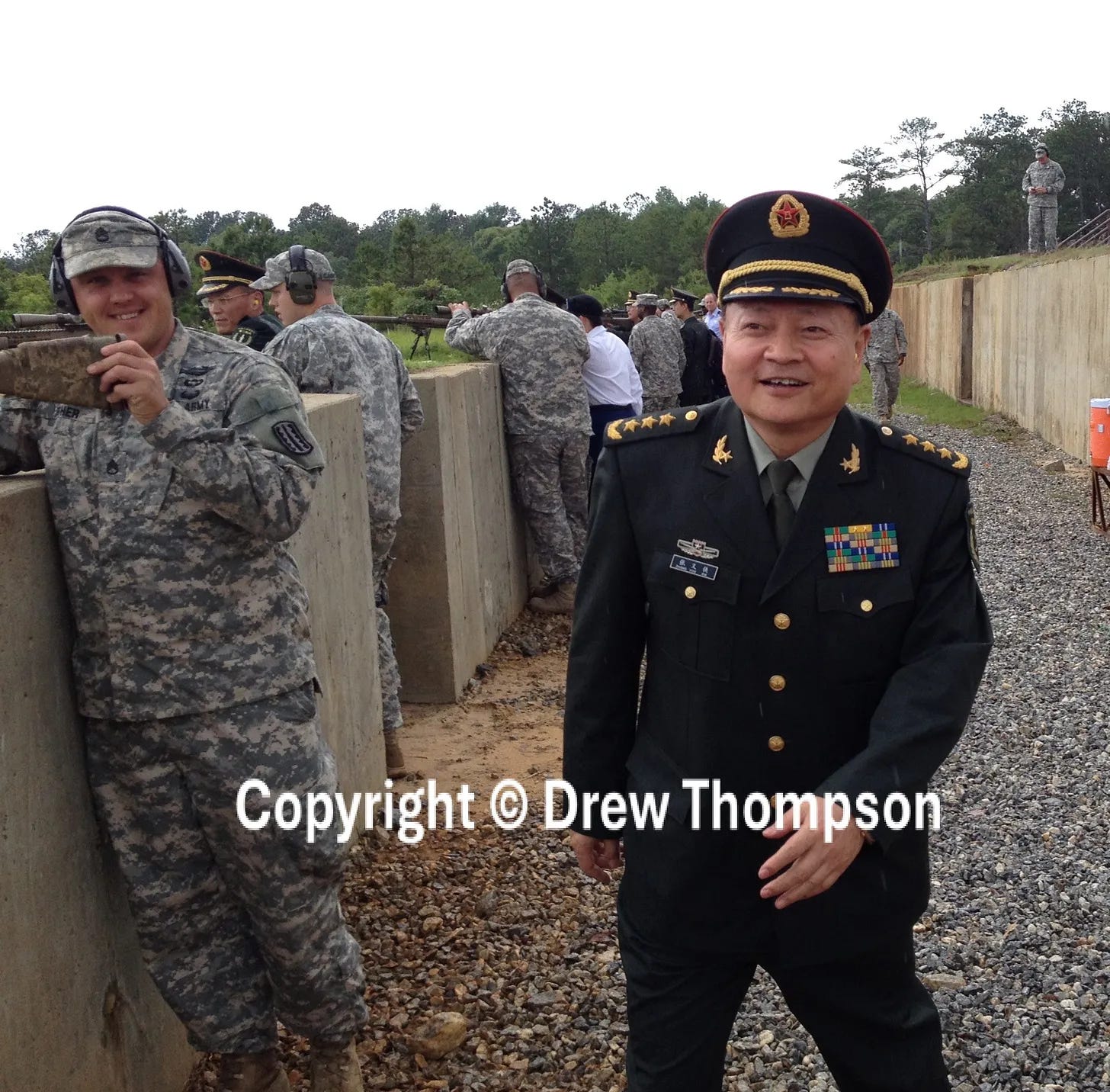 The Zhang Youxia case - Sinocism Live with Bill Bishop and Drew Thompson | Thanks everyone who tuned into my live video with Drew Thompson. Drew is now based in Singapore as a Senior Fellow at the S. Rajaratnam School of International Studies (RSIS) at Nanyang Technological University.From 2011-2018 he was the Director for China, Taiwan and Mongolia in the Office of the Secretary of Defense. In 2012 he planned and organized a visit to the US of a delegation led by then-Defense Minister General Liang Guanglie. Zhang Youxia was part of the delegation.We had a great discussion about his personal experience shepherding Zhang Youxia around the US many years ago, his work on US-China military-to-military relations, and the disappearance in 2023 of South China Morning Post reporter Minnie Chan.Drew wrote about his experience with Zhang in the excellent The demise of Zhang Youxia hits different. You can and should subscribe to him @ Drew ThompsonThanks. This is a public episode. If you'd like to discuss this with other subscribers or get access to bonus episodes, visit sinocism.com/subscribe | 1h 02m 02s | ||||||
| 11/20/25 | 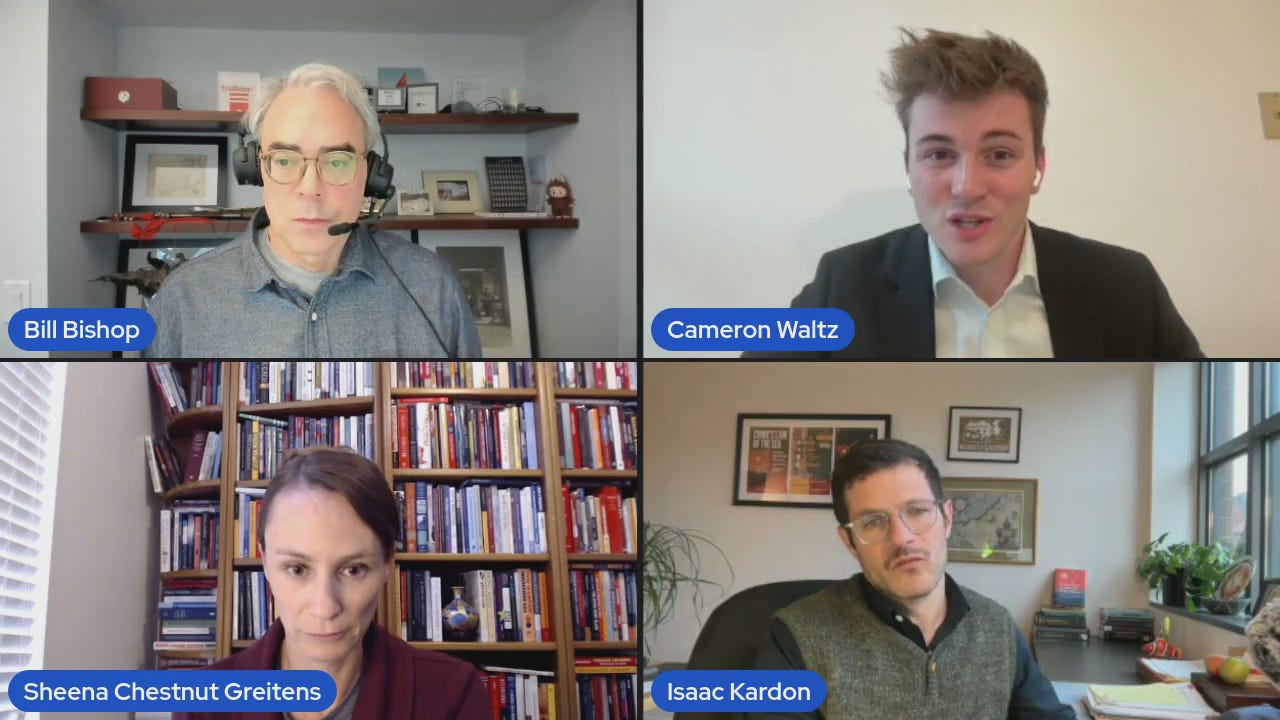 Sinocism Live: Beijing’s strategy to remake global security | This is a recording of my November 20, 2025 discussion with Sheena Chestnut Greitens ( Sheena Chestnut Greitens), Isaac B. Kardon (CHINA: Threat or Menace on Substack), and Cameron Waltz about their excellent and important new paper China’s Foreign Police Training: A Global Footprint - Carnegie Endowment for International Peace.I learned a lot from the paper and the conversation, and we had a good discussion at the end about whether or not China is using this security cooperation and training to export its governance model.From the summary of the paper:Global outreach by China’s internal security agencies is expanding. As China’s Global Security Initiative externalizes a concept of security focused on domestic stability and regime protection, the People’s Republic of China (PRC) has increased its efforts to train and build capacity among foreign law enforcement and internal security forces around the world, including across Asia, Africa, and Latin America. Foreign police training is one of the most concrete and measurable outcomes associated with the Global Security Initiative, as President Xi Jinping and other Chinese leaders have publicly committed to training thousands of foreign security officers in multiple high-profile appearances.This paper examines China’s foreign police, security, and paramilitary training from 2000 to 2025. It draws on an original new dataset of nearly 900 trainings provided to at least 138 countries and places these trainings in the wider context of Chinese soft power, foreign policy objectives and projects such as the Global Security Initiative, broader patterns of Chinese security engagement, and Beijing’s narratives about China’s role as a global security provider.You can read the whole paper here.Earlier this year they published A New World Cop on the Beat? China’s Internal Security Outreach Under the Global Security Initiative.If you prefer to consume the Sinocism Live episodes as a podcast, please add this URL to the podcast player of your choice:https://api.substack.com/feed/podcast/2/s/7556.rssYou can also listen to it in the app:Thanks for watching/listening. This is a public episode. If you'd like to discuss this with other subscribers or get access to bonus episodes, visit sinocism.com/subscribe | 1h 07m 53s | ||||||
| 10/31/25 | 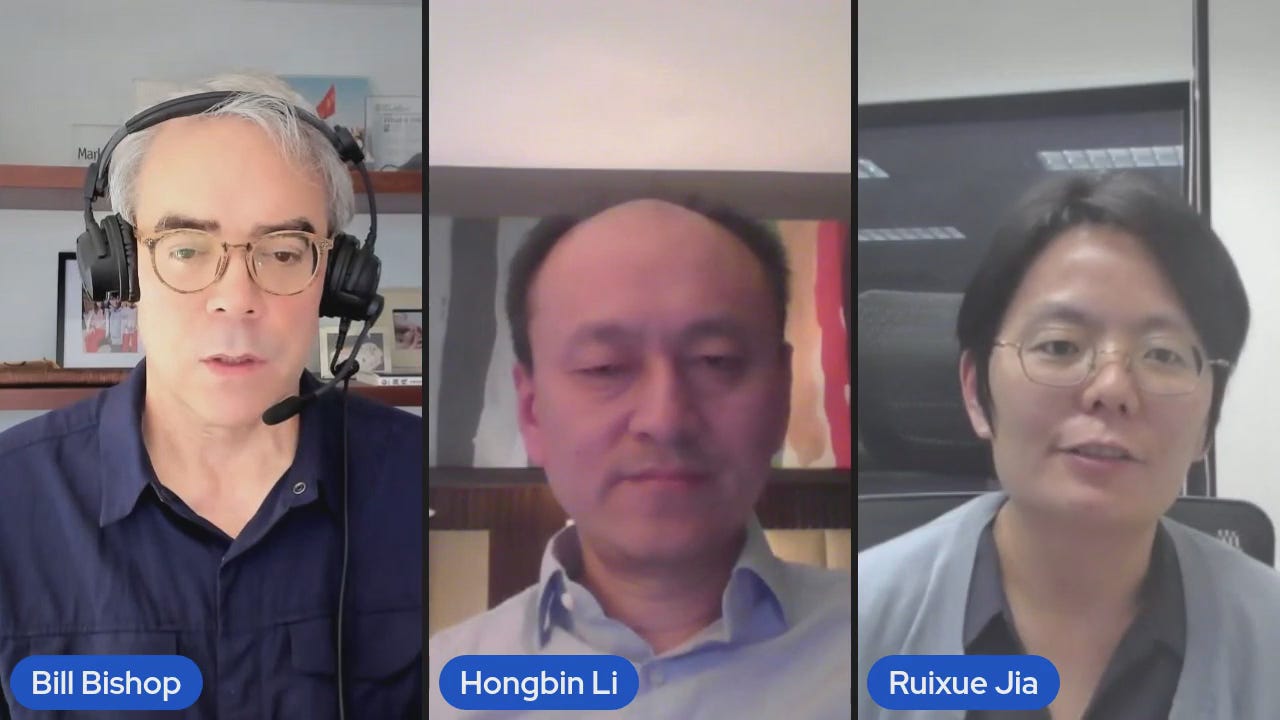 Sinocism Live: Understanding China's Exam-centric Education System | This is a recording of my October 31, 2025 discussion with Ruixue Jia and Hongbin Li about their excellent and important new book The Highest Exam - How the Gaokao Shapes China.From a synopsis of the book:In The Highest Exam, authors Ruixue Jia, Hongbin Li, and Claire Cousineau present a sweeping, data-rich account of China’s exam-centered education system — a “centralized, hierarchical tournament” culminating in the Gaokao, a grueling three-day college entrance exam. Drawing on decades of empirical research and lived experience, Jia and Li — both leading economists who took the Gaokao and later taught at top universities in Beijing, Hong Kong, and the U.S. — reveal how this state-managed system shapes education, labor markets, political legitimacy, and social values.You can buy the book here: The Highest Exam - How the Gaokao Shapes China. It is well-written and priced like a normal book, not an academic one. You can not understand China without understanding the Gaokao system, so this is an important and very useful book.If you prefer to consume the Sinocism Live episodes as a podcast, please add this URL to the podcast player of your choice:https://api.substack.com/feed/podcast/2/s/7556.rssYou can also listen to it in the app:Thanks for watching/listening. This is a public episode. If you'd like to discuss this with other subscribers or get access to bonus episodes, visit sinocism.com/subscribe | 1h 12m 38s | ||||||
| 10/30/25 | 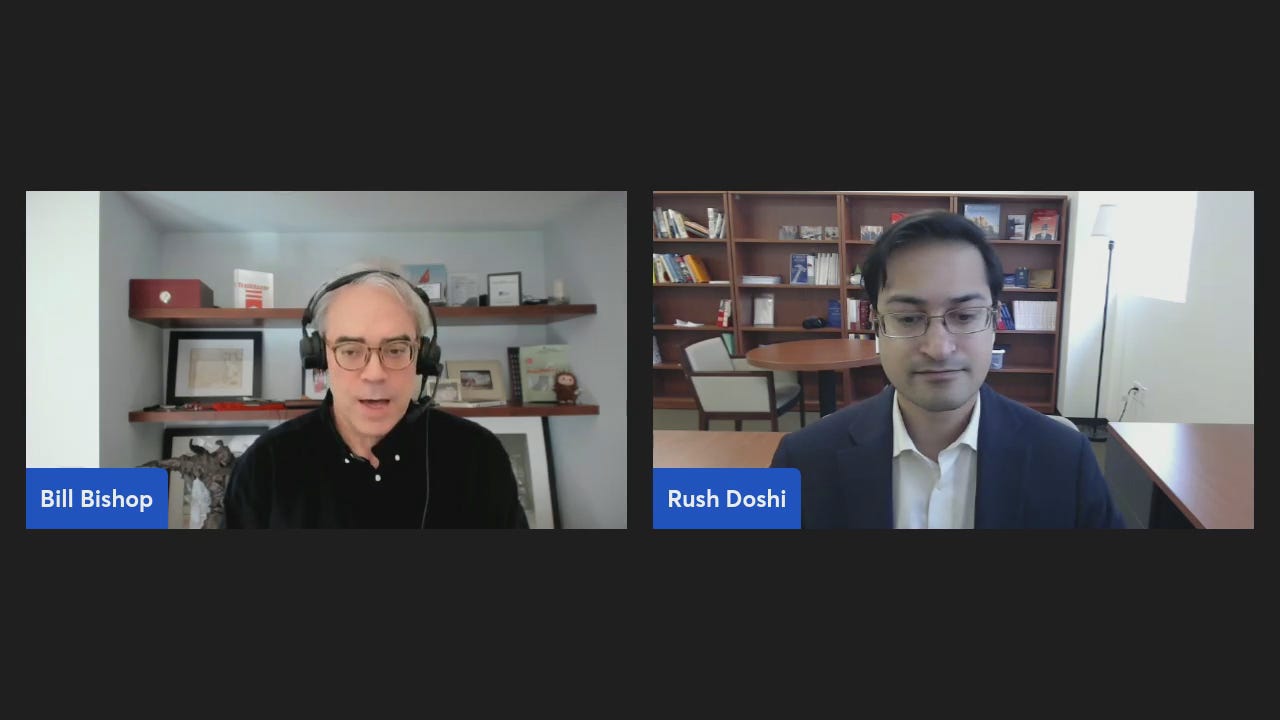 Sinocism Live: Rush Doshi on the Trump-Xi meeting and US-China Relations | This is a recording of my October 30, 2025 conversation with Rush Doshi, the C.V. Starr senior fellow for Asia studies and director of the China Strategy Initiative at the Council on Foreign Relations (CFR) and an assistant professor in Georgetown’s School of Foreign Service.Rush Doshi was deputy senior director for China and Taiwan on President Joe Biden’s National Security Council (NSC), where he served from 2021 to 2024 and helped manage the NSC’s first China directorate.During his time in the Biden Administration he worked on multiple Biden-Xi engagements, so I thought he would be a great guest to help us parse through the Trump-Xi meeting in South Korea and what it means for US-China relations. He did not disappoint.Rush is about to launch a new Substack called “The Great Changes 大变局. You can and should subscribe to it here.You can catch up with many of Rush’s recent writings and podcast appearances here on his CFR page.Thanks for watching/listening. This is a public episode. If you'd like to discuss this with other subscribers or get access to bonus episodes, visit sinocism.com/subscribe | 58m 54s | ||||||
| 10/24/25 | 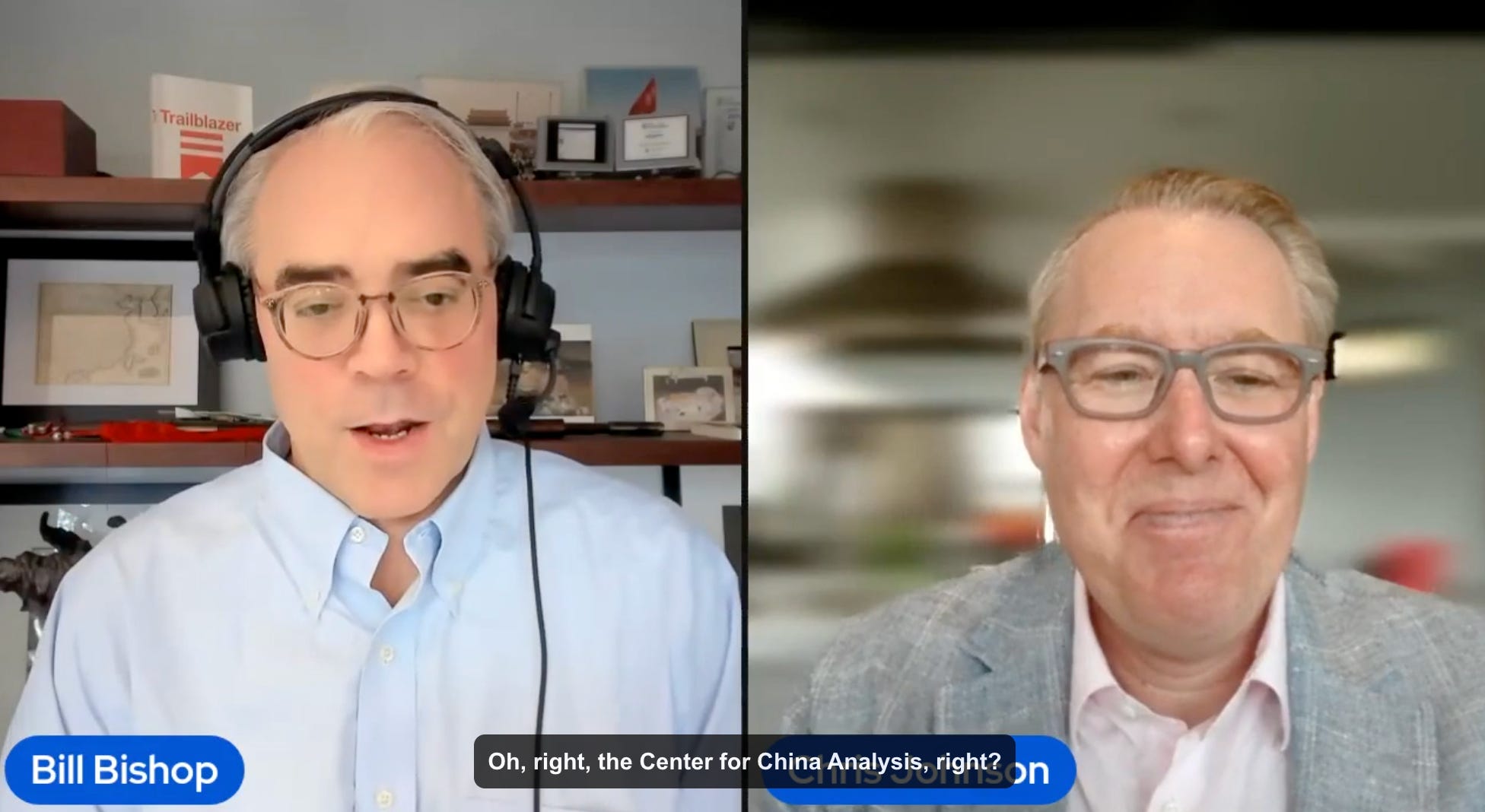 Sinocism Live: The Fourth Plenum and US-China relations with Chris Johnson | This is a recording of my October 24, 2025 conversation with Chris Johnson, CEO of China Strategies Group and a former top China analyst at the CIA, about the recently concluded Fourth Plenum, and specifically the ongoing purges in the PLA, and US-China relations ahead of next week’s Trump-Xi meeting in South Korea.Chris wrote a guest piece for Sinocism earlier this week on Xi and succession - Forever Xi Jinping? Perhaps Not.If you prefer to consume the Sinocism Live episodes as a podcast, please add this URL to the podcast player of your choice:https://api.substack.com/feed/podcast/2/s/7556.rssYou can also listen to it in the app:Thanks for watching/listening. This is a public episode. If you'd like to discuss this with other subscribers or get access to bonus episodes, visit sinocism.com/subscribe | 1h 07m 41s | ||||||
| 10/16/25 | 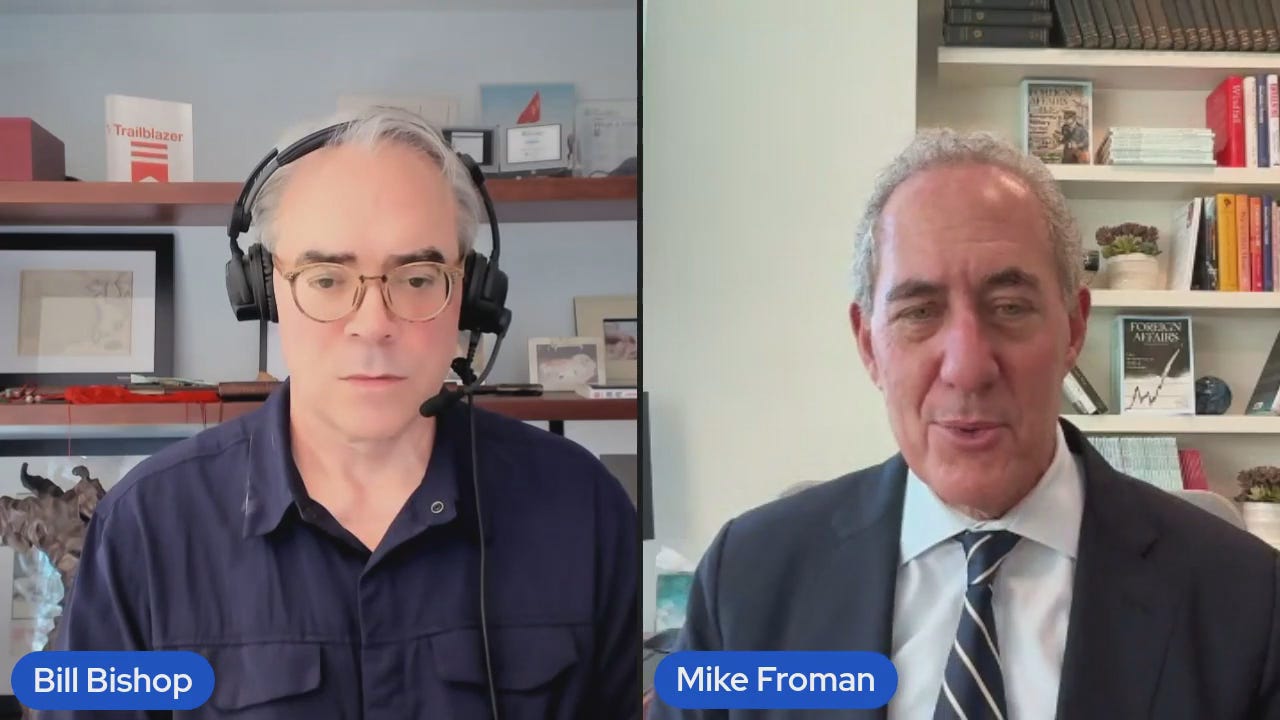 Sinocism Live: Council on Foreign Relations President Michael Froman on the US-China trade war | This is a recording of my October 16, 2025 conversation with Ambassador Mike Froman Mike Froman about recent developments in the US-China trade war and US-China relations in general. I learned a lot from this conversation and I think you will as well.Ambassador Froman is president of the Council on Foreign Relations (CFR), and has had a distinguished career in the private sector and in public service, including as the head of USTR from June 2013 to January 2017. He now writes a weekly newsletter called The World This Week, to which I encourage everyone to subscribe. We also discussed some of his recent writings, including:After the Trade War: Remaking Rules From the Ruins of the Rules-Based System - Foreign AffairsChina Has Already Remade the International System - Foreign AffairsChina, the United States, and the AI Race | Council on Foreign RelationsThanks to everyone who watched our chat live. This is a public episode. If you'd like to discuss this with other subscribers or get access to bonus episodes, visit sinocism.com/subscribe | 1h 02m 32s | ||||||
| 10/14/25 | 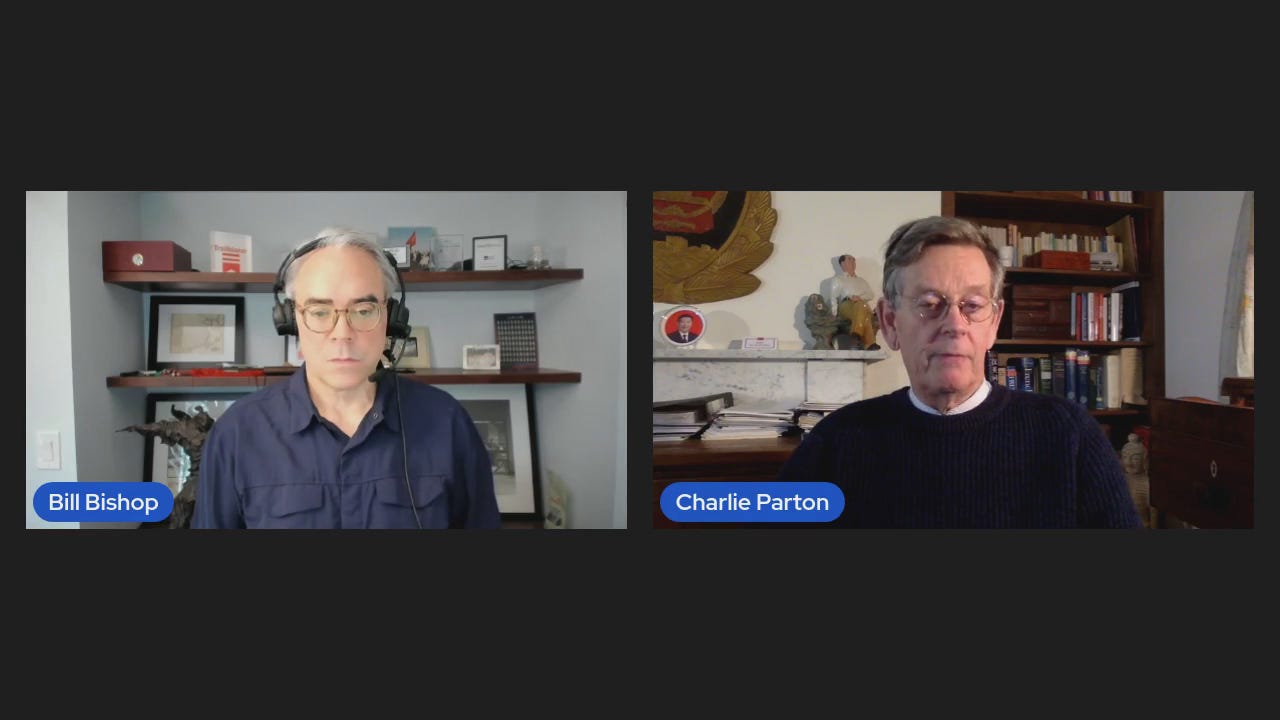 Sinocism Live: The UK-China spy scandal and UK-China relations with Charles Parton | This is a recording of my October 14, 2025 conversation with Charles Parton about the recent UK-China spy case and UK-China relations in general. Charles Parton OBE is the Chief Advisor to the China Observatory at the Council on Geostrategy. He spent 22 years of his 37 year diplomatic career working in or on China, Hong Kong and Taiwan. In his final posting he was seconded to the EU Delegation in Beijing, where, as First Counsellor until late 2016, he focussed on Chinese politics and internal developments, and advised the EU and Member States on how China’s politics might affect their interests.You can follow Charlie on Substack @ Charles Parton.Thanks to everyone who watched our chat live. This is a public episode. If you'd like to discuss this with other subscribers or get access to bonus episodes, visit sinocism.com/subscribe | 59m 46s | ||||||
| 9/22/25 |  Sinocism Live: Dispatches from China with Afra Wang and Jasmine Sun | Thanks everyone for tuning into my live video with afra Wang and Jasmine Sun. We had a great conversation about their recent trip to China, the differing views of AI in the US and China, and the ongoing narrative/vibe shift about China. I highly recommend their newsletters, and specifically the two essays that prompted this discussion:Afra Wang - Topology of "China AI"Jasmine Sun - America Against China Against America This is a public episode. If you'd like to discuss this with other subscribers or get access to bonus episodes, visit sinocism.com/subscribe | 59m 00s | ||||||
Want analysis for the episodes below?Free for Pro Submit a request, we'll have your selected episodes analyzed within an hour. Free, at no cost to you, for Pro users. | |||||||||
| 9/5/25 | 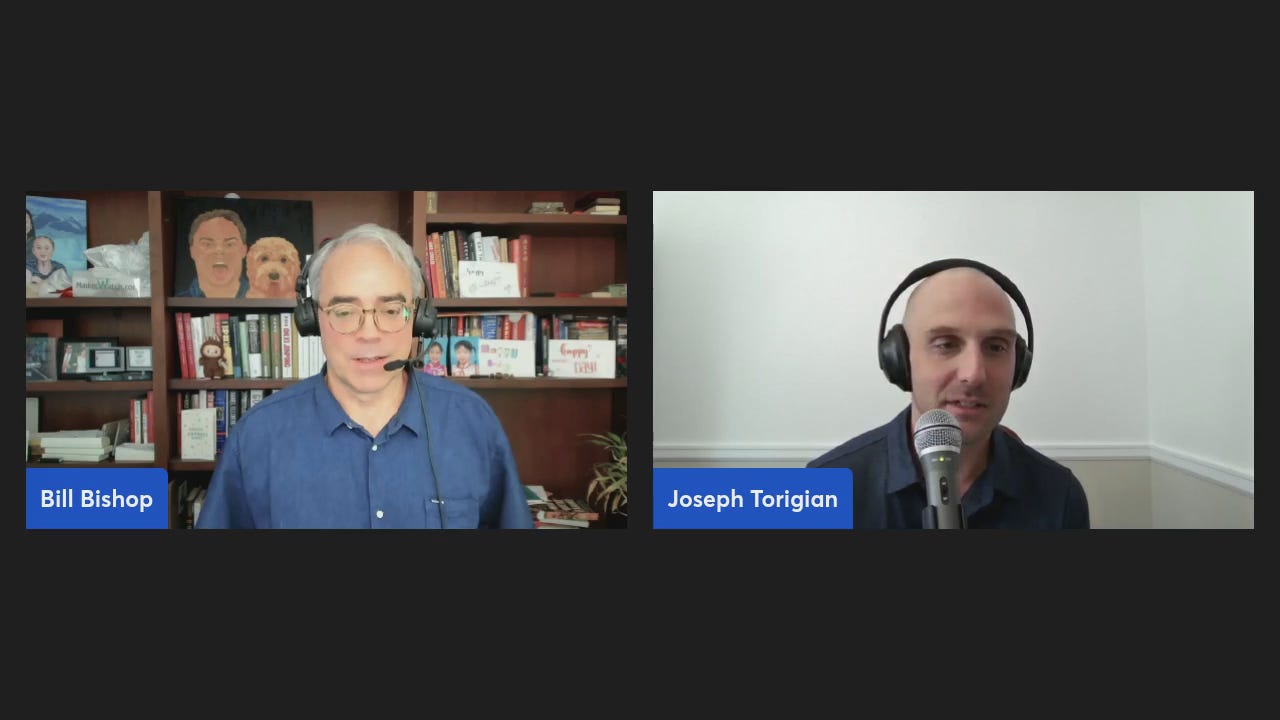 Joseph Torigian on Xi Zhongxun, Xi Jinping, Party History, and the 9.3 Parade | This is a recording from the September 4th live conversation I had with Professor Joseph Torigian about his excellent book on Xi Jinping’s father - The Party's Interests Come First - The Life of Xi Zhongxun, the importance of history to the Party, and to Xi Jinping, and how we might view the recent commemoration of the 80th anniversary of the “Victory in the Chinese People’s War of Resistance Against Japanese Aggression and the World Anti-Fascist War”. This is a public episode. If you'd like to discuss this with other subscribers or get access to bonus episodes, visit sinocism.com/subscribe | 59m 40s | ||||||
| 7/22/25 | 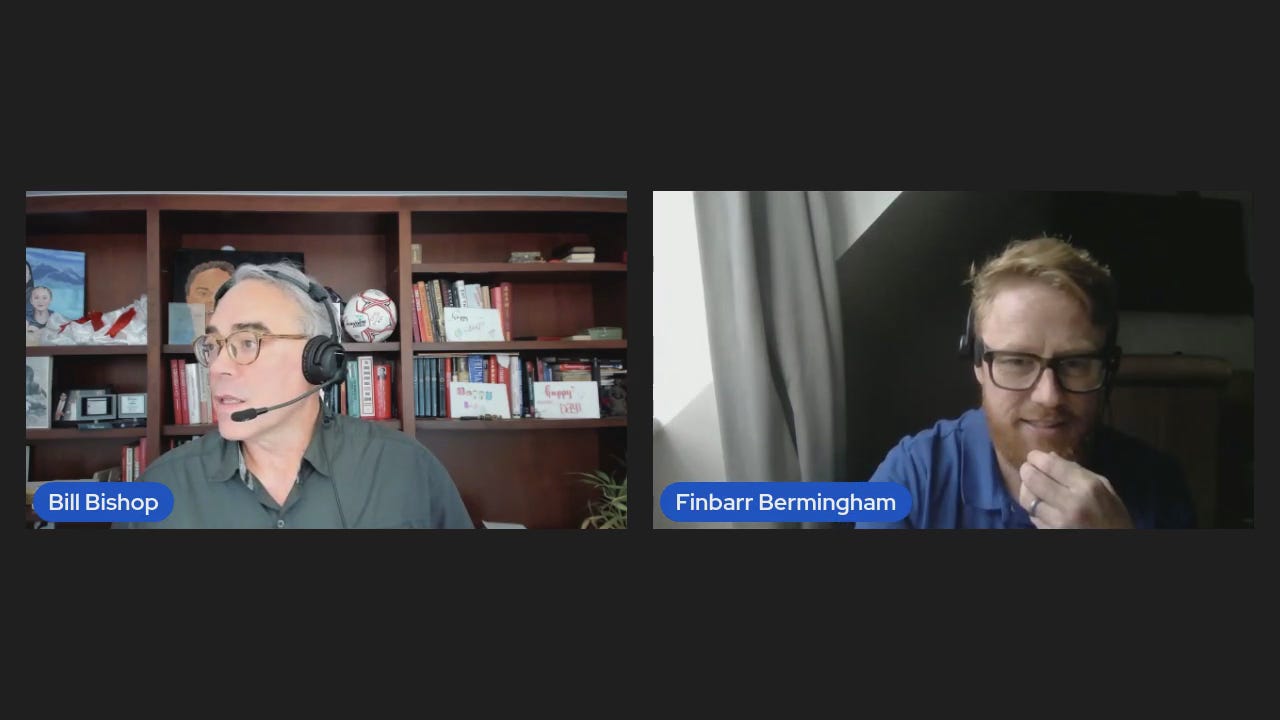 Sinocism Live: Previewing the EU-China Summit with Finbarr Bermingham | On July 22nd I spoke with Finbarr Bermingham, Brussels-based senior correspondent for the South China Morning Post whose beat includes EU-China relations. He has in a roll with scoops about EU-China relations, including China tells EU it does not want to see Russia lose its war in Ukraine earlier this month.He explains what to expect from the EU-China summit that convenes July 24th, and how EU-China relations have deteriorated over the last several months. Apologies, we had some technical difficulties at the start and briefly a few minutes in.He is active on Substack Notes Finbarr Bermingham This is a public episode. If you'd like to discuss this with other subscribers or get access to bonus episodes, visit sinocism.com/subscribe | 1h 00m 12s | ||||||
| 7/2/25 | 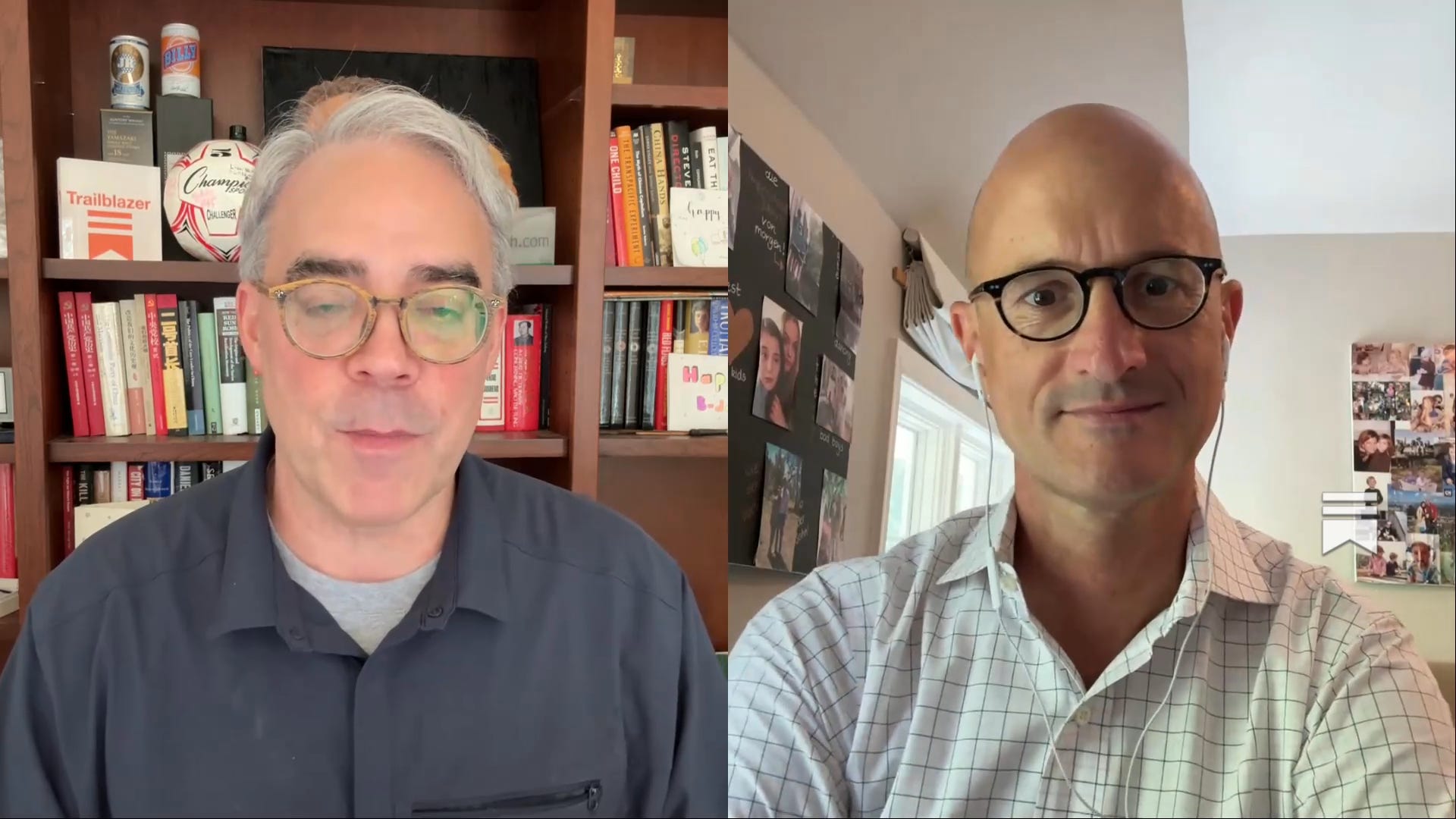 All about the RMB with Robin Brooks | On Wednesday, July 3rd I hosted Robin J Brooks for a discussion about the RMB. Robin is a Senior Fellow at the Brookings Institution, and formerly Chief Economist at the IIF and Chief FX Strategist at Goldman Sachs. He writes an excellent and free Substack which I highly recommend.Some of Robin’s views may be controversial to some, especially his argument that the PRC has more leverage over the US in the trade war because it was the very slight devaluation of the RMB against the USD just after the April 2nd tariff “Liberation Day” that was the proximate cause of the US bond market going “yippy”, which ultimately forced President Trump to back down. We had a good back and forth on that topic.I learned a lot from the whole conversation and I think you will too. And if you enjoyed it please “like” it and restack it on Substack, and send to your friends and contacts. Thanks for watching. This is a public episode. If you'd like to discuss this with other subscribers or get access to bonus episodes, visit sinocism.com/subscribe | 57m 35s | ||||||
| 6/26/25 |  The China video game market with Niko Partners | On Wednesday June 25th I hosted a discussion with Lisa Hanson and Daniel Ahmad of Niko Partners about the China video game market and how Chinese game firms are going global This is a public episode. If you'd like to discuss this with other subscribers or get access to bonus episodes, visit sinocism.com/subscribe | 46m 03s | ||||||
| 6/9/25 |  Live with Bill Bishop and Tu Le on China EVs | Thanks to everyone who joined the live discussion today.This is a recording of a June 9th, 2025 Sinocism Live conversation with Tu Le, Founder and Managing Director of Sino Auto Insights.We had a wide-ranging conversation about the state of the EV market in China, the recent BYD price cuts,Tesla’s China prospects, autonomous driving and the prospects for legacy car makers globally.If you are interested in EVs, China and globally, you should sign up for the free weekly Sino Auto Insights newsletter.Thanks. This is a public episode. If you'd like to discuss this with other subscribers or get access to bonus episodes, visit sinocism.com/subscribe | 1h 02m 43s | ||||||
| 4/1/25 | 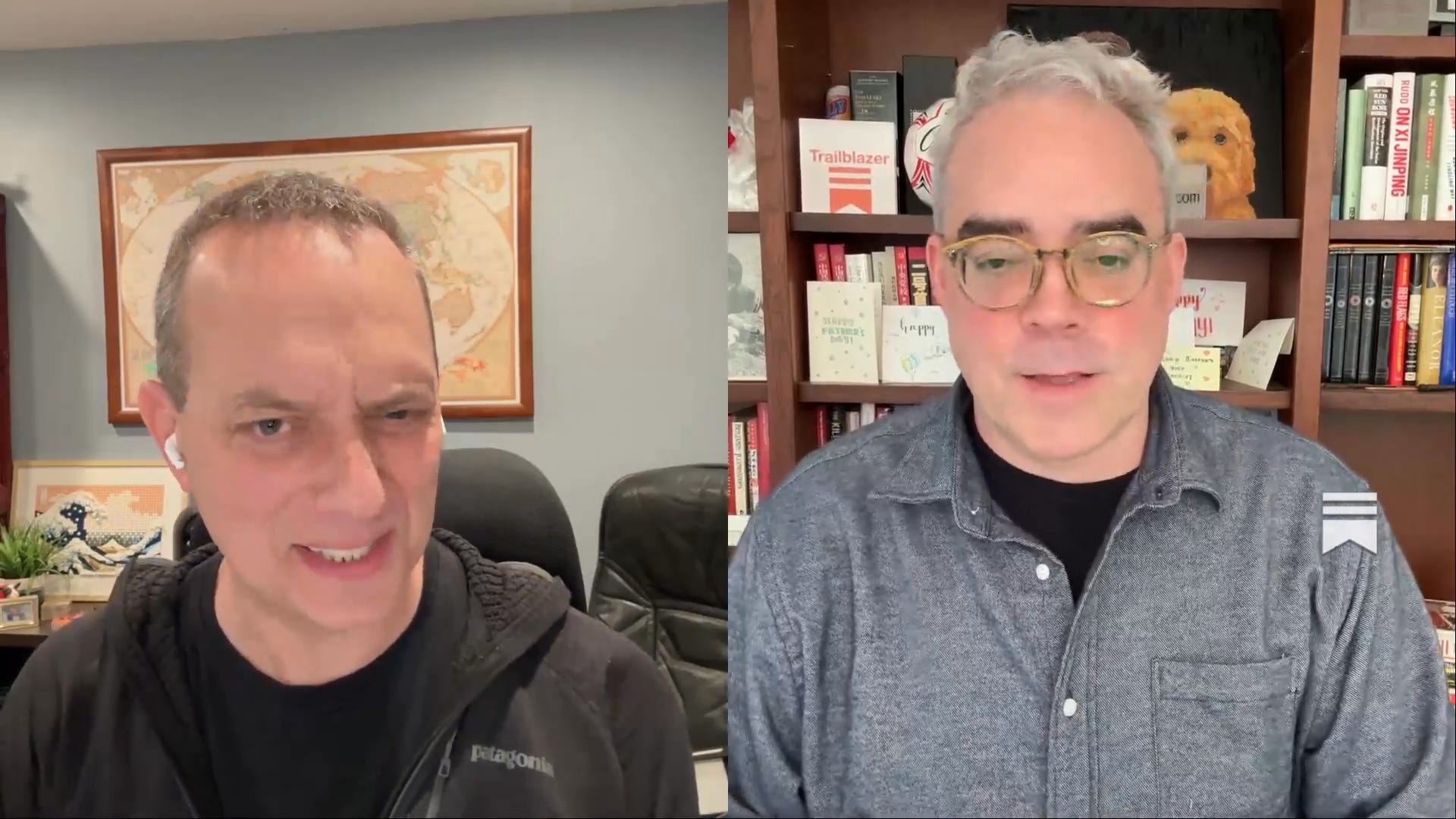 WTF2.0: Bill Bishop | I joined Jonathan V. Last on his show at The Bulwark to chat about China and the Trump Administration. This is a public episode. If you'd like to discuss this with other subscribers or get access to bonus episodes, visit sinocism.com/subscribe | 40m 59s | ||||||
| 3/21/25 |  Sinocism Live: A chat with Jon Czin about US-China, Xi Jinping & some other fun topics | Thanks to everyone who joined the live discussion tonight.This is a recording of a March 20th, 2025 Sinocism Live conversation with Jonathan Czin, now the Michael H. Armacost Chair in Foreign Policy Studies at the Brookings Institution, and before that was for many years at the CIA as one of the US intelligence community’s top China experts. He was director for China at the National Security Council from 2021 to 2023, where he staffed all of President Biden’s interactions with President Xi.I learned a lot from Jonathan Czin in this conversation and I think you will too. His recent work:What Beijing wants from a US-China trade war - BrookingsBurying Deng: Xi Jinping and the Abnormalization of Chinese Politics - China Leadership MonitorThoughts on the political demise of Miao Hua - BrookingsAbetting competition, restraining Beijing: Recommendations for diplomacy toward China - BrookingsAnd his bio:Jonathan A. Czin is joining the Brookings Institution as the Michael H. Armacost Chair in Foreign Policy Studies and a fellow in the John L. Thornton China Center. He is a former member of the Senior Analytic Service at CIA, where he was one of the intelligence community’s top China experts.Czin led the intelligence community’s analysis of Chinese politics and policymaking, playing a central role in assessing and briefing senior policymakers on President Xi Jinping, his rise to power, and decisionmaking on an array of key issues and crises. From 2021 till 2023, he was director for China at the National Security Council, where he advised on, staffed, and coordinated White House and inter-agency diplomacy with the People’s Republic of China, including all of President Biden’s interactions with President Xi, and played a leading role in addressing a wide range of global China issues.He also served as advisor for Asia-Pacific security affairs in the Office of the Secretary of Defense, and overseas at a CIA field station in Southeast Asia. Czin holds a master’s in international relations from Yale University, graduated magna cum laude from Haverford College, and studied at Oxford University. He is proficient in Mandarin Chinese. This is a public episode. If you'd like to discuss this with other subscribers or get access to bonus episodes, visit sinocism.com/subscribe | 1h 00m 05s | ||||||
| 1/18/25 |  Chris and Bill talk TikTok ban and US-China under Trump | I had a good conversation this afternoon with Chris Cillizza about what may happen in the next few hours with TikTok Us, and how President-elect may try to undo the ban. we also chatted a bit about what US-China relations may look like in the Trump 2.0 Era.Join me for my next live video in the app. This is a public episode. If you'd like to discuss this with other subscribers or get access to bonus episodes, visit sinocism.com/subscribe | 59m 03s | ||||||
| 10/12/24 | 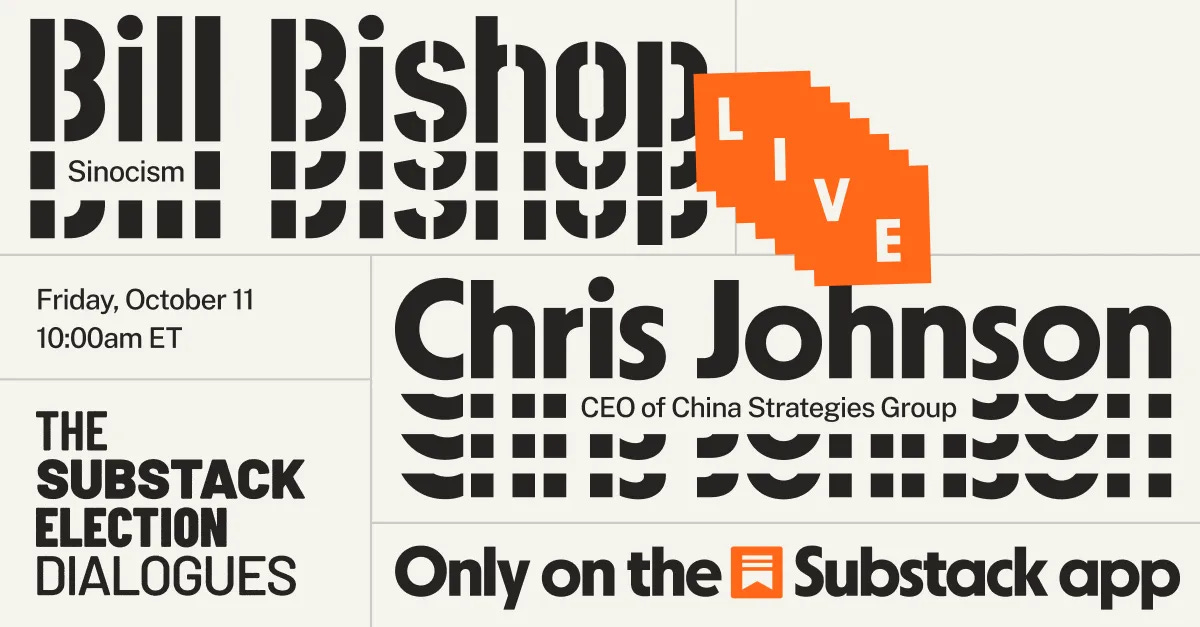 Substack Election Dialogues: China and the US election | Thanks to everyone who tuned in live to my Friday discussion with Christopher Johnson on China and the US election. Our talk was part of the ongoing Substack Election Dialogues. Chris is President and CEO of China Strategies Group. He served for nearly two decades in the United States Government’s intelligence and foreign affairs communities. In addition to his work advising multinational corporations on their business and commercial strategies in China and greater East Asia, his insights on the Chinese leadership and on Beijing’s economic, commercial, foreign and security policies are regularly sought by senior Administration, Congressional, military, and foreign government officials. Chris also serves as a Senior Fellow on Chinese Politics at the Asia Society Policy Institute's Center for China Analysis.The live videos are first available in the Substack app, and that is also where you can find me most days on Notes and in the Sinocism chat:I hope you enjoy this discussion, let me know if you think I should do more.Thanks This is a public episode. If you'd like to discuss this with other subscribers or get access to bonus episodes, visit sinocism.com/subscribe | 55m 30s | ||||||
| 5/9/23 | 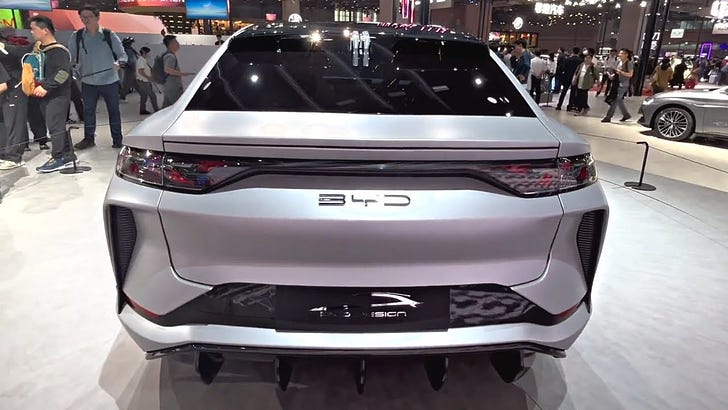 Sinocism Podcast: Tu Le of Sino Auto Insights on the rise of the China vehicle industry | In this episode of the Sinocism Podcast Bill speaks with Tu Le, Founder and Managing Director of Sino Auto Insights. Tu recently attended the Shanghai Auto Show. We discuss the rise of China EVs both inside China and increasingly in other countries, and especially of BYD, why the legacy foreign auto manufacturers are struggling and will continue to struggle in China, and how “China EV Inc” will win share in many overseas markets. We also discuss Tesla’s positioning in the PRC and some if its challenges ahead, especially from BYD, both inside the PRC and in other markets around the world.Links:Sino Auto InsightsSino Auto Insights newsletterDoug DeMuro reviews the BYD Han:The BYD Song L:Transcript:[00:00:00] Bill: Welcome back to the Sinocism podcast. Today we're very lucky to have Tu Le to talk about the PRC auto industry. Tu is the founder and managing director of Sino Auto Insights. Tu recently relocated to Detroit after many years in Beijing. Tu and his team at Sino Auto Insights do advisory and market research work for companies and investors who want to understand the PRC auto industry and especially the rise of Made in China EVs. He also writes an excellent weekly newsletter and does a podcast and occasional or weekly, I think, , Twitter spaces. I will put links to those in the show notes. Tu, welcome and thanks for joining the podcast. Great to see you again.[00:00:36] Tu Le: Bill first. , thanks for having me. Last time we saw each other, I think we were at Central Park having a coffee at Jamaica Blue. That quite a few years ago.[00:00:47] Bill: Tu and I are old friends from, from Beijing. , so, and, and it's, it's good to see you and, , nice to have you, , back in the US and Detroit. , Detroit is home, right. But it's also a great place to be if you're working on the auto industry.[00:00:59] Tu Le: Yeah. It's kind of ground zero for what's happening in the EV and mobility space. So, so it's, it's a great time to be back.[00:01:05] Bill: I've been really wanting to get you on the podcast for a while and I got finally motivated to do so after reading, what you were talking about from the Shanghai Auto Show, which you were, you, you just came back from China, I think, like a week ago, right? You're there for Tu or three weeks, , and nice to be able to travel again, right?[00:01:21] Tu Le: Oh, man. It was, , it was kind of, , surreal because the last time I traveled internationally from China, we were just, we had bags packed and everything, so a little bit different.[00:01:35] Bill: Yeah, no, much, much better. , and I think, you know, the Shanghai Auto Show clearly rocked a lot of people's worlds, and so Tu is going help us understand what's going on, and that's why, you know. So I wanna start though, first with, if you could just tell us a little bit about yourself and how you ended up in China, working in the audio industry and, and what your firm does.[00:01:54] Tu Le: Okay, sure. So, as you'd mentioned, I grew up in Detroit, actually in Pontiac, Michigan.. In my entire family, all eight of us have worked. In the automotive space, along with our significant others. And, my first job, actually out of undergrad at Michigan State University was working at GM where the recently canceled Bolt is manufactured.[00:02:16] Tu Le: After grad school I moved to Silicon Valley, worked there for about six, seven years., and I met a girl and chased her over to Beijing actually. So I quit my Silicon Valley job and what I thought was going be a three or four year commitment ended up being 13 years. I had moved to Shanghai, took a job with Ford in Lujiazui actually for about a year, and then moved back to Beijing due to some family stuff going on.[00:02:46] Tu Le: And, then I started freelance consulting and worked at a couple of Chinese e e e-commerce startups in Beijing. And then I got pulled over to do some freelance consulting because one of my, friends. Had found out that I had some automotive background and, you know, Mercedes, BMW and Audi, they're all located, and VW group are located in Beijing.[00:03:09] Tu Le: And so I started Sino Auto Insights because, you know, right around 2014, 2015, where, you know, at ParkView Green, Tesla had opened the first retail store for China. And so I really started seeing, a shift in what was going on in the space and, a lot of articles and a lot of bad takes. So I started the newsletter, started the consultancy, because of my experience in Detroit, Silicon Valley and China with startups.[00:03:37] Tu Le: It's been quite an adventure and we, what we do is we, , , , we're a management consultant consultancy that helps mobility companies enter markets, develop products, raise capital and build their brand and work with them to find customers. And so we were focused primarily in the China market, but now we've kind of expanded because China, EV Inc.[00:04:05] Tu Le: Has expanded. And with the Inflation Reduction Act, we've recently opened a Detroit office and are, are starting to help companies here expand into the EV space and the mobility space.[00:04:20] Bill: Oh, that's fascinating. And I just, just to your, like what you mentioned about the, Tesla dealership at, or the, the showroom at, at the phone call the Parkview Green. ,I actually, you know, we both, we lived near there. Our, my kids went to school next to it, I think years went to Fangcaido, right.[00:04:35] Tu Le: That's right, exactly. I live right next door,[00:04:37] Bill: you go.[00:04:38] Bill: Right. And so, and so I went there right after it opened with a friend with a, with a friend of mine from Henan who had like, he had a a, a couple of 730s and a BMW very, you know, had like cars had, could buy what he wanted. And it was really fascinating because he wanted to buy a model S right early on.[00:04:54] Bill: And he got in there and he's like, God, it's like, it's, it's just so bare bones that does not, you know, so he didn't buy it because he's just like, this is like, not this just, I wanted like a German luxury car.[00:05:06] Tu Le: and it was over $120,000[00:05:08] Bill: No, they were, they were quite expensive. I mean this was early, early days. Right. And obviously Tesla's done well since then, but it was just really interesting how when they entered the market, they were not at all focused on, I mean, they were, they were, they had a, a brand image, but actually inside the cars, the way they were appointed was not near what sort of Chinese luxury buyers were used[00:05:29] Tu Le: right, and, and I would venture to guess, your friend was probably a little bit older,[00:05:35] Bill: Hey. It was, it's like 40 at the time.[00:05:37] Tu Le: Okay. So he is pretty young because the digital natives, and, and we'll get into this a little bit later, but the digital natives are the ones that are really looking at the safety and the connected vehicle.[00:05:48] Bill: And the, and the screens that make it look like you're, like at a currency trading station, right.[00:05:52] Tu Le: oh, yo. Yeah.[00:05:53] Bill: I want to jump to something that you wrote in your, your latest, , newsletter, , which is excellent. Everyone subscribed to it. And I will link to it, as I said earlier.[00:06:04] Bill: , but the one, the one about the Shanghai Auto Show, so you wrote. In 20, 30, 50 years from now, we'll likely point to Aha Shanghai TW 2023 as that watershed moment. It's the moment most media outlets acknowledge that the foreign legacies that dominated the China auto market for the last 35 years or so have been overtaken and unable to compete with the EV products launched by China, EV, Inc.[00:06:31] Bill: Within just the last few years, the legacies haven't given up by any means, but the writing is on the wall. BYD overtook Volkswagen as China's best selling brand in, first quarter 2023, the first time it's ever happened, BYD has no plans of giving up that title for the foreseeable future and are likely only only going to pull away even further.[00:06:53] Bill: China will never be like it was again, where brand heritage and being foreign gave you an advantage.” So if you're a foreign auto manufacturer…the sense I got from talking to some people reading the media was the foreign, some of the foreign execs who went to the auto show were shocked.[00:07:16] Bill: And so like, like what do they do? And more importantly, how did they fall behind so quickly? Right? I mean, they have had massive operations in China for decades. Didn't they have a flow of information that helped them understand how the market was changing?[00:07:30] Tu Le: So there's a few different things going on here, Bill. I think that the fact that most executives outside of the top management haven't been able to travel to China in three and a half years really limited their ability to kind of see and feel the differences and the changes. I was in China for most of that three and a half years.[00:07:56] Tu Le: And I saw the proliferation of green plates over the last few years. ,[00:08:01] Bill: just to be clear green, green plates, or if you have an EV[00:08:05] Tu Le: Right. You and I lived in Beijing during the worst pollution days, and so it was kind of a necessary evil and what, what we'll likely see in India in the future, but that's another subject, and so for them to first be able to land in Shanghai as an international business, travel, see all the green plates from the fleet vehicles and the taxis and then all the way to the passenger vehicles when you get into Jing’An temple area and stuff like that, I think that really shocked them.[00:08:42] Tu Le: And then to go to the media days on Tuesday and Wednesday, the first days you could actually see, touch and feel the vehicles. You know, they, they close, they make that sound like German cars and the, the fit and finish is much, much better than it was 5, 6, 7, 8 years ago. And so you could always tell the European or German executives, because the uniform, they wear that suit with no tie, white shirt and[00:09:11] Bill: And tears streaking down their face.[00:09:14] Tu Le: So it was just an, it was an awestruck moment, but also what do we do? Like, how, how did they get so far ahead and, and how do we catch up? Because most executives, most automotive, traditional automotive executives have no idea about software and hardware, software integration. And so, and user experience, because most automotive companies, their products are product focused, whereas tech companies are user focused.[00:09:45] Tu Le: And in, in the high tech world, everything's an operating expense. In the traditional automotive sector, everything's a capital expense. And so how you think about financing your new products, it's completely different. And, you know, traditional automotive is just very slow, product life cycles of 5, 6, 7 years.[00:10:04] Tu Le: Whereas every tech product you get is new every 10 to 14 months. And so, , there, it's, it wasn't just that the products were higher quality, it, it was also the number of them and the number of competitors. And we've seen. a decline, a sharp decline over the last several years in GM sales in Volkswagen, group sales in Ford sales.[00:10:33] Tu Le: So they've seen this coming, but if we look at how Volkswagen and GM specifically, and Toyota, to a lesser extent have grown and become these global, number one, number Tu, number three automotive players. It's because of the China market. And, and they were making money hand over fist along with their JV partners.[00:10:56] Tu Le: So they, they had no incentive to disrupt themselves.[00:10:59] Bill: They were fat and happy,[00:11:01] Tu Le: Yeah. I want to give Tesla a decent amount of credit because you and I know about this catfish effect because in 2016, so, so Nio, Peng and Li Auto, those companies were established in about 2014, 2015. And they've been, they were struggling for quite some time.[00:11:21] Tu Le: Nio was close to bankruptcy.[00:11:23] Bill: they got rescued by that, provincial government. Right. Or[00:11:26] Tu Le: That's right. Hefei government. Yep. And so if you look at where the hockey stick starts, it's right around 2019. And guess what? Factory opened up in 2019. Exactly. It's exactly. So the first vehicle for the model three, the Made in China model three rolled off in December of 2019.[00:11:48] Tu Le: So Tesla should get a decent amount of credit for bringing a lot of attention to the Chinese EV sector, but also bringing the level of competition up. And that's where we're at currently. Because actually, if you look at the US and European markets, I would say Tesla is aggressively playing offense, but in the Chinese market, they're playing a little bit more defense with the price cuts.[00:12:11] Bill: Well, that, well, that's, so a couple things there. One is, , sort of, I guess the, the traditional carbon manufacturers were also, you know, a bit, been a bit to be, euphemistic behind the curve when it comes to Tesla outside of China. I just wonder though, I mean, I would imagine that the staff and the executives in China for these foreign firms would've been reporting about what was going on.[00:12:36] Bill: Is it just a case of like the, the foreign headquarters not wanting to listen to the local staff or not believing what they were being told, or they just couldn't do it culturally? They just couldn't, even if they understood intellectually, they just couldn't believe that this could be possible.[00:12:52] Tu Le: yes. You know, I think, I think all of the above. I think the speed at which everything changed and we're talking three and a half years effectively.[00:13:03] Bill: like one software update in an American car….[00:13:07] Tu Le: Yeah.[00:13:07] Bill: little facetious, but[00:13:09] Tu Le: And so, , you know, China's the largest, passenger vehicle market in the world. It has been since 2009. United States is a close, there's not, not a very close second, but their second place. But, again, if you are just printing money because of the brand logo on the front of your vehicle, you're not super incentivized to disrupt yourself.[00:13:38] Bill: So classic.[00:13:39] Tu Le: this came sneaking up. So, so I'd like to think that since I've been writing this newsletter for the last five or six years, I'd like to think I kind of saw it coming and I was kind of warning[00:13:51] Bill: and you did. And you, you did. And it was interesting because it just like, people really paying attention said this stuff is happening. But it's just now become this broader, like,oh my God, the Chinese EVs are like amazing. And they're going, they're dominating China and they're, they're coming overseas.[00:14:09] Tu Le: Yeah. And, if I'm being honest and frank, it is a lot of hubris. Like how could a Chinese EV company[00:14:16] Bill: arrogance. Just arrogance and, and, and no, and, and frankly just being patronizing, like you said. How, I mean, how could a Chinese company this, we saw this, right? I mean, you know, didn't we see this with Japanese and Korean cars too in the US[00:14:29] Tu Le: Yeah. Exactly. And you know that when we were living there in 20 10, 20 11, you got into a BYD car. You didn't feel safe. It wasn't very nice. And you're going talk about this later, but you know, there are western car reviewers, Sandy Munro, and Doug DeMuro. Two of them that really think that BYD is building quality products.[00:14:56] Tu Le: Can they be improved? Of course they can, but they're globally competitive right now. We can talk about that a little bit later. But BYD, the other thing that I think is really not given a lot of, of, of attention. Wang Chuanfu the BYD CEO, Li Shufu the Geely founder.[00:15:21] Tu Le: They're as ambitious as Elon[00:15:27] Bill: And as talented.[00:15:29] Tu Le: Yes, yes. Without question. Without question. Now they're not on Twitter or they're not doing these huge marketing, , you know, presentations for new product launches, but guess what? They're, they're out there getting it done.[00:15:43] Bill: Yeah. They're world class executives.[00:15:46] Tu Le: yeah. So, , and I think they're starting to shine a spotlight on some of what they're doing. But now it's now it might be too late. So,[00:15:56] Bill: Interesting. So, , you mentioned Tesla, a couple questions around Tesla, how are they doing now? You sort of said they're on the defensive and then also what, and I think it's related to Tesla and being on the defensive. What is going on with all these price cuts and this sort of, this price war among the EV manufacturers in China?[00:16:15] Tu Le: So let me start with the price cuts. Now, Tesla has never really acted like a traditional automotive company, and I think if we're looking at the media and, and the folks in the analysts that have covered the traditional automotive sector, That's why it's so surprising, but to me it's, it's kind of reacting to the market in an immediate sense.[00:16:37] Tu Le: Okay. Whereas traditional automotive, they would wait a year before they did any major changes, right? And price cuts, they know that in traditional automotive space, if you do a price cut, you're probably never going get that money back from the customer if you raise the price. And so they're very careful with that. With regards to how Tesla is doing.[00:16:59] Tu Le: So Elon has reiterated that. Tesla's goal is 20 million vehicles by 2030. To give you a good idea of how ambitious that is, Toyota was the number one automaker last year globally at around 10 million units. And so for Tesla to get to 20 million by 2030, we'll need to see many more Gigafactories opened up, all around the world.[00:17:26] Tu Le: And we know that the next Gigafactory is going to be in Mexico City. And so that portends a lower price vehicle because the Latin American market and the South American market are not going be able to afford in millions and millions of units a $40,000, $50,000 Tesla vehicle. And so Shanghai is always going be the most important hub for Tesla.[00:17:52] Tu Le: It's going be a domestic consumption hub, but also an export hub.[00:17:55] Bill: hub. Okay.[00:17:56] Tu Le: Export into, , Southeast Asia. They're, they're, they're looking at building in Southeast Asia too. But again, remember if they're getting to 20 million, they need factories all over the place and they need multiple factories all over the place.[00:18:10] Tu Le: And so, , . But if we get, again, if we look at 20 million units, and then this has less to do with Tesla in China, but more to do with Tesla globally, they'll probably need two or three or four products that are what we call in the automotive space, high runners that sell in the millions and millions of vehicles per year.[00:18:32] Tu Le: And the only way they get to that is if they build multiple cars at around 20 to $25,000 because that's when India will be able to get more vehicles, that's when Southeast Asia buys more vehicles because at the 30, 35,000 Southeast Asia can't really afford them in the mass quantities they need to to get to that 20 million units.[00:18:54] Tu Le: And so it'll be interesting to see because Tesla, in lieu of exporting to Europe because of Berlin Giga, now they've announced their most recent announcements they're going be shipping made in China, model 3s and Model Ys to Canada. And so what we'll likely see is unless they're able to get the Model 3 and model Y refreshes done in this year, we'll probably see some more price cuts.[00:19:21] Tu Le: But until they get to the model 2, model one and a half, where they're really, really going increase the sales volume , the excess capacity of Austin, of Berlin ofShanghai is going be a weight around their neck, I think.[00:19:40] Bill: And and interesting and won't, for the sort of emerging markets developing market strategy like Latin America, aren't they going run into BYD and some of these other Chinese firms?[00:19:50] Tu Le: They're kind of running into BYD in China because they've priced the model three so low because you could call them a premium automaker, although to your friend's point, there's not much to the vehicle.[00:20:04] Bill: Not in the model 3. I wouldn't, that's not a premium vehicle[00:20:06] Tu Le: Well, but, but they had pre priced it at, at a premium level initially, but now that it's three and a half years old, they have to price it much more aggressively.[00:20:16] Tu Le: And yes, they're going run into a buzz saw with BYD because one of the highlights of the Shanghai Auto Show was the BYD Seagull., It's a little hatchback, and so it's a smaller car, but it's starting at $12,000.[00:20:32] Bill: looked really cute.[00:20:33] Tu Le: Yeah. And it's going be one of their global vehicles. And so that's going sell in the millions,[00:20:40] Bill: And, and is it,[00:20:40] Tu Le: America and, and, and Southeast Asia, things like[00:20:43] Bill: is it a better vehicle than the model three?[00:20:46] Tu Le: , I haven't driven it yet, but, you know, sitting inside of it, the fit and finish was, was great. And the other thing about the seagull is that BYD was talking about before the end of this year, also utilizing sodium ion batteries in the seagull, which could bring the price down even further. And so if we're looking at a $10,000 legit electric vehicle, then by BYD's going to sell as many as they can make[00:21:19] Bill: Right. And, and other, like the Tesla and other foreign car manufacturers that they can't compete at that price point.[00:21:25] Tu Le: They can't. I, well, you know, , , I, I say this and I've gotten pushback for it, but Tesla or BYD is what Tesla wants to be because BYD builds, or, you know, fabs its own silicon, it builds its own batteries. They sell batteries in supply batteries to Tesla. They also sell supply batteries to Ford in China.[00:21:46] Tu Le: And so they're vertically integrated. Out of all the automakers building EVs, they have the most control over their costs and[00:21:58] Bill: I know the stock has done really well, but does it trade at the same multiple as Tesla does?[00:22:03] Tu Le: Oh, no. Oh no. , but Tesla and Elon have always had a reality distortion[00:22:12] Bill: Yeah. Yeah.[00:22:13] Tu Le: and part of that is Elon's aura for sure. the second part is that western analysts have been generally too lazy to fly to China to see what was really going on.[00:22:25] Bill: during the pandemic they couldn't go. Right. But, but, and now there's, there's, yeah. Now they should be on the ground and I assume they were, they were all over the auto show and, and so maybe they're all updating their models right now.[00:22:38] Tu Le: well, and, and this is another conversation, but if you were part of an American media group, you didn't have to be American. You could be from Hong Kong working at Bloomberg, or you're, you're going have difficulties or your, or Wall Street Journal reporter that wanted to go cover the Shanghai Auto Show.[00:22:58] Tu Le: It was a little bit more difficult for you to get a visa. So there were some challenges with Western, I won't say Western, with American media companies getting those visas. [00:23:10] Bill: , And then, and then onto the, I mean we've been seeing this, I think it started maybe in January timeframe or so, this, this, like these round of price cuts through the industry. Are we seeing the classic sort of evolution of a Chinese industry as it, as it matures where you, you really end up with a, a fighting, you know, margins, compressing, prices dropping, and you know, eventually you see a shakeout.[00:23:36] Bill: But I mean, cuz you know, there, there's no country, I don't think where the price wars can be as brutal as in China.[00:23:43] Tu Le: So competition in China, and you know this well, is[00:23:48] Bill: next level,[00:23:49] Tu Le: Across sectors. Yes. , there are so many brands and the factor that makes the China market different are the SOEs, because the SOEs will always go lower[00:24:02] Bill: because they have subsidies, right?[00:24:04] Tu Le: Yes. And their sole purpose, I won't say sole purpose, but their, one of their primary purposes is to keep people employed and not actually sell vehicles at a profit.[00:24:15] Tu Le: And so there's always that part of it. And every SOE has an EV brand. Okay, will those EV brands make it to international markets? Likely not, but there is going to be a shakeout. There's a lot of weakness in these companies and, there there's just not a lot of capital that from private enterprises that want to invest further into the EV space because it's pretty low margin right now.[00:24:44] Tu Le: There's probably going be six or seven or eight brands that do pretty well long term, and they're also going to. probably make an impact in Europe, BYD obviously being one of them. , and then I would say Zeekr, which is a Gelly brand, they also launched, , the Zeekr X at Shanghai Auto, and that's 190,000 RMB.[00:25:08] Tu Le: And it's about the size of a Volkswagen Golf,[00:25:11] Bill: Geely own Volvo right?[00:25:15] Tu Le: Yep. And so they own Volvo, they own Polestar, they own Lotus. There's going be a lot of Wolf and sheep's clothing that have European branding, but with Chinese characteristics that are going be entering, that have either already entered Europe or, or will be entering Europe this year or next year.[00:25:38] Bill: So that was one of, one of my questions for you was, was how quickly will, do you think these, the, the PRC EV manufacturers will gain shares overseas and in which markets and, and related..and which markets will probably be the most welcoming? It sounds like you think Europe will.[00:25:53] Bill: There'll be some traction in Europe, but also does the charging infrastructure exist for the surge in new EVs in these markets, or are the Chinese going be building out the charging networks?[00:26:05] Tu Le: So in Europe it's a little bit weird because the European Union has declared that in 2035 they will stop the sale of ICE and diesel fuel engine vehicles. Now the German government has pushed for a carve out for clean e-fules, and so you can still, they'll still be able to sell engines or petrol engine vehicles after 2035, but very few and far between. the UK even more aggressive by 2030.[00:26:37] Tu Le: And so if you look at the lineup of products that are supposed to be launched by foreign legacy, whether it's a French, automotive company, a German automotive company, or an Italian automotive company, there's just not a lot of product in the mass market segments currently in Europe. And guess who plays really well and dominates in the mass market price segment?[00:27:05] Tu Le: And we're probably talking sub 40,- 45,000 euro. That's where China Ev Inc lives.[00:27:11] Bill: And these little, and these smaller cars too, right? I mean, most of the world is not like America and SUV addicted.[00:27:18] Tu Le: Right, exactly. There's smaller battery packs, you know, 40, 60, 65 kilowatt hour battery packs that maybe go 250 miles, which is fine for for most driving. I think United States is definitely a different situation because of how much hauling we do. And you recently bought a big SUV because you like the room and space and so you know there's legitimate differences between use cases between Europe and the United States.[00:27:51] Tu Le: But because the walls are closing in on both sides in Europe because of this 2035 date, I think what we'll see is, A lot of Chinese exports. And I had, there was a Reuters article that I, I was just, quoted in this morning that I said The European market will be a pressure release valve for a lot of China, EV Inc.[00:28:12] Tu Le: Because many of those startups will likely see less competition in Europe than they do in China.[00:28:18] Bill: So it’s the classic over capacity release valve where, where they're, they, they're having a hard time competing in China, they're making too much, and then they can effectively push them out to these other markets.[00:28:28] Tu Le: And, and the crazy thing is, Bill, is that I had the, the pleasure of, , heading down to BYD and Shenzhen right before I left, , to come back here. And I test drove about four or five different, EVs or plug-in hybrids from them. And every single one of them were high quality, like would be competitive in the United States at the $25,000, at the $35,000 price point.[00:28:56] Tu Le: They're in 52 markets currently and in Thailand, they're the number one EV maker in Thailand and in Israel, they're the number one EV maker or EV product or EV brand. Their product resonates. And guess what? If you're China EV Inc you're going see BYD in almost every market you enter, which is probably not what you're , you're hoping for.[00:29:24] Bill: Right. No, and, and I mean, they're obviously well, well capitalized and they just have the massive scale now[00:29:32] Tu Le: Let me point to one thing that I think is really important. In 2022, every other brand, every other OEM had problems with supply chain, with covid, with chips. Who are the machines that built hundreds of thousands, , you know, Tesla with I think half a million, almost half a million units in China and BYD with over a million, million two or something like that.[00:29:57] Tu Le: , Tesla and BYD, they were machines. So they have this operational efficiency that even the GMs and, and the legacy autso, the Volkswagens still have problems building these EVs. And so that's another reason why BYD is just crushing it because they can build as many as they sell, whereas there are challenges ffor manufacturing for a lot of these other automakers.[00:30:25] Bill: Right. And so when it comes to Europe, and I think especially say Germany, I wonder if the, the, we aren't heading into a kind of a backlash towards some of the PRC EV makers, just because on the one hand that the German car makers have such a reliance on China and now they're running into problems.[00:30:47] Bill: And two, as you're talking about, we may be on the cusp of a significant, I mean, I think it's already happening, but it may be accelerating a real surge of PRC exports into the EU market and maybe Germany, where they're actually undercutting a lot of the existing German car manufacturers. It seems like that's the kind of mix that could lead, you know, the, the German car lobby's pretty powerful, it just seems like that's a kind of mix that could lead to a, a bit of a backlash. , and re sorry, and we're related to that, and this is, it's a related question, which is, , there've been reports, and I, I think you can say if they're actually accurate, but there've been reports that there have been occasions where notices have gone out that Tesla vehicles were banned from certain areas in China.[00:31:33] Bill: Say where, around where Xi Jinping was making inspection tour or around sensitive sites like military sites because of national security concerns that potentially the Tesla vehicles, their connected vehicles, they could be, , basically setting back, you know, record video or audio, whatever and, and or like other kinds of data that would threaten PRC national security.[00:31:55] Bill: , isn't that argent possibly something that will be used by other lobbying groups or governments that don't want to see Chinese EVs in their countries? They can point to that and say, well, why is your b y D different than a Tesla?[00:32:10] Tu Le: You're absolutely correct on that last statement, bill. The cameras and the sensors and the, the mapping. That's not a Tesla problem. That's a smart connected EV problem. And so they used Tesla as the example in China because they were the volume seller at that time, and they wanted to make an example and point out the American company.[00:32:35] Tu Le: So I think that's an important distinction. But yeah, all again, all of the above. CarlosTavares , who is the CEO of Stellantis he's already cried about some protectionism.[00:32:49] Bill: Lanis is pulling out, aren't they?[00:32:52] Tu Le: yeah, so , they are[00:32:54] Bill: so he can talk, he's speaking freely, or he's bitter. Or,[00:32:57] Tu Le: speaking openly.[00:32:58] Bill: or both. Right.[00:32:59] Tu Le: So this is, this is the conundrum, and this is the CEO's talking out of both sides of the mouths or, or the ones that are speaking openly and freely.[00:33:10] Tu Le: Now anyways, , you know, Carlos has said, it's much more difficult to do business in China, and that's fair, that's a fair statement. But before that, 35 years, you seem to be doing fine. And he has shareholders that he needs to explain their strategies to, but he, he doesn't acknowledge that, you know what, the competition got a lot better and our products didn't.[00:33:37] Tu Le: And so he doesn't point that out. So I think to, to be fair and, and kind of balanced, , we should acknowledge that China EV Inc. just really, really caught up really quickly.[00:33:48] Bill: No, and I mean, and, and there was, there, there was, there was government programs, government subsidies, you know, made in China, you know, 2025. I mean, they, they're, they, these, the Chinese EV makers got a lot of government support, but we all knew that was coming and especially the foreign automakers. They all knew it was happening years ago.[00:34:04] Tu Le: Yeah. And, and again, so these programs started in 2009. Electric vehicle subsidies, hydrogen fuel cell subsidies, and then R&D for battery cell, R&D subsidies came into place. And CATL was nothing, 5, 6, 7 years ago, but there was about a three or four year program where there was a white list of battery cell manufacturers that if you wanted to get the Chinese subsidy, you needed to buy from one of these 17.[00:34:37] Bill: All domestic suppliers[00:34:38] Tu Le: suppliers.[00:34:39] Tu Le: Y just happened to be, just happened[00:34:41] Bill: Coincidentally only PRC battery suppliers.[00:34:44] Tu Le: Just happened to be, but guess what? They saw the writing on the wall or the Chinese government saw the writing on the wall and said, we're going start exporting, so we need to get rid of this list. And this is one of the reasons BYD and CATL last year owned 50% of the market share for LFP batteries and for the foreseeable future Europe and the United States, those legacies, they're going need Chinese batteries to build sub 50,000 US dollars, sub 45,000 Euro EVs.[00:35:16] Tu Le:I'm saying through 2030 probably because to get those mines, the lithium mines or whatever they're trying to put, , in Europe and the United States, that's going take several years to get enough volume to make a difference and then refining capacity because not only does China own about 40% of the mining rights for lithium, they have about 70% of the capacity for refining it.[00:35:41] Tu Le: And so even if there were mines in the United States, that that sourced enough lithium to supply US legacies, it would need to be shipped to China to get refined.[00:35:54] Bill: not dissimilar from rare earths, which aren't rare, but it's the processing that's the challenge. And China dominates there. So on that, on that point about the batteries, can you talk about the deal that Ford cut to basically license CTL technology? It sounds from a corporate perspective like a really smart deal.[00:36:13] Bill: Obviously it has had some real political, , , it's caused a bit of a political fewer[00:36:19] Tu Le: right. So, so currently there are, there's Gotion who had made an announcement about a firm investment into, Michigan. So they're investing their own RMB into building a battery components factory and, and I think components equals battery cell factory. , And, and you probably remember because your next door neighbors with Virginia Youngkin had kind of said they don't want Chinese money investing in Virginia.[00:36:52] Tu Le: Right. , so I, my the, what I'd heard was the ror was that Youngen wanted a bigger investment from Gotion and he didn't get it. And so he tried to kill to birds with one stone by saying, yes, we're not taking Chinese money. And, you know, governor Whitmer, gladly took it because that means jobs for, for the United States.[00:37:12] Tu Le: And so what you're referring to with Ford is also a Tesla deal where Ford and Tesla are going to build battery cell factories. Ford’s going build it in Michigan. and Tesla, I'm not sure if they've announced where they're going be billed, but they basically are going license the, the IP from, from CATL.[00:37:33] Tu Le: So there are no CATL employees that build battery cells in the United States for on, on Ford's behalf. And so the lesson to me is that if you want American Jobs, don't use RMB to create them. It’s better to go around the Inflation Reduction Act than to try to get American jobs using Chinese capital.[00:38:00] Bill: And so the way that, that the sort of the licensing of the CATL technology, you're saying that's the way to get around the Inflation Reduction Act.[00:38:09] Tu Le: yeah, so I've been hearing that Manchin is going be pushing back on that as well, but currently to my understanding, the Gotion deal will go through CFIUS, but the Ford and the Tesla deal with CATL will not.[00:38:23] Bill: Okay. So, and,[00:38:24] Tu Le: not any money being invested in the US from CATL[00:38:28] Bill: and, and I guess the question, I mean, again, I looked at the sort of about that licensing, the CATL technology. I mean, I don't understand, is the national security risk that people talk about the fact that these, these, these firms will be relying on Chinese battery technology.[00:38:46] Bill: It's not like they're going be like slipping in secret code or like chips to transmit back in the technology they're licensing in the batteries. Are they, I'm just, I'm just curious like why it's such a seen as such a now security problem. It seems like a pretty clever solution to a problem. The problem being that the US doesn't make these things in any kind of the vole that these car companies need it for.[00:39:08] Tu Le: Right? I think the real risk Bill is that. We would get addicted to Chinese battery cells and the pricing that come with it, and never wanna move to domestic because CATL BYD, Gotion, they'll always go lower.[00:39:25] Bill: The US and again I do understand that, that there is pushback because they're able to price that way because of all the subsidies, because of the, you know, and so of course now the US is pursuing an, we're a little bit late, right? We're in like made in USA 2050 at this point, right?[00:39:44] Bill: I mean, it's a little, I mean, but No, but we are like, we've sort of, I mean, I think, you know, the National Security Advisor Sullivan's recent speech, which was really a sort of, this, this a real shift in looking at sort of economic policy, and in many ways it's, you know, they didn't come out and say it, but it's like, cause China's actually looks like they've been successful with some of this stuff, right?[00:40:03] Bill: And I think this is why, like the car industry is certainly one of those areas, right?[00:40:09] Tu Le: So, I have a European friend that told me you cannot call the EU a socialist region anymore because of the Inflation Reduction Act . But to me, as you know, as the Homer, if I'm putting my Homer Detroit in US hat on, it's better late than never.[00:40:28] Bill: right?[00:40:28] Tu Le: , Because I know, and I think you know, that, if we let them, they'll flood the market.[00:40:38] Tu Le: , with EVs, with batteries, , and Americans love, made in America, they love that story. They love that theme. It's the second most important thing to them. The first being price. And so if there's a quality product that a Chinese manufacturer is able to provide to an American consumer, You better believe that that American consumer will buy it.[00:41:04] Tu Le: And so, , there, there needs to be some sort of protectionism or the, the US legacies don't stand a chance[00:41:11] Bill: We saw this with Japan in the, in the early eighties, right? Ultimately the US cut a deal with the, with the Japanese and forced the Japanese effectively forced the Japanese to set up factories in the US and, you know like my wife has a BMW that was made in South Carolina.[00:41:29] Bill: Right. And, and, and, and so I mean, are we, are, should we expect to see like BYD trying to do a manufacturing facility in the US or is that just not politically possible?[00:41:39] Tu Le: I don't think there's any doubt that China, EV Inc. will build and set up a shop in Europe and in, in, I won't say the United States, I'll say North America because we have that free trade agreement[00:41:51] Bill: Right,[00:41:52] Tu Le: So, , if you think of. it from a strategic level. , if we believe that Tesla is going to eventually build a cheaper model 2, in Mexico City, for North America, for Latin America, for South America, there's going be a lot of suppliers in and around that area already.[00:42:12] Tu Le: And so if I was a BYD or an xPeng, I would consider opening in Mexico City because there's already their suppliers, it's free trade with the United States.[00:42:25] Bill: logistic networks are already set up and.[00:42:27] Tu Le: and the politics might not be as nuclear as if they opened up shop in the United States. But I will say this, Bill, if BYD approached the governor of Mississippi or Alabama or South Carolina and said, I'm going write you a 5 billion dollar check.[00:42:47] Tu Le: and I'm going hire a bunch of South Carolinians or Alabamans and Mississippians. You, you don't think that that governor would take that money? Of course he would. But again, this is one of those things we're, we're moving towards an election year, and I think China bashing is kind of en vogue on both sides of the aisle.[00:43:09] Tu Le: , but we have to separate that out with, you know, at the United States, you and I, we work hard for our money. And I want the best product regardless of, of where it's, where it's built or[00:43:22] Bill: and and cars are getting a lot more expensive in the US.[00:43:25] Tu Le: Oh yeah, yeah, exactly. And so, , , do I think that the United States can catch up or the US legacies, I do.[00:43:35] Tu Le: I do, but I think it's where the Europe might be the odd man out because here's a question I've posed to many German auto executives, you know, , I've asked them, okay, name me five globally relevant Chinese technology companies. No problem. We can do that, right? , US name me five globally relevant US technology companies.[00:44:00] Tu Le: Okay, no problem. We can do that now. Name me, five European , globally relevant technology companies. And so that software, that capability that Europe doesn't have, I think it's going create this buy situation. And you either gotta buy it in China, from Chinese technology companies, and then when you go outside China, there's a rest of the world strategy.[00:44:25] Tu Le: This is going really create a lot of anxiety and headaches and sleepless nights for the European leadership of these automotive[00:44:35] Bill: And what about the Japanese and Korean auto firms? I mean, the Japanese market is, is still even after all these years, right? US cars have very low share in Japan and Korea, right? I mean, they're fairly protected markets are the Chinese EVs can have much chance of breaking into those markets.[00:44:51] Tu Le: So, , I think so because again, they can produce these vehicles at such a cost that the Japanese, you know, Toyota doesn't want to play in the 10,000 US dollar price range, 13, 14 US thousand dollars price range.[00:45:12] Bill: In, in Japan, they, they do that in like Southeast Asia, don't they? Or in other markets.[00:45:16] Tu Le: they do, but, , their global strategy on product planning has really been slow. Just like in China and BYD there's a company called Neta. There's a couple of other companies Chinese EV companies that are, have started to export into Thailand, BYD just announced that they're going be building a factory in Vietnam as well now.[00:45:44] Tu Le: And so they have a kit factory in India, BYD does. And so these companies are already there. And what the Thailand and the Vietnams and the Indias…so I'll give you a good example. India became the fourth largest passenger vehicle market in the world last year,, behindChina, United States, Japan, and Germany or something like that, or surpassed Germany.[00:46:10] Tu Le: And so, , I think they're on almost 2 million units. But Modi, he knows he can't stay in power if. It's polluted like it is in, in those Indian cities. And so in order to get rid of that pollution, he's going have to get clean energy vehicles. Most of them are going be mopeds. But as the per capita income increases, people are going wanna buy cheaper passenger vehicles, right?[00:46:33] Tu Le: And so if Modi's to stay in power, he's going really have to get rid of that pollution eally quickly. And how do you do that? You do that through electric mopeds and electric passenger vehicles and commercial vehicles. And the only game in town at that price point is still going be China EV Inc.[00:46:51] Bill: It's really fascinating because I, I mean, so I, I would not be surprised then if we start seeing all many more governments pushing out subsidy programs. I have no in inside knowledge, but I will be shocked if we don't start seeing like a more of a concerted campaign in some of these markets from various.[00:47:14] Bill: Lobbyists, politicians around the national security implications of these connected cars.[00:47:18] Tu Le: Yeah, so,[00:47:19] Bill: I think that's going sort of be the, what, what a, what some people see as kind of the Trump card around sort of why, you know, why you can't, you know, and, and, and again, I think it's like we can, that's a much longer discussion, but, but it, it, it, because it, because from a sort of a, purely a actual product and price perspective, it sounds like this tsunami is coming that most markets and most car manufacturers just can't compete with.[00:47:45] Tu Le: so your point is valid because right now Chinese exports into Europe and the United or Europe are still fairly small, but, but BYD alone said they want to ship 800,000 vehicles to foreign markets this year. The United States last year bought a total of 800,000 EVs. So that gives you kind of ,[00:48:13] Bill: sense of the scale,[00:48:14] Tu Le: the context, right?[00:48:15] Tu Le: And so yeah, scale. So the EU and the United States have different takes on private data security, data privacy and, and, and where it needs to reside and all that stuff. This is their opportunity to get in front of it. Before this, like you said, tsunami arrives, right? But remember, MG is an SAIC brand, but with British heritage.[00:48:38] Tu Le: And so they're already, and, and the other thing that's really, , interesting, Bill, is that Volkswagen announced that they're going be shipping Chinese made Volkswagens into Europe, and Ford has announced that they're going be shipping Chinese made Lincoln Aviators into the United States. And so in these, in these instances Bill, the calls are coming from inside the house.[00:49:16] Tu Le: To me, the ev and we haven't even talked about autonomous vehicles because that's the real, you know, technical and data intensive sector that is going play a huge role in the, in the next 15, 18 years because there's a number of Chinese autonomous vehicle startups[00:49:40] Bill: they pretty good now?[00:49:42] Tu Le: man. I got into the Baidu and level four with, with Duncan, of course.[00:49:47] Tu Le: And, , yeah, there was no, no driver that. And so I've done that in San Francisco and I've done that in, in China. Now I'm probably one of, you know, , , the few people that have,[00:49:58] Bill: This is like the, the Baidu taxi.[00:50:01] Tu Le: yeah, in Yizhuang. So it's South Beijing and they have this, , this like zone where they're testing vehicles. And so I was lucky during my trip, my three week trip, I got into four robo taxis in China, just China.[00:50:15] Tu Le: So there's four of them, but we don't get any kind of coverage on these four. We only talk about Waymo. We only talk about Cruise, Motional to a lesser extent and or certain western companies. But this is going be a global showdown. And what China AV Inc and US AV Inc. are going do is likely going to compete for Europe, compete for Southeast Asia, compete for, the Middle East, from the standpoint of carving out where their autonomous vehicles are going be launched and pilots are going be,[00:50:50] Bill: It, it, it's interesting and I wonder if it'll be like, if, if the country already has the Huawei Telecom network, then the Chinese AVS will be welcome. And the ones that have basically pushed out Huawei, it'll be this big bifurcation. And the ones that don't allow Huawei probably won't allow the China AVs.[00:51:06] Tu Le: I don't think there's any doubt that there's going be some sort of bifurcation. I'll give you a quick example. Bill. , GM acquired Cruise, I want to say about seven years ago or six years ago for over a billion dollars. And you, you would think that for that type of investment they'd make Cruise their autonomous vehicle arm globally.[00:51:27] Tu Le: but last year they invested, I want to say 400 million US dollars in a Chinese autonomous vehicle company called, Menta. And so if they thought that they could use Cruise in China, why would they invest 400 million in the Chinese autonomous vehicle[00:51:49] Bill: They're smart. They, they get it right. They are. And so that way you play, you can play both market, you can play sort of the bifurcation of the of the global market.[00:51:58] Tu Le: yeah. And we'll let the politicians decide how,[00:52:01] Bill: We got our, we have our hedge, right? We, we we're going be able to, that's pretty smart actually.[00:52:07] Tu Le: Exactly. And so I think that as, so, so the, the one thing that's kind of the current wild card is that ADAS or advanced driving assist systems, level Tu, level three, where it's like that smart cruise control or where you can take your hands off the wheels for a little bit as long as you're looking at the,[00:52:27] Bill: or if you're a Tesla driver, think you can like watch a movie while you're driving and then,[00:52:31] Tu Le: Well, yeah. What? But that only[00:52:34] Bill: Don't do that at home, please.[00:52:35] Tu Le: That only happens in the US. That doesn't happen in China, as you know. But I think that's going really push that whole data thing, right? Because now vehicles come with radar, they come with sensors, to your point about the smart EV. So it's, it's coming faster than most governments think.[00:52:53] Tu Le: And so they really probably in the next 18 months, really need to get in front of regulatory, , or kind of regulations and how they want to deal with that stuff. So[00:53:03] Bill: That would require a thoughtful, methodical government regulation and political environment, which I'm, I'm not, maybe that'll happen in the EU. I don't know. I'm not super optimistic that we'll be there in the US, but I could be wrong. So a couple last, a couple final questions. I know, I know you're busy.[00:53:20] Bill: I'll let you go, but I, I, , , you know, I, I like watching the sort of the car review videos on YouTube. I'm a big fan of Doug DeMuro, who has like, I don't know, five and a half million subscribers, something. And so about a, a few weeks ago, or maybe a couple months ago, , BYD, which obviously has a very smart marketing department.[00:53:39] Bill: You know, they're, they're not for sale in the US but they got a BYD Han vehicle to California and he was one of the people they offered it to, to review and test drive. He test drives everything and he's pretty quirky, pretty funny, can be pretty critical and. The takeaway, like he, the car had some quirks, but I think from BYD’s perspective, they must have been ecstatic with this review because it was basically like, wow, this is a really good car.[00:54:09] Bill: There's a lot of potential here. Maybe we're going see a lot more Chinese cars because they actually can make really good cars. Which again, was sort of this eureka, not eureka moment, but like a, a real re it was really revelatory because it's like the old days where the assumption was, you know, the Korean cars were crappy and the Japanese cars were crappy, you know, way back in the day and they were for a while and then all of a sudden they just like rolled over the US auto manufacturers.[00:54:32] Bill: And so I think this review was sort of this wake up call for a lot of people, and especially for him that actually the Chinese, and of course people in China know this and like people like you know this. But this was a much sort of broader market messaging and kudos to BYD for really targeting the right people to review their cars.[00:54:49] Tu Le: and, and, , Sandy Monroe is also a, a very, he's, he's long China EVs as well. Sandy Monroe is famous for, breaking down or, or, , deconstructing vehicles and then selling that information for creating efficiencies and manufacturing to the OEMs. So they can save money. He’s old school. He's, he's here in Michigan and he's very well known in the industry.[00:55:16] Tu Le: He's, he's very, , very positive on Chinese EVs as well. So I think, , again, people are starting to wake up that these are competitive products, competitively priced, and it'll take time because there are two emotional buys in a person's life, a house and a car, and you, although an iPhone might cost you $1,200, ,if you lose it, you'll just go buy another one.[00:55:49] Tu Le: It takes hours of research before you actually go buy a car. And so the Chinese EV manufacturers know this and they'll be patient when it comes to kind of creating a brand, creating that awareness, determining what the positioning is in each of these markets. US market, German market, Italian market. And again, most won't be successful, but there will be 5, 6, 7 brands depending on the market that will be.[00:56:16] Tu Le: And I think the Chinese EV manufacturer, generally speaking, have nothing but patience because of the flexibility they're allowed by being successful in, in the Chinese market. Where Li Xiang, who's Li Auto’s founder. . He said by 2025 there should be an 80% take rate. And last year alone there were 22 million vehicles sold in China.[00:56:43] Tu Le: So 80%, if 80% of those by 2025 are EVs.[00:56:47] Bill: 17 million, 18 millions thereabouts.[00:56:49] Tu Le: So there's plenty of, of, of room.[00:56:51] Bill: more because the market will grow too. Yeah.[00:56:52] Tu Le: Exactly. So there's plenty of space to make money in China alone. So they'll have patience in Europe. And Nio has already said that they're going be entering the market by 2025. B Y D I don't think are going be waiting much longer than that either.[00:57:08] Tu Le: So we'll, we'll start to see them in the US for sure[00:57:11] Bill: Well, I'll just wait and see who does the first Super Bowl ad, right? No, I mean, I'm not joking though. Right. That'll be a real tell. I mean, cuz that'll be like they're here. Like this is the, this is that moment. And you know, in, in some ways, if you are, if you're like, you know, the car advertising industry in the US is, is huge.[00:57:27] Bill: A lot of media companies, you know, TV networks, they rely on, on car advertising. They'll love the Chinese companies coming into the market cuz they're going have to spend a huge amount of money building their brands.[00:57:40] Tu Le: Yeah. And, and I should , also mention, you probably already know this, is that Zeekr will be IPOing in the US later this year. So, or at least that's what they said. , so, so I think not only will there be Nio, xPeng and Li Auto, Zeekr should be joining them very soon[00:57:58] Bill: Interesting. And they, and they, they've had a good, some of them did well, they haven't done so well lately. I think the price cuts seem to be hurting the stock prices. Am I correct?[00:58:05] Tu Le: Yeah, yeah, they are. And you know, some of them are, are, xPenng and Nio have had some operational challenges. Li Auto has been crushing it in the China market, but they're solely focused on China for now. So I think that kind of shields them a little bit more. , and they have, they've, they've gotten some amazing products as well, so, so yeah.[00:58:24] Bill: right, so one last question. So while, while you're at the auto show, or Tu questions actually one. What was your favorite car that you saw? , three questions. Sorry. So what was your favorite car? Is the BYD Yangwang? Does it look exactly like the Land Rover defender? At least from the, on the outside.[00:58:41] Bill: , and then three is if money were no object, would you buy a Rolls Royce or would you buy the top of the line red flag hongqi[00:58:49] Tu Le: Oh[00:58:49] Bill: which look pretty badass these days, I gotta say,[00:58:53] Tu Le: So answer to number one, , and I'm, I'm going keep the exotics out of it because, you know, I'm a car guy and I love the, love the exotics cuz if I had a choice, I would just get a, you know, a an M%. But the car that I really thought. Looked really good was the BYD Song L and it was a concept car that that'll be launching, I think later this year.[00:59:20] Tu Le: I was super curious. It didn't get the, the, the, the windows were blacked out, so we didn't get to see the interior, but the Song L , was what I thought would look really, really good.[00:59:29] Bill: Is it, is it a sedan? What is it? Or is it like more of a sports[00:59:32] Tu Le: kind of like a small crossover. , little bit like an SUV, but not really. So kinda like, like, like a little hatchback.[00:59:42] Tu Le: And then your second question, , yes, the U9 looks exactly Well, I, I'll just say silhouettes. , just like the defender. And so they had two Yangwang cars, the U8 and U9, if I'm mixing them up, , my apologies. The U eight I believe is the, the sports car.[01:00:05] Bill: okay.[01:00:05] Tu Le: then the U9 is the SUV.[01:00:08] Tu Le: There was about five or six people deep on the, the SUV and there's like one or Tu people deep on the sports car. So everybody[01:00:17] Bill: I mean, it looks like a nice car, but, but it definitely looks inspired from the, , British now India owned, , land Rover line.[01:00:24] Tu Le: yes. And , well, and and you should know because you, you see, see it every day now. Right. , and, and I got to see a couple of, of those disguised mules of the SUV of the Yangwang SUV while I was in, in i d headquarters. , last question, I I, I love that home chi man.[01:00:45] Bill: thing look great, right,[01:00:46] Tu Le: end is just mean looking and oh man.[01:00:50] Tu Le: Now the interior's a little cheesy, but it is such a unique car and it just is really badass. Right.[01:00:57] Bill: be fun to drive around Detroit, wouldn't it?[01:01:00] Tu Le: yes. The, you would get so many stares, like this is the coolest thing ever. So that's one of my, one of my goals is to kinda like import a, like an old school. Not one of the new home[01:01:12] Bill: Although the old schools are Yeah, no, they're, they're, they're, , they're pretty impressive. So, ,[01:01:16] Tu Le: So[01:01:17] Bill: great. Well, thank you for your time. Any, anything else you want to add or, I mean, we've, we've talked about a lot.[01:01:21] Tu Le: Yeah, no, I Maybe, maybe we can make this a regular thing cuz you know that it's going be changing. Changing,[01:01:27] Bill: Yes, absolutely. Love[01:01:28] Tu Le: be talking about all this kind of stuff cuz , you know, Beijing auto show is just around the corner, man,[01:01:34] Bill: Are you going?[01:01:34] Tu Le:I'll be there for sure. I'll be there for sure. I plan on, you know, well, you know, we have family ties.[01:01:42] Bill: D the other auto shows around the world matter anymore?[01:01:47] Tu Le: not so much I think[01:01:49] Bill: Amazing.[01:01:50] Tu Le: because even, even in Europe, the, the Chinese brands dominated. . Right. And I went to Detroit last year, and it was just, okay, I mean, I, I, I wasn't that impressed, so, which is unfortunate, but maybe the IRA will make, , the Detroit Auto[01:02:10] Bill: protectionism, baby industrial policy. Right.[01:02:13] Tu Le: Yeah, man. It's a jobs program, right?[01:02:16] Bill: learn. Learn from the, learn from the PRC on. , well look, thank you. So Tu Lee, this has been great. He runs Sino Auto Insights. , I'll put some links in. He has a great newsletter, a great podcast. Your Twitter spaces is weekly or what is that?[01:02:29] Tu Le: It's weekly. Yep. So[01:02:31] Bill: And ,[01:02:31] Tu Le: can find me, you can find me at @SinoAutoInsight without an S so, , my Twitter handle.[01:02:36] Bill: And I'll put all this on the show notes. So thanks again for your time. This is really great and I've learned a lot about the auto industry. Really appreciate it.[01:02:42] Tu Le: thanks for having me, Bill. Let's, let's catch up soon.[01:02:45] Bill: Absolutely This is a public episode. If you'd like to discuss this with other subscribers or get access to bonus episodes, visit sinocism.com/subscribe | 56m 46s | ||||||
| 5/2/23 | 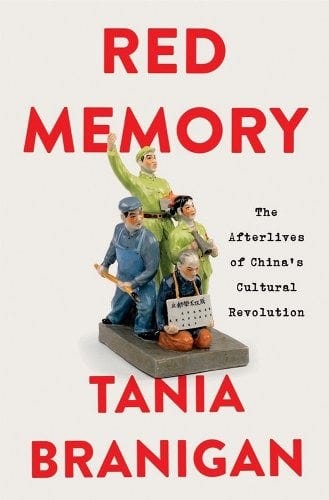 An excerpt from Tania Branigan's Red Memory: The Afterlives of China's Cultural Revolution | It is my pleasure to be able to run an excerpt from Tania Branigan’s excellent new book “Red Memory: The Afterlives of China's Cultural Revolution”. Tania has also kindly recorded herself reading this chapter, so you can listen to it if you prefer. Tania writes editorials for the Guardian and spent seven years as its China correspondent, reporting on politics, the economy, and social changes. we overlapped in Beijing and became friends. We also recorded a podcast about the book which you can listen to here. You can purchase the book on bookshop.org or on Amazon. The audio edition will be available from Tantor starting 7/11/23 wherever audiobooks are sold.Begin excerpt:Chapter 5Chongqing saw some of the era’s fiercest fighting, with the rift between Red Guards descending into warfare. The Kuomintang had made it their capital while battling the Japanese occupation, and it was home to multiple munitions plants; when armed struggles broke out in 1967, the military backed one side and helped its fighters seize what they needed. The factions battled with grenades, machine guns, napalm, tanks and ships upon the river – everything except planes, a resident recalled.They executed in cold blood too: even the injured, even the pregnant. Tens of thousands fled the city and at least twelve hundred people died, though the true toll was probably much higher. Some were caught in the violence by chance, like the eight-year-old killed by a ricocheting bullet as he played on the street. The others were not so much older, and you could blame chance there too, even if they saw themselves as soldiers. They never thought it would be so serious, that people would die, that so many would die. By the time they saw their friends fall they’d been battling for hours. They were numb; none of it seemed possible. Had it really happened at all?Shapingba Park held the proof. More than five hundred of the victims, mostly teenagers, were buried here, at a Red Guard cemetery hidden on one edge of the site, behind a grove of trees. It was the only Cultural Revolution site in the country to be recognised as a national heritage spot. But a mossy wall surrounded the plot and the public were not allowed in any more. I had come before, and stared through the chained gates. Though the cemetery was only half a century old, it reminded me of the Civil War graveyards I had seen in the American South, crumbling and overgrown. Luxuriant greenery crawled over marble monuments, immense and once stark white but now lichened and grey. Stone torches topped great pillars and obelisks, carved with red stars and Maoist slogans and the number 815. It was the rebel faction the dead had belonged to, named for a critical date in its inception in 1966.‘People began to die on 1 July 1967. On the tenth, I was put in charge of the bodies,’ Zheng Zhisheng recalled. He ran a chemicals business in the city, but back then he had been a student, and they had called him the Corpse Master. He was peering through thick tortoiseshell glasses that still bore the maker’s sticker. Two more dusty pairs lay on his desk, jumbled with books, newspapers, a giant magnifying glass and two lidded porcelain cups. He delved for a photograph. ‘This is October 1967. Twenty-seven people – twenty-seven corpses.’ Most of the faces were turned away from the camera. One mouth gaped so wide it could swallow the viewer.‘I had seen dead bodies when I was young. But I’d never had to handle them. I was a model student, and the faction leader thought I was a helpful person and not afraid of hard work. And also,’ he added, after a moment’s thought, ‘I’d opposed him at the beginning. So he thought of me and put me in charge. I was forced to do it. I put make-up, and an armband, and a Mao badge, on each one. At the start I was afraid of the dirty work. I had to wash the dead bodies and I used soap to wash my hands all the time. Afterwards I didn’t mind about that. The second thing was the smell. The dead bodies stank and I wanted to throw up. The third thing was ghosts – I thought ghosts were terrifying. Although I was an atheist, China had these traditional ideas, and so I was afraid.’He foraged for another handful of photographs and showed me a bobbed, full-cheeked young girl. ‘She was the first I dealt with. We used formaldehyde. She went to help the injured on the battlefield and when she stood up she was shot dead. She was sixteen.’ He reached for another. ‘This one is from the university – people were buried there too, but the monument was destroyed later. Now it’s all flower beds.’ He replaced the pictures amid the clutter.‘I felt they were martyrs and it was a waste for them to die so young. After people in our faction died we treated the others as enemies and hated them. So when we captured them, some of them were stoned until they were unconscious. Then they were sent to hospital. Afterwards we moved them to another hospital – but that was just an excuse. On the way we beat them to death; that’s why we ended up in prison. Back then we hated the Fandaodi faction but now I think both factions were cheated. They were all innocent. They were all victims.’The Fandaodi prisoners, already injured, had been battered with rifle stocks. By him?‘No, no.’ He shook his head. ‘It was two other people.’You ordered them to do it, I’d heard?‘Yes.’ He was concise, not curt. ‘I didn’t feel any sadness: I just wanted to take revenge. The other faction had killed our martyrs. I didn’t know them – it was factional.’Zheng and others had been jailed for years for their role in the armed conflict. After release he wanted to search for the victims’ families and make amends, or try to. But someone warned him that the parents might sue, and he gave the idea up. ‘It’s a lifelong nightmare. It’s very traumatic. I have nightmares that I’m still in prison. Afterwards I tried to work hard and to reconcile myself with what I had done. I tried to do good things, and when I stumbled I stood up and carried on. I cried many times.’But the lessons he had learned were priceless, he insisted, though he struggled to define them. A slight sigh escaped him, as if he was hoping I might abandon the subject. ‘It can’t be described in a few words. For foreigners, looking at the Cultural Revolution is like reading a difficult book. It’s really hard to understand. Even young people don’t have an interest.’He was afraid of what might happen if people did not face up to the past and that later generations might echo the mistakes his had made. It was not a repeat of the Cultural Revolution itself he feared – history had progressed, he said. So what was it?‘Turmoil.’ He stopped there, considering.‘For example, with the Tiananmen Square incident – I actually wrote to my son, because he was at university. Because I had that turbulent past, I didn’t let him join them. The students were patriotic. They wanted to fight against corruption. But they were being used by bad guys.’ It took me a moment to understand. He spelled it out: ‘They were manipulated by people like Fang Lizhi, Wu’er Kaixi and Wang Dan, who were pursuing Western large-scale democracy. We can only be led by the Communist Party. We can’t have big democracy like the Americans. It can only bring turbulence and chaos. We had more than two thousand years of feudalism; America started with two parties and democracy. Foreigners can’t understand China; they can’t understand China’s past. Corruption is caused not by one-party rule but by who has checks on the leadership. We can’t get rid of the Party’s rule – impossible. We don’t need any turbulence and chaos.’It was a common view in China, even among relative liberals. The country was not ready to be free; though how it might ever become so, if not allowed to evolve, was never explained. For Zheng, individual caprice and disobedience, pride and egotism had produced this disaster. Stability and the common good were all.Those at the top, such as Deng and Xi’s father, had been forced into a reckoning too. They had suffered, and watched the torment of loved ones. They had lost their oldest friends and their glorious dream of a better, happier China. When they reclaimed power, they did all they could to prevent another disaster. For their own sake, and that of the masses, they committed themselves to stability. They determined that never again would a strongman ride roughshod over his peers, his country and the people. Though Deng would dominate until his death, they did their best to institutionalise and, especially, collectivise rule. After the protests of 1989, which were fuelled by obvious divides in the leadership, the determination to avoid public splits was absolute. It is not hard to imagine the emotions engendered by millions of young people massing in Tiananmen Square again: the cold instinct for survival, the ruthlessness born of the revolution, for which they had already sacrificed so much – but, too, the visceral fear of where it could all lead.The Party adopted unwritten rules to ensure that no one outstayed their welcome, limiting top leaders to two five-year terms and setting a retirement age. Even misdemeanours were handled in line with an unofficial code: members of the politburo might be purged for corruption, but the most senior figures of all – the Politburo Standing Committee – were untouchable, as were their families. You survived and thrived by cultivating patrons and your wider networks. The Party became safer, stabler, calmer and duller.For years, it worked. China prospered. People who might have eaten meat once a year dropped unctuous pork into their bowls each week. People who might never have left their county journeyed to Shanghai, Bangkok or Paris for shopping and sightseeing. They got their hair permed, wore bright sweaters and Nikes, tried red wine and McDonald’s, took up hobbies. It was attractive enough for foreigners to speak of the ‘Beijing model’. But there was a price. Corruption was endemic. To get your child into a decent school, or pass your driving test, or push through a business deal, or dodge prosecution, took cash: a few thousand yuan to a teacher, tens of millions to a senior leader. In cities such as Chongqing, gangs flourished, sheltered by officials they had bought off. Inequality was soaring. The more the economy grew and mutated, the more static politics seemed.Everyone understood the problems. President Hu Jintao and his premier Wen Jiabao, who led the country when I arrived, had rolled out a skeletal welfare state at remarkable speed. But it was not enough, and people don’t stay grateful for long. The mantra was stability maintenance – an idea that would have horrified Mao, and in truth not much of an idea at all, since it meant More Of The Same. Everyone knew that big reforms were needed, yet they were deferred again and again. China was busy getting richer, getting bigger. A hundred new airports within a dozen years; a hundred new museums. The Beijing subway grew more in a decade than the London Underground had expanded in a century and a half. More bridges and blocks, theme parks and highways, shopping malls and factories, cinemas and stations. When the financial crisis hit in 2008, the government poured in 4 trillion yuan and was hailed as saving the world. It propped up the hyper-speed development without addressing its consequences: the hopelessly imbalanced economy, the poisoning of soil and rivers and people, the bribery and embezzlement, the growing gulf between rich and poor, city and village. But the unhappiness grew as wealth did. The Party stopped publishing the key indicator for inequality, and the number of ‘mass incidents’, or unrest. By 2011 the domestic security budget had soared past military spending; it would later rise still more steeply.It didn’t answer the underlying problem. The party could not rely on the Zhengs, not least because the Cultural Revolution Effect – the promise of the party as the guarantor of stability – was largely generational. It had decreasing potency; many had not lived through the torment and, since the party preferred not to mention it, knew little of it. Prosperity, too, was a diminishing asset. The years of double-digit growth were what happens when an economy has been held back, and a demographic bump offers cheap labour, and hundreds of millions take their chance to claw their way out of poverty. It was not a secret Beijing had discovered, an immutable law of Chinese development. Something had to change.End excerptYou can purchase the book on bookshop.org or on Amazon. The audio edition will be available from Tantor starting 7/11/23 wherever audiobooks are sold.Sinocism is a reader-supported publication. To receive new posts and support my work, consider becoming a free or paid subscriber. This is a public episode. If you'd like to discuss this with other subscribers or get access to bonus episodes, visit sinocism.com/subscribe | 13m 29s | ||||||
| 5/2/23 |  Sinocism Podcast: Tania Branigan on her book Red Memory: The Afterlives of China's Cultural Revolution | Episode Notes: Tania Branigan and I discuss her excellent new book “Red Memory: The Afterlives of China's Cultural Revolution”. Tania writes editorials for the Guardian and spent seven years as its China correspondent, reporting on politics, the economy, and social changes. We overlapped in Beijing and became friends. I have also published an excerpt from the book here. You can purchase the book on bookshop.org or on Amazon. The audio edition will be available from Tantor starting 7/11/23 wherever audiobooks are sold.Links:China's Cultural Revolution remembered by artist Xu Weixin - video | The Guardian2012 - China's Cultural Revolution: portraits of accuser and accused | The GuardianXilin Wang: Music by a Survivor | Hamburg International Music Festival - YouTubeWang Xilin ( 王西麟 ): Yunnan Tone Poem (1963) - YouTubeTranscript:[00:00:00] Bill: Welcome back to the occasional Sinocism podcast. I know I've been absent for a while, and now that I do the Weekly Sharp China podcast, I've realized I like podcasting. So we'll be recording more Sinocism episodes with guests I think are really interesting.[00:00:11] Bill: Today. We are very lucky to have Tania Branigan to talk about her excellent new book Red Memory: The After Lives of China's Cultural Revolution. As Tania writes, it is impossible to understand China today without understanding the Cultural Revolution. That is something I agree with wholeheartedly. So much so that I even wrote my grad school thesis on Mao badges.[00:00:30] Bill: I will also be running an excerpt from her book in the coming days, which is released in the UK already and will come out on May 9th in the United States. Tania writes editorials for the Guardian and spent seven years as its China correspondent reporting on politics, the economy, and social changes.[00:00:45] Bill: She lives in London. Welcome Tania, and congratulations on this great book. [00:00:50] Tania: Thank you so much for having me on.[00:00:51] Bill: Oh, it's my pleasure. It's great to see you. It's been it's been a few years and I appreciate it. I got an advance read of the book last year and it [00:01:00] really is it really is, I think, an important book and an important contribution.[00:01:03] Bill: So can you, just for the listeners, can you just talk a bit about your background? So when you first started working in China and what you did when you were there. [00:01:12] Tania: So I came out to China in 2008 just ahead of the Olympics, right at the start of what turned out to be an incredibly news packed year, as you may recall, right?[00:01:22] Tania: And I had never particularly wanted to be a foreign correspondent per se, but I just felt that China was the story of our time, really. Which is only proof to be truer perhaps as time has gone on. And because it's a pretty small bureau there were never more than two of us, max. And quite often there was one of me, I was covering absolutely everything.[00:01:44] Tania: So from natural disasters through to politics, through to culture, business even very occasionally when I couldn't help hit sport. But I became particularly fascinated by this topic and by [00:02:00] China's more recent history, [00:02:02] Bill: one question on your time there. When you arrived, was it already past the Wenchuan earthquake?[00:02:07] Tania: No. And in fact that was one of the sort of formative moments, for me reporting on, yeah, [00:02:15] Bill: it's 15 years next in two weeks. It's crazy. [00:02:18] Tania: It's hard to believe it's gone past so fast. I still think about those parents who lost kids. [00:02:24] Bill: And that, no, it's terrible. Terrible [00:02:29] Bill: So what led you to this book?[00:02:33] Tania: You did actually, as I say in, as I say in the book, I probably wouldn't have written it without you. So I was obviously aware of the Cultural Revolution. I knew something about it. I'd read a little around it. But then it was just when I had that lunch with you and then over coffee, you started telling me about your father-in-law and about going to try to find his body, which I feel is probably a story actually [00:03:00] at this point, that you should.[00:03:00] Tania: Tell rather than me. [00:03:02] Bill: And just for listeners the, I actually tried to have my wife be a special guest but she didn't want to do it, but Tania has interviewed her. I'll put a link in, into the story. I think we you did that great story about the artist Xu Weixin 徐唯辛, which maybe we can talk about too.[00:03:20] Bill: But no, sadly, my. Like many Chinese families people had horrible experiences in the Cultural Revolution. My father-in-law killed himself in 1967 1968 when my wife was like a year old, a year and a half old. And it, it just, it was a, he did it in Miyun outside of Beijing and involved a train.[00:03:47] Bill: And so we went. We had a family member a brother of his who was dying, who came back to say goodbye, and the family went out to this train embankment with this idea that maybe they could dig up the [00:04:00] bones and no one could figure out remember where it happened. Someone went to the village and found an old lady who remembered, and the old lady's warning was just be careful because that time that year, a lot of people jumped in front of train.[00:04:15] Bill: So just make sure you get the right bones. It was just like, oh my God. It was just like this collective ..I mean it was just, it was quite chilling, but it was also like, this is what every so many people of a certain age in China bear these kinds of memories. [00:04:34] Tania: And so that I think was really what struck me.[00:04:37] Tania: Obviously the sort of the cruelty and the loss and the fact that so many people are still living with loss now. And then as you said, the fact that the villagers were matter of fact about it. I remember you saying, they were sympathetic in some ways, but just uncomprehending of your mission in another way.[00:04:59] Tania: And [00:05:00] I think in many ways it was the fact that it was so commonplace, really, that stuck with me because there were so many horror stories you hear from the Cultural Revolution, horrific atrocities that have taken place, but here was a loss, which in a way was sort of typical and that people were still living with the consequences of.[00:05:25] Tania: And so I remember Carol saying to me, You know that even though she was now a mother herself, she couldn't imagine what it would be like to have a father, that there was this kind of space in her life and she couldn't imagine it being filled. And I think that really said so much about the way that people are still living with the consequences all these years on.[00:05:50] Bill: And it really, I think, and it's how people process lost and process the anger and the grief and so much. A lot of it is repressed and we've [00:06:00] seen cycles over the years of expressions or people trying to express, we had right after Xi Jmi came into power, I think one of the, one of the earliest red guards trying to make an apology.[00:06:10] Bill: And, it angered Xi Jinping. It's one of those things where in many ways there were periods where there's been an allowance or it's been allowed to talk about it and then it gets pulled back and you can't really talk about it. And I think we're now one of those periods, but back to where we were talking about it, it was also really around that, around the artist Xu Weixin and what he was doing.[00:06:37] Tania: That's right. . And so you suggested I go off to see him, which was an extraordinary experience because he has this, or had this studio full of around a hundred paintings and they are just immense. It's, I think it's quite hard for people who haven't seen them to imagine them, isn't it?[00:06:53] Tania: Because they're. So daunting when you look at them, they're two and a half meters tall. They're monochrome. [00:07:00] [00:07:00] Bill: And you, I have you did a video for The Guardian. I'll put that in the show notes for people. We've been there. We took our kids cuz my wife's dad and her grandparents were in it.[00:07:10] Bill: So three, three of her family members are in it. And they are, you went there and then were you in Beijing for his show or you missed, you were, you came after? [00:07:17] Tania: No, I came after. And of course that was the only show that he had on the mainland. Of these works we should probably explain. Yes, go ahead.[00:07:25] Tania: It's a series of a hundred portraits of people who were caught up in the Cultural Revolution. And so some of them are obviously very famous figures, Mao himself and others from the era, but many of them are also ordinary people who were just Swept up in it all. And there are people who are clearly recognized as being perpetrators, people who are clearly recognized as being victims, but of course many people were both as well.[00:07:55] Bill: And it was interesting he found some of the more ordinary people because he put out a call on social [00:08:00] media. For people to, if you're interested, and that's actually one of my, one of my wife's cousins sent in a bunch of information and he picked, he said, oh, this is an interesting story, or this is a sad story.[00:08:11] Bill: And he did it. So I actually, we did go to his show. It was at the, today, if people lived in Beijing. Remember the Today Art Museum, museum down in the the Pinguo apartment complex down south of Guomao Qiao. And we went opening day and it was packed. And then it was like, that's it. There was a little bit of coverage and then it was gone.[00:08:34] Bill: And I don't think the show lasted very long. It was it, but it was really moving to be there because it was just packed with all these people who, it wasn't like your typical sort of Beijing art show back in the sort of go-go years. It was just, it was a really remarkably moving and disturbing show.[00:08:56] Tania: And I think that's what's so fascinating, isn't it? Because it shows that [00:09:00] there is that appetite for recalling, for looking back at this time. You see it again with the Cultural Revolution Museum that was set up on the outskirts of Shantou where when it first opened, there was actually quite an influx.[00:09:15] Tania: Of visitors and then there was obviously a bit of a panic and the ruling goes out no more coverage in such Chinese media. Thank you very much. And the signposts are taken down and so it slows down to a trickle. [00:09:28] Bill: And you visited that museum, right? Yes. [00:09:33] Tania: As best I could, because by the time I got up there, it had been hastily locked up.[00:09:38] Tania: But it's a very small museum with a very big sort of memorial. Garden around it with sort of statues and statues of victims and these very big sort of walls with pictures engraved on them and so forth which have now been covered up with propaganda posters and [00:10:00] so forth[00:10:00] Bill:. Ah, and I wonder what it looks like now, because it does seem, it not does seem, it is true.[00:10:06] Bill: Xi Jinping has very clearly. Has made it clear that, while he, everything he's doing is the opposite of a Cultural Revolution, mass movement. It's also very clear that. That part of the, that part of the PRC history, the to up the Mao era, including through cult through Cultural Revolution.[00:10:26] Bill: There is no reopening of the sort of official verdict on the Cultural Revolution and Mao's mistakes. Look forward, move on, don't look back. [00:10:36] Tania: Absolutely. Which obviously has always really been the Party’s belief. So even when the official verdict was drafted in the aftermath of the Cultural Revolution, in the aftermath of Mao's death Deng says very clearly to the people drafting it the point of this is to get people to unite and look ahead. In other words, it's not that kind of [00:11:00] memorialization where you say, Let's draw up a verdict on this that the nation can keep looking back to and remembering and using to make sure this doesn't happen again. It's about saying, let's draw a line under this and then we can all move on.[00:11:13] Tania: So the Party obviously hasn't changed that judgment, that it was a catastrophe that it was an error and so forth, but, it definitely doesn't want people to dwell on it. And as we've seen over time the subject's been more or less sensitive and I would say history generally has become both more important and more sensitive since 2012.[00:11:35] Bill: Yes. One of the things I hear people talk about culture evolution as It why it doesn't matter. It's in the past, and especially like, why do you foreigners keep bringing up? It doesn't matter. We have to look forward. You've talked to so many people. You did this amazing book. How do you react to that? I. [00:11:59] Tania: I understand where [00:12:00] that comes from and I think there is a sort of justified question in the eyes of some people, which is particularly when you saw this number of books following Wild Swans. It seems as if there were a lot of these books coming out in the west.[00:12:15] Tania: And I think people felt, what is this fascination with Maoist trauma when you are not willing to look at your own past and at the less savory aspects of that, whether that be the opium walls or slavery or whatever. So I understand where that comes from. And I was very conscious when I wrote the book that I didn't want it to be voyeuristic.[00:12:38] Tania: I didn't want it to be about trying to find the worst things that had happened. It was much more for me about exploring what it means to people within China. And I suppose that would be my response, which is that a lot of Chinese people as your account of the exhibition being packed out shows a lot of Chinese people do care about this, [00:13:00] even if they're often reluctant to talk about it and they are interested, they want to know, or they want to be able to reflect upon this.[00:13:09] Bill: Yeah. And it is also, I guess with the passage of time, the next generation, the folks in their sort of thirties, forties it does it. They don't even know in some ways unless there's some passing down in inside families. [00:13:27] Tania: Absolutely. And in fact, as you know people are often so reluctant to speak about it.[00:13:32] Tania: When I started. Looking at this, I thought it was more about political repression and about how people aren't allowed to talk about the past in, except in certain ways. And obviously that is a huge factor, but actually it just became clear to me how much the personal trauma had affected people and how much of it was about people being unwilling or simply feeling unable to speak.[00:13:56] Tania: And so I think for the people who do return to the past, and that's what sort of is striking about the people in red memory. They're all people who chose to look at that history in one way or another, or keep it alive in some way. That's a really unusual thing, and I think it's not necessarily that they want to hark back to the past, but that they feel they have to, or that it's inescapable in some way. And so I suppose part of my sort of response to why do people keep talking about this is that our pasts matter and they define us. And in the same way that it's really important for us, we are seeing people looking back upon slavery. And the fact that, particularly if you grew up in Britain, you grew up being told, it's all about the abolition of the slave trade and you don't really learn anything about how important Britain was in creating this right system of industrialized slavery.[00:14:54] Tania: So in the same way that we need to go back and revisit our past, if we are to understand ourselves and who we are as a nation I think that has to be done. And the silence in China has been so profound that's, that I think many people there feel this urge to address it, even if they sometimes don't quite know why.[00:15:16] Bill: That's the thing is there're just millions and millions of human tragedies, right? And so you can abstract it away into sort of this broader political question in history but as I think you bring out in the book, and as you just said, it's on an individual basis, it's just there's so many human tragedies and so much pain and so much grief and so much anger and so few ways to express it.Tania: Yeah, absolutely. Bill: And over time, I've, I. We see it on a daily basis because my mother-in-law lives with us. And you just, we've, anyway, just, you just see how people have to, you have to survive and you have to deal with stuff, and you have to internalize stuff. And it is a remarkable [00:16:00] I don't know.[00:16:02] Bill: It just it's just that generation had so much trauma. Lots of people are fine and deal with it, but they're just it's just a, I don't know. It's why, like I said earlier, I, when I was there in the early nineties I got into trying to understand the whole Mao Badge phenomenon because for me it was like, it was just a sort of an entry point into trying to understand this just collective insanity. And how does a society go to just become basically insane for several years? [00:16:34] Tania: I think you put your finger on something important there as well beause you talk about it as a collective insanity. And that's one of the issues one of the sort of Sinologists who's looked at this says, it's a collective trauma and therefore you need some kind of collective resolution.[00:16:51] Tania: And so even when people do address it as individuals, It's very hard to try and make any sense of it or come to terms with it without having any sort of broader social reckoning or even recognition really of what happened. [00:17:08] Bill: Yeah, and I don't think, clearly in the current trends, it's not gonna happen.Tania: Absolutely[00:17:14] Bill:And the Xi Jinping, his family had their own traumas individually and as a family in the Cultural Revolution and around the Cultural Revolution. And they've obviously, they've dealt with it and they're moving forward. And so it's in some ways I can't imagine he's that sympathetic.[00:17:33] Tania: look at all the. All the sort of the leadership of China over recent years who had all gone through it, endured it in some way or another. The Party elders who had devoted their lives and sacrificed so much to the cause of the revolution only to be devoured by it. And then somehow coming to terms with that and believing that the answer had to be to [00:18:00] maintain the system in some way or be in a radically transformed kind of way.[00:18:03] Bill: And that's one of the reasons why I, there is a kind of a cult of she underway, but I've been skeptical that, there'll be, people say, oh, it'll be a new culture evolution. It, I think everything, for example, that Xi's doing is the opposite.[00:18:19] Bill: It's all about centralizing power. It's about controlling the masses, not unleashing or harnessing the masses, which is what Mao seems to have done. [00:18:28] Tania: Yes. And in fact, there's a fantastic Economist podcast on this very subject drum tower, if anybody listens to it. Bill: Yes, it's a great podcast. Which has just dropped precisely about the differences.[00:18:38] Tania: But one of the things that's so striking is that so many people within China. Have clearly seen parallels. Yes. And see echoes. And I think what they see is firstly the sort of reinsertion of the Party and towards these spheres from which it had retreated like private life [00:19:00] and even things like sort of culture and arts and so forth.[00:19:04] Tania: And business obviously. But also this sort of arbitrariness in what’s done. And so if you look at the fact that some people during covid were talking about white guards all these people who were enforcing the covid policies, obviously harking back to the idea of red guards.[00:19:26] Tania: So people see these parallels and as you say, they're obviously dramatic differences and Xi is somebody who's so wedded to the idea of order and discipline. But it's really striking how many people have seen those parallels, and I think it's very different. It's partly very different because he's in charge of a very different nation. But there are some striking echoes, aren't there? [00:20:00] [00:20:00] Bill: And it was interesting, I think when we were together at the artist Xu Weixin’s studio you were interviewing him for that piece you did. Where you talked to several family members or people who are the of family members of people in the portraits.[00:20:16] Bill: Xu, who's now in the US, I remember him talking about how he wanted to lead because he thought Xi was gonna bring back the new Cultural Revolution. And it was very striking because it was very, it was a, it was just a very dark at the time, seemed to be a very extreme view, but it was from somebody who obviously was very, was very steeped in history and what had happened.[00:20:40] Bill: And I remember thinking like, wow, that's a pretty scary contemplation, but I think, it hasn't happened as extreme as he suggested, but to your point, I think the, especially under Covid, there were again this just how the system can [00:21:00] mobilize and just effectively the realization that when the system decides you have no rights, you have no rights.[00:21:08] Tania: Yes, absolutely. And the other thing of course is having a single figure with this sort of untrammeled power. And clearly not, again, not the full extent of power that Mao had but none or indeed the full sort of veneration, but nonetheless, somebody who's there indefinitely. Somebody who is definitely using Party institutions and strengthening Party institutions in many ways, but is also making them more and more his own, if you look at the personnel for example. [00:21:41] Bill: Yes. And who's somebody who, you know, when he was the the vice president was on the standing committee in the 17th Party Congress, he oversaw, one of the things he oversaw was Party history. He, his story too his father got in trouble [00:22:00] in the early 1960s because of a book that was written about a political case. There was a biography that Kang Sheng, like a really nasty, especially nasty guy, told Mao, oh, this book is actually, it's a sort of anti it's criticizing you and because it involved someone who would work with Xi Jinping's father. Xi’s father ended up getting in trouble and so you see like personally, he understands how history can be used and weaponized. And how it's, how important it is to control it. And if it's gonna be used as weaponized, you want to be the person who's doing it. [00:22:44] Tania: Yeah, absolutely. That control of the narrative. It's obviously got very long history in, within China, of history being a sort of a moral or political force as much as a, or more than a record. But, and we [00:23:00] see that sort of being amped up under the Party over time, but there's no doubt that under Xi, it's really. Taken on renewed strength [00:23:07] Bill: Yeah and in some ways Xi may only be getting started. Back to your book just what's your favorite part of the book, if you have one?[00:23:15] Bill: I know maybe I'm sure you love the whole book, but is there anything that really stands out or stood out for [00:23:21] Tania: you? I don't think any author loves the whole of this. You go back and think, why did I put that full stop there? I think talking to the psychotherapists for me was really interesting and maybe that's not one that sort of many readers will come away with.[00:23:42] Tania: But I think particularly having witnessed or having spoken to people at such length about the trauma that they had been through and about the impact it had upon them, it was also really important to [00:24:00] remember that there is hope that people did survive this and that they came through and were able, as deeply scarred as they were, people did manage to come through and show love to their children or take pleasure in things. Wang Xilian, who's the composer I interview, is just this kind of extraordinary force of nature. I've never met anyone like him really, in terms of just having this kind of determination to seize life that clearly comes from his experiences. And so as scarring and as grim as many of those experiences were, I felt it was really important to remember that humans are resilient, and they find strength in ways that we wouldn't anticipate, but also that, I guess we're all vulnerable and the importance of trying to understand people [00:25:00] rather than to sit in judgment upon them. [00:25:02] Bill: In, in terms of the psychiatrists, China has a vast shortage of mental health professionals, doesn't it?Tania: Yeah, absolutely[00:25:14] Bill:. And how there isn't any sort of special training for this sort of historical trauma. Is there h how do these psych, like how do the psycho psychiatrists know what to do or how to deal with it? [00:25:28] Tania: So they've definitely looked to examples elsewhere. For example, the work that's been done on Transgenerational trauma very much came out of the experiences of people, I think primarily in Israel and the US treating the children of Holocaust survivors, for example.[00:25:48] Tania: So they were certainly looking overseas. There are people from Europe who've worked with psychotherapists there because it's such a kind of [00:26:00] nascent discipline anyway within China. And then I think what was interesting to me as well was the fact that in some ways you'd think it was quite safe territory because it's taking this huge social trauma and it's confining it within a treatment room.[00:26:20] Tania: It turns it in a sense, into one person's problems or it treats as one person's problems. So you could think that from the authorities point of view, that might be quite welcome in some ways. But of course it also means speaking about what happened, and that's certainly why a lot of people find it too threatening to contemplate as potential patients, but I think that's also why it's been a very sensitive area as well and why Chinese psychotherapists haven't really spoken about it publicly.[00:26:54] Tania: The people I spoke to didn't want to be identified, and that's quite telling, isn't it? [00:26:59] Bill: I mean it, [00:27:00] yeah, obviously there’s patient confidentiality but again, I think to your point, there's also a political overlay too. So not, this book is not at all depressing.[00:27:15] Bill: It's an incredibly difficult topic, but actually I found it to be in many ways inspiring because there are some awful stories but they're also you, like you said earlier you see how people can survive.[00:27:28] Tania: Yes. And I didn't, you don't want to attack a, a false happy ending, onto this. So you really have to remember that a lot of people came away scarred and did not recover. And I talk in the psychotherapy chapter, you know the woman who says to me I. For us, the Cultural Revolution only ended last April because that's when my father died. And, his brain had basically stopped in 1966. He had a nervous breakdown after the [00:28:00] red guards persecuted him, and he never recovered. So I didn't want to create two rosy a vision, but I did want to reflect the complexity and the hope that exists. And the fact, I talk about the people who were in sort of red guard factions and turned upon each other and were trying to kill each other, and yet they have this sort of strange relationship now.[00:28:26] Tania: These guys I was talking to where I don't think they necessarily like each other particularly, but they've found a way to live with each other and coexist and even take care of the ultrazealous unrepentant, ultra Maoist guy, who still thinks that that the main problem with the Cultural Revolution is probably really that it didn't it didn't go far enough.[00:28:52] Tania: It didn't go, or yes, it didn't go on far enough or it didn't succeed. But, they've managed to find a way to live with him and they [00:29:00] give him cash and help support him. And I just, I think there is hope to be found there. [00:29:05] Bill: No, it is fascinating. When I, in the early nineties when I had a job in Beijing, I actually I was working as a translator at this at this now defunct publishing house called the Chinese Literature Press. And it, this was 91 to 92. And then I learned that actually, like you said, there were colleagues who were, we're only 15 at that point. It was only, it's crazy. It was only 15 plus years since the end of the Cultural Revolution. And there were colleagues who had been on either side, persecuted or persecutors. And you could tell there was tension there, but it was like they had to deal with each other in their little work unit…That was 15 years outta the Cultural Revolution is very different now.[00:29:50] Bill: We're much further along in history. And I guess, part of it I'm assuming is, the Party will just assume that they just effectively as people age out and die off that the memories will just fade away. And then it's all about moving forward. And so I wonder in some ways, if your book isn't, it's not going be picked up by a publish in the PRC, I assume. I'm curious how they would view your [00:30:15] Tania: book. I don't imagine it could be printed in the PRC, but also some of those I spoke to didn't want it then what? To be published there, which I completely understand. [00:30:24] Bill: So that's, so will you will you try and get it published in Taiwan? In the old days you probably could have published it in Hong Kong, but that obviously I don't think would happen now.[00:30:33] Tania: I felt in the interests of being true to the agreement, the spirit of the agreement I'd made with people that I didn't want to see it published in Chinese. And obviously, I said to them, I can't completely rule out somebody finding bits of it and choosing to translate bits of it on the internet because that can happen.But I won't be Party to it being translated.Sinocism is a reader-supported publication. To receive new posts and support my work, consider becoming a free or paid subscriber.[00:30:57] Bill: That makes sense. So I guess, we've talked about it, but I have, I have some questions. One. Really the other question is, what do you think, like if the memories fade away inside China, does that really matter? Or is it actually something that the Party, they just. The next generation, they move on and the top guys remember it and so they seem to be trying to prevent some of the worst excesses. I is there a way of approaching it actually going work or is it the right way to deal with all this trauma?[00:31:46] Tania: I think that's such a good question and I can understand not just from a political survival point of view, but also from a concern for sort of Chinese society point of view why the authorities are so reluctant for this to be addressed precisely because the issues are so raw and so painful and because people were turning on upon their workmates and so on, and I think their fear was partly, how the hell do you manage this if people start saying, you killed my father. Where the hell do you go from there? And it was so clear talking to people how rancorous it remains, even among people who I had broadly thought of as being what you might call on the same side in terms of them being people who want to remember the Cultural Revolution because they think it was a time where things went dreadfully wrong or we need to learn from that.[00:32:48] Tania: Even between them, there was so much bitterness and rancor at times about. What you should remember and how you should remember, and who you should hold responsible and how much blame you attached to individuals and so forth. So I think that was one real concern, but I don't think you can just bury it because I think these things just fester and make themselves felt in really dangerous ways. Certainly, I talked a bit earlier about transgenerational trauma. So there's a lot of evidence, as I said originally, coming from the families of Holocaust victims, but it's been well established across a range of countries of the effects of trauma being passed down between generations even, or perhaps especially where people aren't speaking about what happened. And so the psychological effects upon the children and grandchildren I think really are significant. And you do just think about how much pain. A huge number of people in China are [00:34:00] still walking around with, and that pain doesn't disappear when that generation dies, although it may ebb to some degree.[00:34:09] Tania: And I also do think because the Cultural Revolution is. I don't think the Cultural Revolution could happen again in that way, in that form, certainly. But I think that, as I said, we need to look back at our histories to understand who we are as people, and also to see how easily humans can go astray.[00:34:37] Tania: And in that sense, it's not just a story for China although, it could only have happened in that way within that particular sort of time and place, but it is something that has a sort of a wider resonance. So I don't think you can just bury it. And I think the final thing actually, which is sort of odd, is that for a long time the [00:35:00] Party has also relied on this unspoken memory of the Cultural Revolution to essentially send this message of either we keep very tight control of all of you or you are going to have to live with this chaos and devastation. Yes. In which anything could happen. And that has been very effective because a lot of people do remember the Cultural Revolution, but as you said, it's a diminishing asset for them in that sense because they don't want to talk about it directly and go into too much detail, and because the people who actually remember it are dying. So for younger people, it really doesn't have the same impact. [00:35:42] Bill: No. And of course the, this sort of the messaging around otherwise it's chaos leaves out that otherwise it's chaos like it was chaos caused by Mao. And that is the, that’s the, again, in the eighties, especially in, in, [00:36:00] they're maybe some more discussions about Mao and his role in history. And now of course it's, again, Xi made very clear soon after he became down secretary and there were these sort of the Pre-reform and opening sort of the founding of the PRC and the early years of the PRC and then there was reform and opening and, neither one of those basically were, you can't negate either one.[00:36:33] Bill: And then, since then he's added effectively this third era, this new era, right? So we're into the third era of the PRC history, and it's all about looking forward. The previous eras have their historical what's the right word? They they have their historical judgements in place and so those aren't gonna be overturned. And so anything that would open up the Cultural Revolution. In any way now. It [00:37:00] just it's a massive political problem, I think for Xi, and so I just don't think I think we're gonna see your book is really important, but I think ultimately we're not gonna see any sort of reopening of the Cultural Revolution in any and Xi's only, we look at his age, he's he's what's gonna turn 70 this year.[00:37:23] Bill: He could be with us for a long time. And so by the time he fades from the scene, most likely, most of the people who have a direct experience of the Cultural Revolution will also have faded from the scene. And it is, it is interesting too, like how, the formative experiences and how they inform his approach to governing and it just risk taking and decision making. And we may never know, and you can certainly speculate, but one of the other things that were quite damaging were that whole generation who lost their [00:38:00] education. Look at Xi he went he basically, Barely even got a high school education. [00:38:10] Tania: And this is, this is one of the things that's fascinating to me, which is that is the one part of the Cultural Revolution that the authorities are willing to talk about and even to celebrate because they managed to detach it entirely from its political context. So when they talk about these 17 million people who are sent off to the countryside. Thinking that they were going there forever. They’re not portraying that as being part of the Cultural Revolution or, part of Mao’s many sort of terrible failings of his people. It's become this sort of story of comradeship on his toil. This is where Xi Jinping learned to be a man of the people he grew up into [00:39:00] manhood. And, all of those things are very appealing, particularly in an age where we were seeing these sort of constant ca cases of hundreds of millions of dollars, if not billions being racked up by high ranking Party officials. To be able to contrast it with, here's Xi Jinping, he went down to the countryside, he struggled, he knows what it is to labor. All of those message are very potentBill:. Yeah. He's a man of the people. No, and it really is like you said they've figured out how to separate out the trauma and actually turn it into this positive, constructive formative experience and I think, but to be honest, I think some people in retrospect do believe it was. [00:39:51] Tania: That's what's fascinating when you talked to them. And in a way, I think that's probably where it came from the Party, that there was already this sort of grassroots nostalgia [00:40:00] movement among the sent down youth which Guobin Yang has written about brilliantly, where people started meeting up, going to exhibitions, and there's this sort of fascination with that time, and it's a very bittersweet thing.[00:40:14] Tania: I sort of draw a comparison with the Waltons and the way that people have this slightly romantic impression of, depression era America. Everybody was terribly poor, but they all loved each other and worked hard, there is a kind of nostalgia for that time, for a sense of meaning and belief and purity. And so that was a very potent thing that was already there to tap into. I think. [00:40:42] Bill: Yeah it's one of those things that I dunno, this is why your book is just, it's a, it's an important contribution to trying to help understand and because it does, again, to the question I asked earlier and that other people have raised why should we [00:41:00] care? It isn't just about trauma, but it's also about it. It has just been so formative for the people running China now and trying to understand how this affected them really does have real implications for how they see the world and how they see ordering China. [00:41:19] Tania: Absolutely. And right across the spectrum as well, if you talk to business people so often they'll say, oh, it was my years as a sent down youth that were this kind of transformative moment that made me realize how hard I would have to struggle to get there and so forth.[00:41:36] Tania: So in so many ways, it shaped the culture, it shaped the politics, it shaped the economy. [00:41:41] And [00:41:41] Bill: I wonder, there, there certainly it was a shorter period, but I wonder if the sort of the covid, especially the last 2022 with dynamics here, COVID and just how hard it was for so many people and so many businesses. I wonder if, I think we're already gonna see this talk about, oh this was a really formative year. [00:42:00] This, we survived and then therefore we're able to do, we understand risk and we understand how to managed through really difficult periods, even though I don't think it was I mean it was obviously different than the Cultural Revolution, but it was also in certain places, clearly very traumatic for people.[00:42:20] Tania: Yes. I feel, I think even looking around the UK, it feels like people are only really starting to realize the impact that the pandemic. Yeah. Had upon them how much it's shaped individuals, how much it's shaped communities, politics, that sense that sort of several people said to me, seeing friends or relatives disappear down the rabbit hole of conspiracy theories during the pandemic because they were suddenly locked at home with nothing else to look at. And the thing that's striking to me actually is how little we are talking all about all of that. And it does make me think when terrible things happen, people want to forget them [00:43:00] and move on.[00:43:01] Bill: move on. And it's also early, right? You people. I mean it and we'll thank you for writing the book.Is there anything else you'd like to say to the audience or, anything else I should have asked you? [00:43:16] Tania: No, in many ways, I think you probably know this subject as well, if not better than…Me, because you are, you've obviously lived with it at a family level as well. And I just hope, I think that people, it's clearly about China, as I say, and about how you can't understand China unless you understand this period. But I would also hope that people didn't see it as being a book about this kind of distant place that has nothing to do with them because it, for me, it raised so many questions, the parallels with our own society in terms of the way that we choose to [00:44:00] address our own history.[00:44:02] Tania: And particularly looking at what's happened with politics in the UK and especially in the us, Trump is clearly in some ways, a more, a much more Maoist figure, you might argue, than she is in terms of his sort of reveling in chaos and disorder, and particularly in this incitement of hatred. Adam Serwer talks about the cruelty being the purpose in the use of hatred and division for political purposes.[00:44:36] Bill: So one question if you're willing to to entertain it would be about politics in the West. You hear a lot of this, call it cancel culture, whatever, and people say, oh, it's just like the Cultural Revolution. How do you react when you hear someone compare, like people getting canceled on Twitter or just saying, how do you, when someone says, oh, that's like the Chinese Cultural Revolution how do you what do you think when you hear that? [00:45:09] Tania: I think it just speaks to how fundamentally people misunderstand the Cultural Revolution in the West. They either regard it as a sort of a punchline or something, a bit kitsch or they regard it as young people being very left wing and getting carried away essentially. And that's really not what the Cultural Revolution is, right? The Cultural Revolution is about a very powerful man exploiting and fomenting public sentiment for his own ends.[00:45:42] Bill: and violent and public violence.[00:45:43] Tania:. Indeed. Yes. Absolutely. Yeah. So it's about the use of power and I just think that's fundamentally distinct from any of the kind of discussions that are going on now. It just speaks to a [00:46:00] really basic misunderstanding of what we're looking at.[00:46:01] Bill: Good. We agree. I have a, I've tried not to engage, but it drives me nuts because I find it to be incredibly facile and an incredibly shallow that portrays a real lack of understanding and appreciation for the horrors and the trauma of the Cultural Revolution in China.[00:46:22] Tania: Yeah, absolutely. [00:46:23] Bill: So how do we end on a happy note? What's a happy takeaway for the, from your book? [00:46:31] Tania: Oh, dear, that's tricky. I think it, unfortunately it was my day job as well involves writing on foreign policy. I do spend a lot more time looking at the the darker sides of things. As I said, I do think people have in many ways managed to move forward. I think there is a wealth of extraordinary and thoughtful work out there on the era, particularly done [00:47:00] by Chinese scholars officially or unofficially, within China and then especially outside it as it's become more difficult to work there.[00:47:12] Tania: I think there's such sort of richness there in terms of understanding the era better, but also in learning, as I said about human nature more generally and those things we can take away. So there's that. And then there is just the fact that people live through horrors and they manage to go on and lead meaningful and loving lives against all the odds, even if they've been deeply scarred as well sometimes…I was just gonna say incidentally, if anybody has the chance to go and look up Wong, she Lynn's work on YouTube. There's a sort of a bunch of his music out there. So he's the composer who nearly died in the Cultural Revolution. But as I said, is this octogenarian with an incredible appetite for life. Still working assiduously living in Germany now, and he would love people to hear his music. So I think if you want a sort of a blast of life in contrast to all the horror that we've been talking about then lease go and listen to you. [00:48:17] Bill: We'll, and I'll, we'll put some links in the in the show notes.[00:48:20] Bill: No, thank you. That's great. And the thing I would just add is, and why, again, I think your book is so important. Is it, as, especially from the US perspective, US China relations worsen, there's just lots of othering on both sides. And one of the things is, It's, we're all human and so much of the pain and suffering and experiences, the reactions are human and it's a reminder that people, even as they go through different experiences, different cultures, there's still some real, there's, we're all people.[00:48:54] And so in many ways your book is important in a way that, [00:49:00] again, it’s so easy to abstract a way what's going on in sort of US China or Chinese politics. You help humanize it in a way that I think is important for everyone to understand, that in many ways we're all the same.[00:49:16] Tania: Thank you. I did want this be, I wanted this to be a book that was about us rather than them, so that's really good to hear. [00:49:24] Bill: Thank you, Tania. It's, I really, I can't recommend Tania's book Red Memory enough like I said I will also be running an excerpt on Sinocism from one of her chapters. And thank you all for listening and thank you, Tania, for taking the time. [00:49:41] Tania: Thank you.Sinocism is a reader-supported publication. To receive new posts and support my work, consider becoming a free or paid subscriber. This is a public episode. If you'd like to discuss this with other subscribers or get access to bonus episodes, visit sinocism.com/subscribe | 49m 44s | ||||||
| 11/4/22 |  Sinocism Podcast #5: 20th Party Congress and US-China Relations with Chris Johnson | Episode Notes:A discussion of the recently concluded 20th Party Congress and what to expect ahead in US China relations. I'm pleased to welcome back Chris Johnson, CEO of Consultancy China Strategies Group, Senior Fellow at the Asia Society Policy Institute Center for China Analysis and former Senior China analyst at the Central Intelligence Agency. This is the 7th Party Congress that Chris has analyzed professionally.Links:John Culver: How We Would Know When China Is Preparing to Invade Taiwan - Carnegie Endowment for International PeaceTranscript:Bill: Welcome back to the very occasional Sinocism podcast. Today we are going to talk about the recently concluded 20th Party Congress and what to expect ahead in US China relations. I'm pleased to welcome back Chris Johnson, CEO of Consultancy China Strategies Group, Senior Fellow at the Asia Society Policy Institute Center for China Analysis and former Senior China analyst at the Central Intelligence Agency. This is the 7th Party Congress that Chris has analyzed professionally. So we have a lot of experience here to help us understand what just happened. Chris, welcome back and thanks for taking the time.Chris: My pleasure. Always fun to be with you, Bill.Bill: Great. Well, why don't we jump right in. I'd like to talk about what you see as the most important outcomes from the Congress starting with personnel. What do you make of the leadership team from the central committee to the Politburo to the Standing Committee and what does that say about.Chris: Yeah, well, I, think clearly Xi Jinping had a massive win, you know, with personnel. I think we see this particularly in the Politburo Standing Committee, right, where on the key portfolios that really matter to him in terms of controlling the key levers of power inside the system. So we're talking propaganda, obviously, Uh, we're talking party bureaucracy, military less so, but security services, you know, these, these sort of areas all up and down the ballot he did very well.So that's obviously very important. And I think obviously then the dropping of the so-called Communist Youth League faction oriented people in Li Keqiang and Wang Yang and, and Hu Chunhua being kind of unceremoniously kicked off the Politburo, that tells us that. He's not in the mood to compromise with any other interest group.I prefer to call them rather than factions. Um, so that sort of suggests to us that, you know, models that rely on that kind of an analysis are dead. It has been kind of interesting in my mind to see how quickly though that, you know, analysts who tend to follow that framework already talking about the, uh, factional elements within Xi's faction, right?So, you know, it's gonna be the Shanghai people versus the Zhijiang Army versus the Fujian people. On Wang HuningBill: people say there's a Tsinghua factionChris: Right. The, the infamous, non infamous Tsinghua clique and, and and so on. But I think as we look more closely, I mean this is all kidding aside, if we look more closely at the individuals, what we see is obviously these people, you know, loyalty to Xi is, is sort of like necessary, but not necessarily sufficient in explaining who these people are. Also, I just always find it interesting, you know, somehow over. Wang Huning has become a Xi Jinping loyalist. I mean, obviously he plays an interesting role for Xj Jinping, but I don't think we should kid ourselves in noting that he's been kind of shunted aside Right by being pushed into the fourth position on the standing committee, which probably tells us that he will be going to oversee the Chinese People's Consultative Congress, which is, you know, kind of a do nothing body, you know, for the most part. And, um, you know, my sense has long been, One of Xi Jinping’s, I think a couple factors there with Wang Huning.Sinocism is a reader-supported publication. To receive new posts and support my work, consider becoming a free or paid subscriber.One is, you know, yes, he is very talented at sort of taking their very, uh, expansive, um, theoretical ideas and coming up with snappy, um, snappy sort of catchphrases, right? This is clearly his, um, his sort of claim to fame. But, you know, we had that article last year from the magazine, Palladium that kind of painted him as some sort of an éminence grise or a Rasputin like figure, you know, in terms of his role.Uh, you know, my sense has always been, uh, as one contact, put it to me one time. You know, the issue is that such analyses tend to confuse the musician with the conductor. In other words, Xi Jinping. is pretty good at ideology, right? And party history and the other things that I think the others had relied on.I think the second thing with Wang Huning is, um, in a way XI can't look at him I don't think, without sort of seeing here's a guy who's changed flags, as they would say, right? He served three very different leaders, Jiang Zemin, Hu Jintao, and now Xi , um, and, and continued on and I think at some level, uh, and we look at the rest of the appointments where it appears that, uh, loyalty was much more important than merit.Um, where that's also a question mark. So there's those issues I think on the Politburo. You know, you mentioned the, the Tsinghua clique it was very interesting. You had shared with me, uh, Desmond Shum of Red Roulette fame’s Twitter stream sort of debunking, you know, this, this Tsinghua clique and saying, well, it turns out in fact that the new Shanghai Municipal Party Secretary Chen Jining can't stand Chen Xi, even though, you know, they both went to Tsinghua and were there at the same time and so on.Um, you know, who knows with Desmond Shum, but I think he knows some things, right? And, and, and it just a reminder to us all, I think, how little we understand right, about these relationships, especially now, uh, with Xi's concentration of power. And also a situation where we've had nearly three years of covid isolationBill: Right. And so it's really hard to go talk to people, even the fewer and fewer numbers, people who, who know something and can talk. Back to the standing committee. I, I think certainly just from friends and contacts the biggest surprise you know, I think, uh was Li Keqiang and Wang Yang not sticking around. And as that long explainer said without naming them they were good comrades who steps aside for the good of the party in the country,Chris: Because that happens so often,Bill: whatever that means. Um, but really the, the bigger surprise was that, oh, Cai Qi showing up. Who I think when you look at the standing committee, I think the general sense is, okay, the, these people are all, you know, not, they're loyal, but they're also competent, like Li Qiang, Chris: Right, Bill: The likely new premier number two on the standing committee is pretty competent. The Shanghai lockdown, disaster aside, Cai Qi on the other hand, was just, looks more like, it's just straight up loyalty to Xi. I think he was not really on anybody's short list of who was gonna make it on there. And so, it does feel like something happened, right?Chris: Yeah. Well, um, a couple things there. I think, um, one, let's start with the. The issue you raised about the economic team cuz I think that's actually very important. Um, you know, I, at some level, sometimes I feel like I'm sort of tiring my, of my role as official narrative buster or a windmill tilter.Uh, whether, whether it's pushback from Li Keqiang or the myth of the savior premier as I was calling it, which, uh, we didn't see, or that these norms actually aren't very enduring and it's really about power politics. I, I think I'm kind of onto a new one now, which is, you know, Xi Jin ping's new team of incompetent sycophants.Right? That's kind of the label that's, uh, come out in a lot of the takes, uh, since the Congress. But to your point, I mean, you know, Li Qiang has run the three most important economic powerhouses on China's east coast, either as governor or as party chief. Right. He seems to have had a, a good relationship with both.Private sector businesses and, and foreign, you know, people forget that, you know, he got the Tesla plant built in Shanghai in a year basically. Right. And it's, uh, responsible for a very significant amount of, of Tesla's total input of vehicles. Output of vehicles. Excuse me. Um, likewise, I hear that Ding Xuexiang, even though we don't know a lot about him, uh, was rather instrumental in things.Breaking the log jam with the US uh, over the de-listing of Chinese ADRs, uh, that he had played an important role in convincing Xi Jinping it would not be a good idea, for example, to, uh, you know, we're already seeing, uh, sort of decoupling on the technology side. It would not be a good idea to encourage the Americans to decouple financially as well. So the point is I think we need to just all kind of calm down, right? And, and see how these people perform in office. He Lifeng, I think is perhaps, you know, maybe more of a question mark, but, But here too, I think it's important for us to think about how their system worksThe political report sets the frame, right? It tells us what. Okay, this is the ideological construct we're working off of, or our interpretation, our dialectical interpretation of what's going on. And that, I think the signal there was what I like to call this fortress economy, right? So self-sufficiency and technology and so on.And so then when we look at the Politburo appointments, you can see that they align pretty closely to that agenda, right? These people who've worked in state firms or scientists and you know, so on and forth.Bill: Aerospace, defenseChris: Yeah, Aerospace. Very close alignment with that agenda. I'm not saying this is the right choice for China or that it even will be successful, I'm just saying it makes sense, you know,Bill: And it is not just sycophants it is actually loyal but some expertise or experience in these key sectors Chris: Exactly. Yeah, and, and, and, and of interest as well. You know, even people who have overlapped with Xi Jinping. How much overlap did they have? How much exposure did they have? You know, there's a lot of discussion, for example, about the new propaganda boss, Li Shulei being very close to Xi and likewise Shi Taifeng.Right? Uh, both of whom were vice presidents at the party school when, when Xi also was there. Um, but remember, you know, he was understudy to Hu Jintao at the time, you know, I mean, the party school thing was a very small part of his portfolio and they were ranked lower, you know, amongst the vice presidents of the party school.So how much actual interaction did he have? So there too, you know, I think, uh, obviously. , yes these people will do what Xi Jinping wants them to do, but that doesn't mean they're not competent. On Cai Qi, I agree with you. I think it's, it's, it's difficult. You know, my speculation would be a couple of things.One, proximity matters, right? He's been sitting in Beijing the last five years, so he is, had the opportunity to, uh, be close to the boss and, and impact that. I've heard some suggestions from contacts, which I think makes some. He was seen as more strictly enforcing the zero Covid policy. Right. In part because he is sitting in Beijing than say a Chen Min’er, right.Who arguably was a other stroke better, you know, candidate for that position on the Politburo standing committee. And there, you know, it will be interesting to see, you know, we're not sure the musical chairs have not yet finished. Right. The post party Congress for people getting new jobs. But you know, for example, if Chen Min’er stays out in Chongqing, that seems like a bit of a loss for him.Bill: Yeah, he needs to go somewhere else if he's got any hope of, um, sort of, But so one thing, sorry. One thing on the Politburo I thought was really interesting, and I know we've talked about offline, um, is that the first time the head of the Ministry State Security was, was. Promoted into the Politburo - Chen Wenqing. And now he is the Secretary of the Central Political Legal Affairs Commission, the party body that oversees the entire security services system and legal system. and what do you think that says about priorities and, and, and where Xi sees things going?Chris: Well, I think it definitely aligns with this concept of Xi Jiping's of comprehensive national security. Right. We've, we've seen and heard and read a lot about that and it seems that the, uh, number of types of security endlessly proliferate, I think we're up to 13 or 14Bill: Everything is National Security in Xi’s China.Chris: Yeah. Everything is, is national security. Uh, that's one thing I think it's interesting perhaps in the, in the frame of, you know, in an era where they are becoming a bigger power and therefore, uh, have more resources and so on. You know, is that role that's played by the Ministry of State Security, which is, you know, they have this unique role, don't they?They're in a way, they're sort of the US' Central Intelligence Agency and, and FBI, Federal Bureau of Investigation combined, and that they do have that internal security role as well, but, They are the foreign civilian anyway, uh, foreign intelligence collection arm. So perhaps, you know, over time there's been some sense that they realized, yes, cyber was great for certain things, but you still need human intelligence.Uh, you know, we don't know how well or not Chen Wenqing has performed, but you know, obviously there, this has been a relentless campaign, you know, the search for spies and so on and so forth. Um, I also think it says something about what we seem to be seeing emerging here, which is an effort to take what previously were these, you know, warring, uh, administrative or ministerial factions, right, of the Ministry of Public Security MPS, the MSS, uh, and even the party's, uh, discipline watchdog, the, uh, Central Commission on Discipline inspection, you know, in an effort to sort of knit those guys into one whole.And you know, it is interesting.Chen wending has experience in all three of those. He started off, I think as a street cop. Um, he did serve on the discipline inspection commission under, uh, Wang Qishan when things were, you know, really going in that department in the early part of, Xi's tenure and then he's headed, uh, the Ministry of State Security.I think, you know, even more interesting probably is. The, uh, formation of the new secretariat, right? Where we have both Chen Wenqing on there and also Wang Xiaohong as a minister of Public Security, but also as a deputy on the CPLAC, right? And a seat on the secretariat. And if we look at the, um, The gentleman who's number two in the discipline inspection, uh, space, he was a longtime police officer as well.So that's very unusual. You know, uh, his name's escaping me at the moment. But, um, you know, so in effect you have basically three people on the Secretariat with security backgrounds and, you know, that's important. It means other portfolios that might be on the secretariat that have been dumped, right? So it shows something about the prioritization, uh, of security.And I think it's interesting, you know, we've, we've often struggled to understand what is the National Security Commission, how does it function, You know, these sort of things. And it's, it's still, you know, absolutely clear as mud. But what was interesting was that, you know, from whatever that early design was that had some aspect at least of looking a bit like the US style, National Security Commission, they took on a much more sort of internal looking flavor.And it had always been my sort of thought that one of the reasons Xi Jinping created this thing was to break down, you know, those institutional rivalries and barriers and force, you know, coordination on these, on these institutions. So, you know, bottom line, I think what we're seeing is a real effort by Xi Jinping to You know, knit together a comprehensive, unified, and very effective, you know, stifling, really security apparatus. And, uh, I don't expect to see that change anytime soon. And then, you know, as you and I have been discussing recently, we also have, uh, another Xi loyalist Chen Yixin showing up as Chen Wenqing's successor right at the Ministry of State SecurityBill: And he remains Secretary General of the Political and Legal Affairs Commission too.Chris: Exactly. So, you know, from, from a, a sheet home where Xi Jinping five years ago arguably had very loose control, if at all, we now have a situation where he's totally dominant. Bill: I think the, the official on the Secretariat, I think it's Liu Jinguo.Chris: That's the one. Yes. Thank you. I'm getting old…Bill: He also has, has a long history of the Ministry of Public Security system. Um, but yeah, it does, it does seem like it's a, it's a real, I mean it, I I, I don't wanna use the word securitization, but it does like this is the indication of a, of a real, sort of, it just sort of fits with the, the general trend towards much more focus on national security. I mean, what about on the, the Central Military Commission? Right? Because one of the surprises was, um, again, and this is where the norms were broken, where you have Zhang Youxia, who should have retired based on his age, but he's 72, he’s on the Politburo he stays as a vice chair of the CMCChris: Yep. Yeah, no, at, at, at the rip old age of 72. It's a little hard, uh, to think of him, you know, mounting a tank or something to go invade Taiwan or whatever the, you know, whatever the case may be. But, you know, I, I think here again, the narratives might be off base a little bit, you know, it's this issue of, you know, well he's just picked, you know, these sycophantic loyalists, He's a guy who has combat experience, right?And that's increasingly rare. Um, I don't think it's any surprise that. That himself. And, uh, the, uh, uh, gentleman on the CMC, uh, Li, who is now heading the, um, Joint Chiefs of Staff, he also has Vietnam combat experience, not from 79, but from the, uh, the border incursions that went on into the80s. Um, so it's not that surprising really.But, but obviously, you know, Zhang Youxia is very close to Xi Jinping, their father's fought together, right? Um, and they have that sort of, uh, blood tie and Xi is signaling, I want, uh, I. Political control and also technologically or, or, um, you know, operationally competent people. I think the other fascinating piece is we see once again no vice chairman from the political commissar iatside of the PLA.I think that's very interesting. You know, a lot of people, including myself, were betting that Miao HuaWould, would, would get the promotion. He didn't, you know, we can't know. But my sense is in a way, Xi Jiping is still punishing that side of the PLA for Xu Caihou’s misdoings. Right. You know, and that's very interesting in and of itself.Also, it may be a signal that I don't need a political commissar vice chairman because I handle the politicsBill: And, and, and he, yeah. And in this, this new era that the, the next phase of the Xi era, it, it is, uh, everybody knows, right? It's, it's all about loyalty to Xi.Chris: we just saw right, uh, today, you know, uh, yet, yet more instructions about the CMC responsibilities, Chairman, responsibility systems. Bill: Unfortunately they didn’t release the full text but it would be fascinating to see what’s in there.Chris: And they never do on these things, which is, uh, which is tough. But, um, you know, I think we have a general sense of what would be in it, . But, but even that itself, right, you know, is a very major thing that people, you know, didn't really pick up. Certain scholars, certainly like James Mulvenon and other people who are really good on this stuff noticed it. But this shift under Hu Jintao was a CMC vice chairman responsibility system. In other words, he was subletting the operational matters certainly to his uniformed officers, Xi Jinping doesn’t do thatBill: Well, this, and here we are, right where he can indeed I mean, I, I had written in the newsletter, um, you know, that she had, I thought, I think he ran the table in terms of personnel.Chris: Oh, completely. Yeah.Bill: And this is why it is interesting he kept around folks like Wang Huning, but we'll move on. The next question I had really was about Xi's report to the party Congress and we had talked, I think you'd also, um, you've talked about on our previous podcasts, I mean there, there seems to be a pretty significant shift in the way Xi is talking about the geopolitical environment and their assessment and how they see the world. Can you talk about a little bit?Chris: Yeah, I mean, I think definitely we saw some shifts there and, uh, you know, you and I have talked a lot about it. You know, there are problems with word counting, right? You know, and when you look at the thing and you just do a machine search, and it's like, okay, well security was mentioned 350 times or whatever, but, but the, you know, in what context?Right. Um, and, uh, our, uh, mutual admiration society, the, uh, the China Media project, uh, I thought they did an excellent piece on that sort of saying, Remember, it's the words that go around the buzzword that matter, you know, just as much. But what we can say unequivocally is that two very important touchstones that kind of explain their thinking on their perception of not only their external environment, but really kind of their internal environment, which had been in the last several political reports, now are gone. And those are this idea of China's enjoying a period of strategic opportunity and this idea that peace and development are the underlying trend of the times. And, you know, on the period of strategic opportunity, I think it's important for a couple reasons. One, just to kind of break that down for our listeners in a way that's not, you know, sort of, uh, CCP speak, , uh, the, the basic idea was that China judged that it's external security environment was sufficiently benign, that they could focus their energies on economic development.Right? So obviously that's very important. I also think it was an important governor, and I don't think I've seen anything out there talking about its absence in this, uh, political report on this topic, It was a, it was an important governor on sort of breakneck Chinese military development, sort of like the Soviet Union, right?In other words, as long as you were, you know, sort of judging that your external environment was largely benign, you. Didn't really have a justification to have a massive defense budget or to be pushy, you know, in the neighborhood, these sort of things. And people might poo poo that and sort of say, Well, you know, this is all just rhetoric and so on. No, they actually tend to Bill: Oh, that's interesting. Well, then that fits a little bit, right, Cuz they added the, the wording around strategic deterrence in the report as well which is seen as a, you know, modernizing, expanding their nuclear forces, right?Chris: Exactly, right. So, you know, that's, uh, an important absence and the fact that, you know, the word, again, word searching, right. Um, strategic and opportunity are both in there, but they're separated and balanced by this risks and challenges, languages and, and so on. Bill: Right the language is very starkly different. Chris: Yeah. And then likewise on, on peace and development. This one, as you know, is, is even older, right? It goes back to the early eighties, I believe, uh, that it's been in, in these political reports. And, uh, you know, there again, the idea was sort of not only was this notion that peace and economic development were the dominant, you know, sort of trend internationally, globally, they would be an enduring one. You know, this idea of the trend of the times, right? Um, now that's missing. So what has replaced it in both these cases is this spirit of struggle, right? Um, and so that's a pretty stark departure and that in my mind just sort of is a real throwback to what you could call the period of maximum danger for the regime in the sixties, right? When they had just split off with the Soviets and they were still facing unremitting hostility from the west after the Korean War experience and, and so on. So, you know, there's definitely a, a decided effort there. I think also we should view the removal of these concepts as a culmination of a campaign that Xi Jinping has been on for a while.You know, as you and I have discussed many times before, from the minute he arrived, he began, I think, to paint this darker picture of the exterior environment. And he seems to have always wanted to create a sort of sense of urgency, certainly maybe even crisis. And I think a big part of that is to justifying the power grab, right? If the world outside is hostile, you need, you know, a strongman. Bill: Well that was a lot of the propaganda going into the Party of Congress about the need for sort of a navigator helmsman because know, we we're, we're closest we have ever been to the great rejuvenation, but it's gonna be really hard and we need sort of strong leadership right. It was, it was all building to that. This is why Ci needs to stay for as long as he wants to stay.Chris: and I think we saw that reflected again just the other day in this Long People's Daily piece by Ding Xuexing, right, Where he's talking again about the need for unity, the throwback, as you mentioned in your newsletter to Mao’s commentary, there is not to be lost on any of us you know, the fact that the Politburo standing committee's. Uh, first field trip is out to Yan’an, right? I mean, you know, these are messages, right? The aren't coincidental.Bill: No, it, it is. The thing that's also about the report that's interesting is that while there was, speaking of word counts, there was no mention of the United States, but it certainly feels like that was the primary backdrop for this entire discussion around. So the, the shifting geopolitical, uh, assessments and this broader, you know, and I think one of the things that I, and I want to talk to as we get into this, a little bit about US China relations, but is it she has come to the conclusion that the US is implacably effectively hostile, and there is no way that they're gonna get through this without some sort of a broader struggle?Chris: I don't know if they, you know, feel that conflict is inevitable. In fact, I kind of assume they don't think that because that's pretty grim picture for them, you know? Um, but I, I do think there's this notion that. They've now had two years to observe the Biden administration. Right? And to some degree, I think it's fair to say that by certain parties in the US, Xi Jinping, maybe not Xi Jinping, but a Wang Qishan or some of these characters were sold a bit of a bag of goods, right?Oh, don't worry, he's not Trump, he's gonna, things will be calmer. We're gonna get back to dialogue and you know, so on and so forth. And that really hasn't happened. And when we look at. Um, when we look at measures like the recent, chip restrictions, which I'm sure we'll discuss at some point, you know, that would've been, you know, the, the wildest dream, right of certain members of the Trump administration to do something that, uh, that's that firm, right? So, um, I think the conclusion of the Politburo then must be, this is baked into the cake, right? It's bipartisan. Um, the earliest we'll see any kind of a turn here is 2024. I think they probably feel. Um, and therefore suddenly things like a no limits partnership with Russia, right, start to make more sense. Um, but would really makes sense in that if that is your framing, and I think it is, and you therefore see the Europeans as like a swing, right, in this equation. This should be a great visit, right, for Chancellor Scholz, uh, and uh, I can't remember if it was you I was reading or someone else here in the last day or so, but this idea that if the Chinese are smart, they would get rid of these sanctions on Bill: That was me. Well, that was in my newsletterChris: Yeah. Parliamentary leaders and you know, Absolutely. Right. You know, that's a no brainer, but. I don't think they're gonna do it , but, but you know, this idea definitely that, and, and when they talk in the political report, you know, it, it's, it's like, sir, not appearing in this film, right, from Money Python, but we know who the people who are doing the bullying, you know, uh, is and the long armed jurisdiction and , so on and so forth and all, I mean, all kidding aside, I think, you know, they will see something like the chip restrictions effectively as a declaration of economic war. I don't think that's going too far to say that.Bill: It goes to the heart of their sort of technological project around rejuvenation. I mean, it is, it is a significant. sort of set of really kind of a, I would think, from the Chinese perspective aggressive policies against them,Chris: Yeah, and I mean, enforcement will be key and we'll see if, you know, licenses are granted and how it's done. And we saw, you know, already some, some backing off there with regard to this US person, uh, restriction and so on. But, but you know, it's still pretty tough stuff. There's no two ways aboutBill: No, and I, I wonder, and I worry that here in DC. You know, where the mood is very hawkish. If, if people here really fully appreciate sort of the shift that's taking, that seems to be taking place in Beijing and how these actions are viewed.Chris: Well, I, I think that's a really, you put your hand on it really, really interesting way, Bill, because, you know, let's face it really since the Trump trade war started, right? We've all analysts, you know, pundits, uh, even businesses and government people have been sort of saying, you know, when are the Chinese gonna punch back? You know, when are they going to retaliate? Right? And we talk about rare earths and we talk about Apple and TeslaBill: They slapped some sanctions on people but they kind of a jokeChris: And I guess what I'm saying is I kind of worry we're missing the forest from the trees. Right. You know, the, the, the work report tells us, the political report tells us how they're reacting. Right. And it is hardening the system, moving toward this fortress economy, you know, so on and so forth. And I wanna be real clear here, you know, they're not doing this just because they're reacting to the United States. Xi Jinping presumably wanted to do this all along, but I don't think we can say that the actions they perceive as hostile from the US aren't playing a pretty major role in allowing him to accelerate.Bill: Well, they called me. Great. You justifying great Accelerationist, right? Trump was called that as well, and, and that, that's what worries me too, is we're in. Kind of toxic spiral where, where they see us doing something and then they react. We see them do something and we react and, and it doesn't feel like sort of there's any sort of a governor or a break and I don't see how we figure that out.Chris: Well, I think, you know, and I'm sure we'll come to this later in our discussion, but you know, uh, yes, that's true, but you know, I'm always deeply skeptical of these inevitability memes, whether it's, you know, Thucydides trap or, you know, these other things. Last time I checked, there is something called political agency, right?In other words, leaders can make choices and they can lead if they want to, right? They have an opportunity to do so at in Bali, and you know, we'll have to see some of the, you know, early indications are perhaps they're looking at sort of a longer meeting. So that would suggest maybe there will be some discussion of some of these longstanding issues.Maybe we will see some of the usual, you know, deliverable type stuff. So there's an opportunity. I, I think one question is, can the domestic politics on either side allow for seizing that opportunity? You know, that's an open.Bill: Interesting. There's a couple things in the party constitution, which I think going into the Congress, you know, they told us they were gonna amend the Constitution. There were expectations that it, the amendments were gonna reflect an increase in Xi’s power, uh, things like this, this idea of the two establishments, uh, which for listeners are * "To establish the status of Comrade Xi Jinping as the core of the Party’s Central Committee and of the whole Party"* "To establish the guiding role of Xi Jinping Thought on Socialism with Chinese Characteristics for the New Era"The thinking, and I, I certainly believe that, I thought that they would write that in. There was some talk that, uh, Xi Jinping Thought the longer version would be truncated to just Xi Jinping thought. that possibly he might get, a, a sort of another title like People's Leader. None of those happened. One thing that did happen, What’s officially translated by the Chinese side in English as the two upholds- “Uphold the 'core' status of General Secretary Xi Jinping within the CC and “Uphold the centralized authority of the Party” those were written in. And so the question is, was there some kind of pushback or are we misreading we what mattered? And actually the two upholds are more important than the two of establishes.Chris: Well, I, and I think it, this may be a multiple choice answer, right? There might be elements of all the above in there. Uh, you know, I think it is important that he didn't get the truncation to Xi Jinping thought. You have to think that that was something he was keen on. In retrospect, it may be that it was something akin. I've always felt, you know, another thing that was on the table that didn't happen was reestablishing the party chairmanship. My view had always been he was using that largely as a bargaining chip. That, you know, in some ways it creates more trouble than it's worth you. If you're gonna have a chairman, you probably have to have vice chairman and what does that say about the succession? I mean, of course he could have, you know, a couple of geezers on there. as vice chairman too. , But I, my view was always is he was holding that out there to trade away. Right. You know, at, at the last minute. Um, maybe that's what happened with Xi Jinping thought. I don't know.You know, uh, there have been some media articles, one of which, You and I were discussing yesterday from, uh, the Japanese, uh, publication Nikkei, you know, that suggested that, you know, the elders had, this was their last gasp, right? So the Jiang Zemins and the Zeng Qinghongs and Hu Jinataos, so on. Um, I'm a little skeptical of that. It is possible. Uh, but, um, I, I'd be a little skeptical of that. You know, it's, it's not at all clear that they had any kind of a role, you know, even at Beidaihe this year and so on, Jiang Zemin didn't even attend the Party Congress so clearly, you know, he must be pretty frail or he thought it was not with his time. You know, a little hard to say, but, you know, I kind of struggle with the notion that, you know, the 105 year old Song Ping gets up on a chair or something and starts, starts making trouble. Right. You know, uh, the poor man's probably lucky if he stays awake during the meeting. Bill: One question, and again, because of the, just, you know, how much more opaque Chinese politics are than the really I think they've ever been. Um, but just one question. It mean, is it possible, for example, that you know, it's more important to get the personnel done. It's more, and then once you get your, you stack the central committee, you get the politburo, you get the standing committee, that these things are sort of a next phase.Chris: yeah, it's entirely possible and, and I think it, it, it does dovetail with this idea that, you know, another reflection from both the political report and the lineup in my mind, is Xi Jinping is a man in a hurry. Right? And he's kind of projected that, as you said, the great accelerator since he arrived.But I think he sees this next five years is really fundamental, right in terms of breaking through on these chokepoint technologies as they call them. You know, these sort of things. And so maybe therefore having the right people in place to handle, you know, uh, speedier policy, execution, you know, was more important.Likewise, I mean, he's sort of telegraphing, He's gonna be around for a while, right? No successor, no visible successor anywhere. Bill: A successor would need likely need five years on the standing committee. So we're looking at ten more years.Chris: Yes, exactly. And so there will be time. The other thing is, um, Xi Jinping is a, is a sort of determined fellow, right? You know, so of interest, even before the 19th Party Congress, I'd been hearing very strong rumors that the notion of lingxiu was out there, that he was contemplating it, right? And so then we see the buildup with, uh, Renmin lingxiu and so on and so forth.And, you know, it didn't happen clearly at the 19th. It didn't happen. But it doesn't mean it won't, you know, at some point. And I think it's really important also to think about, you know, We just saw a pretty serious, um, enterprise of the, you know, quote unquote norm busting, right? So what's to say that mid-course in this five years, he doesn't, uh, hold another sort of extraordinary conference of party delegates like them, Deng Xiaoping did in 1985, right, to push through some of these. You never know, right? In other words, these things don't necessarily have to happen. Just at Party Congresses. So my guess is, you know, this isn't over yet. Uh, but you know, at some level, given how the system was ramping up with those articles about Navigator and the people's leader stuff and so on, you know, that's usually a tell, and yet it didn't happen. And, and so something interesting there. Bill: now they're in the mode of, they're out with these sort of publicity, propaganda education teams where they go out throughout the country and talk about the spirit of the party Congress and push all the key messaging. Um, you know, so far none of those People's leader truncation have happened in that, which is I think an area where some people thought, Well, maybe that could sort of come after the Congress.Chris: What is interesting is it's all two establishments all the time in those discussions, so that's been very interesting since it didn't make it into the, uh, into the document. I guess the other thing is, At some level, is it sort of a distinction without a difference? You know, I, I haven't done the work on this to see, but my guess is short of, you know, the many times they've just junked the entire constitution and rewritten it, this is probably the most amendments there have been, you know, in the to at one time. You know, to the 1982 constitution, and most of them are his various buzzwords. Right. Um, and you know, I think you've been talking about this in the newsletter, there may very well be, uh, something to this issue of, you know, which is the superior thought two establishments or to upholds/safeguards?Bill: and even if the two establishes were superior and then it didn't go in, then somehow it will be theoretically flipped to what got in the ConstitutionChris: I mean, I guess the, the, the thing though where we, it's fair to say that maybe this wasn't his ideal outcome. To me, there's been a very clear and you know, structured stepwise approach on the ideology from the word go. Right? And the first was to create right out of the shoot, this notion of, you know, three eras, right?The, Mao period, Deng and those other guys we don't talk about it anymore, period. and Xi Jinping's new era, right? And then that was. You know, sort of crystallized right at the 19th Party Congress when you know, Xi Jinping thought for horribly long name went into the Constitution. And so, you know, the next step kind of seemed like that should be it.And as we've discussed before, you know, if he's able to get just Thought, it certainly enhances his ability to stay around for a very long time and it makes his diktats and so on even more unquestionable. But you know, you can say again, matter of prioritization. With a team where there's really no visible or other opposition, does it really matter? You know, in other words, no one's gonna be questioning his policy ideas anyway.Bill: Just an aside, but on his inspection, the new standing committee will go on group trip right after the Party Congress and the first trip sends key messages. And group went to Yan’an, you know, they went, they went to the caves. Um, and you know, in the long readout or long CCTV report of the meeting, the visit, there was a section where the tour guide or the person introducing some of the exhibits talked about how the, the famous song, the East Is Red was, by a person, written by the people sort of spontaneously, and it w it definitely caused some tittering about, well, what are they trying to signal for?You know, are we gonna be seeing some Xi songs? there's some kind of really interesting signaling going on that I don't think we quite have figured out how to parse Chris: My takeaway on all this has been, I, I need to go back and do a little more book work on, you know, what was, what was the content of the seventh party Congress? What were the outcomes? I mean, I have the general sense, right? Like you, I immediately, you know, started brushing up on it. But, you know, Xi delivered a, an abridged work report. Right, A political report, which is exactly what Mao did then. I mean, in other words, they're not kidding around with the parallelism here. The question is what's the message?Bill: Just for background, at the visit last week to Yan’an, and the first spot that was in the propaganda was the, the, site of the seventh party Congress which is where…to be very simplistic, the seventh party was really moment, you know, as at the end of the Yan’am rectification came in, it was the moment where sort of Mao fully asserted his dominance throughout the system. Mao Thought etc. Right? The signaling, you could certainly, could certainly take a view that, you know, he doesn't do these things by coincidence, and this is. This is signaling both of, you know, can through anything because they, livedin caves and ended up beating the Japanese and then won the Civil War. You know this, and we can, and by the way, we have a dominant leader. I mean, there are ways, again, I'm being simplistic, but the symbolism was not, I think one that would, for example, give a lot of confidence to investors, which I think is, you know, one, one of the many reasons we've seen until the rumors earlier this week, a, pretty big selloff in the, in the Hong Kong and manland stock markets rightChris: most definitely. And I think, you know, this is the other thing about, about what I was trying to get at earlier with, uh, forest and trees, right? You know, in other words, . Um, he's been at this for a while too. You know, there's a reason why he declared a new long march right in depths of the trade war with Trump.Bill: And a new historical resolution, only the third in historyChris: Yeah. And they have been stepwise building since then. And this is the next building block.Bill: The last thought, I mean, he is 69. He's. 10 years younger than President Joe Biden. He could go, he could be around for a long timeBill: well just quickly, cause I know, uh, we don't have that much more time, but I, you say anything about your thoughts on Hu Jintao and what happened?My first take having had a father and a stepfather had dementia was, um, you know, maybe too sympathetic to the idea that, okay, he's having some sort of a senior cognitive moment. You know, you can get. easily agitated, and you can start a scene. And so therefore, was humiliating and symbolic at the end of the Communist Youth League faction, but maybe it was, it was benign as opposed to some of the other stuff going around. But I think might be wrong so I’d love your take on that. Chris: Well, I, I think, you know, I, I kind of shared your view initially when I watched the, uh, I guess it was an AFP had the first, you know, sort of video that was out there and, you know, he appeared to be stumbling around a bit. He definitely looked confused and, you know, like, uh, what we were discussing earlier on another subject, this could be a multiple choice, you know, A and B or whatever type scenario as well.We don't know, I mean, it seems pretty well established that he has Parkinson's, I think the lead pipe pincher for me though, was that second longer one Singapore's channel, Channel News Asia put out. I mean, he is clearly tussling with Li Zhanshu about something, right. You know that that's. Yes, very clear. And you know, if he was having a moment, you know, when they finally get him up out of the chair and he seems to be kind of pulling back and so on, you know, he moves with some alacrity there, for an 80 year old guy. Uh, I don't know if he was being helped to move quickly or he, you know, realized it was time to exit stage.Right. But I think, you know, as you said in your newsletter, I, we probably will never know. Um, but to me it looked an awful lot like an effort by Xi Jinping to humiliate him. You know, I mean, there was a reason why they brought the cameras back in at that moment, you know? Unless we believe that that just happened spontaneously in terms of Hu Jintao has his freak out just as those cameras were coming back in the stone faces of the other members of the senior leadership there on the rostrum and you know, Wand Hunting, pulling Li Zhanshu back down kind of saying basically, look buddy, this is politics, don't you don't wanna, that's not a good look for you trying to care for Hu Jintao. You know, I mean obviously something was going on, you know? No, no question. Bill: Right. And feeds into the idea that Hu Chunhua, we all expected that he at least be on the Politburo again, and he's, he's off, so maybe something, something was going Chris: Well, I, I think what we know from observing Xi Jinping, right? We know that this is a guy who likes to keep people off balance, right? Who likes to keep the plate spinning. He, this is definitely the Maoist element of his personality, you know, whether it's strategic disappearances or this kind of stuff. And I think it's entirely plausible that he might have made some last minute switches right, to, uh, the various lists that were under consideration that caused alarm, you know, among those who thought they were on a certain list and and no longer were.Bill: and then, and others who were smart enough to realize that if he made those switches, they better just go with it.Chris: Yeah, go along with it. Exactly. I mean, you know, in some ways the most, aside from what happened to Hu Jintao, the, the most, um, disturbing or compelling, depending on how you wanna look at it, part of that video is when Hu Jintao, you know, sort of very, um, delicately taps Li Keqiang on the shoulder. He doesn't even look at it, just keeps looking straight ahead. Uh, and that's tough. And as you pointed out in the newsletter and elsewhere, you know, how difficult must have that have been for Hu Jintao's son Hu Haifeng, who's in the audience watching this all go on? You know, it's, uh, it's tough. Bill: And then two two days later attends a meeting where he praises Xi to high heaven.Chris: Yeah, exactly. So, so if the darker narrative is accurate, I guess one thing that concerns me a bit is, as you know, well, I have never been a fan of these, uh, memes about comparing Xi Jinping to either Stalin or Mao in part because I don't see him as a whimsical guy. They were whimsical people. I think because of his tumultuous upbringing, he understands the problems with that kind of an approach to life, but this was a very ruthless act. If that more malign, you know, sort of definition is true and that I think that says something about his mentality that perhaps should concern us if that's the case. Bill: It has real implications, not just for domestic also potentially for its foreign policy.Chris: Absolutely. I mean, what it shows, right to some degree, again, man in a hurry, this is a tenacious individual, right? if he's willing to do that. And so if you're gonna, you know, kick them in the face on chips and, you know, things like that, um, you should be taking that into consideration.Bill: And I think preparing for a more substantive response that is more thought out and it's also, it happened, it wasn't very Confucian for all this talk Confucian definitely not. and values. One last question, and it is related is what do you make of this recent upsurge or talk in DC from various officials that PRC has accelerated its timeline to absorb Taiwan, because nothing in the public documents indicates any shift in that timeline.Chris: No. Uh, and well, first of all, do they, do they have a timeline? Right? You know, I mean, the whole idea of a timeline is kind of stupid, right? You don't, if you're gonna invade somewhere, you say, Hey, we're gonna do it on on this date. I mean, 2049. Okay. Bill: The only timeline that I think you can point to is is it the second centenary goal and, and Taiwan getting quote unquote, you know, returning Taiwan to the motherland’s key to the great rejuvenation,Chris: Yeah, you can't have rejuvenation without it. Bill: So then it has to be done by 2049. 27 years, but they've never come out and specifically said 27 years or 2049. But that's what No. that's I think, is where the timeline idea comes from.Chris: Oh yes, definitely. And, and I think some confusion of. What Xi Jinping has clearly set out and reaffirmed in the political report as these important, um, operational benchmarks for the PLA, the People's Liberation Army to achieve by its hundredth anniversary in 2027. But that does not a go plan for Taiwan make, you know, And so it's been confusing to me trying to understand this. And of course, you know, I, I'm joking, but I'm not, you know, if we, if we listen now to the chief of naval operations of the US Navy, you know, like they're invading tomorrow, basically.My former colleague from the CIA, John Culver's, done some very, you know, useful public work on this for the Carnegie, where he sort his endowment, where he sort of said, you know, look, there's certain things we would have to see, forget about, you know, a D-day style invasion, any type of military action that, that you don't need intelligence methods to find out. Right. You know, uh, canceling, uh, conscription, demobilization cycles, you know, those, those sort of things. Um, we don't see that happening. So I've been trying to come to grips with why the administration seems fairly seized with this and and their public commentary and so on. What I'm confident of is there's no smoking gun you know, unlike, say the Russia piece where it appears, we had some pretty compelling intelligence. There doesn't seem to be anything that says Xi Jinping has ordered invasion plans for 2024, you know, or, or, or even 2027. Um, so I'm pretty confident that's not the case. And so then it becomes more about an analytic framework. And I, from what I can tell, it's seems to be largely based on what, uh, in, you know, the intelligence community we would call calendar-int.. calendar intelligence. In other words, you know, over the next 18 months, a lot of stuff's going to happen. We're gonna have our midterm elections next week. It's pretty likely the Republicans get at least one chamber of Congress, maybe both.That would suggest that things like the Taiwan Policy Act and, you know, really, uh, things that have, uh, Beijing's undies in a bunch, uh, you know, could really come back on, uh, the radar pretty forcibly and pretty quickly. Obviously Taiwan, nobody talks about it, but Taiwan's having municipal elections around the same time, and normally that would be a very inside Taiwan baseball affair, nobody would care. But the way that KMT ooks like they will not perform, I should say, in those municipal elections. They could be effectively wiped out, you know, as a, as a sort of electable party in Taiwan. That's not a good news story for Beijing.And then of course we have our own presidential in 2024 and Taiwan has a presidential election in 24 in the US case.I mean, look, we could end up with a President Pompeo, right? Or a President DeSantis or others who. Been out there sort of talking openly about Taiwan independence and recognizing Taiwan. And similarly, I think whoever succeeds, uh, President Tsai in Taiwan, if we assume it will likely be a a, a Democratic Progressive party president, will almost by definition be more independence oriented.So I think the administration is saying there's a lot of stuff that's gonna get the Chinese pretty itchy, you know, over this next 18 month period. So therefore we need to be really loud in our signaling to deter. Right. And okay. But I think there's a risk with that as well, which they don't seem to be acknowledging, which is you might create a self-fulfilling prophecy.I mean, frankly, that's what really troubles me about the rhetoric. And so, for example, when Secretary Blinken last week or the before came out and said Yeah, you know, the, the, the Chinese have given up on the status quo. I, I, I've seen nothing, you know, that would suggest that the political report doesn't suggest. Bill: They have called it a couple of times so-called status quo.Chris: Well, Fair enough. Yeah. Okay. That's, that's fine. Um, but I think if we look at the reason why they're calling it the so-called status quo, it's because it's so called now because the US has been moving the goalposts on the status quo.Yeah. In terms of erosion of the commitment to the one China policy. And the administration can say all at once, they're not moving the goal post, but they are, I mean, let's just be honest.Bill: Now, and they have moved it more than the Trump administration did, don't you think?Chris: Absolutely. Yeah. Um, you know, no president has said previously we will defend Taiwan multiple times. Right. You know, um, and things like, uh, you know, Democracy, someone, I mean, this comes back also to the, the framing, right, of one of the risks I think of framing the relationship as democracy versus autocracy is that it puts a very, uh, heavy incentive then for the Biden administration or any future US administration to, you know, quote unquote play the Taiwan card, right, as part of said competition.Whereas if you don't have that framing, I don't think that's necessarily as automatic. Right? In other words, if that's the framing, well Taiwan's a democracy, so we have to lean in. Right? You know? Whereas if it's a more say, you know, straight realist or national interest driven foreign policy, you might not feel that in every instance you've gotta do that,Bill: No, and and I it, that's an interesting point. And I also think too that, um, I really do wonder how much Americans care, right? And, and whether or not we're running the risk of setting something up or setting something in motion that, you know, again, it's easy to be rhetorical about it, but that we're frankly not ready to deal withChris: Well, and another thing that's interesting, right, is that, um, to that point, Some of the administration's actions, you know, that are clearly designed to show toughness, who are they out toughing? You know, in some cases it feels like they're out toughing themselves, right? I mean, obviously the Republicans are watching them and so on and all of that.Um, but you know, interesting, uh, something that came across my thought wave the other day that I hadn't really considered. We’re seeing pretty clear indications that a Republican dominated Congress after the midterms may be less enthusiastic about support to Ukraine, we're all assuming that they're gonna be all Taiwan support all the time.Is that a wrong assumption? You know, I mean, in other words, Ukraine's a democracy, right? And yet there's this weird strain in the Trumpist Wing of the Republican party that doesn't wanna spend the money. Right. And would that be the case for Taiwan as well? I don't know, but you know, the point is, I wonder if the boogieman of looking soft is, is sort of in their own heads to some degree.And, and even if it isn't, you know, sometimes you have to lead. Bill: it’s not clear the allies are listening. It doesn't sound like the Europeans would be on board withChris: I think very clearly they're not. I mean, you know, we're about to see a very uncomfortable bit of Kabuki theater here, aren't we? In the next couple of days with German Chancellor Sholz going over and, um, you know, if you, uh, read the op-ed he wrote in Politico, you know, it's, it's painful, right? You can see him trying to, uh, Trying to, uh, you know, straddle the fence and, and walk that line.And, and obviously there are deep, deep divisions in his own cabinet, right? You know, over this visit, the foreign minister is publicly criticizing him, you know, and so on. So I think this is another aspect that might be worrisome, which is the approach. You know, my line is always sort of a stool, if it's gonna be stable, needs three legs, right.And on US-China relations, I think that is, you know, making sure our own house is in order. Domestic strengthening, these guys call it, coordinating with allies and partners, certainly. But then there's this sort of talking to the Chinese aspect and through a policy, what I tend to call strategic avoidance, we don't.Talk to them that much. So that leg is missing. So then those other two legs need to be really strong. Right. Um, and on domestic strengthening, Okay. Chips act and so on, that's good stuff. On allies and partners, there seems to be a bit of an approach and I think the chip restrictions highlight this of, look, you're either for us or against us.Right? Whereas I think in, you know, the good old Cold War I, we seem to be able to understand that a West Germany could do certain things for us vis-a-vis the Soviets and certain things they couldn't and we didn't like it and we complained, but we kind of lived with it, right? If we look at these chip restrictions, it appears the administration sort of said, Look, we've been doing this multilateral diplomacy on this thing for a year now, it’s not really delivering the goods. The chips for framework is a mess, so let's just get it over with and drag the allies with us, you know? Um, and we'll see what ramifications that will have.Bill: Well on that uplifting note, I, I think I'm outta questions. Is there anything else you'd like to add?Chris: Well, I think, you know, something just to consider is this idea, you know, and maybe this will help us close on a more optimistic note. Xi Jinping is telling us, you know, he's hardening the system, he's, he's doing this fortress economy thing and so on. But he also is telling us, I have a really difficult set of things I'm trying to accomplish in this five years.Right? And that may mean a desire to signal to the us let's stabilize things a bit, not because he's having a change of heart or wants a fundamental rapprochement, so on and so forth. I don't think that's the case, but might he want a bit of room, right? A breathing room. Bill: Buy some time, buy some spaceChris: Yeah, Might he want that? He might. You know, and so I think then a critical question is how does that get sorted out in the context of the negotiations over the meeting in Bali, if it is a longer meeting, I think, you know, so that's encouraging for that. Right. To some degree. I, I, I would say, you know, if we look at what's just happened with the 20th party Congress and we look at what's about to happen, it seems with our midterms here in the United States, Who's the guy who's gonna be more domestically, politically challenged going into this meeting, and therefore have less room to be able to seize that opportunity if it does exist.Exactly. Because I, I think, you know, the, the issue is, The way I've been framing it lately, you know, supposedly our position is the US position is strategic competition and China says, look, that's inappropriate, and we're not gonna sign onto it and forget it.You know, my own view is we kind of have blown past strategic competition where now in what I would call strategic rivalry, I think the chip restrictions, you know, are, are a giant exclamation point, uh, under that, you know, and so on. And my concern is we're kind of rapidly headed toward what I would call strategic enmity.And you know, that all sounds a bit pedantic, but I think that represents three distinct phases of the difficulty and the relationship. You know, strategic enmity is the cold, the old Cold War, what we had with the Soviets, right? So we are competing against them in a brass tax manner across all dimensions. And if it's a policy that, you know, hurts us, but it hurts them, you know, 2% more we do it, you know, kind of thing. I don't think we're there yet. And the meeting offers an opportunity to, you know, arrest the travel from strategic rivalry to strategic enmity. Let's see if there's something there/Bill: And if, and if we don't, if it doesn't arrest it, then I think the US government at least has to do a much better job of explaining to the American people why we're headed in this direction and needs to do a much better job with the allies cuz because again, what I worry about is we're sort of heading down this path and it doesn't feel like we've really thought it through.You know, there are lots of reasons be on this path, but there's also needs to be a much more of a comprehensive understanding of the, of the costs and the ramifications and the solutions and have have an actual sort of theory of the case about how we get out the other side of this in a, in a better way.Chris: Yeah, I think that's important. I want to be real, um, fair to the administration. You know, they're certainly more thoughtful and deliberative than their predecessor. Of course, the bar was low, but, um, you know, they, they seem to approach these things in a pretty. Dedicated and careful manner. And I think they really, you know, take, take things like, uh, looking at outbound investment restrictions, you know, my understanding is they have been, you know, seeking a lot of input about unintended consequences and so on. But then you look at something like the chips piece and it just seems to me that those in the administration who had been pushing for, you know, more there for some time, had a quick moment where they basically said, look, this thing's not working with multilaterally, Let’s just do it, you know? And then, oh, now we're seeing the second and third and other order consequences of it. And the risk is that we wind up, our goal is to telegraph unity to Beijing and shaping their environment around them as the administration calls it. We might be signaling our disunity, I don't know, with the allies, and obviously that would not be a good thingBill: That’s definitely a risk. Well, thanks Chris. It's always great to talk to you and Thank you for listening to the occasional Sinocism podcast. Thank you, Chris.Chris: My pleasure. Sinocism is a reader-supported publication. To receive new posts and support my work, consider becoming a free or paid subscriber. This is a public episode. If you'd like to discuss this with other subscribers or get access to bonus episodes, visit sinocism.com/subscribe | 59m 34s | ||||||
| 2/10/22 |  Sinocism Podcast #4: The Economist's David Rennie on online nationalism, discourse power, reporting from China, US-China relations | Episode Notes:This episode's guest is David Rennie, the Beijing bureau chief for The Economist and author of the weekly Chaguan column. Our topic is online discourse, nationalism, the intensifying contest for global discourse power and US-China relations.Excerpts:I spoke to some very serious NGO people who've been in China a long time, Chinese and foreigners who said that this was the worst time for NGOs since 1989, and the kind of mentions of espionage and national security was a very serious thing. So then I had to make a decision, was I going to try and speak to someone like Sai Lei. Clearly he is an extremely aggressive nationalist, some would call him a troll and there are risks involved in talking to someone like him. But I felt, I'm one of the few English language media still in China, if I'm going to add value, I need to speak to these people.I had a very interesting conversation with a CGTN commentator…He said, I can't tell you how many Western diplomats, or Western journalists they whine. And they moan. And they say, how aggressive China is now and how upset all this Wolf warrior stuff is and how China is doing itself damage. And he goes, we're not, it's working. You in the Western media, used to routinely say that the national people's Congress was a rubber stamp parliament. And because we went after you again and again, you see news organizations no longer as quick to use that. Because we went after you calling us a dictatorship, you're now slower to use that term because we went after you about human rights and how it has different meanings in different countries. We think it's having an effect…One of the things I think is a value of being here is you have these conversations where the fact that we in the West think that China is inevitably making a mistake by being much more aggressive. I don't think that's how a big part of the machine here sees it. I think they think it worked….To simplify and exaggerate a bit, I think that China, and this is not just a guess, this is based on off the record conversations with some pretty senior Chinese figures, they believe that the Western world, but in particular, the United States is too ignorant and unimaginative and Western centric, and probably too racist to understand that China is going to succeed, that China is winning and that the West is in really decadent decline…I think that what they believe they are doing is delivering an educational dose of pain and I'm quoting a Chinese official with the word pain. And it is to shock us because we are too mule headed and thick to understand that China is winning and we are losing. And so they're going to keep delivering educational doses of pain until we get it…The fundamental message and I'm quoting a smart friend of mine in Beijing here is China's rise is inevitable. Resistance is futile…And if you accommodate us, we'll make it worth your while. It's the key message. And they think that some people are proving dimmer and slower and more reluctant to pick that message up and above all Americans and Anglo-Saxons.On US-China relations:The general trend of U.S. China relations. to be of optimistic about the trend of U.S. China relations I'd have to be more optimistic than I currently am about the state of U.S. Politics. And there's a kind of general observation, which is that I think that American democracy is in very bad shape right now. And I wish that some of the China hawks in Congress, particularly on the Republican side, who are also willing to imply, for example, that the 2020 election was stolen, that there was massive fraud every time they say that stuff, they're making an in-kind contribution to the budget of the Chinese propaganda department…You cannot be a patriotic American political leader and tell lies about the state of American democracy. And then say that you are concerned about China's rise…..their message about Joe Biden is that he is weak and old and lacks control of Congress. And that he is, this is from scholars rather than officials, I should say, but their view is, why would China spend political capital on the guy who's going to lose the next election?…The one thing that I will say about the U.S. China relationship, and I'm very, very pessimistic about the fact that the two sides, they don't share a vision of how this ends well.Links:China’s online nationalists turn paranoia into clickbait | The Economist 赛雷:我接受了英国《经济学人》采访,切身体验了深深的恶意 David Rennie on Twitter @DSORennieTranscript:You may notice a couple of choppy spots. We had some Beijing-VPN issues and so had to restart the discussion three times. Bill:Hi, everyone. Welcome back to the `Sinocism podcast. It's been a bit of a break, but we are back and we will continue going forward on a fairly regular schedule today. For the fourth episode, I'm really happy to be able to chat with David Rennie, the Beijing bureau chief for The Economist and author of the weekly Chaguan column. Our topic today is online discourse, nationalism, and the intensifying contest for global discourse power.Bill:I've long been a fan of David's work and the approximate cause for inviting him to join the podcast today was an article on the January 8th issue of The Economist on online nationalism. Welcome David.David:Hello.Bill:So just to start, could you tell us how you got to where you are today?David:I've been a foreign correspondent for frighteningly long time, 24 years. And it's my second China posting. I've been out there so long. I've done two Chinas, two Washingtons, five years in Brussels. I was here in the '90s and then I went off, spent a total of nine years in Washington, DC. And then I came back here in 2018 and I was asked to launch a new column about China called Chaguan, because previously I wrote our Lexington column and our Bagehot column about Britain and our Charlemagne column about Europe. They all have strange names, but that's what we do. And so this is my fourth column for The Economist.Bill:We last met, I think in 2018 in Beijing in what seems like before times in many ways at The Opposite House, I believe.David:And the days when we had visitors, people came from the outside world, all of those things.Bill:Yes. You are quite the survivor, as they say. Although there are advantages to not worry about walking outside and getting sick all the time. Although it's better here in DC now.David:It's a very safe bubble. It's a very large bubble, but it's a bubble.Bill:So let's talk about your article, the January 8th issue. It was titled “China's online nationalist turned paranoia into click bait”. And I thought it was a very good distillation of the surge in nationalists and anti foreign content that is really flooding or was flooded the internet in China. And you interviewed one of the people who's profiting from it because it turns out that not only is it good from a sort of a sentiment perspective, but it's also good from a business perspective.Bill:And that person Sai Lei, interestingly enough, then recorded your conversation and turned it into a whole new post and video about the whole experience of talking to a foreign correspondent. Can you tell us a little about the story and why you chose to write it and just to add the links to David's article and the Sai Lei article will be in the podcast notes.David:So I heard from friends and colleagues, a couple of things in two directions. One was that in the world of private sector media, a couple of reasonably well known explainer sites, popular science video companies had been taken out of business by nationalist attacks. One was called Paperclip, the other called Elephant Union. And their crime in the eyes of online nationalists had been to talk about things which are fairly uncontroversial in Western media, that eating beef from the Amazon or eating beef that is fed soy grown in the Amazon is potentially bad for the rainforest and maybe we should eat less meat.David:But because this was in the Chinese context, that China is the biggest buyer of soybeans, this explainer video was attacked as a plot to deny the Chinese people the protein that they need to be strong, that this was a race traitor attack on the Chinese. And it was outrageous because the West eats so much more meat than China. And so that was one element of it. And I heard that these companies had been shut down. The other was that I'd been picking up that this was an extremely bad time for NGOs, particularly Chinese NGOs that get money from overseas. And we'd seen some really nasty attacks, not just on the idea that they were getting money from overseas, but that they were somehow guilty of espionage.David:And there was an NGO that did incredibly benign work. Tracking maritime and Marine trash, as it floats around the coasts of China based in Shanghai, Rendu Ocean. I'd done a column on them the year before I'd been out with their volunteers. It was a bunch of pensioners and retirees and school kids picking up styrofoam and trash off beaches, weighing it, tracking where it came from and then uploading this data to try and track the fact that China is a big generator of the plastic and other trash in the oceans. They were accused of espionage and taking foreign money to track ocean currents that would help foreign militaries, attack China, that they were guilty of grave national security crimes.David:And they were attacked in a press conference, including at the national defense ministry. And they're basically now in a world of pain. They're still just about clinging on. And so these two things, you have these NGOs under really serious attack, and you also have this attack on online explainer videos. The common theme was that the nationalist attack, they were somehow portraying the country and its national security was a weird combination of not just the security forces, but also private sector, Chinese online nationalists. And in particularly I was told there was a guy called Sai Lei. That's his non to plume who was one of the people making videos taking on these people. He went after celebrities who talked about China should be more careful about eating seafood.David:This was again, sort of race traitors. And he was using this really horrible language about these celebrities who talked about eating more sustainable seafood that they were ‘er guizi”, which is this time about the collaborationist police officers who worked with the Japanese during the World War II. He calls them Hanjian, the s-called traitors to the Chinese race. Very, very loaded language. Went after a group that’s working with Africans down in the south of China, talking about how they faced discrimination. This got them attacked. They had talked also about the role of Chinese merchants in the illegal ivory trade that got them attacked by the nationalists.David:So I thought this question of whether the government is behind this or whether this is a private sector attack on that. There's the profits to be made from this online nationalism struck me something I should write about. So I talked to some of the people whose organizations and companies had been taken down, they were very clear that they thought that was a unholy nexus of profit, clickbait and things like the communist youth league really liking the way that they can turbocharge some of these attacks-Bill:Especially on bilibili, they use that a lot.David:Especially on... Yeah. And so there's this weird sort of sense that, and I spoke to some very serious NGO people who've been in China a long time, Chinese and foreigners who said that this was the worst time for NGOs since 1989, and the kind of mentions of espionage and national security was a very serious thing. So then I had to make a decision, was I going to try and speak to someone like Sai Lei. Clearly he is an extremely aggressive nationalist, some would call him a troll and there are risks involved in talking to someone like him. But I felt, I'm one of the few English language media still in China, if I'm going to add value, I need to speak to these people.David:Yes. And so I reached out to the founder of a big, well known nationalist website who I happen to know. And I said, do you know this guy Sai Lei? And he said, I do, I'll get in touch with him. Sai Lei was very, very anxious about speaking to the Western media. Thought I was going to misquote him. And so eventually we did this deal that he was going to record the whole thing. And that if he thought I had misquoted him, that he was going to run the entire transcript on full on this other very well known nationalist website that had made the introduction. So I said, okay, fine. I have nothing to hide. That's all good. I wrote the column. I quoted Sai Lei. I didn't quote a tremendous amount of Sai Lei because what he said was not especially revealing.David:He was just an extremely paranoid guy. And there was a lot of whataboutism and he was saying, well, how would the American public react if they were told that what they eat damages the Amazon rainforest? And I said, well, they're told that all the time-Bill:All the time.David:It was an incredibly familiar argument. It's on the front page of America newspapers all the time. And so he wasn't willing to engage. And so, I ran this. He then put out this attack on me. It's fair. Look, I make a living handing out my opinions. I knew he was recording me, was it a bit disappointing that he cut and edited it to make me sound as bad as possible rather than running the full transcript. I mean, I interviewed a troll and that was the thing. He attacked me on the basis of my family, which then triggered a whole bunch of stuff that was pretty familiar to me, a lot of wet and journalists get a lot of attacks and it was an unpleasant experience, but I feel that the added value of being here is to talk to people, who The Economist does not agree with.David:And his fundamental problem was that I was using online as a disapproving time. But my line with people like him, or with some of the very prominent nationalists online academics, media entrepreneurs, also with the Chinese foreign ministry, when I'm called in is my job in China is to try to explain how China sees the world. To speak to people in China to let their voices be heard in The Economist. And I absolutely undertake to try and reflect their views faithfully, but I do not promise to agree with them, because The Economist does not hide the fact that we are a Western liberal newspaper. We're not anti-China, we are liberal. And so, if we see illiberall things happening in Abu Ghraib or in Guantanamo Bay or-Bill:DC.David:Being done by Donald Trump or being done by Boris Johnson or Brexit, or Viktor Orbán or in China, we will criticize them because we are what we say we are. We are a liberal newspaper. We have been since 1843. And what's interesting is that online, the reaction was... For a while, I was trending on Bilibili. And that was new. And I take that on the chin. I mean, I'm here, I'm attacking nationalists. They're going to attack back. I think what's interesting is that the online of nationalist attacks were, I hope that the ministry of state security arrest this guy, he should be thrown out of China. Why is he in China? They should be expelled. This guy has no right to be in China.David:I think that at some level, some parts of the central government machinery do still see a value to having newspapers like The Economist, reasonably well read Western media in China. And it's this conversation I've had a lot with the foreign ministry, with the State Council Information Office, which is as you know, it's the front name plate for the propaganda bureau. And I say to them, we are liberals.David:We are not anti-China any more than we're anti-American because we criticize Donald Trump, but you know where we're coming from, but I do believe that if China is concerned about how it's covered, if they throw all of us out, they're not going to get better coverage. I mean, some of the most aggressive coverage about China in the states comes from journalists who never go to China and economists who never go to China. And I think that, that argument resonates with some parts of the machine, to the people whose job is to deal with people like me.David:What I worry about is that there are other parts of the machine, whether it's the Communist Youth League or whether it's the ministry of state security or some other elements in the machine who do also see a tremendous value in delegitimizing Western media full stop, because if you're being criticized and you don't enjoy it. Tactic number one, whether you are Donald Trump talking about fake news, or Vladimir Putin talking about hostile foreign forces, or the Chinese is to delegitimize your critics.David:And I do think that that is going on in a way that in the four years that I've been here this time. And if, I think back to my time here 20 years ago, I do think the attempts to go after and intimidate and delegitimize the Western media they're getting more aggressive and they're trying new tactics, which are pretty concerning.Bill:So that's a great segue into the next question. But first, I just want to ask the nationalist website that you said ran Sai Lei's piece that was Guancha.cn?David:Yeah. And so it's probably not secret, but so I know a bit, Eric Li, Li Shimo, the co-founder Guancha.Bill:Eric actually famous for his TED Talk, went to Stanford business school, venture capitalist. And now, I guess he's affiliated with Fudan, And is quite an active funder of all sorts of online discourse it seems among other things.David:That's right. And I would point out that The Economist, we have this by invitation online debate platform and we invite people to contribute. And we did in fact, run a piece by Eric Li, the co-founder of Guancha, the nationalist website a couple of weeks before this attack, that Guancha ran. And I actually had debate with some colleagues about this, about whether as liberals, we're the suckers that allow people who attack us to write, he wrote a very cogent, but fairly familiar argument about the performance legitimacy, the communist party and how that was superior to Western liberal democracy.David:And I think that it's the price of being a liberal newspaper. If we take that seriously, then we occasionally have to give a platform to people who will then turn around and attack us. And if I'm going to live in China and not see of my family for a very long period of time, and it's a privilege to live in China, but there are costs. If you are an expert, then I'm not ready to give up on the idea of talking to people who we strongly disagree with. If I'm going to commit to living here to me the only reason to do that is so you talk to people, not just liberals who we agree with, but people who strongly disagree with us.Bill:No. And I think that's right. And I think that also ties in for many years, predating Xi Jinping there's been this long stated goal for China to increase its global discourse power as they call it. And to spread more the tell the truth, tell the real story, spread more positive energy about China globally instead of having foreign and especially Western, or I think, and this ties into some of the national stuff increasing what we hear is called the Anglo-Saxons media dominate the global discourse about China. And to be fair, China has a point. I mean, there should be more Chinese voices talking about China globally.Bill:That's not an unreasonable desire, or request from a country as big and powerful as China is. One thing that seems like a problem is on the one hand you've got, the policy makers are pushing to improve and better control discourse about China globally. At the same time, they're increasing their control over the domestic discourse inside the PRC about the rest of the world. And so in some ways, yes, there's an imbalance globally, but there's also a massive imbalance domestically, which seems to fit into what you just went through with Sai Lei and where the trends are. I don't know. I mean, how does China tell a more convincing story to the world in a way that isn't just a constant struggle to use the term they actually use, but more of an actual fact based honest discussion, or is that something that we're just not going to see anytime soon?David:I think there's a couple of elements to that. I mean, you are absolutely right that China like any country has the right to want to draw the attention of the world to stuff that China does. That's impressive. And I do think, one of my arguments when I talk to Chinese officials as to why they should keep giving out visas to people like me is, when I think back to the beginning of the COVID pandemic, I've not left China for more than two years. I've not left since the pandemic began, you had a lot of media writing that this incredibly ferocious crackdown was going to be very unpopular with the Chinese public. And that's because of the very beginning you had people, there lots of stuff on Chinese social media, little videos of people being beaten up by some [inaudible 00:16:26] in a village or tied to a tree, or their doors being welded shot.David:And it did look unbelievably thuggish. And people playing Majiang being arrested. But actually about three weeks into the pandemic, and I was traveling outside Beijing and going to villages and then coming back and doing the quarantine, you'd go into these villages in the middle of Henan or Hunan. And you'd have the earth bomb at the entrance to the village and all the old guys in the red arm bands. And the pitchforks and the school desk, or the entrance to the village with a piece of paper, because you got to have paperwork as well. And you've realized that this incredibly strict grassroots control system that they'd put in motion, the grid management, the fact that the village loud speakers were back up and running and broadcasting propaganda was actually a source of comfort.David:That it gave people a sense that they could do something to keep this frightening disease at bay. And I think to me, that's an absolute example that it's in China's interest to have Western journalists in China because it was only being in China that made me realize that this strictness was actually welcomed by a lot of Chinese people. It made them feel safe and it made them feel that they were contributing to a national course by locking themselves indoors and obeying these sometimes very strange and arbitrary rules. In addition, I think you are absolutely right, China has the right to want the foreign media to report that stuff.David:Instead of looking at China through a Western lens and saying, this is draconian, this is ferocious, this is abuse of human rights. It's absolutely appropriate for China to say no, if you're doing your job properly, you will try and understand this place on China's own terms. You will allow Chinese voices into your reporting and let them tell the world that they're actually comforted by this extremely strict zero COVID policy, which is tremendously popular with the majority of the Chinese public. That is a completely legitimate ambition. And I never failed to take the chance to tell officials that's why they should give visas to have journalists in the country, because if you're not in the country, you can't think that stuff up.David:What I think is much more problematic is that there is alongside that legitimate desire to have China understood on China's own terms, there is a very conscious strategy underway, which is talked about by some of the academics at Fudan who work for Eric Li at Guancha as a discourse war, a narrative war, or to redefine certain key terms.Bill:And the term and the term is really is like struggle. I mean, they see it as a public opinion war globally. I mean, that the language is very martial in Chinese.David:Absolutely. Yeah. And do not say that we are not a democracy. If you say that we are not a democracy, you are ignoring our tremendous success in handling COVID. We are a whole society democracy, which it's basically a performance legitimacy argument, or a collective utilitarian, the maximizing the benefits for the largest number of argument. It's not particularly new, but the aggression with which it's being pushed is new and the extraordinary resources they put into going after Western media for the language that we use of our China. And I had a very interesting conversation with a CGTN commentator who attacked me online, on Twitter and said that I was a... It was sort of like you scratch an English when you'll find a drug dealer or a pirate.David:Now there's a lot of Opium War rhetoric around if you're a British journalist in China. You're never too far from Opium War reference. And for the record, I don't approve of the war, but it was also before my time. So I actually, the guy attacked me fairly aggressively on Twitter. So I said, can you try and be professional? I'm being professional here why won't you be professional. He invited me with coffee. So we had coffee. And we talked about his work for CGTN and for Chaguan and his view of his interactions to Western media. And he said, this very revealing thing. He said, the reason we do this stuff is because it works.David:He said, I can't tell you how many Western diplomats, or Western journalists they whine. And they moan. And they say, how aggressive China is now and how upset all this Wolf warrior stuff is and how China is doing itself damage. And he goes, we're not, it's working. You in the Western media, used to routinely say that the national people's Congress was a rubber stamp parliament. And because we went after you again and again, you see news organizations no longer as quick to use that. Because we went after you calling us a dictatorship, you're now slower to use that term because we went after you about human rights and how it has different meanings in different countries. We think it's having an effect.David:And so I think that this attempt to grind us down is working, although in their view, it's working. And I think that, that ties in with a broader conversation that I have a lot in Beijing with foreign ambassadors or foreign diplomats who they get called into the foreign ministry, treated politically aggressively and shouted at and humiliated. And they say, how does the Chinese side not see that this causes them problems? And I think that in this moment of, as you say, an era of struggle, this phrase that we see from speeches, from leaders, including Xi, about an era of change, not seen in 100 years.David:They really do feel that as the West, particularly America is in decline and as China is rising, that it's almost like there's a turbulence in the sky where these two the two axis are crossing. And that China has to just push through that turbulence. To use a story that I had kept secret for a long time, that I put in a column when Michael Kovrig was released. So, listeners will remember Michael Kovrig was one of the two Canadians who was held cover couple of years, basically as a hostage by the Chinese state security. And fairly early on, I had heard from some diplomats in Beijing from another Western embassy, not the UK, I should say, that the fact that Michael Kovrig in detention was being questioned, not just about his work for an NGO, the international crisis group that he was doing when he was picked up.David:But he was also being questioned about work he'd been doing for the Canadian embassy when he had diplomatic immunity. The fact that that was going on was frightening to Western diplomats in Beijing. And soon after that conversation, I was sitting there talking to this guy, reasonably senior official. And I said to him, I explained this conversation to him. And I said, I've just been having a conversation with these diplomats. And they said, the word that they used was frightened about what you are doing to Michael Kovrig. And I said, how does it help China to frighten people from that country?David:And he'd been pretty cheerful up till then. He switched to English so that he could be sure that I understood everything he wanted to say to me. And he said, this absolute glacial tone. He said, Canada needs to feel pain. So that the next time America asks an ally to help attack China, that ally will think twice. And that's it.Bill:That's it. And it probably works.David:It works. And yeah. So I think that, again, one of the things I think is a value of being here is you have these conversations where the fact that we in the West think that China is inevitably making a mistake by being much more aggressive. I don't think that's how a big part of the machine here sees it. I think they think it worked.Bill:No. I agree. And I'm not actually sure that they're making a mistake because if you look at so far, what have the cost been? As you said, I mean, behavior is shift, but I think it's definitely open for question. I mean, it's like the assumptions you still see this week, multiple columns about how China's COVID policy is inevitably going to fail. And I'm sitting here in DC, we're about to cross a million people dead in this country, and I'm thinking what's failure. It's a very interesting time.Bill:I mean, to that point about this attitude and the way that there seem to be prosecuting a very top down or top level design communication strategy, Zhang Weiwei, who's at Fudan University. And also I think Eric Li is a closer associate of his, he actually was the, discussant at a Politburo study session. One of the monthly study sessions a few months ago, where I think the theme was on improving international communication. And talking about, again, how to better tell China's story, how to increase the global discourse power.Bill:Some people saw that as, oh, they're going to be nicer because they want to have a more lovable China image. I’m very skeptical because I think that this more aggressive tone, the shorthand is “Wolf warriors. wolf-warriorism”, I think really that seems to me to be more of a fundamental tenant of Xi Jinping being thought on diplomacy, about how China communicates to the world. I mean, how do you see it and how does this get better, or does it not get better for a while?David:It's a really important question. So I think, what do they think they're up to? To simplify and exaggerate a bit, I think that China, and this is not just a guess, this is based on off the record conversations with some pretty senior Chinese figures, they believe that the Western world, but in particular, the United States is too ignorant and unimaginative and Western centric, and probably too racist to understand that China is going to succeed, that China is winning and that the West is in really decadent decline.David:And so I think that these aggressive acts like detaining the two Michaels or their diplomatic an economic coercion of countries like Australia or Lithuania. They hear all the Pearl clutching dismay from high officials in Brussels, or in Washington DC-Bill:And the op-eds in big papers about how awful this is and-David:And the op-eds and yeah, self-defeating, and all those things. But I think that what they believe they are doing is delivering an educational dose of pain and I'm quoting a Chinese official with the word pain. And it is to shock us because we are too mule headed and thick to understand that China is winning and we are losing. And so they're going to keep delivering educational doses of pain until we get it. I think they think that's what they're up to-Bill:And by getting it basically stepping a side in certain areas and letting the Chinese pursue some of their key goals, the core interests, whatever you want to call it, that we, yeah.David:That we accommodate. Yeah. The fundamental message I'm quoting a smart friend of mine in Beijing here is China's rise is inevitable. Resistance is futile.Bill:Right. Resistance is futile.David:And if you accommodate us, we'll make it worth your while. It's the key message. And they think that some people are proving dimer and slower and more reluctant to pick that message up and above all Americans and Anglo Saxons. And so they're giving us the touch, the whip. Now, do I think that, that is inevitably going to be great for them? And you ask how does this end well? I mean, I guess my reason for thinking that they may yet pay some price, not a total price, is that they are engaged in a giant experiment. The Chinese government and party are engaged in a giant experiment, that it didn't matter that much, that the Western world was permissive and open to engagement with China.David:That, That wasn't really integral to their economic rise for the last 40 years that China basically did it by itself. And that if the Western world becomes more suspicious and more hostile, that China will not pay a very substantial price because its market power and its own manufacturing, industrial strength, we'll push on through. And so there'll be a period of turbulence and then we'll realized that we have to accommodate. And I think that in many cases they will be right. There will be sectors where industries don't leave China. They in fact, double down and reinvest and we're seeing that right now, but I do worry that there are going to be real costs paid.David:I mean, when I think back to... I did a special report for The Economists in May, 2019 about us generations. And one of the parts of that was the extraordinary number of Chinese students in us colleges. And I went to the University of Iowa and I spoke to Chinese students and you know that now, the levels of nationalism and hostility on both sides and the fear in American campuses, that's a real cost. I mean, I think if you imagine China's relationship with the Western world, particularly the U.S. as a fork in the road with two forks, one total engagement, one total decoupling, then absolutely China is right. There's not going to be total decoupling because we are as dependent as we were on China's, it's just-Bill:Right. Not realistic.David:China is an enormous market and also the best place to get a lot of stuff made. But I wonder, and it's an image I've used in a column, I think. I think that the relationship is not a fork in the road with two forks. It's a tree with a million branches. And each of those branches is a decision. Does this Western university sign a partnership with that Chinese university? Does this Western company get bought by a Chinese company? Does the government approve of that? Does this Western media organization sign a partnership with a Chinese media organization?David:Does this Western country buy a 5g network or an airline or a data cloud service or autonomous vehicles from China that are products and services with very high value added where China wants to be a dominant player. And that's an entirely reasonable ambition, because China's a big high tech power now. But a lot of these very high value added services or these relationships between universities, or businesses, or governments in the absence of trust, they don't make a bunch of sense because if you don't trust the company, who's cloud is holding your data or the company who's made you the autonomous car, which is filled with microphones and sensors and knows where you were last night and what you said in your car last night, if you don't trust that company or the country that made that, none of that makes sense.David:And I think that China's willingness to show its teeth and to use economic coercion and to go to European governments and say, if you don't take a fine Chinese 5g network we're going to hurt you. If you boil that down to a bumper sticker, that's China saying to the world, or certainly to the Western world stay open to China, or China will hurt you. Trust China or China will hurt you. That's the core message for a lot of these Wolf warrior ambassadors. And that's the core message to people like me, a guy who writes a column living in Beijing. And a lot of the time China's market power will make that okay. But I think that's, if you look at that tree with a million decisions, maybe more of those than China was expecting will click from a yes to a no.David:If you're a Western university, do you now open that campus in Shanghai? Do you trust your local Chinese partner when they say that your academics are going to have freedom of speech? And what's heartbreaking about that is that the victims of that are not going to be the politic bureau it's going to be people on the ground, it's going to be researchers and students and consumers and-Bill:On both sides. I mean, that's-David:On both sides. Yeah.Bill:Yeah. That's the problem.David:Yeah.Bill:So that's uplifting. No, I mean, I-David:I've got worse.Bill:Wait until the next question. I think I really appreciate your time and it'd be respective but I just have two more questions. One is really about just being a foreign correspondent in China and the Foreign correspondents' Club of China put out its annual report, I think earlier this week. And it's depressing you read as it's been in years and every year is extremely depressing, but one of the backdrops is really the first foreign ministry press conference of the last year of 2021. It really struck me that Hua Chunying, who is... She's now I think assistant foreign minister, vice foreign minister at the time, she was the head of the information office in I think the one of the spokespeople, she made a statement about how it was kicking off the 100th anniversary year.Bill:And I'm just going to read her couple sentences to get a sense of the language. So she said, and this was on the, I think it was January 4th, 2021, "In the 1930s and 1940s when the Guangdong government sealed off Yunnan and spared, no efforts to demonize the CPC foreign journalists like Americans, Edgar Snow, Anna Louise Strong and Agnes Smedley, curious about who and what the CPC is, chose to blend in with the CPC members in Yunnan and wrote many objective reports as well as works like the famous Red star over China, giving the world, the first clip of the CPC and its endeavor in uniting and leading the Chinese people in pursuing national independence and liberation."Bill:And then went on with more stuff about how basically wanting foreign correspondents to be like Snow, Strong or Smedley. How did that go over? And I mean, is that just part of the, your welcome as long as you're telling the right story message?David:So there was a certain amount of... Yeah. I mean, we also got this from our handlers at the MFA, why couldn't it be more like Edgar Snow? And I fear the first time I had that line in the meeting, I was like, well, he was a communist, if that's the bar, then I'm probably going to meet that one. Edgar Snow went to Yan’an he spent a tremendous amount of time in Mao hours interviewing Mao. If Xi Jinping wants to let me interview him for hours, I'd be up for that. But I would point out that Edgar Snow, after interviewing Mao for hours, then handed the transcripts over to Mao and had them edited and then handed back to him. And that probably would not be-Bill:But doesn't work at The Economist.David:That wouldn't fly with my editors. No. So I think we may have an inseparable problem there. Look, isn't it the phrase that Trump people used to talk about working the refs? I mean, what government doesn't want to work the refs. So, that's part of it. And I'm a big boy, I've been at Trump rallies and had people scream at me and tell me, I'm fake news. And it was still a good thing to meet. I've interviewed Afghan warlords who had happily killed me, but at that precise moment, they wanted the Americans to drop a bomb on the mountain opposite.David:And so they were willing to have me in their encampment. So, the worker of being a journalist, you need to go and talk to people who don't necessarily agree with you or like you and that's the deal. So I'm not particularly upset by that. What is worrying and I think this is shown in the FCC annual server, which is based on asking journalists in China how their job goes at the moment is there is a sense that the Chinese machine and in particular things like the communist youth league have been very effective at whipping up low public opinion.David:So when we saw the floods in Hunan Province in the summer of 2021, where in fact, we recently just found out that central government punished a whole bunch of officials who had covered up the death doll there, journalists who went down there to report this perfectly legitimate, large news story, the communist youth league among other organizations put out notices on their social media feeds telling people they're a hostile foreign journalists trying to make China look bad, to not talk to them, if you see them, tell us where they are. And you've got these very angry crowds chasing journalists around Hunan in a fairly worry way.David:And again, if you're a foreign correspondent in another country, we are guests in China. So, the Chinese people, they don't have to love me. I hope that they will answer my questions, because I think I'm trying to report this place fairly, but I'm not demanding red carpet treatment, but there is a sense that the very powerful propaganda machine here is whipping up very deliberately something that goes beyond just be careful about talking to foreign journalists. And I think in particular, one thing that I should say is that as a middle aged English guy with gray hair, I still have an easier time of it by far because some of the nastiest attacks, including from the nastiest online nationalist trolls.David:They're not just nationalists, but they're also sexist and chauvinist and the people who I think really deserve far more sympathy than some like me is Chinese American, or Chinese Australian, or Chinese Canadian journalists, particularly young women journalists.Bill:I know Emily Feng at NPR was just the subject of a really nasty spate of attacks online about some of her reporting.David:And it's not just Emily, there's a whole-Bill:Right. There's a whole bunch.David:There's a whole bunch of them. And they get called you know er guizi all sorts of [crosstalk 00:37:15]. And this idea and all this horrible stuff about being race traitors and again, one of the conversations I've had with Chinese officials is, if you keep this up, someone is going to get physically hurt. And I don't think that's what you want. David:And again, I fall back on the fact that I'm a Western liberal. What I say to them is if you tell me that a Chinese-British journalist is not as British as me, then you are to my mind, that's racial prejudice. And if some right wing Western white politician said to me that a Chinese immigrant wasn't fully American, or wasn't fully British, that's racism, right?Bill:That's racism. Yeah.David:And I think that is the really troubling element to this level of nationalism. China is a very big country that does some very impressive things that does some less impressive things and does some very wicked things, but we have every reason to give it credit for the things it does well. And it is not that surprising when any government tries to work the refs.David:And get the best coverage they can by intimidating us and calling us out. I've interviewed Donald Trump and he asked me, when are you going to write something nice about me? I mean, we're grownups, this is how it works, but if they are making it toxic for young women journalists to work in China, or if they are driving foreign correspondent out of China, because their families they're under such intimidation that they can't even go on holiday without their children being followed around by secret police. I think there will be a cost.Bill:But that may be a what the Chinese side sees as a benefit, because then it opens the field for them controlling how the story's told. And then you can bring in a bunch of people or pull a bunch of people out of the foreigners working for state media, hey, the new Edgar Snow, the new Agnes Smedley. I mean, that is one of the things that I think potentially is what they're trying to do, which seems self-defeating, but as we've been discussing, what we think is self-defeating the policy makers, or some of them may see as a success.David:So what I think they're confident of is that being aggressive and making us much more jumpy is a win, but throwing all of us out, I think the people at the top get that, that's not a win because the New York times and the BBC and the Washington post, they're still going to cover China, even if they can't have people in China. And a bunch of that coverage is not going to be stuff that China likes, North Korea doesn't have any resident foreign correspondent, but it doesn't get a great press.Bill:And the other group, of course, but beyond the foreign journalists is all the PRC national journalists working for the foreign correspondent as researchers and, I mean, many of them journalists in all but name because they can't legally be that I've certainly, been hearing some pretty distressing stories about how much pressure they're under. And I think they're in almost an impossible situation it seems like right now.David:Now they're amazingly brave people. They're completely integral to our coverage. And many of them, as you say, they're journalists who in any other country, we would be getting to write stuff with their own bylines. I mean, in incredibly cautious about what we have our Chinese colleagues do now, because they are under tremendous pressure. I mean, not naming news organizations, but the just the level of harassment of them and their families and is really bad. And it's the most cynical attempt to make it difficult for us to do our jobs and to divide Chinese people from the Western media.David:But fundamentally at some level, this does not end well because, and this is not me just talking up the role of the Western media, because I think we're magnificently important people, but at some level there's a big problem under way with this level of nationalism in modern China. I was in China in the '90s, you were in China in the '90s, I think. We remember it was-Bill:'80s, '90s, 2000s. Yeah.David:Yeah. You were there before me, but it was not a Jeffersonian democracy. It was a dictatorship, but this level of nationalism is much more serious now. Why does that matter? Well, because I think that for a lot of particularly young Chinese, the gap between their self perception and the outside world's perception of China has become unbearably wide. They think this country has never been so impressive and admirable. And yet I keep seeing foreign media questioning us and criticizing us. And that just enrages them. They can't conceive of any sincere principle on our part that would make us criticize China that way.David:And going back to my conversation with the online nationalist Sai Lei, when he was saying, well, how would the Americans take it if they were told that eating avocados was bad for the environment? When I said to him, but they are told that. There are lots of environmental NGOs that talk about sustainable fisheries, or the cost, the carbon footprint of crops and things in the West. The two countries are pulling apart and the pandemic has just accelerated that process. And so if you are a Chinese nationalist, not only are you angry about being criticized, but you don't believe that the West is ever critical about itself. You think that the West is only bent on criticizing China. And that gap in perceptions is just really dangerously wide.Bill:And widening, it seems like. I mean, I'm not there now, but it certainly, from everything I can see outside of China, it feels like that's what's happening too.David:Yeah. We need to know more about China.Bill:I agree.David:And report more about China. And I don't just say that because that's how I earn my living. I think it's really, really dangerous for us to think that the solution is less reporting about China.Bill:Well, and certainly, I mean, and all sorts of avenues, not just media, but all sorts of avenues, we're seeing a constriction of information getting out of China. And on the one hand China's growing in importance globally and power globally. And on the other hand, our ability to understand the place seems to be getting harder. And it goes back to, I mean, we just, I think it'll be a mistake if we just get forced into accepting the official version of what China is. That's disseminated through the officially allowed and sanctioned outlets in China. Maybe that'll help China, but I'm not sure it helps the rest of the world.David:And it's not compatible with China's ambitions to be a high tech superpower. China wants to be a country that doesn't just-Bill:That's a very fundamental contradiction.David:Yeah. China wants to sell us vaccines and wants the Western world to buy Chinese vaccines and approve Chinese vaccines. Why has the FDA not yet approved Chinese vaccines? Well, one reason is because China hasn't released the data. You can't play this secretive defensive hermit state and be a global high tech superpower. And China is a very, very big country with a lot of good universities, a lot of smart people. It has every right to compete at the highest levels in global high tech. But you can't do that, if you are not willing to earn trust by sharing the data, or by letting your companies be audited, when they list overseas. They need to decide.Bill:Or being able to handle legitimate criticism. I mean, certainly there has been illegitimate criticism and the attacks on the Western media, I mean, I know the BBC was a frequent target last year. And I think they were able to pull out some errors of the reporting and then magnify it. I mean, it is a struggle. And I think one of the things I think is on the Chinese side, they're very much geared up for this ongoing global opinion struggle. And we're not and we're never going to be, because it's just not how our systems are structured. So it's going to be an interesting few years.David:It is. And it's a tremendous privilege to still be here. And as long as I'm allowed, I'm going to keep letting Chinese people, letting their voices be heard in my column. That's what I think I'm here for.Bill:Okay. Last question. Just given your experience in living in DC and writing for The Economist from here, where do you see us, China relations going? And there is a one direct connection to what we just talked about, the foreign journalists where there theoretically has been some sort of an improvement or a deal around allowing more journalists from each side to go to other country. Although what I've heard is that the Chinese side was been very clear that some of the folks who were forced to leave or were experienced are not going to be welcome back. It's going to have to be a whole new crop of people who go in for these places, which again, seems to be, we don't want people who have priors or longer time on the ground, potentially.David:We think that each of the big American news organizations just going to get at least one visa, initially. And that Is going to be this deal done and it's high time. And you're right, as far as we can tell the people who were expelled or forced to leave are not going to come back. And that's a real tragedy because I have Chinese officials say to me, we wish that the Western media sent people who speak good Chinese and who understand China. And I was like Ian Johnson and Chris Buckley, these people lived for, their depth of knowledge and their love for China was absolutely unrivaled. So, if you're going to throw those people out, you can't complain about journalists who don't like China.Bill:Exactly.David:The general trend of U.S. China relations. to be of optimistic about the trend of U.S. China relations I'd have to be more optimistic than I currently am about the state of U.S. Politics. And there's a kind of general observation, which is that I think that American democracy is in very bad shape right now. And I wish that some of the China hawks in Congress, particularly on the Republican side, who are also willing to imply, for example, that the 2020 election was stolen, that there was massive fraud every time they say that stuff, they're making an in-kind contribution to the budget of the Chinese propaganda department.Bill:I agree completely there. It's not a joke because it's too serious, but it's just ludicrous, hypocrisy and shortsightedness. It's disgusting.David:You cannot be a patriotic American political leader and tell lies about the state of American democracy. And then say that you are concerned about China's rise. So there's a general observation about, if dysfunction continues at this level, then-Bill:No wonder the Chinese are so confident.David:Yeah. I mean, the Chinese line on president Biden is interesting. One of the big things about my first couple of years here when president Trump was still in office was, I'd any number of people in the states saying confidently that Donald Trump was a tremendous China hawk. I never believed. And I've interviewed Trump a few times and spoken to him about China and spoken to his China people. I never believed that Donald Trump himself was a China hawk. If you define a China hawk, as someone who has principled objections to the way that China runs itself. I think that Donald Trump couldn't care less about the Uighurs and Xinjiang. In fact, we know he approved to what they were doing.David:Couldn't care less about Hong Kong couldn't care less frankly, about Taiwan. His objection to the China relationship was that I think he thinks the American economy is the big piece of real estate, and you should pay rent to access it. And he thought China wasn't paying enough rent. So he was having a rent review. I mean, that's what the guy. It was about, they needed to pay more and then he was going to be happy. So he was not a China hawk. What was really interesting was that here in China, officials would be pretty open by the end, took them time to get their heads around Trump. For a long time they thought he was New York business guy. Then they realized that was, he wasn't actually like the other New York business guy they knew.David:And then they thought he was like a super China hawk. And then they realized that that wasn't true. By the end, they had a nail. They thought he was a very transactional guy. And the deal that they could do with him was one that they were happy to do, because it didn't really involve structural change on the Chinese side. Then their message about Joe Biden is that he is weak and old and lacks control of Congress. And that he is, this is from scholars rather than officials, I should say, but their view is, why would China spend political capital on the guy who's going to lose the next election?Bill:And not only the next election but is probably going to lose control of the House, at least in nine, what is it? Nine months or 10 months. So why worry? And that they do and I think, I mean, one of the big milestones will be the national security strategy, the national defense strategy, which in the Trump administration they came out in the December of the first year and then January for the NDS. It's February, we still haven't seen those here. I think certainly as you said, but certainly from Chinese interlock is the sense of, is that they can't come to an agreement on what it should be, the U.S. China policy.David:Yeah. And China has some legitimate concerns. I mean, for example, if you are Xi Jinping and you're trying to work out how ambitious your climate change timetables going to be. How much pain are you going to ask co-producing provinces in the Northeast to take to get out to carbon neutrality as quickly as say, the Europeans are pushing you to do. And part of the equation is America going to take some pain too, or are we going to end up being uncompetitive? Because America's not actually going to do the right thing? Well, Joe Biden can talk a good game on climate as an area for cooperation with China. But if he loses the next election and Donald Trump or someone like Donald Trump wins the White House then if you're shooting pink, why would you kind of strike a painful deal with America if you don't think it's going to last beyond 2024?Bill:Right. You'll do what makes sense for your country and not offer anything up to America because we already have a record of backing out of these deals. That's the problem.David:So that has real world consequences. The one thing that I will say about the U.S. China relationship, and I'm very, very pessimistic about the fact that the two sides, they don't share a vision of how this ends well. There is no end game that I think makes both sides happy, because I think the Chinese vision is America sucks it up and accommodates.Bill:Right. Resistance is futile.David:Yeah, exactly. And the American vision, I think, is that China stumbles, that China is making mistakes, that the state is getting involved in the economy too much. That Xi Jinping is centralizing power too much. And that somehow China's going to make so many mistakes that it ends up to feed defeating itself. I think that's one of the arguments you here in DC.Bill:Yes. It's wishful thinking it's not necessarily based on a rigid rigorous analysis. It seems like it's much more wishful thinking.David:So, that is a reason to be pessimistic about the medium and the long-term. The one thing that I will say based here in China is that when I write really specific color about things like what does China think of the idea of Russia invading Ukraine? And I talk to really serious scholars who spent their lives studying things like Russia policy or foreign policy or international relations, or if I talk to really senior tech people, Chinese tech companies, they do take America's power very seriously. Even though there is absolutely sincere disdain for American political dysfunction.David:I think that America's innovation power, the areas of technology, whether it's semiconductors or some forms of AI algorithms where America just really is still ahead by a long way, the really serious people, when you talk to them off the record, they still take America seriously. And on that Ukraine example, what was really interesting, the prompt for that was seeing commentators in the U.S. saying that Xi Jinping would like Putin to invade Ukraine because this was going to be a test that Biden was going to fail and America was going to look weak. And maybe that would lead Xi Jinping to then invade Taiwan.David:And when I spoke to Chinese scholars, really serious Chinese scholars of Russia, their Irish, it's like, no, no, no. Russia is an economy, the size of Guangdong and they sell us oil and gas, which is nice. But our trade to them is not enough to sacrifice our relationship with America.Bill:Thank you, David Rennie. That was a really good conversation. I think very useful, very illuminating. The links, some of the articles we talked about, the links will be in the show notes. And just a note on the schedule for the sinocism podcast. It is not, I think going to be weekly or biweekly as I thought originally, I'm still working it out, but it will be every, at least once a month. I hope it's the plan, if not, a little more frequent depending on the guests.Bill:So thanks for your patience and look forward to hearing from you. I love your feedback. The transcript will be on the website when it goes live. So please let me know what you think. And as always, you can sign up for sinocism at sinocism.com, S-I-N-O-C-I-S-M.com. Thank you. This is a public episode. If you'd like to discuss this with other subscribers or get access to bonus episodes, visit sinocism.com/subscribe | 54m 44s | ||||||
| 11/5/21 |  Sinocism Podcast #3: Chen Long on China's economy, Evergrande, Common Prosperity and the 6th Plenum | Episode Notes:Today's guest is Chen Long, co-founder and partner of Plenum, a research firm covering Chinese economy and politics. Prior to that, he was a China economist at Gavekal Dragonomics. Chen Long is a Beijinger, and graduated from Peking University. Welcome to the podcast. It's great to have you.2:20 - I think the economy is a little bit like ice and fire, for now. There are certain areas certainly doing pretty poorly. Of course, everyone always talking about the property market, Evergrande, and basically every couple weeks we see a property developer default… 6:00 on the power generation problems - usually December is a peak of Chinese electricity consumption. I'm not sure the current supply of coal is not ... I mean, it's better than a month ago, but they probably have to do a little bit more. So I think it's still too early to say that we have totally overcome the end of the shortage.13:07 on whether this time is different with the real estate market - a year after Beijing and many local governments introduced restrictive policies, finally, we had three months in a row of property sales volume falling by double digits, on a year on year basis. But this is just three months, right? If you look at the previous cycles, especially 2015, 16, we could have the down cycle for 15 months. But this is just three, right? So Beijing has not blinked yet, because it's only three months.16:30 on Evergrande - I think there was a little bit of overreaction, especially when you see headlines linking Evergrande to Lehman Brothers, and this sort of thing. And I have to say that this is at least the third time I hear a Chinese Lehman moment in the last ten years.35:50 on the 6th Plenum and likely historical resolution - The previous ones were all about resolutions on certain questions of the party's history. Right? And this one is not uncertain questions. There is no question. It is resolution on the party's accomplishments over the last 100 years, and the lessons. So I guess it's a big, big summary about what he has done. And, of course, this one I think will cement him as the core, right? And we have to follow whatever he thinks we should do soLinks: The Plenum website. Transcript:Bill:Hi everyone. Today's guest is Chen Long, co-founder and partner of Plenum, a research firm covering Chinese economy and politics. Prior to that, he was a China economist at Gavekal Dragonomics. Chen Long is a Beijinger, and graduated from Peking University. Welcome to the podcast. It's great to have you.Chen:Thank you, Bill. It's my honor to be your third guest.Bill:Oh, well, third time is the charm, I hope. And I hope things are well. And I hope things are well in Beijing. I have to say, I very much miss this time of year in Beijing. There is something really special about autumn in Beijing.Bill:So, to kick off, today, I think we want to talk about the state of economy, and various themes related to that, including common prosperity, and real estate, the sixth plenum that's coming up. But, to start out, could you just give a brief intro about yourself, and more specifically what Plenum does?Bill:Just for listeners, it's a high end research service. The website is at Plenum.ai. And it's really terrific. It's one of my top most favorite research services on China now. They're really sharp on economy and politics.Chen:Yeah. Thank you, Bill. I think, Bill, you have done basically all the marketing I need to do. So we are a pretty young firm. I mean, we were founded two years ago, almost exactly two years ago. And that's when we first started to publish reports. And we write on Chinese economy, policies, politics, geopolitics, other stuff. And we serve institutional clients. Some are financial institutions, some are non-financial corporations.Chen:And I think where we are a little bit different from others, is the team is basically entirely Chinese nationals. But, of course, we'll come from different backgrounds. A lot of people work in the US for many years. And, right now, I'm based in Beijing. Yeah.Bill:And I first came across your work, I think, because you were working with Arthur Kroger, over at Gavekal DragonomicsChen:Yes. I was at Gavekal for almost six years. Yeah.Bill:Right. And I think that's where I first started reading your work. So, anyway, it's great to have you. I've always been a big fan. So-Chen:Yeah. Thank you, Bill.Bill:From a top level, could you just give us your view on what's going on in the economy in China, and where things are?Chen:Yeah. I think the economy is a little bit like ice and fire, for now. There are certain areas certainly doing pretty poorly. Of course, everyone always talking about the property market, Evergrande, and basically every couple weeks we see a property developer default.Chen:But, on the other hand, you also see this energy crunch, which actually was because energy demand was really strong, right? And industrial demand was strong. And then the grid and then the power plants could not meet up with that demand. So you basically have one big sector of economy, and actually several big sectors, apart from the real estate, you have the automobile market actually shrinking this year, general consumption were pretty mediocre, right? Because whenever there's a COVID cluster, you have local governments will restrict travel, or implement some sort of lockdown for two or four weeks. So consumption will be affected.Chen:But, on the other hand, the export is really strong, right? We're probably seeing the best export performance since 2011. That's the best we have in a decade. And there's no sign that this is putting off. A lot of people have said, "No, this is just temporary. Not going to be sustainable." I've been hearing that argument since a year ago. And, right now, it's still really hot. So that's why you have certain sectors ... So that's a little bit special, I think, compared with any time in the last decade. Yeah.Bill:And, certainly, specifically around the energy challenges, you said it was really because demand was so high. How quickly do you think that the ... There have been a whole flurry of measures from the NDRC, and other government bodies, about making sure that the coal supply increases, and cracking down on price speculation.Bill:And, I mean, how quickly do you think that these regulatory actions are going to solve the problem? And, the reforming or the changing in the price mechanism, is that enough to make the power generators actually make money now, so they're more willing to produce energy? Or are we still going to be looking at probably fits and starts over the next few months?Chen:Yeah. I think a lot of the power plants may not be losing money at this point. The government basically did several things at the same time. One, they told all the coal miners just to increase supply as much as you can. And, two, they told the coal miners also to restrict the prices. Basically, they set a cap. And there's a debate on what exactly is the cap, because there are several different versions of the cap.Chen:But whatever version you believe in, there's a cap. And the cap is a lot lower than the market price we had two weeks ago. That's why we had this Zhengzhou thermal coal future price, basically halve in two weeks. And they also allow the power plants to raise the electricity prices by up to 20%, and more if the users are high energy intensity sectors.Chen:So there are flurry of changes happen just over the last months or so. And I think the coal supply has probably improved quite a bit. And we are hearing a lot less stories on companies running ... They face blackouts, or they were just told in very short notice that they have to cut production. We hear a lot less that sort of story. But that still exists, it's just a lot less than a month ago, or at the end of September.Chen:But with this winter heating season coming again, usually December is a peak of Chinese electricity consumption. I'm not sure the current supply of coal is not ... I mean, it's better than a month ago, but they probably have to do a little bit more. So I think it's still too early to say that we have totally overcome the end of the shortage.Bill:Thanks. I mean, it is interesting how it really seemed to have caught a lot of people by surprise. I think both policy makers, but also investors. It's just interesting how that happened, and how so many people seemed to not understand what was going on, including myself.Chen:Yeah. Because, for 20 years maybe, people talk about China has over capacity in IPP, this is actually the power plants. China invested too much in some coal power plants. And I think, at one point, like 2015 or 2016, when over capacity got really serious. And then that was one of the sectors that local and others had to work very hard to cut capacity.Chen:So we never really thought for a second that China would have electricity shortage, because there's always huge supply, maybe oversupply. But I think a lot of things changed since the beginning of the pandemic. The services sector used to be growing a lot faster. But, so far, it's underperforming, while the industrial sector, which were slowing for many years, has suddenly started to outperform.Chen:So, basically, since the second quarter of last year, we have a Chinese economy moving further away from a service driven economy, to a more industrial driven economy. So that's a completely reversal of the trend since 2010, or even 2005.Bill:That's also a reversal of what a lot of economists have recommended China do, right?Chen:Yeah. I mean, people say, "No, yeah, China should become more service driven, and less industrial driven. And also, of course, more consumption driven, less investment driven." But I would say this whole rebalancing theme has somewhat reversed over the last year or so.Chen:And this just, again, has to do with this fire and ice, as I mentioned earlier. So this is just one sector doing really well, it's industrials. And the manufacturing facilities are just all pretty at fully capacity, demand from the rest of the world is really strong. And while the domestic consumption is very mediocre. And service sector, of course, the people just go out a little bit less than they were, in 2019 or earlier.Chen:So basically the economy itself is consuming much more electricity than it used to be, that means two years ago. So, suddenly, we have this issue.Bill:Interesting. And just on that stronger industrial, weaker consumption service sector, is that by design? Is that something that the policy makers want? Or is this just more of an outgrowth of the pandemic changing global dynamics, potentially consumer spending dropping because of concerns about consumer debt, for example? I mean, what's driving that?Chen:I don't think it's intended or planned, or even foreseen by Beijing, by the leadership, I think when China started to get out of the pandemic, in April or May 2020, I mean, there was a real fear, because the rest of the world is experiencing the worst of the pandemic. So the worry, at the time, was China is going to face a demand collapse from the rest of the world. So you got a double whammy economic crisis. So just get out from the domestic demand collapse, you're going to see an external demand collapse.Chen:But somehow that external demand collapse didn't really happen, or just basically happened for one month or so. And turned out to be that the export was really strong. And people in Beijing could hardly believe that. And people say, "Oh, this is just temporary. Because this supply chain was disrupted. But maybe when the things get better next year, the demand will go away. And somebody might has to do with this stimulus checks, given by US government, European governments. Once that effect expires, the demand will go away."Chen:But, so far, it still hasn't gone away. And with Southeast Asia, and Eastern Europe, Latin America, lot of developing manufacture hubs in trouble, China basically became the only manufacture hub that can still maintain enough supplies. So I think that really caught a lot of people, including the Chinese government, by a big surprise.Bill:No, it is. It is really interesting. And so as you talk about the economy, I think you called it fire and ice, I mean, one area that seems a bit icy is real estate. And, obviously, Evergrande's been in the news. But there are plenty of real estate developers that have violated the three red lines, or seem to be in various states of default or near default on some of their debt.Bill:One thing that's been interesting is we've seen real estate stresses that are over the last 15 years or so. Every few years, it seems like there's a cycle, and it's usually policy driven. Because the policy makers want to crack down on real estate speculation and unproductive investment. But then when things start getting bad, and stressed, and companies start having problems, and prices maybe start looking like they're going to drop in some places, the policy makers always blink and pull back, and basically find ways to loosen things up, and let the market return.Bill:It seems like, this time, they've been much more disciplined, I think surprising a lot of people, in terms of being willing to ride out a lot more pain around the real estate sector. Is that a fair assessment? And, if it is, why is that? And if it's not, how do you see what's going on?Chen:Yeah. I tend to believe that this time is not that much different from previous episodes. I mean, I know there's the argument there, saying, "Xi really wants to reduce the share of the real estate in the economy, and wants to curb housing prices." But I don't think this is new. We have this episode, like you just mentioned, multiple times in the last 15 years. Basically every three years, we have a property cycle, from trough to peak to trough. Right? And the Chinese government, in both central and local, that will change policies very, very quickly.Chen:And this time is no different, right? Because you talk about the three red lines, the three red lines really were just introduced a year ago, last August. Right? And, well, the background of that was the PBOC, along with other policy makers, the property market recovered too quickly, and think they're doing too well. And housing prices in cities, especially big cities like Shenzhen or Shanghai, were rising too fast. And that was a little bit unanticipated. So they said, "No, we have to restrict the area, this kind of bull run."Chen:And now a year after Beijing and many local governments introduced restrictive policies, finally, we had three months in a row of property sales volume falling by double digits, on a year on year basis. But this is just three months, right? If you look at the previous cycles, especially 2015, 16, we could have the down cycle for 15 months. But this is just three, right? So Beijing has not blinked yet, because it's only three months. Right?Chen:And we are seeing a little bit some early signs, like PBOC two weeks ago said, "Oh, some banks misunderstood our intention, when we told them to restrict the lending. And some of the normal projects would not be restricted," blah, blah, blah. And then I think today, or yesterday, one of the state-owned media, Economic Daily again published article about these housing regulations. So I think we're seeing some signs that those things are easing a little bit. So it's not like they are just letting the market die.Bill:Right. Well, and I mean, there are real risks. I mean, there are real risks around ... I mean, I owned property in China for a while, and certainly had lots of friends, including some real estate developers, and people with lots of ... I mean, there was just this sense that, in these previous cycles, they would go until prices started dropping, and there was a risk of people getting really pissed off because they were losing money again.Bill:And so is that one of the things ... I mean, again, it doesn't seem like the prices have dropped that much yet in most places. Is that one of the things to look for, where if we start seeing housing prices actually go negative, is that one of the triggers that makes the government maybe start loosening faster, just because they're worried about how ... I mean, they have their constituency, and people who own property. They do care what they think, right?Chen:Yeah. That's certainly one thing they care about. And I think another thing they care about is the impact on economy, like the GDP, right? The housing and the real sector as a whole, if you found all the upstream industries all together, it'd account for probably one third of Chinese economy. Right? So if you kill the real estate sector, basically you kill the economy. And they can't do that. That's suicide.Bill:No. It's still a quarter of the economy. Right? So somewhere around there, if you add up all the various-Chen:Yeah. Depending on how you estimate, anywhere between 20% to a third, that's kind of the estimation. Yeah.Bill:So, Evergrande, there was a massive freak out over Evergrande. And I think it's maybe even a month ago, or a little longer. Did people overreact to what's going on at Evergrande. And what is going on there? And how do you think it gets resolved?Chen:Yeah. I think it has a little bit of sense that people were a little bit overreacting. I got called by Al Jazeera twice in two days, saying, "We need you to comment on Evergrande." I was like, "Come on, guys. You guys, yeah, are very respectful media TV, but you don't need to tell your audience in Qatar what's going on in Evergrande, in two days in a row. And one of that is a Sunday."Chen:So I was like, "Oh, this is really everywhere. Right? It's not just Bloomberg or Wall Street Journal. This has gone to non-financial media as well." And that was basically the main theme in the last week, or last two weeks of September. Right? So I think there was a little bit of overreaction, especially when you see headlines linking Evergrande to Lehman Brothers, and this sort of thing. And I have to say that this is at least the third time I hear a Chinese Lehman moment in the last ten years.Bill:I was just going to say, is the default analogy when ... Oh my God, China's Lehman moment. And we saw it. I remember it was, I think, 2013, when the interbank market basically went crazy, the end of Q2, early Q3. And I forget the other one. But, no, every time I see someone say, "China's Lehman market," basically, just to be honest, I just tune it out. Because it doesn't fit. And it never has. And if China has a big problem like Lehman Brothers, it won't be like Lehman brothers. It'll be something else, is my view.Chen:Yes, totally. And I don't know that even if Lehman Brothers exist today. I mean, if the same thing happens today, with the current federal reserve, with the current Fed chairman, that this will not have happened. Because they would just do QE.Bill:So what does happen with Evergrande? I mean, how does this thing get resolved?Chen:Evergrande, on the surface, just a very large company, over leveraged, and had a liquidity problem, maybe has solvency problem. We don't really know how much of its assets is real, or how much liability is real. Maybe its liability is a lot more than is stated. It says it has 2 trillion RMB liability, but if it has 2.5 trillion, then the company is insolvent, right? So we don't really know.Chen:And the thing is, we just start to see that this company started to have funding problem, since PBOC introduced the three red lines, because it failed in all the three. Banks were afraid of giving it money, and couldn't refinance in the bank market either. And the trust company, and the trust world that everyone saw, started to have problems. So, basically, with leverage at that size, you have to keep borrowing. To Evergrande, they're reducing the debt. And once that snowball stops moving, then basically you collapse, right? So I guess that's basically what it faced.Chen:And how we're going to resolve it, I think, in the best case scenario, that a lot of the estate projects will just ... First, they have to get it finished. And some of the land, or some other projects be sold to other developers. And Evergrande will downsize to a much smaller developer, and then will start to exist.Chen:And that's quite similar to what Wanda did. Wanda was a much bigger property developer five years ago. But then since has sold a lot of the projects, both in China and overseas. And, basically, right now, it's like a property management company, and doesn't have a lot of power assets. So that's what Wang Jianlin did to save himself, basically, and his company.Chen:So maybe, on Evergrande, if you're rational, you think that's a good scenario. But I think Hui Ka Yan doesn't want to give up. I think that he is betting on another big easing from Beijing. Right? Because he has been in this, I would say, in the live or die moment, at least twice in the last 15 years. Right? The first time I heard about Evergrande was 2007, right? I saw news that Hui Ka Yen was having drinks with the Hong Kong tycoons, and playing mahjong together. And, finally, he received a lot of money from the Hong Kong tycoons. And then that saved him in 2008, when the company was on the edge of collapse.Chen:And the second time was 2015. The company was again on the edge of collapse. And then it bet on a big easing from Beijing, and then property market turned around. It became much bigger. And I think, this time, Hui Ka Yen doesn't want give up. But he did say two weeks ago that he wants to move further from property developing, wants to become electricity car company. God knows whether he can succeed or not, but he's not going to just give up.Bill:Right. Right. No, he's the kind of ... I mean, that's why he's been so successful, and why he's been able to pull this off, right? I mean, he's just going to go until he can't go anymore. And it will be-Chen:Yeah, yeah. I think that the government ... Yeah. Sorry.Bill:No, go ahead. Go ahead, please.Chen:Yeah. I think from the government's perspective, the government would just want Evergrande to downsize, finish the existing projects, pay off your debt. It becomes a smaller company. And then your risk also is a lot smaller. But I'm not sure that's something that Hui Ka Yen has decided to do. Because then he will become a much less relevant person. Right?Bill:Right. And the government does also seem concerned now about the risks of defaults in the overseas debt markets. Right? I mean, it seems like this is the constant tension, right? They want introduce some discipline, and they want to avoid moral hazard, but they can't have a bunch of offshore bonds default in a short period of time. Right? Because then that potentially really screws up the market for them for a while, doesn't it?Chen:Yeah. That's actually an interesting point. Because when people ask me about Evergrande like a month and a half ago, and I was basically saying, "I think the dollar bond market matters the least for Beijing." Right? Because you have a different kind of creditors of Evergrande, right? You have the home buyers, who've paid, but they haven't received the houses. And then you have the construction firms and their workers. And you have the domestic banks, the domestic WMP holders, domestic trust companies. And they all matter a great deal for the Chinese financial system. And the last one is a hedge fund or someone who bought a bond in Hong Kong. But all of a sudden, they had a meeting a week ago, saying, "Hey, guys, we have to have a little bit discipline. Don't just run away. And you have to also take care of your offshore debt." I still haven't figured out why, what changed in their thinking. Maybe this is just a way to calm down the Wall Street. But why did they suddenly feel they have to calm down the Wall Street, six weeks after the crisis happened? I haven't figured out.Chen:My hypothesis is maybe some Wall Street bosses put some pressure on Chinese leadership. I did notice that a lot of the big bankers, and the big American company, and the senior executives had a video conference with Wang Qishan two or three weeks ago, in the name of the Xinhua advisory board.Bill:Right. Right, right, right. That's interesting. And I have to say, I find it very, very strange that the US Secretary of State, Blinken, brought up Evergrande a couple weeks ago, which he made some comment about hoping the Chinese manage ... I forget exactly, but it just-Chen:Well, he was asked by CNN, or someone. Yeah, he was asked.Bill:Oh, was it a response? He was asked? Okay. It just seemed like it was very out of his lane, in terms of what the Secretary of State would talk about. So-Chen:Yeah. He basically said, "People have to act responsibly."Bill:Interesting. I mean, I think it is interesting though. It definitely does seem to be a shift. So, speaking of shifts, I know we only have a few more minutes, but I'd love to get your thoughts on ... Again, this is something lots of people ... Outside of China, I know we're scratching their heads, but certainly folks I've talked to inside China too, are trying to really get their hands around, what does common prosperity mean? And, really, what changes, what policy direction are we really going to see around common prosperity? And there was that strange WeChat post that was from a very sort of Neo-Maoist-Chen:Li GuangmanBill:Yeah, yeah, the very Neo-Maoist blogger, that was picked up over the weekend by the online properties of Xinhua big state media properties, which caused a lot of consternation outside China, but I think inside China as well. And so it seems like the messaging is a little bit mixed, and there's obviously a lot of politics involved. But what do you see, or what's your guys' view, the point of view on what common prosperity means going forward?Chen:Well, we tend to think that common prosperity is next step after President Xi completed the poverty alleviation campaign, right? So after poverty alleviation, in theory, China should have no absolutely poorer people, right? Nobody's living in poverty anymore. And then what's the next step, right? That's not the end. Right? You get out of poverty, but you should get richer, and you have a better life.Chen:So I think that's something that he came up with after that, that we want everyone to have a more decent lifestyle. And, of course, he chose Zhejiang province, a province he spent five years as party secretary to be this pilot program, or pilot area for common prosperity. And the thing about Zhejiang was ... The thing Zhejiang published was rather, I would say, a standard, right? It basically said, "No, we want to increase the household time by one percentage point, or increase the GDP by certain percentage point. And then the equality among different cities should be restricted within a ratio, and people should be able to find the jobs very easily," blah, blah. So a lot like that.Chen:So it's still very pro growth, the Zhejiang plan. But we all know the common prosperity is not only about growth, it's also about redistribution, which is something Zhejiang did not mention very much in his own report, which is understandable. Because that requires tax policy changes that Zhejiang has no say. So Beijing has to decide what kind of tax, what you have to introduce, right? People talk about this property tax, and more pilot programs for property taxes. And then we talk about the consumption taxes. So this kind of stuff, Zhejiang has no say, right? So Beijing has to decide what exactly they're going to do with all these taxes.Chen:So there's certainly an element also about redistribution, restricting certain super rich, and especially those who got rich without behaving, how to say, legally, or you operate in gray area. For many years, there was no law or no regulation. You got rich, but maybe you broke the law. Right? So if you got rich through that channel, then maybe you have to rethink a little bit. Yeah. Or at least you have to change your model completely, because that's no longer tolerated. Right? Because the President did say, "We encourage everyone to work very hard to get rich. And that's great. But we also want to restrict people from getting rich using dodgy channels."Bill:Right. And I think that's what has certainly freaked out a fair number of people. Right? Because it's always unclear what the definition of dodgy or not legal actually is, and how far back they might go. And, that, I think also ties a bit into ... I know you guys have written a fair amount about all these various regulatory actions, and specifically around anti-monopoly policies and regulatory decisions, and also the changing approach to internet platform regulation.Bill:Are we in a new normal, when it comes to regulation? I talk to some people who think this is all passed, and it's going to get better again. But, to my perspective, it really feels like we're in a new era of this kind of stuff. And so, the big internet companies, their businesses are still good, but they're never going to be the same. And it feels like, their costs, they're going to have a lot higher cost base, because they're not going to be able to exploit workers and customers, like the way they used to be able to.Chen:Yeah. I think the compliance cost will certainly be a lot higher than before. And these regulations have passed. And they will stay here. They'll not go away. They'll not be rolled back. So I don't think there's anything like the end of the regulation, or the end of the regulatory competitor. There will be no end.Chen:But I do think maybe the peak is behind us. Think about the largest internet companies in China, Alibaba and Meituan were already punished for antitrust. And the Tencent was not directly affected by the trust, but the gaming thing was also mentioned, and a lot of other guys also name checked, like ByteDance, or Pinduoduo, they were also a little bit worried. So it is hard to say who will be bigger than Alibaba, who will be a bigger victim than Alibaba, it's very hard to ... Unless Tencent suddenly runs into a big trouble. But nobody else is bigger than Alibaba in the Chinese internet domain.Chen:So I guess, after these campaigns, maybe since we settled down a little bit, it will not be over, but we're likely to suddenly see another company find 18 billion RB immediately, or another large fintech company saying, "You have to dissolve, or you have to be separated into different arms." Nobody else is really as big as Ant Right? So I guess maybe we have passed a peak.Chen:And especially, this year, again, I think there's something different about this year, is since the very beginning, Xi made it very clear that this is a year that we don't have to worry very much about economic growth, because it's very easy. Right? They said the growth is targeted at 6% intentionally, which is a target they're going to reach anyway. Right? So, basically, they can do a lot of other things, like structural reforms, and some things they wanted to do in the past, but didn't have the time or the capacity. But, finally, this year, you can spend all your efforts in these things.Chen:But next year will be different again. But next year, actually, we'll go back to the normal China, that you have to be worried about growth target, right? Where is Beijing going to set the growth target? People are debating. I think it's still being something like five and a half percent. And I definitely don't think it'll be lower than 5%. And given the current trajectory, they have to change policy quite a bit to reach either target, especially…Bill:So you're saying, if they decide the target for next year is 5%, they'd have to ease up on some things for next year?Chen:Yeah. I think, five, there is a little bit. And if five and a half, they have to ease quite a lot. And that means you have to be a little bit nicer to companies in general. Right? So, last year in 2020, Xi had several symposiums with various people, and at least two with large companies, right? One, there was a foreign company, the other was all Chinese private firms.Chen:But, this year, at least on the record, I haven't seen any of these kind of symposiums with companies. Right? So he only does that when he's worried about the corporate sector. And, this year, he's not worried, apparently. But, next year, if he's worried again, he could come up, and then they'll have a conversation with these guys in person. And if he does that, then the crackdowns will be a lot softer, at least. Right?Bill:Interesting. So last question, I know you got to go, is what do you think we're going to see out of the sixth plenum, that investors and others should really be paying attention to, that starts ... I guess it starts on Monday and runs through, I think, Thursday next week, right?Chen:Yeah. Yeah. Well, the sixth plenum is all about one thing, right? It's this resolution about the accomplishments of the party in the last one, two years. Right? And I think the previous two resolutions, we had one in 1945, another in 1981, right? Maybe the 1981 one is more relevant, because of course that's more recent, and that was done by Deng Xiaoping. And, without the second, we wouldn't have known there would be another resolution. Right?Chen:But I think this time it's quite different. Because both in the first resolution, basically written by and approved by Chairman Mao, and the second one basically drafted and finally approved by Deng and Chen Yun and other old comrades. But they had to fight with a different ideology. Right?Chen:So in the first resolution, Chairman Mao was basically saying that the party made a lot of mistakes in the 1930s. Right? And ended up then with the Long March. And then we had the Zunyi conference. And then I had to be this poor core. And then the party was saved. Right? So there was a real fight between Mao and a lot of other guys, from Wang Ming and others. So he used that resolution to cement what happened in the party over the past 20 years or so, which was right and which was wrong. So that was basically that resolution was all about.Chen:And the 1981 resolution was similar. Right? So this old comrades had to ... They felt they had to come with something to summarize what happened since 1949, what was right, what was wrong? Where did chairman Mao did right? And where did he did wrong? And what we should do next? Right? So there was a lot of that. And also of course Hua Guofeng at the time was still relevant. Right? So he had to make sure that this 两个凡是, that whatever Mao said, we had to follow. Right? This is...Bill:Yeah, the two whateversChen:Yes. Yeah. So he had to crack that. So, in both occasions, there were clear things they had to correct. But, this time, I really don't think there's a clear thing that President Xi has to correct. Because no one is really arguing something else. And I think they usually talk about their mistakes, or some problems the party had since 1981. Maybe the biggest thing was what happened in the late '80s. Right?Chen:But since 1992, when Deng did this sudden speech, and everything was basically all about the reform, and open up, blah, blah. Of course, we had a little bit of chaos during the 18th party Congress, Bo Xilai and all these guys. But that, I think, was so minor, if you compare all the other accidents the party had over the last 100 years, right? Maybe it's only relevant in the last 40 years. So I think this all ...Chen:And also the name was a little bit different, right? The previous ones were all about resolutions on certain questions of the party's history. Right? And this one is not uncertain questions. There is no question. It is resolution on the party's accomplishments over the last 100 years, and the lessons. So I guess it's a big, big summary about what he has done. And, of course, this one I think will cement him as the core, right? And we have to follow whatever he thinks we should do so, and that's something definitely right.Bill:That's an interesting point, about if it's not actually about certain questions. And probably, certainly, if people want to ahead of this, I think reading that document ... I think it came out in August. It was basically a long piece about the party's accomplishments. I'm guessing that there'll be a lot in this resolution that is very similar to that language.Chen:Yeah, yeah.Bill:Right? I mean, it seems like it's a draft almost. And, really, like you said, it's not about settling a fight that's been going on, so much as more forward working. But so what does that mean? I mean, I assume this will tie into common prosperity. And I guess, this plenum, it really is going to be about this. There's probably nothing from a policy perspective that's going to affect the economy, or how investors should look at China in the near term, right?Chen:Yeah. I guess not that much in the near term. Well, of course, this one will set a stage for next year, where the big thing will happen. So the 20th party Congress, will get them to say, "No, we're going to follow this revolution, and then do whatever we should do in the next few years." Right.Bill:Great. Well, hey, I really appreciate your time. I think really want to thank you for being one of the first guest of Cynicism. And I will put a link to the Plenum website in the show notes. And I highly recommend anyone who is a financial market professional in China, you should go sign up for trial. Like I said, these guys, Chen Long and his team, and the Plenum research product is really quite terrific. So thanks again for your time. And I hope everything stays safe in Beijing. We see lots of headlines about COVID in Beijing right now. But I-Chen:Yeah, it is absolutely safe. If I go out, I may not be able to come back. So it's absolutely safe to stay here.Bill:Right. So you're probably not leaving Beijing until February, right? I mean, is it possible that you really can't leave before the Olympics?Chen:I think I can. I think, after next week, things may be a little bit relaxed. I think it's just partly because of next week, the sixth plenum.Bill:The plenum.Chen:And partly because the COVID clusters are still on the rise. But I think after next week, I might be able to travel a little bit.Bill:Great. Well, anyway, thanks again for your time. And I hope to talk to you soon.Chen:Yeah. Thank you, Bill. Yep. This is a public episode. If you'd like to discuss this with other subscribers or get access to bonus episodes, visit sinocism.com/subscribe | 37m 24s | ||||||
Showing 25 of 27
Sponsor Intelligence
Sign in to see which brands sponsor this podcast, their ad offers, and promo codes.
Chart Positions
4 placements across 4 markets.
Chart Positions
4 placements across 4 markets.