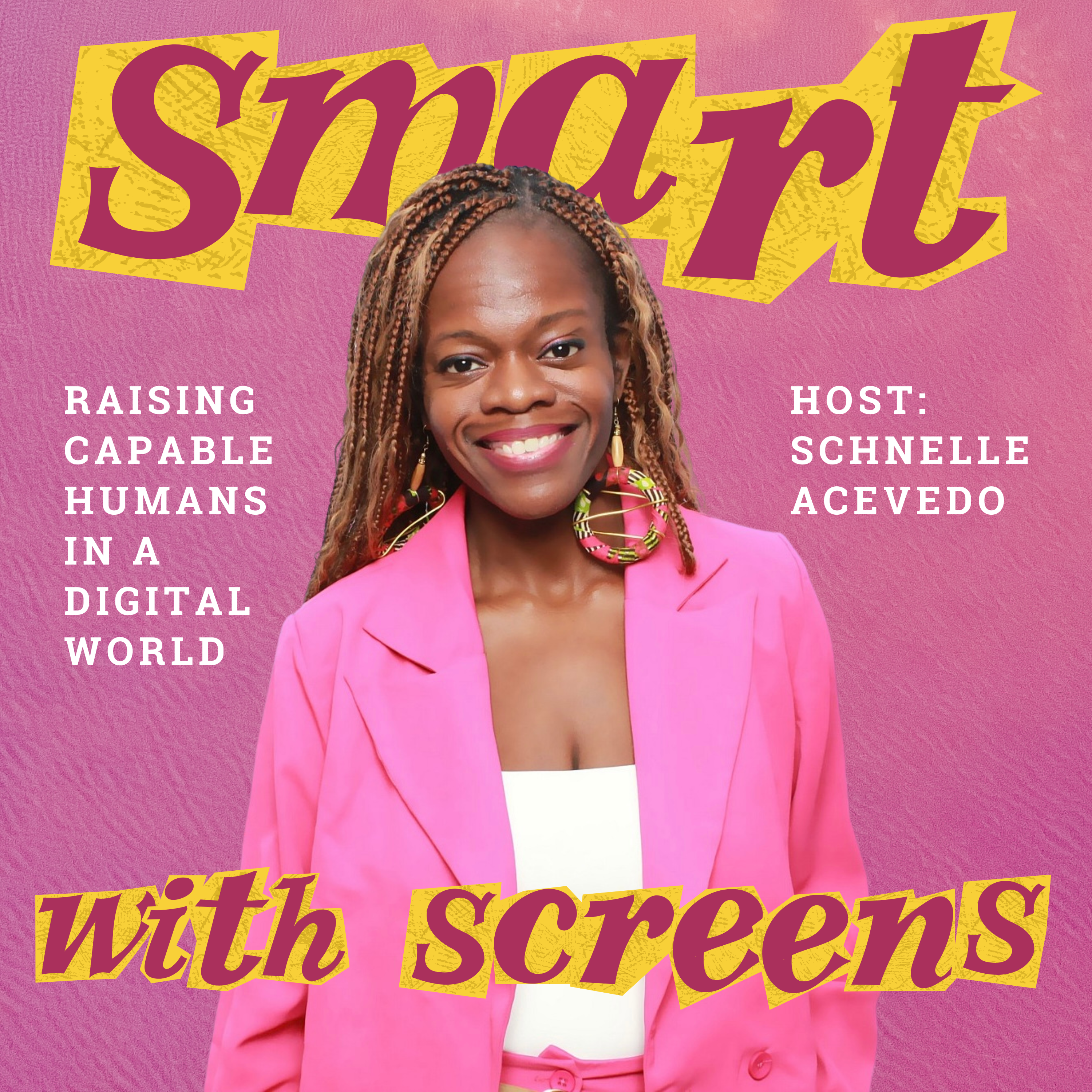
Smart With Screens With Schnelle Acevedo
by Schnelle Acevedo - Digital Literacy Expert + Content Creator
Is this your podcast?Insights from recent episode analysis
Audience Interest
Podcast Focus
Publishing Consistency
Platform Reach
Insights are generated by CastFox AI using publicly available data, episode content, and proprietary models.
Most discussed topics
Brands & references
Est. Listeners
Insufficient chart data. Estimates will improve as the show charts.
- Per-Episode Audience
Est. listeners per new episode within ~30 days
N/A🎙 ~2x weekly·12 episodes·Last published 1mo ago - Monthly Reach
Unique listeners across all episodes (30 days)
N/A - Active Followers
Loyal subscribers who consistently listen
N/A
Market Insights
Platform Distribution
Reach across major podcast platforms, updated hourly
Total Followers
—
Total Plays
—
Total Reviews
—
* Data sourced directly from platform APIs and aggregated hourly across all major podcast directories.
On the show
From 10 epsHost
Recent guests
No guests detected in recent episodes.
Recent episodes
Going Viral at What Cost — The Truth About Attention Addiction in Young Creators
May 13, 2026
13m 22s
She Never Looked Up — A Braiding Shop, a Child, and the Truth About Doom Scrolling
Apr 27, 2026
13m 34s
The Village Has to Show Up — What a Walk Across the Brooklyn Bridge Taught Me About Digital Literacy
Apr 20, 2026
8m 21s
From Consumers to Creators: Why Every Student Needs Digital Creation Skills
Apr 13, 2026
15m 04s
Five Strategies to Stop Doomscrolling (That Actually Work)
Apr 3, 2026
18m 10s
Social Links & Contact
Official channels & resources
Official Website
Login
RSS Feed
Login
| Date | Episode | Topics | Guests | Brands | Places | Keywords | Sponsor | Length | |
|---|---|---|---|---|---|---|---|---|---|
| 5/13/26 | ![]() Going Viral at What Cost — The Truth About Attention Addiction in Young Creators✨ | attention addictionyoung creators+3 | — | BAM Digital Media | — | attention addictionyoung creators+3 | — | 13m 22s | |
| 4/27/26 | ![]() She Never Looked Up — A Braiding Shop, a Child, and the Truth About Doom Scrolling✨ | digital literacydoom scrolling+3 | — | BAM Digital Media | Brooklyn | doom scrollingchildren+3 | — | 13m 34s | |
| 4/20/26 | ![]() The Village Has to Show Up — What a Walk Across the Brooklyn Bridge Taught Me About Digital Literacy✨ | digital literacyeducation+3 | — | BAM Digital Media | Brooklyn BridgeBrooklyn+2 | digital literacyBrooklyn Bridge+4 | — | 8m 21s | |
| 4/13/26 | ![]() From Consumers to Creators: Why Every Student Needs Digital Creation Skills✨ | digital creation skillseducation+3 | — | — | — | digital literacycontent creation+6 | — | 15m 04s | |
| 4/3/26 | ![]() Five Strategies to Stop Doomscrolling (That Actually Work)✨ | doomscrollingdigital wellbeing+3 | — | — | — | doomscrollingstrategies+3 | — | 18m 10s | |
| 3/17/26 | ![]() How Screenshot Culture Is Fueling School Conflict✨ | digital conflictscreenshot culture+3 | — | — | — | screenshot culturedigital ethics+3 | — | 17m 31s | |
| 2/26/26 | ![]() Can AI Write Your Essay? (And Should It?)✨ | AI ethicseducation+3 | — | ChatGPT | — | AIChatGPT+5 | — | 16m 27s | |
| 2/17/26 | ![]() 2026 Digital Scams: The Call That Sounds Like Your Kid (But Isn't)✨ | digital scamsAI voice cloning+3 | — | BAM Digital Media | — | digital scamsAI voice cloning+3 | — | 11m 55s | |
| 2/6/26 | ![]() Deepfakes! When You Can't Trust What You See Anymore✨ | deepfakesAI technology+4 | — | OpenAI | — | deepfakesAI-generated content+5 | — | 15m 14s | |
| 2/2/26 | ![]() When the Expert Feels Lost Too: Honest Talk About Parenting and Phones✨ | parentingdigital literacy+4 | — | — | — | parentingphones+6 | — | 12m 32s | |
Want analysis for the episodes below?Free for Pro Submit a request, we'll have your selected episodes analyzed within an hour. Free, at no cost to you, for Pro users. | |||||||||
| 1/23/26 | ![]() Why One-Size-Fits-All Digital Rules Don't Work | Not all kids have the same relationship with technology—and blanket screen time rules are failing neurodivergent children.Digital literacy educator Schnelle Acevedo explores why individualized approaches matter for kids with ADHD, autism, anxiety, and other neurodivergent traits.Topics covered:Self-Regulation & Screen TimeWhy some kids naturally limit device use while others struggleHow ADHD affects dopamine regulation and makes algorithms more addictiveWhy "just put the phone down" doesn't work for all kidsWhen Algorithms Actually HelpHow neurodivergent kids use technology as assistive toolsYouTube tutorials for kids with executive function challengesDiscord and gaming communities for autistic kidsAI apps designed specifically for neurodivergent childrenApps for anxiety and emotional regulationWhat Individualized Approaches Look LikeQuestions parents should ask instead of universal time limitsHow schools can differentiate digital support (like IEPs)Recognizing when apps are tools for functioning, not just entertainmentInspired by meeting an entrepreneur developing AI for neurodivergent kids, Schnelle challenges blanket phone bans and screen time rules. Instead: What does this specific child need to thrive with technology?Perfect for: ✓ Parents of neurodivergent children ✓ Special education teachers ✓ School administrators creating inclusive policies ✓ Anyone interested in disability justice and digital equityRelated topics: ADHD and screen time, autism and technology, assistive technology, inclusive digital policies, executive function support, digital wellbeing for neurodivergent studentsHosted by Schnelle Acevedo, founder of BAM Digital Media LLC (certified MWBE), former digital marketer for Disney/Netflix/Amazon, and digital literacy educator.Inclusive digital literacy workshops available:📧 Email: contactus@bamdigitalmedia.info🗓️ Schedule consultation: https://bamdigitalmedia.infoVirtual programs nationwide for students, educators, and parents | — | ||||||
| 1/16/26 | ![]() Positive Digital Affirmations (And Why We Need Them) | "I know, I know—affirmations can feel a little... woo-woo. But hear me out."We spend hours every day consuming content designed to make us feel inadequate, anxious, and like we're missing out. Algorithms literally optimize for content that triggers emotional responses—often negative ones, because those drive more engagement.So what if we spent just a few minutes actively countering that messaging?This episode is different from the others. No deep dives into how technology works. No scary statistics about scams or deepfakes. Just affirmations you can come back to when you need them.Schnelle shares affirmations for:Comparison – "My worth is not determined by likes, followers, or how I look in photos"FOMO – "I am exactly where I need to be right now"Screen time guilt – "Progress, not perfection. Every small choice matters"Social media anxiety – "I do not need to perform my life for an audience"Information overload – "I cannot consume every piece of news, and that's okay"Kids and teens – "My worth is not measured in likes or followers"Parents – "I am doing my best in a situation no generation has faced before"Content creators – "My value is not determined by engagement metrics"This is a short episode—just the affirmations with space to let them land. You can listen when you're feeling overwhelmed by social media. You can share specific affirmations with your kids. You can screenshot them and keep them as reminders.Why this matters:If platforms are intentionally manipulating us to feel certain ways to drive engagement, we need to be intentional about countering those feelings. These affirmations aren't magic. They won't fix everything. But they can help you reset, refocus, and remember what's actually true—not what the algorithm wants you to believe.Perfect for: Anyone who's ever felt inadequate after scrolling, parents wanting to help their kids build healthier self-talk around technology, educators looking for tools to support student wellbeing, or anyone needing a digital reset.Come back to this episode as often as you need it. It's here for the hard days.Want to bring digital literacy and wellbeing education to your community?Schnelle offers workshops that address both the mechanics of technology (algorithms, AI, scams) AND the emotional impact (comparison, anxiety, digital wellbeing). Programs available for students, educators, parents, and community groups—virtually and in-person.📧 Email: contactus@bamdigitalmedia.info🗓️ Schedule a consultation: https://bamdigitalmedia.info🗽 Based in Brooklyn, NY | Virtual workshops available nationwide | — | ||||||
| 1/9/26 | ![]() The Question That Stumped the Expert | What happens when a 15-year-old asks better questions than the digital literacy expert has answers for?Schnelle was interviewing with a teen council in Brooklyn—they were evaluating whether her workshops were right for their program. She was ready to impress them with her credentials, her insider knowledge, her 14 years in digital marketing.Then one young man asked: "Do you agree with the phone ban?"Simple question, right? Except it wasn't simple at all.Schnelle's mama heart screamed YES—ban the phones, protect the kids from algorithms and comparison and distraction.But her educator mind hesitated: Are we teaching kids to manage technology, or just removing it and hoping for the best?She gave him an answer: Yes, she agreed with the ban.And then he hit her with the follow-up that made her question everything."What if the good kids—the ones with amazing grades—got to have their phones, and the ones with terrible grades didn't?"In this episode, Schnelle unpacks why that question is so brilliant and so challenging. Because it exposes something we don't talk about enough: Are phone bans about protecting all kids, or about controlling the kids we don't trust?Then came question three: "Don't phones promote socialization through gaming and connecting?"And Schnelle gave the "right" answer (plenty of ways to socialize offline), but she could tell he wasn't buying it. Because he was seeing the limitation in her logic: We're telling kids that connection increasingly happens online while simultaneously restricting their access during huge parts of their day.This episode explores:The mama vs. educator tension in technology decisionsWhy "fair across the board" might not actually be fairWhether we're solving the right problem with phone bansHow kids perceive our contradictions around technologyWhat happens when the expert admits she doesn't have all the answersThis isn't a "here's what you should do about phones" episode. This is a "let's sit with the complexity and admit this is really hard" episode.And sometimes, that's the most valuable education of all.For parents: If you've struggled with phone rules and felt like there's no good answer—you're not alone. This episode validates that struggle.For educators: If you're creating or enforcing phone policies while feeling uncertain about them—this episode gives you permission to question.For teens: If you've felt like adults don't really understand your relationship with technology—this episode proves you're right.Bring nuanced digital literacy conversations to your community:Schnelle's workshops create space for real dialogue about technology—not just rules and restrictions, but understanding why these tools are so compelling and how to navigate them thoughtfully.📧 Contact: contactus@bamdigitalmedia.info🌐 Learn more: https://bamdigitalmedia.infoVirtual and in-person programs for schools, libraries, and organizations nationwide. | — | ||||||
| 12/31/25 | ![]() How Social Media Algorithms Actually Work (And Why You Can't Stop Scrolling) | "I need to confess something embarrassing: I know how algorithms work. I've built campaigns using them. I teach people about them. And I still fall victim to them."In this episode, Schnelle breaks down exactly how social media algorithms decide what you see when you open Instagram, TikTok, or YouTube. Not in vague terms like "the algorithm is watching you" (which sounds creepy but doesn't actually help), but in concrete "here's what's happening right now" terms.She explains the four-step process every algorithm uses:Watching everything you do (and we mean everything)Making predictions about what you'll engage with nextTesting and refining constantlyOptimizing for engagement metrics—not your wellbeingAnd here's where it gets personal: Schnelle admits she still doomscrolls. Even knowing every trick in the book, she still finds herself 45 minutes deep in Instagram feeling worse than when she started.But something's changed recently. She's started catching herself in the moment, asking "Wait, how is this video making me feel?" And if the answer is anxious, inadequate, or drained? She scrolls away.That awareness—recognizing when you're being manipulated—is the difference between being controlled by the algorithm and having some agency over it.The good news? You can train your algorithm.Schnelle teaches you how to be intentional about what you engage with, how to use the "Not Interested" button strategically, and how to reset when your feed has gotten too negative or anxiety-inducing.This isn't about deleting social media or going on a digital detox. It's about understanding the system well enough to use it on your terms.What you'll learn:The exact mechanism behind "why can't I stop scrolling?"Why negative content often gets more engagement than positive (and what that means for your feed)How to actively train your algorithm to show you better contentWhy platforms prioritize engagement over your mental health—and what you can do about itPractical strategies Schnelle uses herself (because she's still figuring this out too)If you've ever wondered why TikTok feels like it can read your mind, or why you open Instagram "just for a second" and lose an hour, this episode explains it all—from someone who built these campaigns professionally.Plus, she shares how this connects to digital literacy education for kids: teaching them they have more control than they think.Perfect for: Anyone who's ever said "I don't know how I ended up scrolling for so long" and wants to understand what's actually happening to their brain.Want to bring digital literacy education to your school, library, or organization?Schnelle offers customized workshops—virtual and in-person—that teach students, educators, parents, and community members how algorithms, manipulation tactics, and social media psychology actually work.Programs available for all ages: elementary students learning internet basics, teens understanding social media psychology, adults navigating digital wellbeing, and seniors protecting themselves online.📧 Email: contactus@bamdigitalmedia.info🗓️ Schedule a consultation: https://bamdigitalmedia.info🗽 Based in Brooklyn, NY | Virtual workshops available nationwideLearn the insider knowledge that makes the difference—from someone who's been on both sides of the screen. | — | ||||||
| 12/31/25 | ![]() Why a Digital Marketer is Teaching Digital Literacy | Episode 1: Why a Digital Marketer is Teaching Digital Literacy"My job was to get you to click, to scroll, to buy. I was really good at it. Now I'm teaching you how it all works."For 14 years, Schnelle Acevedo created digital marketing campaigns designed to capture and hold your attention. She worked with Disney, Netflix, Amazon, P&G—learning every psychological trick, every algorithmic strategy, every data manipulation tactic that makes social media so hard to put down.Then she had kids. Became a PTA President. Started seeing the disconnect between what schools were teaching about "internet safety" and what kids actually needed to know.So she made a career shift: from digital marketer to digital literacy educator.In this first episode, Schnelle pulls back the curtain on her transition and explains why she's the person to teach this. She's not theorizing about how platforms work—she helped build these campaigns. She's not guessing about manipulation tactics—she used them for major brands. And she's not speaking from ivory tower expertise—she's a Brooklyn mom raising kids in NYC public schools.This episode sets the stage for a season of honest, insider education about algorithms, AI, deepfakes, scams, and what it really takes to be smart with screens in 2026.No fear-mongering. No jargon. Just real talk from someone who knows.Interested in digital literacy workshops for your community? Schnelle teaches virtual and in-person sessions for schools, libraries, PTAs, senior centers, and organizations nationwide.📧 Contact: contactus@bamdigitalmedia.info🗓️ Schedule a call: https://bamdigitalmedia.infoCustomized programs available for elementary students, middle school, high school, educators, parents, seniors, and mixed-age community groups. | — | ||||||
Showing 15 of 15
Pitch Fit is a Pro feature
See how bookable this show is for guests, which brands already advertise, the per-episode ad value, and the best-fit guest and sponsor profile. The numbers are blurred on the free plan.
How readily this show books outside guests like you.
How proven this show is for host-read sponsorships.
For Guests
ProFor Advertisers
ProUpgrade to Pro to unlock guest cadence, sponsor categories, fit scores, and per-episode ad value for this show.

