

Insights from recent episode analysis
Audience Interest
Podcast Focus
Publishing Consistency
Platform Reach
Insights are generated by CastFox AI using publicly available data, episode content, and proprietary models.
Total monthly reach
Estimated from 3 chart positions in 3 markets.
By chart position
- 🇦🇺AU · Astronomy#1425K to 30K
- 🇺🇸US · Astronomy#1445K to 30K
- 🇲🇽MX · Astronomy#7710K to 30K
- Per-Episode Audience
Est. listeners per new episode within ~30 days
14K to 63K🎙 Biweekly cadence·84 episodes·Long inactive - Monthly Reach
Unique listeners across all episodes (30 days)
20K to 90K🇦🇺33%🇺🇸33%🇲🇽33% - Active Followers
Loyal subscribers who consistently listen
6K to 27K
Market Insights
Platform Distribution
Reach across major podcast platforms, updated hourly
Total Followers
—
Total Plays
—
Total Reviews
—
* Data sourced directly from platform APIs and aggregated hourly across all major podcast directories.
On the show
Recent episodes
Danny Jaques — Creator & Chief “Salsanaut,” Danny’s Rocket Ranch™ Space Salsa®
Feb 17, 2022
30m 20s
Kevin Rice – Former Director of Business Management for Lockheed Martin’s Skunk Works and NASA JPL
Jan 20, 2022
43m 43s
Laurie Orth — ‘Rocket Recorder’ Author, Composer, Educator
Jan 12, 2022
35m 19s
Steven Hawley — Former NASA Astronaut, Hubble Space Telescope & Chandra X-ray Observatory Missions
Dec 15, 2021
51m 38s
Dorit Donoviel — Director, Translational Research Institute for Space Health
Dec 8, 2021
50m 37s
Social Links & Contact
Official channels & resources
Official Website
Login
RSS Feed
Login
| Date | Episode | Description | Length | ||||||
|---|---|---|---|---|---|---|---|---|---|
| 2/17/22 |  Danny Jaques — Creator & Chief “Salsanaut,” Danny’s Rocket Ranch™ Space Salsa® | In this episode: We meet Danny Jaques creator of Danny’s Rocket Ranch Space Salsa. Born and raised on a ranch (the company’s namesake) near Ignacio, Colorado, Jaques realized that rather than becoming a rancher, he wanted to pursue a career in space. He initially dreamt of being an astronaut, but after graduating from Fort Lewis College he embarked upon a junior high teaching career, during which he escorted hundreds of his students to Space Camp in Huntsville, Alabama. In 2010, Jaques was inducted into the Space Camp Hall of Fame. After years of friends and family raving about his homemade salsa recipe, he had the idea to utilize dehydration techniques developed by NASA to formulate a salsa that could be consumed in and withstand the rigors of space, while still being delicious to consume on Earth. Danny has since retired from his teaching career, but he continues to help students attend Space Camp, with a portion of company profits donated to the U.S. Space & Rocket Center Education Foundation for Space Camp scholarships. Jaques’ Space Salsa has also earned Space Certification through Space Foundation. In our conversation, Danny discusses his overarching love of space, how that played into his teaching career, his experiences taking students to Space Camp, what prompted him to start a salsa business, how he integrated his love of space into his company’s products, and how he perfected the process of making his dehydrated salsa as delicious as fresh salsas on the market. Describing comments he’s received on his salsa, Jaques says, "Dottie Metcalf-Lindenburger, she’s a Shuttle astronaut and a former Ft. Collins high school teacher, and I [asked], ‘Dottie, do you think the folks on the International Space Station would like my salsa?’ And she looked over at me, and her eyes wide, and she said, ‘Danny, they’d love your salsa!’” Learn more about Danny, his “forever bride” Laura, and Danny’s Rocket Ranch Space Salsa by visitinghttps://www.dannysrocketranch.com Introductory and closing music: Paint the Sky by Hans Atom © Copyright 2015, licensed under a Creative Commons Attribution (3.0) license. http://dig.ccmixter.org/files/hansatom/50718 Ft: Miss Judged | 30m 20s | ||||||
| 1/20/22 |  Kevin Rice – Former Director of Business Management for Lockheed Martin’s Skunk Works and NASA JPL | In this episode: We meet Kevin Rice who spent 40 years in the aerospace industry, roughly split between Lockheed Martin’s legendary Skunk Works and NASA’s Jet Propulsion Laboratory (JPL). At Skunk Works Kevin served as Director of Business Management, where his responsibilities included management of several hundred employees in the execution of budgeting, scheduling, proposal development, cost estimating and pricing, contracts, and risk management. His work supported tactical aircraft projects including the F-117, F-22, and F-35, as well as reconnaissance projects such as the U-2, SR-71, various C-130 projects, and the sub-scale X-33 reusable launch vehicle. Following that, and until his retirement in 2019, Kevin worked for NASA JPL, as a Division Manager and Director of Project Business Management for NASA’s research and development centers. Kevin developed, implemented and maintained JPL’s project controls processes, and created JPL’s business policies and practices manual (the “Dark Green Book”), which served as a model for business throughout NASA. He also developed the independent assessment model adopted by NASA to assess project performance. From 1992 to the present, Kevin has served as adjunct professor of Corporate Finance, International Business, and Global Financial Management at the University of Redlands. In our conversation, Kevin discusses how he budgeted costs and set timelines for massive aerospace projects, established risk evaluation and management controls, what it was like maintaining constant discretion on classified projects, details on Skunk Works’ X-33 reusable launch vehicle program with NASA, and his experiences riding the annual Federal appropriations rollercoaster. Discussing his own personal commandments for business management, Kevin says, “It’s about understanding the trends — what are the facts, what is the relationship between facts — that’s analysis. Assessment is, ‘What do I do with that information?’” You know, what is the risk attendant to that? How reasonable is it? What are some of the alternatives that we can apply to some of that?” Introductory and closing music: Paint the Sky by Hans Atom © Copyright 2015, licensed under a Creative Commons Attribution (3.0) license. http://dig.ccmixter.org/files/hansatom/50718 Ft: Miss Judged | 43m 43s | ||||||
| 1/12/22 |  Laurie Orth — ‘Rocket Recorder’ Author, Composer, Educator | In this episode: We meet Laurie Orth, educator, musician, and creator of the Rocket Recorder musical curriculum. Laurie has taught music in several different settings, and in 2012, she began her own business teaching general music classes to home schoolers. Noticing her students lacked motivation to participate, she had an out-of-the-box idea that by creating music and teaching it under a space theme might grab their attention. In our conversation, Orth discusses what led her to careers in music and education, what gave her the idea to merge those different disciplines into Rocket Recorder, and the response she got the first time she introduced her Rocket Recorder songs in the classroom. In describing the results of Rocket Recorder, Orth says, “It was a great outcome, because I wanted my kids to learn how to read music and not just memorize little nursery rhymes — and they did! They really would read the music and they learned how to count (time), so I felt like it was a success all around. And they learned a lot about space exploration.” Learn more about Laurie and Rocket Recorder, visit www.laurieorth.com Introductory and closing music: Paint the Sky by Hans Atom © Copyright 2015, licensed under a Creative Commons Attribution (3.0) license. http://dig.ccmixter.org/files/hansatom/50718 Ft: Miss Judged | 35m 19s | ||||||
| 12/15/21 |  Steven Hawley — Former NASA Astronaut, Hubble Space Telescope & Chandra X-ray Observatory Missions | In this episode: We meet Dr. Steven Hawley, Professor Emeritus of Physics and Astronomy at the University of Kansas, and former NASA astronaut who’s flown on five Space Shuttle missions. In those missions, Hawley had major roles in the deployment and later upkeep of the Hubble Space Telescope, as well as the launch of the Chandra X-ray Observatory. In our conversation, Dr. Hawley discusses the first telescope he owned, the 1991 Hubble Space Telescope deployment mission, his role in its deployment, why it initially didn’t operate as intended, what it’s told us about our universe, his later role in the launch of the Chandra X-ray Observatory, and his thoughts on the upcoming launch of the James Webb Space Telescope. In describing his first space mission deploying the bus-sized Hubble in 1991, Hawley says, “My job was to operate the arm to grasp the telescope, lift it out of the payload bay, and release it. Well, that sounds simple enough on the surface. It actually was quite complicated, and there were a lot of ‘what-ifs’ that we had to think about.” Introductory and closing music: Paint the Sky by Hans Atom © Copyright 2015, licensed under a Creative Commons Attribution (3.0) license. http://dig.ccmixter.org/files/hansatom/50718 Ft: Miss Judged | 51m 38s | ||||||
| 12/8/21 |  Dorit Donoviel — Director, Translational Research Institute for Space Health | In this episode: We meet Dr. Dorit Donoviel, director of the Translational Research Institute for Space Health (TRISH). She is also director of the Biomedical Innovation Laboratory and associate professor of Space Medicine at Baylor College of Medicine. Donoviel’s work revolves around performing research and developing strategies aimed at reducing health and safety risks to astronauts in long-duration space missions. She has received numerous awards for her work, including NASA’s Group Achievement Award for work as a member of the Executive Steering Committee for “The Impact of Sex and Gender on Adaptation to Space,” a collection of six scientific articles published in The Journal of Women's Health. In our conversation Donoviel discusses how her career in the space ecosystem began, what inspired her to do the research she does, changes that occur in the human body in space, how space health includes both physical and behavioral health, the TRISH-sponsored research conducted by the civilian crew on the SpaceX Inspiration4 mission, and her thoughts on the importance of mentorship. Explaining the importance of racial and gender diversity in tracking the health of humans in space, Donoviel says, “You go back to the Sixties; we’ve been in space for 60 years… Roughly 530-something-odd people have been to space. That’s like 10 a year. And as a biologist — as a person who studies particularly humans — you need more than that! You need a lot more people. And you need diversity in your sample.” To learn more about TRISH, visit https://www.bcm.edu/academic-centers/space-medicine/translational-research-institute Introductory and closing music: Paint the Sky by Hans Atom © Copyright 2015, licensed under a Creative Commons Attribution (3.0) license. http://dig.ccmixter.org/files/hansatom/50718 Ft: Miss Judged | 50m 37s | ||||||
| 11/18/21 |  Will Henry – Writer & Producer, “The High Frontier: The Untold Story of Gerard K. O‘Neill” | In this episode: We meet Will Henry, award-winning filmmaker, producer and writer of the documentary film The High Frontier: The Untold Story of Gerard K. O'Neill, released on September 15th of this year. Will is the Creative Director and Senior Producer at Multiverse Media, a media company focusing on space exploration and science and technology. He is also currently producing an eight-part television series in association with NASA, and is the writer and producer of The Legendary Podcast, a monthly podcast dedicated to sharing stories of perseverance and glory from the world’s top athletes. In our conversation, Will discusses how he ended up working on the film, how long it took to take it from concept to release, how difficult it was to encapsulate a 30-year period of O’Neill’s eventful life into documentary film length, how they were able to round up Gerry’s family and associates to participate, and how much O’Neill’s work then has inspired today’s commercial space travel efforts. Discussing O’Neill’s inventiveness, Will says, “He was a prolific inventor. He invented the particle accelerator; he invented the chambers that made that work. He also invented the precursor to GPS, and he predicted a lot of what we use today, you know — things like the Kindle to self-driving cars. And it’s just incredible how way ahead of his time he was.” To learn more about the documentary, visit thehighfrontiermovie.com. To learn more about Will and his projects, visit willhenryfilm.com or catch him on Twitter @WillTHenry. Introductory and closing music: Paint the Sky by Hans Atom © Copyright 2015, licensed under a Creative Commons Attribution (3.0) license. http://dig.ccmixter.org/files/hansatom/50718 Ft: Miss Judged | 27m 56s | ||||||
| 11/10/21 |  Garrett Harwood – Founder/CEO of Eagle Shield Inc. | In this episode: We meet Garrett Harwood, founder of Eagle Shield Inc., a premier provider of energy-saving products for home and business that were developed using a technology originally created by NASA. Eagle Shield’s products are space-certified through Space Foundation’s Space Certification Program. Prior to Eagle Shield, Garrett was vice president of sales for a billion-dollar fitness center with locations in the United States, Europe, and Asia. He is a graduate of Harvard Business School with a degree in administration, and also holds an MBS in Green Sustainability from San Francisco Institute of Architecture. In our conversation, Garrett discusses how the lessons he learned in his previous career in the fitness industry helped to lay the groundwork for Eagle Shield, the space technology at the core of their product and its applications, how radiant barrier reflective insulation works, how use of the insulation has moved beyond residential homes to private and commercial properties, and where he’d like to take Eagle Shield next. In describing how reflective insulation works, Harwood says, “Deep space is -460º [F] below zero. Why wouldn’t you have a heater in an astronaut uniform? Because your own body heat is 98.6 degrees [F]. So, by having the reflective insulation in the astronaut uniform, you’re reflecting your own body heat back in, keeping you comfortable.” Learn more about Eagle Shield by visiting https://eagleshield.com/ Introductory and closing music: Paint the Sky by Hans Atom © Copyright 2015, licensed under a Creative Commons Attribution (3.0) license. http://dig.ccmixter.org/files/hansatom/50718 Ft: Miss Judged | 28m 07s | ||||||
| 10/27/21 |  Libby Jackson – UK Space Agency Human Exploration Programme Manager & “Space Explorers: 25 Extraordinary Stories of Space Exploration and Adventure” Author | In this episode: We meet Libby Jackson, the Human Exploration Programme Manager at the UK Space Agency, and author of two books for young people on space exploration: Galaxy Girls: 50 Amazing Stories of Women in Space published in 2018, and the recently published Space Explorers: 25 Extraordinary Stories of Space Exploration and Adventure. Libby is one of Britain’s leading experts in human spaceflight and she’s passionate about sharing stories on that topic with young people to encourage them to follow their passions in life. Space was Libby’s childhood inspiration, and she has worked in the space industry since she earned her degrees in Physics from Imperial College and Astronautics and Space Engineering from Cranfield University. She began working at Europe's control center for the International Space Station as a flight instructor and controller in 2007, and a few years later, became director for the European Space Agency’s ISS Columbus module. She joined the UK Space Agency in 2014 as spokesperson for the first British ESA astronaut Tim Peake’s mission to the International Space Station and has remained there since. In our conversation, Jackson explains how she wrote a “Travel Guide to Mars” when she was just nine years old, how, at age 17, she shadowed a mission control worker at NASA Johnson Space Center, what it was like working at Europe’s control center for the International Space Station, what inspired her to write her new book, and how the stories in it go beyond just facts — to include the emotions that the explorers experienced on their missions. Describing her objective in writing her newest book, Libby says, “Here’s a book I wish I had when I was 10, or 11 or 12. Something that tells these fantastic stories, gets behind just the pictures and the highlights of what you see. And I hope I get across just how exciting and brilliant a place [space] is.” To learn more about Libby and her books, visit libbyjackson.com Introductory and closing music: Paint the Sky by Hans Atom © Copyright 2015, licensed under a Creative Commons Attribution (3.0) license. http://dig.ccmixter.org/files/hansatom/50718 Ft: Miss Judged | 31m 26s | ||||||
| 10/18/21 |  Homer Hickam – Bestselling Author | In this episode: We meet Homer Hickam, author of the No. 1 New York Times bestselling memoir Rocket Boys and its ever-popular movie adaptation, October Sky. Rocket Boys is the story of a young man and his friends in Coalwood, West Virginia, who, inspired by the space age, started building and launching rockets, which was just the beginning of a fantastic career that eventually took Homer to NASA. Since he published that first book, he has written more than a dozen fictional and nonfictional bestsellers. On October 26, Hickam will release a new follow-up memoir to Rocket Boys titled Don't Blow Yourself Up. This story includes tales of his life and times during the next 40 years that take the reader to college, Vietnam, underwater, NASA, and to remote locations looking for dinosaur bones. In our conversation, Hickam details his memoir writing process, what it was like to pioneer the infamous Virginia Tech Skipper game cannon, his time at NASA, meeting Elon Musk at adult Space Camp, becoming an avid amateur paleontologist, and why he would be considered an old Grinch on a suborbital flight. In discussing whether he is an actual Renaissance man, Homer says, “I wonder if the people during the actual Renaissance thought of themselves as Renaissance people — I don’t think you know that until you look back. I love the idea of having an adventure in my life and, and when it’s presented to me, I just grab it, and I just go with it, and I just want to make it happen so much.” To learn more about Homer Hickam and his newest book, Don't Blow Yourself Up, visit https://homerhickam.com/ Introductory and closing music: Paint the Sky by Hans Atom © Copyright 2015, licensed under a Creative Commons Attribution (3.0) license. http://dig.ccmixter.org/files/hansatom/50718 Ft: Miss Judged | 42m 21s | ||||||
| 10/7/21 |  Dr. Kathryn Thornton — Former NASA Astronaut | In this episode: We meet Dr. Kathryn Thornton, former NASA astronaut and current Professor Emeritus at the University of Virginia in the School of Engineering and Applied Science, Department of Mechanical and Aerospace Engineering. Dr. Thornton was selected by NASA in May 1984, became the third woman to walk in space, and the first woman to make multiple extravehicular activities (EVAs). A veteran of four space flights, which included her stents as a spacewalker, repairing in-orbit satellites — including the Hubble space telescope — gave Dr. Thornton nearly 1000 hours of space travel. In our conversation, Dr. Thornton discusses pursuing education in STEM at a time where women were not encouraged in the field, the advancement of gender equality in space, how she trained for missions, an incident that could have impacted the course of a space flight, and what travel to the Moon means for deep space exploration. In sharing advice regarding a career in space, Dr. Thornton says, “There are lots of ways to be involved in the space program. Anybody can, there’s so many different dimensions that require humans and people with a passion that anybody can be a part of it.” Introductory and closing music: Paint the Sky by Hans Atom © Copyright 2015, licensed under a Creative Commons Attribution (3.0) license. http://dig.ccmixter.org/files/hansatom/50718 Ft: Miss Judged | 19m 27s | ||||||
Want analysis for the episodes below?Free for Pro Submit a request, we'll have your selected episodes analyzed within an hour. Free, at no cost to you, for Pro users. | |||||||||
| 9/22/21 |  Jay Chattaway, longtime Star Trek series music and score composer | In this episode: We meet Jay Chattaway, an Emmy award-winning composer who has been nominated nine times for his work in television, particularly for the hit Star Trek series. In addition to his television work, Jay has composed scores for more than 30 feature films. Chattaway is also the producer of many Grammy-winning music projects, working with artists such as Carly Simon, Bob James, Maynard Ferguson, Gato Barbieri, David Byrne of The Talking Heads, The Fania All-Stars , Herb Alpert, and the von Trapp Children. He has served as Director of A&R for CBS records, has been the president of the Society of Composers and Lyricists, and governor of the Academy of Television Arts and Sciences. Jay is also in demand as a conductor, having recently conducted the London Philharmonic at Royal Albert Hall. Jay has both bachelor’s and master’s degrees from West Virginia University and post-graduate studies at The Eastman School of Music. Jay serves as Distinguished Composer-in-Residence at West Virginia University and received an Honorary Doctorate there in May 2019. In this episode, Jay discusses the first instrument that he picked up and how it led him to a career in music, the musical artists that influenced him and his work, how music adds to storytelling, how he pairs music with a scripted scene, the processes and interactions he has with the director and writers for the show, and more. Recalling how he initially got the job doing music for Star Trek: The Next Generation, Chattaway says, “So then they sent my whale orchestra on to the producers of Star Trek and they thought, ‘Wow, this guy’s out there, so I’m guessing if he’s that far out — doing whales in his orchestra — he might be the right guy to do Star Trek.’” Introductory and closing music: Paint the Sky by Hans Atom © Copyright 2015, licensed under a Creative Commons Attribution (3.0) license. http://dig.ccmixter.org/files/hansatom/50718 Ft: Miss Judged | 52m 20s | ||||||
| 9/9/21 |  Frank Culbertson — former NASA astronaut, “The only US citizen not on Earth when the Sept. 11 attacks occurred” | In this episode: We meet CAPT Frank Lee Culbertson, Jr., USN (Ret.), a former American Naval officer and aviator, test pilot, aerospace engineer, NASA astronaut, and graduate of the U.S. Naval Academy. He served as the Commander of the International Space Station (ISS) for almost four months in 2001, giving him the distinction of being the only U.S. citizen not on Earth when the Sept. 11, 2001 attacks occurred. As the ISS passed over New York City after the attacks, he captured impactful photos and video from low Earth orbit of the smoke emanating from Ground Zero in Lower Manhattan. You can read a letter he wrote detailing the complex emotions he experienced that day at https://www.nasa.gov/topics/nasalife/features/sept11_culbertson.html Culbertson’s achievements are too numerous to list completely here. He served in the Gulf of Tonkin, Vietnam, and later as a Naval aviator, Culbertson flew aircraft with the U.S. Air Force in the 426th Tactical Fighter Training Squadron at Luke Air Force Base, Arizona, where he served as Weapons and Tactics Instructor. Culbertson then served as the Catapult and Arresting Gear Officer for USS John F. Kennedy until he was selected to attend the U.S. Naval Test Pilot School, from which he graduated with distinction in 1982. He has logged over 9,500 hours flying time in 60 different types of aircraft. Frank was selected for and completed NASA astronaut training in 1985. He’s a veteran of three space flights: STS-38 aboard Space Shuttle Atlantis (Nov. 1990), STS-51 aboard Space Shuttle Discovery (Sept. 1993), and as part of the ISS Expedition 3 crew (launched via STS-105 on Space Shuttle Discovery, Aug. 2001). Culbertson lived and worked aboard the International Space Station for a total of 129 days on that mission and commanded the ISS for 117 of those days. Culbertson recently retired as President of the Space Systems Group at Northrop Grumman Innovation Systems, and currently consults for several aerospace companies. He’s also on the Board of Advisors of Bye Aerospace, the Board of Trustees of the AIAA, the Board of Directors of Firefly Black Aerospace, and is Member at Large on the Space Foundation Board of Directors. He remains an active pilot and is president of his own company, Higher Flight LLC. In this episode, Frank recalls his day on the ISS on Sept. 11, 2001, how he received information about the attacks in bits and pieces as the day unfolded, the loss of his friend Capt. Charles “Chic” Burlingame (pilot of Flight 77 which terrorists crashed into the Pentagon that day), and how much the world had changed by the time he returned to Earth three months later. Detailing his memories of taking photos aboard the ISS that morning, Culbertson says, “So, it made it easy to zoom in with the camera and look at what was happening. And as I zoomed in ... a big gray blob enveloped Southern Manhattan, and ... I found out later what I was seeing was the second tower come down.” Introductory and closing music: Paint the Sky by Hans Atom © Copyright 2015, licensed under a Creative Commons Attribution (3.0) license. http://dig.ccmixter.org/files/hansatom/50718 Ft: Miss Judged | 27m 18s | ||||||
| 8/11/21 |  Sam Mastovich – General Manager, Keystone Compliance | In this episode: We meet Sam Mastovich, general manager of Keystone Compliance. He joined the company more than 10 years ago following a career in commercial banking. What started as a three-person, one-location Electromagnetic Compatibility (EMC) testing lab is now a 40-person, four-location, EMC, mechanical, wireless, package and product safety testing lab. Their many testing capabilities also make them a perfect partner for aerospace companies. In our conversation, Sam discusses how Keystone tests EMC, how Keystone grew to be more than just an EMC test lab, how all these tests relate to space technology, some of the general test programs Keystone provides for space companies, the more common mistakes that manufacturers make, and the new tests that he sees being developed as we venture further into space. In describing how seldom consumers consider the testing that goes into the products they purchase, Mastovich says, “What we do is what every consumer takes for granted. We go to Target or Walmart or ... on Amazon, we order something, bring it home, plug it in—and it doesn’t kill us... So, that’s basically what we as consumers just take for granted.” To learn more about Keystone Compliance, visit keystonecompliance.com. Introductory and closing music: Paint the Sky by Hans Atom © Copyright 2015, licensed under a Creative Commons Attribution (3.0) license. http://dig.ccmixter.org/files/hansatom/50718 Ft: Miss Judged | 30m 40s | ||||||
| 7/28/21 |  Robert Brumley – Cofounder/Chairman of CommStar Space Communications | In this episode: We meet Robert Brumley, cofounder and chairman of the CommStar space companies. CommStar intends to deploy the CommStar-1 satellite to cislunar orbit in 2023, serving as a high-capacity data relay satellite in the cislunar service area. CommStar-1 is being designed in cooperation with Thales Alenia Space to serve as a hybrid satellite able to receive and relay both radio-frequency and laser-optic communications — serving demand for bidirectional data communications between the Earth and the Moon for commercial, civil science, and government customers. Brumley was a Senate-confirmed Presidential appointee in the Reagan administration, serving in both terms. During that time, he acted as the Executive Director of the Commercial Space Working Group of the National Security Council, and the Economic Policy Council. He is also a retired Lieutenant Colonel in the U.S. Marine Corps Reserve. Bob has extensive executive experience in the management and financing of early-stage ventures, particularly in aerospace, telecommunications, and defense. In our conversation, Brumley explains what the vast cislunar area of space means to private companies like CommStar, why it’s so important to have this kind of infrastructure closer to the Moon, how the system will provide the same internet and communications services on the Moon as we currently have on Earth, and how a similar configuration could potentially be considered as infrastructure for other locations in deep space. In discussing the growing importance of the cislunar service area, Bob says, “People are just learning: What is cislunar? And what is that to do with the Moon? And is there a real commercial opportunity outside what the government is doing? And within the last six months — particularly what we've experienced — the answer is yes, and there is real excitement about bypassing what would be low Earth orbit and going deeper.” To learn more about CommStar Space Communications, visit https://commstar.space/ Introductory and closing music: Paint the Sky by Hans Atom © Copyright 2015, licensed under a Creative Commons Attribution (3.0) license. http://dig.ccmixter.org/files/hansatom/50718 Ft: Miss Judged | 47m 23s | ||||||
| 7/14/21 |  Daniel Lockney – NASA Technology Transfer Program | In this episode: We meet Daniel Lockney, the Technology Transfer Program executive at NASA Headquarters in Washington, D.C. NASA has a long history of finding new and innovative uses for its space and aeronautical technologies, and Lockney is the agency’s leading authority on those technologies and their practical applications on Earth. Daniel is responsible for agency-level management of NASA intellectual property and the transfer of NASA technology to the public. In this role, Lockney oversees policy, strategy, resources, and direction for the agency’s technology commercialization efforts. In our conversation, Lockney explains how the Technology Transfer office bridges the gap between space technology and our needs on Earth, how space technology impacts Earth’s economy, and some of the most interesting secondary applications of space technologies he’s seen. Describing the significant uptick in commercial applications of NASA-developed technologies, Daniel says, “Over the past decade, a quintupling of the amount of commercialization we've typically seen from NASA... Our patent licensing is through the roof. You know, we used to average about 20, 25 patents licensed per year — now we're hitting 150 to 175 easily.” To learn more about the Technology Transfer Program at NASA, visit https://technology.nasa.gov. Introductory and closing music: Paint the Sky by Hans Atom © Copyright 2015, licensed under a Creative Commons Attribution (3.0) license. http://dig.ccmixter.org/files/hansatom/50718 Ft: Miss Judged | 35m 25s | ||||||
| 6/23/21 |  Andrew Matthes & Leyton Torres – SystemsGo Curriculum Program | In this episode: We meet Andrew Matthes and Leyton Torres to hear about their experiences with the SystemsGo High School STEM Curriculum Program from both teacher and student perspectives. Matthes has been teaching at Fredericksburg High School in Fredericksburg, Texas, since 2003. He has taught chemistry, all levels of physics, and currently teaches all four years of the engineering program. Having graduated from the United States Merchant Marine Academy with a bachelor’s degree in Marine Engineering, he sailed as a third assistant engineer on commercial merchant ships to fulfill his obligation. Deciding not to follow the design engineering path thereafter, he moved up his plans to teach and followed his true passion — changing lives through hands-on education. Leyton Torres is finishing his junior year at Fredericksburg High School and has been in the SystemsGo engineering classes since his freshman year. He has always been a problem solver, driven by challenges and new opportunities. He volunteered at the 2021 SystemsGo launches for two days, totaling about 24 hours, and assisted in launching a record-breaking 40 rockets in one day. He is now interested in pursuing a career in aerospace engineering. In our conversation, Andrew shares how he first learned about SystemsGo’s innovative high school rocketry and aerospace curriculum, and what made him decide to bring the program to his school. Leyton discusses helping with the launches and building rockets in past years, the obstacles he encountered, and how SystemsGo changed his future goals. In explaining how SystemsGo encourages students to develop an emotional connection to their projects, Matthes says, “The fact that they take ownership over everything ... when it flies, they’ve got a lot of heart and emotion and commitment put into their rocket, and I think it sticks with them much longer knowing that it’s 100% theirs.” To learn more about SystemsGo, visit www.systemsgo.org. Introductory and closing music: Paint the Sky by Hans Atom © Copyright 2015, licensed under a Creative Commons Attribution (3.0) license. http://dig.ccmixter.org/files/hansatom/50718 Ft: Miss Judged | 38m 47s | ||||||
| 6/16/21 |  Trevor Bennett – Cofounder of Starfish Space | In this episode: We meet Dr. Trevor Bennett, cofounder of Starfish Space — a software, robotics, and autonomous space infrastructure company developing satellite servicing and space debris capture missions. Their current products include the Otter space tug, Cephalopod software, and Nautilus capture mechanism. Trevor earned his PhD in Aerospace from the University of Colorado where he was a NASA Space Technology Research Fellow and was also spotlighted in the Aviation Week “20 Twenties.” Trevor has worked at both NASA Goddard and NASA’s Jet Propulsion Laboratory (JPL) on robotic missions, and for Blue Origin on the New Glenn launch vehicle. In our conversation, Bennet explains what led him to cofound Starfish Space and focus on these specific aspects of the space ecosystem, why space debris is a critical issue from his perspective, what sets Starfish apart from other companies developing technologies for space debris capture, the company’s upcoming in-orbit test launch on a SpaceX Falcon 9, and more. In explaining the role that Starfish Space would like to play in the space infrastructure of the future, Trevor says, “If we are able to provide some component of that industry and do in-space mining, in-space recycling, in-space manufacturing — I think that’s really where the space industry kicks off and starts doing amazing things.” To learn more about Starfish Space, visit starfishspace.com. Introductory and closing music: Paint the Sky by Hans Atom © Copyright 2015, licensed under a Creative Commons Attribution (3.0) license. http://dig.ccmixter.org/files/hansatom/50718 Ft: Miss Judged | 29m 01s | ||||||
| 4/21/21 |  Tom Smokov & Craig Fairclough — Water Pure Technologies | In this episode: We meet Tom Smokov, Cofounder and CEO, and Craig Fairclough, President, of Water Pure Technologies. Over the past 25 years, Smokov’s entrepreneurial vision has driven innovations in the way water is treated and filtered. He’s worked with federal, state, and international water quality codes, and his research has been focused on the development of safer, long-term solutions for point-of-use water treatment based on proven science and testing. Craig Fairclough came to Water Pure after 18 years in sales management, and together their goal is to provide the best possible drinking water throughout the world. In this conversation, our guests explain how the water we believe to be clean can still contain bacteria, viruses, heavy metals, pesticides, pharmaceuticals, or hormones. Using a Nano Water Filtration Technology codeveloped by NASA for use on the International Space Station, these contaminants can be reduced by 99.999999%. Water Pure Technologies believes that clean drinking water is a human right, and they participate in many humanitarian efforts to supply clean water to regions of developing nations in need. In discussing the high performance of their filter, Smokov says, “This is a game-changing filter, as far as its ability to save lives, treat lots of water, and it really does a great job. It's got the highest reduction of bacteria and viruses tested to date.” To learn more about Water Pure Technologies and their line of products, visit waterpuretechnologies.com. Introductory and closing music: Paint the Sky by Hans Atom © copyright 2015, licensed under a Creative Commons Attribution (3.0) license. http://dig.ccmixter.org/files/hansatom/50718 Ft: Miss Judged | 38m 44s | ||||||
| 4/14/21 |  Tracy Fanara – NOAA Scientist/Program Manager & ‘Inspector Planet’ | In this episode: We meet environmental engineer Dr. Tracy Fanara, a research scientist and program manager at the National Oceanic and Atmospheric Administration (NOAA) where she works with other scientists and engineers from around the world to understand and forecast Earth systems. Before joining NOAA, Tracy managed the Environmental Health research program at Mote Marine Laboratory where she was called on as an expert in the Florida Water Crises, during which The Weather Channel’s Jim Cantore called her, "The face of red tide.” Fanara earned her BS, ME, and PhD from the University of Florida. In addition to appearing in hundreds of written and broadcast news outlets, as well as Saturday morning educational television programs on Fox, CBS and ABC, you may have also seen Tracy on The Weather Channel, Animal Outtakes, Weird Earth, or on the Science Channel’s MythBusters and What on Earth?Additionally, Fanara produces her own series of Inspector Planet videos. In our conversation, Tracy discusses her passionate quest to help people understand our connectedness to Earth’s systems, resources, and other species. She also explains her Coastal Modeling Portfolio Manager job at NOAA, how satellites help monitor algae blooms like red tide, the work she’s done for NASA researching the use of aquaponics for space missions, and why she decided to use media appearances as a way to be a role model for girls interested in future STEM (science, technology, engineering, and math) careers. In explaining the important role that space plays in studying and protecting our own planet, Fanara says, “It’s absolutely necessary that we look at Earth from space. That we understand how all of our Earth systems work together in order to answer the big questions, especially in a changing world.” To learn more about Tracy’s various projects, visit inspectorplanet.com. Introductory and closing music: Paint the Sky by Hans Atom © copyright 2015, licensed under a Creative Commons Attribution (3.0) license. http://dig.ccmixter.org/files/hansatom/50718 Ft: Miss Judged | 37m 25s | ||||||
| 3/24/21 |  Chris Carberry – Cofounder/CEO of Explore Mars, Inc. | In this episode: We meet Chris Carberry, Cofounder/CEO of Explore Mars, Inc., and president of the Space Drinks Association. Prior to his tenure with Explore Mars, Chris served as executive director of The Mars Society. He is also the author of the book Alcohol in Space: Past, Present, and Future and he has penned more than a hundred articles published in a number of highly respected publications around the world. Carberry has also been interviewed hundreds of times for print and online publications, as well as local, national, and international radio and television outlets. He has extensive political and policy outreach experience with both the legislative and executive branches of the U.S. Government, and has testified to both the United States Senate and the House of Representatives. Explore Mars is a nonprofit organization created to advance the goal of sending humans to Mars by the end of the 2030s. They are the creators and hosts of the annual Humans to Mars Summit (H2M), the largest Mars exploration conference in the world, which hosts experts from NASA and other international space agencies, as well as policy makers, and members of academia and the entertainment industry. They also conduct significant STEM and educational outreach activities for students, young professionals, and other space advocates. In our conversation, Chris discusses how his passion for the Red Planet began, what led him to cofound Explore Mars, his opinion on what’s currently the greatest hindrance to getting boots on Mars, what the recently landed Perseverance rover will do to advance the quest to get humans on Mars, the history and future of alcohol in space, and NASA’s current budget and spending with regard to future Mars missions. In describing the percentage of the Federal budget that currently goes toward the space program and how much a mission to Mars would cost, Carberry says, “We’ll probably spend roughly the same amount on NASA over the next 15 to 20 years whether we go to Mars or not, or we go back to the Moon or not. You know, we can either find ourselves 20 years down the line pretty much where we are now, saying, ‘Well, maybe in the next 15 to 20 years we’ll be able to go to Mars,’ and having spent all that money — or have spent the money and say, ‘We have returned to the Moon, we are now walking on Mars.’” To learn more about Explore Mars, visit exploremars.org. Introductory and closing music: Paint the Sky by Hans Atom © copyright 2015, licensed under a Creative Commons Attribution (3.0) license. http://dig.ccmixter.org/files/hansatom/50718 Ft: Miss Judged | 54m 10s | ||||||
| 3/17/21 |  Alan Mittelman – Founder, CEO, and President of Eagle Eyes Optics | In this episode: We meet Alan Mittelman, Founder, CEO, and President of SunTiger, Inc./DBA Eagle Eyes Optics. In the late 1980s, Alan acquired this unique intellectual property for lenses adapted from an innovation originally developed by physicists at the Jet Propulsion Laboratory (JPL), and used by astronauts while building the International Space Station (ISS). The technology can both protect vision and enhance sight by selectively blocking ultraviolet light and blue light radiation. This became the foundation of SunTiger, and after utilizing SunTiger’s U.S. and Japanese patents to refine the technology, Mittelman negotiated a manufacturing/distribution relationship with Mitsubishi Gas Chemical of Japan. Within two years, his wholly owned company in Japan became the world’s largest manufacturer and distributor of polarized polycarbonate lenses to the sunglasses industry. Today, the Eagle Eyes product line is comprised of hundreds of models for every style preference, and almost every light condition including bright sunlight, night driving, low-light conditions, computer screen viewing, gaming, office wear, travel, and occupational safety glasses. Continually finding ways to bring their glasses to high-risk populations, Eagle Eyes also regularly donates glasses to Space Foundation education initiatives, and Carolyn Blashek, founder of Operation Gratitude. In describing NASA’s initial development of the technology, Alan says, “These NASA scientists —physicists — knew that radiational light was harmful to the human eye. They knew that welders needed very, very heavy protection here on Earth. So, of course, being that there is no ozone in outer space, just mere protection from the sun is much more important.” To learn more about Eagle Eyes and their products, visit EagleEyes.com. Introductory and closing music: Paint the Sky by Hans Atom © copyright 2015, licensed under a Creative Commons Attribution (3.0) license. http://dig.ccmixter.org/files/hansatom/50718 Ft: Miss Judged | 25m 41s | ||||||
| 2/26/21 |  Jonathan Gardner – Deputy Senior Project Scientist, James Webb Space Telescope | In this episode: We meet Dr. Jonathan Gardner, the Deputy Senior Project Scientist for the James Webb Space Telescope and the Chief of the Laboratory for Observational Cosmology in the Astrophysics Science Division at NASA Goddard. He received his bachelor’s degree in Astronomy in Astrophysics from Harvard University, and then attended graduate school at the University of Hawaii, earning a master’s degree and a PhD in Astronomy. He began working on Webb as a member of the Ad-Hoc Science Working Group in the late 1990s, and then joined the project as the Deputy Senior Project Scientist in 2002. The James Webb Space Telescope project began in 1996 and is currently scheduled for launch on October 31, 2021. It will be the largest and most powerful space telescope ever built and launched into space — 100 times more powerful than the Hubble Space Telescope, and it promises to fundamentally alter our understandings of the universe. The telescope is an international collaboration between NASA, the European Space Agency, and the Canadian Space Agency, and with an almost $10 billion price tag it's one of the most expensive space missions in history. In our conversation, Dr. Gardner explains how Webb will be able to see the first light created in the universe after the big bang 13.5 billion years ago, how it will create a 3D model of our universe together with Hubble, how it’ll have the capability to detect signs of life in the atmospheres of 300+ exoplanets, and he tells us when the public will begin to see images of what Webb is observing. Sharing what he's looking forward to most about the mission, Gardner says, “I’m most excited about the fact that whenever we put up a new capability that is a hundred times better than anything that’s happened before ... we find discoveries that we really were not expecting.” To learn more about the James Webb Space Telescope, visit webb.nasa.gov. Introductory and closing music: Paint the Sky by Hans Atom © copyright 2015, licensed under a Creative Commons Attribution (3.0) license. http://dig.ccmixter.org/files/hansatom/50718 Ft: Miss Judged | 51m 16s | ||||||
| 2/17/21 |  Joe Urso — Founder/CEO ActivePure Technologies | In this episode: We meet Joe Urso, Founder, Chairman and CEO of ActivePure Technologies, LLC. Urso purchased the former Electrolux North America in 1998 and has transformed the company into what is now an industry leader in creating healthy indoor environments. Their air-cleansing technology, initially used exclusively by NASA on space missions, has been reengineered for use in a range of portable and installed units that serve both residential and commercial markets, including healthcare, education, and hospitality. It is for this adaptation that ActivePure Technologies was inducted into the Space Technology Hall of Fame in 2017. In our conversation, Joe explains how he took the concept of the space-based ethylene scrubber and adapted the technology to build a family of products that benefit people in their everyday lives. He also shares his passion for bringing peace of mind to everyone who uses their line of products, and testimonials of people’s lives who have been changed because of ActivePure’s ability to eliminate bacteria, viruses, and allergens. Joe describes a time in the mid-1990s when he attended a global summit at the White House where leaders were discussing plans to address a future bacterial or viral pandemic. Regarding the technology now known as ActivePure, Joe says, “So, when I saw this technology, the early stage of it, I thought ‘My gosh — this has a chance to make a difference.’” To learn more about ActivePure Technologies, visit https://www.activepure.com/ Introductory and closing music: Paint the Sky by Hans Atom © copyright 2015, licensed under a Creative Commons Attribution (3.0) license. http://dig.ccmixter.org/files/hansatom/50718 Ft: Miss Judged | 29m 59s | ||||||
| 2/10/21 |  Jack Gregg — Author of ‘The Cosmos Economy’ | In this episode: We meet Dr. Jack Gregg, author of the forthcoming book The Cosmos Economy, currently scheduled for publication on March 14, 2021. Dr. Gregg has served in corporate learning as the Founding Dean of the Space Sector Corporate University at Northrop Grumman, and in the nonprofit sector as Executive Director of the California Space Authority. Dr. Gregg has also held leadership positions in public and private higher education, as Associate Dean of Graduate Programs at Loyola Marymount University, and as Assistant Dean at the University of California-Irvine, California State University-Long Beach, and the University of California-Riverside. In our conversation, Dr. Gregg discusses what the cosmos economy is, how the drivers for the cosmos economy are different compared to those of the space economy, the role of governments in developing the cosmos economy, and the skills and jobs that are going to be in the highest demand. Referring to the questions he’s sought to answer in his research and writing, Dr. Gregg says, “What are the industries that will thrive in space? How will space business differ from Earth business? How will the cosmos economy impact Earth’s industries and economy? When will all this stuff start to happen? And how will investors and entrepreneurs know they’re on the right track?” To learn more about the cosmos economy visit http://cosmoseconomy.com, and to preorder Dr. Gregg’s book, go to https://www.amazon.com/Cosmos-Economy-Industrialization-Space/dp/3030625680. Note: This podcast was recorded in December 2020 and mentions an anticipated publication date for “The Cosmos Economy” in January 2021. The confirmed release date for the book is now March 14, 2021. Introductory and closing music: Paint the Sky by Hans Atom © copyright 2015, licensed under a Creative Commons Attribution (3.0) license. http://dig.ccmixter.org/files/hansatom/50718 Ft: Miss Judged | 33m 21s | ||||||
| 1/27/21 | 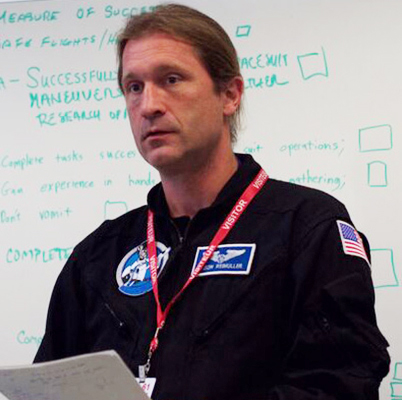 Jason Reimuller – Executive Director, International Institute for Astronautical Sciences & Project PoSSUM | In this episode: We meet Dr. Jason Reimuller, Executive Director of both the International Institute for Astronautical Sciences (IIAS) and Project PoSSUM, a nonprofit astronautics research and education program within the IIAS studying our upper atmosphere and its role in our changing global climate. Jason is also Co-Investigator of NASA’s PMC-Turbo experiment and works as a commercial research pilot and flight test engineer with atmospheric remote-sensing company GATS, Inc. He is a National Association of Underwater Instructors scuba divemaster, has authored the book Spacecraft Egress and Rescue Operations, and formerly served as a system engineer and project manager for NASA’s Constellation Program. In our conversation, Jason explains how little we understand about our planet's upper atmosphere, noctilucent cloud dynamics and how they're indicators for changes in global climate, the many aspects of Project PoSSUM, how it advocates for underrepresented groups in the space community, and whether he personally has an interest in being involved in the space missions of the future. Explaining his part in Project PoSSUM, Jason says, “You know, my first role in this organization is to serve our community ... serve the community, and to make sure that what we’re all doing is preserving that historic role and the imperative of what astronauts have been.” To learn more about the IIAS, go to https://astronauticsinstitute.org, and for more on Project PoSSUM visit https://projectpossum.org. Candidate applications for the Out Astronaut program that Jason mentions in this conversation are being accepted through Jan. 31, 2021, at https://outastronaut.org/contest/. Introductory and closing music: Paint the Sky by Hans Atom © copyright 2015, licensed under a Creative Commons Attribution (3.0) license. http://dig.ccmixter.org/files/hansatom/50718 Ft: Miss Judged | 42m 21s | ||||||
Showing 25 of 84
Pitch Fit is a Pro feature
See how bookable this show is for guests, which brands already advertise, the per-episode ad value, and the best-fit guest and sponsor profile. The numbers are blurred on the free plan.
How readily this show books outside guests like you.
How proven this show is for host-read sponsorships.
For Guests
ProFor Advertisers
ProUpgrade to Pro to unlock guest cadence, sponsor categories, fit scores, and per-episode ad value for this show.
Chart Positions
3 placements across 3 markets.
Chart Positions
3 placements across 3 markets.