
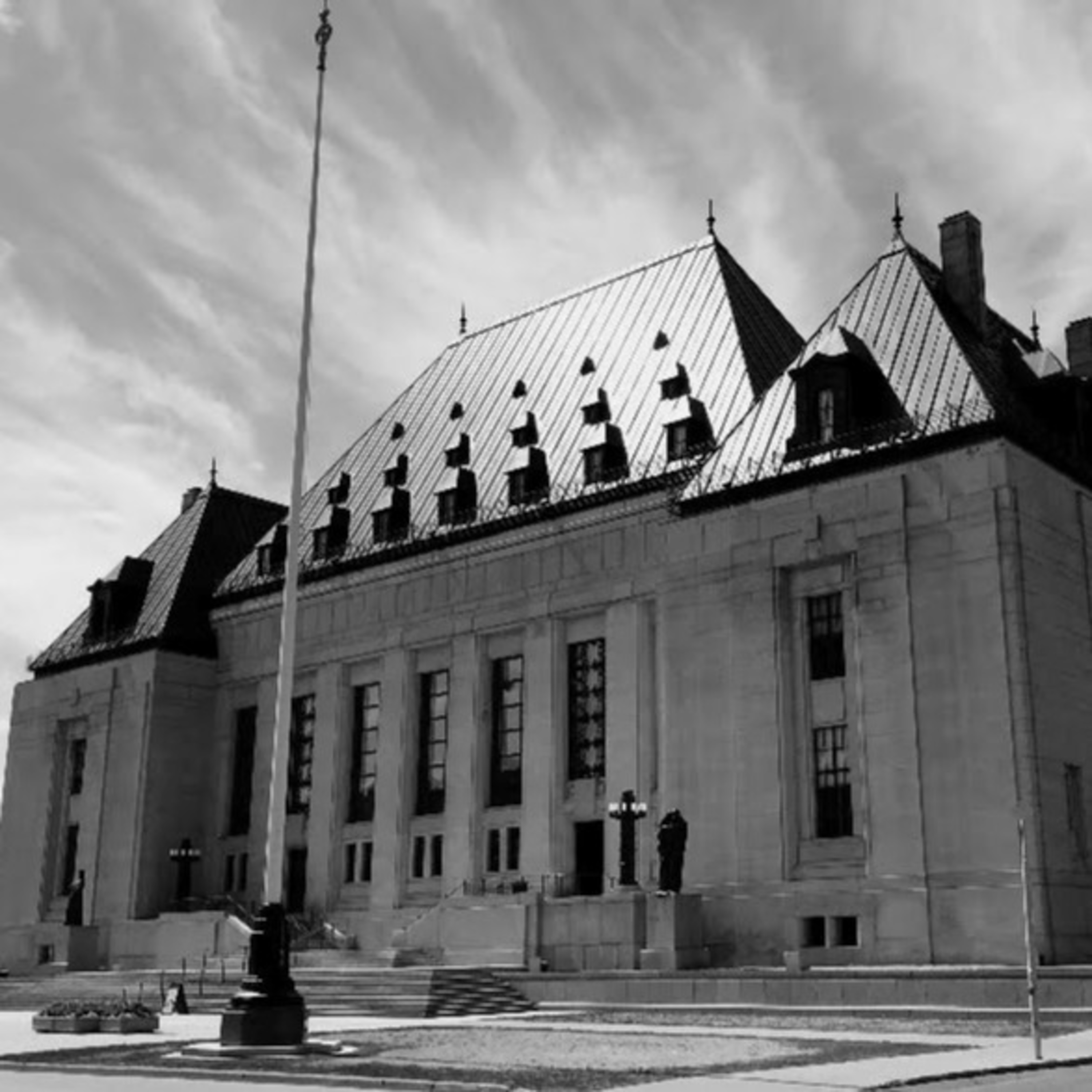
Supreme Court of Canada Hearings (English Audio)
by SCC Hearings Podcast
Is this your podcast?Insights from recent episode analysis
Audience Interest
Podcast Focus
Publishing Consistency
Platform Reach
Insights are generated by CastFox AI using publicly available data, episode content, and proprietary models.
Total monthly reach
Estimated from 2 chart positions in 2 markets.
By chart position
- 🇨🇦CA · Government#1965K to 30K
- 🇹🇷TR · Government#793K to 10K
- Per-Episode Audience
Est. listeners per new episode within ~30 days
2.4K to 12K🎙 Daily cadence·152 episodes·Last published 1mo ago - Monthly Reach
Unique listeners across all episodes (30 days)
8K to 40K🇨🇦75%🇹🇷25% - Active Followers
Loyal subscribers who consistently listen
3.2K to 16K
Market Insights
Platform Distribution
Reach across major podcast platforms, updated hourly
Total Followers
—
Total Plays
—
Total Reviews
—
* Data sourced directly from platform APIs and aggregated hourly across all major podcast directories.
On the show
Recent episodes
His Majesty the King v. Terrell Burke-Whittaker (41786)
May 21, 2026
3h 08m 43s
Richard Leonard Walker v. His Majesty the King (Day 2/2) (41703)
May 21, 2026
2h 19m 41s
Cynthia Prescott, et al. v. Benchwood Builders Inc., et al. (41794)
May 18, 2026
3h 05m 48s
Ali Bhatti v. His Majesty the King (42107)
May 15, 2026
1h 16m 18s
Ville de Québec v. Jardins de Vérone S.E.C. (41748)
May 13, 2026
2h 05m 33s
Social Links & Contact
Official channels & resources
Official Website
Login
RSS Feed
Login
| Date | Episode | Description | Length | ||||||
|---|---|---|---|---|---|---|---|---|---|
| 5/21/26 | His Majesty the King v. Terrell Burke-Whittaker (41786) | On June 9, 2020, Mr. Burke-Whittaker attended a funeral for Dimarjo Jenkins, who had been shot and killed on a street in downtown Toronto on May 26, 2020. The funeral took place at a restaurant in North York. The parking lot behind the restaurant backed onto Highway 401. Late on the evening of the viewing, a vehicle driving on Highway 401 pulled onto the shoulder of the westbound lanes behind the restaurant. Someone in the car started firing shots into the crowd that had gathered in the parking lot. Many people in the parking lot ran into the building, but others stayed in the parking lot and returned fire in the direction of passing traffic on Highway 401. Still others hid behind a dumpster that was close to the door of the building. Mr. Burke-Whittaker was in the parking lot when the shooting started. He took cover behind the dumpster. He took a firearm out of his satchel and, having struggled to cock it, he came out from behind the dumpster, fired a shot toward the vehicle, and fled into the building through the parking lot door. The incident was relatively brief and captured on video. No one was killed or injured.The police investigation identified Mr. Burke-Whittaker as one of the shooters. He turned himself in on June 22, 2021, just over one year after the shooting. His firearm was never recovered. He pled guilty to one count of possession of a loaded or prohibited or restricted firearm contrary to s. 95 of the Criminal Code. He was 24 years old at the time of the shooting and has no other criminal record. He was raised by his mother and grandmother in Brampton, as his father was in and out of jail during much of his childhood. He completed high school and began college, but did not finish that course of studies. He has one child born in 2018. At the time of sentencing, he had been accepted into the Toronto Fire Academy. While on bail, he started a vending machine business. Several positive character letters submitted to the sentencing judge indicated that, as a young Black male, he had experienced systemic racism. An Enhanced Pre-Sentence Report was not submitted.The sentencing judge sentenced the respondent to a conditional sentence of two years less a day to be followed by three years’ probation. A majority of the Court of Appeal granted leave to appeal the sentence and dismissed the applicant’s appeal of the sentence. The dissenting justice would have allowed the appeal, set aside the sentence imposed by the sentencing judge, and imposed a sentence of 38 months’ incarceration less credit of 17 months. Argued Date 2026-05-19 Keywords Criminal law — Sentencing — Conditional sentencing orders — What principles should guide appellate courts’ review of conditional sentencing orders for offences under Criminal Code, R.S.C. 1985, c. C-46, 1, s. 95 — When, and based on what principles, appellate courts should reincarcerate offenders after otherwise successful Crown sentence appeal. Notes (Ontario) (Criminal) (By Leave) Language English Audio Disclaimers This podcast is created as a public service to promote public access and awareness of the workings of Canada's highest court. It is not affiliated with or endorsed by the Court. The original version of this hearing may be found on the Supreme Court of Canada's website. The above case summary was prepared by the Office of the Registrar of the Supreme Court of Canada (Law Branch). | 3h 08m 43s | ||||||
| 5/21/26 | Richard Leonard Walker v. His Majesty the King (Day 2/2) (41703) | During the course of an investigation under the Traffic Safety Act, a police officer attempted to effect a warrantless arrest of the appellant for obstruction under s. 129(a) of the Criminal Code. In a pre-trial application, the trial judge found that the police officer was not executing a lawful arrest, and therefore breached the appellant’s s. 9 Charter right not to be arbitrarily detained by attempting the arrest. The trial judge acquitted the appellant of assault causing bodily harm. The Court of Appeal allowed the appeal, and ordered a new trial. Argued Date 2026-05-20 Keywords Criminal law — Arrest — Accused assaulted police officer attempting to effect warrantless arrest for obstruction under s. 129(a) of Criminal Code — Trial judge holding that officer was not executing lawful arrest and breached accused’s s. 9 rights — Trial judge further holding Crown failed to prove beyond reasonable doubt that accused was not acting in self-defence — Accused acquitted of assaulting officer — Court of Appeal allowing appeal and ordering new trial — Whether a police officer can arrest an individual for obstruction under the Criminal Code during the course of a regulatory (or municipal) investigation where the regulatory (or municipal) statute provides for a lesser enforcement remedy — Whether the discretion referenced in Goodwin v. British Columbia (Superintendent of Motor Vehicles), 2015 SCC 46, allows police officers to engage the more serious Criminal Code provisions during the course of an investigation for less serious regulatory or municipal offences? Notes (Alberta) (Criminal) (By Leave) Language English Audio Disclaimers This podcast is created as a public service to promote public access and awareness of the workings of Canada's highest court. It is not affiliated with or endorsed by the Court. The original version of this hearing may be found on the Supreme Court of Canada's website. The above case summary was prepared by the Office of the Registrar of the Supreme Court of Canada (Law Branch). | 2h 19m 41s | ||||||
| 5/18/26 | Cynthia Prescott, et al. v. Benchwood Builders Inc., et al. (41794) | The applicants, two homeowners, hired the respondent company, Benchwood, to renovate their home. Benchwood is a general contracting and construction management business, and the respondent Michael Slaven is one of its co-owners. There were several areas of disagreement between the parties during the course of the renovations. A heated discussion occurred between Mr. Slaven and one of the homeowners. Benchwood performed no further work for the homeowners following this incident.The homeowners subsequently discovered that Benchwood posted photographs of their home online to attract new customers. This angered them and prompted them to post allegedly defamatory statements about Benchwood and Mr. Slaven on social media platforms.In response to these statements, Benchwood and Mr. Slaven commenced an action seeking damages for defamation. The homeowners subsequently brought a motion pursuant to s. 137.1 of the Courts of Justice Act for an order dismissing the action as a proceeding that limits freedom of expression on matters of public interest. The motion judge agreed with the homeowners and ordered that the action be dismissed. Benchwood and Mr. Slaven appealed to the Ontario Court of Appeal. The Court of Appeal unanimously allowed the appeal and set aside the dismissal of the action. Argued Date 2026-05-15 Keywords Torts — Libel and slander — Anti-SLAPP legislation — Dissatisfied clients of company posting negative statements online about company and its owner — Company and owner suing clients for defamation — Clients bringing motion to dismiss action pursuant to anti-SLAPP legislative provision — Whether the Court of Appeal erred in overturning the motion judge’s finding that the impugned expression relates to a matter of public interest — Whether the Court of Appeal erred in overturning the motion judge’s finding that there are no grounds to believe that the defences are not valid — Whether the Court of Appeal erred in overturning the motion judge’s finding that the harms resulting from the impugned expression do not outweigh the public interest in protecting the expression — Courts of Justice Act, R.S.O. 1990, c. C.43, s. 137.1 Notes (Ontario) (Civil) (By Leave) Language English Audio Disclaimers This podcast is created as a public service to promote public access and awareness of the workings of Canada's highest court. It is not affiliated with or endorsed by the Court. The original version of this hearing may be found on the Supreme Court of Canada's website. The above case summary was prepared by the Office of the Registrar of the Supreme Court of Canada (Law Branch). | 3h 05m 48s | ||||||
| 5/15/26 | Ali Bhatti v. His Majesty the King (42107) | The appellant was charged with firearms offences. Police had obtained a general warrant to detain the appellant and search for his phone. The search for the phone authorized by the warrant was limited to the person of the appellant and his immediate and surrounding area. The police stopped the appellant while he was driving. During the execution of the warrant, the police seized three cell phones as well as firearms from the appellant’s vehicle, including in a hidden compartment. The appellant successfully sought to exclude the firearms evidence from his trial pursuant to s. 24(2) of the Charter on the basis of a violation of his s. 8 Charter right to be free from unreasonable search or seizure. The appellant was acquitted of the firearms offences charged. A majority of the Court of Appeal allowed the Crown’s appeal against acquittal and ordered a new trial. It concluded that the application judge erred both in finding that the search was not authorized by the warrant and in finding that the firearms should have been excluded pursuant to s. 24(2). The dissenting judge in the Court of Appeal would have dismissed the Crown’s appeal as she agreed with the application judge that, in executing the general warrant, the police exceeded the scope of the order and violated the appellant’s rights under s. 8. She further agreed that the firearms should have been excluded pursuant to s. 24(2). Argued Date 2026-05-14 Keywords Charter of rights — Search and seizure — Remedy — Exclusion of evidence — Whether majority of Court of Appeal erred in law in finding police complied with the warrant — If appellant’s s. 8 Charter rights were breached, whether Court should interfere with application judge’s s. 24(2) Charter analysis. Notes (Ontario) (Criminal) (As of Right) Language English Audio Disclaimers This podcast is created as a public service to promote public access and awareness of the workings of Canada's highest court. It is not affiliated with or endorsed by the Court. The original version of this hearing may be found on the Supreme Court of Canada's website. The above case summary was prepared by the Office of the Registrar of the Supreme Court of Canada (Law Branch). | 1h 16m 18s | ||||||
| 5/13/26 | Ville de Québec v. Jardins de Vérone S.E.C. (41748) | The respondent, Jardins de Vérone S.E.C., owned land within the territory of the appellant, Ville de Québec (“City”). The land was officially designated as “serviced vacant land”, a particular that was included in the information concerning the unit of assessment on the assessment roll. On March 1, 2018, the respondent received a building permit from the City for the erection of a building with 109 dwellings. The work began on April 1, 2018, and was carried out without interruption as of that date. In July 2018, the respondent applied to the City’s assessment department to have the “serviced vacant land” particular removed from the information on the assessment roll. In October 2018, the municipal assessor’s representative denied that request on the ground that no action had been omitted by the assessor, having regard to ss. 32 and 244.36 of the Act respecting municipal taxation, CQLR, c. F-2.1 (AMT), and that there was therefore no basis for making an alteration. The respondent then brought a proceeding before the Administrative Tribunal of Québec (ATQ) under s. 132.1 of the AMT, seeking an order requiring the municipal assessor to alter the information on the roll so that the “serviced vacant land” particular was removed, in accordance with ss. 174, 57.1.1 and 244.36 of the AMT. The building was not entered on the roll until early summer in 2019. On December 16, 2019, the ATQ rendered a decision in the respondent’s favour, confirming that, as soon as a building is situated on land, the assessor must alter the assessment roll by removing the “serviced vacant land” particular, regardless of its value. The ATQ ordered that the “serviced vacant land” particular be removed from the assessment roll retroactively to the date when the work had begun.The Court of Québec allowed the City’s appeal. The ATQ’s decision was set aside and replaced. In the court’s view, the interpretation of s. 244.36 of the AMT adopted by the ATQ was not “correct” under the standard of review applicable in this case.The Superior Court dismissed the application filed by the respondent for judicial review of the Court of Québec’s decision. The reasonableness of the Court of Québec’s decision was upheld.The Court of Appeal allowed the respondent’s appeal. It set aside the decisions of the Court of Québec and the Superior Court and restored the ATQ’s decision. The Court of Appeal held that, although the Court of Québec did not owe deference to a statutory interpretation by the ATQ, it still could not substitute its erroneous interpretation for the ATQ’s correct interpretation. The Court of Appeal accordingly found that the Court of Québec had not properly applied the correctness standard and therefore, contrary to what the Superior Court had concluded, the Court of Québec’s decision should have been found unreasonable. Argued Date 2026-05-12 Keywords Administrative law — Appeals — Standard of review — Municipal law — Taxation — Property assessments — Interpretation of concept of “serviced vacant land” under Act respecting municipal taxation — Manner in which Court of Québec must apply standard for appellate intervention (correctness) to conclusions of law in administrative decision — Whether Court of Québec performed its appellate function reasonably — Courts of Justice Act, CQLR, c. T-16, s. 83.1 — Act respecting municipal taxation, CQLR, c. F-2.1, ss. 32, 57.1.1, 131.2, 174 para. 13.1.1(a), 244.36 and 244.49. Notes (Quebec) (Civil) (By Leave) Language English Audio Disclaimers This podcast is created as a public service to promote public access and awareness of the workings of Canada's highest court. It is not affiliated with or endorsed by the Court. The original version of this hearing may be found on the Supreme Court of Canada's website. The above case summary was prepared by the Office of the Registrar of the Supreme Court of Canada (Law Branch). | 2h 05m 33s | ||||||
| 4/24/26 | Attorney General of Quebec v. Xavier-Antoine Lalande, et al. (42152) | This case concerns the constitutional validity of the Act to interrupt the electoral division delimitation process (“A.T.I.”) and the issue of whether its infringement of the right to vote guaranteed by s. 3 of the Canadian Charter is justified under s. 1 of the Canadian Charter. The A.T.I. has the effect of interrupting, until Quebec’s next general election, the process relating to the delimitation of Quebec’s electoral divisions made by the Commission de la représentation after every second general election in order to ensure that the delimitation respects the right to effective representation of electors under the Election Act, R.Q.L.R., c. E 3.3. Argued Date 2026-04-22 Keywords Charter of Rights — Constitutional law — Elections — Right to vote — Right to effective representation of electors — Interruption of Quebec’s electoral division delimitation process — Whether Act to interrupt the electoral division delimitation process infringes s. 3 of Canadian Charter in manner that cannot be justified under s. 1 of Canadian Charter — Canadian Charter of Rights and Freedoms, ss. 1 and 3 — Act to interrupt the electoral division delimitation process, S.Q. 2024, c. 14. Notes (Quebec) (Civil) (By Leave) Language English Audio Disclaimers This podcast is created as a public service to promote public access and awareness of the workings of Canada's highest court. It is not affiliated with or endorsed by the Court. The original version of this hearing may be found on the Supreme Court of Canada's website. The above case summary was prepared by the Office of the Registrar of the Supreme Court of Canada (Law Branch). | 3h 29m 57s | ||||||
| 4/21/26 | St. John’s International Airport Authority v. Michel Thibodeau (41651) | In January 2018, the respondent, Mr. Thibodeau, filed six complaints under the Official Languages Act, R.S.C. 1985 (4th supp.) (OLA) with the intervener, the Commissioner of Official Languages of Canada against the appellant, St. John’s International Airport Authority (SJIAA) with regards to the violation of ss. 22 and 23 of the OLA related to the language of communication and services. In summary, Mr. Thibodeau alleged that the SJIAA: (1) has an exclusively English presence on social media such as Facebook, YouTube and Instagram; (2) has a website with an English-only URL and of which the French version is not of equal quality to the English version; (3) publishes its press releases in English only; (4) makes certain documents on its website, including annual reports and its master plan, available in English only; (5) uploads content on Twitter almost exclusively in English; and (6) displays certain automated teller machine (ATM) signage in English only within the airport.Mr. Thibodeau’s complaints resulted in the issuance of two separate reports by the Commissioner: the first addressed the complaints concerning various types of content posted on social media and online, while the second focused on the complaint related to the ATM. With respect to the first complaint, the Commissioner found that the OLA had been breached. The Commissioner recommended that all content posted by SJIAA, both on social media and online, be of equal quality in both official languages. With respect to the second complaint, because the Official Languages Regulations expressly designates ATMs as a service within the meaning of s. 23(2) of the OLA, the Commissioner concluded that the OLA had been contravened. However, given that the SJIAA had, by the time the report was issued, already replaced the signage with universally recognizable pictograms, the Commissioner declined to issue any recommendations and closed the file.Following the issuance of the Commissioner’s recommendations, Mr. Thibodeau commenced an application under s. 77 of the OLA, seeking a declaration that the OLA had been breached and requesting that the Court order SJIAA to issue a letter of apology and award him $9,000 in damages. The Federal Court has granted the application for a remedy and ordered the payment of $5,000 in damages against SJIAA. The majority of the Federal Court of Appeal dismissed the appeal. Argued Date 2026-04-20 Keywords Official languages — Airport authorities — Transfer of the administration of airports pursuant to the Airport Transfer (Miscellaneous Matters) Act — Obligations pursuant to the Official Languages Act for the local bodies operating airports — Are the authorities subject to the “head office rule” created by s. 22 of the Official Languages Act, or was that the rule excluded by the Airport Transfer (Miscellaneous Matters) Act? — What is the proper definition of the “travelling public” under the Official Languages Act? — What test should be used to determine when a communication of service is intended for the travelling public, rather than the general public? — Can an applicant under s. 77 of the Official Languages Act receive damages from any contravention of the Official Languages Act, even if the applicant’s own personally-held language rights are not implemented by that contravention? — Official Languages Act, R.S.C. 1985, c. 31 (4th Suppl), ss. 22, 23 and 77 — Airport Transfer (Miscellaneous Matter) Act, S.C. 1992, c. 5, s. 4(1) Notes (Federal) (Civil) (By Leave) Language English Audio Disclaimers This podcast is created as a public service to promote public access and awareness of the workings of Canada's highest court. It is not affiliated with or endorsed by the Court. The original version of this hearing may be found on the Supreme Court of Canada's website. The above case summary was prepared by the Office of the Registrar of the Supreme Court of Canada (Law Branch). | 3h 11m 57s | ||||||
| 4/20/26 | Moadd Maadani v. His Majesty the King (41972) | The appellant was convicted of second-degree murder following a trial by a judge sitting with a jury. The central issue at trial was whether the appellant had acted in self-defence during an exchange of gunfire with the deceased.On appeal, the appellant brought a motion to adduce further evidence from a third-party witness, who would have testified to the deceased being the aggressor in the altercation, as well as evidence from the law clerk of trial counsel as to why the evidence was not presented at trial. The majority of the Court of Appeal concluded that the proposed fresh evidence from the third-party witness was not reasonably capable of belief and therefore did not meet the criteria for admission. The majority dismissed the motion to adduce further evidence and dismissed the appeal.The dissenting judge would have granted the motion to adduce further evidence. In the dissenting judge’s view, the proposed fresh evidence was reasonably capable of belief and could reasonably be expected to have affected the result of the trial. Accordingly, the dissenting judge would have allowed the appeal and ordered a new trial. Argued Date 2026-04-17 Keywords Criminal Law — Evidence — Fresh evidence — Court of Appeal dismissing motion to adduce fresh evidence — Whether Court of Appeal erred in dismissing motion to adduce further evidence — Whether fresh evidence would reasonably be expected to have affected result of trial — Whether Court of Appeal erred in dismissing appeal from conviction Notes (Ontario) (Criminal) (As of Right) Language English Audio Disclaimers This podcast is created as a public service to promote public access and awareness of the workings of Canada's highest court. It is not affiliated with or endorsed by the Court. The original version of this hearing may be found on the Supreme Court of Canada's website. The above case summary was prepared by the Office of the Registrar of the Supreme Court of Canada (Law Branch). | 1h 08m 11s | ||||||
| 4/17/26 | His Majesty the King in Right of Canada v. Damodar Arapakota (42061) | The respondent, Damodar Arapakota, was charged with bribing a foreign public official, contrary to s. 3(1)(a) of the Corruption of Foreign Public Officials Act, S.C. 1998, c. 34. The Crown alleged that the respondent bribed an official with the government of Botswana by paying for the official’s family vacation in Orlando, Florida, in return for which the respondent received letters confirming the government of Botswana’s intention to award a contract to his company and confirming the value of the prospective contract. The trial judge found that the respondent conferred a material benefit on the official, but that the benefit was not consideration for the letters that the official later provided. She further found that the letters did not rise to the level of a material or tangible economic advantage sufficient to trigger liability under s. 3(1)(a). As a result, she acquitted the respondent. The Crown appealed the acquittal. The majority of the Court of Appeal for Ontario dismissed the appeal finding that while the trial judge misinterpreted one of the elements of the offence at s. 3(1)(a), this error had no impact on the proper disposition of the case. Justice Monahan, dissenting, would have allowed the appeal, set aside the acquittal and ordered a new trial. He found that the trial judge erred in her interpretation of s. 3(1)(a), which had a material impact on the verdict. Argued Date 2026-04-16 Keywords Criminal law — Bribing a foreign public official — Elements of offence — Whether the majority of the Court of Appeal erred in its interpretation of s. 3(1)(a) of the Corruption of Foreign Public Officials Act, S.C. 1998, c. 34 — Whether the majority of the Court of Appeal erred in finding that the trial judge’s legal error did not affect the verdict. Notes (Ontario) (Criminal) (As of Right) Language English Audio Disclaimers This podcast is created as a public service to promote public access and awareness of the workings of Canada's highest court. It is not affiliated with or endorsed by the Court. The original version of this hearing may be found on the Supreme Court of Canada's website. The above case summary was prepared by the Office of the Registrar of the Supreme Court of Canada (Law Branch). | 1h 12m 17s | ||||||
| 4/10/26 | R.B.-C. v. His Majesty the King (41677) | R.B.-C., an Iranian citizen in Canada on a post-graduation work permit, was convicted for sexual assault. More than 14 months after conviction, a conditional sentence of two years less a day plus probation was ordered. R.B.-C. applied for a stay of proceedings as a remedy for unreasonable delay during the sentencing phase of proceedings in breach of s. 11(b) of the Charter of Rights and Freedoms. The motions judge applied R. v. Charley, 2019 ONCA 726, which adopted the framework set out in R. v. Jordan, 2016 SCC 27, and which set a five-month presumptive ceiling for post-verdict delay. After calculating total delay and deductions, the motions judge derived a net delay below the presumptive five-month ceiling and dismissed the motion to stay proceedings. The Court of Appeal allowed an appeal. It held post-conviction delay exceeded the five-month presumptive ceiling and the appropriate remedy was to reduce the sentence to 20 months. Argued Date 2026-01-16 Keywords Charter of Rights and Freedoms — Right to be tried within a reasonable time — Remedies — What is the test for unreasonable delay in the sentencing phase — What is the appropriate remedy for unreasonable delay in the sentencing phase? Notes (Ontario) (Criminal) (By Leave) (Publication ban in case) Language English Audio Disclaimers This podcast is created as a public service to promote public access and awareness of the workings of Canada's highest court. It is not affiliated with or endorsed by the Court. The original version of this hearing may be found on the Supreme Court of Canada's website. The above case summary was prepared by the Office of the Registrar of the Supreme Court of Canada (Law Branch). | 3h 29m 43s | ||||||
Want analysis for the episodes below?Free for Pro Submit a request, we'll have your selected episodes analyzed within an hour. Free, at no cost to you, for Pro users. | |||||||||
| 3/26/26 | English Montreal School Board, et al. v. Attorney General of Quebec, et al. (Day 4/4) (41231) | The Act respecting the laicity of the State was passed and assented to on June 16, 2019. Its purposes include affirming the laicity of the state in Quebec and specifying the general obligations arising therefrom, prohibiting the listed persons from wearing religious symbols in the exercise of their functions and requiring those persons to perform their functions with their face uncovered. The Act also contains provisions through which the legislature exercises the override power granted to it by s. 52 of the Quebec Charter and s. 33 of the Canadian Charter and permits the Act to apply notwithstanding certain rights and freedoms.Once the Act came into force, a number of persons, groups of persons and organizations brought separate proceedings challenging the constitutionality of the Act or certain of its provisions. They raised constitutional grounds, some of which were related to the Canadian Charter or the Quebec Charter. The Superior Court largely dismissed the challenge, except on two points. The Court of Appeal arrived at the same conclusions except as regards the educational language rights that s. 23 of the Canadian Charter guarantees to Canadian citizens belonging to Quebec’s English linguistic minority. Unlike the trial judge, the Court of Appeal found that the Act does not infringe s. 23. Argued Date 2026-03-26 Keywords Constitutional law — Constitutional validity — Division of powers — Pre-Confederation legislation — Constitutional architecture and unwritten principles — Charters of rights — Notwithstanding clauses — Rights guaranteed equally to both sexes — Minority language educational rights — Democratic rights of citizens — Enumerations — Whether grounds raised to challenge constitutional validity of Act respecting the laicity of the State should be accepted — Canadian Charter of Rights and Freedoms, ss. 3, 23, 28 and 33 — Charter of human rights and freedoms, ss. 50.1 and 52 — Act respecting the laicity of the State, CQLR, c. L-0.3. Notes (Quebec) (Civil) (By Leave) Language English Audio Disclaimers This podcast is created as a public service to promote public access and awareness of the workings of Canada's highest court. It is not affiliated with or endorsed by the Court. The original version of this hearing may be found on the Supreme Court of Canada's website. The above case summary was prepared by the Office of the Registrar of the Supreme Court of Canada (Law Branch). | 3h 31m 30s | ||||||
| 3/25/26 | English Montreal School Board, et al. v. Attorney General of Quebec, et al. (Day 3/3) (41231) | The Act respecting the laicity of the State was passed and assented to on June 16, 2019. Its purposes include affirming the laicity of the state in Quebec and specifying the general obligations arising therefrom, prohibiting the listed persons from wearing religious symbols in the exercise of their functions and requiring those persons to perform their functions with their face uncovered. The Act also contains provisions through which the legislature exercises the override power granted to it by s. 52 of the Quebec Charter and s. 33 of the Canadian Charter and permits the Act to apply notwithstanding certain rights and freedoms.Once the Act came into force, a number of persons, groups of persons and organizations brought separate proceedings challenging the constitutionality of the Act or certain of its provisions. They raised constitutional grounds, some of which were related to the Canadian Charter or the Quebec Charter. The Superior Court largely dismissed the challenge, except on two points. The Court of Appeal arrived at the same conclusions except as regards the educational language rights that s. 23 of the Canadian Charter guarantees to Canadian citizens belonging to Quebec’s English linguistic minority. Unlike the trial judge, the Court of Appeal found that the Act does not infringe s. 23. Argued Date 2026-03-25 Keywords Constitutional law — Constitutional validity — Division of powers — Pre-Confederation legislation — Constitutional architecture and unwritten principles — Charters of rights — Notwithstanding clauses — Rights guaranteed equally to both sexes — Minority language educational rights — Democratic rights of citizens — Enumerations — Whether grounds raised to challenge constitutional validity of Act respecting the laicity of the State should be accepted — Canadian Charter of Rights and Freedoms, ss. 3, 23, 28 and 33 — Charter of human rights and freedoms, ss. 50.1 and 52 — Act respecting the laicity of the State, CQLR, c. L-0.3. Notes (Quebec) (Civil) (By Leave) Language English Audio Disclaimers This podcast is created as a public service to promote public access and awareness of the workings of Canada's highest court. It is not affiliated with or endorsed by the Court. The original version of this hearing may be found on the Supreme Court of Canada's website. The above case summary was prepared by the Office of the Registrar of the Supreme Court of Canada (Law Branch). | 3h 10m 40s | ||||||
| 3/24/26 | English Montreal School Board, et al. v. Attorney General of Quebec, et al. (Day 2/2) (41231) | The Act respecting the laicity of the State was passed and assented to on June 16, 2019. Its purposes include affirming the laicity of the state in Quebec and specifying the general obligations arising therefrom, prohibiting the listed persons from wearing religious symbols in the exercise of their functions and requiring those persons to perform their functions with their face uncovered. The Act also contains provisions through which the legislature exercises the override power granted to it by s. 52 of the Quebec Charter and s. 33 of the Canadian Charter and permits the Act to apply notwithstanding certain rights and freedoms.Once the Act came into force, a number of persons, groups of persons and organizations brought separate proceedings challenging the constitutionality of the Act or certain of its provisions. They raised constitutional grounds, some of which were related to the Canadian Charter or the Quebec Charter. The Superior Court largely dismissed the challenge, except on two points. The Court of Appeal arrived at the same conclusions except as regards the educational language rights that s. 23 of the Canadian Charter guarantees to Canadian citizens belonging to Quebec’s English linguistic minority. Unlike the trial judge, the Court of Appeal found that the Act does not infringe s. 23. Argued Date 2026-03-24 Keywords Constitutional law — Constitutional validity — Division of powers — Pre-Confederation legislation — Constitutional architecture and unwritten principles — Charters of rights — Notwithstanding clauses — Rights guaranteed equally to both sexes — Minority language educational rights — Democratic rights of citizens — Enumerations — Whether grounds raised to challenge constitutional validity of Act respecting the laicity of the State should be accepted — Canadian Charter of Rights and Freedoms, ss. 3, 23, 28 and 33 — Charter of human rights and freedoms, ss. 50.1 and 52 — Act respecting the laicity of the State, CQLR, c. L-0.3. Notes (Quebec) (Civil) (By Leave) Language English Audio Disclaimers This podcast is created as a public service to promote public access and awareness of the workings of Canada's highest court. It is not affiliated with or endorsed by the Court. The original version of this hearing may be found on the Supreme Court of Canada's website. The above case summary was prepared by the Office of the Registrar of the Supreme Court of Canada (Law Branch). | 3h 15m 19s | ||||||
| 3/23/26 | English Montreal School Board, et al. v. Attorney General of Quebec, et al. (41231) | The Act respecting the laicity of the State was passed and assented to on June 16, 2019. Its purposes include affirming the laicity of the state in Quebec and specifying the general obligations arising therefrom, prohibiting the listed persons from wearing religious symbols in the exercise of their functions and requiring those persons to perform their functions with their face uncovered. The Act also contains provisions through which the legislature exercises the override power granted to it by s. 52 of the Quebec Charter and s. 33 of the Canadian Charter and permits the Act to apply notwithstanding certain rights and freedoms.Once the Act came into force, a number of persons, groups of persons and organizations brought separate proceedings challenging the constitutionality of the Act or certain of its provisions. They raised constitutional grounds, some of which were related to the Canadian Charter or the Quebec Charter. The Superior Court largely dismissed the challenge, except on two points. The Court of Appeal arrived at the same conclusions except as regards the educational language rights that s. 23 of the Canadian Charter guarantees to Canadian citizens belonging to Quebec’s English linguistic minority. Unlike the trial judge, the Court of Appeal found that the Act does not infringe s. 23. Argued Date 2026-03-23 Keywords Constitutional law — Constitutional validity — Division of powers — Pre-Confederation legislation — Constitutional architecture and unwritten principles — Charters of rights — Notwithstanding clauses — Rights guaranteed equally to both sexes — Minority language educational rights — Democratic rights of citizens — Enumerations — Whether grounds raised to challenge constitutional validity of Act respecting the laicity of the State should be accepted — Canadian Charter of Rights and Freedoms, ss. 3, 23, 28 and 33 — Charter of human rights and freedoms, ss. 50.1 and 52 — Act respecting the laicity of the State, CQLR, c. L-0.3. Notes (Quebec) (Civil) (By Leave) Language English Audio Disclaimers This podcast is created as a public service to promote public access and awareness of the workings of Canada's highest court. It is not affiliated with or endorsed by the Court. The original version of this hearing may be found on the Supreme Court of Canada's website. The above case summary was prepared by the Office of the Registrar of the Supreme Court of Canada (Law Branch). | 3h 36m 44s | ||||||
| 3/20/26 | Facebook Inc. v. Privacy Commissioner of Canada (41538) | On March 19, 2019, the respondent, the Privacy Commissioner of Canada received a complaint under s. 11(1) of the Personal Information Protection and Electronic Documents Act, S.C. 2000, c. 5 (“PIPEDA”) which raised concerns about the appellant Facebook’s compliance with the PIPEDA. The concerns were related to Facebook’s practice of sharing Facebook users’ personal information with third-party applications hosted on its platform. The complaint was filed in the context of reports related to a professor at the University of Cambridge, U.K., Dr. Aleksandr Kogan, who launched an application through Facebook’s Platform titled “thisisyourdigitallife” (“TYDL”) in November 2013. Presented to users as a personality quiz, Dr. Kogan could access the personal information of installing users and installing users’ friends. In December 2015, it was reported that user data obtained by TYDL was sold to a corporation named Cambridge Analytica and a related entity, Strategic Communication Laboratories Elections Ltd. (SCL), who, in turn, used the data purchased from Dr. Kogan to help their clients target political messaging to potential voters in the then upcoming presidential election in the United States. When TYDL was launched in 2013, it agreed to Facebook’s Platform Policy and Terms of Service. In 2014, Facebook issued a version 2 (v.2) of its communication protocol, Graph API, under which third party developers could no longer request permission to access installing users’ friends unless the app developer, through an expanded access to additional personal information request, can demonstrate that the data would be used to “enhance the user’s in-app experience”. The process for consideration of expanded access requests was introduced alongside Graph API v.2 as “App Review.” Although Graph API v.2 took effect in 2014, existing apps were given a one-year grace period before complying with the new iteration. When Graph API v.2 was announced, Dr. Kogan’s request for expanded access to additional personal information was denied by Facebook because his intended use, research, would not enhance user experience. Nonetheless, Dr. Kogan continued to collect data under Graph API v.1 with no additional scrutiny from Facebook. As a result, though only 272 Canadians ever installed the TYDL app, Facebook estimates that these installations lead to the potential disclosure of the data of over 600,000 Canadians. In 2015, when the reports became public, Facebook removed TYDL from Platform and asked Cambridge Analytica to delete the user data it had obtained. Facebook did not notify the affected users that their Facebook data had been collected and sold. It was not until 2018 that Facebook suspended Dr. Kogan and Cambridge Analytica from Platform. After receiving the complaint, the Privacy Commissioner investigated and concluded that Facebook failed to obtain valid and meaningful consent for its disclosures to applications and failed to safeguard its users’ information. As a result, in February 2020, the Privacy Commissioner filed a notice of application in the Federal Court claiming that Facebook was in breach of its obligations set out in Schedule 1 pursuant to s. 5(1)(a) of PIPEDA through its practice of sharing Facebook users’ personal information with third-party applications hosted on the Facebook Platform.The Federal Court dismissed the application. The Federal Court of Appeal allowed the appeal and granted the Privacy Commissioner’s application in part. Argued Date 2026-03-19 Keywords Privacy — Online social media platform — Obligation to safeguard users’ data — Obligation to obtain meaningful consent from users for disclosure of personal data — Whether application judge erred in finding Privacy Commissioner of Canada did not prove that Facebook failed to get meaningful consent to disclose personal information to third-party apps — Whether application judge erred in finding Privacy Commissioner did not prove that Facebook failed to maintain | 3h 11m 27s | ||||||
| 3/18/26 | Dayton Kelly v. His Majesty the King (42050) | One evening in October 2021, the applicant was driving in rural southwestern Ontario. The sun had set and it was dark. The posted speed limit on the highway the applicant was using was 80km/h; he was travelling at least 116km/h. A horse-drawn buggy entered the roadway at an intersection. The applicant did not see the buggy in time to stop; his vehicle collided with it. Both occupants of the buggy died from injuries sustained in the collision. During the police investigation that night, the applicant admitted to being a chronic marijuana smoker and consented to providing two samples of his blood. Evidence established that the applicant’s blood drug concentration (“BDC”) exceeded the prescribed limit at the time of the collision. The parties agreed at trial that there was no evidence of a causal nexus between the applicant’s BDC and the collision. The applicant was charged with operating a conveyance with an excess BDC under s. 320.14(1)(c), two counts of committing an offence under s. 320.14(1)(c) causing death under s. 320.14(3), and two counts of dangerous operation of a conveyance causing death under s. 320.13(3).The trial judge held that it is insufficient that the applicant had a prohibited BDC and was operating a conveyance at the time he caused a death; a conviction for offences under s. 320.14(3) requires a causal nexus between an accused’s BDC and the death of a victim. As the parties have agreed that there is no causal nexus between the applicant’s BDC and the death of the victims, the applicant was acquitted on those counts.The Court of Appeal held that the trial judge erred in his interpretation of s. 320.14(3). A plain reading establishes that the elements are made out simply by operating a vehicle with excess BDC, and causing the death of a person. No causal nexus between the excess BDC and the cause of death is required. Accused persons retain the benefit of the basic legal causation standard: the Crown must prove that the applicant’s actions were a significant contributing cause of death. Because of the trial judge’s erroneous interpretation of s. 320.14(3), he did not make any finding as to whether the Crown had proven legal causation on this standard. The Court of Appeal therefore ordered a new trial on these counts. Argued Date 2026-03-17 Keywords Criminal law — Causing death while operating conveyance with excess blood drug concentration — Causation — Whether causal nexus required between blood drug concentration and death of victim — Constitutional law — Charter of Rights — Right to life, liberty and security of person — Whether s. 320.14(3) of the Criminal Code violates s. 7 of the Charter — Criminal Code, R.S.C. 1985, c. C-46, s. 320.14(3) Notes (Ontario) (Criminal) (By Leave) Language English Audio Disclaimers This podcast is created as a public service to promote public access and awareness of the workings of Canada's highest court. It is not affiliated with or endorsed by the Court. The original version of this hearing may be found on the Supreme Court of Canada's website. The above case summary was prepared by the Office of the Registrar of the Supreme Court of Canada (Law Branch). | 37m 19s | ||||||
| 2/20/26 | Aphria Inc. v. Canada Life Assurance Company, et al. (41665) | The appellant, Aphria Inc. (“tenant”), entered into a ten-year lease for commercial office premises with the respondent landlords and successors (collectively, “landlord”). The tenant served a notice of repudiation on the landlord and vacated the premises. The landlord did not accept the tenant’s repudiation of the lease. Ultimately, the landlord sued the tenant for rents owing.The motion judge in the Ontario Superior Court of Justice granted the landlord summary judgment for the rent owing plus interest. The motion judge declined to grant the landlord judgment for future rent. The motion judge dismissed the tenant’s cross-motion for summary judgment for a declaration that if rent was owing, the amount was capped at rent owing for two years from the date of default pursuant to the lease. The Ontario Court of Appeal unanimously dismissed the tenant’s appeal. It held that the motion judge did not err by refusing to depart from Highway Properties Ltd. v. Kelly, Douglas and Co. Ltd., [1971] S.C.R. 562, in order to recognize a duty to mitigate on commercial landlords who reject a repudiation of a lease by the tenant. The court also held that the motion judge did not err in his interpretation of the lease. Argued Date 2026-02-18 Keywords Contracts — Commercial leases — Repudiation — Duty to mitigate — Stare decisis — Interpretation — Are commercial landlords exempt from the duty to mitigate damages? — If the common law is able to grow and adapt to changing conditions, when and how should lower courts depart from Supreme Court of Canada decisions on common law? — Should courts apply the plain meaning of the words chosen by the parties in interpreting a contract, in the absence of any factual matrix evidence? Notes (Ontario) (Civil) (By Leave) Language English Audio Disclaimers This podcast is created as a public service to promote public access and awareness of the workings of Canada's highest court. It is not affiliated with or endorsed by the Court. The original version of this hearing may be found on the Supreme Court of Canada's website. The above case summary was prepared by the Office of the Registrar of the Supreme Court of Canada (Law Branch). | 2h 35m 46s | ||||||
| 2/18/26 | Megan Rae Korduner v. His Majesty the King (41737) | Ms. Korduner was a motor vehicle driver involved in a two-vehicle accident. A responding police officer questioned her at the scene for approximately three minutes, during which she stated that she should not have been driving because she was drunk. Ms. Korduner was arrested for impaired operation of a motor vehicle. She refused to provide a breath sample into an approved screening device and was charged for refusing to provide a breath sample. In voir dire proceedings to determine the admissibility of Ms. Korduner’s statements, the trial judge held that Ms. Korduner’s statements were compelled by the Traffic Safety Act, R.S.A. 2000, c. T-6, and were inadmissible pursuant to the use immunity principle; reliance on s. 320.31(9) of the Criminal Code, R.S.C. 1985, c. C-46, as a basis for admitting the statements would breach Ms. Korduner’s rights under s. 7 of the Charter of Rights and Freedoms; and Crown counsel failed to prove the breach was justified pursuant to s. 1 of the Charter. The charges were dismissed. The Court of King’s Bench of Alberta dismissed a summary conviction appeal. The majority of the Court of Appeal for Alberta allowed an appeal and ordered a new trial. Argued Date 2026-02-17 Keywords Charter of Rights and Freedoms — Principles of fundamental justice — Self-incrimination — Criminal law — Evidence — Use immunity — Remedies — Police officer responding to motor vehicle accident questioning driver involved in accident — Statements by driver causing officer to demand breath samples in order to administer approved roadside screening device — Trial judge declaring statements to officer compelled by Traffic Safety Act — Section 320.31(9) of Criminal Code setting out that a statement to a peace officer including statement compelled under provincial Act admissible in evidence for purpose of justifying demand to provide breath sample — Whether s. 320.31(9) infringes s. 7 of Charter — If so, whether limit reasonable and demonstrably justified pursuant to s. 1 of Charter — If not, appropriate remedy — Traffic Safety Act, R.S.A. 2000, c. T-6, ss. 69(1), 71(1) — Criminal Code, R.S.C. 1985, c. C-46, s. 320.21(9). Notes (Alberta) (Criminal) (By Leave) Language English Audio Disclaimers This podcast is created as a public service to promote public access and awareness of the workings of Canada's highest court. It is not affiliated with or endorsed by the Court. The original version of this hearing may be found on the Supreme Court of Canada's website. The above case summary was prepared by the Office of the Registrar of the Supreme Court of Canada (Law Branch). | 3h 24m 37s | ||||||
| 2/17/26 | Québec Major Junior Hockey League, now doing business as Quebec Maritimes Junior Hockey League Inc., et al. v. Lukas Walter, et al. (41532) | The respondents in these applications for leave to appeal, Mr. Walter and Mr. Gobeil, were recognized as representative plaintiffs for the class covered by a class action brought against the applicants/interveners in these applications for leave to appeal, that is, the Québec Major Junior Hockey League, now doing business as the Quebec Maritimes Junior Hockey League Inc., and the impleaded hockey teams that are members of the League. In the class action, the respondents submitted that the applicants/interveners were refusing to recognize major junior hockey players as having employee status, with the result that the players had no access to the protection provided by legislation governing working conditions. Two other similar class actions were authorized, one in Ontario against the Ontario Hockey League and one in Alberta against the Western Hockey League. In total, 4,286 major junior hockey players, including 1,702 in Quebec, are covered by the class actions. On March 31, 2020, the parties to the three class actions reached a settlement agreement. The agreement was submitted to the superior courts in each of the three provinces through a joint hearing. The superior courts rejected the agreement in October 2020 solely on the basis that the scope of the release provided for was overly broad. In June 2023, after the releases were renegotiated, all of the parties, including the respondents, signed an amendment to the initial settlement agreement in order to replace the release provisions. However, it appears that, shortly after the signing, the respondents disavowed their signature and announced that they would oppose the submission of the amended agreement for judicial approval. Despite the instructions given by the respondents, Mr. Savonitto, a member of one of the firms that are applicants/interveners in these applications for leave to appeal, nevertheless submitted the amended settlement agreement to the Superior Court judge for her approval. In response, the respondents filed notices with the Superior Court formally revoking the mandate of the law firms that are applicants/interveners in this case and announced that they were retaining the services of other lawyers. The applicant/intervener law firms opposed the notices of revocation and asked the Superior Court to determine the conditions for approving the amended settlement agreement. The Superior Court recorded the revocation of the mandate of the applicants/interveners as far as the respondents were concerned, but it confirmed that the applicants/interveners still continued to represent the members of the class covered by the class action. The Court of Appeal allowed the appeal and set aside the Superior Court’s decision. Argued Date 2026-02-16 Keywords Civil procedure – Class action – Lawyer client relationship in context of class action –Lawyer’s ethical obligations to client in context of class action – Protection for class members – Revocation of legal mandates given to firms by class representatives – Whether Court of Appeal erred in law in ordering that agreement to settle authorized class action be submitted to court by applicants/defendants for approval, thereby placing their lawyers in conflict of interest and in situation that compromised their ethical obligations – Whether Court of Appeal erred in ruling that lawyer who acts for plaintiffs in class action: (i) has lawyer client relationship only with class representative; (ii) does not represent class members; and (iii) has no duty to act in best interests of class where those interests conflict with instructions of class representative – Whether Court of Appeal erred in breaching its own duty to protect interests of absent members, especially where those interests conflict with interests of class representatives – Whether Court of Appeal erred in law in holding that art. 2633 of Civil Code of Québec and art. 528 of Code of Civil Procedure concerning homologation of transaction under ordinary law | 2h 36m 25s | ||||||
| 2/16/26 | Nathalie Sinclair-Desgagné v. Directeur général des élections du Canada, Directeur du scrutin de la circonscription de Terrebonne, et al. (42076) | (Confidentiality order)Following the Canadian general election held on April 28, 2025, and the subsequent judicial recount, the respondent Tatiana Auguste became a member of Parliament for the electoral district of Terrebonne. Only one vote in her favour separated her from her closest rival, the appellant, Nathalie Sinclair-Desgagné. One voter then notified the media that her special ballot, mailed within the prescribed time, had been returned to her after the polling day, marked [translation] “Moved or unknown – return to sender”. In fact, there was an error in the postal code that the returning officer placed on the prepaid envelope sent to the voter in that the last three characters of the postal code were for somewhere other than the polling station. But that voter maintained that she voted for Ms. Sinclair-Desgagné.The Superior Court found that there was no irregularity within the meaning of s. 524(1)(b) of the Canada Elections Act. It therefore dismissed the application to contest the election filed by Ms. Sinclair-Desgagné. Argued Date 2026-02-13 Keywords Elections — Application to contest election — Irregularity — Allegations of irregularities that affected result of election made by candidate defeated by single vote in federal election — Whether trial judge erred in interpretation of notion of irregularity — Whether trial judge erred in determination of consequences of irregularity on integrity of electoral system — Whether trial judge erred in imposing burden much greater than that under Canada Elections Act on voter — Canada Elections Act, S.C. 2000, c. 9, ss. 524(1)b), 531(2). Notes (Quebec) (Civil) (As of Right) (Publication ban in case) (Sealing order) (Certain information not available to the public) Language English Audio Disclaimers This podcast is created as a public service to promote public access and awareness of the workings of Canada's highest court. It is not affiliated with or endorsed by the Court. The original version of this hearing may be found on the Supreme Court of Canada's website. The above case summary was prepared by the Office of the Registrar of the Supreme Court of Canada (Law Branch). | 1h 59m 40s | ||||||
| 2/13/26 | Maxime Bergeron v. Assemblée parlementaire des étudiants du Québec inc., et al. (41566) | Maxime Bergeron was expelled from a mock parliament organized by one of the respondents, the Assemblée parlementaire des étudiants du Québec inc. Some participants said that they were afraid of him because of his [TRANSLATION] “disruptive behaviour”. His father, Jean Bergeron, a lawyer, quickly became involved in the situation, seeking to have the expulsion decision revoked and to obtain reparation for the damage sustained by his son. The respondents filed a motion to have J. Bergeron declared disqualified.The Superior Court found that exceptional circumstances warranted declaring J. Bergeron disqualified. A reasonably informed member of the public knowing the facts of the case would be satisfied that he did not have the distance he was required to have. The Court of Appeal found that there was no reviewable error. Public confidence in the proper administration of justice could be compromised if M. Bergeron’s father were authorized to continue representing him in the particular circumstances of this case. Argued Date 2026-02-12 Keywords Civil procedure — Motion to have lawyer declared disqualified — Whether principles applicable with regard to conflict of interest since MacDonald Estate apply by analogy in context of disqualification of lawyer for not having enough distance — Criteria and factors to be weighed by trial judge considering application for disqualification of lawyer for not having enough distance to balance lawyer’s obligations as officer of court — Code of Civil Procedure, CQLR, c. C 25.01, art. 193. Notes (Quebec) (Civil) (By Leave) Language English Audio Disclaimers This podcast is created as a public service to promote public access and awareness of the workings of Canada's highest court. It is not affiliated with or endorsed by the Court. The original version of this hearing may be found on the Supreme Court of Canada's website. The above case summary was prepared by the Office of the Registrar of the Supreme Court of Canada (Law Branch). | 2h 18m 03s | ||||||
| 2/11/26 | Sophia Hemmings, by her Litigation Guardian, Rosalie Brown, et al. v. Lloyd Gregory Padmore, et al. (41350) | Sophia Hemmings was left with a severe brain injury after suffering cardiac arrest during a caesarean section at the respondent Scarborough Hospital (hereafter, the “Hospital”).The appellants, Sophia Hemmings, by her Litigation Guardian, Rosalie Brown, Rosalie Brown personally, Samantha Camile Gayle and Moses Hemmings, minors by their Litigation Guardian, Rosalie Brown, and Samantha Hemmings, commenced an action against a number of health care practitioners, alleging that their negligence had caused Sophia’s injuries. The parties agreed on the amount of her damages. The action went to trial, solely on the issue of liability.At trial, Lloyd Gregory Padmore, Dr. Neil Thomas Jamensky, and the Hospital were found liable in negligence. The Court of Appeal allowed appeals brought by Dr. Padmore and the Hospital, and set the judgment as against them aside. The appeal brought by Dr. Jamensky was dismissed. Argued Date 2026-02-10 Keywords Torts – Professional liability – Negligence – Causation – Mother suffering severe brain injury following cardiac arrest during delivery of child by caesarian section – Application of law of causation by Canadian courts – How principles of causation to be applied in the context of women’s healthcare in Canada – What is required to show factual causation and how Courts should engage with counterfactual analyses – What is required to show legal causation and demonstrate meaningful contemplation of applicable testCivil procedure –Trial – Judgments – Reasons for judgment – Appeals – What is the permissible nature and extent of appellate courts’ power to review trial record when assessing sufficiency of reasons that are, on their face, deficient Notes (Ontario) (Civil) (By Leave) Language English Audio Disclaimers This podcast is created as a public service to promote public access and awareness of the workings of Canada's highest court. It is not affiliated with or endorsed by the Court. The original version of this hearing may be found on the Supreme Court of Canada's website. The above case summary was prepared by the Office of the Registrar of the Supreme Court of Canada (Law Branch). | 3h 25m 37s | ||||||
| 1/28/26 | Gaétan Ouellet v. His Majesty the King (41785) | The appellant, Gaétan Ouellet, was acquitted by Judge Garneau of the Court of Québec of a charge of sexual assault relating to three distinct incidents. On appeal to the Quebec Court of Appeal, the prosecutor raised four grounds of appeal.A majority of the Court of Appeal allowed the appeal and ordered a new trial on the ground that the trial judgment gave insufficient reasons. The majority were of the opinion that for that same reason, it was extremely difficult and speculative to assess the well foundedness of the two first grounds raised by the prosecutor, but they were nevertheless of the view that with respect to the second incident, the judge made a finding in the absence of evidence, which was an added reason for ordering a new trial. Bachand J.A., dissenting, would have dismissed the appeal, being of the opinion that the trial judge’s reasons were not so insufficient so as to undermine the validity of the judgment and that the other grounds of appeal were unfounded. Argued Date 2025-12-03 Keywords Criminal law — Appeal — Sufficiency of reasons — Evidence — Absence of evidence — Assessment — Sexual assault — Whether trial judge’s reasons were so insufficient so as to undermine validity of his decision — Scope of error of law described in R. v. J.M.H., 2011 SCC 45, [2011] 3 S.C.R. 197, as “finding of fact for which there is no supporting evidence”. Notes (Quebec) (Criminal) (As of Right) (Publication ban in case) Language English Audio Disclaimers This podcast is created as a public service to promote public access and awareness of the workings of Canada's highest court. It is not affiliated with or endorsed by the Court. The original version of this hearing may be found on the Supreme Court of Canada's website. The above case summary was prepared by the Office of the Registrar of the Supreme Court of Canada (Law Branch). | 1h 12m 57s | ||||||
Showing 23 of 154
Sponsor Intelligence
Sign in to see which brands sponsor this podcast, their ad offers, and promo codes.
Chart Positions
2 placements across 2 markets.
Chart Positions
2 placements across 2 markets.