
Insights from recent episode analysis
Audience Interest
Podcast Focus
Publishing Consistency
Platform Reach
Insights are generated by CastFox AI using publicly available data, episode content, and proprietary models.
Total monthly reach
Estimated from 16 chart positions in 16 markets.
By chart position
- 🇬🇧GB · Courses#17300K to 1M
- 🇦🇺AU · Courses#40100K to 300K
- 🇸🇪SE · Courses#7110K to 30K
- 🇮🇳IN · Courses#7510K to 30K
- 🇳🇬NG · Courses#3100K to 300K
- Per-Episode Audience
Est. listeners per new episode within ~30 days
275K to 881K🎙 ~2x weekly·10 episodes·Last published 1w ago - Monthly Reach
Unique listeners across all episodes (30 days)
550K to 1.8M🇬🇧57%🇦🇺17%🇳🇬17%+13 more - Active Followers
Loyal subscribers who consistently listen
220K to 704K
Market Insights
Platform Distribution
Reach across major podcast platforms, updated hourly
Total Followers
—
Total Plays
—
Total Reviews
—
* Data sourced directly from platform APIs and aggregated hourly across all major podcast directories.
On the show
Recent episodes
AI Through a Systems Lens: Solutions and Illusions
Jun 14, 2026
Unknown duration
The Natureology Hallucination
May 19, 2026
Unknown duration
Book Review: How to Design Programs: Systematic Computing and Design Principles
May 9, 2026
Unknown duration
Book Review: Bilingual Messianic Passover Haggadah
May 2, 2026
Unknown duration
Mission Engineering, a Return to the Original Systems Engineering Analytical Paradigm?
Apr 25, 2026
Unknown duration
Social Links & Contact
Official channels & resources
Official Website
Login
RSS Feed
Login
| Date | Episode | Description | Length | |
|---|---|---|---|---|
| 6/14/26 |  AI Through a Systems Lens: Solutions and Illusions | In this presentation, the AI team takes a deep dive into a YouTube video discusion the dual nature of artificial intelligence as both a powerful problem-solving tool and a source of deceptive illusions. He utilizes Large Language Models (LLMs) to demonstrate how they can assist with tasks ranging from systems engineering to resolving mundane household issues. The sources clarify that these models function using probabilistic text generation rather than genuine understanding, operating as stateless engines that rely on a context window to mimic memory. This structural design leads to significant risks, such as hallucinations where the AI confidently fabricates false information, and vulnerability to deepfake scams. Ultimately, the text argues that while AI can drastically increase productivity, it requires a human pilot to provide critical reasoning and verification. Users are encouraged to manage the technology's limitations by providing hyperspecific instructions and maintaining active oversight of the AI's output. The original video may be found at https://youtu.be/OVjreyqYDEk. | — | |
| 5/19/26 |  The Natureology Hallucination | The AI team takes a deep dive into "Natureology" hallucination which occurred when the AI was asked to define a non-existent term (a typo for "Naturology") and, rather than simply seeking clarification, invented a complete philosophical and academic framework for the word. Drawing on Joseph Kasser's nine Holistic Thinking Perspectives (HTPs), the AI defined this imaginary field as the "integrative study of the natural world" and detailed how it would function across every perspective, such as describing "Big Picture Natureology" as the recognition of interconnected Earth systems. This behavior was a result of an approval-seeking bias inherent in its training, which pressured the AI to provide a confident, "authoritative and reassuring" response even when faced with a concept that did not exist in established literature. | — | |
| 5/9/26 | 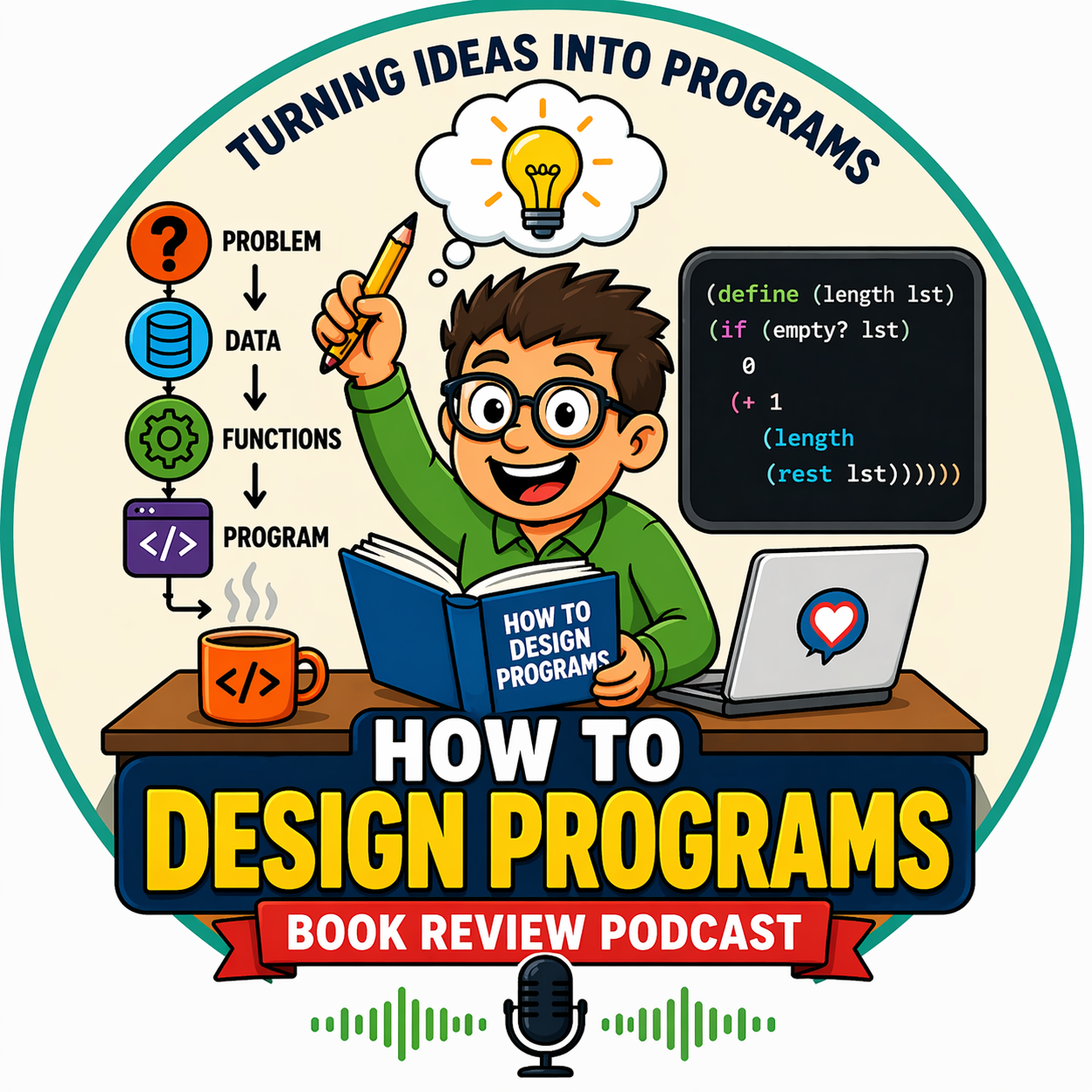 Book Review: How to Design Programs: Systematic Computing and Design Principles | The AI team takes a deep dive into the second edition of How to Design Programs , which presents a systematic methodology for software creation, emphasizing program design over mere coding. The authors advocate for a design recipe consisting of six essential steps that transform a problem analysis into a functional, tested program. This approach utilizes the DrRacket environment and a series of teaching languages specifically crafted to provide clear feedback to beginners. Students learn to manipulate various forms of data, including numbers, strings, and images, through a process of iterative refinement. Beyond technical skills, the text aims to cultivate transferable problem-solving abilities and an appreciation for the aesthetic elegance of well-structured logic. Ultimately, the book positions program design as a fundamental liberal arts skill applicable to a wide range of professional disciplines. The book may be found online at https://htdp.org/2026-2-25//Book/index.html | — | |
| 5/2/26 |  Book Review: Bilingual Messianic Passover Haggadah | Have you ever wondered about the Jewish Passover festival? The AI team takes a deep dive into a bilingual guide that presents the order of a Passover Seder through a blend of Jewish tradition and Christian theology. The text provides a step-by-step liturgical framework, including the lighting of candles, the four cups of wine, and the symbolic foods found on the Seder plate. It utilizes scriptural readings from both the Old and New Testaments to connect the exodus from Egypt to the life and sacrifice of Jesus. Written in both English and Chinese, the source serves as an educational tool for participants to understand the historical significance and spiritual symbolism of the holiday. The narrative emphasizes themes of redemption, freedom from slavery, and the messianic hope shared across generations. Note the differences between this version of the Passover seder and the traditional Jewish version. | — | |
| 4/25/26 |  Mission Engineering, a Return to the Original Systems Engineering Analytical Paradigm? | The AI team takes a deep dive into the Department of Defense Mission Engineering Guide (Version 2.0), which provides a standardized, interdisciplinary framework for analyzing and designing military missions to achieve specific outcomes. This methodology decomposes missions into mission threads and engineering threads to evaluate how different technologies, systems, and tactics impact overall success. By utilizing digital engineering tools and quantitative modeling, the guide helps practitioners identify capability gaps and inform high-level investment and acquisition decisions. The process is highly iterative, moving from initial problem definition and characterization to rigorous analysis and final recommendations. It emphasizes the use of data-driven metrics, such as Measures of Success and Measures of Performance, to ensure that military solutions are both effective and well-integrated. Ultimately, this guide serves as a scalable roadmap for the defense community to engineer missions that are robust, transparent, and aligned with modern strategic goals. | — | |
| 4/19/26 |  Book Review: Learn Systems Thinking | The AI takes a deep dive into a book that serves as an instructional guide to systems thinking, a holistic methodology designed to address the complex, interconnected challenges of the modern world. The authour, Wallace Wright argues against linear, mechanistic problem-solving, encouraging readers instead to view organizations and global issues as dynamic feedback loops. By examining the underlying structures and patterns which exist beneath surface-level events—frequently illustrated through the iceberg analogy—individuals can identify the root causes of dysfunction. The book details various systemic archetypes, such as "drifting goals" and "shifting the burden," to explain why quick fixes often fail or result in unintended consequences. Ultimately, the source advocates for adaptive strategies and mental model shifts to foster sustainable, innovative solutions in professional and personal contexts. | — | |
| 4/18/26 |  Bogdanov: The Unknown Pioneer of Systems Science | The AI team takes a deep dive into Alexander Bogdanov’s Tektology, a pioneering work that seeks to establish a universal science of organization. The author argues that all human, biological, and cosmic processes are governed by identical structural laws, positioning his theory as a precursor to modern systems theory and cybernetics. Through a detailed table of contents and introductory essays, the source explains how mankind and nature both function as organizers, utilizing mechanisms such as equilibrium, selection, and structural stability. The text also addresses the historical resistance Bogdanov faced from Marxist contemporaries, who viewed his scientific generalizations as a threat to traditional dialectical materialism. Ultimately, the work aims to harmonize fragmented knowledge into a single framework for understanding how complex wholes are formed, maintained, and dissolved. The full text may be found as a result of the following query on the Internet Archive https://archive.org/search.php?query=Bogdanov%20Tektology | — | |
| 4/11/26 |  Book Review: Systems Science for Engineers and Scholars | The AI team takes a deep dive into a text which introduces systems science as an interdisciplinary framework designed to bridge the gap between specialized academic "silos" such as biology, physics, and engineering. Written by Avner Engel, the book Systems Science for Engineers and Scholars outlines ten fundamental principles—including hierarchy, complexity, and emergence—that govern all systems regardless of their specific domain. It encourages professionals to adopt holistic thinking to solve modern global dilemmas, such as the climate and energy crises, by applying lessons learned from one field to another through isomorphic mapping. The material also provides a detailed roadmap of the book’s structure, which covers practical applications in risk management, decision-making, and accident analysis. Ultimately, the text serves as a guide for using systemic methodologies to design more resilient technologies and understand the interconnected nature of the universe. | — | |
| 4/5/26 |  Understanding Large Language Model AIs | The AI team takes a deep dive into the technical architecture and operational logic of Large Language Models (LLMs). They explain that these systems are trained through a multi-stage process; pre-training, fine-tuning, and human feedback, to predict text sequence. A central focus is the Transformer architecture, which uses an attention mechanism to understand relationships between words and manage linguistic nuances such as spelling errors. The team clarify that AI "memory" is actually a process where the entire conversation history is re-read during every interaction to maintain coherence. Finally, the team define LLMs as probabilistic state machines that, despite their sophisticated conversational abilities, face limitations such as factual hallucinations and fixed knowledge cutoffs. | — | |
| 3/28/26 |  An Introduction to System Science | The AI team take a deep dive into a book, Introduction to System Science with MATLAB by Gary Marlin Sandquist Zakary and Robert Wilde. The book introduces system science as a multidisciplinary framework for analyzing and modeling rational systems through the use of MATLAB. It emphasizes that effective practitioners must combine mathematical proficiency with computer competence to evaluate complex phenomena ranging from physical sciences to human history and sociology. By applying the principle of causality, the material demonstrates how to quantify diverse topics such as economic growth, medical diagnoses, and even religious impacts or personal stress. The provided excerpts offer various system equations and modeling exercises that explore the relationship between inputs, outputs, and feedback mechanisms. Ultimately, the book seeks to provide students with the computational tools necessary to simulate and understand the interconnected nature of the modern world. | — |
Showing 10 of 10
Sponsor Intelligence
Sign in to see which brands sponsor this podcast, their ad offers, and promo codes.
Chart Positions
17 placements across 16 markets.
Chart Positions
17 placements across 16 markets.