

Insights from recent episode analysis
Audience Interest
Podcast Focus
Publishing Consistency
Platform Reach
Insights are generated by CastFox AI using publicly available data, episode content, and proprietary models.
Est. Listeners
Based on iTunes & Spotify (publisher stats).
- Per-Episode Audience
Est. listeners per new episode within ~30 days
25,001 - 50,000 - Monthly Reach
Unique listeners across all episodes (30 days)
75,001 - 150,000 - Active Followers
Loyal subscribers who consistently listen
15,001 - 40,000
Market Insights
Platform Distribution
Reach across major podcast platforms, updated hourly
Total Followers
—
Total Plays
—
Total Reviews
—
* Data sourced directly from platform APIs and aggregated hourly across all major podcast directories.
On the show
Recent episodes
136: Bureaucracy (revisited) -- Max Weber (Part 4)
May 5, 2026
Unknown duration
136: Bureaucracy (revisited) -- Max Weber (Part 3)
Apr 28, 2026
Unknown duration
136: Bureaucracy (revisited) -- Max Weber (Part 2)
Apr 21, 2026
Unknown duration
136: Bureaucracy (revisited) -- Max Weber (Part 1)
Apr 14, 2026
Unknown duration
136: Bureaucracy (revisited) -- Max Weber (summary of episode)
Apr 9, 2026
Unknown duration
Social Links & Contact
Official channels & resources
Official Website
Login
RSS Feed
Login
| Date | Episode | Description | Length | ||||||
|---|---|---|---|---|---|---|---|---|---|
| 5/5/26 |  136: Bureaucracy (revisited) -- Max Weber (Part 4) 136: Bureaucracy (revisited) -- Max Weber (Part 4) | This is an expanded version of the supplement from the original Episode 6 on Max Weber's Bureaucracy. This release includes both the original supplement from Dmitrijs along with an extended commentary from Tom to cover contemporary views on bureaucracy since the original episode's January 2016 release. | — | ||||||
| 4/28/26 |  136: Bureaucracy (revisited) -- Max Weber (Part 3) 136: Bureaucracy (revisited) -- Max Weber (Part 3) | In this release, we take a retrospective look at Weber's famous work and our original episode. How has our views about bureaucracy changed over the past decade (2016-when the original Weber episode was released) or century (1918-when the speech was delivered). | — | ||||||
| 4/21/26 |  136: Bureaucracy (revisited) -- Max Weber (Part 2) 136: Bureaucracy (revisited) -- Max Weber (Part 2) | This is an edited re-release of our Episode 6, Part 2 on Max Weber's bureaucracy, originally from January 2016. Next week, we will provide an additional discussion where we bring Weber's ideas to contemporary times. | — | ||||||
| 4/14/26 |  136: Bureaucracy (revisited) -- Max Weber (Part 1) 136: Bureaucracy (revisited) -- Max Weber (Part 1) | We are revisiting an older episode, our Episode 6 on Weber’s bureaucracy. The original episode explored the work objectively, trying to understand how Weber was encouraging the use of rational rules and hierarchical systems to foster greater stability in society rather than efficiency. But it never seemed to happen as bureaucracies became a dominant organizational form. By re-reading Weber through the lens of institutional logics, we hope to better understand why this is the case. This week, we release an edited version of Part 1 of the original episode. | — | ||||||
| 4/9/26 | 136: Bureaucracy (revisited) -- Max Weber (summary of episode) | Coming soon! We will re-examine one of our earlier episodes which deserves another look. Weber’s chapter on the meaning of bureaucracy (Episode 6) remains one of the most popular episodes on the program, but given how bureaucracy has become so dimly viewed, we wanted to give it another look with fresh eyes. Is there something we missed as bureaucracies formed? | — | ||||||
| 3/17/26 |  135: Boundary Work in Science -- Thomas Gieryn (Part 2) 135: Boundary Work in Science -- Thomas Gieryn (Part 2) | In Part 2 of our episode on Gieryn’s 1983 article “Boundary-Work and the Demarcation of Science from non-Science,” we review the main points in the context of contemporary tensions over society’s growing distrust of scientists and rejection of science. What factors may be contributing to this trend after so many decades where scientists have been considered noble individual or science considered an inherently good thing? What might be necessary to stem or reverse such trends? | — | ||||||
| 3/10/26 |  135: Boundary Work in Science -- Thomas Gieryn (Part 1) 135: Boundary Work in Science -- Thomas Gieryn (Part 1) | We continue our series of discussions on the sociology of science and cover a seminal article that is commonly found as required reading in doctoral programs -- Thomas Gieryn’s 1983 article “Boundary-Work and the Demarcation of Science from non-Science” from the American Sociological Review. This commentary draws from three different historical case studies to explore where the boundary is between what is or should be considered science or the autonomy granted to scientists and what is considered other forms of intellectual pursuit. In Part 1, we explore the cases that involve competition between the world of science and those of religion and engineering, of true science vs. pseudo-science, and of scientific openness and collaboration vs. national security and commensurate need for secrecy. | — | ||||||
| 3/5/26 | 135: Boundary Work in Science -- Thomas Gieryn (Summary of Episode) | Coming soon! Our next episode features a 1983 article from Thomas Gieryn that discusses how the “boundary work” of scientists and others science contributes to a broader understanding of where science is separated from non-science or pseudo-science and scientists navigate the gap between their individual autonomy and the constraints placed on them by others such as government leaders. Through historical cases, Gieryn explores the contested spaces surrounding science and why the boundary will likely never be clear. | — | ||||||
| 2/17/26 |  134: Normal Accidents -- Charles Perrow (Part 2) 134: Normal Accidents -- Charles Perrow (Part 2) | In Part 2 of our episode on Charles Perrow’s book Normal Accidents, we carry the framework forward into the 21st century to consider newer technological systems (especially in information technology) and the Y2K problem that was looming when the updated edition of the book was published in 1999. Is there any hope for mitigating the potential for new forms of high-risk accidents, or are we just stuck with having to deal with the occasional mass disaster? | — | ||||||
| 2/10/26 |  134: Normal Accidents -- Charles Perrow (Part 1) 134: Normal Accidents -- Charles Perrow (Part 1) | This month we are discussing Charles Perrow’s book Normal Accidents that addresses the risks associated with complex, tightly coupled high-risk technological systems. Through analyses of numerous accidents and incidents involving nuclear power plants, petrochemical plants, aerospace and maritime systems, and others, Perrow derived a framework that showed how high-risk systems are prone to accidents if they are highly complex and the components are tightly coupled. He also argued that efforts to improve safety such as more meters and indicators can have the opposite effect of complicating the operator’s ability to control a catastrophic situation. | — | ||||||
Want analysis for the episodes below?Free for Pro Submit a request, we'll have your selected episodes analyzed within an hour. Free, at no cost to you, for Pro users. | |||||||||
| 2/5/26 | E134: Normal Accidents -- Charles Perrow (Summary of Episode) | Coming soon! Our next episode features a 1999 book by Charles Perrow titled Normal Accidents that addresses the risks associated with complex, tightly coupled high-risk technological systems. With the Three Mile Island disaster and a host of other catastrophes, Perrow built a framework that helps forecast which kinds of technologies are most at risk. However, he suggests there are constraints regarding what one can do to preclude accidents. | — | ||||||
| 1/27/26 |  133: Strategic Planning & Design -- Henry Mintzberg (Part 2) 133: Strategic Planning & Design -- Henry Mintzberg (Part 2) | In Part 2 of our episode on five works of Henry Mintzberg, we move toward the contemporary environment and ask ourselves how much has changed since the Rise and Fall of Strategic Planning was published. After all, some of the very systems that Mintzberg criticized heavily are still very much in use, and still appear to exhibit some of the same failings. So what should be done? | — | ||||||
| 1/20/26 |  133: Strategic Planning & Design -- Henry Mintzberg (Part 1) 133: Strategic Planning & Design -- Henry Mintzberg (Part 1) | This month we return to the works of Henry Mintzberg, whose book Simply Managing we covered way back in Episode 14. This time, we decided to cover a number of works covering broad themes of strategy development and organizational planning, along with critiques of extant design school works. We divided five works among us to discuss in which he argues about why strategies and plans so often seem to fail, why planners seem so out of touch with the rest of the organization, and why even the processes of strategy development and planning may be inherently flawed. | — | ||||||
| 1/16/26 | 133: Strategic Planning & Design -- Henry Mintzberg (Summary of Episode) | Coming soon! We will cover a body of work by Henry Mintzberg. His career as a consultant and management researcher spans decades and has resulted in numerous works that provide critical perspectives on dominant schools of thought in organizational design, strategic, and planning. So instead of a single reading, we chose five and the cast members divided the works as they all converged on several common themes. | — | ||||||
| 12/16/25 | 132: AoM Special (Part 2) -- Queer Eye for Academics: Skills for Navigating Academic Life | We now release a recording of a professional development workshop (PDW) called Queer Eye For Academics: Skills For Navigating Academic Life, held at the 2025 Academy of Management annual meeting. Inspired by the popular Queer Eye television series, this PDW offered a fresh approach to skill-sharing within academia, and featured six presenters – most early-career scholars from the LGBTQ+ community -- covering a variety of practical skills such as teaching, crafting research programs, and presenting, and interpersonal development skills such as engaging, fostering caring relations, and recognizing colleagues. | — | ||||||
| 12/10/25 | 132: AoM Special (Part 1) -- Multimodal Impact: Translating Academic Knowledge via Contextual, Collaborative, and Collectivist Modes | This month, we are presenting recordings of two events from the Academy of Management Annual Meeting 2025. The first event was Multimodal Impact: Translating Academic Knowledge via Contextual, Collaborative, and Collectivist Modes. This symposium brings together five presenters to explore diverse modes of translating academic expertise into practice. As management researchers increasingly strive to achieve societal impact, this event sought to understand how different communication modes can bridge the persistent research-practice divide. | — | ||||||
| 11/18/25 |  131: Commitment and Community -- Rosabeth Moss Kanter (Part 2) 131: Commitment and Community -- Rosabeth Moss Kanter (Part 2) | In Part 2 of our episode on Kanter’s Commitment and Community, we examine in depth her conclusions about the distinction between “retreat” and “service” communities and why the former tends to fail while the latter shows greater chances of long-term success. However, we also debate on the meaning of “success” as being more nuanced that merely duration of the commune over time. We then discuss the implications for this study for the present day when Internet-based social movements of all forms and perspectives can be formed readily – but how and why do they last? | — | ||||||
| 11/11/25 |  131: Commitment and Community -- Rosabeth Moss Kanter (Part 1) 131: Commitment and Community -- Rosabeth Moss Kanter (Part 1) | This month we return to the works of Rosabeth Moss Kanter, whose works on tokenism we explored way back in Episode 17. This time, we will discuss one of her better known books Commitment and Community: Commune and Utopias in Sociological Perspective that examines the origins and life cycle of numerous communes that sprang up in the US from the mid-19th century to the 1960s. Written based on her dissertation study at a time when hippie communes were popular, she wondered what drove people to start or join these communes and what factors enabled the communes’ survival. This week’s Part 1 is about her conceptual framework and study, and next week’s Part 2 will focus on the conclusions and implications for social movements today. | — | ||||||
| 11/11/25 | 131: Commitment and Community -- Rosabeth Moss Kanter (summary of episode) | Coming soon! In our next episode, we will discuss Rosabeth Moss Kanter’s famous book Commitment and Community that examines the origins and life cycle of numerous communes that sprang up in the US from the mid-19th century to the 1960s. What drove people to start or join these communes? And then, what factors allowed some to survive for decades or longer while others broke up within months? The answers have added greatly to our understandings of individual commitment to an organization and an organization’s commitment to its members. | — | ||||||
| 10/28/25 |  130: Structure of Scientific Revolutions -- Thomas Kuhn (Part 2) 130: Structure of Scientific Revolutions -- Thomas Kuhn (Part 2) | In Part 2 of the episode on Kuhn’s Structure of Scientific Revolutions, we bring the concepts to the present day. His essay uses examples mostly from the natural sciences, so we ponder over how well his concepts apply to the social sciences. Also, in Kuhn’s time, science was generally seen to be a good thing and scientific progress translated into benefits for society writ large. Sixty-plus years later, science and scientists are not necessarily as highly regarded. What might that mean for the future of science? | — | ||||||
| 10/21/25 |  130: Structure of Scientific Revolutions -- Thomas Kuhn (Part 1) 130: Structure of Scientific Revolutions -- Thomas Kuhn (Part 1) | For our 10th anniversary episode, we selected a modern classic that greatly informs science and research across many disciplines, including organization studies. Thomas Kuhn’s The Structure of Scientific Revolutions is a book often assigned to rising graduate students as a primer for entering the sciences. A culmination of Kuhn’s earlier works on the philosophy and history of science, Scientific Revolutions challenges the notion that science progresses along a predictable or linear path and instead progresses through significant episodes of disruptive change. Filled with useful and accessible historical examples, Kuhn is a great resource for understanding how science and scientific communities function. | — | ||||||
| 10/21/25 | 130: Structure of Scientific Revolutions -- Thomas Kuhn (Summary of Episode) | Coming soon! For our 10th anniversary episode, we selected a modern classic that greatly informs science and research across many disciplines, including organization studies. Thomas Kuhn’s The Structure of Scientific Revolutions is a book often assigned to rising graduate students as a primer for entering the sciences. | — | ||||||
| 10/13/25 |  130A: Our 10th Anniversary Episode! 130A: Our 10th Anniversary Episode! | 10 years ago today, on October 13th, 2015, four rising scholars – Dmitrijs, Pedro, Miranda, and Ralph – launched the Talking About Organization Podcast with an episode on Frederic Taylor’s The Principles of Scientific Management. In this special, current-day cast members reflect on what we have done and what we would like to continue doing in the program. To learn more about this program and its mission, please go to our website at www.talkingaboutorganizations.com | — | ||||||
| 9/16/25 | 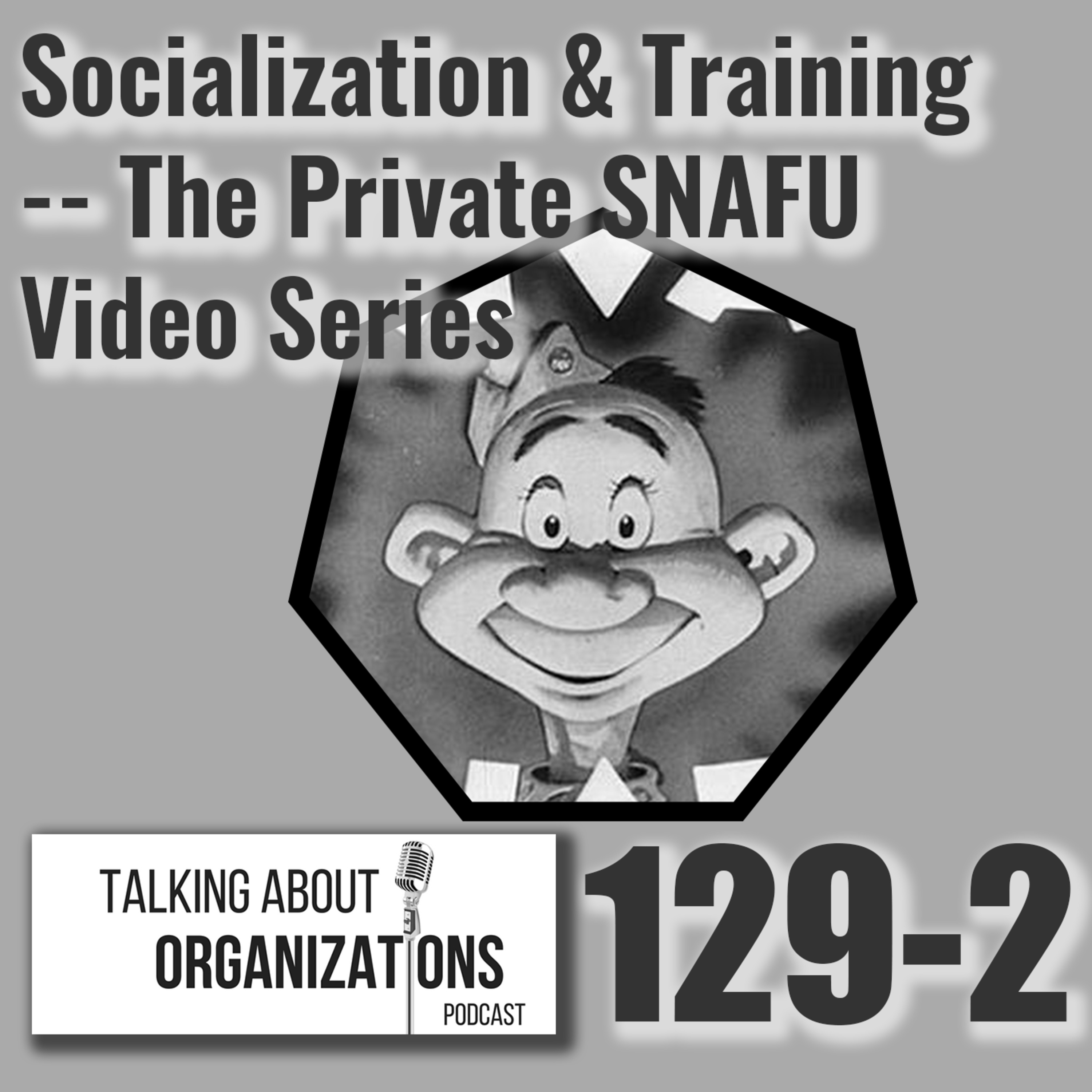 129: Socialization and Training -- The Private SNAFU Series (Part 2) 129: Socialization and Training -- The Private SNAFU Series (Part 2) | In Part 2 of the episode on the Private SNAFU video series, we recount the various trials and tribulations of developing training modules for organizational use. What kinds of media and approaches would be most effective and most efficient, given the increasing breadth and complexity of workplace rules and policies that need to be socialized among the workforce? | — | ||||||
| 9/16/25 | 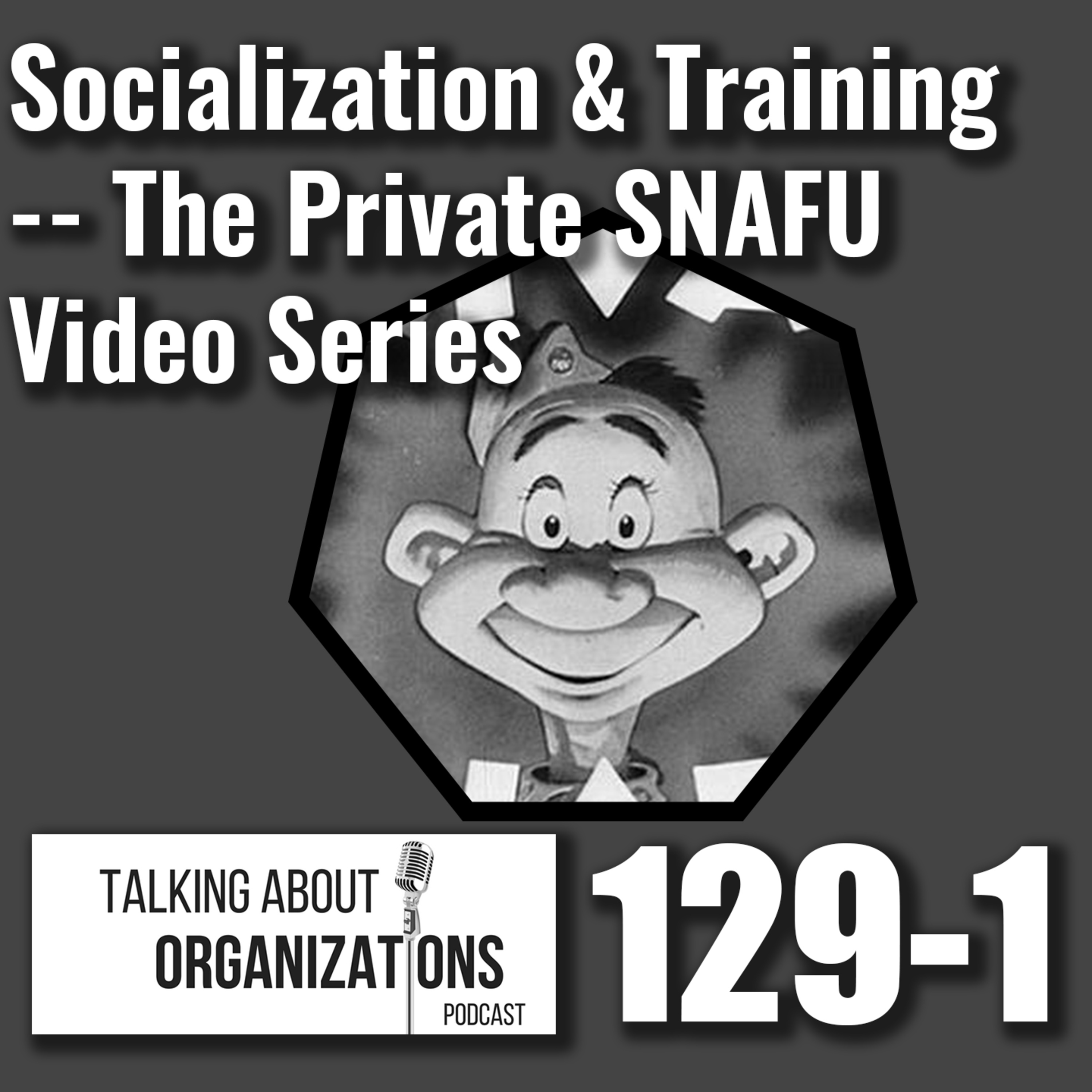 129: Socialization and Training -- The Private SNAFU Series (Part 1) 129: Socialization and Training -- The Private SNAFU Series (Part 1) | Private SNAFU was a series of black-and-white animated shorts of three to five minutes in length recounting various misadventures of the title character as he goes to war. The purpose of the training videos was to socialize and reinforce the importance of adherence existing US Army policies and procedures and helping to introduce soldiers to potential hazards and challenges that they would face in combat. Produced by Warner Bros. using a Looney Tunes animation style, the shorts used comedy to get the points across that failing to adhere to the rules would compromise the mission and likely get oneself killed or seriously injured. We examine these videos through an organizational socialization lens – how to impart the needed rules and regulations to a large number of homesick and nervous soldiers and make the messages stick? | — | ||||||
Showing 25 of 357
Sponsor Intelligence
Sign in to see which brands sponsor this podcast, their ad offers, and promo codes.
Chart Positions
5 placements across 5 markets.
Chart Positions
5 placements across 5 markets.