Teaching Python
by Sean Tibor and Kelly Paredes
Is this your podcast?Insights from recent episode analysis
Audience Interest
Podcast Focus
Publishing Consistency
Platform Reach
Insights are generated by CastFox AI using publicly available data, episode content, and proprietary models.
Most discussed topics
Brands & references
Total monthly reach
Estimated from 1 chart position in 1 market.
By chart position
- 🇸🇬SG · Education#107500 to 3K
- Per-Episode Audience
Est. listeners per new episode within ~30 days
250 to 1.5K🎙 Weekly cadence·156 episodes·Last published 3w ago - Monthly Reach
Unique listeners across all episodes (30 days)
500 to 3K🇸🇬100% - Active Followers
Loyal subscribers who consistently listen
150 to 900
Market Insights
Platform Distribution
Reach across major podcast platforms, updated hourly
Total Followers
—
Total Plays
—
Total Reviews
—
* Data sourced directly from platform APIs and aggregated hourly across all major podcast directories.
On the show
From 15 epsHosts
Recent guests
Recent episodes
Episode 161: Teaching Hard Things Simply
Aug 7, 2026
Unknown duration
Episode 160: Data Science, Math and Python, Oh My!
Jul 16, 2026
1h 00m 08s
Episode 159: Big Lessons from Small Models with Gwyneth Peña‑Siguenza
Jun 22, 2026
56m 15s
Episode 158: Will Vincent on Django, AI Coding, and Why Fundamentals Still Matter
Jun 10, 2026
1h 12m 13s
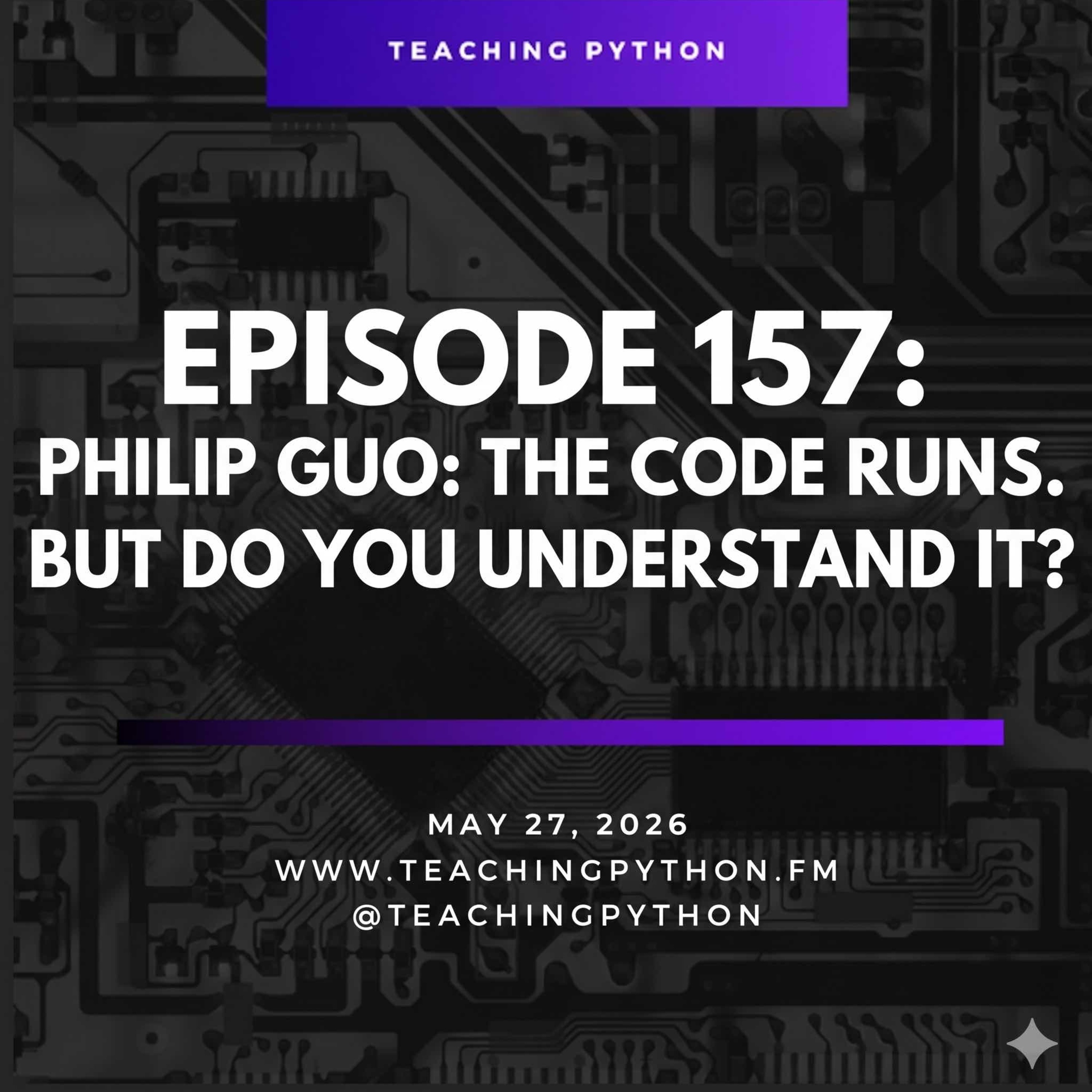
Episode 157: Philip Guo: The Code Runs. But Do You Understand It?
May 30, 2026
53m 53s
Social Links & Contact
Official channels & resources
Official Website
Login
RSS Feed
Login
| Date | Episode | Topics | Guests | Brands | Places | Keywords | Sponsor | Length | |
|---|---|---|---|---|---|---|---|---|---|
| 8/7/26 |  Episode 161: Teaching Hard Things Simply | In this episode of Teaching Python, Kelly and Julian welcome IBM Distinguished Engineer Jeff Crume to talk about teaching hard things simply. The conversation begins with Jeff’s short, visually driven videos and the studio setup behind them, including the lightboard format, the editing process, and the amount of planning needed to turn a 15-minute explanation into something clear and usable. They then turn to the challenge of explaining complex ideas in a way that fits the audience. Jeff describes how he chooses topics from his work with clients, why he thinks teaching deepens his own understanding, and how he adapts for YouTube, classrooms, and conference talks. He emphasizes brevity, structure, and using visuals so viewers are not faced with a talking head and a blank background. A major part of the discussion focuses on AI, the humanities, and education. Jeff explains why he believes the humanities are essential for understanding meaning, purpose, truth, and context, and why those questions matter when using AI. He argues that AI should be treated as a tool to augment learning rather than something to exclude from classrooms. The conversation also covers cybersecurity and practical AI risks. Jeff discusses passwords versus passkeys, phishing, public chatbots, data privacy, cloud services, and the security concerns around agents and connected tools. He argues for private instances, stronger security practices, and doing security earlier in the process. Near the end, Jeff highlights communication, curiosity, and critical thinking as key skills for students. He also points listeners to IBM SkillsBuild and Coursera for training, and closes by encouraging lifelong learning in a fast-changing field.Special Guest: Jeff Crume.Support Teaching Python | — | ||||||
| 7/16/26 | data science educationteaching Python+4 | Mahmoud Harding | PythonNumPy+3 | — | data sciencePython+5 | — | 1h 00m 08s | ||
| 6/22/26 | small language modelsAI understanding+4 | Gwyneth Peña-Sigüenza | Microsoft | Ecuador | small language modelsAI+5 | — | 56m 15s | ||
| 6/10/26 | DjangoAI in software engineering+4 | Will Vincent | JetBrainsDjango | — | DjangoAI coding+5 | — | 1h 12m 13s | ||
| 5/30/26 | AI in educationPython Tutor+4 | Philip Guo | Python Tutor | — | Python TutorAI-generated code+4 | — | 53m 53s | ||
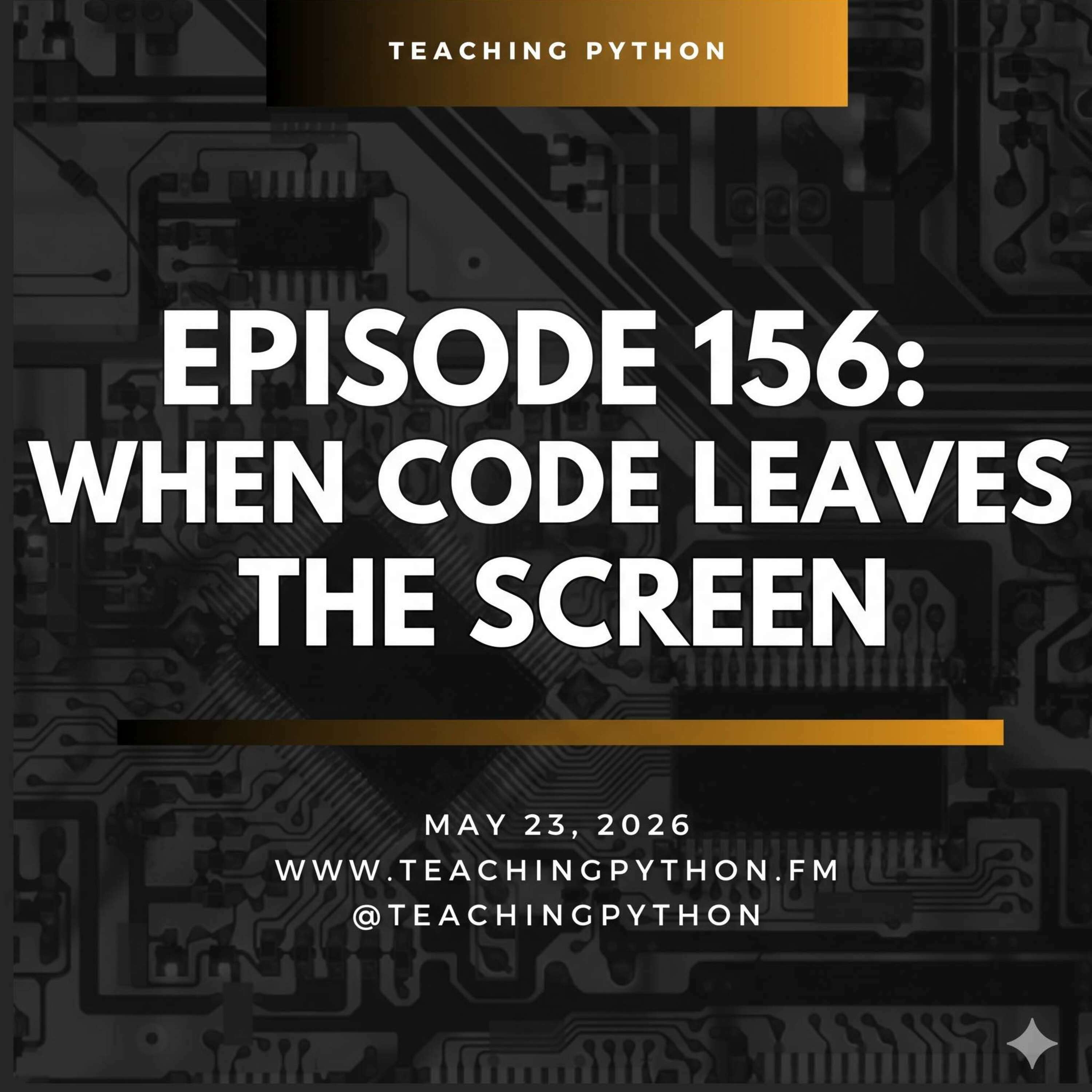
| 5/23/26 | physical computingCircuitPython+4 | Todd Kurt | CircuitPythonMicroPython+3 | — | CircuitPythonMicroPython+5 | — | 56m 02s | ||
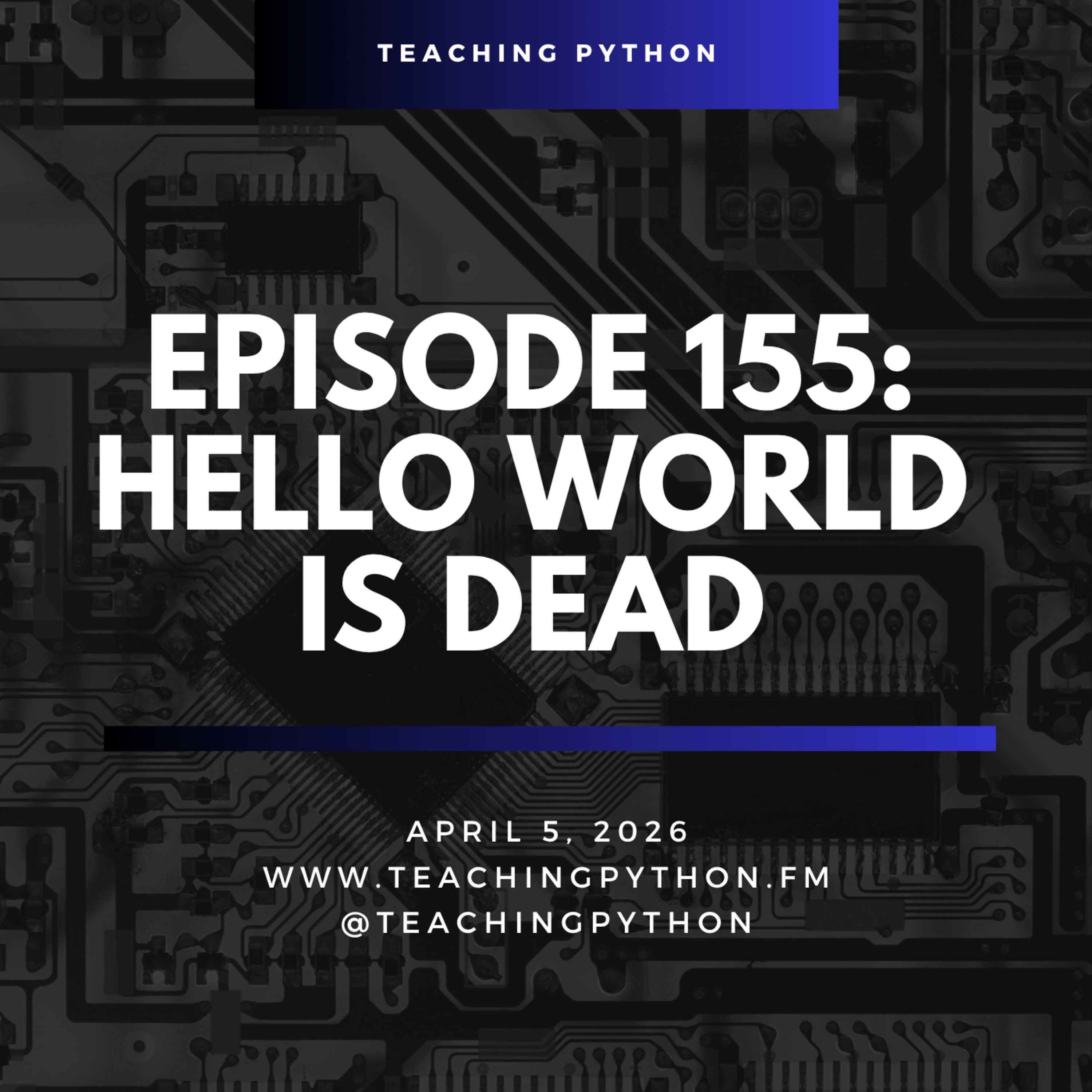
| 4/6/26 | Hello WorldAI in programming+3 | Julian Sequeira | PythonSQLite+9 | PittsburghUS+1 | AI assistantsvoice interfaces+2 | — | 47m 57s | ||
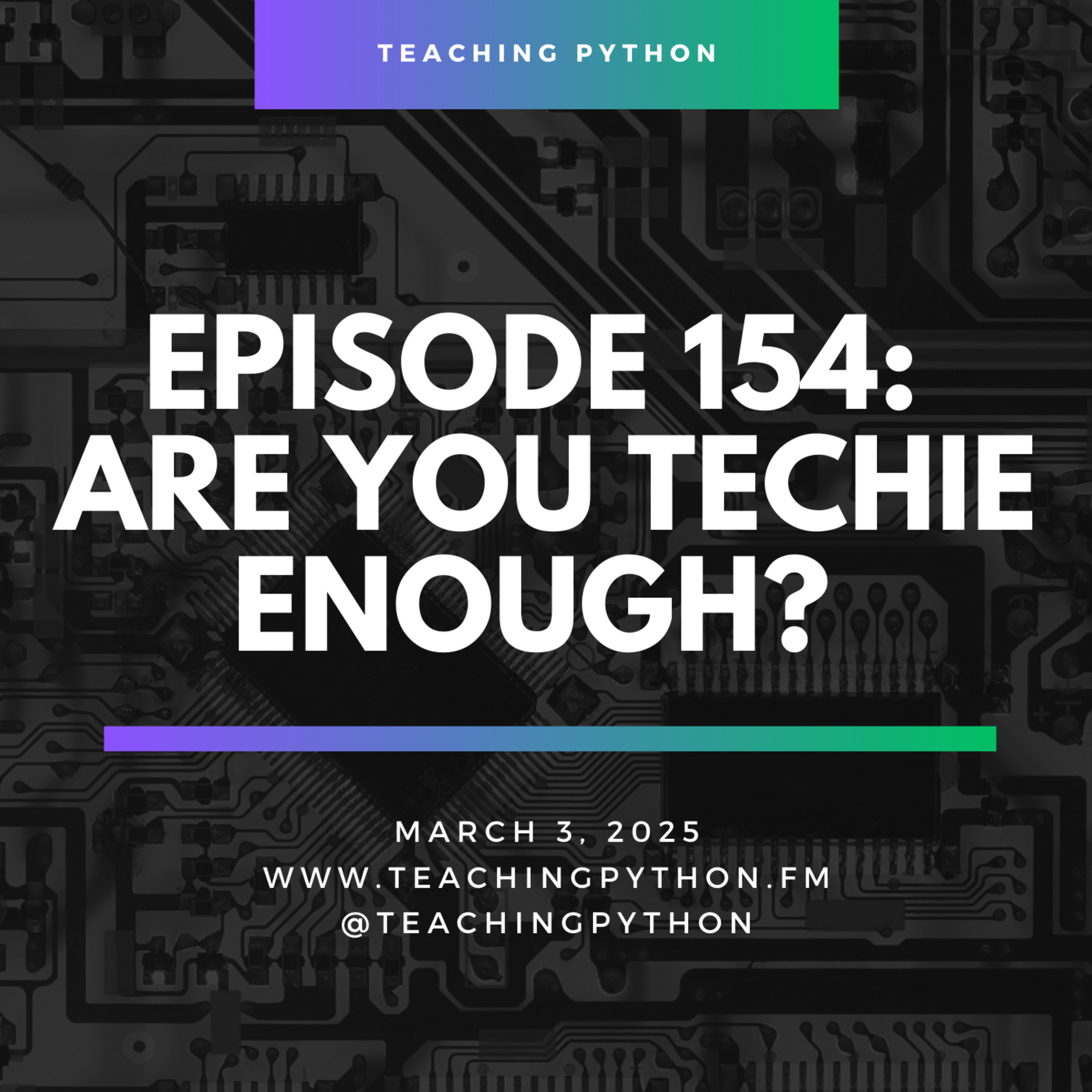
| 3/3/26 | techieimposter syndrome+3 | Amelia Hough-Ross | Canvafiber internet+8 | PittsburghDenmark+3 | labelsproductive struggle+2 | — | 49m 37s | ||
| 12/14/25 | holiday gift guidecoding+2 | Julian Sequeira | Fusion 360A1 Mini+27 | North CarolinaAustralia+3 | gift ideas3D printing+2 | — | 40m 12s | ||
| 11/26/25 | high school computer sciencecurriculum development+5 | Quincy Tennyson | ButtonpadCS61A from UC Berkeley+11 | — | CS educationAP Computer Science+2 | — | 54m 19s | ||
Want analysis for the episodes below?Free for Pro Submit a request, we'll have your selected episodes analyzed within an hour. Free, at no cost to you, for Pro users. | |||||||||
| 9/29/25 | AIlaw+3 | Pritesh Patel | NotebookLMPython+10 | — | Jobs to Be Donereinforcement learning+2 | — | 54m 50s | ||
| 8/28/25 | Educational StrategySecurity Concerns+5 | Simon WIllison | DjangoDatasette+3 | — | LLMsAI tools+5 | — | 1h 36m 27s | ||
| 7/15/25 | Python educationsoft skills in technical education+4 | Sheena O'Connell | PythonDjango+17 | South AfricaTanzania+3 | UbuntuDjango Con Africa+2 | — | 47m 42s | ||
| 6/8/25 | AI in educationcoding productivity+3 | Industry ProfessionalsUniversity Lecturers+2 | PythonAI tools+1 | Pittsburgh | AI toolseducation+2 | — | 57m 25s | ||
| 3/24/25 | APIseducation+2 | — | PythonTeaching Python | — | LLMsLarge Language Models+2 | — | 40m 05s | ||
| 1/21/25 | Python educationcommunity engagement+2 | Cheuk Ting HoKeith Murray | PythonPSF Education Outreach Workgroup+10 | ClevelandOH+1 | Python Software Foundationeducational resources+1 | — | 52m 32s | ||
| 1/13/25 |  Episode 145: The Bigger Picture of Teaching Python | In episode 145 of Teaching Python, Sean Tibor and Kelly Schuster-Paredes celebrate their six-year podcast anniversary and discuss the shifts within computer science education and the growing influence of AI. They both reflect on the podcast’s journey, their experiences with Blue Sky, and the milestone of over 500,000 downloads. The conversation delves into the changing landscape of tech roles, emphasizing the importance of foundational coding skills and computational thinking, regardless of emerging technologies like AI. They underline how coding remains a key skill that enables personal growth and opens vast opportunities, even in the face of fast-evolving tech sectors. Our hosts also highlight their exciting upcoming engagements, including the FETC conference and the Pine Crest Innovation Institute, encouraging listeners to remain adaptable and open to new learning avenues. Furthermore, they discuss the concept of adapting computer science curriculums to reflect real-world applications and evolving job markets, focusing on how to better prepare students for future careers. With a mix of personal anecdotes and professional insights, this episode offers a heartfelt look at the impact of teaching coding and the continuous evolution in education and technology.Support Teaching PythonLinks:Learn VIM while playing a game - VIM Adventures — Learning VIM while playing a game Teaching Python Podcast (@teachingpython.fm) — Bluesky — Teaching Python on Bluesky Sean Tibor (@seantibor.com) — Bluesky — Sean's profile on Bluesky Kelly Paredes (@kellypared.bsky.social) — Bluesky — Kelly's profile on Bluesky Future of Education Technology Conference | FETC 2025 Pine Crest School's Innovation Institute Bett UK: Leading EdTech Event | 22-24 Jan 2025, ExCeL London Top announcements of AWS re:Invent 2024 | AWS News Blog | — | ||||||
| 1/6/25 |  Episode 144: Python in Africa with Kudzayi Bamhare | In episode 144 of Teaching Python, hosts Sean Tibor and Kelly Schuster-Paredes are joined by special guest Kudzayi Bamhare from Zimbabwe. They dive into the important topic of Python education as a driver of innovation in Africa, focusing specifically on the challenges and opportunities in Zimbabwe. The conversation covers how coding communities are forming and thriving despite various hurdles, and how inclusive environments can foster learning and growth in the tech industry. Kudzayi shares his inspiring journey into the world of coding, beginning with his initial exposure to Python and how attending Python conferences like PyCon Namibia have been pivotal in his growth. He emphasizes the importance of community, collaboration, and support in helping budding coders overcome challenges and stay motivated. The discussion also highlights the need for more initiatives and workshops to bridge the gap in tech education across the continent. The episode concludes with insightful ideas on how to create effective learning environments and the role of educators in nurturing future tech talents. Sean and Kelly, alongside Kudzayi, discuss the significance of making coding accessible and engaging, especially in underrepresented regions. They call on listeners to support initiatives that bring Python education to Africa, encouraging a global collaboration to drive technological progress and innovation.Special Guest: Kudzayi Bamhare.Support Teaching Python | — | ||||||
| 12/30/24 |  Episode 143: Computational Thinking 2.0 with Dr. John Chapin | In Episode 143 of Teaching Python, hosts Sean Tibor and Kelly Schuster-Paredes engage in a compelling conversation with Dr. John Chapin, a renowned computer science educator and presenter at CSTA. As the CS Pathway Leader at the Academies of Loudoun, Dr. Chapin brings over a decade of experience in primary and secondary education, creating and implementing rigorous curricula for post-AP CS students. He shares insights into the transformative power of Computational Thinking 2.0, emphasizing the importance of Python and data science in today's educational landscape. Listeners will gain a deeper understanding of how integrating machine learning, data analytics, and mobile app development into CS education can foster a culture of inquiry, creativity, and collaboration among students and educators. Throughout the episode, Dr. Chapin discusses his recent research on the impact of whiteboarding on student self-efficacy in CS1 classes, as presented at the Association for Computing Machinery's Global Computer Education Conference (CompEd2023). He also shares his experiences conducting professional development workshops for CS teachers across Virginia and his efforts to align CS programs with the evolving needs of the workforce and society. This episode is a must-listen for educators, administrators, and anyone passionate about the future of computer science education, offering actionable ideas and inspiration to enhance their teaching practices and curriculum design.Special Guest: Dr. John Chapin.Support Teaching PythonLinks:(PDF) CT 2.0 A Neural Network Playground — Tinker With a Neural Network Right Here in Your Browser. Don’t Worry, You Can’t Break It. We Promise. Teach, learn, and make with the Raspberry Pi Foundation — Discover world-leading curricula, resources, and professional development to support the teaching and learning of AI literacy. We bring together original research, industry expertise, and practical classroom experience to help you bring the excitement of AI into your classroom. Machine Learning for Kids ACM CompEd Home - ACM CompEd About The Coalition | Data Science for Everyone AI by Hand ✍️ | Tom Yeh | Substack | — | ||||||
| 12/22/24 |  Episode 142: Middle School Magic: Integrating AI, Data Science, and Computational Thinking with Kelly Powers | In Episode 142 of Teaching Python, hosts Sean Tibor and Kelly Schuster-Paredes are joined by Kelly Powers, a fellow middle school educator and curriculum designer, to explore the dynamic world of middle school instruction. As a passionate advocate for computational thinking, Powers shares valuable insights on introducing students to the concepts of AI, data science, and cybersecurity in a way that is both rigorous and joyful. Topics Covered Engaging Middle School Students: Strategies for capturing and maintaining student interest. Creativity and Collaboration: How to foster a collaborative environment that inspires creativity. Core Computational Concepts: Real-world applications that make these concepts accessible and interesting. Data Science Projects: Practical advice on integrating data science into your curriculum. Generative AI Ethics: Discussing the ethical use of AI in education. Python as a Teaching Tool: Exploring the versatility of Python for various projects. Key Takeaways Integrating Computational Thinking Skills: Tips on how to weave these skills into everyday classroom routines. Teamwork and Communication: The importance of teamwork and effective communication in coding projects. Engaging Lessons with Python: How Python can be used to create engaging and meaningful projects for students. About Kelly Powers Kelly Powers transitioned from the business world to education, bringing a fresh perspective on teaching computational thinking. She offers invaluable insights into making rigorous and joyful learning experiences for middle school students. Whether you are an experienced teacher or new to the field, this episode is packed with actionable ideas and inspirational moments that will help you create a more engaging and effective learning environment. Tune in for a lively conversation that celebrates the magic of middle school teaching and the endless possibilities of computer science education. Listen to the episode: Teaching Python Podcast Follow us on Social Media: Twitter Facebook LinkedIn ``` Special Guest: Kelly Powers.Support Teaching PythonLinks:CodeHS - Teach Coding and Computer Science at Your School | CodeHS — Everything You Need, All In One Spot CodeHS is trusted by thousands of teachers and schools all over the world. Overview ‹ Scratch — MIT Media Lab — Scratch is the world's most popular coding community for kids. Millions of kids around the world are using Scratch to program their own interactive stories, games, and animations—and share their creations in an active online community. Welcome To Colab - Colab — Colab is an online Jupyter notebook from Google Computer Science Teachers Association Connect, Grow, & Share With CS Teachers- — CSTA understands that teaching computer science is hard. That’s why we’re focused on creating a supportive environment for K–12 educators. | — | ||||||
| 12/14/24 |  Episode 141: Unlocking Python Expertise with Trey Hunner | Join hosts Kelly Schuster-Paredes and Sean Tibor as they welcome esteemed Python expert Trey Hunner to the show. This episode is a delightful mix of practical insights, engaging stories, and thought-provoking discussions about Python and teaching. Trey shares his experiences with listeners, starting with his recent venture into launching a 10-week Python course called Python High Five. He talks about the excitement and challenges of teaching across different time zones with this unique setup, highlighting the importance of accountability and the fun of learning alongside his students. Throughout the episode, Sean and Kelly discuss the evolving landscape of AI and its impact on learning. Trey emphasizes the critical skill of asking the right questions, saying, "Knowing how to use that tool is a really valuable thing, but also knowing what to stick into the tool and how to evaluate the output of the tool is a really valuable thing." The conversation transitions into the heart of Python programming, where Trey, Sean, and Kelly share their favorite features and nuances of Python. They explore the value of looping helpers and marvel at the elegance and simplicity of Python's tools and functions. Sean recalls a memorable teaching moment about Python turtle graphics, reflecting on the joy and discovery that comes with coding: "It was so cool that this sixth grader showed me how to do it." This episode is not just about technical insights but also about the joy of teaching and learning. Trey, Kelly, and Sean discuss strategies for balancing the basics with advanced learning and the importance of having fun in the process. Join them for a warm, inclusive conversation that invites you to be part of their journey through the wonders of Python programming.Special Guest: Trey Hunner.Support Teaching PythonLinks:Python Morsels: Write better Python code — Learning efficiently requires planning a path that repeatedly answers the question what skill should I learn next and how best can I learn it? Instead of wading through blog posts and YouTube videos in search of the next thing to learn, I can guide you. My name is Trey Hunner and I created Python Morsels to give life-long learners a low-stress way to improve their Python skills. PEP 636 – Structural Pattern Matching: Tutorial | peps.python.org — As an example to motivate this tutorial, you will be writing a text adventure. That is a form of interactive fiction where the user enters text commands to interact with a fictional world and receives text descriptions of what happens. Commands will be simplified forms of natural language like get sword, attack dragon, go north, enter shop or buy cheese. Amazon.com: The Worlds I See: Curiosity, Exploration, and Discovery at the Dawn of AI eBook : Li, Fei-Fei: Kindle Store — The Worlds I See is a story of science in the first person, documenting one of the century’s defining moments from the inside. It provides a riveting story of a scientist at work and a thrillingly clear explanation of what artificial intelligence actually is—and how it came to be. Emotionally raw and intellectually uncompromising, this book is a testament not only to the passion required for even the most technical scholarship but also to the curiosity forever at its heart. Blog Archive - Trey Hunner | — | ||||||
| 12/1/24 |  Episode 140: Girls Programming Network with Renee Noble | In this episode of Teaching Python, Sean and Kelly are joined by Renee Noble, a dynamic Microsoft Cloud Advocate and CEO of a nonprofit dedicated to helping women and gender-diverse individuals learn to code. The discussion delves into Renee's inspiring journey from chemical engineering to tech advocacy, her role in the Girls Programming Network (GPN), and how she has helped thousands of individuals build their coding skills and confidence. Renee emphasizes the importance of creating inclusive and supportive learning environments, explaining the unique methodologies used at GPN to cater to diverse learning levels. The conversation also covers the role of mentors and the significance of having role models at different stages of one's learning and professional journey in tech. Finally, Renee shares her insights on her advocacy work at Microsoft and the impact of clear, approachable guidance in onboarding new learners to cloud technologies. Tune in to discover valuable lessons on building supportive tech communities and fostering diversity in the industry.Support Teaching PythonLinks:ConnectEd Code Renee Noble Amazon.com: Python Cheat Sheet Desk Mat for Software Engineers, Hackers and Programmers, Quick Key, Large Anti-Slip Keyboard Pad Mouse Mat KMH : Office Products — Python Cheat Sheet Desk Mats | — | ||||||
| 11/24/24 |  Episode 139: Code Your Dreams with Brianne Caplan | In Episode 139 of Teaching Python, hosts Sean Tibor and Kelly Schuster-Paredes welcome back Brianne Caplan, the dynamic founder of Code Your Dreams. The conversation explores the exciting advancements in coding education since Brianne's last appearance in 2019. They delve into the importance of blending play and learning, the impact of generative AI, and the power of community-driven innovation. Brianne shares inspiring success stories from students of all ages, from first graders creating mindfulness apps to adults developing solutions for police transparency. The episode also examines the role of failures in the learning process and the opportunities for growth they present. Tune in for an uplifting discussion about leveraging technology to create positive change in diverse communities and fostering an environment where everyone has the opportunity to innovate.Special Guest: Brianne Caplan.Support Teaching PythonLinks:Code Your Dreams | Teaching Inner-City Chicago Kids To Code — Where Every Dream Counts: Embracing Innovation Through Education for a Brighter Future | — | ||||||
| 9/30/24 |  Episode 138: Innovative Coding Education with Pamela Fox | In episode 138 of Teaching Python, hosts Sean Tibor and Kelly Schuster-Paredes welcome Pamela Fox, a Principal Developer Advocate at Microsoft, to discuss the dynamic world of teaching, coding, and creating. Pamela shares her experiences working with Python in the cloud, emphasizing the various applications from serverless functions to web application backends using frameworks like Flask and Django. This episode provides a comprehensive look at how cloud-based environments like GitHub CodeSpaces and CoLab make programming more accessible and reduce the friction often associated with setting up development environments. Pamela dives into her approach to teaching and the unique challenges posed by different educational formats. Drawing from her work at institutions like UC Berkeley and her development of AP Computer Science Principles content for Khan Academy, she highlights the importance of making learning engaging and personalized. Pamela shares insights into the design of interactive and project-based curricula, touching on how tools like Parsons problems can scaffold learning effectively and make complex concepts like recursion more approachable. The conversation also explores the significance of visualizations in learning programming, as exemplified by Pamela's recursion visualizer tool. The episode concludes with reflections on the breadth of topics covered in AP CSP and the value of exposing students to a wide array of programming experiences. Listeners gain a deeper understanding of the balance between teaching fundamental concepts and encouraging creative expression through code, along with practical tips for educators at all levels.Special Guest: Pamela Fox.Support Teaching PythonLinks:GitHub - pamelafox/recursive-visualizations: An online tool to visualize recursive JS functions step-by-step as a tree. — A way to visualize the call graph of recursive functions. Uses Pyodide to run rcviz.py and then a WASM PyDot/GraphViz port to build an SVG graph. Finally, some JavaScript adds a slider for stepping through the calls. GitHub - pamelafox/faded-parsons-static: A way to run Python Faded Parsons problems entirely in the browser. — This website allows you to run Faded Parsons Problems in the browser. It uses Pyodide for executing Python doctests and localStorage for storing user progress. | — | ||||||
| 8/18/24 |  Episode 137: Lifelong Learning with Kelsey Hightower | In this insightful episode of Teaching Python, hosts Sean Tibor and Kelly Schuster-Paredes engage in a dynamic conversation with the eminent Kelsey Hightower. The episode delves into Hightower's journey from self-taught programmer to distinguished engineer at Google, touching on the significance of lifelong learning and the non-traditional paths that many successful technologists follow. Hightower's anecdotes are not only inspiring but also provide valuable lessons on perseverance and the importance of staying curious. The episode tackles key themes around the entrepreneurial mindset, advising both students and educators on how to take calculated risks and break away from conventional norms. Hightower shares his unique insights on how thinking like an entrepreneur can lead to personal and professional growth, and how these principles can be applied even in structured educational environments. His stories about facing and overcoming challenges offer a blueprint for anyone looking to innovate within their current roles. For educators, Hightower's discussion emphasizes the need to look beyond the standard curriculum and foster an environment where students feel empowered to explore and experiment. The episode is rich with ideas on how to cultivate a nurturing yet challenging atmosphere that encourages students to think independently and embrace failure as a stepping stone to success. Whether you are a teacher, student, or tech enthusiast, this episode provides a wealth of wisdom on nurturing potential and achieving excellence.Special Guest: Kelsey Hightower.Support Teaching PythonLinks:Kubernetes: Up and Running: Dive into the Future of Infrastructure: Burns, Brendan, Beda, Joe, Hightower, Kelsey, Evenson, Lachlan: 9781098110208: Amazon.com: Books — In just five years, Kubernetes has radically changed the way developers and ops personnel build, deploy, and maintain applications in the cloud. With this book's updated third edition, you'll learn how this popular container orchestrator can help your company achieve new levels of velocity, agility, reliability, and efficiency--whether you're new to distributed systems or have been deploying cloud native apps for some time. Brendan Burns, Joe Beda, Kelsey Hightower, and Lachlan Evenson--who have worked on Kubernetes at Google and beyond--explain how this system fits into the life cycle of a distributed application. Software developers, engineers, and architects will learn ways to use tools and APIs to automate scalable distributed systems for online services, machine learning applications, or even a cluster of Raspberry Pi computers. Great Software & Storytelling Is Emotional | Kelsey Hightower (Legendary Developer) | CRAFTED. - YouTube — Kelsey Hightower is a legend. He’s a Kubernetes pioneer and recently retired (at 42!) from Google where he was a distinguished engineer. He still regularly gives live software demos in front of tens of thousands of people, improvising them like it’s jazz. He’s a master storyteller and a master craftsman. Kelsey Hightower (@kelseyhightower) / X kelseyhightower (Kelsey Hightower) · GitHub | — | ||||||

Showing 25 of 131
Pitch Fit is a Pro feature
See how bookable this show is for guests, which brands already advertise, the per-episode ad value, and the best-fit guest and sponsor profile. The numbers are blurred on the free plan.
How readily this show books outside guests like you.
How proven this show is for host-read sponsorships.
For Guests
ProFor Advertisers
ProUpgrade to Pro to unlock guest cadence, sponsor categories, fit scores, and per-episode ad value for this show.
Chart history for Teaching Python
Peaked at #107 in SG, currently #107 in SG.
| Market | Genre | Peak | Current | Trend |
|---|---|---|---|---|
| SG | — | #107 | #107 | — |
Chart Positions
1 placement across 1 market.
Chart Positions
1 placement across 1 market.