
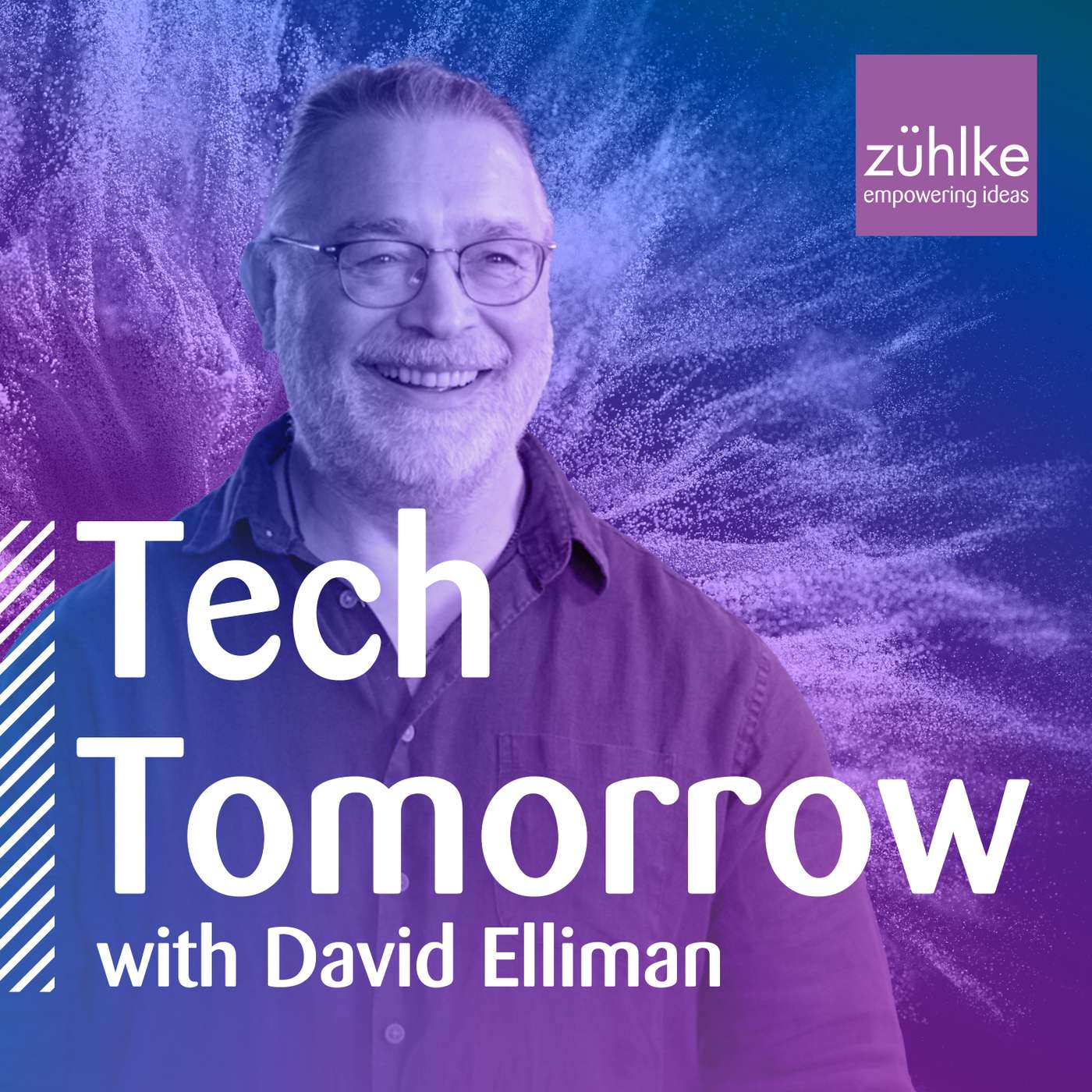
Insights from recent episode analysis
Audience Interest
Podcast Focus
Publishing Consistency
Platform Reach
Insights are generated by CastFox AI using publicly available data, episode content, and proprietary models.
Most discussed topics
Brands & references
Total monthly reach
Estimated from 1 chart position in 1 market.
By chart position
- 🇨🇭CH · Technology#182500 to 3K
- Per-Episode Audience
Est. listeners per new episode within ~30 days
250 to 1.5K🎙 Weekly cadence·26 episodes·Last published 3d ago - Monthly Reach
Unique listeners across all episodes (30 days)
500 to 3K🇨🇭100% - Active Followers
Loyal subscribers who consistently listen
150 to 900
Market Insights
Platform Distribution
Reach across major podcast platforms, updated hourly
Total Followers
—
Total Plays
—
Total Reviews
—
* Data sourced directly from platform APIs and aggregated hourly across all major podcast directories.
On the show
From 13 epsHost
Recent guests
Recent episodes
Are leaders deploying AI faster than they can effectively govern it with Zahra Shah
Jun 23, 2026
23m 05s
Is it possible for tech for good to exist within a for-profit model with Jim Fruchterman
Jun 9, 2026
22m 00s
Is irrational AI making our decision-making worse with Stephanie Antonian
May 26, 2026
22m 01s
What boundaries should define our relationship with agentic AI in large-scale systems with Sam Newman
May 12, 2026
28m 08s
Could AI and data science help us find a cure for Alzheimer’s with Prof. Alejo Nevado-Holgado
Apr 28, 2026
25m 07s
Social Links & Contact
Official channels & resources
Official Website
Login
RSS Feed
Login
| Date | Episode | Topics | Guests | Brands | Places | Keywords | Sponsor | Length | |
|---|---|---|---|---|---|---|---|---|---|
| 6/23/26 | Are leaders deploying AI faster than they can effectively govern it with Zahra Shah | AI adoption is moving so quickly that, for many organisations, governance is struggling to keep pace. So how can leaders begin thinking more strategically about how, when, and even if they use AI?In this episode of Tech Tomorrow, David Elliman speaks with responsible AI expert Zahra Shah about what it takes to adopt AI safely and responsibly, and to deliver real business value.Zahra explains that rapid AI development is making it harder for businesses to keep up with evolving risks, regulations, and operational demands. At the same time, ‘shadow AI’ is on the rise, as employees use generative AI tools without oversight, increasing the risk of exposing sensitive company or customer data.Zahra stresses that successful AI adoption starts with the basics: clear use cases, proper due diligence, and strong governance from the outset. She also recommends starting with a requirements analysis, establishing responsible AI principles such as transparency and explainability, and implementing safeguards against bias, hallucinations, and compliance risks before scaling.Rather than launching sweeping transformation programmes, she encourages businesses to begin with smaller, lower-risk pilots that deliver measurable outcomes. Internal HR policy assistants, for example, can help teams test workflows in a safe environment while also teaching employees not to treat AI like ‘Google 2.0.’Another major theme in this episode, and throughout Season 3, is avoiding vendor lock-in. Zahra recommends using abstraction layers so organisations can switch providers as the market evolves while retaining control over prompts, evaluations, and proprietary data. She argues that accountability should remain with business owners, supported by cross-functional governance groups spanning technical, legal, compliance, and operational teams.Finally, the conversation explores the UK context and how it could build confidence in AI through trust marks, certification, and regional workforce development. Zahra points to Singapore as a strong example of practical, agile AI governance in action.Episode Highlights01:18 – The staggering speed of AI deployment.04:07 – Small pilots are a good policy.06:40 – Data hygiene and AI governance.08:39 – David’s Thoughts: The problem of vendor lock-in.10:03 – Not every company needs a large language model.11:27 – AI ethics and the fear of accountability.14:27 – The global picture of AI regulation.18:07 – David’s Thoughts: Regional employment inequality in the UK.19:02 – The global erosion of trust in AI.20:31 – Are leaders deploying AI faster than they can effectively govern it?About Zühlke:Zühlke is a global transformation partner, with engineering and innovation at its core. We help clients envision and build their businesses for the future – running smarter today while adapting for tomorrow’s markets, customers, and communities.Our multidisciplinary teams specialise in technology strategy and business innovation, digital solutions and applications, and device and systems engineering. We thrive in complex, regulated sectors such as healthcare and finance, connecting strategy, implementation, and operations to help clients build more effective and resilient businesses.Links:Zühlke WebsiteZühlke on LinkedInDavid Elliman on LinkedInZahra Shah on LinkedIn | 23m 05s | ||||||
| 6/9/26 | Is it possible for tech for good to exist within a for-profit model with Jim Fruchterman✨ | tech for goodsocial impact+4 | Jim Fruchterman | Silicon ValleyB Corps+3 | — | tech for goodsocial entrepreneurship+5 | — | 22m 00s | |
| 5/26/26 | Is irrational AI making our decision-making worse with Stephanie Antonian✨ | artificial intelligencedecision-making+4 | Stephanie Antonian | AestoraAI is Irrational | — | artificial intelligencedecision-making+5 | — | 22m 01s | |
| 5/12/26 | What boundaries should define our relationship with agentic AI in large-scale systems with Sam Newman✨ | agentic AIlarge-scale systems+4 | Sam Newman | Zühlke | — | agentic AIboundaries+6 | — | 28m 08s | |
| 4/28/26 | Could AI and data science help us find a cure for Alzheimer’s with Prof. Alejo Nevado-Holgado✨ | Alzheimer's diseasedata science+3 | Alejo Nevado-Holgado | University of OxfordBig Data Institute+1 | — | Alzheimer'sdata science+5 | — | 25m 07s | |
| 4/22/26 | 5 New Episodes Starting April 28th!✨ | emerging techagentic systems+4 | — | Zühlke | — | emerging technologyAI+3 | — | 0m 30s | |
| 12/19/25 | More Tech Tomorrow, Coming 2026!✨ | emerging technologyAI+3 | — | Zühlke | — | Tech TomorrowZühlke+5 | — | 0m 39s | |
| 12/9/25 | Down the rabbit hole: Will our secrets survive the quantum computing leap with Dr. Sarah McCarthy✨ | quantum computingencryption+4 | Dr. Sarah McCarthy | CitiAlice in Wonderland | — | quantum computingencryption+4 | — | 26m 57s | |
| 11/25/25 | Can executives balance AI innovation with societal responsibility with Lord Clement-Jones✨ | AI innovationsocietal responsibility+4 | Lord Clement-Jones | Liberal DemocratHouse of Lords AI Select Committee+2 | — | artificial intelligencepublic trust+5 | — | 27m 26s | |
| 11/11/25 | Will AI and digital twins make animal testing in drug discovery obsolete with Professor Julie Frearson✨ | AI in drug discoverydigital twins+4 | Professor Julie Frearson | Charles River LaboratoriesFDA | — | AIdigital twins+7 | — | 23m 32s | |
Want analysis for the episodes below?Free for Pro Submit a request, we'll have your selected episodes analyzed within an hour. Free, at no cost to you, for Pro users. | |||||||||
| 10/28/25 | Will the next biotech breakthrough be digital before it’s biological with Bibi Ephraim✨ | biotechnologyartificial intelligence+4 | Bibi Ephraim | Genentech | — | biotechAI+5 | — | 27m 44s | |
| 10/14/25 | Is net zero even possible without open data with Gavin Starks✨ | open dataclimate action+4 | Gavin Starks | Icebreaker OnePerseus | UK | open datanet zero+6 | — | 28m 18s | |
| 9/30/25 | Is the global food crisis a problem that only tech can solve with Illtud Dunsford✨ | global food crisiscultivated meat+4 | Illtud Dunsford | Cellular Agriculture LtdUnited Nations | — | food crisiscultivated meat+7 | — | 30m 16s | |
| 9/16/25 | Should we trust AI as a creative collaborator with Professor Anjana Susarla✨ | AI creativitycollaboration+4 | Anjana Susarla | Eli Broad College of BusinessMichigan State University+1 | — | AI-generated contentcreativity+4 | — | 27m 26s | |
| 9/9/25 | Welcome to Tech Tomorrow | Tech Tomorrow is your front-row seat to the conversations redefining the future.Each episode explores a big, thought-provoking question, from how we collaborate with machines to the possibilities intelligent systems could unlock in the future. Created for leaders steering innovation through complexity, the show cuts through the noise, connecting cross-disciplinary trends so you can make confident decisions in a rapidly changing world.Your host, David Elliman, Chief of Software Engineering at Zühlke, draws on four decades of global experience in technology and innovation. An expert in enterprise-scale solutions and emerging technologies, including AI, IoT, blockchain, and cloud computing, David brings clarity and insight to even the most complex topics.Tech Tomorrow, from Zühlke – coming soon, wherever you get your podcasts.About Zühlke:Zühlke is a global transformation partner, with engineering and innovation in our DNA. We're trusted to help clients envision and build their businesses for the future – to run smarter today while adapting for tomorrow’s markets, customers, and communities.Our multidisciplinary teams specialise in tech strategy and business innovation, digital solutions and applications, and device and systems engineering. We excel in complex, regulated spaces, including health and finance, connecting strategy, tech implementation, and operational services to help clients become more effective, resilient businesses.Links:Zühlke WebsiteZühlke on LinkedInDavid Elliman on LinkedIn | 0m 48s | ||||||
| 7/16/24 |  Data and Artificial Neural Networks with Damian Borth | Neural networks are the backbone of many AI and machine learning systems. But how can they be applied to real-world scenarios?Today’s guest is Damian Borth, Professor of Artificial Intelligence & Machine Learning at the University of St. Gallen. He is also the director of the Computer Science Institute at St. Gallen.His work on neural networks has taken him to several subject areas including climate change, financial fraud detection, and text-to-speech. He is also the recipient of a Google Research Scholar Award.We discuss what neural networks are, what they do, and how their application could help us save the world.00:00 - Intro02:02 - Damian’s background03:01 - What is a neural network?09:21 - Neural networks and climate change12:44 - Neural networks and text-to-speech14:56 - Bias in AI training data12:44 - Academia and the real world27:12 - Dan's final thoughtsLINKS:Damian Borth: https://www.linkedin.com/in/damianborth/?originalSubdomain=chDan Klein: https://uk.linkedin.com/in/dplkleinZühlke: https://www.zuehlke.com/enWelcome to Data Today, a podcast from Zühlke.We're living in a world of opportunities. But to fully realise them, we have to reshape the way we innovate.We need to stop siloing data, ring-fencing knowledge and looking at traditional value chains. And that's what this podcast is about. Every two weeks, we’re taking a look at data outside the box to see how amazing individuals from disparate fields and industries are transforming the way they work with data, the challenges they are overcoming, and what we can all learn from them.Zühlke is a global innovation service provider. We envisage ideas and create new business models for our clients by developing services and products based on new technologies – from the initial vision through development to deployment, production and operation. | 28m 08s | ||||||
| 4/17/24 |  Data and Alzheimer’s Testing with Rhoda Au | According to Alzheimer's Disease International, the number of people around the world with the condition will reach 78 million in 2030, and 139 million in 2050. As of 2024, there is no known cure for Alzheimer's, dementia, or similar degenerative brain conditions. So, how are those testing for these diseases using data and technology to help improve health outcomes?Today’s guest is Rhoda Au, Professor of Anatomy & Neurobiology, Neurology, and Epidemiology at Boston University, and Director of Neuropsychology at the Framingham Heart Study. She’s also the Director of Global Cohort Development at the Davos Alzheimer's Collaborative.We discuss Rhoda’s experience of paper-and-pen Alzheimer's testing in the early 90s, her switch to voice capture in 2005, and her thoughts about how medical data should be shared. 00:00 - Intro02:02 - The pen-and-paper days of Altizmer’s testing12:34 - The ethics of voice capture20:20 - Why we need to open up health data to the community26:07 - Dan's final thoughtsLINKS:Rhoda Au: https://www.linkedin.com/in/rhoda-au-1687277/Boston University School of Medicine & Public Health: https://www.bu.edu/sph/Framingham Heart Study: https://www.framinghamheartstudy.org/Alzheimer's Disease International: https://www.alzint.org/Alzheimer's Disease Data Initiative: https://www.alzheimersdata.org/Dan Klein: https://uk.linkedin.com/in/dplkleinZühlke: https://www.zuehlke.com/enWelcome to Data Today, a podcast from Zühlke.We're living in a world of opportunities. But to fully realise them, we have to reshape the way we innovate.We need to stop siloing data, ring-fencing knowledge and looking at traditional value chains. And that's what this podcast is about. Every two weeks, we’re taking a look at data outside the box to see how amazing individuals from disparate fields and industries are transforming the way they work with data, the challenges they are overcoming, and what we can all learn from them.Zühlke is a global innovation service provider. We envisage ideas and create new business models for our clients by developing services and products based on new technologies – from the initial vision through development to deployment, production and operation. | 27m 28s | ||||||
| 4/3/24 |  Data and the Subterranean with the British Geological Survey’s Holger Kessler | We don’t often think about what's going on beneath the surface of our cities and towns. But how could more understanding of this underground world help deliver better public services and tackle environmental impact?Today’s guest is Holger Kessler, a renowned geoscientist who has racked up an astonishing 25 years at the British Geological Survey. In early 2024, he started a new role at AtkinsRéalis but previously worked at the Government Office for Science as the Science Lead of the Future of the Subsurface Foresight Programme.We discuss the siloed nature of data underground, the benefits of digital twins, and why it's so important to use the utilities we have underground. 00:00 - Intro12:24 - Why is subsurface data so siloed?23:05 - Holger’s work in the London subterranean28:15 - Dan's final thoughtsLINKS:Holger Kessler: https://www.linkedin.com/in/holgerkessler/British Geological Survey: https://www.bgs.ac.uk/Dan Klein: https://uk.linkedin.com/in/dplkleinZühlke: https://www.zuehlke.com/enWelcome to Data Today, a podcast from Zühlke.We're living in a world of opportunities. But to fully realise them, we have to reshape the way we innovate.We need to stop siloing data, ring-fencing knowledge and looking at traditional value chains. And that's what this podcast is about. Every two weeks, we’re taking a look at data outside the box to see how amazing individuals from disparate fields and industries are transforming the way they work with data, the challenges they are overcoming, and what we can all learn from them.Zühlke is a global innovation service provider. We envisage ideas and create new business models for our clients by developing services and products based on new technologies – from the initial vision through development to deployment, production, and operation. | 29m 28s | ||||||
| 3/20/24 |  Data and Money for the Community with Peter Forsgren | Public services and higher education facilities are under enormous pressure to keep track of their funds. But what if they were able to utilise some of that money, and put it back into the hands of the communities they serve?Today’s guest is Peter Forsgren, co-founder and COO of three+one, an organisation that assists clients across the United States in identifying opportunities to increase their revenue.Peter has worked in public sector finance for a long time but also serves on his local school board. We discuss Peter’s first role out of college with the Oneida Indian Nation, break down just how much financial data is required to optimise funds and examine a few case studies that show the power of money saved.00:00 - Intro02:30 - Peter’s experience with the Oneida Indian Nation10:53 - What does scalability look like for three+one?18:33 - The plan for national domination27:34 - Dan's final thoughtsLINKS:Peter Forsgren: https://www.linkedin.com/in/peterdforsgren/three+one: https://threeplusone.us/Oneida Indian Nation: https://www.oneidaindiannation.com/Dan Klein: https://uk.linkedin.com/in/dplkleinZühlke: https://www.zuehlke.com/enWelcome to Data Today, a podcast from Zühlke.We're living in a world of opportunities. But to fully realise them, we have to reshape the way we innovate.We need to stop siloing data, ring-fencing knowledge, and looking at traditional value chains. And that's what this podcast is about. Every two weeks, we’re taking a look at data outside the box to see how amazing individuals from disparate fields and industries are transforming the way they work with data, the challenges they are overcoming, and what we can all learn from them.Zühlke is a global innovation service provider. We envisage ideas and create new business models for our clients by developing services and products based on new technologies – from the initial vision through development to deployment, production, and operation. | 28m 10s | ||||||
| 3/6/24 |  Data and the Public Sector with Giuseppe Sollazzo | The UK’s public sector uses vast quantities of data to keep its vital services running. But what's the best way to communicate with the public about these services?Today’s guest is Giuseppe Sollazzo, who currently heads up data products and services at the Department of Work and Pensions. He’s spent his entire career at the heart of the public sector. Giuseppe initially aspired to be an academic, but one failed Ph.D. later, he realised he needed to be more agile in his career trajectory. This led him into the NHS, the Department for Transport, and placed him squarely at the nexus of how we communicate data across society. Giuseppe and his team also pen the famous Quantum of Sollazzo newsletter, which has become a staple in the open data community.We discuss communicating data to citizens, the role of AI in the public sector, and the UK’s digital skills gap.00:00 - Intro02:46 - Legacy systems, public discourse, and information gathering at DWP06:37 - The role of AI in the public sector17:36 - The digital skills gap in the public sector30:10 - Dan's final thoughtsLINKS:Giuseppe Sollazzo: https://www.linkedin.com/in/giuseppesollazzoThe Quantum of Sollazzo: https://puntofisso.net/newsletter/Dan Klein: https://uk.linkedin.com/in/dplkleinZühlke: https://www.zuehlke.com/enWelcome to Data Today, a podcast from Zühlke.We're living in a world of opportunities. But to fully realise them, we have to reshape the way we innovate.We need to stop siloing data, ring-fencing knowledge and looking at traditional value chains. And that's what this podcast is about. Every two weeks, we’re taking a look at data outside the box to see how amazing individuals from disparate fields and industries are transforming the way they work with data, the challenges they are overcoming, and what we can all learn from them.Zühlke is a global innovation service provider. We envisage ideas and create new business models for our clients by developing services and products based on new technologies – from the initial vision through development to deployment, production, and operation. | 22m 03s | ||||||
| 2/21/24 |  Data and Disinformation in Ukraine with Olga Tokariuk | It's been just over two years since Russia's full-scale invasion of Ukraine. How has disinformation played a part in the conflict, and what has been done to help combat it?Today's guest is Olga Tokariuk, a Chatham House Fellow and journalist who specialises in research around disinformation. She has spoken widely about Russia's use of disinformation in the war and what it means for the public's wider trust in the media.We discuss the four ways that technology and AI are being used in Ukraine, how to debunk and tackle disinformation in wartime, and how the public has been galvanised to think critically about the media they're consuming.00:00 - Intro01:54 - The four ways technology and AI are used on the battlefield08:19 - What does disinformation look like in this conflict?16:44 - The global decline of trust in the media21:55 - How did the evolution of the DIA app help galvanise the public in Ukraine?19:18 - Dan's final thoughtsLINKS:Olga Tokariuk: https://www.linkedin.com/in/olga-tokariuk/Chatham House: https://www.chathamhouse.org/Dan Klein: https://uk.linkedin.com/in/dplkleinZühlke: https://www.zuehlke.com/enWelcome to Data Today, a podcast from Zühlke. We're living in a world of opportunities. But to fully realise them, we have to reshape the way we innovate. We need to stop siloing data, ring-fencing knowledge, and looking at traditional value chains. And that's what this podcast is about. Every two weeks, we're taking a look at data outside the box to see how amazing individuals from disparate fields and industries are transforming the way they work with data, the challenges they are overcoming, and what we can all learn from them.Zühlke is a global innovation service provider. We envisage ideas and create new business models for our clients by developing services and products based on new technologies – from the initial vision through development to deployment, production, and operation. | 30m 32s | ||||||
| 2/7/24 |  Data and Digital Archiving with John Sheridan | We can use archives to unlock our past. But how can these vast analogue data sets utilise technology and still retain their value? Today’s guest is John Sheridan, Digital Director at The National Archives. In his role, John looks after all things digital. He shapes the strategy and direction of its numerous digital services including the vast and extensive National Archive website.We discuss the power of being able to easily access archival material, the increasing quality of document digitisation, and why archives are critical to the retention of primary sources.00:00 - Intro01:48 - What are the Archives up to right now?07:31 - Why the Archives are important in a wider cultural context17:35 - How archives save the world23:00 - What challenges does new technology present?26:18 - Dan's final thoughtsLINKSJohn Sheridan: https://www.linkedin.com/in/johnlsheridan/?originalSubdomain=ukThe National Archives: https://www.nationalarchives.gov.uk/Dan Klein: https://uk.linkedin.com/in/dplkleinZühlke: https://www.zuehlke.com/enWelcome to Data Today, a podcast from Zühlke.We're living in a world of opportunities. But to fully realise them, we have to reshape the way we innovate.We need to stop siloing data, ring-fencing knowledge and looking at traditional value chains. And that's what this podcast is about. Every two weeks, we’re taking a look at data outside the box to see how amazing individuals from disparate fields and industries are transforming the way they work with data, the challenges they are overcoming, and what we can all learn from them.Zühlke is a global innovation service provider. We envisage ideas and create new business models for our clients by developing services and products based on new technologies – from the initial vision through development to deployment, production and operation. | 27m 51s | ||||||
| 1/24/24 |  Data and Nuclear Test Monitoring with Megan Slinkard | Nuclear weapons still loom large on the world stage. So why has the number of nuclear tests dropped so dramatically?Today’s guest is Megan Slinkard, Chief of the Software Applications Section in the International Data Centre at the Comprehensive Nuclear-Test-Ban Treaty Organization (CTBTO). Based in Vienna, Megan has worked in nuclear explosion monitoring for more than 10 years and is really at the coal face of the monitoring work that the organisation does.We discuss Megan’s path to nuclear testing, how the CBTO has helped to create a culture where nuclear testing is rare, and how monitoring nuclear tests has helped bolster the CTBT (Comprehensive Nuclear-Test-Ban Treaty).00:00 - Intro02:41 - Megan’s origin story13:05 - What does CTBTO do when they detect an unusual event?23:00 - How monitoring and testing can add robustness to a treaty30:01 - Dan's final thoughtsLINKS:Megan Slinkard: https://www.linkedin.com/in/megan-slinkard-4905b2167/CTBTO: https://www.ctbto.org/Dan Klein: https://uk.linkedin.com/in/dplkleinZühlke: https://www.zuehlke.com/enWelcome to Data Today, a podcast from Zühlke.We're living in a world of opportunities. But to fully realize them, we have to reshape the way we innovate.We need to stop siloing data, ring-fencing knowledge and looking at traditional value chains. And that's what this podcast is about. Every two weeks, we’re taking a look at data outside the box to see how amazing individuals from disparate fields and industries are transforming the way they work with data, the challenges they are overcoming, and what we can all learn from them.Zühlke is a global innovation service provider. We envisage ideas and create new business models for our clients by developing services and products based on new technologies – from the initial vision through development to deployment, production and operation. | 31m 51s | ||||||
| 1/10/24 |  Welcome to a Brand New Series of Data Today | Welcome to a brand new series of Data Today with Dan Klein, a podcast from Zühlke. We're living in a world of opportunities, but to transform opportunity into impact, we have to change the way we innovate. We need to stop siloing data, ring-fencing knowledge, and thinking in traditional value chains. That's what this podcast is about.In Season Two, we're asking the question, how can data help us save the world? We'll be exploring how we can build more equal societies, combat climate change, and improve global health with the right data strategies, practices, and applications.Zühlke is a global innovation service provider. We turn big ideas into working solutions that deliver positive and sustainable value.Find out more at: https://www.zuehlke.com | 2m 01s | ||||||
| 5/24/23 |  Data Transformation with Heather Savory | When moving and transforming data, how do you make sure it retains its accuracy?That's the question that drives today’s guest, Heather Savory. Heather has 30 years of experience in both the public and private sectors. She currently holds Non-Executive Director roles in the UK Parliament and Ministry of Justice and was previously the Director General for Data Capability at the Office of National Statistics (ONS).We discuss connecting siloed data sources, how to communicate the importance of data with the public, and the benefits of sharing data.00:00 - Intro01:52 - How did Heather experience data and information handling in Parliament? 07:13 - Heather’s journey from VLSI chips to government10:59 - There's no digital without the data - what does this mean to Heather?23:57 - Dan's final thoughtsLINKS:Heather Savory: https://www.linkedin.com/in/heather-savory-63055b/?originalSubdomain=ukDan Klein: https://uk.linkedin.com/in/dplkleinZühlke: https://www.zuehlke.com/enWelcome to Data Today, a podcast from Zühlke.We're living in a world of opportunities. But to fully realise them, we have to reshape the way we innovate.We need to stop siloing data, ring-fencing knowledge, and looking at traditional value chains. And that's what this podcast is about. Every two weeks, we’re taking a look at data outside the box to see how amazing individuals from disparate fields and industries are transforming the way they work with data, the challenges they are overcoming, and what we can all learn from them.Zühlke is a global innovation service provider. We envisage ideas and create new business models for our clients by developing services and products based on new technologies – from the initial vision through development to deployment, production, and operation. | 25m 28s | ||||||
Showing 25 of 32
Pitch Fit is a Pro feature
See how bookable this show is for guests, which brands already advertise, the per-episode ad value, and the best-fit guest and sponsor profile. The numbers are blurred on the free plan.
How readily this show books outside guests like you.
How proven this show is for host-read sponsorships.
For Guests
ProFor Advertisers
ProUpgrade to Pro to unlock guest cadence, sponsor categories, fit scores, and per-episode ad value for this show.
Chart Positions
1 placement across 1 market.
Chart Positions
1 placement across 1 market.