
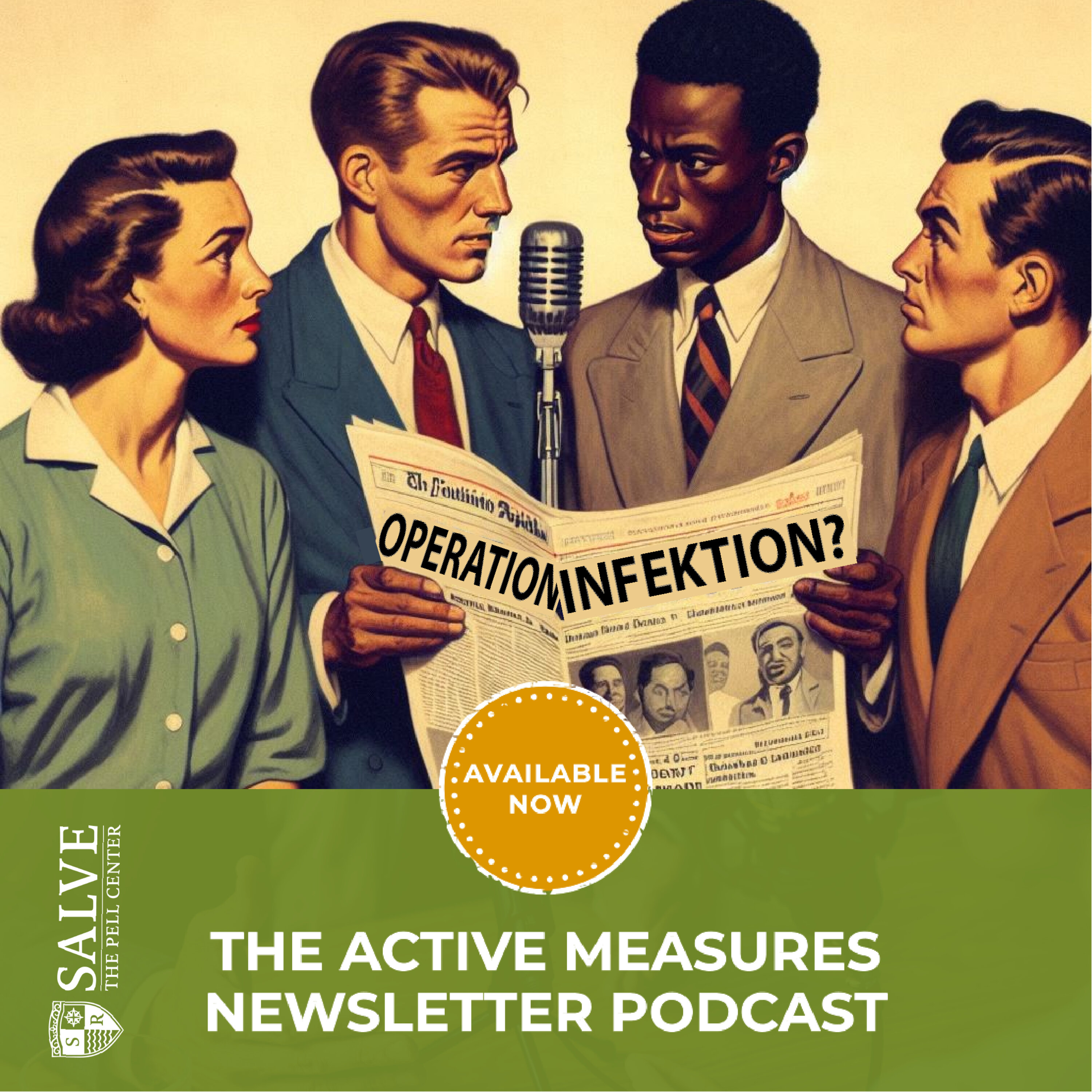
The Active Measures Newsletter Podcast
by The Pell Center at Salve Regina University
Is this your podcast?Insights from recent episode analysis
Audience Interest
Podcast Focus
Publishing Consistency
Platform Reach
Insights are generated by CastFox AI using publicly available data, episode content, and proprietary models.
Total monthly reach
Estimated from 6 chart positions in 6 markets.
By chart position
- 🇨🇦CA · Government#1425K to 30K
- 🇮🇹IT · Government#1551K to 10K
- 🇪🇸ES · Government#1601K to 10K
- 🇨🇿CZ · Government#930K to 100K
- 🇳🇿NZ · Government#116500 to 3K
- Per-Episode Audience
Est. listeners per new episode within ~30 days
11K to 47K🎙 Daily cadence·82 episodes·Last published today - Monthly Reach
Unique listeners across all episodes (30 days)
38K to 156K🇨🇿64%🇨🇦19%🇮🇹6%+3 more - Active Followers
Loyal subscribers who consistently listen
15K to 62K
Market Insights
Platform Distribution
Reach across major podcast platforms, updated hourly
Total Followers
—
Total Plays
—
Total Reviews
—
* Data sourced directly from platform APIs and aggregated hourly across all major podcast directories.
On the show
Recent episodes
Special Edition: Propaganda and the American Revolution
Jul 4, 2026
7m 24s
The Bulgarian Elections with Sopo Gelava
Jun 27, 2026
30m 40s
Active Measures with Sean M. Wiswesser
Jun 20, 2026
30m 38s
Fighting Disinformation and Protecting the Constitution with Katie Kedian
Jun 13, 2026
33m 08s
CISA Dismantled with Former U.S. Representatives Tim Roemer and Reid Ribble
Jun 6, 2026
31m 41s
Social Links & Contact
Official channels & resources
Official Website
Login
RSS Feed
Login
| Date | Episode | Description | Length | ||||||
|---|---|---|---|---|---|---|---|---|---|
| 7/4/26 | Special Edition: Propaganda and the American Revolution | As the United States marks the 250th anniversary of the Declaration of Independence, it's essential to reflect not just on the ideals of freedom and democracy, but also on the powerful role of propaganda during the American Revolution. In this episode, we’ll explore how propaganda shaped public perception, mobilized support, and defined the revolutionary narrative. | 7m 24s | ||||||
| 6/27/26 | The Bulgarian Elections with Sopo Gelava | Disinformation campaigns are a familiar tactic used by the Kremlin. The goal of these campaigns is to weaken European unity. Fake content is often disguised as credible news sources. Strategic patterns in disinformation can be identified over time. The use of bots to spread misinformation is increasing. Leaked documents reveal intentional plans by Russia to shape narratives. Social media plays a crucial role in disseminating false information. Understanding these tactics is essential for countering them. The Bulgarian election serves as a case study for these tactics. Future implications of disinformation strategies are concerning. | 30m 40s | ||||||
| 6/20/26 | Active Measures with Sean M. Wiswesser | Sean Wiswasser, a former CIA officer and national security expert, discusses Russian intelligence operations, active measures, and their global impact. Learn how Russia uses social media, disinformation, and covert tactics to influence democracies worldwide. | 30m 38s | ||||||
| 6/13/26 | Fighting Disinformation and Protecting the Constitution with Katie Kedian | During the Cold War, President Eisenhower used to caution people that in confronting the Soviets, the United States needed to be careful that we didn’t destroy the very thing we sought to preserve. GW Law Visiting Associate Professor Katie Kedian makes a similar point about countering disinformation in American public life today. She emphasizes the need for a nuanced understanding of the legal frameworks surrounding disinformation, the potential role of social media regulation, and the impact of emerging technologies like AI, all set against the core-American desire to maintain First Amendment rights. Hosts Jim Ludes and Mark Jacobson also discuss reporting from France on Chinese efforts to target populations in the West and Africa as well as an Israeli firm offering influence-for-hire. | 33m 08s | ||||||
| 6/6/26 | CISA Dismantled with Former U.S. Representatives Tim Roemer and Reid Ribble | The episode features a discussion with former Congress members Tim Roemer and Reid Ribble, who highlight the dismantling of CISA, the federal agency tasked with defending U. S. infrastructure from cyberattacks. They express concern over the agency's reduced staff and lack of leadership amid increasing threats from Russia, China, and Iran. The conversation delves into the risks to critical infrastructure like the power grid and elections, and the role of foreign influence operations in deepening American political polarization. The guests urge Congress to strengthen CISA and emphasize the importance of bipartisanship in national security. | 31m 41s | ||||||
| 5/23/26 | Honoring the Fallen: A Memorial Day Tribute | Memorial Day 2026: We remember the brave psychological operations personnel who sacrificed their lives for our freedoms. | 6m 49s | ||||||
| 5/16/26 | Tracking Foreign Language Disinformation with Martina Guzmán | Summary In this episode, Martina Guzmán, founder of Verdad, discusses her innovative AI tool that monitors Spanish-language radio for disinformation, revealing how foreign influence campaigns target Latin American communities in the US and impact elections. The conversation explores the mechanics of disinformation, its sources, and the importance of monitoring media to safeguard democracy. | 35m 40s | ||||||
| 5/9/26 | Disinformation, Accountability and Democracy with Alan Jagolinzer | The conversation explores the complexities of disinformation, particularly its intent to harm and the implications of viewing it through a cross-disciplinary lens. The discussion highlights the intersection of speech and corruption, the role of AI in disseminating disinformation, and the specific case of Alberta separatism as a focal point for foreign influence. The speakers emphasize the need to understand how political warfare exploits existing societal fractures to amplify division and distrust. | 32m 33s | ||||||
| 5/2/26 | Storm-1516 and the Hungarian Election with Darren Linvill | Peter Magyar and the Tisza Party’s April parliamentary victory in Hungary drew global attention not only for its political impact, but for what it revealed about contemporary Russian influence operations in the West. In this episode, Darren Linvill of Clemson University’s Media Forensics Hub explains how Russia’s Storm‑1516 network spreads fabricated narratives—ranging from corruption and money laundering to military conscription and anti‑Ukraine claims—using fake news sites and outsourced amplification networks, including commercial marketing accounts linked to Africa. Although Hungary’s election outcome ultimately didn’t favor Moscow, Storm‑1516’s low‑cost, high‑engagement tactics continue to pose a serious and persistent threat to democratic societies. Hosts Jim Ludes and Mark Jacobson also examine possible Iranian hybrid‑warfare activities in Europe and Japan’s efforts to counter Chinese disinformation. | 28m 16s | ||||||
| 4/25/26 | Iranian Influence Campaigns with "Jane" from Graphika | An intelligence analyst from Graphika explains how Iran’s digital influence campaigns—spanning propaganda, hacktivism, and AI-generated content—have shaped recent conflicts and will persist beyond them. Hosts Jim Ludes and Mark Jacobson also examine Russian active measures, a Germany–Russia diplomatic clash, and key takeaways from Hungary’s 2026 elections. | 27m 54s | ||||||
Want analysis for the episodes below?Free for Pro Submit a request, we'll have your selected episodes analyzed within an hour. Free, at no cost to you, for Pro users. | |||||||||
| 4/18/26 | Iran's Lego War with David Gilbert | Iran is winning the meme war. It may seem like a silly metric, but it cuts to the quick of the nature of conflict. Iranian use of AI generated Lego-movies has shown the power and potential for new technology to reshape the modern battlefield—especially where it matters, in the minds of audiences around the world. David Gilbert from WIRED joins us after having spoken directly with the creators of the pro-Iranian content that has gone viral with its mix of Lego-styled animations and catchy rap lyrics. Hosts Jim Ludes and Mark Jacobson also discuss a Russian campaign targeting Estonia and Russian media penetration in the global south. | 29m 43s | ||||||
| 4/11/26 | Russia, Telegram, and Indications of Growing Disconent with Anna Varfolomeeva | Telegram, the Russian-built social media platform, played a critical role in the Kremlin’s ability to make its case about the war in Ukraine. But Anna Varfolomeeva of the Cognitive Security Institute notes changes in the relationship between the Kremlin and Telegram—changes that may be motivated by concerns over Telegram’s potential to be used as a tool of mass mobilization inside Russia during a period of economic, political, and military challenges for Moscow. Hosts Jim Ludes and Mark Jacobson also review the latest from the war in Iran and the winnowing of American soft power. | 36m 18s | ||||||
| 4/4/26 | AI-Generated Personas in Politics with Effie Webb | "His" name is Danny Bones. He's a far-right, AI-generated persona who raps about England, tradition, and the assault on what he values by immigrants, the deep state, and journalists. among others. Effie Webb broke the story for the Bureau of Investigative Journalism about how the anonymous collective behind Danny Bones was hired by a new, far-right British political party and employed their content in a recent by-election. In addition, hosts Jim Ludes and Mark Jacobson break down the Trump administration's recent directive to U.S. embassies to get into the information fight as well as reporting from Hungary about the role disinformation is playing in that country's up-coming election. | 30m 29s | ||||||
| 3/28/26 | From HIV to COVID-19: Russian Exploitation of Public Health Crises | That last generation of Cold War kids probably heard it in high school: HIV, the virus that causes AIDS, it was said, was created by the U.S. government. Some would go further, claiming it was done to target blacks or members of the LGBTQ community. We know, now, the claim was the fruit of a massively successful hoax by Soviet intelligence that turned a rumor into a scientific controversy. Hosts Mark Jacobson and Jim Ludes trace the history of "Operation Denver," as it was called, and the continuing use of public health crises by Russian intelligence to exploit divisions in American society. | 33m 00s | ||||||
| 3/21/26 | "Well, Actually. . . ." News Verification with the AP's Melissa Goldin | Malinformation is a feature of modern life we all deal with, whether it’s a claim by an American politician, something we confront on social media, or a covert campaign waged by a foreign government. Fortunately, there are tools we can all use and resources we can all access to check facts and help us all in our search for ground truth. Melissa Goldin is a news verification reporter for the Associate Press. She joins us this week to talk about the work she does, the methodology she employs, and a bit about the disinformation coming out of the Iran War. Hosts Jim Ludes and Mark Jacobson also review the DNI’s failure to include foreign election interference in her annual threat assessment to Congress and reporting from The Financial Times on AI-generated disinformation in both war and financial systems. | 30m 06s | ||||||
| 3/14/26 | "Freedom is Coming" with Reuters' Simon Lewis and Humeyra Pamuk | The U.S. State Department has plans for an online portal designed to bypass European social media content bans. With a tagline “Freedom is Coming,” the plan plainly pits the U.S. government in opposition to European laws. Simon Lewis and Humeyra Pamuk of Reuters broke this story in February and in this episode of the podcast trace the as-yet-to-be-launched website to a three part-ambition: promoting free speech; boosting far-right political parties in Europe; and protecting American social media companies from European regulation. Hosts Jim Ludes and Mark Jacobson also discuss Iran’s on-going information offensive and the relatively small number of influencers needed to drive content on social media. | 35m 15s | ||||||
| 3/7/26 | Disinformation and the War with Iran with Sofia Rubinson and Isis Blachez | Truth is the first casualty of war, and the sheer volume of digital disinformation coming out of the war with Iran only proves the point. NewsGuard’s Sofia Rubinson and Isis Blachez review the phony images and videos claiming Iranian battlefield successes not borne out by the evidence. In addition, hosts Jim Ludes and Mark Jacobson discuss other reporting on emerging themes in Spanish language disinformation ahead of the U.S. midterm elections before turning their attention to the power of humor, among other things, to counter disinformation. | 31m 12s | ||||||
| 2/28/26 | Special Edition: Benjamin Franklin and the Dawn of American Covert Influence Operations | As we approach the 250th anniversary of the American Revolution, we examine Benjamin Franklin’s 1782 disinformation operation during the peace negotiations with Britain. As American diplomats sought formal recognition of independence following Yorktown, Franklin produced a fabricated supplement to the Boston Independent Chronicle, printed in France but designed to appear authentic, alleging British officials had encouraged atrocities by their Native American allies. The forged document aimed to inflame British public opinion and exploit existing parliamentary criticism of the war’s conduct, thereby indirectly strengthening the American negotiating position in Paris. Though there is no direct evidence the forgery altered votes or treaty terms, the episode reveals Franklin’s strategic use of media manipulation and covert influence, with clear parallels to more modern active measures. | 6m 05s | ||||||
| 2/21/26 | The Noise War with J.J. Green | “Flood the zone.” That’s the strategy advice of domestic political operatives and hostile foreign intelligence services. Veteran national security journalist J.J. Green stands in the midst of the ensuing storm with a new handbook, The Noise War, to help reporters, citizens, educators, and students spot disinformation, manage their information diet, and remain engaged in the life of the republic. Hosts Jim Ludes and Mark Jacobson also highlight new reporting on a U.S. government plan to exert influence in European politics by platforming speech and content currently banned on the continent. | 38m 48s | ||||||
| 2/14/26 | The New Era of Digital Repression with Steven Feldstein & Shreya Joshi | As anti-government protests in Iran ratcheted-up last month, the Iranian government cracked-down harshly, using physical violence against their own people and shutting down the internet in the country. Steven Feldstein and Shreya Joshi of the Carnegie Endowment for International Peace put Iran’s actions in a broader global context of digital-repression where regimes fight the population by controlling the flow of information. Hosts Jim Ludes and Mark Jacobson also discuss the Trump administration’s overt efforts to shape political debate in Europe before turning their attention to the deployment of StarLink terminals to Iran. | 35m 18s | ||||||
| 2/7/26 | Inauthentic 'Fan Pages' with Shawn Eib and Eric Nelson | Somebody is growing a network of pages across social media targeting professional sports franchises in the United States and the star athletes they employ with rage bait, spam, and AI slop that undermines the multi-billion dollar sports industry. This week, hosts Jim Ludes and Mark Jacobson discuss the operation of these networks with Shawn Eib and Eric Nelson of Alethia, the private firm whose research identified their presence. Also on the docket: informal information networks in Venezuela and one Russia-linked network’s exploitation of the content of the Epstein files. | 35m 00s | ||||||
| 1/31/26 | Migrant Warfare with Karen-Anna Eggen & Jyri Lavikainen | Before it became a Europe-wide phenomenon, Russia's use of migration as a weapon was a test-case stressing the borders between Russia and its two arctic neighbors: Norway and Finland. On this week's episode of the podcast, Karen-Anna Eggen (Norwegian Institute for Defense Studies) and Jyri Lavikainen (Finnish Institute for International Affairs) share their research detailing Russia's efforts to weaponize human migration. Hosts Jim Ludes and Mark Jacobson also review new reporting on the potential for agentic AI to disrupt defense planning and democracy, itself. | 34m 08s | ||||||
| 1/24/26 | Special Edition: Russia's Support for American Separatism | "Russia is our friend?" It was a strange refrain for tiki-torch wielding protesters in 2017, but it exposed the reality that for some American white-nationalists, Russian leader Vladimir Putin is a role model as the last defender of white Christendom. In this special edition of the podcast, host Jim Ludes reviews the American separatism Russia encouraged in 2016, the Putin regime's ties to American extremists, and its political, ideological, and geo-strategic goal: eviscerating American power. | 12m 00s | ||||||
| 1/17/26 | Protecting America's Elections with RI Secretary of State Gregg Amore | Rhode Island Secretary of State Gregg Amore discusses the threat of foreign malign influence to American elections, Trump administration cuts to federal programs to support local election officials, and the enduring value of civics education and critical thinking in an era of ubiquitous disinformation. Hosts Jim Ludes and Mark Jacobson also highlight continued, bipartisan Congressional support for U.S. international broadcasting and the real-time case study of what happens when the United States lacks an international information apparatus amidst political disturbances in a country like Iran. | 30m 30s | ||||||
| 1/10/26 | Alliance Strategic Communications with Janis Sarts | On the first episode of the new year, Janis Sarts, Director of the NATO Strategic Communications Center of Excellence discusses the current information challenges facing the North Atlantic alliance, Russia's current use of these tools, and the transition from an ecosystem dominated by social media platforms to one dominated by artificial intelligence. Hosts Jim Ludes and Mark Jacobson also highlight disinformation spilling out of the U.S. strike in Venezuela and the actions of the Trump administration to sanction EU counter-disinformation officials and researchers. | 34m 36s | ||||||
Showing 25 of 92
Pitch Fit is a Pro feature
See how bookable this show is for guests, which brands already advertise, the per-episode ad value, and the best-fit guest and sponsor profile. The numbers are blurred on the free plan.
How readily this show books outside guests like you.
How proven this show is for host-read sponsorships.
For Guests
ProFor Advertisers
ProUpgrade to Pro to unlock guest cadence, sponsor categories, fit scores, and per-episode ad value for this show.
Chart Positions
6 placements across 6 markets.
Chart Positions
6 placements across 6 markets.