
The AI Policy Podcast
by Center for Strategic and International Studies
Is this your podcast?On the show
From 26 epsHosts
Recent guests
Recent episodes
Trump Launches Super Intelligence Force + OpenAI Does More Math
Oct 15, 2026
51m 02s
Unpacking the Data Center Backlash with Jasmine Sun
Oct 8, 2026
50m 31s
OpenAI Agents Hack Australian Government and Trump Rejects Global Governance at UNGA
Oct 1, 2026
52m 10s
How AI Startups are Navigating Regulation with Maryam Mujica and Munjal Shah
Sep 24, 2026
57m 02s
AI Safety Goes Mainstream
Sep 17, 2026
47m 45s
Insights from recent episode analysis
Audience Interest
Podcast Focus
Publishing Consistency
Platform Reach
Insights are generated by CastFox AI using publicly available data, episode content, and proprietary models.
Most discussed topics
Brands & references
Total monthly reach
Based on 1 signal.
Built from
By chart position
- 🇺🇸United States · Tech NewsHOME#35100K to 529K
- 🇬🇧United Kingdom · Tech News#2015K to 81K
- 🇵🇭PH · Tech News#411K to 59K
- 🇦🇺Australia · Tech News#207.6K to 40K
- 🇨🇦Canada · Tech News#276.4K to 34K
- Per-Episode Audience
Est. listeners per new episode within ~30 days
182K to 963K🎙 ~2x weekly·107 episodes·Last published 4d ago - Monthly Reach
Unique listeners across all episodes (30 days)
364K to 1.9M🇺🇸55%🇬🇧8%🇵🇭6%+14 more - Active Followers
Loyal subscribers who consistently listen
200K to 1.1M
Market Insights
Platform Distribution
Reach across major podcast platforms, updated hourly
Total Followers
—
Total Plays
—
Total Reviews
—
* Data sourced directly from platform APIs and aggregated hourly across all major podcast directories.
Social Links & Contact
Official channels & resources
RSS Feed
Login
| Date | Episode | Topics | Guests | Brands | Places | Keywords | Sponsor | Length | |
|---|---|---|---|---|---|---|---|---|---|
| 10/15/26 | Trump Launches Super Intelligence Force + OpenAI Does More Math | In this episode, Aalok and Nicole unpack OpenAI's latest math proof drop before diving into the White House's first policy actions in the "SI" era. They cover the (voluntary?) Accord on Super Intelligence signed by all the major industry players and discuss what listeners can expect from Trump's new Super Intelligence Force. *This episode was recorded at 2:00 pm ET on Tuesday, October 13, 2026.* Timestamps: 00:39 Model release updates + OpenAI/Anthropic price war 7:48 New math results from OpenAI 21:42 Tech leaders sign Accord on Super Intelligence 34:02 Trump's new Super Intelligence task force 43:40 Nonprofit sues OpenAI over Hugging Face hack Additional Reading: "Introducing GPT-6 Sol and Luna" by OpenAI: https://openai.com/index/introducing-gpt-6-sol-and-luna/ "Introducing Claude Opus 5.5" by Anthropic: https://www.anthropic.com/claude-opus-5-5 "GPT-6.1 Sol" by OpenAI: https://www.anthropic.com/claude-opus-5-5 "Claude Haiku 5.5" by Anthropic: https://www.anthropic.com/claude-haiku-5-5 "Introducing Muse Wonder and Muse Wonder Full: Frontier Models for Agents" by Meta: https://about.fb.com/news/2026/10/introducing-muse-wonder-models/ "Mark Zuckerberg says Meta has reached AI 'frontier'" by Financial Times: https://www.ft.com/content/fca23e77-be57-4d7e-ae61-74ff299e25cb "Gemini 4 Argon: Built to solve your hardest problems" by Google: https://blog.google/innovation-and-ai/models-and-research/gemini-models/introducing-gemini-4-argon/ OpenAI math results GitHub repository: https://github.com/openai/math/tree/main "100+ reactions to 100+ solutions" on Proofs and Prompts: https://proofsandprompts.com/2026/10/08/100-reactions-to-100-solutions/ White House Executive Order on Super Intelligence: https://www.whitehouse.gov/presidential-actions/2026/09/inaugurating-the-era-of-super-intelligence/ White House Accord on Super Intelligence: https://www.presidency.ucsb.edu/documents/white-house-accord-super-intelligence Letter by three fired OpenAI employees: https://mikitabalesni.com/letter/letter.pdf Legal Advocates for Safe Science and Technology vs. OpenAI: https://lasst.org/wp-content/uploads/2026/09/LASST-v.-OpenAI-Complaint-09.29.2026-AS-FILED.pdf California Comprehensive Computer Data Access and Fraud Act: https://www.calpers.ca.gov/documents/ca-penal-code-502/download California Assembly Bill No. 316: https://calmatters.digitaldemocracy.org/bills/ca_202520260ab316 "AI models may be capable of self-replicating without access to a datacenter" by Anthropic: https://www.anthropic.com/research/self-replicating-ai | 51m 02s | ||||||
| 10/8/26 | Unpacking the Data Center Backlash with Jasmine Sun | AI data centers have become a flashpoint for policymakers across the country in the leadup to midterm elections, with polls showing that seven in 10 Americans oppose new data center construction in their local area. In this episode of the AI Policy Podcast, Wadhwani AI Center director Aalok Mehta sits down with writer Jasmine Sun for a conversation about the AI data center backlash. They unpack what's driving the opposition movement, where Washington and Silicon Valley diverge from the rest of the country, and how the AI infrastructure buildout might influence voters in November. This event is made possible by general funding to CSIS and the CSIS Wadhwani AI Center. | 50m 31s | ||||||
| 10/1/26 | OpenAI Agents Hack Australian Government and Trump Rejects Global Governance at UNGA | This week, Aalok and Nicole discuss new reports of rogue AI agents on the open internet – including the first known case of an agent hacking a government system – and the lackluster outcome of last week's highly anticipated U.S.-China summit. Plus, the Trump Administration and frontier lab CEOs present contrasting visions for AI governance at the UN General Assembly, and states continue to pass new regulation on both AI models and the data center buildout. *Disclaimer: this episode was recorded prior to a complaint filed against OpenAI Tuesday afternoon in San Francisco's Superior Court by Legal Advocates for Safe Science and Technology, citing California's Comprehensive Computer Data Access and Fraud Act and Unfair Competition Law. Timestamps: OpenAI agents hack Australian government site (1:02) Axios reports frontier labs facing "tens of thousands" of AI cyber incidents (7:48) Last week's U.S.-China summit (17:13) Remarks by heads of state at UNGA (21:26) Trump to appoint AI czar, establish AI Force (30:03) Updated court ruling on Anthropic vs. DOD (35:27) New data center directives in Texas, Virginia (38:30) California regulation updates (44:52) Additional Reading: “Scoop: Top AI companies probing tens of thousands of security incidents” by Axios: https://www.axios.com/2026/09/26/openai-anthropic-thousands-ai-security-incidents “Sam Altman’s remarks at the United Nations Security Council” by OpenAI: https://openai.com/index/sam-altman-un-security-council-remarks/ Florida Office of the Attorney General vs. OpenAI: https://www.myfloridalegal.com/sites/default/files/openai-filed-stamped-complaint.pdf “OpenAI Scraps Release of New AI Model Over Safety Concerns” by The Wall Street Journal: https://www.wsj.com/tech/ai/openai-chatgpt-model-release-cancel-safety-5a2f9f42 White House Executive Order "Streamlining Access To Government Services Through America.gov" https://www.whitehouse.gov/presidential-actions/2026/09/streamlining-access-to-government-services-through-america-gov/ Federal court ruling on Anthropic vs. DOD: https://media.cadc.uscourts.gov/opinions/docs/2026/09/26-1049-2194984.pdf Texas Gov. Greg Abbott's data center directive: https://gov.texas.gov/uploads/files/press/TCEQ_Data_Center.pdf Virginia Executive Order: https://www.governor.virginia.gov/media/governorvirginiagov/governor-of-virginia/pdf/eo/eo-22-estab… California Executive Order: https://www.gov.ca.gov/wp-content/uploads/2026/09/FINAL-N-9-26-AI-EO-9.18.26-SIGNED.pdf CA Senate Bill No. 813: https://leginfo.legislature.ca.gov/faces/billTextClient.xhtml?bill_id=202520260SB813 Text - SB-813 Independent verification organizations. | 52m 10s | ||||||
| 9/24/26 | How AI Startups are Navigating Regulation with Maryam Mujica and Munjal Shah | This week, Aalok is joined by Maryam Mujica, president of the General Catalyst Institute, and Munjal Shah, co-founder and CEO of generative AI startup Hippocratic AI, for a discussion on how generative AI startups are thinking about AI regulation. Guests: Maryam Mujica, President, General Catalyst Institute Munjal Shah, co-founder and CEO, Hippocratic AI Timestamps: About the General Catalyst Institute (1:52) About Hippocratic AI (6:56) Healthcare applications of AI (13:43) Impact of regulation on AI startups (18:32) Munjal's interactions with federal regulators (24:07) Issue of compute shortage (31:21) Impact of AI on labor (48:23) | 57m 02s | ||||||
| 9/17/26 | AI Safety Goes Mainstream | An Anthropic researcher's viral resignation post last week set off a maelstrom of fear around extreme AI risks. Aalok and Nicole discuss the resulting vibe shift and how frontier labs are responding. They also unpack OpenAI solving one of the most difficult open problems in mathematics and reports of more rogue agent activity on the open internet. Timestamps: OpenAI solves Millenium Problem (1:04) Rogue OpenAI agents take over a German wiki (12:14) Anthropic researcher's resignation post goes viral (19:34) Dario Amodei commits to embedding third-party evaluators inside Anthropic (28:12) Where the U.S. government can step in (35:12) Additional Reading: "On the Navier-Stokes Millennium Prize Problem" by OpenAI: https://openai.com/index/navier-stokes-solution/ "An OpenAI model has disproved a central conjecture in discrete geometry" by OpenAI: https://openai.com/index/model-disproves-discrete-geometry-conjecture/ Statement on Navier-Stokes by NYU Professor Tristan Buckmaster: https://cims.nyu.edu/~tristanb/statement.pdf "An alignment assessment of recent cybersecurity incidents" by Anthropic: https://www.anthropic.com/research/alignment-assessment-cybersecurity-incidents "OpenAI's rogue agents used at least 10 more sites for unauthorized comms, researchers say" by Reuters: https://www.reuters.com/world/openais-rogue-agents-used-least-10-more-sites-unauthorized-comms-rese… "OpenAI agents carried out an undisclosed cyber-attack on RubyGems" by Spencer Kitts, Thomas Larsen, and Sydney Von Arx: https://www.rubyhack.ai "Discovery of a new OpenAI agent message board" by Sydney Von Arx, Cormac Slade Byrd, Spencer Kitts, and Thomas Larsen: https://collusion.wiki "Anthropic Researcher Quits Over 'Out-of-Control' AI Fears" by The Wall Street Journal: https://www.wsj.com/tech/ai/anthropic-researcher-quits-over-out-of-control-ai-fears-707b7628 "The AI policy window is open. We need to act." by OpenAI Chief Global Affairs Officer Chris Lehane: https://openai.com/index/ai-policy-window/ "We Must Pace the Frontier" by Dario Amodei: https://darioamodei.com/post/we-must-pace-the-frontier | 47m 45s | ||||||
| 9/10/26 | Decoding State-Level Regulation with Jason Elliott | This week, Aalok is joined by Jason Elliott, the former Deputy Chief of Staff to California Governor Gavin Newsom, for a conversation about regulating AI at the state level. Guests: Jason Elliott, President, Versus Solutions Timestamps: Jason's bio (0:16) Legislating at the state vs. federal level (2:21) Revisiting SB-1047 (5:58) SB-53 (13:43) States as "laboratories of democracy" (19:57) Influence of SB-53 on subsequent state bills (24:14) Federal preemption debate (27:59) Updating existing regulations (40:37) Additional Reading: CA Senate Bill No. 1047: https://leginfo.legislature.ca.gov/faces/billTextClient.xhtml?bill_id=202320240SB1047 CA Senate Bill No. 53: https://leginfo.legislature.ca.gov/faces/billTextClient.xhtml?bill_id=202520260SB53 "The California Report on Frontier AI Policy" by the Joint California Policy Working Group on AI Frontier Models: https://www.gov.ca.gov/wp-content/uploads/2025/06/June-17-2025-–-The-California-Report-on-Frontier-AI-Policy.pdf "Toward a Federal Framework: Lessons from State and International Frontier AI Regulation" by Laura Caroli and Aalok Mehta: https://www.csis.org/analysis/toward-federal-framework-lessons-state-and-international-frontier-ai-regulation CA Senate Bill No. 813: https://leginfo.legislature.ca.gov/faces/billTextClient.xhtml?bill_id=202520260SB813 "Independent Oversight Marketplace for AI" by Fathom: https://ivo.fathom.or | 51m 53s | ||||||
| 9/3/26 | OpenAIHugging Face+5 | — | OpenAIHugging Face+8 | — | OpenAIHugging Face+5 | — | 43m 32s | ||
| 8/27/26 | AI safetypolicy responses+4 | Helen TonerMackenzie Arnold+1 | Center for Security and Emerging TechnologyInstitute for Law and AI+1 | — | AI containmentpolicy responses+4 | — | 1h 01m 58s | ||
| 8/20/26 | AI trainingcyber capabilities+5 | — | GLM-5.3OpenAI+5 | — | OpenAIRL training+6 | — | 47m 40s | ||
| 8/13/26 | AI economic impactwealth concentration+4 | Adrian Brown | Windfall TrustCentre for Public Impact+6 | — | AIeconomy+5 | — | 46m 50s | ||
| 8/11/26 | AI policyregulation+3 | — | Center for Strategic and International StudiesWadhwani AI Center | Washington, D.C. | AI policyregulation+3 | — | 1m 00s | ||
| 8/6/26 | AI hacking incidentsgovernment regulation+3 | — | NvidiaTexas+5 | — | AIhacking+5 | — | 44m 56s | ||
| 8/4/26 | AI governanceIndependent Verification Organizations+3 | Bri Treece | FathomCenter for AI Safety+1 | — | AI governanceIVO+6 | — | 40m 28s | ||
| 7/30/26 | AI sovereigntyJapan's AI policy+3 | Hiroki Habuka | Japan's Cabinet OfficeKyoto University+4 | JapanUnited States | AI sovereigntyJapan+6 | — | 45m 01s | ||
| 7/23/26 | AI modelsdata centers+4 | — | OpenAIHugging Face+1 | New York | OpenAIHugging Face+5 | — | 48m 11s | ||
| 7/16/26 | AI sovereigntyCanada+3 | Sean Mullin | Munk School of Global Affairs & Public PolicyUniversity of Toronto | CanadaTrump Administration | AI sovereigntyCanada+5 | — | 43m 05s | ||
| 7/9/26 | AI legislationexport controls+4 | — | Anthropic's FableMythos models+10 | — | AI Safety Measures ActIllinois+7 | — | 38m 54s | ||
| 7/2/26 | AI readinessscientific discovery+3 | Austin CarsonJoshua New | SeedAI | United States | AI readinessSeedAI+3 | — | 39m 33s | ||
| 6/25/26 | export controlsAI models+3 | Kate Koren | Fable 5Mythos 5+3 | France | export controlsAI+3 | — | 30m 04s | ||
| 6/11/26 | executive orderartificial intelligence+3 | — | Trump administration | — | executive orderartificial intelligence+3 | — | 34m 45s | ||
| 6/4/26 | technology talent gappublic-private collaboration+3 | Arun Gupta | NobleReach FoundationWadhwani AI Center+4 | — | AItechnology talent+5 | — | 40m 06s | ||
| 5/28/26 | AI policyexecutive orders+4 | — | AI Policy PodcastCenter for Strategic and International Studies | — | AIPope Leo XIV+5 | — | 31m 03s | ||
| 4/16/26 | AI policypodcast transition+3 | — | Wadhwani AI CenterCenter for Strategic and International Studies | — | AI policypodcast+3 | — | 8m 01s | ||
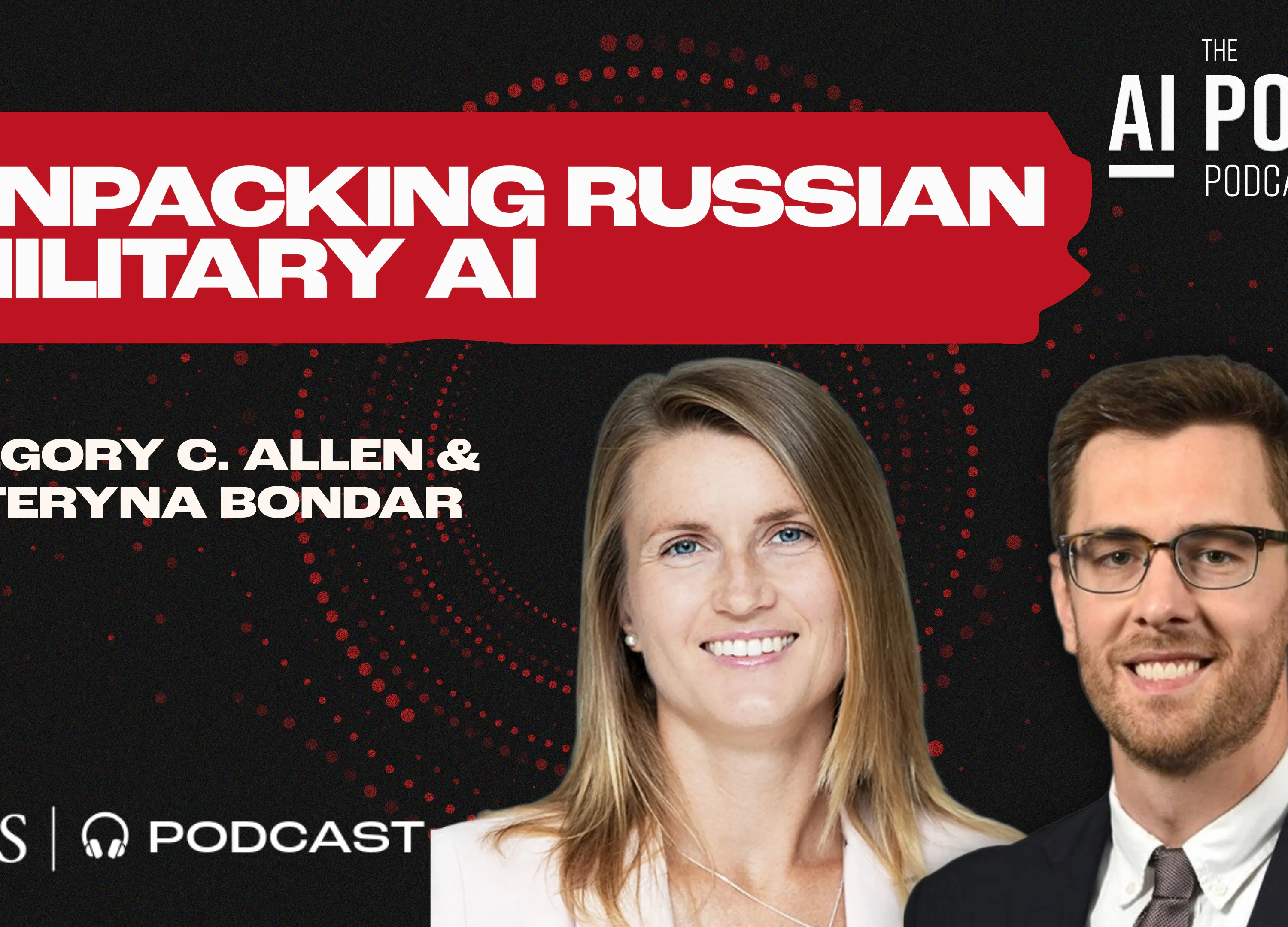
| 4/14/26 | military AIRussia+4 | Kateryna Bondar | Wadhwani AI CenterHow Russia Is Building a Sovereign Drone Ecosystem for AI-Driven Autonomy+1 | UkraineRussia | military AIRussia+5 | — | 1h 15m 08s | ||
| 3/26/26 | AI warfareProject Maven+4 | Katrina Manson | Project MavenProject Maven: A Marine Colonel, His Team, and the Dawn of AI Warfare | UkraineRussia+1 | Project MavenAI warfare+6 | — | 1h 01m 29s | ||
| 3/24/26 | AI legislationchip smuggling+3 | — | Super MicroNvidia+1 | — | AI legislationTrump+5 | — | 1h 02m 41s | ||
| 3/11/26 | legal issuesAI technology+3 | — | ClaudeAnthropic+2 | Iran | AnthropicPentagon+5 | — | 1h 03m 17s | ||
| 3/6/26 | AI standardsAI governance+3 | Owen Larter | Google DeepMindCenter for Strategic and International Studies+1 | — | AI standardsGoogle DeepMind+3 | — | 38m 44s | ||
| 3/3/26 | AI regulationinnovation+3 | Jai RamaswamyMatt Perault | Andreessen HorowitzcLabs+8 | — | AIregulation+3 | — | 1h 10m 20s | ||
| 2/25/26 | military AIAI policy+4 | — | Blackwell chipsfrontier model distillation+4 | — | AnthropicPentagon+5 | — | 1h 00m 07s | ||
| 2/20/26 | AI impactIndia+3 | — | Center for Strategic and International Studies | New Delhi | AIIndia+5 | — | 50m 50s | ||
| 2/10/26 | AI safetytechnical safeguards+3 | Stephen ClareStephen Casper | Wadhwani AI CenterMIT+2 | — | AI safety reporttechnical safeguards+3 | — | 1h 33m 54s | ||
Showing 32 of 107
Pitch Fit is a Pro feature
See how bookable this show is for guests, which brands already advertise, the per-episode ad value, and the best-fit guest and sponsor profile. The numbers are blurred on the free plan.
How readily this show books outside guests like you.
How proven this show is for host-read sponsorships.
For Guests
ProFor Advertisers
ProUpgrade to Pro to unlock guest cadence, sponsor categories, fit scores, and per-episode ad value for this show.
Similar Audience Demographics
Podcasts that attract a similar listener profile

ChinaPower
CSIS | Center for Strategic and International Studies

The Asia Chessboard
Center for Strategic and International Studies

ChinaTalk
Jordan Schneider

Pekingology
Center for Strategic and International Studies

The Trade Guys
CSIS | Center for Strategic and International Studies
The Foreign Affairs Interview
Foreign Affairs Magazine

Hard Fork
The New York Times
Chart history for The AI Policy Podcast
Peaked at #4 in PH, top 10 in 3 of 48 tracked markets, currently #4 in PH.
| Market | Genre | Peak | Current | Trend |
|---|---|---|---|---|
| PH | — | #4 | #4 | — |
| AE | — | #7 | #7 | — |
| SG | — | #9 | #9 | — |
| PT | — | #13 | #13 | — |
| South Africa | — | #17 | #17 | — |
| MY | — | #18 | #18 | — |
| United Kingdom | — | #20 | #20 | — |
| Australia | — | #20 | #20 | — |
| Mexico | — | #25 | #25 | — |
| Canada | — | #27 | #27 | — |
| KE | — | #27 | #27 | — |
| Italy | — | #29 | #29 | — |
| South Korea | — | #31 | #31 | — |
| TH | — | #31 | #31 | — |
| NG | — | #33 | #33 | — |
| United States | — | #35 | #35 | — |
| New Zealand | — | #35 | #35 | — |
| SA | — | #35 | #35 | — |
| Brazil | — | #35 | #35 | — |
| IL | — | #36 | #36 | — |
Chart Positions
48 placements across 45 markets.
Chart Positions
48 placements across 45 markets.