
The AI XR Podcast.
Get the inside story on the biggest tech developments from founders, former executives, and industry veterans who built companies like OpenAI, Google DeepMind, Meta Reality Labs, Apple Vision Pro, Microsoft HoloLens, and...
Insights from recent episode analysis
On the show
- Ted Schilowitz2 eps
- Rony Abovitz2 eps
- Joshua Pantony2 eps
Also: Jonathan Rodriguez Cefalu, Ori Inbar, Malia Probst, Alan Lasky, Ian Hamilton, Lucas Rizzotto, Shelley Palmer, Cathy Hackl, Dr. Salman Avestimehr, Dr. Aiden He, Rob Minkoff, Vicki Dobbs Beck, Kristi Woolsey, Alvin Wang Graylin, Akash Nigam, Caspar Thykier, Connell Gauld
Audience Interest
- AI technology advancements
- spatial computing developments
Podcast Focus
- interviews with tech industry leaders
- analysis of tech news
Publishing Consistency
- weekly or more episodes
- active for five years
Insights are generated by CastFox AI using publicly available data, episode content, and proprietary models.
Most discussed topics
Brands & references
Total monthly reach
Based on 1 signal.
Built from
By chart position
- 🇺🇸United States · TechnologyHOME#4083K to 439K
- Per-Episode Audience
Est. listeners per new episode within ~30 days
83K to 439K🎙 Daily cadence·309 episodes·Last published 1w ago - Monthly Reach
Unique listeners across all episodes (30 days)
277K to 1.5M🇺🇸100% - Active Followers
Loyal subscribers who consistently listen
152K to 805K
Market Insights
Platform Distribution
Reach across major podcast platforms, updated hourly
Total Followers
—
Total Plays
—
Total Reviews
—
* Data sourced directly from platform APIs and aggregated hourly across all major podcast directories.
| Date | Episode | Topics | Guests | Brands | Places | Keywords | Sponsor | Length | |
|---|---|---|---|---|---|---|---|---|---|
| 10/9/26 | Audience Is Dead. Meet the ‘Actience'. ft. Charles Melcher, Author of "The Future of Storytelling" | Ted and Charlie open with a quieter AI news week, giving them room to dig into XR hardware, including hands-on impressions of two new smart glasses, a Norway story on camera glasses restrictions, the shutdown of the XR Association, backlash over Meta’s Muse app, and a tour through AI’s fast-moving film scene.Charles Melcher, founder of the Future of Storytelling summit and author of the book of the same name, joins to talk about two decades spent studying how people want to experience stories. Charles explains why he thinks VR never quite broke through for mainstream audiences, walks through his theory of the “actience,” his term for audiences who now expect to participate rather than just watch, and makes the case that AI’s biggest opportunity in entertainment isn’t visual effects but deeply personalized, responsive storytelling. The conversation wraps with a tour through some of the best immersive entertainment happening right now, from the Sphere and ABBA Voyage to Meow Wolf and Vegas’s underground escape-room scene.Key Moments: [00:39] Hands-on impressions of Samsung’s Aura vs. Snap’s Specs [03:29] The ergonomics problem still holding back smart glasses [06:39] Norway’s new restrictions on camera glasses [08:26] The XR Association shuts down [10:00] Meta’s Muse app and the backlash over its user dossiers [11:47] A tour through the fast-moving world of AI filmmaking [18:00] Charles Melcher joins — the origin of Future of Storytelling [24:15] Why VR never had its mainstream moment [39:00] Charles’s concept of the “actience” [42:33] A tour of the Sphere, ABBA Voyage, and Meow Wolf Hosted on Acast. See acast.com/privacy for more information. | 57m 07s | ||||||
| 10/2/26 | A Four-Day Coma Couldn't Stop This Game ft. Johnny Monsarrat, Founder of Turbine (MMO) | Charlie, Ted, and Rony open on the week's AI political theater, from the sudden rebrand of AI to "superintelligence" to Dario Amodei's uncomfortable White House appearance. From there, the conversation covers AMD's acquisition of Fei-Fei Li's World Labs, the curious divergence between OpenAI's and Anthropic's paths toward going public, and Rony's read on why liability risk may be the real story behind both. They also dig into Nvidia's push to regulate AI safety at the chip level, a stranger-than-fiction report about Anthropic bringing religious leaders in to discuss whether Claude might be conscious, OpenAI's new companion AI "Dots," and a candid look at where consumer VR actually stands right now.Johnny Monsarrat, founder of Turbine and now of Monserrat, joins to talk about building what he calls the next platform for outdoor gaming, ten years in the making. Johnny explains why Niantic, despite Pokémon Go's success, is really a mapping company rather than a game company, and how his own approach, built around full 3D game zones rather than map pins, is meant to unlock genres outdoor gaming has never supported. He also shares a genuinely harrowing story from just before this interview: a medical emergency that left him in a coma for four and a half days, unreachable, while his team had no idea whether he was alive.Key Moments: [00:25] AI's rebrand to "superintelligence" and a tense White House appearance [04:00] AMD acquires Fei-Fei Li's World Labs [05:28] OpenAI, Anthropic, and the liability question behind going public [08:37] Nvidia's push to regulate AI safety at the chip level [10:27] Anthropic brings religious leaders in to discuss AI consciousness [11:06] OpenAI's new companion AI, Dots, and the "Seven Sisters effect" [17:30] Where consumer VR actually stands right now [19:13] Johnny Monsarrat joins — and reveals he was just in a four-day coma [21:24] Why Niantic is a mapping company, not a game company [51:56] Johnny's pitch: outdoor gaming's "Atari moment" Hosted on Acast. See acast.com/privacy for more information. | 57m 58s | ||||||
| 9/25/26 | How Quilty Is Opening Hollywood's Gates ft. Simon Horsman & Daniel Wood, Quilty.app | Cortney Harding steps in as guest co-host this week, joining Charlie to unpack a genuinely strong Meta Connect, new occluded VR glasses aimed squarely at the Vision Pro, a camera-free Ray-Ban, and Muse AI's surprise climb to the top of the app stores. From there, the conversation turns to Disney's newly created CTO role, the quiet fate of its big-money bets on Epic Games and Sora, and Jeffrey Katzenberg's open letter arguing entertainment has always been a technology business. They close out the news with a sharp exchange on Amazon's push into drone delivery and a pointed critique of DraftKings' use of AI to target its most engaged, and most vulnerable, customers.Simon Horsman and Daniel Wood, co-founders of Quilty.app, join to talk about building an AI-powered script coverage tool for screenwriters who have no access to Hollywood's traditional gatekeepers. The two walk through how Quilty scores a script the way a studio story analyst would, the leaderboard system built to surface strong writing, and a striking real-world comparison Simon shares from his years running a film fund: a big-budget historical epic north of $220 million versus a hybrid AI production covering similar ground for under a million dollars. The conversation closes with how Quilty is trying to connect writers directly to producers in a system that's traditionally shut most people out.Key Moments: [01:35] A confident, glitch-free Meta Connect and what it signals [11:35] Disney creates a company-wide CTO role, hired from Character AI [13:35] The quiet status of Disney's Epic Games and Sora deals [15:35] Jeffrey Katzenberg's open letter on tech and entertainment [19:35] The backlash brewing over Amazon's drone delivery push [21:35] DraftKings, AI, and the ethics of targeting engaged gamblers [24:35] Simon Horsman and Daniel Wood join to introduce Quilty.app [30:35] A real budget comparison: $220M studio epic vs. under $1M hybrid AI film [34:35] How Quilty scores scripts and connects writers to producersBrought to you by Zappar and Mattercraft, the leading visual development environment for immersive 3D web experiences. Start building at mattercraft.io. Hosted on Acast. See acast.com/privacy for more information. | 58m 00s | ||||||
| 9/18/26 | Peloton for Gamers: Virtuix Goes Public ft. Jan Goetgeluk, CEO of Virtuix | Charlie and Rony open with Charlie's hands-on take on Snap's $2,200 Specs launch and Rony's theory on how big tech companies let smaller players pioneer risky new hardware first. From there, the conversation turns to a tense week in AI safety, sparked by Dario Amodei's call for frontier labs to slow down, and a sharp debate over whether the industry's talk of needing regulation is really about something else entirely. They close out the news with a look at how China is approaching AI development differently than the West, plus a genuinely stunning breakthrough in brain-computer interfaces.Jan Goetgeluk, founder and CEO of Virtuix, joins to talk about the company's path from a Shark Tank rejection to a recent Nasdaq listing (VTIX). Jan walks through Virtuix's VR treadmill business, the surprising overlap between gaming and fitness that's driving consumer sales, and why the company is leaning harder into defense contracts and location-based entertainment than the crowded consumer VR space. The conversation closes with what it's actually like running a public company day to day, and Jan's outlook for the next two years, including a possible move into autism therapy.Key Moments: [01:35] Charlie's hands-on impressions from the Snap Specs launch [04:35] Rony's theory: why big tech lets pioneers take the risk first [06:35] Dario Amodei's essay and the case for pacing frontier AI [08:35] Is AI safety talk really about dodging product liability? [12:35] China's practical approach to AI vs. the race for AGI [15:35] A brain-computer interface breakthrough restores speech [20:35] Jan Goetgeluk joins — Virtuix's path to Nasdaq [30:35] The surprising fitness angle driving VR treadmill sales [32:35] Virtuix's pivot toward defense contractsBrought to you by Zappar and Mattercraft, the leading visual development environment for immersive 3D web experiences. Start building at mattercraft.io. Hosted on Acast. See acast.com/privacy for more information. | 55m 53s | ||||||
| 9/11/26 | Revisiting "Cyberselfish": Silicon Valley's Libertarian Culture, Then and Now ft. Paulina Borsook | Recorded on the 25th anniversary of 9/11, this episode opens on a somber note: Charlie, Rony, and Ted remember where they were in 2001 and reflect on where they are now. By happenstance, Ted is actually in New York right now & is joined by the team behind GLO, a mixed-reality graffiti tour running through the streets of Manhattan on Magic Leap 2 headsets, live from their office. After a brief catch-up with friends (and a promo code waiting for you at the end of this description), the news turns dark fast. Anthropic researcher Jacob Coxon's resignation, and his warning that AI could kill us all within a decade, sparks a pointed debate about why the AI industry has no equivalent of the FAA or FDA, and why "regulate it like we regulate everything else dangerous" isn't the same as stopping innovation.Paulina Borsook, former Wired writer and author of the newly re-released Cyberselfish: a Critical Romp Through the Terribly Libertarian Culture of High Tech, joins to talk about the 26-year throughline connecting her original critique of Silicon Valley's libertarian culture to today's AI safety crisis. The conversation covers the amorality she identified in tech back in the 90s & 2000s, some candid psychological reads on the Tech Fascists of today, and a shared frustration with "spreadsheet philanthropy" and effective altruism's obsession with measurable ROI over genuine selflessness.Key Moments:[07:15] A live mixed-reality graffiti tour through Manhattan with the GLO.city team[15:32] Anthropic researcher Jacob Coxon's resignation and AI risk warnings[19:30] Why AI has no FAA or FDA equivalent[22:50] Paulina Borsook joins as today's guest to discuss the 26-year legacy of her book, Cyberselfish[30:22] Silicon Valley's libertarian culture, then and now[57:27] A psychological read on Zuckerberg's philanthropic reversals[1:01:00] Effective altruism, "spreadsheet philanthropy," and doing good without an ROICyberselfish by Paulina Borsook is being re-printed via Tin House in 2026 and is available for purchase on September 15th. Find out more on where you can purchase the book in your territory at https://www.cyberselfish.com/.Special offer: Get 25% off your mixed-reality graffiti tour of New York with promo code AIXR25. Visit www.glo.city, click Book Now to select your date and time, and enter AIXR25 at checkout. Follow Glo.City on Instagram, Tiktok, and X at @GLOdotcity.Brought to you by Zappar and Mattercraft, the leading visual development environment for immersive 3D web experiences. Start building at mattercraft.io. Hosted on Acast. See acast.com/privacy for more information. | 1h 03m 17s | ||||||
| 9/4/26 | VR platformseducation technology+4 | Steve GrubbsMalia Probst | Victory XRScout House+9 | — | VR WinterEngage XR+7 | — | 47m 54s | ||
| 9/2/26 | robot intelligenceAI news+4 | Biwei Huang | Aether AIOpenAI+3 | BeijingUCSD | Causal AIrobot intelligence+8 | — | 57m 58s | ||
| 8/21/26 | virtual realityimmersive displays+3 | Barmak Heshmat | HiggsfieldSnap+9 | — | virtual realityimmersive displays+6 | — | 56m 40s | ||
| 8/14/26 | smart glassesenterprise technology+3 | Mark Greget | MetaOpenAI+3 | The Verge | smart glassesAI+5 | — | 50m 46s | ||
| 8/11/26 | AI regulationsmart glasses+5 | Cortney Harding | Meta's camera-equipped smart glassesSpecs+8 | — | AI safetyMeta+5 | — | 57m 08s | ||
Want analysis for the episodes below?Free for Pro Submit a request, we'll have your selected episodes analyzed within an hour. Free, at no cost to you, for Pro users. | |||||||||
| 8/3/26 | augmented realitycharacter intelligence+4 | Mark Drummond | AI smart glassesPixi+7 | — | augmented realityiPhone+6 | — | 53m 43s | ||
| 7/24/26 | AI safetyChina's AI developments+4 | Katie Jacobs Stanton | Kimi 3Samsung's foldables+8 | Silicon Valley | AI agentHugging Face+7 | — | 48m 21s | ||
| 7/17/26 | XR technologyMeta's financial management+4 | Irena Cronin | Infinite RetinaIKEA+5 | — | MetaApple+5 | — | 46m 34s | ||
| 7/13/26 | virtual realitymedical training+4 | Justin Barad | Osso VR | 50 countries | surgery trainingvirtual reality+5 | — | 53m 11s | ||
| 7/8/26 | VR arcadeslocation-based entertainment+4 | Kevin Williams | Magic Leap 2Mario Kart AR+8 | — | VR arcadeslocation-based entertainment+7 | — | 54m 15s | ||
| 6/29/26 | AIsynthetic performers+4 | Eline Van Der Velden | Snap SpectaclesParticle6+4 | Hollywood | AI actresssynthetic performer+7 | — | 1h 00m 59s | ||
| 6/25/26 | XR industrytechnology trends+4 | Malia ProbstMary Matheson+1 | Snap SpectaclesGoogle Glass+5 | Long Beach | XRtechnology+6 | — | 1h 00m 58s | ||
| 6/22/26 | optimismcivil unrest+5 | Peter Diamandis | XPRIZESingularity University+4 | — | Peter DiamandisXPRIZE+6 | — | 57m 28s | ||
| 6/19/26 | XR conferenceAI and spatial computing+3 | Ori Inbar | SnapCerebras+2 | — | AWE 2026Ori Inbar+5 | — | 51m 40s | ||
| 6/19/26 | AIprompt injection+5 | Jonathan Rodriguez Cefalu | Snap Spectacles Gen 6Snap+6 | — | AIprompt injection+6 | — | 58m 56s | ||
| 6/19/26 | AI newsspatial computing+4 | Ted SchilowitzRony Abovitz | OpenAISpaceX+2 | — | AIspatial computing+7 | — | 35m 50s | ||
| 6/19/26 | AI in financeinvestment technology+3 | Joshua Pantony | Snap SpectaclesSamsung Galaxy Glasses+6 | — | AIfinance+5 | — | 54m 12s | ||
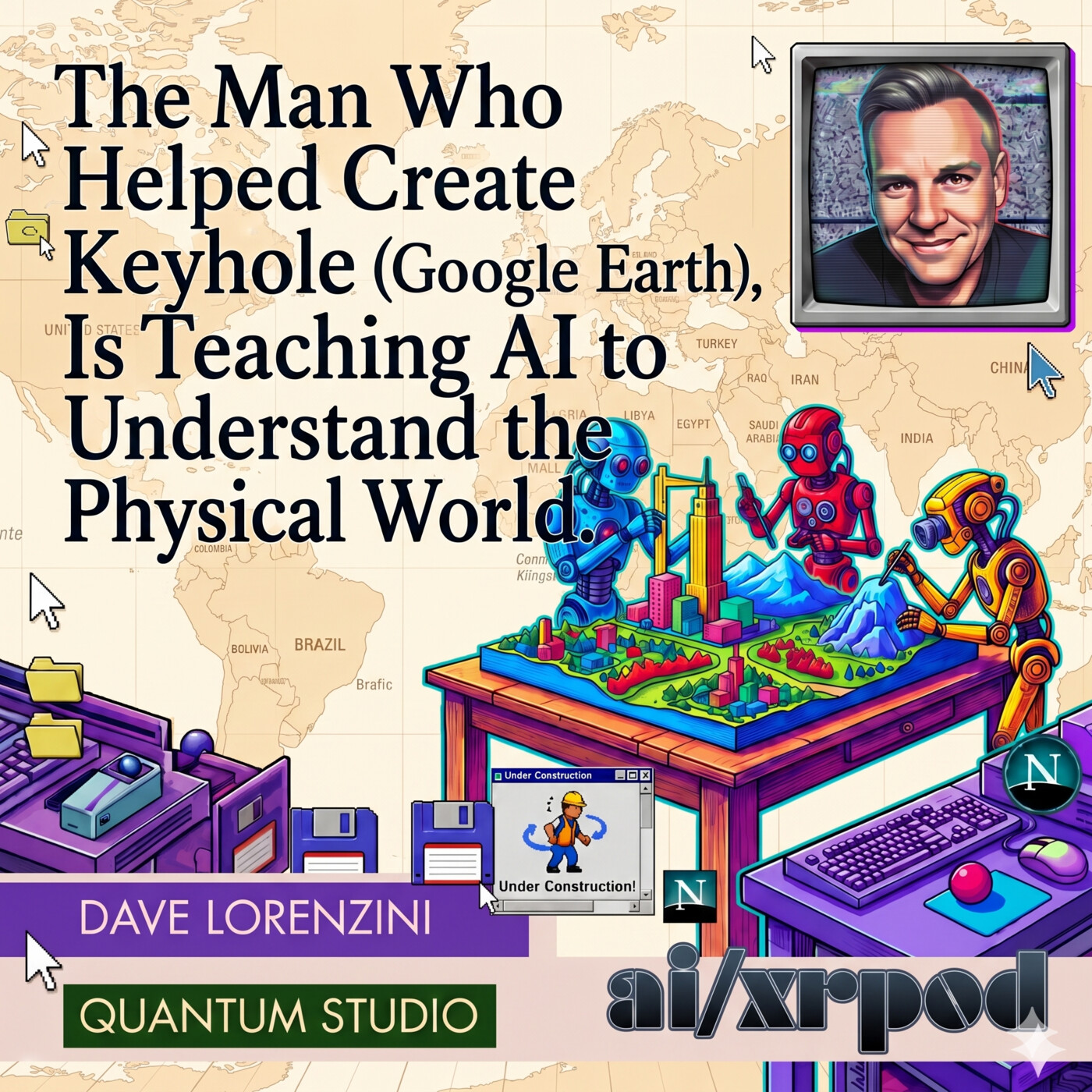
| 6/19/26 | An Early Builder On Google Earth Is Now Teaching AI to Understand the Physical World ft. Dave Lorenzini | As director of Keyhole, Dave Lorenzini delivered the 3D Earth zooms that ran on CNN during the 2003 Iraq War — netting five million users in a month. Sergey Brin was one of them. Google bought the company and poured in billions to build, fuel, and serve maps. As Google Earth, it forever changed how we relate to space.From there: pioneering work on Google Glass, AR platforms, and running an immersive XR lab in Europe for Draw & Code exploring the future of spaces, places, and faces. Today Dave directs Quantum Studio, building World Agent and 4D ID — the "DNS for real space," an addressing layer where every place, object, and moment gets a name AI systems can agree on. His thesis: the next decade of AI won't run on better maps. AI needs an operating system for reality. Not a map. Not a database. A living, queryable foundation where every place on Earth answers for itself.AI XR News: The OpenAI vs. Musk trial continued with damaging testimony from Mira Murati and Greg Brockman. Anthropic struck an unholy alliance with xAI's Colossus compute. GameStop bid for eBay. Colin Angle is back with Familiar, an AI robot pet. Coinbase cut staff. Ask.com finally died. VRChat hit 100,000 concurrent daily users in Japan.Key Moments:[00:03:34] AWE Long Beach in 30 days: Dave on the board, Snap glasses expected, 400 speakers and 250 exhibitors[00:20:10] 30 AI glasses coming: why the near future belongs to audio-first, AI-powered smart glasses[00:25:34] Keyhole origin story: satellite imagery, $25K/sq mile, Sergey Brin, and a $500M/year acquisition[00:37:30] Google Glass, Luxottica, and why Google blinked when it could have been 10 years ahead of Meta[00:40:00] XR vs. rockets: why building for the human brain is harder than getting to MarsBrought to you by Zappar, the company behind Mattercraft — the leading visual development environment for immersive 3D web experiences. Start building at mattercraft.io.Subscribe to the AI XR Podcast wherever you listen to podcasts. Watch the full episode on YouTube: https://youtu.be/weNANIIo7EA Hosted on Acast. See acast.com/privacy for more information. | 49m 33s | ||||||
| 6/19/26 | Find Anything In Any Building Using AR, Without Downloading an App ft. Caspar Thykier & Connell Gauld | The AI XR Podcast had a massive news week and one of its best guest conversations of the year. Caspar Thykier and Connell Gauld, CEO and CTO co-founders of Zappar, joined Charlie Fink and Ted Schilowitz to talk about something deceptively simple: helping people find stuff.Zappar's new product, Spaces, is app-free indoor navigation built on the web. QR code or link in a meeting invite — your phone shows AR breadcrumbs to the nearest restroom, the right meeting room, the hospital ward three floors away. No app download. No specific hardware. No Azure dependency. Caspar put the pitch simply: it's fundamentally just helping people find stuff. Connell's vision: the same technology running in glasses indistinguishable from a regular pair, within four to five years.AI XR News: Elon Musk's $135 billion lawsuit against OpenAI went to trial in Berkeley. OpenAI's IPO may be pushed to 2027 over its CFO reporting structure and $600B CapEx problem. Meta is laying off 20% of its staff in two waves. Google earnings were up 10% while Meta got punished. Freepik rebranded as Magnifi with $230M ARR and a million paid subscribers. Samsung announced displayless AI smart glasses. Google partnered with Gucci for another AI glasses play. And Google put $40 billion into Anthropic.Key Moments:[00:03:02] Elon vs. Sam: the $135 billion trial[00:05:09] OpenAI's IPO in jeopardy — CFO structure and $600B CapEx[00:07:12] Meta's 20% layoffs and Charlie's read on bad CEO behavior[00:10:32] Freepik becomes Magnifi: $230M ARR, a million subscribers[00:13:10] Samsung Galaxy XR and Google x Gucci smart glasses[00:15:15] Google puts $40B into Anthropic — a cloud play[00:21:06] Spaces: turn-by-turn AR indoor navigation, no app required[00:41:13] 16 years in XR: how Zappar survived by being the cockroachBrought to you by Zappar, the company behind Mattercraft — the leading visual development environment for immersive 3D web experiences. Start building at mattercraft.io.Watch the Full episode on YouTube: https://youtu.be/HmOXA4HgBmo. Subscribe to the AI XR Podcast wherever you listen to podcasts. Hosted on Acast. See acast.com/privacy for more information. | 50m 48s | ||||||
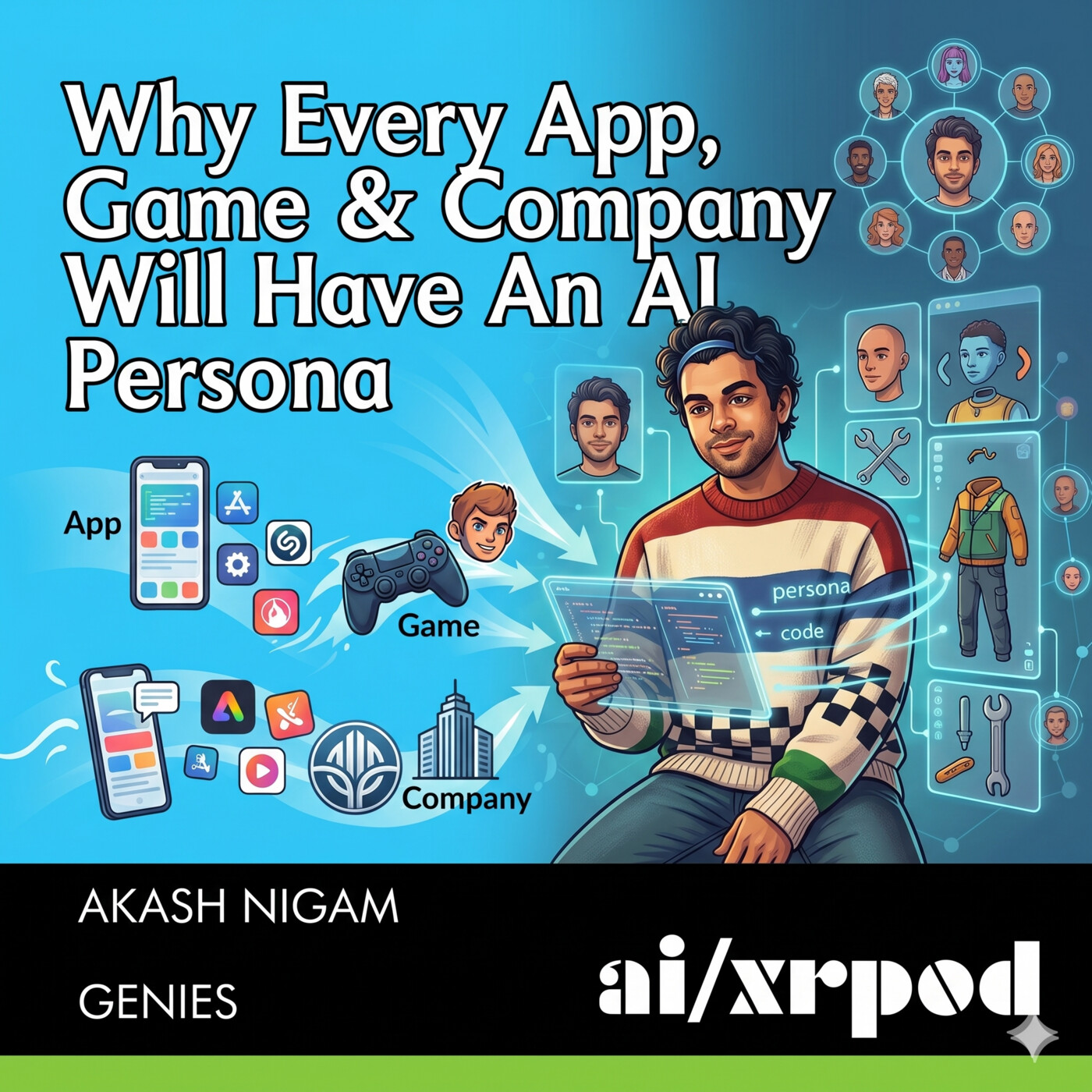
| 6/19/26 | Avatars Are the UI of the Internet: Why Every App, Game, Corp Will Have An AI Persona ft. Akash Nigam | Akash Nigam has been building Genies since 2017 with a conviction that avatars will be the visual layer of the internet. As CEO of Genies, he's assembled IP partners including the NBA, MLB, Sanrio, and Kakao, with more major studios and agencies set to announce before the end of May. The pitch: every app, game, website, and celebrity is going to have an AI personality. Genies wants to be the framework that gives all of those personalities a face.What separates Genies is portability and scale. A character that took eight weeks in 2021 now takes ten minutes. Staying stylized rather than photorealistic isn't just aesthetic — it's what got Hollywood to the table. Talent doesn't want deepfakes. They want a Genie: trained on private IP data, capable of one-on-one fan relationships that make Instagram feel thin.AI XR News: Tim Cook stepped aside as Apple CEO with hardware chief John Ternus taking over. Humanoid robots ran a half marathon in Beijing while a Sony robot defeated professional table tennis players, opening a conversation about Chinese robotics capabilities and AI data infiltration risks the US is still underestimating.Key Moments:[00:06:45] Tim Cook steps aside: what the Apple leadership transition signals about wearable AI[00:12:00] Humanoid robots and table tennis: China's robotics flex[00:13:00] The data infiltration argument: open-source risk and a warning for the US[00:24:00] The IP land grab: NBA, MLB, Sanrio, Kakao, Naver Webtoon[00:28:00] From photo to avatar in 10 minutes: how Genies' generation pipeline scaled[00:32:00] Why Instagram feels thin and how Genies enables one-on-one fan relationships[00:49:00] 80 people, $150M raised, and why Bob Iger sees Genies as the future of DisneyIf AI personalities are going to be everywhere, what do they look like? Akash has been building the answer for nearly a decade. Q3 is when it goes live.Brought to you by Zappar and Mattercraft — the leading visual development environment for immersive 3D web experiences. Mattercraft now includes an AI assistant for design, code, and debugging in real time. Start building at mattercraft.io.Subscribe to the AI XR Podcast wherever you listen to podcasts, or watch on YouTube - https://youtu.be/Fs8h2KcJclQ Hosted on Acast. See acast.com/privacy for more information. | 56m 33s | ||||||
| 6/9/26 | XR conferenceAI+3 | Ori Inbar | Cleveland ClinicIBM+4 | — | AWE 2026XR+8 | — | 51m 40s | ||
| 5/19/26 | AI in financeinvestment technology+4 | Joshua Pantony | MicrosoftBoosted AI+3 | — | AIfinance+6 | — | 54m 12s | ||
| 5/12/26 | AIGoogle Earth+4 | Dave Lorenzini | GoogleKeyhole+12 | Japan | Google EarthAI+7 | — | 49m 33s | ||
| 5/5/26 | AR navigationindoor navigation+3 | Caspar ThykierConnell Gauld | ZapparOpenAI+6 | — | AR breadcrumbsindoor navigation+5 | — | 50m 48s | ||
| 4/28/26 | avatarsAI personalities+4 | Akash Nigam | GeniesNBA+3 | BeijingUS+1 | Geniesavatars+8 | — | 56m 33s | ||
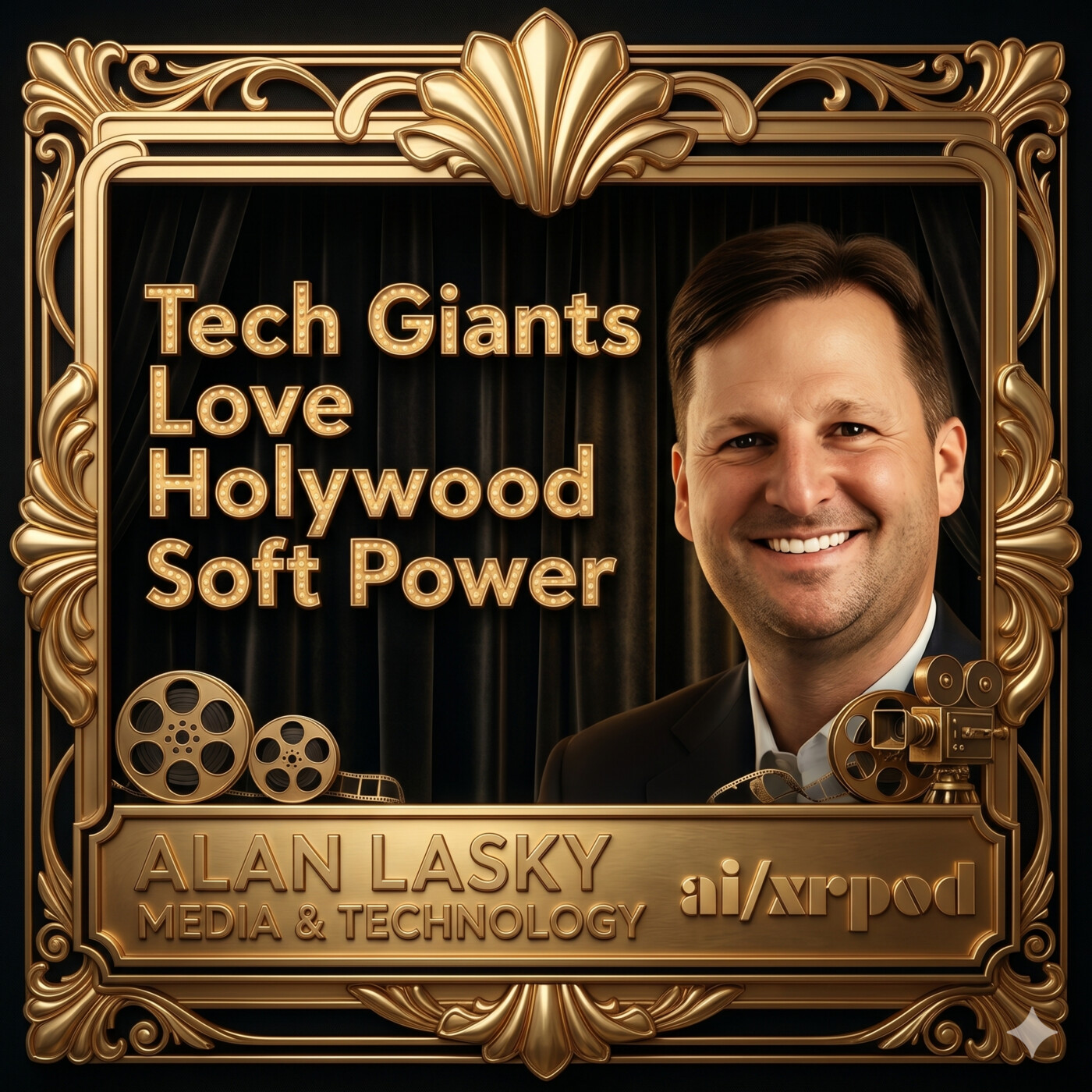
| 4/21/26 | AI in mediaHollywood's structural collapse+4 | Alan Lasky | MIT Media LabSilicon Graphics+10 | Las Vegas | AIHollywood+7 | — | 51m 14s | ||
| 4/14/26 | virtual realityXR+4 | Ian Hamilton | Upload VRGood VR+7 | — | XRvirtual reality+6 | — | 55m 12s | ||
| 4/7/26 | AIVR+4 | Lucas Rizzotto | OpenAIRec Room+4 | — | AI smartglassesVR+7 | — | 56m 39s | ||
| 3/31/26 | social media liabilityAI surveillance+4 | Shelley Palmer | GoogleMeta+3 | — | AIsocial media+7 | — | 53m 47s | ||
| 3/17/26 | Spatial AIQuantum Computing+4 | Cathy Hackl | NokiaBoston Consulting Group+3 | UAEKSA | Spatial ComputingQuantum Supremacy+4 | — | 48m 45s | ||
| 3/10/26 | AI in social networksagentic AI+4 | Dr. Salman AvestimehrDr. Aiden He | Teamily AINetflix+3 | — | Teamily AIagentic social networks+5 | — | 46m 14s | ||
| 3/3/26 | AI storytellingHollywood adaptation+4 | Rob Minkoff | Seed DanceVITURE+11 | — | AI storytellingHollywood+6 | — | 43m 19s | ||
| 2/24/26 | AI learningVR technology+4 | Vicki Dobbs Beck | Quest 1 headsetILMxLab+9 | — | ILMxLabAI+8 | — | 57m 05s | ||
| 2/17/26 | AI Smart GlassesDigital Twins+5 | Kristi Woolsey | Boston Consulting GroupSwiss Rail+4 | — | AIXR+8 | — | 52m 13s | ||
| 2/10/26 | AIAGI+4 | Alvin Wang Graylin | HTCIBM+9 | — | AI cliffAGI+5 | — | 49m 23s | ||






Showing 40 of 309
Pitch Fit is a Pro feature
See how bookable this show is for guests, which brands already advertise, the per-episode ad value, and the best-fit guest and sponsor profile. The numbers are blurred on the free plan.
How readily this show books outside guests like you.
How proven this show is for host-read sponsorships.
For Guests
ProFor Advertisers
ProUpgrade to Pro to unlock guest cadence, sponsor categories, fit scores, and per-episode ad value for this show.
Similar Audience Demographics
Podcasts that attract a similar listener profile

NY's Sports Loud Mouth
NY's Sports Loud Mouth

NY's Sports Loud Mouth
NY's Sports Loud Mouth

Workday Playdate
Erin Diehl - Workday Playdate

Carlos Inspire Show
Carlos Siqueira

The Consequential CHRO | Business-First CHRO and HR Leadership Podcast
Jackson O. Lynch

NY's Sports Loud Mouth (VIDEO)
NY's Sports Loud Mouth

Prof G Markets
Vox Media Podcast Network
Distribution & Reach
About the show, platforms, and key insights.
Distribution & Reach
About the show, platforms, and key insights.
Key insights
What the show covers
- interviews with tech industry leaders
- analysis of tech news
- insights from founders and executives
- discussions on emerging technologies
Audience interests
- AI technology advancements
- spatial computing developments
- business insights from leaders
- news on tech innovations
Platform reach
- available on major podcast platforms
- potentially broad audience
- no specific platforms detected
- followers across platforms unknown
Publishing consistency
- weekly or more episodes
- active for five years
- 288 episodes published
- consistent content delivery
Chart history for The AI XR Podcast.
Peaked at #40 in United States, currently #40 in United States.
| Market | Genre | Peak | Current | Trend |
|---|---|---|---|---|
| United States | — | #40 | #40 | — |
Chart Positions
1 placement across 1 market.
Chart Positions
1 placement across 1 market.