

Insights from recent episode analysis
Audience Interest
Podcast Focus
Publishing Consistency
Platform Reach
Insights are generated by CastFox AI using publicly available data, episode content, and proprietary models.
Total monthly reach
Estimated from 1 chart position in 1 market.
By chart position
- 🇦🇺AU · Education for Kids#1875K to 30K
- Per-Episode Audience
Est. listeners per new episode within ~30 days
1.5K to 9K🎙 Daily cadence·20 episodes·Last published 2mo ago - Monthly Reach
Unique listeners across all episodes (30 days)
5K to 30K🇦🇺100% - Active Followers
Loyal subscribers who consistently listen
1.5K to 9K
Market Insights
Platform Distribution
Reach across major podcast platforms, updated hourly
Total Followers
—
Total Plays
—
Total Reviews
—
* Data sourced directly from platform APIs and aggregated hourly across all major podcast directories.
On the show
Recent episodes
The Boy in the Submarine – Season 3, Episode 5: Puffer Fish
Mar 10, 2026
Unknown duration
The Boy in the Submarine – Season 3, Episode 4: Bowhead Whales
Feb 24, 2026
Unknown duration
The Boy in the Submarine – Season 3, Episode 3: Remoras
Feb 10, 2026
Unknown duration
The Boy in the Submarine – Season 3, Episode 2: Sea Otters
Jan 27, 2026
Unknown duration
The Boy in the Submarine – Season 3, Episode 1: Blue Whales
Jan 20, 2026
Unknown duration
Social Links & Contact
Official channels & resources
Official Website
Login
RSS Feed
Login
| Date | Episode | Description | Length | ||||||
|---|---|---|---|---|---|---|---|---|---|
| 3/10/26 |  The Boy in the Submarine – Season 3, Episode 5: Puffer Fish | Puffer fish are actually a whole family of fish with somewhere between 120 and 200 species. They are famous for their ability to blow themselves up like a balloon to scare off predators, but that’s not their only defence! Puffer fish are very poisonous and anything that eats them is in serious trouble. Many of them have spines on their body as well. They need all the defences they can get, because they are slow and clumsy swimmers. Puffer fish scrape algae from rocks, or use the “beak” made up of their fused-together front teeth to crack open the shells of snails, crabs, and shellfish. They can be found anywhere the water is warm, and live both in salt and fresh water. | — | ||||||
| 2/24/26 | 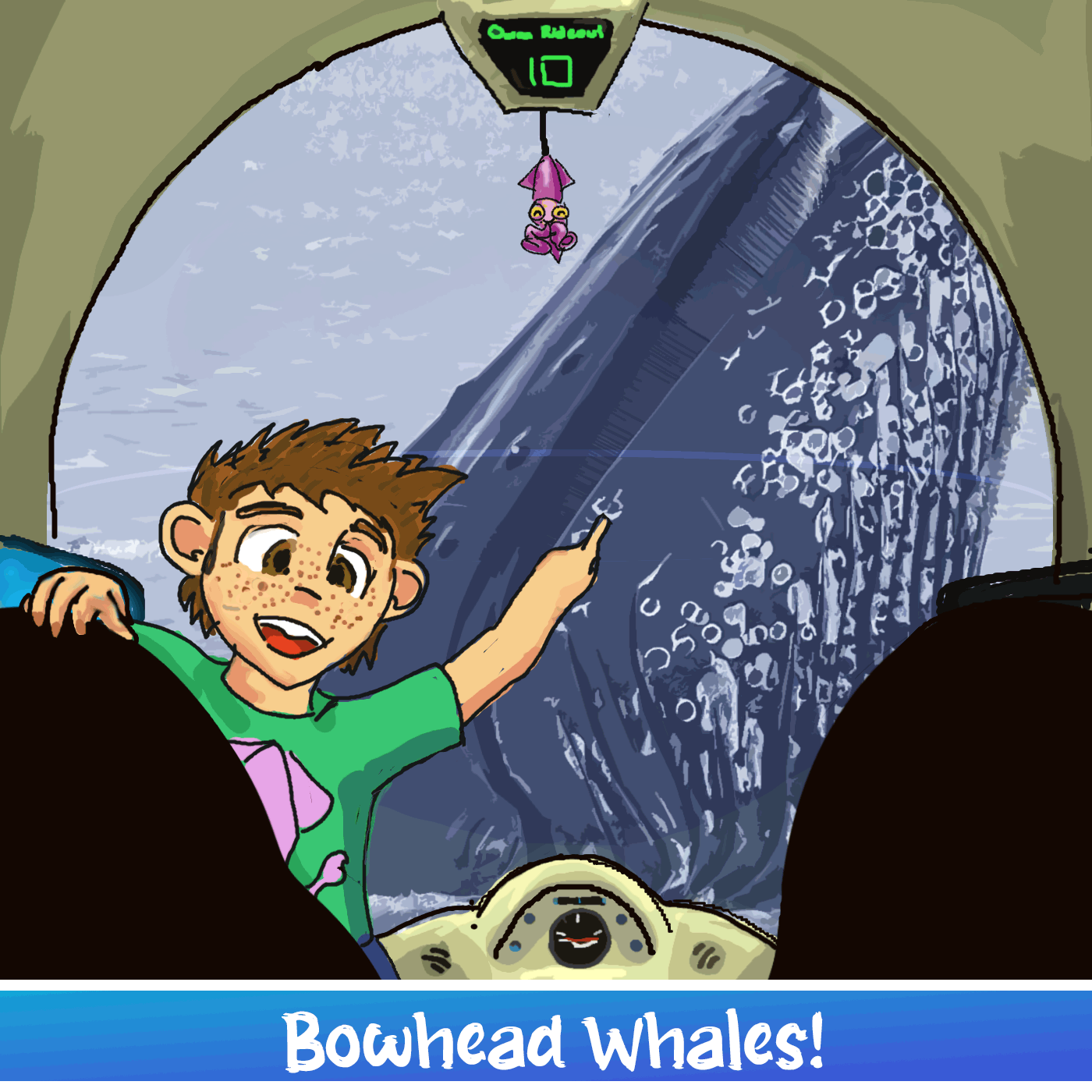 The Boy in the Submarine – Season 3, Episode 4: Bowhead Whales | Bowhead whales are baleen whales who live in the icy Arctic Ocean. Their bow-shaped heads have a hard plate on the top that lets them smash through the ice when they want to come up for air. They are incredibly long lived, with lifespans of around 300-400 years. They are also amazing singers with an incredible range of haunting vocalizations. They are an important filter feed that controls the population of krill and plankton in the Arctic. | — | ||||||
| 2/10/26 |  The Boy in the Submarine – Season 3, Episode 3: Remoras | The remora is a fish that sticks to the underbelly of bigger creatures. They eat the food that the creature they are riding misses, and helps keep them clean: a perfect picture of symbiosis! | — | ||||||
| 1/27/26 |  The Boy in the Submarine – Season 3, Episode 2: Sea Otters | Sea otters are the biggest member of the mustelid family, which includes skunks, weasels, ferrets, stoats, badgers, and minks… but they are also the smallest marine mammal. Sea otters dive underwater for up to 8 minutes at a time to catch crabs, shellfish, and urchins. They are clever tool-users who bang their prey with rocks to crack open their shells for meat. They also wrap their babies in kelp to keep them from floating away while they dive! Sea otters are very important for the environment, which is why we call they a keystone species. All along the North Pacific coast of North America, where there are sea otters, sea grasses are more healthy. They also eat up to 1/4 their body weight in sea urchins a day, which is important, because sea urchins can devastate a kelp forest if they become too numerous. Sea otters are endangered, mostly because we used to hunt them for their fur. Laws were passed to protect them as early as 1911, but one of the most important things we have done to protect them is to just stop considering fur clothing fashionable! | — | ||||||
| 1/20/26 | The Boy in the Submarine – Season 3, Episode 1: Blue Whales | Blue Whales are the largest animal that has ever lived! They get to 30.5 meters, and can be as heavy as 181,000kg (400 tons). They have tongues the size of an elephant, hearts as big as a car, and blood vessels a kid could crawl in. For such a big creature their food is very small: they eat krill, plankton, and shrimp: as much as 3,600kg (8000lbs) every day by sucking them into their huge mouths, then spitting the water back out so that their food gets caught on the back of the baleen they have instead of teeth. They then lick their food off the back of their teeth. Not are they the biggest creature in the world, they are the second loudest, too. Only the Sperm Whale gets louder. Blue Whales swim up and down every Ocean except the Arctic following the plankton and krill that they eat through the seasons, They dive to catch their food, and can hold their breath for 90 minutes, while diving as deep as 500m. (1600 feet) although they prefer to dive 100m deep or less. | — | ||||||
| 12/17/25 |  Coming Soon: Season 3 of Boy in the Submarine | Last year I had to cut season 2 off early because my dad (and producer) got very sick. But he’s better now, and I’m back, with new facts about amazing life under the sea! | 0m 31s | ||||||
| 11/20/24 | The Boy in the Submarine – Season 2, Episode 10: Bigfin Reef Squid | Bigfin Reef Squid image CC-BY-SA “Rhododendrites“ Bigfin Reef Squid is the name of a tiny squid close to Owen’s heart… or so we thought! These sneaky, sparkling squid turned out to be a cryptospecies complex: several different kind of squid that all look so much alike that scientists couldn’t tell them apart until they studied their DNA. That’s okay – owen loves them all. Bigfin reef squid are one of the only kind(s) of squid that can hear, and they are one of the most social, they know and stick close to their families. They sparkle because of special cells in their body called scinitillophores. Some important fish we eat like swordfish and tuna live on these little guys, and we eat lots of them, too. They are very important to us! | — | ||||||
| 11/13/24 |  The Boy in the Submarine – Season 2, Episode 9: Jellies! | Jellies might look like blobs, but they are very complicated invertebrates that come in hundreds of shapes and can be microscopic or as big as a whale! They can fill almost any ecological niche from prey, to keystone species, to predator! Jellies’ chemistry is a little different from other creatures, and can be mysterious. Some jellyfish seem immune to aging! While most people think of common jellyfish like the sea nettle, there are many strange and beautiful species, like the comb jelly, which looks kind of like a crystal space ship strung with twinkling Christmas Lights! | — | ||||||
| 11/6/24 |  The Boy in the Submarine – Season 2, Episode 8: Crown of Thorns Starfish | Crown of Thorns Starfish Image CC-BY Joi Ito The Crown of Thorns Starfish is an very unusual species of Sea-Star. It has a round-flat body with a much bigger central body and stomach than most sea stars, and is symmetrical with an even number of arms, while most sea stars have odd numbers. It is called a “crown of thorns” starfish because of the rings of sharp spikes growing on the top of its body. The Crown of Thorns Starfish is toxic. Eating it or getting pricked by it can cause pain like a bee sting and cause a stomach upset that can last over a week. Only a few types of sea creatures have the body chemistry to be able to eat them. The Crown of Thorns Starfish likes spots where the air in the water is a bit thinner like crevices and nooks. Where water has become polluted, they seem to be thriving these days. They like eating invertebrates that make calcium crusts around itself like sea anemones and especially coral. They are a big contributor right now to the disappearance of our world’s coral reef. | — | ||||||
| 10/30/24 |  The Boy in the Submarine – Season 2, Episode 7: Pearl Oysters | Oysters, clams, and mussels are a type of mollusc called a bivalve. Bivalves grow two shells, one on the right side of their body and one on the left. They hold them closed except when they need to open them with a powerful muscle. Oysters grow together, sometimes little ones make a home on a shell of a bigger oyster and grow right off of them. This can lead to hills of oysters called reefs, or big stretches of sea floor covered in oysters called beds. Bivalves sometimes get grit and sand stuck in them, which hurts. When they can’t get rid of it they secrete a thick mucus we call mother of pearl which hardens into a shiny resin, they coat the grit until it is a smooth ball with no hard edges to hurt them. This is where pearls come from. A few kinds of pearl are called “pearl oysters” because they make big, perfectly round, beautiful pearls. We grow them and put and in them on purpose to get big beautiful pearls. Bivalves like the pearl oyster are living water filters: they suck in water, and clean it by taking out pollutants and bacteria, they spit it out much cleaner. That makes them a very important part of the environment. | — | ||||||
Want analysis for the episodes below?Free for Pro Submit a request, we'll have your selected episodes analyzed within an hour. Free, at no cost to you, for Pro users. | |||||||||
| 10/23/24 |  The Boy in the Submarine – Season 2, Episode 6: The Portuguese Man O’War | People long thought that the Portuguese Man O’War was long thought to be a strange jellyfish that evolved to float on the surface. It wasn’t until we saw other Siphonophores deep underwater that we figured out it was a type of Siphohophore, too! The Portuguese Man O’War, sometimes called the Man O’War, Box Jellyfish, or Bluebottle Jellyfish is in fact a siphonophore made up of seven different kinds of creatures: the big bubble with the sail on the back that lets it float on the surface and catch wind with its sail is a creature called a pneumatophore. It’s tentacles are creatures called Tentacular Zooids, that work just like jellyfish tentacles: they sting and paralyze prey, then bring it up to two other kinds of creatures that work together to eat and digest prey, then feed it to the others. Another creature helps push the Man ‘O’War through the water. The seventh one is a mystery: we don’t know what it’s job is yet. The Man O’War is famous for its deadly sting. In reality, most people get a welt that hurts for 3 hours or so, but if its venom goes to the wrong place in your body it can kill you. Portuguese The Man O’War paralyzes and eats small fish as it sails the warm seas in most of the oceans. It can be found almost anywhere where the water is warm. They are eaten by few other creatures, but are a favourite food for some kinds of sea slugs and nudibranches. | — | ||||||
| 10/16/24 |  The Boy in the Submarine – Season 2, Episode 5: Kelp | Kelp grows in huge forests, which cover 0.1% of the ocean floor. That might not sound like a lot, but some Kelp forests are so huge you can see them from space! Each kelp stalk is rooted on the ocean floor, but thanks to the air it traps in its stalk, it floats up, looking like a kind of underwater tree. Some stalks can get as tall as 175 feet (54m) tall. Kelp forests are the home to thousands of species that use it as food, a place to hide, and as a nest. It is one of the most important life forms in for getting the sun’s energy into the water. And it also fixes almost 3% of the ocean’s carbon… making it one of the world’s big heavy lifters for protecting us from climate change and the greenhouse effect. People use kelp as a source of food and dry it and burn it to heat homes. Some kelp can be used as a gelatin substitute, and so we used to use it as an ingredient in ice cream! You can often find dried kelp chips to eat at the health food and organic section of your supermarket. | — | ||||||
| 10/9/24 |  The Boy in the Submarine – Season 2, Episode 4: Cuttlefish | Cuttlefish are clever tricksters of the ocean. Like their cephalopod cousins the squid and octopus, they can squirt ink, but the tricky cuttlefish can also make a balloon out of mucus and fill it with ink to make a decoy cuttlefish. They can also change their shape and colour to make themselves appear to be rocks, plants, bits of coral, or other objects found nearby. They are very smart and use these abilities with creativity and to help them explore their environment because they are both shy and very curious at the same time. Cuttlefish are loners: they only spend time together when mating. Otherwise, they spend their time alone hunting small fish, shrimp, worms, and crabs. Some cuttlefish will eat other kinds of cuttlefish, too. There are 120 types of cuttlefish that we know of! | — | ||||||
| 10/2/24 |  The Boy in the Submarine - Season 2, Episode 3: Siphonophores | Siphonophores are big colonies of individual creatures (nectophores) that stick together and share the work of living I the deep sea. Some nectophores swim, some catch food, some digest it, and some do the steering. They are the perfect example of teamwork! There are over 175 kinds of Siphonophores known to humans. The most famous is the Portuguese Man-O’-War, and the most recently discovered kind is called the Spaghetti Monster. | — | ||||||
| 9/25/24 |  The Boy in the Submarine - Season 2, Episode 2: Coconut Octopi | Coconut Octopus image, CC-BY Christian Gloor The Coconut Octopus is the cleverest species of cephalopod. They collect coconut shells, clam shells, or other objects they can squeeze into and hold closed. They use these tools to hide from predators and to sneak up on prey. They even carry handy hiding places around by using their arms to walk along the floor. We have seen Coconut Octopi watch other creatures to figure out how alert they are. When they know prey isn’t paying attention, they shoot out of their hiding place, bite with their beak, and inject a powerful poison. They also change color to blend into their environment and show their feelings. | — | ||||||
| 9/18/24 | The Boy in the Submarine - Season 2, Episode 1: Mimic Octopi | Mimic Octopus Image, CC-BY Elias Levy The mimic octopus is sneaky! It can change its colour and shape to imitate other sea creatures. They have been seen pretending to be crabs, sea snakes, rays, jawfish, lionfish, anemones, coral, and more! They use this amazing power to sneak up on their favourite food, damselfish! They also have been seen foraging for food from whatever is sitting around the warm shallow water and reefs of the Indian Ocean and Pacific. Mimic Octopi are so sneaky that while people have been swimming in waters where they can be found for centuries, we only discovered them in 1998, and only observed their amazing mimicry powers years later! You can find mimic octopi everywhere from Indonesia to the Great Barrier Reef, and around Thailand, the Philippines, and even Oman! | — | ||||||
| 6/4/24 |  The Boy in the Submarine - Episode 12: Talking to Whales | “We played a sound that we think means ‘Hello’ to the [humpback whale named] Twain… and Twain said ‘Hello’ back!” Owen Today we are updating two of our episodes with follow-up information. Both about how intelligent whales really are, because we are getting closer and closer to talking to them. In 2021 a team of marine biologists including Josie Hubbard approached a humpback whale that marine biologists have nicknamed Twain, and played a recording that they believed was a greeting, like “hello”. Twain answered with the same sound back, not once, but many times over a half an hour, seemingly as excited to talk to us as we were to talk with him. Here’s an article my dad shared with me! But earlier this month, using computers, marine biologists working with Project CETI (Cetacean Translation Initiative) identified recognizable repeated patterns in sperm whale clicking that are used like an alphabet or words over and over again. We might soon be able to use computers to figure out what they are talking about! This is the last episode of season 1 of Boy in the Submarine, and I have really enjoyed creating this for my friends and family, and all you listeners out there. Let me know if there are things you would like me to learn about sea creatures to give me ideas for a season 2 some time soon! | — | ||||||
| 5/28/24 |  Boy in the Submarine - Episode 11: Humpback Whales | Humpback whales can have beautiful voices, and they can be heard for miles and miles! Owen Humpback Whales have beautiful voices, and are the great musicians of the sea. Each family has their own special song, and each individual whale has a song of its own based on it, just like a personal name! They also make up new songs for both fun and communication. If a whale makes up a particularly catchy tune, the whole ocean of Humpbacks can pick it up and start singing it. Humback whales work in teams to make huge swirling nets of bubbles to catch krill and plankton. They eat 1.5 tonnes of krill every day. Without big filter feeders, clouds of micro-organisms could become a pollutant in the water. Humpback whales don;t live for centuries like other whales: they are fully grown by 7, and live 40-60 years. They also spend less time under water: most of their dives onlly last 10-15 minutes, even though they can hold their breath for as long as 48 minutes. | — | ||||||
| 5/21/24 |  The Boy in the Submarine - Episode 10: Orca | Orca are really smart! They can be taught to do tricks like sing songs and count, if they are trained well! Owen Orca, sometimes called “Killer Whales” are a really large Dolphin: they are one of the Oceans’ apex predators. They work in packs to take down large prey. Humans have trained them to do all kinds of amazing things, because Orca love to learn. Family is very important to Orcas. Every family has its own patterns and markings, and they often come up with new tricks, games, and even fashions that they will keep repeating for years just for fun. These can be as weird as funny backwards swimming and wearing dead fish as hats, to the frightening, such as tipping sailboats. But they don’t mean to hurt people: they are curious about us, and sometimes cause trouble by accident. | — | ||||||
| 5/14/24 |  The Boy in the Submarine – Episode 9: Sea Anemones | Sea Anemones come in thousands of different shapes and colours, just like flowers! Owen Sea Anemones are another invertebrate related to coral. They look kind of like flowers, they are even named after a flower: but their stem is a hard tube, and their petals are tendrils full of stingers. Only a few creatures with special slime can touch a Sea Anemone. Some, like the clown fish even live in the anemone for safety. Others, like some nudibranches eat the stingers in anemones, then put them in their own skin for self-defence. WHen an Anemone is old ienough it splits down the middle into two new Anemones that quickly heal up. Whole families of anemones live close together that are all clones. And if they get crowded by other anemones they form clone armies that sting the other anemones until they can’t find any more. Anemones eat microscopic organisms, and are very important for keeping wherever they live clean and healthy, while providing safe hiding places and food for the creatures who can handle the sting. | — | ||||||
Showing 20 of 20
Sponsor Intelligence
Sign in to see which brands sponsor this podcast, their ad offers, and promo codes.
Chart Positions
1 placement across 1 market.
Chart Positions
1 placement across 1 market.