
Insights from recent episode analysis
Audience Interest
Podcast Focus
Publishing Consistency
Platform Reach
Insights are generated by CastFox AI using publicly available data, episode content, and proprietary models.
Most discussed topics
Brands & references
Total monthly reach
Estimated from 1 chart position in 1 market.
By chart position
- 🇨🇦CA · Politics#31100K to 300K
- Per-Episode Audience
Est. listeners per new episode within ~30 days
50K to 150K🎙 ~2x weekly·85 episodes·Last published 2d ago - Monthly Reach
Unique listeners across all episodes (30 days)
100K to 300K🇨🇦100% - Active Followers
Loyal subscribers who consistently listen
40K to 120K
Market Insights
Platform Distribution
Reach across major podcast platforms, updated hourly
Total Followers
—
Total Plays
—
Total Reviews
—
* Data sourced directly from platform APIs and aggregated hourly across all major podcast directories.
On the show
From 14 epsHost
Recent guests
Recent episodes
'Moral Hazard on Steroids': The Investor Who Called the Big Short Says Carney's Condo Bailout Is Worse Than 2008 Subprime Fiasco
Jun 22, 2026
1h 11m 00s
Carney’s Surveillance Push Targets Canadians, Not Politically Connected Narco Kingpins — and Hands Beijing a Gift
Jun 17, 2026
1h 03m 08s
“I Wonder How Many People Mark Carney Has Around Him That’s Actually Working for China": Rushan Abbas, author of Unbroken.
Jun 10, 2026
41m 45s
"There's a Whole Machinery that Could Not Want Me To Do What I Have To Do" : Grace Jin Drexel
May 29, 2026
36m 27s
Unexamined Conflicts: The PRC/Carney Brookfield Dealings Research Behind My Washington D.C. Panel Remarks
May 22, 2026
1h 03m 35s
Social Links & Contact
Official channels & resources
Official Website
Login
RSS Feed
Login
| Date | Episode | Topics | Guests | Brands | Places | Keywords | Sponsor | Length | |
|---|---|---|---|---|---|---|---|---|---|
| 6/22/26 |  'Moral Hazard on Steroids': The Investor Who Called the Big Short Says Carney's Condo Bailout Is Worse Than 2008 Subprime Fiasco | VANCOUVER — Marc Cohodes built his name and his fortune betting against frauds, from small public companies to the American subprime-mortgage machine that collapsed in 2008. This week, he returned to The Bureau with a blunt verdict on Prime Minister Mark Carney’s plan to spend up to $3.2 billion absorbing Vancouver’s unsold condominiums: he has seen this movie before, and this version is worse.“This Carney buying back Vancouver condos is just really rich,” Cohodes said, “especially on the backdrop of him cutting a deal with China.” What makes it worse than 2008, Cohodes says, is not the size of the losses but the refusal to let them happen at all.In the United States, Cohodes notes, the government let housing fall — “everything went down 40 to 50 percent” — and only then stepped in to keep the banks and brokerages from failing, once the leveraged players had taken their hits. Painful, but the market cleared and prices found a level. Canada, he argues, is doing the opposite: propping up prices before anyone is allowed to lose. “Here, the Canadian government won’t even let the prices clear,” he said. The result, in his words, is “a moral hazard on steroids, which encourages these developers then to go and do this again, and do it again on probably a greater scale.”Moral hazard is the concept Carney, a former central banker, knows intimately, and Cohodes defines it the way a short-seller does: “people doing bad things and taking exceptional risk to benefit themselves. And the risk eventually gets subsidized by the federal government, aka the taxpayer.” Reward the people who built and bought at unsustainable prices, he argues, and you have taught the next cohort that the downside is socialized. His prescription is the mirror image of the bailout, and it is the same argument he has made for more than a decade. Let the towers sell for what the market will bear — but let that “market” consist of Canadian income earners and taxpayers, not foreign investors propped up by underground-banking flows. That is what my reporting on Chinese mortgage fraud and underground banking in Toronto, alongside the laundering apparatus mapped by British Columbia’s Cullen Commission, has exposed.The homes must sell to real home buyers, even at a brutal discount, Cohodes said, and the government must then protect the financial system rather than the developers. “If you’re asking a million three for these,” he said, “we don’t care if you sell them for half a million bucks. As long as law-abiding Canadians buy these, we don’t care.” The banks would take write-downs; some builders would go under; and Canadians shut out of the market would finally buy at prices tied to local incomes. “The winners are the people who buy at a low price,” he said. “The losers are the people who borrowed money and built things at a ridiculously high price.” Instead, he argues, Ottawa is subsidizing the losers and penalizing the people it claims to help.This is where Cohodes’s diagnosis converges with the reporting underlying The Bureau’s analysis of the bailout — and where his language runs ahead of it. I frame it in the podcast discussion like this: “I’m not saying any one developer or even casino owner is knowingly laundering money. I’m saying the structure of the money and the market is Chinese capital flight.” That structural claim is the one The Bureau has documented — through leaked bank files showing fabricated foreign-income mortgages, through a federal financial-intelligence study of roughly 48,000 diaspora transactions, and through the casino-and-real-estate apparatus mapped by British Columbia’s Cullen Commission.What gives the conversation its political edge is that the cast has not changed. The man Carney appointed as federal housing minister, Gregor Robertson, presided as Vancouver’s mayor during a period in which home prices doubled, and once dismissed the first study to flag the inflow of mainland-Chinese mortgage capital as racially divisive. Cohodes’s words for Robertson and for Premier David Eby are harsh. But the narrower point lands: the figures who waved away the warnings a decade ago are the ones now writing the cheque.Cohodes situates the bailout within a darker reading of the whole economy. He describes a country dangerously leveraged to real estate, with a banking regulator he considers compromised and a currency he expects to weaken sharply — to the point that he speculates Carney could one day resort to capital controls. He calls the country “Arctic Mexico,” a deliberate provocation meant to argue that Canada has become a haven where financial crime, narcotics, and laundered capital intersect with too little consequence.And he is scathing about why none of this is louder. The story, he notes, has barely registered in the national press. “This BC story hasn’t even been picked up in the mainstream media,” he said, tracing the silence to the federal subsidies that flow to large outlets — money he characterizes, in his trademark rhetorical style, as buying a comfortable narrative. Editor's note: The Prime Minister's Office frames the June 18 announcement as a new "Canada–British Columbia Partnership on Condo Conversion," delivered through Build Canada Homes and BC Housing using what it calls "innovative financing tools." The government states the partnership remains "subject to Treasury Board approvals," and the specific terms — including the price at which units would be acquired and the discount to be achieved — have not been published. The "up to $3.2 billion" cited here is the government's own figure for the announcement's housing stream; because the condo-conversion financing carries no published cost and remains subject to approval, the ultimate public exposure, and the price of condo absorption, are not yet clear.The Bureau is a reader-supported publication. To receive new posts and support my work, consider becoming a free or paid subscriber. This is a public episode. If you'd like to discuss this with other subscribers or get access to bonus episodes, visit www.thebureau.news/subscribe | 1h 11m 00s | ||||||
| 6/17/26 |  Carney’s Surveillance Push Targets Canadians, Not Politically Connected Narco Kingpins — and Hands Beijing a Gift | OTTAWA — In this episode with Jason James, I break down my criticisms of the raft of public-safety and surveillance laws Mark Carney’s manufactured-majority government is attempting to push through Canada’s Parliament before the summer break — a legislative push now drawing serious concern from privacy experts, media lawyers, civil-liberties advocates, and technology leaders including Shopify founder Tobi Lütke.I also reiterate my analysis that Canada’s failed trade dealings with the Trump Administration are now foreseeably snagged on Carney’s Chinese EV import deal. The Liberal government, I argue, is trying to have its cake and eat it too: securing the deeper trade flows with China that the party’s Beijing trade lobby has pushed for since Pierre Trudeau, while also trying to secure a favorable deal with Washington.I tell Jason, as I have before, that this is a non-starter for Washington. The United States will not be gaslit into accepting Chinese spy platforms and forced-labour trade goods dumped into North American trade — goods and platforms that undermine North American workers and security, among many other threats.But Carney persists in attempting to assuage his business backers, as Trudeau did before him, I tell Jason.Focusing on Bill C-22, the so-called Lawful Access Act, I start with an unavoidable observation: Ottawa is again confusing mass expansion of state power over ordinary Canadians with the targeted legal tools actually needed to confront Canada’s most serious threat actors.As a subject-matter reporter on Chinese Triad networks, Mexican cartel platforms, hostile-state proxies, fentanyl supply chains, underground banking, and foreign-interference structures in Canada, I argue that the problem is not that law enforcement lacks ways to collect more data from forty million Canadians. The problem is that the senior criminal actors driving these networks are already identifiable, already known to investigators, and often uncomfortably well-connected in Canadian political, business, and diaspora power structures.Bill C-22, I argue, does little to fix the real architecture of impunity: disclosure and trial-delay barriers that have helped collapse major organized-crime prosecutions; weak racketeering tools; limited financial-intelligence-to-prosecution pathways; and a failure to build deeper Five Eyes and DEA-style cooperation against the Chinese-Mexican-Canadian criminal ecosystem now running fentanyl, laundering, and encryption platforms through Canadian cities.Instead, the Carney government is advancing a surveillance framework that has alarmed Signal, Apple, Meta, Windscribe, NordVPN, the Canadian Chamber of Commerce, U.S. lawmakers, and Canadian tech leaders. Critics warn the bill could damage privacy, journalism, encryption, Canadian tech viability, and even U.S. national security interests.The central argument: Canada does not need a blanket metadata and lawful-access regime aimed at everyone with a phone. It needs precise, aggressive tools to target the few thousand individuals and networks actually threatening national security — the cartel brokers, Triad financiers, hostile-state proxies, fentanyl logisticians, underground bankers, and United Front-linked intermediaries who have turned Canada into a platform for continental narco-finance.Bill C-22 gets the problem backwards. And in doing so, it risks handing Beijing and other hostile actors exactly the structural vulnerabilities they have been waiting to exploit.The Bureau is a reader-supported publication. To receive new posts and support my work, consider becoming a free or paid subscriber. This is a public episode. If you'd like to discuss this with other subscribers or get access to bonus episodes, visit www.thebureau.news/subscribe | 1h 03m 08s | ||||||
| 6/10/26 |  “I Wonder How Many People Mark Carney Has Around Him That’s Actually Working for China": Rushan Abbas, author of Unbroken.✨ | ChinaUyghurs+4 | Rushan Abbas | Campaign for UyghursUnbroken | CanadaUnited States+1 | ChinaUyghurs+5 | — | 41m 45s | |
| 5/29/26 |  "There's a Whole Machinery that Could Not Want Me To Do What I Have To Do" : Grace Jin Drexel✨ | human rightsreligious freedom+4 | Grace Jin Drexel | Zion Church | ChinaWashington+2 | Pastor Ezra JinZion Church+7 | — | 36m 27s | |
| 5/22/26 |  Unexamined Conflicts: The PRC/Carney Brookfield Dealings Research Behind My Washington D.C. Panel Remarks✨ | China influencefinancial institutions+5 | — | Center for Peace and Security in the Middle EastHudson Institute+2 | ChinaCanada+3 | ChinaWall Street+8 | — | 1h 03m 35s | |
| 5/20/26 |  Carney, Power Corporation, and Beijing's Quiet Elite Capture Via Trade: Breaking Down Carney’s Canada China Business Council Speech✨ | Canada China relationsbusiness elite+4 | Mike DoranBrenda Shaffer+1 | Canada China Business CouncilPower Corporation+1 | OttawaWashington, D.C. | BeijingCanada China Business Council+7 | — | 1h 11m 49s | |
| 4/8/26 |  Before Michael Ma’s Cross-Examination of a China Expert, The Bureau Warned Ottawa That Foreign Interference Witnesses Could Be Targeted✨ | foreign interferencepolitical dynamics+4 | Jason James | The BureauLiberal+3 | OttawaCanada | Michael Maforeign interference+7 | — | 1h 05m 09s | |
| 3/27/26 |  The Bureau Podcast: Floor-Crosser, Alleged United Front Ties, and a Beijing Propaganda Blitz — Was Michael Ma's Attack on a Canadian China Expert Coordinated?✨ | Canadian politicsChina relations+4 | Brian Lilley | University of OttawaJamestown Foundation+1 | — | Michael MaMargaret McCuaig-Johnston+6 | — | 19m 42s | |
| 3/11/26 |  The Fog of War: Does Trump's Iran Campaign Deter Xi Jinping's Taiwan Invasion Threat — or Increase the Danger?✨ | U.S.-Israel campaign in IranTaiwan invasion threat+4 | Jason James | Central Intelligence AgencySilicon Valley+2 | TaiwanUnited States+3 | IranTaiwan+6 | — | 1h 05m 18s | |
| 3/9/26 |  What Money Couldn't Buy: The Intelligence Logic Behind the Epstein Cover-Up✨ | Epstein cover-upintelligence+4 | Jason Pack | RUSIBear Stearns+2 | Long IslandManhattan+1 | Epsteincover-up+6 | — | 55m 37s | |
Want analysis for the episodes below?Free for Pro Submit a request, we'll have your selected episodes analyzed within an hour. Free, at no cost to you, for Pro users. | |||||||||
| 3/5/26 |  Five Days Into War With Iran, Normalcy In Tel Aviv✨ | warIran+4 | Adam Zivo | Iran’s Islamic regime | Tel AvivIsrael+3 | IranIsrael+6 | — | 30m 17s | |
| 3/4/26 |  How Canada Birthed a Sinaloa Cartel Boss: A Veteran Mountie With 50 Years of Experience Explains the Unthinkable Rise of Ryan Wedding✨ | Sinaloa CartelCanadian crime+4 | Garry Clement | Royal Canadian Mounted Police14K Triad+1 | CanadaCoquitlam+2 | Ryan WeddingSinaloa Cartel+8 | — | 59m 11s | |
| 2/13/26 | 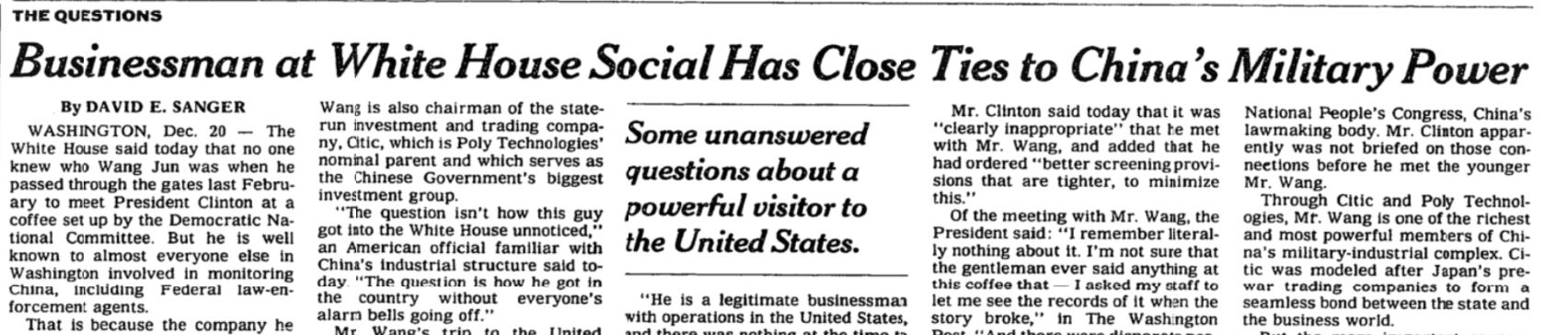 “The Control Grid”: Digging Deeper into the Revelations of Epstein’s Network, Elites Operating Without Regard for Morality, Borders, and Democracy✨ | Epstein networkglobal elites+4 | Jason James | CITIC GroupChinese Communist Party+2 | — | EpsteinChina+7 | — | 1h 08m 30s | |
| 2/12/26 |  The Bureau Podcast: How United Front Networks Build Access—And Why Canada Is a Prime Target✨ | United Front networksChinese influence+4 | Cheryl Yu | Chinese Communist PartyUnited Front Work Department | CanadaUnited States+2 | United Front Work DepartmentChinese Communist Party+7 | — | 35m 01s | |
| 2/10/26 |  Carney’s China Deal: Trade, Electioneering, Police Cooperation, and Risks to Canada’s Sovereignty✨ | Canada-China relationstrade agreements+4 | Brian Lilley | People’s Republic of ChinaChinese Communist Party+1 | — | CanadaChina+6 | — | 42m 37s | |
| 1/30/26 |  Taiwan 2027 Deadline at Center of Reported Purge of China's Top Military Commander✨ | China politicsmilitary purge+4 | Chris Meyer | People’s Liberation Army | TaiwanChina+3 | TaiwanChina+6 | — | 42m 18s | |
| 1/26/26 |  China's Top General Falls: Inside Xi Jinping's Hollow Military Purge | OTTAWA/LOS ANGELES — The weekend delivered a jolt from Beijing that underscores a theme Chris Meyer and I have explored across multiple podcast discussions: Xi Jinping’s regime can look strong yet be brittle.China’s Defence Ministry says it has opened investigations into senior military figures including Gen. Zhang Youxia, a vice chairman of the Central Military Commission—an escalation that is shaking the top ranks of the People’s Liberation Army and fuelling fresh questions, inside and outside China, about whether this is an anti-corruption purge, a political power struggle, or both.On Saturday, Chinese state media reported that Zhang is under investigation for alleged “serious violations” of Party discipline and state law. But as Chris Meyer argues in this episode, the announcement may be only the visible edge of a much larger rupture unfolding inside China’s opaque military and political system.The Wall Street Journal reported that Zhang is accused of leaking information related to China’s nuclear weapons program to the United States and accepting bribes, including in connection with a senior promotion. The Journal said the allegations were raised during a closed-door briefing held Saturday morning with senior officers, shortly before the formal announcement.As Chris and I note in this episode, those WSJ claims—sourced to internal Communist Party accounts—may not ultimately be borne out, and could even serve Xi’s interests as a narrative frame. What is clear is that Zhang sits at the apex of the Party’s military command structure, and his reported downfall signals an extraordinary level of turmoil at the top.Chris and I also discuss the obvious: Prime Minister Mark Carney’s new strategic engagement with Beijing, already questionable to many critics of China’s hybrid warfare efforts in the West and especially targeting Canada, now looks increasingly dubious as questions hover over the stability of Xi’s regime.As Meyer explains in the episode, social media and dissident sources have circulated dramatic claims about what really happened. According to these accounts, there was a planned operation to arrest Xi Jinping at an elite CCP leaders’ hotel on the outskirts of Beijing around January 18th. Meyer heard reports that approximately 20 people—split between Xi loyalists and Zhang faction members—were killed in a confrontation when Xi received advance warning and turned the tables on Zhang.There is no verified evidence of violence, mass arrests beyond senior officers, or an active coup attempt. Claims of shootings and widespread detentions remain unconfirmed and trace back to social media posts and opposition-linked outlets. Analysts caution that China’s opaque political system often fuels speculation, and such reports should be treated carefully until independently confirmed.What we do know is that China’s military command structure is in unprecedented disarray. Whether this represents a foiled coup or an anti-corruption purge, the result is the same: China’s military leadership has been gutted. As Meyer outlines in the episode, since Xi came to power in 2012, he has systematically installed loyalists throughout the PLA’s top ranks. Now, those same appointees have been systematically removed.The Central Military Commission has been left almost entirely vacant, with only Xi and Zhang Shengmin, who heads the anti-corruption committee, remaining. Every uniformed commander appointed to the commission in 2022 has been removed.The purge extends beyond Zhang. Since summer 2023, more than 50 senior officers and defense industry executives have been ousted. In October 2024 alone, nine generals were dismissed, including another vice chairman of the Central Military Commission. The Communist Party expelled He Weidong, the other vice chair of the commission, in October 2024.Meyer notes that PLA Daily published a series of articles in December 2024—one per week—that were highly critical of Xi Jinping. Zhang was urging the civil servant class that opposed Xi to get involved, according to Meyer. The Bureau is a reader-supported publication. To receive new posts and support my work, consider becoming a free or paid subscriber. This is a public episode. If you'd like to discuss this with other subscribers or get access to bonus episodes, visit www.thebureau.news/subscribe | 40m 14s | ||||||
| 1/21/26 |  Carney’s Beijing Bet, the Arctic Squeeze, and the Race for Rare Earths | OTTAWA — In this podcast interview with Jason James of BNN, taped shortly before Prime Minister Mark Carney’s Beijing trip, I lay out why I expected the visit to deepen long-running elite commercial ties between Chinese Communist Party-aligned networks and Canadian industries — relationships that have shaped Liberal Asia policy for decades. We cover a lot of ground, including heightened tensions over Greenland; Elbridge Colby’s “strategy of denial”; the United States’ race to prepare for potential conflict with China and Russia; and the parallel race to secure critical minerals in the Western Hemisphere—aimed at breaking Beijing’s decades-old effort to dominate rare-earth supply chains essential for munitions and advanced weapons. We discuss how the fast-moving headlines and heated rhetoric of 2026 have convinced many Western citizens that President Trump is the biggest threat to world peace. I understand where those concerns come from, but I don’t believe that is the right interpretation of world events. A better reading, I tell Jason, comes from a 2023 clip in which President Xi Jinping, after meeting President Vladimir Putin in Moscow, is heard saying: “Right now there are changes—the likes of which we haven’t seen for 100 years—and we are the ones driving these changes together.”The Bureau is a reader-supported publication. To receive new posts and support my work, consider becoming a free or paid subscriber. This is a public episode. If you'd like to discuss this with other subscribers or get access to bonus episodes, visit www.thebureau.news/subscribe | 1h 03m 17s | ||||||
| 1/9/26 |  BREAKING Iranian Revolt Update: The “Trump Factor,” a Revolt Spreading Beyond Iran’s Traditional Fault Lines, and Exposing Iranian Guard Networks in Canada | VANCOUVER-OTTAWAIn this Bureau Podcast breaking episode, I’m joined by my former colleague Negar Mojtahedi — now a Canadian investigative journalist with Iran International English — to unpack a revolt in Iran that was moving at internet speed abroad until the regime shut down networks last night, making Negar’s on-the-ground sourcing all the more crucial — especially as major broadcasters, from the BBC to the CBC, have appeared reticent to cover this monumental story.We begin where both Negar and I share expertise: exposing the Iranian regime and the organized-crime national security story hiding in plain sight here in North America. Negar’s reporting has found “hundreds, potentially if not thousands” of regime-linked officials and intermediaries living freely in Canada — often not uniformed Islamic Revolutionary Guard Corps figures, but family-linked networks and financial middlemen who can move money, facilitate influence, and in some cases monitor dissidents.We discuss how this threat extends beyond the Iranian diaspora, reaching into the Jewish community as well — including lethal threats against former Canadian justice minister Irwin Cotler. Later in the episode, I return to the point that even if Western citizens think they don’t care about the Iranian regime’s harms abroad, they should understand the dangers they face at home — including how organized crime networks can traffic fentanyl one day and take Iranian intelligence-linked hit contracts the next.From there, we move into how this uprising began in an unexpected place and metastasized into something larger and more dangerous for the clerical state. We discuss how the first sparks appeared in the bazaar’s electronics and phone sector — a modern pressure point where merchants live and die by currency volatility and market shocks — before widening into a protest movement not anchored to one grievance. We discuss how the breadth of complaints matters as much as the size of street protests — and how what stands out is where the revolt has taken root: smaller and religious cities the regime traditionally counted on, including Mashhad, alongside multi-ethnic participation from Kurds, Baluch, and Azerbaijanis. As Negar frames it, the regime’s legitimacy is eroding across constituencies it once relied on.We also discuss the day-by-day escalation and the accelerants outside Iran’s borders. A major theme, Negar says, is the “Trump factor”: we discuss how President Trump’s warning that if the regime kills its people “we’re locked and we’re loaded” appears to have shifted the psychological environment for protesters, even if the threat so far remains rhetorical. We discuss why that message lands differently given Trump’s history of action — including the killing of Qasem Soleimani, strikes on Iranian nuclear sites, and this week’s stunning special forces extraction of Iranian regime ally President Nicolás Maduro of Venezuela — and how Trump’s at-times chaotic, unpredictable approach may be shaping how regime officials calculate risk now, even as he has publicly kept his options open.Against that backdrop, we discuss reports of mounting deaths and mass arrests as the internet goes dark, and why the blackout itself becomes part of the story — cutting off real-time verification, restricting organizing, and enabling harsher repression away from the cameras.On the ground, we discuss whether state coercive power is cracking and what signals analysts watch in a true revolutionary moment. We discuss protests targeting symbols of control, including isolated attacks on Revolutionary Guard assets, reports of some security personnel withdrawing rather than confronting crowds, and — most striking — scenes described as police in smaller towns cheering protesters. We also discuss the regime’s use of outsourced repression, including Iran International reporting that “more than 800 members” of an Iran-backed Iraqi militia have entered Iran, alongside accounts of Arabic being heard on the streets, buses transporting detainees, and people disappearing into prisons without family notification.The Bureau is a reader-supported publication. To receive new posts and support my work, consider becoming a free or paid subscriber. This is a public episode. If you'd like to discuss this with other subscribers or get access to bonus episodes, visit www.thebureau.news/subscribe | 58m 13s | ||||||
| 1/7/26 |  From Maduro’s Extraction to a North Atlantic Showdown: The West’s New Hybrid War Front | OTTAWA — In this episode, I speak with Canada’s top political columnist Brian Lilley to unpack the fast-moving opening days of 2026 — a week that has redrawn the Western Hemisphere’s security map. We trace how the Trump administration’s dramatic extraction of Venezuelan President Nicolás Maduro and the Justice Department’s superseding indictment are part of what I see as a wider strategy to counter hybrid warfare — the fusion of narco-states, cartel finance, terrorism, and authoritarian state influence stretching from Caracas to Beijing and Moscow.Our conversation also takes in this morning’s U.S. military interception of a Russian-flagged oil tanker in the North Atlantic, a vessel linked to Venezuela’s sanctions-evasion “dark fleet.” We then turn to the terrain covered in The Bureau’s Monday report: a deeper dive into the U.S. indictment against Maduro, Cilia Flores, and their military-security inner circle, which alleges a 25-year enterprise trafficking “thousands of tons” of cocaine northward under state protection. Prosecutors describe a system that fuses diplomatic cover, armed colectivos, and National Guard airlifts enriching political and military elites while empowering insurgent groups such as the FARC and ELN. Notably, I tell Brian, the indictment recounts drug shipments routed through Margarita Island involving generals, Maduro’s son, and flights tied to Venezuela’s state oil company, PDVSA, citing recorded DEA meetings and other evidence.We also discuss striking commentary from senior Canadian Conservative figures. Jason Kenney revealed that, while in cabinet, he was briefed by a foreign intelligence service on a Venezuela–Hezbollah–Iran pipeline using Quds Force logistics to move cocaine through Beirut and finance terror operations, and that he was shown “receipts” linking these flows to Canada-based laundering channels and lax immigration controls.And Senator Leo Housakos argued that Beijing is “leading the way” in a broader bloc in Latin American states — including Russia, Iran, and Turkey — that exploits drug trafficking, migration, and information warfare to undermine Western democracies, calling the environment “a threat we haven’t seen since the Second World War.”I also brief Brian on my breaking TD Bank story: a bank insider admitting to helping Chinese networks launder nearly half a billion U.S. dollars in drug proceeds through New York branches. I argue it reflects a broader laundering model involving Chinese underground-banking cells taking over Latin cartel finance, with Canada functioning as a key command-and-control hub — a pattern I first reported through the British Columbia casino money-laundering surge.The Bureau is a reader-supported publication. To receive new posts and support my work, consider becoming a free or paid subscriber. This is a public episode. If you'd like to discuss this with other subscribers or get access to bonus episodes, visit www.thebureau.news/subscribe | 44m 32s | ||||||
| 12/24/25 | 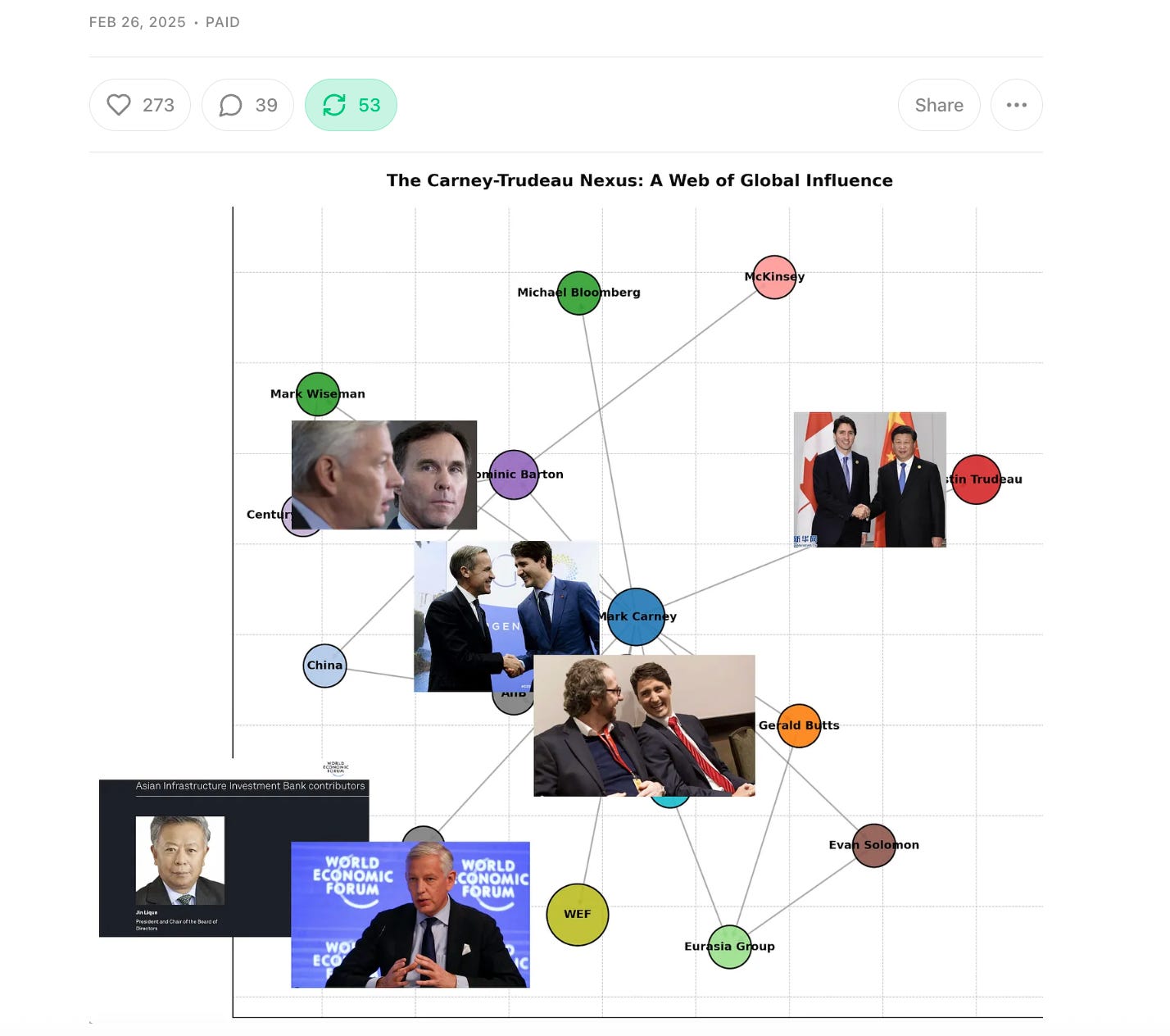 The Carney Network: Davos, Beijing, and the 2025 Appointments That Made The Bureau's Map Look Prescient | OTTAWA — For The Bureau’s 2025 Holiday Special, I sat down once again with Jason James for a long-form, two-hour conversation—our second holiday edition—to answer his questions about the elite networks surrounding Prime Minister Mark Carney and the China connections that have quietly defined his ascent.Perhaps presciently, during the federal election campaign The Bureau published a network-mapping model outlining the key figures orbiting Carney, including Dominic Barton, Jin Liqun, Mark Wiseman, and Evan Solomon. Months later, that exercise looks well founded. Wiseman has now been appointed Carney’s ambassador to the United States—a critical position as Canada tries to steer a course between the world’s two rival superpowers. And Solomon, the former CBC host once caught up in an art-dealing scandal involving Carney, is now Minister of Artificial Intelligence—another portfolio that sits squarely between U.S. and Chinese competition over advanced technology, critical minerals, and energy security.In the episode, I tell Jason that the pattern isn’t coincidental. It reflects the same constellation of influence The Bureau mapped before Carney ever took office: long-standing relationships of trust shaped through finance, global governance, and shared ambition—often paired with a marked propensity to favour deeper trade and engagement with Beijing, an authoritarian regime built on the subjugation of hundreds of millions of Chinese nationals. That context is central to how I assess Carney’s rise, including analysis I have previously provided in testimony at a Parliamentary ethics hearing.A review of corporate records showed that Brookfield—the influential Canadian investment fund from which Carney stepped away to replace Justin Trudeau as Canada’s leader—maintains many billions in politically sensitive investments with Chinese state-linked real estate and energy companies, alongside a substantial offshore banking presence. One major venture included a $750 million entry into high-end Shanghai commercial property in 2013 with a Hong Kong tycoon affiliated with the Chinese People’s Political Consultative Conference—an entity U.S. intelligence and national-security analysts have described as central to Beijing’s united front ecosystem.As that market later deteriorated—vacancies rising in Shanghai and credit conditions tightening—Brookfield secured hundreds of millions of dollars in loans from the Bank of China to refinance its Shanghai commercial holdings. The Bureau’s reporting has also noted the broader continuity: a decade earlier, Carney, as Governor of the Bank of England, publicly advanced policies designed to expand China’s financial footprint, including support for renminbi clearing in London. In a 2013 speech, UK at the Heart of Renewed Globalisation, Carney said: “The Bank of England [has] signed an agreement with the People’s Bank of China … Helping the internationalisation of the Renminbi is a global good.”In this episode, Jason adds a finding about Mark Carney’s promotion of Beijing’s Belt and Road plan—another massive boost, I argue, to President Xi Jinping’s global ambitions.The Bureau is a reader-supported publication. To receive new posts and support my work, consider becoming a free or paid subscriber. This is a public episode. If you'd like to discuss this with other subscribers or get access to bonus episodes, visit www.thebureau.news/subscribe | 1h 49m 16s | ||||||
| 12/16/25 |  The Bureau Assesses Floor-Crossing Motives With Brian Lilley: Suspicious Diaspora Pressure Group Behind Michael Ma and United Front–Tied Riding Chair Behind Tim Hodgson in Markham Ridings | TORONTO — In this breaking news episode for The Bureau, I speak with political columnist Brian Lilley about the diaspora pressure networks now surfacing around Michael Ma, the Conservative MP who crossed the floor last week and left Prime Minister Mark Carney’s Liberals one seat short of a majority. Brian says his sourcing points to a straightforward explanation. Tim Hodgson, the minister of energy and the MP for Markham–Thornhill, played a key role in persuading Ma to switch sides, drawing on the pair’s business-network affinities.I tell Brian that is likely true — but it may not be the only dynamic at work. Diaspora pressure groups that have repeatedly aligned themselves with Beijing’s interests and intervened in Conservative Party politics could be operating in parallel. In both scenarios, actors advocating expanded trade with Beijing could be a shared underlying motivation.A second layer concerns the pro-Beijing ecosystem embedded in Hodgson’s riding. The Liberal executive head in Hodgson’s riding, a senior Liberal organizer and former leader of the Jiangsu Commerce Council of Canada, has already come under scrutiny after Prime Minister Mark Carney falsely denied meeting the group during his January leadership campaign. The episode is one of many concrete data points emerging from a years-long Bureau investigation into the Jiangsu council’s structure and leadership, documenting direct ties to Beijing’s United Front Work Department, and significant overlap between this pro-Beijing business network and Liberal Party organizing.Against that wider backdrop, I walk Brian through the core findings of my new reporting on Ma. Chinese-language records reviewed by The Bureau show he was part of the Chinese Canadian Conservative Association, a controversial diaspora organization that urged Erin O’Toole to resign after the 2021 election over what it called his “anti-China” stance, later urged Chinese Canadians to “vote carefully” ahead of the 2025 election, and resurfaced after the vote to call for Pierre Poilievre to step down.None of this is proof of wrongdoing by Ma, I tell Brian. But taken together, it suggests he should answer questions about the pro-Beijing supporters who endorsed his Conservative campaign this year.The Bureau is a reader-supported publication. To receive new posts and support my work, consider becoming a free or paid subscriber. This is a public episode. If you'd like to discuss this with other subscribers or get access to bonus episodes, visit www.thebureau.news/subscribe | 28m 57s | ||||||
| 12/15/25 |  When Diplomacy Blurs Into Crime: The Coercion Ecosystem Behind Beijing’s Power | OTTAWA — In this investigative conversation, sinologist Chris Meyer and I start with Chinese threats against Japan’s new prime minister, Sanae Takaichi—and advance the argument that Beijing’s “diplomacy” is increasingly inseparable from criminal subversion operations worldwide, and should be treated as such.The trigger is simple. Newly elected Takaichi reiterates a strategic reality Japan has been forced to confront for years. An attack on Taiwan would represent a grave threat to Japan. Chris, who writes for Wide Fountain, notes this was not some wild new doctrine, but a restatement of what former prime minister Shinzo Abe had already made public. The response from Beijing, however, does not resemble conventional state-to-state disagreement. Chris describes how China’s consul general in Osaka replied with language that reads like a street-level threat—saying that if Takaichi “sticks her dirty neck out,” it will have to be “sliced off.”What follows matters even more than the threat itself. Chris explains how Beijing then moved to the United Nations with a concerted effort to discredit Japan’s prime minister and pressure her to retract her comment—an example of how international institutions can be leveraged as tools of coercion and narrative warfare. I frame it as gaslighting: the familiar move in which Beijing provokes, threatens, and escalates, then turns around and casts the democratic target as the aggressor.Chris offers a theory for why the intimidation is so brazen. He says there is constant chatter in Beijing that Xi Jinping has been losing leverage internally—over military networks and provincial factions—while his external apparatus, especially diplomatic channels, may be less disturbed. In that scenario, Chris argues, foreign intimidation becomes one of the few levers still available. Louder, uglier, and more reckless precisely because it is meant to compensate for weakness elsewhere.From Japan we widen to the United Nations not as an abstract symbol, but as a venue where Chris and I argue the line between “diplomacy” and “criminal enterprise” has been blurred before—and where Beijing nonetheless demands to be treated as an arbiter of international law. Chris references the cases of Ng Lap Seng and Patrick Ho as part of the backdrop—figures he describes as operating around the UN ecosystem while pursuing corrupt influence projects. His core point is that China cannot plausibly posture as the guardian of international legal order while, in the same era, actors linked to Beijing were accused of bribery and covert influence schemes tied to Belt and Road ambitions.From there, the conversation becomes less about one diplomatic incident and more about a recurring operating system: intelligence-linked influence, organized-crime logistics, and the laundering of legitimacy through formal titles and institutions. The most sprawling and contemporary case we examine is Cambodia’s Prince Group. Chris describes it as an industrial-scale scam ecosystem — a network of “prison factories” where coerced workers are forced to run global fraud operations under threat of violence, their passports confiscated to prevent escape.What distinguishes Prince Group, Chris argues, is that it appears to function not merely as a criminal enterprise but as a Chinese intelligence-directed operation designed to destabilize Western nations — and it is far from the only one of its kind operating across Southeast Asia. We also note that U.S. Treasury sanctions and recent indictments highlight that players linked to Prince Group, including a United Front figure named Rose Wang and sanctioned “Hongmen” Triad boss Broken Tooth Koi, perform diplomatic functions for Beijing.Near the end, we return to North America with a detail that we both treat as chilling. I reference CBC/Radio-Canada reporting about a Chinese operative known as Eric—someone whose phone records reportedly suggested lethal targeting of dissidents, including a Vancouver-based Chinese dissident who later died in a suspicious kayaking incident.All of that sets up the ending. Canada’s leadership has spoken about re-engaging China as a strategic partner. After what we have just mapped—threat diplomacy against Japan, coercive lawfare at the UN, criminal-corporate influence systems in Southeast Asia, triad-linked “patriotic” networks, and North American beachheads that, in my view, were never checked—what does “strategic partner” even mean? Chris’s answer is unambiguous. In his assessment, there is no reset available with Xi Jinping’s system in place.The Bureau is a reader-supported publication. To receive new posts and support my work, consider becoming a free or paid subscriber. This is a public episode. If you'd like to discuss this with other subscribers or get access to bonus episodes, visit www.thebureau.news/subscribe | 56m 17s | ||||||
| 12/8/25 |  ‘Old Friends’ of Beijing: Dennis Molinaro on Trudeau and the Elite Networks That Rewired Canada–China Relations | OTTAWA — In this episode of The Bureau Podcast, I chat with Canadian author, historian and former national security analyst Dennis Molinaro to unpack Under Assault: Interference and Espionage in China’s Secret War Against Canada — the book The Bureau has reviewed in three pieces, and which covers a vast array of cases revealing how Beijing has shaped Canada’s trajectory for more than half a century.One of the central themes of the conversation is Molinaro’s insistence that you cannot understand the evolution of Canada–China relations by looking only at diplomatic files or security reports.“We can’t just detach security from diplomacy and from relations,” he says. “So I wanted to try to tell that complete story as best I could.”That fuller picture includes a re-assessment of Pierre Trudeau and the 1970 recognition of the People’s Republic of China. Molinaro is careful with his evidence, but blunt about the pattern it reveals. On the recognition decision, he tells me: “I would say that the recognition of China, I’m comfortable in saying that likely looks like it was a foreign interference operation by the PRC … because of Paul Lin.”Molinaro walks listeners through the previously obscure figure of Paul Lin, an academic who moved between the West Coast, the United States, China and finally McGill University. Newly released RCMP and allied intelligence files show Lin under heavy surveillance and flagged as a likely Chinese Communist Party influence operator. In Molinaro’s words, the Mounties “flat out say that this is part of his task of being an agent of influence is to get China recognized.”At the same time, Beijing’s internal language about Canada’s leaders was far from neutral. Drawing on the testimony of defector Chen Yonglin, Molinaro explains how Chinese internal documents categorized Pierre Trudeau, Jean Chrétien and Henry Kissinger as “old friends” of the regime. As he tells me: “Old friends… it’s this category of an individual that is very close to the PRC in supporting the CCP… the CCP views them as a close ally, in a sense… even generations later, which is quite a substantial thing, I would say.”I push the conversation further, asking whether Molinaro’s work is forcing a broader re-evaluation of Pierre Trudeau’s ideological legacy and the way Canada’s elites still “see” China. Molinaro argues that the Hogue Commission hearings themselves became an example of how much Canada’s political class has preferred a comforting story over a harder look at Chinese Communist Party power.The discussion then turns to the Canada–China Business Council, Power Corporation and the Desmarais network of political relationships. I note my own reporting on how Power Corp, the Desmarais family and Jean Chrétien have been intertwined with senior Chinese state–investment bodies. Molinaro adds a deeper origin story, explaining that Paul Lin helped midwife the business council itself and then became a gatekeeper to “curated” deals inside China.For Molinaro, the problem is not legitimate business in 2025, but the origins and intent: “The problem becomes Paul Lin… his central interests were the CCP… it brings into all kinds of questions… mainly, if the government’s getting briefed on this guy… what was done about this?”Winnipeg, Wuhan and the lab-leak debateMidway through the episode, Molinaro and I shift to the Winnipeg Level 4 lab and the contested origins of COVID-19 — a chapter Molinaro says “was all about… Canada being this place where the PRC is just actively somehow operating … as it will.”We walk through the now-public documents on Dr. Xiangguo Qiu, Thousand Talents applications, the transfer of Ebola and other high-consequence pathogens to Wuhan, and the proposed “bat filovirus” gain-of-function project linking Winnipeg and the Wuhan Institute of Virology. Molinaro is explicit that the lab-leak hypothesis is not fringe: “I see this as probably more likely than having a virus that emerges so fast, basically overnight, that can infect humans on scale, just on a mass scale.”‘Canada is overrun’: how Washington now sees its northern allyIn the final third of the conversation, Molinaro reveals what senior United States officials told him when he asked how they now view Canada’s China file. One line that stuck with me: “I don’t want to say joke,” one official told him, “but the saying you get a lot of times here is, look to Canada if you want to see what could happen here.”Another was even starker: “Canada is overrun.” Molinaro interprets that as a quiet warning about intelligence sharing: “What they were trying to essentially say as nice as possible was we’re going to have to start thinking about how we share intelligence with you if you don’t clean up your PRC problem.”The episode closes with prescriptions. Molinaro says Canada must finally pass and use a meaningful foreign-agent registry. It needs RICO-style anti-racketeering laws: “You need a structure of laws that will target the people who are running these organizations and tie them to the individual offenses like the Americans are doing.” And the country must overhaul its security culture — including how CSIS, the RCMP and political leaders share and act on intelligence.Above all, he says, this is a leadership question: “If you don’t have good leadership, that’s going to take the lead on these things and solve them… don’t expect any changes.”The Bureau is a reader-supported publication. To receive new posts and support my work, consider becoming a free or paid subscriber. This is a public episode. If you'd like to discuss this with other subscribers or get access to bonus episodes, visit www.thebureau.news/subscribe | 57m 54s | ||||||
| 11/26/25 | 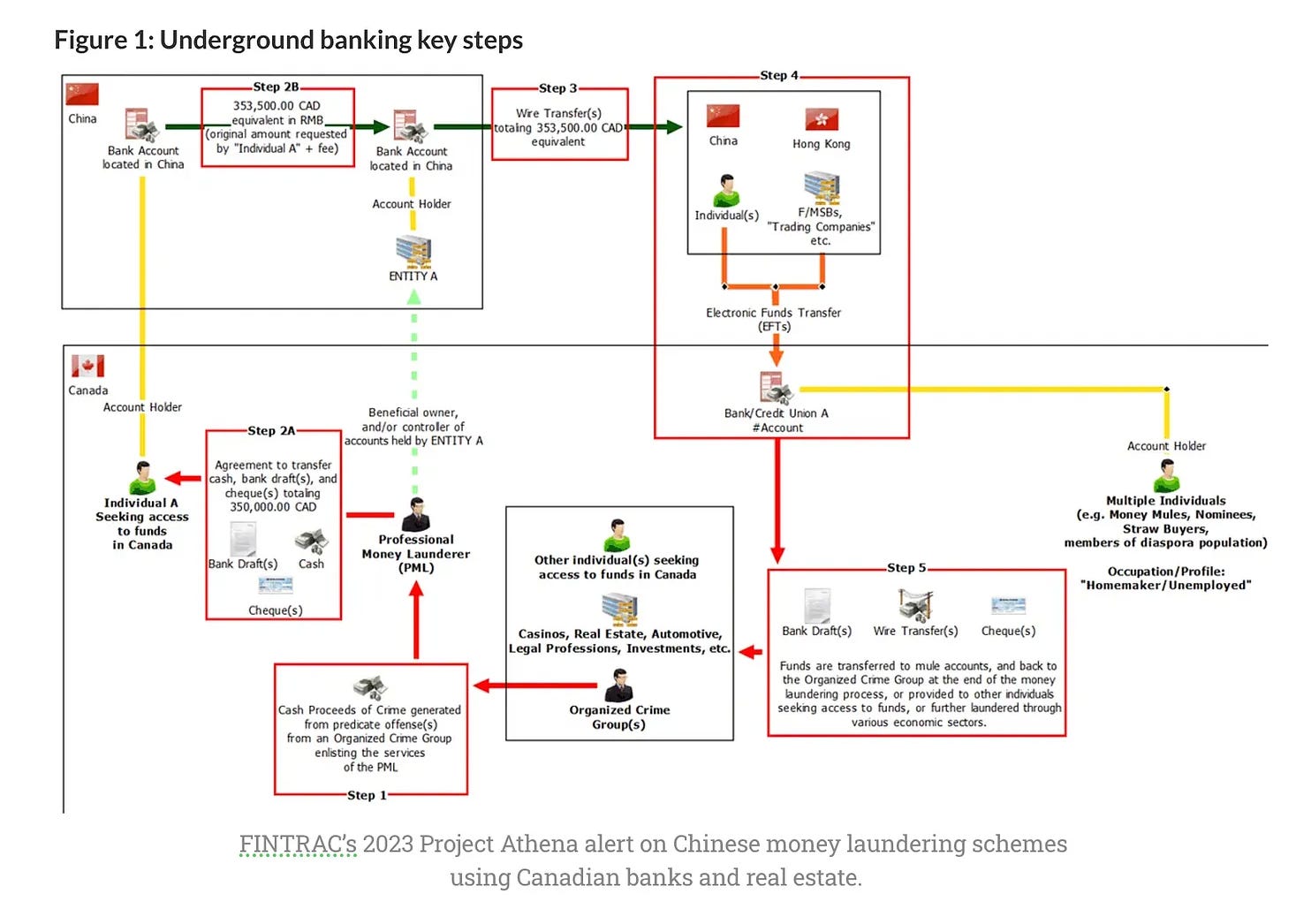 Vancouver Real Estate Horror Story: How Author Jesse Ferreras Turned a Broken Housing Market into Gothic Fiction | In today’s Bureau Podcast, I reconnect with my former journalism colleague Jesse Ferreras. We both came of age as reporters in Vancouver and worked together at Global News, including on an investigation into some of the most significant figures in what became known as the Vancouver Model. We don’t walk through those cases in detail on the tape, but I’ve long believed some of the people we examined could and should be the focus of deportation orders from Canada — if Ottawa’s border and security agencies fully exercised their mandates. Quietly resolving those long-ignored files would, in my view, go a long way toward rebuilding trust with Washington, where officials remain deeply concerned about certain actors embedded in Vancouver’s financial and real-estate systems.Our conversation turns on two main threads. First, we explore Jesse’s new work of fiction — a gothic horror story set in Vancouver real estate, a kind of clash-of-civilizations tale rooted in the city’s housing market. Second, we talk about how both of us, as reporters, leaned heavily on the data and analysis of B.C. urban planner Andy Yan to understand how foreign capital has dominated and distorted Vancouver’s housing market. Yan’s work on glaring income-to-home-price “incongruities” helped me see that what I once called the Vancouver Model had grown into something much larger: the “Canada Model.”The podcast goes deeper into Jesse’s story. Here in the notes, I want to unpack a bit more of Andy Yan’s seminal research, and how it intersected with confidential datasets and banking disclosures I later obtained. Two years after my 2023 investigation, the U.S. Treasury has now identified the same global Chinese underground money-laundering typologies I reported on, in a major dataset that tracks roughly $300 billion in Chinese money laundering for Mexican narco-cartels over the past four years—including more than $50 billion tied to real-estate laundering.Yan’s earlier Vancouver mortgage work supported my deep dive in Toronto, showing that the same suspicious Chinese real-estate mortgage patterns he identified in Vancouver had also become deeply embedded in eastern Canada, inside Canada’s largest banks, with virtually no enforcement response. My reporting also drew on FINTRAC’s release of a sweeping analysis of 48,000 transactions involving members of the Chinese diaspora. That study revealed massive wire transfers from Hong Kong and Mainland China moving through “money mule” accounts held by students, homemakers, and shell companies—including law firms. In a nutshell, FINTRAC found that during the pandemic, massive money laundering through Vancouver-area government casinos evolved into Canadian bank accounts, law office accounts, real-estate developer accounts, and more complex electronic transaction paths. For me, the findings showed that FINTRAC, a division of Canada’s Ministry of Finance, had complete visibility into how Canada’s banking system was being exploited at scale by Chinese transnational crime networks. At the same time, this raised serious alarms about Canada’s banking oversight, because FINTRAC’s data led to no Canadian police prosecutions and only a few minimal fines in the range of millions against several banks, including TD Canada. FINTRAC’s patterns overlapped neatly with the U.S. Justice Department’s US$3-billion TD Bank case, where international students from China and Beijing-linked United Front networks played central roles in laundering drug proceeds, according to former U.S. investigator David Asher.At the heart of my exclusive story on mortgage fraud was reporting sourced from an HSBC Canada whistleblower, who uncovered dubious Toronto-area mortgages propped up by fabricated, high “remote-work” salaries from China. The types of mortgages the whistleblower discovered—fake job titles, faked massive incomes, failed banking due diligence—in my analysis, explained the patterns behind the data that Andy Yan first uncovered in Vancouver, that FINTRAC examined in 2023, and that the U.S. Treasury flagged again in 2025.The Bureau is a reader-supported publication. To receive new posts and support my work, consider becoming a free or paid subscriber. This is a public episode. If you'd like to discuss this with other subscribers or get access to bonus episodes, visit www.thebureau.news/subscribe | 26m 09s | ||||||
Showing 25 of 91
Pitch Fit is a Pro feature
See how bookable this show is for guests, which brands already advertise, the per-episode ad value, and the best-fit guest and sponsor profile. The numbers are blurred on the free plan.
How readily this show books outside guests like you.
How proven this show is for host-read sponsorships.
For Guests
ProFor Advertisers
ProUpgrade to Pro to unlock guest cadence, sponsor categories, fit scores, and per-episode ad value for this show.
Chart Positions
2 placements across 1 market.
Chart Positions
2 placements across 1 market.