

Insights from recent episode analysis
Audience Interest
Podcast Focus
Publishing Consistency
Platform Reach
Insights are generated by CastFox AI using publicly available data, episode content, and proprietary models.
Most discussed topics
Brands & references
Total monthly reach
Estimated from 1 chart position in 1 market.
By chart position
- 🇵🇹PT · Christianity#883K to 10K
- Per-Episode Audience
Est. listeners per new episode within ~30 days
900 to 3K🎙 Daily cadence·60 episodes·Last published today - Monthly Reach
Unique listeners across all episodes (30 days)
3K to 10K🇵🇹100% - Active Followers
Loyal subscribers who consistently listen
1.2K to 4K
Market Insights
Platform Distribution
Reach across major podcast platforms, updated hourly
Total Followers
—
Total Plays
—
Total Reviews
—
* Data sourced directly from platform APIs and aggregated hourly across all major podcast directories.
On the show
From 24 epsHosts
Recent guests
Recent episodes
Becoming Relics
Jun 25, 2026
Unknown duration
What Does Love Look Like?
Jun 24, 2026
Unknown duration
Two Views on Just War Just-War Reflections Randall Smith Outdated or Obsolete? Luis Lugo
Jun 23, 2026
Unknown duration
Can the Catholic Church Save Education?
Jun 22, 2026
Unknown duration
A Perfect Model of Fatherhood
Jun 21, 2026
Unknown duration
Social Links & Contact
Official channels & resources
Official Website
Login
RSS Feed
Login
| Date | Episode | Topics | Guests | Brands | Places | Keywords | Sponsor | Length | |
|---|---|---|---|---|---|---|---|---|---|
| 6/25/26 |  Becoming Relics | By Stephen P. White As you surely know, not least because it has been mentioned repeatedly in these pages, the bishops of the United States, in preparation of the celebration for the 250th anniversary of the Declaration of Independence have consecrated the entire nation to the Sacred Heart of Jesus. No doubt you also know, faithful readers of The Catholic Thing, that the image of the Sacred Heart was revealed by Jesus himself to a 17th-century French nun named Margaret Mary Alacoque. If you didn't know this before, you probably learned it just yesterday from Msgr. Charles Fink's wonderful reflection on how holy images, including the Sacred Heart, can captivate the imagination and so move us toward greater devotion. What you may not know, but should know, is this: the major relics of St. Margaret Mary Alacoque, the Apostle of the Sacred Heart, are coming to our nation's capital just in time for the Fourth of July. They will be available for public veneration at the Saint John Paul II National Shrine in Washington, DC, from June 29th through July 4th. I mention this for several reasons. First, I mention this because I work at the Shrine and I would like very much for everyone who is able to come venerate these relics. But I also mention it because, as Msgr. Fink observed in regard to holy images yesterday, I believe Catholic veneration of relics offers a path to deeper devotion. Venerating the holy bodies of the saints is a powerful antidote to the Gnosticism of our disembodied age. Relics are a powerful reminder that we are all, as it were, in the same story. Any ancient artifact can, on a natural level, remind us that we are all carried along in the same stream of time: you, me, George Washington, Cleopatra, and Nebuchadnezzar. We can throw in the mastodons and the dinosaurs while we're at it. But saintly relics are more than mementos, more than fossils or museum pieces – as fascinating as those objects may be. Relics remind us both of the fact of our mortality and of precious exemplars of holiness and devotion. And they remind us of the promise of resurrection. Relics remind us that the working of grace is neither sporadic nor sparse, but suffuses all of human experience across time and space. Relics remind us that we are bound together in the same great drama which has been unfolding, under God's providence, through all of history. In this way, holy relics of the saints make present to us those who share our same mortal fate and immortal destiny. Above all, relics are sacramentals, which is to say they are not merely reminders of something interesting or moving; they bring about spiritual effects in imitation of the sacraments themselves. Yes, there is something slightly weird, a little macabre, and even, dare I say, Gothic about our Catholic relics (as a recent visit to the Capuchin "bone church" in Rome reminded me). It's also the sort of thing we who claim to believe in the reality of the Incarnation ought to do. And it's precisely the sort of thing that we, who profess to "look forward to the resurrection of the dead" ought to do! The saints, of course, are not disembodied abstractions or ideas. They are neither angels nor mere memories. Saints were flesh and blood and bone – just as God himself was in Jesus Christ. They were real people who lived and died in concrete times and places. Moreover, the saints, God's holy ones, are very much alive in Christ for, as our Lord himself insisted, "He is not the God of the dead but of the living." This is why the veneration of relics is such a good thing. The bodies of the saints are the bodies of those who are united in Christ, who have died in Christ and who will rise in Christ. The saints, in their earthly lives, brought God's love into the world through their bodies. And they continue to be instruments of God's grace now that those saints have been raised to eternal life. As Jesus said to St. Margaret Mary Alacoque, His work is carried on through His servants, His love is ... | — | ||||||
| 6/24/26 |  What Does Love Look Like? | By Msgr. Charles Fink It's a commonplace observation that most people think more readily in pictures than in abstract concepts, and that stories move and transform us in ways that logical arguments often don't. God, who of course knows this, therefore has revealed Himself to us, as C.S. Lewis put it, by writing Himself into a part in our story – at once author of the whole and character in the play, so to speak – and over the centuries, bequeathing to us a series of vivid images that, as the saying goes, are worth thousands of words. Three of these images, or pictures, are closely related, even though great swaths of time separate the production of each by the Divine Artist. The first and most ancient is the Crucifix, depicting the death of Christ on the Cross. How odd that it adorns our churches, our homes, even our persons, symbol as it is of such tragic human inanity and brutality and a reminder of what we're all capable of in our worst moments. And yet a reminder, too, of God's willingness out of incomprehensible love to absorb all that the worst in us can dish out rather than use His infinite power to give us what we deserve. What we have here, then, is a symbol of inexpressible love and mercy on God's part and unconscionable sin on ours. Can we learn more about God and human nature by contemplating the Crucifix than by reading dozens of theology and psychology books? But God is also aware of our fathomless capacity to take even the best gifts for granted and to trivialize even things most sacred and profound, not to mention the variety of human temperaments that make one picture transformative for some, less for others. Many centuries after Christ was crucified, and with crucifixes being everywhere by then, Jesus appeared to a simple Visitation nun in 17th-century France. What he revealed to St. Margaret Mary Alacoque was the image of his Sacred Heart, ringed with thorns, cross-crowned, a gash, the result of the centurion's spear, all aflame with love. He answered the rigorism and gloom of the Jansenist heresy with a picture. It told the same story as the Crucifix, and still does, but with a different emphasis, directing our attention even more clearly to Christ's sacrifice as an act of love, taking pity on humanity's waywardness and insensibility. Our bishops just consecrated the United States to the Sacred Heart of Jesus in preparation for the 250th Anniversary of our Founding. If this leads to nothing but a renewal among our Catholic people of devotion to Jesus' sacrificial Heart and our more faithfully living out the Two Great Commandments, the Church and the nation would surely be much better off. I wonder if even our Protestant brothers and sisters might profit by adopting this visual reminder of our Lord's love. In some circles, they already seem less hostile than in the past to Catholic sacramentals, e.g., in the distribution of ashes at the beginning of Lent. Why not the Sacred Heart? How could it hurt? In between the two great wars of the 20th century, God painted a third picture revelatory of His love and mercy. In 1931, the recipient of the revelation was a cloistered nun named Faustina Kowalska, subsequently canonized by Pope John Paul II, the first saint of the third millennium. In fact, John Paul II was more than anyone else responsible for making St. Faustina's Diary widely known – and for devotion to the Divine Mercy becoming one of the most popular Catholic devotions in the contemporary world. There are five elements to it: the second Sunday of Easter as Divine Mercy Sunday, the Divine Mercy Novena, the Hour of Mercy (3 p.m., the hour Jesus died on the Cross), the Divine Mercy Chaplet, and the Divine Mercy Image. This last is the complement to the aforementioned images and the gentlest and subtlest in communicating the message of God's love and solicitation toward us – and a reminder of our desperate need for His mercy. Harsh wounds do not appear in the Divine Mercy Image, and the brutality that inf... | — | ||||||
| 6/23/26 |  Two Views on Just War
Just-War Reflections
Randall Smith
Outdated or Obsolete?
Luis Lugo | By Randall Smith and Luis E. Lugo The next synod might or might not deal with the Church's "just war" doctrine. So, let me go on record as saying: I don't like war. It doesn't represent a great "profile in courage" to say that. I mean, who loves war? I suppose some tyrants do. But that poses a problem. If tyrants pursue wars in order to secure their positions of power, what are others who hate war to do? The Church has long defended the legitimacy of wars of self-defense. But recent proclamations from certain sectors of the Church seem to verge on pacifism, the view that all war is wrong. Perhaps this simply means all aggressive wars by tyrants are wrong. That would not be a new or especially troubling teaching. It would be a welcome change if we could get tyrants to abide by the principle. But I am still wondering about other possible causes of war. So, for example, the United States went to war against England in 1812 for a number of reasons, but chiefly because the British Navy would stop U.S. ships at sea, search their crews, and "press" into service on British ships anyone who couldn't prove U.S. citizenship. Attempts to escape would be punished by severe whipping or even hanging. To state the matter overly simply: the U.S. government demanded that this kidnapping of American sailors stop. The British refused. War ensued. Was going to war to stop British enslavement of American sailors immoral? War is bad, but so was essentially kidnapping American sailors and forcing them to serve on British ships. Here's another conundrum. Let's say that Adolph Hitler had not attacked Poland or France. But now let's say it became known that the Nazis were exterminating millions of Jews. Would that justify an offensive attack on Germany to stop the killing? Or would any offensive declaration of war that was not in response to an attack on one's own country be "immoral"? Now again, I don't like war, but I also want to be aware of what those who lost people in the Holocaust would likely (and legitimately) say if we insisted that, "No, going to war to save millions of Jews from extermination would not be justified." Really? Hitler marches his armies into Poland, and the world goes to war. But if he was just killing Jews, no? Reasoning of this sort seems to have prevented "civilized" countries, like the U.S., from "intervening" when Hutus in Rwanda were slaughtering millions of Tutsis. They haven't attacked us, and we don't like war, so, although we don't like it, there's really nothing we can do. Maybe that's true. But I would at least want a serious discussion of the pros and cons. Here's another quandary. Let's say Hitler had not attacked any countries in Europe (yet), but he was threatening, and it became known that he was developing an atomic bomb. Would the European powers have been justified in attacking him to stop that development? Should attacking Nazi Germany to forestall Hitler getting an atomic weapon be rejected a priori based on the notion that all offensive wars are per se immoral? Maybe. But I'm glad I'm not the one who has to make those decisions (which admittedly is a pretty cheap cop-out). As a general rule, I admire pacifists, especially when they're like Desmond Doss, the combat medic who refused to carry a weapon but became the first conscientious objector to be awarded the Medal of Honor after single-handedly saving the lives of 75 to 100 wounded soldiers under heavy fire during the Battle of Okinawa. Or when they're like the townspeople of Le Chambon in France who conspired together during the Second World War to hide and save thousands of Jewish refugees fleeing from the Holocaust. They too risked everything. What is harder to admire are the pacifists whom author Philip Hallie criticizes in an essay on Le Chambon — those who "keep their hands clean" but let the powerful tyrannize the less powerful. "Too often I had found nonviolent people to be too patient," writes Hallie, "patient with the murder of others. They... | — | ||||||
| 6/22/26 |  Can the Catholic Church Save Education? | By Robert Royal There's a strange ferment underway in American education. This week, two promising Catholic initiatives emerged: a gathering at Christendom College on K-12 education that resulted in the Front Royal Principles, and a high-level consultation in Washington D.C. organized by the Cardinal Newman Society, pursuing the renewal of everything from kindergarten to college-level Catholic instruction. But in recent months, there have been similar efforts for education renewal at secular universities: one from Yale – yes, Ivy-League Yale – addressing the "lack of trust" in higher education, and another convened jointly by Vanderbilt and Washington Universities over the crisis in the humanities. Among the various aims of these studies, the common concern is that much modern education, Catholic and not, is not working and needs to be different – and better. Meanwhile, the U.S. Department of Education – an unconstitutional agency (education is not among the "enumerated powers" allotted by the Constitution to the Federal government) – is downsizing and offloading various activities to other agencies. The DOE's enormous bureaucracy and budget ($250 billion a year) couldn't help doing some good over the decades, of course. But since it got "woke," it has also trespassed constitutional limits intended to prevent precisely such abuses: politicizing learning and inserting itself into everything from obsessing over racism in U.S. history to pushing LGBT activism. The Yale report (here), written by a faculty committee, provides a kind of skeleton key to everything else. Many people today lament the politicization and bias in university education. What's not so common is an actual effort to understand – and do something – about a problem that you almost have to willfully choose to ignore. The report was prompted by the need to "regain trust" at a time when high tuitions and dubious campus politics have led many to question the value of education, even at prestigious institutions like Yale. And given the "demographic cliff" – the smaller numbers of young people who are now turning college age – institutions of higher learning need all the help they can get just to survive. Yale's president emphasized several salient findings, beginning with "trust needs to be earned." She pointed out the need for a rigorous admissions process – even the best universities are finding more and more students incapable of basic reading and thinking. On campus, students often don't discover openness in classroom discussions: "echo chambers do not produce the best teaching, research, or scholarship." Self-censorship results. And grade inflation has further distorted undergraduate study. The committee rightly recommended renewed attention to the liberal arts, the "foundational wisdom. . .that will serve [students] throughout their lives." But as the Vanderbilt-Washington University study found, the liberal arts are themselves currently in crisis not least because of a "deterioration in scholarly standards." It was written by professors drawn from several distinguished institutions who were careful to point out that there's much good work still being done by their colleagues. But it allows there's some truth in the widespread complaint that standards have been: distorted within these disciplines both to privilege work on topics that are taken to be relevant to social justice, and…designed to ensure that only politically acceptable work is published, taught, and valorized. The result of this distortion…is an academic ecosystem in which much of what passes as scholarship in the humanistic disciplines is in fact a mix of tendentious, biased research, feeble academic agitprop, and jargon-laden nonsense. Both studies propose reasonable remedies, too reasonable given the depth of the crisis, whose source – and remedy – lie elsewhere. If there is a solution, it may have to come from the institution that created the university with its emphasis on the proper study... | — | ||||||
| 6/21/26 |  A Perfect Model of Fatherhood | By St. Pope John Paul II Excerpted from Address of John Paul II to the members of the Pontifical Council for the Family, June 4, 1999 The theme of fatherhood, which you have chosen for this plenary meeting, refers to the third year of preparation for the Great Jubilee, dedicated precisely to the Father of our Lord Jesus Christ. It is worthwhile reflecting on this theme, since in today's family the father figure is in danger of becoming more and more hidden or even absent. In the light of the paternity of God "from whom every family in heaven and on earth is named" (Eph 3:15), human fatherhood and motherhood acquire all their meaning, dignity, and greatness. "Human fatherhood and motherhood, while remaining biologically similar to that of other living beings in nature, contain in an essential and unique way a 'likeness' to God which is the basis of the family as a community of human life, as a community of persons united in love (communio personarum)." (Gratissimam sane, n. 6) We can still hear the vivid echo of the recent celebration of Pentecost, which moves us to proclaim with hope St. Paul's affirmation: "All who are led by the Spirit of God are sons of God." (Rom 8:14) Just as the Holy Spirit is the life of the Church (cf. Lumen gentium, n. 7), he must also be the life of the family, the little domestic church. For every family, he must be the inner principle of vitality and energy, which keeps the flame of conjugal love ever burning in the spouses' reciprocal gift of self. It is the Holy Spirit who leads us to the heavenly Father and enables the trusting, jubilant prayer "Abba, Father!" (Rom 8:15; Gal 4:6) to rise from our hearts. The Christian family is called to be distinguished for its atmosphere of shared prayer, in which God is addressed with the freedom of children and called by the affectionate name of "our Father"! May the Holy Spirit help us discover the Father's face as a perfect model of fatherhood in the family. For some time now, the family institution has been under repeated attack. These attacks are all the more dangerous and insidious since they ignore the irreplaceable value of the family based on marriage. They have reached the point of proposing false alternatives to the family and of calling for legislative recognition of them. But when laws, which should be at the service of the family, a fundamental good for society, turn against it, they acquire alarming destructive power. Thus, in some countries, there is a desire to impose on society so-called "de facto unions," reinforced by a series of legal effects which erode the very meaning of the family institution. "De facto unions" are marked by instability and the lack of the irrevocable commitment which gives rise to rights and duties and respects the dignity of the man and woman. Instead, there is a desire to give juridical value to a will that is far removed from any form of definitive bond. With these premises, how can we hope for truly responsible procreation which is not limited to giving life, but also includes that training and education which only the family can guarantee in all its dimensions? Arrangements of this sort ultimately put the meaning of human fatherhood, of fatherhood in the family, seriously at risk. This happens in various ways when families are not well established. When the Church explains the truth about marriage and the family, she does not do so only on the basis of the data of Revelation, but also by taking into account the demands of the natural law, which are at the foundation of the true good of society and its members. In fact, it is important for children to be born and raised in a home where parents are united in a faithful covenant. It is quite possible to imagine other forms of relationship and cohabitation between the sexes, but none of these, despite some people's contrary opinion, offers a real juridical alternative to matrimony, but rather a weakening of it. In the so-called "de facto unions," we see a more o... | — | ||||||
| 6/20/26 |  Of Jesus and Life at the Bottom | By Auguste Meyrat Among the greatest challenges that Jesus poses to His disciples are His prescriptions on wealth. On the one hand, Jesus extolls poverty. He begins the Beatitudes with the declaration, "Blessed are the poor in spirit, for theirs is the kingdom of heaven." Elsewhere in the Gospels, He tells a rich man to give away all his possessions since "it is easier for a camel to pass through the eye of a needle than for someone who is rich to enter the kingdom of God." On the other hand, Jesus also acknowledges the need for productivity, especially in the parable of the talents, where the third servant is punished for not generating a profit with the one talent with which the master had invested him. Jesus also recognizes the need to pay taxes to Caesar ("Render unto Caesar what is Caesar's") and even does so Himself without complaint. Christians have traditionally reconciled these two views by treating money as a means and not an end. You should indeed work and produce wealth, but must never idolize money or fall into greed. Unfortunately, instead of maintaining this balance, Catholic progressives (among others) now idolize the poor and condemn wealth. They, therefore, ignore the actual causes of poverty (social and political dysfunction, lack of education, indolence, addiction and vice, etc.), and focus their ire on the ultrawealthy and capitalism because this fits a false political "narrative." The main problem with this view, however, is that it frames poverty as a material rather than a spiritual phenomenon. In truth, behind every rich tycoon and penniless pauper is a story that involves certain beliefs, values, and perceptions, i.e., the immaterial part of themselves. To better understand this dynamic, one would do well to read Theodore Dalrymple's modern classic Life at the Bottom: The Worldview That Makes the Underclass. As a psychiatrist working in the slums and prisons of England, Dalrymple was close enough to see what really afflicts the poor. It is usually not various systems of "oppression," the lack of economic opportunities, or the rise in CO2 levels; it's more often an attitude that rejects discipline, gratitude, and personal agency. Of course, Dalrymple recognizes that this mindset does not arise spontaneously, but has been inculcated by popular media, public education, and ideologues and demagogues. Growing up in unstable households, rife with domestic abuse, alcoholism, and criminal neglect, the children who make it to adulthood are completely unequipped to cope with reality and blame others for their problems. They cannot control impulses, work a steady job, or make sacrifices. Many of them cannot read, write, or do arithmetic, and few of them are part of a religious community. As a result, hardly anyone in this class has a moral compass to guide them. When Dalrymple talks to a group of murderers in a prison where he worked, he notes they were "so convinced of the gross injustice of the world that they were convinced also that nothing they did themselves could add significantly to its sum." This distorted moral outlook also comes out in many stories of women staying with abusive and unfaithful men because they learned to equate love and commitment with lust and wrath: "In the absence of a marriage ceremony, a black eye is his promissory note to love, honor, cherish, and protect." Many souls are thus condemned to live in squalor in an otherwise developed country like England. The men end up unemployed and frequently in prison; the women have children out of wedlock and continue coupling with different partners; and the children internalize the chaos around them, forming gangs, bullying others, and committing crimes with impunity. Sadly, this situation is only made worse by the poor's supposed champions in the British upper classes. Like their counterparts in America, they call for more welfare payments, more social services, more subsidized housing, and less policing. They believe that poverty is de... | — | ||||||
| 6/19/26 |  Whatever Happened to Natural Law? | By Richard A. Spinello There are many crises in the Catholic Church today, but one of the most serious is the dismal state of moral theology. That crisis has its roots in the confusion and intellectual ferment that ensued in the aftermath of Vatican II. Progressive moral theologians proposed questionable moral theories like proportionalism and the "fundamental option," while prominent scholars like Bernard Häring dissented on vital issues of received moral teaching such as the inadmissibility of contraception and the indissolubility of marriage. These dissident theologians had differing visions, but one common theme: the Church had no authority to proclaim specific, exceptionless moral norms based on natural law. The best it could do was to teach formal moral principles. Specific moral precepts such as "adultery is always wrong" are highly problematic, in their view, because there may be valid exceptions. A corollary is the autonomy of conscience along with "discernment" in making moral decisions. In place of natural law, they recommended more flexible theories that allow for moral compromise in some situations. John Paul II sought to correct these errors in his encyclical Veritatis splendor. The fundamental option, proportionalism, the sovereignty of conscience, and moral subjectivism – all the heterodox doctrines – were thoroughly refuted through principled reasoning. He also reaffirmed the Church's commitment to natural law and its anthropological premise of a common and fixed human nature that is a bridge to that law. Intrinsic goods such as life and health, marriage and friendship, constitute our human flourishing. A set of moral norms flows from the first precepts of the natural law and prohibits intrinsic evils such as adultery or the taking of innocent life. For a time, it looked like the philosopher-pope had succeeded in his herculean effort to renew moral theology. But then came the papacy of Pope Francis, which consistently sought to dethrone the principles of traditional natural law theory. Archbishop Vincenzo Paglia admits as much in his recent interview, "My Reforms with Francis." He recounts how Pope Francis dispatched him to reinvent the John Paul II Institute in Rome to overcome the rigid and moralistic natural law framework that was at the center of the curriculum. What was necessary, declares Bishop Paglia, "was the rethinking of the concept of 'nature,' which underpinned a static and immutable vision of the natural law, and with it the questioning of the essentialist and ahistorical paradigm that had supported. . .moral theology." Pope Francis' Amoris Laetitia was an attempt to move in this direction, and it replaced Veritatis Splendor as the guiding text at the JPII Institute. Pope Francis' encyclical clearly sides with the progressive wing of the Church on issues like intrinsic evil. In chapter eight, he explains: It is reductive simply to consider whether or not an individual's actions correspond to a general law or rule, because that is not enough to discern and ensure full fidelity to God in the concrete life of a human being. . . .It is true that general rules set forth a good which can never be disregarded or neglected, but in their formulation they cannot provide absolutely for all particular situations. (304) The relevant "general rule" is Jesus' prohibition against remarriage for someone divorced from his or her spouse because it is tantamount to adultery. But Amoris laetitia clearly does not consider this rule to be exceptionless, nor does it consider adultery to be an intrinsic evil, something always, objectively, wrong and harmful even if there is no subjective culpability. Since Amoris Laetitia, there have been many other assaults on traditional natural law and absolute moral norms. During an international conference on moral theology at the Gregorian University in Rome, the keynote speaker, Father Julio Martinez, spoke about the need to "untie the knots Veritatis splendor made in moral th... | — | ||||||
| 6/18/26 |  Faith in Space | By Michael Pakaluk During the high point of investment clubs – back in the dark ages, long ago, in 1998! – mom and pop investors would gather and use a tool such as the NAIC's "Stock Selection Guide," to pick stocks based on a ten-year record of sales, earnings, and profitability. These sober "retail investors" wouldn't even look at a prospectus. A newly launched company was simply too speculative. They were looking for long-term plays, as reliable as interest on deposits, but with better returns. Their problem was not, "How do we make 20 percent in a few days?" but "What company deserves our hard-earned money, if we do not spend it on household needs?" But if such folks had considered an "initial public offering" (IPO), they would have regarded it as insane not to study the prospectus. Remember what a prospectus is? After the stock market crash in 1929, Congress mandated that any new company raising money from the general public needed to file a report ("S-1") detailing its business plan and risks, with audited financial statements. One might naively suppose that corresponding to a company's duty to file such a report is the public's duty actually to read it. But no one does, in a world where, in an instant with a smartphone, you can bet via Kalshi as to who wins the next game or next election. Surely, a "Catholic ethics of investing" begins with sobriety. Does a prospectus perhaps deserve greater weight when demand for a company's stock seems absurdly high, given the fundamentals – as in the case of Elon Musk's SpaceX? It's trading at more over 100x its trailing sales (sales, mind you, not earnings, because so far it is not profitable), and its leverage is high. And yet as of yesterday it had become the fifth most valuable public company by market capitalization, only behind mega-giants like Nvidia and Apple. The size of its IPO was so disproportionately great that it must say something about our character and even our civic religion. To get a sense of the size: if the previous largest IPO were a city bus, the SpaceX IPO would be an Airbus jumbo jet. Its prospectus also seems important because of the governance of SpaceX. Shareholders are shut out from suing the company, and Elon Musk controls 85 percent of the votes. Therefore, to buy SpaceX is effectively to hand money over to Elon Musk. His vision governs. And his vision is in the prospectus. The whole spectacle looks so bizarre to me that I want to ask what religious belief, what faith, is inspiring it. Faith in a "paradigm shift," not surprisingly: "We believe the next paradigm shift for humanity is the creation of a resilient, perpetually expanding spacefaring civilization that drives continuous innovation across new frontiers, ultimately propelling us to Kardashev Type II status – we believe we are capable of unlocking an era of unprecedented economic expansion, while also contributing to the safeguards of humanity's future against existential risk." Kardashev was a Russian scientist who ranked civilizations as more or less advanced, not on the basis of their philosophy or art, but rather on how extensively they harnessed the energy of their local sun, or even their entire galaxy. The prospectus in many places reads like a religious tract, not a plain business plan. It has two sections entitled "Why This Matters Now," with language like this: For the entirety of its existence, human civilization has lived on a single celestial body: Earth. The current paradigm, in which human civilization is confined to one planet, exposes humanity to existential threats that are unpredictable and uncontrollable on a planetary scale. These threats include naturally occurring catastrophic events – such as asteroid impacts, volcanic activity, or solar fluctuations – as well as man-made global conflicts. Geological and astronomical records indicate a non-zero probability of extinction-level events occurring over periods measurable in millions of years. Reliance on a single planetary ... | — | ||||||
| 6/17/26 |  A Brief Note on Consequences | By Francis X. Maier On a cool October evening some years back, a young woman – let's call her Jenny, age 18 – checked into St. John's Hospital in Santa Monica and gave birth to a baby boy. Her friends had urged her to have an abortion. So did her boyfriend, Jack, also 18, who waited with us now outside the delivery room, his eyes red with feelings he didn't expect and couldn't put a name to. I sat next to him and listened while he explained that yes, he really loved Jenny, but it just hadn't worked out. He drank too much. He liked to fight. He couldn't hold a job. And now he was in trouble with the law for driving his car through the plate-glass front window of a gas station, boozed to oblivion. The idea of being a dad – well, it just seemed crazy. Jenny, who'd followed Jack from the Midwest, fended off her friends through the sixth, seventh, and into the eighth month, agreeing that sure, abortion was the sensible route, and yes, she'd get the problem taken care of. And then, on a rainy afternoon, she walked into a local Catholic church instead. The priest referred her to a support group who, at her request, connected her with a young woman lawyer who did prolife adoption work. The lawyer explained some options: She knew quite a few Catholic and other Christian couples seeking to adopt. But Jenny already knew what she wanted. A week or so later, the phone rang in our home. What I remember most about the next few weeks is Jenny's courage. She had no money. She loved Jack but had no illusions about building a life with him. Her friends thought she was a fool for putting herself through the birth and never showed up at the hospital. Her family back home in Wisconsin didn't even know where she was. Yet in the midst of her turmoil and anxiety, and completely alone, she focused on just one thing: giving her baby a chance to live. Why Jenny chose us, or more specifically my wife Suann, was simple. She'd seen Suann on local TV talking about the humanity of the unborn child. What moved Jenny was some grace or goodness that she sensed, correctly, in my wife – qualities Jenny herself shared. She could have turned her baby into a profit; many other good couples were eager for a child and could pay. Instead she went with two people who were living month to month on writing and odd jobs. We had to borrow the money for her hospital bill. The doctor and lawyer, both Catholic, worked gratis. Jenny asked only for the cost of a ticket home to the Midwest. Looking back, all this sounds implausible. But it happened. In the hospital waiting room, that autumn night, a nurse finally came along to fetch my wife and me. And in that moment, the roads that had briefly brought us together with Jack – the baby's natural father – parted ways. He grabbed my hand and thanked us, but stayed behind. We went ahead to meet the newborn. When we came back later, he was gone. We never saw him again. As for the baby: Well, as the days flowed on into the first months of his life, and we held and played with him night after night, our unexpected gift from God, he seemed (at least to me) to have his mother's eyes, the eyes of the mother who would raise and love him – my wife's eyes. All of the above happened nearly half a century ago. Our son is a grown man now. He has a good job, a gifted, beautiful wife, a ferociously talented son of his own, and a daughter, Veronica, who owns his heart. "Vero" is wheelchair bound. She was born severely disabled. She can't speak. She can't feed or clean herself. Yet beneath those burdens is a being with a distinct personality, a young woman with a forever purpose in the mind of God, conscious of the world, with her own likes and dislikes, joys and frustrations. Now 21, her smile can light up the room. Her displeasure can be equally vivid. But she knows that she's loved, and watching the everyday devotion – the unapplauded heroism – of her parents is a master class in what it means to be human for anyone who enters the family's orb... | — | ||||||
| 6/16/26 |  Who is a Christian? | By Anthony Esolen The Department of Defense recently made waves over a decision to remove Mormons from the category of "Christian," to distinguish more clearly among the chaplains and the servicemen as to who might best minister to them in matters of faith and morals. The label seems to be intended as a generic marker, as the department went on to separate Catholics, Lutherans, and Pentecostals from the category also, granting each a distinct status. The decision caused a ruckus, and a lot of hurt feelings among Mormons who insist that they are Christian, and that they do look upon Jesus Christ as their Lord and Savior. I am disposed to credit their earnestness, though what their church teaches about the Father, the Son, the Holy Spirit, the angels, and other planets seems to me a jungle of nineteenth century American mysticism and utopianism. It's as if northern American religious sensibility met a fork in the road, and the Unitarians went one way, towards trading the faith for social amelioration, conventionality, and vague inner feelings, while Joseph Smith went the other way, towards myth-making and building up a society from its foundations. Which of them prevailed seems obvious. Where is the Unitarian Tabernacle Choir? The real question for Catholics is not whether Mormons are Christian, but whether all of us Catholics are Catholic, or Christian, for that matter. What is the minimal standard that divides Christian from not-Christian? It must be in answer to the question, "Who is Christ?" We have that question answered for us in Scripture. "Thou art the Christ, the Son of the living God," says Peter. (Matthew 16:16) "He is the image of the invisible God," says Paul. (Colossians 1:15) He is the Word, who was in the beginning with God, and who is God, says John. (John 1:1) Only as such can He be our Savior, rather than a merely great man whom we should emulate; though for a long time, Unitarians and their cousins the Quakers wished very much in their hearts to honor Christ as Lord, though their doctrines had demoted Him. And now, it appears, they no longer trouble themselves over it. Jesus may as well be Buddha, or Buddha be Jesus. What answers you may get from Catholics whose attendance at Mass is spotty. No doubt they will vary from nation to nation. I would like very much to believe that in Italy, the land of my forebears, the Son of God has not been relieved of His throne beside the Father, embosomed with Him in the Holy Spirit from all eternity. But perhaps I am underestimating the corrosion that sets in with the creed of humanitarian and technological progress, which must relegate even Jesus to but a stage along the way. Suppose we go farther, and, among Catholics who agree that Jesus is the Son of God, co-eternal with the Father, ask them about his full and real presence in the Eucharist. Martin Luther, I am told, frustrated with Ulrich Zwingli's anti-sacramentalism, took a knife out of his pocket and carved the words Hoc est corpus meum on the table they were sitting at, asking him, "Which of these words do you not understand?" Is the American Catholic less sacramental than Luther? Or rather, at which churches will you find such Catholics who do not embrace this teaching with full assent and joy? They either must not attend to what they are saying, or must hedge it with reservations, or must say it with an uneasy conscience when they pray, "Lord, I am not worthy that you should enter under my roof." Central to all Catholic teaching on the social life of man is marriage, inscribed in the bodily nature of male and female, instituted by God in the beginning before the Fall, and confirmed by Jesus and elevated to a sacrament that cannot be undone. Without marriage and family, there is no real society for which social teachings may be applied, just as medicine is not applicable to a body blown to bits. What we see instead among us is a wraith, a simulacrum of the social. Rifle all the assets of the rich and spread th... | — | ||||||
Want analysis for the episodes below?Free for Pro Submit a request, we'll have your selected episodes analyzed within an hour. Free, at no cost to you, for Pro users. | |||||||||
| 6/15/26 |  ‘Ars Poetica’ | By Robert Royal But first a note from Robert Royal: Thanks from the bottom of our hearts to all of you who donated to our mid-year fundraising campaign. From what we've received and what we can anticipate will still arrive, especially monthly donations, we're confident that TCT is good now for the rest of the year. So, let's carry on together! Now for today's column... The proverbial Martian visiting America in this 250th year (a whole quarter millennium) of our existence would be struck by many things. But probably by nothing more obvious than the large gap between what, on the one hand, we daily say and do – and on the other, what we would like to be. We're worried about how technologies like AI are coming to define us, but are mostly blind to how we've already defined ourselves – confined ourselves, really, even before the devices took over – to a materially prosperous but flat view of the world and ourselves. The Church, in recent years, has been trying to compensate with terms like Dignitas infinita and Magnifica humanitas, concepts that, in their argumentative way, do try to get at the problem. But they fall well short because what we desperately need now is not yet more arguments, but serious and artful poetry. The incomparably great Dante Alighieri already understood all this at the beginning of his Paradiso: Trasumanar significar per verba non si poria; però l'essemplo basti a cui esperïenza grazia serba. To transhumanize in words Cannot be done; but let the example suffice For those whom grace reserves the experience. (RR trans.) It's been said by some scholars that, by some inexplicable inspiration, Dante invented this idea of "transhumanism." Perhaps so. But he certainly meant something different, something Christian, by it, unlike the grotesque transmodern projections emanating from the thickets of AI in our day. And nota bene: he recognized several deep questions as well, even as he was embarking on writing a poem about the only realm in which we achieve real happiness, a state for which the term human "dignity" is a pale and distant shadow – as if we were all merely Victorian ladies and gentlemen claiming a decorous position in polite society. But we are His sons and daughters. Christianity, which is to say the truth about human existence, is much more fierce, and on a wholly different plane, than that. And to grasp that truth at all requires considerable skill, indirection – and poetry. (See Emily Dickinson's "Tell all the truth but tell it slant.") Dante Alighieri by Giotto di Bondone (attributed), c. 1333-37 [Cappella del Podestà of the Bargello Palace, Florence: source: Wikipedia] We need arguments, of course, to keep from falling into "subhumanism." And to prevent poetry from turning into sentimentality or idolatry. And also to remind us that what exceeds human reason is not, therefore, irrational, but participates in something that, beyond us, paradoxically makes us more ourselves. Because it brings us into the presence of the Truth beyond truths. This has long been understood in the Christian tradition. Modern rationalism and scientism see the transcendent as something unwarranted; within the Faith, that transrationalism is precisely what shows Christ's very power and truth. As St. Ambrose, who knew a few things about such matters, put it: Non in dialectica complacuit Deo salvum facere populum suum ("It pleased God to save his people not through dialectics [i.e., argument]"). His follower, the great St. Augustine, wrote Si comprehendis, non est Deus ("If you understand, it's not God.") And in more recent days, St. John Paul II urged that we rediscover a more ambitious reason, a reason that appreciates its limits and seeks answers that it needs, but goes beyond what human powers can achieve solely on their own. These can only come to us as revelation ("thoughts beyond their thought to those high bards were given") or, in its way, what we might call a kind of poetry. That few people read or value poetry... | — | ||||||
| 6/14/26 | 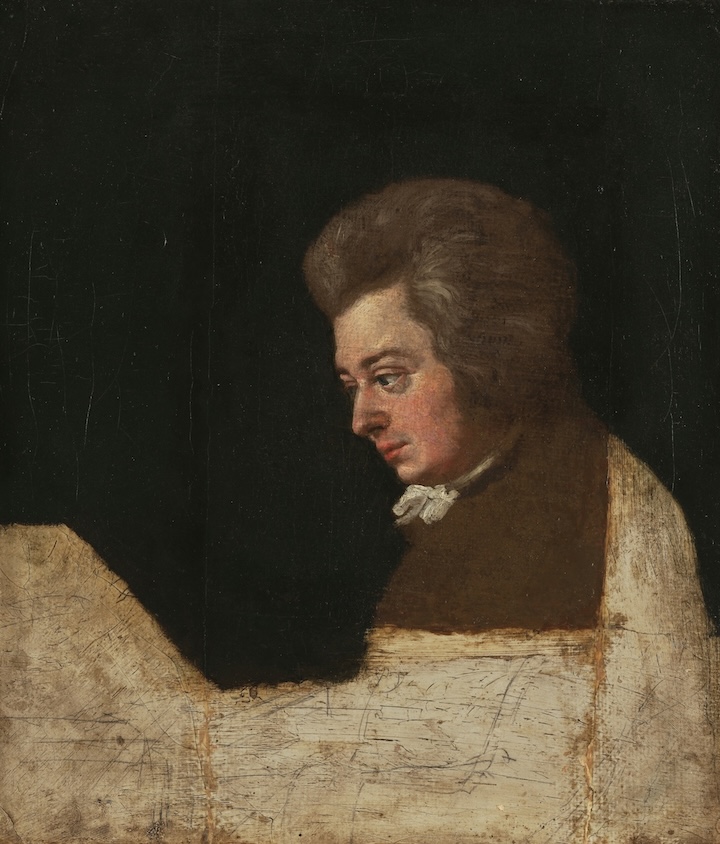 Mozart, Freemasonry, and the Synodal Way | By Brad Miner A recent, brief exhibit at the Morgan Library & Museum in New York City highlighted the life and work of Wolfgang Amadeus Mozart. J.P. Morgan, the famous financier, built his library on Madison Avenue in the 19th century as a place to house, preserve, and make available to scholars Morgan's burgeoning collection of rare books and manuscripts, among them copies of musical scores in Mozart's hand. "Wolfgang Amadeus Mozart: Treasures from the Mozarteum Foundation of Salzburg" included some of those scores and, thanks to the Mozarteum, several of the great man's musical instruments, numerous portraits of Mozart, his family, and his patrons, and many letters and other documents across the span of W.A. Mozart's all-too-brief life (1756-1791). And once again, it got me wondering about the Catholic Mozart's affiliation/flirtation with Freemasonry. More about that diversion from the One True Faith shortly, but first: Mozart the Catholic. Begin with the fact that he wrote five dozen Catholic liturgical compositions, the most famous of which is the last thing he wrote: his nearly hour-long, unfinished Requiem Mass. In my opinion, however, his most beautiful work is the four-minute eucharistic hymn, Ave verum corpus ("Hail true body"), a four-part SATB, meaning the music is arranged for four distinct vocal ranges: Soprano, Alto, Tenor, and Bass. It's lovely with orchestra and large chorus or as an a cappella quartet. Here's Leonard Bernstein conducting Ave verum corpus (and drawing, as he often did, nearly more attention to himself than to the music): In childhood, the Mozart family – Wolfgang's father (Leopold), mother (Anna Maria), sister (Maria Anna), and Wolfgang – were devoted Mass-goers. (Five other Mozart children died in infancy.) Wolfgang never really ceased being a faithful Christian. So, why – at 28 – did the genius from a devoutly Catholic family decide to join Zur Wohltätigkeit (the "Beneficence") Masonic lodge in Vienna? Well, why does Masonic imagery persist on America's currency? To the second question, the answer may be as simple as: Ben Franklin, who was a Mason and a free thinker, and (as Mr. Jefferson might say – and did say about his Declaration) Masonic ideas were "in the air" 250 years ago. In Vienna as in Philadelphia, liberty, fraternity, equality, and scientific inquiry were seemingly irresistible Enlightenment ideals, and there's no doubt their basis was largely secular, often even anti-Catholic. But it's also true that, for statesmen and artists, religious faith was rather more in their bones than simply in the air. Mozart's lodge was a social club with rituals and mysteries that parodied Roman Catholic rites. The Church had been the ground upon which the culture of the West was based. Some scholars speculate that Masonic Temples, secular in nature, were meant to be refuges from the Catholic/Protestant conflicts that had been roiling in Britain and in Europe since the 16th century (mostly settled by the Treaty of Westphalia in 1648, but still haunting regional conflicts through the religious affiliations of the combatants). The Lodge became a place where Protestants, Catholics, and men of no faith could gather in peace. Of course, Mozart and his friends may also have attended Mass on Sunday. But composing, like writing, is a solitary profession, and Mozart may have found the lodge more relaxed and congenial than church. Pope Clement XII had banned Catholics from becoming Freemasons in the 1738 bull, In Eminenti apostolatus, and the penalty for being a Mason was excommunication. None of the documents in the Morgan exhibit (nor any known to exist elsewhere) suggest Mozart read the bull and chose to ignore it. A peculiar historical fact is that Zur Wohltätigkeit was a kind of reform-Catholic lodge based upon the teachings of the liberal Italian priest-theologian Ludovico Antonio Muratori (1672-1750). Muratori was solidly Catholic in most respects but eschewed popular piety and was particularly co... | — | ||||||
| 6/13/26 |  Defeating Modernism✨ | Catholic Churchmodernism+3 | — | The Catholic Thing | — | Catholic Churchmodernism+3 | — | 6m 45s | |
| 6/12/26 |  Two Reflections on the Feast of the Sacred Heart
Now for Human Hearts and the Sacred Heart by Matthew D. Walz
And Now for A Pilgrimage to the Sacred Heart by Fr. Thomas G. Weinandy, OFM Cap.✨ | Feast of the Sacred Heartspirituality+3 | Matthew D. WalzFr. Thomas G. Weinandy, OFM Cap. | Catechism | — | Sacred HeartCatholic Church+3 | — | 12m 30s | |
| 6/11/26 |  The Consecration of the United States to the Sacred Heart✨ | consecrationCatholic Church+4 | — | Basilica of the National Shrine of Mary, Queen of the UniverseUSCCB | United StatesOrlando, Florida | consecrationSacred Heart+5 | — | 6m 41s | |
| 6/10/26 |  'Madame Bovary' and Us✨ | literatureCatholicism+5 | Casey Chalk | The Catholic ChurchMadame Bovary | — | Madame BovaryFlaubert+5 | — | 7m 27s | |
| 6/9/26 |  Beauty in the Power of the Holders✨ | beautyCatholicism+4 | David G Bonagura, Jr. | The Catholic Thing | RomeSt. Peter's Basilica+6 | beautyCatholic Church+5 | — | 6m 48s | |
| 6/8/26 |  The World as the Womb of Divine Love✨ | Christian faithdivine love+3 | Randall Smith | — | — | Christianitydivine love+3 | — | 6m 14s | |
| 6/7/26 |  Sheen Beatification Calls Catholics Back to the Eucharist✨ | EucharistCatholicism+5 | — | Catholic ChurchCatholic Thing+1 | America | EucharistCorpus Christi+5 | — | 5m 57s | |
| 6/6/26 |  Gambling with Gambling✨ | gamblingDante+4 | Daniel B. Gallagher | Divine ComedyDante | — | gamblingDante+5 | — | 7m 03s | |
| 6/5/26 |  A Still Higher Magnificence✨ | CatholicismPope Francis+4 | Robert Royal | The Catholic ThingMagnifica humanitas | — | Catholic Thingdonations+5 | — | 7m 17s | |
| 6/4/26 |  Books in Stone✨ | Church architectureCatholicism+4 | — | St. Paul's ChurchHarvard | Cambridge, Massachusetts | St. Paul's ChurchCatholic Church+6 | — | 6m 24s | |
| 6/3/26 |  On Recovering the Christian Man | By Francis X. Maier But first a note from Robert Royal: The editor of The Catholic Thing has many surprises, almost daily. But how about this from today's author: Bob, just in case you'd like to offer those first two grafs in High Elvish (Quenya) for your Middle-earth readers, here you go. No need to thank me: Sín, órelyen loqui neldëa quillië, ar avanyárë enquë-epenquë loilli lúteva vanyë ar handë Amandil nissemen, láman lesta anta titta sanwi lesta vanya "Erunítë veru." Ú-antaleva, haryas mári: yávëa antando; mára atar; alassëa mi yárë lanyar; ar nítë mal tanyë carva mardë andë loilli. Mettë colla ná foina-andavárea. Tana colla mapë ístëa ar netya Erunítë veri andavë tanna andalúmë. I casta ná calina. I ilvanya veru ná illumë titta hampa ollo ilvanyessë — aí quë lastas quallë. I ask you: How can you NOT donate to a publication like this? Now in my late 70s and the veteran of 56 annual performance reviews by a beautiful and highly intelligent Catholic female, I feel licensed to offer a few thoughts on the nature of an acceptably "Christian man," married variety. In no special order, he must be: a fruitful provider; a good dad; fun, within traditional moral parameters; and an endearing but stubbornly long-term construction project. This last trait is deceptively vital. It keeps even the most gifted, crafty, and impatient Christian wife engaged for the duration. The reason why should be obvious. The perfect husband is always just a few (dozen) well-meaning tweaks away from perfection – if he would only listen. So much for humor. In the real world, the Christian man needs, above all, to be faithful: faithful to his wife and children, faithful to his Church, and faithful to Jesus Christ. No exceptions. No excuses. No escape clauses. Fidelity matters. This is the Big One. There's more to becoming a man, of course. Check out the relevant comments here of a great Catholic pastor; Philadelphia's emeritus archbishop, Charles Chaput. Note the 22 rules for a Christian man's conduct that he borrows from Erasmus. Note, too, his reflection on the history and essence of Christian knighthood. His whole talk is worth branding on the masculine heart – but especially its closing thought: "Maleness, brothers, is a matter of biology. It just happens. Manhood must be learned and earned and taught." How does a young man do any of that? Let's start with a few simple facts: Mothers shape the early lives of their sons. Wives anchor their husbands in reality and purpose. But in the end, men are made better men by the example and friendship of other, better men. Over the space of my lifetime, American culture has recognized the dignity of women more fully than ever before and created fresh avenues for their leadership in dramatic new ways. As a man with an extraordinary wife, daughter, and granddaughters, I can welcome that enthusiastically – absent the anarchic sex and homage to unborn child-killing "rights." But in the process, the same culture has too often neglected and even deliberately debased the formation of young men. And that has ugly consequences. "Toxic masculinity" isn't fixed by effeminizing young males. The result of that mistake is a bumper crop of drones, Peter Pans, predators, porn addicts, and Lost Boys; in other words, a shortage of good, unselfish men of virtue, trained to provide and protect. Which is the pressing problem we now face. So how do we deal with it? Exactly 900 years ago, a new religious order of fighting men took root in the Holy Land, the "Poor Fellow-Soldiers of Christ and of the Temple of Solomon." They're better known to history as the Knights Templar. The animating core of the Templars, as the archbishop stressed in his remarks above, was a uniquely demanding form of love; one urgently needed by the times: "to build a new order of new Christian men, skilled at arms, living as brothers, committed to prayer, austerity, and chastity, and devoting themselves radically to serving the Church and her people, especial... | — | ||||||
| 6/2/26 |  Against 'Minor Attracted Persons' | By Brad Miner But first a note from Robert Royal: Today Brad Miner puts his finger on a worrisome development in the current carnival of sexuality. "Minor Attracted persons" may be going away as yet another step toward perdition, but only because we, along with many others, have kept the pressure on across a wide spectrum of cultural issues in many places. It's a slow and challenging battle, but if we don't do it and many other things like it, who will? Which is why I am emboldened to ask you again: Time is growing short for our campaign and there's still far to go. I have great confidence in TCT readers. Please show us all, yet again, precisely why we're right to think that way. Support TCT. Bravely, strongly, exuberantly. Now for today's column... If we were to travel to the distant past, say, way back to 1976, I'm pretty sure we'd find nobody advocating for adults having sex with children. Then came the revolution of 1978. What revolution, you ask? I refer to the founding of the homosexual pedophile group, the National Man/Boy Love Association (NAMBLA). Adults having sex with children has never had much approbation. Yes, the Greeks and Romans (the ancient ones) tolerated pederasty – in the Greek context, the union of men (erastes) with adolescent boys (eromenos). And there was also male-female pedophilia in the sense that young girls were often taken in marriage, although sexual consummation usually awaited puberty. But if menses came before age 12 . . . All good reasons to praise the Incarnation, Christ's ministry, and the birth of the Church. Still, these things – these sins – have gone on, but without the passive toleration, let alone the approbation of society. This is part of what makes the recent clergy sex-abuse crisis so sickening (and costly), even if the majority of those cases involved hebephilia (boys 11-14), ephebophilia (15-19), and just plain old homosexual liaisons with other adult males. Do we say that this last is as sinful as the others? I don't think that matters, since each is mortally sinful and, therefore, in the absence of repentance, forgiveness, and reform, soul-killing. Lately, we haven't heard much about NAMBLA, and I suspect that's because, sinners though these men remain, they don't entirely lack prudence. But they do lack progress, and so they've decided to slink back into darkness and let other activists in the ongoing transgressive movement rebrand pedophilia. The new term (and it's not all that new) is Minor Attracted Persons or MAP. Brilliant! Desensitize (maybe even anesthetize) people to the horror of pedophilia by wedging MAP into scholarly journals and scientific forums, all designed to do for pederasty what's already been done with homosexuality ("gay" and "lesbian") and the whole LGBTQIA+ panoply. Pedophiles even have their own flag because you can't be "queer" without a flag. Sarcasm aside, the historical and global existence of same-sex attraction, cross-dressing, and other variations from what can only be called the heterosexual norm (which, after all, is based on nature itself, and, therefore, natural law, and, above all, God's law), suggests that tolerance is required of Christians; if not by all, then certainly by compassionate believers. We can live and let live. But the same cannot apply to pedophilia. Pedophilia is child abuse. It is only "consummated" by the criminal manipulation of an innocent child by a corrupt adult. Surely, we agree on that. This is why we have age-of-consent laws. Of course, the range of ages in "consent" laws throughout the U.S. has a baseline of 16 (31 states), which surprises me, because I thought it would be 18, which it is in 11 states, with 8 states opting for age 17. Still, it's a remarkable improvement from 1920 and even 1980 In the Roaring Twenties, the age of consent in the Deep South was criminal. Delaware isn't technically a Southern state, but it had the lowest age of consent at 7. Six states were at 10, and the rest were at other ages... | — | ||||||
| 6/1/26 |  Markets, Mercy, and True Prudence | By Alden Abbott But first a note from Robert Royal: So, we're back at our fundraising – and need to be. We're well into the campaign but need to pick up the pace. I know this isn't a great economy at the moment, but we have to ask you to pray and dig deep. It's a good deal. I'm told the reward for generosity will be even greater in Heaven. Now for today's column. Pope Leo XIV's encyclical Magnifica Humanitas thoughtfully speaks to one of the great anxieties of our moment: whether artificial intelligence, data platforms, robotics, and global capital will serve the human person or reduce us to a disposable input. Its concern for workers, the poor, families, and the marginalized is recognizably Catholic. The economy exists for man, not man for the economy. On that much, Catholics should readily agree. But good moral ends do not guarantee sound economic means. The encyclical criticizes market economics for allowing profit, technological efficiency, and concentrated ownership to outrun solidarity. It warns that automation may displace workers, data may become an instrument of control, and the benefits of innovation may be captured by a narrow elite. It therefore calls for stronger public oversight, redistributive taxation, social criteria for innovation, protection of workers, and regulation of AI and data so that economic life becomes more inclusive from the beginning rather than corrected after the fact. The moral worry is serious. Yet the policy instinct is less convincing. Historian Thomas E. Woods, in The Church and the Market, makes a distinction that Catholic social thought badly needs: the Church speaks authoritatively on moral principles, but technical economic analysis is a matter of prudence, evidence, and reason. A pope may rightly condemn indifference to the poor; it does not follow that wage controls, industrial planning, redistributive schemes, or technology regulation will actually help them. Markets are often caricatured as cold machines for rewarding greed. At their best, they are systems of social cooperation. Prices communicate information that no official can fully possess. Profit and loss discipline production by showing whether resources are being used to serve real human wants. Competition limits power more effectively than many regulations, because it gives customers, workers, and entrepreneurs alternatives. When property rights, contracts, sound money, and the rule of law are secure, markets draw dispersed knowledge and talent into productive service. This matters, especially for labor. Wages are not simply the result of employer benevolence or employer oppression. Over time, wages rise when workers become more productive, when capital per worker increases, when firms compete for labor, and when people are free to move, learn, start businesses, and bargain with multiple potential employers. Policies that make hiring more costly or innovation riskier may protect some visible jobs today while preventing the creation of better jobs tomorrow. [caption id="attachment_357703" align="aligncenter" width="614"] Leo XIV signs Magnifica Humanitas [Vatican News via YouTube screenshot][/caption] Automation offers a clear example. A robot or AI system may replace a particular task. That loss is concrete and painful. But productivity gains also reduce prices, improve quality, create new firms, and free labor for uses no planner could have specified in advance. The poor often benefit first from cheaper necessities: food, energy, transport, health tools, education, communication, and financial services. When regulation slows innovation in the name of protecting workers, it may instead preserve stagnation and deny low-income families the gains that innovation makes possible. The same caution applies to AI and data rules. Some law is necessary: fraud, coercion, theft, privacy violations, and genuine abuses should be punished. But heavy, vague, or premature AI regulation may entrench the very corporate power Catholics fea... | — | ||||||
Showing 25 of 60
Pitch Fit is a Pro feature
See how bookable this show is for guests, which brands already advertise, the per-episode ad value, and the best-fit guest and sponsor profile. The numbers are blurred on the free plan.
How readily this show books outside guests like you.
How proven this show is for host-read sponsorships.
For Guests
ProFor Advertisers
ProUpgrade to Pro to unlock guest cadence, sponsor categories, fit scores, and per-episode ad value for this show.
Chart Positions
1 placement across 1 market.
Chart Positions
1 placement across 1 market.